EP4503597A1 - Bilderzeugungsvorrichtung, bildwiedergabevorrichtung, bilderzeugungsverfahren und programm - Google Patents
Bilderzeugungsvorrichtung, bildwiedergabevorrichtung, bilderzeugungsverfahren und programm Download PDFInfo
- Publication number
- EP4503597A1 EP4503597A1 EP22935168.9A EP22935168A EP4503597A1 EP 4503597 A1 EP4503597 A1 EP 4503597A1 EP 22935168 A EP22935168 A EP 22935168A EP 4503597 A1 EP4503597 A1 EP 4503597A1
- Authority
- EP
- European Patent Office
- Prior art keywords
- image data
- recording
- use image
- display
- scene
- Prior art date
- Legal status (The legal status is an assumption and is not a legal conclusion. Google has not performed a legal analysis and makes no representation as to the accuracy of the status listed.)
- Pending
Links
Images


Classifications
-
- H—ELECTRICITY
- H04—ELECTRIC COMMUNICATION TECHNIQUE
- H04N—PICTORIAL COMMUNICATION, e.g. TELEVISION
- H04N7/00—Television systems
- H04N7/18—Closed-circuit television [CCTV] systems, i.e. systems in which the video signal is not broadcast
-
- G—PHYSICS
- G06—COMPUTING OR CALCULATING; COUNTING
- G06T—IMAGE DATA PROCESSING OR GENERATION, IN GENERAL
- G06T15/00—Three-dimensional [3D] image rendering
- G06T15/10—Geometric effects
-
- A—HUMAN NECESSITIES
- A63—SPORTS; GAMES; AMUSEMENTS
- A63F—CARD, BOARD, OR ROULETTE GAMES; INDOOR GAMES USING SMALL MOVING PLAYING BODIES; VIDEO GAMES; GAMES NOT OTHERWISE PROVIDED FOR
- A63F13/00—Video games, i.e. games using an electronically generated display having two or more dimensions
- A63F13/20—Input arrangements for video game devices
- A63F13/21—Input arrangements for video game devices characterised by their sensors, purposes or types
- A63F13/212—Input arrangements for video game devices characterised by their sensors, purposes or types using sensors worn by the player, e.g. for measuring heart beat or leg activity
-
- A—HUMAN NECESSITIES
- A63—SPORTS; GAMES; AMUSEMENTS
- A63F—CARD, BOARD, OR ROULETTE GAMES; INDOOR GAMES USING SMALL MOVING PLAYING BODIES; VIDEO GAMES; GAMES NOT OTHERWISE PROVIDED FOR
- A63F13/00—Video games, i.e. games using an electronically generated display having two or more dimensions
- A63F13/25—Output arrangements for video game devices
-
- A—HUMAN NECESSITIES
- A63—SPORTS; GAMES; AMUSEMENTS
- A63F—CARD, BOARD, OR ROULETTE GAMES; INDOOR GAMES USING SMALL MOVING PLAYING BODIES; VIDEO GAMES; GAMES NOT OTHERWISE PROVIDED FOR
- A63F13/00—Video games, i.e. games using an electronically generated display having two or more dimensions
- A63F13/40—Processing input control signals of video game devices, e.g. signals generated by the player or derived from the environment
- A63F13/42—Processing input control signals of video game devices, e.g. signals generated by the player or derived from the environment by mapping the input signals into game commands, e.g. mapping the displacement of a stylus on a touch screen to the steering angle of a virtual vehicle
- A63F13/428—Processing input control signals of video game devices, e.g. signals generated by the player or derived from the environment by mapping the input signals into game commands, e.g. mapping the displacement of a stylus on a touch screen to the steering angle of a virtual vehicle involving motion or position input signals, e.g. signals representing the rotation of an input controller or a player's arm motions sensed by accelerometers or gyroscopes
-
- A—HUMAN NECESSITIES
- A63—SPORTS; GAMES; AMUSEMENTS
- A63F—CARD, BOARD, OR ROULETTE GAMES; INDOOR GAMES USING SMALL MOVING PLAYING BODIES; VIDEO GAMES; GAMES NOT OTHERWISE PROVIDED FOR
- A63F13/00—Video games, i.e. games using an electronically generated display having two or more dimensions
- A63F13/50—Controlling the output signals based on the game progress
- A63F13/52—Controlling the output signals based on the game progress involving aspects of the displayed game scene
- A63F13/525—Changing parameters of virtual cameras
- A63F13/5255—Changing parameters of virtual cameras according to dedicated instructions from a player, e.g. using a secondary joystick to rotate the camera around a player's character
-
- A—HUMAN NECESSITIES
- A63—SPORTS; GAMES; AMUSEMENTS
- A63F—CARD, BOARD, OR ROULETTE GAMES; INDOOR GAMES USING SMALL MOVING PLAYING BODIES; VIDEO GAMES; GAMES NOT OTHERWISE PROVIDED FOR
- A63F13/00—Video games, i.e. games using an electronically generated display having two or more dimensions
- A63F13/85—Providing additional services to players
- A63F13/86—Watching games played by other players
-
- G—PHYSICS
- G06—COMPUTING OR CALCULATING; COUNTING
- G06F—ELECTRIC DIGITAL DATA PROCESSING
- G06F3/00—Input arrangements for transferring data to be processed into a form capable of being handled by the computer; Output arrangements for transferring data from processing unit to output unit, e.g. interface arrangements
- G06F3/01—Input arrangements or combined input and output arrangements for interaction between user and computer
- G06F3/011—Arrangements for interaction with the human body, e.g. for user immersion in virtual reality
- G06F3/012—Head tracking input arrangements
Definitions
- the present invention relates to an image generation apparatus configured to generate an image to be displayed on a display apparatus, an image reproduction apparatus configured to reproduce an image, an image generation method, and a program.
- an image generation apparatus repeatedly executes processing of generating an image depicting the state of a virtual space or the like and displaying the generated image on a screen of a display apparatus, thereby presenting a video to the user.
- the image generation apparatus records the content of the video generated for display, in order to make the video available to third parties later, for example.
- the content of the video generated for display changes according to the content of instructions from the user.
- the image generation apparatus may change the video to be displayed on the display apparatus, in conjunction with changes in the orientation of the face of the user.
- the recorded video may change unexpectedly for the viewer or make the viewer feel motion sickness.
- the video generated for display and recorded as it is does not necessarily serve as a video suitable for later watching.
- the present invention has been made in consideration of the above-mentioned circumstances, and it is one object thereof to provide an image generation apparatus, an image reproduction apparatus, an image generation method, and a program that make it possible to reproduce the content generated in real-time and displayed as a video, in a form that is easy to watch later.
- An image generation apparatus is an image generation apparatus including a display-use image generation unit configured to generate, on the basis of scene information, image data representing a part of a scene represented by the scene information, as display-use image data, a determination unit configured to determine, as a recording target, a part that is at least a part of the scene and at least partially overlaps with the display-use image data, and a recording-use image generation unit configured to generate, as recording-use image data, image data regarding a part that is at least a part of the scene and has been determined as the recording target, in which the recording-use image data generated is subjected to predetermined reproduction processing.
- An image reproduction apparatus is an image reproduction apparatus including a recording-use image data reception unit configured to receive recording-use image data generated on the basis of scene information together with display-use image data representing a part of a scene represented by the scene information, the recording-use image data including a part that is at least a part of the scene and corresponds to the display-use image data, and a reproduction unit configured to reproduce the recording-use image data received by the recording-use image data reception unit, in which the reproduction unit acquires field-of-view information regarding a field of view of a viewer who watches a video obtained by reproducing the recording-use image data, and extracts and displays at least a part of the recording-use image data on the basis of the field-of-view information.
- An image generation method is an image generation method including a step of generating, on the basis of scene information, image data representing a part of a scene represented by the scene information, as display-use image data, a step of determining, as a recording target, a part that is at least a part of the scene and at least partially overlaps with the display-use image data, and a step of generating, as recording-use image data, image data regarding a part that is at least a part of the scene and has been determined as the recording target, in which the recording-use image data generated is subjected to predetermined reproduction processing.
- a program is a program for causing a computer to execute a step of generating, on the basis of scene information, image data representing a part of a scene represented by the scene information, as display-use image data, a step of determining, as a recording target, a part that is at least a part of the scene and at least partially overlaps with the display-use image data, and a step of generating, as recording-use image data, image data regarding a part that is at least a part of the scene and has been determined as the recording target, in which the recording-use image data generated is subjected to predetermined reproduction processing.
- This program may be stored in a computer-readable non-transitory information storage medium to be provided.
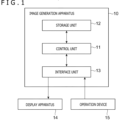
- FIG. 1 is a configuration block diagram illustrating a configuration of an image generation apparatus 10 according to the embodiment of the present invention.
- the image generation apparatus 10 is used to generate videos to be presented to a user of the image generation apparatus 10, and to record video data corresponding to the presented videos.
- the user who uses the image generation apparatus 10 is referred to as a recording user.
- the image generation apparatus 10 is a home game console, a handheld game console, a personal computer, or the like.
- the image generation apparatus 10 includes a control unit 11, a storage unit 12, and an interface unit 13. Further, the image generation apparatus 10 is connected to a display apparatus 14 and an operation device 15.
- the control unit 11 includes at least one processor such as a central processing unit (CPU) and executes programs stored in the storage unit 12, to execute various types of information processing. Note that specific examples of processing that the control unit 11 executes in the present embodiment are described later.
- the storage unit 12 includes at least one memory device such as a random access memory (RAM) and stores programs that the control unit 11 executes and data to be processed by the programs.
- the interface unit 13 is an interface for data communication with the display apparatus 14 and the operation device 15.
- the image generation apparatus 10 is connected to each of the display apparatus 14 and the operation device 15 by wired or wireless connection through the interface unit 13.
- the interface unit 13 is assumed to include a multimedia interface for transmitting video signals supplied from the image generation apparatus 10, to the display apparatus 14.
- the interface unit 13 includes a data communication interface for receiving signals indicating the content of operations performed by the recording user on the operation device 15.
- the interface unit 13 may include a communication interface for transmitting and receiving data to and from other communication equipment via a communication network such as the Internet.
- the display apparatus 14 displays, on a screen, videos based on video signals supplied from the image generation apparatus 10.
- the display apparatus 14 is assumed to be a head-mounted display apparatus capable of presenting stereoscopic video by presenting different videos to the respective left and right eyes of the recording user.
- the display apparatus 14 is assumed to include an attitude sensor for detecting changes in its attitude. This attitude sensor may be an acceleration sensor, a gyroscope sensor, a geomagnetic sensor, or the like.
- the operation device 15 is, for example, a controller of a home game console or the like and receives operation input from the recording user.
- the operation device 15 is connected to the image generation apparatus 10 by wired or wireless connection and transmits operation signals indicating the content of the operation input received from the recording user to the image generation apparatus 10.
- the operation device 15 may take various shapes, such as a device that the recording user uses by holding it by hand or a device that the recording user uses by wearing it on the hand, for example.
- the image generation apparatus 10 functionally includes a scene information generation unit 21, a field-of-view direction information reception unit 22, a display-use image generation unit 23, a part-to-be-recorded determination unit 24, and a recording-use image generation unit 25.
- These functions are achieved by the control unit 11 operating in accordance with one or a plurality of programs stored in the storage unit 12. These programs may be provided to the image generation apparatus 10 via a communication network such as the internet, or may be stored in a computer-readable information storage medium such as an optical disc to be provided.
- the scene information generation unit 21 determines the content of a scene to be presented to the recording user and generates scene information for identifying the content.
- the scene information generation unit 21 may be achieved by an application program such as a game program, for example.
- the scene to be presented to the recording user is assumed to depict the state of the interior of a virtual three-dimensional space (virtual space).
- the scene information generation unit 21 determines, as the scene information, information for identifying the shapes and appearances of objects arranged in the virtual space, the positions in the virtual space thereof, and the like.
- the scene information generation unit 21 is assumed to also determine information for identifying a part of the scene determined by the scene information that is to be actually displayed. Specifically, the scene information generation unit 21 determines a viewpoint position and a field-of-view direction set in the virtual space, on the basis of field-of-view direction information received by the field-of-view direction information reception unit 22 described below.
- the field-of-view direction information reception unit 22 receives field-of-view direction information regarding the orientation of the face of the recording user.
- the field-of-view direction information reception unit 22 receives information indicating the detection result of the attitude sensor from the display apparatus 14 and identifies, on the basis of the detection result, information indicating how the orientation of the display apparatus 14 worn on the head of the recording user has changed, as the field-of-view direction information.
- the scene information generation unit 21 is assumed to change the field-of-view direction set in the virtual space, in conjunction with this field-of-view direction information.
- the video displayed on the display apparatus 14 also changes to depict the state on the right side of the front, which has been depicted so far, in the virtual space, thereby allowing the recording user to watch the video displayed on the display apparatus 14, as if he/she were directly looking around in the virtual space.
- the display-use image generation unit 23 generates display-use image data ID on the basis of scene information generated by the scene information generation unit 21.
- the display-use image generation unit 23 may be achieved by such a program as a rendering engine, which is different from the application program for achieving the scene information generation unit 21.
- the display-use image generation unit 23 generates, on the basis of the scene information, the display-use image data ID representing the state in the virtual three-dimensional space viewed from a viewpoint position and a field-of-view direction specified by the scene information generation unit 21.
- This display-use image data ID is image data representing a part of the scene (state of the virtual three-dimensional space) represented by the scene information provided by the scene information generation unit 21.
- the display apparatus 14 since the display apparatus 14 presents images to the respective right and left eyes of the recording user, the display apparatus 14 generates images for the right eye and images for the left eye.
- the image generation apparatus 10 may execute similar processing for both right eye-use images and left eye-use images.
- the display-use image generation unit 23 transmits a video signal including the generated display-use image data ID to the display apparatus 14. Accordingly, the display-use image is displayed on the screen of the display apparatus 14 and presented to the recording user.
- the image generation apparatus 10 can repeatedly execute generation processing of scene information by the scene information generation unit 21, generation processing of the display-use image data ID by the display-use image generation unit 23, and the transmission processing of the display-use image data ID to the display apparatus 14 at a given frame rate, thereby causing the display apparatus 14 to display a video depicting the state of the virtual space that changes over time.
- the part-to-be-recorded determination unit 24 determines a part to be recorded (hereinafter referred to as a part to be recorded), in a case where, when the display-use image generation unit 23 generates the display-use image data ID on the basis of scene information provided by the scene information generation unit 21, image data based on the scene information is also recorded.
- This part to be recorded is a part at least partially overlapping with the display-use image data ID. That is, both the image data to be recorded (hereinafter referred to as recording-use image data IR) and the display-use image data ID are image data depicting the content of the same scene determined by the same scene information, and are data regarding images drawn for parts at least partially overlapping with each other.
- the part-to-be-recorded determination unit 24 determines, as the part to be recorded, a part that is at least a part of the scene determined by the scene information generated by the scene information generation unit 21, that includes the entire display-use image data ID, and that is wider than the display-use image data ID.
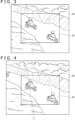
- FIG. 3 is a view illustrating an example of a method of determining such a part to be recorded.
- FIG. 3 illustrates a relation between the display-use image data ID and the recording-use image data IR. In the example of FIG.
- the part to be recorded is determined such that the recording-use image data IR includes the entire display-use image data ID and includes the surrounding part of the display-use image data ID by the same width in all up, down, left, and right directions.
- the part-to-be-recorded determination unit 24 can set the viewpoint position for generating the recording-use image data IR, at a position located at a predetermined distance behind (on the opposite side in the field-of-view direction of) the viewpoint position for generating the display-use image data ID, to thereby include such a part to be recorded, in the recording-use image data IR.
- the part of the recording-use image data IR corresponding to the display-use image data ID is referred to as a part to be displayed, and the part excluding the part to be displayed (outer peripheral part surrounding the part to be displayed) is referred to as an extended part. Note that other specific examples of the method of determining a part to be recorded are described later.
- the recording-use image generation unit 25 generates image data corresponding to a part to be recorded determined by the part-to-be-recorded determination unit 24, as the recording-use image data IR.
- the processing of generating the recording-use image data IR may be processing similar to the processing of generating the display-use image data ID by the display-use image generation unit 23, except that the target part is different.
- the recording-use image generation unit 25 may be achieved by the same program as that for the display-use image generation unit 23. Further, the recording-use image generation unit 25 may execute, during the time when the display-use image generation unit 23 is executing the processing of generating the display-use image data ID, the processing of generating the recording-use image data IR in parallel on the basis of the same scene information.
- the recording-use image data IR generated by the recording-use image generation unit 25 is subjected to predetermined reproduction processing later.
- the recording-use image generation unit 25 is assumed to generate the recording-use image data IR such that the part to be displayed in the recording-use image data IR has the same resolution as that of the display-use image data ID. Since the recording-use image data IR includes a wider range than that of the display-use image data ID, the data size of the recording-use image data IR is larger than that of the display-use image data ID.
- the recording-use image generation unit 25 generates, in a case where the recording user gives an instruction to record the recording-use image data IR, for example, the recording-use image data IR over the instructed period.
- the period in which the recording-use image data IR is generated is referred to as a recording target period.
- the recording target period may be a period from a point in time when the recording user gives an instruction to start recording to a point in time when the recording user gives an instruction to end recording, or may be the period from a point in time when the recording user gives an instruction to start recording to a point in time when time determined in advance has elapsed.
- the recording-use image generation unit 25 generates, each time the display-use image generation unit 23 generates a single piece of the display-use image data ID within the recording target period, a single piece of the recording-use image data IR on the basis of the same scene information.
- the recording-use image generation unit 25 stores data including a plurality of pieces of recording-use image data IR generated in chronological order within the recording target period, as recorded video data.
- the recorded video data may be data including the plurality of pieces of recording-use image data IR in their original format, or may be encoded data encoded by a given video encoding method.
- the image generation apparatus 10 can upload the stored recorded video data to a predetermined server apparatus in response to, for example, instructions from the recording user or distribute the stored recorded video data in response to requests from other users, thereby making the stored recorded video data available to others.
- the image reproduction apparatus 30 which is described later, reproduces the content of this recorded video data, thereby allowing other users to watch a video that is the same in terms of the represented scene content and the length as the video displayed on the display apparatus 14 in the recording target period.
- the details of processing of reproducing the content of recorded video data by the image reproduction apparatus 30 are described later.
- the part-to-be-recorded determination unit 24 may determine a part to be recorded, on the basis of the content of scene information. For example, the part-to-be-recorded determination unit 24 may determine the part to be recorded, on the basis of the position and the movement of, among the objects arranged in the virtual space specified by the scene information, an object of interest T, which is assumed to particularly attract the attention of the recording user.
- the object of interest T in this example may be an object specified by the scene information generation unit 21.
- an object such as a character to be operated by the recording user is included in the display target in some cases.
- the object to be operated by the recording user may be the object of interest T.
- the scene information generation unit 21 may specify, among the objects to be displayed, an object particularly important for the recording user (for example, an enemy object that the recording user is targeting for an attack) as the object of interest T.
- the part-to-be-recorded determination unit 24 determines the part to be recorded, such that, while the part to be displayed is included, the object of interest T is present at a position near the center of the recording-use image data IR.
- the part-to-be-recorded determination unit 24 determines the part to be recorded, such that the part to be displayed is included and the width of the extended part on the right side of the part to be displayed is larger than the default width.
- the width of the extended part in the direction of the edge portion may be larger.
- the width of the extended part in the direction opposite thereto may be decreased from the default width to control the size of the recording-use image data IR to always remain constant.
- the widths in other directions may remain at the default width, resulting in the size of the recording-use image data IR changing according to the position of the object of interest T.
- FIG. 4 illustrates an example of the part to be recorded determined according to the position of the object of interest T.
- the object of interest T is present at an upper-left position relative to the center of the part to be displayed, and thus, compared to FIG. 3 , the left and upper widths of the extended part are large.
- the part-to-be-recorded determination unit 24 may determine the part to be recorded, on the basis of not only the position of the object of interest T but also the movement direction of the object of interest T in the virtual space. Specifically, for example, in a case where the object of interest T is moving upward from the viewpoint position, the part-to-be-recorded determination unit 24 determines the part to be recorded, such that the width of the extended part on the upper side of the part to be displayed is large. Moreover, in this case, as the recent movement speed of the object of interest T is higher, the width of the extended part in the movement direction may be larger. Note that the part-to-be-recorded determination unit 24 may determine the part to be recorded, in consideration of both the position and the movement direction of the object of interest T.
- the part-to-be-recorded determination unit 24 may change the overall size of the part to be recorded, according to the movement speed of the object of interest T, regardless of the movement direction. In this case, it is assumed that, as the recent movement speed of the object of interest T is higher, the widths of the extended part in all directions are larger.
- the part-to-be-recorded determination unit 24 may determine a part to be recorded, on the basis of the content of operations by the recording user on the operation device 15. For example, in a case where the recording user performs, on the operation device 15, an operation indicating the left direction, the part to be recorded is determined such that the left width of the extended part is larger than the default width. As in the first example, the width of the extended part in the direction opposite to the direction indicated by the recording user may be smaller than the default width.
- the part-to-be-recorded determination unit 24 may determine the extent to which the extended part is widened according to those operation amounts. For example, in a case where the operation device 15 is provided with a tilting operation member capable of indicating directions by being tilted, the part-to-be-recorded determination unit 24 may determine the part to be recorded, such that, as the amount of tilt of the tilting operation member by the recording user is larger, the width of the extended part is larger.
- the part-to-be-recorded determination unit 24 may change the size of the part to be recorded, simply according to the operation frequency or the magnitude of operation amount, regardless of the operation direction of the recording user. For example, the part-to-be-recorded determination unit 24 may increase the overall size of the part to be recorded, as the number of times or the magnitude of the operation amount of a predetermined operation performed within a predetermined period in the recent past increases.
- the part-to-be-recorded determination unit 24 may determine a part to be recorded, on the basis of field-of-view direction information regarding the recording user received by the field-of-view direction information reception unit 22. For example, it is assumed that, in a case where the orientation of the face of the recording user changes over time, the part-to-be-recorded determination unit 24 increases the width of the extended part corresponding to the direction of the change. Further, the width of the extended part may be changed according to the speed of change in the orientation of the face. As a specific example, in a case where the recording user is moving his/her face to the left, the part to be recorded is determined such that the left width of the extended part is larger as the magnitude of that movement is larger. Further, as in the first example and the second example described above, the size of the part to be recorded may be changed according to, regardless of the change direction of the orientation of the face, the magnitude of the speed of change.
- the part-to-be-recorded determination unit 24 may determine a part to be recorded, on the basis of the point of gaze of the recording user.
- the field-of-view direction information reception unit 22 receives not only field-of-view direction information regarding the orientation of the face of the recording user but also information indicating at which position in the image displayed on the display apparatus 14 the recording user is looking (point-of-gaze information).
- the point of gaze of the recording user can be identified by methods involving, for example, capturing the pupils of the recording user with an internal camera provided to the display apparatus 14 and analyzing the movement of the pupils included in the captured image.
- the part-to-be-recorded determination unit 24 determines the part to be recorded, such that the position at which the recording user is looking (that is, the position at which the recording user is gazing) is close to the center. For example, in a case where it is identified that the recording user is looking at a position corresponding to the lower-left part of the part to be displayed, the part-to-be-recorded determination unit 24 determines the part to be recorded, such that the left and lower widths of the extended part are large. Accordingly, the position at which the recording user is looking is close to the center of the recording-use image data IR.
- the part-to-be-recorded determination unit 24 may determine the position and the size of the part to be recorded, according to the movement direction and the movement speed of the point of gaze. Specifically, for example, the part-to-be-recorded determination unit 24 may increase the width of the extended part based on the recent movement direction of the point of gaze, or may increase the size of the part to be recorded, as the movement speed of the point of gaze increases.
- the position of the part to be recorded may be determined in consideration of both the position of the object of interest T and the field-of-view direction of the recording user.
- the recording-use image generation unit 25 may also record at least some of information indicating the position of the object of interest T, information indicating the content of operations performed by the recording user, field-of-view direction information and point-of-gaze information regarding the recording user, and the like. These pieces of information are utilized when the content of the recorded video data is reproduced. Note that the recording-use image generation unit 25 may also record information not utilized to determine the part to be recorded, among these pieces of information.
- the field-of-view direction information sequentially received by the field-of-view direction information reception unit 22 over the recording target period is recorded together with the recording-use image data IR, thereby enabling the easy achievement of reproduction processing considering changes in the field-of-view direction during reproduction processing described later.
- the reproduction processing using the recording-use image data IR generated by the image generation apparatus 10 is described.
- an information processing apparatus configured to execute this reproduction processing is referred to as the image reproduction apparatus 30, and the user who watches a video reproduced using the image reproduction apparatus 30 is referred to as a viewing user.
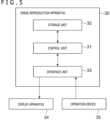
- the image reproduction apparatus 30 includes a control unit 31, a storage unit 32, and an interface unit 33, and is connected to a display apparatus 34 and an operation device 35 via the interface unit 33.
- the display apparatus 34 may not necessarily be an apparatus that the user uses by wearing it on the head and may be, for example, a stationary display apparatus such as a home television receiver or a portable display apparatus.
- the image generation apparatus 10 that has generated recorded video data itself may function as the image reproduction apparatus 30.
- the image reproduction apparatus 30 functionally includes a recording-use image reception unit 41 and a reproduction unit 42. These functions are achieved by the control unit 31 of the image reproduction apparatus 30 executing programs stored in the storage unit 32.
- the recording-use image reception unit 41 receives the recording-use image data IR generated and recorded by the image generation apparatus 10 together with the facial expression-use image data ID.
- the image reproduction apparatus 30 may acquire the recording-use image data IR by reading out the recorded video data stored in the image reproduction apparatus 30 through downloading or the like in advance, or may receive the recording-use image data IR by receiving the recording-use image data IR distributed in real-time from a server apparatus via a communication network such as the Internet.
- the reproduction unit 42 uses the recording-use image data IR received by the recording-use image reception unit 41, to reproduce the video.
- the reproduction unit 42 does not display the entire recording-use image data IR on the screen of the display apparatus 34 as it is, but transmits an image of a partial region extracted from the recording-use image data IR to the display apparatus 34 as a reproduction-use image and causes the display apparatus 34 to display the reproduction-use image on the screen.
- the reproduction-use image to be extracted may be an image of the same size as that of the display-use image data ID.
- the recording-use image data IR regards a wider range than that of the display-use image data ID, and hence, the reproduction unit 42 can extract an image that has the same size and resolution as those of the display-use image data ID and at least partially overlaps with the display-use image data ID, as the reproduction-use image.
- the reproduction unit 42 refers to, among the series of pieces of recording-use image data IR recorded in chronological order, the predetermined number of pieces of recording-use image data IR recorded before and after the recording-use image data IR to be extracted, thereby detecting the movement of the field-of-view direction made when the recording-use image data IR has been generated.
- Such processing of detecting the movement of a field-of-view direction may be achieved using known methods used for moving image encoding and the like.
- the reproduction unit 42 identifies a region to be extracted as the reproduction-use image from the recording-use image data IR to be extracted, such that, in the detected movement of the field-of-view direction, fine changes that cause motion sickness are canceled out. For example, the reproduction unit 42 determines, as the extraction target, a region corresponding to a direction obtained by averaging field-of-view directions in a predetermined period which is before and after the timing of interest. Alternatively, a region corresponding to the middle position between the field-of-view directions detected before and after the timing of interest may be determined as the extraction target.
- the image reproduction apparatus 30 can reproduce the video recorded in a manner that makes the viewing user less likely to get motion sickness.
- the reproduction unit 42 may not only reduce the movement of the field-of-view direction made when the recording-use image data IR has been recorded but also determine the extraction position of the reproduction-use image in consideration of the orientation of the face of the viewing user.
- the display apparatus 34 is of a type of a display apparatus that the viewing user uses by wearing it on the head, like the display apparatus 14, and that the image reproduction apparatus 30 receives field-of-view direction information regarding the orientation of the face of the viewing user, like the field-of-view direction information reception unit 22 of the image generation apparatus 10.
- the reproduction unit 42 identifies the extraction position of the reproduction-use image according to changes in the field-of-view direction information regarding the viewing user.
- the recording-use image data IR includes a wider range than that of the display-use image data ID, and hence, with such a method, within the range covered by the recording-use image data IR, the viewing user can also watch the state in a direction different from the direction at which the recording user has been looking.
- the reproduction unit 42 may change the extraction position of the reproduction-use image in real-time according to, for example, the content of instruction operations executed by the viewing user on the operation device 35.
- the reproduction unit 42 may determine the position for extracting the reproduction-use image, by various methods, including but not limited to the examples described so far. Now, several specific examples of the method of determining the position for extracting a reproduction-use image by the reproduction unit 42 are described.
- the reproduction unit 42 may refer to the field-of-view direction information recorded together with the recording-use image data IR, to determine the extraction position of a reproduction-use image.
- the recording-use image generation unit 25 is assumed to record the field-of-view direction information used when the display-use image data ID is generated, together with the recording-use image data IR.
- the reproduction unit 42 can identify the movement of the field-of-view direction without performing the field-of-view direction movement detection processing as described above.
- the reproduction unit 42 may refer to the position of the object of interest T to determine the extraction position of a reproduction-use image.
- information indicating the position of the object of interest T is assumed to be recorded together with the recording-use image data IR.
- the reproduction unit 42 determines the extraction position of the reproduction-use image in consideration of the past positions of the object of interest T such that the display position of the object of interest T does not change significantly.
- the extraction position of the reproduction-use image may be determined such that the position of the object of interest T is located at a position near the center in the reproduction-use image.
- the extraction position is determined using as a reference the position of the object of interest T included in the recording-use image data IR in this way, thereby enabling the prevention of drastic changes in the position of the object of interest T in the reproduced video or enabling the display of the object of interest T at a position near the center of the screen.
- the viewing user can more easily follow the movement of the object of interest T. Note that, when the part to be recorded is determined in consideration of the position, the movement direction, and the movement speed of the object of interest T as described above, it is easier to perform extraction of a reproduction-use image focusing on the object of interest T as described above.
- the reproduction unit 42 may refer to operation information regarding the recording user to determine the extraction position of a reproduction-use image.
- the operation information indicating the content of operations performed by the recording user on the operation device 15 is assumed to be recorded together with the recording-use image data IR.
- the reproduction unit 42 determines the extraction position according to, for example, the content of direction indication operations performed by the recording user. Accordingly, as in the case where the extraction position is determined according to the movement of the object of interest T, the extraction position of the reproduction-use image can be determined to follow the direction indicated by the recording user.
- the reproduction unit 42 may refer to information regarding the point of gaze of the recording user to determine an extraction position. Also in this case, as with the object of interest T in the second example, information indicating the position of the point of gaze is assumed to be recorded together with the recording-use image data IR. The reproduction unit 42 refers to this point-of-gaze information to determine the extraction position of the reproduction-use image such that the position of the point of gaze does not change significantly, or that the point of gaze is located at a position near the center in the reproduction-use image. Accordingly, the viewing user can easily confirm the place at which the recording user has been gazing. Note that, in a case where the part to be recorded is determined in consideration of the position, the movement direction, and the movement speed of the point of gaze as described above, it is easier to perform extraction of a reproduction-use image focusing on a point of gaze as described above.
- the reproduction unit 42 may extract the part to be displayed included in the recording-use image data IR, as the reproduction-use image, according to instructions from the viewing user.
- the part to be displayed of the recording-use image data IR has the content corresponding to the display-use image data ID actually referred to by the recording user.
- the image reproduction apparatus 30 can reproduce a video with the same content as that of the video watched by the recording user.
- the image reproduction apparatus 30 may switch, according to instructions from the viewing user, between the processing of reproducing a video corresponding to the display-use image data ID as described in this fifth example and the processing of reproducing a video in which the movement of the field-of-view direction is reduced as described so far.
- the reproduction unit 42 can obtain the same image as that corresponding to the display-use image data ID by extracting the image at that position.
- the part-to-be-recorded determination unit 24 determines the part to be recorded, on the basis of information regarding the object of interest T, operation information, field-of-view direction information, or point-of-gaze information regarding the recording user, or the like, the position of the part to be displayed included in the recording-use image data IR is not fixed.
- the recording-use image generation unit 25 may also record, when generating and recording the recording-use image data IR, information indicating the position, in the recording-use image data IR, of the part to be displayed. By referring to such information indicating the position of the part to be displayed, the reproduction unit 42 can determine the part to be displayed, as the extraction target.
- the recording-use image generation unit 25 may record information regarding the object of interest T, operation information, field-of-view direction information, or point-of-gaze information regarding the recording user, or the like referred to by the part-to-be-recorded determination unit 24 when determining the part to be recorded, together with the recording-use image data IR.
- the reproduction unit 42 can perform processing similar to that performed by the part-to-be-recorded determination unit 24 when, by referring to the recorded information, determining the part to be recorded, thereby identifying the part to be displayed included in the recording-use image data IR.
- the reproduction unit 42 may superimpose a given direction guidance image for guiding a field-of-view direction on the reproduction-use image extracted from the recording-use image data IR, to thereby include this direction guidance image in the display target of the display apparatus 34.
- This guidance image may be, for example, an arrow image indicating a direction.
- the reproduction unit 42 is assumed to refer to the field-of-view direction information recorded together with the recording-use image data IR and include, in the display target, a direction guidance image indicating the direction of change of that field-of-view direction.
- a direction guidance image indicating the left direction is also displayed. Accordingly, the viewing user can realize in which direction the video he/she is currently watching is changing.
- the viewing user can change the orientation of his/her face to the direction indicated by the direction guidance image, thereby watching a video that changes in a manner similar to that of the video that the recording user has been watching.
- the direction guided by the direction guidance image is assumed to be determined on the basis of the field-of-view direction information recorded together with the recording-use image data IR, but the present embodiment is not limited to this. Also in a case where chronological changes in the recording-use image data IR are analyzed to detect the movement of the field-of-view direction, the direction guided by the direction guidance image may be determined according to this detection result.
- the reproduction unit 42 may display a direction guidance image indicating the field-of-view direction of the recording user itself. For example, in a case where the extraction position of the reproduction-use image is determined using the recording-use image data IR recorded in a state where the recording user is looking straight ahead, even when the orientation of the face of the viewing user deviates from the front direction, as long as the orientation is within the range included in the recording-use image data IR, the extraction position can be determined according to the orientation of the face of the viewing user, and the extracted reproduction-use image can be displayed.
- the reproduction unit 42 is assumed to display, in a case where the field-of-view direction of the viewing user deviates by a predetermined amount or more from the field-of-view direction of the recording user identified by the field-of-view direction information, a direction guidance image for guiding the field-of-view direction of the recording user. In this way, the viewing user can recognize the need to return the orientation of his/her face to the direction guided by the direction guidance image.
- the display-use image data ID is generated, and the recording-use image data IR at least partially overlapping with the display-use image data ID is generated on the basis of the same scene information, thereby making it possible to reproduce later a video of the same scene as that of the video watched by the recording user, in a manner that is easier for the viewing user to watch, such as a manner that is less likely to cause motion sickness or a manner that makes it easier to confirm the object of interest.
- embodiments of the present invention are not limited to the one described above.
- the display apparatus 14 includes the attitude sensor, and that the field-of-view direction information reception unit 22 receives field-of-view direction information indicating the orientation of the face of the recording user identified on the basis of the detection result of the attitude sensor.
- the method of identifying the orientation of the face of the recording user is not limited to this.
- the field-of-view direction information reception unit 22 may receive field-of-view direction information identified by various methods.
- the field-of-view direction information reception unit 22 may receive field-of-view direction information identified by analyzing a captured image captured from a location away from the display apparatus 14, to detect the movement of the display apparatus 14, or analyzing a captured image taken by a camera disposed on the display apparatus 14 itself, to detect the movement of the display apparatus 14.
- the display apparatus 14 is assumed to be a display apparatus that the user can wear on the head to watch stereoscopic video, but the embodiments of the present invention are not limited to this. Even in a case where the display apparatus 14 is a stationary display apparatus or the like, in a case where the field-of-view direction set in the virtual space changes finely according to, for example, the content of operations by the recording user on the operation device 15, when watching that video as it is later, the viewing user may feel motion sickness due to the unpredictable movements.
- the image of the part to be recorded including the part to be displayed is generated and recorded as the recording-use image data IR as described above, thereby enabling a video of the same scene to be reproduced later in a manner that reduces changes in the field-of-view direction.
- the recording-use image data IR including the part to be recorded determined in consideration of the position of the object of interest T or the like is generated, thereby enabling a video focusing on the object of interest T to be reproduced later.
- the image generation apparatus 10 always determines a range that includes the entire part to be displayed and is wider than that of the part to be displayed, as the part to be recorded, and that the image reproduction apparatus 30 extracts a part of the recording-use image data IR as the reproduction-use image.
- the image generation apparatus 10 may identify a part to be utilized as the reproduction-use image, at the time of generating the recording-use image data IR, and may generate the recording-use image data IR including only that part.
- the part-to-be-recorded determination unit 24 determines the part to be recorded, by processing similar to the processing of determining an extraction position, which is assumed to be executed by the reproduction unit 42 in the description above. More specifically, for example, the part-to-be-recorded determination unit 24 determines, on the basis of field-of-view direction information obtained in the recent past, the part to be recorded, such that fine changes in the field-of-view direction are reduced. Alternatively, the part-to-be-recorded determination unit 24 may determine the part to be recorded, such that the position of the object of interest T is located at a position near the center.
- the part-to-be-recorded determination unit 24 determines the part to be recorded, such that the part to be recorded at least partially overlaps with the part to be displayed corresponding to the display-use image data ID and has the same size as that of the part to be displayed.
- the recording-use image generation unit 25 generates image data regarding the part to be recorded determined in this way, as the recording-use image data IR. Since the recording-use image data IR generated in this way does not necessarily include the entire display-use image data ID, a video equivalent to the video watched by the recording user cannot be reproduced later, unlike the fifth example of the reproduction processing described above. However, in this example, the reproduction unit 42 of the image reproduction apparatus 30 does not need to determine the extraction position of the reproduction-use image, and the content of the recorded video data can be reproduced by processing similar to that for general video data.
- the image generation apparatus 10 is assumed to be an information processing apparatus that is present at a position relatively close to the recording user and that is directly connected to the display apparatus 14 and the operation device 15.
- the embodiments of the present invention are not limited to this.
- a server apparatus connected to the client apparatus via a communication network instead of a client apparatus directly connected to the display apparatus 14 and the operation device 15 used by the recording user, a server apparatus connected to the client apparatus via a communication network generates images to be displayed on the screen of the display apparatus 14, in some cases.
- the server apparatus connected, via the communication network, to the client apparatus used by the recording user may function as the image generation apparatus 10 of the present invention.
- the image generation apparatus 10 In this case, information regarding operations performed on the operation device 15, field-of-view direction information regarding the user, and the like acquired by the client apparatus are transmitted to the image generation apparatus 10 via the communication network.
- the image generation apparatus 10 generates the display-use image data ID on the basis of the received information and transmits the display-use image data ID to the client apparatus. Then, the client apparatus causes the received display-use image data ID to be displayed on the screen of the display apparatus 14.
- the image generation apparatus 10 generates the recording-use image data IR together with the display-use image data ID.
- the generated recording-use image data IR may be stored in the image generation apparatus 10 itself or transmitted to the client apparatus to be stored in the client apparatus.
- the image reproduction apparatus 30 may be a server apparatus connected, via a communication network, to a client apparatus to which the display apparatus 34 and the operation device 35 used by the viewing user are directly connected.
- the reproduction unit 42 of the image reproduction apparatus 30 transmits, via the communication network, the reproduction-use image extracted from the recording-use image data IR to the client apparatus used by the viewing user.
- the client apparatus causes the received reproduction-use image to be displayed on the screen of the display apparatus 34, thereby allowing the viewing user to watch a video based on the recorded video data.
- the present disclosure may include the following aspects.
- An image generation apparatus including:
- the image generation apparatus in which the one or more processors determine, as the recording target, a part that is at least the part of the scene, that includes the display-use image data, and that is wider than the display-use image data.
- the image generation apparatus in which the one or more processors determine, as the recording target, a part that is at least the part of the scene and that includes a part corresponding to the display-use image data, on the basis of information regarding an object included in the scene information.
- the image generation apparatus according to any one of items 1 to 5, in which one or more processors sequentially acquire and record field-of-view direction information regarding an orientation of a face of a user who refers to the display-use image data, and the field-of-view direction information sequentially received is subjected to reproduction processing of the recording-use image data.
- An image reproduction apparatus including:
- An image generation method including:
- a computer-readable non-transitory information storage medium that stores a program for causing a computer to execute processing of:
Landscapes
- Engineering & Computer Science (AREA)
- Multimedia (AREA)
- Human Computer Interaction (AREA)
- Theoretical Computer Science (AREA)
- Physics & Mathematics (AREA)
- General Engineering & Computer Science (AREA)
- General Physics & Mathematics (AREA)
- Computer Graphics (AREA)
- Geometry (AREA)
- Life Sciences & Earth Sciences (AREA)
- Heart & Thoracic Surgery (AREA)
- General Health & Medical Sciences (AREA)
- Cardiology (AREA)
- Biophysics (AREA)
- Health & Medical Sciences (AREA)
- Signal Processing (AREA)
- Television Signal Processing For Recording (AREA)
Applications Claiming Priority (1)
| Application Number | Priority Date | Filing Date | Title |
|---|---|---|---|
| PCT/JP2022/015597 WO2023188020A1 (ja) | 2022-03-29 | 2022-03-29 | 画像生成装置、画像再生装置、画像生成方法、及びプログラム |
Publications (2)
| Publication Number | Publication Date |
|---|---|
| EP4503597A1 true EP4503597A1 (de) | 2025-02-05 |
| EP4503597A4 EP4503597A4 (de) | 2026-01-14 |
Family
ID=88200140
Family Applications (1)
| Application Number | Title | Priority Date | Filing Date |
|---|---|---|---|
| EP22935168.9A Pending EP4503597A4 (de) | 2022-03-29 | 2022-03-29 | Bilderzeugungsvorrichtung, bildwiedergabevorrichtung, bilderzeugungsverfahren und programm |
Country Status (4)
| Country | Link |
|---|---|
| US (1) | US20250209727A1 (de) |
| EP (1) | EP4503597A4 (de) |
| JP (1) | JP7789183B2 (de) |
| WO (1) | WO2023188020A1 (de) |
Family Cites Families (10)
| Publication number | Priority date | Publication date | Assignee | Title |
|---|---|---|---|---|
| JP5156571B2 (ja) * | 2008-10-10 | 2013-03-06 | キヤノン株式会社 | 画像処理装置、画像処理方法 |
| US20150379772A1 (en) * | 2014-06-30 | 2015-12-31 | Samsung Display Co., Ltd. | Tracking accelerator for virtual and augmented reality displays |
| JP6511386B2 (ja) * | 2015-11-20 | 2019-05-15 | 株式会社ソニー・インタラクティブエンタテインメント | 情報処理装置および画像生成方法 |
| US10270825B2 (en) * | 2016-03-31 | 2019-04-23 | Verizon Patent And Licensing Inc. | Prediction-based methods and systems for efficient distribution of virtual reality media content |
| US11017712B2 (en) * | 2016-08-12 | 2021-05-25 | Intel Corporation | Optimized display image rendering |
| US10179286B2 (en) * | 2016-08-26 | 2019-01-15 | Minkonet Corporation | Method of replaying game video using camera information calibration |
| JP6964142B2 (ja) * | 2017-11-10 | 2021-11-10 | 株式会社ソニー・インタラクティブエンタテインメント | 情報処理装置、情報処理方法、及びプログラム |
| US10918945B2 (en) * | 2019-03-15 | 2021-02-16 | Sony Interactive Entertainment Inc. | Methods and systems for spectating characters in follow-mode for virtual reality views |
| JP7349256B2 (ja) * | 2019-04-23 | 2023-09-22 | 株式会社ソニー・インタラクティブエンタテインメント | 画像生成装置および情報提示方法 |
| US11215817B1 (en) * | 2020-12-03 | 2022-01-04 | Facebook Technologies, Llc. | Systems and methods for generating spectator images of an artificial reality environment |
-
2022
- 2022-03-29 EP EP22935168.9A patent/EP4503597A4/de active Pending
- 2022-03-29 JP JP2024510814A patent/JP7789183B2/ja active Active
- 2022-03-29 WO PCT/JP2022/015597 patent/WO2023188020A1/ja not_active Ceased
- 2022-03-29 US US18/847,286 patent/US20250209727A1/en active Pending
Also Published As
| Publication number | Publication date |
|---|---|
| JP7789183B2 (ja) | 2025-12-19 |
| EP4503597A4 (de) | 2026-01-14 |
| JPWO2023188020A1 (de) | 2023-10-05 |
| WO2023188020A1 (ja) | 2023-10-05 |
| US20250209727A1 (en) | 2025-06-26 |
Similar Documents
| Publication | Publication Date | Title |
|---|---|---|
| US11079999B2 (en) | Display screen front panel of HMD for viewing by users viewing the HMD player | |
| EP3479257B1 (de) | Vorrichtung und verfahren zur blickverfolgung | |
| US10182720B2 (en) | System and method for interacting with and analyzing media on a display using eye gaze tracking | |
| JP2020042807A (ja) | フォービエイテッド・レンダリング・システムおよび方法 | |
| US10042421B2 (en) | System and method of latency-aware rendering of a focal area of an animation | |
| US20180061084A1 (en) | System and method of bandwidth-sensitive rendering of a focal area of an animation | |
| US12382005B2 (en) | Image processing apparatus, image processing method, and storage medium | |
| US12092834B2 (en) | Barometric pressure sensor arrays for detecting presence and motion of objects for tracking or triggering a response | |
| US11847715B2 (en) | Image processing apparatus, image distribution system, and image processing method | |
| EP3236336A1 (de) | Causaler zusammenfassender inhalt in virtueller realität | |
| EP4498670A1 (de) | Bildverarbeitungsvorrichtung, bildverarbeitungsverfahren und programm | |
| WO2018216402A1 (ja) | 情報処理装置、情報処理方法、及びプログラム | |
| US11995233B2 (en) | Biometric feedback captured during viewing of displayed content | |
| JP6609078B1 (ja) | コンテンツ配信システム、コンテンツ配信方法、およびコンテンツ配信プログラム | |
| EP4503597A1 (de) | Bilderzeugungsvorrichtung, bildwiedergabevorrichtung, bilderzeugungsverfahren und programm | |
| CN113170231A (zh) | 跟随用户运动控制播放视频内容的方法和装置 | |
| KR101810671B1 (ko) | 전방향 영상의 방향 정보를 생성하는 방법 및 이러한 방법을 수행하는 장치 | |
| US20240302902A1 (en) | Leveraging eye gestures to enhance game experience | |
| JP7258620B2 (ja) | 画像処理システム、及び画像処理方法 | |
| CN117354486A (zh) | 一种基于ar眼镜的显示方法、装置及电子设备 | |
| KR20180102482A (ko) | 전방향 영상의 방향 정보를 생성하는 방법 및 이러한 방법을 수행하는 장치 | |
| CN105630170B (zh) | 一种信息处理方法及电子设备 | |
| JP7789184B2 (ja) | 画像生成装置、画像生成方法、及びプログラム | |
| KR20180116939A (ko) | 눈 깜박임을 이용한 가상현실 내 셀프카메라 촬영장치 | |
| CN120532115A (zh) | 声源信息显示方法、装置、电子设备和存储介质 |
Legal Events
| Date | Code | Title | Description |
|---|---|---|---|
| STAA | Information on the status of an ep patent application or granted ep patent |
Free format text: STATUS: THE INTERNATIONAL PUBLICATION HAS BEEN MADE |
|
| PUAI | Public reference made under article 153(3) epc to a published international application that has entered the european phase |
Free format text: ORIGINAL CODE: 0009012 |
|
| STAA | Information on the status of an ep patent application or granted ep patent |
Free format text: STATUS: REQUEST FOR EXAMINATION WAS MADE |
|
| 17P | Request for examination filed |
Effective date: 20241006 |
|
| AK | Designated contracting states |
Kind code of ref document: A1 Designated state(s): AL AT BE BG CH CY CZ DE DK EE ES FI FR GB GR HR HU IE IS IT LI LT LU LV MC MK MT NL NO PL PT RO RS SE SI SK SM TR |
|
| DAV | Request for validation of the european patent (deleted) | ||
| DAX | Request for extension of the european patent (deleted) | ||
| REG | Reference to a national code |
Ref country code: DE Ref legal event code: R079 Free format text: PREVIOUS MAIN CLASS: H04N0007180000 Ipc: A63F0013525500 |
|
| A4 | Supplementary search report drawn up and despatched |
Effective date: 20251211 |
|
| RIC1 | Information provided on ipc code assigned before grant |
Ipc: A63F 13/5255 20140101AFI20251205BHEP Ipc: A63F 13/212 20140101ALI20251205BHEP Ipc: A63F 13/25 20140101ALI20251205BHEP Ipc: A63F 13/428 20140101ALI20251205BHEP Ipc: A63F 13/86 20140101ALI20251205BHEP Ipc: H04N 7/18 20060101ALI20251205BHEP |