EP4503669A1 - Réseau mobile, fonction ou service de réseau lié à la détection, équipement utilisateur et support - Google Patents
Réseau mobile, fonction ou service de réseau lié à la détection, équipement utilisateur et support Download PDFInfo
- Publication number
- EP4503669A1 EP4503669A1 EP23189616.8A EP23189616A EP4503669A1 EP 4503669 A1 EP4503669 A1 EP 4503669A1 EP 23189616 A EP23189616 A EP 23189616A EP 4503669 A1 EP4503669 A1 EP 4503669A1
- Authority
- EP
- European Patent Office
- Prior art keywords
- sensing
- service
- functionality
- mobile communication
- enabled
- Prior art date
- Legal status (The legal status is an assumption and is not a legal conclusion. Google has not performed a legal analysis and makes no representation as to the accuracy of the status listed.)
- Granted
Links
Images

Classifications
-
- H—ELECTRICITY
- H04—ELECTRIC COMMUNICATION TECHNIQUE
- H04W—WIRELESS COMMUNICATION NETWORKS
- H04W4/00—Services specially adapted for wireless communication networks; Facilities therefor
- H04W4/30—Services specially adapted for particular environments, situations or purposes
- H04W4/38—Services specially adapted for particular environments, situations or purposes for collecting sensor information
-
- G—PHYSICS
- G01—MEASURING; TESTING
- G01S—RADIO DIRECTION-FINDING; RADIO NAVIGATION; DETERMINING DISTANCE OR VELOCITY BY USE OF RADIO WAVES; LOCATING OR PRESENCE-DETECTING BY USE OF THE REFLECTION OR RERADIATION OF RADIO WAVES; ANALOGOUS ARRANGEMENTS USING OTHER WAVES
- G01S7/00—Details of systems according to groups G01S13/00, G01S15/00, G01S17/00
- G01S7/003—Transmission of data between radar, sonar or lidar systems and remote stations
- G01S7/006—Transmission of data between radar, sonar or lidar systems and remote stations using shared front-end circuitry, e.g. antennas
-
- H—ELECTRICITY
- H04—ELECTRIC COMMUNICATION TECHNIQUE
- H04W—WIRELESS COMMUNICATION NETWORKS
- H04W4/00—Services specially adapted for wireless communication networks; Facilities therefor
- H04W4/02—Services making use of location information
-
- H—ELECTRICITY
- H04—ELECTRIC COMMUNICATION TECHNIQUE
- H04W—WIRELESS COMMUNICATION NETWORKS
- H04W4/00—Services specially adapted for wireless communication networks; Facilities therefor
- H04W4/50—Service provisioning or reconfiguring
-
- H—ELECTRICITY
- H04—ELECTRIC COMMUNICATION TECHNIQUE
- H04W—WIRELESS COMMUNICATION NETWORKS
- H04W8/00—Network data management
- H04W8/22—Processing or transfer of terminal data, e.g. status or physical capabilities
Definitions
- the present invention relates to a method for assessing or detecting sensing-related capabilities of a mobile communication network and/or for preparing to provide at least one sensing-related service by using a mobile communication network, wherein the mobile communication network comprises
- the present invention relates to a system or to a mobile communication network for assessing or detecting sensing-related capabilities of the mobile communication network and/or for preparing to provide at least one sensing-related service by using the mobile communication network, wherein the mobile communication network comprises
- the present invention relates to a sensing-related network function or service as part of an inventive system or an inventive mobile communication network.
- the present invention relates to a user equipment as part of, or connected to, an inventive system or an inventive mobile communication network.
- the present invention relates to a program and to a computer-readable medium for assessing or detecting sensing-related capabilities of a mobile communication network and/or for preparing to provide at least one sensing-related service by using a mobile communication network according to the inventive method.
- Mobile communication networks such as public land mobile networks are typically realized as cellular mobile communication networks, i.e. comprising (or using or being associated or assigned to a radio access network comprising) radio cells.
- Such cellular systems are known conforming to different mobile communication standards or radio access technologies, like 2G/3G/4G/5G/6G radio access technologies (referring to the different generations of radio access technologies) and typically comprise (or consist of) cells (or radio cells) of one or a plurality of the respective radio access technology/radio access technologies, which are typically organized throughout a country (or a part of or a region within a country) in a repeating pattern of (radio) cells (and associated base station entities) which belong to (or are used by or associated or assigned to) a mobile network operator (MNO).
- MNO mobile network operator
- Wireless sensing technologies have originated from the most widely used sensing technology known as radar (radio detection and ranging), where radio waves are exploited to determine distance, angle, or instantaneous velocity of objects.
- radar radio detection and ranging
- lidar light detection and ranging
- a lidar system may be either a stand-alone device or integrated in a mobile device or a vehicle.
- radiofrequency resources may be applied in an orthogonal way by separated waveforms, but it is also feasible to use common waveforms for both purposes. More and more, sensing is considered in a broader range, especially referring to the ability of devices (e.g. base station entities or user equipments) to detect and gather information about the environment around them.
- devices e.g. base station entities or user equipments
- An object of the present invention is to provide a technically simple, effective and cost-effective solution for assessing or detecting sensing-related capabilities of a mobile communication network and/or for preparing to provide at least one sensing-related service by using a mobile communication network, the mobile communication network comprising at least one sensing-capable or sensing-enabled entity or functionality and at least one sensing-related network function or service as part of the mobile communication network, wherein, in order to perform a sensing-related functionality, the at least one sensing-capable or sensing-enabled entity or functionality transmits a radiofrequency sensing signal and wherein, as a result of the radiofrequency sensing signal being transmitted, a radiofrequency sensing reception signal is received by either the sensing-capable or sensing-enabled entity or functionality or by a further sensing-capable or sensing-enabled entity or functionality or by both the sensing-capable or sensing-enabled entity or functionality and the further sensing-capable or sensing-enabled entity or functionality, wherein
- the object of the present invention is achieved by a method for assessing or detecting sensing-related capabilities of a mobile communication network and/or for preparing to provide at least one sensing-related service by using a mobile communication network, wherein the mobile communication network comprises
- a mobile communication network or a mobile radio system that allows an optimized handling of radio resources between traditional communication services and a new service type based on sensing functionalities to be newly incorporated in the mobile radio system, also designated by or known as sensing-as-a-service, SaaS.
- sensing-as-a-service also designated by or known as sensing-as-a-service, SaaS.
- it is advantageously possible according to the present invention to be able to provide definitions of quality-of-service classes for sensing purposes, e.g. based on use case requirements, especially regarding the accuracy of the (determined or detected) position of a sensed object, e.g.
- sensing quality-of-service classes may be able to be determined or described, especially in a manner analogous to - and integrated with the handling of - quality-of-service classes for 5G communication services, especially in a manner such that sensing quality-of-service classes and quality-of-service classes for 5G communication services are able to be handled, e.g. by a scheduler, in a coordinated manner.
- the considered mobile communication network comprises at least one sensing-capable or sensing-enabled entity or functionality (but preferably a plurality of sensing-capable or sensing-enabled entities or functionalities, especially as part of a radio access network of the mobile communication network, wherein especially such sensing-capable or sensing-enabled entities or functionalities are realized as antenna entities or functionalities, especially of or related (or assigned) to base station entities, but also antenna modules or antenna entities or functionalities of (or related or assigned to) user equipments might be used as sensing-capable or sensing-enabled entities or functionalities) and at least one sensing-related network function or service as part of the mobile communication network, especially as part of a core network of the considered mobile communication network.
- the at least one sensing-capable or sensing-enabled entity or functionality transmits a radiofrequency sensing signal and, as a result of the radiofrequency sensing signal being transmitted, a radiofrequency sensing reception signal is received by either the sensing-capable or sensing-enabled entity or functionality or by a further sensing-capable or sensing-enabled entity or functionality (or by both the sensing-capable or sensing-enabled entity or functionality and the further sensing-capable or sensing-enabled entity or functionality).
- the radiofrequency sensing reception signal (comprising necessarily information about the environment of the sensing-capable or sensing-enabled entities or functionalities) such information about the environment is able to be gathered as sensing data (or sensing information) - typically first as raw data, wherein, after subsequent inference steps, sensing data or sensing information are able to be derived.
- sensing data or sensing information
- This is able to be performed, according to the present invention, by means of detecting and/or collecting, by the at least one sensing-related network function or service, the capabilities of the at least one sensing-capable or sensing-enabled entity or functionality and/or the further sensing-capable or sensing-enabled entity or functionality in view of the capabilities of the mobile communication network to provide defined sensing-related services.
- sensing-related use cases are at least contemplated. This includes, e.g., the following:
- the prerequisites are provided such as to be able to meaningfully provide at least one sensing-related service by means of using the mobile communication network, i.e. wherein at least a part or parts of the mobile communication network help to generate such sensing-related or sensing data.
- the actual sensing operation typically involves that the sensing-related network function or service, also called sensing function or SF, gets the sensing service requirements inclusive intended area of service and service duration from, typically, a third party application function, AF, or sensing application function, SAF, or by means of (sensing) application function specific to the mobile communication network or to its operator in order to start the sensing (operationally).
- the sensing network function or service triggers a single sensing-capable or sensing-enabled entity or functionality (often a gNB or base station entity) or a plurality or set thereof to start sensing referencing potentially down to the level of transmission-reception-points.
- the sensing-capable or sensing-enabled entities or functionalities (typically gNBs or base station entities) then consider both the sensing quality-of-service as well as the quality-of-service of running communication service flows to user equipments for radio resource management (scheduling), potentially across different frequency layers. If coordination between several gNBs and/or gNB distributed units (for intra-gNB deployment across different sites) is required, exchange of information is handled via Xn interface between gNBs or via F1 interface between gNB centralized unit and gNB distributed units, and/or can be triggered directly via the sensing-related network function or service (for inter-gNB coordination).
- resource selection may happen by assigning dedicated radiofrequency resources for sensing (dedicated physical resource blocks within an OFDM symbol (orthogonal frequency-division multiplex symbol) or even several OFDM symbols) and/or via the use of joint radiofrequency resources (e.g. dedicated pilot signals that are defined for both communication and sensing purposes; such signals have to be specified/optimized in a way that they are applicable for both targets).
- the setting of resources for sensing may happen on demand (e.g. event-triggered), as single shot or in a regular, periodic way, until the sensing-related network function or service stops the sensing service via appropriate signaling to the radio access network.
- the weight between communication and sensing services impacting the possible resource allocation should be based on operator's policies triggered by the core network which consider service level agreements, SLAs, with third parties as well as charging aspects compared to communication services.
- Another important aspect that has to be considered for SaaS introduction is the impact on system energy efficiency:
- the radio access network introduces measures to save energy on a larger level (e.g. switching off/on full frequency layers inclusive of power amplifier in the radio unit ((O-)RU, open radio unit), antenna parts (e.g. for Massive MIMO (multiple input multiple output) antennas) or on a shorter level (i.e., micro sleep modes where only parts of radio unit, RU, are shortly (e.g.
- SaaS integration and radiofrequency resource management is considered in a way that the energy consumption of radio access network nodes still remains on a comparatively low level, but it must be sufficient to achieve the required sensing quality-of-service requirements or quality-of-service class.
- such bi-directional interworking is not available for sensing, i.e., the radio access network typically does not know in advance which one of a demanded or requested quality-of-service class is currently able to be fulfilled without further actions beforehand.
- the detection and/or the collection of the capabilities of the sensing-capable or sensing-enabled entities or functionalities comprises starting sensing measurements and/or sensing-related testing operations - especially as part of communication-related operations or actions - based on selected combinations of the sensing-capable or sensing-enabled entities or functionalities and/or their capabilities in order to collect sensing-related testing result data, the sensing-related testing result data especially comprising information about achievable reliabilities and/or accuracies with respect to sensed objects, especially in the environments and/or vicinity of the respective sensing-capable or sensing-enabled entities or functionalities,
- a first training phase of such sensing measurements or of such training measurements generates trained model data
- a second training phase of such sensing measurements or of such training measurements generates further trained model data
- the sensing-related network function or service is provided with or is able to generate basic map data or a data layer comprising information regarding achievable sensing performance in a plurality of training areas and/or regarding training subsets of the sensing-capable or sensing-enabled entities or functionalities,
- the sensing-related network function or service is able to map sensing service requirements to sensing-related quality-of-service classes, especially in order to be communicated to the at least one sensing-capable or sensing-enabled entity or functionality in the radio access network applying the information stored in the basic map data or data layer regarding required radio resources for use case specific sensing purposes, wherein each sensing-related quality-of-service class is described by means of key performance indicators and/or parameters, especially comprising at least one out of the following:
- the detection and/or the collection of the capabilities of the sensing-capable or sensing-enabled entities or functionalities comprises an operations and maintenance entity or functionality of the mobile communication network informing the sensing-related network function or service regarding sensing-related capabilities and/or characteristics of the sensing-capable or sensing-enabled entities or functionalities, and/or the sensing-related network function or service directly communicates with the sensing-capable or sensing-enabled entities or functionalities - especially by means of using capability request and/or capability response messages -, especially regarding gNB distributed units and/or transmission-reception-points, and especially regarding at least one out of their respective location, their respective antenna direction, their respective transmission power, their respective receiver sensitivity, their respective beam characteristics, their respective frequency bands, wherein especially
- the present invention relates to a system or to a mobile communication network for assessing or detecting sensing-related capabilities of the mobile communication network and/or for preparing to provide at least one sensing-related service by using the mobile communication network, wherein the mobile communication network comprises
- the present invention relates to a sensing-related network function or service as part of an inventive system or an inventive mobile communication network.
- the present invention relates to a user equipment as part of an inventive system or an inventive mobile communication network, or connected thereto.
- the present invention relates to a program comprising a computer readable program code, which, when executed on a computer and/or on a sensing-capable or sensing-enabled entity or functionality and/or on a sensing-related network function or service and/or in part on a sensing-capable or sensing-enabled entity or functionality and/or in part on a sensing-related network function or service, causes the computer and/or the sensing-capable or sensing-enabled entity or functionality and/or the sensing-related network function or service to perform an inventive method.
- the present invention relates to a computer-readable medium comprising instructions which when executed on a computer and/or on a sensing-capable or sensing-enabled entity or functionality and/or on a sensing-related network function or service and/or in part on a sensing-capable or sensing-enabled entity or functionality and/or in part on a sensing-related network function or service, causes the computer and/or the sensing-capable or sensing-enabled entity or functionality and/or the sensing-related network function or service to perform an inventive method.
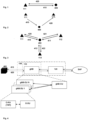
- a base station entity as a (first) sensing-capable or sensing-enabled entity or functionality 111 is schematically and exemplarily represented, which (first) sensing-capable or sensing-enabled entity or functionality 111 transmits signals (radiofrequency sensing signals 410) and receives the reflected signals (as radiofrequency sensing reception signals 420), the echoes, of a target 400 in a mono-static sensing operation scenario.
- a bi-static operation scenario is schematically and exemplarily shown, where a target 400 is illuminated - i.e. radiofrequency sensing signals 410 sent - by a first base station entity as a first sensing-capable or sensing-enabled entity or functionality 111 and radiofrequency sensing reception signals 420 (resulting from the radiofrequency sensing signals 410) detected by a second sensing-capable or sensing-enabled entity or functionality 112, e.g.
- a situation is schematically and exemplarily represented, where a target 400 is illuminated (i.e. radiofrequency sensing signals sent) and detected (via radiofrequency sensing reception signals), respectively, by a first, second and third base station entity as first, second and third sensing-capable or sensing-enabled entities or functionalities 111, 112, 113 (i.e. Figure 3 depicts mono-static sensing of three base stations 111, 112, 113).
- the first sensing-capable or sensing-enabled entity or functionality 111 sends, or transmits, a first radiofrequency sensing signal 410 and receives - as a result thereof - a first radiofrequency sensing reception signal 420.
- the second sensing-capable or sensing-enabled entity or functionality 112 sends, or transmits, a second radiofrequency sensing signal 411 and receives - as a result thereof - a second radiofrequency sensing reception signal 421.
- the third sensing-capable or sensing-enabled entity or functionality 113 sends, or transmits, a third radiofrequency sensing signal 412 and receives - as a result thereof - a third radiofrequency sensing reception signal 422.
- the first radiofrequency sensing reception signal 420 is a result, especially besides the first radiofrequency sensing signal 410, of at least one of the second and third radiofrequency sensing signals 411, 412, and analogously for the other radiofrequency sensing reception signals 421, 422.
- the transmitter of radiofrequency sensing signals 410, 411, 412 and the receiver (of radiofrequency sensing reception signals 420, 421, 422) are co-located in the sensing-capable or sensing-enabled entities or functionalities 111, 112, 113 (i.e., typically base station entities and/or user equipments), respectively, especially with time division duplex (TDD) or full-duplex (FD) capability.
- TDD time division duplex
- FD full-duplex
- the measurements of ToA Time-of-Arrival
- AoA Angle-of-Arrival
- AoD Angle-of-Departure
- Doppler of each of the resolved (radiofrequency signal propagation) paths correspond to the detection of a target 400, where the location is relative to the coordinate system of the sensing-capable or sensing-enabled entities or functionalities 111, 112, 113 (i.e., typically base station entities and/or user equipments), respectively.
- the transmitter (of radiofrequency sensing signals 410, 411, 412) and the receiver (of radiofrequency sensing reception signals 420, 421, 422) are located at different sites, i.e. a (radiofrequency sensing) signal between two sensing-capable or sensing-enabled entities or functionalities such as a base station entity and a user equipment, such signal to the user equipment is able to be used to estimate ToA, AoA, AoD, and Doppler of each of the resolved (radiofrequency signal propagation) paths.
- the targets are detected, and their location estimated especially in an absolute joint coordinate system of these base station entities.
- FIG 4 a high-level logical architecture for an integrated communication and sensing system based on a 5G system is schematically shown.
- the base station entity here designated by means of reference sign gNB
- reflected radiofrequency signals 420 - reflected from a target 400 - are received by the base station entity 111/gNB.
- the base station entity gNB is part of a radio access network 110 which in turn is part of the mobile communication network 100 as an example of a sensing-enabled mobile communication network.
- the mobile communication network 100 furthermore also comprises a core network 120.
- a sensing application function, SAF is connected to the mobile communication network 100 (but, typically external to the 5G system) and able to transmit sensing requests to the mobile communication network 100.
- the base station entity 111 or gNB might be understood as comprising a gNB centralized unit (gNB-CU) as well as one or a plurality of gNB distributed units (denoted by means of reference signs gNB-DU-1 to gNB-DU-N).
- One of such gNB distributed units might be realized as comprising an open radio unit (O-RU) or transmission-reception-point (TRP) as well as an open-distributed unit (O-DU).
- Raw sensing measurements or raw measurement data are, typically, provided by the open radio units or transmission-reception-points O-RU/TRP, and transferred to the gNB distributed unit base band processing (open distributed unit).
- a sensing data pre-processing might be realized as part of the radio access network 110, wherein the required type of such pre-processing and related results are typically dependent on the sensing use case (e.g. differentiation between object tracking/identification and sensing for weather reporting needed).
- the sensing pre-processing should happen as early as possible i.e., in the open distributed unit, to save data rate over interfaces towards the core network 120 and to avoid delays.
- the gNB centralized unit could be more appropriate to consider joint processing of data from several gNB distributed units.
- a near-real time radio access network intelligent controller (not shown in Figure 4 ) might be a further alternative from an open-radio access network architecture perspective due to artificial intelligence/machine-learning functionalities such as xApps, especially according to the O-RAN standardization (or Open-RAN standardization of the O-RAN-Alliance.
- FIG. 5 schematically and exemplarily illustrates an example of a core network-related part of an integrated communication and sensing system (i.e. a mobile communication network 100) based on a 5G system or 5G core system.
- the core network 120 comprises a plurality of network functions or services, such as, e.g., a network exposure function, NEF, a unified data repository, UDR, a unified data management, UDM, an application function, AF, an access and mobility management function, AMF, a location management function, LMF, and a gateway mobile location centre/location retrieval function, GMLC/LRF that is interacting with an external location services, LCS, client.
- a network exposure function such as, e.g., a network exposure function, NEF, a unified data repository, UDR, a unified data management, UDM, an application function, AF, an access and mobility management function, AMF, a location management function, LMF, and a gateway mobile location centre/location retrieval function,
- the access network 110 or radio access network 110 (designated, in Figure 5 , by means of reference sign (R)AN) is connected to or with the core network 120 (especially with the access and mobility management function, AMF, and via an N2 interface or reference point), and the user equipment 20 (designated, in Figure 5 , by means of reference sign UE) is connected to the radio access network (R)AN.
- sensing-related network function or service 125 could be directly involved in case of a trusted function or via the network exposure function in the untrusted case (like the sensing application function SAF shown in Figure 4 ).
- requests on sensing services are triggered by sensing application functions SAFs to the sensing-related network function or service 125 based on service requirements.
- the core network 120 is furthermore, and depending on the use case, responsible for sensing service authorization and fulfilment of data integrity/encryption.
- the sensing-related network function or service 125 especially corresponds to an extension, especially similar to the location management entity or functionality, and typically performs the processing of sensing data and the preparation of results to be offered to SAFs - especially the processing demand depends on a split of processing stages across the different logical nodes inclusive of radio access network. Furthermore, the sensing-related network function or service 125 especially performs an initiation and parametrization of related sensing measurements in the radio access network based on sensing service requirements from SAFs.
- the detection and/or the collection of the capabilities of the sensing-capable or sensing-enabled entities or functionalities 111, 112 comprises an operations and maintenance entity or functionality of the mobile communication network 100 informing the sensing-related network function or service 125 regarding sensing-related capabilities and/or characteristics of the sensing-capable or sensing-enabled entities or functionalities 111, 112, and/or the sensing-related network function or service 125 directly communicates with the sensing-capable or sensing-enabled entities or functionalities 111 - especially by means of using capability request and/or capability response messages -, especially regarding gNB distributed units and/or transmission-reception-points, and especially regarding at least one out of their respective location, their respective antenna direction, their respective transmission power, their respective reception sensitivity, their respective beam characteristics, their respective frequency bands, wherein especially
- a method for a mobile radio system that allows an optimized handling of radio resources between traditional communication services and a new service type based on sensing functionalities to be newly incorporated in the mobile radio system (Sensing as a Service, or SaaS). Especially, it includes the following steps and/or comprises the following aspects:
- the SF is initiating sensing measurements towards the RAN nodes related to the requested sensing service area via dedicated signaling (measurement request message).
- the signaling will incorporate the demanded S5QI class weighted according to MNO policy. It further provides information to the RAN node(s) about TRPs to be involved and their capabilities to be used to fulfil the S5QI demands on accuracy etc.
- the RAN node provides feedback in a response message if the sensing service demand can be fulfilled based on available resources.
- the RAN scheduler especially incorporates the 5QI values of requested communication service flows together with the S5QI values of requested sensing services to assign RF resources on the PHY layer in a way that the QoS of both service types can be fulfilled.
- the prioritization between service types may also incorporate ARP (Allocation and Retention Priority) setting according to 3GPP TS 23.501.
- the radiofrequency resource scheduling is handled (1) across TRPs within a single gNB-DU/O-DU, (2) across TRPs between gNB-DUs/O-DUs of a single gNB or (3) across TRPs belonging to different gNBs.
- the involved RAN schedulers will exchange time/frequency resource information about the sensing scheduling process to align transmission and reception intervals (over F1 interface in case of (2) and over Xn/F1 interfaces in case of (3)).
Landscapes
- Engineering & Computer Science (AREA)
- Computer Networks & Wireless Communication (AREA)
- Radar, Positioning & Navigation (AREA)
- Remote Sensing (AREA)
- Physics & Mathematics (AREA)
- General Physics & Mathematics (AREA)
- Signal Processing (AREA)
- Mobile Radio Communication Systems (AREA)
Priority Applications (3)
| Application Number | Priority Date | Filing Date | Title |
|---|---|---|---|
| EP23189616.8A EP4503669B1 (fr) | 2023-08-03 | 2023-08-03 | Réseau mobile, fonction ou service de réseau lié à la détection, équipement utilisateur et support |
| ES23189616T ES3062390T3 (en) | 2023-08-03 | 2023-08-03 | Method for assessing or detecting sensing-related capabilities of a mobile communication network and/or for preparing to provide at least one sensing-related service by using a mobile communication network, system or mobile communication network, sensing-related network function or service, user equipment, program and computer-readable medium |
| PCT/EP2024/070914 WO2025026834A1 (fr) | 2023-08-03 | 2024-07-23 | Procédé d'évaluation ou de détection des capacités sensorielles d'un réseau de communication mobile et/ou de préparation à la fourniture d'au moins un service sensoriel à l'aide d'un réseau de communication mobile, d'un système ou d'un réseau de communication mobile, d'une fonction ou d'un service de réseau sensoriel, d'un équipement utilisateur, d'un programme et d'un support lisible par ordinateur |
Applications Claiming Priority (1)
| Application Number | Priority Date | Filing Date | Title |
|---|---|---|---|
| EP23189616.8A EP4503669B1 (fr) | 2023-08-03 | 2023-08-03 | Réseau mobile, fonction ou service de réseau lié à la détection, équipement utilisateur et support |
Publications (2)
| Publication Number | Publication Date |
|---|---|
| EP4503669A1 true EP4503669A1 (fr) | 2025-02-05 |
| EP4503669B1 EP4503669B1 (fr) | 2026-01-21 |
Family
ID=87556486
Family Applications (1)
| Application Number | Title | Priority Date | Filing Date |
|---|---|---|---|
| EP23189616.8A Active EP4503669B1 (fr) | 2023-08-03 | 2023-08-03 | Réseau mobile, fonction ou service de réseau lié à la détection, équipement utilisateur et support |
Country Status (3)
| Country | Link |
|---|---|
| EP (1) | EP4503669B1 (fr) |
| ES (1) | ES3062390T3 (fr) |
| WO (1) | WO2025026834A1 (fr) |
Cited By (1)
| Publication number | Priority date | Publication date | Assignee | Title |
|---|---|---|---|---|
| CN121603908A (zh) * | 2026-01-28 | 2026-03-03 | 荣耀终端股份有限公司 | 资源配置方法、通信装置、系统及存储介质 |
Citations (2)
| Publication number | Priority date | Publication date | Assignee | Title |
|---|---|---|---|---|
| US20220182161A1 (en) * | 2020-12-09 | 2022-06-09 | Qualcomm Incorporated | Interference management techniques |
| WO2022133951A1 (fr) * | 2020-12-24 | 2022-06-30 | Huawei Technologies Co., Ltd. | Réseau de détection et de communication intégrées |
Family Cites Families (1)
| Publication number | Priority date | Publication date | Assignee | Title |
|---|---|---|---|---|
| CN113841461A (zh) * | 2019-07-01 | 2021-12-24 | 英特尔公司 | 用于智能交通系统中的同信道共存的资源分配管理 |
-
2023
- 2023-08-03 ES ES23189616T patent/ES3062390T3/es active Active
- 2023-08-03 EP EP23189616.8A patent/EP4503669B1/fr active Active
-
2024
- 2024-07-23 WO PCT/EP2024/070914 patent/WO2025026834A1/fr active Pending
Patent Citations (2)
| Publication number | Priority date | Publication date | Assignee | Title |
|---|---|---|---|---|
| US20220182161A1 (en) * | 2020-12-09 | 2022-06-09 | Qualcomm Incorporated | Interference management techniques |
| WO2022133951A1 (fr) * | 2020-12-24 | 2022-06-30 | Huawei Technologies Co., Ltd. | Réseau de détection et de communication intégrées |
Non-Patent Citations (1)
| Title |
|---|
| 3GPP TS 23.501 |
Cited By (1)
| Publication number | Priority date | Publication date | Assignee | Title |
|---|---|---|---|---|
| CN121603908A (zh) * | 2026-01-28 | 2026-03-03 | 荣耀终端股份有限公司 | 资源配置方法、通信装置、系统及存储介质 |
Also Published As
| Publication number | Publication date |
|---|---|
| ES3062390T3 (en) | 2026-04-10 |
| EP4503669B1 (fr) | 2026-01-21 |
| WO2025026834A1 (fr) | 2025-02-06 |
Similar Documents
| Publication | Publication Date | Title |
|---|---|---|
| EP4391602A1 (fr) | Procédé et appareil pour établir un canal de détection, dispositif de communication, support de stockage et système | |
| US20250056488A1 (en) | Enhanced positioning framework including support to ai/ml | |
| WO2023078297A1 (fr) | Procédé et appareil de collaboration de détection sans fil, dispositif côté réseau et terminal | |
| Garcia et al. | The Development of Two Systems for Indoor Wireless Sensors Self-location. | |
| CN116710806A (zh) | 无线网络中的协作环境感测 | |
| CN116866818A (zh) | 用于定位的方法和通信装置 | |
| EP4581391A1 (fr) | Architecture et procédure de détection dans des réseaux cellulaires 3gpp | |
| EP4503669B1 (fr) | Réseau mobile, fonction ou service de réseau lié à la détection, équipement utilisateur et support | |
| WO2024186246A1 (fr) | Procédés de configuration et d'utilisation d'informations cibles de détection | |
| CN118250712A (zh) | 感知融合方法、装置及通信设备 | |
| Ratnam et al. | Integrated sensing and communication in wi-fi and cellular: An industry and standards perspective | |
| US20250301448A1 (en) | Environment-based positioning and communication | |
| WO2024131761A1 (fr) | Procédé et appareil de collaboration de détection, et dispositif de communication | |
| CN118250709A (zh) | 感知融合方法、装置及通信设备 | |
| JP2026505977A (ja) | 無線通信システムにおいて無線信号の送受信方法および装置 | |
| WO2024223045A1 (fr) | Indice de mesure d'intérêt pour une pluralité de faisceaux | |
| Jadoon et al. | Dynamic and resource-efficient ISAC operations in sensing-enabled 6G systems | |
| So et al. | Technical Overview and Trend for Integrated Sensing and Communications (ISAC) | |
| EP4425206B1 (fr) | Serveur de bord de détection ou d'application de détection | |
| WO2026021155A1 (fr) | Configuration de détection pour des mesures de différence temporelle de signal de référence ou de différence doppler | |
| WO2026031854A1 (fr) | Configuration de détection pour mesures de différence doppler ou de différence de temps de signal de référence | |
| US20260101212A1 (en) | Data procedures associated with access stratum states or use cases | |
| US20260104497A1 (en) | Velocity measurements for sensing in a wireless network | |
| EP4460032A1 (fr) | Procédé pour fournir un service lié à la détection par un serveur de périphérie de détection | |
| US20250080959A1 (en) | Sensing in a wireless communication system |
Legal Events
| Date | Code | Title | Description |
|---|---|---|---|
| PUAI | Public reference made under article 153(3) epc to a published international application that has entered the european phase |
Free format text: ORIGINAL CODE: 0009012 |
|
| STAA | Information on the status of an ep patent application or granted ep patent |
Free format text: STATUS: EXAMINATION IS IN PROGRESS |
|
| 17P | Request for examination filed |
Effective date: 20240619 |
|
| AK | Designated contracting states |
Kind code of ref document: A1 Designated state(s): AL AT BE BG CH CY CZ DE DK EE ES FI FR GB GR HR HU IE IS IT LI LT LU LV MC ME MK MT NL NO PL PT RO RS SE SI SK SM TR |
|
| GRAP | Despatch of communication of intention to grant a patent |
Free format text: ORIGINAL CODE: EPIDOSNIGR1 |
|
| STAA | Information on the status of an ep patent application or granted ep patent |
Free format text: STATUS: GRANT OF PATENT IS INTENDED |
|
| INTG | Intention to grant announced |
Effective date: 20250829 |
|
| GRAS | Grant fee paid |
Free format text: ORIGINAL CODE: EPIDOSNIGR3 |
|
| GRAA | (expected) grant |
Free format text: ORIGINAL CODE: 0009210 |
|
| STAA | Information on the status of an ep patent application or granted ep patent |
Free format text: STATUS: THE PATENT HAS BEEN GRANTED |
|
| AK | Designated contracting states |
Kind code of ref document: B1 Designated state(s): AL AT BE BG CH CY CZ DE DK EE ES FI FR GB GR HR HU IE IS IT LI LT LU LV MC ME MK MT NL NO PL PT RO RS SE SI SK SM TR |
|
| REG | Reference to a national code |
Ref country code: CH Ref legal event code: F10 Free format text: ST27 STATUS EVENT CODE: U-0-0-F10-F00 (AS PROVIDED BY THE NATIONAL OFFICE) Effective date: 20260121 |
|
| REG | Reference to a national code |
Ref country code: DE Ref legal event code: R096 Ref document number: 602023010946 Country of ref document: DE |
|
| REG | Reference to a national code |
Ref country code: IE Ref legal event code: FG4D |
|
| REG | Reference to a national code |
Ref country code: ES Ref legal event code: FG2A Ref document number: 3062390 Country of ref document: ES Kind code of ref document: T3 Effective date: 20260410 |