EP4503676A1 - Procédé et appareil pour déterminer une défaillance de liaison radio, et terminal et dispositif côté réseau - Google Patents
Procédé et appareil pour déterminer une défaillance de liaison radio, et terminal et dispositif côté réseau Download PDFInfo
- Publication number
- EP4503676A1 EP4503676A1 EP23778168.7A EP23778168A EP4503676A1 EP 4503676 A1 EP4503676 A1 EP 4503676A1 EP 23778168 A EP23778168 A EP 23778168A EP 4503676 A1 EP4503676 A1 EP 4503676A1
- Authority
- EP
- European Patent Office
- Prior art keywords
- terminal
- radio link
- relay
- determining
- timer
- Prior art date
- Legal status (The legal status is an assumption and is not a legal conclusion. Google has not performed a legal analysis and makes no representation as to the accuracy of the status listed.)
- Pending
Links
Images



Classifications
-
- H—ELECTRICITY
- H04—ELECTRIC COMMUNICATION TECHNIQUE
- H04W—WIRELESS COMMUNICATION NETWORKS
- H04W76/00—Connection management
- H04W76/10—Connection setup
- H04W76/19—Connection re-establishment
-
- H—ELECTRICITY
- H04—ELECTRIC COMMUNICATION TECHNIQUE
- H04B—TRANSMISSION
- H04B7/00—Radio transmission systems, i.e. using radiation field
- H04B7/14—Relay systems
- H04B7/15—Active relay systems
- H04B7/155—Ground-based stations
-
- H—ELECTRICITY
- H04—ELECTRIC COMMUNICATION TECHNIQUE
- H04W—WIRELESS COMMUNICATION NETWORKS
- H04W24/00—Supervisory, monitoring or testing arrangements
- H04W24/04—Arrangements for maintaining operational condition
-
- H—ELECTRICITY
- H04—ELECTRIC COMMUNICATION TECHNIQUE
- H04W—WIRELESS COMMUNICATION NETWORKS
- H04W24/00—Supervisory, monitoring or testing arrangements
- H04W24/08—Testing, supervising or monitoring using real traffic
-
- H—ELECTRICITY
- H04—ELECTRIC COMMUNICATION TECHNIQUE
- H04W—WIRELESS COMMUNICATION NETWORKS
- H04W4/00—Services specially adapted for wireless communication networks; Facilities therefor
- H04W4/70—Services for machine-to-machine communication [M2M] or machine type communication [MTC]
-
- H—ELECTRICITY
- H04—ELECTRIC COMMUNICATION TECHNIQUE
- H04W—WIRELESS COMMUNICATION NETWORKS
- H04W72/00—Local resource management
- H04W72/20—Control channels or signalling for resource management
- H04W72/25—Control channels or signalling for resource management between terminals via a wireless link, e.g. sidelink
-
- H—ELECTRICITY
- H04—ELECTRIC COMMUNICATION TECHNIQUE
- H04W—WIRELESS COMMUNICATION NETWORKS
- H04W76/00—Connection management
- H04W76/10—Connection setup
- H04W76/18—Management of setup rejection or failure
-
- H—ELECTRICITY
- H04—ELECTRIC COMMUNICATION TECHNIQUE
- H04W—WIRELESS COMMUNICATION NETWORKS
- H04W88/00—Devices specially adapted for wireless communication networks, e.g. terminals, base stations or access point devices
- H04W88/02—Terminal devices
- H04W88/04—Terminal devices adapted for relaying to or from another terminal or user
-
- H—ELECTRICITY
- H04—ELECTRIC COMMUNICATION TECHNIQUE
- H04W—WIRELESS COMMUNICATION NETWORKS
- H04W92/00—Interfaces specially adapted for wireless communication networks
- H04W92/16—Interfaces between hierarchically similar devices
- H04W92/18—Interfaces between hierarchically similar devices between terminal devices
Definitions
- This application relates to the field of communication technologies, and in particular, to a method and apparatus for determining a radio link failure, and terminal and network side device.
- Long term evolution (Long Term Evolution, LTE) systems support sidelink (Sidelink, SL) from a twelfth release version.
- Data may be transmitted between pieces of user equipment (User Equipment, UE) through the SL, and the data are transmitted without network devices such a base station.
- UE User Equipment
- U2U UE-to-UE
- An open Relay UE is arranged, and relay may be performed between the UEs through one or more Relay UEs.
- the UE is connected with the Relay UE, and the Relay UE is connected to the Relay UE through the SL, so that the data may be transmitted between the UEs at a long distance through the SL.
- SL RLF Sidelink Radio Link Failure
- a current SL RLF mechanism can only determine whether a radio link between two UEs that directly communicate with each other fails to establish, but cannot determine whether a radio link between UEs under the U2U Relay mechanism fails to establish. Service transmission quality between the two UEs under the U2U Relay mechanism cannot be ensured, and communication robustness is not high.
- Embodiments of this application provide a method and an apparatus for determining a radio link failure, and a terminal and a network side device, which can solve a problem of low robustness of communication between UEs under a U2U Relay mechanism.
- a method for determining a radio link failure including:
- the first event includes any one of the following:
- a method for determining a radio link failure including: transmitting, by a third terminal, first indication information to a first terminal in a case that a radio link failure (RLF) occurs in a radio link between the third terminal and a next-hop terminal of the third terminal.
- RLF radio link failure
- the first indication information is used to indicate that the RLF occurs in a relay communication radio link between the first terminal and a second terminal; the first terminal communicates with the second terminal through at least one relay terminal; and the third terminal is a terminal in the at least one relay terminal.
- a method for determining a radio link failure including: transmitting, by a network side device, configuration information related to a first timer to a first terminal, where the configuration information related to the first timer includes: a length value of the at least one first timer; there being a one-to-one mapping relationship, a many-to-one mapping relationship, or a one-to-many mapping relationship between the length value of the first timer and any hop count of the relay communication radio link; and the first terminal communicating with a second terminal through at least one relay terminal.
- an apparatus for determining a radio link failure including:
- the first event includes any one of the following:
- an apparatus for determining a radio link failure including: a first transmission module, configured to transmit first indication information to a first terminal in a case that radio link failure (RLF) occurs in a radio link between a third terminal and a next-hop terminal of the third terminal.
- RLF radio link failure
- the first indication information is used to indicate that the RLF occurs in a relay communication radio link between the first terminal and a second terminal; the first terminal communicates with the second terminal through at least one relay terminal; and the third terminal is a terminal in the at least one relay terminal.
- an apparatus for determining a radio link failure including: a second transmission module, configured to transmit configuration information related to a first timer to a first terminal, where the configuration information related to the first timer includes: a length value of the at least one first timer; there being a one-to-one mapping relationship, a many-to-one mapping relationship, or a one-to-many mapping relationship between the length value of the first timer and any hop count of the relay communication radio link; and the first terminal communicating with a second terminal through at least one relay terminal.
- a first terminal includes a processor and a memory, the memory stores a program or instructions executable on the processor, and the program or the instructions implement steps of the method for determining a radio link failure according to the first aspect.
- a first terminal including a processor and a communication interface.
- the communication interface is configured to: communicate with a second terminal through at least one relay terminal.
- the processor is configured to: determine, in a case that a first event is satisfied, that a radio link failure (RLF) occurs in a relay communication radio link between the first terminal and the second terminal.
- RLF radio link failure
- the first event includes any one of the following: a first timer being expired, the first timer being started by the first terminal upon transmission of a radio resource control (RRC) message to the second terminal through the relay communication radio link; and receiving first indication information transmitted by a third terminal, the first indication information being used to indicate that the radio resource control (RLF) occurs in the relay communication radio link, and the third terminal is a terminal in the at least one relay terminal.
- RRC radio resource control
- a third terminal includes a processor and a memory, the memory stores a program or instructions executable on the processor, and the program or the instructions implement steps of the method for determining a radio link failure according to the second aspect.
- a third terminal including a processor and a communication interface.
- the communication interface is configured to: transmit first indication information to a first terminal in a case that a radio link failure (RLF) occurs in a radio link between the third terminal and a next-hop terminal of the third terminal.
- the first indication information is used to indicate that the RLF occurs in a relay communication radio link between the first terminal and a second terminal; the first terminal communicates with the second terminal through at least one relay terminal; and the third terminal is a terminal in the at least one relay terminal.
- RLF radio link failure
- a network side device includes a processor and a memory, the memory stores a program or instructions executable on the processor, and the program or the instructions implement steps of the method for determining a radio link failure according to the third aspect.
- a network side device including a processor and a communication interface.
- the communication interface is configured to: transmit configuration information related to a first timer to a first terminal, where the configuration information related to the first timer includes: a length value of the at least one first timer; there being a one-to-one mapping relationship, a many-to-one mapping relationship, or a one-to-many mapping relationship between the length value of the first timer and any hop count of the relay communication radio link; and the first terminal communicating with a second terminal through at least one relay terminal.
- a system for determining a radio link failure including: a first terminal, a second terminal, a third terminal, and a network side device.
- the first terminal may be configured to perform steps of the method according to the first aspect.
- the third terminal may be configured to perform steps of the method according to the second aspect.
- the network side device may be configured to perform steps of the method according to the third aspect.
- a readable storage medium stores a program or instructions.
- the program or the instructions when executed by a processor, implement steps of the method according to the first aspect, or implement steps of the method according to the second aspect, or implement steps of the method according to the third aspect.
- a chip includes a processor and a communication interface.
- the communication interface is coupled to the processor.
- the processor is configured to run a program or instructions to implement the method according to the first aspect, or implement the method according to the second aspect, or implement the method according to the third aspect.
- a computer program/program product is provided.
- the computer program/program product is stored in a storage medium.
- the computer program/program product is executed by at least one processor to implement steps of the method according to the first aspect, or implement steps of the method according to the second aspect, or implement steps of the method according to the third aspect.
- the first terminal communicates with the second terminal through the at least one relay terminal.
- the first terminal determines, in a case that the first event is satisfied, that the radio link failure (RLF) occurs in the relay communication radio link between the first terminal and the second terminal.
- the first terminal may determine, based on the first event, whether the RLF occurs in the relay communication radio link to solve a problem that a current SL RLF mechanism cannot determine whether a radio link fails to establish between UEs under a U2U Relay mechanism and enable service to be transmitted between the UEs on a premise that a radio link condition is good, thereby ensuring service transmission quality between two UEs under the U2U Relay mechanism and improving communication robustness.
- technologies described in the embodiments of this application are not limited to a long term evolution (Long Term Evolution, LTE)/LTE-advanced (LTE-Advanced, LTE-A) system, and may alternatively be applied to other wireless communication systems such as code division multiple access (Code Division Multiple Access, CDMA), time division multiple access (Time Division Multiple Access, TDMA), frequency division multiple access (Frequency Division Multiple Access, FDMA), orthogonal frequency division multiple access (Orthogonal Frequency Division Multiple Access, OFDMA), single carrier frequency division multiple access (Single Carrier Frequency Division Multiple Access, SC-FDMA), and other systems.
- Code Division Multiple Access Code Division Multiple Access
- TDMA time division multiple access
- FDMA frequency division multiple access
- OFDMA Orthogonal frequency division multiple access
- SC-FDMA single carrier frequency division multiple access
- SC-FDMA Single Carrier Frequency Division Multiple Access
- the described technologies may be applied the above-mentioned system and radio technology, and may alternatively be applied to other systems and radio systems.
- the following description describes a new radio (New Radio, NR) system for a purpose of giving examples, and the term NR is used in most of the following descriptions.
- NR New Radio
- these technologies may alternatively be applied to applications other than an NR system application, for example, a 6th generation (6th Generation, 6G) communication system.
- FIG. 1 is a schematic diagram of a wireless communication system applicable to an embodiment of this application.
- the wireless communication system shown in FIG. 1 includes a terminal 11 and a network side device 12.
- the terminal 11 may be a terminal side device such as a mobile phone, a tablet personal computer (Tablet Personal Computer), a laptop computer (Laptop Computer) or referred to as a notebook computer, a personal digital assistant (Personal Digital Assistant, PDA), a palm computer, a netbook, an ultra-mobile personal computer (ultra-mobile personal computer, UMPC), a mobile Internet device (Mobile Internet Device, MID), an augmented reality (augmented reality, AR)/virtual reality (virtual reality, VR) device, a robot, a wearable device (Wearable Device), a vehicle user equipment (Vehicle User Equipment, VUE), a pedestrian user equipment (PUE), a smart home device (a home device with a wireless communication function, such as a refrigerator, a television, a washing machine, or furniture), a game
- the wearable device includes: a smart watch, a smart bracelet, a smart headphone, smart glasses, smart jewelry (a smart bracelet, a smart bracelet, a smart ring, a smart necklace, a smart anklet, a smart ankle chain, and the like), a smart wristband, smart clothing, and the like. It is to be noted that, there is no limitation to a specific type of the terminal 11 in the embodiments of this application.
- the network side device 12 may include an access network device or a core network device.
- the access network device may alternatively be referred to as a Radio Access Network device, a Radio Access Network (RAN), a Radio Access Network function, or a Radio Access Network unit.
- the access network device may include a base station, a WLAN access point, a WiFi node, or the like.
- the base station may be referred to as a node B, an evolved node B (eNB), an access point, a base transceiver station (Base Transceiver Station, BTS), a radio base station, a radio transceiver, a basic service set (Basic Service Set, BSS), an extended service set (Extended Service Set, ESS), a home B node, a home evolved B node, a transmitting receiving point (Transmitting Receiving Point, TRP), or another appropriate term in the art.
- the base station is not limited to a specific technology vocabulary.
- the core network device may include, but is not limited to, at least one of the following: a core network node, a core network function, a mobility management entity (Mobility Management Entity, MME), an access and mobility management function (Access and Mobility Management Function, AMF), a session management function (Session Management Function, SMF), a user plane function (User Plane Function, UPF), a policy control function (Policy Control Function, PCF), a policy and charging rules function (Policy and Charging Rules Function, PCRF), an edge application server discovery function (Edge Application Server Discovery Function, EASDF), a unified data management (Unified Data Management, UDM), a unified data repository (Unified Data Repository, UDR), a home subscriber server (Home Subscriber Server, HSS), and a centralized network configuration (Centralized network configuration, CNC), a
- One terminal 11 may communicate with the another terminal 11 directly through a sidelink SL. In this case, the one terminal 11 does not need to communicate with the another terminal 11 through a network side device 12.
- the SL designed in an LTE system may be applied to a specific public safety transaction scenario, for example, may be applied to an emergency communication scenario in a disaster location such as fire and an earthquake, or may be applied to a scenario such as vehicle to everything (V2X) communication, and may be applied to a scenario such as basic safety type communication, autonomous driving, platooning, and sensor expansion.
- a specific public safety transaction scenario for example, may be applied to an emergency communication scenario in a disaster location such as fire and an earthquake, or may be applied to a scenario such as vehicle to everything (V2X) communication, and may be applied to a scenario such as basic safety type communication, autonomous driving, platooning, and sensor expansion.
- V2X vehicle to everything
- the SL mentioned in this application is not limited to the SL in the LTE system, and may alternatively be an SL in a 5G NR system.
- an SL-based U2U Relay mechanism is described as follows.
- FIG. 2 is a schematic diagram of connections of various terminals in a U2U Relay mechanism according to an embodiment of this application. As shown in FIG. 2 , an example in which two terminals communicate with each other through at least one relay terminal is taken as an example.
- FIG. 2 includes: a source terminal 201, at least one relay terminal 202, and a destination terminal 203.
- the source terminal 201 may communicate with the destination terminal 203 through at least one relay terminal 202.
- the source terminal 201 may be connected with the relay terminal 202 through an SL/PC5 interface, and the relay terminal 202 may be connected with the destination terminal 203 through an SL/PC5 interface.
- the relay terminal 202 is in an open state. That is, the relay terminal 202 may serve any of the source terminal 201 and the destination terminal 203.
- the source terminal 201 is connected to the destination terminal 203 through more than two relay terminals 202 for communication.
- the source terminal 201 may connected with the relay terminal 202 through an SL/PC5 interface
- the relay terminal 202 may be connected to another relay terminal 202 through an SL/PC5 interface
- the relay terminal 202 may be connected to the destination terminal 203 through an SL/PC5 interface.
- a method for determining a radio link failure according to the embodiments of this application may be applied to a first terminal serving as the source terminal 201.
- FIG. 3 is a first schematic flowchart of a method for determining a radio link failure according to the embodiments of this embodiment. As shown in FIG. 3 , the method includes step 301 and step 302.
- Step 301 A first terminal communicates with a second terminal through at least one relay terminal.
- Step 302 The first terminal determines, in a case that a first event is satisfied, that a radio link failure (RLF) occurs in a relay communication radio link between the first terminal and the second terminal, where the first event includes any one of the following: a first timer being expired, the first timer being started by the first terminal upon transmission of a radio resource control (RRC) message to the second terminal through the relay communication radio link; and receiving first indication information transmitted by a third terminal, the first indication information being used to indicate that the radio resource control (RLF) occurs in the relay communication radio link, and the third terminal is a terminal in the at least one relay terminal.
- RRC radio resource control
- the embodiments of this application may be applied to the source terminal 201 based on the SL-based U2U Relay mechanism.
- the source terminal 201 may determine, through the embodiments of this application, whether the RLF occurs in the relay communication radio link between the first terminal and the second terminal.
- the second terminal is the destination terminal 203 in FIG. 2 .
- the RRC message is used to trigger an SL RRC process for configuring a U2U Relay parameter.
- the first terminal starts a first timer upon transmission of the radio resource control (RRC) message to the second terminal through the relay communication radio link, and stops the first timer upon receiving an RRC response message transmitted back by the second terminal through the relay communication radio link.
- RRC radio resource control
- information may be bi-directionally transmitted between the first terminal and the second terminal.
- it may be considered that no radio link failure (RLF) occurs in the relay communication radio link between the first terminal and the second terminal.
- the first timer is expired, the first terminal cannot receive the RRC response message transmitted back by the second terminal through the relay communication radio link. It can be learned, in this case, that information cannot be transmitted bi-directionally between the first terminal and the second terminal, and it may be considered that a radio link failure (RLF) has occurred in the relay communication radio link between the first terminal and the second terminal.
- RLF radio link failure
- the RRC response message transmitted back by the second terminal through the relay communication radio link may include a process success message or a process failure message.
- the process success message indicates that a radio link between the first terminal and the second terminal is successfully connected, and a configuration corresponding to the radio link is in an available state.
- the process failure message indicates that a radio link between the first terminal and the second terminal is successfully connected, and a configuration corresponding to the radio link is in an unavailable state. It can be learned that, any one of the foregoing RRC response messages may indicate that the radio link between the first terminal and the second terminal has successfully connected. A difference is that whether a configuration corresponding to the successfully connected radio link is in an available state.
- the RRC response message transmitted back by the second terminal through the relay communication radio link is reconfiguration procedure information, and specifically includes a reconfiguration process success message or a reconfiguration process failure message.
- the first terminal communicates with the second terminal through the at least one relay terminal.
- the first terminal determines, in a case that the first event is satisfied, that the radio link failure (RLF) occurs in the relay communication radio link between the first terminal and the second terminal.
- RLF radio link failure
- a problem that a current SL RLF mechanism cannot determine whether a radio link fails to establish between UEs under a U2U Relay mechanism can be solved, and a service is enabled to be transmitted between the UEs on a premise that a radio link condition is good, thereby ensuring service transmission quality between two UEs under the U2U Relay mechanism and improving communication robustness.
- FIG. 4 is a second schematic flowchart of a method for determining a radio link failure according to an embodiment of this application.
- step 401 and step 402 are substantially the same as step 301 and step 302. Details are not described herein again. A difference is that the method further includes step 403.
- Step 401 A first terminal communicates with a second terminal through at least one relay terminal.
- Step 402 The first terminal determines, in a case that a first event is satisfied, that a radio link failure (RLF) occurs in a relay communication radio link between the first terminal and the second terminal, where the first event includes any one of the following: a first timer being expired, the first timer being started by the first terminal upon transmission of a radio resource control (RRC) message to the second terminal through the relay communication radio link; and receiving first indication information transmitted by a third terminal, the first indication information being used to indicate that the radio resource control (RLF) occurs in the relay communication radio link, and the third terminal is a terminal in the at least one relay terminal.
- RRC radio resource control
- Step 403 The first terminal performs at least one of the following operations: releasing a resource configuration related to the relay communication radio link between the first terminal and the second terminal; resetting the resource configuration related to the relay communication radio link between the first terminal and the second terminal in a MAC layer; transmitting second indication information to an upper layer entity of the first terminal, the second indication information being used to indicate that the RLF occurs in the relay communication radio link between the first terminal and the second terminal; and transmitting third indication information to a serving base station of the first terminal, the third indication information being used to indicate that the RLF occurs in the relay communication radio link between the first terminal and the second terminal.
- the resource configuration related to the relay communication radio link between the first terminal and the second terminal includes at least one of the following:
- the SRAP entity configuration includes at least one of the following:
- an upper layer entity of the first terminal is a general term for an upper layer entity above the RRC layer in the first terminal, and may specifically include: a non-access stratum layer (NAS), a proximity service layer (ProSe layer), and an application layer.
- NAS non-access stratum layer
- ProSe layer proximity service layer
- application layer an application layer
- the first terminal after determining that the RLF has occurred in the relay communication radio link between the first terminal and the second terminal, the first terminal performs corresponding processing on the relay communication radio link, for example, transmits indication information to the upper layer entity of the first terminal, or transmits indication information to the serving base station of the first terminal, so that the upper layer entity or the serving base station can collect information related to the RLF and perform corresponding processing, and then communication robustness can be improved.
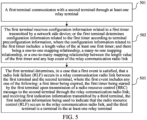
- FIG. 5 is a third schematic flowchart of a method for determining a radio link failure according to an embodiment of this application.
- step 501 and step 503 are substantially the same as step 301 and step 302. Details are not described herein again. A difference is that the method further includes step 502.
- Step 501 A first terminal communicates with a second terminal through at least one relay terminal.
- Step 502 The first terminal receives configuration information related to a first timer transmitted by a network side device; or the first terminal determines configuration information related to the first timer according to terminal preconfiguration information, where the configuration information related to the first timer includes: a length value of the at least one first timer; and there being a one-to-one mapping relationship, a many-to-one mapping relationship, or a one-to-many mapping relationship between the length value of the first timer and any hop count of the relay communication radio link.
- Step 503 The first terminal determines, in a case that a first event is satisfied, that a radio link failure (RLF) occurs in a relay communication radio link between the first terminal and the second terminal, where the first event includes any one of the following: a first timer being expired, the first timer being started by the first terminal upon transmission of a radio resource control (RRC) message to the second terminal through the relay communication radio link; and receiving first indication information transmitted by a third terminal, the first indication information being used to indicate that the radio resource control (RLF) occurs in the relay communication radio link, and the third terminal is a terminal in the at least one relay terminal.
- RRC radio resource control
- the first timer may reuse a T400 timer set in the first terminal, or a new timer T4xx may be set as the first timer.
- the length value of the first timer is set to be dedicated to a scenario of U2U Relay communication.
- the first timer corresponds to one length value.
- the first terminal communicates with the second terminal through two or more relay terminals
- N is an integer greater than 1.
- a network side device may configure a timer length value list according to the hop count.
- content in the list includes: in a case that the hop count is 2, the length value of the corresponding first timer is T2; in a case that the hop count is 3, the length value of the corresponding first timer is T3; and in a case that the hop count is N, the length value of the corresponding first timer is TN.
- Values of T2, T3,..., and TN may be the same or different.
- cases of different hop counts supporting the radio link between the first terminal and the second terminal may be distinguished according to the length value corresponding to the first timer. For example, in a case that the length value of the first timer is T2, it may be determined that the hop count supporting the radio link between the first terminal and the second terminal is 2; in a case that the length value of the first timer is T3, it may be determined that the hop count supporting the radio link between the first terminal and the second terminal is 3; and in a case that the length value of the first timer is TN, it may be determined that the hop count supporting the radio link between the first terminal and the second terminal is N.
- whether the radio link between the first terminal and the second terminal supports relay communication may further be distinguished according to the length value corresponding to the first timer. For example, in a case that the length value of the first timer is a, it may be determined that the radio link between the first terminal and the second terminal supports relay-based communication. In a case that the length value of the first timer is b, it may be determined that the radio link between the first terminal and the second terminal does not support relay-based communication.
- the first terminal receives the configuration information related to the first timer transmitted by the network side device, and sets the length value of the first timer according to the configuration information to adapt to relay communication scenarios with different hop counts.
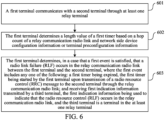
- FIG. 6 is a fourth flowchart of a method for determining a radio link failure according to an embodiment of this application.
- step 601 and step 603 are substantially the same as step 301 and step 302. Details are not described herein again. A difference is that the method further includes step 602.
- Step 601 A first terminal communicates with a second terminal through at least one relay terminal.
- Step 602 The first terminal determines a length value of a first timer based on a hop count of a relay communication radio link and network side device configuration information or terminal preconfiguration information.
- Step 603 The first terminal determines, in a case that a first event is satisfied, that a radio link failure (RLF) occurs in the relay communication radio link between the first terminal and the second terminal, where the first event includes any one of the following: a first timer being expired, the first timer being started by the first terminal upon transmission of a radio resource control (RRC) message to the second terminal through the relay communication radio link; and receiving first indication information transmitted by a third terminal, the first indication information being used to indicate that the radio resource control (RLF) occurs in the relay communication radio link, and the third terminal is a terminal in the at least one relay terminal.
- RRC radio resource control
- the first indication information is carried in at least one of the following:
- the first indication information may reuse information in a related art, for example, may reuse UEAssistanceInformationSidelink information, or the first indication information may be a new piece of information.
- the first indication information includes at least one of the following:
- the failure cause corresponding to the RLF includes at least one of the following:
- the identification information corresponding to the RLF includes at least one of the following:
- a Destination L2 ID is included in a terminal ID, and the terminal ID may further include a local identity and a Source L2 ID.
- the Destination L2 ID may be carried in a header format of the PC5 SRAP layer or the MAC layer for transmission, or, carried in PC5 RRC message content for transmission.
- the Destination L2 ID corresponds to the second terminal, and is used to identify the second terminal.
- the Destination L2 ID may correspond to the second terminal for identifying the second terminal, or may correspond to the third terminal and/or a next-hop terminal of the third terminal where the RLF occurs for identifying the third terminal and/or the next-hop terminal of the third terminal.
- the ID of the RLC channel is used to identify an RLC channel in which the RLF occurs between the first terminal and the second terminal.
- the SL radio bearer ID is used to identify a relay radio bearer between the first terminal and the second terminal. There is a mapping relationship between the relay radio bearer and the RLC channel where the RLF occurs.
- the first terminal determines a length value of the first timer based on a hop count of the relay communication radio link and the network side device configuration information or the terminal preconfiguration information, so as to adapt to relay communication scenarios with different hop counts.
- the method for determining a radio link failure may be applied to the third terminal serving as a relay terminal 202.
- FIG. 7 is a fifth schematic flowchart of a method for determining a radio link failure according to the embodiments of this embodiment. As shown in FIG. 7 , the method includes step 701.
- Step 701 A third terminal transmits first indication information to a first terminal in a case that a radio link failure (RLF) occurs in a radio link between the third terminal and a next-hop terminal of the third terminal.
- the first indication information is used to indicate that the RLF occurs in a relay communication radio link between the first terminal and a second terminal; the first terminal communicates with the second terminal through at least one relay terminal; and the third terminal is a terminal in the at least one relay terminal.
- RLF radio link failure
- any terminal transmits, in a case that it is determined that an RLF has occurred in a radio link between the relay terminal and a next-hop terminal of the relay terminal, the first indication information to a previous-hop terminal of the relay terminal.
- the previous-hop terminal of the relay terminal continues to transmit the first indication information to a further previous-hop terminal of the previous-hop terminal until the first indication information is transmitted to the first terminal.
- the relay terminal 3 determines that the RLF has occurred in the radio link between the relay terminal 3 and the relay terminal 4, the relay terminal 3 transmits the first indication information to the relay terminal 2, the relay terminal 2 continues to transmit the first indication information to the relay terminal 1, and the relay terminal 1 finally transmits the first indication information to the first terminal.
- the first indication information is carried in at least one of the following:
- the first indication information includes at least one of the following:
- the failure cause corresponding to the RLF includes at least one of the following:
- identification information of a resource corresponding to the RLF includes at least one of the following:
- the third terminal transmits, in a case that it is determined that the radio link failure (RLF) occurs between in the radio link between the third terminal and a next-hop terminal of the third terminal, indication information for indicating that the RLF occurs in the radio link between the first terminal and the second terminal to the first terminal, so that a problem that a current SL RLF mechanism cannot determine whether a radio link fails to establish between UEs under a U2U Relay mechanism is solved, a service is enabled to be transmitted between the UEs on a premise that a radio link condition is good, then service transmission quality between two UEs under the U2U Relay mechanism is ensured, and communication robustness is improved.
- RLF radio link failure
- the method for determining a radio link failure may be applied to a network side device.
- FIG. 8 is a sixth schematic flowchart of a method for determining a radio link failure according to an embodiment of this application. As shown in FIG. 8 , the method includes step 801.
- Step 801 A network side device transmits configuration information related to a first timer to a first terminal, where the configuration information related to the first timer includes: a length value of the at least one first timer; there being a one-to-one mapping relationship, a many-to-one mapping relationship, or a one-to-many mapping relationship between the length value of the first timer and any hop count of the relay communication radio link; and the first terminal communicating with a second terminal through at least one relay terminal.
- the network side device transmits the configuration information related to the first timer to the first terminal, so that the first terminal sets the length value of the first timer according to the configuration information to adapt to relay communication scenarios with different hop counts.
- the method for determining a radio link failure according to the embodiments of this application may be performed by an apparatus for determining a radio link failure.
- an example in which the apparatus for determining a radio link failure performs the method for determining a radio link failure is taken to describe the apparatus for determining a radio link failure according to the embodiments of this application.
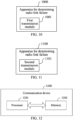
- FIG. 9 is a first schematic structural diagram of an apparatus for determining a radio link failure according to an embodiment of this application. As shown in FIG. 9 , the apparatus 900 for determining a radio link failure is applied to a first terminal, and includes:
- An apparatus for determining a radio link failure communicates with the second terminal through the at least one relay terminal, and determines, in a case that the first event is satisfied, that the radio link failure (RLF) occurs in the relay communication radio link between the first terminal and the second terminal.
- RLF radio link failure
- a problem that a current SL RLF mechanism cannot determine whether a radio link fails to establish between UEs under a U2U Relay mechanism can be solved, and a service is enabled to be transmitted between the UEs on a premise that a radio link condition is good, thereby ensuring service transmission quality between two UEs under the U2U Relay mechanism and improving communication robustness.
- the apparatus 900 for determining a radio link failure further includes:
- the determination module 902 is further configured to: receive configuration information related to a first timer transmitted by a network side device; or determine, by the first terminal, configuration information related to the first timer according to terminal preconfiguration information.
- the configuration information related to the first timer includes: a length value of the at least one first timer; and there being a one-to-one mapping relationship, a many-to-one mapping relationship, or a one-to-many mapping relationship between the length value of the first timer and any hop count of the relay communication radio link.
- the determination module 902 is further configured to: determine the length value of the first timer based on a hop count of the relay communication radio link and network side device configuration information or the terminal preconfiguration information.
- the first indication information is carried in at least one of the following:
- the first indication information includes at least one of the following:
- the identification information corresponding to the RLF includes at least one of the following:
- the failure cause corresponding to the RLF includes at least one of the following:
- FIG. 10 is a second schematic structural diagram of an apparatus for determining a radio link failure according to an embodiment of this application.
- the apparatus 1000 for determining a radio link failure is applied to a third terminal, and includes: a first transmission module 1001, configured to transmit first indication information to a first terminal in a case that a radio link failure (RLF) occurs in a radio link between a third terminal and a next-hop terminal of the third terminal, where the first indication information is used to indicate that the RLF occurs in a relay communication radio link between the first terminal and a second terminal; the first terminal communicates with the second terminal through at least one relay terminal; and the third terminal is a terminal in the at least one relay terminal.
- RLF radio link failure
- the third terminal transmits, in a case that it is determined that the radio link failure (RLF) occurs between in the radio link between the third terminal and a next-hop terminal of the third terminal, indication information for indicating that the RLF occurs in the radio link between the first terminal and the second terminal to the first terminal, so that a problem that a current SL RLF mechanism cannot determine whether a radio link fails to establish between UEs under a U2U Relay mechanism is solved, a service is enabled to be transmitted between the UEs on a premise that a radio link condition is good, then service transmission quality between two UEs under the U2U Relay mechanism is ensured, and communication robustness is improved.
- RLF radio link failure
- the first indication information is carried in at least one of the following:
- the first indication information includes at least one of the following:
- the identification information corresponding to the RLF includes at least one of the following:
- the failure cause corresponding to the RLF includes at least one of the following:
- FIG. 11 is a third schematic structural diagram of an apparatus for determining a radio link failure according to an embodiment of this application.
- the apparatus 1100 for determining a radio link failure is applied to a network side device, and includes: a second transmission module 1101, configured to transmit configuration information related to a first timer to a first terminal, where the configuration information related to the first timer includes: a length value of the at least one first timer; there being a one-to-one mapping relationship, a many-to-one mapping relationship, or a one-to-many mapping relationship between the length value of the first timer and any hop count of the relay communication radio link; and the first terminal communicating with a second terminal through at least one relay terminal.
- the network side device transmits the configuration information related to the first timer to the first terminal, so that the first terminal sets the length value of the first timer according to the configuration information to adapt to relay communication scenarios with different hop counts.
- the apparatus for determining a radio link failure in the embodiments of this application may be an electronic device, for example, an electronic device having an operating system, or may be a component in the electronic device, for example, an integrated circuit or a chip.
- the electronic device may be a terminal or a device other than the terminal.
- the electronic device may be a mobile phone, a tablet computer, a notebook computer, a palm computer, a vehicle electronic device, a mobile Internet device (Mobile Internet Device, MID), an augmented reality (augmented reality, AR)/virtual reality (virtual reality, VR), a robot, a wearable device, an ultra-mobile personal computer (ultra-mobile personal computer, UMPC), a netbook, a personal digital assistant (personal digital assistant, PDA), or the like, and may alternatively be a server, a network attached storage (Network Attached Storage, NAS), a personal computer (personal computer, PC), a television (television, TV), a teller machine, or an automated machine.
- the terminal may include, but is not limited to, types of the terminal 11 listed above.
- Another device may be a server, a NAS, or the like. This is not specifically limited in the embodiments of this application.
- the apparatus for determining a radio link failure in the embodiments of this application may be an apparatus having an operating system.
- the operating system may be an Android operating system, may be an ios operating system, or may be another possible operating system. This is not specifically limited in the embodiments of this application.
- the apparatus for determining a radio link failure in the embodiments of this application can implement all processes implemented by the method embodiments corresponding to FIG. 1 to FIG. 8 and achieve the same technical effects. To avoid repetition, details are not described herein again.
- FIG. 12 is a schematic structural diagram of a communication device according to an embodiment of this application.
- the communication device 1200 includes a processor 1201 and a memory 1202.
- the memory 1202 stores a program or instructions executable on the processor 1201.
- various steps in an embodiment of a method for determining a radio link failure corresponding to the foregoing first terminal are implemented, and the same technical effects can be achieved.
- the communication device 1200 is a third terminal and when the program or the instructions are executed by the processor 1201, various steps in an embodiment of a method for determining a radio link failure corresponding to the third terminal described above are implemented, and the same technical effects can be achieved.
- the communication device 1200 is a network side device and when the program or the instructions are executed by the processor 1201, various steps in an embodiment of a method for determining a radio link failure corresponding to the network side device described above are implemented, and the same technical effects can be achieved. To avoid repetition, details are not described herein again.
- the embodiments of this application further provide a first terminal, including a processor and a communication interface.
- the communication interface is configured to: communicate with a second terminal through at least one relay terminal.
- the processor is configured to: determine, in a case that a first event is satisfied, that a radio link failure (RLF) occurs in a relay communication radio link between the first terminal and the second terminal.
- the first event includes any one of the following: a first timer being expired, the first timer being started by the first terminal upon transmission of a radio resource control (RRC) message to the second terminal through the relay communication radio link; and receiving first indication information transmitted by a third terminal, the first indication information being used to indicate that the radio resource control (RLF) occurs in the relay communication radio link, and the third terminal is a terminal in the at least one relay terminal.
- RRC radio resource control
- This terminal embodiment corresponds to the foregoing first terminal side method embodiment.
- Various implementation processes and implementations of the foregoing method embodiments may all be applied to the first terminal embodiment, and the same technical effects can be achieved.
- the embodiments of this application further provide a third terminal, including a processor and a communication interface.
- the communication interface is configured to transmit first indication information to a first terminal in a case that a radio link failure (RLF) occurs in a radio link between the third terminal and a next-hop terminal of the third terminal.
- the first indication information is used to indicate that the RLF occurs in a relay communication radio link between the first terminal and a second terminal; the first terminal communicates with the second terminal through at least one relay terminal; and the third terminal is a terminal in the at least one relay terminal.
- This terminal embodiment corresponds to the foregoing third terminal side method embodiment.
- Various implementation processes and implementations of the foregoing method embodiments may all be applied to the third terminal embodiment, and the same technical effects can be achieved.
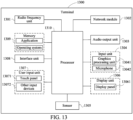
- FIG. 13 is a schematic structural diagram of a terminal according to an embodiment of this application.
- a terminal 1300 includes, but is not limited to: at least part components such as a radio frequency unit 1301, a network module 1302, an audio output unit 1303, an input unit 1304, a sensor 1305, a display unit 1306, a user input unit 1307, an interface unit 1308, a memory 1309, and a processor 1310.
- the terminal 1300 may further include a power supply (for example, a battery) for supplying power to the components.
- the power supply may be logically connected to the processor 1310 through a power management system, thereby realizing functions such as charging, discharging, and power consumption management through the power management system.
- a terminal structure shown in FIG. 13 does not constitute a limitation on the terminal, and the terminal may include more or fewer components than shown, or combine some components, or have different component arrangements. Details are not described herein again.
- the input unit 1304 may include a graphics processing unit (Graphics Processing Unit, GPU) 13041 and a microphone 13042.
- the graphics processing unit 13041 performs processing on image data of a static picture or a video that is obtained by an image acquisition device (for example, a camera) in a video acquisition mode or an image acquisition mode.
- the display unit 1306 may include a display panel 13061.
- the display panel 13061 may be configured in a form of a liquid crystal display, an organic light-emitting diode, or the like.
- the user input unit 1307 includes at least one of a touch panel 13071 and another input device 13072.
- the touch panel 13071 is alternatively referred to as a touchscreen.
- the touch panel 13071 may include two parts: a touch detection apparatus and a touch controller.
- the another input device 13072 may include, but is not limited to, a physical keyboard, a functional key (such as a volume control key or a switch key), a track ball, a mouse, and a joystick. Details are not described herein again.
- the radio frequency unit 1301 may transmit the downlink data to the processor 1310 for processing.
- the radio frequency unit 1301 may transmit uplink data to the network side device.
- the radio frequency unit 1301 includes, but is not limited to, an antenna, an amplifier, a transceiver, a coupler, a low noise amplifier, a duplexer, and the like.
- the memory 1309 may be configured to store a software program or instructions and various data.
- the memory 1309 may mainly include a program storage area for storing the program or the instructions and a data storage area for storing the data.
- the first storage area may store an operating system, an application or instructions required by at least one function (for example, a sound playback function and an image display function), and the like.
- the memory 1309 may include a volatile memory or a non-volatile memory, or the memory 1309 may include both a volatile memory and a non-volatile memory.
- the non-volatile memory may be a read-only memory (Read-Only Memory, ROM), a programmable read-only memory (Programmable ROM, PROM), an erasable programmable read-only memory (Erasable PROM, EPROM), an electrically erasable programmable read-only memory (Electrically EPROM, EEPROM) or a flash memory.
- ROM Read-Only Memory
- PROM programmable read-only memory
- Erasable PROM Erasable PROM
- EPROM electrically erasable programmable read-only memory
- EEPROM electrically erasable programmable read-only memory
- the volatile memory may be a random access memory (Random Access Memory, RAM), a static random access memory (Static RAM, SRAM), a dynamic random access memory (Dynamic RAM, DRAM), a synchronous dynamic random access memory (Synchronous DRAM, SDRAM), a double data rate synchronous dynamic random access memory (Double Data Rate SDRAM, DDR SDRAM), an enhanced synchronous dynamic random access memory (Enhanced SDRAM, ESDRAM), a synchronous link dynamic random access memory (Synch link DRAM, SLDRAM), or a direct rambus random access memory (Direct Rambus RAM, DR RAM).
- RAM Random Access Memory
- SRAM static random access memory
- DRAM dynamic random access memory
- DRAM synchronous dynamic random access memory
- SDRAM double data rate synchronous dynamic random access memory
- Enhanced SDRAM, ESDRAM enhanced synchronous dynamic random access memory
- Synch link DRAM, SLDRAM synchronous link dynamic random access memory
- Direct Rambus RAM Direct Rambus RAM, DR RAM
- the processor 1310 may include one or more processing units.
- the processor 1310 integrates an application processor and a modulation and demodulation processor.
- the application processor mainly processes operations related to an operating system, a user interface, an application program, and the like.
- the modulation and demodulation processor mainly processes a wireless communication signal, for example, a baseband processor. It may be understood that, the foregoing modulation and demodulation processor may alternatively not be integrated into the processor 1310.
- the radio frequency unit 1301 is configured to communicate with a second terminal through at least one relay terminal.
- the processor 1310 is configured to determine, in a case that a first event is satisfied, that a radio link failure (RLF) occurs in a relay communication radio link between the first terminal and the second terminal.
- the first event includes any one of the following: a first timer being expired, the first timer being started by the first terminal upon transmission of a radio resource control (RRC) message to the second terminal through the relay communication radio link; and receiving first indication information transmitted by a third terminal, the first indication information being used to indicate that the radio resource control (RLF) occurs in the relay communication radio link, and the third terminal is a terminal in the at least one relay terminal.
- RRC radio resource control
- the first terminal communicates with the second terminal through at least one relay terminal.
- the first terminal determines, in a case that the first event is satisfied, that the radio link failure (RLF) occurs in the relay communication radio link between the first terminal and the second terminal.
- RLF radio link failure
- a problem that a current SL RLF mechanism cannot determine whether a radio link fails to establish between UEs under a U2U Relay mechanism can be solved, and a service is enabled to be transmitted between the UEs on a premise that a radio link condition is good, thereby ensuring service transmission quality between two UEs under the U2U Relay mechanism and improving communication robustness.
- the radio frequency unit 1301 is configured to transmit first indication information to a first terminal in a case that a radio link failure (RLF) occurs in a radio link between the third terminal and a next-hop terminal of the third terminal.
- the first indication information is used to indicate that the RLF occurs in a relay communication radio link between the first terminal and a second terminal; the first terminal communicates with the second terminal through at least one relay terminal; and the third terminal is a terminal in the at least one relay terminal.
- the embodiments of this application further provide a network side device, including a processor and a communication interface.
- the communication interface is configured to transmit configuration information related to a first timer to a first terminal.
- the configuration information related to the first timer includes: a length value of the at least one first timer; there being a one-to-one mapping relationship, a many-to-one mapping relationship, or a one-to-many mapping relationship between the length value of the first timer and any hop count of the relay communication radio link; and the first terminal communicating with the second terminal through at least one relay terminal.
- This network side device embodiment corresponds to the foregoing network side device method embodiments.
- Various implementation processes and implementations of the foregoing method embodiments may all be applied to the network side device embodiments, and the same technical effects can be achieved.
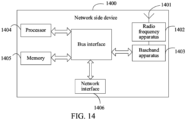
- FIG. 14 is a schematic structural diagram of a network side device according to an embodiment of this application.
- a network side device 1400 includes: an antenna 1401, a radio frequency apparatus 1402, a baseband apparatus 1403, a processor 1404, and a memory 1405.
- the antenna 1401 is connected to the radio frequency apparatus 1402.
- the radio frequency apparatus 1402 receives information through the antenna 1401, and transmits the received information to the baseband apparatus 1403 for processing.
- the baseband apparatus 1403 processes to-be-transmitted information, and transmits processed information to the radio frequency apparatus 1402.
- the radio frequency apparatus 1402 processes received information and transmits processed information through the antenna 1401.
- the method performed by the network side device in the foregoing embodiments may be implemented in the baseband apparatus 1403.
- the baseband apparatus 1403 includes a baseband processor.
- the baseband apparatus 1403 may include, for example, at least one baseband board. A plurality of chips are disposed on the baseband board. As shown in FIG. 14 , one chip is, for example, a baseband processor, and is connected to the memory 1405 through a bus interface to invoke a program in the memory 1405 to perform operations of a network device shown in the foregoing method embodiments.
- the network side device may further include a network interface 1406.
- the interface is, for example, a common public radio interface (CPRI).
- CPRI common public radio interface
- the network side device 1400 in the embodiments of this application further includes: instructions or a program stored in the memory 1405 and executable on the processor 1404.
- the processor 1404 invokes the instructions or the program in the memory 1405 to perform the foregoing method for determining a radio link failure, and achieve the same technical effect. To avoid repetition, details are not described herein again.
- An embodiment of this application further provides a system for determining a radio link failure, including: a first terminal, a second terminal, a third terminal, and a network side device.
- the first terminal may be configured to perform steps of the foregoing method for determining a radio link failure on a first terminal side.
- the second terminal may perform steps of the foregoing method for determining a radio link failure.
- the third terminal may be configured to perform steps of the foregoing method for determining a radio link failure on a third terminal side.
- the network side device may be configured to perform steps of the foregoing method for determining a radio link failure of the network side device.
- the embodiments of this application further provide a readable storage medium.
- the readable storage medium may be volatile or non-volatile.
- a program or instructions are stored in the readable storage medium.
- the program or the instructions implement various processes of the foregoing embodiments of the method for determining a radio link failure and achieve the same technical effects when executed by a processor. To avoid repetition, details are not described herein again.
- the processor is a processor in a terminal in the foregoing embodiments.
- the readable storage medium includes a computer-readable storage medium, such as a computer read-only memory (ROM), a random access memory (RAM), a magnetic disk, an optical disc, or the like.
- the embodiments of this application further provide a chip.
- the chip includes a processor and a communication interface.
- the communication interface is coupled to the processor.
- the processor is configured to run a program or instructions to implement various processes in the foregoing embodiments of the method for determining a radio link failure. To avoid repetition, details are not described herein again.
- the chip mentioned in the embodiments of this application may alternatively be referred to as a system-level chip, a system chip, a chip system, a system on a chip, or the like.
- the embodiments of this application further provide a computer program/a program product.
- the computer program/program product is stored in a storage medium.
- the computer program/program product is executed by at least one processor to implement various processes of the foregoing embodiments of the method for determining a radio link failure and can achieve the same technical effects. To avoid repetition, details are not described herein again.
- the method in the above embodiments may be implemented by software in addition to a necessary universal hardware platform or by hardware only. In most cases, the former is a more preferred implementation.
- the technical solutions of this application essentially or a part thereof that contributes to art technologies may be embodied in a form of a software product.
- the computer software product is stored in a storage medium (for example, a ROM/RAM, a magnetic disk, or an optical disc), and includes several instructions for instructing a terminal (which may be a mobile phone, a computer, a server, an air conditioner, a network device, or the like) to perform the methods the embodiments of this application.
Landscapes
- Engineering & Computer Science (AREA)
- Computer Networks & Wireless Communication (AREA)
- Signal Processing (AREA)
- Mobile Radio Communication Systems (AREA)
Applications Claiming Priority (2)
| Application Number | Priority Date | Filing Date | Title |
|---|---|---|---|
| CN202210322674.8A CN116939552A (zh) | 2022-03-29 | 2022-03-29 | 无线链路失败的确定方法、装置、终端及网络侧设备 |
| PCT/CN2023/084289 WO2023185803A1 (fr) | 2022-03-29 | 2023-03-28 | Procédé et appareil pour déterminer une défaillance de liaison radio, et terminal et dispositif côté réseau |
Publications (2)
| Publication Number | Publication Date |
|---|---|
| EP4503676A1 true EP4503676A1 (fr) | 2025-02-05 |
| EP4503676A4 EP4503676A4 (fr) | 2025-07-23 |
Family
ID=88199113
Family Applications (1)
| Application Number | Title | Priority Date | Filing Date |
|---|---|---|---|
| EP23778168.7A Pending EP4503676A4 (fr) | 2022-03-29 | 2023-03-28 | Procédé et appareil pour déterminer une défaillance de liaison radio, et terminal et dispositif côté réseau |
Country Status (5)
| Country | Link |
|---|---|
| US (1) | US20250024285A1 (fr) |
| EP (1) | EP4503676A4 (fr) |
| KR (1) | KR20240161835A (fr) |
| CN (1) | CN116939552A (fr) |
| WO (1) | WO2023185803A1 (fr) |
Families Citing this family (2)
| Publication number | Priority date | Publication date | Assignee | Title |
|---|---|---|---|---|
| WO2025081353A1 (fr) * | 2023-10-17 | 2025-04-24 | 北京小米移动软件有限公司 | Procédé de communication, terminal, système de communication et support de stockage |
| WO2025129514A1 (fr) * | 2023-12-20 | 2025-06-26 | Oppo广东移动通信有限公司 | Procédé, appareil et dispositif de communication, puce et support de stockage |
Family Cites Families (12)
| Publication number | Priority date | Publication date | Assignee | Title |
|---|---|---|---|---|
| EP3603324A1 (fr) * | 2017-03-23 | 2020-02-05 | INTEL Corporation | Gestion de ressources radio avancée dans un réseau cellulaire de relais à sauts multiples de nouvelle génération |
| US11700565B2 (en) * | 2018-09-18 | 2023-07-11 | Qualcomm Incorporated | Management of radio link failure in wireless backhaul |
| WO2020258107A1 (fr) * | 2019-06-26 | 2020-12-30 | Oppo广东移动通信有限公司 | Procédé de communication sans fil et appareil terminal |
| US20230061163A1 (en) * | 2020-02-12 | 2023-03-02 | Mitsubishi Electric Corporation | Communication system and communication terminal |
| CN113596934B (zh) * | 2020-04-30 | 2022-10-18 | 维沃移动通信有限公司 | 中继终端设备的重选方法和终端设备 |
| CN113923697B (zh) * | 2020-07-10 | 2024-04-02 | 大唐移动通信设备有限公司 | 链路失败的处理方法、装置、中继终端及通信设备 |
| JP7805351B2 (ja) * | 2020-08-05 | 2026-01-23 | インターデイジタル パテント ホールディングス インコーポレイテッド | サイドリンクリレーのためのリンク管理及び回復のための方法及び装置 |
| US20230284310A1 (en) * | 2020-08-06 | 2023-09-07 | Lenovo (Beijing) Limited | Methods and apparatuses for a failure handling procedure in a sidelink relay system |
| US20230328828A1 (en) * | 2020-09-27 | 2023-10-12 | Lenovo (Beijing) Limited | Methods and apparatuses for a relay reselection and connection handling procedure in a ue-to-ue relay scenario |
| KR20230082666A (ko) * | 2020-10-07 | 2023-06-08 | 텔레호낙티에볼라게트 엘엠 에릭슨(피유비엘) | 릴레이 라디오 통신들에서 라디오 링크 실패를 핸들링하기 위한 방법들, 장치들, 컴퓨터 프로그램 제품 및 시스템 |
| WO2022080702A1 (fr) * | 2020-10-13 | 2022-04-21 | 엘지전자 주식회사 | Procédé de fonctionnement d'équipement utilisateur associé à un relais de liaison latérale et à une défaillance de liaison radio dans un système de communication sans fil |
| KR20220057457A (ko) * | 2020-10-29 | 2022-05-09 | 현대자동차주식회사 | 사이드링크 릴레이 통신에서 링크 복구를 위한 방법 및 장치 |
-
2022
- 2022-03-29 CN CN202210322674.8A patent/CN116939552A/zh active Pending
-
2023
- 2023-03-28 EP EP23778168.7A patent/EP4503676A4/fr active Pending
- 2023-03-28 KR KR1020247035494A patent/KR20240161835A/ko active Pending
- 2023-03-28 WO PCT/CN2023/084289 patent/WO2023185803A1/fr not_active Ceased
-
2024
- 2024-09-26 US US18/897,949 patent/US20250024285A1/en active Pending
Also Published As
| Publication number | Publication date |
|---|---|
| US20250024285A1 (en) | 2025-01-16 |
| KR20240161835A (ko) | 2024-11-12 |
| WO2023185803A1 (fr) | 2023-10-05 |
| EP4503676A4 (fr) | 2025-07-23 |
| CN116939552A (zh) | 2023-10-24 |
Similar Documents
| Publication | Publication Date | Title |
|---|---|---|
| US20240224326A1 (en) | Consistent LBT Failure Processing Method, and Terminal and Network-Side Device | |
| US20250024285A1 (en) | Method and apparatus for determining radio link failure, and terminal and network side device | |
| EP4550888A1 (fr) | Procédés et appareil de configuration d'identifiant, terminal et support de stockage | |
| US20240430960A1 (en) | Data Transmission Method, Terminal, and Device | |
| WO2020038294A1 (fr) | Procédé de transmission, et dispositif terminal | |
| EP4460108A1 (fr) | Procédé d'exécution d'opération de communication, appareil, terminal et support de stockage | |
| US20250261202A1 (en) | Method for common pucch transmission with repetitions, terminal, and network-side device | |
| US20250168720A1 (en) | Information sending method, information receiving method, apparatus, and related device | |
| US20250016867A1 (en) | Resource control method and apparatus, terminal, and network side device | |
| US20200252842A1 (en) | Managing cell group configuration in disaggregated base station architecture | |
| EP4593355A1 (fr) | Procédé de communication, appareil, ue, et support d'enregistrement lisible | |
| US20250024242A1 (en) | Service processing method and apparatus, terminal, network side device, and readable storage medium | |
| US20250344180A1 (en) | Message exchange method for sidelink positioning, terminal and network side device | |
| US20250261257A1 (en) | Terminal aggeration establishment method and apparatus, terminal aggeration establishment configuration method and apparatus, and communication device | |
| US20260101170A1 (en) | Information exchange method and apparatus, terminal, and network-side device | |
| US20260032745A1 (en) | Path establishment methods and apparatuses, ue, network-side device, and readable storage medium | |
| US20250048209A1 (en) | Handover command triggering method, device, and network-side device | |
| EP4633210A1 (fr) | Procédé et appareil de transmission de message, ue et support de stockage | |
| EP4622324A1 (fr) | Procédé et appareil de traitement après une défaillance de connexion, et dispositif terminal et dispositif côté réseau | |
| CN117835219A (zh) | 能力指示方法、装置、终端及介质 | |
| CN118945681A (zh) | 副链路数据传输方法、设备及可读存储介质 | |
| CN119012346A (zh) | 信息处理方法及通信设备 | |
| CN120128884A (zh) | 交互方法、装置、系统、终端及网络侧设备 | |
| CN119893531A (zh) | 承载建立方法、装置、终端、网络设备及可读存储介质 | |
| CN119946914A (zh) | 连接恢复过程的控制方法、装置、终端及网络侧设备 |
Legal Events
| Date | Code | Title | Description |
|---|---|---|---|
| STAA | Information on the status of an ep patent application or granted ep patent |
Free format text: STATUS: THE INTERNATIONAL PUBLICATION HAS BEEN MADE |
|
| PUAI | Public reference made under article 153(3) epc to a published international application that has entered the european phase |
Free format text: ORIGINAL CODE: 0009012 |
|
| STAA | Information on the status of an ep patent application or granted ep patent |
Free format text: STATUS: REQUEST FOR EXAMINATION WAS MADE |
|
| 17P | Request for examination filed |
Effective date: 20240927 |
|
| AK | Designated contracting states |
Kind code of ref document: A1 Designated state(s): AL AT BE BG CH CY CZ DE DK EE ES FI FR GB GR HR HU IE IS IT LI LT LU LV MC ME MK MT NL NO PL PT RO RS SE SI SK SM TR |
|
| REG | Reference to a national code |
Ref country code: DE Ref legal event code: R079 Free format text: PREVIOUS MAIN CLASS: H04W0004700000 Ipc: H04W0076190000 |
|
| DAV | Request for validation of the european patent (deleted) | ||
| DAX | Request for extension of the european patent (deleted) | ||
| A4 | Supplementary search report drawn up and despatched |
Effective date: 20250620 |
|
| RIC1 | Information provided on ipc code assigned before grant |
Ipc: H04W 76/19 20180101AFI20250613BHEP Ipc: H04W 4/70 20180101ALI20250613BHEP Ipc: H04B 7/155 20060101ALI20250613BHEP Ipc: H04W 88/04 20090101ALN20250613BHEP Ipc: H04W 92/18 20090101ALN20250613BHEP |