EP4503752A1 - Transmission de données de mesure de réception pour une sélection de réseau ultérieure par une station mobile selon un critère rehaussé de sélection de cellule basé sur un seuil de signal controlé par un operateur de réseau - Google Patents
Transmission de données de mesure de réception pour une sélection de réseau ultérieure par une station mobile selon un critère rehaussé de sélection de cellule basé sur un seuil de signal controlé par un operateur de réseau Download PDFInfo
- Publication number
- EP4503752A1 EP4503752A1 EP23188820.7A EP23188820A EP4503752A1 EP 4503752 A1 EP4503752 A1 EP 4503752A1 EP 23188820 A EP23188820 A EP 23188820A EP 4503752 A1 EP4503752 A1 EP 4503752A1
- Authority
- EP
- European Patent Office
- Prior art keywords
- mobile communication
- mobile station
- network
- communication network
- regarding
- Prior art date
- Legal status (The legal status is an assumption and is not a legal conclusion. Google has not performed a legal analysis and makes no representation as to the accuracy of the status listed.)
- Granted
Links
Images
Classifications
-
- H—ELECTRICITY
- H04—ELECTRIC COMMUNICATION TECHNIQUE
- H04W—WIRELESS COMMUNICATION NETWORKS
- H04W48/00—Access restriction; Network selection; Access point selection
- H04W48/16—Discovering, processing access restriction or access information
-
- H—ELECTRICITY
- H04—ELECTRIC COMMUNICATION TECHNIQUE
- H04W—WIRELESS COMMUNICATION NETWORKS
- H04W48/00—Access restriction; Network selection; Access point selection
- H04W48/20—Selecting an access point
-
- H—ELECTRICITY
- H04—ELECTRIC COMMUNICATION TECHNIQUE
- H04W—WIRELESS COMMUNICATION NETWORKS
- H04W48/00—Access restriction; Network selection; Access point selection
- H04W48/08—Access restriction or access information delivery, e.g. discovery data delivery
- H04W48/12—Access restriction or access information delivery, e.g. discovery data delivery using downlink control channel
Definitions
- the present invention relates to a method for transmitting reception measurement data and/or for subsequently conducting network selection by a mobile station being in a radio environment comprising a plurality of available radio cells of a plurality of mobile communication networks, each one of these available radio cells being associated, respectively, to at least one mobile communication network of the plurality of mobile communication networks, wherein the mobile station is related or associated to a home mobile communication network, and wherein, while being in the considered radio environment, the mobile station is able to measure or to detect reception conditions regarding the plurality of available radio cells.
- the present invention relates to a mobile station for transmitting reception measurement data and/or for subsequently conducting network selection by a mobile station being in a radio environment comprising a plurality of available radio cells of a plurality of mobile communication networks, each one of these available radio cells being associated, respectively, to at least one mobile communication network of the plurality of mobile communication networks, wherein the mobile station is related or associated to a home mobile communication network, and wherein, while being in the considered radio environment, the mobile station is able to measure or to detect reception conditions regarding the plurality of available radio cells.
- the present invention relates to a system or to a mobile communication network for transmitting reception measurement data and/or for subsequently conducting network selection of a mobile station being in a radio environment comprising a plurality of available radio cells of a plurality of mobile communication networks, each one of these available radio cells being associated, respectively, to at least one mobile communication network of the plurality of mobile communication networks, wherein, and wherein, while being in the considered radio environment, the mobile station is able to measure or to detect reception conditions regarding the plurality of available radio cells.
- the present invention relates to a program and to a computer-readable medium for transmitting reception measurement data and/or for subsequently conducting network selection by a mobile station being in a radio environment comprising a plurality of available radio cells of a plurality of mobile communication networks according to the inventive method.
- a mobile communication network (or: cellular mobile communication network) comprises a plurality of radio cells (i.e., typically, a plurality of base station entities) at different geographical locations, thereby covering (or: providing radio coverage to) a certain geographical area.
- a mobile station typically a user equipment
- a radio environment comprising a plurality of radio cells.
- One such radio cell (of typically a plurality radio cells), 'seen' by the mobile station or user equipment, is normally provided by a base station entity, hence, in this case, the radio environment of the mobile station comprises the considered radio cell.
- the plurality of radio cells of the radio environment of the mobile station are part of a plurality of mobile communication networks.
- the mobile station by means of selecting a radio cell, the mobile station also selects a mobile communication network.
- the mobile station needs to find a suitable radio cell of a mobile communication network or public land mobile network to camp on.
- the criteria for a radio cell to be considered as suitable radio cell is dependent on the considered network technology (or radio access technology) being defined in or by means of the relevant standardization documents, mostly referred to as 3GPP (third generation partnership project) documents.
- a radio cell of a considered radio access technology is considered to be a suitable radio cell only in case that the corresponding reception conditions, as measured by the user equipment or mobile station, correspond to or exceed this HPLMN-provided (or operator-controlled) cell selection criterion regarding the considered radio access technology, i.e. the definition of what is considered to be suitable radio cell is changed by means of applying such HPLMN-provided (or operator-controlled) cell selection criterion.
- such a SENSE-level (or HPLMN-provided or operator-controlled) signal threshold per access technology may be either preconfigured on the USIM and applied either in the initial (very first) network selection the 3GPP device carries out, or subsequent to a "normal/traditional" network selection without considering operator-controlled signal thresholds.
- network selection might be delayed (due to setting the SENSE-level signal threshold too aggressively - as possible networks for registration might be omitted in the "first phase of the network selection process"); in the latter case, user equipment may consider a network for the initial network selection without considering the SENSE-level signal threshold with all its associated problems (that lead to the introduction of applying SENSE-level thresholds); again and even worse, it might be the case that the user equipment may not even find at all a network providing a better coverage in case that SENSE-levels are set too aggressively.
- operator-controlled signal thresholds are able to be adapted to the respective reception conditions of the considered user equipment.
- An object of the present invention is to provide a technically simple, effective and cost-effective solution for transmitting reception measurement data and/or for subsequently conducting network selection by a mobile station being in a radio environment comprising a plurality of available radio cells of a plurality of mobile communication networks.
- a further object of the present invention is to provide a corresponding mobile station or user equipment, a corresponding system or a mobile communication network, and a corresponding program and computer-readable medium.
- the object of the present invention is achieved by a method for transmitting reception measurement data and/or for subsequently conducting network selection by a mobile station being in a radio environment comprising a plurality of available radio cells of a plurality of mobile communication networks, each one of these available radio cells being associated, respectively, to at least one mobile communication network of the plurality of mobile communication networks,
- the home mobile communication network By means of providing the reception measurement data to the home mobile communication network of the user equipment or mobile station, it is advantageously possible that the home mobile communication network is informed about, and, hence, knows the reception measurement data as measured by the user equipment or mobile station. As a consequence, it is possible for the home mobile communication network to be able to derive an appropriate SENSE-level (or HPLMN-provided or operator-controlled) signal threshold per access technology (or enhanced network selection criterion) - especially to be used for a subsequent network selection.
- SENSE-level or HPLMN-provided or operator-controlled
- the definition of what is considered to be suitable radio cell is changed by means of applying such HPLMN-provided (or operator-controlled) network selection criterion as a radio cell of a considered radio access technology (and of a mobile communication network) is considered to be a suitable radio cell only in case that the corresponding reception conditions, as measured by the user equipment or mobile station, correspond to or exceed this HPLMN-provided (or operator-controlled) network selection criterion regarding the considered radio access technology.
- the present invention it is suggested to apply a different concept for defining the enhanced (and typically HPLMN-provided) network selection criterion (or SENSE-level or operator-controlled signal threshold (or enhanced network selection criterion) per access technology): by means of providing the reception measurement data to the home mobile communication network of the user equipment or mobile station, it is advantageously possible that the home mobile communication network is able to adapt or chose the correct SENSE-levels (i.e.
- the enhanced (and typically HPLMN-provided) network selection criterion or operator-controlled signal threshold) due to receiving (or having received from the user equipment) the reception measurement data, especially the actual field-strength and beneficially the quality of the received signal and/or the minimum field-strength/quality criteria (RxaccesLevMin, S-Criterion) for registration in the network.
- the home mobile communication network HPLMN
- SENSE-levels or the enhanced network selection criterion or operator-controlled signal threshold
- reception measurement data i.e. parameters that are available in the user equipment
- the home mobile communication network is able to communicate an improved (or the correct) SENSE-level/enhanced network selection criterion or operator-controlled signal threshold.
- the mobile station is provided with connectivity to the home mobile communication network (especially via the visited mobile communication network) and transmits the reception measurement data to the home mobile communication network via non-access stratum signaling.
- NAS Network Access Stratum
- NAS Network Access Stratum
- the related information i.e. the reception measurement data.
- such parameters are just visible/available in the user equipment (typically being in the visited PLMN or visited mobile communication network - and not in the home mobile communication network).
- the SENSE-level (or the enhanced network selection criterion or operator-controlled signal threshold) per access technology, is in its nature an offset applied on top of the measured field Strength by the UE to just select networks exceeding the min Field-Strenght/Quality criteria (RxaccesLevMin, S-Criterion) being set by the visited network.
- the mobile station (especially a user equipment) is located in a radio environment comprising radio cells of a plurality of mobile communication networks, and the mobile station 20 (or user equipment 20) is related or associated to the (or its) home mobile communication network. Furthermore, the user equipment or mobile station is able to measure or to detect reception conditions regarding the plurality of available radio cells in view of conducting cell selection and/or network selection procedures. In this respect, the user equipment or mobile station is able to apply a cell selection criterion (per radio access technology) regarding cell selection (and/or regarding network selection) in order to consider a radio cell (whose radiofrequency signals are received by the user equipment 20) to be a suitable radio cell.
- a cell selection criterion per radio access technology
- an enhanced network selection criterion is able to be applied, which is typically a SENSE-level or operator-controlled signal threshold typically provided by the home network of the user equipment.
- the method comprises the steps of the mobile station measuring or detecting the reception conditions regarding the plurality of available radio cells, and, based thereon, generating reception measurement data that are transmitted to the home mobile communication network via non-access stratum signaling.
- This transmission requires some kind of connectivity; thus, either subsequently or during the generation of the reception measurement data, the mobile station is provided with connectivity to the home mobile communication network, typically using one of the available mobile communication networks.
- a mobile station especially corresponds to a user equipment, i.e. comprising the mobile equipment with a USIM or UMTS (universal mobile telecommunications system) subscriber identity module, or a mobile equipment (especially in case that standalone non-public network are concerned)).
- a user equipment i.e. comprising the mobile equipment with a USIM or UMTS (universal mobile telecommunications system) subscriber identity module, or a mobile equipment (especially in case that standalone non-public network are concerned)).
- the reception measurement data are transmitted to the home mobile communication network such that
- the method further comprises, after the second step,
- a preliminary mobile communication network (and/or a preliminary radio cell) is used to transmit (by the mobile station or user equipment) the reception measurement data (to the home mobile communication network) and to receive (by the mobile station or user equipment) the enhanced network selection criterion information indicating the updated value of the enhanced network selection criterion (from the home mobile communication network).
- the choice of the preliminary mobile communication network might either be based on data stored in the mobile station or user equipment; however, alternatively, the mobile station might perform such (preliminary) registration with the preliminary radio cell or with the preliminary mobile communication network independently from any stored data (e.g. a user preferred network list information and/or an operator preferred network list information).
- the mobile station or user equipment might be especially advantageous for the mobile station or user equipment to minimize (electrical) power usage in order to get (or to be provided with) the preliminary connectivity - which is especially relevant for user equipments or mobile stations that are of the type of (or realize) machine type communication or internet-of-things devices.
- the mobile station registers with a radio cell of the available radio cells, this radio cell belonging to or being part of a visited mobile communication network.
- a roaming agreement or arrangement exists, or is applied, between the visited mobile communication network and the home mobile communication network.
- the preliminary mobile communication network to which a user equipment or mobile station initially registers corresponds to a visited mobile communication network (or visited public land mobile network, VPLMN) that the home mobile communication network or HPLMN has a roaming agreement with.
- the user equipment or mobile station may register to another mobile communication network based on the decision taken by the home mobile communication network or home public land mobile network.
- the reception measurement data comprises a list information comprising a reference information indicating the available radio cells and/or indicating their respective mobile communication networks, as well as, regarding each such available radio cell and/or regarding each such mobile communication networks, respectively, at least one out of the following:
- the present invention relates to a mobile station for conducting network selection by a mobile station being in a radio environment comprising a plurality of available radio cells of a plurality of mobile communication networks, each one of these available radio cells being associated, respectively, to at least one mobile communication network of the plurality of mobile communication networks, wherein the mobile station is related or associated to a home mobile communication network, and wherein, while being in the considered radio environment, the mobile station is able to measure or to detect reception conditions regarding the plurality of available radio cells, wherein regarding cell selection, a cell selection criterion is able to be applied, regarding a considered radio access technology, in order to consider a radio cell to be a suitable radio cell, wherein regarding network selection by the mobile station an enhanced network selection criterion is able to be applied, wherein, in order to conduct network selection, the mobile station is configured such that:
- the present invention relates to a system or to a mobile communication network for conducting network selection of a mobile station being in a radio environment comprising a plurality of available radio cells of a plurality of mobile communication networks, each one of these available radio cells being associated, respectively, to at least one mobile communication network of the plurality of mobile communication networks,
- the present invention relates to a program comprising a computer readable program code which, when executed on a computer and/or on a mobile station and/or on a network node of a mobile communication network, or in part on a mobile station and/or in part on network node of a mobile communication network, causes the computer and/or the mobile station and/or the network node of the mobile communication network to perform the inventive method.
- the present invention relates to a computer-readable medium comprising instructions which when executed on a computer and/or on a mobile station and/or on a network node of a mobile communication network, or in part on a mobile station and/or in part on network node of a mobile communication network, causes the computer and/or the mobile station and/or the network node of the mobile communication network to perform the inventive method.
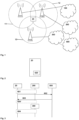
- a mobile station 20 (or user equipment 20) is schematically illustrated in a radio environment comprising a plurality of radio cells that are available to (i.e. physically reachable by) that considered mobile station or user equipment 20, the plurality of such (available) radio cells being of a plurality of mobile communication networks (or, each one of these available radio cells being associated, respectively, to at least one mobile communication network of the plurality of mobile communication networks).
- a first radio cell 11 is associated with or related to a first mobile communication network 100
- a second radio cell 12 is associated with or related to a second mobile communication network 200
- a third radio cell 13 is associated with or related to a third mobile communication network 300.
- the mobile station 20 or user equipment 20 is related or associated to a home mobile communication network 500 (or home public land mobile network 500) and is furthermore able to measure or to detect reception conditions regarding the plurality of available radio cells 11, 12, 13.
- a base station entity is represented regarding each one of the three available radio cells 11, 12, 13 that the mobile station 20 detects or "sees”:
- a first base station entity 111 (typically but not necessarily of the first mobile communication network 100) generates or provides radio coverage of or regarding the first radio cell 11
- a second base station entity 112 (typically but not necessarily of the second mobile communication network 200) generates or provides radio coverage of or regarding the second radio cell 12
- a third base station entity 113 typically but not necessarily of the third mobile communication network 200 generates or provides radio coverage of or regarding the third radio cell 13.
- the mobile station 20 is shown being located within the radio coverage area (illustrated by means of dashed circles) of the first radio cell 11, the second radio cell 12, as well as the third radio cell 13.
- the mobile station 20 typically measures or detects reception conditions regarding the plurality of available radio cells 11, 12, 13, and subsequently selects and/or registers to a mobile communication network out of the plurality of mobile communication networks 100, 200, 300.
- the mobile station 20 (especially a user equipment, i.e. comprising the mobile equipment with a USIM or subscriber identity module, or a mobile equipment) is located in a radio environment, i.e. at the location of the mobile station 20 or user equipment 20 a plurality of mobile communication networks 100, 200, 300 are able to be received (by the mobile station 20 or user equipment 20).
- the mobile station 20 (or user equipment 20) is related or associated to the home mobile communication network 500, and it is able to measure or to detect reception conditions regarding the plurality of available radio cells 11, 12, 13 (of mobile communication networks 100, 200, 300) in view of conducting cell selection and/or network selection.
- a cell selection criterion 610 is able to be applied (per radio access technology, i.e. especially, regarding each considered radio access technology, typically a different cell selection criterion is able to be applied) in order to consider a radio cell (whose radiofrequency signals are received by the user equipment 20) a suitable radio cell, wherein - regarding network selection by the user equipment 20 or mobile station 20 - an enhanced network selection criterion 620 is able to be applied, which enhanced network selection criterion 620 is typically a SENSE-level or operator-controlled signal threshold that is typically provided by the HPLMN (-operator).
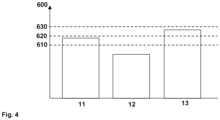
- the cell selection criterion 610 and the enhanced network selection criterion 620 are schematically shown in Figure 4 which represents a situation of the user equipment 20 measuring different signal strength of the different radio cells 11, 12, 13.
- the method comprises the steps of the mobile station 20 measuring or detecting the reception conditions regarding the plurality of available radio cells 11, 12, 13 and, based thereon, generating reception measurement data, wherein - either subsequently or during the generation of the reception measurement data - the mobile station 20 is provided with connectivity to the home mobile communication network 500 and transmits the reception measurement data to the home mobile communication network 500 via non-access stratum signaling.
- the mobile station 20 or user equipment 20 transmits the reception measurement data to the (or its) home mobile communication network 500.
- the mobile station 20 or user equipment 20 needs to be provided, at least somehow, with some kind of (typically but not necessarily wireless) connectivity.
- some kind of connectivity typically but not necessarily wireless
- the home mobile communication network 500 After having transmitted the reception measurement data to the home mobile communication network 500, the home mobile communication network 500 is aware of the reception measurement data and is able to act accordingly, e.g. by means of adjusting the enhanced network selection criterion 620 (i.e. by means of transmitting an updated value of the enhanced network selection criterion 620 to the user equipment 20 or mobile station 20).
- the inventive method further comprises (especially subsequent to the second step), in a third step, the user equipment or mobile station 20 receiving, from the home mobile communication network 500, an enhanced network selection criterion information indicating the mentioned updated value of the enhanced network selection criterion 620, and especially, in a subsequent fourth step, the mobile station 20 subsequently performs network selection using, as the enhanced network selection criterion 620, the updated value corresponding to or indicated by the enhanced network selection criterion information.
- the user equipment or mobile station 20 especially performs network selection and registers with a selected radio cell of the available radio cells 11, 12, 13, i.e. belonging to or being part of a selected mobile communication network, the selected mobile communication network being one of the available mobile communication networks 100, 200, 300.
- the mobile station 20 (or user equipment 20) is schematically shown comprising the enhanced network selection criterion 620.
- the enhanced network selection criterion 620 might either be statically stored in a memory module of the mobile station 20, typically the USIM or the universal integrated circuit card in case of the mobile station 20 being a user equipment 20, or in another memory portion of the mobile equipment / mobile station.
- the enhanced network selection criterion 620 are received from the home public land mobile network 500 or home mobile communication network 500 of the user equipment 20 or mobile station 20.
- FIG 3 an example of a communication between the mobile station 20 (or user equipment 20) on the one hand and its home mobile communication network 500 on the other hand is schematically and exemplarily shown, illustrating the above mentioned inventive method:
- the user equipment 20 or the mobile station 20 - considered to be located in a specific radio environment, e.g. according to the representation of Figure 1 , i.e. comprising the first, second and third mobile communication network 100, 200, 300 (which radio environment is, however, not represented in Figure 3 ), and, especially, after being switched on or after recovery from loss of (radio) coverage - measures or detects the reception conditions of or regarding its radio environment, i.e.
- reception measurement data (corresponding to the first step according to the method of the present invention).
- the user equipment 20 or mobile station 20 is provided with connectivity - exemplarily using the second mobile communication network 200 -, and in a second processing step 602, the mobile station 20 (or user equipment 20) transmits the (previously generated) reception measurement data to its home mobile communication network 500 (both the first and second processing steps 601, 602 correspond to the second step according to the method of the present invention).
- the home mobile communication network 500 might simply collect further measurements - of either the same user equipment 20, e.g. in a different radio environment, e.g. at another time and/or at another location of the user equipment 20, or, especially, of another user equipment or a plurality of other user equipments at (roughly) the same location.
- the user equipment or mobile station 20 receives, from the home mobile communication network 500, the enhanced network selection criterion information (in order to update the enhanced network selection criterion 620 value), and especially, in the subsequent fourth step, the mobile station 20 subsequently performs network selection using, as the enhanced network selection criterion 620, the updated value.
- Figure 3 shows, in a third processing step 603, the mobile station 20 (or user equipment 20) receiving the enhanced network selection criterion information from the home mobile communication network 500.
- the user equipment 20 or mobile station 20 registers - in a fourth processing step 604 - with a selected radio cell of the available radio cells 11, 12, 13 belonging to or being part of a selected mobile communication network; in the exemplarily represented scenario shown in Figure 3 , the selected mobile communication network corresponds to the third mobile communication network 300.
- the mobile station 20 or user equipment 20 in order for the mobile station 20 or user equipment 20 to be able to transmit the reception measurement data to the home mobile communication network 500, it needs to be provided with some kind of - especially (but not necessarily) wireless - connectivity, or preliminary connectivity, which is provided, in the exemplary situation shown in Figure 3 , by the second mobile communication network 200.
- a user equipment 20 or mobile station 20 with a mobile communication network) - such as, e.g., using wireless access points (using WLAN or Wifi-technology) and/or registrations that are aimed rather at machine type communication-oriented devices -, this might fit as well.
- the mobile station 20 preliminarily registers with a preliminary radio cell of the available radio cells 11, 12, 13, the preliminary radio cell (in the example represented in Figure 3 , the second radio cell 12) belonging to or being part of a preliminary mobile communication network (in the example represented in Figure 3 , the second mobile communication network 200), wherein the reception measurement data as well as the enhanced network selection criterion information are transmitted and/or received using the preliminary mobile communication network.
- the choice of the preliminary mobile communication network might either be based on data stored in the mobile station or user equipment 20 (such as user preferred network list information and/or operator preferred network list information as stored on a universal integrated circuit card of or associated with the mobile station 20); however, alternatively, the mobile station 20 might perform such (preliminary) registration with the preliminary radio cell or with the preliminary mobile communication network independently from a user preferred network list information and/or an operator preferred network list information as stored on an universal integrated circuit card of or associated with the mobile station 20.
- the user equipment 20 or mobile station 20 After the mobile station 20 or user equipment 20 having received - in the third processing step 603 - the network selection data from the home mobile communication network 500, the user equipment 20 or mobile station 20 is able to perform (in the fourth processing step 604) its (proper or, rather, definitive) registration with the selected one of the available radio cells 11, 12, 13, i.e. with the third mobile communication network 300 as the selected mobile communication network.
- the result of the preliminary network selection and the result of the definitive network selection corresponds to one and the same mobile communication network (i.e.
- the fourth processing step 604 (represented as a dashed box)
- the alternative fourth processing step 604' (represented as a dotted box) would (have to) be performed:
- the fourth step and the second step of the inventive method are performed, at least partly, in parallel; however, if, alternatively, in the second step of the inventive method, the registration with the preliminary mobile communication network (in order to provide the mobile station or user equipment 20 with connectivity) corresponds to only a preliminary or lesser (kind of) registration, in the fourth step (of the inventive method) the mobile station or user equipment 20 definitively registers with the selected mobile communication network.
- the mentioned cell selection criterion 610 and the enhanced network selection criterion 620 are schematically shown in Figure 4 which represents a situation of the user equipment 20 measuring different signal strength of the different radio cells 11, 12, 13.
- the ordinate of the diagram shown corresponds to the signal strength 600 or an indicator thereof (such as a field strength value or signal quality parameter).
- the user equipment 20 or mobile station 20 applies a conventionally defined cell selection criterion 610 in the cell selection stage.
- both the first radio cell 11 and the third radio cell 13 would be regarded as suitable radio cells (according to or applying the cell selection criterion 610 in the cell selection stage) as both radio cells 11, 13 are schematically shown as having or providing (at the location of the user equipment 20 or mobile station 20) a signal strength corresponding to or exceeding the cell selection criterion 610.
- the enhanced network selection criterion 620 is able to be taken into consideration when it comes to select a public land mobile network.
- the enhanced network selection criterion 620 is typically more demanding or requires an increased reception signal level or quality (schematically indicated, in Figure 4 , by means of the enhanced network selection criterion 620 being represented above the conventionally defined cell selection criterion 610, i.e. the enhanced network selection criterion 620 is especially more restrictive compared to the conventionally defined cell selection criterion 610), only the third radio cell 13, or, rather, its associated public land mobile network 300, is considered, by the user equipment 20 and due to measurements conducted by the user equipment 20, to be taken into consideration.
- a further criterion is schematically indicated in Figure 4 , corresponding to a high-quality criterion 630.
- the enhanced network selection criterion 620 (regarding the respective radio access technology) especially corresponds to a signal strength or signal strength level in between the cell selection criterion 610, and the high-quality criterion 630, and in order for a radio cell to be considered a suitable radio cell, the enhanced network selection criterion 620 needs to be passed; hence, in the exemplary representation of Figure 4 , only the third radio cell 13 would be regarded as a suitable radio cell. However, in case that the HPLMN-provided enhanced cell selection criterion would be defined such that it is only slightly less demanding, also the first radio cell 11 would be regarded as a suitable radio cell.
Landscapes
- Engineering & Computer Science (AREA)
- Computer Security & Cryptography (AREA)
- Computer Networks & Wireless Communication (AREA)
- Signal Processing (AREA)
- Mobile Radio Communication Systems (AREA)
Priority Applications (3)
| Application Number | Priority Date | Filing Date | Title |
|---|---|---|---|
| EP23188820.7A EP4503752B1 (fr) | 2023-07-31 | 2023-07-31 | Transmission de données de mesure de réception pour une sélection de réseau ultérieure par une station mobile selon un critère rehaussé de sélection de cellule basé sur un seuil de signal controlé par un operateur de réseau |
| ES23188820T ES3063365T3 (en) | 2023-07-31 | 2023-07-31 | Transmission of reception measurement data for subsequent network selection by a mobile station according to an enhanced cell selection criterion based on an operator-controlled signal threshold |
| PCT/EP2024/070911 WO2025026831A1 (fr) | 2023-07-31 | 2024-07-23 | Transmission de données de mesure de réception pour une sélection ultérieure de réseau par une station mobile selon un critère de sélection de cellule amélioré sur la base d'un seuil de signal commandé par l'opérateur |
Applications Claiming Priority (1)
| Application Number | Priority Date | Filing Date | Title |
|---|---|---|---|
| EP23188820.7A EP4503752B1 (fr) | 2023-07-31 | 2023-07-31 | Transmission de données de mesure de réception pour une sélection de réseau ultérieure par une station mobile selon un critère rehaussé de sélection de cellule basé sur un seuil de signal controlé par un operateur de réseau |
Publications (2)
| Publication Number | Publication Date |
|---|---|
| EP4503752A1 true EP4503752A1 (fr) | 2025-02-05 |
| EP4503752B1 EP4503752B1 (fr) | 2026-01-21 |
Family
ID=87553889
Family Applications (1)
| Application Number | Title | Priority Date | Filing Date |
|---|---|---|---|
| EP23188820.7A Active EP4503752B1 (fr) | 2023-07-31 | 2023-07-31 | Transmission de données de mesure de réception pour une sélection de réseau ultérieure par une station mobile selon un critère rehaussé de sélection de cellule basé sur un seuil de signal controlé par un operateur de réseau |
Country Status (3)
| Country | Link |
|---|---|
| EP (1) | EP4503752B1 (fr) |
| ES (1) | ES3063365T3 (fr) |
| WO (1) | WO2025026831A1 (fr) |
Citations (1)
| Publication number | Priority date | Publication date | Assignee | Title |
|---|---|---|---|---|
| EP4002923A1 (fr) * | 2020-11-23 | 2022-05-25 | Deutsche Telekom AG | Procédé de réalisation de la sélection de cellules par un équipement utilisateur se trouvant dans un environnement radio comprenant une pluralité de cellules radio d'une pluralité de réseaux de communication mobiles, équipement utilisateur, système ou réseau de communication mobile, programme et produit programme informatique |
-
2023
- 2023-07-31 EP EP23188820.7A patent/EP4503752B1/fr active Active
- 2023-07-31 ES ES23188820T patent/ES3063365T3/es active Active
-
2024
- 2024-07-23 WO PCT/EP2024/070911 patent/WO2025026831A1/fr active Pending
Patent Citations (1)
| Publication number | Priority date | Publication date | Assignee | Title |
|---|---|---|---|---|
| EP4002923A1 (fr) * | 2020-11-23 | 2022-05-25 | Deutsche Telekom AG | Procédé de réalisation de la sélection de cellules par un équipement utilisateur se trouvant dans un environnement radio comprenant une pluralité de cellules radio d'une pluralité de réseaux de communication mobiles, équipement utilisateur, système ou réseau de communication mobile, programme et produit programme informatique |
Non-Patent Citations (3)
| Title |
|---|
| 3GPP TS 23.122 |
| AKANSHA ARORA ET AL: "CP-SOR for SENSE capable UE", vol. 3GPP CT 1, no. Bratislava, SK; 20230522 - 20230526, 30 May 2023 (2023-05-30), XP052380716, Retrieved from the Internet <URL:https://www.3gpp.org/ftp/tsg_ct/WG1_mm-cc-sm_ex-CN1/TSGC1_142_Bratislava/Docs/C1-233865.zip C1-233865_was_C1-233439_TS23.122_CP-SOR for SENSE capable UE_r7.docx> [retrieved on 20230530] * |
| REINHARD LAUSTER ET AL: "Signal level enhanced network selection requirements for PLMN selection", vol. 3GPP CT 1, no. Athens, GR; 20230227 - 20230303, 17 February 2023 (2023-02-17), XP052238405, Retrieved from the Internet <URL:https://www.3gpp.org/ftp/tsg_ct/WG1_mm-cc-sm_ex-CN1/TSGC1_140_Athens/Docs/C1-230063.zip C1-230063_SENSE_requirements_PLMN.docx> [retrieved on 20230217] * |
Also Published As
| Publication number | Publication date |
|---|---|
| ES3063365T3 (en) | 2026-04-16 |
| WO2025026831A1 (fr) | 2025-02-06 |
| EP4503752B1 (fr) | 2026-01-21 |
Similar Documents
| Publication | Publication Date | Title |
|---|---|---|
| EP2169972B1 (fr) | Procédé de contrôle d'un accès de cellule et équipement utilisateur | |
| EP4173349B1 (fr) | Techniques pour effectuer une minimisation d'essai en mouvement | |
| KR101365191B1 (ko) | 드라이브 테스트 최소화 측정을 처리하는 방법 및 관련 통신 디바이스 | |
| US8538410B2 (en) | User-customized mobility method and system in a mobile communication system | |
| US20120083268A1 (en) | Method of Enhancing Public Land Mobile Network Search and Related Communication Device | |
| US20090088135A1 (en) | Access control for base stations | |
| CN101925142B (zh) | 一种小区切换的控制方法、网络设备和系统 | |
| EP3525520B1 (fr) | Procédé et terminal pour une commutation de réseau | |
| US20220361058A1 (en) | Method and apparatus for performing handover of a multi-usim radio-capable ue over same or different systems | |
| US12439330B2 (en) | Method for realizing cell selection by a user equipment being in a radio environment comprising a plurality of radio cells of a plurality of mobile communication networks | |
| WO2022059768A1 (fr) | Procédé et appareil pour déterminer un support pour une tranche de réseau dans une bande radio de desserte en cours | |
| WO2021093201A1 (fr) | Techniques de resélection de cellule | |
| KR101620019B1 (ko) | 무선 통신 디바이스 기능들의 동적 인에이블먼트를 위한 장치들 및 방법들 | |
| US12225453B2 (en) | Serving cell rat acquisition and indication methods and apparatuses, and devices | |
| JP7609995B2 (ja) | 複数の移動通信ネットワークの複数の無線セルを備える無線環境にあるユーザ機器によってネットワーク選択を実現するための方法、ユーザ機器、システムまたは移動通信ネットワーク、プログラムおよびコンピュータプログラム製品 | |
| EP4503752B1 (fr) | Transmission de données de mesure de réception pour une sélection de réseau ultérieure par une station mobile selon un critère rehaussé de sélection de cellule basé sur un seuil de signal controlé par un operateur de réseau | |
| US20160337941A1 (en) | System and Method for Wireless Network Access Control | |
| EP4503751A1 (fr) | Procédé de sélection de réseau par une station mobile dans un environnement radio | |
| CN104854899B (zh) | 用于通信的方法和装置、移动通信终端和用于在终端中处理信号的芯片组 | |
| US20150365875A1 (en) | Selecting a Radio Access Network Cell | |
| EP2393321A1 (fr) | Système et procédé pour faire le rapport de cellules voisines lors d'un transfert depuis un GAN | |
| US20250261151A1 (en) | Operating a user equipment in a radio environment comprising a plurality of radio cells of a plurality of mobile communication networks | |
| US20240292322A1 (en) | Network Nodes, User Equipment and Methods Performed Therein | |
| CN119836822A (zh) | 信号电平增强网络选择 | |
| CN117440475A (zh) | 信号级别增强网络选择方法及用户设备 |
Legal Events
| Date | Code | Title | Description |
|---|---|---|---|
| PUAI | Public reference made under article 153(3) epc to a published international application that has entered the european phase |
Free format text: ORIGINAL CODE: 0009012 |
|
| STAA | Information on the status of an ep patent application or granted ep patent |
Free format text: STATUS: EXAMINATION IS IN PROGRESS |
|
| 17P | Request for examination filed |
Effective date: 20240619 |
|
| AK | Designated contracting states |
Kind code of ref document: A1 Designated state(s): AL AT BE BG CH CY CZ DE DK EE ES FI FR GB GR HR HU IE IS IT LI LT LU LV MC ME MK MT NL NO PL PT RO RS SE SI SK SM TR |
|
| GRAP | Despatch of communication of intention to grant a patent |
Free format text: ORIGINAL CODE: EPIDOSNIGR1 |
|
| STAA | Information on the status of an ep patent application or granted ep patent |
Free format text: STATUS: GRANT OF PATENT IS INTENDED |
|
| RIC1 | Information provided on ipc code assigned before grant |
Ipc: H04W 48/16 20090101AFI20250804BHEP Ipc: H04W 48/20 20090101ALI20250804BHEP Ipc: H04W 48/12 20090101ALN20250804BHEP |
|
| INTG | Intention to grant announced |
Effective date: 20250905 |
|
| GRAS | Grant fee paid |
Free format text: ORIGINAL CODE: EPIDOSNIGR3 |
|
| GRAA | (expected) grant |
Free format text: ORIGINAL CODE: 0009210 |
|
| STAA | Information on the status of an ep patent application or granted ep patent |
Free format text: STATUS: THE PATENT HAS BEEN GRANTED |
|
| AK | Designated contracting states |
Kind code of ref document: B1 Designated state(s): AL AT BE BG CH CY CZ DE DK EE ES FI FR GB GR HR HU IE IS IT LI LT LU LV MC ME MK MT NL NO PL PT RO RS SE SI SK SM TR |
|
| REG | Reference to a national code |
Ref country code: CH Ref legal event code: F10 Free format text: ST27 STATUS EVENT CODE: U-0-0-F10-F00 (AS PROVIDED BY THE NATIONAL OFFICE) Effective date: 20260121 |
|
| REG | Reference to a national code |
Ref country code: DE Ref legal event code: R096 Ref document number: 602023010943 Country of ref document: DE |
|
| REG | Reference to a national code |
Ref country code: IE Ref legal event code: FG4D |
|
| REG | Reference to a national code |
Ref country code: ES Ref legal event code: FG2A Ref document number: 3063365 Country of ref document: ES Kind code of ref document: T3 Effective date: 20260416 |