EP4505660B1 - Procédé et dispositif d'attribution individuelle d'au moins un diagramme de fonction de véhicule à au moins un véhicule - Google Patents
Procédé et dispositif d'attribution individuelle d'au moins un diagramme de fonction de véhicule à au moins un véhicule Download PDFInfo
- Publication number
- EP4505660B1 EP4505660B1 EP23822252.5A EP23822252A EP4505660B1 EP 4505660 B1 EP4505660 B1 EP 4505660B1 EP 23822252 A EP23822252 A EP 23822252A EP 4505660 B1 EP4505660 B1 EP 4505660B1
- Authority
- EP
- European Patent Office
- Prior art keywords
- vehicle
- nft
- nfts
- dlt
- settings
- Prior art date
- Legal status (The legal status is an assumption and is not a legal conclusion. Google has not performed a legal analysis and makes no representation as to the accuracy of the status listed.)
- Active
Links
Images


Classifications
-
- H—ELECTRICITY
- H04—ELECTRIC COMMUNICATION TECHNIQUE
- H04L—TRANSMISSION OF DIGITAL INFORMATION, e.g. TELEGRAPHIC COMMUNICATION
- H04L9/00—Cryptographic mechanisms or cryptographic arrangements for secret or secure communications; Network security protocols
- H04L9/50—Cryptographic mechanisms or cryptographic arrangements for secret or secure communications; Network security protocols using hash chains, e.g. blockchains or hash trees
-
- H—ELECTRICITY
- H04—ELECTRIC COMMUNICATION TECHNIQUE
- H04L—TRANSMISSION OF DIGITAL INFORMATION, e.g. TELEGRAPHIC COMMUNICATION
- H04L2209/00—Additional information or applications relating to cryptographic mechanisms or cryptographic arrangements for secret or secure communication H04L9/00
- H04L2209/84—Vehicles
Definitions
- the invention relates to a method for individually assigning at least one vehicle function scheme to at least one vehicle according to the preamble of claim 1. Furthermore, the invention relates to a device for carrying out such a method according to the preamble of claim 10.
- the document US 2012/0317161 A1 describes an in-vehicle computer system with instructions that cause a processor to store a media profile of a first user indicating their media preferences.
- the processor further determines when the vehicle encounters a second vehicle and receives a media profile of a second user.
- the processor further evaluates the profiles to determine a similarity between them. If a similarity is determined, recommended media is identified based on the characteristics of the profiles and the provision of recommended media to one of the users of the first vehicle and the user of the second vehicle is triggered.
- a database containing multiple configuration templates is provided.
- a configuration template includes parameters of configurable features and settings of an associated vehicle.
- a user is enabled to retrieve and customize a configuration template using a configuration application.
- Customized configuration data is transmitted to a control module of the vehicle to customize features and settings in accordance with the user's configuration data.
- the document US 2017/0369052 A1 describes an apparatus and method for controlling an autonomous vehicle.
- the method includes receiving a profile selection by an electronic processor of the autonomous vehicle.
- the method further includes receiving a driver profile having a plurality of settings based on the profile selection.
- the method further includes, in a autonomous driving mode, controlling with the electronic processor based on at least one of the several settings.
- the document US 2022/0366061 A1 describes a method for verifying the authenticity of an association of a non-fungible token (NFT) with a physical object.
- the method is suitable for verifying the connection between an NFT and an authenticated physical object.
- the method comprises retrieving authentication metadata for a security feature that is associated with a physical object. It can be verified whether the authentication metadata for the security feature contains an identifier of the NFT.
- the document US 2022/0075845 A1 describes a computer-aided design (CAD) system using an image analysis device to identify objects in video images.
- Customization rules and object identifiers determined by the image analysis device determine whether a video image is approved for use in customizing a product. It determines which video images should be used for customization.
- a first video image that has not yet been selected for customization of the product is selected and printed on the product. The first video image is excluded from further use for customizing the product.
- the document US 2013/0124009 A1 describes an apparatus and method for managing vehicle configurations.
- a database comprising a plurality of configuration templates is provided.
- the configuration templates include parameters of configurable features and settings of an associated vehicle.
- a user is provided with a software application with which configuration templates can be retrieved and personalized.
- the personalized Configuration data is transmitted to a vehicle control unit to adjust features and settings according to the user's configuration data.
- the invention is based on the object of providing an improved method for individually assigning at least one vehicle function scheme to at least one vehicle. This object is achieved according to the invention by a method having the features of claim 1.
- the invention is based on the object of providing a device for carrying out this method. This object is achieved by a device having the features of claim 10.
- the user experience that is, the perception of multimedia content, but also the perception of vehicle operation by a passenger—in modern vehicles is influenced by a multitude of freely selectable parameters. Optimizing such a user experience is complex and offers added value over standardized settings. Therefore, there is a need for a process that can control the sharing of such customized settings and, in particular, prevent arbitrary duplication by assigning customized settings to an individual (i.e., identifiable) vehicle.
- DLT refers to the individualization and registration of digital data records.
- the DLT system manages Individualized (for example, via assigned numbers or character strings unique within the DLT system) vehicle function schemes and can assign these in a traceable and tamper-proof manner to other entities, such as users, organizations, vehicles, or other systems.
- DLT systems are known from the state of the art, for example, DLT systems based on the blockchain process.
- a DLT system is used to mint and manage NFTs corresponding to vehicle functional diagrams, which is configured to assign a maximum of one vehicle to an NFT at a specific point in time.
- NFTs can also be assigned to a vehicle functional diagram, which are thus essentially functionally identical (i.e., configure a vehicle in the same way) and can be assigned to different vehicles.
- a vehicle functional diagram which are thus essentially functionally identical (i.e., configure a vehicle in the same way) and can be assigned to different vehicles.
- only a single vehicle or any other limited number of vehicles can be assigned to this specific vehicle functional diagram.
- At least one NFT is selected and/or acquired for a vehicle.
- the vehicle functional scheme associated with this selected and/or acquired NFT is applied to the vehicle.
- the method according to the invention makes it possible to control the distribution of vehicle function diagrams and create a digital marketplace for trading them.
- unauthorized distribution of vehicle function diagrams is prevented by the forgery-proof assignment to a maximum of one vehicle in the DLT system. This promotes the development and further development of such vehicle function diagrams, achieves exclusive access to certain vehicle functions, and generates additional added value from trading in vehicle function diagrams.
- a vehicle functional diagram is understood here and in the following as a configuration, i.e. a set of parameters and/or functional settings of a vehicle function.
- a vehicle functional diagram captures parameters of a visually perceptible presentation of a vehicle interior.
- Such parameters can, for example, relate to vehicle interior lighting and can be adjusted in such a way that a specific color, brightness, and/or brightness distribution is or will be generated, triggering a particular user experience.
- Alternatively or additionally, such parameters can also configure background images or background patterns displayed on one or more displays in the vehicle interior.
- Visually perceptible presentations are particularly easy to personalize and offer a high level of recognition.
- a vehicle functional diagram can parameterize audio playback in the vehicle interior, for example, with regard to absolute and/or frequency-dependent relative volume or with regard to specific sound effects.
- preferred audio playback settings can be parameterized in a vehicle functional diagram depending on an audio source (e.g., radio or external media) or depending on an audio characteristic (e.g., speech, classical music, or rock music). Sound effects generated for perception in the immediate vehicle environment, such as an artificial engine sound for an electrically powered vehicle, can also be parameterized.
- an NFT comprises requirement data and parameter data, wherein the parameter data describe the settings of the vehicle functional scheme and wherein the requirement data describe those equipment features of the vehicle that are required for implementing a vehicle functional scheme according to the parameter data.
- an NFT has a transaction-variable cryptographic hash value that incorporates both characteristics of the protected digital asset (in this case, parameters of a vehicle functional diagram) and characteristics of one or more transactions involving this digital asset, such as timestamps of a transfer of ownership or usage rights.
- characteristics of the protected digital asset in this case, parameters of a vehicle functional diagram
- characteristics of one or more transactions involving this digital asset such as timestamps of a transfer of ownership or usage rights.
- such a transaction-variable hash value of an NFT is formed solely based on the parameter data and supplemented by a transaction-invariant part containing the request data.
- the transaction-invariant part can be used to search for those NFTs that can be implemented on a vehicle with given specific equipment features.
- the cryptographic security of the settings of the vehicle functional scheme to be protected is not compromised.
- the request data includes a special equipment code (SA code) and/or a hardware version and/or a software version of an equipment feature.
- SA code special equipment code
- the compatibility of at least one NFT registered in the DLT system with a specific vehicle is determined based on the identity of that vehicle.
- the identity of a vehicle can be determined, for example, by a number or character string known as the Vehicle Identification Number (VIN), which is unique at least for the fleet of vehicles of a vehicle manufacturer.
- VIN Vehicle Identification Number
- a selection list is generated and stored in at least one head unit of a vehicle, which includes the NFTs registered in the DLT system and compatible with that vehicle.
- a head unit is understood here and below to be a central control unit that has a user interface and can be used to control vehicle functions, in particular settings in the vehicle interior and/or infotainment functions.
- a selection of NFTs can be executed particularly quickly and autonomously, i.e. without repeated access to the DLT system.
- equipment features are assigned to a vehicle in a configuration management system and stored there.
- Such equipment features may, for example, but not exclusively, relate to compatibility with vehicle functional schemes of NFTs. For example, a hardware configuration installed in the vehicle for a vehicle interior lighting system and a software version installed on it may be recorded.
- a list of all NFTs registered in the DLT system is created, and at least one NFT is selected from this list.
- its compatibility with the vehicle is determined using the configuration management system.
- This embodiment ensures that only those NFTs are selected for a vehicle whose associated vehicle functional schemes can be implemented in the vehicle. This enables particularly good usability and prevents the acquisition of unsuitable NFTs.
- a selection list of NFTs registered in the DLT system that are compatible with the respective vehicle is generated for a vehicle.
- a selection list also referred to as a whitelist, is offered for the selection of one or more compatible NFTs. This makes it easier for the user to select NFTs.
- such a selection list is stored locally in the vehicle in one or more head units and reused for subsequent NFT selection.
- the selection process is accelerated and usability is improved.
- a first hash value is generated for each NFT, which is based on the request data describing the equipment features required for implementing the settings of the vehicle functional scheme assigned to this NFT, for example as a set of SA codes. Furthermore, a second hash value is generated, which is based on the settings of the vehicle functional scheme.
- a first list comprising the first hash values is created and stored locally in a vehicle. Furthermore, a second list comprising creating the second hash values and storing them in a distributed system independent of a vehicle, preferably in a cloud.
- the first list stored locally in the vehicle, is used to select those NFTs that can be implemented on the vehicle, and their first hash values are extracted. Then, using the second list, stored distributed and preferably in the cloud, the associated second hash values are searched for and extracted, which describe the associated settings of the vehicle's functional scheme.
- the first and the associated second hash values are combined and checked for correct assignment using a verification algorithm. If the assignment is correct, the NFT is retrieved from the DLT system using the combined value of the first and second hash values.
- a device for carrying out the method according to the first aspect of the invention comprises at least one DLT system which is configured for access via an over-the-air network, preferably via a mobile radio network.
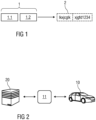
- Figure 1 shows a schematic diagram of the structure of a non-fungible token (NFT) 1 for configuring vehicle functions, for example, for configuring a color scheme for vehicle interior lighting or for configuring a sound or audio scheme for an audio system.
- NFT 1 comprises data, preferably characters arranged in a character string, control instructions, and/or numbers.
- the NFT 1 comprises requirement data 1.1, which can be used to check the technical feasibility of a configuration specified by the NFT 1 (i.e., a vehicle functional diagram related to a specific function).
- Requirement data 1.1 can, for example, include one or more special equipment codes (SA codes).
- SA codes special equipment codes
- An SA code is used to specify certain optional, for example, country- or region-specific, equipment features of a vehicle specified in Figure 1 vehicle not shown in detail.
- the requirement data 1.1 can identify development stages of subsystems of the vehicle, for example a hardware version and/or a software version.
- the NFT 1 comprises parameter data 1.2, which defines settings for certain functions available in a vehicle that satisfies the requirement data 1.1.
- the lighting of a vehicle interior can be configured to display certain colors or sequences of colors.
- the lighting can be controlled depending on the vehicle's operating states (e.g., speed, acceleration, or deceleration) or other parameters determined by a user of the vehicle.
- the vehicle's adjustable vehicle or multimedia functions can be changed. For example, a lighting scheme can be set depending on the music selected by the user from an infotainment system.
- vehicle's audio or sound functions can be configured.
- vehicle seats can be adjusted to suit a user's specific preferences.
- parameter data 1.2 can be used to specify specific graphics or images to be displayed on one or more display devices available in the vehicle.
- a backlight for such display devices can also be specified using parameter data 1.2.
- lighting effects such as a light show when opening a vehicle door or the illumination of a type or brand plate
- sound effects such as the engine noise of an electrically powered vehicle
- An NFT 1 is assigned an NFT hash value 2, which can be represented as a character string and/or integer, using a cryptographic hash function.
- a hash function that is collision-resistant and a one-way function is particularly cryptographic (or cryptological).
- no further NFT 1 can be determined that results in the same NFT hash value 2 as a different first NFT 1.
- no NFT 1 can be determined that, when applied to this cryptographic hash function, results in a given NFT hash value 2.
- the NFT hash value 2 can be transmitted and/or stored instead of the NFT 1.
- the cryptographic hash function is selected such that certain particularly significant features of the request data 1.1 and/or the parameter data 1.2 can be derived from the NFT hash value 2, for example, restrictions regarding the technical applicability of the NFT 1 (for example, a minimum hardware and/or software version).
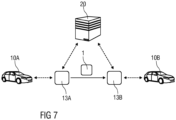
- FIG 2 illustrates the method of transferring an NFT 1 between a Distributed Ledger Technology (DLT) system 20 and a vehicle 10.
- the vehicle 10 has at least one infotainment device referred to as a head unit 11, which is used for data exchange, in particular via a Figure 2 wirelessly available Over-The-Air (OTA) network (not shown in detail) with which DLT System 20 is set up and which can be operated by a vehicle occupant via a user interface.
- OTA Over-The-Air
- the head unit 11 controls functions of the vehicle 10, for example lighting functions of a vehicle interior lighting, the audio playback of an audio system in the vehicle interior, a sound generator for generating an artificial engine noise for a vehicle with electric drive or actuators for adjusting vehicle seats in the vehicle 10, typically with the inclusion of further Figure 2 control units not shown in detail.
- the DLT system 20 can, for example, be implemented as a blockchain and is configured to manage a plurality of NFTs 1.
- the DLT system 20 is configured to individualize the NFTs 1 managed therein in a manner that is tamper-proof and forgery-proof, i.e., to assign them to a specific user.
- the functionality of the DLT system 20 is explained in more detail below.
- a user i.e. a driver or other vehicle occupant of the vehicle 10
- a list of NFTs 1 whose assigned configurations can be implemented on the vehicle 10.
- a list of technically suitable NFTs 1 for the respective vehicle 10 is displayed on the user interface for selection and/or stored on a data storage device.
- a user can activate a corresponding NFT 1 for their vehicle 10 (i.e., adjust vehicle functions of the vehicle 10 according to the parameters specified in the selected NFT 1).
- this will require acquiring a selected NFT 1 prior to use, for example, through an e-commerce transaction mediated via a wireless network.
- the invention is based on the idea that configurations parameterized via NFTs 1 are not applied to an arbitrary number of vehicles 10, but are unique (i.e., to a single vehicle 10) or limited (i.e., to a maximum of a predetermined number of vehicles 10), regardless of the number of vehicles 10 that would be technically equipped and prepared for the use of such an NFT 1.
- an individualization of NFTs 1 is first required, which is carried out using Figure 3 is explained in more detail.
- FIG. 3 schematically shows three different vehicles 10A to 10C, each with at least one head unit 11, which independently access the DLT system 20.
- the DLT system 20 manages four NFTs 1A to 1D, which similarly encode a specific configuration or parameterization for a vehicle 10. For example, identical settings for a vehicle interior lighting can be defined via each of the four NFTs 1A to 1D shown.
- these four NFTs 1A to 1D encode the technical requirements necessary to implement the configuration specified therein, for example a specific type and at least one development stage of a vehicle interior lighting as hardware version and at least one software version of a head unit 11. It is possible that the configuration encoded in the NFT 1A to 1D can be implemented with vehicles 10A to 10C of different types or different development stages.
- the illustrated NFTs 1A to 1D are thus functionally identical.
- each of the four NFTs 1A to 1D when installed on a vehicle 10A to 10C suitable for this purpose due to its type and level of development, leads to the same user perception, for example, to a certain, typical interior lighting.
- the configuration encoded by an NFT 1A to 1D is not limited to visual user perception; settings of an audio system or settings on one or more vehicle seats, or combinations of such settings, can also be encoded.
- the user perception that can be associated with an NFT 1A to 1D is limited only by the technical parameters on the vehicle 10A to 10C that can be influenced by the head unit 11 or downstream control units.
- the functionally identical NFTs 1A to 1D have distinguishable identities, which can be determined, for example, by different assigned integer values or character strings in the form of globally unique identifiers (GUI).
- GUI globally unique identifiers
- each of the functionally identical NFTs 1A to 1D is either individualized, i.e., assigned to a vehicle 10A to 10C, or registered as still available.
- a first NFT 1A can be assigned to a first vehicle 10A
- a second NFT 1B to a second vehicle 10B
- a third NFT 1C to a third vehicle 10C based on the respective VIN.
- a fourth NFT 1D can be registered as still freely available and offered for purchase to other users.
- Both the transfer of an already issued NFT 1A to 1C (i.e., the assignment of a different VIN) and the acquisition of an as yet unissued NFT 1D (i.e., the initial assignment of a new VIN) are registered and managed by the DLT system 20.
- a limited edition of functionally identical NFTs 1A to 1D can be implemented, as in the present case, for example, with four functionally identical NFTs 1A to 1D.
- the amount (scope) of a limited edition can be arbitrarily determined by the operator of the DLT system 20, which issues the NFTs 1A to 1D, and can, for example, be one.
- Vehicles 10 on which certain settings (for example, the vehicle interior lighting) are to be made request authorization for this from a central configuration management system 30, preferably by specifying the respective VIN.
- the vehicles 10 are connected to the configuration management system 30 via a wireless over-the-air (OTA) network 31.
- OTA wireless over-the-air
- the configuration management system 30 determines whether the requested parameterization (i.e., the totality of all settings required to generate the specific user experience) is assigned to an NFT 1 that has been registered in the DLT system 20 for a vehicle 10 or for multiple vehicles 10A to 10C. If such an assignment is not registered, any vehicle can make and use the requested settings.
- the requested parameterization i.e., the totality of all settings required to generate the specific user experience
- the configuration management system 30 checks whether the identity of the requesting vehicle 10 matches the identity of one owner or the identities of the multiple owners of the NFTs 1 issued for the requested settings. For example, it can be checked whether one of the eligible NFTs 1 was issued to the VIN of the requesting vehicle 10.
- the parameters and/or the algorithm for the requested parameterization are passed to the Figure 4 not shown in detail Head Unit 11 of the requesting vehicle 10, which then determines the specific instructions and parameters required to set the vehicle functions and implements them in the vehicle 10.
- the technical feasibility of the vehicle settings encoded in an NFT 1 may be tied to technical requirements that are not present in every vehicle 10 of a vehicle type, for example, a specific hardware configuration and/or a firmware version for an interior lighting system or for an audio system.
- Figure 5 explains in more detail how an NFT 1 is selected that is suitable for a specific vehicle 10 (i.e. whose coded settings can be implemented on the vehicle 10).
- a vehicle 10 (comprising a Figure 5
- the head unit 11 (not shown in detail) communicates its VIN via an OTA network 31 to a configuration management system 30 in which the equipment features of the vehicle 10 are recorded.
- the configuration management system 30 determines the totality of equipment features (for example, hardware and software configurations of an interior lighting system and/or an audio system) that are assigned to the communicated VIN.
- the configuration management system 30 determines, by querying the DLT system 20, those NFTs 1 registered there that are compatible with the equipment features of the vehicle 10. Alternatively or additionally, it is also possible to transmit the NFT hash values 2 assigned to the selected NFTs 1 to the vehicle 10. This embodiment is described below with reference to Figure 6 be explained in more detail.
- this vehicle-specific selection of NFTs 1 is transmitted via the OTA network 31 to the vehicle 10 and displayed there on a display 12 (which can be assigned to the head unit 11, for example).
- each NFT 1 of this vehicle-specific selection For display on the display 12, it is necessary to determine the essential characteristics of each NFT 1 of this vehicle-specific selection. This can be done by decoding the respective NFT 1 or using the associated NFT hash value 2.
- Figure 6 explains in more detail an embodiment of a method in which a selection of suitable NFTs 1 is made in a vehicle 10 based on their NFT hash values 2.
- settings for vehicle functions preferably settings related to the vehicle interior, are developed that, for example, provide a particularly pleasant or original user experience. These settings can be developed by the manufacturer of the vehicle 10, but also by a service provider, a supplier, or a third party uninvolved in the production of the vehicle 10.
- an NFT 1 or a predetermined, limited number of NFTs 1 is minted from the developed vehicle settings (i.e., the parameters or configuration of vehicle functions) on a DLT system 20 using a cryptographic process.
- a third step S3 the at least one NFT 1 that has been assigned to the developed vehicle settings is transmitted to the configuration management system 30, on which the equipment features of the vehicles 10 of a fleet and/or a manufacturer are registered based on their respective VINs.
- a fourth step S4 the configuration management system 30 determines the VINs of those vehicles 10 whose equipment features are compatible with the developed vehicle settings (which were assigned to the at least one NFT 1 during its minting). If at least one compatible vehicle 10 is determined, the at least one NFT 1 is transmitted to an NFT hash value converter 40.
- the NFT hash value converter 40 assigns an NFT hash value 2 to each NFT 1 such that the NFT hash value 2 contains a character string describing the function or triggered user experience of the respective NFT 1. For example, for an NFT 1 with a specific vehicle light setting, an NFT hash value 2 could be generated as the character string "XXXXLIGHTINGXXX284UR".
- the generated NFT hash value 2 is sent via an OTA network 31 to a vehicle 10 whose equipment features are compatible with the settings of the associated NFT 1.
- the NFT hash value 2 can be added to a selection list (whitelist) that includes all settings available on the DLT system 20 for this vehicle 10 and protected via NFTs 1.
- the complete NFT hash value 2 instead of the complete NFT hash value 2, only a part of it can be stored locally in the vehicle 10, with which the function and optionally further parameters, for example the required equipment features or the amount of a limited edition, are described.
- a user can select settings of interest to them and purchase an associated NFT 1 from the DLT system 20.
- the VIN of the vehicle 10 is assigned in a seventh step S7 in the DLT system 20. This assigns the configuration associated with the NFT 1 (for example, the setting of the vehicle interior lighting) to this individual vehicle 10.
- an eighth step S8 the user can activate the settings of this NFT 1.
- the identity i.e. the VIN
- the user upon activation it is checked whether the identity (i.e. the VIN) of the vehicle 10 matches that of the vehicle 10 or one of the vehicles 10 for which a corresponding NFT 1 was registered in the DLT system 20.
- a negative list (blacklist) of those NFTs 1 can be created and stored on the vehicle 10 for which this vehicle 10 is not compatible (i.e., does not have the required features).
- FIG. 7 shows a schematic of the process of a transaction in which an NFT 1 is transferred from a first vehicle 10A to a second vehicle 10B.
- Each of the vehicles 10A, 10B is assigned a user account 13A, 13B in the DLT system 20.
- an NFT 1 is registered in the DLT system 20 for the first vehicle 10A.
- the settings assigned to this NFT 1 can be activated and implemented on the first vehicle 10A.
- the NFT 1 is transferred to the second vehicle 10B in exchange for payment of an agreed purchase price.
- the transaction i.e., the reassignment of a vehicle identity, typically a VIN, to the NFT 1 is registered in the DLT system 20.
- the assigned settings are deactivated on the first vehicle 10A and can be activated on the second vehicle 10B.
- the user accounts 13A, 13B serve to assign one or more vehicles 10, 10A to 10C to a user, i.e., to a natural or legal person with ownership rights to the respective vehicle 10, 10A to 10C. Furthermore, business transactions such as the described sale and purchase of NFTs 1 can be processed via the user accounts 13A, 13B.
- the operator of an NFT marketplace through which these transactions are processed and to which the user accounts 13A, 13B provide access can charge fees for transactions with or for the management of NFTs 1.
- Such an NFT marketplace will preferably be accessible for smartphones or web browsers from computer workstations.
- Such a sales transaction can also be executed in the event that not just a single (exclusive) NFT 1, but a limited number of NFTs 1 related to certain vehicle settings, such as a color scheme for the vehicle interior lighting, have been minted.
- a buyer can potentially choose from several providers of NFTs that are identical in terms of vehicle settings, but select individually distinguishable NFTs 1 that are potentially also offered under different conditions.
- NFTs 1 can be acquired by legal or natural persons with a user account 13A, 13B without being simultaneously assigned to a vehicle 10, 10A to 10C.
- a vehicle manufacturer can acquire or reacquire NFTs 1 to offer them again.
Landscapes
- Engineering & Computer Science (AREA)
- Computer Security & Cryptography (AREA)
- Computer Networks & Wireless Communication (AREA)
- Signal Processing (AREA)
- Fittings On The Vehicle Exterior For Carrying Loads, And Devices For Holding Or Mounting Articles (AREA)
- Management, Administration, Business Operations System, And Electronic Commerce (AREA)
Claims (10)
- Procédé d'attribution individuelle d'au moins un schéma de fonction de véhicule, décrivant la configuration d'au moins une fonction de véhicule, à au moins un véhicule (10, 10A à 10C), le procédé comprenant :- un schéma de fonction de véhicule est saisi numériquement et est frappé sous la forme d'un jeton non fongible (NFT) (1, 1A à 1D) en un nombre prédéterminé dans un système (20) de technologie de registre distribué (DLT), qui est conçu pour l'association respectivement d'au plus un véhicule (10, 10A à 10C) à un NFT (1, 1A à 1D),- pour un véhicule (10, 10A à 10C), au moins un NFT (1, 1A à 1D) est sélectionné et/ou acquis, et- le schéma de fonction de véhicule respectivement associé est appliqué au véhicule (10, 10A à 10C),- dans lequel un NFT (1, 1A à 1D) code les conditions techniques requises pour mettre en œuvre une configuration de l'au moins une fonction de véhicule décrite par le schéma de fonction de véhicule associé, et- dans lequel un NFT (1, 1A à 1D) comprend des données de demande (1.1) et des données de paramètre (1.2), dans lequel les données de paramètre (1.2) décrivent les réglages du schéma de fonction de véhicule et dans lequel les données de demande (1.1) décrivent les caractéristiques d'équipement du véhicule (10, 10A à 10C) nécessaires pour une mise en œuvre du schéma de fonction de véhicule selon les données de paramètre (1.2).
- Procédé selon la revendication 1,
caractérisé en ce que
les données de demande (1.1) comprennent un code d'équipement spécial (SA Code) et/ou une version de matériel et/ou une version de logiciel d'une caractéristique d'équipement. - Procédé selon l'une des revendications précédentes,
caractérisé en ce que
le schéma de fonction de véhicule détecte des paramètres d'une mise en scène visuellement perceptible de l'habitacle du véhicule (10, 10A à 10C). - Procédé selon l'une des revendications précédentes,
caractérisé en ce que
le schéma de fonction de véhicule détecte des paramètres d'une reproduction audio et/ou sonore dans l'habitacle ou dans l'environnement du véhicule (10, 10A à 10C). - Procédé selon l'une des revendications précédentes,
caractérisé en ce que
pour au moins un NFT (1, 1A à 1D) enregistré dans le système DLT (20), sa compatibilité avec un véhicule (10, 10A à 10C) est déterminée à l'aide de l'identité du véhicule (10, 10A à 10C). - Procédé selon l'une des revendications précédentes,
caractérisé en ce que
pour un véhicule (10, 10A à 10C), une liste de sélection de NFT (1, 1A à 1D) compatibles avec ce véhicule (10, 10A à 10C) est déterminée et proposée pour la sélection d'au moins un NFT (1, 1A à 1D). - Procédé selon la revendication 5 ou 6,
caractérisé en ce que
la liste de sélection de NFT (1, 1A à 1D) compatibles avec un véhicule (10, 10A à 10C) est mémorisée dans au moins une unité principale (11) dudit véhicule (10, 10A à 10C). - Procédé selon l'une des revendications 5 à 7,
caractérisé en ce que- dans un système de gestion de configuration (30), des caractéristiques d'équipement sont associées à un véhicule (10, 10A à 10C) et l'association est mémorisée,- une liste de tous les NFT (1, 1A à 1D) frappés dans le système DLT (20) est générée,- au moins un NFT (1, 1A à 1D) est sélectionné dans la liste, et- pour l'au moins un NFT (1, 1A à 1D) sélectionné, la compatibilité avec le véhicule (10, 10A à 10C) est déterminée à l'aide du système de gestion de configuration (30). - Procédé selon la revendication 8,
caractérisé en ce que
à chaque NFT (1, 1A à 1D) est associée une première valeur de hachage basée sur des données de demande (1.1) et une seconde valeur de hachage basée sur des données de paramètres (1.2) et une première liste comprenant les premières valeurs de hachage est générée et mémorisée localement dans un véhicule et une seconde liste comprenant les secondes valeurs de hachage est générée et mémorisée de manière répartie dans un nuage, dans lequel les données de paramètres (1.2) décrivent les réglages du schéma de fonction de véhicule et dans lequel les données de demande (1.1) décrivent les caractéristiques d'équipement du véhicule (10, 10A à 10C) nécessaires pour une mise en œuvre du schéma fonctionnel du véhicule selon les données de paramètre (1.2). - Dispositif pour la réalisation d'un procédé selon l'une des revendications précédentes, dans lequel le dispositif comprend au moins un système DLT (20) conçu pour l'accès par l'intermédiaire d'un réseau en liaison directe (OTA) (31).
Applications Claiming Priority (2)
| Application Number | Priority Date | Filing Date | Title |
|---|---|---|---|
| DE102022004820.5A DE102022004820A1 (de) | 2022-12-20 | 2022-12-20 | Verfahren und Vorrichtung zur individuellen Zuweisung mindestens eines Fahrzeugfunktionsschemas zu mindestens einem Fahrzeug |
| PCT/EP2023/084313 WO2024132503A1 (fr) | 2022-12-20 | 2023-12-05 | Procédé et dispositif d'attribution individuelle d'au moins un diagramme de fonction de véhicule à au moins un véhicule |
Publications (3)
| Publication Number | Publication Date |
|---|---|
| EP4505660A1 EP4505660A1 (fr) | 2025-02-12 |
| EP4505660C0 EP4505660C0 (fr) | 2025-06-18 |
| EP4505660B1 true EP4505660B1 (fr) | 2025-06-18 |
Family
ID=89222143
Family Applications (1)
| Application Number | Title | Priority Date | Filing Date |
|---|---|---|---|
| EP23822252.5A Active EP4505660B1 (fr) | 2022-12-20 | 2023-12-05 | Procédé et dispositif d'attribution individuelle d'au moins un diagramme de fonction de véhicule à au moins un véhicule |
Country Status (5)
| Country | Link |
|---|---|
| US (1) | US20260046152A1 (fr) |
| EP (1) | EP4505660B1 (fr) |
| CN (1) | CN120419125A (fr) |
| DE (1) | DE102022004820A1 (fr) |
| WO (1) | WO2024132503A1 (fr) |
Families Citing this family (1)
| Publication number | Priority date | Publication date | Assignee | Title |
|---|---|---|---|---|
| DE102024003192A1 (de) | 2024-09-30 | 2026-04-02 | Mercedes-Benz Group AG | Verfahren zur Erzeugung, zum Aufzeichnen und/oder zur Aktivierung von Unterhaltungsinhalten in einem Fahrzeug |
Family Cites Families (12)
| Publication number | Priority date | Publication date | Assignee | Title |
|---|---|---|---|---|
| DE19926206C2 (de) * | 1999-06-09 | 2003-04-03 | Daimler Chrysler Ag | Fahrzeugelektrik-Konfigurationssystem |
| US8476832B2 (en) * | 2011-03-15 | 2013-07-02 | Ford Global Technologies, Llc | Vehicle interior lighting system with welcome and farewell stages |
| US8682956B2 (en) | 2011-06-09 | 2014-03-25 | Gm Global Technology Operations, Inc | Systems and methods for determining recommended media content for exchange between vehicles |
| US20130124009A1 (en) | 2011-11-14 | 2013-05-16 | Ford Global Technologies, Llc | Method and system for managing personal settings on a vehicle |
| US10872077B2 (en) * | 2013-09-23 | 2020-12-22 | David D. Wright, SR. | Management of entitlements using blockchain |
| CN107249954B (zh) | 2014-12-29 | 2020-07-10 | 罗伯特·博世有限公司 | 用于使用个性化驾驶简档操作自主车辆的系统和方法 |
| DE102018219719A1 (de) * | 2018-11-16 | 2020-05-20 | Volkswagen Aktiengesellschaft | Fahrzeug, Netzwerkkomponente, Verfahren, Computerprogramm und Vorrichtung zum Generieren einer Kennung für einen Ausrüstungszustand eines Fahrzeugs |
| US11532062B2 (en) * | 2019-10-08 | 2022-12-20 | Ford Global Technologies, Llc | Distributed vehicle access |
| US11514203B2 (en) * | 2020-05-18 | 2022-11-29 | Best Apps, Llc | Computer aided systems and methods for creating custom products |
| US20220075845A1 (en) * | 2020-05-18 | 2022-03-10 | Best Apps, Llc | Computer aided systems and methods for creating custom products |
| US20220366061A1 (en) * | 2021-03-16 | 2022-11-17 | Blocktag, Inc. | Validation of Authenticity of Association of a Physical Entity with a Non-Fungible Token and Creation of the Non-Fungible Token having a Verifiable Association with the Physical Entity |
| US11367060B1 (en) * | 2021-08-10 | 2022-06-21 | Creator Proof Llc | Collaborative video non-fungible tokens and uses thereof |
-
2022
- 2022-12-20 DE DE102022004820.5A patent/DE102022004820A1/de active Pending
-
2023
- 2023-12-05 WO PCT/EP2023/084313 patent/WO2024132503A1/fr not_active Ceased
- 2023-12-05 US US19/140,686 patent/US20260046152A1/en active Pending
- 2023-12-05 CN CN202380086459.5A patent/CN120419125A/zh active Pending
- 2023-12-05 EP EP23822252.5A patent/EP4505660B1/fr active Active
Also Published As
| Publication number | Publication date |
|---|---|
| US20260046152A1 (en) | 2026-02-12 |
| EP4505660A1 (fr) | 2025-02-12 |
| EP4505660C0 (fr) | 2025-06-18 |
| DE102022004820A1 (de) | 2024-06-20 |
| WO2024132503A1 (fr) | 2024-06-27 |
| CN120419125A (zh) | 2025-08-01 |
Similar Documents
| Publication | Publication Date | Title |
|---|---|---|
| EP1704073B1 (fr) | Transfert d'au moins un reglage, relatif aux personnes, d'un vehicule | |
| DE60316585T2 (de) | Verfahren und system zum aufrechterhalten eines zeitlichen konfigurationsverlaufs eines fahrzeugs | |
| WO2010133264A1 (fr) | Fonctions de programme activables et désactivables | |
| DE102012109619A1 (de) | Verfahren zum Bereitstellen einer digitalen Signatur zum Sichern einer Flash-Programmierfunktion | |
| DE102010007992A1 (de) | Verfahren und Systeme zum Vereinigen von Medien | |
| EP2232366A2 (fr) | Procédé, système et modèle de simulation ou d'analyse pour le traitement de données | |
| EP4505660B1 (fr) | Procédé et dispositif d'attribution individuelle d'au moins un diagramme de fonction de véhicule à au moins un véhicule | |
| EP2734398B1 (fr) | Procédé de commande d'un appareil mobile au moyen d'un véhicule automobile | |
| EP3889806B1 (fr) | Système de classification des données basé sur les séquences de bits | |
| EP1879772A1 (fr) | Procede permettant de faire fonctionner un vehicule au moyen d'une pluralite de systemes fonctionnels | |
| DE102016224455A1 (de) | Datenbankindex aus mehreren Feldern | |
| DE102022134639B3 (de) | Verfahren zum Vornehmen von Einstellungen an zumindest einem ersten Aktor eines Kraftfahrzeugs, Verfahren zum Ermöglichen eines Änderns von Einstellungen und Kraftfahrzeug | |
| DE102024117006A1 (de) | Digitaler Fahrzeugschlüssel für ein Kraftfahrzeug | |
| DE102017000167A1 (de) | Anonymisierung einer Blockkette | |
| WO2021190715A1 (fr) | Procédé mis en œuvre par ordinateur et système de stockage distribué pour fournir des objets de données fiables | |
| DE102023005095A1 (de) | Verfahren zum Freischalten einer Fahrzeugfunktion und informationstechnisches System | |
| DE102023005094A1 (de) | Verfahren zum Ansteuern einer Fahrzeugfunktion und Fahrzeug | |
| DE102020107141B4 (de) | Simulieren einer Steuergerätekommunikation zwischen einem zu testenden Steuergerät und mindestens einem weiteren Steuergerät | |
| DE102024003650A1 (de) | Vorrichtung und Verfahren zum Betrieb eines Entertainment- und/oder Komfortsystems eines Fahrzeugs | |
| DE102024210000A1 (de) | Inbetriebnahme eines Fortbewegungsmittels in der Produktion | |
| WO2022117306A1 (fr) | Procédé assurant la disponibilité de données de programme à partir d'une base de données | |
| DE10339112A1 (de) | Verfahren zum Erzeugen mindestens eines Projekt-Referenzmodells, Verfahren zur Generierung einer strukturierten Konfigurationsinformation mittels eines solchen Projekt-Referenzmodells sowie Vorrichtung zur Durchführung, Verwaltung und Organisation solcher Verfahren | |
| DE102014104060B4 (de) | Verfahren zum Verarbeiten einer Datei | |
| WO2024235818A1 (fr) | Contrôle de données d'approvisionnement contrôlé par l'utilisateur | |
| EP4713860A1 (fr) | Procédé de déverrouillage d'une fonction de véhicule, et système de technologie d'informations |
Legal Events
| Date | Code | Title | Description |
|---|---|---|---|
| STAA | Information on the status of an ep patent application or granted ep patent |
Free format text: STATUS: UNKNOWN |
|
| STAA | Information on the status of an ep patent application or granted ep patent |
Free format text: STATUS: THE INTERNATIONAL PUBLICATION HAS BEEN MADE |
|
| PUAI | Public reference made under article 153(3) epc to a published international application that has entered the european phase |
Free format text: ORIGINAL CODE: 0009012 |
|
| STAA | Information on the status of an ep patent application or granted ep patent |
Free format text: STATUS: REQUEST FOR EXAMINATION WAS MADE |
|
| 17P | Request for examination filed |
Effective date: 20241107 |
|
| AK | Designated contracting states |
Kind code of ref document: A1 Designated state(s): AL AT BE BG CH CY CZ DE DK EE ES FI FR GB GR HR HU IE IS IT LI LT LU LV MC ME MK MT NL NO PL PT RO RS SE SI SK SM TR |
|
| GRAP | Despatch of communication of intention to grant a patent |
Free format text: ORIGINAL CODE: EPIDOSNIGR1 |
|
| STAA | Information on the status of an ep patent application or granted ep patent |
Free format text: STATUS: GRANT OF PATENT IS INTENDED |
|
| INTG | Intention to grant announced |
Effective date: 20250214 |
|
| GRAS | Grant fee paid |
Free format text: ORIGINAL CODE: EPIDOSNIGR3 |
|
| GRAA | (expected) grant |
Free format text: ORIGINAL CODE: 0009210 |
|
| STAA | Information on the status of an ep patent application or granted ep patent |
Free format text: STATUS: THE PATENT HAS BEEN GRANTED |
|
| DAV | Request for validation of the european patent (deleted) | ||
| DAX | Request for extension of the european patent (deleted) | ||
| AK | Designated contracting states |
Kind code of ref document: B1 Designated state(s): AL AT BE BG CH CY CZ DE DK EE ES FI FR GB GR HR HU IE IS IT LI LT LU LV MC ME MK MT NL NO PL PT RO RS SE SI SK SM TR |
|
| REG | Reference to a national code |
Ref country code: GB Ref legal event code: FG4D Free format text: NOT ENGLISH |
|
| REG | Reference to a national code |
Ref country code: CH Ref legal event code: EP |
|
| REG | Reference to a national code |
Ref country code: DE Ref legal event code: R096 Ref document number: 502023001200 Country of ref document: DE |
|
| REG | Reference to a national code |
Ref country code: CH Ref legal event code: EP |
|
| REG | Reference to a national code |
Ref country code: IE Ref legal event code: FG4D Free format text: LANGUAGE OF EP DOCUMENT: GERMAN |
|
| U01 | Request for unitary effect filed |
Effective date: 20250708 |
|
| U07 | Unitary effect registered |
Designated state(s): AT BE BG DE DK EE FI FR IT LT LU LV MT NL PT RO SE SI Effective date: 20250714 |
|
| PG25 | Lapsed in a contracting state [announced via postgrant information from national office to epo] |
Ref country code: NO Free format text: LAPSE BECAUSE OF FAILURE TO SUBMIT A TRANSLATION OF THE DESCRIPTION OR TO PAY THE FEE WITHIN THE PRESCRIBED TIME-LIMIT Effective date: 20250918 Ref country code: GR Free format text: LAPSE BECAUSE OF FAILURE TO SUBMIT A TRANSLATION OF THE DESCRIPTION OR TO PAY THE FEE WITHIN THE PRESCRIBED TIME-LIMIT Effective date: 20250919 |
|
| PG25 | Lapsed in a contracting state [announced via postgrant information from national office to epo] |
Ref country code: HR Free format text: LAPSE BECAUSE OF FAILURE TO SUBMIT A TRANSLATION OF THE DESCRIPTION OR TO PAY THE FEE WITHIN THE PRESCRIBED TIME-LIMIT Effective date: 20250618 |
|
| PG25 | Lapsed in a contracting state [announced via postgrant information from national office to epo] |
Ref country code: RS Free format text: LAPSE BECAUSE OF FAILURE TO SUBMIT A TRANSLATION OF THE DESCRIPTION OR TO PAY THE FEE WITHIN THE PRESCRIBED TIME-LIMIT Effective date: 20250918 |
|
| PG25 | Lapsed in a contracting state [announced via postgrant information from national office to epo] |
Ref country code: IS Free format text: LAPSE BECAUSE OF FAILURE TO SUBMIT A TRANSLATION OF THE DESCRIPTION OR TO PAY THE FEE WITHIN THE PRESCRIBED TIME-LIMIT Effective date: 20251018 |
|
| PG25 | Lapsed in a contracting state [announced via postgrant information from national office to epo] |
Ref country code: SM Free format text: LAPSE BECAUSE OF FAILURE TO SUBMIT A TRANSLATION OF THE DESCRIPTION OR TO PAY THE FEE WITHIN THE PRESCRIBED TIME-LIMIT Effective date: 20250618 |
|
| PG25 | Lapsed in a contracting state [announced via postgrant information from national office to epo] |
Ref country code: CZ Free format text: LAPSE BECAUSE OF FAILURE TO SUBMIT A TRANSLATION OF THE DESCRIPTION OR TO PAY THE FEE WITHIN THE PRESCRIBED TIME-LIMIT Effective date: 20250618 |
|
| PG25 | Lapsed in a contracting state [announced via postgrant information from national office to epo] |
Ref country code: PL Free format text: LAPSE BECAUSE OF FAILURE TO SUBMIT A TRANSLATION OF THE DESCRIPTION OR TO PAY THE FEE WITHIN THE PRESCRIBED TIME-LIMIT Effective date: 20250618 |
|
| PG25 | Lapsed in a contracting state [announced via postgrant information from national office to epo] |
Ref country code: SK Free format text: LAPSE BECAUSE OF FAILURE TO SUBMIT A TRANSLATION OF THE DESCRIPTION OR TO PAY THE FEE WITHIN THE PRESCRIBED TIME-LIMIT Effective date: 20250618 |
|
| U20 | Renewal fee for the european patent with unitary effect paid |
Year of fee payment: 3 Effective date: 20251223 |
|
| PG25 | Lapsed in a contracting state [announced via postgrant information from national office to epo] |
Ref country code: ES Free format text: LAPSE BECAUSE OF FAILURE TO SUBMIT A TRANSLATION OF THE DESCRIPTION OR TO PAY THE FEE WITHIN THE PRESCRIBED TIME-LIMIT Effective date: 20250618 |
|
| PLBE | No opposition filed within time limit |
Free format text: ORIGINAL CODE: 0009261 |
|
| STAA | Information on the status of an ep patent application or granted ep patent |
Free format text: STATUS: NO OPPOSITION FILED WITHIN TIME LIMIT |
|
| REG | Reference to a national code |
Ref country code: CH Ref legal event code: L10 Free format text: ST27 STATUS EVENT CODE: U-0-0-L10-L00 (AS PROVIDED BY THE NATIONAL OFFICE) Effective date: 20260430 |