EP4505884A1 - Article sans fumée - Google Patents
Article sans fumée Download PDFInfo
- Publication number
- EP4505884A1 EP4505884A1 EP23190375.8A EP23190375A EP4505884A1 EP 4505884 A1 EP4505884 A1 EP 4505884A1 EP 23190375 A EP23190375 A EP 23190375A EP 4505884 A1 EP4505884 A1 EP 4505884A1
- Authority
- EP
- European Patent Office
- Prior art keywords
- content
- powdered cellulose
- less
- examples
- smokeless
- Prior art date
- Legal status (The legal status is an assumption and is not a legal conclusion. Google has not performed a legal analysis and makes no representation as to the accuracy of the status listed.)
- Pending
Links
Images


Classifications
-
- A—HUMAN NECESSITIES
- A24—TOBACCO; CIGARS; CIGARETTES; SIMULATED SMOKING DEVICES; SMOKERS' REQUISITES
- A24B—MANUFACTURE OR PREPARATION OF TOBACCO FOR SMOKING OR CHEWING; TOBACCO; SNUFF
- A24B13/00—Tobacco for pipes, for cigars, e.g. cigar inserts, or for cigarettes; Chewing tobacco; Snuff
-
- A—HUMAN NECESSITIES
- A24—TOBACCO; CIGARS; CIGARETTES; SIMULATED SMOKING DEVICES; SMOKERS' REQUISITES
- A24B—MANUFACTURE OR PREPARATION OF TOBACCO FOR SMOKING OR CHEWING; TOBACCO; SNUFF
- A24B15/00—Chemical features or treatment of tobacco; Tobacco substitutes, e.g. in liquid form
- A24B15/10—Chemical features of tobacco products or tobacco substitutes
- A24B15/16—Chemical features of tobacco products or tobacco substitutes of tobacco substitutes
-
- A—HUMAN NECESSITIES
- A24—TOBACCO; CIGARS; CIGARETTES; SIMULATED SMOKING DEVICES; SMOKERS' REQUISITES
- A24B—MANUFACTURE OR PREPARATION OF TOBACCO FOR SMOKING OR CHEWING; TOBACCO; SNUFF
- A24B15/00—Chemical features or treatment of tobacco; Tobacco substitutes, e.g. in liquid form
- A24B15/18—Treatment of tobacco products or tobacco substitutes
- A24B15/28—Treatment of tobacco products or tobacco substitutes by chemical substances
- A24B15/30—Treatment of tobacco products or tobacco substitutes by chemical substances by organic substances
Definitions
- the present disclosure relates to a smokeless article.
- the disclosure relates to a smokeless article for oral consumption comprising a pouch enclosing a content, the content comprising powdered cellulose and a nicotinic compound, wherein the powdered cellulose has an average particle size of 100-500 ⁇ m.
- the disclosure also relates to the use of a content, the content comprising powdered cellulose and a nicotinic compound.
- Smokeless articles are a suitable alternative to conventional cigarettes because they do not require heating for substance delivery to the user. Instead, smokeless articles rely on saliva to extract soluble substances, typically nicotine and/or flavours, from tobacco contained within the smokeless article.
- Smokeless articles are placed in the mouth where saliva extracts the soluble element from the content contained within.
- the smokeless article is placed in the oral cavity, sublingually or in the oral vestibule (between the teeth and lips/cheeks).
- the user may assist extraction by oral manipulation, such as by chewing and/or sucking or pressing on the outside of the mouth to squeeze the pouch.
- Snuff is smokeless tobacco made from ground or pulverised tobacco leaves. Snuff is available in dry form or wet (moist) form. Moist snuff may be referred to as snus. Two common varieties of snus are Scandinavian snus and American snus. Both varieties of snus are available in a loose form, but are often contained within a saliva permeable pouch.
- the present disclosure relates to a smokeless article e.g. an oral nicotine delivery (OND) article for oral use.
- OND oral nicotine delivery
- the present disclosure provides in a first aspect a smokeless article for oral consumption comprising a pouch enclosing a content.
- the content comprises powdered cellulose and an active agent and/or flavourant, wherein the powdered cellulose has an average particle size of 100-500 ⁇ m.
- a smokeless article comprising powdered cellulose of a particle size within this range leads to improved properties of the content and the article itself.
- the resultant content has a lower Carr's Index (indicating improved compressibility) and a lower Hausner's Ratio (indicating improved flowability) than contents prepared with powdered cellulose having an average particle size outside this range.
- the improved flowability and/or compressibility of the content is itself advantageous because it improves the handling of the powder during manufacture.
- the powder has improved compressibility and/or flowability, it is possible to increase the amount of water in the content beyond what would normally be possible, while still maintaining acceptable compressibility and flowability.
- the user's perception of the active agent and/or flavourant can be improved, because a higher water content causes the perceived active agent content or flavourant content of the smokeless article to be increased.
- the end result is a smokeless article which seems "stronger" to the user, which is desirable to many users.
- the powdered cellulose within this particle size range improves the mouth feel of the smokeless article which has a positive impact on the consumer's experience.
- the presence of powdered cellulose with an average particle size of 100-500 ⁇ m therefore delivers a smokeless article which is easier to manufacture due to improved compressibility and/or flowability of the constituent content, which may deliver a more intense experience to the user, and which also improves mouth feel.
- oral consumption is intended to refer to any oral administration route achieved by placing the smokeless article into the oral cavity. This includes, but is not limited to, buccal, sub-lingual, periodontal, gingival and ingestion.
- the smokeless article may be an oral nicotine delivery (OND) article when the active agent within the content comprises a nicotinic compound.
- OND oral nicotine delivery
- the active agent comprises or consists of an active compound. In some examples the active agent comprises or consists of a nicotinic compound.
- the smokeless article comprises a pouch enclosing a content, wherein the content (including e.g. a nicotinic compound and non-tobacco plant material fibres) is completely enclosed by the pouch.
- the pouch is sealed to ensure that the contents of the pouch does not scatter inside the mouth.
- the smokeless article may have a mass of about 0.1 g to 5.0 g, such as about 0.5 g to about 4.0 g or about 1.0 g to about 3.0 g.
- the smokeless article may have a length of about 30 mm, such as about 28 mm or 26 mm, a width of about 12 mm, such as about 10 mm or 8 mm, and a depth of about 5 mm, such as about 4 mm or 3 mm.
- the smokeless article may have an active lifetime of about 20 minutes to about 60 minutes, such as about 25 minutes to 50 minutes or about 30 minutes to about 45 minutes, after being placed in the mouth.
- active lifetime is intended to refer to the amount of time after being placed in the mouth that the smokeless article provides the user with a perceptible taste and/or physiological experience.
- the active lifetime may be defined as the in use period of time in which 90%wt of the available pharmacologically active is released.
- the active lifetime may be the duration of time from insertion into the oral cavity for 90%wt of the total amount of nicotine pharmacologically active ingredient that is capable of being released during normal use to dissolve into the user's saliva and /or enter the user's bloodstream. It will therefore be appreciated that the active lifetime of a product may vary from user to user and for a user based on oral conditions, in particular extent of salivation. Nonetheless, the skilled person is able to mimic oral conditions to determine the active lifetime in one instance, which can be used as a comparison or analysis point.
- the pouch may be formed from one or more materials.
- the pouch material may be formed from fiber, paper, cloth and fabric.
- the pouch material may be formed from one or more polymeric materials.
- the polymeric material may be selected from one or more of hydroxypropyl cellulose (HPC), hydroxypropyl methylcellulose (HPMC), polyvinyl alcohol (PVOH), polyvinylpyrrolidone (PVP), polyethylene oxide (PEO) hydroxyethyl cellulose (HEC), polyethylene glycol (PEG), pullulan, sodium alginate, xanthan gum, tragancanth gum, guar gum, acacia gum, arabic gum, polyacrylic acid, maltodextrin, methylmethacrylate copolymer, carboxyvinyl copolymers, starch and gelatin.
- HPC hydroxypropyl cellulose
- HPMC hydroxypropyl methylcellulose
- PVH polyvinyl alcohol
- PVP polyvinylpyrrolidone
- the pouch is typically completely insoluble in saliva.
- Suitable insoluble pouch materials include, but are not limited to, fiber, paper, water-insoluble polymers, cloth and fabric.
- Suitable soluble pouch materials include, but are not limited to, water-soluble polymers such as polyethylene oxide (PEO), hydroxypropyl cellulose (HPC) and hydroxypropyl methylcellulose (HPMC).
- the pouch may be formed by, for example, folding a single sheet on itself or bringing two or more sheets together and sealing the edges.
- the edges may initially be partially sealed to provide an open pouch in which the content (e.g. a nicotinic compound and non-tobacco plant material fibres) may be placed before completely sealing the pouch closed.
- the sheets may be the same thickness or different thicknesses.
- the pouch is porous.
- at least 50% of the pores have a diameter of 50 ⁇ m to 200 ⁇ m, such as 100 ⁇ m to 175 ⁇ m or 125 ⁇ m or 150 ⁇ m.
- at least 50% of the pores have a diameter of at least 100 ⁇ m.
- at least 55%, 60%, 65%, 70%, 75%, 80%, 85%, 90%, 95% or 100% of the pores have such diameters.
- the pouch may be coloured or include markings, such as brand logos and text, to improve user perception.
- the pouch may be partially or completely coloured by a colourant.
- the powdered cellulose has an average particle size above 200 ⁇ m, for example above 250 ⁇ m, above 280 ⁇ m, above 290 ⁇ m, above 300 ⁇ m, or above 310 ⁇ m.
- the powdered cellulose has an average particle size of up to 450 ⁇ m, for example up to 400 ⁇ m, up to 350 ⁇ m, up to 340 ⁇ m, up to 330 ⁇ m, or up to 320 ⁇ m.
- the powdered cellulose has an average particle size of 150-500 ⁇ m, for example 200-500 ⁇ m, 250-500 ⁇ m, 300-500 ⁇ m, 300-450 ⁇ m, 300-400 ⁇ m, or 300-350 ⁇ m.
- the powdered cellulose has an average particle size of 250-450 ⁇ m.
- the powdered cellulose has an average particle size of about 320 ⁇ m.
- the powdered cellulose has a bulk density above about 0.20 g/mL, for example above about 0.25 g/mL, above about 0.28 g/mL, or above about 0.30 g/mL.
- the powdered cellulose has a bulk density up to about 0.48 g/mL, for example up to about 0.46 g/mL, up to about 0.44 g/mL, up to about 0.43 g/mL, or up to about 0.42 g/mL.
- the powdered cellulose has a bulk density of 0.20-0.5 g/mL, 0.25-0.5 g/mL, 0.28-0.5 g/mL, 0.30-0.5 g/mL, 0.30-0.45 g/mL, or 0.30-0.42 g/mL.
- the powdered cellulose has a bulk density of 0.30-0.45 g/mL, for example 0.30-0.40 g/mL.
- the powdered cellulose has a bulk density of about 0.35 g/mL.
- the bulk density may be determined according to the method in DIN EN ISO 60.
- the powdered cellulose has an average particle size of 150-500 ⁇ m and a bulk density of 0.20-0.5 g/mL, for example an average particle size of 200-500 ⁇ m and a bulk density of 0.25-0.5 g/mL, an average particle size of 250-500 ⁇ m and a bulk density of 0.25-0.5 g/mL, or an average particle size of 250-500 ⁇ m and a bulk density of 0.28-0.5 g/mL.
- the powdered cellulose has an average particle size of 250-450 ⁇ m and a bulk density of 0.30-0.45 g/mL. In some examples, the powdered cellulose has an average particle size of 250-350 ⁇ m and a bulk density of 0.30-0.40 g/mL.
- the powdered cellulose has an average particle size of about 320 ⁇ m and a bulk density of about 0.35 g/mL.
- the powdered cellulose has an angle of repose of at least 30°, for example at least 32°, at least 34° or at least 36°. In some examples, the powdered cellulose has an angle of repose of up to 48°, for example up to 46°, up to 44°, up to 42°, up to 40°, up to 38° or up to 36°. In some examples, the powdered cellulose has an angle of repose of from 30° to 48°, for example from 30° to 44°, from 30° to 40°, from 32° to 40° or from 34° to 38. Angle of repose is a measure of powder flowability and may be determined by the method in ISO 4324.
- the term 'powdered cellulose' refers to a plant-based functional filler.
- the powdered cellulose comprises a mechanically-processed cellulose derivative with a fibrous structure.
- the mechanically processed cellulose derivative is purified.
- the powdered cellulose is mechanically-disintegrated cellulose prepared by processing ⁇ -cellulose.
- the powdered cellulose comprises a purified mechanically processed cellulose derivative with a fibrous structure, which is prepared by processing ⁇ -cellulose.
- the powdered cellulose may be obtained from commercial sources such as ARBOCEL ® A300 or Vitacel EPG 70, each sold by JRS Fibres for Life.
- the powdered cellulose contains the amorphous regions of cellulose present in the natural cellulose before processing. In some examples, the powdered cellulose is not microcrystalline cellulose (MCC).
- the term 'average particle size' when referring to the powdered cellulose indicates the average particle size as measured by laser diffraction, for example according to ASTM D4464-15 applying the Fraunhofer Diffraction theory.
- the average particle size can be measured using suitable equipment such as the Malvern Mastersizer 3000.
- Laser diffraction measures particle size distributions by measuring the angular variation in intensity of light scattered as a laser beam passes through a dispersed particulate sample. Large particles scatter light at small angles relative to the laser beam and small particles scatter light at large angles.
- the angular scattering intensity data is then analysed to calculate the size of the particles responsible for creating the scattering pattern, using the Mie theory of light scattering.
- the particle size is reported as a volume equivalent sphere diameter.
- the term 'average particle size' refers to the Dv50 (or Dv0.5), which is the median for a volume distribution.
- the active agent comprises or consists of a nicotinic compound.
- the nicotinic compound may be added to or mixed with the powdered cellulose prior to incorporation into the smokeless article.
- the cellulose fibres are loaded into a suitable dryer, sprayed with a solution of nicotinic compound and dried to form nicotine-dosed cellulose fibres.
- the dyer may be a fluidised bed dryer.
- the solution may be solution of nicotinic compound in glycerin.
- the solution of nicotinic compound in glycerin may comprise from 10 to 50 wt% nicotinic compound based on the total solution weight, for example from 10 to 40 wt% or from 10 to 30 wt%.
- the nicotinic compound (for example, dissolved in a suitable solvent) may be mixed with the powdered cellulose.
- the powdered cellulose may be added to the solution of nicotinic compound, or added to a mixture containing the nicotinic compound and one or more further components.
- the nicotinic compound may be selected from nicotine, nicotine salt(s), nicotine complex(es); and nicotine solvate(s).
- the nicotinic compound may be present within a plant material such as tobacco.
- the content may comprise or consist of a mixture of powdered cellulose and tobacco.
- the smokeless article is tobacco free.
- the user may experience a similar or enhanced recreational/pharmaceutical effect as compared to conventional tobacco-containing products without experiencing undesirable components inherent to tobacco (e.g. tobacco flavour).
- the content comprises powdered cellulose, a nicotinic compound, and water. In some examples, the content comprises powdered cellulose, a nicotinic compound, water, and a flavourant.
- the content of the smokeless article comprises at least 20 wt% powdered cellulose, for examples at least 25 wt%, at least 35 wt%, at least 40 wt%, or at least 45 wt%, based on the total weight of the content.
- the content of the smokeless article comprises from 25 wt% to 60 wt% powdered cellulose, for example from 20 wt% to 60 wt%, from 20 wt% to 55 wt%, for example from 20 wt% to 50 wt%, for example from 20 wt% to 45 wt%, for example from 25 wt% to 45 wt%, based on the total weight of the content.
- the content of the smokeless article comprises from 40 wt% to 60 wt% powdered cellulose, for example from 40 wt% to 55 wt%, from 40 wt% to 50 wt% or from 40 wt% to 45 wt%, based on the total weight of the content.
- the content comprises nicotinic compound (e.g. nicotine) in an amount of from 0.3 wt% to 1 wt%, for example from 0.4 wt% to 1 wt%, from 0.5 wt% to 1 wt%, from 0.5 wt% to 0.9 wt%, from 0.5 wt% to 0.8 wt%, or from 0.3 wt% to 0.8 wt% based on the total weight of the content.
- nicotinic compound e.g. nicotine
- the total nicotinic compound (e.g. nicotine) content is from 4 to 15 mg. In some examples, the nicotinic compound content is about 10 mg.
- the amount of water in the content is from 30 wt% to 60 wt%, for example from 35 wt% to 60 wt%, from 40 wt% to 60 wt%, from 40 wt% to 55 wt%, from 40 wt% to 50 wt%, or from 45 wt% to 50 wt% based on the total weight of the content. In some examples, the amount of water in the content is from 45 wt% to 48 wt%, based on the total weight of the content.
- the content may comprise powdered cellulose, a nicotinic compound, and at least 45 wt% water, based on the total weight of the content, for example at least 46 wt%, at least 47 wt%, at least 48 wt%, at least 49 wt%, at least 50 wt%, at least 51 wt% or at least 52 wt%.
- Such high water content has not been previously possible without detrimental effects on other properties of the formulation such as powder flow and compressibility.
- the content has a Carr's Index of less than 42, for example less than 41, less than 40, less than 39, less than 37, less than 36, less than 35, less than 34, less than 33, less than 32, less than 31, or less than 30.
- the content has a Carr's Index of from 25 to 42, for example 29 to 42, 30 to 42, 30 to 40, 30 to 39 or 33 to 39.
- the content has a Hausner's ratio of less than 1.75, for example less than 1.72, less than 1.70, less than 1.65, less than 1.64, less than 1.60, less than 1.55, less than 1.50, less than 1.45, less than 1.40, or less than 1.35.
- the content has a Hausner's ratio of from 1.35 to 1.74, for example 1.38 to 1.74, 1.40 to 1.74, 1.40 to 1.70, 1.45 to 1.70, 1.45 to 1.65 or 1.50 to 1.65.
- the content has a Carr's Index of less than 42, for example less than 41, less than 40, less than 39, less than 37, less than 36, less than 35, less than 34, less than 33, less than 32, less than 31, or less than 30; and a Hausner's ratio of less than 1.75, for example less than 1.72, less than 1.70, less than 1.65, less than 1.64, less than 1.60, less than 1.55, less than 1.50, less than 1.45, less than 1.40, or less than 1.35.
- the content has a Carr's Index of less than 40; and a Hausner's ratio of less than 1.65.
- the content has a bulk density above about 0.20 g/mL, for example above about 0.21 g/mL, above about 0.22 g/mL, or above about 0.24 g/mL.
- the content has a bulk density up to about 0.40 g/mL, for example up to about 0.38 g/mL, up to about 0.36 g/mL, up to about 0.34 g/mL, or up to about 0.338 g/mL.
- the content has a bulk density of 0.20-0.40 g/mL, 0.24-0.40 g/mL, 0.24-0.38 g/mL, 0.24-0.36 g/mL, 0.24-0.34 g/mL, or 0.242-0.337 g/mL.
- the content has a tapped density above about 0.35 g/mL, for example above about 0.36 g/mL, above about 0.38 g/mL, or above about 0.39 g/mL.
- the content has a tapped density up to about 0.60 g/mL, for example up to about 0.58 g/mL, up to about 0.56 g/mL, up to about 0.54 g/mL, or up to about 0.51 g/mL.
- the content has a tapped density of 0.35-0.60 g/mL, 0.36-0.58 g/mL, 0.38-0.55 g/mL, 0.38-0.52 g/mL, 0.39-0.51 g/mL, or 0.394-0.505 g/mL.
- the content has a Carr's Index of less than 40, a Hausner's ratio of less than 1.65 and a bulk density of 0.20-0.40 g/mL. In some examples, the content has a Carr's Index of less than 40, a Hausner's ratio of less than 1.65, a bulk density of 0.20-0.40 g/mL and a tapped density of 0.35-0.60 g/mL.
- Tapped density can be measured using the method described in the Examples.
- the content comprises powdered cellulose, a nicotinic compound, and may comprise one or more additional substances.
- the content comprises powdered cellulose, a nicotinic compound, water and may comprise one or more additional substances.
- the or each additional substance may individually be a biologically/pharmacologically active compound, one or more types of cellulose, pH stabilisers or adjusters, humectants, flavourants, fillers, preservatives, aqueous/non-aqueous solvents and binders.
- the or each additional substance may be provided for more than one purpose.
- the contents of the pouch preferably occupies substantially all of the internal volume of the pouch.
- the contents may occupy 80%, 85%, 90%, 95% or 100% of the internal volume of the pouch.
- the contents may comprise a solid material to provide physical integrity, such as an organic material (e.g. plant material) or an inorganic material. Such solid materials may naturally or inherently contain one or more biologically/pharmacologically active compounds and/or additives.
- Biologically/pharmacologically active compounds are provided to produce a pharmacological effect in the user.
- Suitable biologically/pharmacologically active compounds include the group consisting of: nicotine, cocaine, caffeine, opiates and opioids, cathine and cathinone, kavalactones, mysticin, beta-carboline alkaloids, salvinorin A together with any combinations, functional equivalents to, and/or synthetic alternatives of the foregoing.
- Biologically/pharmacologically active compounds may also have additive properties.
- the contents include an active compound comprising nicotine and wherein the form of nicotine is selected from the group consisting of nicotine salts, nicotine base, stabilized nicotine and mixtures thereof.
- the contents may include at least one nicotine salt selected from the group consisting of nicotine hydrochloride, nicotine dihydrochloride, nicotine monotartrate, nicotine ditartrate, nicotine ditartrate dihydrate, nicotine sulfate, nicotine zinc chloride monohydrate, nicotine salicylate and mixtures thereof.
- One or more types of cellulose can be selected from microcrystalline cellulose (MCC), methyl cellulose (MC), ethyl cellulose (EC), hydroxyethyl cellulose (HEC), hydroxypropyl cellulose (HPC) and carboxymethyl cellulose (CMC).
- MCC microcrystalline cellulose
- MC methyl cellulose
- EC ethyl cellulose
- HEC hydroxyethyl cellulose
- HPC hydroxypropyl cellulose
- CMC carboxymethyl cellulose
- the contents comprise the powdered cellulose, a nicotinic compound, and microcrystalline cellulose.
- MCC is particularly effective when it comes to reducing the rate of nicotine release from the pouch during use.
- Suitable MCC for use in the invention includes Avicel ® PH-102 available from DuPont.
- the one or more types of cellulose is microcrystalline cellulose (MCC).
- MCC microcrystalline cellulose
- the term microcrystalline cellulose is a purified, partially depolymerised cellulose prepared by treating ⁇ -cellulose, obtained as a pulp from strains of fibrous plant material. Suitable types of MCC are know to the skilled person.
- the one or more types of cellulose are in the form of particles having a D 50 particle size of at least 30 ⁇ m, for examples at least 40 ⁇ m, at least 50 ⁇ m, at least 60 ⁇ m, at least 70 ⁇ m, at least 80 ⁇ m, at least 90 ⁇ m, at least 100 ⁇ m, at least 110 ⁇ m, at least 120 ⁇ m, at least 130 ⁇ m, at least 140 ⁇ m, at least 150 ⁇ m, at least 160 ⁇ m, at least 170 ⁇ m, or at least 180 ⁇ m.
- the one or more types of cellulose are in the form of particles having a D 50 particle size of up to 500 ⁇ m, for example up to 500 ⁇ m, up to 450 ⁇ m, up to 400 ⁇ m, up to 350 ⁇ m, up to 300 ⁇ m, up to 290 ⁇ m, up to 280 ⁇ m, up to 270 ⁇ m, up to 260 ⁇ m, up to 250 ⁇ m, up to 240 ⁇ m, up to 230 ⁇ m, or up to 220 ⁇ m.
- a D 50 particle size of up to 500 ⁇ m, for example up to 500 ⁇ m, up to 450 ⁇ m, up to 400 ⁇ m, up to 350 ⁇ m, up to 300 ⁇ m, up to 290 ⁇ m, up to 280 ⁇ m, up to 270 ⁇ m, up to 260 ⁇ m, up to 250 ⁇ m, up to 240 ⁇ m, up to 230 ⁇ m, or up to 220 ⁇ m.
- the one or more types of cellulose are in the form of particles having a D 50 particle size of from 30 to 500 ⁇ m, for examples from 100 to 500 ⁇ m or from 150 to 250 ⁇ m. In some embodiments, the one or more types of cellulose are in the form of particles having a D 50 particle size of about 100 ⁇ m. In some embodiment, the cellulose is microcrystalline cellulose type 102 (MCC 102).
- the one or more types of cellulose are in the form of particles having a D 50 particle size of about 200 ⁇ m.
- the content of the smokeless article comprises from 0 to 40 wt% one or more types of cellulose, for examples from 0 to 35 wt%, from 0 to 30 wt%, from 0 to 25 wt%, from 0 to 20 wt%, from 5 to 30 wt%, from 5 to 25 wt%, from 5 to 20 wt %, or from 10 to 20 wt% based on the total weight of the content.
- the content of the smokeless article comprises at least 5 wt% one or more types of cellulose, for examples at least 10 wt%, at least 15 wt%, at least 20 wt% based on the total weight of the content.
- pH stabilisers or adjusters may be provided to adjust the user experience and/or modify the bicavailability of a pharmacologically active compound. For instance, under acidic conditions, nicotine is protonated and does not readily cross mucous membranes.
- suitable pH stabilisers include ammonia, ammonium carbonate, sodium carbonate and calcium carbonate.
- the overall pH of the smokeless article is preferably pH 7 to pH 9, such as pH 7.25 to pH 8.75 or pH 7.5 to pH 8.5.
- the overall pH of a smokeless article may be determined by, for example, (i) placing the smokeless article in 10 mL of distilled water (ii) agitating the mixture for at least 5 minutes and (iii) measuring the pH of the solution with a pH probe.
- the content comprises a pH modifier (e.g. sodium carbonate) in an amount of from 0 wt% to 1 wt%, for example from 0.01 wt% to 1 wt%, from 0.01 wt% to 0.5 wt%, from 0.01 wt% to 0.2 wt%, from 0.01 wt% to 0.1 wt%, from 0.01 wt% to 0.08 wt%, or from 0.01 wt% to 0.06 wt% based on the total weight of the content.
- a pH modifier e.g. sodium carbonate
- the pH modifier may have a lower limit of at least 0.01 % by weight of the contents such as at least 0.02 wt%, such as at least 0.03 wt%, such as at least 0.04 wt%, such as at least 0.05 wt%, or such as least 0.06 wt%.
- Fillers may be provided to increase the volume of the smokeless article (e.g. by increasing the volume contained within the pouch and to strengthen the contents).
- Suitable fillers include calcium carbonate, calcium phosphate, corn starch, grains, lactose, polysaccharides (e.g. maltodextrin), polyols, sugars (e.g. dextrose, manitol, xylitol, sorbitol), natural fibres (e.g. non-tobacco fibres), microcrystalline cellulose, cellulose and cellulose derivatives (e.g. finely divided cellulose), lignocellulose fibres (e.g. wood fibres), jute fibres and combinations thereof.
- the filler content is 5 to 10 wt% of the contents e.g. around 6 to 9 wt%.
- Flavourants may be provided in solid or liquid form. Suitable flavourants include coffee, eucalyptus, menthol, liquorice, peppermint, spearmint, chocolate, fruit flavour (including e.g. citrus, cherry etc.), vanilla, spice (e.g. ginger, cinnamon) and tobacco flavour.
- the flavourant may be evenly dispersed throughout the contents or may be provided in isolated locations and/or varying concentrations throughout the contents.
- flavourant denotes a compound having a desirable taste, aroma or both.
- the content comprises one or more flavourants (e.g. peppermint flavour) in an amount of from 0 wt% to 10 wt%, for example from 1 wt% to 10 wt%, from 1 wt% to 8 wt%, from 1 wt% to 6 wt%, or from 2 wt% to 6 wt% based on the total weight of the content.
- flavourants e.g. peppermint flavour
- Humectants may be provided to control moisture content thereby preventing the smokeless article from drying out during storage and reducing the amount of saliva wetting required before the user experience begins.
- Suitable humectants include polyhydric alcohols (e.g. propylene glycol (PG), triethylene glycol, 1 ,2-butane diol and vegetable glycerine (VG)) and their esters (e.g. glycerol mono-, di- or tri-acetate).
- the humectant may have a lower limit of at least 1 % by weight of the contents such as at least 2 wt%, such as at least 5 wt%, such as at least 10 wt%, such as at least 20 wt%, such as at least 30 wt%, or such as least 40 wt%.
- the humectant may have an upper limit of at most 50% by weight of the contents, such as at most 40 wt%, such as at most 30 wt%, or such as at most 20 wt%, such as at most 10 wt %, such as at most 5 wt %, such as at most 2 wt%.
- the amount of humectant is 1 to 40 wt% of the contents, such as 2 to 20 wt% or 5 to 10 wt%.
- Smokeless articles having a total moisture content of 10% or less are generally considered to be 'dry'.
- Smokeless articles having a total moisture content of 40% or more are generally considered to be ⁇ wet'.
- Sweeteners may be provided to modify the user taste perception and, in particular, overcome bitter flavours that result from other substances. Suitable sweeteners include honey, sugar, brown sugar, glucose, fructose, sucrose, aspartame, xylitol, maltitol, saccharin sodium, glycyrrhizin tripotassium liquorice, jujube or a mixture thereof.
- the content comprises a sweetener (e.g. acesulfame K) in an amount of from 0 wt% to 1 wt%, for example from 0.01 wt% to 1 wt%, from 0.01 wt% to 0.5 wt%, from 0.01 wt% to 0.2 wt%, from 0.01 wt% to 0.1 wt%, or from 0.01 wt% to 0.08 wt% based on the total weight of the content.
- a sweetener e.g. acesulfame K
- the sweetener may have a lower limit of at least 0.01 % by weight of the contents such as at least 0.02 wt%, such as at least 0.03 wt%, such as at least 0.04 wt%, such as at least 0.05 wt%, or such as least 0.06 wt%.
- Stabilisers are provided to prevent decomposition or degradation over time during storage by, for example, retarding oxidation or unwanted biological activity.
- Stabilisers may be selected from the group consisting of antioxidants including vitamin E, such as tocopherole, ascorbic acid, sodium pyrosulfite,
- butylhydroxytoluene butylated hydroxyanisole, edetic acid and salts thereof; and preservatives including citric acid, tartaric acid, lactic acid, malic acid, acetic acid, benzoic acid, sorbic acid and salts thereof.
- Binders may be provided. Suitable binders include starches and/or cellulosic binders such as methyl cellulose, ethyl cellulose, hydroxypropyl! cellulose, hydroxyethyl cellulose and carboxymethyl cellulose, gums such as xanthan, guar, arabic and/or locust bean gum, organic acids and their salts such as alginic acid (sodium alginate), agar and pectins. In some embodiments the binder content is 5 to 10 wt% of the contents, e.g. around 6 to 9 wt% or 7 to 8 wt%.
- Colourants may be provided to modify the user impression of the smokeless article. Colourants include whitening agents. Colourants may be selected from one or more of common colourants such as curcumin (E100), turmeric (E100(ii)), riboflavin (E101), riboflavin-5'-phosphate (E101(ii)), tartrazine (E102), quinoline yellow (E104), riboflavin-5-sodium phosphate (E106), yellow 2G (E107), sunset yellow FCF (E110), carmine, cochineal (E120), azorubine (E122), amaranth (E123), ponceau 4R (E124), erythrosine (E127), red 2G (E128), allura red AC (E129), patent blue V (E131), indigotine (E132), brilliant blue FCF (E133) chlorophylls (E140), copper complexes of chlorophyll (E141), green S (E142), caramel (E150a-d), brilliant black BN (E
- Plant material may be provided for physical integrity and may function as a natural source of substances such as, for example, biologically/pharmacologically active compounds, flavourants, pH stabilisers etc.
- the plant material may comprise least one plant material selected from the list including Amaranthus dubius, Arctostaphylos uva-ursi (Bearberry), Argemone mexicana, Amica, Artemisia vulgaris, Yellow Tees, Galea zacatechichi, Canavalia maritima (Baybean), Cecropia mexicana (Guamura), Cestrum noctumum, Cynoglossum virginianum (wild comfrey), Cytisus scoparius, Damiana, Entada rheedii, Eschscholzia califomica (California Poppy), Fittonia albivenis, Hippobroma longiflora, Humulus japonica (Japanese Hops), Humulus lup
- the plant material comprises or consist of one or more of wheat fibres, cellulose fibres, bamboo fibres, pine fibres and eucalyptus fibres.
- the plant material is bamboo fibres.
- the bamboo fibres may have a particle size of 10-500 ⁇ m, for example 10-450 ⁇ m, 10-400 ⁇ m, 10-350 ⁇ m, 10-300 ⁇ m, 10-250 ⁇ m, 10-200 ⁇ m, 10-150 ⁇ m, 10-100 ⁇ m, 10-50 ⁇ m, 15-50 ⁇ m, 10-450 ⁇ m, 15-45 ⁇ m, 20-50 ⁇ m, 20-45 ⁇ m, 20-40 ⁇ m, or 25-35 ⁇ m.
- the bamboo fibres have a particle size of about 30 ⁇ m.
- the bamboo fibres have a particle size of 15-500 ⁇ m, for example, 20-500 ⁇ m, 50-500 ⁇ m, 100-500 ⁇ m, 150-500 ⁇ m, 200-500 ⁇ m, 250-500 ⁇ m, 250-450 ⁇ m, 250-400 ⁇ m, 250-350 ⁇ m, 260-340 ⁇ m, 270-330 ⁇ m, 280-320 ⁇ m, 290-310 ⁇ m, or 295-305 ⁇ m. In some embodiments, the bamboo fibres have a particle size of about 300 ⁇ m.
- the bamboo fibres have a particle size of 30-300 ⁇ m.
- the bamboo fibres are nicotine-dosed bamboo fibres.
- the nicotine-dosed bamboo fibres comprise a nicotinic compound selected from nicotine, nicotine salts(s), nicotine complex(es), and nicotine solvate(s).
- the nicotinic compound is provided in a plant material.
- the plant material is tobacco.
- particle size when referring to fibres such as bamboo fibres indicates the maximum size of the longest dimension of the fibres. For example, a particle size of 50 ⁇ m indicates that in the population of fibres, the maximum fibre length is 50 ⁇ m.
- Particles having the desired particle size may be obtained by passing a population of fibres through a sieve of corresponding mesh size. For example, to obtain fibres of particle size 300 ⁇ m (i.e. a maximum fibre length of 300 ⁇ m), a population of fibres are passed through a sieve with 300 ⁇ m diameter apertures in the mesh. In this way, fibres with a length of 300 ⁇ m or less pass through the mesh and fibres longer than 300 ⁇ m are retained by the mesh. The fibres which pass through the mesh may then be used in the smokeless article of the invention, having a particle size of 300 ⁇ m. Fibres of a desired particle size are also available from commercial suppliers such as Jelu-technik.
- the term "bamboo fibres" refers to natural fibres from plants of the Bambusoideae subfamily of the Poaceae family of grasses.
- the fibres may originate from any part of the plant, but in some embodiments may be originate from the stem of the plant.
- the fibres may be obtained from commercial sources such as JELUCEL ® BF fibres sold by Jelu-technik, or may be prepared by grinding or milling plant material until fibers of the required particle size are obtained.
- the term "nicotine-dosed bamboo fibres” refers to a composition comprising bamboo fibres and a nicotinic compound.
- the nicotinic compound may be added to or mixed with the bamboo fibres prior to incorporation into the smokeless article.
- the bamboo fibres are loaded into a suitable dryer, sprayed with a solution of nicotinic compound and dried to form nicotine-dosed bamboo fibres.
- the dryer may be a fluidised bed dryer.
- the solution may be a solution of nicotinic compound in glycerin.
- the solution of nicotinic compound in glycerin may comprise from 10 to 50 wt% nicotinic compound based on the total solution weight, for example from 10 to 40 wt% or from 10 to 30 wt%.
- any suitable parts of the tobacco plant may be used. This includes leaves, stems, roots, bark, seeds and flowers.
- the tobacco may comprise one or more of leaf tobacco, stem tobacco, tobacco powder, tobacco dust, tobacco derivatives, expanded tobacco, homogenised tobacco, shredded tobacco, extruded tobacco, cut rag tobacco and/or reconstituted tobacco (e.g. slurry recon or paper recon).
- the contents may comprise at least 50 wt% plant material based on the weight of the contents, e.g. at least 60 wt% plant material e.g. around 65 wt% plant material.
- the contents may comprise 80 wt% or less plant material e.g. 75 or 70 wt% or less plant material.
- the contents may comprise a gathered sheet of homogenised (e.g. paper/slurry recon) tobacco or gathered shreds/strips formed from such a sheet.
- homogenised e.g. paper/slurry recon
- the sheet may have a grammage greater than or equal to 100 g/m 2 , e.g. greater than or equal to 110 g/m 2 such as greater than or equal to 120 g/m 2 .
- the sheet may have a grammage of less than or equal to 300 g/m 2 e.g. less than or equal to 250 g/m 2 or less than or equal to 200 g/m 2 .
- the sheet may have a grammage of between 120 and 190 g/m 2 .
- the content comprises or consists of:
- the content comprises or consists of:
- the content comprises or consists of:
- a second aspect of the invention is the use of powdered cellulose having an average particle size of 100-500 ⁇ m in a smokeless article, to improve powder flow, improve mouth feel, and/or improve nicotine perception.
- a third aspect of the invention is a process of manufacturing the smokeless article according to the first aspect, comprising the steps of:
- a fourth of the invention is a kit comprising a plurality of smokeless articles according to the first aspect and a container.
- a fifth aspect of the invention is a smokeless article for oral consumption comprising a pouch enclosing a content, the content comprising powdered cellulose and an active agent and/or flavourant; wherein the content satisfies one or more of the following:
- the content has a Carr's Index of less than 42, for example less than 41, less than 40, less than 39, less than 37, less than 36, less than 35, less than 34, less than 33, less than 32, less than 31, or less than 30.
- the content has a Carr's Index of from 25 to 42, for example 29 to 42, 30 to 42, 30 to 40, 30 to 39 or 33 to 39.
- the content has a Hausner's ratio of less than 1.75, for example less than 1.72, less than 1.70, less than 1.65, less than 1.64, less than 1.60, less than 1.55, less than 1.50, less than 1.45, less than 1.40, or less than 1.35.
- the content has a Hausner's ratio of from 1.35 to 1.74, for example 1.38 to 1.74, 1.40 to 1.74, 1.40 to 1.70, 1.45 to 1.70, 1.45 to 1.65 or 1.50 to 1.65.
- the content has a Carr's Index of less than 42, for example less than 41, less than 40, less than 39, less than 37, less than 36, less than 35, less than 34, less than 33, less than 32, less than 31, or less than 30; and a Hausner's ratio of less than 1.75, for example less than 1.72, less than 1.70, less than 1.65, less than 1.64, less than 1.60, less than 1.55, less than 1.50, less than 1.45, less than 1.40, or less than 1.35.
- the content has a Carr's Index of less than 40; and a Hausner's ratio of less than 1.65.
- the content has a bulk density above about 0.20 g/mL, for example above about 0.21 g/mL, above about 0.22 g/mL, or above about 0.24 g/mL.
- the content has a bulk density up to about 0.40 g/mL, for example up to about 0.38 g/mL, up to about 0.36 g/mL, up to about 0.34 g/mL, or up to about 0.338 g/mL.
- the content has a bulk density of 0.20-0.40 g/mL, 0.24-0.40 g/mL, 0.24-0.38 g/mL, 0.24-0.36 g/mL, 0.24-0.34 g/mL, or 0.242-0.337 g/mL.
- the content has a tapped density above about 0.35 g/mL, for example above about 0.36 g/mL, above about 0.38 g/mL, or above about 0.39 g/mL.
- the content has a tapped density up to about 0.60 g/mL, for example up to about 0.58 g/mL, up to about 0.56 g/mL, up to about 0.54 g/mL, or up to about 0.51 g/mL.
- the content has a tapped density of 0.35-0.60 g/mL, 0.36-0.58 g/mL, 0.38-0.55 g/mL, 0.38-0.52 g/mL, 0.39-0.51 g/mL, or 0.394-0.505 g/mL.
- the content has a Carr's Index of less than 40, a Hausner's ratio of less than 1.65 and a bulk density of 0.20-0.40 g/mL. In some examples, the content has a Carr's Index of less than 40, a Hausner's ratio of less than 1.65, a bulk density of 0.20-0.40 g/mL and a tapped density of 0.35-0.60 g/mL.
- Tapped density can be measured using the method described in the Examples.
- a first embodiment of a smokeless article 10 having a pouch 12 containing contents 14.
- the pouch 12 is substantially rectangular.
- the pouch 12 is formed from a single sheet of material and is substantially filled by the contents 14.
- the pouch 12 has a seal 16 along each of the three edges where the inner face of the single sheet meets itself to seal the contents 14 in the pouch 12.
- Figure 2 shows a second embodiment of a smokeless article 10' having a pouch 12 containing contents 14.
- the pouch 12 is substantially circular.
- the pouch 12 is formed from two opposing sheets of material and is substantially filled by the contents 14.
- the pouch has a circumferential seal 16 along the edges where the two opposing sheets of material meet to seal the contents 14 in the pouch 12.
- Figure 3 shows a third embodiment of a smokeless article 10" that, like the first embodiment, has a pouch 12 made from a single sheet of material. However, one of the three seals 16' is formed by an overlap of the inner face and the outer face of the single sheet meet to seal the contents 14 in the pouch 12. The remaining two seals at opposing ends of the pouch 12 are formed where the inner face of the single sheet meets itself.
- Figure 4 shows a fourth embodiment of a smokeless article 10'" that comprises the third embodiment enclosed by outer pouch 12" having an outer contents 14" positioned in the space between the inner pouch 12' and the outer pouch 12".
- the outer pouch 12" also has a circumferential seal 16'" to seal the outer contents 14" and inner pouch 12' in the outer pouch 12".
- Use of the second embodiment begins when the smokeless article 10'" is placed in the user's mouth where it is exposed to saliva. Saliva first permeates outer pouch 12" and dissolves and extracts the saliva soluble substances of outer contents 14". Upon leaving the outer pouch 12", the saliva soluble substances of outer contents 14" therefore provide the user with a first experience. Saliva subsequently further permeates the inner pouch 12' where it dissolves and extracts the saliva soluble substances of inner contents 14'. The saliva soluble substances of inner contents 14' therefore provide the user with a complimentary and secondary experience. When the extractable amount of saliva soluble substances in the inner contents 14' and outer contents 14" drops below perceivable levels the active lifetime of the smokeless article 10'" has ended.
- Figure 5 shows that there is a negative correlation between the percentage of powdered cellulose (Arbocel A300) used in the content, relative to the total amount of plant-based filler (powdered cellulose and bamboo fibres) and the Hausner's Ratio of the content. In other words, as the percentage of powdered cellulose is increased, the flowability of the content is improved.
- Figure 6 shows that there is a negative correlation between the percentage of powdered cellulose (Arbocel A300) used in the content, relative to the total amount of plant-based filler (powdered cellulose and bamboo fibres) and the Carr's Index of the content. In other words, as the percentage of powdered cellulose is increased, the compressibility of the content is improved.
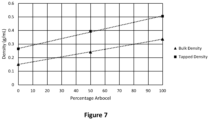
- Figure 7 shows that there is a positive correlation between the percentage of powdered cellulose (Arbocel A300) used in the content, relative to the total amount of plant-based filler (powdered cellulose and bamboo fibres) and the density (both bulk and tapped) of the content. In other words, as the percentage of powdered cellulose is increased, the compressibility of the content is improved.
- Example 1 was prepared containing powdered cellulose with an average particle size of 320 ⁇ m (ARBOCEL ® A300).
- Example 1 contained the following components: Material Purpose %w/w mg/Dose g/Batch Nicotine Active 0.70 4.21 1.05 Glycerine Humectant 6.30 37.93 9.45 Water Solvent 45.06 271.26 67.59 Sodium Carbonate pH Modifier 0.06 0.37 0.09 Acesulfame K Sweetener 0.08 0.48 0.12 BF-300 Bulking Agent (Snus Substitute) 21.90 131.84 32.85 Arbocel A300 Bulking Agent (Snus Substitute) 21.90 131.84 32.85 Peppermint flavour Flavour Extract 4.00 24.08 6.00 Total 100.00 602.01 150.00
- Arbocel A300 is powdered cellulose supplied by Pharma Excipients.
- BF-300 is JELUCEL ® BF-300 bamboo fibres supplied by Jelu-technik.
- Example 2 was prepared containing powdered cellulose with an average particle size of 320 ⁇ m (ARBOCEL ® A300).
- Example 2 contained the following components: Material Purpose %w/w mg/Dose g/Batch Nicotine Active 0.70 4.21 1.05 Glycerine Humectant 6.30 37.93 9.45 Water Solvent 45.06 271.26 67.59 Sodium Carbonate pH Modifier 0.06 0.37 0.09 Acesulfame K Sweetener 0.08 0.48 0.12 BF-300 Bulking Agent (Snus Substitute) 0.00 0.00 0.00 0.00 Arbocel A300 Bulking Agent (Snus Substitute) 43.80 263.68 65.70 Peppermint flavour Flavour Extract 4.00 24.08 6.00 Total 100.00 602.01 150.00
- Comparative Example 1 was prepared containing no powdered cellulose (only bamboo fibres were used as bulking agent). Comparative Example 1 contained the following components: Material Purpose %w/w mg/Dose g/Batch Nicotine Active 0.70 4.21 1.05 Glycerine Humectant 6.30 37.93 9.45 Water Solvent 45.06 271.26 67.59 Sodium Carbonate pH Modifier 0.06 0.37 0.09 Acesulfame K Sweetener 0.08 0.48 0.12 BF-300 Bulking Agent (Snus Substitute) 43.80 263.68 65.70 Arbocel A300 Bulking Agent (Snus Substitute) 0.00 0.00 0.00 0.00 0.00 0.00 0.00 0.00 0.00 0.00 0.00 0.00 0.00 0.00 0.00 0.00 0.00
- Example 1 The compositions of Example 1, Example 2, and Comparative Example 1 were each prepared using the following method (Protocol A):
- Comparative Example 1 ⁇ 0.151 0.265 42.8 1.75 ⁇ Prepared at lab-scale following the method of Protocol A
- the Hausner's ratio of Examples 1 and 2 and Comparative Example 1 are plotted in Figure 5 .
- powdered cellulose in particular powdered cellulose having an average particle size of 100-500 ⁇ m, e.g. about 320 ⁇ m, as a bulking agent instead of other plant-based fillers such as bamboo fibres improves the powder properties.
- the Carr's Index of Examples 1 and 2 and Comparative Example 1 are plotted in Figure 6 .
- % powdered cellulose as a proportion of the total amount of powdered cellulose and bamboo fibres increases.
- powdered cellulose in particular powdered cellulose having an average particle size of 100-500 ⁇ m, e.g. about 320 ⁇ m, as a bulking agent instead of other plant-based fillers such as bamboo fibres improves the powder properties.
- the Carr's Index and Hausner's Ratio would decrease further when moving the production from lab-scale to factory scale. More specifically, the Carr's index can be expected to decrease by ⁇ 11 % and the Hausner's Ratio can be expected to decrease by ⁇ 8 %.
- Example 2 when Example 2 is prepared on a factory scale the Carr's Index and Hausner's Ratio could be expected to be further improved to around 29.7 and 1.38 respectively.
- Another important aspect associated with the use of powdered cellulose is the increase in density. This means that during manufacture of the product, the feedstock occupies a smaller volume, and a larger mass of fibres may be processed per unit time. This increases manufacturing capacity, reducing the overall production cost for the product and increasing efficiency of the manufacturing process.
- the higher density means that the pouch may be smaller while carrying the same mass of fibre. This means that the amount of material used to manufacture the pouch per smokeless article is reduces, which reduces manufacturing cost.
- the use of powdered cellulose improved the mouth feel of the smokeless article compared to products that do not contain powdered cellulose.
Landscapes
- Chemical & Material Sciences (AREA)
- Chemical Kinetics & Catalysis (AREA)
- General Chemical & Material Sciences (AREA)
- Health & Medical Sciences (AREA)
- General Health & Medical Sciences (AREA)
- Toxicology (AREA)
- Medicinal Preparation (AREA)
- Pharmaceuticals Containing Other Organic And Inorganic Compounds (AREA)
Priority Applications (2)
| Application Number | Priority Date | Filing Date | Title |
|---|---|---|---|
| EP23190375.8A EP4505884A1 (fr) | 2023-08-08 | 2023-08-08 | Article sans fumée |
| PCT/EP2024/072171 WO2025032058A1 (fr) | 2023-08-08 | 2024-08-05 | Article sans fumée |
Applications Claiming Priority (1)
| Application Number | Priority Date | Filing Date | Title |
|---|---|---|---|
| EP23190375.8A EP4505884A1 (fr) | 2023-08-08 | 2023-08-08 | Article sans fumée |
Publications (1)
| Publication Number | Publication Date |
|---|---|
| EP4505884A1 true EP4505884A1 (fr) | 2025-02-12 |
Family
ID=87567573
Family Applications (1)
| Application Number | Title | Priority Date | Filing Date |
|---|---|---|---|
| EP23190375.8A Pending EP4505884A1 (fr) | 2023-08-08 | 2023-08-08 | Article sans fumée |
Country Status (2)
| Country | Link |
|---|---|
| EP (1) | EP4505884A1 (fr) |
| WO (1) | WO2025032058A1 (fr) |
Citations (6)
| Publication number | Priority date | Publication date | Assignee | Title |
|---|---|---|---|---|
| US20130160782A1 (en) * | 2006-03-16 | 2013-06-27 | Niconovum Ab | Snuff composition |
| US20210068447A1 (en) * | 2019-09-11 | 2021-03-11 | R. J. Reynolds Tobacco Company | Pouched products with enhanced flavor stability |
| EP3868222A1 (fr) * | 2020-02-18 | 2021-08-25 | Nerudia Limited | Article sans fumée |
| US20210307375A1 (en) * | 2019-06-07 | 2021-10-07 | Ncp Nextgen A/S | Nicotine pouch composition |
| US20220408786A1 (en) * | 2021-06-25 | 2022-12-29 | Nicoventures Trading Limited | Oral products and method of manufacture |
| EP4144231A1 (fr) * | 2020-04-28 | 2023-03-08 | Japan Tobacco Inc. | Produit en sachet pour administration orale de nicotine et son procédé de fabrication |
-
2023
- 2023-08-08 EP EP23190375.8A patent/EP4505884A1/fr active Pending
-
2024
- 2024-08-05 WO PCT/EP2024/072171 patent/WO2025032058A1/fr active Pending
Patent Citations (6)
| Publication number | Priority date | Publication date | Assignee | Title |
|---|---|---|---|---|
| US20130160782A1 (en) * | 2006-03-16 | 2013-06-27 | Niconovum Ab | Snuff composition |
| US20210307375A1 (en) * | 2019-06-07 | 2021-10-07 | Ncp Nextgen A/S | Nicotine pouch composition |
| US20210068447A1 (en) * | 2019-09-11 | 2021-03-11 | R. J. Reynolds Tobacco Company | Pouched products with enhanced flavor stability |
| EP3868222A1 (fr) * | 2020-02-18 | 2021-08-25 | Nerudia Limited | Article sans fumée |
| EP4144231A1 (fr) * | 2020-04-28 | 2023-03-08 | Japan Tobacco Inc. | Produit en sachet pour administration orale de nicotine et son procédé de fabrication |
| US20220408786A1 (en) * | 2021-06-25 | 2022-12-29 | Nicoventures Trading Limited | Oral products and method of manufacture |
Non-Patent Citations (1)
| Title |
|---|
| DÜSENBERG BJÖRN ET AL: "Flowability of plant based food powders: Almond, chestnut, chickpea, coconut, hazelnut and rice", JOURNAL OF FOOD ENGINEERING, ELSEVIER, AMSTERDAM, NL, vol. 357, 5 June 2023 (2023-06-05), XP087370188, ISSN: 0260-8774, [retrieved on 20230605], DOI: 10.1016/J.JFOODENG.2023.111606 * |
Also Published As
| Publication number | Publication date |
|---|---|
| WO2025032058A1 (fr) | 2025-02-13 |
Similar Documents
| Publication | Publication Date | Title |
|---|---|---|
| US20220202071A1 (en) | Smokeless article | |
| EP3868222A1 (fr) | Article sans fumée | |
| JP7600232B2 (ja) | ニコチン粒子を含有する充填材を含む経口袋状ニコチン製品 | |
| WO2021165418A1 (fr) | Article sans fumée | |
| EP1458252B1 (fr) | Tabac et/ou substitut de tabac en combinaison avec du tabac s'utilisant comme tabac a priser dans la cavite buccale | |
| US20220248748A1 (en) | An oral pouched nicotine product including a filling material comprising nicotine-containing particles | |
| US20020170567A1 (en) | Chewable flavor delivery system | |
| EP3868221A1 (fr) | Article sans fumée | |
| JP2009529342A (ja) | 改善された嗅ぎたばこ組成物 | |
| EP3837995A1 (fr) | Article sans fumée | |
| EP3868224A1 (fr) | Article sans fumée | |
| US20220386685A1 (en) | Smokeless article | |
| EP3861873A1 (fr) | Contenant pour article sans fumée | |
| WO2022214444A1 (fr) | Produit oral aromatisé à base de nicotine en sachet comprenant un acide | |
| EP3868223A1 (fr) | Article sans fumée | |
| EP4505883A1 (fr) | Procédé de fabrication d'un article sans fumée | |
| WO2025032058A1 (fr) | Article sans fumée | |
| EP4740755A1 (fr) | Article sans fumée | |
| EP4631366A1 (fr) | Article sans fumée | |
| RU2832481C1 (ru) | Бездымное изделие, содержащее бамбуковые волокна с дозированным количеством никотина, применение таких волокон, способ изготовления указанного изделия и комплект, содержащий бездымное изделие | |
| EP4740757A1 (fr) | Article sans fumée | |
| WO2026099514A1 (fr) | Article sans fumée | |
| EP4467010A1 (fr) | Produit en sachet et procédé de fabrication | |
| EP4740756A1 (fr) | Article sans fumée | |
| EP4670521A1 (fr) | Article sans fumée |
Legal Events
| Date | Code | Title | Description |
|---|---|---|---|
| PUAI | Public reference made under article 153(3) epc to a published international application that has entered the european phase |
Free format text: ORIGINAL CODE: 0009012 |
|
| STAA | Information on the status of an ep patent application or granted ep patent |
Free format text: STATUS: THE APPLICATION HAS BEEN PUBLISHED |
|
| AK | Designated contracting states |
Kind code of ref document: A1 Designated state(s): AL AT BE BG CH CY CZ DE DK EE ES FI FR GB GR HR HU IE IS IT LI LT LU LV MC ME MK MT NL NO PL PT RO RS SE SI SK SM TR |