EP4506000A1 - Kit antiseptique et son utilisation - Google Patents
Kit antiseptique et son utilisation Download PDFInfo
- Publication number
- EP4506000A1 EP4506000A1 EP23190191.9A EP23190191A EP4506000A1 EP 4506000 A1 EP4506000 A1 EP 4506000A1 EP 23190191 A EP23190191 A EP 23190191A EP 4506000 A1 EP4506000 A1 EP 4506000A1
- Authority
- EP
- European Patent Office
- Prior art keywords
- kit
- solution
- oxidizing agent
- use according
- reducing agent
- Prior art date
- Legal status (The legal status is an assumption and is not a legal conclusion. Google has not performed a legal analysis and makes no representation as to the accuracy of the status listed.)
- Pending
Links
Images

Classifications
-
- A—HUMAN NECESSITIES
- A61—MEDICAL OR VETERINARY SCIENCE; HYGIENE
- A61K—PREPARATIONS FOR MEDICAL, DENTAL OR TOILETRY PURPOSES
- A61K31/00—Medicinal preparations containing organic active ingredients
- A61K31/33—Heterocyclic compounds
- A61K31/335—Heterocyclic compounds having oxygen as the only ring hetero atom, e.g. fungichromin
- A61K31/365—Lactones
- A61K31/375—Ascorbic acid, i.e. vitamin C; Salts thereof
-
- A—HUMAN NECESSITIES
- A61—MEDICAL OR VETERINARY SCIENCE; HYGIENE
- A61K—PREPARATIONS FOR MEDICAL, DENTAL OR TOILETRY PURPOSES
- A61K33/00—Medicinal preparations containing inorganic active ingredients
- A61K33/20—Elemental chlorine; Inorganic compounds releasing chlorine
-
- A—HUMAN NECESSITIES
- A61—MEDICAL OR VETERINARY SCIENCE; HYGIENE
- A61P—SPECIFIC THERAPEUTIC ACTIVITY OF CHEMICAL COMPOUNDS OR MEDICINAL PREPARATIONS
- A61P17/00—Drugs for dermatological disorders
-
- A—HUMAN NECESSITIES
- A61—MEDICAL OR VETERINARY SCIENCE; HYGIENE
- A61P—SPECIFIC THERAPEUTIC ACTIVITY OF CHEMICAL COMPOUNDS OR MEDICINAL PREPARATIONS
- A61P17/00—Drugs for dermatological disorders
- A61P17/02—Drugs for dermatological disorders for treating wounds, ulcers, burns, scars, keloids, or the like
-
- A—HUMAN NECESSITIES
- A61—MEDICAL OR VETERINARY SCIENCE; HYGIENE
- A61P—SPECIFIC THERAPEUTIC ACTIVITY OF CHEMICAL COMPOUNDS OR MEDICINAL PREPARATIONS
- A61P31/00—Antiinfectives, i.e. antibiotics, antiseptics, chemotherapeutics
- A61P31/02—Local antiseptics
Definitions
- the present invention relates to the field of medical technology, in particular to devices for preparing and dispensing active substance solutions, for example wound irrigation solutions.
- the present invention further relates to the medical use of aqueous solutions for local antiseptic treatment and antiseptic kits.
- the aqueous solutions, devices and kits according to the invention can be used for the antiseptic treatment of soft tissue and bone tissue surfaces.
- Antiseptic hypochlorite solutions are well known in the art. For over a hundred years, a 4-5% sodium hypochlorite solution has been used to disinfect skin surfaces and objects. This disinfectant is generally known as Dakin's solution. The use of calcium hypochlorite and chlorinated lime is also generally known in the art. In hypochlorite solutions, the hypochlorite ions themselves and, particularly at pH values below 7, the hypochlorous acid in equilibrium with the hypochlorite ions have an antiseptic effect. Hypochlorite ions and hypochlorous acid act as oxidizing agents by transferring oxygen to the microorganisms or biofilms to be treated.
- hypochlorite solutions When using hypochlorite solutions, there is a possibility that not all of the hypochlorite is used during the actual disinfection and that residues of hypochlorite remain on the surfaces to be disinfected, especially on surfaces of human or animal tissue. As a result, local undesirable effects cannot be ruled out, especially with more highly concentrated hypochlorite solutions.
- the invention provides a device containing an active ingredient that can be used to quickly, easily and inexpensively produce a ready-to-use active ingredient solution using commercially available containers with sterile saline solution or comparable solutions. If the device according to the invention contains the active ingredient in solid form, the device can be stored for a longer period of time, even if it contains an active ingredient that is not permanently stable in aqueous solution. In addition, the sterilization of liquids is not required when producing such a device. Some active ingredients can be sterilized better in solid form because they decompose more easily in solution during sterilization.
- the device according to the invention provides the possibility of dispensing the liquid produced therein directly to a patient, for example using a nozzle that can be attached to the device according to the invention.
- the invention provides a treatment method and a kit for use in such a method in which the antiseptic active ingredient is neutralized by a reducing agent after application to the patient.
- the antiseptic solutions are preferably composed in such a way that they can convert into non-toxic decomposition products.
- the solutions are preferably composed in such a way that they are not hypotonic and bursting of human or animal cells during the disinfecting treatment is avoided by absorbing water.
- the solutions preferably do not have a pH value lower than pH 4 and no pH value higher than 8 in order to avoid damage to the tissue to be disinfected as far as possible. Accordingly, the solutions can preferably have a pH value of 4 to 8, for example from 6 to 7.5 or from 7.3 to 7.6.
- a second embodiment relates to a device according to embodiment 1, wherein the mandrel has a hollow interior adapted to receive a liquid from a container into the reservoir.
- a third embodiment relates to a device according to one of the preceding embodiments, wherein the fluidic element has a piston which is movably arranged within the reservoir and which seals the reservoir in a liquid-tight manner.
- a fourth embodiment relates to a device according to one of the preceding embodiments, which has a first component and a second component which can be detachably connected to one another.
- a fifth embodiment relates to a device according to embodiment 4, wherein the first component contains the connection element and the mandrel, and/or wherein the second component contains the reservoir, the filter and the fluidic element.
- a sixth embodiment relates to a device according to embodiment 4 or 5, wherein the device further comprises a thread by means of which the first component can be connected to the second component.
- a seventh embodiment relates to a device according to one of the preceding embodiments, wherein the device is completely sterilized, preferably completely pyrogen-free.
- An eighth embodiment relates to a device according to one of the preceding embodiments, wherein the device further comprises a spray nozzle which is designed to dispense the active ingredient in dissolved form.
- a ninth embodiment relates to a device according to embodiment 8, wherein the spray nozzle can be detachably connected to the connection element in a fluid-conducting manner.
- a tenth embodiment relates to a device according to one of the preceding embodiments, wherein the active ingredient is an antiseptic, which is preferably selected from the group consisting of calcium hypochlorite, magnesium hypochlorite, sodium hypochlorite, sodium percarbonate, sodium peroxide, calcium peroxide, urea peroxide, triisocyanuric chloride, sodium N-chloro-4-methylbenzenesulfonamide, sodium N-chlorobenzenesulfonamide, octenidine, polyhexanide and chlorhexidine digluconate.
- an antiseptic which is preferably selected from the group consisting of calcium hypochlorite, magnesium hypochlorite, sodium hypochlorite, sodium percarbonate, sodium peroxide, calcium peroxide, urea peroxide, triisocyanuric chloride, sodium N-chloro-4-methylbenzenesulfonamide, sodium N-chlorobenzenesulfonamide, oc
- connection element has a first passage which is designed to receive a liquid from a container into the reservoir.
- a twelfth embodiment relates to a device according to one of the preceding embodiments, wherein the connection element has a second passage which is designed to dispense a liquid from a container, wherein the dispensing is preferably possible in a state in which the device is connected to the reservoir via the first passage according to embodiment 11.
- a thirteenth embodiment relates to a device according to one of the preceding embodiments, wherein the reservoir is permeable to gamma rays and/or electron beams.
- a further aspect relates to a kit comprising a device according to one of embodiments 1 to 13 and a container with a medically acceptable liquid, wherein the device can be detachably connected to the container, wherein the kit is packaged together in a germ-tight manner, preferably completely sterilized, more preferably completely pyrogen-free.
- a further aspect relates to an active ingredient for use in a medical treatment method, wherein the active ingredient is dissolved in a liquid immediately before administration to a patient using a device according to one of the preceding embodiments and is then administered in dissolved form.
- a further aspect relates to the use of a device according to one of embodiments 1 to 13 for producing an active ingredient solution.
- kits for use in the local antiseptic treatment of a patient comprising an antiseptic oxidizing agent and a reducing agent, the antiseptic oxidizing agent being decomposable by reaction with the reducing agent.
- the use comprises contacting the oxidizing agent with a tissue surface of the patient and subsequent contact of the reducing agent with the tissue surface of the patient.
- the oxidizing agent and/or the reducing agent are brought into contact with the tissue surface of the patient for a period of time of 10 seconds to 300 seconds.
- the kit comprises a molar amount of the reducing agent which corresponds at least to the molar amount of the oxidizing agent.
- the oxidizing agent is selected from the group consisting of sodium hypochlorite ( CAS 7681-52-9 ), calcium hypochlorite ( CAS 7778-54-3 ) and sodium chlorite ( CAS 7758-19-2 ).
- the reducing agent is selected from the group consisting of ascorbic acid (CAS 50-81-7 ), sodium ascorbate ( CAS 134-03-2 ), potassium ascorbate ( CAS 15421-15-5 ), calcium ascorbate ( CAS 5743-27-1 ), L-cystine ( CAS 52-90-4 ) and cysteamine ( CAS 60-23-1 ).
- the kit further comprises a buffer substance, wherein the buffer substance is preferably selected from the group consisting of citric acid (CAS 77-92-9 ), sodium dihydrogen citrate ( CAS 18996-35-5 ), disodium hydrogen citrate ( CAS 6132-05-4 ), sodium dihydrogen phosphate ( CAS 7558-80-7 ), calcium dihydrogen phosphate ( CAS 7758-23-8 ), sodium hydrogen sulfate ( CAS 7681-38-1 ), disodium hydrogen phosphate ( CAS 7558-79-4 ) and trisodium phosphate ( CAS 760-54-9 ), especially preferably citric acid.
- the buffer substance is preferably selected from the group consisting of citric acid ( CAS 77-92-9 ), sodium dihydrogen citrate ( CAS 18996-35-5 ), disodium hydrogen citrate ( CAS 6132-05-4 ), sodium dihydrogen phosphate ( CAS 7558-80-7 ), calcium dihydrogen phosphate ( CAS 77
- the kit comprises a first solution containing hypochlorite ions, chlorite ions and/or hypochlorous acid in a total (cumulative) concentration of 50 ppm to 5000 ppm.
- the kit comprises a second solution containing ascorbic acid and/or ascorbate ions in a concentration of 50 ppm to 10,000 ppm.
- the kit comprises a first solution with the oxidizing agent and/or a second solution with a reducing agent each having an osmolarity of at least 310 mOsmol/L.
- the kit comprises a first solution comprising an oxidizing agent and a pH in the range of pH 4 to pH 8.
- the kit comprises a second solution comprising a reducing agent and a pH in the range of pH 4 to pH 7.
- a first solution with the oxidizing agent and/or a second solution with the reducing agent is/are each prepared immediately before contacting with the tissue surface by dissolving the oxidizing agent or reducing agent in solid form, optionally together with a buffer substance, in water.
- the kit further comprises a surfactant, the use comprising contacting the surfactant together with the oxidizing agent with a tissue surface of the patient, wherein the surfactant is preferably an alkyl sulfate.
- the device comprises an active ingredient.
- the active ingredient is preferably an antiseptic active ingredient, for example an antiseptic oxidizing agent, as described in more detail below.
- the active ingredient solution is preferably an antiseptic wound irrigation solution.
- antiseptic and “antimicrobial” are used synonymously herein and refer to a bactericidal or fungicidal, i.e. germicidal, effect of an active ingredient.
- the device can also contain an excipient.
- the active ingredient can be present as a mixture with such an excipient.
- the excipient can comprise, for example, a buffer substance.
- the excipient is selected from the group consisting of glucuronic acid, galacturonic acid, gluconic acid lactone, sodium gluconate, sodium hydrogen sulfate, sodium dihydrogen phosphate, calcium dihydrogen phosphate, citric acid and monosodium citrate.
- the device has a connection element.
- the connection element is designed and configured for the liquid-tight connection of the device to a container.
- Such containers can be, for example, packaging in which physiological saline solutions, infusion solutions and similar liquid medical products are commercially available. Common examples of this are bottles or foil bags. These containers are often made of plastic.
- the container can be a container with a flexible, preferably elastically deformable, outer wall, so that a liquid contained therein can be released from the container by squeezing the container.
- the container can comprise a septum which can be pierced with the mandrel of the device.
- the connection element of the device can preferably be connected to a container in a form-fitting manner.
- connection element can be plugged onto the opening of a plastic bottle or the connection of a foil bag.
- the device also contains a mandrel which is designed and configured to pierce a septum of a container.
- the mandrel can have a tapered shape, with the tip of which a septum of a container can be penetrated by manually exerting pressure of the mandrel on the septum. Similar structures are used to connect infusion sets to containers with infusion solutions.
- the device further comprises a reservoir.
- the reservoir contains an active ingredient in solid form, for example as a powder.
- the reservoir can have a substantially cylindrical shape, similar to the interior of a syringe.
- the device can be designed to release the active ingredient contained therein in dissolved form into the container.
- a filter is arranged at an outlet of the reservoir.
- This filter is designed to retain the active ingredient in the reservoir as long as the active ingredient is not dissolved in a liquid. In this way, it can be prevented that the active ingredient is delivered to a patient in undissolved form. However, it is desirable that the active ingredient can only be delivered to a patient in dissolved form.
- the filter can preferably be permeable to liquids.
- the filter is preferably permeable to gases.
- a gas-permeable filter makes it easier to fill the reservoir with active ingredient, for example, particularly when producing the device according to the invention.
- the active ingredient can preferably be introduced into the reservoir using compressed air or a vacuum, whereby the gas-permeable filter allows the gas to pass through but retains the active ingredient in the reservoir.
- the filter can, for example, have the shape of a disk.
- the filter preferably has an open porosity.
- the filter has open pores with a pore size of less than 5 ⁇ m, preferably less than 3 ⁇ m and particularly preferably less than 1 ⁇ m.
- This pore size can be determined by excluding spherical particles with a corresponding particle diameter. It is therefore a nominal pore size.
- the filter can be secured by a holder within the reservoir.
- the holder can be designed, for example, in the form of a clamping ring. If necessary, the filter can be secured in a recess in a wall of the reservoir.
- the filter can, for example, contain polyethylene, polyurethane, polyimide, polyethersulfone, polyvinylidene fluoride or polytetrafluoroethylene.
- the filter can be a woven filter or a non-woven filter.
- the reservoir comprises a second filter that divides the reservoir into two separate areas, i.e. a first area and a second area.
- the second filter can be secured within the reservoir by a second holder.
- the first area can contain a first active ingredient
- the second area can contain a second active ingredient that is different from the first active ingredient.
- the first active ingredient and the second active ingredient are preferably each in solid form. for example powder form.
- the reservoir can be dimensioned such that the ratio of the volumes of the reservoir and the container is in a ratio of 1:25 to 1:500.
- the volume of the container can be, for example, 250 ml, 500 ml or 1000 ml. Accordingly, the volume of the reservoir can be, for example, 0.5 to 10 ml, 1 to 20 ml, or 2 to 40 ml.
- the device further comprises a fluidic element.
- the fluidic element is preferably designed to receive a liquid from a container into the reservoir.
- the fluidic element can alternatively or additionally be designed to dispense a liquid from the reservoir.
- the fluidic element is preferably designed to actively convey a liquid.
- the fluidic element can, for example, comprise a piston for conveying a liquid.
- the fluidic element can comprise a syringe or a pump.
- the mandrel has a hollow interior that is designed to receive a liquid from a container into the reservoir.
- the mandrel can be designed in the form of a hollow needle, for example.
- the mandrel can be made of plastic, for example, or can comprise a plastic.
- the mandrel is preferably sufficiently stiff to penetrate a septum of a commercially available container for physiological saline solution, but not so hard and solid that there is a risk of injury to medical personnel.
- the mandrel is not a metal needle.
- the fluidic element has a piston that is movably arranged within the reservoir and seals the reservoir in a liquid-tight manner.
- the fluidic element can thus be designed as a syringe or syringe pump, for example.
- the fluidic element can also have other types of means for moving a liquid, e.g. a diaphragm pump, peristaltic pump, compressed air cartridge, or a connection for an external pressure or vacuum source.
- the device comprises a first component and a second component which can be detachably connected to one another.
- the first component can contain the connection element and the mandrel, and/or the second component can contain the reservoir, the filter and the fluidic element.
- the first component and the second component can be connected to one another by a connecting element, preferably a positive-locking connecting element, for example by means of a thread or snap hook.
- a preferred thread is a Luer-Lock thread.
- the first component can preferably have an external thread that can be connected to an internal thread of the second component.
- the second component can have an external thread that can be connected to an internal thread of the first component.
- the first component can be designed to be connected to a container in a fluid-conducting manner, while the second component is detached from the first component and optionally replaced with another device, for example a closure or a nozzle.
- the first component can thus serve as a type of multifunctional quick connector for other components.
- the second component can comprise a syringe, particularly preferably a Luer-Lock syringe.
- the device can comprise a connecting element to either connect individual parts of the device according to the invention, in particular the first component and the second component, to one another, or to connect the device to other devices, or both.
- a connecting element is preferably a positive-locking connecting element.
- An example of such a connecting element is a thread.
- the connecting element is a Luer-Lock thread.
- the device has a connecting element with the aid of which the first component can be connected to the second component.
- the same connecting element is additionally designed to connect the device to a closure, a nozzle or another dispensing device.
- individual, different connecting elements can be provided for these purposes.
- the device is completely sterilized. In one embodiment, the device is completely pyrogen-free.
- the term "sterilized” refers to the device having undergone a process to remove or kill pathogens so that the device can be used medically in accordance with common standards such as DIN EN 556-1. Sterilization processes include for example, autoclaving, irradiation with electron beams or gamma rays, or treatment with disinfecting substances such as ethylene oxide.
- pyrogen-free refers to the fact that the device has been subjected to a treatment customary in the art to remove or decompose pyrogens. Whether the device is pyrogen-free can be tested using the Limulus Amebocyte Lysate (LAL) test according to Ph. Eur. Chapter 2.6.14. The standards or documents that are current on the priority date of the present application apply in each case.
- LAL Limulus Amebocyte Lysate
- the device further comprises a nozzle which is designed to dispense the active ingredient in dissolved form.
- the nozzle can comprise a substantially cylindrical hollow body tapering at one end.
- the nozzle can optionally comprise a joint which allows the dispensing of a liquid in different directions by bending an opening of the nozzle laterally relative to the entire device.
- the nozzle can be detachably connected to the connection element in a fluid-conducting manner.
- a positive connection element for example a thread, preferably a Luer-Lock thread.
- the device can further comprise a shield.
- the shield can be designed to protect parts of the device from splashes of the dispensed liquid, in particular an active substance solution.
- the shield can be arranged on or in spatial proximity to the nozzle.
- the shield can have the shape of a disk.
- the shield can have a concave curvature, similar to a parabolic antenna.
- the shield can have a centrally arranged recess which is designed to attach the shield to an outlet of the device.
- the active ingredient contained in the device is an antiseptic.
- the active ingredient or antiseptic can be, for example, an antiseptic oxidizing agent.
- the antiseptic is selected from the group consisting of calcium hypochlorite, magnesium hypochlorite, sodium hypochlorite, sodium percarbonate, sodium peroxide, calcium peroxide, urea peroxide, triisocyanuric chloride, sodium N-chloro-4-methylbenzenesulfonamide, sodium N-chlorobenzenesulfonamide, octenidine, polyhexanide and chlorhexidine digluconate.
- the antiseptic is a hypochlorite salt.
- the active ingredient is present as a powder with an average particle size of less than 300 ⁇ m, preferably less than 200 ⁇ m and particularly preferably less than 100 ⁇ m.
- the small particle size enables rapid dissolution of the active ingredient particles.
- the particle size of the active ingredient can preferably be above the exclusion volume of the filter. This average diameter of the particles can be determined by fractional sieving, as is common in the art.
- the active ingredient is present as a cylindrical pellet or as a cylindrical solidified melt.
- connection element has a first passage which is designed to receive a liquid from a container into the reservoir.
- the first passage preferably forms a fluid-conducting connection between the connection element, in particular the mandrel, and the reservoir.
- the device is designed to dispense a liquid from a container.
- dispensing is preferably possible in a state in which the device is fluidically connected to the reservoir via the first passage described above.
- liquid from a container connected to the device can first be taken up into the reservoir of the device, the active ingredient contained in it can be dissolved in the liquid, and the dissolved active ingredient can then be dispensed into the container while the device is connected to the container.
- the dissolved active ingredient can then be dispensed from the container to a patient via the device while the device, in particular the first component of the device, remains connected to the container.
- the device for dispensing the dissolved active ingredient can be connected to a nozzle or another dispensing device, wherein the second component of the device can be exchanged for the nozzle or other dispensing device if necessary.
- the liquid is preferably a medically acceptable liquid.
- the liquid is preferably suitable for internal use.
- the reservoir is permeable to gamma rays and/or electron beams. This makes it possible to sterilize the interior and the active ingredient contained in the device using gamma rays and/or electron beams in order to obtain a completely sterilized device.
- the mandrel and the reservoir together define a transfer axis, wherein the liquid can be discharged from the reservoir and/or into the reservoir along this transfer axis.
- the container and the reservoir together define a transfer axis, wherein the liquid can be discharged from the reservoir and/or taken up into the reservoir along this transfer axis.
- a further aspect relates to a kit comprising a device according to one of the preceding embodiments and a container with a medically acceptable liquid, wherein the device can be detachably connected to the container.
- the components of the kit namely the device and the container, are packaged together in a germ-tight manner.
- the components of the kit are each completely sterilized.
- the components of the kit are each completely pyrogen-free.
- the kit can further contain a dispensing device for dispensing a liquid, for example a nozzle or rinsing device, for example a rinsing device according to EP4035605A1 , which is hereby incorporated in its entirety by reference.
- the medically acceptable liquid may comprise an infusion solution or medical rinsing solution.
- the medically acceptable liquid may comprise a physiological saline solution, a Ringer's solution, or a comparable saline-containing solution.
- the medically acceptable liquid is preferably sterile and/or pyrogen-free.
- a further aspect relates to an active ingredient for use in a medical treatment method, wherein the active ingredient is dissolved in a liquid using a device described herein immediately before administration to a patient and is then administered in dissolved form.
- the active ingredient can be a substance which has a pharmacological effect.
- the active ingredient can, for example, have an antimicrobial effect.
- a further aspect relates to a medical treatment method, wherein the active ingredient is dissolved in a liquid as described herein immediately before administration to a patient using a device described herein and is then administered in dissolved form.
- the liquid is preferably a medically acceptable liquid as described herein.
- the method may preferably be carried out in the order a), b), c) or a), b), c), d).
- the method may further comprise a step in which the active agent solution is dispensed from the device or from the container.
- the active agent solution may be dispensed from the container via the device, as described in more detail elsewhere herein.
- a further aspect concerns an active ingredient solution that can be produced according to a process described above.
- a further aspect relates to a use of a device or a kit described herein for preparing an active ingredient solution.
- kits for use in the local antiseptic treatment of a patient comprising an antiseptic oxidizing agent and a reducing agent, the antiseptic oxidizing agent being decomposable by reaction with the reducing agent.
- the oxidizing agent and the reducing agent are preferably present separately from one another, for example in completely separate containers, or within a container in different separate compartments of the container. Such compartments can be separated from one another, for example, by a porous membrane.
- the kit preferably comprises the oxidizing agent and the reducing agent in a form that allows the oxidizing agent and the reducing agent to be administered at separate times.
- a local antiseptic treatment means any treatment in which disinfection of tissue is carried out directly on the patient.
- Disinfection includes the Treatment with an antimicrobial agent, such as an antiseptic oxidant.
- An oxidizing agent is a substance that is capable of accepting electrons from other substances and is itself reduced in the process. By accepting electrons, an oxidizing agent causes oxidation of the reacting substances. As used herein, an antiseptic oxidizing agent can exert an antimicrobial effect through such oxidation. In some embodiments, the oxidizing agent of the invention is capable of transferring oxygen to another substance. Examples of oxidizing agents of the invention include hypochlorous acid, calcium hypochlorite, magnesium hypochlorite, sodium hypochlorite, sodium percarbonate, sodium peroxide, calcium peroxide, chlorite ion-containing solutions, and urea peroxide.
- a reducing agent is a substance that can donate electrons to other substances and is itself oxidized in the process. By donating electrons, a reducing agent leads to a reduction of the reacting substances.
- the reducing agent described herein is capable of reducing the antiseptic oxidizing agent according to the invention.
- the reducing agent is capable of decomposing the antiseptic oxidizing agent to form water.
- the antiseptic oxidizing agent loses its oxidizing property and the antiseptic effect based thereon by reacting with the reducing agent.
- a hypochlorite salt can react with a reducing agent such as sodium ascorbate to form a chloride salt.
- a basic concept of the present invention is to use oxidizing antiseptic solutions to reduce germs and to inactivate them after the exposure time has ended by exposure to a solution of a reducing agent to form non-toxic, non-oxidizing secondary products, the preferred secondary products being water and chloride ions, within a few seconds.
- a solution of a reducing agent to form non-toxic, non-oxidizing secondary products, the preferred secondary products being water and chloride ions, within a few seconds.
- This makes it easier to avoid damage to the previously treated human or animal tissue caused by remaining residues of the oxidizing antiseptic, especially at higher concentrations of the antiseptic.
- This enables the compatible use of more concentrated solutions of oxidizing antiseptics. This can significantly increase the antiseptic effect, particularly against microorganisms contained in biofilms, without subsequent toxic Damage can occur.
- Preferred oxidizing antiseptics are hypochlorite ions, hypochlorous acid and chlorite ions. These can be easily reduced to water and chloride
- Ascorbic acid and ascorbate ions react with oxygen-releasing oxidizing agents to form dehydroascorbic acid, with water being produced as a further product.
- One advantage of ascorbic acid is that ascorbic acid and dehydroascorbic acid form a redox pair that occurs naturally in the human organism.
- Dehydroascorbic acid has the additional advantage that it is highly soluble in water.
- the kit contains a first solution with hypochlorite ions and/or hypochlorous acid as oxidizing agent, and a second solution with ascorbic acid and/or ascorbate ions as reducing agent.
- Hypochlorite ions and hypochlorous acid can react with ascorbic acid to form chloride ions, water and dehydroascorbic acid. These reaction products are non-toxic and are natural components of the human organism.
- the use comprises contacting the oxidizing agent with a tissue surface of the patient and subsequently contacting the reducing agent with the tissue surface of the patient.
- a patient in particular a tissue surface of the patient, can therefore first be brought into contact with a first solution containing an antiseptic oxidizing agent for local antiseptic treatment.
- a second solution can then be brought into contact with the patient at the same location in order to inactivate residues of the first solution as described above.
- the first solution and/or the second solution can be removed after the treatment or after application of the first solution, for example by suctioning or dabbing the treated tissue surface of the patient. This allows microorganism residues, biofilm residues and other debris to be removed from the patient.
- This first solution can optionally be freshly prepared, for example as described in detail herein in connection with the device according to the invention.
- an antiseptic oxidizing agent which is present in solid form, can be dissolved in an aqueous medium by the treating doctor. This can preferably be done immediately before the treatment of the patient.
- the second solution can also be prepared in the same way, optionally immediately before the treatment, by dissolving the reducing agent in water or an aqueous solution.
- additional auxiliary substances such as buffer substances and/or surfactants can be added during these processes.
- these auxiliary substances can already be present in an aqueous medium, which is mixed with the oxidizing agent or reducing agent to form a finished solution.
- the antiseptic oxidizing agent and/or the reducing agent are provided in solid form to facilitate such fresh preparation of the respective solutions.
- the antiseptic oxidizing agent is present as a solid and the reducing agent is present as a solution.
- the antiseptic oxidizing agent is present as a solution and the reducing agent is present as a solid.
- both the antiseptic oxidizing agent and the reducing agent are present as a solid.
- both the antiseptic oxidizing agent and the reducing agent are present as a solution.
- the oxidizing agent and/or the reducing agent are each provided in sterile form.
- the kit contains the antiseptic oxidizing agent as a sterile solid. In one embodiment, the kit contains the reducing agent as a sterile solid. In one embodiment, the kit further contains one or more sterile liquids, such as water for injection, sterile saline, Ringer's solution, or other sterile aqueous components.
- sterile liquids such as water for injection, sterile saline, Ringer's solution, or other sterile aqueous components.
- the kit contains a sterile first solution with an oxidizing agent and/or a sterile second solution with a reducing agent.
- the kit may further comprise buffer substances and/or other excipients in sterile form, either as solids or as aqueous solutions.
- a first sterile solution containing an antiseptic oxidizing agent and a second sterile solution containing a reducing agent are prepared immediately before use by dissolving a sterile antiseptic oxidizing agent in solid form and dissolving a sterile reducing agent in solid form.
- the first solution can be applied to a tissue surface of the patient using a device described herein.
- the second solution can be applied to a tissue surface of the patient using a device described herein.
- the first solution and/or the second solution can in principle be applied to the tissue surface by any suitable means, for example by spraying using squirt bottles or motor-driven lavage systems.
- the first solution and/or the second solution can be removed from the tissue surface by suction or other suitable absorption, for example using a swab.
- the oxidizing agent and/or the reducing agent are brought into contact with the tissue surface of the patient for a period of time of 10 seconds to 300 seconds, for example 10 to 20 seconds, 10 to 30 seconds, 10 to 50 seconds, 10 to 60 seconds, or 10 to 120 seconds.
- the kit comprises a molar amount of the reducing agent which corresponds at least to the molar amount of the oxidizing agent. In one embodiment, the kit comprises a sufficient amount of reducing agent to completely neutralize the oxidizing agent contained in the kit.
- the oxidizing agent is selected from the group consisting of sodium hypochlorite (CAS 7681-52-9), calcium hypochlorite (CAS 7778-54-3) and sodium chlorite (CAS 7758-19-2).
- Preferred reducing agents are medically acceptable substances which react with hypochlorous acid and/or hypochlorite salts in a redox reaction to form chloride salts and water.
- the reducing agent is selected from the group consisting of ascorbic acid (CAS 50-81-7), sodium ascorbate (CAS 134-03-2), potassium ascorbate (CAS 15421-15-5), calcium ascorbate (CAS 5743-27-1), L-cystine (CAS 52-90-4) and cysteamine (CAS 60-23-1).
- the kit further comprises a buffer substance, wherein the buffer substance is preferably selected from the group consisting of Group consisting of citric acid (CAS 77-92-9), sodium dihydrogen citrate (CAS 18996-35-5), disodium hydrogen citrate (CAS 6132-05-4), sodium dihydrogen phosphate (CAS 7558-80-7), calcium dihydrogen phosphate (CAS 7758-23-8), sodium hydrogen sulfate (CAS 7681-38-1), disodium hydrogen phosphate (CAS 7558-79-4) and trisodium phosphate (CAS 760-54-9), particularly preferably citric acid.
- Particularly preferred buffer substances are medically acceptable substances which can form a clear solution with the other components of the kit, in particular the antiseptic oxidizing agent and/or the reducing agent.
- citric acid has the special advantage that it can form a water-soluble complex with calcium ions. This means that the solutions formed with calcium hypochlorite and citric acid can be completely clear.
- the kit comprises a first solution comprising hypochlorite ions, chlorite ions and/or hypochlorous acid in a total (i.e. cumulative) concentration of 50 ppm to 5000 ppm.
- the first solution contains 50 ppm to 5000 ppm hypochlorite ions.
- the first solution contains 50 ppm to 5000 ppm chlorite ions.
- the first solution contains 50 ppm to 5000 ppm hypochlorous acid.
- the first solution contains 50 ppm to 5000 ppm total of these three species, namely hypochlorite ions, chlorite ions and hypochlorous acid.
- the kit comprises a first solution containing hypochlorite ions, chlorite ions and/or hypochlorous acid in a concentration of 50 ppm to 5000 ppm.
- Chlorite ions are strong oxidizing agents and have a strong antiseptic effect.
- the unit of measurement ppm means "parts per million” and indicates, for example, how many parts of hypochlorite are present per million parts of the solution, based on the weight of the respective components and in relation to the total weight of the solution.
- the unit ppm is therefore used to express the mass fraction of a substance, for example the hypochlorite ions, in the solution.
- the unit of measurement ppm therefore always refers to a mass fraction and not to a molar fraction.
- the kit comprises a second solution containing ascorbic acid and/or ascorbate ions in a concentration of 50 ppm to 10,000 ppm.
- the kit comprises a first solution with the oxidizing agent and/or a second solution with a reducing agent each having an osmolarity of at least 310 mOsmol/L.
- the first solution and the second solution are preferably isotonic or hypertonic. This makes it possible to avoid hypotonic damage to human or animal cells by the solutions.
- the kit comprises a first solution comprising an oxidizing agent and a pH in the range of pH 4 to pH 8. In this pH range, the balance between hypochlorite ions and hypochlorous acid is on the side of hypochlorous acid. Hypochlorous acid has a higher antimicrobial activity than hypochlorite ions.
- the kit comprises a second solution comprising a reducing agent and a pH in the range of pH 4 to pH 7.
- the kit for use according to this aspect comprises a first solution comprising an oxidizing agent and a pH in the range of pH 4 to pH 8 and a second solution comprising a reducing agent and a pH in the range of pH 4 to pH 7.
- a first solution with the oxidizing agent and/or a second solution with the reducing agent is/are each prepared immediately before contacting with the tissue surface by dissolving the oxidizing agent or reducing agent in solid form, optionally together with a buffer substance, in water.
- DAIR procedure DAIR: Debridement, Antibiotics, Implant retention
- DAIR Debridement, Antibiotics, Implant retention
- the kit further comprises a surfactant, the use comprising contacting the surfactant together with the oxidizing agent with a tissue surface of the patient, wherein the surfactant is preferably an alkyl sulfate.
- the surfactant is preferably an alkyl sulfate.
- a preferred alkyl sulfate is sodium dodecyl sulfate.
- the device is preferably designed and configured to receive a liquid from a container into the reservoir, to dissolve the active ingredient in the liquid, and to deliver the dissolved active ingredient to a patient via the connection element.
- the active ingredient is preferably an antiseptic oxidizing agent.
- the device preferably comprises a reducing agent which can neutralize the oxidizing agent by a redox reaction.
- the kit may comprise two such devices, one of the devices comprising an antiseptic oxidizing agent and the other of the two devices comprising a reducing agent.
- a further aspect of the invention relates to a therapeutic method, wherein the therapeutic method comprises contacting an antiseptic oxidizing agent with a tissue surface of a patient and subsequently contacting a reducing agent with the tissue surface of the patient.
- the therapeutic method comprises contacting an antiseptic oxidizing agent with a tissue surface of a patient and subsequently contacting a reducing agent with the tissue surface of the patient.
- sodium chloride Sigma-Aldrich
- calcium hypochlorite Sigma-Aldrich
- citric acid Sigma-Aldrich
- sodium chlorite Sigma-Aldrich
- ascorbic acid Sigma-Aldrich
- sodium ascorbate Sigma-Aldrich
- Solutions A1-A7 and solutions B1 and B2 had a pH value between pH 4.7 and 5.0 as measured with a pH electrode.
- Example No. Solution C distilled water [g] NaCl [g] sodium ascorbate [g] ascorbic acid [g] C1 500 0.45 0.700 0.062 C2 500 0.45 1,400 0.122 C3 500 0.45 2,800 0.248 C4 500 0.45 3,500 0.310 C5 500 0.45 7,000 0.620 C6 500 0.45 14,000 1,240 C7 500 0.45 35.00 3.10
- Solutions C1-C7 had a pH value of 5.3-5.5 as measured with a pH electrode.
- solutions C 20 ml of solutions A1-A7, B1 and B2 were mixed with 20 ml of solutions C1-C7 in a beaker with a magnetic stirrer. After two minutes, 2.0% potassium iodine solution and 1% starch were added and it was observed whether a color change to blue-black occurred as a result of the oxidation of iodide to iodine.
- a color change to blue-black indicates the presence of undecomposed hypochlorite ions or chlorite ions, which are able to oxidize iodide ions to iodine.
- the iodine formed by the oxidation of the iodide ions forms a blue-black complex with starch.
- Solutions A1 to A7, B1 and B2 were first tested for their ability to oxidize iodide ions to iodine.
- a kit was put together from the following components.
- One kit contained a plastic bottle A, which had a septum in the bottle head, a plastic bottle C, which also had a septum, and two hollow plastic mandrels as connectors and ejection nozzles, which can pierce the septa of the two plastic bottles by piercing.
- a commercially available 500 ml plastic bottle A contained 500 ml of distilled water. Water in which 0.45 g of sodium chloride, 0.143 g of calcium hypochlorite and 0.143 g of citric acid were dissolved in a clearly visible manner.
- the commercially available 500 ml plastic bottle B contained 500 ml of distilled water in which 0.45 g of sodium chloride, 0.700 g of sodium ascorbate and 0.062 g of ascorbic acid were dissolved.
- the plastic bottles C and the hollow plastic mandrels were sterilized by gamma sterilization with a dose greater than 25 kGy.
- the solution in the plastic bottle A was sterile filtered and filled into a previously steam sterilized plastic bottle.
- a kit consisted of a plastic bottle A, which had a septum in the bottle head, a plastic bottle C, which also had a septum, and two hollow plastic mandrels as connectors and ejection nozzles, which can pierce the septa of the two plastic bottles by piercing.
- the commercially available 500 ml plastic bottle A contained 500 ml of distilled water in which 0.45 g of sodium chloride, 0.286 g of calcium hypochlorite and 0.286 g of citric acid were dissolved until clearly visible.
- the commercially available 500 ml plastic bottle B contained 500 ml of distilled water in which 0.45 g of sodium chloride, 1.400 g of sodium ascorbate and 0.122 g of ascorbic acid were dissolved.
- the plastic bottles C and the hollow plastic mandrels were sterilized by gamma sterilization with a dose greater than 25 kGy.
- the solution in plastic bottle A was sterile filtered and filled into a previously steam-
- the kit consists of a plastic bottle A, which had a septum in the bottle head, a plastic bottle C, which also had a septum, and two hollow plastic mandrels as connectors and ejection nozzles, which can pierce the septa of the two plastic bottles by piercing.
- the commercially available 500 ml plastic bottle A contained 500 ml of distilled water in which 0.45 g of sodium chloride, 0.572 g of calcium hypochlorite and 0.572 g of citric acid were dissolved until clearly visible.
- the commercially available 500 ml plastic bottle B contained 500 ml of distilled water in which 0.45 g of sodium chloride, 2.800 g of sodium ascorbate and 0.248 g of ascorbic acid were dissolved.
- the plastic bottles C and the hollow plastic mandrels were sterilized by gamma sterilization with a dose greater than 25 kGy.
- the solution in plastic bottle A was sterile filtered and filled into a previously steam
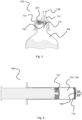
- the plastic syringes contained a Porex filter disk in their interior, which was fixed with a clamping ring directly in front of the syringe head.
- the calcium hypochlorite-citric acid mixtures were located in a cavity between the Porex filter disk and the inserted plastic piston.
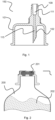
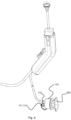
- the filled Luer-Lock plastic syringes were filled with a Figure 1
- the adapter was designed as a cap through which a hollow mandrel was passed.
- the hollow mandrel had a bevel on its underside for piercing septa.
- a first kit was made up of two commercially available plastic bottles filled with 500 ml of a 0.9% aqueous sodium chloride solution, a plastic syringe A from example 26 with an attached adapter, a plastic syringe B from example 26 and two ejection nozzles that could be screwed onto the adapters. All components of the kit were gamma sterilized with a dose of 25 kGy.
- a second kit was made up of two commercially available plastic bottles filled with 500 ml of a 0.9% aqueous sodium chloride solution, a plastic syringe A from example 27 with an attached adapter, a plastic syringe B from example 27 and two ejection nozzles that could be screwed onto the adapters. All components of the kit were gamma sterilized with a dose of 25 kGy.
- a third kit was made up of two commercially available plastic bottles filled with 500 ml of a 0.9% aqueous sodium chloride solution, a plastic syringe A from example 28 with an attached adapter, a plastic syringe B from example 28 and two ejection nozzles that could be screwed onto the adapters. All components of the kit were gamma sterilized with a dose of 25 kGy.
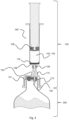
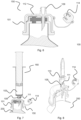
- the kit of examples 26-28 was used in such a way that the adapter with the connected plastic syringe A was first pierced through the septum of the first plastic bottle. The plastic bottle was then tilted at an angle and the aqueous sodium chloride solution was sucked in using the syringe plunger. The mixture contained in the plastic bottle began to dissolve. The solution formed was injected back into the plastic bottle by operating the plunger. The process was repeated twice until all the mixture particles in the interior of the plastic syringe had dissolved. The plastic syringe was then unscrewed and an ejection nozzle was screwed onto the adapter.
- the adapter with the connected plastic syringe C was pierced through the septum of the second plastic bottle, which contained 500 ml of aqueous saline solution.
- the plastic bottle was then tilted at an angle and the aqueous sodium chloride solution was sucked in using the syringe plunger.
- the mixture contained in the plastic bottle began to dissolve.
- the solution formed was injected back into the plastic bottle by operating the plunger. The process was repeated twice until all the mixture particles in the interior of the plastic syringe had dissolved.
- the plastic syringe was then unscrewed and an ejection nozzle was screwed onto the adapter.
- Solution A was squeezed out of the first plastic bottle by squeezing the plastic bottle and directing the liquid jet through the ejection nozzle.
- the surface to be disinfected was disinfected with the resulting solution. After 2 minutes, an equal volume of solution C was sprayed onto the previously treated surface. After an exposure time of approximately two minutes, the liquid remaining on the surface was vacuumed off.
Landscapes
- Health & Medical Sciences (AREA)
- Veterinary Medicine (AREA)
- Animal Behavior & Ethology (AREA)
- Public Health (AREA)
- Chemical & Material Sciences (AREA)
- Life Sciences & Earth Sciences (AREA)
- General Health & Medical Sciences (AREA)
- Medicinal Chemistry (AREA)
- Pharmacology & Pharmacy (AREA)
- Nuclear Medicine, Radiotherapy & Molecular Imaging (AREA)
- General Chemical & Material Sciences (AREA)
- Chemical Kinetics & Catalysis (AREA)
- Organic Chemistry (AREA)
- Dermatology (AREA)
- Bioinformatics & Cheminformatics (AREA)
- Engineering & Computer Science (AREA)
- Epidemiology (AREA)
- Inorganic Chemistry (AREA)
- Oncology (AREA)
- Communicable Diseases (AREA)
- Pharmaceuticals Containing Other Organic And Inorganic Compounds (AREA)
- Apparatus For Disinfection Or Sterilisation (AREA)
Priority Applications (3)
| Application Number | Priority Date | Filing Date | Title |
|---|---|---|---|
| EP23190191.9A EP4506000A1 (fr) | 2023-08-08 | 2023-08-08 | Kit antiseptique et son utilisation |
| PCT/EP2024/072232 WO2025032084A1 (fr) | 2023-08-08 | 2024-08-06 | Kit antiseptique contenant un oxydant et un agent réducteur, et son utilisation |
| AU2024321204A AU2024321204A1 (en) | 2023-08-08 | 2024-08-06 | Antiseptic kit containing an oxidant and a reducing agent, and use thereof |
Applications Claiming Priority (1)
| Application Number | Priority Date | Filing Date | Title |
|---|---|---|---|
| EP23190191.9A EP4506000A1 (fr) | 2023-08-08 | 2023-08-08 | Kit antiseptique et son utilisation |
Publications (1)
| Publication Number | Publication Date |
|---|---|
| EP4506000A1 true EP4506000A1 (fr) | 2025-02-12 |
Family
ID=87567746
Family Applications (1)
| Application Number | Title | Priority Date | Filing Date |
|---|---|---|---|
| EP23190191.9A Pending EP4506000A1 (fr) | 2023-08-08 | 2023-08-08 | Kit antiseptique et son utilisation |
Country Status (3)
| Country | Link |
|---|---|
| EP (1) | EP4506000A1 (fr) |
| AU (1) | AU2024321204A1 (fr) |
| WO (1) | WO2025032084A1 (fr) |
Citations (20)
| Publication number | Priority date | Publication date | Assignee | Title |
|---|---|---|---|---|
| US243781A (en) | 1881-07-05 | Revolving cake and fruit stand | ||
| US3749672A (en) | 1971-04-19 | 1973-07-31 | Du Pont | Stabilized solutions of n-halo compounds |
| WO1991003936A1 (fr) | 1989-09-15 | 1991-04-04 | Auchincloss Thomas R | Compositions effervescentes |
| US6162371A (en) | 1997-12-22 | 2000-12-19 | S. C. Johnson & Son, Inc. | Stabilized acidic chlorine bleach composition and method of use |
| US6471974B1 (en) | 1999-06-29 | 2002-10-29 | S.C. Johnson & Son, Inc. | N-chlorosulfamate compositions having enhanced antimicrobial efficacy |
| US20090148342A1 (en) | 2007-10-29 | 2009-06-11 | Bromberg Steven E | Hypochlorite Technology |
| US20090258083A1 (en) | 2008-04-11 | 2009-10-15 | Justo Leonardo Calderon | Method of producing and applications of composition of hypochlorous acid |
| WO2010148004A1 (fr) | 2009-06-15 | 2010-12-23 | Oculus Innovative Sciences, Inc. | Solution contenant de l'acide hypochloreux, et procédés d'utilisation de cette solution |
| US20110236490A1 (en) | 2008-12-18 | 2011-09-29 | Nevoa Solutions | Treatment or prevention of viral infection by chlorination |
| WO2016100543A2 (fr) | 2014-12-16 | 2016-06-23 | Puricore, Inc. | Formulations d'acide hypochloreux et méthodes de traitement des maladies de peau |
| US20190328776A1 (en) | 2018-04-25 | 2019-10-31 | Reoxcyn, Llc | Compositions and methods for the treatment of cystic fibrosis |
| WO2020089693A1 (fr) | 2018-11-02 | 2020-05-07 | Wiab Water Innovation Ab | Compositions pour traiter des biofilms sans induire de résistance antimicrobienne |
| WO2020174436A1 (fr) | 2019-02-28 | 2020-09-03 | Clinical Health Technologies Ltd | Solutions d'acide hypochloreux stabilisées et leurs utilisations médicales et cosmétiques |
| WO2020252433A1 (fr) | 2019-06-14 | 2020-12-17 | Collidion, Inc. | Compositions, kits, procédés et utilisations pour prévenir la croissance microbienne |
| WO2021001789A1 (fr) | 2019-07-03 | 2021-01-07 | Apr Applied Pharma Research, S.A. | Utilisations thérapeutiques de solutions acides oxydantes hypotoniques |
| WO2021134041A1 (fr) | 2019-12-26 | 2021-07-01 | Nevoa Life Sciences Holdings, Inc. | Acide hypochloreux de longue conservation |
| WO2021162736A1 (fr) | 2020-02-14 | 2021-08-19 | Collidion, Inc. | Compositions, kits, procédés et utilisations pour le nettoyage, la désinfection, la stérilisation et/ou le traitement |
| WO2022038507A1 (fr) | 2020-08-17 | 2022-02-24 | Jacobus Johannes Viljoen | Solution destinée à être utilisée dans le traitement de l'hypoxémie et d'une asphyxie potentielle |
| EP4035605A1 (fr) | 2021-01-28 | 2022-08-03 | Heraeus Medical GmbH | Dispositif de nettoyage chirurgical |
| CN115252883A (zh) * | 2022-03-04 | 2022-11-01 | 久益康恒基(广东)健康产业科技有限公司 | 一种对体表损伤快速修复和灭菌的复合液体敷料配方 |
-
2023
- 2023-08-08 EP EP23190191.9A patent/EP4506000A1/fr active Pending
-
2024
- 2024-08-06 AU AU2024321204A patent/AU2024321204A1/en active Pending
- 2024-08-06 WO PCT/EP2024/072232 patent/WO2025032084A1/fr not_active Ceased
Patent Citations (21)
| Publication number | Priority date | Publication date | Assignee | Title |
|---|---|---|---|---|
| US243781A (en) | 1881-07-05 | Revolving cake and fruit stand | ||
| US3749672A (en) | 1971-04-19 | 1973-07-31 | Du Pont | Stabilized solutions of n-halo compounds |
| WO1991003936A1 (fr) | 1989-09-15 | 1991-04-04 | Auchincloss Thomas R | Compositions effervescentes |
| US6162371A (en) | 1997-12-22 | 2000-12-19 | S. C. Johnson & Son, Inc. | Stabilized acidic chlorine bleach composition and method of use |
| US6471974B1 (en) | 1999-06-29 | 2002-10-29 | S.C. Johnson & Son, Inc. | N-chlorosulfamate compositions having enhanced antimicrobial efficacy |
| US20090148342A1 (en) | 2007-10-29 | 2009-06-11 | Bromberg Steven E | Hypochlorite Technology |
| US20090258083A1 (en) | 2008-04-11 | 2009-10-15 | Justo Leonardo Calderon | Method of producing and applications of composition of hypochlorous acid |
| US8945630B2 (en) | 2008-04-11 | 2015-02-03 | Aquilabs S.A. | Method of producing and applications of composition of hypochlorous acid |
| US20110236490A1 (en) | 2008-12-18 | 2011-09-29 | Nevoa Solutions | Treatment or prevention of viral infection by chlorination |
| WO2010148004A1 (fr) | 2009-06-15 | 2010-12-23 | Oculus Innovative Sciences, Inc. | Solution contenant de l'acide hypochloreux, et procédés d'utilisation de cette solution |
| WO2016100543A2 (fr) | 2014-12-16 | 2016-06-23 | Puricore, Inc. | Formulations d'acide hypochloreux et méthodes de traitement des maladies de peau |
| US20190328776A1 (en) | 2018-04-25 | 2019-10-31 | Reoxcyn, Llc | Compositions and methods for the treatment of cystic fibrosis |
| WO2020089693A1 (fr) | 2018-11-02 | 2020-05-07 | Wiab Water Innovation Ab | Compositions pour traiter des biofilms sans induire de résistance antimicrobienne |
| WO2020174436A1 (fr) | 2019-02-28 | 2020-09-03 | Clinical Health Technologies Ltd | Solutions d'acide hypochloreux stabilisées et leurs utilisations médicales et cosmétiques |
| WO2020252433A1 (fr) | 2019-06-14 | 2020-12-17 | Collidion, Inc. | Compositions, kits, procédés et utilisations pour prévenir la croissance microbienne |
| WO2021001789A1 (fr) | 2019-07-03 | 2021-01-07 | Apr Applied Pharma Research, S.A. | Utilisations thérapeutiques de solutions acides oxydantes hypotoniques |
| WO2021134041A1 (fr) | 2019-12-26 | 2021-07-01 | Nevoa Life Sciences Holdings, Inc. | Acide hypochloreux de longue conservation |
| WO2021162736A1 (fr) | 2020-02-14 | 2021-08-19 | Collidion, Inc. | Compositions, kits, procédés et utilisations pour le nettoyage, la désinfection, la stérilisation et/ou le traitement |
| WO2022038507A1 (fr) | 2020-08-17 | 2022-02-24 | Jacobus Johannes Viljoen | Solution destinée à être utilisée dans le traitement de l'hypoxémie et d'une asphyxie potentielle |
| EP4035605A1 (fr) | 2021-01-28 | 2022-08-03 | Heraeus Medical GmbH | Dispositif de nettoyage chirurgical |
| CN115252883A (zh) * | 2022-03-04 | 2022-11-01 | 久益康恒基(广东)健康产业科技有限公司 | 一种对体表损伤快速修复和灭菌的复合液体敷料配方 |
Non-Patent Citations (6)
| Title |
|---|
| CAS , no. 6132-05-4 |
| CAS, no. 18996-35-5 |
| PAULA ZWICKER ET AL: "Antiseptic efficacy of two mouth rinses in the oral cavity to identify a suitable rinsing solution in radiation- or chemotherapy induced mucositis", BMC ORAL HEALTH, BIOMED CENTRAL LTD, LONDON, UK, vol. 23, no. 1, 26 March 2023 (2023-03-26), pages 1 - 7, XP021316367, DOI: 10.1186/S12903-023-02884-5 * |
| SIDDIQI AHMED ET AL: "What Is the Optimal Irrigation Solution in the Management of Periprosthetic Hip and Knee Joint Infections?", THE JOURNAL OF ARTHROPLASTY, ELSEVIER, AMSTERDAM, NL, vol. 36, no. 10, 26 May 2021 (2021-05-26), pages 3570 - 3583, XP086795585, ISSN: 0883-5403, [retrieved on 20210526], DOI: 10.1016/J.ARTH.2021.05.032 * |
| WANG L ET AL: "Hypochlorous Acid as a Potential Wound Care Agent Part I. Stabilized Hypochlorous Acid: A Component of the Inorganic Armamentarium of Innate Immunity", JOURNAL OF BURNS AND WOUNDS, vol. 6, 11 April 2007 (2007-04-11), US, pages 65 - 79, XP055166217, ISSN: 1554-0766 * |
| WRIGHT PATRICIA ET AL: "Alkaline Sodium Hypochlorite Irrigant and Its Chemical Interactions", vol. 10, no. 10, 29 September 2017 (2017-09-29), pages 1147, XP055939458, Retrieved from the Internet <URL:https://www.ncbi.nlm.nih.gov/pmc/articles/PMC5666953/pdf/materials-10-01147.pdf> DOI: 10.3390/ma10101147 * |
Also Published As
| Publication number | Publication date |
|---|---|
| AU2024321204A1 (en) | 2026-03-26 |
| WO2025032084A1 (fr) | 2025-02-13 |
Similar Documents
| Publication | Publication Date | Title |
|---|---|---|
| DE60127290T3 (de) | Erzeugung eines therapeutischen mikroschaums | |
| DE60035016T2 (de) | Aktivsauerstoff enthaltende Lösung zur Förderung von Gewebewachstum an Wundstellen | |
| EP0399549B2 (fr) | Système de poche avec deux chambres pour dialyse péritonéale | |
| DE3878616T2 (de) | Sterilisierbare vorrichtung fuer die aufbewahrung von blut. | |
| EP3656432A1 (fr) | Dispositif d'application temporaire et locale de fluides | |
| DE3834634C2 (de) | Antiseptikum-enthaltendes Alginat-Abdruckmaterial | |
| EP0655002A1 (fr) | Objets bactericides et/ou fongicides en matieres plastiques a usage medical | |
| EP3795196B1 (fr) | Dispositif d'application temporaire et locale de fluides | |
| EP0700249A1 (fr) | Agents anti-infectieux | |
| DE60037657T2 (de) | Infektionsmittel enthaltendes medizinisches gerät und verfahren zu ihrer darstellung | |
| EP1259200B1 (fr) | Dispositif de preparation et d'application de materiaux d'implant | |
| EP2740468A1 (fr) | Procédé de libération de principe actif et systèmes de libération de principe actif | |
| DE102010012179A1 (de) | Vorrichtung für die Peritonealdialyse | |
| DE2303364C3 (de) | Sterilisiermittel für Wasser, insbesondere Trinkwasser | |
| WO2025032084A1 (fr) | Kit antiseptique contenant un oxydant et un agent réducteur, et son utilisation | |
| EP3854437B1 (fr) | Dispositif d'application temporaire et locale des fluides | |
| EP4585254A1 (fr) | Solution de rinçage de plaie pour éliminer des biofilms | |
| EP4458343B1 (fr) | Dispositif de préparation et de distribution de solution antiseptique pour le lavage des plaies | |
| EP2647397B1 (fr) | Concentré acide pour dialyse | |
| DE3913391C2 (de) | Toxikologische Stabilisierung von Chloramin T | |
| DE3505536C2 (de) | Verfahren und Arzneimittelbehälter zur Verarbreichung von Medikamenten o.dgl. an in Wasserbehältern gehaltene Tiere, insbesondere Fische | |
| DE10207968A1 (de) | Lösungsvermittler für ein karbonisiertes Wurzelkanal-Füllmaterial auf Calciumhydroxidbasis | |
| DE102009042791A1 (de) | Halbfeste Zubereitungen biologischer Arzneimittel | |
| DE102013006596A1 (de) | Verfahren zum Herstellen einer sterilen intraokularen Spül-Lösung und Spül-Lösung | |
| DE2537303A1 (de) | Waessrige loesung fuer die verteilung von jod in einem jodophor und deren verwendung |
Legal Events
| Date | Code | Title | Description |
|---|---|---|---|
| PUAI | Public reference made under article 153(3) epc to a published international application that has entered the european phase |
Free format text: ORIGINAL CODE: 0009012 |
|
| STAA | Information on the status of an ep patent application or granted ep patent |
Free format text: STATUS: REQUEST FOR EXAMINATION WAS MADE |
|
| 17P | Request for examination filed |
Effective date: 20230808 |
|
| AK | Designated contracting states |
Kind code of ref document: A1 Designated state(s): AL AT BE BG CH CY CZ DE DK EE ES FI FR GB GR HR HU IE IS IT LI LT LU LV MC ME MK MT NL NO PL PT RO RS SE SI SK SM TR |
|
| STAA | Information on the status of an ep patent application or granted ep patent |
Free format text: STATUS: EXAMINATION IS IN PROGRESS |