EP4506231A1 - Procédé et dispositif de détermination de contact - Google Patents
Procédé et dispositif de détermination de contact Download PDFInfo
- Publication number
- EP4506231A1 EP4506231A1 EP22936454.2A EP22936454A EP4506231A1 EP 4506231 A1 EP4506231 A1 EP 4506231A1 EP 22936454 A EP22936454 A EP 22936454A EP 4506231 A1 EP4506231 A1 EP 4506231A1
- Authority
- EP
- European Patent Office
- Prior art keywords
- electrode
- contact
- threshold
- capacitance
- electrode portion
- Prior art date
- Legal status (The legal status is an assumption and is not a legal conclusion. Google has not performed a legal analysis and makes no representation as to the accuracy of the status listed.)
- Withdrawn
Links
Images

Classifications
-
- H—ELECTRICITY
- H03—ELECTRONIC CIRCUITRY
- H03K—PULSE TECHNIQUE
- H03K17/00—Electronic switching or gating, i.e. not by contact-making and –breaking
- H03K17/94—Electronic switching or gating, i.e. not by contact-making and –breaking characterised by the way in which the control signals are generated
- H03K17/96—Touch switches
- H03K17/962—Capacitive touch switches
-
- B—PERFORMING OPERATIONS; TRANSPORTING
- B62—LAND VEHICLES FOR TRAVELLING OTHERWISE THAN ON RAILS
- B62D—MOTOR VEHICLES; TRAILERS
- B62D1/00—Steering controls, i.e. means for initiating a change of direction of the vehicle
- B62D1/02—Steering controls, i.e. means for initiating a change of direction of the vehicle vehicle-mounted
- B62D1/04—Hand wheels
- B62D1/046—Adaptations on rotatable parts of the steering wheel for accommodation of switches
-
- G—PHYSICS
- G01—MEASURING; TESTING
- G01R—MEASURING ELECTRIC VARIABLES; MEASURING MAGNETIC VARIABLES
- G01R27/00—Arrangements for measuring resistance, reactance, impedance, or electric characteristics derived therefrom
- G01R27/02—Measuring real or complex resistance, reactance, impedance, or other two-pole characteristics derived therefrom, e.g. time constant
- G01R27/26—Measuring inductance or capacitance; Measuring quality factor, e.g. by using the resonance method; Measuring loss factor; Measuring dielectric constants ; Measuring impedance or related variables
- G01R27/2605—Measuring capacitance
-
- G—PHYSICS
- G01—MEASURING; TESTING
- G01R—MEASURING ELECTRIC VARIABLES; MEASURING MAGNETIC VARIABLES
- G01R31/00—Arrangements for testing electric properties; Arrangements for locating electric faults; Arrangements for electrical testing characterised by what is being tested not provided for elsewhere
- G01R31/28—Testing of electronic circuits, e.g. by signal tracer
- G01R31/282—Testing of electronic circuits specially adapted for particular applications not provided for elsewhere
- G01R31/2829—Testing of circuits in sensor or actuator systems
-
- G—PHYSICS
- G01—MEASURING; TESTING
- G01V—GEOPHYSICS; GRAVITATIONAL MEASUREMENTS; DETECTING MASSES OR OBJECTS; TAGS
- G01V3/00—Electric or magnetic prospecting or detecting; Measuring magnetic field characteristics of the earth, e.g. declination, deviation
- G01V3/08—Electric or magnetic prospecting or detecting; Measuring magnetic field characteristics of the earth, e.g. declination, deviation operating with magnetic or electric fields produced or modified by objects or geological structures or by detecting devices
- G01V3/088—Electric or magnetic prospecting or detecting; Measuring magnetic field characteristics of the earth, e.g. declination, deviation operating with magnetic or electric fields produced or modified by objects or geological structures or by detecting devices operating with electric fields
-
- B—PERFORMING OPERATIONS; TRANSPORTING
- B62—LAND VEHICLES FOR TRAVELLING OTHERWISE THAN ON RAILS
- B62D—MOTOR VEHICLES; TRAILERS
- B62D1/00—Steering controls, i.e. means for initiating a change of direction of the vehicle
- B62D1/02—Steering controls, i.e. means for initiating a change of direction of the vehicle vehicle-mounted
- B62D1/04—Hand wheels
- B62D1/06—Rims, e.g. with heating means; Rim covers
-
- H—ELECTRICITY
- H03—ELECTRONIC CIRCUITRY
- H03K—PULSE TECHNIQUE
- H03K2217/00—Indexing scheme related to electronic switching or gating, i.e. not by contact-making or -breaking covered by H03K17/00
- H03K2217/94—Indexing scheme related to electronic switching or gating, i.e. not by contact-making or -breaking covered by H03K17/00 characterised by the way in which the control signal is generated
- H03K2217/96—Touch switches
- H03K2217/9607—Capacitive touch switches
- H03K2217/960705—Safety of capacitive touch and proximity switches, e.g. increasing reliability, fail-safe
-
- H—ELECTRICITY
- H03—ELECTRONIC CIRCUITRY
- H03K—PULSE TECHNIQUE
- H03K2217/00—Indexing scheme related to electronic switching or gating, i.e. not by contact-making or -breaking covered by H03K17/00
- H03K2217/94—Indexing scheme related to electronic switching or gating, i.e. not by contact-making or -breaking covered by H03K17/00 characterised by the way in which the control signal is generated
- H03K2217/96—Touch switches
- H03K2217/9607—Capacitive touch switches
- H03K2217/960755—Constructional details of capacitive touch and proximity switches
- H03K2217/960775—Emitter-receiver or "fringe" type detection, i.e. one or more field emitting electrodes and corresponding one or more receiving electrodes
Definitions
- the present invention relates to a contact determination method and a contact determination device for determining contact of a driver with a steering wheel.
- WO2021/095478 discloses a technique in which two electrodes are provided on an outer peripheral portion of a steering wheel via an insulator to overlap each other, and contact of a driver with the steering wheel is determined.
- a steering wheel has a complicated surface rather than a flat surface. Therefore, when a sheet-shaped electrode and an insulator are attached to the steering wheel, it is necessary to attach the sheet-shaped electrode and the insulator by using a jig or the like in accordance with a complicated surface of the steering wheel. However, when there is a failure in the electrode or the electrode is damaged at the time of the attachment operation, a part of the electrode may be cut. In such a state, the electrode becomes abnormal, and it is impossible to perform appropriate contact determination.
- An object of the present invention is to more reliably determine an abnormal state of an electrode portion in a case of determining contact of a driver with a steering wheel.
- An aspect of the present invention relates to a contact determination method for determining contact of a driver with a steering wheel based on an electric signal detected from a sheet-shaped electrode portion, the electrode portion being formed by laminating a first electrode and a second electrode with an insulator interposed therebetween and being provided to cover an outer peripheral portion of the steering wheel.
- the contact determination method includes a detection step of detecting a capacitance and an impedance generated in the electrode portion, and a determination step of determining, based on the capacitance and the impedance detected in the detection step, whether a hand of the driver is in contact with the steering wheel and whether the electrode portion is abnormal. In the determination step, it is determined that the electrode portion is abnormal when the capacitance exceeds a first threshold and the impedance is less than a second threshold.
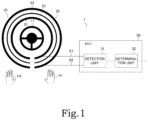
- FIG. 1 is a diagram illustrating a simplified configuration example of a contact determination device 1.
- the contact determination device 1 is a device installed in a vehicle, and is a device that determines whether hands H1 and H2 of a driver of the vehicle are in contact with a steering wheel 10.
- the steering wheel 10 is installed in front of a seat (driver seat) on which a driver sits.
- the contact determination device 1 includes a sheet-shaped electrode portion 20 provided on the steering wheel 10, and an electronic control unit (ECU) 30.
- the electrode portion 20 functions as a so-called touch sensor, and is a sheet-shaped electrode portion formed by laminating a first electrode 21 and a second electrode 22 with an insulator 23 interposed therebetween.
- the first electrode 21 may also be referred to as an active shield electrode, and the second electrode 22 may also be referred to as a sensor electrode.
- the touch sensor implemented by the electrode portion 20 is, for example, a capacitance type touch sensor.
- the steering wheel 10 is an operation member including a core metal 11 that forms a framework of the steering wheel 10 and is formed of metal material, and is used when a driver who drives the vehicle steers the vehicle.
- a substantially circular ring-shaped gripping portion of the steering wheel 10 is a portion gripped by the hands of the driver who drives the vehicle, and the periphery of the core metal 11 is covered by a substrate.
- An insulating material is used as the substrate.
- a resin material such as urethane is used as the substrate.
- the first electrode 21 is a sheet-shaped electrode electrically connected to the ECU 30 via a signal line S1.
- the second electrode 22 is a sheet-shaped electrode electrically connected to the ECU 30 via a signal line S2.
- the insulator 23 is an elastic sheet-shaped insulator, for example, an insulating sheet.
- the electrode portion 20 is attached to an outer peripheral portion of the substrate constituting the gripping portion of the steering wheel 10 to cover the substrate in a circumferential direction of the steering wheel 10.
- the first electrode 21 is disposed on an inner peripheral side of the steering wheel 10
- the second electrode 22 is disposed on the outer peripheral side of the steering wheel 10.
- FIG. 1 illustrates an example in which the electrode portion 20 is provided in all portions of the steering wheel 10 in the circumferential direction
- the electrode portion 20 may be provided in a part of the steering wheel 10 in the circumferential direction.
- the exterior portion is preferably formed of insulating leather or resin. In this way, the electrode portion 20 is disposed between the substrate and the exterior portion in the gripping portion of the steering wheel 10. That is, the electrode portion 20 is covered by the exterior portion.
- the ECU 30 controls each unit based on various programs stored in a storage unit (not illustrated), and includes a detection unit 31 and a determination unit 32.
- the ECU 30 is implemented by a processing device such as a central processing unit (CPU).
- the storage unit stores various types of information (for example, control programs and detection values) necessary for the ECU 30 to perform various types of processing.
- a read only memory (ROM), a random access memory (RAM), a hard disk drive (HDD), a solid state drive (SSD), or a combination thereof may be used.
- the detection unit 31 is connected to the first electrode 21 via the signal line S1, is connected to the second electrode 22 via the signal line S2, detects a capacitance and an impedance generated in the first electrode 21 and the second electrode 22, and outputs the detection result to the determination unit 32.
- the detection unit 31 supplies an alternating current signal to the electrode portion 20, and detects the capacitance and the impedance generated in the first electrode 21 and the second electrode 22 based on a response signal acquired in response to the alternating current signal.
- a well-known measurement method can be used as a method for measuring the capacitance and the impedance.
- the impedance can be detected based on a ratio (current/voltage) of signals acquired from measurement results obtained by applying the alternating current signal to the electrode portion 20 and simultaneously measuring the voltage and the current.
- a ratio current/voltage
- an absolute self-capacitance type electrostatic IC capable of simultaneously measuring sensor inputs of a plurality of zones and having a characteristic that a drive waveform of a sensor is a sine wave can be adopted as the detection unit 31.
- the electrostatic IC drives a shield electrode (first electrode 21), and compares a drive waveform thereof with an input waveform from a sensor electrode (second electrode 22).
- the electrostatic IC performs digital conversion on a difference waveform obtained by the comparison, and demodulates and integrates the difference waveform subjected to the digital conversion with a sin component and a cos component of a drive frequency to calculate detection values.
- the impedance is calculated based on the calculation result of the sin component
- the capacitance is calculated based on the calculation result of the cos component.
- the detection unit 31 can output a sine wave to the electrode portion 20 and detect the capacitance and the impedance based on a difference in phase and amplitude between the sine wave and a response wave.
- the hands of the driver come into contact with or approach the steering wheel 10
- the hands of the driver approach the second electrode 22, and a capacitance Crg of the second electrode 22 changes.
- the capacitance Crg of the second electrode 22 can be detected by a capacitance method such as a self-capacitance method or a mutual capacitance method. That is, the detection unit 31 can detect the capacitance generated in the second electrode 22 according to the contact of the driver with the steering wheel 10 by the capacitance method such as a self-capacitance method or a mutual capacitance method.
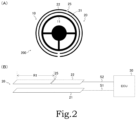
- FIG. 2 is a diagram illustrating an example in which a part of the second electrode 22 is cut.
- a position 25 where a part of the second electrode 22 is cut in the steering wheel 10 is illustrated in a simplified manner.
- a part of the configuration of the contact determination device 1 illustrated in FIG. 1 is omitted.
- (B) of FIG. 2 schematically illustrates a relationship among the first electrode 21, the second electrode 22, and the ECU 30 for ease of description.
- a step of attaching the electrode portion 20 to the steering wheel 10 will be described.
- conductive cloth obtained by subjecting cloth woven in a mesh structure to a metal plating treatment is used as the sheet-shaped first electrode 21 and the sheet-shaped second electrode 22.
- the conductive cloth has flexibility and extensibility, but it is also assumed that the metal plating is peeled off or the mesh of the conductive cloth is easily widened.
- the sheet-shaped electrode portion 20 when the sheet-shaped electrode portion 20 is attached to the steering wheel 10, it is necessary to wind the sheet-shaped electrode portion 20 around the steering wheel 10 using a jig such as a perforating rod. However, since the steering wheel 10 has no flat surface, the sheet-shaped electrode portion 20 is wound around a complicated surface. At the time of the attachment operation, it is also assumed that the conductive cloth may be stretched, or the conductive cloth may be further damaged by an excessive pushing operation by the perforating rod while the conductive cloth is stretched. It is also assumed that an electrode of the conductive cloth has a problem such as a failure.
- FIG. 2 schematically illustrates a case where the sheet-shaped first electrode 21 and the sheet-shaped second electrode 22 are arranged in parallel to each other for ease of description. Such a cut portion may be referred to as a plating crack.
- the second electrode 22 is in an electric connection state while the electrodes of the cut portion are in contact with each other.
- This connection state can also be referred to as pseudo contact.
- both the capacitance and the resistance between the first electrode 21 and the second electrode 22 tend to have normal values.
- FIG. 3 is a diagram illustrating a contact determination example as a comparative example. Specifically, an example of a relationship between the capacitance generated in the electrode portion 20 and a determination value ⁇ AD used when determining the contact of the driver with the steering wheel 10 is illustrated.
- FIG. 3 illustrates an example of a case where the electrode portion 20 is in a normal state, that is, a case where there is no abnormality in the electrode portion 20, and (B) of FIG. 3 illustrates an example of a case where the electrode portion 20 is in a disconnection state, that is, a case where there is an abnormality in the electrode portion 20.
- (B) of FIG. 3 illustrates an example of a case where the position 25 is the cut portion, similar to the example illustrated in (B) of FIG. 2 .
- a state where the second electrode 22 is cut is referred to as an abnormal state, but the same can be applied to a case where the first electrode 21 is cut or a case where the abnormal state occurs for other reasons.
- the present invention is not limited thereto, and the case where the electrode portion 20 is abnormal may be referred to as a case where the electrode portion 20 is failed, a case where the electrode portion 20 has a problem, or the like.
- the determination value ⁇ AD used in the comparative example can be obtained by the following Expression 1.
- Crg represents the capacitance generated between the hand of the driver and the second electrode 22 when the hand approaches the second electrode 22.
- Crs represents the capacitance between the first electrode 21 and the second electrode 22. That is, Crs means a capacitance originally held by the electrode portion 20.
- a difference value of ⁇ AD shown in Expression 1 may be used as the determination value.
- ⁇ AD Crg/ Crs + Crg
- the capacitance Crs between the first electrode 21 and the second electrode 22 can be obtained by the following Expression 2.
- ⁇ rs represents a dielectric constant between the first electrode 21 and the second electrode 22.
- drs represents a distance between the first electrode 21 and the second electrode 22.
- Srs represents an area of the second electrode 22.
- Crs ⁇ rs Srs/drs
- a capacitance Crgl between the core metal 11 and the second electrode 22 and a capacitance Csg between the core metal 11 and the first electrode 21 are also generated, and descriptions thereof are omitted here.
- the capacitance Crs between the first electrode 21 and the second electrode 22 is normally a fixed value.
- a value of the capacitance Crg changes according to a contact state of the driver on the steering wheel 10. Specifically, in a state where the hand of the driver is not in contact with the steering wheel 10, the value of the capacitance Crg is 0 or close to 0.
- the value of the capacitance Crg increases according to the degree of contact. That is, when the driver grips the steering wheel 10, the capacitance Crg is added, and the determination value ⁇ AD increases. When the driver continues to grip the steering wheel 10, the determination value ⁇ AD is maintained at a high value. On the other hand, when the driver releases the steering wheel 10, the determination value ⁇ AD rapidly decreases.
- a capacitance Crs2 between the first electrode 21 and the second electrode 22 in the case where the electrode portion 20 is in the disconnection state is less than a capacitance Crs1 between the first electrode 21 and the second electrode 22 in the case where the electrode portion 20 is in the normal state.
- the contact determination device 1 may make an erroneous determination. Therefore, in the present embodiment, an example in which the contact determination is performed using a decrease in a capacitance component and an increase in a resistance component in the case where the electrode portion 20 is in the disconnection state is illustrated. Accordingly, for example, a logic that does not determine that there is the contact when the capacitance component decreases and the resistance component increases apparently due to the cut of the electrode can be implemented.
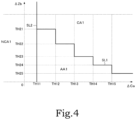
- FIG. 4 is a diagram illustrating an example of determination processing for performing a contact determination based on a capacitance ⁇ Ca and an impedance ⁇ Zb generated in the electrode portion 20.
- a horizontal axis illustrated in FIG. 4 represents the capacitance ⁇ Ca, and a vertical axis illustrated in FIG. 4 represents the impedance ⁇ Zb.
- the impedance means a resistance when an alternating current flows, and is also referred to as an alternating current resistance.
- the capacitance ⁇ Ca illustrated in FIG. 4 means the capacitance generated in the second electrode 22 in response to the contact of the driver with the steering wheel 10.
- the impedance ⁇ Zb means the impedance between the first electrode 21 and the second electrode 22.
- a slop ( ⁇ Zb/ ⁇ Ca) of the capacitance ⁇ Ca and the impedance ⁇ Zb is a low value, for example, about 1/8 to 1/15 even when the driver grips the steering wheel 10. That is, in the case where the electrode portion 20 is in the normal state, the slop ( ⁇ Zb/ ⁇ Ca) of the capacitance ⁇ Ca and the impedance ⁇ Zb is small even when the driver grips the steering wheel 10.
- the capacitance Crg increases according to the contact state of the driver on the steering wheel 10.
- the resistance between the first electrode 21 and the second electrode 22 is changed by the contact of the driver as illustrated in FIGS. 2 and 3 in the case where the second electrode 22 is in the cut state due to the contact of the driver. That is, in the case where the second electrode 22 is in the cut state due to the contact of the driver, the resistance value changes to a small value according to the contact state of the driver. Therefore, the variation of the impedance ⁇ Zb becomes large. That is, since the impedance ⁇ Zb greatly decreases according to the contact state of the driver, the variation also increases.
- an absolute value of the slop ( ⁇ Zb/ ⁇ Ca) of the capacitance ⁇ Ca and the impedance ⁇ Zb is a high value, for example, 1 to 2 or more. That is, in the case where the electrode portion 20 is in the abnormal state, when the driver grips the steering wheel 10, the slope ( ⁇ Zb/ ⁇ Ca) of the capacitance ⁇ Ca and the impedance ⁇ Zb increases. That is, a change amount of the impedance ⁇ Zb greatly varies with respect to a change amount of the capacitance ⁇ Ca.
- the resistance between the first electrode 21 and the second electrode 22 does not change due to the contact of the driver, but the resistance value becomes small. Therefore, in the case where the second electrode 22 is in the cut state regardless of the presence or absence of the contact of the driver, the value of the impedance ⁇ Zb becomes small.
- the contact determination is performed using the relationship between the capacitance ⁇ Ca and the impedance ⁇ Zb. Specifically, when the capacitance ⁇ Ca is equal to or less than a contact threshold TH11 indicated by a straight line SL2, it is determined that there is non-contact. That is, when an intersection point of the capacitance ⁇ Ca and the impedance ⁇ Zb is present in a non-contact region NCA1, it is determined that there is the non-contact.
- the capacitance ⁇ Ca exceeds the contact threshold TH11 indicated by the straight line SL2, it is determined that there is the contact.
- the capacitance ⁇ Ca exceeds the contact threshold TH11 (straight line SL2), when the impedance ⁇ Zb is equal to or less than a stepped polygonal line SL1, it is assumed that the electrode portion 20 is in the abnormal state, for example, the second electrode 22 is in the cut state, and thus it is determined that there is an abnormality.
- the contact threshold TH11 is a contact determination threshold used when determining the contact of the driver with the steering wheel 10.
- the contact threshold TH11 can be appropriately set based on experiment data or the like.
- the contact threshold TH11 may be a fixed value, or may be variable depending on the driver, an internal environment of the vehicle, and a surrounding environment of the vehicle, such as a temperature and humidity.
- the stepped polygonal line SL1 represents an abnormality determination threshold used when determining the abnormality in the electrode portion 20.
- the abnormality determination threshold is set to TH21.
- the capacitance ⁇ Ca is in a range larger than TH12 and equal to or less than TH13
- the abnormality determination threshold is set to TH22.
- TH23 to TH25 are set as the abnormality determination thresholds according to ranges (TH13 to TH15) of the capacitance ⁇ Ca in the same manner. In this way, the values TH21 to TH25 that decrease with an increase in the capacitance ⁇ Ca can be set as the abnormality determination thresholds.
- FIG. 4 illustrates an example in which the abnormality determination thresholds TH21 to TH25 that decrease stepwise are set
- another threshold that decreases in accordance with an increase in the capacitance ⁇ Ca may be set as the abnormality determination threshold.
- a value TH shown in the following Expression 3 can be set as the abnormality determination threshold.
- DC1 and ⁇ 1 represent diagnostic coefficients, and can be appropriately set based on experiment data or the like.
- TH ⁇ Ca ⁇ DC1 + ⁇ 1
- FIG. 4 for ease of description, an example in which the contact determination is performed using the relationship between the latest capacitance ⁇ Ca and the latest impedance ⁇ Zb is illustrated.
- an abnormal value may be detected due to variation, radio noise, or the like, it is preferable to use detection results of a plurality of detections in order to eliminate such an abnormal value and improve reliability.
- FIG. 5 This example is illustrated in FIG. 5 .
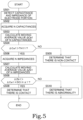
- FIG. 5 is a flowchart illustrating an example of contact determination processing in the contact determination device 1.
- the contact determination processing is executed by the ECU 30 based on a program stored in the storage unit (not illustrated).
- the contact determination processing is always executed in each control cycle.
- the determination unit 32 holds the capacitance and the impedance detected by the detection unit 31 a predetermined number of times.
- the predetermined number of times is a value equal to or larger than N.
- N represents a value appropriately set based on experiment data or the like.
- step S501 the detection unit 31 detects the capacitance ⁇ Ca and the impedance ⁇ Zb of the electrode portion 20.
- step S502 the determination unit 32 acquires N capacitances among the capacitances detected by the detection unit 31.
- the N capacitances are N values from the capacitance acquired last to the capacitance acquired N times before.
- step S503 the determination unit 32 calculates a moving average value ⁇ Cal of the N capacitances acquired in step S501.
- the moving average value ⁇ Cal means an average value of the N capacitances.
- FIG. 5 illustrates an example in which the moving average value ⁇ Cal is used, as described above, a single capacitance may be used, or other values calculated by using one or more capacitances may be used.
- step S504 the determination unit 32 determines whether the moving average value ⁇ Cal calculated in step S503 is larger than the contact threshold TH11 (see FIG. 4 ). when the moving average value ⁇ Cal is equal to or less than the contact threshold TH11, the processing proceeds to step S505. On the other hand, when the moving average value ⁇ Ca1 is larger than the contact threshold TH11, the processing proceeds to step S506.
- step S505 the determination unit 32 determines that the hand of the driver is not in contact with the steering wheel 10. That is, since the moving average value ⁇ Cal is present in the non-contact region NCA1 (see FIG. 4 ), it is determined that there is the non-contact.
- step S506 the determination unit 32 acquires N impedances among the impedances detected by the detection unit 31.
- the N impedances are N values from the last acquired impedance to the impedances acquired N times before.
- step S507 the determination unit 32 calculates a moving average value ⁇ Zb1 of the N impedances acquired in step S505.
- the moving average value ⁇ Zb1 means an average value of the N impedances.
- FIG. 5 illustrates an example in which the moving average value ⁇ Zb1 is used, as described above, a single impedance may be used, or other values calculated by using one or more impedances may be used.
- step S508 the determination unit 32 determines whether the moving average value ⁇ Zb1 calculated in step S507 satisfies Expression 4 described above. when the moving average value ⁇ Zb1 satisfies Expression 4 described above, the processing proceeds to step S509. On the other hand, when the moving average value ⁇ Zb1 does not satisfy Expression 4 described above, the processing proceeds to step S510.
- step S509 the determination unit 32 determines that the hand of the driver is in contact with the steering wheel 10. That is, since an intersection point of the moving average value ⁇ Zb1 and the moving average value ⁇ Cal is present in the contact region CA1 (see FIG. 4 ), it is determined that there is the contact.
- step S510 the determination unit 32 determines that the contact determination device 1 is abnormal. That is, since the intersection point of the moving average value ⁇ Zb1 and the moving average value ⁇ Ca1 is present in the abnormal region AA1 (see FIG. 4 ), it is determined that there is an abnormality.
- the determination unit 32 outputs a determination result to be used for autonomous driving or outputting an alarm. For example, when it is determined that the driver drives the vehicle with his or her hand released at a predetermined autonomous driving level, an alarm is output. For example, an alarm may be output when it is determined that an abnormality is present in the electrode portion 20.
- FIG. 5 illustrates an example in which it is determined that the electrode portion 20 is abnormal even when the number of times that the moving average value ⁇ Cal exceeds the contact threshold TH11 and the moving average value ⁇ Zb1 becomes equal to or less than the abnormality determination threshold (abnormality determination threshold TH shown in Expression 3 is one. However, it may be determined that the electrode portion 20 is abnormal when the number of times that the moving average value ⁇ Ca1 exceeds the contact threshold TH11 and the moving average value ⁇ Zb1 becomes equal to or less than the abnormality determination threshold (abnormality determination threshold TH shown in Expression 3) is equal to or larger than a predetermined number (2 or more). Accordingly, even if an abnormal value is detected due to variation, radio noise, or the like, the abnormal value can be eliminated, thereby improving a determination accuracy of the contact determination.
- the abnormal state of the electrode portion 20 can be more reliably determined using the capacitance ⁇ Ca and the impedance ⁇ Zb of the electrode portion 20. Accordingly, for example, it is possible to prevent an appropriate contact determination from not being performed due to an electrode failure. By only changing the logic of the software, the determination accuracy of the contact determination can be improved, and robustness can be improved.
- a contact determination method is a contact determination method for determining contact of a driver with the steering wheel 10 based on the electric signal detected from the sheet-shaped electrode portion 20, the electrode portion 20 formed by laminating the first electrode 21 and the second electrode 22 with the insulator 23 interposed therebetween and being provided to cover the outer peripheral portion of the steering wheel 10.
- the contact determination method includes a detection step (step S501) of detecting the capacitance ⁇ Ca and the impedance ⁇ Zb generated in the electrode portion 20, and a determination step (steps S502 to S510) of determining, based on the capacitance ⁇ Ca and the impedance ⁇ Zb detected in the detection step, whether the hand of the driver is in contact with the steering wheel 10 and whether the electrode portion 20 is abnormal.
- a determination step step S504, S508, and S510
- the electrode portion 20 is abnormal.
- the abnormal state of the electrode portion 20 can be more reliably determined using the capacitance ⁇ Ca and the impedance ⁇ Zb of the electrode portion 20.
- a fixed value is set as the contact threshold TH11 (example of first threshold), and a variable value that decreases in accordance with an increase in the capacitance is set as the abnormality determination threshold (polygonal line SL1 (see FIG. 4 ), and abnormality determination threshold TH shown in Expression 3 (example of second threshold)).
- the abnormality determination threshold TH shown in Expression 3 is a value ( ⁇ Ca ⁇ DC1 + ⁇ 1) calculated based on the capacitance ⁇ Ca and the predetermined coefficients (DC1, ⁇ 1).
- the electrode portion 20 is determined to be abnormal when the number of times that the moving average value ⁇ Ca1 of the predetermined number of the capacitances detected within a predetermined time exceeds the contact threshold TH11 (example of first threshold) and the moving average value ⁇ Zb1 of the predetermined number of the impedances detected within the predetermined time is less than the abnormality determination threshold (polygonal line SL1 (see FIG. 4 ), abnormality determination threshold TH shown in Expression 3 (example of second threshold)) is equal to or larger than a predetermined number.
- steps S504 and S505 it is determined that the hand of the driver is not in contact with the steering wheel 10 when the moving average value ⁇ Cal of the predetermined number of the capacitances detected within the predetermined time is equal to or less than the contact threshold TH11 (example of first threshold).
- steps S504, S508, and S509 it is determined that the hand of the driver is in contact with the steering wheel 10 when the moving average value ⁇ Cal of the capacitances is larger than the contact threshold TH11 and the moving average value ⁇ Zb1 of the predetermined number of the impedances detected within the predetermined time is larger than the abnormality determination threshold (polygonal line SL1 (see FIG.
- abnormality determination threshold TH shown in Expression 3 (example of second threshold)
- steps S504, S508, and S510 it is determined that the electrode portion 20 is abnormal when the moving average value ⁇ Ca1 of the capacitances is larger than the contact threshold TH11 and the moving average value ⁇ Zb1 of the impedances is equal to or smaller than the abnormality determination threshold.
- the electrode portion 20 is configured such that the second electrode 22 is disposed outside the steering wheel 10 and the first electrode 21 is disposed inside the steering wheel 10.
- the capacitance ⁇ Ca generated in the second electrode 22 and the impedance ⁇ Zb generated between the first electrode 21 and the second electrode 22 are detected based on a difference between the alternating current signal input to the electrode portion 20 and the response signal acquired in response to the alternating current signal.
- the contact determination device 1 is a contact determination device that determines contact of a driver with the steering wheel 10 based on the electric signal detected from the sheet-shaped electrode portion 20, the electrode portion 20 formed by laminating the first electrode 21 and the second electrode 22 with the insulator 23 interposed therebetween and being provided to cover the outer peripheral portion of the steering wheel 10.
- the contact determination device 1 includes the detection unit 31 configured to detect the capacitance ⁇ Ca and the impedance ⁇ Zb generated in the electrode portion 20, and the determination unit 32 configured to determine, based on the capacitance ⁇ Ca and the impedance ⁇ Zb detected by the detection unit 31, whether the hand of the driver is in contact with the steering wheel 10 and whether the electrode portion 20 is abnormal.
- the determination unit 32 determines that the electrode portion 20 is abnormal.
- the abnormal state of the electrode portion 20 can be more reliably determined using the capacitance ⁇ Ca and the impedance ⁇ Zb of the electrode portion 20.
- Each processing procedure described in the present embodiment is an example for implementing the present embodiment, and an order of a part of each processing procedure may be changed within the scope of implementing the present embodiment, or a part of each processing procedure may be omitted or other processing procedures may be added.
- the processing described in the present embodiment is executed based on a program for causing a computer to execute each processing procedure. Therefore, the present embodiment can be understood as an embodiment of a program that implements a function of executing the processing and a recording medium that stores the program.
- the program can be stored in a storage device of the contact determination device by performing update processing for adding a new function to the contact determination device. Accordingly, it is possible to cause the updated contact determination device to perform the processing described in the present embodiment.
Landscapes
- Engineering & Computer Science (AREA)
- Physics & Mathematics (AREA)
- General Physics & Mathematics (AREA)
- Life Sciences & Earth Sciences (AREA)
- Remote Sensing (AREA)
- Electromagnetism (AREA)
- Environmental & Geological Engineering (AREA)
- Geology (AREA)
- General Life Sciences & Earth Sciences (AREA)
- Geophysics (AREA)
- Chemical & Material Sciences (AREA)
- Combustion & Propulsion (AREA)
- Transportation (AREA)
- Mechanical Engineering (AREA)
- General Engineering & Computer Science (AREA)
- Steering Controls (AREA)
Applications Claiming Priority (1)
| Application Number | Priority Date | Filing Date | Title |
|---|---|---|---|
| PCT/JP2022/017065 WO2023195052A1 (fr) | 2022-04-04 | 2022-04-04 | Procédé et dispositif de détermination de contact |
Publications (2)
| Publication Number | Publication Date |
|---|---|
| EP4506231A1 true EP4506231A1 (fr) | 2025-02-12 |
| EP4506231A4 EP4506231A4 (fr) | 2025-06-11 |
Family
ID=88242637
Family Applications (1)
| Application Number | Title | Priority Date | Filing Date |
|---|---|---|---|
| EP22936454.2A Withdrawn EP4506231A4 (fr) | 2022-04-04 | 2022-04-04 | Procédé et dispositif de détermination de contact |
Country Status (5)
| Country | Link |
|---|---|
| US (1) | US20250222972A1 (fr) |
| EP (1) | EP4506231A4 (fr) |
| JP (1) | JP7722565B2 (fr) |
| CN (1) | CN119072426A (fr) |
| WO (1) | WO2023195052A1 (fr) |
Families Citing this family (3)
| Publication number | Priority date | Publication date | Assignee | Title |
|---|---|---|---|---|
| JP7577103B2 (ja) * | 2022-11-30 | 2024-11-01 | 本田技研工業株式会社 | ステアリング装置 |
| DE112024001309T5 (de) * | 2023-03-17 | 2026-01-29 | Alps Alpine Co., Ltd. | Elektrostatischer detektor |
| WO2025243647A1 (fr) * | 2024-05-22 | 2025-11-27 | アルプスアルパイン株式会社 | Dispositif capteur |
Family Cites Families (4)
| Publication number | Priority date | Publication date | Assignee | Title |
|---|---|---|---|---|
| JP6475791B2 (ja) * | 2017-07-24 | 2019-02-27 | 本田技研工業株式会社 | ステアリングホイールユニット |
| FR3065294B1 (fr) * | 2018-06-27 | 2020-10-02 | Autoliv Dev | Dispositif capacitif de detection de la presence d'une personne a proximite d'un composant d'un vehicule automobile |
| JP2021079767A (ja) | 2019-11-15 | 2021-05-27 | 株式会社東海理化電機製作所 | 接触検出装置 |
| JP7344810B2 (ja) * | 2020-02-17 | 2023-09-14 | 本田技研工業株式会社 | ステアリングホイールユニット |
-
2022
- 2022-04-04 CN CN202280094118.8A patent/CN119072426A/zh active Pending
- 2022-04-04 WO PCT/JP2022/017065 patent/WO2023195052A1/fr not_active Ceased
- 2022-04-04 JP JP2024513581A patent/JP7722565B2/ja active Active
- 2022-04-04 EP EP22936454.2A patent/EP4506231A4/fr not_active Withdrawn
- 2022-04-04 US US18/851,517 patent/US20250222972A1/en active Pending
Also Published As
| Publication number | Publication date |
|---|---|
| JP7722565B2 (ja) | 2025-08-13 |
| CN119072426A (zh) | 2024-12-03 |
| EP4506231A4 (fr) | 2025-06-11 |
| US20250222972A1 (en) | 2025-07-10 |
| WO2023195052A1 (fr) | 2023-10-12 |
| JPWO2023195052A1 (fr) | 2023-10-12 |
Similar Documents
| Publication | Publication Date | Title |
|---|---|---|
| EP4506231A1 (fr) | Procédé et dispositif de détermination de contact | |
| CN112135766B (zh) | 方向盘、方向盘系统、控制方向盘的方法以及非临时计算机可读存储介质 | |
| US9524067B2 (en) | Capacitive touch screen with adaptive touch sensing threshold based on sharpness of the capacitive data | |
| US5453929A (en) | Control system with driver monitor | |
| US11794800B2 (en) | Steering-wheel grip sensor and grip detection method | |
| US6499359B1 (en) | Compressible capacitance sensor for determining the presence of an object | |
| CN109291928B (zh) | 方向盘单元 | |
| CN113165553B (zh) | 基于冗余耦合测量的电容式传感器保护诊断 | |
| CN113711064B (zh) | 多通道电容感测测量电路 | |
| US20220349928A1 (en) | Method for estimating the insulation resistance of a high-voltage circuit in an electric or hybrid motor vehicle | |
| US20240030914A1 (en) | Method for detecting contact with a manually activated steering device, in particular a vehicle steering wheel, and a device for carrying out the method | |
| US20250162642A1 (en) | Steering apparatus | |
| JP2006136983A (ja) | ロボットハンド用分布型触覚センサの検出方法及びロボットハンド | |
| CN112203889A (zh) | 用于车辆的控制系统 | |
| US20240264011A1 (en) | Load detecting device | |
| WO2025257896A1 (fr) | Procédé et dispositif de détermination de contact | |
| US11847281B2 (en) | Electrostatic-capacitance detection sensor | |
| CN110174972A (zh) | 触控系统、操作方法以及非暂态电脑可读取记录媒体 | |
| US12135400B2 (en) | Contact determination device and contact determination method | |
| EP4512691A1 (fr) | Dispositif et programme de détection de préhension | |
| CN112344981B (zh) | 用于比率分析接近度感测的方法和系统 | |
| US20250128752A1 (en) | Hands-on detection device and computer program | |
| JP2006080366A (ja) | ケーブル状圧電素子及びそれを用いた振動検知センサ | |
| JP6028604B2 (ja) | タッチセンサ | |
| US12535341B2 (en) | Proximity sensor system, steering device, and fault diagnostic method for proximity sensor |
Legal Events
| Date | Code | Title | Description |
|---|---|---|---|
| STAA | Information on the status of an ep patent application or granted ep patent |
Free format text: STATUS: THE INTERNATIONAL PUBLICATION HAS BEEN MADE |
|
| PUAI | Public reference made under article 153(3) epc to a published international application that has entered the european phase |
Free format text: ORIGINAL CODE: 0009012 |
|
| STAA | Information on the status of an ep patent application or granted ep patent |
Free format text: STATUS: REQUEST FOR EXAMINATION WAS MADE |
|
| 17P | Request for examination filed |
Effective date: 20241101 |
|
| AK | Designated contracting states |
Kind code of ref document: A1 Designated state(s): AL AT BE BG CH CY CZ DE DK EE ES FI FR GB GR HR HU IE IS IT LI LT LU LV MC MK MT NL NO PL PT RO RS SE SI SK SM TR |
|
| A4 | Supplementary search report drawn up and despatched |
Effective date: 20250513 |
|
| RIC1 | Information provided on ipc code assigned before grant |
Ipc: G01R 31/28 20060101ALI20250507BHEP Ipc: B62D 1/04 20060101ALI20250507BHEP Ipc: G01R 27/26 20060101ALI20250507BHEP Ipc: H03K 17/96 20060101ALI20250507BHEP Ipc: B62D 1/06 20060101AFI20250507BHEP |
|
| DAV | Request for validation of the european patent (deleted) | ||
| DAX | Request for extension of the european patent (deleted) | ||
| STAA | Information on the status of an ep patent application or granted ep patent |
Free format text: STATUS: THE APPLICATION HAS BEEN WITHDRAWN |
|
| 18W | Application withdrawn |
Effective date: 20250915 |