EP4506496A1 - Non-tissé utilisant une fibre d'hyaluronate et son procédé de fabrication - Google Patents
Non-tissé utilisant une fibre d'hyaluronate et son procédé de fabrication Download PDFInfo
- Publication number
- EP4506496A1 EP4506496A1 EP22935859.3A EP22935859A EP4506496A1 EP 4506496 A1 EP4506496 A1 EP 4506496A1 EP 22935859 A EP22935859 A EP 22935859A EP 4506496 A1 EP4506496 A1 EP 4506496A1
- Authority
- EP
- European Patent Office
- Prior art keywords
- hyaluronate
- fibers
- woven fabric
- fiber
- present
- Prior art date
- Legal status (The legal status is an assumption and is not a legal conclusion. Google has not performed a legal analysis and makes no representation as to the accuracy of the status listed.)
- Pending
Links
Images


Classifications
-
- A—HUMAN NECESSITIES
- A45—HAND OR TRAVELLING ARTICLES
- A45D—HAIRDRESSING OR SHAVING EQUIPMENT; EQUIPMENT FOR COSMETICS OR COSMETIC TREATMENTS, e.g. FOR MANICURING OR PEDICURING
- A45D44/00—Other cosmetic or toiletry articles, e.g. for hairdressers' rooms
-
- A—HUMAN NECESSITIES
- A61—MEDICAL OR VETERINARY SCIENCE; HYGIENE
- A61K—PREPARATIONS FOR MEDICAL, DENTAL OR TOILETRY PURPOSES
- A61K47/00—Medicinal preparations characterised by the non-active ingredients used, e.g. carriers or inert additives; Targeting or modifying agents chemically bound to the active ingredient
- A61K47/30—Macromolecular organic or inorganic compounds, e.g. inorganic polyphosphates
- A61K47/36—Polysaccharides; Derivatives thereof, e.g. gums, starch, alginate, dextrin, hyaluronic acid, chitosan, inulin, agar or pectin
-
- A—HUMAN NECESSITIES
- A61—MEDICAL OR VETERINARY SCIENCE; HYGIENE
- A61K—PREPARATIONS FOR MEDICAL, DENTAL OR TOILETRY PURPOSES
- A61K8/00—Cosmetics or similar toiletry preparations
- A61K8/02—Cosmetics or similar toiletry preparations characterised by special physical form
-
- A—HUMAN NECESSITIES
- A61—MEDICAL OR VETERINARY SCIENCE; HYGIENE
- A61K—PREPARATIONS FOR MEDICAL, DENTAL OR TOILETRY PURPOSES
- A61K8/00—Cosmetics or similar toiletry preparations
- A61K8/02—Cosmetics or similar toiletry preparations characterised by special physical form
- A61K8/0212—Face masks
-
- A—HUMAN NECESSITIES
- A61—MEDICAL OR VETERINARY SCIENCE; HYGIENE
- A61K—PREPARATIONS FOR MEDICAL, DENTAL OR TOILETRY PURPOSES
- A61K8/00—Cosmetics or similar toiletry preparations
- A61K8/02—Cosmetics or similar toiletry preparations characterised by special physical form
- A61K8/0241—Containing particulates characterized by their shape and/or structure
- A61K8/027—Fibers; Fibrils
-
- A—HUMAN NECESSITIES
- A61—MEDICAL OR VETERINARY SCIENCE; HYGIENE
- A61K—PREPARATIONS FOR MEDICAL, DENTAL OR TOILETRY PURPOSES
- A61K8/00—Cosmetics or similar toiletry preparations
- A61K8/18—Cosmetics or similar toiletry preparations characterised by the composition
- A61K8/72—Cosmetics or similar toiletry preparations characterised by the composition containing organic macromolecular compounds
- A61K8/73—Polysaccharides
-
- A—HUMAN NECESSITIES
- A61—MEDICAL OR VETERINARY SCIENCE; HYGIENE
- A61K—PREPARATIONS FOR MEDICAL, DENTAL OR TOILETRY PURPOSES
- A61K8/00—Cosmetics or similar toiletry preparations
- A61K8/18—Cosmetics or similar toiletry preparations characterised by the composition
- A61K8/72—Cosmetics or similar toiletry preparations characterised by the composition containing organic macromolecular compounds
- A61K8/73—Polysaccharides
- A61K8/735—Mucopolysaccharides, e.g. hyaluronic acid; Derivatives thereof
-
- A—HUMAN NECESSITIES
- A61—MEDICAL OR VETERINARY SCIENCE; HYGIENE
- A61K—PREPARATIONS FOR MEDICAL, DENTAL OR TOILETRY PURPOSES
- A61K9/00—Medicinal preparations characterised by special physical form
- A61K9/70—Web, sheet or filament bases ; Films; Fibres of the matrix type containing drug
-
- A—HUMAN NECESSITIES
- A61—MEDICAL OR VETERINARY SCIENCE; HYGIENE
- A61L—METHODS OR APPARATUS FOR STERILISING MATERIALS OR OBJECTS IN GENERAL; DISINFECTION, STERILISATION OR DEODORISATION OF AIR; CHEMICAL ASPECTS OF BANDAGES, DRESSINGS, ABSORBENT PADS OR SURGICAL ARTICLES; MATERIALS FOR BANDAGES, DRESSINGS, ABSORBENT PADS OR SURGICAL ARTICLES
- A61L15/00—Chemical aspects of, or use of materials for, bandages, dressings or absorbent pads
- A61L15/16—Bandages, dressings or absorbent pads for physiological fluids such as urine or blood, e.g. sanitary towels, tampons
- A61L15/22—Bandages, dressings or absorbent pads for physiological fluids such as urine or blood, e.g. sanitary towels, tampons containing macromolecular materials
- A61L15/28—Polysaccharides or their derivatives
-
- A—HUMAN NECESSITIES
- A61—MEDICAL OR VETERINARY SCIENCE; HYGIENE
- A61L—METHODS OR APPARATUS FOR STERILISING MATERIALS OR OBJECTS IN GENERAL; DISINFECTION, STERILISATION OR DEODORISATION OF AIR; CHEMICAL ASPECTS OF BANDAGES, DRESSINGS, ABSORBENT PADS OR SURGICAL ARTICLES; MATERIALS FOR BANDAGES, DRESSINGS, ABSORBENT PADS OR SURGICAL ARTICLES
- A61L31/00—Materials for other surgical articles, e.g. stents, stent-grafts, shunts, surgical drapes, guide wires, materials for adhesion prevention, occluding devices, surgical gloves, tissue fixation devices
- A61L31/04—Macromolecular materials
-
- A—HUMAN NECESSITIES
- A61—MEDICAL OR VETERINARY SCIENCE; HYGIENE
- A61Q—SPECIFIC USE OF COSMETICS OR SIMILAR TOILETRY PREPARATIONS
- A61Q19/00—Preparations for care of the skin
-
- D—TEXTILES; PAPER
- D01—NATURAL OR MAN-MADE THREADS OR FIBRES; SPINNING
- D01D—MECHANICAL METHODS OR APPARATUS IN THE MANUFACTURE OF ARTIFICIAL FILAMENTS, THREADS, FIBRES, BRISTLES OR RIBBONS
- D01D5/00—Formation of filaments, threads, or the like
- D01D5/08—Melt spinning methods
- D01D5/084—Heating filaments, threads or the like, leaving the spinnerettes
-
- D—TEXTILES; PAPER
- D01—NATURAL OR MAN-MADE THREADS OR FIBRES; SPINNING
- D01F—CHEMICAL FEATURES IN THE MANUFACTURE OF ARTIFICIAL FILAMENTS, THREADS, FIBRES, BRISTLES OR RIBBONS; APPARATUS SPECIALLY ADAPTED FOR THE MANUFACTURE OF CARBON FILAMENTS
- D01F9/00—Artificial filaments or the like of other substances; Manufacture thereof; Apparatus specially adapted for the manufacture of carbon filaments
-
- D—TEXTILES; PAPER
- D02—YARNS; MECHANICAL FINISHING OF YARNS OR ROPES; WARPING OR BEAMING
- D02G—CRIMPING OR CURLING FIBRES, FILAMENTS, THREADS, OR YARNS; YARNS OR THREADS
- D02G1/00—Producing crimped or curled fibres, filaments, yarns, or threads, giving them latent characteristics
-
- D—TEXTILES; PAPER
- D04—BRAIDING; LACE-MAKING; KNITTING; TRIMMINGS; NON-WOVEN FABRICS
- D04H—MAKING TEXTILE FABRICS, e.g. FROM FIBRES OR FILAMENTARY MATERIAL; FABRICS MADE BY SUCH PROCESSES OR APPARATUS, e.g. FELTS, NON-WOVEN FABRICS; COTTON-WOOL; WADDING ; NON-WOVEN FABRICS FROM STAPLE FIBRES, FILAMENTS OR YARNS, BONDED WITH AT LEAST ONE WEB-LIKE MATERIAL DURING THEIR CONSOLIDATION
- D04H1/00—Non-woven fabrics formed wholly or mainly of staple fibres or like relatively short fibres
- D04H1/40—Non-woven fabrics formed wholly or mainly of staple fibres or like relatively short fibres from fleeces or layers composed of fibres without existing or potential cohesive properties
- D04H1/42—Non-woven fabrics formed wholly or mainly of staple fibres or like relatively short fibres from fleeces or layers composed of fibres without existing or potential cohesive properties characterised by the use of certain kinds of fibres insofar as this use has no preponderant influence on the consolidation of the fleece
- D04H1/4266—Natural fibres not provided for in group D04H1/425
-
- D—TEXTILES; PAPER
- D04—BRAIDING; LACE-MAKING; KNITTING; TRIMMINGS; NON-WOVEN FABRICS
- D04H—MAKING TEXTILE FABRICS, e.g. FROM FIBRES OR FILAMENTARY MATERIAL; FABRICS MADE BY SUCH PROCESSES OR APPARATUS, e.g. FELTS, NON-WOVEN FABRICS; COTTON-WOOL; WADDING ; NON-WOVEN FABRICS FROM STAPLE FIBRES, FILAMENTS OR YARNS, BONDED WITH AT LEAST ONE WEB-LIKE MATERIAL DURING THEIR CONSOLIDATION
- D04H1/00—Non-woven fabrics formed wholly or mainly of staple fibres or like relatively short fibres
- D04H1/40—Non-woven fabrics formed wholly or mainly of staple fibres or like relatively short fibres from fleeces or layers composed of fibres without existing or potential cohesive properties
- D04H1/42—Non-woven fabrics formed wholly or mainly of staple fibres or like relatively short fibres from fleeces or layers composed of fibres without existing or potential cohesive properties characterised by the use of certain kinds of fibres insofar as this use has no preponderant influence on the consolidation of the fleece
- D04H1/4326—Condensation or reaction polymers
-
- D—TEXTILES; PAPER
- D04—BRAIDING; LACE-MAKING; KNITTING; TRIMMINGS; NON-WOVEN FABRICS
- D04H—MAKING TEXTILE FABRICS, e.g. FROM FIBRES OR FILAMENTARY MATERIAL; FABRICS MADE BY SUCH PROCESSES OR APPARATUS, e.g. FELTS, NON-WOVEN FABRICS; COTTON-WOOL; WADDING ; NON-WOVEN FABRICS FROM STAPLE FIBRES, FILAMENTS OR YARNS, BONDED WITH AT LEAST ONE WEB-LIKE MATERIAL DURING THEIR CONSOLIDATION
- D04H1/00—Non-woven fabrics formed wholly or mainly of staple fibres or like relatively short fibres
- D04H1/40—Non-woven fabrics formed wholly or mainly of staple fibres or like relatively short fibres from fleeces or layers composed of fibres without existing or potential cohesive properties
- D04H1/42—Non-woven fabrics formed wholly or mainly of staple fibres or like relatively short fibres from fleeces or layers composed of fibres without existing or potential cohesive properties characterised by the use of certain kinds of fibres insofar as this use has no preponderant influence on the consolidation of the fleece
- D04H1/4382—Stretched reticular film fibres; Composite fibres; Mixed fibres; Ultrafine fibres; Fibres for artificial leather
- D04H1/43835—Mixed fibres, e.g. at least two chemically different fibres or fibre blends
-
- D—TEXTILES; PAPER
- D04—BRAIDING; LACE-MAKING; KNITTING; TRIMMINGS; NON-WOVEN FABRICS
- D04H—MAKING TEXTILE FABRICS, e.g. FROM FIBRES OR FILAMENTARY MATERIAL; FABRICS MADE BY SUCH PROCESSES OR APPARATUS, e.g. FELTS, NON-WOVEN FABRICS; COTTON-WOOL; WADDING ; NON-WOVEN FABRICS FROM STAPLE FIBRES, FILAMENTS OR YARNS, BONDED WITH AT LEAST ONE WEB-LIKE MATERIAL DURING THEIR CONSOLIDATION
- D04H1/00—Non-woven fabrics formed wholly or mainly of staple fibres or like relatively short fibres
- D04H1/40—Non-woven fabrics formed wholly or mainly of staple fibres or like relatively short fibres from fleeces or layers composed of fibres without existing or potential cohesive properties
- D04H1/42—Non-woven fabrics formed wholly or mainly of staple fibres or like relatively short fibres from fleeces or layers composed of fibres without existing or potential cohesive properties characterised by the use of certain kinds of fibres insofar as this use has no preponderant influence on the consolidation of the fleece
- D04H1/4391—Non-woven fabrics formed wholly or mainly of staple fibres or like relatively short fibres from fleeces or layers composed of fibres without existing or potential cohesive properties characterised by the use of certain kinds of fibres insofar as this use has no preponderant influence on the consolidation of the fleece characterised by the shape of the fibres
- D04H1/43918—Non-woven fabrics formed wholly or mainly of staple fibres or like relatively short fibres from fleeces or layers composed of fibres without existing or potential cohesive properties characterised by the use of certain kinds of fibres insofar as this use has no preponderant influence on the consolidation of the fleece characterised by the shape of the fibres nonlinear fibres, e.g. crimped or coiled fibres
-
- D—TEXTILES; PAPER
- D04—BRAIDING; LACE-MAKING; KNITTING; TRIMMINGS; NON-WOVEN FABRICS
- D04H—MAKING TEXTILE FABRICS, e.g. FROM FIBRES OR FILAMENTARY MATERIAL; FABRICS MADE BY SUCH PROCESSES OR APPARATUS, e.g. FELTS, NON-WOVEN FABRICS; COTTON-WOOL; WADDING ; NON-WOVEN FABRICS FROM STAPLE FIBRES, FILAMENTS OR YARNS, BONDED WITH AT LEAST ONE WEB-LIKE MATERIAL DURING THEIR CONSOLIDATION
- D04H1/00—Non-woven fabrics formed wholly or mainly of staple fibres or like relatively short fibres
- D04H1/40—Non-woven fabrics formed wholly or mainly of staple fibres or like relatively short fibres from fleeces or layers composed of fibres without existing or potential cohesive properties
- D04H1/44—Non-woven fabrics formed wholly or mainly of staple fibres or like relatively short fibres from fleeces or layers composed of fibres without existing or potential cohesive properties the fleeces or layers being consolidated by mechanical means, e.g. by rolling
- D04H1/46—Non-woven fabrics formed wholly or mainly of staple fibres or like relatively short fibres from fleeces or layers composed of fibres without existing or potential cohesive properties the fleeces or layers being consolidated by mechanical means, e.g. by rolling by needling or like operations to cause entanglement of fibres
-
- D—TEXTILES; PAPER
- D04—BRAIDING; LACE-MAKING; KNITTING; TRIMMINGS; NON-WOVEN FABRICS
- D04H—MAKING TEXTILE FABRICS, e.g. FROM FIBRES OR FILAMENTARY MATERIAL; FABRICS MADE BY SUCH PROCESSES OR APPARATUS, e.g. FELTS, NON-WOVEN FABRICS; COTTON-WOOL; WADDING ; NON-WOVEN FABRICS FROM STAPLE FIBRES, FILAMENTS OR YARNS, BONDED WITH AT LEAST ONE WEB-LIKE MATERIAL DURING THEIR CONSOLIDATION
- D04H1/00—Non-woven fabrics formed wholly or mainly of staple fibres or like relatively short fibres
- D04H1/40—Non-woven fabrics formed wholly or mainly of staple fibres or like relatively short fibres from fleeces or layers composed of fibres without existing or potential cohesive properties
- D04H1/44—Non-woven fabrics formed wholly or mainly of staple fibres or like relatively short fibres from fleeces or layers composed of fibres without existing or potential cohesive properties the fleeces or layers being consolidated by mechanical means, e.g. by rolling
- D04H1/46—Non-woven fabrics formed wholly or mainly of staple fibres or like relatively short fibres from fleeces or layers composed of fibres without existing or potential cohesive properties the fleeces or layers being consolidated by mechanical means, e.g. by rolling by needling or like operations to cause entanglement of fibres
- D04H1/48—Non-woven fabrics formed wholly or mainly of staple fibres or like relatively short fibres from fleeces or layers composed of fibres without existing or potential cohesive properties the fleeces or layers being consolidated by mechanical means, e.g. by rolling by needling or like operations to cause entanglement of fibres in combination with at least one other method of consolidation
-
- D—TEXTILES; PAPER
- D04—BRAIDING; LACE-MAKING; KNITTING; TRIMMINGS; NON-WOVEN FABRICS
- D04H—MAKING TEXTILE FABRICS, e.g. FROM FIBRES OR FILAMENTARY MATERIAL; FABRICS MADE BY SUCH PROCESSES OR APPARATUS, e.g. FELTS, NON-WOVEN FABRICS; COTTON-WOOL; WADDING ; NON-WOVEN FABRICS FROM STAPLE FIBRES, FILAMENTS OR YARNS, BONDED WITH AT LEAST ONE WEB-LIKE MATERIAL DURING THEIR CONSOLIDATION
- D04H1/00—Non-woven fabrics formed wholly or mainly of staple fibres or like relatively short fibres
- D04H1/40—Non-woven fabrics formed wholly or mainly of staple fibres or like relatively short fibres from fleeces or layers composed of fibres without existing or potential cohesive properties
- D04H1/44—Non-woven fabrics formed wholly or mainly of staple fibres or like relatively short fibres from fleeces or layers composed of fibres without existing or potential cohesive properties the fleeces or layers being consolidated by mechanical means, e.g. by rolling
- D04H1/46—Non-woven fabrics formed wholly or mainly of staple fibres or like relatively short fibres from fleeces or layers composed of fibres without existing or potential cohesive properties the fleeces or layers being consolidated by mechanical means, e.g. by rolling by needling or like operations to cause entanglement of fibres
- D04H1/48—Non-woven fabrics formed wholly or mainly of staple fibres or like relatively short fibres from fleeces or layers composed of fibres without existing or potential cohesive properties the fleeces or layers being consolidated by mechanical means, e.g. by rolling by needling or like operations to cause entanglement of fibres in combination with at least one other method of consolidation
- D04H1/485—Non-woven fabrics formed wholly or mainly of staple fibres or like relatively short fibres from fleeces or layers composed of fibres without existing or potential cohesive properties the fleeces or layers being consolidated by mechanical means, e.g. by rolling by needling or like operations to cause entanglement of fibres in combination with at least one other method of consolidation in combination with weld-bonding
-
- D—TEXTILES; PAPER
- D04—BRAIDING; LACE-MAKING; KNITTING; TRIMMINGS; NON-WOVEN FABRICS
- D04H—MAKING TEXTILE FABRICS, e.g. FROM FIBRES OR FILAMENTARY MATERIAL; FABRICS MADE BY SUCH PROCESSES OR APPARATUS, e.g. FELTS, NON-WOVEN FABRICS; COTTON-WOOL; WADDING ; NON-WOVEN FABRICS FROM STAPLE FIBRES, FILAMENTS OR YARNS, BONDED WITH AT LEAST ONE WEB-LIKE MATERIAL DURING THEIR CONSOLIDATION
- D04H1/00—Non-woven fabrics formed wholly or mainly of staple fibres or like relatively short fibres
- D04H1/70—Non-woven fabrics formed wholly or mainly of staple fibres or like relatively short fibres characterised by the method of forming fleeces or layers, e.g. reorientation of fibres
- D04H1/72—Non-woven fabrics formed wholly or mainly of staple fibres or like relatively short fibres characterised by the method of forming fleeces or layers, e.g. reorientation of fibres the fibres being randomly arranged
- D04H1/728—Non-woven fabrics formed wholly or mainly of staple fibres or like relatively short fibres characterised by the method of forming fleeces or layers, e.g. reorientation of fibres the fibres being randomly arranged by electro-spinning
-
- D—TEXTILES; PAPER
- D04—BRAIDING; LACE-MAKING; KNITTING; TRIMMINGS; NON-WOVEN FABRICS
- D04H—MAKING TEXTILE FABRICS, e.g. FROM FIBRES OR FILAMENTARY MATERIAL; FABRICS MADE BY SUCH PROCESSES OR APPARATUS, e.g. FELTS, NON-WOVEN FABRICS; COTTON-WOOL; WADDING ; NON-WOVEN FABRICS FROM STAPLE FIBRES, FILAMENTS OR YARNS, BONDED WITH AT LEAST ONE WEB-LIKE MATERIAL DURING THEIR CONSOLIDATION
- D04H1/00—Non-woven fabrics formed wholly or mainly of staple fibres or like relatively short fibres
- D04H1/70—Non-woven fabrics formed wholly or mainly of staple fibres or like relatively short fibres characterised by the method of forming fleeces or layers, e.g. reorientation of fibres
- D04H1/72—Non-woven fabrics formed wholly or mainly of staple fibres or like relatively short fibres characterised by the method of forming fleeces or layers, e.g. reorientation of fibres the fibres being randomly arranged
- D04H1/732—Non-woven fabrics formed wholly or mainly of staple fibres or like relatively short fibres characterised by the method of forming fleeces or layers, e.g. reorientation of fibres the fibres being randomly arranged by fluid current, e.g. air-lay
-
- D—TEXTILES; PAPER
- D10—INDEXING SCHEME ASSOCIATED WITH SUBLASSES OF SECTION D, RELATING TO TEXTILES
- D10B—INDEXING SCHEME ASSOCIATED WITH SUBLASSES OF SECTION D, RELATING TO TEXTILES
- D10B2331/00—Fibres made from polymers obtained otherwise than by reactions only involving carbon-to-carbon unsaturated bonds, e.g. polycondensation products
- D10B2331/30—Fibres made from polymers obtained otherwise than by reactions only involving carbon-to-carbon unsaturated bonds, e.g. polycondensation products polycondensation products not covered by indexing codes D10B2331/02 - D10B2331/14
-
- D—TEXTILES; PAPER
- D10—INDEXING SCHEME ASSOCIATED WITH SUBLASSES OF SECTION D, RELATING TO TEXTILES
- D10B—INDEXING SCHEME ASSOCIATED WITH SUBLASSES OF SECTION D, RELATING TO TEXTILES
- D10B2401/00—Physical properties
- D10B2401/06—Load-responsive characteristics
- D10B2401/063—Load-responsive characteristics high strength
-
- D—TEXTILES; PAPER
- D10—INDEXING SCHEME ASSOCIATED WITH SUBLASSES OF SECTION D, RELATING TO TEXTILES
- D10B—INDEXING SCHEME ASSOCIATED WITH SUBLASSES OF SECTION D, RELATING TO TEXTILES
- D10B2509/00—Medical; Hygiene
-
- D—TEXTILES; PAPER
- D10—INDEXING SCHEME ASSOCIATED WITH SUBLASSES OF SECTION D, RELATING TO TEXTILES
- D10B—INDEXING SCHEME ASSOCIATED WITH SUBLASSES OF SECTION D, RELATING TO TEXTILES
- D10B2509/00—Medical; Hygiene
- D10B2509/02—Bandages, dressings or absorbent pads
Definitions
- the present invention relates to a hyaluronate non-woven fabric made of hyaluronate fibers and a method of manufacturing the same. More particularly, the present invention relates to a highly functional hyaluronate non-woven fabric made of hyaluronate fibers having a rough surface and a micro-size diameter and a method of manufacturing the same.
- Non-woven fabric is a flat fibrous structure made by forming sheet-shaped webs in which various fibers such as natural fibers, chemical fibers, glass fibers, and metal fibers are tangled according to their characteristics and then mechanically or physically combining the webs.
- Such non-woven fabric is widely and diversely used in various industrial fields according to its use, characteristics, and functions.
- research has been conducted on developing various non-woven fabrics by performing secondary processing on existing non-woven fabrics or adding components capable of imparting various functions to the existing non-woven fabrics.
- non-woven fabric is hot-pressed to produce a hard panel to be used as a finishing material for automobiles or buildings.
- intensive research is being conducted on value-added non-woven fabric products that are advanced products from existing simple products and which have various functions.
- non-woven fabric products are not only used for wearable products such as surgical gowns and masks but also as surgical drapes, pads, dressings, and filter materials, and even as tissue supports to be inserted into the body for regeneration of internal organs.
- Biodegradable polymers are polymers that gradually lose their shape and weight as they undergo chemical degradation in vivo.
- natural polymers include collagen, fibronectin, gelatin, chitosan, and alginic acid
- synthetic polymers include poly(lactic acid) (PLA), poly(glycolic acid) (PGA), poly(D,L-lactic-co-glycolic acid) (PLGA) and similar copolymers, poly( ⁇ -caprolactone) (PCL), polyanhydrides, and polyorthoesters.
- Korean Patent No. 1329261 discloses functional non-woven fabric using chitosan and a manufacturing method thereof
- Korean Patent No. 2002586 discloses thermally bonded non-woven fabric containing natural fibers having a form in which chitosan is coated on cellulose fibers.
- Hyaluronic acid is a mucopolysaccharide present in the dermis layer and is a biopolymer in which disaccharides formed by ⁇ -1,4 glucosidic bonding of N-acetyl glucosamine and D-glucuronic acid are linked by ⁇ -1,3 glucosidic bonds to form hyaluronate chains.
- Hyaluronic acid is evenly distributed throughout the connective, epithelial, and neural tissues of the human body and is a biocompatible material with various physiological activities. As it has been proven to be effective in skin regeneration, moisturizing, elasticity maintenance, and wrinkle improvement, it has recently been necessary for the industry to manufacture non-woven fabrics from hyaluronate acid fibers for use as wound coverings, beauty patches, and anti-adhesion coverings. However, hyaluronate fibers to be used as raw materials for non-woven fabrics have problems described below, depending on the manufacturing methods thereof.
- Hyaluronic acid nanofiber manufacturing methods involve the process of removing organic solvents such as DMF, DMSO, and formic acid, which are essential volatile required for the manufacture of nanofibers.
- organic solvents such as DMF, DMSO, and formic acid, which are essential volatile required for the manufacture of nanofibers.
- Korean Patent No. 2338355 discloses a wet non-woven fabric manufacturing method, but the non-woven fabric manufactured by the method has poor physical properties, and the procedures of the manufacturing method are somewhat complicated. Therefore, research is needed for the development of more efficient manufacturing methods.
- the non-woven fabric does not have a certain level of strength, it is difficult to commercialize the non-woven fabric because processing operations such as spinning for commercialization cannot be performed.
- the present inventors have made efforts to solve the problems and found that when a hyaluronate paste with a moisture content of 50 wt% to 95 wt% is prepared, melted, extruded through a nozzle, and then dried, hyaluronate fibers with a rough surface and excellent tensile strength can be produced in large quantities, and hyaluronate non-woven fabrics with good adhesion and tensile strength can be produced from the fibers through needle punching.
- the present invention could be made.
- the present invention provides a hyaluronate non-woven fabric including hyaluronate fibers having a bending angle of 2° to 10°, a moisture content of 5 to 25 wt%, and a hyaluronate content of 90 wt% or more with respect to a total fiber weight excluding a weight of moisture.
- the hyaluronate fiber may have a tensile strength in a range of 3 to 15 kg/cm 2 .
- the hyaluronate non-woven fabric may have a adhesion strength in a range of 0.9 to 2.7 kPa.
- the hyaluronate non-woven fabric may have a thickness in a range of 1 to 10 mm.
- the hyaluronate non-woven fabric may have a tensile strength in a range of 0.3 to 1.5 kg/cm 2 .
- the hyaluronate non-woven fabric is used as a mask pack for external application to the skin, a biomaterial for tissue repairing, or an anti-adhesion coating material.
- the present invention provides a method of manufacturing a hyaluronate non-woven fabric, the method including: (a) preparing hyaluronate fibers; (b) treating the hyaluronate fibers to be curled; (c) cutting the curled hyaluronate fibers; (d) forming a hyaluronate web from the curled hyaluronate fibers; and (e) needle-punching the hyaluronate web.
- the preparing of the hyaluronate fibers includes (a-1) preparing a hyaluronate paste by adjusting the moisture content of a hyaluronate having a weight-average molecular weight of 100 to 3,000 kDa to a range of 50 to 95 wt%; (a-2) melting the moisture-controlled hyaluronate paste at a temperature of 15°C to 100°C, and then extruding a fluid resulting from the melting of the hyaluronate paste through a nozzle; and (a-3) drying the extruded spun fluid to form a fiber.
- fibers made of a polymeric material selected from the group consisting of collagen, fibrin, gelatin, chitosan, alginic acid, polylactic acid (PLA), polyglutamic acid (PGA), polylactide-glycolide copolymer (PLGA), and polycaprolactone (PCL) is mixed.
- the hyaluronate non-woven fabric of the present invention contains hyaluronate in a large amount, is manufactured by needle punching high strength hyaluronate fibers, and has excellent adhesion and tensile strength.
- a hyaluronate fiber with a rough fiber surface can be manufactured, and a non-woven fabric with excellent adhesion and mechanical strength can be manufactured by needle-punching the hyaluronate fibers.
- the moisture content of hyaluronate is adjusted to 50 to 95 wt% to produce a hyaluronate paste.
- the temperature of the hyaluronate paste is heated to a temperature range of 15°C to 100°C so as to be melted, then extruded through a nozzle, and then dried at a temperature in a range of 100°C to 150°C.
- hyaluronate fibers having a moisture content of 5 to 25 wt%, a tensile strength of 3 to 15 kg/cm 2 , and a rough surface are manufactured in large quantities.
- Heat is applied to the hyaluronate fibers so that the hyaluronate fibers may be curled, the curled hyaluronate fibers are cut to have a predetermined length, the cut fibers are subjected to carding and air-laying to produce a web, and the webs are needle-punched to produce a piece of non-woven fabric, and the piece of non-woven fabric is pressed to produce non-woven fabric with excellent adhesion and tensile strength.
- the present invention relates to a method of manufacturing a hyaluronate non-woven fabric, the method including: (a) preparing hyaluronate fibers; (b) treating the hyaluronate fibers to be curled; (c) cutting the curled hyaluronate fibers; (d) forming a hyaluronate web from the curled hyaluronate fibers; and (e) needle-punching the hyaluronate web.
- the preparing of the hyaluronate fibers includes (a-1) preparing a hyaluronate paste by adjusting the moisture content of a hyaluronate having a weight-average molecular weight of 100 to 3,000 kDa to a range of 50 to 95 wt%; (a-2) heating the moisture-controlled hyaluronate paste to a temperature range of 15°C to 100°C so that the moisture-controlled hyaluronate paste can be melted, and then extruding a fluid resulting from the melting of the hyaluronate paste through a nozzle; and (a-3) drying the extruded spun fluid to form hyaluronate fibers.
- the hyaluronate is a combined form of a salt and hyaluronic acid.
- examples of the hyaluronate include, but are not limited to, sodium hyaluronate, calcium hyaluronate, potassium hyaluronate, and the like.
- the molecular weight of the hyaluronate is preferably in a range of 100 to 3,000 kDa.
- the content of the hyaluronate in the hyaluronate paste is in a range of 50 to 95 wt%.
- the hyaluronate paste may be prepared by applying a solvent to the hyaluronate.
- the solvent may be water or an aqueous solution of ethanol.
- the solvent may be mixed for uniform mixing.
- the moisture content of the hyaluronate paste may be adjusted to 50 to 95 wt% and preferably to 88 to 92 wt%.
- the pressure for spinning the paste needs to be high.
- the moisture content is higher than 95 wt%, the hyaluronate is present in the form of a liquid phase rather than a paste phase. In this case, there is a problem that threads easily break during spinning.
- the hyaluronate paste is allowed to stand at a temperature of 0°C to 100°C for 6 to 12 hours for moisture equilibration.
- the temperature or the duration is out of the corresponding range, the moisture equilibrium is not properly reached.
- the water equilibration is to ensure that water molecules and hyaluronic acid in the paste are evenly mixed.
- spinning is performed without the moisture equilibration, water molecules and hyaluronic acid are not evenly mixed, and thus spinning cannot be performed at a constant speed.
- the hyaluronate paste having a controlled moisture content of 50 to 95 wt% is placed in a spinning device, melted at a temperature in a range of 15°C to 100°C, and then extruded through a nozzle to produce a spinning fluid.
- the temperature is lower than 15°C, the hyaluronate paste does not melt and thus cannot be extruded.
- the melt boils.
- the extruded spinning fluid is dried to form a fiber.
- the drying is performed at a temperature in a range of 100°C to 150°C depending on the moisture content of the paste.
- the drying temperature is lower than 100°C, since the surface of the manufactured fiber is smooth, the tangling is not good during the needle punching process after the web formation. That is, it is difficult to form a non-woven fabric.
- the drying temperature exceeds 150°C, there are problems in that the fiber is browned and a crack occurs.
- the prepared hyaluronate fibers may have a hyaluronate content of more than 90 wt%.
- the hyaluronate fibers may have a moisture content of 5 wt% to 25 wt%, a tensile strength of 3 to 15 kg/cm 2 , and an extremely rough surface. Therefore, when the hyaluronate fibers are used to form non-woven fabrics, non-woven fabrics having various densities and physical properties can be manufactured.
- the method of manufacturing a hyaluronate non-woven fabric according to the present invention is characterized in that the fibers are curled by heat treatment to increase the tangling force of the fibers.
- the hyaluronate fibers may be treated by hot air at a temperature of 70°C or higher, so that the hyaluronate fibers can be curled.
- the web can be formed by carding and air-laying processes in which the manufactured hyaluronate fibers are cut to fiber pieces having the desired length, and the cut hyaluronate fibers are dispersed by air pressure and then injected by air pressure.
- the needle punching step of the present invention is a step of punching sheet-shaped webs using a needle.
- the needle punching step is a process of repeatedly moving a needled bed up and down as the webs pass through a needle loom, thereby combining portions of each of the two-dimensional random fiber arrays into a three-dimensional random structure.
- the hyaluronate non-woven fabric manufacturing method of the present invention may include a step of adding and mixing fibers made of a biocompatible material when forming a web. That is, collagen, fibrin, gelatin, chitosan, alginic acid, polylactic acid (PLA), polyglutamic acid (PGA), polylactide-glycolide copolymers (PLGA), polycaprolactone (PCL), and the like that are pharmacologically acceptable biocompatible materials and which can be made into fibers may be blended with the hyaluronate fibers to impart a wider range of properties and functions to the hyaluronate fibers.
- a biocompatible material that is, collagen, fibrin, gelatin, chitosan, alginic acid, polylactic acid (PLA), polyglutamic acid (PGA), polylactide-glycolide copolymers (PLGA), polycaprolactone (PCL), and the like that are pharmacologically acceptable biocompatible materials and which can be
- the present invention relates to a hyaluronate non-woven fabric including hyaluronate fibers, the fabric having a bending angle of 2° to 10°, a moisture content of 5 to 25 wt%, and a hyaluronate content of 90 wt% or more with respect to a total fiber weight excluding a weight of moisture, as measured by the following method.
- the tensile strength of the hyaluronate fibers is in a range of 3 to 15 kg/cm 2 , non-woven fabrics can be manufactured through needle punching.
- the tensile strength of the hyaluronate fibers is less than 3 kg/cm 2 , the fibers are highly likely to break, and thus it is difficult to process the fibers.
- the tensile strength exceeds 15 kg/cm 2 , the material is hard, which can cause discomfort in use after being made into non-woven fabric.
- the hyaluronate non-woven fabric of the present invention has a thickness of 1 to 10 mm.
- the manufactured non-woven fabric has a tensile strength of 0.3 to 1.5 kg/cm 2 depending on the thickness of the non-woven fabric and an adhesion strength of 0.9 to 2.7 kPa.
- the hyaluronate non-woven fabric of the present invention has excellent adhesion and tensile strength. Therefore, the hyaluronate non-woven fabric can be used as a mask pack for external skin applications, a biomaterial for tissue repairing, and an anti-adhesion coating material.
- Example 2 Manufacture of hyaluronate fiber by spinning
- the hyaluronate paste prepared in Example 1 was placed in a storage unit of a spinning device, melted at a temperature in a range of 15°C to 100°C, pressurized to be spun through a nozzle, and dried at 120°C to produce hyaluronate fibers having a moisture content of 5 to 25 wt%.
- the hyaluronate paste prepared in Example 1 was placed in a storage unit of a spinning device, melted at a temperature in a range of 15°C to 100°C, pressurized to be spun through a nozzle, and dried at 59°C to produce hyaluronate fibers having a moisture content of 5 to 25 wt%.
- the hyaluronate paste prepared in Example 1 was placed in a storage unit of a spinning device, melted at a temperature in a range of 15°C to 100°C, pressurized to be spun through a nozzle, and dried at 160°C to produce hyaluronate fibers.
- Example 2 The surface roughness of each of the fibers prepared in Example 2, Comparative Example 1, and Comparative Example 2 was evaluated by microscopy ( FIG. 1 ).
- the bending angle of the hyaluronate fibers prepared in Example 2 was measured by the following method (see FIG. 2 ), and the results are shown in Table 1.
- the moisture content of the hyaluronate fibers was less than 5 wt%, the shape of the fibers could be maintained, but the fibers easily broke because the fibers were not flexible due to their excessive hardness.
- the fibers had a bending angle in the range of 2° to 10°, so that the hyaluronate fibers were suitable for the manufacture of non-woven fabric through needle punching.
- the tensile strength of the hyaluronate fibers prepared in Example 2 was measured, and the results are shown in Table 2.
- the tensile strength was measured using a universal material tester by mounting a sample with a length of 5 cm on a test jig and setting a cross head speed to 2 mm/min.
- Hyaluronate fiber moisture content (wt%) Tensile strength (N/mm 2 ) 50 0.27 30 2.83 25 3.24 20 5.29 10 10.53 5 13.38
- Example 3 Manufacture of hyaluronate non-woven fabric through needle punching
- Hyaluronate fibers were manufactured using the method described in Example 2.
- the hyaluronate fibers had a bending angle of 2° to 10°, a moisture content of 5 to 25 wt%, and a hyaluronate content of 90 wt% or more with respect to the total fiber weight excluding the weight of moisture (see FIG. 3A ).
- the hyaluronate fibers had a tensile strength of 3 to 15 kg/cm 3 .
- the manufactured hyaluronate fibers were treated with hot air at 70°C to 100°C to produce curled hyaluronate fibers (see FIG. 3B ).
- the curled hyaluronate fibers were cut into fiber pieces with a predetermined length of 3 to 7 cm using a cutter.
- the cut hyaluronate fibers were dispersed by blowing air and then injected into an air stream to form a web.
- Needle punching was performed on multiple layers of webs to produce an even non-woven fabric (with an average thickness of 5 mm) (see FIG. 4 ).
- Hyaluronate fibers were manufactured using the method described in Comparative Example 1.
- the hyaluronate fibers had a bending angle of 2° to 10°, a moisture content of 5 to 25 wt%, and a hyaluronate content of 90 wt% or more with respect to the total fiber weight excluding the weight of moisture.
- the hyaluronate fibers had a tensile strength of 3 to 15 kg/cm 3 .
- a hyaluronate non-woven fabric was manufactured from the hyaluronate fibers using the same method as in Example 3.
- Example 4 Manufacture of hyaluronate and chitosan blended non-woven fabric through needle punching
- Hyaluronate fibers were manufactured using the same method as in Example 2.
- the hyaluronate fibers had a bending angle of 2° to 10°, a moisture content of 5 to 25 wt%, and a hyaluronate content of 90 wt% or more with respect to the total fiber weight excluding the weight of moisture.
- the hyaluronate fibers had a tensile strength of 3 to 15 kg/cm 3 .
- Hyaluronate fibers with curl were prepared by hot air treatment at a high temperature in the range of 70°C to 100°C.
- Chitosan fibers with curl were prepared by heat-treating chitosan fibers with water vapor having a temperature 100°C or above or by the same hot air treatment process used for the heat treatment of the hyaluronate fibers.
- the curled hyaluronate fibers and the curled chitosan fibers were cut into fiber pieces with a predetermined length of 3 to 7 cm using a cutter.
- the cut hyaluronate fibers and the cut chitosan fibers were mixed in a 50:50 wt% ratio and treated in the same manner as in Example 3 to produce a hyaluronate and chitosan blended non-woven fabric (average thickness of 5 mm) (see FIG. 5 ).
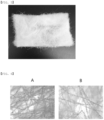
- a microscope (CX33RTFS2, Olympus Corporation., Korea) was used to observe the microstructure of the hyaluronate non-woven fabrics prepared in Examples 3 and 4 (see FIG. 6 ). It was possible to identify the web-shaped non-woven structure in which the fibers were cross-lined to each other. Especially for the non-woven fabric in which chitosan was mixed, it was confirmed that the hyaluronate fibers and the chitosan fibers were well mixed. Web-shaped non-woven fabrics have better physical properties than wet spun non-woven fabrics because the web-shaped non-woven fabrics have a space between the cross-linked fibers. For this reason, the web-shaped non-woven fabrics can be easily processed and conveniently used.
- the pure hyaluronate non-woven fabric with a size of 2 x 2 cm and the hyaluronate (50%) and chitosan (50%) blended non-woven fabric with the same size were immersed in purified water for 5 seconds and then taken out. Next, water on the surface of each of the non-woven fabrics was removed, and the weight of each fabric was measured to determine the gelling degree.
- the chitosan-containing non-woven fabric had a low solubility in water, and it was found that the chitosan-containing non-woven fabric exhibits a lower gelling degree than the pure hyaluronate non-woven fabric.
- the tensile strength of the pure hyaluronate non-woven fabric (Example 3, pure hyaluronate non-woven fabric with a moisture content of 25 wt%) manufactured through needle punching and the tensile strength of the hyaluronate and chitosan 50%:50% blended non-woven fabric (Example 4, hyaluronate plus chitosan non-woven fabric (50%:50% weight ratio) with a moisture content of 25 wt%) were measured. The results are shown in Table 5. The tensile strength was measured using a universal material tester by mounting a sample with a length of 5 cm on a test jig and setting a crosshead speed to 2 mm/min. [Table 5] Sample Tensile strength (kgf) Pure hyaluronate non-woven fabric 0.3 Hyaluronate plus chitosan non-woven fabric 1.5
- the hyaluronate non-woven fabric of the present invention has excellent adhesion and tensile strength. Therefore, the hyaluronate non-woven fabric of the present invention can be used as a mask pack for external skin applications, a biomaterial for tissue repairing, and an anti-adhesion coating material.
Landscapes
- Engineering & Computer Science (AREA)
- Health & Medical Sciences (AREA)
- Textile Engineering (AREA)
- Life Sciences & Earth Sciences (AREA)
- Animal Behavior & Ethology (AREA)
- Veterinary Medicine (AREA)
- Public Health (AREA)
- General Health & Medical Sciences (AREA)
- Epidemiology (AREA)
- Mechanical Engineering (AREA)
- Chemical & Material Sciences (AREA)
- Birds (AREA)
- Chemical Kinetics & Catalysis (AREA)
- Pharmacology & Pharmacy (AREA)
- Medicinal Chemistry (AREA)
- General Chemical & Material Sciences (AREA)
- Bioinformatics & Cheminformatics (AREA)
- Hematology (AREA)
- Materials Engineering (AREA)
- Vascular Medicine (AREA)
- Surgery (AREA)
- Heart & Thoracic Surgery (AREA)
- Dermatology (AREA)
- Inorganic Chemistry (AREA)
- Nonwoven Fabrics (AREA)
- Medicinal Preparation (AREA)
- Materials For Medical Uses (AREA)
- Polysaccharides And Polysaccharide Derivatives (AREA)
- Spinning Methods And Devices For Manufacturing Artificial Fibers (AREA)
- Biomedical Technology (AREA)
- Cosmetics (AREA)
- Pharmaceuticals Containing Other Organic And Inorganic Compounds (AREA)
- Artificial Filaments (AREA)
Applications Claiming Priority (3)
| Application Number | Priority Date | Filing Date | Title |
|---|---|---|---|
| KR20220040033 | 2022-03-31 | ||
| KR1020220062829A KR102475485B1 (ko) | 2022-03-31 | 2022-05-23 | 히알루론산염 파이버를 활용한 부직포 및 이의 제조 방법 |
| PCT/KR2022/007708 WO2023191184A1 (fr) | 2022-03-31 | 2022-05-31 | Non-tissé utilisant une fibre d'hyaluronate et son procédé de fabrication |
Publications (2)
| Publication Number | Publication Date |
|---|---|
| EP4506496A1 true EP4506496A1 (fr) | 2025-02-12 |
| EP4506496A4 EP4506496A4 (fr) | 2026-04-08 |
Family
ID=84437066
Family Applications (2)
| Application Number | Title | Priority Date | Filing Date |
|---|---|---|---|
| EP22935859.3A Pending EP4506496A4 (fr) | 2022-03-31 | 2022-05-31 | Non-tissé utilisant une fibre d'hyaluronate et son procédé de fabrication |
| EP23781241.7A Pending EP4502258A4 (fr) | 2022-03-31 | 2023-03-23 | Feuille de nano-tissu d'hyaluronate et procédé pour sa fabrication |
Family Applications After (1)
| Application Number | Title | Priority Date | Filing Date |
|---|---|---|---|
| EP23781241.7A Pending EP4502258A4 (fr) | 2022-03-31 | 2023-03-23 | Feuille de nano-tissu d'hyaluronate et procédé pour sa fabrication |
Country Status (6)
| Country | Link |
|---|---|
| US (2) | US20240417901A1 (fr) |
| EP (2) | EP4506496A4 (fr) |
| JP (2) | JP2025510665A (fr) |
| KR (2) | KR102475485B1 (fr) |
| CN (2) | CN118974336A (fr) |
| WO (2) | WO2023191184A1 (fr) |
Families Citing this family (1)
| Publication number | Priority date | Publication date | Assignee | Title |
|---|---|---|---|---|
| KR102475485B1 (ko) * | 2022-03-31 | 2022-12-08 | (주)진우바이오 | 히알루론산염 파이버를 활용한 부직포 및 이의 제조 방법 |
Family Cites Families (28)
| Publication number | Priority date | Publication date | Assignee | Title |
|---|---|---|---|---|
| IT1254704B (it) * | 1991-12-18 | 1995-10-09 | Mini Ricerca Scient Tecnolog | Tessuto non tessuto essenzialmente costituito da derivati dell'acido ialuronico |
| KR101482800B1 (ko) * | 2006-02-24 | 2015-01-14 | 큐피가부시키가이샤 | 신규한 저분자량 히알루론산 및/또는 이의 염, 및 이를 이용한 화장료, 의약 조성물 및 식품 조성물 |
| JP5600005B2 (ja) * | 2007-09-05 | 2014-10-01 | 太陽化学株式会社 | 水溶性電界紡糸シート |
| AU2009288118B2 (en) * | 2008-09-02 | 2014-12-11 | Allergan, Inc. | Threads of hyaluronic acid and/or derivatives thereof, methods of making thereof and uses thereof |
| KR20110110482A (ko) * | 2010-04-01 | 2011-10-07 | 중앙대학교 산학협력단 | 비타민이 함유된 히알우론산 나노섬유 |
| KR101224882B1 (ko) * | 2010-04-20 | 2013-01-22 | 가톨릭대학교 산학협력단 | 히알루론산으로 이루어진 나노섬유 시트 및 그를 이용한 조직배양용 나노섬유 지지체 |
| CN102068339B (zh) * | 2010-12-03 | 2013-08-21 | 北京化工大学 | 一种载有药物的可生物降解的纳米纤维医用敷料制备方法 |
| CZ302994B6 (cs) * | 2010-12-31 | 2012-02-08 | Cpn S.R.O. | Hyaluronová vlákna, zpusob jejich prípravy a použití |
| CZ304651B6 (cs) * | 2012-05-11 | 2014-08-20 | Contipro Biotech S.R.O. | Způsob přípravy mikrovláken, způsob výroby krytů ran, kryty ran a zařízení pro přípravu polysacharidových vláken |
| KR101329261B1 (ko) | 2012-05-16 | 2013-11-13 | (주)태봉 | 키토산을 이용한 기능성 부직포 및 그 제조방법 |
| JP6489750B2 (ja) * | 2014-03-26 | 2019-03-27 | キヤノン株式会社 | ポリマーナノファイバ構造体の製造方法 |
| JP6418977B2 (ja) * | 2015-02-25 | 2018-11-07 | ライオン株式会社 | 貼付剤及び非ステロイド系抗炎症剤の経皮吸収促進剤 |
| KR101709608B1 (ko) * | 2015-09-03 | 2017-03-09 | (주)진우바이오 | 용융 방사에 의한 히알루론산염 파이버의 제조방법 및 이로부터 제조된 히알루론산염 파이버 |
| CN106012289B (zh) * | 2016-07-12 | 2018-04-27 | 宜宾长顺竹木产业有限公司 | 一种由竹原纤维制备无纺布的方法 |
| CN106137786B (zh) * | 2016-08-02 | 2018-09-18 | 华熙福瑞达生物医药有限公司 | 一种透明质酸抗衰组合物及其制备方法和应用 |
| KR102002586B1 (ko) | 2017-11-29 | 2019-10-01 | 주식회사 휴비스 | 천연섬유가 포함된 열접착 부직포 |
| KR102271874B1 (ko) * | 2017-12-28 | 2021-07-01 | 주식회사 아데나 | 다당류 섬유 제형 변형용 조성물을 포함하는 마스크 팩 키트 |
| KR20190106091A (ko) | 2018-03-07 | 2019-09-18 | (주)진우바이오 | 히알루론산염 필름의 제조방법 및 이로부터 제조된 히알루론산염 필름 |
| KR20190138907A (ko) | 2018-06-07 | 2019-12-17 | 주식회사 에스엔비아 | 히알루론산 필름의 제조방법 |
| CN109355916A (zh) * | 2018-10-18 | 2019-02-19 | 合肥中科卫云健康科技有限公司 | 一种透气亲水复合面料及其制备方法 |
| KR102188593B1 (ko) * | 2019-04-03 | 2020-12-09 | 서울대학교산학협력단 | 두 가지의 상이한 분자량의 히알루론산을 포함하는 인공타액 |
| US20220354752A1 (en) * | 2019-10-08 | 2022-11-10 | Nanolayr Limited | Nanofibre matrix made of natural polymers with natural functional ingredients for cosmetic products |
| CN115066519A (zh) * | 2020-02-13 | 2022-09-16 | 贝克尔有限公司 | 静电纺丝天然聚合物的方法 |
| CN111607844B (zh) * | 2020-06-02 | 2023-01-03 | 南京工业大学 | 一种基于改性透明质酸的超分子纳米纤维的制备方法 |
| CN111759749A (zh) * | 2020-06-30 | 2020-10-13 | 太仓淼品源材料科技有限公司 | 一种新型的玻尿酸面膜及其制备方法和使用方法 |
| JP7346551B2 (ja) * | 2020-11-26 | 2023-09-19 | ジンウ バイオ カンパニー リミテッド | ヒアルロン酸塩ファイバーおよびその製造方法 |
| KR102338355B1 (ko) * | 2021-05-17 | 2021-12-22 | 주식회사 우럭 | 히알루론산염 부직포의 제조방법 |
| KR102475485B1 (ko) * | 2022-03-31 | 2022-12-08 | (주)진우바이오 | 히알루론산염 파이버를 활용한 부직포 및 이의 제조 방법 |
-
2022
- 2022-05-23 KR KR1020220062829A patent/KR102475485B1/ko active Active
- 2022-05-31 WO PCT/KR2022/007708 patent/WO2023191184A1/fr not_active Ceased
- 2022-05-31 EP EP22935859.3A patent/EP4506496A4/fr active Pending
- 2022-05-31 JP JP2024555279A patent/JP2025510665A/ja active Pending
- 2022-05-31 CN CN202280094094.6A patent/CN118974336A/zh active Pending
- 2022-06-14 KR KR1020220072058A patent/KR102475486B1/ko active Active
-
2023
- 2023-03-23 EP EP23781241.7A patent/EP4502258A4/fr active Pending
- 2023-03-23 WO PCT/KR2023/003879 patent/WO2023191385A1/fr not_active Ceased
- 2023-03-23 JP JP2024556047A patent/JP2025510707A/ja active Pending
- 2023-03-23 CN CN202380031780.3A patent/CN118974335A/zh active Pending
-
2024
- 2024-08-30 US US18/820,298 patent/US20240417901A1/en active Pending
- 2024-09-19 US US18/889,424 patent/US20250011985A1/en active Pending
Also Published As
| Publication number | Publication date |
|---|---|
| CN118974336A (zh) | 2024-11-15 |
| US20250011985A1 (en) | 2025-01-09 |
| JP2025510665A (ja) | 2025-04-15 |
| EP4502258A4 (fr) | 2026-03-25 |
| EP4506496A4 (fr) | 2026-04-08 |
| CN118974335A (zh) | 2024-11-15 |
| WO2023191385A1 (fr) | 2023-10-05 |
| KR102475486B1 (ko) | 2022-12-08 |
| JP2025510707A (ja) | 2025-04-15 |
| EP4502258A1 (fr) | 2025-02-05 |
| WO2023191184A1 (fr) | 2023-10-05 |
| US20240417901A1 (en) | 2024-12-19 |
| KR102475485B1 (ko) | 2022-12-08 |
Similar Documents
| Publication | Publication Date | Title |
|---|---|---|
| KR102006836B1 (ko) | 다당류 섬유의 제조 방법, 이를 포함하는 상처 피복재, 상처 피복재의 제조 방법, 및 다당류 섬유의 제조 장치 | |
| Zoccola et al. | Study on cast membranes and electrospun nanofibers made from keratin/fibroin blends | |
| EP2627813B1 (fr) | Fibres hydrogélifiantes ainsi que structure fibreuse hydrogélifiante | |
| CN107073173B (zh) | 用于产生由结合丝丝心蛋白微纤维和纳米纤维组成的混合结构的方法、由此获得的混合结构及其作为可植入医疗装置的用途 | |
| Nguyen et al. | Fabrication and characterization of cross-linked gelatin electro-spun nano-fibers | |
| EP2650413B1 (fr) | Fibres formant un hydrogel et formation fibreuse | |
| RU2133127C1 (ru) | Нетканый материал, способ его получения и способ лечения | |
| DE60310815T2 (de) | Hämostatischer Wundverband und Verfahren zu deren Herstellung | |
| Kancheva et al. | Enhancing the mechanical properties of electrospun polyester mats by heat treatment. | |
| CN112210888B (zh) | 利于组织再生的聚乳酸弹性无纺材料及其制备方法 | |
| JPH02119866A (ja) | 医療用繊維状物 | |
| US20240417901A1 (en) | Non-woven fabric using hyaluronate fiber and method for manufacturing same | |
| JP2010065373A (ja) | 弾性不織シート | |
| KR102338355B1 (ko) | 히알루론산염 부직포의 제조방법 | |
| EP2686381B1 (fr) | Film composite et fibres kératiniques et cellulosiques | |
| EP3074568B1 (fr) | Fibres hydrogélifiantes et produit à base de fibres hydrogélifiant | |
| Gholipour-Kanani et al. | Novel blend scaffolds from poly (caprolactone) chitosan-poly (vinyl alcohol): Physical, morphological and biological studies | |
| CN1997787B (zh) | 弹性非织造片材及其制备方法 | |
| Sosiati et al. | Effects of Aloe Vera/Chitosan Ratios on the Tensile Properties of Aloe Vera/Chitosan/Polyvinyl Alcohol Nanofibrous Membranes for Wound Care Dressing | |
| KR101234385B1 (ko) | 터치감이 우수한 장섬유 스펀본드 부직포와 그 제조방법 | |
| Nugroho et al. | The Fabrication and characterization of electrospun PVA-snail mucin nanofiber membrane | |
| KR102380400B1 (ko) | 사용성이 개선된 유착방지막 및 그 제조방법 | |
| Mukopadhyay | Biodegradable textile yarns | |
| KR20120059302A (ko) | 기능성 폴리올레핀계 단섬유 및 이의 제조방법과 이를 이용한 서멀본드 부직포 | |
| PL220068B1 (pl) | Sposób wytwarzania kompozytu z włókien węglowych modyfikowanych nanododatkami ceramicznymi |
Legal Events
| Date | Code | Title | Description |
|---|---|---|---|
| STAA | Information on the status of an ep patent application or granted ep patent |
Free format text: STATUS: THE INTERNATIONAL PUBLICATION HAS BEEN MADE |
|
| PUAI | Public reference made under article 153(3) epc to a published international application that has entered the european phase |
Free format text: ORIGINAL CODE: 0009012 |
|
| STAA | Information on the status of an ep patent application or granted ep patent |
Free format text: STATUS: REQUEST FOR EXAMINATION WAS MADE |
|
| 17P | Request for examination filed |
Effective date: 20241018 |
|
| AK | Designated contracting states |
Kind code of ref document: A1 Designated state(s): AL AT BE BG CH CY CZ DE DK EE ES FI FR GB GR HR HU IE IS IT LI LT LU LV MC MK MT NL NO PL PT RO RS SE SI SK SM TR |
|
| DAV | Request for validation of the european patent (deleted) | ||
| DAX | Request for extension of the european patent (deleted) | ||
| A4 | Supplementary search report drawn up and despatched |
Effective date: 20260305 |
|
| RIC1 | Information provided on ipc code assigned before grant |
Ipc: D04H 1/4266 20120101AFI20260227BHEP Ipc: D04H 1/48 20120101ALI20260227BHEP Ipc: A45D 44/00 20060101ALI20260227BHEP Ipc: A61L 15/28 20060101ALI20260227BHEP Ipc: A61L 31/04 20060101ALI20260227BHEP Ipc: D04H 1/728 20120101ALI20260227BHEP Ipc: D04H 1/485 20120101ALI20260227BHEP Ipc: A61K 8/73 20060101ALI20260227BHEP |