EP4506510A1 - Engin de chantier - Google Patents
Engin de chantier Download PDFInfo
- Publication number
- EP4506510A1 EP4506510A1 EP23780003.2A EP23780003A EP4506510A1 EP 4506510 A1 EP4506510 A1 EP 4506510A1 EP 23780003 A EP23780003 A EP 23780003A EP 4506510 A1 EP4506510 A1 EP 4506510A1
- Authority
- EP
- European Patent Office
- Prior art keywords
- fan
- rotational speed
- temperature
- cooling
- cooling target
- Prior art date
- Legal status (The legal status is an assumption and is not a legal conclusion. Google has not performed a legal analysis and makes no representation as to the accuracy of the status listed.)
- Pending
Links
Images





Classifications
-
- B—PERFORMING OPERATIONS; TRANSPORTING
- B60—VEHICLES IN GENERAL
- B60K—ARRANGEMENT OR MOUNTING OF PROPULSION UNITS OR OF TRANSMISSIONS IN VEHICLES; ARRANGEMENT OR MOUNTING OF PLURAL DIVERSE PRIME-MOVERS IN VEHICLES; AUXILIARY DRIVES FOR VEHICLES; INSTRUMENTATION OR DASHBOARDS FOR VEHICLES; ARRANGEMENTS IN CONNECTION WITH COOLING, AIR INTAKE, GAS EXHAUST OR FUEL SUPPLY OF PROPULSION UNITS IN VEHICLES
- B60K11/00—Arrangement in connection with cooling of propulsion units
- B60K11/02—Arrangement in connection with cooling of propulsion units with liquid cooling
-
- E—FIXED CONSTRUCTIONS
- E02—HYDRAULIC ENGINEERING; FOUNDATIONS; SOIL SHIFTING
- E02F—DREDGING; SOIL-SHIFTING
- E02F9/00—Component parts of dredgers or soil-shifting machines, not restricted to one of the kinds covered by groups E02F3/00 - E02F7/00
-
- E—FIXED CONSTRUCTIONS
- E02—HYDRAULIC ENGINEERING; FOUNDATIONS; SOIL SHIFTING
- E02F—DREDGING; SOIL-SHIFTING
- E02F9/00—Component parts of dredgers or soil-shifting machines, not restricted to one of the kinds covered by groups E02F3/00 - E02F7/00
- E02F9/08—Superstructures; Supports for superstructures
- E02F9/0858—Arrangement of component parts installed on superstructures not otherwise provided for, e.g. electric components, fenders, air-conditioning units
- E02F9/0866—Engine compartment, e.g. heat exchangers, exhaust filters, cooling devices, silencers, mufflers, position of hydraulic pumps in the engine compartment
-
- E—FIXED CONSTRUCTIONS
- E02—HYDRAULIC ENGINEERING; FOUNDATIONS; SOIL SHIFTING
- E02F—DREDGING; SOIL-SHIFTING
- E02F9/00—Component parts of dredgers or soil-shifting machines, not restricted to one of the kinds covered by groups E02F3/00 - E02F7/00
- E02F9/20—Drives; Control devices
- E02F9/2004—Control mechanisms, e.g. control levers
-
- E—FIXED CONSTRUCTIONS
- E02—HYDRAULIC ENGINEERING; FOUNDATIONS; SOIL SHIFTING
- E02F—DREDGING; SOIL-SHIFTING
- E02F9/00—Component parts of dredgers or soil-shifting machines, not restricted to one of the kinds covered by groups E02F3/00 - E02F7/00
- E02F9/20—Drives; Control devices
- E02F9/2058—Electric or electro-mechanical or mechanical control devices of vehicle sub-units
- E02F9/2062—Control of propulsion units
- E02F9/207—Control of propulsion units of the type electric propulsion units, e.g. electric motors or generators
-
- E—FIXED CONSTRUCTIONS
- E02—HYDRAULIC ENGINEERING; FOUNDATIONS; SOIL SHIFTING
- E02F—DREDGING; SOIL-SHIFTING
- E02F9/00—Component parts of dredgers or soil-shifting machines, not restricted to one of the kinds covered by groups E02F3/00 - E02F7/00
- E02F9/20—Drives; Control devices
- E02F9/2058—Electric or electro-mechanical or mechanical control devices of vehicle sub-units
- E02F9/2095—Control of electric, electro-mechanical or mechanical equipment not otherwise provided for, e.g. ventilators, electro-driven fans
-
- E—FIXED CONSTRUCTIONS
- E02—HYDRAULIC ENGINEERING; FOUNDATIONS; SOIL SHIFTING
- E02F—DREDGING; SOIL-SHIFTING
- E02F9/00—Component parts of dredgers or soil-shifting machines, not restricted to one of the kinds covered by groups E02F3/00 - E02F7/00
- E02F9/20—Drives; Control devices
- E02F9/22—Hydraulic or pneumatic drives
- E02F9/2203—Arrangements for controlling the attitude of actuators, e.g. speed, floating function
-
- E—FIXED CONSTRUCTIONS
- E02—HYDRAULIC ENGINEERING; FOUNDATIONS; SOIL SHIFTING
- E02F—DREDGING; SOIL-SHIFTING
- E02F9/00—Component parts of dredgers or soil-shifting machines, not restricted to one of the kinds covered by groups E02F3/00 - E02F7/00
- E02F9/20—Drives; Control devices
- E02F9/22—Hydraulic or pneumatic drives
- E02F9/226—Safety arrangements, e.g. hydraulic driven fans, preventing cavitation, leakage, overheating
-
- E—FIXED CONSTRUCTIONS
- E02—HYDRAULIC ENGINEERING; FOUNDATIONS; SOIL SHIFTING
- E02F—DREDGING; SOIL-SHIFTING
- E02F9/00—Component parts of dredgers or soil-shifting machines, not restricted to one of the kinds covered by groups E02F3/00 - E02F7/00
- E02F9/26—Indicating devices
-
- F—MECHANICAL ENGINEERING; LIGHTING; HEATING; WEAPONS; BLASTING
- F01—MACHINES OR ENGINES IN GENERAL; ENGINE PLANTS IN GENERAL; STEAM ENGINES
- F01P—COOLING OF MACHINES OR ENGINES IN GENERAL; COOLING OF INTERNAL-COMBUSTION ENGINES
- F01P3/00—Liquid cooling
- F01P3/12—Arrangements for cooling other engine or machine parts
-
- F—MECHANICAL ENGINEERING; LIGHTING; HEATING; WEAPONS; BLASTING
- F01—MACHINES OR ENGINES IN GENERAL; ENGINE PLANTS IN GENERAL; STEAM ENGINES
- F01P—COOLING OF MACHINES OR ENGINES IN GENERAL; COOLING OF INTERNAL-COMBUSTION ENGINES
- F01P3/00—Liquid cooling
- F01P3/20—Cooling circuits not specific to a single part of engine or machine
-
- F—MECHANICAL ENGINEERING; LIGHTING; HEATING; WEAPONS; BLASTING
- F01—MACHINES OR ENGINES IN GENERAL; ENGINE PLANTS IN GENERAL; STEAM ENGINES
- F01P—COOLING OF MACHINES OR ENGINES IN GENERAL; COOLING OF INTERNAL-COMBUSTION ENGINES
- F01P5/00—Pumping cooling-air or liquid coolants
- F01P5/02—Pumping cooling-air; Arrangements of cooling-air pumps, e.g. fans or blowers
-
- F—MECHANICAL ENGINEERING; LIGHTING; HEATING; WEAPONS; BLASTING
- F01—MACHINES OR ENGINES IN GENERAL; ENGINE PLANTS IN GENERAL; STEAM ENGINES
- F01P—COOLING OF MACHINES OR ENGINES IN GENERAL; COOLING OF INTERNAL-COMBUSTION ENGINES
- F01P7/00—Controlling of coolant flow
- F01P7/02—Controlling of coolant flow the coolant being cooling-air
- F01P7/04—Controlling of coolant flow the coolant being cooling-air by varying pump speed, e.g. by changing pump-drive gear ratio
-
- F—MECHANICAL ENGINEERING; LIGHTING; HEATING; WEAPONS; BLASTING
- F04—POSITIVE - DISPLACEMENT MACHINES FOR LIQUIDS; PUMPS FOR LIQUIDS OR ELASTIC FLUIDS
- F04D—NON-POSITIVE-DISPLACEMENT PUMPS
- F04D25/00—Pumping installations or systems
- F04D25/02—Units comprising pumps and their driving means
- F04D25/08—Units comprising pumps and their driving means the working fluid being air, e.g. for ventilation
-
- F—MECHANICAL ENGINEERING; LIGHTING; HEATING; WEAPONS; BLASTING
- F15—FLUID-PRESSURE ACTUATORS; HYDRAULICS OR PNEUMATICS IN GENERAL
- F15B—SYSTEMS ACTING BY MEANS OF FLUIDS IN GENERAL; FLUID-PRESSURE ACTUATORS, e.g. SERVOMOTORS; DETAILS OF FLUID-PRESSURE SYSTEMS, NOT OTHERWISE PROVIDED FOR
- F15B15/00—Fluid-actuated devices for displacing a member from one position to another; Gearing associated therewith
- F15B15/18—Combined units comprising both motor and pump
-
- F—MECHANICAL ENGINEERING; LIGHTING; HEATING; WEAPONS; BLASTING
- F15—FLUID-PRESSURE ACTUATORS; HYDRAULICS OR PNEUMATICS IN GENERAL
- F15B—SYSTEMS ACTING BY MEANS OF FLUIDS IN GENERAL; FLUID-PRESSURE ACTUATORS, e.g. SERVOMOTORS; DETAILS OF FLUID-PRESSURE SYSTEMS, NOT OTHERWISE PROVIDED FOR
- F15B19/00—Testing; Calibrating; Fault detection or monitoring; Simulation or modelling of fluid-pressure systems or apparatus not otherwise provided for
-
- F—MECHANICAL ENGINEERING; LIGHTING; HEATING; WEAPONS; BLASTING
- F15—FLUID-PRESSURE ACTUATORS; HYDRAULICS OR PNEUMATICS IN GENERAL
- F15B—SYSTEMS ACTING BY MEANS OF FLUIDS IN GENERAL; FLUID-PRESSURE ACTUATORS, e.g. SERVOMOTORS; DETAILS OF FLUID-PRESSURE SYSTEMS, NOT OTHERWISE PROVIDED FOR
- F15B21/00—Common features of fluid actuator systems; Fluid-pressure actuator systems or details thereof, not covered by any other group of this subclass
- F15B21/04—Special measures taken in connection with the properties of the fluid
- F15B21/042—Controlling the temperature of the fluid
- F15B21/0423—Cooling
-
- F—MECHANICAL ENGINEERING; LIGHTING; HEATING; WEAPONS; BLASTING
- F24—HEATING; RANGES; VENTILATING
- F24F—AIR-CONDITIONING; AIR-HUMIDIFICATION; VENTILATION; USE OF AIR CURRENTS FOR SCREENING
- F24F11/00—Control or safety arrangements
- F24F11/70—Control systems characterised by their outputs; Constructional details thereof
- F24F11/72—Control systems characterised by their outputs; Constructional details thereof for controlling the supply of treated air, e.g. its pressure
- F24F11/74—Control systems characterised by their outputs; Constructional details thereof for controlling the supply of treated air, e.g. its pressure for controlling air flow rate or air velocity
- F24F11/77—Control systems characterised by their outputs; Constructional details thereof for controlling the supply of treated air, e.g. its pressure for controlling air flow rate or air velocity by controlling the speed of ventilators
-
- H—ELECTRICITY
- H05—ELECTRIC TECHNIQUES NOT OTHERWISE PROVIDED FOR
- H05K—PRINTED CIRCUITS; CASINGS OR CONSTRUCTIONAL DETAILS OF ELECTRIC APPARATUS; MANUFACTURE OF ASSEMBLAGES OF ELECTRICAL COMPONENTS
- H05K7/00—Constructional details common to different types of electric apparatus
- H05K7/20—Modifications to facilitate cooling, ventilating, or heating
- H05K7/20009—Modifications to facilitate cooling, ventilating, or heating using a gaseous coolant in electronic enclosures
- H05K7/20209—Thermal management, e.g. fan control
-
- H—ELECTRICITY
- H05—ELECTRIC TECHNIQUES NOT OTHERWISE PROVIDED FOR
- H05K—PRINTED CIRCUITS; CASINGS OR CONSTRUCTIONAL DETAILS OF ELECTRIC APPARATUS; MANUFACTURE OF ASSEMBLAGES OF ELECTRICAL COMPONENTS
- H05K7/00—Constructional details common to different types of electric apparatus
- H05K7/20—Modifications to facilitate cooling, ventilating, or heating
- H05K7/20709—Modifications to facilitate cooling, ventilating, or heating for server racks or cabinets; for data centers, e.g. 19-inch computer racks
- H05K7/20836—Thermal management, e.g. server temperature control
-
- B—PERFORMING OPERATIONS; TRANSPORTING
- B60—VEHICLES IN GENERAL
- B60K—ARRANGEMENT OR MOUNTING OF PROPULSION UNITS OR OF TRANSMISSIONS IN VEHICLES; ARRANGEMENT OR MOUNTING OF PLURAL DIVERSE PRIME-MOVERS IN VEHICLES; AUXILIARY DRIVES FOR VEHICLES; INSTRUMENTATION OR DASHBOARDS FOR VEHICLES; ARRANGEMENTS IN CONNECTION WITH COOLING, AIR INTAKE, GAS EXHAUST OR FUEL SUPPLY OF PROPULSION UNITS IN VEHICLES
- B60K1/00—Arrangement or mounting of electrical propulsion units
- B60K2001/003—Arrangement or mounting of electrical propulsion units with means for cooling the electrical propulsion units
- B60K2001/006—Arrangement or mounting of electrical propulsion units with means for cooling the electrical propulsion units the electric motors
-
- E—FIXED CONSTRUCTIONS
- E02—HYDRAULIC ENGINEERING; FOUNDATIONS; SOIL SHIFTING
- E02F—DREDGING; SOIL-SHIFTING
- E02F9/00—Component parts of dredgers or soil-shifting machines, not restricted to one of the kinds covered by groups E02F3/00 - E02F7/00
- E02F9/20—Drives; Control devices
- E02F9/22—Hydraulic or pneumatic drives
- E02F9/2278—Hydraulic circuits
- E02F9/2285—Pilot-operated systems
-
- E—FIXED CONSTRUCTIONS
- E02—HYDRAULIC ENGINEERING; FOUNDATIONS; SOIL SHIFTING
- E02F—DREDGING; SOIL-SHIFTING
- E02F9/00—Component parts of dredgers or soil-shifting machines, not restricted to one of the kinds covered by groups E02F3/00 - E02F7/00
- E02F9/20—Drives; Control devices
- E02F9/22—Hydraulic or pneumatic drives
- E02F9/2278—Hydraulic circuits
- E02F9/2292—Systems with two or more pumps
Definitions
- the present invention relates to a working machine such as an excavator (a backhoe).
- a slewable working machine such as an excavator (a backhoe) includes a radiator provided with an electric radiator fan that cools cooling water used for cooling an electric motor and the like and an oil cooler provided with an electric oil cooler fan that cools a hydraulic fluid.
- the present invention has been made to solve the above-mentioned problem of the related art, and it is an object of the present invention to achieve noise reduction, reduction in power consumption, and prevention of excessive cooling in a working machine including an electric fan.
- a working machine includes an electric motor, a working device to be driven by power of the electric motor, an operation device to operate the working device, an operation locker switchable between an enabling position where an operation of the working device by the operation device is enabled and a disabling position where the operation of the working device by the operating position is disabled, a cooler including an electric cooling fan, a temperature detector to detect a cooling target temperature that is a temperature of a cooling target to be cooled by the cooler, and a controller to control a fan rotational speed that is a rotational speed of the cooling fan in accordance with the cooling target temperature detected by the temperature detector.
- the controller is configured or programmed to change a characteristic of the fan rotational speed with respect to the cooling target temperature depending on whether the operation locker is in the enabling position or in the disabling position.
- the working machine may include a memory to store a plurality of fan control maps each indicating a characteristic of the fan rotational speed with respect to the cooling target temperature.
- the plurality of fan control maps may include a first map and a second map that are different from each other.
- the controller may be configured or programmed to control rotational driving of the cooling fan based on the first map when the operation locker is in the disabling position, and to control the rotational driving of the cooling fan based on the second map when the operation locker is in the enabling position.
- the first map may be configured to switch the fan rotational speed between zero and a predetermined first fan rotational speed in accordance with the cooling target temperature.
- the first map may be configured to switch the fan rotational speed to the first fan rotational speed when the cooling target temperature increases from a temperature lower than a predetermined first rotation increase temperature to the first rotation increase temperature in a state where the fan rotational speed is zero, and to switch the fan rotational speed to zero when the cooling target temperature decreases to a predetermined first rotation decrease temperature lower than the first rotation increase temperature in a state where the fan rotational speed is set to the first fan rotational speed.
- the second map may be configured to set the fan rotational speed to a value greater than zero when the cooling target temperature increases from a temperature lower than a predetermined second rotation increase temperature to the second rotation increase temperature in a state where the fan rotational speed is zero, set the fan rotational speed to a predetermined second fan rotational speed when the cooling target temperature is equal to or higher than a first specified temperature that is set to be higher than the second rotation increase temperature, set the fan rotational speed to become higher, within a range below the second fan rotational speed, as the cooling target temperature increases when the cooling target temperature is equal to or higher than the second rotation increase temperature and lower than the first specified temperature, and reduce the fan rotational speed to zero when the cooling target temperature decreases to a predetermined second rotation decrease temperature lower than the second rotation increase temperature in a state where the fan rotational speed is not zero.
- the second map may be configured to set the fan rotational speed to a fixed value less than the second fan rotational speed when the cooling target temperature is lower than a second specified temperature that is set to be equal to or higher than the second rotation increase temperature and to be lower than the first specified temperature and set the fan rotational speed to become higher, within a range below the second fan rotational speed, as the cooling target temperature increases when the cooling target temperature is equal to or higher than the second specified temperature and lower than the first specified temperature.
- the plurality of fan control maps may include a third map.
- the controller may be configured or programmed to set a rotational speed of the electric motor to an idle speed, and control the cooling fan based on the third map when the operation locker is in the enabling position and the operation device is not operated for a certain period of time.
- the third map may be configured to switch the fan rotational speed to a predetermined auto-idle speed when the cooling target temperature increases from a temperature lower than a predetermined third increase temperature to the third rotation increase temperature in a state where the fan rotational speed is zero, and to switch the fan rotational speed to zero when the cooling target temperature decreases to a predetermined third rotation decrease temperature lower than the third rotation increase temperature in a state where the fan rotational speed is set to the auto-idle speed.
- the third map may be common with the first map.
- the cooling target of the cooler may be a refrigerant that is used to cool cooling target equipment included in the working machine.
- the working machine may comprise an abnormally-high-temperature detector to detect an abnormally high temperature of the cooling target equipment.
- the controller may be configured or programmed to cause the cooling fan to rotate at a third fan rotational speed higher than the second fan rotational speed when the abnormally-high-temperature detector detects an abnormally high temperature and the cooling target temperature is equal to or higher than a third specified temperature that is set to be equal to or higher than the second rotation increase temperature.
- the controller may be configured or programmed to cause control of the rotational speed of the cooling fan to return to control based on the second map when the cooling target temperature decreases to a fourth specified temperature that is lower than the third specified temperature in a state where the cooling fan is rotating at the third fan rotational speed.
- the second map may be configured to set the fan rotational speed to a fourth fan rotational speed that is higher than the second fan rotational speed when the cooling target temperature increases to a fourth rotation increase temperature that is higher than the first specified temperature in a state where the fan rotational speed is set to the second fan rotational speed and reduce the fan rotational speed to the second fan rotational speed when the cooling target temperature decreases to a predetermined fourth rotation decrease temperature that is lower than the fourth rotation increase temperature and higher than the first specified temperature in a state where the fan rotational speed is set to the fourth fan rotational speed.
- the plurality of fan control maps may include a fourth map.
- the fourth map may be configured to set the fan rotational speed to a value greater than zero when the cooling target temperature increases from a temperature lower than the second rotation increase temperature to the second rotation increase temperature in a state where the fan rotational speed is zero, set the fan rotational speed to a predetermined fifth fan rotational speed that is lower than the second fan rotational speed when the cooling target temperature is equal to or higher than the first specified temperature, set the fan rotational speed to become higher, within a range below the fifth fan rotational speed, as the cooling target temperature increases when the cooling target temperature is equal to or higher than the second rotation increase temperature and lower than the first specified temperature, and reduce the fan rotational speed to zero when the cooling target temperature decreases to the second rotation decrease temperature in a state where the fan rotational speed is not zero.
- the controller may be configured or programmed to control the cooling fan based on the second map when a rotational speed of the electric motor is set to a high value, and to control the cooling fan based on the fourth map when the rotational speed of the electric motor is set to a low value.
- the fourth map may be configured to set the fan rotational speed to a sixth fan rotational speed that is higher than the fifth fan rotational speed when the cooling target temperature increases to a fourth rotation increase temperature that is higher than the first specified temperature in a state where the fan rotational speed is set to the fifth fan rotational speed and reduce the fan rotational speed to the fifth fan rotational speed when the cooling target temperature decreases to a predetermined fourth rotation decrease temperature that is lower than the fourth rotation increase temperature and higher than the first specified temperature in a state where the fan rotational speed is set to the sixth fan rotational speed.
- the cooler may be a radiator to cool cooling water that is used to cool equipment including the electric motor.
- the cooling fan may be a radiator fan included in the radiator.
- the temperature detector may be configured to detect a temperature of the cooling water as the cooling target temperature.
- the cooler may be a radiator to cool cooling water that is used to cool equipment including the electric motor.
- the cooling fan may be a radiator fan included in the radiator.
- the temperature detector may detect a temperature of the cooling water as the cooling target temperature.
- the working machine may comprise a hydraulic pump to be driven by the electric motor and a hydraulic actuator to be driven by a hydraulic pressure of a hydraulic fluid discharged by the hydraulic pump.
- the cooler may be an oil cooler to cool the hydraulic fluid, and the cooling fan is an oil cooler fan included in the oil cooler.
- the temperature detector may be configured to detect a temperature of the hydraulic fluid as the cooling target temperature.
- the working machine may comprise a hydraulic pump to be driven by the electric motor and a hydraulic actuator to be driven by a hydraulic pressure of a hydraulic fluid discharged by the hydraulic pump.
- the cooler may be an oil cooler to cool the hydraulic fluid, and the cooling fan is an oil cooler fan included in the oil cooler.
- the temperature detector may be configured to detect a temperature of the hydraulic fluid as the cooling target temperature.
- the working machine may comprise a hydraulic pump to be driven by the electric motor and a hydraulic actuator to be driven by a hydraulic pressure of a hydraulic fluid discharged by the hydraulic pump.
- the working machine may comprise a radiator to cool cooling water that is used to cool equipment including the electric motor and an oil cooler to cool the hydraulic fluid, the radiator and the oil cooler each serving as the cooler.
- the working machine may comprise a radiator fan included in the radiator and an oil cooler fan included in the oil cooler, the radiator fan and the oil cooler fan each serving as the cooling fan.
- the temperature detector may be configured to detect a temperature of the cooling water and a temperature of the hydraulic fluid, each as the cooling target temperature.
- the memory may be configured to store a plurality of fan control maps for the radiator fan each indicating a characteristic of a rotational speed of the radiator fan with respect to the temperature of the cooling water and a plurality of fan control maps for the oil cooler fan each indicating a characteristic of a rotational speed of the oil cooler fan with respect to the temperature of the hydraulic fluid.
- the controller may be configured or programmed to control the rotational speed of the radiator fan based on the plurality of fan control maps for the radiator fan, and control the rotational speed of the oil cooler fan based on the plurality of fan control maps for the oil cooler fan.
- the rotation of the cooling fan can be controlled in accordance with the switching position of the operation locker, and thus, noise reduction, power consumption reduction, and prevention of excessive cooling can be achieved.
- the working machine 1 is a slewable working machine called a backhoe.
- the working machine 1 includes a machine body (slewing base) 2, a traveling device 10, a working device 20, and so forth.
- the machine body 2 is mounted on an upper portion of the traveling device 10 via a vertical slewing shaft (not illustrated). As illustrated in FIG. 7 , it is mounted so as to be relatively rotatable in the horizontal direction with respect to the traveling device 10 about an axis X of the slewing shaft extending in the vertical direction.
- a "longitudinal direction” refers to the longitudinal direction of the machine body 2 regardless of the relative rotational position of the traveling device 10 with respect to the machine body 2.
- arrow F extends in a direction toward the front of the machine body 2. This direction matches the horizontal direction of an operator's line of sight, the operator sitting in an operator's seat 4 illustrated in FIG. 7 and facing forward. The horizontal direction that is opposite to arrow F is toward the rear of the machine body 20.
- a transverse direction refers to a transverse direction of the machine body 2 (the width direction of the machine body 2) regardless of the relative rotational position of the traveling device 10 with respect to the machine body 2.
- arrow L extends toward the left side of the machine body 2.
- arrow L When arrow L is illustrated together with arrow F as in FIG. 8 and FIG. 9 , arrow L extends from the starting point of arrow F leftward with respect to arrow F.
- the direction in which arrow L extends matches the horizontal left direction for the operator sitting in the operator's seat 4.
- the horizontal direction that is opposite to arrow L is toward the right side of the machine body 2.
- the front, rear, left, and right positions or directions of each component or each portion of the working machine 1 will hereinafter be described on the basis of the front, rear, left, and right directions of the machine body 2 as described above.
- the operator's seat 4 where the operator (a worker) sits and a protective structure 6 that protects the operator's seat 4 from the front, rear, left, right, and upper sides are provided on the machine body 2 of the working machine 1.
- the protective structure 6 is a cabin.
- the protective structure 6 may be a canopy or the like.
- Each side surface of the protective structure 6 is provided with a transparent portion (so-called window) through which the surroundings can be viewed from the operator's seat 4.
- the protective structure 6 partitions an internal space in which the operator's seat 4 is provided from the outside.
- An operation device 5 for operating the working machine 1 is provided around the operator's seat 4 inside the protective structure 6. The operator can manipulate the operation device 5 while sitting in the operator's seat 4.
- the traveling device 10 will be described on the assumption that the longitudinal direction of the traveling device 10 and the longitudinal direction of the machine body 2 match each other.
- the traveling device 10 includes a traveling frame (a track frame) 11 and a left- and-right pair of traveling mechanisms 12.
- the machine body 2 is supported on an upper portion of the traveling frame 11.
- the traveling mechanisms 12 illustrated in the drawings are each a crawler traveling mechanism, each of the traveling mechanisms 12 may be, for example, a tire (wheel) traveling mechanism.
- the traveling mechanisms 12 are provided one each on a left portion and a right portion of the traveling frame 11.
- Each of the traveling mechanisms 12 includes an idler 13, a drive wheel (drive sprocket) 14, a plurality of track rollers 15, a crawler belt 16 having an endless loop shape, and a corresponding one of traveling motors ML and MR.
- the idler 13 is disposed at a front portion of the traveling frame 11.
- the drive wheel (drive sprocket) 14 is disposed at a rear portion of the traveling frame 11.
- the plurality of track rollers 15 are arranged between the idler 13 and the drive wheel 14.
- the crawler belt 16 is wound around the idler 13, the drive wheel 14, and the track rollers 15.
- the left traveling motor ML is included in the traveling mechanism 12 provided on the left portion of the traveling frame 11.
- the right traveling motor MR is included in the traveling mechanism 12 provided on the right portion of the traveling frame 11.
- the traveling motors ML and MR are hydraulic motors.
- each of the traveling motors ML and MR is provided coaxially to a corresponding one of the drive wheels 14, and an output shaft thereof is directly connected to a rotation center shaft of the corresponding drive wheel 14.
- Each of the traveling motors ML and MR may have a power train, such as a reduction gear train, between it and the corresponding drive wheel 14. That is, it may not necessarily be disposed coaxially to the drive wheel 14.
- the crawler belts 16 are driven by rotations of the drive wheels 14, each of which is driven by a corresponding one of the traveling motors ML and MR, and then, the idlers 13 and the track rollers 15 are driven to rotate. Driving the left and right crawler belts 16 enables the traveling device 10 to travel.
- the output rotational speeds and the output rotational directions of the left and right traveling motors ML and MR can be controlled independently of each other.
- the traveling device 10 that is, the working machine 1 travels straight forward or rearward.
- the left and right traveling motors ML and MR to have different output rotational speeds or different output rotational directions, the working machine 1 turns.
- a dozer 18 is mounted on a front portion of the traveling frame 11 and extends toward the front of the traveling device 10.
- the dozer 18 swings up and down by extension and retraction of a dozer cylinder C5.
- the dozer cylinder C5 is attached to the traveling frame 11.
- the dozer cylinder C5 is a hydraulic cylinder.
- the machine body 2 is supported on the traveling frame 11 via a slewing bearing 3 so as to be rotatable about the axis X.
- a slewing motor MT is provided inside the machine body 2.
- the slewing motor MT is a hydraulic motor that is one of hydraulic actuators.
- the machine body 2 turns about the axis X by the power of the slewing motor MT.
- a swing bracket 24 is provided at a front portion of the machine body 2 so as to be relatively rotatable in the transverse direction with respect to the machine body 2 about a vertical axis (an axis extending in the vertical direction).
- the working device 20 is supported on the front portion of the machine body 2 via the swing bracket 24.
- the working device 20 will be described below on the assumption that the longitudinal direction of the working device 20 and the longitudinal direction of the machine body 2 match each other.
- the working device 20 includes a boom 21, an arm 22, and a bucket (hydraulic attachment) 23.
- a base end portion of the boom 21 is pivotally attached to the swing bracket 24 so as to be rotatable about a horizontal axis.
- the horizontal axis is defined as an axis with a horizontal axis center along the transverse direction of the machine body 2.
- the arm 22 is pivotally attached to an end portion of the boom 21 so as to be rotatable about a horizontal axis. Thus, the arm 22 can swing in the longitudinal direction or the vertical direction.
- the bucket 23 is provided at an end portion of the arm 22 so as to be capable of performing a shoveling operation and a dumping operation.
- the shoveling operation and the dumping operation are relative rotations of the bucket 23 with respect to the arm 22.
- the shoveling operation is a rotation in a direction toward the boom 21 and the arm 22, and the dumping operation is a rotation in a direction away from the boom 21 and the arm 22.
- the working device 20 includes a boom cylinder C2, an arm cylinder C3, and a bucket cylinder C4 as hydraulic actuators (hydraulic cylinders) for causing the boom 21, the arm 22, and the bucket 23 to operate.
- the machine body 2 is further provided with a swing cylinder C1 that is a hydraulic actuator (a hydraulic cylinder) for causing the swing bracket 24 to rotate.
- the swing bracket 24 swings to the left and right with respect to the machine body 2 by extension and retraction of the swing cylinder C1.
- the boom 21 swings up and down or back and forth with respect to the swing bracket 24 by extension and retraction of the boom cylinder C2.
- the arm 22 swings up and down or back and forth with respect to the boom 21 by extension and retraction of the arm cylinder C3.
- the bucket 23 performs the shoveling operation and the dumping operation by extension and retraction of the bucket cylinder (working tool cylinder) C4.
- another working tool that can be driven by a hydraulic actuator can be attached to the end portion of the arm 22.
- another working tool include a hydraulic breaker, a hydraulic crusher, an angle broom, an earth auger, a pallet fork, a sweeper, a mower, a snow blower, and the like.
- the working machine 1 drives the traveling device 10 by the traveling motors ML and MR, drives the working device 20 and the dozer 18 by the hydraulic cylinders C1 to C5, and turns the machine body 2 by the slewing motor MT so as to perform an operation such as excavation.
- the working machine 1 includes the traveling motors ML and MR, the slewing motor MT, and the hydraulic cylinders C1 to C5 as hydraulic actuators for hydraulically operating the respective components.
- all of these hydraulic actuators will be simply referred to as “hydraulic actuators” unless otherwise stated.
- the working machine 1 includes a hydraulic system (a hydraulic circuit K) such as that illustrated in FIG. 2 in order to actuate these hydraulic actuators. This matter will be described in detail later.
- a battery unit 30 that includes a plurality of battery packs 31 and 32 combined together is supported by a support frame 90 in a state where the battery packs 31 and 32 are arranged side by side on the left and right with respect to the machine body 2 and is installed on a base 2c that forms a bottom plate of the machine body (slewing base) 2.
- a motor and pump assembly 91 is installed on the base 2c in such a manner as to be located on the right of the battery unit 30 by utilizing a space inside a portion of the hood 2a protruding rightward.
- the motor and pump assembly 91 is formed by combining an electric motor 9 that serves as a prime mover and hydraulic pumps P1 and P2.
- a radiator 35 and an oil cooler 37 are provided on the right of the battery unit 30 in a space above the motor and pump assembly 91 as illustrated in FIG. 8 such that the radiator 35 and the oil cooler 37 are arranged in the longitudinal direction (the radiator 35 is positioned in front of the oil cooler 37) in the present embodiment).
- a radiator fan 35a of the radiator 35 and an oil cooler fan 37a of the oil cooler 37 are arranged in the longitudinal direction and are both oriented toward a right side surface of the hood 2a.
- a right cover 2b of the hood 2a has an air outlet port (not illustrated), and hot air exhausted by the radiator fan 35a and the oil cooler fan 37a is discharged to the outside of the machine body 2 through an air passage, which is defined by a shroud 96, and the air outlet port.
- the right cover 2b is openable and closable, and opening the right cover 2b allows an access to the radiator fan 35a, the oil cooler fan 37a, and the like for, for example, maintenance.
- a low-voltage battery 33 illustrated in FIG. 1 is disposed on the left of the battery unit 30.
- a fan motor 35b that drives the radiator fan 35a, a fan motor 37b that drives the oil cooler fan 37a, and the like receive electric power from the low-voltage battery 33.
- the low-voltage battery 33 can be charged with electric power supplied from the battery packs 31 and 32 of the battery unit 30.
- Conversion equipment 97 including an inverter 38, a converter 40, and the like, which will be described later, for supplying the electric power of the battery packs 31 and 32 to the electric motor 9 and to the low-voltage battery 33 is provided at a top portion of the support frame 90.
- electric equipment including the electric motor 9 that operates by receiving high-voltage electric power from the battery packs 31 and 32
- electric equipment an electric component that operates by receiving low-voltage electric power from the low-voltage battery 33
- low-power equipment electric equipment including the electric motor 9 that operates by receiving high-voltage electric power from the battery packs 31 and 32
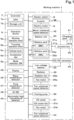
- FIG. 1 is a block diagram illustrating the electrical system of the working machine 1.
- the working machine 1 includes a controller 7, and the controller 7 includes a CPU 7a and a storage unit 7b.
- the CPU 7a controls the operation of each component included in the working machine 1 illustrated in FIG. 1 .
- the storage unit 7b includes a volatile memory, a nonvolatile memory, or the like. Information, data, programs, and the like for controlling the operation of each component by the CPU 7a are stored in the storage unit 7b in a readable and writable manner.
- the working machine 1 includes a memory, which stores such data, programs, and the like, as the storage unit 7b incorporated in the controller 7.
- a memory which stores such data, programs, and the like, as the storage unit 7b incorporated in the controller 7.
- a memory may be provided separately from the controller 7 and may be provided in the form of, for example, an external memory.
- the operation device 5 includes manipulators such as a working operation lever 5a, a traveling operation lever 5b, an unload lever 5c, an accelerator dial 5d, a mode selection switch (SW) 5e, and the like.
- manipulators such as a working operation lever 5a, a traveling operation lever 5b, an unload lever 5c, an accelerator dial 5d, a mode selection switch (SW) 5e, and the like.
- the operation device 5 further includes a potentiometer, a switch, a sensor, or the like (not illustrated) for detecting whether each of the manipulators 5a to 5e is manipulated or for detecting the manipulation position or the manipulation amount of each of the manipulators 5a to 5e.
- the working operation lever 5a is a member for controlling the operation of the working device 20.
- the traveling operation lever 5b is a member for controlling the operation of the traveling device 10.
- the working operation lever 5a and the traveling operation lever 5b are each illustrated as a single block. In practice, however, a plurality of levers each corresponding to the working operation lever 5a may be provided, or a plurality of levers each corresponding to the traveling operation lever 5b may be provided.
- These manipulators may be configured as dials, switches, or the like other than levers.
- the unload lever 5c is a member that is switchable between a load position (a first position, an enabling position) at which the operation of at least one of the hydraulic actuators is enabled and an unload position (a second position, a disabling position) at which the operation of the working device 20 is not allowed (is disabled).
- the unload lever 5c is disposed on, for example, the side of the operator's seat 4 ( FIG. 1 ) so as to be vertically swingable, and in its vertical swing range, the lowermost position and the uppermost position are set to the load position and the unload position, respectively.
- the accelerator dial 5d is rotationally manipulated in order to set a target rotational speed of the electric motor 9.
- the manipulation position of the accelerator dial 5d that is, the turning angle of the accelerator dial 5d
- the target rotational speed of the electric motor 9 can be changed.
- the controller 7 calculates an instruction value for the rotational speed of the electric motor 9 in accordance with the manipulation position (manipulation amount) of the accelerator dial 5d and instructs the electric motor 9 to rotate at the rotational speed corresponding to the instruction value.
- the mode selection SW 5e is a switch to be manipulated in order to select either a normal mode (a first mode) or an ECO mode (an ecology mode, a second mode) for controlling driving of the electric motor 9.
- a normal mode a first mode
- ECO mode an ecology mode, a second mode
- power consumption is reduced more than in the normal mode.
- a high idle speed MS1 (see FIG. 5 ) that is a rotational speed for a high-speed rotation motor is set as a motor rotational speed MS of the electric motor 9.
- An example of the value of the high idle speed MS1 may be 2200 rpm.
- a low idle speed MS2 (see FIG. 5 ) that is a rotational speed for a low-speed rotation motor is set as the motor rotational speed MS of the electric motor 9.
- An example of the value of the low idle speed MS2 may be 1000 rpm.
- the electric motor 9 is driven at an idle speed MS3 (see FIG. 5 ) that is lower than the low idle speed MS2.
- An example of the value of the idle speed MS3 may be 250 rpm.
- a starter switch (SW) 8 is provided inside the protective structure 6 such that the operator sitting in the operator's seat 4 can manipulate the starter SW 8.
- the starter SW 8 is manipulated in order to start and stop the working machine 1.
- the controller 7 activates the electric motor 9, which is a prime mover, and activates each component of the working machine 1.
- the controller 7 stops the electric motor 9 and stops each component of the working machine 1.
- the electric motor 9 that is a prime mover of the working machine 1 includes, for example, a permanent-magnet-embedded three-phase AC synchronous motor.
- the inverter 38 is a motor driver that drives the electric motor 9.
- the inverter 38 is connected to the electric motor 9 and a junction box 39.
- the junction box 39 is connected to the battery unit 30, the DC-DC converter 40, and a charging port 41, in addition to the inverter 38.
- the junction box 39 outputs electric power that is output by the battery unit 30 to the inverter 38 and the DC-DC converter 40.
- the inverter 38 converts direct-current power that is input thereto from the battery unit 30 via the junction box 39 into three-phase alternating-current power and supplies this three-phase alternating-current power to the electric motor 9. As a result, the electric motor 9 is driven.
- the inverter 38 can appropriately adjust the current and the voltage of the electric power that is supplied to the electric motor 9.
- the controller 7 drives or stops the electric motor 9 by controlling the operation of the inverter 38.
- a motor rotational speed detector 42 includes a sensor that detects the rotational speed (actual rotational speed) of the electric motor 9, an encoder, a pulse generator, or the like.
- the controller 7 controls the driving of the electric motor 9 by the inverter 38 on the basis of the rotational speed (actual rotational speed) of the electric motor 9 detected by the motor rotational speed detector 42.
- the controller 7 controls the driving of the electric motor 9 by the inverter 38 such that the actual rotational speed of the electric motor 9 detected by the motor rotational speed detector 42 is equal to the target rotational speed (a value set by the accelerator dial 5d or predetermined rotational speeds R1 to R3, which will be described later).
- the target rotational speed a value set by the accelerator dial 5d or predetermined rotational speeds R1 to R3, which will be described later.
- the DC-DC converter 40 is a voltage converter that converts a voltage of direct-current power that is input thereto from the battery unit 30 via the junction box 39 into a different voltage.
- the DC-DC converter 40 is a step-down converter that converts a high voltage from the battery unit 30 into a predetermined low voltage corresponding to the above-mentioned low-power equipment (electric component) included in the working machine 1.
- the DC-DC converter 40 supplies electric power to the low-voltage battery 33 after performing voltage conversion.
- the working machine 1 includes the above-mentioned low-power equipment (electric components) such as an illuminator, a heater, and the like in addition to the units illustrated in FIG. 1 , and these low-power equipment (electric components) are operated by using the electric power from the low-voltage battery 33.
- the charging port 41 includes a connector (not illustrated), into which a charging cable (not illustrated) is fitted, and a connection detector 41a.
- the charging port 41 is connected to an external power supply (such as a commercial power supply or the like) via the charging cable.
- the connection detector 41a includes a sensor or the like that detects that the charging cable is fitted into the charging port 41 and that the external power supply is connected to the charging port 41.
- the junction box 39 outputs electric power that is input through the charging port 41 from the external power supply via the charging cable to the battery unit 30.
- the battery unit 30 is charged with the electric power input from the charging port 41 via the junction box 39.
- the battery unit 30 includes a plurality of battery packs 31 and 32.
- Each of the battery packs 31 and 32 is a secondary battery (a storage battery) such as a lithium ion battery that includes at least one battery.
- each of the battery packs 31 and 32 includes a plurality of batteries
- the plurality of batteries are electrically connected in series and/or in parallel.
- the battery included in each of the battery packs 31 and 32 has a plurality of cells therein, and the plurality of cells are electrically connected in series and/or in parallel.
- Each of the battery packs 31 and 32 has an electric capacity with which each component of the working machine 1 can operate for a certain period of time.
- the battery packs 31 and 32 are connected to each other in parallel.
- the battery unit 30 includes the two battery packs 31 and 32.
- the number of battery packs included in the battery unit 30 is not limited to two and may be one or may be three or more.
- connection switches 31a and 32a are provided with connection switches 31a and 32a, respectively.
- Each of the connection switches 31a and 32a includes, for example, a relay, a switch, or the like and is switchable between a connected state and a disconnected state.
- the controller 7 switches one of the connection switches 31a and 32a to the connected state and switches the other of the connection switches 31a and 32a to the disconnected state, so that one of the plurality of battery packs 31 and 32 outputs electric power to the junction box 39, and the other of the plurality of battery packs 31 and 32 stops outputting electric power.
- the controller 7 controls the output and stop of output of the electric power from each of the battery packs 31 and 32.
- the controller 7 switches the connection state inside the junction box 39 so as to connect or disconnect the inverter 38, the DC-DC converter 40, or the charging port 41 to or from each of the battery packs 31 and 32.
- the junction box 39 and the connection switches 31a and 32a are included in a connection switcher that switches between connection and disconnection of the inverter 38, the DC-DC converter 40, and the charging port 41 to and from the battery packs 31 and 32.
- the battery packs 31 and 32 are also provided with battery management units (BMUs) 31b and 32b, respectively.
- BMUs battery management units
- FIG. 1 although the BMUs 31b and the 32b are disposed inside the battery packs 31 and 32, respectively, the BMUs 31b and the 32b may be incorporated in their respective battery packs 31 and 32 or may be disposed outside their respective battery packs 31 and 32.
- the BMU 31b monitors and controls the corresponding battery pack 31.
- the BMU 32b monitors and controls the corresponding battery pack 32. More specifically, the BMUs 31b and the 32b control opening and closing of relays provided inside their respective battery packs 31 and 32 so as to control start and stop of supply of the electric power from the battery packs 31 and 32.
- the BMUs 31b and 32b also detect the temperatures, the voltages, or the currents of their respective battery packs 31 and 32 or detect the terminal voltages of the cells inside their respective battery packs 31 and 32, or the like.
- the BMUs 31b and 32b further detect, on the basis of, for example, the terminal voltages of the cells inside their respective battery packs 31 and 32, the remaining capacities (remaining amounts of power) of their respective battery packs 31 and 32 by a voltage measurement method.
- the method of detecting the remaining capacities of the battery packs 31 and 32 is not limited to the voltage measurement method and may be a different method, such as a coulomb counting method, a battery-cell modeling method, or an impedance tracking method.
- a capacity detector that detects the remaining capacities of the battery packs 31 and 32 may be provided separately from the BMUs 31b and 32b.
- the low-voltage battery 33 is a storage battery having a voltage lower than that of the battery unit 30.
- the low-voltage battery 33 is charged with electric power supplied from the DC-DC converter 40.
- the low-voltage battery 33 supplies electric power to the above-mentioned electric components included in the working machine 1.
- High-heat-generating electrical equipment including the electric motor 9, the inverter 38, the DC-DC converter 40, the battery unit 30, and the like is cooling target equipment to be cooled by cooling water, and the radiator 35 cools the cooling water.
- the cooling water is not simply water and includes, for example, a liquid that does not freeze even in a cold region.
- the high-heat-generating electrical equipment which is the cooling target equipment to be cooled by the radiator 35, is electrical equipment that operates by receiving electric power and generates higher temperature heat than other electrical equipment included in the working machine 1, corresponding to the above-mentioned high-power equipment.
- the high-power equipment each includes a temperature sensor, and these temperature sensors function as abnormally-high-temperature detectors 49 each of which detects an abnormally high temperature of the corresponding high-power equipment.
- an upper temperature limit is set, and when the actual temperature reaches this upper limit, the operation is stopped in order to protect the high-power equipment.
- output reduction (derating) of the high-power equipment is performed.
- the abnormally high temperature detected by each of the abnormally-high-temperature detectors 49 is a temperature at the stage prompting this derating, before reaching the upper temperature limit.
- the radiator 35 includes a heat exchanger (not illustrated), the radiator fan 35a, and the fan motor 35b.
- the radiator fan 35a rotates in response to the output of the fan motor 35b and releases heat recovered from the cooling water by the heat exchanger to the outside of the machine body 2 or the like.
- the fan motor 35b is driven by electric power of the low-voltage battery 33.
- a fan rotational speed detector 43 detects the rotational speed of the radiator fan 35a.
- the cooling pump 36 is disposed on a cooling water passage (not illustrated) that is provided in the machine body 2 together with the radiator 35 and the high-heat-generating electrical equipment mentioned above.
- the cooling pump 36 discharges the cooling water to the cooling water passage.
- the oil cooler 37 cools a hydraulic fluid that has passed through hydraulic equipment such as the above-mentioned hydraulic actuators ML, MR, MT, and C1 to C5, the hydraulic pumps P1 and P2, which will be described later, and a control valve unit CV (illustrated in FIG. 2 and the like), which will be described later.
- a cooling target that is to be cooled by the oil cooler 37 is the hydraulic fluid.
- the oil cooler 37 includes a heat exchanger (not illustrated), the oil cooler fan 37a, and the fan motor 37b.
- the oil cooler fan 37a rotates in response to the output of the fan motor 37b and releases heat recovered from the hydraulic fluid by the heat exchanger to the outside of the machine body 2 or the like.
- the fan motor 37a is driven by electric power of the low-voltage battery 33.
- a fan rotational speed detector 44 detects the rotational speed of the oil cooler fan 37a.
- a display 45 includes a liquid crystal display, a touch panel, or the like and displays various information items.
- a water temperature detector 46 detects the temperature of the cooling water circulating through the cooling water passage.
- a fluid temperature detector 47 detects the temperature of the hydraulic fluid, particularly, the temperature of the hydraulic fluid at the stage of being returned to a hydraulic fluid tank 59, which will be described later, after being used in the operation of the hydraulic actuator or the like.
- An auto-idling switch (AI-SW) 48 is a pressure sensor that is operated by the hydraulic pressure of the hydraulic fluid supplied to the above-mentioned hydraulic actuators C1 to C5, ML, MR, and MT.
- the AI-SW 48 is brought into an ON state when at least one of the hydraulic actuators C1 to C5, ML, MR, and MT is operating and is brought into an OFF state when none of these hydraulic actuators is operating.
- the AI-SW 48 detects whether any one of the working device 20, the traveling device 10, and the like that are to be driven by the hydraulic actuators C1 to C5, ML, MR, and MT is operating.
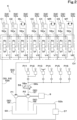
- FIG. 2 is a diagram illustrating the hydraulic circuit K of the working machine 1.
- the hydraulic circuit K includes hydraulic equipment such as the hydraulic actuators C1 to C5, ML, MR, and MT, the control valve unit CV, the hydraulic pumps P1 and P2, the hydraulic fluid tank 59, the oil cooler 37, operation valves PV1 to PV6, an unloading valve 58, a fluid passage 50, and so forth.
- One of the plurality of hydraulic pumps P1 and P2 is an operating hydraulic pump P1, and the other is a control hydraulic pump P2. These hydraulic pumps P1 and P2 are driven by the power of the electric motor 9.
- the motor and pump assembly 91 installed in the hood 2a includes the electric motor 9 and the hydraulic pumps P1 and P2.
- An output shaft of the electric motor 9 is extended so as to function as an input shaft (a pump shaft) of the hydraulic pumps P1 and P2.
- the operating hydraulic pump P1 draws in the hydraulic fluid stored in the hydraulic fluid tank 59 and then discharges the hydraulic fluid toward the control valve unit CV.
- the single operating hydraulic pump P1 is illustrated for convenience of description.
- the present invention is not limited to this, and an appropriate number of operating hydraulic pumps P1 may be provided such that the hydraulic fluid can be supplied to each of the hydraulic actuators C1 to C5, ML, MR, and MT.
- the control hydraulic pump P2 draws in the hydraulic fluid stored in the hydraulic fluid tank 59 and then discharges the hydraulic fluid so as to output a hydraulic pressure for signal, control, or the like.
- the control hydraulic pump P2 supplies (discharges) a pilot fluid for controlling (switching) the positions of control valves V1 to V8.
- An appropriate number of control hydraulic pumps P2 may also be provided.
- the control valve unit CV includes the plurality of control valves V1 to V8 combined together.
- the control valves V1 to V8 adjust control (adjustment) of the flow rates of the hydraulic fluid to be output from the hydraulic pumps P1 and P2 to the hydraulic actuators C1 to C5, ML, MR, and MT.
- control valves V1 to V8 are used for controlling the working device 20.
- the swing control valve V1 controls the flow rate and the flow direction of the hydraulic fluid to be supplied to the swing cylinder C1.
- the boom control valve V2 controls the flow rate and the flow direction of the hydraulic fluid to be supplied to the boom cylinder C2.
- the arm control valve V3 controls the flow rate and the flow direction of the hydraulic fluid to be supplied to the arm cylinder C3.
- the bucket control valve V4 controls the flow rate and the flow direction of the hydraulic fluid to be supplied to the bucket cylinder C4.
- the dozer control valve V5 controls the flow rate of the hydraulic fluid to be supplied to the dozer cylinder C5.
- the left traveling control valve V6 controls the flow rate of the hydraulic fluid to be supplied to the left traveling motor ML.
- the right traveling control valve V7 controls the flow rate of the hydraulic fluid to be supplied to the right traveling motor MR.
- the turn control valve V8 controls the flow rate of the hydraulic fluid to be supplied to the slewing motor MT.
- the term “left” is used for those for the left traveling mechanism 12, and the term “right” is used for those for the right traveling mechanism 12.
- the terms “left” and “right” do not necessarily refer to the actual left and right positional relationship.
- the operation valves (remote control valves) PV1 to PV6 are solenoid valves and are operated in response to manipulation of the operation levers 5a and 5b ( FIG. 1 ), which are included in the operation device 5.
- the pilot fluid acts on the control valves V1 to V8 in proportion to the operation amounts (manipulation amounts) of the operation valves PV1 to PV6, so that spools of the control valves V1 to V8 moves linearly.
- the hydraulic fluid at flow rates proportional to the amounts of movement of the spools of the control valves V1 to V8 is supplied to the hydraulic actuators C1 to C5, ML, MR, and MT, which are to be controlled. In this manner, the hydraulic actuators C1 to C5, ML, MR, and MT are driven in accordance with the amounts of the hydraulic fluid supplied from the control valves V1 to V8.
- the hydraulic fluid serving as the pilot fluid that acts on each of the control valves V1 to V8 is adjusted, so that the control valves V1 to V8 are controlled.
- the flow rates and the flow directions of the hydraulic fluid to be supplied from the control valves V1 to V8 to the hydraulic actuators C1 to C5, ML, MR, and MT are adjusted so as to control the driving and stopping of the hydraulic actuators C1 to C5, ML, MR, and MT.
- the fluid passage 50 includes, for example, a hose or a pipe that is made of a material such as a metal or the like.
- the fluid passage 50 is a flow passage that connects the components of the hydraulic circuit K to each other and allows the hydraulic fluid or the pilot fluid to flow to each of the component.
- the fluid passage 50 includes a first fluid passage 51, a second fluid passage 52, a first suction fluid passage 54, a second suction fluid passage 55, and a control fluid passage 57.
- the first suction fluid passage 54 is a flow passage through which the hydraulic fluid that has been drawn in by the operating hydraulic pump P1 from the hydraulic fluid tank 48 flows.
- the second suction fluid passage 55 is a flow passage through which the hydraulic fluid that has been drawn in by the control hydraulic pump P2 from the hydraulic fluid tank 59 flows.
- the first fluid passage 51 is a flow passage through which the hydraulic fluid discharged by the operating hydraulic pump P1 flows toward the control valves V1 to V8 of the control valve unit CV.
- the first fluid passage 51 is branched into a plurality of passages, and the plurality of passages are connected to their respective control valves V1 to V8.
- the second fluid passage 52 is a flow passage through which the hydraulic fluid that has passed through the control valves V1 to V8 flows toward the hydraulic fluid tank 48.
- the hydraulic fluid tank 59 stores the hydraulic fluid.
- the second fluid passage 52 includes a forward-and-return fluid passages 52a and a discharge fluid passage 52b.
- Each two of the forward-and-return fluid passages 52a are paired with each other, and each of the pairs of forward-and-return fluid passages 52a are interposed between one of the control valves V1 to V8 and a corresponding one of the hydraulic actuators C1 to C5, ML, MR, and MT to be controlled.
- the forward-and-return fluid passages 52a are flow passages through which the hydraulic fluid is supplied from the control valves V1 to V8 connected thereto the hydraulic actuators C1 to C5, ML, MR, and MT and through which the hydraulic fluid is returned from the hydraulic actuators C1 to C5, ML, MR, and MT to the control valves V1 to V8.
- One end of the discharge fluid passage 52b is branched into a plurality of passages, and the plurality of passages are connected to their respective control valves V1 to V8.
- the other end of the discharge fluid passage 52b is connected to the hydraulic fluid tank 59.
- Some of the hydraulic fluid that has flown to one of the control valves V1 to V8 through the first fluid passage 51 passes through the one of the control valves V1 to V8 and passes through one of the corresponding pair of fluid passages defining the forward-and-return fluid passages 52a, so as to be supplied to a corresponding one of the hydraulic actuators C1 to C5, ML, MR, and MT to be controlled.
- the hydraulic fluid discharged from the one of the hydraulic actuators C1 to C5, ML, MR, and MT returns to the one of the control valves V1 to V8 fluidly connected thereto by passing through the other one of the pair of fluid passages defining the forward-and-return fluid passages 52a, and flows toward the discharge fluid passage 52b by passing through the one of the control valves V1 to V8.
- the hydraulic fluid that has flown to the other ones of the control valves V1 to V8 by passing through the first fluid passage 51 is not supplied to the corresponding ones of the hydraulic actuators C1 to C5, ML, MR, and MT and flows into the discharge fluid passage 52b by passing through the other ones of the control valves V1 to V8.
- the oil cooler 37 is disposed in the discharge fluid passage 52b.
- the oil cooler 37 cools the hydraulic fluid flowing thereto from any one of the control valves V1 to V8 through the discharge fluid passage 52b.
- the hydraulic fluid cooled by the oil cooler 37 returns to the hydraulic fluid tank 59 by passing through the discharge fluid passage 52b.
- the fluid passages 54, 51, and 52 are arranged so as to cause the hydraulic fluid to circulate among the hydraulic fluid tank 59, the hydraulic pump P1, and the control valves V1 to V8 of the control valve unit CV while some of the hydraulic fluid also circulates through the hydraulic actuators C1 to C5, ML, MR, and MT.
- the control fluid passage 57 is a flow passage through which the hydraulic fluid discharged by the control hydraulic pump P2 flows to the operation valves PV1 to PV6.
- One end of the control fluid passage 57 is connected to the control hydraulic pump P2.
- the other end of the control fluid passage 57 is branched into a plurality of passages, and the plurality of passages are connected to primary-side ports (primary ports) of the respective operation valves PV1 to PV6.
- the operation valves PV1 to PV6 are solenoid valves, and the opening degrees of the operation valves PV1 to PV6 are adjusted on the basis of command signals output by the controller 7. By adjusting the opening degrees, the flow rates at which the pilot pressure fluid flows toward the control valves V1 to V8 are adjusted.
- the unloading valve 58 that includes a two-position switching valve is disposed in the control fluid passage 57.
- the unloading valve 58 is a two-position switching valve that has a fluid supplying position 58a and a fluid blocking position 58b as its switching positions, and is switched to either the fluid supplying position 58a or the fluid blocking position 58b in conjunction with the manipulation of the unload lever 5c ( FIG. 1 ).
- the unloading valve 58 When the unload lever 5c is manipulated to be located at the load position (the lowered position), the unloading valve 58 is switched to the fluid supplying position 58a (a load position), and the hydraulic fluid discharged from the control hydraulic pump P2 to the control fluid passage 57 is supplied to the operation valves PV1 to PV6, so that the operations of the control valves V1 to V8 are enabled.
- the unloading valve 58 When the unload lever 5c is manipulated to be located at the unload position (the raised position), the unloading valve 58 is switched to the fluid blocking position 58b (an unload position), and the hydraulic fluid discharged from the control hydraulic pump P2 to the control fluid passage 57 is discharged to the hydraulic fluid tank 48 without being supplied to the operation valves PV1 to PV6, so that the operations of the control valves V1 to V8 are disabled.
- the unloading valve 58 is switched in accordance with the manipulation of the unload lever 5c so as to switch the supply and discharge states of the hydraulic fluid to and from the operation valves PV1 to PV6, thereby switching between enabling and disabling the operations of the working device 20 and the traveling device 10 by the operation device 5.
- the present invention is not limited to this configuration.
- a solenoid valve that switches the operations of some or all of the control valves V1 to V8 may be provided, and a controller that controls the operation of this solenoid valve may control the operation of the solenoid valve in accordance with the switching position of the unload lever 5c so as to switch the working device 20 and the traveling device 10 between an operable state and an inoperable state.
- the working device 20 and the traveling device 10 may be entirely or partially caused to operate by one or more electric actuators, and a controller that controls the operation of the one or more electric actuators may control the operation of the one or more electric actuators in accordance with the switching position of the unload lever 5c so as to switch the working device 20 and the traveling device 10 between the operable state and the inoperable state.
- the working device 20, the traveling device 10, the dozer 17, and the like that are operated by the working operation lever 5a and the traveling operation lever 5b (hereinafter referred to as "operation levers 5a and 5b" or simply referred to as the “operation device") of the operation device 5 will hereinafter be collectively referred to as working devices (regardless of whether or not they are hydraulic, electric, or the like).
- the unlock lever 5c is an operation locker that is switchable between the enabling position at which the operations of the working devices by the operation device (the operation levers 5a and 5b) are enabled and the disabling position at which the operation of the working devices by the operation device (the operation levers 5a and 5b) are disabled.
- the hydraulic circuit K includes, in addition to those mentioned above, an operation detecting fluid passage (not illustrated) for detecting the operating states of the control valves V1 to V8.
- the operation detecting fluid passage is a fluid passage that is used for causing the pilot fluid discharged from the control hydraulic pump P2 to return to the hydraulic fluid tank 59 by sequentially passing through a plurality of switching valves for switching the positions of the control valves V1 to V8.
- the AI-SW 48 ( FIG. 1 ) is connected to this operation detecting fluid passage.
- the operation detecting fluid passage When all of the control valves V1 to V8 are in their neutral positions, the operation detecting fluid passage is open, and thus, the pressure of the pilot fluid in the operation detecting fluid passage does not increase to a certain level (a so-called non-pressurized state), so that the AI-SW 48 is brought into the OFF state. In other words, none of the hydraulic actuators C1 to C5, ML, MR, and MT being in operation is detected by the AI-SW 48.
- the AI-SW 48 When the unload lever 5c is in the load position (lowered position), that is, when the unloading valve 58 is in the fluid supplying position 58a, the AI-SW 48 is in the ON state as long as at least one of the hydraulic actuators C1 to C5, ML, MR, and MT is in operation.
- the AI-SW 48 is switched to the OFF state.
- the controller 7 issues a command to set the motor rotational speed MS of the electric motor 9 to the idle speed MS3 (see FIG. 5 ). This control of the electric motor 9 will hereinafter be referred to as auto-idling control.
- the working machine 1 includes the electrical system and the hydraulic system having the above-described structures, and the working machine 1 includes the radiator 35 and the oil cooler 37, which have been described above, as coolers that cool their cooling targets.
- the cooling targets are the cooling water and the hydraulic fluid circulating through the equipment that belongs to the electrical system and the hydraulic system.
- the coolers each include an electric cooling fan.
- the radiator 35 includes the radiator fan 35a that is rotationally driven by the output of the electric fan motor 35b
- the oil cooler 37 includes the oil cooler fan 37a that is rotationally driven by the output of the electric fan motor 37b.
- a radiator fan of a radiator attached along the engine is configured to rotate synchronously with an engine output shaft via a fan belt or the like, and thus, in principle, the radiator fan continuously rotates while the engine is rotating.
- the rotational speed of the radiator fan also changes synchronously with the change in the engine rotational speed.
- the working machine 1 includes the electric motor 9 as a prime mover, and the rotational driving of the electric cooling fans, such as the radiator fan 35a and the like, included in the above-mentioned coolers is independent of the rotational driving of the electric motor 9.
- the controller 7 controls the rotational driving of the radiator fan 35a and the oil cooler fan 37a, which are the electric cooling fans, in accordance with the temperature conditions or the like of the cooling targets.
- the electric cooling fans can be controlled depending on the situation so as to, for example, either remain stationary or rotate at low speeds in order to reduce noise.
- the radiator fan 35a and the oil cooler fan 37a which serves as the cooling fans, are arranged side by side as illustrated in FIG. 8 , and thus, noise reduction is particularly desired.
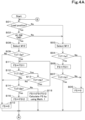
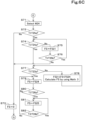
- the working machine 1 employs a control system for electric cooling fans such as that illustrated in FIG. 3 , FIG. 4A , FIG. 4B , FIG. 5 , FIG. 6A , FIG. 6B and FIG. 6C .
- a control system for electric cooling fans such as that illustrated in FIG. 3 , FIG. 4A , FIG. 4B , FIG. 5 , FIG. 6A , FIG. 6B and FIG. 6C . This structure will be described below.
- a cooling-fan rotation characteristic diagram that indicates a control pattern of at least one of the cooling fans is stored in the memory such as the above-mentioned storage unit 7b.
- the cooling-fan rotation characteristic diagram includes a plurality of fan control maps combined together.
- the plurality of fan control maps are created in accordance with individual situations.
- the cooling-fan rotation characteristic diagram is a single map group.
- a first map group MG1 illustrated in FIG. 3 and a second map group MG2 illustrated in FIG. 5 are stored in the memory.
- Each of the map groups MG1 and MG2 includes a plurality of fan control maps each indicating a rotational speed characteristic of a corresponding one of the cooling fans with respect to the temperature of the corresponding cooling target (the cooling water, the hydraulic fluid, or the like).
- each of the fan control maps is a graph in which the horizontal axis denotes a temperature T of the cooling target (hereinafter referred to as a "cooling target temperature T”) as mentioned above and in which the vertical axis denotes a rotational speed FS of the cooling fan (hereinafter referred to as a "fan rotational speed FS").
- the first map group MG1 illustrated in FIG. 3 will now be described.
- the first map group MG1 includes a plurality of fan control maps M11, M12, and M13.
- the fan control map M11 is selected when the unloading valve 58 is in the fluid blocking position 58b or when the unload lever 5c is pulled up to the unload position (raised position) (hereinafter simply referred to as "during unloading").
- the fan control map M12 is selected when the unloading valve 58 is in the fluid supplying position 58a or when the unload lever 5c is lowered to the load position (lowered position) (hereinafter simply referred to as "during loading").
- the fan control map M11 is selected.
- the fan control map M13 is selected when any one of the abnormally-high-temperature detectors 49 included in the high-power equipment (including the electric motor 9) as mentioned above, detects an abnormally high temperature regardless of whether it is during loading or during unloading.
- the fan control map M11 which is selected during unloading or when the auto-idling control is performed, indicates that the fan rotational speed FS is a fan rotational speed FS11 when the cooling target temperature T is equal to or higher than a temperature T11a.
- the temperature T11a is set as a threshold for determining whether to increase the rotational speed FS from zero to the rotational speed FS11. In other words, when the cooling target temperature T increases from a temperature lower than the temperature T11a and reaches the temperature T11a while the cooling fan is not rotating, the cooling fan starts to rotate at the rotational speed FS11, and the fan rotational speed FS is maintained at the rotational speed FS11 while the temperature further increases.
- the rotational speed FS11 is maintained, and when the cooling target temperature T further decreases to a temperature T11b, the rotation of the cooling fan is stopped.
- the temperature T11b is a threshold for determining whether to stop the rotation of the cooling fan that is rotating at the rotational speed FS11 (to set the rotational speed to zero), and the temperature T11b is lower than the temperature T11a.
- the temperature T11a which is the threshold for starting the rotation of the cooling fan (ON)
- the temperature T11b which is the threshold for stopping the rotation of the cooling fan (OFF)
- the motor rotational speed MS of the electric motor 9 during the auto-idling control is the idle speed MS3 (see FIG. 5 ).
- the rotational speed FS11 is determined in accordance with the rotational driving of the electric motor 9 at the idle speed MS3.
- the fan control map M12 that is selected during loading except for the case where the auto-idling control is performed indicates that the fan rotational speed FS is a rotational speed FS12 when the cooling target temperature T is equal to or higher than a temperature T12 and that the fan rotational speed FS increases from the rotational speed FS 11 to the rotational speed FS12 as the temperature T increases from a temperature T13a that is lower than the temperature T12 to the temperature T12.
- the rotational speed FS12 is defined as a rotational speed of each of the cooling fans at which the cooling targets can be cooled when the hydraulic actuators are normally operated to drive the working device 20 and the traveling device 10.
- the temperature T13a is set as a threshold for determining whether to increase the fan rotational speed FS from zero to the rotational speed FS 11. In other words, when the cooling target temperature T increases from a temperature lower than the temperature T13a and reaches the temperature T13a while the cooling fan is not rotating, the cooling fan starts to rotate at the rotational speed FS 11.
- the fan rotational speed FS increases from the rotational speed FS11 to the rotational speed FS12, and the rotational speed FS12 is maintained while the cooling target temperature T is higher than the temperature T12.
- a temperature T13b is a threshold for determining whether to stop the rotation of the cooling fan that is rotating at the rotational speed FS11 (to set the rotational speed to zero).
- the temperature T13a which is the threshold for starting the rotation of the cooling fan (ON)
- the temperature T13b which is the threshold for stopping the rotation of the cooling fan (OFF)
- the temperature T12 that corresponds to the timing at which the fan rotational speed FS increases in accordance with an increase of the cooling target temperature T and reaches the rotational speed FS12 is set to be substantially equal to the temperature T11a that corresponds to the timing at which the cooling target temperature T increases and the fan rotational speed FS increases from zero to the rotational speed FS 11 on the fan control map M11.
- the fan control map M13 is set such that the fan rotational speed FS is set to a rotational speed FS13 when the abnormally-high-temperature detector 49 of any of the high-power equipment detects an abnormally high temperature and the cooling target temperature T is equal to or higher than a temperature T14a.
- the rotational speed FS13 is a rotational speed suitable for cooling the high-power equipment that is in an abnormally-high temperature state and recovering the high-power equipment from the abnormally-high temperature state to a normal temperature state and is a rotational speed higher than the rotational speed FS12.
- the fan control map M13 indicates that the fan rotational speed FS is a rotational speed on the fan control map M11 or M12 at a stage where the cooling target temperature T is lower than the temperature T14a.
- the temperature T14a is set as a threshold for determining whether to switch the fan control map selected for controlling the rotational driving of the cooling fan from the fan control map M11 or M12, which has been used so far, to the fan control map 13.
- a temperature T14b that is lower than the temperature T14a is set as a threshold for determining whether to decrease the fan rotational speed FS from a fan rotational speed FS3 to a rotational speed on the fan control map M11 or M12.
- the fan rotational speed FS once increased to the rotational speed FS13 is maintained at the rotational speed FS13 until the cooling target temperature T decreases to the temperature T14b, which is lower than the temperature T14a.
- This can avoid a situation in which the cooling target temperature T decreases as soon as the fan rotational speed FS increases to the fan rotational speed FS and in which the fan rotational speed FS quickly decreases to the original rotational speed, so that the high-power equipment can be appropriately cooled.
- the temperature T14a is set to be higher than the temperature T13a and lower than the temperature T12, and the temperature T14b is set to be substantially equal to the temperature T13a.
- the present invention is not limited to this, and they may be appropriately set in accordance with the characteristics of the high-power equipment, the cooling performances, and the like.
- step S01 it is determined whether the unloading valve 58 is in the fluid supplying position (load position) 58a (loaded) or in the fluid blocking position (unload position) 58b (unloaded) (step S01). This determination may be replaced with a determination as to whether the unload lever 5c is in the load position (lowered position) or in the unload position (raised position) based on detection of the manipulation position of the unload lever 5c.
- the controller 7 selects the fan control map M11 from the first map group MG1 stored in the storage unit 7b (step S03).
- step S05 if the cooling target temperature T that is detected by the temperature detector (corresponding to the water temperature detector 46 or the fluid temperature detector 47 illustrated in FIG. 1 ) is lower than the temperature T11a (NO in step S04), the fan rotational speed FS is set to zero (step S05), and if the cooling target temperature T is equal to or higher than the temperature T11a (YES in step S04), the fan rotational speed FS is set to the rotational speed FS11. (step S06).
- the reason why the fan rotational speed FS is set to a certain value is that the controller 7 issues a command signal to the electric actuator (the fan motors 35b, 37b, or the like) for driving the corresponding cooling fan and controls the output of the electric actuator so as to adjust the fan rotational speed FS detected by the corresponding fan rotational speed detector (the fan rotational speed detectors 43, 44, or the like) to a target value.
- the electric actuator the fan motors 35b, 37b, or the like
- the fan rotational speed FS once increased to the rotational speed FS11 is maintained as long as the cooling target temperature T is equal to or higher than the temperature T11b (YES in step S07), and if the temperature T becomes lower than the temperature T11b (NO in step S07), the fan rotational speed FS is set to zero (step S05).
- step S01 If it is determined that the unloading valve 58 is in the fluid supplying position (load position) 58a (in a loading state) (YES in step S01), the AI-SW 48 is in the ON state (a state in which the auto-idling control is not performed) or in the OFF state (in a state in which the auto-idling control is performed and the operation device 5 has not been manipulated for a period of time equal to or greater than a certain period of time) (step S02).
- step S02 If the AI-SW 48 is in the OFF state (NO in step S02), the controller 7 selects the fan control map M11 from the first map group MG1 (step S03), and the rotation of the cooling fan is controlled in a manner similar to that in the case where the unloading valve 58 in the fluid blocking position 58b.
- step S08 the controller 7 selects the fan control map M12 from the first map group MG1 (step S08).
- step S10 if the cooling target temperature T detected by the above-mentioned temperature detector is lower than the temperature T13a (NO in step S09), the fan rotational speed FS is set to zero (step S10). If the cooling target temperature T reaches the temperature T11a (YES in step S09), the fan rotational speed FS is increased to the rotational speed FS11 (step S11).
- step S12 Regarding the fan rotational speed FS once increased to the rotational speed FS11 when the cooling target temperature T reaches the temperature T11a, even if the cooling target temperature T falls below the temperature 13a thereafter (YES in step S12), the fan rotational speed FS is maintained at the rotational speed FS11 (step S11) as long as the cooling target temperature T is equal to or higher than the temperature T13b (YES in step S13), and if the cooling target temperature T becomes lower than the temperature T13b (NO in step S13), the fan rotational speed FS is set to zero (step S10).
- the value of the fan rotational speed FS that has increased to the rotational speed FS11 when the cooling target temperature T increases and reaches the temperature T13a is determined on the basis of the cooling target temperature T that is detected each time.
- the cooling fan rotates at the rotational speed FS that is determined in accordance with the value of the temperature T. For example, by substituting the temperature T actually detected into the following formula [Math. 1], the fan rotational speed FS that is equal to or higher than the rotational speed FS11 and lower than the rotational speed FS12 can be obtained (step S15).
- FS (T-T13a) ⁇ (FS12-FS11) / (T12-T13a) +FS11 T13a ⁇ T ⁇ T12
- the fan rotational speed FS is set to the rotational speed FS12 (step S16), and this rotational speed FS12 is maintained as long as the temperature T is maintained at the temperature T12 or higher.
- the abnormally-high-temperature detector 49 of each high-power equipment continuously checks the presence or absence of an abnormally high temperature (step S21).
- the fan control map M13 is selected (step S23), and the cooling fan rotates at the rotational speed FS13, which is a high rotational speed so as to achieve removal of the abnormally high temperature from the high-power equipment.
- the fan While the cooling target temperature T detected by the temperature detector is equal to or higher than the temperature T14b (YES in step S25), the fan continues to rotate at the rotational speed FS13. If the detected cooling target temperature T falls below the temperature T14b (NO in step S25), it is determined that the abnormally high temperature has been removed from the high-power equipment, and the control returns to the control of the cooling fan by selecting the fan control map M11 or M12 in accordance with the situation at that time (B).
- the rotation of the cooling fan can be stopped, or the cooling fan can be caused to rotate at a minimum rotational speed in the case where an increase in the temperature of the cooling target is not a significant concern. Examples of such a case include during unloading, when the auto-idling control is performed, and the like.
- the rotation of the cooling fan can be stopped, or the rotational speed of the cooling fan can be kept low.
- the cooling target when the temperature of the cooling target is high due to the operation of the corresponding hydraulic actuator or the like, the cooling target can be cooled by the rotation of the cooling fan at high rotational speed.
- the abnormally high temperature when the high-power equipment has an abnormally high temperature, the abnormally high temperature can be quickly removed from the high-power equipment by increasing the rotational speed of the cooling fan. As a result, a reliable cooling effect can be obtained when the need for cooling the cooling target is high.
- radiator fan 35a as the cooling fan whose rotational driving is controlled by using the first map group MG1 as described above may be considered.
- the following may be considered: a cooler to which the control of the rotational driving of the cooling fan is applied is the radiator 35, the cooling target thereof is the cooling water for cooling the high-power equipment including the electric motor 9, and the cooling target temperature T is a cooling water temperature T detected by the water temperature detector 46.
- the first map group MG1 illustrated in FIG. 3 is used for controlling the rotational driving of the radiator fan 35a, for example, setting the rotational speed FS11, the rotational speed FS12, and the rotational speed FS13 to 1000 rpm, 2500 rpm, and 3000 rpm, respectively, may be considered.
- a cooling water temperature T11 serving as a threshold that is used when the rotational speed FS of the radiator fan 35a is increased from zero to the rotational speed FS11 in the fan control map M11 is set to 70°C
- the cooling water temperature T13a serving as a threshold that is used when the rotational speed FS of the radiator fan 35a is increased from zero to the rotational speed FS11 in the fan control map M12 is set to 60°C
- the cooling water temperature T12 that corresponds to the timing at which the rotational speed FS of the radiator fan 35a, increased from rotation speed FS11, reaches the rotational speed FS12 in the fan control map M12 is set to 70°C
- the cooling water temperature T14a that corresponds to the timing at which the rotational speed FS of the radiator fan 35a is increased to the rotational speed FS13 in the fan control map M13 is set to 65°C.
- the second map group MG2 includes a plurality of fan control maps M21, M22, M23, and M24.
- the fan control map M21 is selected.
- one of the fan control map M23 and the fan control map M24 is selected in accordance with the value to which the motor rotational speed MS of the electric motor 9 is set.
- the fan control map M23 is selected.
- the fan control map M24 is selected.
- the fan control map M21 that is selected during unloading is set such that, when the cooling target temperature T is lower than a temperature T21a in a state where the fan rotational speed FS is zero, the fan rotational speed FS is maintained at zero and such that, when the cooling target temperature T increases from this state to the temperature T21a, the fan rotational speed FS is set to the rotational speed FS21.
- the fan control map M21 is also set such that, even when the cooling target temperature T decreases after the cooling target temperature T has increased to the temperature T21a and the cooling fan has started to rotate, the rotation of the cooling fan is maintained at the rotational speed FS21 until the cooling target temperature T decreases to a temperature T21b.
- the fan control map M22 that is selected during loading and when the auto-idling control is performed is set such that, when the cooling target temperature T is lower than a temperature T22a in a state where the fan rotational speed FS is zero, the fan rotational speed FS is maintained at zero and such that, when the cooling target temperature T increases from this state to the temperature T22a, the fan rotational speed FS is set to the rotational speed FS21.
- the fan control map M22 is also set such that, even when the cooling target temperature T decreases after the cooling target temperature T has increased to the temperature T22a and the cooling fan has started to rotate, the rotation of the cooling fan is maintained at the rotational speed FS21 until the cooling target temperature T decreases to a temperature T22b.
- the fan control map M23 that is selected when the electric motor 9 is rotating at the high idle speed MS1 during loading (hereinafter simply referred to as "during high idle speed") is set such that, when the cooling target temperature T increases from a temperature lower than a temperature T25a and reaches the temperature T25a while the cooling fan is not rotating, the cooling fan starts to rotate at the rotational speed FS21 and such that the cooling fan is caused to rotate at the rotational speed FS21 until the cooling target temperature T reaches a temperature T24 or decreases to a temperature T25b.
- the fan control map M23 is set such that, even when the cooling target temperature T decreases after the cooling target temperature T has increased to the temperature T25a and the cooling fan has started to rotate, the rotation of the cooling fan is maintained at the rotational speed FS21 until the cooling target temperature T decreases to the temperature T25b and such that, when the cooling target temperature T decreases to the temperature T25b, the fan rotational speed is set to zero.
- the fan control map M23 is also set such that, when the cooling target temperature T is equal to or higher than the temperature T24 and lower than a temperature T23, the fan rotational speed is increased in accordance with an increase in the cooling target temperature T and such that, when the cooling target temperature T is equal to the temperature T23, the fan rotational speed FS is set to a rotational speed FS22.
- the fan control map M23 is also set such that, when the cooling target temperature T becomes equal to or higher than the temperature T23, the fan rotational speed FS is maintained at the rotational speed FS22 until the cooling target temperature T further increases and reaches a temperature T26a.
- the fan control map M23 is set such that, when the cooling target temperature T reaches the temperature T26a in the state of the rotational speed FS22, the fan rotational speed FS is increased to a rotational speed FS23 that is higher than the rotational speed FS22 and such that, even if the cooling target temperature T further increases, the fan rotational speed FS is maintained at the rotational speed FS23.
- the fan control map M23 is also set such that, after the fan rotational speed FS has been increased to the rotational speed FS22, the fan rotational speed FS is decreased to the rotational speed FS22 when the cooling target temperature T is decreased to a temperature T26b that is lower than the temperature T26a and higher than the temperature T23.
- the temperatures T22a and T22b that serve as thresholds used for determining whether to set the fan rotational speed FS to zero or the rotational speed FS21 in the fan control map M22, which is selected when the auto-idling control is performed are set between the temperature T23 and the temperature T24 in the fan control map M23.
- the temperature T22a is set to be lower than the temperature T23
- the temperature T22b is set to be higher than the temperature T24.
- the temperature T21a that is a threshold for determining whether to increase the fan rotational speed FS from zero to the rotational speed FS21 is set to be higher than the temperature T23 on the fan control map M23.
- setting the temperature T21b that is a threshold for changing the fan rotational speed FS from the rotational speed FS21 to zero to be substantially equal to the temperature T23 on the fan control map M23 may be considered.
- the relationship between the temperature T23 on the fan control map M23 and the temperatures T21a and T21b on the fan control map M21 or the temperatures T22a and T22b on the fan control map M22 has been described above as an example and is not particularly limited thereto.
- the temperature T21a or the temperature T22a may be set to be substantially equal to the temperature T23 on the fan control map M23.
- the fan control map M24 that is selected when the electric motor 9 is rotating at the low idle speed MS2 during loading (hereinafter simply referred to as "during low idle speed") is set such that, when the cooling target temperature T increases from a temperature lower than the temperature T25a and reaches the temperature T25a while the cooling fan is not rotating, the cooling fan starts to rotate at the rotational speed FS21 and such that the cooling fan is caused to rotate at the rotational speed FS21 until the cooling target temperature T reaches the temperature T24 or decreases to the temperature T25b.
- the fan control map M24 is set such that, even when the cooling target temperature T decreases after the cooling target temperature T has increased to the temperature T25a and the cooling fan has started to rotate, the rotation of the cooling fan is maintained at the rotational speed FS21 until the cooling target temperature T decreases to the temperature T25b and such that, when the cooling target temperature T decreases to the temperature T25b, the fan rotational speed is set to zero.
- the fan control map M24 is also set such that, when the cooling target temperature T is equal to or higher than the temperature T24 and lower than the temperature T23, the fan rotational speed is increased in accordance with an increase in the cooling target temperature T and such that, when the cooling target temperature T is equal to the temperature T23, the fan rotational speed FS is set to a rotational speed FS24.
- the rotational speed FS24 is set to be lower than the rotational speed FS22, which has been mentioned above.
- the fan control map M24 is set such that the fan rotational speed FS is maintained at the rotational speed FS21 during the period when the cooling target temperature T is increasing from the temperature T25a to the temperature T24.
- the fan control map M24 increases the fan rotational speed FS in accordance with an increase in the cooling target temperature T when the cooling target temperature T is within a range from the temperature T24 to the temperature T23.
- the fan control map M24 is set such that, when the cooling target temperature T becomes equal to or higher than the temperature T23, the fan rotational speed FS is maintained at the rotational speed FS24 until the cooling target temperature T further increases and reaches the temperature T26a.
- the fan control map M24 is also set such that, when the cooling target temperature T increases to the temperature T26a, the fan rotational speed FS is increased from the rotational speed FS24 to a rotational speed FS25 that is higher than the rotational speed FS24. Even if the cooling target temperature T further increases, the fan rotational speed FS is maintained at the rotational speed FS25.
- the fan control map M24 is also set such that the fan rotational speed FS that has increased to the rotational speed FS25 is maintained until the cooling target temperature T decreases to the temperature T26b, which is lower than the temperature T26a, and such that the fan rotational speed FS is decreased to the rotational speed FS24 when the cooling target temperature T decreases to the temperature T26b.
- the relationship of the temperatures T23 and T24 on the fan control map 24 with the temperatures T21a and 21b on the fan control map M21 and with the temperatures T22a and T22b on the fan control map M22 is similar to the relationship of the temperatures T23 and T24 on the fan control map 23 with the temperatures T21a, 21b, 22a, and 22b.
- step S31 it is determined whether the unloading valve 58 is in the fluid supplying position 58a (during loading) or in the fluid blocking position 58b (during unloading) (step S31). This determination may be replaced with a determination as to whether the unload lever 5c is in the load position (lowered position) or in the unload position (raised position) based on detection of the manipulation position of the unload lever 5c.
- step S31 If it is determined that the unloading valve 58 is in the fluid blocking position 58b (during unloading) (NO in step S31), as illustrated in FIG. 6B , the controller 7 selects the fan control map M21 from the second map group MG2 stored in the storage unit 7b (step S51).
- step S52 if the cooling target temperature T that is detected by the temperature detector (corresponding to the water temperature detector 46 or the fluid temperature detector 47 illustrated in FIG. 1 ) is lower than the temperature T21a (NO in step S52), the fan rotational speed FS is set to zero (step S53), and if the cooling target temperature T is equal to or higher than the temperature T21a (YES in step S52), the fan rotational speed FS is set to the rotational speed FS21. (step S54).
- the fan rotational speed FS once increased to the rotational speed FS21 is maintained as long as the cooling target temperature T is equal to or higher than the temperature T21b (YES in step S55), and if the temperature T becomes lower than the temperature T21b (NO in step S55), the fan rotational speed FS is set to zero (step S53).
- the AI-SW 48 is in the ON state (a state in which the auto-idling control is not performed) or in the OFF state (a state in which the auto-idling control is performed). It is determined whether the operation device 5 (the operation levers 5a or 5b) has not been manipulated for a period of time equal to or greater than a certain period of time (step S32).
- the controller 7 selects the fan control map M22 from the second map group MG1 (step S61) and controls the rotational driving of the cooling fan on the basis of the fan control map M22.
- step S62 if the cooling target temperature T detected by the temperature detector is lower than the temperature T22a (NO in step S62), the fan rotational speed FS is set to zero (step S63), and if the cooling target temperature T is equal to or higher than the temperature T21a (YES in step S62), the fan rotational speed FS is set to the rotational speed FS21. (step S64).
- the fan rotational speed FS once increased to the rotational speed FS21 is maintained as long as the cooling target temperature T is equal to or higher than the temperature T22b (NO in step S65), and if the cooling target temperature T becomes lower than the temperature T22b (YES in step S65), the fan rotational speed FS is set to zero (step S63).
- step S32 it is determined whether the normal mode (in which the electric motor 9 rotates at the high idle speed MS1) or the ECO mode (in which the electric motor 9 rotates at the low idle speed MS2) is selected by the mode selection SW 5e (step S33).
- step S33 it may be determined whether the actual motor rotational speed MS of the electric motor 9 detected by the motor rotational speed detector 42 is set to the high idle speed MS1 or the low idle speed MS2.
- step S33 the controller 7 selects the fan control map M23 from the second map group MG2 (step S34).
- step S35 if the cooling target temperature T detected by the above-mentioned temperature detector is lower than the temperature T25a (NO in step S35), the fan rotational speed FS is set to zero (step S36). If the cooling target temperature T reaches the temperature T25a (YES in step S35), the fan rotational speed FS is increased to the rotational speed FS21, and the fan rotational speed FS is set to the rotational speed FS21 (step S38) until the cooling target temperature T increases to the temperature T24 (NO in step S37).
- the fan rotational speed FS is maintained at the rotational speed FS21 (step S38) as long as the cooling target temperature T is equal to or higher than the temperature T25b (YES in step S39), and if the temperature T becomes lower than the temperature T25b (NO in step S39), the fan rotational speed FS is set to zero (step S36).
- the cooling fan rotates at the rotational speed FS that is determined in accordance with the value of the temperature T. For example, by substituting the temperature T actually detected into the following formula [Math. 2], the fan rotational speed FS can be obtained (step S41).
- FS (T-T24) ⁇ (FS22-FS21) / (T23-T24) +FS21 T24 ⁇ T ⁇ T23
- the fan rotational speed FS is set to the rotational speed FS22 (step S44).
- step S43 If the cooling target temperature T becomes equal to or higher than the temperature T26a (YES in step S43), the fan rotational speed FS is increased to the rotational speed FS23 (step S44).
- the fan rotational speed FS is maintained at the rotational speed FS23 (step S44) as long as the cooling target temperature T is equal to or higher than the temperature T26b (YES in step S45), and if the temperature T becomes lower than the temperature T26b (YES in step S45), the fan rotational speed FS is set to the rotational speed FS22 (step S42).
- step S31 If during loading (YES in step S31), the AI-SW 48 is in the ON state (YES in step S32), and the ECO mode is selected by the operation of the mode selection SW7e, that is, if the motor rotational speed MS of the electric motor 9 is set to the low idle speed MS2 (NO in step S33), the controller 7 selects the fan control map M24 from the second map group MG2 as illustrated in FIG. 6C (step S71).
- the fan rotational speed FS is set to zero (step S73). If the cooling target temperature T reaches the temperature T25a (YES in step S72), the fan rotational speed FS is increased to the rotational speed FS21, and the fan rotational speed FS is set to the rotational speed FS21 (step S75) until the cooling target temperature T increases to the temperature T24 (NO in step S74).
- the fan rotational speed FS is maintained at the rotational speed FS21 (step S75) as long as the cooling target temperature T is equal to or higher than the temperature T25b (YES in step S76), and if the temperature T becomes lower than the temperature T25b (NO in step S76), the fan rotational speed FS is set to zero (step S73).
- the cooling fan rotates at the rotational speed FS that is determined in accordance with the value of the temperature T. For example, by substituting the temperature T actually detected into the following formula [Math. 3], the fan rotational speed FS can be obtained (step S78).
- FS (T-T24) ⁇ (FS24-FS21) / (T23-T24) +FS21 T24 ⁇ T ⁇ T23
- the fan rotational speed FS is set to the rotational speed FS24 (step S79).
- step S80 If the cooling target temperature T becomes equal to or higher than the temperature T26a (YES in step S80), the fan rotational speed FS is increased to the rotational speed FS25 (step S81).
- the fan rotational speed FS is maintained at the rotational speed FS25 (step S81) as long as the cooling target temperature T is equal to or higher than the temperature T26b (YES in step S82), and if the temperature T becomes lower than the temperature T26b (YES in step S82), the fan rotational speed FS is set to the rotational speed FS24 (step S79).
- the rotation of the cooling fan can be stopped, or the cooling fan can be caused to rotate at a minimum rotational speed in the case where an increase in the temperature of the cooling target is not a significant concern. Examples of such a case include during unloading, when the auto-idling control is performed, and the like.
- the rotation of the cooling fan can be stopped, or the rotational speed of the cooling fan can be kept low. Even if the cooling target temperature is high, the rotational speed of the cooling fan can be kept low during low idle speed.
- the cooling target when the temperature of the cooling target is high due to the operation of the corresponding hydraulic actuator or the like, the cooling target can be cooled by the rotation of the cooling fan at high rotational speed.
- the rotational speed of the cooling fan when the cooling target temperature is very high, the rotational speed of the cooling fan can be increased both during high idle speed and during low idle speed so as to quickly bring the cooling target out of an abnormally-high temperature state, and a reliable cooling effect can be obtained.
- applying the oil cooler fan 37a as the cooling fan whose rotational driving is controlled by using the second map group MG1 as described above may be considered.
- a cooler to which the control of the rotational driving of the cooling fan is applied is the oil cooler 37
- the cooling target thereof is the hydraulic fluid discharged from the hydraulic pumps P1 and P2, which are driven by the electric motor 9, toward the hydraulic actuators
- the cooling target temperature T is a hydraulic fluid temperature T detected by the fluid temperature detector 47.
- the second map group MG1 illustrated in FIG. 5 when used for controlling the rotational driving of the oil cooler fan 37a, for example, setting the rotational speed FS21, the rotational speed FS22, the rotational speed FS23, the rotational speed FS24, and the rotational speed FS25 to 1000 rpm, 3000 rpm, 3500 rpm, 1500 rpm, and 2000 rpm respectively, may be considered.
- the hydraulic fluid temperature T21a serving as a threshold that is used when the rotational speed FS of the oil cooler fan 37a is increased from zero to the rotational speed FS21 in the fan control map M21 is set to 90°C
- the hydraulic fluid temperature T22a serving as a threshold that is used when the rotational speed FS of the oil cooler fan 37a is increased from zero to the rotational speed FS21 in the fan control map M22 is set to 80°C
- the hydraulic fluid temperature T25a serving as a threshold that is used when the rotational speed FS of the oil cooler fan 37a is increased from zero to the rotational speed FS21 in the fan control maps M23 and M24 is set to 60°C
- the temperature T23 that corresponds to the timing at which the rotational speed FS of the oil cooler fan 37a, increased from rotation speed FS21, reaches the rotational speeds FS22 and FS24 in the fan control maps M23 and M24 is set to 85°C
- the temperature T26a that corresponds to the timing at
- a change in the rotational speed of the electric motor 9 leads to a change in the delivery flow rate of the hydraulic pumps P1 and P2, and the result appears as a change in the temperature of the hydraulic fluid.
- the second map group MG2 that provides the plurality of fan control maps M22 and M24 in accordance with variations in the rotational speed of the electric motor 9.
- the absorbed torque of each of the hydraulic pumps P1 and P2 is constant regardless of a change in the rotational speed of the electric motor 9, and thus, the amount of heat generated by the electric motor 9 itself does not change much during both low-speed rotation and high-speed rotation. Consequently, regarding the radiator 35 whose cooling target is the cooling water that is used for cooling the electrical equipment, such as the electric motor 9 and the like, the cooling water temperature T is not significantly affected by a change in the rotational speed of the electric motor 9, unlike the hydraulic pumps P1 and P2. Therefore, in the present embodiment, the first map group MG1 that provides the fan control map M12 created without considering variations in the rotational speed of the electric motor 9 is employed for the control of the radiator fan 35a.
- a map group that provides, like the second map group MG2 a plurality of fan control maps in accordance with variations in the motor rotational speed MS may be employed.
- a map group that provides, like the first map group MG1, that provides a uniform fan control map without considering a change in the motor rotational speed MS may be employed.
- the controller 7 in the working machine 1 selects any one of the plurality of fan control maps indicating the characteristics of the fan rotational speed FS with respect to the cooling target temperature T, depending on whether it is during loading or during unloading so as to vary the characteristics of the fan rotational speed that appear from the control of the cooling fan in each case.
- This is a minimum control that is to be performed by the controller 7 according to the present embodiment, and there are no other limitations.
- the cooling fans to be controlled may be fans other than the radiator fan 35a and the oil cooler fan 37a.
- the first map group MG1 is basically employed, some of the features found in the second map group MG2 may be employed.
- An example of the features may be providing a map different from the fan control map M11, which is used during unloading, when the auto-idling control is performed.
- the second map group MG2 is basically employed, some of the features found in the first map group MG1 may be employed.
- An example of the features may be adding a map such as the fan control map M13 for cooling in emergencies.
- a working machine 1 includes an electric motor 9, a working device to be driven by power of the electric motor 9, an operation device 5 (operation lever 5a, 5b) to operate the working device, an operation locker (unload lever 5c), a cooler (radiator 35, oil cooler 37) including an electric cooling fan (radiator fan 35a, oil cooler fan 37a), a temperature detector (water temperature detector 46, fluid temperature detector 47) to detect a cooling target temperature T that is a temperature of a cooling target (cooling water, hydraulic fluid) to be cooled by the cooler (radiator 35, oil cooler 37), and a controller 7 to control a fan rotational speed FS that is a rotational speed of the cooling fan (radiator fan 35a, oil cooler fan 37a) in accordance with the cooling target temperature T (of cooling water, of hydraulic fluid) detected by the temperature detector (water temperature detector 46, fluid temperature detector 47).
- the operation locker (unload lever 5c) is switchable between an enabling position (load position) where an operation of the working device by the operation device (operation lever 5a, 5b) is enabled and a disabling position (unload position) where the operation of the working device by the operation device (operation lever 5a, 5b) is disabled.
- the controller 7 is configured or programmed to change a characteristic of the fan rotational speed FS with respect to the cooling target temperature T depending on whether the operation locker (unload lever 5c) is in the enabling position (load position) or the disabling position (unload position).
- the control of rotational driving of the cooling fan (radiator fan 35a, oil cooler fan 37a) according to the cooling target temperature T can vary between when the operation locker (unload lever 5c) is in the enabling position (load position) and when the operation locker (unload lever 5c) is in the disabling position (unload position), and for each case, an appropriate rotational state of the cooling fan (radiator fan 35a, oil cooler fan 37a) can be achieved.
- the working machine 1 includes a memory (storage unit 7b) to store a plurality of fan control maps M11, M12, M13, M21, M22, M23, and M24 each indicating a characteristic of the fan rotational speed FS with respect to the cooling target temperature T.
- the plurality of fan control maps includes a first map M11, M21 and a second map M12, M23 that are different from each other.
- the controller 7 is configured or programmed to control rotational driving of the cooling fan (radiator fan 35a, oil cooler fan 37a) based on the first map M11, M21 when the operation locker (unload lever 5c) is in the disabling position (unload position), and to control the rotational driving of the cooling fan (radiator fan 35a, oil cooler fan 37a) based on the second map M12, M23 when the operation locker (the unload lever 5c) is in the enabling position (load position).
- the plurality of fan control maps By storing the plurality of fan control maps, it is possible to exhibit various fan rotational speed characteristics corresponding to the number of the stored maps, enabling for detailed control of the rotational driving of the cooling fans according to the temperature conditions of the cooling targets and the like.
- the first map M11, M21 and the second map M12, M23 different from each other and controlling the rotational driving of the cooling fan by using these maps depending on whether the operation locker (unload lever 5c) is in the enabling position (load position) or in the disabling position (unload position) it is possible to exhibit different fan rotational speed characteristics in respective cases.
- the first map M11, M21 is configured to switch the fan rotational speed FS between zero and a predetermined first fan rotational speed FS11, FS21 in accordance with the cooling target temperature T.
- the cooling fan is caused to rotate only when the cooling target temperature T becomes a high temperature that is equal to or higher than a first temperature T11a, T21a and cooling is required, also in this case, by setting the first fan rotational speed FS11, FS21 to a low value, the cooling fan rotates at a low speed, so that the noise can be reduced.
- the first map M11, M21 is configured to switch the fan rotational speed FS to the first fan rotational speed FS 11 when the cooling target temperature T increases from a temperature lower than a predetermined first rotation increase temperature T11a, T21a to the first rotation increase temperature T11a, T21a in a state where the fan rotational speed FS is zero, and to switch the fan rotational speed FS to zero when the cooling target temperature T decreases to a predetermined first rotation decrease temperature T11b, T21b lower than the first rotation increase temperature T11a, T21a in a state where the fan rotational speed FS is set to the fan rotational speed FS 11.
- the second map M12, M23, M25 is configured to set the fan rotational speed FS to a value greater than zero when the cooling target temperature T increases from a temperature lower than a predetermined second rotation increase temperature T13a, T25a to the second rotation increase temperature T13a, T25a in a state where the fan rotational speed FS is zero, to set the fan rotational speed FS to a predetermined second fan rotational speed FS12, FS22, FS24 when the cooling target temperature T is equal to or higher than a first specified temperature T12, T23 that is set to be higher than the second rotation increase temperature T13a, T25a, to set the fan rotational speed FS to become higher, within a range below the second fan rotational speed FS12, FS23, as the cooling target temperature T increases when the cooling target temperature T is equal to or higher than the second rotation increase temperature T13a, T25a and lower than the first specified temperature T12, T23, and to reduce the fan rotational speed FS to zero when the cooling target temperature T decreases to
- the rotational speed of the cooling fan is set to the second fan rotational speed FS12, FS22, FS24 within a range of the expected cooling target temperature T during normal operation of the working device, so that a reliable cooling effect can be obtained.
- the noise can be reduced by reducing the rotational speed at a stage where the cooling target temperature T is low.
- the fan rotational speed FS increases (gradually) to the second fan rotational speed FS12, FS22, FS24 as the temperature increases, and thus, while ensuring a cooling effect appropriate for the temperature condition, it is possible to prevent a sudden change in the fan rotational speed FS and to eliminate a situation where the noise condition changes abruptly (e.g., sudden generation of loud noise).
- the second map M12, M23, M25 is configured to set the fan rotational speed FS to a fixed value FS11, FS21 less than the second fan rotational speed FS12, FS22, FS24 when the cooling target temperature T is lower than a second specified temperature T13a, T24 that is set to be equal to or higher than the second rotation increase temperature T13a, T25a and to be lower than the first specified temperature T12, T23, and to set the fan rotational speed FS to become higher, within a range below the second fan rotational speed FS12, FS22, FS24, as the cooling target temperature T increases when the cooling target temperature T is equal to or higher than the second specified temperature T13a, T24 and lower than the first specified temperature T12, T23.
- the cooling target temperature T increases to the second specified temperature T13a, T24
- the generation of noise and the occurrence of excessive cooling can be prevented by stopping the cooling fan.
- the rotation of the cooling fan at the fixed fan rotational speed FS11, FS21 is maintained until the cooling target temperature T falls to the third specified temperature T13b, T25b.
- the cooling fan is maintained in a nonoperating state until the cooling target temperature T increases to the second specified temperature T13a.
- the plurality of fan control maps include a third map M11, M22.
- the controller 7 is configured or programmed to set a rotational speed MS of the electric motor 9 to an idle speed MS3, and control the cooling fan based on the third map M11, M22 when the operation locker (unlock lever 7c) is in the enabling position (load position) and the operation device 5 (working operation lever 5a, traveling operation lever 5b) is not operated for a certain period of time.
- the third map M11, M22 is configured to switch the fan rotational speed FS to a predetermined auto-idle speed FS11, FS21 when the cooling target temperature T increases from a temperature lower than a predetermined third increase temperature T11a, T22a to the third rotation increase temperature T11a, T22a in a state where the fan rotational speed FS is zero, and to switch the fan rotational speed FS to zero when the cooling target temperature T decreases to a predetermined third rotation decrease temperature T11b, T22b lower than the third increase temperature T11a, T22a in a state where the fan rotational speed FS is set to the auto-idle speed FS11, FS21.
- the third map M11 is common with the first map M11.
- the cooling target of the cooler is a refrigerant that is used to cool cooling target equipment (electric motor 9 and/or the like) included in the working machine 1, and the working machine 1 includes an abnormally-high-temperature detector 49 to detect an abnormally high temperature of the cooling target equipment (electric motor 9 and/or the like).
- the controller 7 is configured or programmed to rotate at a third fan rotational speed FS13 higher than the second fan rotational speed FS12 when the abnormally-high-temperature detector 49 detects an abnormally high temperature and the cooling target temperature T is equal to or higher than a third specified temperature T14a that is set to be equal to or higher than the second rotation increase temperature T13a.
- the cooling fan can rotate at the third fan rotational speed FS13, which is higher than the second fan rotational speed FS12, allowing the refrigerant to be quickly and strongly cooled in order to prioritize the cooling of the cooling target equipment, thereby preventing a failure of the cooling target equipment.
- the controller 7 is configured or programmed to cause control of the rotational speed of the cooling fan to return to control based on the second map M12 when the cooling target temperature T decreases to the fourth specified temperature T14b that is lower than the third specified temperature T14a in a state where the cooling fan is rotating at the third fan rotational speed FS13.
- the second map M23, M24 is configured to set the fan rotational speed FS to a fourth fan rotational speed FS23, FS25 that are higher than the second fan rotational speed FS22, FS24 when the cooling target temperature T increases to a fourth rotation increase temperature T26a that is higher than the first specified temperature T23 in a state where the fan rotational speed FS is set to the second fan rotational speed FS22, FS24, and to reduce the fan rotational speed FS to the second fan rotational speed FS22, FS24 when the cooling target temperature T decreases to a predetermined fourth rotation decrease temperature T26b that is lower than the fourth rotation increase temperature T26a and higher than the first specified temperature T23 in a state where the fan rotational speed FS is set to the fourth fan rotational speed FS23, FS25.
- the fan rotational speed FS is immediately increased to the fourth fan rotational speed F23, F25, that is, the rotational speed of the cooling fan is increased, so that the cooling target can be quickly brought out of such a high temperature state.
- This can also avoid a situation in which the cooling target temperature T decreases as soon as the fan rotational speed FS increases to the fourth fan rotational speed FS and in which the fan rotational speed FS quickly decreases to the original rotational speed and ensure a sufficient and reliable cooling effect for the cooling target that is in the high temperature state.
- the plurality of fan control maps includes a fourth map M24.
- the fourth map M24 is configured to set the fan rotational speed FS to a value greater than zero when the cooling target temperature T increases from a temperature lower than the second rotation increase temperature T25a to the second rotation increase temperature T25a in a state where the fan rotational speed FS is zero, to set the fan rotational speed FS to a predetermined fifth fan rotational speed FS24 that is lower than the second fan rotational speed FS22 when the cooling target temperature T is equal to or higher than the first specified temperature T23, to set the fan rotational speed FS to become higher, within a range below the fifth fan rotational speed FS24, as the cooling target temperature T increases when the cooling target temperature T is equal to or higher than the second rotation increase temperature T25a and lower than the first specified temperature T23, and to reduce the fan rotational speed FS to zero when the cooling target temperature T decreases to the second rotation decrease temperature T25b in a state where the fan rotational speed FS is not zero.
- the controller 7 is configured or programmed to control the cooling fan based on the second map M23 when a rotational speed MS of the electric motor 9 is set to a high value MS1, and to control the cooling fan based on the fourth map M24 when the rotational speed MS of the electric motor 9 is set to a low value MS2.
- the characteristic of the fan rotational speed FS with respect to the cooling target temperature T can vary between when the electric motor 9 rotates (hereinafter simply referred to as "during motor rotation") at the high rotational speed MS1 and during motor rotation at the low rotational speed MS2, so that it is possible to exhibit a cooling-fan rotation characteristic that is appropriate for the temperature condition of the cooling target and that is exhibited by the motor rotation at each motor rotational speed.
- the fourth map M24 employs, in accordance with the temperature condition of the cooling target during motor rotation at the low rotational speed MS2, a rotation characteristic in which the fan rotational speed FS changes at a low value in response to an increase in the cooling target temperature T.
- the fourth map M24 is configured to set the fan rotational speed FS to a sixth fan rotational speed FS25 that is higher than the fifth fan rotational speed FS24 when the cooling target temperature T increases to a fourth rotation increase temperature T26a higher than the first specified temperature T23 in a state where the fan rotational speed FS is set to the fifth fan rotational speed FS24, and to reduce the fan rotational speed FS to the fifth fan rotational speed FS24 when the cooling target temperature T decreases to a predetermined fourth rotation decrease temperature T26b that is lower than the fourth rotation increase temperature T26a and higher than the first specified temperature T23 in a state where the fan rotational speed FS is set to the sixth fan rotational speed FS25.
- the rotational speed of the cooling fan immediately increases to the sixth fan rotational speed FS25, so that the cooling target can be quickly brought out of such a high temperature state.
- a situation in which the cooling target temperature T decreases as soon as the fan rotational speed FS increases to the sixth fan rotational speed FS25 and in which the fan rotational speed FS quickly decreases to the fifth fan rotational speed FS24 is avoided, and a sufficient and reliable cooling effect for the high-power equipment by the rotation of the cooling fan at the sixth fan rotational speed FS25 is ensured.
- the cooler is a radiator 35 to cool cooling water that is used to cool equipment including the electric motor 9, and the cooling fan is a radiator fan 35a included in the radiator 35.
- the temperature detector is configured to detect a temperature of the cooling water as the cooling target temperature T.
- the radiator fan 35a of the radiator 35 for cooling the cooling water which is used to cool equipment including the electric motor 9 and/or the like, by taking advantage of the fact that it is an electric fan, the characteristic of the fan rotational speed FS of the radiator fan 35a with respect to the cooling water temperature T, which is the target of control, can be optimized depending on whether the situation is during loading, during unloading, or the like.
- the rotation of the radiator fan 35a is stopped, or the radiator fan 35a is caused to rotate at the first fan rotational speed FS11 (at a low speed), so that advantageous effect(s) such as a reduction in noise generated by the high-speed rotation of the radiator fan 35a, a reduction in power consumption, prevention of excessive cooling, and/or the like can be obtained.
- the radiator fan 35a By controlling the rotational speed of the radiator fan 35a based on the abnormally high temperature detected by the abnormally-high-temperature detector 49, even in a state where the rotational speed of the radiator fan 35a is controlled in accordance with the temperature condition during loading, if an abnormally high temperature of the cooling target equipment, which is high-power equipment such as the electric motor 9, is detected, the radiator fan 35a can rotate at the third fan rotational speed FS13, which is higher than the second fan rotational speed FS12, allowing the cooling water which is the refrigerant to be quickly and strongly cooled in order to prioritize the cooling of the cooling target equipment, thereby preventing a failure of the cooling target equipment including the electric motor 9.
- the working machine 1 further includes a hydraulic pump P1, P2 to be driven by the electric motor 9 and a hydraulic actuator C1 to C5, ML, MR, MT to be driven by a hydraulic pressure of a hydraulic fluid discharged by the hydraulic pump P1, P2.
- the cooler is an oil cooler 37 to cool the hydraulic fluid
- the cooling fan is an oil cooler fan 37a included in the oil cooler 37.
- the temperature detector is configured to detect a temperature of the hydraulic fluid as the cooling target temperature T.
- the oil cooler fan 37a of the oil cooler 37 for cooling the hydraulic fluid which is discharged from the hydraulic pump P1, P2 and supplied to the hydraulic actuator C1 to C5, ML, MR, MT, by taking advantage of the fact that it is an electric fan, the characteristic of the fan rotational speed FS of the oil cooler fan 37a with respect to the hydraulic fluid temperature T, which is the target of control, can be optimized depending on whether the situation is during loading, during unloading, or the like.
- the rotation of the oil cooler fan 37a is stopped, or the oil cooler fan 37a is caused to rotate at the first fan rotational speed FS11 (at a low speed), so that advantageous effect(s) such as a reduction in noise generated by the high-speed rotation of the oil cooler fan 37a, a reduction in power consumption, prevention of excessive cooling, and/or the like can be obtained.
- the fourth map M24 employs, in accordance with the temperature condition of the cooling target during motor rotation at the low rotational speed MS2, a rotation characteristic in which the fan rotational speed FS changes at a low value in response to an increase in the cooling target temperature T.
- advantageous effect(s) such as noise reduction, power consumption reduction, and/or the like can be achieved.
- the working machine 1 includes the hydraulic pump P1, P2 to be driven by the electric motor 9, and a hydraulic actuator C1 to C5, ML, MR, MT, to be driven by a hydraulic pressure of a hydraulic fluid discharged by the hydraulic pump P1, P2.
- the working machine 1 includes a radiator 35 to cool cooling water that is used to cool equipment including the electric motor 9 and an oil cooler 37 to cool the hydraulic fluid, the radiator 35 and the oil cooler 37 each serving as the cooler, and includes a radiator fan 35a included in the radiator 35 and an oil cooler fan 37a included in the oil cooler 37, the radiator fan 35a and the oil cooler fan 37a each serving as the cooling fan.
- the temperature detector (water temperature detector 46, fluid temperature detector 47) is configured to detect a temperature of the cooling water and a temperature of the hydraulic fluid, each as the cooling target temperature T.
- the memory (the storage unit 7b) is configured to store a plurality of fan control maps M11, M12, and M13 for the radiator fan 35a indicating a characteristic of a rotational speed FS of the radiator fan 35a with respect to the temperature T of the cooling water and a plurality of fan control maps M21, M22, M23, and M24 for the oil cooler fan 37a indicating a characteristic of a rotational speed FS of the oil cooler fan 37a with respect to the temperature T of the hydraulic fluid.
- the controller 7 is configured or programmed to control the rotational speed FS of the radiator fan 35a based on the plurality of fan control maps M11, M12, and M13 for the radiator fan 35a and controls he rotational speed FS of the oil cooler fan 37a based on the plurality of fan control maps M21, M22, M23, and M24 for the oil cooler fan 37a.
- the working machine 1 including the two cooling fans which are the radiator fan 35a and the oil cooler fan 37a
- optimal rotational control according to the function of each of the cooling fans and each expected temperature condition can be achieved.
- the problem of noise is more serious compared with the case of providing a single cooling fan, and a reliable noise reduction effect can be provided for such a structure.
- the present invention is applied to the working machine 1, such as a backhoe or the like.
- the target to which the present invention is to be applied is not limited to this, and for example, the present invention may be applied to any other construction machine such as a wheel loader, a compact track loader, a skid-steer loader, or the like or may be applied to an agricultural machine such as a tractor, a combine, a rice transplanter, a lawn mower, or the like.
Landscapes
- Engineering & Computer Science (AREA)
- General Engineering & Computer Science (AREA)
- Mining & Mineral Resources (AREA)
- Civil Engineering (AREA)
- Structural Engineering (AREA)
- Mechanical Engineering (AREA)
- Chemical & Material Sciences (AREA)
- Combustion & Propulsion (AREA)
- Physics & Mathematics (AREA)
- Fluid Mechanics (AREA)
- Microelectronics & Electronic Packaging (AREA)
- Transportation (AREA)
- Thermal Sciences (AREA)
- Analytical Chemistry (AREA)
- Computer Hardware Design (AREA)
- Operation Control Of Excavators (AREA)
- Cooling, Air Intake And Gas Exhaust, And Fuel Tank Arrangements In Propulsion Units (AREA)
Applications Claiming Priority (2)
| Application Number | Priority Date | Filing Date | Title |
|---|---|---|---|
| JP2022061893 | 2022-04-01 | ||
| PCT/JP2023/011388 WO2023189992A1 (fr) | 2022-04-01 | 2023-03-23 | Engin de chantier |
Publications (2)
| Publication Number | Publication Date |
|---|---|
| EP4506510A1 true EP4506510A1 (fr) | 2025-02-12 |
| EP4506510A4 EP4506510A4 (fr) | 2026-03-25 |
Family
ID=88201914
Family Applications (1)
| Application Number | Title | Priority Date | Filing Date |
|---|---|---|---|
| EP23780003.2A Pending EP4506510A4 (fr) | 2022-04-01 | 2023-03-23 | Engin de chantier |
Country Status (4)
| Country | Link |
|---|---|
| US (1) | US20250003193A1 (fr) |
| EP (1) | EP4506510A4 (fr) |
| JP (1) | JP7797627B2 (fr) |
| WO (1) | WO2023189992A1 (fr) |
Families Citing this family (1)
| Publication number | Priority date | Publication date | Assignee | Title |
|---|---|---|---|---|
| CN117345735A (zh) * | 2023-10-23 | 2024-01-05 | 南京宝地梅山产城发展有限公司 | 一种细碎破碎机液压油站油液冷却装置 |
Family Cites Families (6)
| Publication number | Priority date | Publication date | Assignee | Title |
|---|---|---|---|---|
| JP5171888B2 (ja) * | 2010-06-09 | 2013-03-27 | 日立建機株式会社 | 建設機械 |
| JP7321900B2 (ja) * | 2019-11-18 | 2023-08-07 | 株式会社クボタ | 旋回作業機 |
| JP7422610B2 (ja) * | 2020-06-02 | 2024-01-26 | ヤンマーホールディングス株式会社 | 電動式建設機械 |
| US11673451B2 (en) * | 2020-07-28 | 2023-06-13 | Deere & Company | Waste heat scavenging method and system for a work machine |
| JP7848464B2 (ja) * | 2021-11-10 | 2026-04-21 | コベルコ建機株式会社 | 作業機械 |
| JP7707120B2 (ja) * | 2022-03-31 | 2025-07-14 | 株式会社クボタ | 旋回作業機 |
-
2023
- 2023-03-23 EP EP23780003.2A patent/EP4506510A4/fr active Pending
- 2023-03-23 JP JP2024512249A patent/JP7797627B2/ja active Active
- 2023-03-23 WO PCT/JP2023/011388 patent/WO2023189992A1/fr not_active Ceased
-
2024
- 2024-09-16 US US18/885,836 patent/US20250003193A1/en active Pending
Also Published As
| Publication number | Publication date |
|---|---|
| EP4506510A4 (fr) | 2026-03-25 |
| US20250003193A1 (en) | 2025-01-02 |
| WO2023189992A1 (fr) | 2023-10-05 |
| JP7797627B2 (ja) | 2026-01-13 |
| JPWO2023189992A1 (fr) | 2023-10-05 |
Similar Documents
| Publication | Publication Date | Title |
|---|---|---|
| JP7676546B2 (ja) | 電動作業機および電動作業機の充電システム | |
| US12345014B2 (en) | Swiveling working machine | |
| JP7581380B2 (ja) | 電動作業機 | |
| CN112004974A (zh) | 电动式作业机械 | |
| US12583281B2 (en) | Working machine | |
| JP2021080703A (ja) | 電動作業機 | |
| JP2021080704A (ja) | 旋回作業機 | |
| JP2021080709A (ja) | 旋回作業機 | |
| US20250003193A1 (en) | Working machine | |
| JP2021080706A (ja) | 旋回作業機 | |
| JP2021080707A (ja) | 作業機 | |
| JP7711310B2 (ja) | 電動作業機 | |
| JP7379319B2 (ja) | 作業機 | |
| EP4502294A1 (fr) | Machine de travail électrique | |
| US12500541B2 (en) | Electric working machine and method of controlling electric working machine | |
| JP7830311B2 (ja) | 電動作業機、及び電動作業機の制御方法 | |
| US20260103872A1 (en) | Electric working machine and method of controlling electric working machine | |
| US20260106567A1 (en) | Electric working machine and method of controlling electric working machine | |
| JP2024094639A (ja) | 電動作業機、及び電動作業機の制御方法 | |
| WO2026004282A1 (fr) | Engin électrique de chantier | |
| WO2026004283A1 (fr) | Engin de chantier électrique | |
| WO2023189576A1 (fr) | Machine de travail | |
| JP2025102228A (ja) | 作業機械 | |
| JP2011241638A (ja) | ハイブリッド式作業機の冷却システム |
Legal Events
| Date | Code | Title | Description |
|---|---|---|---|
| STAA | Information on the status of an ep patent application or granted ep patent |
Free format text: STATUS: THE INTERNATIONAL PUBLICATION HAS BEEN MADE |
|
| PUAI | Public reference made under article 153(3) epc to a published international application that has entered the european phase |
Free format text: ORIGINAL CODE: 0009012 |
|
| STAA | Information on the status of an ep patent application or granted ep patent |
Free format text: STATUS: REQUEST FOR EXAMINATION WAS MADE |
|
| 17P | Request for examination filed |
Effective date: 20240916 |
|
| AK | Designated contracting states |
Kind code of ref document: A1 Designated state(s): AL AT BE BG CH CY CZ DE DK EE ES FI FR GB GR HR HU IE IS IT LI LT LU LV MC ME MK MT NL NO PL PT RO RS SE SI SK SM TR |
|
| DAV | Request for validation of the european patent (deleted) | ||
| DAX | Request for extension of the european patent (deleted) | ||
| A4 | Supplementary search report drawn up and despatched |
Effective date: 20260219 |
|
| RIC1 | Information provided on ipc code assigned before grant |
Ipc: E02F 9/00 20060101AFI20260213BHEP Ipc: F01P 5/02 20060101ALI20260213BHEP Ipc: F01P 7/04 20060101ALI20260213BHEP Ipc: F01P 3/12 20060101ALI20260213BHEP Ipc: F01P 3/20 20060101ALI20260213BHEP |