EP4507380A1 - Procédé et dispositif d'itinérance, et système de communication associé - Google Patents
Procédé et dispositif d'itinérance, et système de communication associé Download PDFInfo
- Publication number
- EP4507380A1 EP4507380A1 EP23795165.2A EP23795165A EP4507380A1 EP 4507380 A1 EP4507380 A1 EP 4507380A1 EP 23795165 A EP23795165 A EP 23795165A EP 4507380 A1 EP4507380 A1 EP 4507380A1
- Authority
- EP
- European Patent Office
- Prior art keywords
- radio frequency
- frequency module
- roaming
- signal
- indicator
- Prior art date
- Legal status (The legal status is an assumption and is not a legal conclusion. Google has not performed a legal analysis and makes no representation as to the accuracy of the status listed.)
- Pending
Links
Images




Classifications
-
- H—ELECTRICITY
- H04—ELECTRIC COMMUNICATION TECHNIQUE
- H04W—WIRELESS COMMUNICATION NETWORKS
- H04W8/00—Network data management
- H04W8/18—Processing of user or subscriber data, e.g. subscribed services, user preferences or user profiles; Transfer of user or subscriber data
- H04W8/183—Processing at user equipment or user record carrier
-
- H—ELECTRICITY
- H04—ELECTRIC COMMUNICATION TECHNIQUE
- H04B—TRANSMISSION
- H04B1/00—Details of transmission systems, not covered by a single one of groups H04B3/00 - H04B13/00; Details of transmission systems not characterised by the medium used for transmission
- H04B1/06—Receivers
- H04B1/10—Means associated with receiver for limiting or suppressing noise or interference
- H04B1/1027—Means associated with receiver for limiting or suppressing noise or interference assessing signal quality or detecting noise/interference for the received signal
-
- H—ELECTRICITY
- H04—ELECTRIC COMMUNICATION TECHNIQUE
- H04B—TRANSMISSION
- H04B1/00—Details of transmission systems, not covered by a single one of groups H04B3/00 - H04B13/00; Details of transmission systems not characterised by the medium used for transmission
- H04B1/38—Transceivers, i.e. devices in which transmitter and receiver form a structural unit and in which at least one part is used for functions of transmitting and receiving
- H04B1/40—Circuits
- H04B1/401—Circuits for selecting or indicating operating mode
-
- H—ELECTRICITY
- H04—ELECTRIC COMMUNICATION TECHNIQUE
- H04W—WIRELESS COMMUNICATION NETWORKS
- H04W24/00—Supervisory, monitoring or testing arrangements
- H04W24/04—Arrangements for maintaining operational condition
-
- H—ELECTRICITY
- H04—ELECTRIC COMMUNICATION TECHNIQUE
- H04W—WIRELESS COMMUNICATION NETWORKS
- H04W36/00—Hand-off or reselection arrangements
- H04W36/24—Reselection being triggered by specific parameters
- H04W36/30—Reselection being triggered by specific parameters by measured or perceived connection quality data
- H04W36/302—Reselection being triggered by specific parameters by measured or perceived connection quality data due to low signal strength
-
- H—ELECTRICITY
- H04—ELECTRIC COMMUNICATION TECHNIQUE
- H04W—WIRELESS COMMUNICATION NETWORKS
- H04W8/00—Network data management
- H04W8/18—Processing of user or subscriber data, e.g. subscribed services, user preferences or user profiles; Transfer of user or subscriber data
-
- H—ELECTRICITY
- H04—ELECTRIC COMMUNICATION TECHNIQUE
- H04W—WIRELESS COMMUNICATION NETWORKS
- H04W88/00—Devices specially adapted for wireless communication networks, e.g. terminals, base stations or access point devices
- H04W88/02—Terminal devices
- H04W88/06—Terminal devices adapted for operation in multiple networks or having at least two operational modes, e.g. multi-mode terminals
-
- H—ELECTRICITY
- H04—ELECTRIC COMMUNICATION TECHNIQUE
- H04W—WIRELESS COMMUNICATION NETWORKS
- H04W36/00—Hand-off or reselection arrangements
- H04W36/08—Reselecting an access point
-
- H—ELECTRICITY
- H04—ELECTRIC COMMUNICATION TECHNIQUE
- H04W—WIRELESS COMMUNICATION NETWORKS
- H04W84/00—Network topologies
- H04W84/02—Hierarchically pre-organised networks, e.g. paging networks, cellular networks, WLAN [Wireless Local Area Network] or WLL [Wireless Local Loop]
- H04W84/10—Small scale networks; Flat hierarchical networks
- H04W84/12—WLAN [Wireless Local Area Networks]
Definitions
- This disclosure relates to the communication field, and more specifically, to a roaming method, a device, and a communication system.
- a wired network can be converted into a wireless network by installing customer premises equipment (customer premises equipment, CPE) on a production line device, and then a network access connection is completed through the wireless network.
- CPE customer premises equipment
- Embodiments of this application provide a roaming solution, to resolve a problem of a packet loss during data transmission in a roaming scenario.
- this solution based on a dual fed and selective receiving mode, roaming processes of two radio frequency modules are uniformly and cooperatively controlled, to ensure that there is always a reliable wireless connection available for service packet processing in the roaming processes.
- a roaming method is provided, and is applied to a device.
- the method includes: The device enables a first radio frequency module to start first roaming, where the device includes the first radio frequency module and a second radio frequency module; if it is detected that the first radio frequency module is in a process of the first roaming, the device suppresses the second radio frequency module to start second roaming; and if it is detected that the first roaming of the first radio frequency module is ended, the device enables the second radio frequency module to start the second roaming.
- the device in response to the first radio frequency module initiating a first roaming request, the device enables the first radio frequency module to start the first roaming.
- the device detects that the first radio frequency module initiates a first roaming request; and in response to detecting that signal quality represented by a signal indicator of the first radio frequency module is poorer than signal quality represented by a signal indicator of the second radio frequency module, the device enables the first radio frequency module to start the first roaming.
- the method further includes: The first radio frequency module initiates the first roaming request in response to detecting that the signal quality represented by the signal indicator of the first radio frequency module is poorer than or equal to signal quality represented by a first threshold.
- the method further includes: When the first radio frequency module is in the process of the first roaming, the device detects that the second radio frequency module initiates a second roaming request.
- the device detects that the second radio frequency module initiates a second roaming request; and in response to detecting that signal quality represented by a signal indicator of the first radio frequency module is poorer than signal quality represented by a signal indicator of the second radio frequency module, the device enables the first radio frequency module to start the first roaming.
- the method further includes: The second radio frequency module initiates the second roaming request in response to detecting that the signal quality represented by the signal indicator of the second radio frequency module is poorer than or equal to signal quality represented by a second threshold.
- the device in response to detecting that signal quality represented by a signal indicator of the first radio frequency module is poorer than signal quality represented by a signal indicator of the second radio frequency module and that the signal quality represented by the signal indicator of the first radio frequency module is poorer than or equal to signal quality represented by a third threshold, the device enables the first radio frequency module to start the first roaming.
- either of the signal indicator of the first radio frequency module and the signal indicator of the second radio frequency module includes a signal optimization degree indicator or a signal degradation degree indicator.
- the signal optimization degree indicator includes one or more of the following: signal strength, a channel quality indicator CQI, a signal to interference plus noise ratio SINR, or a transmit opportunity TXOP
- the signal degradation degree indicator includes one or more of the following: channel busyness, channel load, a packet retransmission rate, a bit error rate, a packet loss rate, a channel delay, or a quantity of missed beacon frames.
- a larger value of the signal optimization degree indicator indicates better signal quality
- a smaller value of the signal degradation degree indicator indicates better signal quality.
- the signal indicator of the first radio frequency module is the signal optimization degree indicator, a value of the signal indicator of the first radio frequency module is less than or equal to the first threshold; or if the signal indicator of the first radio frequency module is the signal degradation degree indicator, a value of the signal indicator of the first radio frequency module is greater than or equal to the first threshold. If the signal indicator of the second radio frequency module is the signal optimization degree indicator, a value of the signal indicator of the second radio frequency module is less than or equal to the second threshold; or if the signal indicator of the second radio frequency module is the signal degradation degree indicator, a value of the signal indicator of the second radio frequency module is greater than or equal to the second threshold.
- the signal indicator of the first radio frequency module is the signal optimization degree indicator, a value of the signal indicator of the first radio frequency module is less than or equal to the third threshold; or if the signal indicator of the first radio frequency module is the signal degradation degree indicator, a value of the signal indicator of the first radio frequency module is greater than or equal to the third threshold.
- the method further includes: Before the first roaming is started, the device accesses a first wireless access point (AP) through the first radio frequency module. After the first roaming is ended, the device accesses a third AP through the first radio frequency module.
- the first roaming is that the device roams from the first AP to the third AP through the first radio frequency module, and the first AP and the third AP have same settings that include one or more of the following: a service set identifier SSID, an authentication password, an operating frequency band, an encryption manner, or the like.
- the method further includes: Before the second roaming is started, the device accesses a second AP through the second radio frequency module. After the second roaming is ended, the device accesses a fourth AP through the second radio frequency module.
- the second roaming is that the device roams from the second AP to the fourth AP through the second radio frequency module, and the second AP and the fourth AP have same settings that include one or more of the following: a service set identifier SSID, an authentication password, an operating frequency band, an encryption manner, or the like.
- the device is a first device, and the method further includes: The first device sends a packet through the first radio frequency module; and the first device sends the packet through the second radio frequency module.
- the packet sent through the first radio frequency module and the packet sent through the second radio frequency module are successively received by a second device, so that the packet that is first received by the second device is reserved or forwarded by the second device, and the packet that is later received by the second device is deleted by the second device.
- packet transmission reliability can be improved, and a packet loss rate can be reduced.
- the second device includes a wireless local area network access controller, and the second device is configured to manage the first AP, the second AP, the third AP, and/or the fourth AP.
- the second device is configured to receive the packet that is sent through the first radio frequency module and that is received by the first AP; the second device is configured to receive the packet that is sent through the second radio frequency module and that is received by the second AP; the second device is configured to receive the packet that is sent through the first radio frequency module and that is received by the third AP; and/or the second device is configured to receive the packet that is sent through the second radio frequency module and that is received by the fourth AP.
- the first radio frequency module operates on a 2.4 GHz frequency band, and the second radio frequency module operates on a 5 GHz frequency band.
- the first radio frequency module operates on a 5 GHz frequency band
- the second radio frequency module operates on a 2.4 GHz frequency band.
- the device includes any one of the following: customer premises equipment (CPE), a router, a mobile phone, a tablet computer, a portable computer, a mobile smart home device, a vehicle-mounted device, a wearable device, a virtual reality terminal device, an augmented reality terminal device, a terminal in industrial control, a terminal in unmanned driving, a terminal in telemedicine, a terminal in a smart grid, a terminal in transportation safety, a terminal in a smart city, and a terminal in a smart home.
- CPE customer premises equipment
- a router a mobile phone
- a tablet computer a portable computer
- a mobile smart home device a vehicle-mounted device
- a wearable device a virtual reality terminal device
- an augmented reality terminal device a terminal in industrial control
- a terminal in unmanned driving a terminal in telemedicine, a terminal in a smart grid, a terminal in transportation safety, a terminal in a smart city, and a terminal in a smart home.
- a roaming apparatus includes a first radio frequency module and a second radio frequency module, and further includes: a control unit, configured to enable the first radio frequency module to start first roaming; and an obtaining unit, configured to obtain a status of the first radio frequency module or the second radio frequency module.
- the control unit is further configured to: if the obtaining unit detects that the first radio frequency module is in a process of the first roaming, suppress the second radio frequency module to start second roaming.
- the control unit is further configured to: if the obtaining unit detects that the first roaming of the first radio frequency module is ended, enable the second radio frequency module to start the second roaming.
- the obtaining unit is further configured to obtain that the first radio frequency module initiates a first roaming request.
- the control unit is further configured to: in response to obtaining, by the obtaining unit, that the first radio frequency module initiates the first roaming request, enable the first radio frequency module to start the first roaming.
- the apparatus further includes a detection unit, configured to detect a signal indicator of the first radio frequency module or a signal indicator of the second radio frequency module.
- the obtaining unit is further configured to obtain that the first radio frequency module initiates a first roaming request.
- the control unit is further configured to: in response to detecting that signal quality represented by a signal indicator of the first radio frequency module is poorer than signal quality represented by a signal indicator of the second radio frequency module, enable the first radio frequency module to start the first roaming.
- the obtaining unit is further configured to: in response to detecting that the signal quality represented by the signal indicator of the first radio frequency module is poorer than or equal to signal quality represented by a first threshold, obtain that the first radio frequency module initiates the first roaming request.
- the obtaining unit is further configured to: when the first radio frequency module is in the process of the first roaming, obtain that the second radio frequency module initiates a second roaming request.
- the obtaining unit is further configured to obtain that the second radio frequency module initiates a second roaming request.
- the control unit is further configured to: in response to detecting that signal quality represented by a signal indicator of the first radio frequency module is poorer than signal quality represented by a signal indicator of the second radio frequency module, enable the first radio frequency module to start the first roaming.
- the obtaining unit is further configured to: in response to detecting that the signal quality represented by the signal indicator of the second radio frequency module is poorer than or equal to signal quality represented by a second threshold, obtain that the second radio frequency module initiates the second roaming request.
- control unit is configured to: in response to detecting that signal quality represented by a signal indicator of the first radio frequency module is poorer than signal quality represented by a signal indicator of the second radio frequency module and that the signal quality represented by the signal indicator of the first radio frequency module is poorer than or equal to signal quality represented by a third threshold, enable the first radio frequency module to start the first roaming.
- either of the signal indicator of the first radio frequency module and the signal indicator of the second radio frequency module includes a signal optimization degree indicator or a signal degradation degree indicator
- the signal optimization degree indicator includes one or more of the following: signal strength, a channel quality indicator CQI, a signal to interference plus noise ratio SINR, or a transmit opportunity TXOP
- the signal degradation degree indicator includes one or more of the following: channel busyness, channel load, a packet retransmission rate, a bit error rate, a packet loss rate, a channel delay, or a quantity of missed beacon frames.
- a larger value of the signal optimization degree indicator indicates better signal quality
- a smaller value of the signal degradation degree indicator indicates better signal quality.
- that the signal quality represented by the signal indicator of the first radio frequency module is poorer than or equal to signal quality represented by a first threshold includes: If the signal indicator of the first radio frequency module is the signal optimization degree indicator, a value of the signal indicator of the first radio frequency module is less than or equal to the first threshold; or if the signal indicator of the first radio frequency module is the signal degradation degree indicator, a value of the signal indicator of the first radio frequency module is greater than or equal to the first threshold.
- that the signal quality represented by the signal indicator of the second radio frequency module is poorer than or equal to signal quality represented by a second threshold includes: If the signal indicator of the second radio frequency module is the signal optimization degree indicator, a value of the signal indicator of the second radio frequency module is less than or equal to the second threshold; or if the signal indicator of the second radio frequency module is the signal degradation degree indicator, a value of the signal indicator of the second radio frequency module is greater than or equal to the second threshold.
- that the signal quality represented by the signal indicator of the first radio frequency module is poorer than or equal to signal quality represented by a third threshold includes: if the signal indicator of the first radio frequency module is the signal optimization degree indicator, a value of the signal indicator of the first radio frequency module is less than or equal to the third threshold; or if the signal indicator of the first radio frequency module is the signal degradation degree indicator, a value of the signal indicator of the first radio frequency module is greater than or equal to the third threshold.
- the apparatus further includes a communication unit, where the communication unit is configured to: before the first roaming is started, access a first wireless access point (AP) through the first radio frequency module.
- the communication unit is further configured to: after the first roaming is ended, access a third AP through the first radio frequency module.
- the first roaming is that the communication unit roams from the first AP to the third AP through the first radio frequency module, and the first AP and the third AP have same settings that include one or more of the following: a service set identifier SSID, an authentication password, an operating frequency band, or an encryption manner.
- the communication unit is further configured to: before the second roaming is started, access a second AP through the second radio frequency module.
- the communication unit is further configured to: after the second roaming is ended, access a fourth AP through the second radio frequency module.
- the second roaming is that the communication unit roams from the second AP to the fourth AP through the second radio frequency module, and the second AP and the fourth AP have same settings that include one or more of the following: a service set identifier SSID, an authentication password, an operating frequency band, or an encryption manner.
- the apparatus is a first apparatus, and the communication unit is further configured to send a packet through the first radio frequency module.
- the communication unit is further configured to send the packet through the second radio frequency module.
- the packet sent through the first radio frequency module and the packet sent through the second radio frequency module are successively received by a second apparatus, so that the packet that is first received by the second apparatus is reserved or forwarded by the second apparatus, and the packet that is later received by the second apparatus is deleted by the second apparatus.
- the second apparatus includes a wireless local area network access controller, and the second apparatus is configured to manage the first AP, the second AP, the third AP, and/or the fourth AP.
- the second apparatus is configured to receive the packet that is sent through the first radio frequency module and that is received by the first AP; the second apparatus is configured to receive the packet that is sent through the second radio frequency module and that is received by the second AP; the second apparatus is configured to receive the packet that is sent through the first radio frequency module and that is received by the third AP; and/or the second apparatus is configured to receive the packet that is sent through the second radio frequency module and that is received by the fourth AP.
- the first radio frequency module operates on a 2.4 GHz frequency band, and the second radio frequency module operates on a 5 GHz frequency band.
- the first radio frequency module operates on a 5 GHz frequency band
- the second radio frequency module operates on a 2.4 GHz frequency band.
- the apparatus includes any one of the following: customer premises equipment (CPE), a router, a mobile phone, a tablet computer, a portable computer, a mobile smart home device, a vehicle-mounted device, a wearable device, a virtual reality terminal device, an augmented reality terminal device, a terminal in industrial control, a terminal in unmanned driving, a terminal in telemedicine, a terminal in a smart grid, a terminal in transportation safety, a terminal in a smart city, and a terminal in a smart home.
- CPE customer premises equipment
- a router a mobile phone
- a tablet computer a portable computer
- a mobile smart home device a vehicle-mounted device
- a wearable device a virtual reality terminal device
- an augmented reality terminal device a terminal in industrial control
- a terminal in unmanned driving a terminal in telemedicine, a terminal in a smart grid, a terminal in transportation safety, a terminal in a smart city, and a terminal in a smart home.
- an electronic device includes a transceiver, a memory, and a processor coupled to the memory.
- the transceiver is configured to receive and send a packet
- the memory stores executable instructions
- the processor is configured to invoke the executable instructions, so that the electronic device implements an operation of the method according to any one of the first aspect or the embodiments of the first aspect.
- a computer-readable storage medium stores computer-executable instructions.
- the computer-executable instructions are executed by a processor, an operation of the method according to any one of the first aspect or the embodiments of the first aspect is implemented.
- a computer program product includes computer-executable instructions.
- the computer-executable instructions When the computer-executable instructions are executed, an operation of the method according to any one of the first aspect or the embodiments of the first aspect is implemented.
- a chip or a chip system includes a processing circuit, used in a device, and configured to implement an operation of the method according to any one of the first aspect or the embodiments of the first aspect.
- a communication system includes a first device, a second device, a first AP, a second AP, a third AP, and a fourth AP.
- the first device is configured to implement an operation of the method according to any one of the first aspect or the embodiments of the first aspect.
- the device can uniformly and cooperatively control roaming processes of two radio frequency modules, to ensure that there is always a reliable wireless connection available for service packet processing in the roaming processes, thereby helping improve packet transmission reliability, and further avoiding a loss that may be caused by a lost transmitted packet.
- first and second are merely intended for a purpose of description, and shall not be understood as an indication or implication of relative importance or an implicit indication of a quantity of indicated technical features. Therefore, features defined by “first” and “second” may explicitly or implicitly include one or more of the features. In the descriptions of the embodiments of this application, "a plurality of” means two or more unless otherwise specified. Other explicit and implied definitions may be included below.
- a CPE may be mounted on a terminal.
- the CPE may convert a wired network into a wireless network.
- the CPE may obtain a same packet through replication, and then send the packets through two different channels respectively.
- the two packets arrive at a wireless local area network (wireless local area network, WLAN) wireless access controller (access point controller, AC) successively or simultaneously, and one of the packets is selected on the WLAN AC for subsequent transmission.
- WLAN wireless local area network
- AC access point controller
- This dual fed and selective receiving mode can further ensure reliability of air interface (air interface) transmission.
- a terminal device such as an automated guided vehicle (automated guided vehicle, AGV) in a moving process, that is, when a wireless network is in a roaming scenario, a packet loss may occur.
- AGV automated guided vehicle
- this application provides a roaming solution, to resolve a problem of a packet loss during data transmission in a roaming scenario.
- roaming processes of two radio frequency (radio frequency, RF) modules are uniformly and cooperatively controlled, to ensure that there is always a reliable wireless connection available for service packet processing in the roaming processes.
- Terminal device user equipment, UE
- the terminal device is referred to as a terminal.
- the terminal may be fixed or mobile.
- a terminal device is usually an intelligent electronic device that can interact with a user and provide a service function for the user. Some terminals may provide user interfaces.
- the terminal device may also be referred to as user equipment, a terminal (terminal), an access terminal, a user terminal, a subscriber unit, a subscriber station, a station (station, STA), a mobile device, a mobile terminal, a mobile console, a mobile station (mobile station), a mobile client, a mobile unit (mobile unit), a remote station, a remote terminal, a remote unit, a wireless unit, a communication device, a user agent, a user apparatus, or the like.
- the terminal may be a mobile phone (mobile phone), a tablet computer (Pad), a portable computer, a desktop computer, a laptop computer, a handheld computer, a notebook computer, a netbook, an unmanned aerial vehicle, a cellular phone, a personal digital assistant (personal digital assistant, PDA), an augmented reality (augmented reality, AR) device, a virtual reality (virtual reality, VR) device, an artificial intelligence (artificial intelligence, AI) device, a wearable device, a vehicle-mounted device, a terminal in industrial control (industrial control), a terminal in a smart grid (smart grid), a terminal in transportation safety (transportation safety), a terminal in a smart city (smart city), a terminal in a smart home (smart home), or the like.
- industrial control industrial control
- a terminal in a smart grid smart grid
- transportation safety transportation safety
- a terminal in a smart city smart city
- smart home smart home
- a specific type of the terminal is not specially limited in embodiments of this application.
- the terminal in embodiments of this application may be equipped with an Android ® system, a Windows ® system, an iOS ® system, a macOS ® system, a Linux ® system, a Microsoft ® system, a HarmonyOS, or another type of operating system. This is not limited in this application.
- the CPE is a network terminal device for network conversion.
- the CPE may convert a mobile network signal, a wired network signal (for example, a broadband signal), a wireless network signal (for example, a Wi-Fi signal), or the like that is received into a wireless network signal (for example, a Wi-Fi signal), a wired network signal (for example, a broadband signal), or the like for sending, so that another terminal device can access a network.
- the CPE may be configured with at least one of a subscriber identification module (subscriber identification module, SIM) card interface, a wireless network interface, a wired network interface, and the like.
- the CPE may receive a cellular network (cellular network) signal such as a 2G/3G/4G/5G signal by inserting a SIM card, and then convert the signal into a wireless network signal such as a Wi-Fi signal, so that another STA can access a wireless network conveniently.
- the CPE may also be connected to a wired network interface via a network cable to convert a broadband network signal into a wireless network signal such as Wi-Fi, so that another STA can access the wireless network conveniently.
- the CPE may further receive a wireless network signal from a wireless network device or a wireless access point (access point, AP), convert the wireless network signal into a radio signal, and transmit the radio signal, so that another STA can access the wireless network.
- the CPE may establish one or more wireless APs to transmit wireless network signals.
- Some CPEs may further convert a received signal into a wired network signal.
- a manner in which a CPE obtains a network signal and converts the network signal is not limited in this application. Therefore, the CPE can be for extending coverage of a wired or wireless network signal.
- the CPE may have an indicator, and the indicator indicates that a currently accessed network is a mobile network (for example, 4G or 5G), a wireless network, or the like.
- the radio frequency module may also be referred to as a radio frequency system or radio frequency, is a communication integrated circuit that may be configured to receive and/or send a radio signal, and may include a transmitter and/or a receiver.
- the radio frequency module may include components such as a radio frequency front end, a baseband processor, and an upper-layer interface.
- the channel may also be referred to as a path or a frequency band, and is a path that uses a radio signal as a transmission carrier and is for transmitting data.
- a frequency and a bandwidth may be for describing the wireless channel, and the frequency and the bandwidth jointly determine a frequency range of the signal transmitted on the channel.
- a parameter for measuring communication performance of a wireless channel may include one or more of the following: a channel quality indicator (channel quality indicator, CQI), a signal to interference plus noise ratio (signal to interference plus noise ratio, SINR), channel utilization (channel utilization) or channel busyness, channel load, a transmit opportunity (transmit opportunity, TXOP), a packet retransmission rate, a channel delay, a communication rate, or the like.
- a channel quality indicator channel quality indicator, CQI
- SINR signal to interference plus noise ratio
- SINR signal to interference plus noise ratio
- channel utilization channel utilization or channel busyness
- channel load channel load
- TXOP transmit opportunity
- packet retransmission rate a packet retransmission rate
- the CQI may indicate channel quality.
- a higher CQI value indicates that a channel transmission condition is better, and that data with a higher modulation and coding rate can be transmitted, that is, channel quality is better.
- the SINR is a ratio of strength of a received expected signal to strength of a received interference signal (noise and interference). Usually, a higher SINR value indicates a smaller noise in a signal, that is, better channel quality.
- the channel utilization or the channel busyness reflects a busy degree of a radio frequency spectrum and overall channel availability of a wireless access point. Usually, a value is expressed in percentage. A larger percentage indicates a busier channel, that is, poorer channel quality.
- the channel utilization reflects impact of co-channel interference, adjacent-channel interference, and non-Wi-Fi interference on an operating channel of the wireless access point, and reflects intensity of air medium competition (impact of client competition on the channel utilization) and a data transmission status.
- the channel load refers to a quantity of wireless access points operating on a current channel. A larger quantity of wireless access points operating on one channel usually indicates poorer channel quality.
- the TXOP indicates maximum duration for which an AP occupies a channel (without contention). Longer TXOP duration obtained by a channel usually indicates better channel quality.
- the packet retransmission rate is a ratio of a quantity of retransmitted packets to a quantity of valid packets. A higher packet retransmission rate indicates poorer channel quality.
- the channel delay is time consumed by the wireless channel to transmit data from one end to another end.
- a user can directly perceive an interaction delay, where the interaction delay includes the channel delay.
- There are many factors that affect a channel delay for example, an air interface busy degree of an access device and a signal-to-noise ratio of a wireless channel.
- an air interface busy degree of an access device for example, a wireless channel, when there are a plurality of high-throughput services on the channel for data exchange, it may be considered that an air interface corresponding to the wireless channel is busy.
- a larger quantity of other services for transmitting data on a same channel indicates a lower signal-to-noise ratio of the channel.
- the communication rate is a quantity of information bits that are correctly transmitted on the wireless channel in a unit time.
- a STA may obtain one or more of the foregoing parameters for measuring channel communication performance.
- the channel communication performance may be represented by one of the foregoing parameters, or may be comprehensively measured by a plurality of parameters. For example, different weights are configured for different parameters, and a parameter for comprehensively measuring channel quality is obtained through calculation.
- a time period for obtaining the parameter may be further customized. For example, obtaining an average channel quality parameter within six hours may be set.
- a specific parameter may be set by a developer according to an actual situation, and this is not limited in embodiments.
- a wireless channel In an open system interconnection (open system interconnection, OSI) model, a wireless channel is located at a physical layer. It should be noted that the communication performance of the wireless channel is time-varying, to be specific, the communication performance of the wireless channel in a future period of time may not be accurately determined.
- OSI open system interconnection
- a Wi-Fi channel has a specific bandwidth, and is for carrying information to be transmitted.
- Wi-Fi frequency bands include a 5 GHz frequency band and a 2.4 GHz frequency band.
- a channel of the 5 GHz frequency band may provide a wireless transmission rate higher than a channel of the 2.4 GHz frequency band.
- a minimum wireless transmission rate of the channel may reach 433 Mbps, and a wireless transmission rate of some high-performance devices connected to the 5 GHz frequency band may even reach 1 Gbps or higher.
- a frequency bandwidth of the 2.4 GHz frequency band is 83.5 MHz, and a frequency bandwidth of the 5 GHz frequency band reaches 555 MHz.
- a 2.4 GHz/5 GHz frequency band is divided into a plurality of channels.
- Frequency overlapping exists between a plurality of adjacent channels. If a same channel or an overlapping channel is used for wireless connection, a channel contention relationship is formed, and radio link quality is affected. This is because interference is generated when an electromagnetic wave encounters a wave with a same frequency. The interference is superimposed or attenuated based on a phase difference. If there are different Wi-Fi access points in a coverage area and a plurality of APs use a same channel to access the Internet at the same time, severe signal interference may be generated, resulting in slow Internet access. To effectively avoid mutual interference caused by channel overlapping, a wireless connection should be selected for operating on channels that do not overlap each other, that is, on independent channels.
- a CPE supports dual-band Wi-Fi, to be specific, Wi-Fi is supported to operate on a 2.4 GHz frequency band and a 5 GHz frequency band.
- a Wi-Fi module of the CPE may access an AP on the 2.4 GHz frequency band and an AP on the 5 GHz frequency band.
- the CPE may access a first AP and a second AP, an operating frequency band of the first AP accessed by the CPE is a first frequency band (for example, the 2.4 GHz frequency band), and an operating frequency band of the second AP accessed by the CPE is a second frequency band (for example, the 5 GHz frequency band).
- the AP and the CPE may negotiate a channel frequency band when establishing a Wi-Fi connection, to determine a channel frequency band to be used.
- the Wi-Fi module of the CPE may further provide a plurality of APs. Some or all of the plurality of APs may operate on the first frequency band (for example, the 2.4 GHz frequency band), or may operate on the second frequency band (for example, the 5 GHz frequency band). The first frequency band and the second frequency band are different. One wireless connection cannot operate on both the first frequency band and the second frequency band. Other STAs can be connected to different APs on the CPE through wireless connections.
- a radio frequency range of the 2.4 GHz frequency band is 2.4 GHz to 2.4835 GHz.
- a radio frequency range of the 5 GHz frequency band may be 5.150 GHz to 5.350 GHz, 5.725 GHz to 5.825 GHz, or 5.470 GHz to 5.725 GHz.
- the radio frequency range of the 5 GHz frequency band differs in different areas.
- the first frequency band is not limited to the 2.4 GHz frequency band
- the second frequency band is not limited to the 5 GHz frequency band.
- the method provided in embodiments of this application may be used provided that both devices connected through Wi-Fi support two frequency bands.
- Wireless access point access point, AP
- the AP is known as a "hotspot", and is for providing a wireless network.
- the hotspot provides relay and bridging functions, and may expand coverage of the wireless network.
- a wireless network adapter may be configured on a terminal to receive a wireless network signal.
- the AP may include a fit AP (FIT AP) and a fat AP (FAT AP).
- Fit APs cannot be configured by themselves. Instead, they need to be uniformly controlled, managed, and configured by a wireless access controller (access point controller, AC).
- AC access point controller
- Some fat APs can be managed by themselves without requiring an additional AC.
- they In addition to a wireless access function, they have two interfaces, a wide area network (wide area network, WAN) interface and a local area network (local area network, LAN) interface, and support a network address translation (network address translation, NAT) function.
- Most fat APs support security functions such as dynamic host configuration protocol (dynamic host configuration protocol, DHCP) servers, domain name system (domain name system, DNS) services, virtual private network (virtual private network, VPN) access, and firewall.
- dynamic host configuration protocol dynamic host configuration protocol, DHCP
- domain name system domain name system
- DNS virtual private network
- VPN virtual private network
- Step 1 An AP sends broadcast.
- the AP may periodically broadcast a beacon signal to announce its existence and send a message to a STA within a coverage area of the AP, such as a beacon interval, a timestamp, a service set identifier (service set identifier, SSID), and other parameters.
- a beacon signal such as a beacon interval, a timestamp, a service set identifier (service set identifier, SSID), and other parameters.
- SSID service set identifier
- Step 2 The STA scans a wireless channel.
- Each STA can perform active scanning or passive scanning.
- the STA In the active scanning, the STA actively detects and searches for a wireless network.
- the passive scanning the STA merely passively receives a radio signal sent by the AP.
- the STA may attempt to broadcast a probe request (probe request) to locate the AP.
- the STA actively sends a probe signal on supported channels in sequence to detect surrounding wireless networks.
- the probe signal sent by the STA may be referred to as a probe request (probe request) frame.
- the probe request frame is a message satisfying a specific frame format, and the probe request frame includes address information of the STA.
- the probe request frame may be further classified into two types: One is that no SSID is specified, and the other is that an SSID is specified. If no SSID is specified in a probe request frame, the probe request frame is for requesting all available wireless network signals peripherally.
- All APs that receive the broadcast probe request frame respond to the STA and indicate their SSIDs. If a function of hiding an SSID in a beacon frame (Beacon frame) is configured in a wireless network of an AP, the AP does not respond to the broadcast probe request frame that is from the STA. As a result, the STA cannot obtain SSID information of the AP in this manner. If an SSID is specified in a probe request frame, after receiving the probe request frame, an AP responds to the STA when finding that the specified SSID in the probe request frame is the same as an SSID of the AP. After receiving the probe request frame, the AP sends a probe response (probe response) based on the address information of the STA, where the probe response is similar to a beacon. Based on the probe response, the STA may determine whether to connect to the AP.
- Beacon frame Beacon frame
- the STA does not actively send a probe request packet, but passively listens to a beacon frame periodically broadcast by a surrounding AP. Once a beacon frame is detected, the STA then determines whether to connect to the AP.
- the beacon frame of the AP includes information such as an SSID of the AP and a supported rate.
- the AP periodically broadcasts the beacon frame to the outside. For example, a default period for sending the beacon frame by the AP may be 100 ms. In other words, the AP broadcasts the beacon frame once every 100 ms.
- the STA listens to a beacon frame on each channel supported by the STA to learn about a surrounding wireless network.
- an SSID carried in a beacon frame sent by an AP is an empty character string. As a result, the STA cannot obtain SSID information from the beacon frame.
- Whether the STA searches for a radio signal in active or passive scanning mode depends on whether the STA supports this mode.
- a wireless network adapter of a mobile phone or a computer usually supports both of the two scanning modes.
- a wireless network detected through either active scanning or passive scanning is displayed in network connections of the mobile phone or the computer for a user to select.
- a VoIP voice terminal usually uses passive scanning to save power.
- Step 3 The STA sends an association request (association request) to the AP.
- a link authentication manner may include open system authentication (open system authentication) and shared-key authentication (shared-key authentication).
- the open system authentication may be referred to as open authentication for short, and is also referred to as non-authentication.
- the AP allows a successful authentication of the STA provided that the STA sends an authentication request.
- the open system authentication is an insecure authentication manner. Therefore, the open authentication manner is usually used together with another access authentication manner to improve security.
- the shared-key authentication the AP and the STA are configured with same keys. If the keys match, authentication succeeds.
- the STA may send the association request to the AP, where the association request may enable the AP to allocate a resource to the STA.
- An association request frame sent by the STA may include various information/parameters about the STA, and various parameters selected based on a service configuration, for example, a data rate, a channel, and quality of service (quality of service, QoS) supported by the STA, an SSID of the AP, or a selected access authentication and encryption algorithm.
- Step 4 The AP sends an association response (association response) to the STA.
- the AP determines whether to grant the request; and if the request is granted, sends the STA a response frame indicating whether the request has been granted.
- Step 5 The AP establishes a wireless connection to the STA to perform data transmission.
- the STA may obtain an IP address, and then may further need to perform access authentication, key agreement, and the like. Finally, the STA can access a wireless network through the AP to perform data transmission.
- the wireless AC is an access control network device in a wireless local area network, is configured to control, configure, and manage one or more controllable wireless APs in the wireless local area network in a centralized manner, is responsible for aggregating data from APs and connecting to the network, and supports functions such as AP configuration management (such as delivery configuration and modifying a related configuration parameter), access user authentication and management, mobile roaming, broadband access, intelligent radio frequency management, and access security control.
- AP configuration management such as delivery configuration and modifying a related configuration parameter
- access user authentication and management such as mobile roaming, broadband access, intelligent radio frequency management, and access security control.
- the wireless AC may support a fast roaming function.
- time for associating a wireless client with an AP can be greatly reduced, and a wireless adapter such as a mobile terminal can be quickly switched in a wireless network, thereby implementing the fast roaming function.
- a roaming function is a function of associating a terminal device with a new AP and disconnecting from an original AP when the terminal device moves to critical areas of coverage of the two APs, and an uninterrupted connection to an upper-layer application network is maintained in this process.
- a roaming mechanism can ensure uninterrupted communication of the terminal device in an AP switching process, meeting a requirement of seamless switching; and further ensure that an attribute and a permission of the terminal remain unchanged before and after the switching.
- a roaming process is usually initiated and driven by a terminal device.
- a rule affecting whether the terminal device roams may be determined by a wireless network adapter manufacturer, and is usually defined by a received signal strength indicator (received signal strength indicator, RSSI) threshold.
- RSSI received signal strength indicator
- Different wireless network adapter manufacturers set different roaming thresholds of terminal devices. Therefore, when a plurality of terminal devices are associated with a same AP and receive same signal strength, some terminal devices start to roam, and some other terminal devices may still be associated with the original AP.
- the RSSI threshold usually includes but is not limited to parameters such as signal strength, signal quality, a noise level, a bit error rate, and a quantity of missed beacon frames.
- the terminal device attempts to connect to another AP with stronger signal strength, and roams from a current basic service set (basic service set, BSS) to a new BSS.
- BSS basic service set
- the terminal device sends a re-association request (re-association request) frame, and then starts a roaming process.
- Re-association refers to re-association with an SSID of a wireless network instead of re-association with an AP.
- the RSSI threshold is set to -75 dBm.
- the roaming function may be implemented based on a fast basic service set transition (fast basic service set (BSS) transition, FT) mechanism of the IEEE 802.11r standard protocol.
- BSS basic service set
- FT fast basic service set
- client roaming based on the 802.11r standard protocol does not require an authentication (such as open system authentication, WPA2-PSK authentication, and WPA2-802.1X authentication) process and a key agreement process, to reduce a quantity of times of information exchange.
- an interval for a client to switch between APs is significantly reduced, a delay of a service data flow during roaming is shortened, and a user cannot perceive an interruption of an upper-layer service, especially for a real-time uninterrupted communication service (for example, a voice or video application), thereby improving internet surfing experience of the user.
- a real-time uninterrupted communication service for example, a voice or video application
- 802.11r fast roaming supports the following two modes: 1. Over-the-air (over-the-air): The client directly communicates with a target AP based on IEEE 802.11 authentication and FT authentication algorithms. 2. Over-the-distributed-system (over-the-DS): The client communicates with a target AP through a current AP. Communication information is encapsulated in an FT action data frame of the client and the current AP. The current AP communicates with the target AP in another different encapsulation mode. The current AP performs conversion between the two encapsulation modes.
- 802.11k and 802.11v are also common seamless roaming protocols.
- the IEEE 802.11k protocol specifies a spectrum measurement specification in a wireless local area network, and formulation of the specification reflects a requirement of the wireless local area network for intelligent use of spectrum resources.
- the 802.11k standard further provides criteria for channel selection, roaming services, and transmission power control in the wireless local area network. For specific content, refer to the standard document. Details are not described herein.
- a STAfirst establishes a connection to a first AP and roams from the first AP (an original AP) to a second AP (a target AP) to describe a process in which the STA switches an AP through roaming.
- a roaming mechanism can ensure uninterrupted communication of a terminal in an AP switching process, meet a requirement of seamless switching, and further ensure that an attribute and a permission of the terminal remain unchanged before and after the switching. Specific steps are as follows:
- Step 10 The STA sends a re-association request to the second AP, where a re-association request frame includes a basic service set identifier (basic service set identifier, BSSID) of the first AP that is currently connected, and the BSSID refers to a MAC address of the AP.
- BSSID basic service set identifier
- Step 20 The second AP responds to the STA by using an ACK frame.
- Step 30 The second AP communicates with the first AP by using a distribution system medium (distribution system medium, DSM), attempts to notify the first AP of information about starting roaming of the STA, and requests the first AP to forward all buffered data of the roaming STA.
- DSM distribution system medium
- Step 40 If the communication succeeds, the first AP forwards all the buffered data to the second AP by using the DSM.
- Step 50 The second AP sends a re-association response frame to the STA by using a wireless network.
- Step 60 The STA sends an ACK frame to the second AP.
- the STA maintains a connection to the first AP, and attempts to roam to another target AP.
- the second AP sends the forwarded buffered data to the STA by using the wireless network. After receiving the data, the STA sends an ACK to the second AP to acknowledge that the data is received.
- the roaming process may include the foregoing steps.
- the STA When the STA is disconnected from the first AP, the STA establishes a communication connection to the second AP, and the second AP starts to process a frame for the STA, it means that the roaming process is ended.
- a terminal device when a terminal device detects that signal strength of the first AP is lower than a threshold A, the terminal device initiates roaming, and switches to access the second AP that has a same SSID, password, encryption manner, and the like as the first AP. Because the second AP and the first AP have same settings such as the SSID, the password, and the encryption manner, the terminal device does not need to be authenticated again when roaming to access the second AP.
- That the terminal device switches to access the second AP from the first AP through roaming means that the terminal device is disconnected from the first AP and establishes the connection to the second AP.
- the terminal device may first disconnect an old link to the first AP, and then establish a new link to the second AP; may first establish a new link to the second AP, and then disconnect an old link to the first AP; or may establish a new link while maintaining an old link, where the old link is not actively disconnected, and waits for being discarded.
- the terminal device may not be disconnected from the first AP during roaming.
- the terminal device does not actively send a disassociation or deauthentication packet to the first AP, but directly establishes a link to the second AP.
- the terminal device usually maintains "information about two clients", where one is a client in a "link success state” on the first AP, and the other is a client in a "linking state” on the second AP. After a final state is converged, there is only one client in the "link success state" on the terminal device.
- the client may be a "terminal device” that successfully roams to the second AP, or may be a “terminal device” that still stays on the first AP without successfully roaming.
- the following describes a structure of a terminal device 100 provided in embodiments of this application.
- the terminal device 100 may be movable, or may be at a fixed location. This is not limited in embodiments.
- the terminal device 100 in embodiments of this application may be a mobile phone (mobile phone), a tablet computer (Pad), a portable computer, a mobile vehicle, a CPE, a mobile smart home device, a handheld device, a vehicle-mounted device, a wearable device, a virtual reality (virtual reality, VR) terminal device, an augmented reality (augmented reality, AR) terminal device, a terminal in industrial control (industrial control), a terminal in self-driving (self-driving), a terminal in remote medical (remote medical), a terminal in a smart grid (smart grid), a terminal in transportation safety (transportation safety), a terminal in a smart city (smart city), a terminal in a smart home (smart home), or the like.
- the terminal device 100 may include a CPE.
- the CPE may establish a wireless connection to another AP, and access various types of networks such as the Internet and a local area network via an AP in an area.
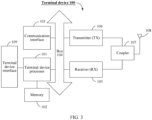
- FIG. 3 shows an example of a structure of the terminal device 100 according to an embodiment of this application.
- the terminal device 100 may include one or more terminal device processors 101, a memory 102, a communication interface 103, a receiver 105, a transmitter 106, a coupler 107, an antenna 108, and a terminal device interface 109. These components may be connected through a bus 104 or in another manner. In FIG. 3 , an example in which the components are connected through the bus 104 is used.
- the terminal device processor 101 is a control center of the terminal device 100, is connected to various parts of the terminal device 100 through various interfaces and lines, and may be configured to read and execute computer-readable instructions. Specifically, the terminal device processor 101 may be configured to invoke a program or data stored in the memory 102, and execute instructions included in the program, to implement various functions of the terminal device 100. In some embodiments, the terminal device processor 101 may include one or more processing units. The terminal device processor 101 may further integrate an application processor and a modem processor. The application processor is mainly configured to process an operating system, a user interface, an application program, and the like. The modem processor is mainly configured to process wireless communication. It may be understood that the modem processor may not be integrated into the terminal device processor 101.
- the terminal device processor 101 may be further configured to perform wireless channel management, implement call and communication link establishment and disconnection, provide cell handover control for a user in a local control area, and the like.
- the terminal device processor 101 may include an administration/communication module (administration module/communication module, AM/CM) (used in a speech channel switching and information exchange center), a basic module (basic module, BM) (configured to complete call processing, signaling processing, radio resource management, radio link management, and circuit maintenance functions), a transcoder and submultiplexer (transcoder and submultiplexer, TCSM) (configured to complete multiplexing/demultiplexing and transcoding functions), and the like.
- administration/communication module administration module/communication module, AM/CM
- basic module basic module
- TCSM transcoder and submultiplexer
- the memory 102 is coupled to the terminal device processor 101, and is configured to store various software programs and/or a plurality of groups of instructions.
- the memory 102 may include a high-speed random access memory, and may further include a nonvolatile memory, for example, one or more disk storage devices, a flash memory device, or another nonvolatile solid-state storage device.
- the memory 102 may store an operating system, for example, an embedded operating system.
- the memory 102 may further store a network communication program, and the network communication program may be for communicating with one or more additional devices, one or more terminal devices, and one or more network devices.
- the memory 102 may further store a terminal device interface program.
- the terminal device interface program may vividly display content of an application program via a graphical operation interface, and receive, via an input control such as a menu, a dialog box, and a key, a control operation performed by the terminal device on the application program.
- the memory 102 may be configured to store an implementation program of the method provided in one or more embodiments of this application on a side of the terminal device 100.
- the terminal device 100 may include a mobile communication module, a wireless communication module, and the like.
- the mobile communication module may provide a wireless communication solution, such as 2G/3G/4G/5G, that is applied to the terminal device 100.
- the mobile communication module may include at least one filter, a switch, a power amplifier, a low noise amplifier (low noise amplifier, LNA), and the like.
- the mobile communication module may receive an electromagnetic wave through the antenna 108, perform processing such as filtering and amplification on the received electromagnetic wave, and send a processed electromagnetic wave to the modem processor for demodulation.
- the mobile communication module may further amplify a signal modulated by the modem processor, and convert the signal into an electromagnetic wave for radiation through the antenna 108.
- the terminal device 100 may be provided with a subscriber identification module (subscriber identification module, SIM) card interface, and the SIM card interface is configured to connect to a SIM card.
- SIM subscriber identification module
- the SIM card is a subscriber identification card of a digital cellular mobile device, and is for mobile communication.
- the SIM card stores user information, an encryption key, and the like of the digital mobile device, and may be used by a mobile network to authenticate a user identity and encrypt user information.
- the SIM card may be inserted into the SIM card interface or removed from the SIM card interface, to implement contact with or separation from the terminal device 100.
- the terminal device 100 may support one or N SIM card interfaces, where N is a positive integer greater than 1.
- the SIM card interface may support a nano-SIM card, a micro-SIM card, a SIM card, and the like. A plurality of cards may be simultaneously inserted into a same SIM card interface. The plurality of cards may be of a same type or different types.
- the SIM card interface is also compatible with different types of SIM cards.
- the SIM card interface is also compatible with an external storage card.
- the terminal device 100 interacts with a network through the SIM card, to implement functions such as conversation and data communication.
- the wireless communication module may provide a wireless communication solution that includes a wireless local area network (wireless local area network, WLAN) (for example, a Wi-Fi network), Bluetooth (bluetooth, BT), a global navigation satellite system (global navigation satellite system, GNSS), frequency modulation (frequency modulation, FM), a near field communication (near field communication, NFC) technology, an infrared (infrared, IR) technology, or the like and that is applied to the terminal device 100.
- the wireless communication module may be one or more components that integrate at least one communication processing module.
- the wireless communication module receives an electromagnetic wave by the antenna 108, performs frequency modulation and filtering processing on the electromagnetic wave signal, and sends a processed signal to the processor.
- the wireless communication module may further receive a to-be-sent signal from the processor, perform frequency modulation and amplification on the signal, and convert the signal into an electromagnetic wave for radiation through the antenna 108.
- one or more antennas 108 of the terminal device 100 are separately coupled to the mobile communication module and the wireless communication module, so that the terminal device 100 can communicate with a network and another device by using a wireless communication technology.
- the wireless communication technology may include a global system for mobile communications (global system for mobile communications, GSM), a general packet radio service (general packet radio service, GPRS), code division multiple access (code division multiple access, CDMA), wideband code division multiple access (wideband code division multiple access, WCDMA), time division code division multiple access (time division code division multiple access, TD-SCDMA), long term evolution (long term evolution, LTE), BT, a GNSS, a WLAN, NFC, FM, an IR technology, and/or the like.
- GSM global system for mobile communications
- GPRS general packet radio service
- code division multiple access code division multiple access
- CDMA wideband code division multiple access
- WCDMA wideband code division multiple access
- WCDMA wideband code division multiple access
- time division code division multiple access time division code
- the GNSS may include a global positioning system (global positioning system, GPS), a global navigation satellite system (global navigation satellite system, GLONASS), a Beidou navigation satellite system (Beidou navigation satellite system, BDS), a quasi-zenith satellite system (quasi-zenith satellite system, QZSS), and/or a satellite-based augmentation system (satellite-based augmentation systems, SBAS).
- GPS global positioning system
- GLONASS global navigation satellite system
- BDS Beidou navigation satellite system
- QZSS quasi-zenith satellite system
- SBAS satellite-based augmentation system
- the wireless communication module may include a Wi-Fi module, configured to provide, for the terminal device 100, network access that complies with a Wi-Fi-related standard protocol.
- the terminal device 100 may access an AP through the Wi-Fi module.
- the terminal device 100 including the Wi-Fi module may be used as an AP to provide Wi-Fi network access for another electronic device.
- the Wi-Fi-related standard protocol may include IEEE 802.11ac, IEEE 802.11b, IEEE 802.11g/a, and/or IEEE 802.11n.
- the Wi-Fi module may provide at least two Wi-Fi APs, and the two Wi-Fi APs may respectively operate on a 5 GHz frequency band and a 2.4 GHz frequency band.
- the Wi-Fi AP on the 5 GHz frequency band may provide a higher wireless transmission rate. For example, a minimum wireless transmission rate of the Wi-Fi AP may reach 433 Mbps. After some high-performance terminal devices are connected to the Wi-Fi AP operating on the 5 GHz frequency band, a wireless transmission rate of the terminal devices may even reach 1 Gbps or higher.
- the communication interface 103 may be used by the terminal device 100 to communicate with another communication device, for example, a network device.
- the network device may be a network device 200 shown in FIG. 4 .
- the communication interface 103 may be a long term evolution (LTE) (4G) communication interface, a 5G communication interface, or a future new radio (new radio, NR) communication interface.
- LTE long term evolution
- NR future new radio
- the terminal device 100 may be further configured with a wired communication interface 103, for example, a local area network (local access network, LAN) interface, to support wired communication.
- the transmitter 106 may be configured to perform transmission processing on a signal output by the terminal device processor 101.
- the receiver 105 may be configured to perform receiving processing on a mobile communication signal received by the antenna 108.
- the transmitter 106 and the receiver 105 may be considered as a wireless modem.
- the antenna 108 may be configured to convert electromagnetic energy in a transmission line into an electromagnetic wave in free space, or convert an electromagnetic wave in the free space into electromagnetic energy in the transmission line.
- the coupler 107 is configured to divide a mobile communication signal received by the antenna 108 into a plurality of signals, and allocate the plurality of signals to the plurality of receivers 105.
- Each antenna in the terminal device 100 may be configured to cover one or more communication frequency bands. Different antennas may be further reused, to improve antenna utilization. For example, an antenna for mobile communication may be reused as a diversity antenna of a wireless local area network. In some other embodiments, the antenna 108 may be used in combination with a tuning switch.
- the terminal device 100 may further include an input/output module.
- the input/output module may be configured to implement interaction between the terminal device 100 and another terminal device/an external environment, and may mainly include an audio input/output module, a key input module, a display, and the like.
- the input/output module may further include a camera, a touchscreen, a sensor, and the like.
- the input/output module communicates with the terminal device processor 101 through the terminal device interface 109.
- the terminal device 100 shown in FIG. 3 is merely an implementation of embodiments of this application.
- the terminal device 100 may further include more or fewer components, and may combine two or more components, combine some components, split some components, or have different component arrangements.
- the components shown in the figure may be implemented by hardware, software, or a combination of software and hardware. This is not limited herein.
- the following describes a structure of a network device 200 provided in embodiments of this application.
- the network device 200 may include various forms of network devices, including but not limited to: a macro base station, a micro base station (also referred to as a small cell), a relay station, a wireless access point AP, a gateway device, a router, a network edge device, a wireless local area network (wireless local area network (WLAN) access point controller, WAC), a radio network controller (radio network controller, RNC), a NodeB (NodeB, NB), a base transceiver station (base transceiver station, BTS) in a TD-SCDMA system, an evolved NodeB (evolved NodeB, eNB) in an LTE system, a next generation NodeB (next Generation NodeB, gNB) in a 5G system or a new radio system, a base station controller (base station controller, BSC), a home base station (for example, a home evolved NodeB, or a home NodeB, HNB), a transmission
- the network device 200 may be an access device, such as an AP, that has a wireless transceiver function and via which a terminal device (for example, a CPE or a mobile device) accesses a communication system in a wireless manner.
- a terminal device for example, a CPE or a mobile device
- a plurality of network devices may belong to a same local area network, for example, a campus network.
- FIG. 4 shows an example of a structure of the network device 200 according to an embodiment of this application.
- the network device 200 may include one or more network device processors 201, a memory 202, a communication interface 203, a receiver 205, a transmitter 206, a coupler 207, an antenna 208, and a network device interface 209. These components may be connected through a bus 204 or in another manner. In FIG. 4 , an example in which the components are connected through the bus 204 is used.
- the network device processor 201 is a control center of the network device 200, is connected to various parts of the network device 200 through various interfaces and lines, and may be configured to read and execute computer-readable instructions. Specifically, the network device processor 201 may be configured to invoke a program or data stored in the memory 202, and execute instructions included in the program, to implement various functions of the network device 200. In some embodiments, the network device processor 201 may include one or more processing units. The network device processor 201 may further integrate an application processor and a modem processor. The application processor is mainly configured to process an operating system, a user interface, an application program, and the like. The modem processor is mainly configured to process wireless communication. It may be understood that the modem processor may not be integrated into the network device processor 201. In some embodiments, the network device processor 201 may be further configured to perform wireless channel management, implement call and communication link establishment and disconnection, provide cell handover control for a user in a local control area, and the like.
- the memory 202 is coupled to the network device processor 201, and is configured to store various software programs and/or a plurality of groups of instructions.
- the memory 202 may include a high-speed random access memory, and may further include a nonvolatile memory, for example, one or more disk storage devices, a flash memory device, or another nonvolatile solid-state storage device.
- the memory 202 may store a network communication program, and the network communication program may be for communicating with one or more additional devices, one or more terminal devices, and one or more network devices.
- the memory 202 may be configured to store an implementation program of the method provided in one or more embodiments of this application on a side of the network device 200.
- the network device 200 may include a mobile communication module, a wireless communication module, and the like.
- the mobile communication module may provide a wireless communication solution, such as 2G/3G/4G/5G, that is applied to the network device 200.
- the mobile communication module may include at least one filter, a switch, a power amplifier, a low noise amplifier, and the like.
- the mobile communication module may receive an electromagnetic wave through the antenna 208, perform processing such as filtering and amplification on the received electromagnetic wave, and send a processed electromagnetic wave to the modem processor for demodulation.
- the mobile communication module may further amplify a signal modulated by the modem processor, and convert the signal into an electromagnetic wave for radiation through the antenna 208.
- a SIM card interface may be disposed in the network device 200, and the SIM card interface is configured to connect to a SIM card.
- the network device 200 interacts with a network through the SIM card, to implement functions such as conversation and data communication.
- the wireless communication module may provide a wireless communication solution that is applied to the network device 200 and that includes a WLAN (for example, a Wi-Fi network), BT, a GNSS, FM, NFC, IR, and the like.
- the wireless communication module may be one or more components that integrate at least one communication processing module.
- the wireless communication module receives an electromagnetic wave by the antenna 208, performs frequency modulation and filtering processing on the electromagnetic wave signal, and sends a processed signal to the processor.
- the wireless communication module may further receive a to-be-sent signal from the processor, perform frequency modulation and amplification on the signal, and convert the signal into an electromagnetic wave for radiation through the antenna 208.
- one or more antennas 208 of the network device 200 are separately coupled to the mobile communication module and the wireless communication module, so that the network device 200 can communicate with a network and another device by using a wireless communication technology.
- the wireless communication technology may include technologies such as GSM, GPRS, CDMA, WCDMA, TD-SCDMA, LTE, BT, GNSS, WLAN, NFC, FM, and/or IR.
- the wireless communication module may include a Wi-Fi module, configured to provide, for the network device 200, network access that complies with a Wi-Fi-related standard protocol.
- the network device 200 may access an AP through the Wi-Fi module.
- the network device 200 including the Wi-Fi module may be used as an AP to provide Wi-Fi network access for another electronic device.
- the Wi-Fi-related standard protocol may include IEEE 802.11ac, IEEE 802.11b, IEEE 802.11g/a, and/or IEEE 802.11n.
- the Wi-Fi module may provide at least two Wi-Fi APs, and the two Wi-Fi APs may respectively operate on a 5 GHz frequency band and a 2.4 GHz frequency band.
- the communication interface 203 may be used by the network device 200 to communicate with another communication device, for example, a terminal device.
- the terminal device may be the terminal device 100 shown in FIG. 3 .
- the communication interface 203 may be a 5G communication interface, or may be a future new radio communication interface.
- the network device 200 may be further configured with a wired communication interface 203, for example, a LAN interface.
- the transmitter 206 may be configured to perform transmission processing on a signal output by the network device processor 201.
- the receiver 205 may be configured to perform receiving processing on a mobile communication signal received by the antenna 208.
- the transmitter 206 and the receiver 205 may be considered as a wireless modem.
- the antenna 208 may be configured to convert electromagnetic energy in a transmission line into an electromagnetic wave in free space, or convert an electromagnetic wave in the free space into electromagnetic energy in the transmission line.
- the coupler 207 is configured to divide a mobile communication signal received by the antenna 208 into a plurality of signals, and allocate the plurality of signals to the plurality of receivers 205.
- Each antenna in the terminal device 100 may be configured to cover one or more communication frequency bands. Different antennas may be further reused, to improve antenna utilization. For example, an antenna for mobile communication may be reused as a diversity antenna of a wireless local area network. In some other embodiments, the antenna 208 may be used in combination with a tuning switch.
- the network device 200 shown in FIG. 4 is merely an implementation of embodiments of this application.
- the network device 200 may further include more or fewer components, and may combine two or more components, combine some components, split some components, or have different component arrangements.
- the components shown in the figure may be implemented by hardware, software, or a combination of software and hardware. This is not limited herein.
- FIG. 5 shows an example of an application scenario 500 according to an embodiment of this application.
- This application provides a roaming solution, to resolve a problem of a packet loss during data transmission in a roaming scenario.
- roaming processes of two radio frequency modules are uniformly and cooperatively controlled, to ensure that there is always a reliable wireless connection available for service packet processing in the roaming processes.
- packet transmission reliability can be improved, and a loss that may be caused by a lost transmitted packet can be avoided.
- a CPE 503 may be mounted on a mobile vehicle 501 in a production line, to convert an input wired network signal, cellular network signal, wireless network signal, or the like into a wireless network signal, and perform wireless connection to an AP through the CPE 503, to perform network access communication.
- the mobile vehicle 501 may be free from a constraint of a fixed network cable and is not restricted by an insufficient quantity of reserved network interfaces, and production line rearrangement becomes easy.
- an activity range may be extended, and communication may be implemented in a place covered by the AP.
- the CPE 503 of the mobile vehicle 501 may include a radio frequency module A and a radio frequency module B.
- the radio frequency module A is for communication on a 2.4 GHz frequency band
- the radio frequency module B is for communication on a 5 GHz frequency band.
- the mobile vehicle 501 is in a moving process, and a moving direction is moving from a location A to a location C through a location B, to be specific, moving from the location A close to an AP 1 and an AP 2 and away from an AP 3 and an AP 4 to the location C close to the AP 3 and the AP 4 and away from the AP 1 and the AP 2.
- the AP 1 and the AP 3 may have same settings such as an SSID, a password, an encryption manner, and an operating frequency band (that is, 2.4 GHz), and support seamless roaming of the CPE 503 between the AP 1 and the AP 3.
- the AP 2 and the AP 4 may have same settings such as an SSID, a password, an encryption manner, and an operating frequency band (that is, 5 GHz), and support seamless roaming of the CPE 503 between the AP 2 and the AP 4.
- the CPE 503 on the mobile vehicle 501 may replicate a received packet to obtain a same packet, add a same numerical label to the two same packets, and then send the two same packets through the radio frequency module A and the radio frequency module B respectively, that is, send the same packets through two channels of the 2.4 GHz frequency band and the 5 GHz frequency band respectively.
- the two packets arrive at a WLAN AC (WAC) 502 successively, and the WAC 502 selects a packet that arrives earlier for subsequent transmission, and deletes a duplicate packet that arrives later, to ensure reliability of data transmission in the wireless network.
- the WAC 502 identifies, by using the same numerical label in the packets, the packet that arrived later as a duplicate packet that has been received.
- Network devices such as one or more WACs and one or more APs may belong to a same wireless local area network.
- the WAC 502 may manage a plurality of APs, for example, the AP 1, the AP 2, the AP 3, and the AP 4.
- an operating frequency band of the AP 1 is the 2.4 GHz frequency band
- an operating frequency band of the AP 2 is the 5 GHz frequency band
- an operating frequency band of the AP 3 is the 2.4 GHz frequency band
- an operating frequency band of the AP 4 is the 5 GHz frequency band.
- the radio frequency module A of the CPE 503 accesses the AP 1
- the radio frequency module B accesses the AP 2
- the CPE 503 sends same packets through two channels of the 2.4 GHz frequency band and the 5 GHz frequency band respectively.
- the WAC 502 selects one of the packets for subsequent transmission, and deletes the other duplicate packet.
- the CPE 503 associates a connection of the radio frequency module A with a connection of the radio frequency module B, and compares radio frequency signal conditions.
- the CPE 503 In a process in which the mobile vehicle 501 moves from the location A to the location B, the CPE 503 detects that radio signal conditions of the AP 1 and the AP 2 become weak. Assuming that signal strength of a connection between the CPE 503 and the AP 1 is poorer than signal strength of a connection between the CPE 503 and the AP 2, or signal strength received by the radio frequency module A reaches a roaming threshold earlier than signal strength received by the radio frequency module B, the CPE 503 starts a roaming process of the radio frequency module A, that is, selects a radio frequency connection with a poorer signal condition to start roaming first.
- the CPE 503 suppresses a roaming request of the radio frequency module B to ensure that the two radio frequency connections are not for simultaneous roaming and that there is always a channel available for service processing. Therefore, when one radio frequency connection temporarily interrupts packet transmission due to a roaming process, the other radio frequency connection does not enter the roaming process, thereby ensuring timely packet transmission.
- the CPE 503 enables the radio frequency module A to initiate roaming, and switches to the AP 3 with stronger access signal strength.
- the AP 1 and the AP 3 may have same settings such as an SSID, a password, an encryption manner, and an operating frequency band (that is, 2.4 GHz).
- an operating frequency band that is, 2.4 GHz.
- the radio frequency module A of the CPE 503 accesses the AP 3 through roaming, establishes a communication connection to the AP 3, and sends a packet through a channel of the 2.4 GHz frequency band.
- the radio frequency module B still maintains a connection to the AP 2, and sends a packet through a channel of the 5 GHz frequency band.
- the radio frequency module A and the radio frequency module B send the same packets, and then forward the packets to the WAC 502 through the AP 3 and the AP 2.
- the WAC 502 may receive two packets, and then select one packet for subsequent transmission and delete the other duplicate packet.
- the CPE 503 After roaming of the radio frequency module A of the CPE 503 is ended, and a service is restored, the CPE 503 responds to the roaming application, and starts a roaming process of the radio frequency module B.
- the CPE 503 initiates roaming, and switches to the AP 4 with stronger access signal strength.
- the AP 2 and the AP 4 may have same settings such as an SSID, a password, an encryption manner, and an operating frequency band (that is, 5 GHz).
- the WAC 502 selects one of the packets for subsequent transmission, and deletes the other duplicate packet.
- the radio frequency module A of the CPE 503 accesses the AP 3
- the radio frequency module B accesses the AP 4
- the CPE 503 sends same packets through two channels of the 2.4 GHz frequency band and the 5 GHz frequency band respectively.
- the WAC 502 selects one of the packets for subsequent transmission, and deletes the other duplicate packet.
- the CPE 503 continuously monitors radio frequency signal conditions of the connections of the radio frequency module A and the radio frequency module B that are associated, for subsequent roaming.
- the example application scenario 500 shown in FIG. 5 is merely intended to describe the technical solutions of this application more clearly, and does not constitute a limitation on this application.
- the application scenario 500 may further include more or fewer terminal devices and network devices, and more or fewer communication connections. This is not limited herein.
- the network device and the terminal device may also be referred to as communication devices.
- a person of ordinary skill in the art may learn that, with evolution of a network architecture and emergence of a new service scenario, the technical solutions provided in this application are also applicable to resolving similar technical problems.
- FIG. 6A to FIG. 6D shows a case in which a terminal 601 roams in a process of continuously sending a packet to an application server 604 based on a dual fed and selective receiving mode.
- a CPE 602 based on a WLAN dual fed and selective receiving mode, uniformly and cooperatively controls roaming processes of two radio frequencies, to ensure that there is always a reliable wireless connection available for service packet processing in the roaming processes.
- packet transmission reliability of a terminal can be improved, and a loss that may be caused by a lost transmitted packet can be avoided.
- the CPE 602 (for example, the CPE 503) may be mounted on a terminal (STA) 601 (for example, the mobile vehicle 501).
- the CPE 602 may convert an input wired network signal, cellular network signal, wireless network signal, or the like into a wireless network signal.
- the terminal is wirelessly connected to an AP through the CPE 602, to implement network access communication.
- the terminal 601 may be free from a constraint of a fixed network cable and is not restricted by an insufficient quantity of reserved network interfaces.
- an activity range may be extended, and communication may be implemented in a place covered by the AP.
- a process in which the terminal 601 sends a packet 1 to the application server (Server) 604 includes: The terminal 601 sends the packet 1 to the CPE 602, and the packet 1 arrives at the CPE 602 through a wired connection.
- the CPE 602 sends the packet 1 from the terminal 601 to the AP, and the packet 1 is forwarded by the AP to a WLAN AC (WAC) 603.
- the WAC 603 further forwards the packet 1 to the application server (Server) 604.
- the terminal 601 finally sends the packet 1 to the application server 603.
- the CPE 602 on the terminal 601 may include a radio frequency module A and a radio frequency module B.
- the radio frequency module A is for communication on a 2.4 GHz frequency band
- the radio frequency module B is for communication on a 5 GHz frequency band.
- reliability of data transmission in a wireless network is improved by using the dual fed and selective receiving mode.
- the CPE 602 may replicate a received packet to obtain a same packet, add a same numerical label to the two same packets, and then send the two same packets through the radio frequency module A and the radio frequency module B respectively, that is, send the same packets through two channels of the 2.4 GHz frequency band and the 5 GHz frequency band respectively.
- the two packets arrive at the WLAN AC (WAC) 603 successively, and the WAC 603 selects a packet that arrives earlier for subsequent transmission, and deletes a duplicate packet that arrives later, to ensure reliability of data transmission in the wireless network.
- the WAC 603 identifies, by using the same numerical label in the packets, the packet that arrived later as a duplicate packet that has been received.
- Network devices such as one or more WACs and one or more APs may belong to a same wireless local area network.
- the WAC 603 may manage a plurality of APs, for example, the AP 1, the AP 2, the AP 3, and the AP 4.
- an operating frequency band of the AP 1 is the 2.4 GHz frequency band
- an operating frequency band of the AP 2 is the 5 GHz frequency band
- an operating frequency band of the AP 3 is the 2.4 GHz frequency band
- an operating frequency band of the AP 4 is the 5 GHz frequency band.
- the radio frequency module A of the CPE 602 accesses the AP 1, and the radio frequency module B accesses the AP 2.
- the CPE 602 separately establishes a connection to the AP 1 and the AP 2.
- the AP 1 corresponds to a connection channel of the 2.4 GHz operating frequency band
- the AP 2 corresponds to a connection channel of the 5 GHz operating frequency band.
- the CPE 602 sends two same packets 1 of the received packet 1 of the terminal 601 through the two channels of the 2.4 GHz frequency band and the 5 GHz frequency band respectively.
- the WAC 603 selects a packet 1 that arrives earlier, sends the packet 1 to the application server 604, and deletes the other duplicate packet 1 that arrives later.
- the CPE 602 may associate a connection of the radio frequency module A with a connection of the radio frequency module B, and compares radio frequency signal conditions.
- the CPE 602 detects that radio signals of the AP 1 and the AP 2 become weak. Assuming that the signal strength of the AP 1 is poorer than the signal strength of the AP 2, and signal strength received by the radio frequency module A reaches a threshold for requesting roaming earlier than signal strength received by the radio frequency module B, the CPE 602 starts a roaming process of the radio frequency module A, that is, selects a radio frequency connection with a poorer signal to start roaming first. In addition, the CPE 602 suppresses a roaming request of the radio frequency module B to ensure that the two radio frequency connections are not for simultaneous roaming and that there is always a channel available for service processing. Therefore, when one radio frequency connection temporarily interrupts packet transmission due to a roaming process, the other radio frequency connection does not enter the roaming process, thereby ensuring timely packet transmission.
- the CPE 602 initiates roaming, so that the radio frequency module A switches to the AP 3 with stronger signal strength, the AP 1 and the AP 3 may have same settings such as an SSID, a password, an encryption mode, and an operating frequency band (that is, 2.4 GHz).
- a threshold A for example, a first threshold or a third threshold
- the CPE 602 may ensure that the radio frequency module B does not enter a roaming process. Therefore, the CPE 602 may ensure that the radio frequency module B sends the packet 1 to the AP 2 in a timely manner through the channel of the 5 GHz frequency band, then the AP 2 transmits the received packet 1 to the WAC 603 in a timely manner, and the WAC 603 transmits the packet 1 to the application server 604 in a timely manner.
- the CPE 602 After roaming of the radio frequency module A of the CPE 602 is ended, and a service is restored, the CPE 602 starts a roaming process of the radio frequency module B.
- the radio frequency module A of the CPE 602 has accessed the AP 3, and sends the received packet 1 of the terminal 601 to the AP 3 through the channel of the 2.4 GHz frequency band.
- the AP 3 forwards the received packet 1 to the WAC 603, and the WAC 603 then transmits the packet 1 to the application server 604 in a timely manner.
- a threshold B for example, a second threshold
- the AP 2 and the AP 4 may have same settings such as an SSID, a password, an encryption manner, and an operating frequency band (that is, 5 GHz).
- an SSID a password
- an encryption manner a password
- an operating frequency band that is, 5 GHz
- the CPE 602 may ensure that the radio frequency module A does not enter a roaming process. Therefore, the CPE 602 may ensure that the radio frequency module A sends the packet 1 to the AP 3 in a timely manner through the channel of the 2.4 GHz frequency band, then the AP 3 transmits the received packet 1 to the WAC 603 in a timely manner, and the WAC 603 transmits the packet 1 to the application server 604 in a timely manner.
- the WAC 603 selects a packet 1 that arrives earlier and transmits the packet to the application server 604, and deletes the other duplicate packet 1 that arrives later.
- the radio frequency module B of the CPE 602 ends roaming and restores a service. It may be detected that signal strength of the AP 3 and the AP 4 is stronger.
- the radio frequency module A of the CPE 602 accesses the AP 3, and the radio frequency module B accesses the AP 4.
- the CPE 602 separately establishes a connection to the AP 3 and the AP 4.
- the AP 3 corresponds to a connection channel of a 2.4 GHz operating frequency band
- the AP 4 corresponds to a connection channel of a 5 GHz operating frequency band.
- the CPE 602 sends two same packets 1 of the received packet 1 of the terminal 601 through the two channels of the 2.4 GHz frequency band and the 5 GHz frequency band respectively. After receiving the two packets 1 from the AP 3 and the AP 4 successively, the WAC 603 selects a packet 1 that arrives earlier, sends the packet 1 to the application server 604, and deletes the other duplicate packet 1 that arrives later.
- the CPE 602 still continuously monitors radio frequency statuses of the connections of the radio frequency module A and the radio frequency module B that are associated, for subsequent roaming.
- FIG. 6A to FIG. 6D is merely intended to describe the technical solutions of this application more clearly, and does not constitute a limitation on this application.
- more or fewer terminal devices and network devices may be included, and more or fewer communication connections may be included. This is not limited herein.
- a person of ordinary skill in the art may learn that, with evolution of a network architecture and emergence of a new service scenario, the technical solutions provided in this application are also applicable to resolving similar technical problems.
- FIG. 7 is a schematic diagram of the service processing procedure 700.
- FIG. 7 shows the service processing procedure 700 in a CPE roaming process based on a dual fed and selective receiving mode.
- a CPE that is, the terminal device 100
- packet transmission reliability of a terminal can be improved, and a loss that may be caused by a lost transmitted packet can be avoided.
- a CPE (for example, the CPE 503 on the mobile vehicle 501 in the foregoing embodiment, or the CPE 602 on the terminal 601) may be mounted on the STA.
- the CPE may convert a wired network signal, a cellular network signal, a wireless network signal, or the like input by the STA into a wireless network signal, and the CPE is wirelessly connected to an AP to implement network access communication.
- the STA may be free from a constraint of a fixed network cable and is not restricted by an insufficient quantity of reserved network interfaces.
- an activity range may be extended, and communication may be implemented in a place covered by the AP.
- a signal condition of a connection between the CPE and an original AP deteriorates due to a near-to-far change of a moving distance.
- the signal condition is lower than a specified threshold, a roaming process is triggered to disconnect the CPE from the original AP and then connect the CPE to an AP with better signal quality.
- the CPE may support simultaneous operating of two frequency bands, and is configured to receive and send a radio signal.
- the CPE may simultaneously support establishment of two wireless connections that operate on two frequency bands, 2.4 GHz and 5 GHz, respectively.
- the CPE may include two complete baseband processing modules and two radio frequency front-ends. Because the CPE has two independent paths, the paths may operate independently by using a 2.4 GHz connection and a 5 GHz connection.
- Two implementation methods are further included to implement the two complete paths.
- One implementation method is to use two integrated circuits to support the two paths respectively.
- the other implementation method is to use a single integrated circuit. Two independent paths may be integrated on the single integrated circuit.
- a device may schedule the single integrated circuit by using an upper-layer program, so that the single integrated circuit operates in two frequency bands.
- the CPE includes a first radio frequency module and a second radio frequency module (for example, the radio frequency module A and the radio frequency module B in the foregoing embodiment), which are for communication in different frequency bands.
- the first radio frequency module may be for communication on the 2.4 GHz frequency band or the 5 GHz frequency band
- the second radio frequency module may be for communication on the 5 GHz frequency band or the 2.4 GHz frequency band.
- Operating frequency bands of the first radio frequency module and the second radio frequency module may be the same or may be different. This is not limited in this embodiment.
- the CPE may replicate a received packet to obtain a same packet, add a same numerical label to the two same packets, and then send the two same packets through the first radio frequency module and the second radio frequency module respectively, that is, send the same packets through two channels of the 2.4 GHz frequency band and the 5 GHz frequency band respectively.
- the two packets arrive at a next transceiver node (for example, a WAC) successively, and the next transceiver node selects a packet that arrives earlier for subsequent transmission, and deletes a duplicate packet that arrives later, to ensure reliability of data transmission in the wireless network.
- the CPE may associate the first radio frequency module with the second radio frequency module, and monitor and compare radio frequency signal conditions.
- the service processing procedure 700 in the CPE roaming process may include the following procedures, and an implementation sequence of the following procedures is not limited in this embodiment.
- the CPE establishes a first connection to an AP 1 through the first radio frequency module.
- the CPE establishes a second connection to the AP 2 through the second radio frequency module.
- Anti-interference capabilities and penetration capabilities of radio frequency bands are different.
- interference sources of the radio frequency bands in a wireless environment are different. Therefore, signal strength of different channels is different.
- the CPE associates the first radio frequency module with the second radio frequency module.
- the CPE may continuously monitor signal conditions of the first connection and the second connection. Because both the first connection and the second connection are for transmitting a same packet, the first radio frequency module and the second radio frequency module that are for dual fed and selective receiving are associated in terms of resources, and are for comparing the signal conditions of the first connection and the second connection, to determine whether to start roaming and a roaming start sequence, thereby ensuring that roaming of one of the two radio frequency modules is suppressed in a timely manner while the other radio frequency module is in a roaming process.
- the signal condition may be represented by using a customized parameter for measuring a channel condition, and includes but is not limited to being defined by using one parameter or a combination of a plurality of (weighted) parameters such as signal strength, a CQI, an SINR, channel busyness, channel load, a bit error rate, and a packet loss rate.
- signal strength may be used as a parameter for measuring a signal condition. Larger signal strength indicates a better signal condition, and smaller signal strength indicates a poorer signal condition.
- a terminal senses a signal in passive or active mode: passively listening to a beacon frame and actively sending a probe frame for detection.
- the terminal also uses the two modes to sense a signal. Different types of terminals use different modes, but a purpose is to better sense environment information to provide a decision basis for roaming behavior.
- the CPE detects that a signal condition of the first connection is less than or equal to a first threshold.
- the first threshold may be a threshold for triggering the first radio frequency module to initiate roaming. When it is detected that the signal condition of the first connection is less than or equal to the first threshold, the first radio frequency module is triggered to initiate a roaming request.
- the first threshold may be, for example, the threshold A in the foregoing embodiment.
- a roaming process is usually initiated and driven by a terminal device.
- a rule affecting whether the terminal device roams may be determined by a wireless network adapter manufacturer, and is usually defined by an RSSI threshold. Different wireless network adapter manufacturers set different roaming thresholds of terminal devices.
- the RSSI threshold usually includes but is not limited to one or more (weighted) parameters such as signal strength, signal quality, a noise level, a bit error rate, a packet loss rate, a quantity of missed beacon frames, and the like, and a value of the RSSI threshold represents quality of a communication link.
- roaming may include active roaming and passive roaming.
- the active roaming means that a device actively initiates roaming when a signal condition is lower than a threshold, to search for an AP with a better signal condition.
- the passive roaming means that a threshold may be set on an AP; and when the AP detects that a signal condition of a connection is lower than the threshold, the AP forces the device to go offline, and then the device passively searches for an AP with a better signal condition.
- This embodiment is mainly applied to a case of active roaming, or a case of active roaming combined with passive roaming. In a case of passive roaming, if an AP disconnects both radio frequency connections of the device, the device does not need to suppress or allow a roaming request. Instead, the device immediately searches for an accessible AP with stronger signal strength.
- the first radio frequency module reaches a roaming triggering threshold earlier than the second radio frequency module, in other words, it is detected that the signal condition of the first connection is less than or equal to the first threshold.
- a distance between the CPE and the AP 1 is greater than a distance between the CPE and the AP 2. Therefore, in the moving process, the signal conditions of both the first connection and the second connection become poorer, but the signal condition of the first connection is poorer than the signal condition of the second connection, and the signal condition of the first connection first becomes poorer to the first threshold for triggering roaming.
- the CPE enables the first radio frequency module to start first roaming.
- the CPE detects that a signal condition of the AP 3 is better, and therefore starts the first roaming, so that the first radio frequency module establishes a third connection to the AP 3.
- the first roaming refers to a roaming process in which the first radio frequency module roams from the AP 1 to the AP 3.
- the AP 3 and the AP 1 have same settings such as an SSID, a password, an encryption manner, and an operating frequency band, so that an upper-layer application connection is not interrupted in a process of roaming and switching between APs, and an attribute and a permission of the connection remain unchanged.
- SSID SSID
- password a password
- an encryption manner an encryption manner
- an operating frequency band so that an upper-layer application connection is not interrupted in a process of roaming and switching between APs, and an attribute and a permission of the connection remain unchanged.
- the CPE detects that the signal condition of the second connection is less than or equal to a second threshold.
- the second threshold may be a threshold for triggering the second radio frequency module to initiate roaming. Values of the first threshold and the second threshold may be the same, or may be different. This is not limited in this embodiment.
- the second threshold may be, for example, the threshold B in the foregoing embodiment.
- the CPE detects that the second radio frequency module initiates a roaming request.
- the CPE In response to detecting that the first roaming of the first radio frequency module is not ended, the CPE suppresses the second radio frequency module to start roaming.
- the CPE When a radio frequency module is in a roaming process, the CPE suppresses a roaming process of the other radio frequency module. This ensures that there is always a channel available for service processing and ensures timely packet transmission.
- the CPE establishes the third connection to the AP 3 through the first radio frequency module, and the first roaming of the first radio frequency module is ended.
- the CPE detects that a signal condition of the AP 4 is better, and therefore starts the second roaming, so that the second radio frequency module establishes a fourth connection to the AP 4.
- the second roaming refers to a roaming process in which the second radio frequency module roams from the AP 2 to the AP 4.
- the AP 4 and the AP 2 have same settings such as an SSID, a password, an encryption manner, and an operating frequency band, so that an upper-layer application connection is not interrupted in a process of roaming and switching between APs, and an attribute and a permission of the connection remain unchanged.
- the CPE establishes the fourth connection to the AP 4 through the second radio frequency module, and the second roaming of the second radio frequency module is ended.
- the second roaming is ended, and the second radio frequency module accesses the AP 4.
- the second radio frequency module when the first radio frequency module is in a process of the first roaming, the second radio frequency module may initiate roaming, or roaming may not be triggered because the second threshold is not reached. If the second radio frequency module initiates roaming when the first radio frequency module is in the process of the first roaming, roaming of the second radio frequency module is suppressed until the first roaming of the first radio frequency module is ended. If the second radio frequency module initiates roaming only after the first roaming of the first radio frequency module is ended, the second roaming of the second radio frequency module may be directly started.
- the CPE enables the radio frequency module that first sends the roaming request to start roaming and then suppresses roaming of the other radio frequency module. After the roaming of the radio frequency module that first sends the roaming request is ended, the CPE starts roaming of the other radio frequency module.
- FIG. 8 is a schematic diagram of the service processing procedure 800.
- This embodiment shows another case different from the embodiment corresponding to the service processing procedure 700.
- the CPE may compare the signal conditions of the first connection and the second connection, and select a radio frequency module with a poorer signal condition to start roaming, to suppress roaming of the other radio frequency module.
- the first threshold is different from the second threshold, which may result in that a signal condition of a radio frequency connection that first reaches the roaming threshold is better than that of a radio frequency connection that later reaches the roaming threshold.
- the first threshold is -80 dBm
- the second threshold is -60 dBm
- the second threshold is higher than the first threshold.
- the CPE may first compare the signal conditions of the first radio frequency module and the second radio frequency module, and select a radio frequency module with a poorer signal condition to actively initiate roaming, to suppress roaming of the other radio frequency module. For example, in this example, the signal strength of the second connection reaches -60 dBm and a roaming application is triggered, the signal strength of the first connection is -70 dBm but roaming is not triggered yet.
- the first radio frequency module may be selected to start roaming, to suppress roaming of the second radio frequency module. After roaming of the first radio frequency module is ended, roaming of the second radio frequency module is started.
- FIG. 8 shows the service processing procedure 800 in a CPE roaming process based on a dual fed and selective receiving mode.
- a CPE uniformly and cooperatively controls roaming processes of two radio frequencies, to ensure that there is always a reliable wireless connection available for service packet processing in the roaming processes.
- packet transmission reliability of a terminal can be improved, and a loss that may be caused by a lost transmitted packet can be avoided.
- a CPE (for example, the CPE 503 on the mobile vehicle 501 in the foregoing embodiment, or the CPE 602 on the terminal 601) may be mounted on the STA.
- the CPE may convert a wired network signal, a cellular network signal, a wireless network signal, or the like input by the STA into a wireless network signal, and the CPE is wirelessly connected to an AP to implement network access communication.
- the STA may be free from a constraint of a fixed network cable and is not restricted by an insufficient quantity of reserved network interfaces.
- an activity range may be extended, and communication may be implemented in a place covered by the AP.
- a signal condition of a connection between the CPE and an original AP deteriorates due to a near-to-far change of a moving distance.
- the signal condition is lower than a specified threshold, a roaming process is triggered to disconnect the CPE from the original AP and then connect the CPE to an AP with better signal quality.
- the CPE may support simultaneous operating of two frequency bands, and is configured to receive and send a radio signal.
- the CPE may simultaneously support establishment of two wireless connections that operate on two frequency bands, 2.4 GHz and 5 GHz, respectively.
- the CPE may include two complete baseband processing modules and two radio frequency front-ends. Because the CPE has two independent paths, the paths may operate independently by using a 2.4 GHz connection and a 5 GHz connection.
- Two implementation methods are further included to implement the two complete paths.
- One implementation method is to use two integrated circuits to support the two paths respectively.
- the other implementation method is to use a single integrated circuit. Two independent paths may be integrated on the single integrated circuit.
- a device may schedule the single integrated circuit by using an upper-layer program, so that the single integrated circuit operates in two frequency bands.
- the CPE includes a first radio frequency module and a second radio frequency module, which are for communication on different frequency bands.
- the first radio frequency module may be for communication on the 2.4 GHz frequency band or the 5 GHz frequency band
- the second radio frequency module may be for communication on the 5 GHz frequency band or the 2.4 GHz frequency band.
- Operating frequency bands of the first radio frequency module and the second radio frequency module may be the same or may be different. This is not limited in this embodiment.
- the CPE may replicate a received packet to obtain a same packet, add a same numerical label to the two same packets, and then send the two same packets through the first radio frequency module and the second radio frequency module respectively, that is, send the same packets through two channels of the 2.4 GHz frequency band and the 5 GHz frequency band respectively.
- the two packets arrive at a next transceiver node (for example, a WAC) successively, and the next transceiver node selects a packet that arrives earlier for subsequent transmission, and deletes a duplicate packet that arrives later, to ensure reliability of data transmission in the wireless network.
- the CPE may associate the first radio frequency module with the second radio frequency module, and monitor and compare radio frequency signal conditions.
- the service processing procedure 800 in the CPE roaming process may include the following procedures, and an implementation sequence of the following procedures is not limited in this embodiment.
- the CPE establishes a first connection to an AP 1 through the first radio frequency module.
- the CPE establishes a second connection to the AP 2 through the second radio frequency module.
- Anti-interference capabilities and penetration capabilities of radio frequency bands are different.
- interference sources of the radio frequency bands in a wireless environment are different. Therefore, signal strength of different channels is different.
- the CPE associates the first radio frequency module with the second radio frequency module.
- the CPE may continuously monitor signal conditions of the first connection and the second connection. Because both the first connection and the second connection are for transmitting a same packet, the first radio frequency module and the second radio frequency module that are for dual fed and selective receiving are associated in terms of resources, and are for comparing the signal conditions of the first connection and the second connection, to determine whether to start roaming and a roaming start sequence, thereby ensuring that roaming of one of the two radio frequency modules is suppressed in a timely manner while the other radio frequency module is in a roaming process.
- the signal condition may be represented by using a customized parameter for measuring a channel condition, and includes but is not limited to being defined by using one parameter or a combination of a plurality of (weighted) parameters such as signal strength, a CQI, an SINR, channel busyness, channel load, a bit error rate, and a packet loss rate.
- signal strength may be used as a parameter for measuring a signal condition. Larger signal strength indicates a better signal condition, and smaller signal strength indicates a poorer signal condition.
- a terminal senses a signal in passive or active mode: passively listening to a beacon frame and actively sending a probe frame for detection.
- the terminal also uses the two modes to sense a signal. Different types of terminals use different modes, but a purpose is to better sense environment information to provide a decision basis for roaming behavior.
- step 804 the CPE detects that the first radio frequency module initiates a first roaming request.
- the first threshold may be a threshold for triggering the first radio frequency module to initiate roaming.
- the first radio frequency module is triggered to initiate the first roaming request.
- the first roaming is roaming of the first radio frequency module from the AP 1 to an AP 3, where at a moment when the first roaming request is initiated, a signal condition of the AP 3 is better than a signal condition of the AP 1.
- the first threshold may be, for example, the threshold A in the foregoing embodiment.
- step 805 the CPE detects that the second radio frequency module initiates a second roaming request.
- the second threshold may be a threshold for triggering the second radio frequency module to initiate roaming.
- the second threshold may be, for example, the threshold B in the foregoing embodiment. Values of the first threshold and the second threshold may be the same, or may be different. This is not limited in this embodiment.
- a roaming process is usually initiated and driven by a terminal device.
- a rule affecting whether the terminal device roams may be determined by a wireless network adapter manufacturer, and is usually defined by an RSSI threshold. Different wireless network adapter manufacturers set different roaming thresholds of terminal devices.
- the RSSI threshold usually includes but is not limited to one or more (weighted) parameters such as signal strength, signal quality, a noise level, a bit error rate, a packet loss rate, a quantity of missed beacon frames, and the like, and a value of the RSSI threshold represents quality of a communication link.
- the CPE compares the signal condition of the first connection with the signal condition of the second connection, and the CPE detects that the signal condition of the first connection is poorer than the signal condition of the second connection.
- the CPE when the CPE detects that the first radio frequency module or the second radio frequency module initiates a roaming request, the CPE compares the signal conditions of the first connection and the second connection, selects a radio frequency module with a poorer signal condition, enables the radio frequency module to start roaming, and suppresses roaming of the other radio frequency module with a better signal condition, instead of directly allowing a radio frequency module that first initiates a roaming application to start roaming. That is, the CPE starts roaming based on a signal condition of a radio frequency connection.
- the CPE monitors and compares the signal condition of the first connection with the signal condition of the second connection constantly or at intervals.
- the CPE initiates roaming.
- the third threshold may be the first threshold or the second threshold, or may not be the first threshold or the second threshold. In other words, the CPE initiates roaming based on a detected signal condition lower than the third threshold, instead of being triggered based on the roaming request of the first radio frequency module or the second radio frequency module.
- the third threshold may be greater than the first threshold, and has not reached the threshold for the first radio frequency module to initiate roaming, the CPE enables the first radio frequency module to start roaming.
- the third threshold may be, for example, the threshold A in the foregoing embodiment.
- the signal condition is indicated by one or more of the following parameters: signal strength, a channel quality indicator CQI, a signal to interference plus noise ratio SINR, channel busyness, channel load, a packet retransmission rate, a bit error rate, a packet loss rate, a channel delay, a transmit opportunity TXOP, a quantity of missed beacon frames, or the like.
- the CPE enables the first radio frequency module to start first roaming.
- the CPE detects that a signal condition of the AP 3 is better, and therefore starts the first roaming, so that the first radio frequency module establishes a third connection to the AP 3.
- the first roaming refers to a roaming process in which the first radio frequency module roams from the AP 1 to the AP 3.
- the AP 3 and the AP 1 have same settings such as an SSID, a password, an encryption manner, and an operating frequency band, so that an upper-layer application connection is not interrupted in a process of roaming and switching between APs, and an attribute and a permission of the connection remain unchanged.
- SSID SSID
- password a password
- an encryption manner an encryption manner
- an operating frequency band so that an upper-layer application connection is not interrupted in a process of roaming and switching between APs, and an attribute and a permission of the connection remain unchanged.
- the CPE In response to detecting that the first roaming of the first radio frequency module is not ended, the CPE suppresses the second radio frequency module to start roaming.
- the CPE When a radio frequency module is in a roaming process, the CPE suppresses a roaming process of the other radio frequency module. This ensures that there is always a channel available for service processing and ensures timely packet transmission.
- the CPE has detected the second roaming request initiated by the second radio frequency module. However, the CPE does not start the second roaming but suppresses the second radio frequency module to start the second roaming, until the first radio frequency module ends the first roaming.
- the CPE learns that the second radio frequency module initiates the second roaming request because the second threshold is reached, and the CPE suppresses starting of the second roaming until the first radio frequency module ends the first roaming.
- the CPE establishes the third connection to the AP 3 through the first radio frequency module, and the first roaming of the first radio frequency module is ended.
- the CPE detects that a signal condition of the AP 4 is better, and therefore starts the second roaming, so that the second radio frequency module establishes a fourth connection to the AP 4.
- the second roaming refers to a roaming process in which the second radio frequency module roams from the AP 2 to the AP 4.
- the AP 4 and the AP 2 have same settings such as an SSID, a password, an encryption manner, and an operating frequency band, so that an upper-layer application connection is not interrupted in a process of roaming and switching between APs, and an attribute and a permission of the connection remain unchanged.
- the CPE establishes a fourth connection to the AP 4 through the second radio frequency module, and the second roaming of the second radio frequency module is ended.
- the second roaming is ended, and the second radio frequency module accesses the AP 4.
- the second radio frequency module when the first radio frequency module is in a process of the first roaming, the second radio frequency module may initiate roaming, or roaming may not be triggered because the second threshold is not reached. If the second radio frequency module initiates roaming when the first radio frequency module is in the process of the first roaming, roaming of the second radio frequency module is suppressed until the first roaming of the first radio frequency module is ended. If the second radio frequency module initiates roaming only after the first roaming of the first radio frequency module is ended, the second roaming of the second radio frequency module may be directly started.
- the CPE determines to select a radio frequency module with a poorer signal condition to enable the radio frequency module to first start roaming, and then suppresses the other radio frequency module to start roaming. No matter whether thresholds for initiating roaming by the two radio frequency modules are the same, and no matter which radio frequency connection initiates a roaming request first, roaming may be preferentially started provided that a signal condition is poorer. After the roaming of the radio frequency module with poorer signal quality is ended, roaming of the other radio frequency module is started.
- the terminal device 100 may uniformly and cooperatively control roaming processes of two radio frequencies, to ensure that there is always a reliable wireless connection available for service packet processing in the roaming processes.
- packet transmission reliability of a terminal can be improved, and a loss that may be caused by a lost transmitted packet can be avoided.
- the terminal device 100 may also be referred to as a first device, and may be implemented as the CPE in the foregoing embodiments.
- the terminal device 100 may be wirelessly connected to the AP, to implement network access communication.
- a signal condition of a connection between the terminal device and an original AP deteriorates due to a near-to-far change of a moving distance.
- the signal condition is lower than a specified threshold, a roaming process is triggered to disconnect the terminal device from the original AP and then connect the terminal device to an AP with better signal quality.
- the terminal device 100 may support simultaneous operating of two frequency bands, and is configured to receive and send a radio signal.
- the terminal device may simultaneously support establishment of two wireless connections that operate on two frequency bands, 2.4 GHz and 5 GHz, respectively.
- the terminal device 100 includes a first radio frequency module and a second radio frequency module, which are for communication on different frequency bands.
- the first radio frequency module may be for communication on the 2.4 GHz frequency band or the 5 GHz frequency band
- the second radio frequency module may be for communication on the 5 GHz frequency band or the 2.4 GHz frequency band.
- Operating frequency bands of the first radio frequency module and the second radio frequency module may be the same or may be different. This is not limited in this embodiment.
- the terminal device 100 may replicate a received packet to obtain a same packet, add a same numerical label to the two same packets, and then send the two same packets through the first radio frequency module and the second radio frequency module respectively, that is, send the same packets through two channels of the 2.4 GHz frequency band and the 5 GHz frequency band respectively.
- the two packets arrive at a second device (for example, a wireless local area network access controller WAC) through the AP successively, and the second device selects a packet that arrives earlier for subsequent transmission, and deletes a duplicate packet that arrives later, to ensure reliability of data transmission in the wireless network.
- a second device for example, a wireless local area network access controller WAC
- the terminal device 100 may associate the first radio frequency module with the second radio frequency module, and monitor and compare radio frequency signal conditions.
- the second device is configured to manage a plurality of APs, including a first AP, a second AP, a third AP, and/or a fourth AP.
- the second device may receive the packet that is sent through the first radio frequency module and that is received by the first AP, the packet that is sent through the second radio frequency module and that is received by the second AP, the packet that is sent through the first radio frequency module and that is received by the third AP, and the packet that is sent through the second radio frequency module and that is received by the fourth AP.
- the roaming method may include the following procedures, and an implementation sequence of the following procedures is not limited in this embodiment.
- Block 901 A terminal device 100 enables a first radio frequency module to start first roaming.
- the terminal device 100 includes a first radio frequency module and a second radio frequency module. Before starting the first roaming, the terminal device 100 establishes a first connection to an AP 1 through the first radio frequency module, and establishes a second connection to an AP 2 through the second radio frequency module. At a moment at which the first roaming is initiated, it may be detected that a signal condition of an AP 3 is better than that of the AP 1. After the first roaming is ended, the terminal device 100 establishes a third connection to the AP 3 through the first radio frequency module. The first roaming refers to a roaming process in which the first radio frequency module roams from the AP 1 to the AP 3.
- the terminal device 100 establishes a fourth connection to the AP 4 through the second radio frequency module.
- the second roaming refers to a roaming process in which the second radio frequency module roams from the AP 2 to the AP 4.
- the AP 3 and the AP 1 have same settings, and the AP 4 and the AP 2 have same settings, such as an SSID, a password, an encryption manner, and an operating frequency band, so that an upper-layer application connection is not interrupted in a process of roaming and switching between APs, and an attribute and a permission of the connection remain unchanged.
- the terminal device 100 may continuously monitor signal conditions of the first connection and the second connection. Because both the first connection and the second connection are for transmitting a same packet, the first radio frequency module and the second radio frequency module that are for dual fed and selective receiving are associated in terms of resources, and are for comparing the signal conditions of the first connection and the second connection, to determine whether to start roaming and a roaming start sequence, thereby ensuring that roaming of one of the two radio frequency modules is suppressed in a timely manner while the other radio frequency module is in a roaming process.
- the signal condition may be represented by using a customized parameter for measuring a channel condition, and includes but is not limited to being defined or indicated by using one parameter or a combination of a plurality of (weighted) parameters such as signal strength, a CQI, an SINR, channel busyness, channel load, a packet retransmission rate, a bit error rate, a packet loss rate, a channel delay, a transmit opportunity TXOP, and a quantity of missed beacon frames.
- signal strength may be used as a parameter for measuring a signal condition. Larger signal strength indicates a better signal condition, and smaller signal strength indicates a poorer signal condition.
- the signal condition may refer to signal quality represented by a signal indicator.
- the signal indicator includes a signal optimization degree indicator or a signal degradation degree indicator.
- the signal optimization degree indicator includes one or more of the following: signal strength, a channel quality indicator CQI, a signal to interference plus noise ratio SINR, a transmit opportunity TXOP, or the like
- the signal degradation degree indicator includes one or more of the following: channel busyness, channel load, a packet retransmission rate, a bit error rate, a packet loss rate, a channel delay, a quantity of missed beacon frames, or the like.
- a larger value of the signal optimization degree indicator indicates better signal quality
- a smaller value of the signal degradation degree indicator indicates better signal quality.
- a terminal senses a signal in passive or active mode: passively listening to a beacon frame and actively sending a probe frame for detection.
- the terminal also uses the two modes to sense a signal. Different types of terminals use different modes, but a purpose is to better sense environment information to provide a decision basis for roaming behavior.
- a roaming process is usually initiated and driven by a terminal device.
- a rule affecting whether the terminal device roams may be determined by a wireless network adapter manufacturer, and is usually defined by an RSSI threshold. Different wireless network adapter manufacturers set different roaming thresholds of terminal devices.
- the RSSI threshold usually includes but is not limited to one or more (weighted) parameters such as signal strength, signal quality, a noise level, a bit error rate, a packet loss rate, a quantity of missed beacon frames, and the like, and a value of the RSSI threshold represents quality of a communication link.
- a mechanism for triggering the terminal device 100 to enable the first radio frequency module to start the first roaming may include the following several cases.
- the terminal device 100 in response to the first radio frequency module initiating a first roaming request, the terminal device 100 enables the first radio frequency module to start the first roaming. That is, no matter whether the thresholds for initiating roaming by the two radio frequency modules are the same, or no matter which signal condition of the two radio frequency connections is actually better, provided that one of the two radio frequency modules first initiates a roaming request, it is considered that a signal condition of the radio frequency connection that first initiates the roaming request is poorer because the radio frequency connection first reaches a roaming threshold.
- the terminal device 100 enables the radio frequency module that first sends the roaming request to start roaming and then suppresses roaming of the other radio frequency module. After the roaming of the radio frequency module that first sends the roaming request is ended, the terminal device starts roaming of the other radio frequency module.
- the first radio frequency module reaches a roaming triggering threshold earlier than the second radio frequency module, in other words, it is detected that a value of a signal indicator of the first connection first reaches the first threshold.
- signal quality represented by a signal indicator of the first radio frequency module is poorer than or equal to signal quality represented by a first threshold. If the signal indicator of the first radio frequency module is the signal optimization degree indicator, a value of the signal indicator of the first radio frequency module is less than or equal to the first threshold; or if the signal indicator of the first radio frequency module is the signal degradation degree indicator, a value of the signal indicator of the first radio frequency module is greater than or equal to the first threshold.
- a distance between the terminal device and the AP 1 is greater than a distance between the terminal device and the AP 2. Therefore, in the moving process, the signal conditions of both the first connection and the second connection become poorer, but the signal condition of the first connection is poorer than the signal condition of the second connection, and the signal condition of the first connection first becomes poorer to the first threshold for triggering roaming initiation.
- the terminal device 100 detects that the first radio frequency module initiates a first roaming request, or the terminal device 100 detects that the second radio frequency module initiates a second roaming request, and then determines which signal condition of the first radio frequency module and the second radio frequency module is poorer.
- the terminal device 100 enables, based on a detected signal condition of the first radio frequency module that is poorer than a signal condition of the second radio frequency module, the first radio frequency module to start the first roaming.
- the terminal device 100 may compare signal conditions of the first connection and the second connection, and select a radio frequency module with a poorer signal condition to start roaming, to suppress roaming of the other radio frequency module.
- the terminal device 100 compares the signal condition of the first connection with the signal condition of the second connection, detects that the signal condition of the first connection is poorer than the signal condition of the second connection, and then enables the first radio frequency module to start the first roaming.
- the terminal device 100 when the terminal device 100 detects that the first radio frequency module or the second radio frequency module initiates the roaming requests, the terminal device 100 compares the signal conditions of the first connection and the second connection, selects a radio frequency module with a poorer signal condition, enables the radio frequency module to start roaming, and suppresses roaming of the other radio frequency module with a better signal condition, instead of directly allowing a radio frequency module that first initiates the roaming application to start roaming. That is, the terminal device 100 starts roaming based on a signal condition of a radio frequency connection.
- the first threshold may be a threshold for triggering the first radio frequency module to initiate roaming.
- the first threshold may be, for example, the threshold A in the foregoing embodiment.
- the first radio frequency module initiates the first roaming request.
- signal quality represented by a signal indicator of the first radio frequency module is poorer than or equal to signal quality represented by a first threshold.
- the first roaming is roaming of the first radio frequency module from the AP 1 to an AP 3, where at a moment when the first roaming request is initiated, a signal condition of the AP 3 is better than a signal condition of the AP 1.
- the second threshold may be a threshold for triggering the second radio frequency module to initiate roaming.
- the second threshold may be, for example, the threshold B in the foregoing embodiment. Values of the first threshold and the second threshold may be the same, or may be different. This is not limited in this embodiment.
- the second radio frequency module In response to detecting that a value of a signal indicator of the second radio frequency module reaches the second threshold, the second radio frequency module initiates the second roaming request. To be specific, signal quality represented by the signal indicator of the second radio frequency module is poorer than or equal to signal quality represented by the second threshold.
- the signal indicator of the second radio frequency module is the signal optimization degree indicator
- the value of the signal indicator of the second radio frequency module is less than or equal to the second threshold; or if the signal indicator of the second radio frequency module is the signal degradation degree indicator, the value of the signal indicator of the second radio frequency module is greater than or equal to the second threshold.
- the second roaming is roaming of the second radio frequency module from the AP 2 to an AP 4, where at a moment when the second roaming request is initiated, a signal condition of the AP 4 is better than a signal condition of the AP 2.
- the first threshold is different from the second threshold, which may result in that a signal condition of a radio frequency connection that first reaches the roaming threshold is better than that of a radio frequency connection that later reaches the roaming threshold.
- the first threshold is -80 dBm
- the second threshold is -60 dBm
- the second threshold is higher than the first threshold.
- the terminal device 100 may first compare the signal conditions of the first radio frequency module and the second radio frequency module, and select a radio frequency module with a poorer signal condition to actively initiate roaming, to suppress roaming of the other radio frequency module. For example, in this example, the signal strength of the second connection reaches -60 dBm and a roaming application is triggered, the signal strength of the first connection is -70 dBm but roaming is not triggered yet.
- the first radio frequency module may be selected to start roaming, to suppress roaming of the second radio frequency module. After roaming of the first radio frequency module is ended, roaming of the second radio frequency module is started.
- the terminal device 100 in response to detecting that a signal condition of the first radio frequency module is poorer than a signal condition of the second radio frequency module and that a value of a signal indicator of the first radio frequency module reaches a third threshold, the terminal device 100 enables the first radio frequency module to start the first roaming.
- the value of the signal indicator of the first radio frequency module reaches the third threshold means that signal quality represented by the signal indicator of the first radio frequency module is poorer than or equal to signal quality represented by the third threshold.
- the signal indicator of the first radio frequency module is the signal optimization degree indicator, a value of the signal indicator of the first radio frequency module is less than or equal to the third threshold; or if the signal indicator of the first radio frequency module is the signal degradation degree indicator, a value of the signal indicator of the first radio frequency module is greater than or equal to the third threshold.
- a value of the third threshold is not limited, the third threshold may be greater than, less than, or equal to the first threshold or the second threshold, and the third threshold may be set according to an actual situation.
- the third threshold may be, for example, the threshold A in the foregoing embodiment.
- the terminal device 100 determines to select a radio frequency module with a poorer signal condition to enable the radio frequency module to first start the roaming, and then suppresses the other radio frequency module to start roaming. No matter whether thresholds for initiating roaming by the two radio frequency modules are the same, and no matter which radio frequency connection initiates a roaming request first, roaming may be preferentially started provided that a signal condition is poorer than the third threshold. After the roaming of the radio frequency module with poorer signal quality is ended, roaming of the other radio frequency module is started.
- the terminal device 100 may monitor and compare the signal condition of the first connection and the signal condition of the second connection constantly or at intervals. When detecting that the signal condition of the first connection is poorer than the signal condition of the second connection, and the signal condition of the first connection is lower than the third threshold, the terminal device 100 initiates roaming.
- the third threshold may be the first threshold or the second threshold, or may not be the first threshold or the second threshold. In other words, the terminal device 100 initiates roaming based on a detected signal condition lower than the third threshold, instead of being triggered based on the roaming request of the first radio frequency module or the second radio frequency module.
- the third threshold may be greater than the first threshold, and has not reached the threshold for the first radio frequency module to initiate roaming, the terminal device 100 enables the first radio frequency module to start roaming.
- the terminal device 100 detects that the second radio frequency module initiates the second roaming request.
- the second radio frequency module when the first radio frequency module is in a process of the first roaming, may initiate the second roaming request because the second threshold is reached, or roaming may not be triggered because the second threshold is not reached. If the second radio frequency module initiates roaming when the first radio frequency module is in the process of the first roaming, roaming of the second radio frequency module is suppressed until the first roaming of the first radio frequency module is ended. If the second radio frequency module initiates roaming only after the first roaming of the first radio frequency module is ended, the second roaming of the second radio frequency module may be directly started.
- the terminal device 100 before the first roaming of the first radio frequency module is started, the terminal device 100 has detected the second roaming request initiated by the second radio frequency module. However, the terminal device 100 does not start the second roaming but suppresses the second radio frequency module to start the second roaming, and starts the second roaming until the first radio frequency module ends the first roaming.
- Block 903 The terminal device 100 determines whether the first roaming of the first radio frequency module is ended; and if the first roaming is not ended, performs block 904; or if the first roaming is ended, performs block 905.
- Block 904 The terminal device 100 suppresses the second radio frequency module to start the second roaming.
- the terminal device 100 When a radio frequency module is in a roaming process, the terminal device 100 suppresses a roaming process of the other radio frequency module. This ensures that there is always a channel available for service processing and ensures timely packet transmission.
- the terminal device 100 continues to monitor whether the first roaming of the first radio frequency module is ended, and may enable the second radio frequency module to start the second roaming until detecting that the first roaming of the first radio frequency module is ended.
- Block 905 The terminal device 100 enables the second radio frequency module to start the second roaming.
- the terminal device 100 accesses the AP 4 through the second radio frequency module, and the second roaming is ended.
- the communication system 1000 may be divided into function modules.
- each function module may be obtained through division based on each function of the communication system 1000, or two or more functions of the communication system 1000 may be integrated into one function module.
- the integrated module may be implemented in a form of hardware, or may be implemented in a form of a software function module.
- FIG. 10 is a schematic diagram of function modules of the communication system 1000 according to an embodiment of this application.
- the communication system 1000 may include a terminal device 100, a network device 200, a network device 300, and a network management device 400.
- the terminal device 100 may be implemented as the CPE or the first device in the foregoing embodiments
- the network device 200 and the network device 300 may be implemented as the APs in the foregoing embodiments, for example, the AP 1, the AP 2, the AP 3, and the AP 4, and the network management device 400 may be implemented as the WAC or the second device in the foregoing embodiments.
- the terminal device 100 may be configured to implement functions of the CPE described in the foregoing embodiments.
- the network device 200 and the network device 300 may be configured to implement functions of the AP described in the foregoing embodiments.
- the network management device 400 may be configured to implement functions of the WAC described in the foregoing embodiments. For brevity, details are not described herein again.
- Function modules in the communication system 1000, the terminal device 100, the network device 200, the network device 300, and the network management device 400 may be implemented by software, hardware, or a combination of software and hardware.
- the terminal device 100 may include a communication unit 1011 and a processing unit 1012.
- the communication unit 1011 may be configured to: communicate with the network device 200, send a radio signal to the network device 200, and receive a packet of the network device 200.
- the communication unit 1011 may include a wired protocol stack and a wireless protocol stack, which are responsible for processing a wired and wireless packet and protocol respectively.
- the communication unit 1011 may be further configured to measure a signal condition of a channel, for example, signal strength.
- the communication unit 1011 may be further configured to determine a channel, an operating frequency band, and the like through negotiation.
- the processing unit 1012 may be configured to control the communication unit 1011 to separately send a same packet to the network device 200 and the network device 300 through two radio frequency modules.
- the processing unit 1012 may be configured to control starting/suppressing of roaming of a radio frequency module. For example, when to start roaming is determined based on a signal condition of a radio frequency module. For example, when a radio frequency module is roaming, roaming of the other radio frequency module is suppressed.
- the processing unit 1012 may include a system on chip (system on chip, SOC), and is mainly configured to complete task scheduling and data forwarding control, including network control plane communication and forwarding plane communication, for example, data encapsulation and decapsulation, and traffic forwarding information query.
- SOC system on chip
- the network device 200 may include a communication unit 1021 and a processing unit 1022.
- the communication unit 1021 may be configured to: communicate with the terminal device 100, send a packet to the terminal device 100, and receive a packet from the terminal device 100.
- the communication unit 1021 may be configured to communicate with the network management device 400, and receive and send a message from and to the network management device 400.
- the communication unit 1021 may be further configured to measure a signal condition of each channel, for example, signal strength.
- the processing unit 1022 may be configured to process, control, and schedule received and sent data, packets, or the like.
- the network device 300 may include a communication unit 1031 and a processing unit 1032.
- the communication unit 1031 may be configured to: communicate with the terminal device 100, send a packet to the terminal device 100, and receive a packet from the terminal device 100.
- the communication unit 1031 may be configured to communicate with the network management device 400, and receive and send a message from and to the network management device 400.
- the communication unit 1031 may be further configured to measure a signal condition of each channel, for example, signal strength.
- the processing unit 1032 may be configured to process, control, and schedule received and sent data, packets, or the like.
- the network management device 400 may include a communication unit 1041 and a processing unit 1042.
- the communication unit 1041 may be configured to: communicate with the network device 200 and the network device 300, send a control instruction or a data packet to the network device 200 and the network device 300, and receive a packet, data, or a message of the network device 200 and the network device 300.
- the processing unit 1042 may be configured to control, configure, and schedule managed network devices, such as the network device 200 and the network device 300.
- the processing unit 1042 may be further configured to process received and sent data, packets, or the like.
- the network management device 400 may successively receive two same packets from the terminal device 100 that are received by the network device 200 and the network device 300, and then the network management device 400 may reserve or forward a first received packet, and delete a later received duplicate packet.
- the apparatus 1100 may be the terminal device 100.
- logical function division may be performed on the apparatus 1100.
- each logical unit may be obtained through division based on each function of the apparatus 1100, or two or more functions of the apparatus 1100 may be integrated into one logical unit. This is not limited in this embodiment.
- the integrated logical unit may be implemented in a form of hardware, software, or a combination of hardware and software.
- the apparatus 1100 may include any one of the following: a CPE, a router, a mobile phone, a tablet computer, a portable computer, a mobile smart home device, a vehicle-mounted device, a wearable device, a virtual reality terminal device, an augmented reality terminal device, a terminal in industrial control, a terminal in unmanned driving, a terminal in telemedicine, a terminal in a smart grid, a terminal in transportation safety, a terminal in a smart city, and a terminal in a smart home.
- the apparatus 1100 may be implemented as the CPE or the first device in the foregoing embodiments, and the apparatus 1100 may be configured to implement functions of the CPE described in the foregoing embodiments.
- FIG. 11 is a schematic diagram of logical units of the apparatus 1100 according to an embodiment of this application.
- the apparatus 1100 may include a control unit 1101, an obtaining unit 1102, a detection unit 1103, a communication unit 1104, and the like.
- the apparatus 1100 includes two radio frequency modules: a first radio frequency module and a second radio frequency module.
- the first radio frequency module operates on a 2.4 GHz frequency band, and the second radio frequency module operates on a 5 GHz frequency band; or the first radio frequency module operates on a 5 GHz frequency band, and the second radio frequency module operates on a 2.4 GHz frequency band.
- the control unit 1101 is configured to enable or suppress the first radio frequency module or the second radio frequency module to start roaming.
- the obtaining unit 1102 is configured to obtain a status of the first radio frequency module or the second radio frequency module, such as a state in which roaming is not started, a roaming request is initiated, a roaming process is in progress, and roaming is ended.
- the detection unit 1103 is configured to detect a signal indicator of the first radio frequency module or a signal indicator of the second radio frequency module.
- the communication unit 1104 is configured to connect to another apparatus, and receive a packet of the another apparatus or send a packet to the another apparatus.
- the control unit is configured to enable the first radio frequency module to start first roaming.
- the obtaining unit is configured to obtain the status of the first radio frequency module or the second radio frequency module.
- the control unit is further configured to: if the obtaining unit detects that the first radio frequency module is in a process of the first roaming, suppress the second radio frequency module to start second roaming.
- the control unit is further configured to: if the obtaining unit detects that the first roaming of the first radio frequency module is ended, enable the second radio frequency module to start the second roaming.
- the obtaining unit is further configured to obtain that the first radio frequency module initiates a first roaming request.
- the control unit is further configured to: in response to obtaining, by the obtaining unit, that the first radio frequency module initiates the first roaming request, enable the first radio frequency module to start the first roaming.
- the detection unit is configured to detect a signal indicator of the first radio frequency module or a signal indicator of the second radio frequency module.
- the obtaining unit is further configured to obtain that the first radio frequency module initiates a first roaming request.
- the control unit is further configured to: in response to detecting that signal quality represented by a signal indicator of the first radio frequency module is poorer than signal quality represented by a signal indicator of the second radio frequency module, enable the first radio frequency module to start the first roaming.
- the obtaining unit is further configured to: in response to detecting that the signal quality represented by the signal indicator of the first radio frequency module is poorer than or equal to signal quality represented by a first threshold, obtain that the first radio frequency module initiates the first roaming request.
- the obtaining unit is further configured to: when the first radio frequency module is in the process of the first roaming, obtain that the second radio frequency module initiates a second roaming request.
- the obtaining unit is further configured to obtain that the second radio frequency module initiates a second roaming request.
- the control unit is further configured to: in response to detecting that signal quality represented by a signal indicator of the first radio frequency module is poorer than signal quality represented by a signal indicator of the second radio frequency module, enable the first radio frequency module to start the first roaming.
- the obtaining unit is further configured to: in response to detecting that the signal quality represented by the signal indicator of the second radio frequency module is poorer than or equal to signal quality represented by a second threshold, obtain that the second radio frequency module initiates the second roaming request.
- control unit is configured to: in response to detecting that signal quality represented by a signal indicator of the first radio frequency module is poorer than signal quality represented by a signal indicator of the second radio frequency module and that the signal quality represented by the signal indicator of the first radio frequency module is poorer than or equal to signal quality represented by a third threshold, enable the first radio frequency module to start the first roaming.
- either of the signal indicator of the first radio frequency module and the signal indicator of the second radio frequency module includes a signal optimization degree indicator or a signal degradation degree indicator
- the signal optimization degree indicator includes one or more of the following: signal strength, a channel quality indicator CQI, a signal to interference plus noise ratio SINR, or a transmit opportunity TXOP
- the signal degradation degree indicator includes one or more of the following: channel busyness, channel load, a packet retransmission rate, a bit error rate, a packet loss rate, a channel delay, or a quantity of missed beacon frames.
- a larger value of the signal optimization degree indicator indicates better signal quality
- a smaller value of the signal degradation degree indicator indicates better signal quality.
- That the signal quality represented by the signal indicator of the first radio frequency module is poorer than or equal to signal quality represented by a first threshold includes: If the signal indicator of the first radio frequency module is the signal optimization degree indicator, a value of the signal indicator of the first radio frequency module is less than or equal to the first threshold; or if the signal indicator of the first radio frequency module is the signal degradation degree indicator, a value of the signal indicator of the first radio frequency module is greater than or equal to the first threshold.
- That the signal quality represented by the signal indicator of the second radio frequency module is poorer than or equal to signal quality represented by a second threshold includes: If the signal indicator of the second radio frequency module is the signal optimization degree indicator, a value of the signal indicator of the second radio frequency module is less than or equal to the second threshold; or if the signal indicator of the second radio frequency module is the signal degradation degree indicator, a value of the signal indicator of the second radio frequency module is greater than or equal to the second threshold.
- That the signal quality represented by the signal indicator of the first radio frequency module is poorer than or equal to signal quality represented by a third threshold includes: if the signal indicator of the first radio frequency module is the signal optimization degree indicator, a value of the signal indicator of the first radio frequency module is less than or equal to the third threshold; or if the signal indicator of the first radio frequency module is the signal degradation degree indicator, a value of the signal indicator of the first radio frequency module is greater than or equal to the third threshold.
- the communication unit is configured to: before the first roaming is started, access a first wireless access point (AP) through the first radio frequency module.
- the communication unit is further configured to: after the first roaming is ended, access a third AP through the first radio frequency module.
- the first roaming is that the communication unit roams from the first AP to the third AP through the first radio frequency module, and the first AP and the third AP have same settings that include one or more of the following: a service set identifier SSID, an authentication password, an operating frequency band, or an encryption manner.
- the communication unit is further configured to: before the second roaming is started, access a second AP through the second radio frequency module.
- the communication unit is further configured to: after the second roaming is ended, access a fourth AP through the second radio frequency module.
- the second roaming is that the communication unit roams from the second AP to the fourth AP through the second radio frequency module, and the second AP and the fourth AP have same settings that include one or more of the following: a service set identifier SSID, an authentication password, an operating frequency band, or an encryption manner.
- the apparatus is a first apparatus, and the communication unit is further configured to send a packet through the first radio frequency module.
- the communication unit is further configured to send the packet through the second radio frequency module.
- the packet sent through the first radio frequency module and the packet sent through the second radio frequency module are successively received by a second apparatus, so that the packet that is first received by the second apparatus is reserved or forwarded by the second apparatus, and the packet that is later received by the second apparatus is deleted by the second apparatus.
- the second apparatus includes a wireless local area network access controller, and the second apparatus is configured to manage the first AP, the second AP, the third AP, and/or the fourth AP.
- the second apparatus is configured to receive the packet that is sent through the first radio frequency module and that is received by the first AP; the second apparatus is configured to receive the packet that is sent through the second radio frequency module and that is received by the second AP; the second apparatus is configured to receive the packet that is sent through the first radio frequency module and that is received by the third AP; and/or the second apparatus is configured to receive the packet that is sent through the second radio frequency module and that is received by the fourth AP.
- division into the modules or the units is an example, and is merely logical function division. In actual implementation, another division manner may also be used.
- function units in embodiments may be integrated into one unit, or may exist alone physically, or two or more units may be integrated into one unit.
- the integrated unit may be implemented in a form of hardware, or may be implemented in a form of a software function unit.
- packet transmission reliability of a terminal can be improved in a WLAN dual fed and selective receiving roaming scenario, thereby greatly avoiding a possible loss that may be caused by a lost transmitted packet, and effectively ensuring better experience of a communication service.
- An embodiment of this application further provides a chip.
- the chip may include an input interface, an output interface, and a processing circuit.
- the input interface and the output interface may complete signaling or data exchange
- the processing circuit may complete generation and processing of signaling or data information.
- An embodiment of this application further provides a chip system, including a processor, configured to support a computing device in implementing a function in any one of the foregoing embodiments.
- the chip system may further include a memory, configured to store necessary program instructions and data.
- the processor runs the program instructions, a device in which the chip system is installed is enabled to implement the method in any one of the foregoing embodiments.
- the chip system may include one or more chips, or may include a chip and another discrete device.
- An embodiment of this application further provides a processor, configured to be coupled to a memory.
- the memory stores instructions.
- the processor runs the instructions, the processor is enabled to perform the method and the function in any one of the foregoing embodiments.
- An embodiment of this application further provides a computer-readable storage medium, where the computer-readable storage medium stores computer instructions or program code.
- the computer-readable storage medium stores computer instructions or program code.
- the processor runs the instructions or the program code, the processor is enabled to perform the method and the function in any one of the foregoing embodiments.
- the computer-readable medium may be any tangible medium that includes or stores programs used for or related to an instruction execution system, apparatus, or device.
- the computer-readable medium may be a computer-readable signal medium or a computer-readable storage medium.
- the computer-readable medium may include but is not limited to electronic, magnetic, optical, electromagnetic, infrared, or semiconductor systems, apparatuses or devices, or any suitable combination thereof.
- the computer-readable storage medium may be any usable medium accessible by a computer, or a data storage device, such as a server or a data center, integrating one or more usable media. More detailed examples of the computer-readable storage medium include an electrical connection with one or more wires, a magnetic medium (for example, a magnetic disk, a floppy disk, a hard disk, a magnetic tape, or a magnetic storage device), an optical medium (for example, an optical storage device or a DVD), a semiconductor medium (for example, a solid state drive), a random access memory (RAM), a read-only memory (ROM), an erasable programmable read-only memory (EPROM or flash memory), or any suitable combination thereof.
- a magnetic medium for example, a magnetic disk, a floppy disk, a hard disk, a magnetic tape, or a magnetic storage device
- an optical medium for example, an optical storage device or a DVD
- semiconductor medium for example, a solid state drive
- RAM random access memory
- ROM read-only memory
- All or some of the foregoing embodiments may be implemented by software, hardware, firmware, or any combination thereof.
- software is used to implement the embodiments, all or a part of the embodiments may be implemented in a form of a computer program product.
- Embodiments of this application further provide at least one computer program product that is tangibly stored on a non-transitory computer-readable storage medium.
- the computer program product includes one or more computer-executable instructions, for example, instructions included in a program module, and the instructions are executed in a device on a target real or virtual processor, to perform a process, a method, and a function in any one of the foregoing embodiments.
- the computer may be a general-purpose computer, a dedicated computer, a computer network, or other programmable apparatuses.
- the computer instructions may be stored in a computer-readable storage medium or may be transmitted from one computer-readable storage medium to another computer-readable storage medium.
- the computer instructions may be transmitted from one website, computer, server, or data center to another website, computer, server, or data center in a wired (for example, a coaxial cable, an optical fiber, or a digital subscriber line) or wireless (for example, infrared, radio, or microwave) manner.
- this application further provides a computer program product.
- the computer program product includes computer program code.
- the computer program code When the computer program code is run on a computer, the computer is enabled to perform a process, a method, and a function in the foregoing embodiments.
- a program module includes a routine, a program, a library, an object, a class, a component, a data structure, or the like that executes a specific task or implements a specific abstract data type.
- the functions of the program modules may be combined or split between the program modules as required.
- Machine-executable instructions used for the program module may be executed locally or in a distributed device. In the distributed device, the program module may be locally located and located in a remote storage medium.
- Computer program code used for implementing the method in this disclosure may be written in one or more programming languages.
- the computer program code may be provided for a processor of a general-purpose computer, a dedicated computer, or another programmable data processing apparatus, so that when the program code is executed by the computer or the another programmable data processing apparatus, the function/operation specified in the flowchart and/or block diagram is implemented.
- the program code may be executed entirely on a computer, executed partially on a computer, executed as a standalone software package, executed partially on a computer and partially on a remote computer, or executed entirely on a remote computer or a server.
- the computer program code or related data may be carried in any proper carrier, so that the device, the apparatus, or the processor can perform various processing and operations described above.
- Examples of the carrier include a signal, a computer-readable medium, and the like.
- Examples of the signal may include an electrical signal, an optical signal, a radio signal, a voice signal, or other forms of propagated signals, such as a carrier wave and an infrared signal.
- various embodiments of this application may be implemented by hardware or a dedicated circuit, software, logic, or any combination thereof. Some aspects may be implemented by hardware, and other aspects may be implemented by firmware or software, and may be executed by a controller, a microprocessor, or another computing device. Although various aspects of embodiments of this disclosure are shown and described as block diagrams, flowcharts, or some other figures, it should be understood that the blocks, apparatuses, systems, techniques, or methods described in this specification may be implemented as, for example, non-limiting examples, hardware, software, firmware, dedicated circuits or logic, general-purpose hardware, controllers, other computing devices, or a combination thereof.
- the term “when” used in the foregoing embodiments may be interpreted as “if”, “after”, “in response to determining”, or “in response to detecting”.
- the phrase “when it is determined that” or “if (a stated condition or event) is detected” may be interpreted as a meaning of “if it is determined that” or “in response to determining” or “when (a stated condition or event) is detected” or “in response to detecting (a stated condition or event)”.
Landscapes
- Engineering & Computer Science (AREA)
- Computer Networks & Wireless Communication (AREA)
- Signal Processing (AREA)
- Databases & Information Systems (AREA)
- Mobile Radio Communication Systems (AREA)
Applications Claiming Priority (2)
| Application Number | Priority Date | Filing Date | Title |
|---|---|---|---|
| CN202210476673.9A CN117014857A (zh) | 2022-04-30 | 2022-04-30 | 漫游方法、设备及通信系统 |
| PCT/CN2023/089337 WO2023207732A1 (fr) | 2022-04-30 | 2023-04-19 | Procédé et dispositif d'itinérance, et système de communication associé |
Publications (2)
| Publication Number | Publication Date |
|---|---|
| EP4507380A1 true EP4507380A1 (fr) | 2025-02-12 |
| EP4507380A4 EP4507380A4 (fr) | 2025-08-20 |
Family
ID=88517672
Family Applications (1)
| Application Number | Title | Priority Date | Filing Date |
|---|---|---|---|
| EP23795165.2A Pending EP4507380A4 (fr) | 2022-04-30 | 2023-04-19 | Procédé et dispositif d'itinérance, et système de communication associé |
Country Status (3)
| Country | Link |
|---|---|
| EP (1) | EP4507380A4 (fr) |
| CN (1) | CN117014857A (fr) |
| WO (1) | WO2023207732A1 (fr) |
Families Citing this family (1)
| Publication number | Priority date | Publication date | Assignee | Title |
|---|---|---|---|---|
| CN121645368A (zh) * | 2024-08-29 | 2026-03-10 | 中兴通讯股份有限公司 | 漫游处理方法、存储介质、电子装置及计算机程序产品 |
Family Cites Families (7)
| Publication number | Priority date | Publication date | Assignee | Title |
|---|---|---|---|---|
| CN101765170B (zh) * | 2008-12-25 | 2013-08-21 | 上海寰创通信科技股份有限公司 | 一种双射频模块wlan终端快速漫游的切换方法 |
| US8301136B2 (en) * | 2010-06-08 | 2012-10-30 | Lg Electronics Inc. | Method for restricting communicating service in roaming in multi mode terminal and apparatus therefor |
| CN102869061B (zh) * | 2011-07-07 | 2015-04-08 | 中国科学院上海高等研究院 | 一种基于wlan的轨道交通通信系统的无缝切换方法 |
| CN112449401B (zh) * | 2019-08-31 | 2022-03-08 | Oppo广东移动通信有限公司 | WiFi漫游方法、装置、移动终端及存储介质 |
| CN113747502A (zh) * | 2020-05-27 | 2021-12-03 | 华为技术有限公司 | 多链路试关联方法及相关装置 |
| CN111698742B (zh) * | 2020-06-08 | 2023-03-21 | 锐捷网络股份有限公司 | 数据通信方法、终端设备、电子设备及计算机存储介质 |
| CN114339919A (zh) * | 2022-01-28 | 2022-04-12 | 南京亚沙通信技术有限公司 | 双频终端设备预漫游的一种加速方法 |
-
2022
- 2022-04-30 CN CN202210476673.9A patent/CN117014857A/zh active Pending
-
2023
- 2023-04-19 EP EP23795165.2A patent/EP4507380A4/fr active Pending
- 2023-04-19 WO PCT/CN2023/089337 patent/WO2023207732A1/fr not_active Ceased
Also Published As
| Publication number | Publication date |
|---|---|
| CN117014857A (zh) | 2023-11-07 |
| EP4507380A4 (fr) | 2025-08-20 |
| WO2023207732A1 (fr) | 2023-11-02 |
Similar Documents
| Publication | Publication Date | Title |
|---|---|---|
| US12335755B2 (en) | Communication method and communications apparatus | |
| US9973992B2 (en) | Offloading of user plane packets from a macro base station to an access point | |
| EP2792187B1 (fr) | Procédure requête/réponse pour réseau sans fil | |
| JP5025585B2 (ja) | 通信装置、通信プログラムおよび記憶媒体 | |
| JP4810516B2 (ja) | ワイヤレスローカルエリアネットワークにおけるハンドオフを実行するワイヤレス通信方法およびコンポーネント | |
| US20190200406A1 (en) | Signaling for multiple radio access technology dual connectivity in wireless network | |
| US11706824B2 (en) | Local area network client participation in a network slice | |
| US9510372B2 (en) | Method and apparatus for establishing device-to-device connection in wireless communication system | |
| EP3189689B1 (fr) | Système et procédé de transfert de technologie d'accès inter radio | |
| US9820324B2 (en) | Network control of terminals with respect to multiple radio access networks | |
| US10159035B2 (en) | Methods for backhaul operations in millimeter wave networks | |
| KR102074754B1 (ko) | 무선 통신 장치, 네트워크 노드 및 측정 리포팅을 위한 이들에서의 방법 | |
| US12501328B2 (en) | Electronic device and method for performing emergency service in wireless communication system | |
| US20140295826A1 (en) | Method and apparatus for controlling traffic next generation mobile communication system | |
| CN114339903A (zh) | 一种无线通信方法及电子设备 | |
| US9596070B2 (en) | Methods and apparatuses for device-to-device communication | |
| EP4507380A1 (fr) | Procédé et dispositif d'itinérance, et système de communication associé | |
| US20140064229A1 (en) | Method and apparatus for transmitting discovery signal in wireless communication system | |
| US9497696B2 (en) | Techniques for region-based scanning of different frequency bands for use in a wireless LAN | |
| KR20140105357A (ko) | 무선랜 연결 상태 관리를 위한 방법 및 장치 | |
| US20120252472A1 (en) | Wireless communication system, user terminal, base station, and communication method | |
| US10433226B2 (en) | WLAN—3GPP interworking | |
| CN120937429A (zh) | 通信的方法和装置 | |
| WO2023007020A1 (fr) | Technique de sélection de cellules | |
| WO2023212944A1 (fr) | Identification et découverte de dispositif |
Legal Events
| Date | Code | Title | Description |
|---|---|---|---|
| STAA | Information on the status of an ep patent application or granted ep patent |
Free format text: STATUS: THE INTERNATIONAL PUBLICATION HAS BEEN MADE |
|
| PUAI | Public reference made under article 153(3) epc to a published international application that has entered the european phase |
Free format text: ORIGINAL CODE: 0009012 |
|
| STAA | Information on the status of an ep patent application or granted ep patent |
Free format text: STATUS: REQUEST FOR EXAMINATION WAS MADE |
|
| 17P | Request for examination filed |
Effective date: 20241104 |
|
| AK | Designated contracting states |
Kind code of ref document: A1 Designated state(s): AL AT BE BG CH CY CZ DE DK EE ES FI FR GB GR HR HU IE IS IT LI LT LU LV MC ME MK MT NL NO PL PT RO RS SE SI SK SM TR |
|
| DAV | Request for validation of the european patent (deleted) | ||
| DAX | Request for extension of the european patent (deleted) | ||
| A4 | Supplementary search report drawn up and despatched |
Effective date: 20250723 |
|
| RIC1 | Information provided on ipc code assigned before grant |
Ipc: H04W 36/00 20090101AFI20250717BHEP Ipc: H04W 36/08 20090101ALI20250717BHEP Ipc: H04B 1/10 20060101ALI20250717BHEP Ipc: H04W 8/18 20090101ALI20250717BHEP Ipc: H04W 88/06 20090101ALI20250717BHEP Ipc: H04W 36/30 20090101ALN20250717BHEP Ipc: H04W 84/12 20090101ALN20250717BHEP |