EP4509123A2 - Composition pharmaceutique du nilotinib - Google Patents
Composition pharmaceutique du nilotinib Download PDFInfo
- Publication number
- EP4509123A2 EP4509123A2 EP24192295.4A EP24192295A EP4509123A2 EP 4509123 A2 EP4509123 A2 EP 4509123A2 EP 24192295 A EP24192295 A EP 24192295A EP 4509123 A2 EP4509123 A2 EP 4509123A2
- Authority
- EP
- European Patent Office
- Prior art keywords
- nilotinib
- composition
- acid
- tartrate
- pharmaceutically acceptable
- Prior art date
- Legal status (The legal status is an assumption and is not a legal conclusion. Google has not performed a legal analysis and makes no representation as to the accuracy of the status listed.)
- Pending
Links
Images



Classifications
-
- A—HUMAN NECESSITIES
- A61—MEDICAL OR VETERINARY SCIENCE; HYGIENE
- A61K—PREPARATIONS FOR MEDICAL, DENTAL OR TOILETRY PURPOSES
- A61K31/00—Medicinal preparations containing organic active ingredients
- A61K31/33—Heterocyclic compounds
- A61K31/395—Heterocyclic compounds having nitrogen as a ring hetero atom, e.g. guanethidine or rifamycins
- A61K31/495—Heterocyclic compounds having nitrogen as a ring hetero atom, e.g. guanethidine or rifamycins having six-membered rings with two or more nitrogen atoms as the only ring heteroatoms, e.g. piperazine or tetrazines
- A61K31/4985—Pyrazines or piperazines ortho- or peri-condensed with heterocyclic ring systems
-
- A—HUMAN NECESSITIES
- A61—MEDICAL OR VETERINARY SCIENCE; HYGIENE
- A61K—PREPARATIONS FOR MEDICAL, DENTAL OR TOILETRY PURPOSES
- A61K9/00—Medicinal preparations characterised by special physical form
- A61K9/10—Dispersions; Emulsions
-
- A—HUMAN NECESSITIES
- A61—MEDICAL OR VETERINARY SCIENCE; HYGIENE
- A61K—PREPARATIONS FOR MEDICAL, DENTAL OR TOILETRY PURPOSES
- A61K9/00—Medicinal preparations characterised by special physical form
- A61K9/14—Particulate form, e.g. powders, Processes for size reducing of pure drugs or the resulting products, Pure drug nanoparticles
- A61K9/141—Intimate drug-carrier mixtures characterised by the carrier, e.g. ordered mixtures, adsorbates, solid solutions, eutectica, co-dried, co-solubilised, co-kneaded, co-milled, co-ground products, co-precipitates, co-evaporates, co-extrudates, co-melts; Drug nanoparticles with adsorbed surface modifiers
- A61K9/146—Intimate drug-carrier mixtures characterised by the carrier, e.g. ordered mixtures, adsorbates, solid solutions, eutectica, co-dried, co-solubilised, co-kneaded, co-milled, co-ground products, co-precipitates, co-evaporates, co-extrudates, co-melts; Drug nanoparticles with adsorbed surface modifiers with organic macromolecular compounds
-
- A—HUMAN NECESSITIES
- A61—MEDICAL OR VETERINARY SCIENCE; HYGIENE
- A61K—PREPARATIONS FOR MEDICAL, DENTAL OR TOILETRY PURPOSES
- A61K9/00—Medicinal preparations characterised by special physical form
- A61K9/14—Particulate form, e.g. powders, Processes for size reducing of pure drugs or the resulting products, Pure drug nanoparticles
- A61K9/16—Agglomerates; Granulates; Microbeadlets ; Microspheres; Pellets; Solid products obtained by spray drying, spray freeze drying, spray congealing,(multiple) emulsion solvent evaporation or extraction
- A61K9/1605—Excipients; Inactive ingredients
- A61K9/1629—Organic macromolecular compounds
- A61K9/1652—Polysaccharides, e.g. alginate, cellulose derivatives; Cyclodextrin
-
- A—HUMAN NECESSITIES
- A61—MEDICAL OR VETERINARY SCIENCE; HYGIENE
- A61K—PREPARATIONS FOR MEDICAL, DENTAL OR TOILETRY PURPOSES
- A61K9/00—Medicinal preparations characterised by special physical form
- A61K9/20—Pills, tablets, discs, rods
- A61K9/2095—Tabletting processes
-
- A—HUMAN NECESSITIES
- A61—MEDICAL OR VETERINARY SCIENCE; HYGIENE
- A61K—PREPARATIONS FOR MEDICAL, DENTAL OR TOILETRY PURPOSES
- A61K9/00—Medicinal preparations characterised by special physical form
- A61K9/48—Preparations in capsules, e.g. of gelatin, of chocolate
- A61K9/4841—Filling excipients; Inactive ingredients
- A61K9/4866—Organic macromolecular compounds
Definitions
- Amorphous solid dispersions of nilotinib fumarate or nilotinib tartrate are provided, as well as pharmaceutical compositions thereof, wherein the inventive compositions exhibit enhanced bioavailability in the fasted state compared to a reference formulation.
- the pharmaceutical compositions eliminate or reduce the food effect, such that they may be administered without regard to food.
- the composition may preferably comprise a granulate material that can be filled into a capsule or compressed into a tablet.
- the present application also provides methods for treating proliferation disorders in a human subject, such as chronic myeloid leukemia and gastrointestinal stromal tumours, by administering a pharmaceutically effective amount of the pharmaceutical composition.
- Nilotinib is chemically described as 4-methyl-N-[3-(4-methyl-1H-imidazol-1-yl)-5-(trifluoromethyl) phenyl]-3-[[4-(3-pyridinyl)-2-pyrimidinyl] amino]-benzamide and is an inhibitor of protein tyrosine kinase (TK), and in particular, it is a selective inhibitor of Bcr-Abl tyrosine kinase.
- TK protein tyrosine kinase
- Examples of conditions that may be treated by nilotinib include, but are not limited to, chronic myeloid leukemia and gastrointestinal stromal tumours.
- Nilotinib is characterized as a Biopharmaceutical Classification System (BCS) class IV compound, which means that it has low/moderate aqueous solubility and low permeability.
- BCS Biopharmaceutical Classification System
- the solubility of nilotinib at 25°C in aqueous solutions decreases strongly with increasing pH and it is practically insoluble at pH 4.5 and higher. This decrease in the solubility of nilotinib in environments with a pH of more than 1.0 leads to a decrease in the absorption of nilotinib.
- Nilotinib hydrochloride is poorly water soluble and hence, it would be difficult to formulate and deliver oral dosage forms which exhibit good bioavailability.
- TASIGNA ® Nilotinib is currently marketed under the brand name TASIGNA ® .
- TASIGNA ® is available in the form of hard gelatin capsules containing nilotinib hydrochloride monohydrate equivalent to 50 mg, 150 mg and 200 mg of nilotinib.
- the package insert of TASIGNA ® reveals that the patients are instructed to take the capsules twice daily at approximately 12-hour intervals.
- TASIGNA ® is prescribed as 300 mg twice daily (600 mg total daily dose) for treatment of newly diagnosed philadelphia chromosome positive chronic myeloid leukemia and 400 mg twice daily (800 mg total daily dose) for treatment resistant or intolerant philadelphia chromosome positive chronic myelogenous leukemia.
- TASIGNA ® The bioavailability of TASIGNA ® is increased when given with a meal. Compared to the fasted state, the systemic exposure (AUC) is reported to increase by 82% when the dose is given 30 minutes after a high fat meal. In order to minimize the food effect, the label indicates that it is necessary to administer the capsules on an empty stomach. Therefore, no food should be consumed for at least 2 hours before the dose is taken and for at least 1 hour after the dose is taken.
- nilotinib pose risk of adverse effects, particularly if the patient ingests the tablets of nilotinib with or after meals, particularly high fat meals, because the rate and extent of absorption (area under the plasma profile curve and the C max ) are increased by 82% and 112%, respectively.
- composition for oral administration which provides nilotinib to a patient population with lower variability in bioavailability, thus providing consistent PK parameters (e.g. , a narrower observed range for C max and AUC values) across patient population to whom the formulation is administered.
- composition for oral administration which provides enhanced nilotinib bioavailability compared to commercially available formulation, i.e. , TASIGNA ® , thus yielding higher plasma levels in fasted state.
- composition for oral administration which provides an acceptable plasma level of nilotinib when administered to a patient in fed state.
- nilotinib composition that is suitable for oral administration to patients, and which provides uniform plasma level(s) and sufficient nilotinib exposure (AUC) in fasted and fed states.
- a nilotinib oral composition which exhibit less variability in pharmacokinetic parameters (e.g. , C max , AUC 0-t and AUC 0-infinity ) than commercially available nilotinib formulation (TASIGNA ® ).
- nilotinib oral compositions which exhibit improved bioavailability in fasting state and also exhibit less variability in pharmacokinetic parameters (e.g. , C max , AUC 0-t and AUC 0-infinity ) in fasted and fed states, than a reference product, i.e. commercially available nilotinib formulation (TASIGNA ® ).
- TASIGNA ® commercially available nilotinib formulation
- solid dispersions of poorly soluble drugs in polymers are generally unstable overtime.
- Amorphous solid dispersions especially tend to convert to crystalline forms over time, which can lead to improper dosing due to differences of the bioavailability and solubility of crystalline drug material compared to amorphous drug material.
- One skilled in the art cannot predict which carriers, if any, would be useful for preparing stable amorphous dispersions for a particular drug product.
- compositions suitable for oral administration comprising stable amorphous solid dispersions of nilotinib or its pharmaceutically acceptable salts, wherein the compositions exhibit enhanced bioavailability in the fasted state, and which can be administered without regard to food.
- the present invention relates to pharmaceutical compositions comprising amorphous solid dispersion of nilotinib or pharmaceutically acceptable salts thereof (e.g. , nilotinib fumarate or nilotinib tartrate) for oral administration, wherein the composition exhibits enhanced bioavailability in the fasted state and may be administered without regard to food.
- nilotinib or pharmaceutically acceptable salts thereof e.g. , nilotinib fumarate or nilotinib tartrate
- nilotinib or its pharmaceutically acceptable salts thereof e.g. , nilotinib fumarate or nilotinib tartrate
- the composition eliminates or reduces the food effect.
- the dose of nilotinib administered to a human subject is reduced by at least 10% in comparison to a reference formulation which is current marketed formulation of nilotinib ( i.e. , TASIGNA ® ). In yet another embodiment, the dose of nilotinib administered to a human subject is reduced by at least 50% in comparison to a reference formulation which is current marketed formulation of nilotinib ( i.e. , TASIGNA ® ).
- the present application further provides pharmaceutical compositions of nilotinib exhibiting a mean C max and AUC under fasting condition which is at least about 2 to 2.5 times higher than the mean C max and AUC of TASIGNA ® under fasting condition.
- the present application further provides pharmaceutical compositions of nilotinib fumarate or nilotinib tartrate having enhanced bioavailability in comparison to the current marketed formulation of nilotinib ( i.e. , TASIGNA ® ) in fasted state and still be bioequivalent to TASIGNA ® underfed and fasting conditions.
- Solid dispersions methods of making solid dispersions, methods of making pharmaceutical compositions, and methods of treatment using the pharmaceutical compositions described are also provided.
- compositions comprising nilotinib fumarate or nilotinib tartrate.
- Pharmaceutical compositions are also provided, which comprise an effective amount of amorphous solid dispersion of nilotinib fumarate or nilotinib tartrate, wherein the solid dispersion comprises a pharmaceutically acceptable carrier and optionally at least one organic acid, and wherein the pharmaceutical composition provides enhanced bioavailability when compared to a reference formulation in fasted state.
- compositions preferably comprise an effective amount of amorphous solid dispersion of nilotinib fumarate or nilotinib tartrate, wherein the solid dispersion further comprises a pharmaceutically acceptable carrier and optionally at least one organic acid, and wherein at least one pharmacokinetic parameter of nilotinib in a human subject subsequent to administration in the fasted state is from about 80% to about 125% of that pharmacokinetic parameter of nilotinib in a human subject subsequent to administration in the fed state, wherein at least one pharmacokinetic parameter is selected from AUC 0-infinity , C max , AUC 0-t , or combinations thereof.
- exemplary combinations applicable to the embodiments described in this application may include any combination with one or more of the elements described above.
- nilotinib refers to nilotinib free base or its pharmaceutically acceptable salts, solvates or hydrates thereof. In principle, any crystalline form of nilotinib or amorphous form of nilotinib may be used for manufacturing the pharmaceutical composition of the present invention.
- pharmaceutically acceptable means those, which, according to a common medical judgment, are suitable to be in contact with a tissue of a patient without any inappropriate toxicity, irritation, allergic response, etc. , have a reasonable balance between advantages and disadvantages, and can be applied to its target use effectively.
- salts refers to nilotinib salts which are formed with inorganic acids or organic acids. Suitable salts include salts formed with organic acids such as citric acid, tartaric acid, or fumaric acid.
- pharmaceutical composition refers to a pharmaceutical composition administered to a patient in need of treatment, which is typically in the form of powder, granules, pill, beads, capsule, caplet, tablet, oral suspension etc.
- carrier and “pharmaceutically acceptable carrier” are interchangeable.
- the carrier is able to form a matrix embedding (surrounding) the active ingredient.
- the matrix may comprise one carrier or a mixture of two or more carriers.
- the carrier used in the solid dispersion of the present invention may be an enteric polymer or non-enteric polymer.
- the pharmaceutically acceptable carrier is selected from one or more of hydroxypropyl methyl cellulose acetate succinate (HPMC-AS), polyvinyl pyrrolidine and vinyl acetate (PVP/VA) copolymer, hydroxypropyl methylcellulose phthalate (HPMCP), hydroxypropyl methylcellulose (HPMC), polyethylene glycol (PEG), hydroxypropyl cellulose (HPC), carboxymethyl cellulose (CMC), and polyvinyl pyrrolidine (PVP).
- HPMC-AS hydroxypropyl methyl cellulose acetate succinate
- PVP/VA vinyl acetate copolymer
- HPMC hydroxypropyl methylcellulose phthalate
- HPMC polyethylene glycol
- HPPC hydroxypropyl cellulose
- CMC carboxymethyl cellulose
- PVP polyvinyl pyrrolidine
- the hydroxypropyl methylcellulose acetate succinate comprises various types, such as LF, LG, MF, MG, HF and HG, etc.
- the first letters L, M and H of the type's names mean the pH level at the beginning of dissolution of HPMC-AS.
- L refers to low level (e.g. , HPMC-AS begins to be dissolved when the pH value is more than 5.5)
- M refers to middle level ( e.g. , HPMC-AS begins to be dissolved when the pH value is more than 6.0)
- H refers to high level (e.g. , HPMC-AS begins to be dissolved when the pH value is more than 6.5).
- the second letters F and G refer to the particle size of HPMC-AS, where F refers to fine powder, and G refers to granular.
- the type of HPMC-AS is LF; in some embodiments, the type of HPMC-AS is MF; in some embodiments, the type of HPMC-AS is HG.
- solid dispersion is meant a molecular dispersion of a compound, particularly a drug substance within a carrier.
- the term solid dispersion in general means a system in solid state comprising at least two components, wherein one component is dispersed substantially evenly throughout the other component(s).
- solid dispersions may be the dispersion of one or more active ingredients in an inert carrier or matrix at solid state, prepared by the melting, solvent, or melting-solvent methods.
- the drug in a solid dispersion, the drug may be present in a molecular state, colloidal state, metastable state, or an amorphous state. Formation of a molecular dispersion may provide a means of reducing the particle size to nearly molecular levels ( i.e. , there are no particles).
- solubility means solubility of nilotinib or its pharmaceutically acceptable salts in aqueous media such as water, buffer, gastrointestinal simulated fluid, gastrointestinal fluid and the like.
- in vivo in general means in the living body of a plant or animal, whereas the term “in vitro” generally means outside the body and in an artificial environment.
- the term "reference formulation” is a formulation that is used for comparison.
- the reference formulation may refer to an oral dosage form containing 50 mg, 150 mg or 200 mg of nilotinib hydrochloride.
- the reference formulation corresponds to an oral dosage form of nilotinib, which is currently marketed under the brand name TASIGNA ® .
- subject refers to an animal, including a human or non-human (e.g. , beagle dogs).
- patient and subject may be used interchangeably herein.
- bioavailability indicates the extent to which a drug or another substance is utilized by a target tissue after administration.
- bioavailability may refer to the fraction of drug absorbed following administration to a subject or patient underfed or fasted state.
- the bioavailability of nilotinib when formulated as described herein is at least about 15%, but may be greater than 20%, 25%, 30%, 35%, 40%, 45%, or 50% of the dose administered.
- peak time of plasma drug concentration means the time when peak plasma drug concentration (C max ) is attained after drug administration.
- peak plasma drug concentration means the maximum plasma drug concentration attained after drug administration.
- AUC 0-infinity means the area under a plasma drug concentration- time curve from time point of 0 to infinity after drug administration
- AUC 0-t means the area under a plasma drug concentration-time curve from time point of 0 to t after drug administration.
- the term "enhanced bioavailability" refers to increase in concentration of the active ingredient in the body fluid provided by the compositions of the present invention when compared to concentration of the active ingredient in the body fluid obtained from a reference formulation under identical conditions.
- the bioavailability of nilotinib when formulated as described herein is enhanced at least about 15%, but may be greater than 20%, 25%, 30%, 35%, 40%, 45%, or 50% of the dose administered when compared to a reference formulation under identical conditions.
- fasted state means that the human or other mammal has not ingested 500 calories or more than 500 calories for at least two hours before taking nilotinib solid oral dosage form and for at least two hours after taking nilotinib solid oral dosage form.
- the term "fed state” refers to a human who has eaten a United States Food and Drug Administration (FDA) standard high fat breakfast (or other meal containing a comparable quantity of fat and calories) within said time period.
- the meal is high in both fat (approximately 50% of total calorie content of the meal) and calories (approximately 800-1000 calories).
- the term "food effect” as used herein means food-drug interactions which either decrease or increase the extent of drug absorption. In other words the bioavailability for a drug is altered when administered under fasted state, in comparison to the drug when administered in the fed state. It may refer to a relative difference in one or more of AUC ⁇ , AUC 0-t and/or C max of a drug, when said drug or a formulation thereof is administered orally to a human, concomitantly with food or in a fed state as compared to the same values when the same formulation is administered in a fasted state or without food.
- the food effect may be defined as the ratio of the C max and/or AUC values of the tested drug in fed versus fasted states. Measuring the C max and/or AUC values of the tested drug in fed and in fasted states is standard practice in the art. Reduction of food effect can be determined by comparing the value of the ratio from the composition or pharmaceutical composition of the invention and the value of a composition without the solubilized form disclosed in the present invention.
- the pharmaceutical compositions described herein reduce or eliminate the food effect.
- reducing the food effect refers to narrowing the difference in bioavailability, e.g. , AUC ⁇ , AUC 0-t and/or C max for a drug administered under fasted states in comparison to the drug administered under fed states.
- the food effect is eliminated.
- the difference between a pharmacokinetic parameter measured after oral administration to a mammal with and without food, respectively is less than 40%, e.g.
- composition or the pharmaceutical composition of the invention has at least 15% reduced food effect, preferably 20%, preferably 25%, preferably 30%, preferably 40%, reduced food effect.
- Pharmacokinetic parameters for the compositions can be measured in a single or multiple dose study using a replicate or a non-replicate design.
- the pharmacokinetic parameters can be measured in a single dose pharmacokinetic study using a two-period, two-sequence crossover design. Alternately, a four-period, replicate design crossover study may also be used.
- Pharmacokinetic parameters characterizing rate and extent of nilotinib absorption are evaluated statistically.
- the area under the plasma concentration-time curve from time zero to the time of measurement of the last quantifiable concentration (AUC 0-t ) and to infinity (AUC 0- infinity ), C max , and T max can be determined according to standard techniques.
- Statistical analysis of pharmacokinetic data is performed on logarithmic transformed data (e.g. , AUC 0-t , AUC 0-infinity , or C max data) using analysis of variance (ANOVA).
- the difference in C max of the compositions of the present invention, when administered in fed versus the fasted state, preferably is less than about 100%, less than about 90%, less than about 80%, less than about 70%, less than about 65%, less than about 60%, less than about 55%, less than about 50%, less than about 45%, less than about 40%, less than about 35%, less than about 30%, less than about 25%, less than about 20%, less than about 15%, less than about 10%, less than about 5%, or less than about 3%.
- the mean bioavailability is greater than about 20% (e.g. , greater than 25%, 30%, 35%, 40%, 45%, 50%, 55%, 60%, 65%, 70%, 75%, 80%, 85%, 90%, 95%, or even 99%) or between about 20% to about 90% (e.g., from 20% to 30%, from 20% to 40%, from 20% to 50%, from 20% to 60%, from 20% to 70%, from 20% to 80%, from 20% to 90%, from 30% to 40%, from 30% to 50%, from 30% to 60%, from 30% to 70%, from 30% to 80%, from 30% to 90%, from 40% to 50%, from 40% to 60%, from 40% to 70%, from 40% to 80%, from 40% to 90%, from 50% to 60%, from 50% to 70%, from 50% to 80%, from 50% to 90%, from 60% to 70%, from 60% to 80%, from 60% to 90%, from 70% to 80%, from 70% to 90%, and from 80% to 90%).
- 20% to 30% from 20% to 40%, from 20% to 50%, from 20% to 60%, from 20% to 70%, from 20% to 80%
- the ratio of the mean bioavailability for fed subjects to the mean bioavailability for fasted subjects is from about 1.0 to about 2.0 ( e.g. , from 1.0 to 1.1, from 1.0 to 1.2, from 1.0 to 1.3, from 1.0 to 1.4, from 1.0 to 1.5, from 1.0 to 1.6, from 1.0 to 1.7, from 1.0 to 1.8, from 1.0 to 1.9, from 1.3 to 1.4, from 1.3 to 1.5, from 1.3 to 1.6, from 1.3 to 1.7, from 1.3 to 1.8, from 1.3 to 1.9, from 1.3 to 2.0, from 1.5 to 1.6, from 1.5 to 1.7, from 1.5 to 1.8, from 1.5 to 1.9, from 1.5 to 2.0, from 1.7 to 1.8, from 1.7 to 1.9, from 1.7 to 2.0, from 1.8 to 1.9, and from 1.8 to 2.0).
- administration of the pharmaceutical composition to fed and fasted subjects produces a coefficient of variation in AUC 0-t , T max , C max and/or AUC ⁇ of less than about 60% ( e.g. , less than 55%, 50%, 45%, 40%, 35%, 30%, 25%, 20%, and 15%).
- the coefficient of variation in C max and/or AUC ⁇ is of from about 20% to about 60% ( e.g.
- administration of the pharmaceutical composition to a fasted subject produces mean C max that is greater than about 100 ng/mL (e.g., greater than about 150 ng/mL, 200 ng/mL, 250 ng/mL, 300 ng/mL, 350 ng/mL, 400 ng/mL, 450 ng/mL, 500 ng/mL, 550 ng/mL, 600 ng/mL, 650 ng/mL, 700 ng/mL, 750 ng/mL, 800 ng/mL, 850 ng/mL, 900 ng/mL, 950 ng/mL, and/or up to about 1000 ng/mL) for a 50 mg equivalent dose of nilotinib.
- mean C max that is greater than about 100 ng/mL (e.g., greater than about 150 ng/mL, 200 ng/mL, 250 ng/mL, 300 ng/mL, 350 ng/mL, 400 ng
- administration of the pharmaceutical composition to a fasted subject produces mean AUC 0- ⁇ that is greater than about 1500 hr*ng/mL (e.g., greater than 1500 hr*ng/mL, 1600 hr*ng/mL, 1700 hr*ng/mL, 1800 hr*ng/mL, 1900 hr*ng/mL, 2000 hr*ng/mL, 2100 hr*ng/mL, 2200 hr*ng/mL, 2300 hr*ng/mL, 2400 hr*ng/mL, 2500 hr*ng/mL, 2600 hr*ng/mL, 2700 hr*ng/mL, 2800 hr*ng/mL, 2900 hr*ng/mL and/or greater than about 3000 hr*ng/mL) for a 50 mg equivalent dose of nilotinib.
- salts of nilotinib may be formed as acid addition salts, for example with organic or inorganic acids.
- Suitable inorganic acids include, but are not limited to, halogen acids, such as hydrochloric acid, sulfuric acid, or phosphoric acid.
- Suitable organic acids are, for example, carboxylic, phosphonic, sulfonic or sulfamic acids, for example acetic acid, propionic acid, octanoic acid, decanoic acid, dodecanoic acid, glycolic acid, lactic acid, fumaric acid, succinic acid, adipic acid, pimelic acid, malic acid, tartaric acid, citric acid, amino acids, such as glutamic acid or aspartic acid, maleic acid, benzoic acid, salicylic acid, cinnamic acid, or other organic protonic acids, such as ascorbic acid.
- Useful salts of nilotinib for preparing inventive compositions herein are nilotinib tartrate and nilotinib fumarate.
- solid dispersion refers to a system in a solid-state comprising at least two components, wherein one component is dispersed throughout the other component or components.
- solid dispersions of nilotinib may be formed by any conventional technique, e.g. , spray drying, co-grinding, hot melt extrusion, freeze drying, rotary evaporation, solvent evaporation, co-precipitation, lyophilization, or any suitable solvent removal process.
- solid dispersions of nilotinib of the present application comprises crystalline and/or amorphous forms of nilotinib free base or a pharmaceutically acceptable salt thereof, and a pharmaceutically acceptable carrier.
- the nilotinib starting material used in the process for preparation of the solid dispersion may be crystalline or amorphous form. Alternatively, it may be obtained in situ from a previous processing step.
- the nilotinib in the solid dispersion obtained may be present in either crystalline or amorphous form.
- a solid that is in the "amorphous" solid state form means that it is in a non-crystalline state.
- Amorphous solids generally possess crystal-like short-range molecular arrangement, but no long-range order of molecular packing as are found in crystalline solids.
- the solid-state form of a solid, such as the drug substance in the amorphous dispersion may be determined by Polarized Light Microscopy, X-Ray Powder Diffraction (XPRD), Differential Scanning Calorimetry (DSC), or other standard techniques known to those of skill in the art.
- the amorphous solid contains drug substance in a substantially amorphous solid-state form, e.g.
- At least about 80% of the drug substance in the dispersion is in an amorphous form, more preferably at least about 90% of the drug substance in the dispersion is in an amorphous form, and most preferably at least about 95% of the drug substance in the dispersion is in amorphous form.
- At least about 90% e.g., at least 95%, 96%, 97%, 98%, 99%, 99.5%, or even 99.9%, such as from 90% to 99.9%, from 90% to 99.5%, from 90% to 99%, from 90% to 98%, from 90% to 97%, from 90% to 96%, from 90% to 95%, from 95% to 99.9%, from 95% to 99.5%, from 95% to 99%, from 95% to 98%, from 95% to 97%, and from 95% to 96%) of the nilotinib is in amorphous form.
- the solid dispersion can be in a single phase such as substitutional or interstitial crystalline solutions or amorphous solutions; or it can be a two-phase system such as eutectics, crystalline drug and amorphous carrier or amorphous drug and amorphous carrier dispersions. Solid solutions are a resultant single phase upon dispersion of two compounds in each other, at their molecular level.
- compositions comprising amorphous solid dispersion of nilotinib or its pharmaceutically acceptable salts comprising at least one pharmaceutically acceptable carrier and at least one organic acid at a certain ratio, can increase the solubility of nilotinib in gastrointestinal tract, and can ameliorate the problem of precipitation or crystallization, thereby increasing the absorption of nilotinib in vivo and bioavailability thereof.
- the composition can alter the absorption behavior of nilotinib in vivo, increasing C max and AUC without prolonging T max in fasted state.
- a pharmaceutically acceptable carrier used in the solid dispersion may be an enteric or a non-enteric polymer.
- the enteric polymers are selected from the group consisting of cellulose acetate phthalate, cellulose acetate trimellitate, cellulose acetate succinate, methyl cellulose phthalate, ethylhydroxymethylcellulose phthalate, hydroxypropylmethylcellulose phthalate (HPMCP), hydroxypropylmethyl cellulose acetate succinate (HPMC-AS), hydroxypropylmethyl cellulose acetate maleate, hydroxypropylmethylcellulose trimellitate, carboxymethylethyl cellulose, polyvinyl butyrate phthalate, polyvinyl acetate phthalate, a methacrylic acid/ethyl acrylate copolymer and a methacrylic acid/methyl methacrylate copolymer, preferably selected from the group consisting of HPMCP, HPMC-AS, hydroxypropylmethyl cellulose acetate maleate and hydroxypropylmethylcellulose trimellitate, and more preferably is HPMC-AS.
- the non-enteric polymers are selected from the group consisting of hydroxypropyl methylcellulose, hydroxypropyl cellulose, hydroxyethyl cellulose, polyvinylpyrrolidone (povidone), poly(vinylpyrrolidone/vinylacetate) (copovidone), polyvinylcaprolactam/polyvinylacetate/polyethylene glycol graft copolymer, polyethylene glycol/polyvinyl alcohol graft copolymer, polyethylene oxide, polypropylene oxide, copolymers of ethylene oxide and propylene oxide, polyvinyl alcohol, partially saponified polyvinylalcohol, macrogolglycerol hydroxystearate, polyethylene glycol, and maltodextrins.
- the pharmaceutical composition includes amorphous solid dispersion of the nilotinib or a pharmaceutically acceptable salt thereof, and a pharmaceutically acceptable carrier, where the weight ratio of the nilotinib or a pharmaceutically acceptable salt thereof, to the pharmaceutically acceptable carrier is from about 1:6 to about 1:1 ( e.g.
- nilotinib or its pharmaceutically acceptable salt and pharmaceutically acceptable carrier are present in a ratio of about 1:1 to about 1:6 (w/w), about 1:1 to about 1:4 (w/w), preferably in the ratio of about 1:3 (w/w).
- Solid dispersions of the present invention optionally may include one or more organic acids.
- the organic acid may be selected from acetic acid, propionic acid, octanoic acid, decanoic acid, dodecanoic acid, glycolic acid, lactic acid, fumaric acid, succinic acid, adipic acid, pimelic acid, malic acid, tartaric acid, citric acid, glutamic acid, aspartic acid, maleic acid, benzoic acid, salicylic acid, phthalic acid, phenylacetic acid, cinnamic acid and ascorbic acid.
- the concentration of organic acid in the inventive compositions may range from about 10 mg to about 300 mg.
- nilotinib or its pharmaceutically acceptable salt and organic acid are present in a ratio of 1:0.5 to 1:5, preferably present in a ratio of 1:2, more preferably present in a ratio of 1:1.
- Solid dispersions of the present invention optionally may include one or more solubilizers, i.e. , additives which increase solubility of the pharmaceutical active ingredient in the solid dispersion or additives which act as pore-forming agents in the solid dispersion.
- solubilizers for use in compositions of the present invention include mannitol, transcutol, polyvinylalcohol, hydroxypropyl methylcellulose, hydroxypropyl cellulose, polyvinylpyrrolidone, glycofurol and transcutol.
- the concentration of solubilizer ranges from about 1% to about 30 % w/w of carrier concentration.
- the amorphous solid dispersions of the present invention optionally may include one or more surfactants.
- Surfactants are compounds which are capable of improving the wetting of the drug and/or enhancing the dissolution.
- the surfactants can be selected from hydrophilic surfactants or lipophilic surfactants or mixtures thereof.
- the surfactants can be anionic, nonionic, cationic, and zwitterionic surfactants.
- Surfactants according to the present invention include, but not limited to, polyoxyethylene alkylaryl ethers such as polyoxyethylene lauryl ether, polyoxyethylene cetyl ether, polyoxyethylene stearyl ether; polyethylene glycol fatty acid esters such as PEG monolaurate, PEG dilaurate, PEG distearate, PEG dioleate; polyoxyethylene sorbitan fatty acid ester such as polysorbate 40, polysorbate 60, polysorbate 80; sorbitan fatty acid mono esters such as sorbitan monolaurate, sorbitan monooleate, sorbitan sesquioleate, sorbitan trioleate, sodium lauryl sulfate, sodium dioctyl sulfosuccinate (DOSS), lecithin, stearylic alcohol, cetostearylic alcohol, cholesterol, polyoxyethylene ricin oil, polyoxyethylene fatty acid glycerides, cremophor RH 40, and the like or combinations
- the percentage loading of nilotinib fumarate or nilotinib tartrate in solid dispersion is from about 1% to about 90% (w/w) ( e.g. , from 1% to 19%, from 10% to 19%, from 10% to 20%, from 10% to 30%, from 10% to 40%, from 10% to 50%, from 10% to 60%, from 10% to 70%, from 10% to 80%, from 10% to 90%, from 20% to 30%, from 20% to 40%, from 20% to 50%, from 20% to 60%, from 20% to 70%, from 20% to 80%, from 20% to 90%, from 21% to 30%, from 21% to 34%, from 21% to 40%, from 21% to 50%, from 21% to 60%, from 21% to 70%, from 21% to 80%, from 21% to 90%, from 30% to 40%, from 30% to 50%, from 30% to 60%, from 30% to 70%, from 30% to 80%, from 30% to 90%, from 36% to 40%, from 36% to 49%, from 36% to 60%, from 36% to 70%, from 36%
- the percentage loading of nilotinib fumarate or nilotinib tartrate is from about 10% to about 60% (w/w) (e.g., from 10% to 20%, from 10% to 30%, from 10% to 40%, from 10% to 50%, from 10% to 60%, from 20% to 30%, from 20% to 40%, from 20% to 50%, from 20% to 60%, from 30% to 40%, from 30% to 50%, from 30% to 60%, from 40% to 50%, and from 40% to 60%).
- Solid dispersions of the present application are obtained by one or more of methods selected from spray-drying, solvent evaporation, co-precipitation, hot melt extrusion, co-grinding and lyophilization.
- the solid dispersions obtained by the present application may be present either in crystalline form or in amorphous form.
- amorphous solid dispersions of nilotinib or its pharmaceutically acceptable salts are obtained by hot melt extrusion.
- hot-melt extrusion or hot-melt extruded is used herein to describe a process whereby a composition is heated and/or compressed to a molten (or softened) state and subsequently forced through an orifice in a die where the extruded product is formed into its final shape in which it solidifies upon cooling.
- the blend is conveyed through one or more heating zones typically by a screw mechanism.
- the screw or screws are rotated by a variable speed motor inside a cylindrical barrel where only a small gap exists between the outside diameter of the screw and the inside diameter of the barrel. In this conformation, high shear is created at the barrel wall and between the screw fights by which the various components of the powder blend are well mixed and disaggregated.
- the die can be a dual manifold, multi-manifold or feed-block style die.
- the hot-melt extrusion used for the preparation of the pharmaceutical composition of the present invention has to be conducted at temperatures below 200°C.
- the hot-melt extrusion is conducted at a temperature of 30-170°C., more preferred at a temperature of 120-160°C.
- the hot-melt extrusion has to be carried out at a temperature that allows the dissolution of the nilotinib or its pharmaceutically acceptable salts used as staring material within the mixture of enteric polymer and optionally at least one organic acid.
- amorphous solid dispersions of nilotinib or its pharmaceutically acceptable salts are obtained by spray drying process.
- Spray dried dispersions are obtained by dissolving drug and the carrier in an organic solvent and then spray-drying the solution.
- the formulation and process conditions are chosen so that the solvent quickly evaporates from the droplets, allowing insufficient time for phase separation or crystallization.
- nilotinib or its pharmaceutically acceptable salt, at least one enteric polymer and optionally at least one organic acid are mixed with one or more of organic solvents.
- Suitable solvents for mixing are selected from methanol, ethanol, isopropanol (IPA), ethyl acetate, dichloromethane (DCM), ethylene chloride, chloroform, acetonitrile, acetone and mixtures thereof.
- spray dried amorphous solid dispersions of nilotinib or its pharmaceutically acceptable salts are obtained by a process comprising; mixing nilotinib or its pharmaceutically acceptable salt, at least one enteric polymer and optionally at least one organic acid in a mixture of DCM and methanol (1:1) and spray drying the solution using spray drier.
- spray dried amorphous solid dispersions of nilotinib are obtained by a process comprising; mixing nilotinib or its pharmaceutically acceptable salt, at least one enteric polymer and optionally at least one organic acid in methanol and spray drying the solution using spray drier.
- the spray drying equipment, solvent quantities and process conditions are selected by one skilled in the art based on requirements.
- the resultant amorphous solid dispersions of nilotinib fumarate or nilotinib tartrate can be blended with one or more excipients, as described herein, and then granulated and/or compacted to produce a final blend for encapsulating or tableting.
- the amorphous solid dispersion of nilotinib may be combined with one or more excipient(s) may be included to form granules, e.g., such as a binding agent, a filler, a disintegrating agent, a wetting agent, a glidant, and a lubricant.
- compositions comprising Solid Dispersions of Nilotinib
- the solid dispersion may be used for filling any one of the unit dosage forms described herein (e.g. , a capsule) or for tableting.
- the solid dispersion can optionally be further processed before filling or tableting. Exemplary further processing includes spheronizing, pelletizing, milling, injection molding, sieving, and/or calendering the solid dispersion.
- Amorphous solid dispersions of nilotinib or its pharmaceutically acceptable salts of the present application can be optionally subjected to a particle size reduction procedure before or after the completion of drying of the product to produce desired particle sizes and distributions. Milling or micronization can be performed to achieve the desired particle sizes or distributions. Equipment that may be used for particle size reduction include, without limitation thereto, ball mills, roller mills, hammer mills, and jet mills.
- solid dispersion of nilotinib comprising amorphous form of nilotinib having particle size distributions wherein D90 is less than about 500 microns or less than about 200 microns or less than about 100 microns or less than about 50 microns or less than about 40 microns or less than about 30 microns or less than about 20 microns or less than about 10 microns or any other suitable particle sizes.
- the amorphous solid dispersion of nilotinib fumarate or nilotinib tartrate may be combined with pharmaceutically acceptable excipients to make other pharmaceutical compositions, or a finished dosage form.
- pharmaceutically acceptable excipients are selected from diluents, binders, disintegrants, lubricants, glidants, surfactants, solubilizers, stabilizing agents, antioxidants, colors, flavors, preservatives, and combinations thereof.
- compositions comprising amorphous solid dispersion of nilotinib fumarate or nilotinib tartrate and pharmaceutically acceptable excipients are prepared by using, but not limited, to wet granulation, dry granulation, and direct compression.
- compositions comprising amorphous solid dispersion of nilotinib or pharmaceutically acceptable salts thereof and pharmaceutically acceptable excipients are prepared by using direct compression, which process comprises mixing amorphous solid dispersion of nilotinib and pharmaceutically acceptable excipients, the resultant mixture is either compressed to tablet or filled in hard gelatin capsules.
- compositions comprising amorphous solid dispersion of nilotinib fumarate or nilotinib tartrate and pharmaceutically acceptable excipients are prepared by using dry granulation, wherein dry granulation is carried out by either direct compaction or roller compaction or both.
- compositions comprising amorphous solid dispersion of nilotinib fumarate or nilotinib tartrate and pharmaceutically acceptable excipients are prepared by using direct compaction dry granulation, which process comprises compressing mixture of amorphous solid dispersion of nilotinib fumarate or nilotinib tartrate and intragranular material into slug, compressed slugs are milled and passed through mess screen manually or automatically which results in granules. The resulting granules were mixed with extra-granular material. This final mixture is either compressed to tablet or filled in hard gelatin capsules.
- compositions comprising amorphous solid dispersion of nilotinib fumarate or nilotinib tartrate and pharmaceutically acceptable excipients are prepared by using roller compaction dry granulation, which process comprises passing a mixture of amorphous solid dispersion of nilotinib fumarate or nilotinib tartrate and intragranular material between two high-pressure rollers to form consolidated and densified material, the resultant densified material is then reduced to a uniform granule size by milling, which were then mixed with extra-granular material. This final mixture is either compressed to tablet or filled in hard gelatin capsules.
- compositions comprising amorphous solid dispersion of nilotinib fumarate or nilotinib tartrate and pharmaceutically acceptable excipients are prepared by wet granulation, which process comprises: (a) mixing amorphous solid dispersion of nilotinib fumarate or nilotinib tartrate and pharmaceutically acceptable excipients (b) adding sufficient solvent, wherein the solvent is selected form water, isopropanol, ethanol, to the mixture obtained from step (a) under shear to generate granules; (c) milling or grinding the granules followed by sieving of said granules; optionally mixing with other excipients. This final mixture is either compressed to tablet or filled in hard gelatin capsules.
- the invention also relates to compositions comprising amorphous solid dispersion of nilotinib fumarate or nilotinib tartrate for oral administration, which solid dispersion further comprises at least one pharmaceutically acceptable carrier and optionally at least one organic acid, which composition comprises (a) an immediate-release portion and (b) a modified-release portion, wherein the organic acid may be present either in immediate-release or modified-release portion or may be present in both the portions.
- immediate-release refers to the rapid release of the majority of the therapeutic compound. Particularly useful conditions for immediate-release are release of at least or equal to about 80% of the therapeutic compound within thirty minutes after oral ingestion. The particular immediate-release conditions for a specific therapeutic compound will be recognized or known by one of ordinary skill in the art.
- modified-release refers to slower release of the majority of the therapeutic compound as compared to immediate release dosage forms.
- modified-release conditions for a specific therapeutic compound will be recognized or known by one of ordinary skill in the art.
- compositions are manufactured by processes such as direct compression, wet granulation or dry granulation.
- the pharmaceutical compositions are in the form of oral dosage forms, preferably solid oral dosage forms, including capsules, tablets and multi-particulates.
- the combination of active ingredient and vehicle may either form a solid dispersion, i.e., the active ingredient is dispersed in the vehicle in particulate form, or may form a solid solution, i.e., the active ingredient is dissolved in the vehicle at a molecular level.
- the active ingredient and the vehicle may also form a solid dispersion having therein a part of the active ingredient dissolved at a molecular level.
- the physical state of the dispersion and/or solution may be determined by using various techniques such as Hot Stage Microscopy (HSM), Differential Scanning Calorimetry (DSC), Scanning Electron Microscopy (SEM) optionally in combination with Energy Dispersive X-ray (EDX), and X-ray powder diffraction.
- HSM Hot Stage Microscopy
- DSC Differential Scanning Calorimetry
- SEM Scanning Electron Microscopy
- EDX Energy Dispersive X-ray
- X-ray powder diffraction X-ray
- inventive amorphous solid dispersions of nilotinib tartrate of the present application comprise nilotinib tartrate, at least one enteric polymer and at least one organic acid, wherein the enteric polymer is HPMC-AS and the organic acid is tartaric acid.
- nilotinib tartrate and HPMC-AS are present in a ratio of 1:3 (w/w)
- nilotinib tartrate and tartaric acid are present in a ratio of 1:1 (w/w).
- inventive amorphous solid dispersions of nilotinib fumarate of the present application comprise nilotinib fumarate, at least one enteric polymer and at least one organic acid, wherein the enteric polymer is HPMC-AS and the organic acid is fumaric acid.
- nilotinib fumarate and HPMC-AS are present in a ratio of 1:3 (w/w)
- nilotinib fumarate and fumaric acid are present in a ratio of 1:1 (w/w).
- An embodiment relates to pharmaceutical compositions comprising amorphous solid dispersions of nilotinib fumarate or nilotinib tartrate for oral administration, wherein at least 30% of nilotinib fumarate or nilotinib tartrate is released within 60 minutes as determined by USP dissolution apparatus II (paddle) at 75 rotations per minute (rpm) in 500 mL of 0.01M HCl as dissolution medium.
- compositions comprising amorphous solid dispersions of nilotinib fumarate or nilotinib tartrate for oral administration, wherein at least 30% of nilotinib fumarate or nilotinib tartrate is released within 60 minutes in 0.01M HCl media, as determined using USP dissolution apparatus II (paddle) at 75 rpm in 500 mL of 0.01M HCl media for 60 minutes followed by 900 mL of pH 5.0 ⁇ 0.05 FeSSIF media buffer and FaSSIF media buffer for 90 minutes at 37 ⁇ 0.5 °C.
- the obtained amorphous solid dispersions of nilotinib fumarate or nilotinib tartrate are combined with other pharmaceutically acceptable excipients such as diluents, binders, disintegrating agents, glidants, lubricants, plasticizers, colorants and surfactants to make it into finished dosage form.
- pharmaceutical compositions comprising inventive amorphous solid dispersions of nilotinib fumarate or nilotinib tartrate and pharmaceutically acceptable excipients are prepared by using process such as wet granulation, dry granulation, direct compression, preferably dry granulation. The dry granulation process may be carried out either by direct compaction or roller compaction or both.
- compositions comprising amorphous solid dispersions of nilotinib or its pharmaceutically acceptable salts thereof and pharmaceutically acceptable excipients can be prepared by using direct compaction dry granulation, which process comprises of compressing mixture of the amorphous solid dispersions of nilotinib and intra-granular excipients into slug; compressed slugs are milled and passed through mess screen manually or automatically. The resulting granules are mixed with extra-granular excipients. This final mixture is either compressed into tablet or filled in capsules.
- compositions comprising amorphous solid dispersions of nilotinib fumarate or nilotinib tartrate and pharmaceutically acceptable excipients may also be prepared by using roller compaction dry granulation, which process comprises of passing mixture of solid dispersion and intra-granular excipients between two high-pressure rollers to form consolidated and densified material; the resultant densified material is then reduced to a uniform granule size by milling, which are then mixed with extra-granular excipients. This final mixture is either compressed into tablet or filled in capsules.
- roller compaction dry granulation which process comprises of passing mixture of solid dispersion and intra-granular excipients between two high-pressure rollers to form consolidated and densified material; the resultant densified material is then reduced to a uniform granule size by milling, which are then mixed with extra-granular excipients. This final mixture is either compressed into tablet or filled in capsules.
- compositions comprising amorphous solid dispersions of nilotinib fumarate or nilotinib tartrate and pharmaceutically acceptable excipients may also be prepared by using direct compression, which process comprises of mixing the amorphous solid dispersions of nilotinib fumarate or nilotinib tartrate and pharmaceutically acceptable excipients; the resultant mixture is either compressed into tablets or filled in capsules.
- compositions comprising amorphous solid dispersions of nilotinib fumarate or nilotinib tartrate and pharmaceutically acceptable excipients can also be prepared by wet granulation, which process comprises of: (a) mixing amorphous solid dispersions of nilotinib fumarate or nilotinib tartrate and pharmaceutically acceptable excipients (b) adding sufficient solvent, wherein the solvent is selected form water, isopropanol, ethanol, to the mixture obtained from step (a) under shear to generate granules; (c) milling or grinding the granules followed by sieving of said granules; optionally mixing with other excipients. This final mixture is either compressed into tablet or filled in capsules.
- the pharmaceutical composition of the present invention is preferably a granulate/particulate material.
- the granules/particles may be filled into a capsule or compressed into a tablet.
- the tablet may optionally be coated with an additional enteric polymer or an immediate-release coating.
- extrudates/granules of the present invention may be formulated into any suitable dosage form, including but not limited to oral suspensions, gels, tablets, capsules, immediate release formulations, delayed release formulations, controlled release formulations, extended release formulations, pulsatile release formulations, and mixed immediate and controlled release formulations.
- compositions may include, but are not limited to, diluents, binders, disintegrating agents, surfactants, plasticizers, lubricants, glidants, chelating agents, coating agents and the like or mixtures thereof as extra-granular agents.
- Suitable diluents include microcrystalline cellulose, calcium carbonate, calcium phosphate-dibasic, calcium phosphate-tribasic, calcium sulfate, cellulose powdered, dextrates, dextrins, dextrose excipients, fructose, kaolin, lactitol, lactose, mannitol, sorbitol, starch, starch pregelatinized, sucrose, sugar compressible, sugar confectioners and the like.
- diluent is included either in intra-granular portion or extra- granular portion or both.
- the diluent concentration ranges from about 10% to about 60 % w/w of total composition.
- the diluent concentration in the intra-granular portion ranges from about 10% to about 60 % w/w of total composition, preferably about 25% to about 35%.
- Suitable binders include methyl cellulose, hydroxypropyl cellulose, hydroxypropyl methylcellulose, polyvinyl pyrrolidone, microcrystalline cellulose, gelatin, gum arabic, ethyl cellulose, polyvinyl alcohol, pullulan, pregelatinized starch, agar, tragacanth, sodium alginate, propylene glycol and the like.
- concentration of binder ranges from about 1% to about 20 % w/w of total composition, preferably about 10% to about 15% w/w.
- Suitable disintegrating agents include croscarmellose sodium, low-substituted hydroxypropyl cellulose (L-HPC), sodium starch glycollate, carboxymethyl cellulose, calcium carboxymethyl cellulose, sodium carboxymethyl cellulose, starch, crystalline cellulose, hydroxypropyl starch, pregelatinized starch, and the like and mixtures thereof.
- the concentration of disintegrating agent ranges from about 1% to about 10 % w/w of total composition.
- Suitable lubricants/glidants include colloidal silicon dioxide (AEROSIL ® ), stearic acid, magnesium stearate, calcium stearate, talc, hydrogenated castor oil, sucrose esters of fatty acid, microcrystalline wax, yellow beeswax, white beeswax, and the like and mixtures thereof.
- concentration of lubricant/glidant ranges from about 0.5% to about 5 % w/w of total composition.
- Suitable surfactants include both non-ionic and ionic (cationic, anionic and zwitterionic) surfactants suitable for use in pharmaceutical dosage forms. These include polyethoxylated fatty acids and its derivatives, for example, polyethylene glycol 400 distearate, polyethylene glycol-20 dioleate, polyethylene glycol 4 - 150 mono dilaurate, and polyethylene glycol - 20 glyceryl stearate; alcohol - oil transesterification products, for example, polyethylene glycol - 6 corn oil; polyglycerized fatty acids, for example, polyglyceryl - 6 pentaoleate; propylene glycol fatty acid esters, for example, propylene glycol monocaprylate; mono and diglycerides, for example, glyceryl ricinoleate; sterol and sterol derivatives; sorbitan fatty acid esters and its derivatives, for example, polyethylene glycol - 20 sorbitan monooleate and sorbitan
- Suitable plasticizers include polyethylene glycol, propylene glycol, polyethylene oxide, 1,2-butylene glycol, 2,3-butylene glycol, styrene glycol, diethylene glycol, triethylene glycol, tetraethylene glycol and monoisopropyl ether, propylene glycol monoethyl ether, ethylene glycol monoethyl ether, diethylene glycol monoethyl ether, sorbitol lactate, ethyl lactate, butyl lactate, ethyl glycolate, triethyl citrate, acetyl triethyl citrate, tributyl citrate and allyl glycolate.
- the concentration of plasticizer ranges from about 0.5% to about 10 % w/w of total composition.
- Suitable colouring agent include dyes and pigments such as iron oxide red or yellow, titanium dioxide, talc.
- concentration of colouring agent ranges from about 0.1% to about 1% w/w of total composition.
- Suitable chelating agents include, one or more of, but not limited to ethylenediaminetetraacetic acid (EDTA), disodium EDTA and derivatives thereof, citric acid and derivatives thereof, niacinamide and derivatives thereof, and sodium desoxycholate and the like or mixtures thereof.
- concentration of chelating agent ranges from about 0.1% to about 1% w/w of total composition.
- the pharmaceutical composition may also optionally be coated, i.e., seal coated and/or enteric coated and/or film coated.
- the pharmaceutical composition may be seal coated and finally film coated or it may be seal coated and further enteric coated.
- pharmaceutical compositions of the invention may be film coated.
- the film coating polymer may be present in an amount from about 2 to 10 % w/w.
- the invention relates to pharmaceutical compositions comprising amorphous solid dispersions of nilotinib fumarate or nilotinib tartrate for oral administration, which solid dispersion comprises at least one pharmaceutically acceptable carrier and optionally at least one organic acid, having a fed/fasted ratio of 0.8-1.5 for AUC and/or C max .
- compositions comprising amorphous solid dispersions of nilotinib fumarate or nilotinib tartrate for oral administration, which solid dispersion comprises at least one pharmaceutically acceptable carrier and optionally at least one organic acid, having a fasted state bioavailability that exceeds 130% of the commercially available product.
- the invention relates to a kit comprising a) a solid dosage form comprising an effective amount of amorphous solid dispersions of nilotinib fumarate or nilotinib tartrate and a pharmaceutically acceptable carrier; and b) instructions for oral administration of the dosage form (a), which i) do not specify administration with food, or ii) indicate that the dosage form (a) may be administered without regard to food.
- compositions as described herein which are stable, e.g. , stable over the shelf life of the drug product.
- stable is defined as no more than about 5% loss of nilotinib under typical commercial storage conditions.
- the formulations of the present invention will have no more than about 3% loss of nilotinib, more preferably, no more than about 2% loss of nilotinib, under typical commercial storage conditions.
- the composition retains at least about 95% of the potency of nilotinib after storing the composition at 40°C and 75% relative humidity for at least three months.
- stable refers to chemical stability, wherein not more than 1.5% w/w of total related substances are formed on storage at accelerated conditions of stability at 40° C. and 75% relative humidity or at 25° C. and 60% relative humidity for a period of at least three months or to the extent necessary for use of the composition.
- the dose of the therapeutic compound will be in the range from about 0.1 to about 1000 mg per kilogram body weight of the recipient per day.
- Exemplary unit doses of therapeutic compound range from 20 mg to 1000 mg, including unit dosages of 25 mg, 50 mg, 75 mg, 100 mg, 125 mg, 150 mg, 175 mg, 200 mg, 225 mg, 250 mg, 275 mg, 300 mg, 350 mg, 400 mg, 450 mg, 500 mg, 550 mg, 600 mg and 800 mg.
- lower doses may be given, for example doses of 0.5 to 100 mg; 0.5 to 50 mg; or 0.5 to 20 mg per kilogram body weight per day.
- the effective dosage range of the pharmaceutically acceptable salts may be calculated based on the weight of the active moiety to be delivered. If the salt exhibits activity itself, the effective dosage may be estimated as above using the weight of the salt, or by other means known to those skilled in the art.
- the invention provides methods of therapeutically treating proliferative disorders by administering a quantity of: a composition of the invention; formulation comprising a composition of the invention; or dosage form comprising a composition of the invention, which administered quantity provides from about 25 mg to about 500 mg of nilotinib per day, either in a single or divided dose.
- it is preferred to administer daily in either a single or divided dose an amount of: a composition of the invention or dosage form comprising a composition of the invention which provides from about 50 mg to about 400 mg of nilotinib, preferably at least about 50 mg, 150 mg and 200 mg of nilotinib.
- the pharmaceutical composition according to the present invention improves the absorption behavior of nilotinib in human body, and increases the absorption and bioavailability of the drug in comparison to the commercially available nilotinib formulation (TASIGNA ® ).
- the dose of nilotinib is at the most about 98% w/w, or at the most about 95% w/w, or at the most about 90% w/w, or at the most about 85% w/w, or at the most about 80% w/w, or at the most about 75% w/w, or at the most about 70% w/w, or at the most about 65% w/w, or at the most about 60% w/w, or at the most about 55% w/w or at the most about 50% w/w of the dose of the nilotinib administered in the form of a commercially available product.
- the invention relates to a method for treating a proliferative disorder in a human, which method comprises administering a) a solid dosage form comprising an effective amount of amorphous solid dispersions of nilotinib fumarate or nilotinib tartrate and a pharmaceutically acceptable carrier; and b) instructions for oral administration of the dosage form (a), which i) do not specify administration with food, or ii) indicate that the dosage form (a) may be administered without regard to food.
- to treat" a condition or “treatment” of the condition is an approach for obtaining beneficial or desired results, such as clinical results.
- beneficial or desired results can include, but are not limited to, alleviation or amelioration of one or more symptoms or conditions; diminishment of extent of disease, disorder, or condition; stabilized ( i.e. , not worsening) state of disease, disorder, or condition; preventing spread of disease, disorder, or condition; delay or slowing the progress of the disease, disorder, or condition; amelioration or palliation of the disease, disorder, or condition; and remission (whether partial or total), whether detectable or undetectable.
- “Palliating" a disease, disorder, or condition means that the extent and/or undesirable clinical manifestations of the disease, disorder, or condition are lessened and/or time course of the progression is slowed or lengthened, as compared to the extent or time course in the absence of treatment.
- the pharmaceutical compositions comprise an effective dosage amount of nilotinib or a pharmaceutically acceptable salt thereof.
- the formulation may be prepared using conventional methods, for example, depending on the subject to be treated, the mode of administration, and the type of treatment desired (e.g. , prevention, prophylaxis, or therapy).
- nilotinib or pharmaceutically acceptable salt thereof may be present in amounts totaling 1-95% by weight of the total weight of the composition.
- the pharmaceutical composition will be provided in a dosage form that is suitable for oral administration, including but not limited to hard capsules (e.g. , hard gelatin capsules or hard hydroxypropyl methylcellulose capsules), soft gelatin capsules, tablets, caplets, enteric coated tablets, chewable tablets, enteric coated hard gelatin capsules, enteric coated soft gelatin capsules, lozenges, films, strips, suspensions, syrups, or sprinkles.
- hard capsules e.g. , hard gelatin capsules or hard hydroxypropyl methylcellulose capsules
- soft gelatin capsules e.g., tablets, caplets, enteric coated tablets, chewable tablets, enteric coated hard gelatin capsules, enteric coated soft gelatin capsules, lozenges, films, strips, suspensions, syrups, or sprinkles.
- the compositions may be formulated according to conventional pharmaceutical practice.
- the dosage levels can be dependent on the nature of the condition, drug efficacy, the condition of the patient, the judgment of the practitioner, and the frequency and mode of administration.
- the unit dosage forms can be administered to achieve any daily amount described herein, such as by administering one to five times daily (e.g. , one, two, three, four, or five times daily).
- the invention relates to certain methods of treatment comprising administration of a pharmaceutical composition described herein, where the total daily dosage amount is 400 mg, 600 mg or 800 mg.
- Preferred unit dosage amounts include 15 mg, 20 mg, 25 mg, 30 mg, 35 mg, 40 mg, 45 mg, 50 mg, 75 mg, 100 mg, 125 mg, 150 mg, 175 mg, or 200 mg of nilotinib or a pharmaceutically acceptable salt thereof.
- unit dosage form refers to a physically discrete unit suitable as a unitary dosage, such as a tablet, caplet, hard capsule, or soft capsule, each unit containing a predetermined quantity of a drug.
- an effective amount is meant the amount of a drug sufficient to treat, prevent, or ameliorate a condition in a subject or patient.
- the effective amount of nilotinib or pharmaceutically acceptable salt thereof, used to practice the present invention for therapeutic management of a condition may be determined and adjusted by a person of ordinary skill to provide the appropriate amount and dosage regimen, e.g. , depending upon one or more of the manner of administration, the age, body weight, sex, and/or general health of the patient.
- amorphous solid dispersions of nilotinib fumarate or nilotinib tartrate and pharmaceutical compositions manufactured in the present application were tested for comparative dissolution by using USP apparatus-II (paddle) in 0.01M HCl followed by buffer (FaSSIF and/or FeSSIF) media. Preparation of dissolution media required for the studies was prepared as described below.
- Solid dispersions of nilotinib base having compositions set forth in Table 2 were prepared by spray drying.
- Table 2 Ingredients Composition 1 2 3 4 5 %w/w %w/w %w/w %w/w %w/w %w/w Nilotinib base 33.3 25 20 33.3 25 HPMC-AS 66.6 75 80 -- -- HPMCP55 -- -- -- 66.6 75
- DCM Methanol (3:1) q.s. q.s. q.s. q.s. q.s. q.s. q.s. q.s.: quantity sufficient
- nilotinib base and the selected carrier i.e., HPMC-AS and HPMCP 55
- DCM dichloromethane
- methanol methanol
- the required quantities of nilotinib base and the selected carrier were dissolved in a mixture of dichloromethane (DCM) and methanol in 3:1 ratio, to provide a feeder solution.
- the obtained feeder solution was passed through a nozzle as a fine spray into a chamber where the solvent was evaporated quickly to generate particles containing the nilotinib and carrier.
- the resulting spray dried powder was dried further to remove residual solvents in a static dryer.
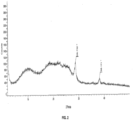
- Powder X-ray diffraction patterns of nilotinib base solid dispersion of composition 2 and 5 were provided in FIG. 1 .
- the total weight of each composition was 100 grams.
- nilotinib fumarate and carrier i.e., HPMC-AS, PVP K30 or HPMC E3
- the required quantities of nilotinib fumarate and carrier i.e., HPMC-AS, PVP K30 or HPMC E3
- the obtained feeder solutions were passed through nozzles as fine spray into chambers where the solvents (i.e., methanol and dichloromethane) were evaporated quickly to generate powders.
- the resulting spray dried powders were further dried to remove residual solvents in a static dryer.
- the total weight of each prepared composition was 100 grams.
- nilotinib fumarate, HPMC-AS, PVP K30, HPMC E3 and fumaric acid as mentioned in Table 4 were dissolved in methanol, to provide feeder solutions.
- the obtained feeder solutions were passed through nozzles as fine spray into chambers where solvents ( i.e. , methanol and dichloromethane) were evaporated quickly to generate powders.
- solvents i.e. , methanol and dichloromethane
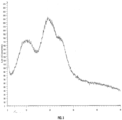
- the powder X-ray diffraction pattern (PXRD) for the amorphous solid dispersion of nilotinib fumarate of Composition 13 is illustrated in FIG. 2 .
- Solid dispersions of nilotinib tartrate having composition set forth in Table 5 were prepared by spray drying.
- Table 5 Ingredients Composition 16 17 Qty(g) %w/w Qty(g) %w/w Nilotinib tartrate 25 25 20.4 20.4 HPMC-AS 75 75 63.7 63.7 Tartaric acid -- -- 15.9 15.9 Methanol q.s. q.s. q.s. q.s.
- nilotinib tartrate, HPMC-AS and tartaric acid as mentioned in Table 5 were dissolved in methanol to prepare feeder solutions.
- the obtained feeder solutions were passed through nozzles as fine spray into chambers where methanol was evaporated quickly to generate powders.
- the resulting spray dried powders were dried further to remove residual solvent in a static dryer. Total weight of each prepared composition was 100 grams.
- Powder X-ray diffraction pattern of Composition 16 is illustrated in FIG. 3 .
- Instrument used for spray drying in the above examples 1-4 was Buchi B-290 mini-spray dryer and parameters of spray drying were given below:
- Solid dispersions of nilotinib tartrate having the compositions set forth in Table 6 were prepared by hot-melt extrusion (HME).
- HME hot-melt extrusion
- nilotinib tartrate, HPMC-AS, HPMC E3 and PVP K30 were weighed as mentioned in the Table 6 and physically mixed in a polybag.
- the resultant mixtures were then placed in an extruder hopper separately.
- the mixtures were passed through the heated extruder at a temperature range from about 30°C to about 170°C, as determined by temperature setting of the extruder heating zones so that melting or softening of the carrier occurred.
- the resulting extrudate was cooled to room temperature and milled, then the milled material was sifted through a 30-mesh screen. Total weight of each prepared composition was 100 grams.
- nilotinib tartrate HPMC-AS, triethyl citrate (TEC), polyethylene glycol (PEG), propylene glycol (PG) and tartaric acid were weighed as mentioned in the Table 7 and physically mixed in a polybag.
- the resultant mixtures were then placed in an extruder hopper separately, and were passed through heated extruder at a temperature range from about 30°C to about 170°C, as determined by temperature setting of the extruder heating zones so that melting or softening of the carrier occurred.
- the resulting extrudate was cooled to room temperature and milled, then the milled material was sifted through a 30-mesh screen. Total weight of each prepared composition was 100 grams.
- Thermofischer11 extruder used in the examples 5 and 6 has a single screw solid conveying mechanism that extends from the hopper through multiple heating zones to the extrusion die. Temperature controls, extruder screw speed, feed rate and the process parameters used during hot-melt extrusion are provided in Table 8 Zone Temperature Zone 1 33-35 °C Zone 2 60 °C Zone 3 120 °C Zone 4 130 °C Zone 5 140 °C Zone 6 150 °C Zone 7 160 °C Zone 8 170 °C Parameters Die 2 mm Screw speed 100 rpm Feed rate 1g/minute
- Nilotinib capsules were prepared, having the compositions set forth in Table 9.
- Table 9 Ingredients Composition 34 Composition 35 mg/unit %w/w mg/unit %w/w Nilotinib base (solid dispersion from composition 2) 200 68 -- -- Nilotinib base (solid dispersion from composition 5) -- -- 200 68 Intra-granular material Microcrystalline cellulose 73.4 25.0 73.4 25.0 Croscarmellose Sodium 14.6 5.0 14.6 5.0 AEROSIL ® 1.5 0.5 1.5 0.5 Magnesium stearate 1.5 0.5 1.5 0.5 Extra-granular material AEROSIL ® 1.5 0.5 1.5 0.5 Magnesium stearate 1.5 0.5 1.5 0.5 Total 294 100.1 294 100.1
- Nilotinib fumarate capsules were prepared, having the compositions set forth in Table 11 .
- Table 11 Ingredients Composition 36 37 38 39 40 41 42 mg/unit Nilotinib fumarate (solid dispersion from composition 13) 293 263.8 205.2 146.5 263.8 205.2 146.5 Nilotinib fumarate (solid dispersion from composition 14) -- 29.3 87.9 146.5 -- -- -- -- nilotinib fumarate (solid dispersion from composition 15) -- -- -- -- 29.3 87.9 146.5
- Intra-granular material Microcrystalline cellulose 107.5 107.5 107.5 107.5 107.5 107.5 107.5 107.5 107.5 107.5 107.5 107.5 Croscarmellose Sodium 21.4 21.4 21.4 21.4 21.4 21.4 AEROSIL ® 2.15 2.15 2.15 2.15 2.15 2.15 2.15 2.15 2.15 2.15 2.15 Magnesium stearate 2.15 2.15 2.15 2.15 2.15 2.15 2.15 2.15 2.15 Magnesium stearate 2.
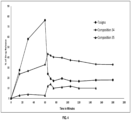
- TASIGNA ® 50mg capsule and Composition 36 are tested by using USP apparatus II (paddle); 500 mL of 0.01 M HCl media for 60 minutes and followed by 900 mL of FeSSIF media and FaSSIF media for 90 minutes at 37 ⁇ 0.5 °C and stirred at 75 rpm, the dissolution profile of Composition 36 was compared with TASIGNA ® 50mg capsule in FeSSIF and FaSSIF media in following Table 12 . Samples of 5mL were withdrawn at 15, 30 and 60 minutes in 0.01 M HCl acid media and 65, 70, 75, 90, 105, 120, 150 and 180-minute time points in FeSSIF and FaSSIF media.
- Solid dispersions of nilotinib fumarate were prepared, having the compositions set forth in Table 13 Table 13 Ingredients Composition 43 44 45 46 47 48 49 mg/unit Nilotinib fumarate (solid dispersion from composition 7) 243.0 218.7 170.2 121.5 218.7 170.2 121.5 Nilotinib fumarate (solid dispersion from composition 10) -- 24.3 72.9 121.5 -- -- -- Nilotinib fumarate (solid dispersion from composition 12) -- -- -- -- -- 24.3 72.9 121.5 Microcrystalline cellulose 89.2 89.2 89.2 89.2 89.2 89.2 89.2 89.2 89.2 89.2 89.2 89.2 Croscarmellose Sodium 17.7 17.7 17.7 17.7 17.7 17.7 AEROSIL ® 1.8 1.8 1.8 1.8 1.8 1.8 1.8 1.8 1.8 1.8 1.8 1.8 1.8 1.8 1.8 1.8 1.8 1.8 1.8 1.8 Magne
- the manufacturing procedure was as follows:
- Nilotinib tartrate capsules were prepared, having the compositions set forth in Table 14 .
- Table 14 Ingredients Composition 50 Composition 51 mg/unit %w/w mg/unit %w/w Nilotinib tartrate (solid dispersion from composition 16) 256 68.0 -- -- Nilotinib tartrate (solid dispersion from composition 17) -- -- 306 68.0 Intra-granular Material Microcrystalline cellulose 78.55 25.0 93.9 25.0 Croscarmellose Sodium 15.64 5.0 18.65 5.0 AEROSIL ® 1.58 0.5 1.88 0.5 Magnesium stearate 1.58 0.5 1.88 0.5 Extra-granular Material AEROSIL ® 1.58 0.5 1.88 0.5 Magnesium stearate 1.58 0.5 1.88 0.5 Total 356.48 100 426.07 100
- nilotinib tartrate solid dispersion of Composition 16 and 17 were weighed according to Table 14, mixed with intragranular ingredients (i.e. , microcrystalline cellulose, croscarmellose sodium, AEROSIL ® and magnesium stearate) according to Table 14.
- the resulting mixtures obtained were each separately compacted with roller compactor.
- the resulting compacts were each separately milled and passed through a 30-mesh screen.
- the obtained granules were blended with AEROSIL ® to obtain pre-lubricated blends.
- the pre-lubricated blends were lubricated with magnesium stearate.
- the final blends were filled into capsules with respective fill weights for respective strengths of 25 mg to 100 mg.
- composition 50 and 51 When tested by using USP apparatus II (paddle); 500 mL of 0.01 M HCl media for 60 minutes and followed by 900 mL of pH 5.0 ⁇ 0.05 FeSSIF media for 90 minutes at 37 ⁇ 0.5 °C and stirred at 75 rpm, the dissolution profiles of composition 50 and 51 were compared with TASIGNA ® 50mg capsule in following Table 15 . Samples of 5mL were withdrawn at 15, 30 and 60 minutes in 0.01 M HCl acid media and 65, 70, 75, 90, 105, 120, 150 and 180-minute time points in FeSSIF media.
- nilotinib tartrate Solid dispersion of nilotinib tartrate was prepared, having the composition set forth in Table 16 Table 16 Ingredients Composition 52 mg/unit %w/w Nilotinib tartrate 64 19.9 HPMC-AS MF 200 62.1 Tartaric acid 50 15.5 AEROSIL ® 5 1.6 Magnesium stearate 3 0.9 Total 322 100
- nilotinib tartrate, HPMC-AS MF and tartaric acid were weighed and blended for 5 minutes to obtain a premix, according to Table 16.
- the premix obtained was subjected to hot-melt extrusion, which was performed on a hot melt extruder (Pharma 11 Twin-screw Extruder) at screw speed of 100 rpm using feed rate of 1 gram/minute.
- the extrude was collected at a temperature of 160°C, milled and passed through 40-mesh screen to obtain granules.
- the specified quantity of AEROSIL ® was co-sifted with granules through 40-mesh screen and blended for 5 minutes to obtain pre-lubricated blend.
- Magnesium stearate was passed through 60-mesh screen and added to pre-lubricated blend and lubricated for 5 minutes.
- Nilotinib fumarate capsules were prepared, having the composition set forth in Table 19 .
- Table 19 Ingredients Composition 53 mg/capsule %w/w Nilotinib fumarate 60.77 20.7 HPMC-AS MF 182.3 62.2 Fumaric acid 50 17.1 Methanol 9000 - Total weight of solid dispersion filled in each capsule 293.07 100
- nilotinib fumarate, fumaric acid and HPMC-AS were dissolved in methanol solvent to prepare a solution containing 3% solid content.
- Prepared solution was sprayed on a spray dryer (Buchi B-290) at an inlet temperature of 115°C and flow rate of 10 mL/minute. Obtained spray dried solid dispersion was filled into capsules.
- a nilotinib fumarate tablets were prepared, having the composition set forth in Table 22 .
- Table 22 Ingredients Composition 54 Composition 55 Dry-granulation process Wet granulation process mg/tablet %w/w mg/tablet %w/w Nilotinib fumarate solid dispersion of Composition 53 293.07 57.6 293.07 57.9 Intra-granular material Microcrystalline cellulose 100 19.6 100 19.8 Crospovidone 50 9.8 -- -- AEROSIL ® 5 1.0 -- -- -- Magnesium stearate 3 0.6 -- -- METHOCEL ® E5 -- -- 5 1.0 Purified water -- -- q.s. -- Extra-granular material Crospovidone 50 9.8 100 19.8 AEROSIL ® 5 1.0 5 1.0 Magnesium stearate 3 0.6 3 0.6 Total 509.07 100 506.07 100 Note: q.s. - quantity sufficient
- the dry-granulation/slugging process comprised the following:
- the wet-granulation process comprised the following: 1. Nilotinib fumarate solid dispersion of Composition 53 was granulated with aqueous solution of METHOCEL ® E5 in a rapid mixer granulator. The granules obtained were dried at 60°C for 20 minutes. The dried granules were sifted through 40-mesh screen. 2. The required quantities of Crospovidone and AEROSIL ® were weighed and co-sifted with granules through 40-mesh screen and blended for 5 minutes to obtain pre-lubricated blend. 3. Magnesium stearate was passed through 60-mesh screen and added to pre-lubricated blend and lubricated for 5 minutes.
- the process for the preparation of the pharmaceutical compositions of present invention involves an extrusion process followed by a formulation process. Formation of an impurity was observed and determined to be directly related to process temperature of hot-melt extrusion employed. Optimization of process temperature, feed rate and screw speed during hot-melt extrusion was critical in order to reduce formation of impurities. Critical process parameters such as feed rate and screw speed were also found to have a significant impact on critical product attributes of the solid dispersion such as amorphous nature of nilotinib in solid dispersion.
- compositions and methods are described herein in terms of “comprising” various components or steps, the compositions and methods can also “consist essentially of” or “consist of” the various components and steps.
Landscapes
- Health & Medical Sciences (AREA)
- Chemical & Material Sciences (AREA)
- Animal Behavior & Ethology (AREA)
- Pharmacology & Pharmacy (AREA)
- Epidemiology (AREA)
- Life Sciences & Earth Sciences (AREA)
- Medicinal Chemistry (AREA)
- General Health & Medical Sciences (AREA)
- Public Health (AREA)
- Veterinary Medicine (AREA)
- Engineering & Computer Science (AREA)
- Bioinformatics & Cheminformatics (AREA)
- Dispersion Chemistry (AREA)
- Medicinal Preparation (AREA)
- Pharmaceuticals Containing Other Organic And Inorganic Compounds (AREA)
Applications Claiming Priority (3)
| Application Number | Priority Date | Filing Date | Title |
|---|---|---|---|
| IN201941006393 | 2019-02-18 | ||
| PCT/US2020/018564 WO2020172120A1 (fr) | 2019-02-18 | 2020-02-18 | Composition pharmaceutique du nilotinib |
| EP20760325.9A EP3914252B1 (fr) | 2019-02-18 | 2020-02-18 | Composition pharmaceutique du nilotinib |
Related Parent Applications (2)
| Application Number | Title | Priority Date | Filing Date |
|---|---|---|---|
| EP20760325.9A Division EP3914252B1 (fr) | 2019-02-18 | 2020-02-18 | Composition pharmaceutique du nilotinib |
| PCT/US2020/018564 Previously-Filed-Application WO2020172120A1 (fr) | 2019-02-18 | 2020-02-18 | Composition pharmaceutique du nilotinib |
Publications (2)
| Publication Number | Publication Date |
|---|---|
| EP4509123A2 true EP4509123A2 (fr) | 2025-02-19 |
| EP4509123A3 EP4509123A3 (fr) | 2025-05-07 |
Family
ID=72040748
Family Applications (2)
| Application Number | Title | Priority Date | Filing Date |
|---|---|---|---|
| EP20760325.9A Active EP3914252B1 (fr) | 2019-02-18 | 2020-02-18 | Composition pharmaceutique du nilotinib |
| EP24192295.4A Pending EP4509123A3 (fr) | 2019-02-18 | 2020-02-18 | Composition pharmaceutique du nilotinib |
Family Applications Before (1)
| Application Number | Title | Priority Date | Filing Date |
|---|---|---|---|
| EP20760325.9A Active EP3914252B1 (fr) | 2019-02-18 | 2020-02-18 | Composition pharmaceutique du nilotinib |
Country Status (6)
| Country | Link |
|---|---|
| US (3) | US10874671B2 (fr) |
| EP (2) | EP3914252B1 (fr) |
| JP (1) | JP7211644B2 (fr) |
| CN (1) | CN113573712A (fr) |
| ES (1) | ES2993251T3 (fr) |
| WO (1) | WO2020172120A1 (fr) |
Families Citing this family (19)
| Publication number | Priority date | Publication date | Assignee | Title |
|---|---|---|---|---|
| CN120305263A (zh) | 2018-06-15 | 2025-07-15 | 汉达癌症医药责任有限公司 | 卡博替尼的盐类于制备治疗癌症的剂型的用途 |
| CN113573712A (zh) * | 2019-02-18 | 2021-10-29 | 斯莱班克制药有限责任公司 | 尼洛替尼的药物组合物 |
| CA3168667A1 (fr) | 2020-01-24 | 2021-07-29 | Nanocopoeia, Llc | Dispersions solides amorphes de dasatinib et leurs utilisations |
| EP4096791A1 (fr) | 2020-01-31 | 2022-12-07 | Nanocopoeia LLC | Microparticules de nilotinib amorphe et leurs utilisations |
| WO2021161347A1 (fr) * | 2020-02-15 | 2021-08-19 | Cipla Limited | Nouveaux sels de nilotinib et formes polymorphes de celui-ci |
| CN112294971B (zh) * | 2020-02-20 | 2022-02-01 | 深圳市泰力生物医药有限公司 | 具有改进的溶解性的尼洛替尼组合物 |
| US20220378788A1 (en) * | 2020-04-30 | 2022-12-01 | Nanocopoeia, Llc | Orally disintegrating tablet comprising amorphous solid dispersion of nilotinib and in vitro characterization thereof |
| IL297776A (en) | 2020-04-30 | 2022-12-01 | Nanocopoeia Llc | Orally disintegrating tablets containing an amorphous solid dispersion of nalotinib |
| US20230293439A1 (en) * | 2020-07-24 | 2023-09-21 | Lonza Bend Inc. | Spray drying of supersaturated solutions of api with acetic acid |
| MX2023003556A (es) | 2020-09-29 | 2023-06-13 | Shenzhen Pharmacin Co Ltd | Composiciones farmaceuticas. |
| WO2022162687A1 (fr) * | 2021-01-27 | 2022-08-04 | Natco Pharma Limited | Compositions pharmaceutiques comprenant du nilotinib |
| WO2022177983A1 (fr) * | 2021-02-19 | 2022-08-25 | Slayback Pharma Llc | Compositions pharmaceutiques de cabozantinib |
| JP2024520799A (ja) | 2021-06-10 | 2024-05-24 | ロンザ・ベンド・インコーポレーテッド | ギ酸を含む過飽和溶液中のapiの噴霧乾燥 |
| WO2023285981A1 (fr) * | 2021-07-15 | 2023-01-19 | Torrent Pharmaceuticals Limited | Composition pharmaceutique liquide stable de nilotinib |
| US11980619B2 (en) | 2021-07-28 | 2024-05-14 | Nanocopoeia, Llc | Pharmaceutical compositions and crushable tablets including amorphous solid dispersions of dasatinib and uses |
| CN115581678B (zh) * | 2022-11-04 | 2023-09-12 | 北京鑫开元医药科技有限公司 | 一种瑞派替尼片组合物及其制备方法 |
| WO2025099249A1 (fr) * | 2023-11-08 | 2025-05-15 | Xspray Pharma Ab | Compositions pharmaceutiques comprenant du nilotinib |
| WO2025154730A1 (fr) * | 2024-01-18 | 2025-07-24 | 沢井製薬株式会社 | Dispersion solide, préparation contenant une dispersion solide et procédé de production de dispersion solide |
| CN120919059B (zh) * | 2025-10-15 | 2026-02-03 | 浙江奥翔药业股份有限公司 | 一种芦可替尼药物组合物 |
Family Cites Families (13)
| Publication number | Priority date | Publication date | Assignee | Title |
|---|---|---|---|---|
| GT200600316A (es) * | 2005-07-20 | 2007-04-02 | Sales de 4-metilo-n-(3-(4-metilo-imidazol-1-ilo)-5-trifluorometilo-fenilo)-3-(4-piridina-3-ilo-pirimidina-2-iloamino)- benzamida. | |
| KR101462693B1 (ko) | 2006-08-16 | 2014-11-17 | 노파르티스 아게 | 고도 결정질 치료용 화합물의 고체 분산체 제조 방법 |
| US9145396B2 (en) | 2008-12-01 | 2015-09-29 | Targacept, Inc. | Synthesis and novel salt forms of (R)-5-((E)-2-pyrrolidin-3ylvinyl)pyrimidine |
| ES2555263T3 (es) | 2010-06-21 | 2015-12-30 | Teva Pharmaceutical Industries Ltd. | Sales de Nilotinib y formas cristalinas de las mismas |
| US8901419B2 (en) | 2011-06-13 | 2014-12-02 | The Wiremold Company | Rising receptacle box assembly |
| AR086913A1 (es) | 2011-06-14 | 2014-01-29 | Novartis Ag | 4-metil-3-[[4-(3-piridinil)-2-pirimidinil]-amino]-n-[5-(4-metil-1h-imidazol-1-il)-3-(trifluoro-metil)-fenil]-benzamida amorfa, forma de dosificacion que la contiene y metodo para prepararlas |
| US9301957B2 (en) | 2011-11-14 | 2016-04-05 | Novartis Ag | Immediate release 4-methyl-3-4[[4-(3-pyridinyl)-2-pyrimidinyl]amino]-N-[5-(4-methyl-1H-imidazol-1-YL)-3-(trifluoromethyl)phenyl] benzamide formulation |
| DK3181122T3 (da) * | 2012-01-13 | 2023-06-06 | Xspray Pharma Ab Publ | Farmaceutisk dasatinib-sammensætning |
| EP2742940B1 (fr) * | 2012-12-13 | 2017-07-26 | IP Gesellschaft für Management mbH | Sel de fumarate de (R)-3-(6-(4-methylphenyl)-pyridin-3-yloxy)-l-aza-bicyclo-[2.2.2]octane destinés à être administrés une fois par jour, deux fois par jour ou trois fois par jour |
| PT107846B (pt) * | 2014-08-01 | 2019-03-22 | Hovione Farm S A | Produção de nano- partículas de dispersões sólidas amorfas por co-precipitação controlada |
| WO2017149550A1 (fr) * | 2016-03-02 | 2017-09-08 | Msn Laboratories Private Limited | Forme amorphe du 4-méthyl-n-[3-(4-méthyl-1h-imidazol-1-yl)-5-(trifluorométhyl)phényl]-3-[[4-(3-pyridinyl)-2-pyrimidinyl]amino]-benzamide |
| HUE050890T2 (hu) * | 2016-03-14 | 2021-01-28 | Pliva Hrvatska D O O | Nilotinib sók szilárd halmazállapotú formái |
| CN113573712A (zh) * | 2019-02-18 | 2021-10-29 | 斯莱班克制药有限责任公司 | 尼洛替尼的药物组合物 |
-
2020
- 2020-02-18 CN CN202080021471.4A patent/CN113573712A/zh active Pending
- 2020-02-18 ES ES20760325T patent/ES2993251T3/es active Active
- 2020-02-18 JP JP2021548238A patent/JP7211644B2/ja active Active
- 2020-02-18 WO PCT/US2020/018564 patent/WO2020172120A1/fr not_active Ceased
- 2020-02-18 EP EP20760325.9A patent/EP3914252B1/fr active Active
- 2020-02-18 US US16/793,833 patent/US10874671B2/en active Active
- 2020-02-18 EP EP24192295.4A patent/EP4509123A3/fr active Pending
- 2020-11-20 US US16/953,728 patent/US11793809B2/en active Active
-
2023
- 2023-09-15 US US18/468,266 patent/US12403140B2/en active Active
Non-Patent Citations (1)
| Title |
|---|
| CASTAGNETTI ET AL., HEMATOLOGY MEETING REPORTS, vol. 2, no. 5, 2008, pages 22 - 26 |
Also Published As
| Publication number | Publication date |
|---|---|
| JP7211644B2 (ja) | 2023-01-24 |
| JP2022510732A (ja) | 2022-01-27 |
| EP3914252A1 (fr) | 2021-12-01 |
| CN113573712A (zh) | 2021-10-29 |
| US20240009188A1 (en) | 2024-01-11 |
| EP3914252B1 (fr) | 2024-08-07 |
| WO2020172120A1 (fr) | 2020-08-27 |
| EP4509123A3 (fr) | 2025-05-07 |
| US12403140B2 (en) | 2025-09-02 |
| US10874671B2 (en) | 2020-12-29 |
| US20200261449A1 (en) | 2020-08-20 |
| EP3914252A4 (fr) | 2022-03-30 |
| US20210077485A1 (en) | 2021-03-18 |
| US11793809B2 (en) | 2023-10-24 |
| ES2993251T3 (en) | 2024-12-26 |
| US20250332165A1 (en) | 2025-10-30 |
Similar Documents
| Publication | Publication Date | Title |
|---|---|---|
| US12403140B2 (en) | Pharmaceutical compositions of nilotinib | |
| US12357627B2 (en) | Pharmaceutical compositions of cabozantinib | |
| KR101156916B1 (ko) | 이마티닙 및 방출 지연제를 포함하는 제약 조성물 | |
| AU2012340759B2 (en) | Pharmaceutical formulations | |
| US20250248987A1 (en) | Pharmaceutical compositions of cabozantinib | |
| US20220362235A1 (en) | Pharmaceutical compositions of cabozantinib | |
| US20220280500A1 (en) | Pharmaceutical compositions of cabozantinib | |
| US11103503B2 (en) | Pharmaceutical compositions of Lurasidone | |
| US12629369B2 (en) | Pharmaceutical compositions of nilotinib | |
| WO2024126772A1 (fr) | Composition pharmaceutique comprenant de la rupatadine et du montélukast | |
| HK1197024B (en) | Pharmaceutical formulations | |
| NZ623628B2 (en) | Solid oral pharmaceutical formulations comprising amorphous (S)-methyl (1- ((4-(3-(5-chloro-2-fluoro-3-(methylsulfonamido)phenyl)-1-isopropy1-1H-pyrazo1-4-yl)pyrimidin-2-yl)amino)propan-2-yl)carbamate (Compound A) |
Legal Events
| Date | Code | Title | Description |
|---|---|---|---|
| PUAI | Public reference made under article 153(3) epc to a published international application that has entered the european phase |
Free format text: ORIGINAL CODE: 0009012 |
|
| STAA | Information on the status of an ep patent application or granted ep patent |
Free format text: STATUS: THE APPLICATION HAS BEEN PUBLISHED |
|
| AC | Divisional application: reference to earlier application |
Ref document number: 3914252 Country of ref document: EP Kind code of ref document: P |
|
| AK | Designated contracting states |
Kind code of ref document: A2 Designated state(s): AL AT BE BG CH CY CZ DE DK EE ES FI FR GB GR HR HU IE IS IT LI LT LU LV MC MK MT NL NO PL PT RO RS SE SI SK SM TR |
|
| REG | Reference to a national code |
Ref country code: DE Ref legal event code: R079 Free format text: PREVIOUS MAIN CLASS: A61K0031498500 Ipc: A61K0009140000 |
|
| PUAL | Search report despatched |
Free format text: ORIGINAL CODE: 0009013 |
|
| AK | Designated contracting states |
Kind code of ref document: A3 Designated state(s): AL AT BE BG CH CY CZ DE DK EE ES FI FR GB GR HR HU IE IS IT LI LT LU LV MC MK MT NL NO PL PT RO RS SE SI SK SM TR |
|
| RIC1 | Information provided on ipc code assigned before grant |
Ipc: A61K 31/4985 20060101ALI20250401BHEP Ipc: A61K 9/48 20060101ALI20250401BHEP Ipc: A61K 9/20 20060101ALI20250401BHEP Ipc: A61K 9/16 20060101ALI20250401BHEP Ipc: A61K 9/14 20060101AFI20250401BHEP |
|
| STAA | Information on the status of an ep patent application or granted ep patent |
Free format text: STATUS: REQUEST FOR EXAMINATION WAS MADE |
|
| 17P | Request for examination filed |
Effective date: 20251023 |
|
| STAA | Information on the status of an ep patent application or granted ep patent |
Free format text: STATUS: EXAMINATION IS IN PROGRESS |
|
| 17Q | First examination report despatched |
Effective date: 20260331 |