EP4509207A2 - Mélangeur statique compact et procédé de mélange d'au moins deux fluides - Google Patents
Mélangeur statique compact et procédé de mélange d'au moins deux fluides Download PDFInfo
- Publication number
- EP4509207A2 EP4509207A2 EP24221068.0A EP24221068A EP4509207A2 EP 4509207 A2 EP4509207 A2 EP 4509207A2 EP 24221068 A EP24221068 A EP 24221068A EP 4509207 A2 EP4509207 A2 EP 4509207A2
- Authority
- EP
- European Patent Office
- Prior art keywords
- inlets
- fluids
- premixing
- static mixer
- fluid
- Prior art date
- Legal status (The legal status is an assumption and is not a legal conclusion. Google has not performed a legal analysis and makes no representation as to the accuracy of the status listed.)
- Pending
Links
Images





Classifications
-
- B—PERFORMING OPERATIONS; TRANSPORTING
- B01—PHYSICAL OR CHEMICAL PROCESSES OR APPARATUS IN GENERAL
- B01F—MIXING, e.g. DISSOLVING, EMULSIFYING OR DISPERSING
- B01F25/00—Flow mixers; Mixers for falling materials, e.g. solid particles
- B01F25/12—Interdigital mixers, i.e. the substances to be mixed are divided in sub-streams which are rearranged in an interdigital or interspersed manner
-
- B—PERFORMING OPERATIONS; TRANSPORTING
- B01—PHYSICAL OR CHEMICAL PROCESSES OR APPARATUS IN GENERAL
- B01F—MIXING, e.g. DISSOLVING, EMULSIFYING OR DISPERSING
- B01F25/00—Flow mixers; Mixers for falling materials, e.g. solid particles
- B01F25/40—Static mixers
- B01F25/42—Static mixers in which the mixing is affected by moving the components jointly in changing directions, e.g. in tubes provided with baffles or obstructions
- B01F25/43—Mixing tubes, e.g. wherein the material is moved in a radial or partly reversed direction
- B01F25/431—Straight mixing tubes with baffles or obstructions that do not cause substantial pressure drop; Baffles therefor
- B01F25/4314—Straight mixing tubes with baffles or obstructions that do not cause substantial pressure drop; Baffles therefor with helical baffles
- B01F25/43141—Straight mixing tubes with baffles or obstructions that do not cause substantial pressure drop; Baffles therefor with helical baffles composed of consecutive sections of helical formed elements
-
- B—PERFORMING OPERATIONS; TRANSPORTING
- B01—PHYSICAL OR CHEMICAL PROCESSES OR APPARATUS IN GENERAL
- B01F—MIXING, e.g. DISSOLVING, EMULSIFYING OR DISPERSING
- B01F25/00—Flow mixers; Mixers for falling materials, e.g. solid particles
- B01F25/40—Static mixers
- B01F25/42—Static mixers in which the mixing is affected by moving the components jointly in changing directions, e.g. in tubes provided with baffles or obstructions
- B01F25/43—Mixing tubes, e.g. wherein the material is moved in a radial or partly reversed direction
- B01F25/431—Straight mixing tubes with baffles or obstructions that do not cause substantial pressure drop; Baffles therefor
- B01F25/4316—Straight mixing tubes with baffles or obstructions that do not cause substantial pressure drop; Baffles therefor the baffles being flat pieces of material, e.g. intermeshing, fixed to the wall or fixed on a central rod
- B01F25/43161—Straight mixing tubes with baffles or obstructions that do not cause substantial pressure drop; Baffles therefor the baffles being flat pieces of material, e.g. intermeshing, fixed to the wall or fixed on a central rod composed of consecutive sections of flat pieces of material
-
- B—PERFORMING OPERATIONS; TRANSPORTING
- B01—PHYSICAL OR CHEMICAL PROCESSES OR APPARATUS IN GENERAL
- B01F—MIXING, e.g. DISSOLVING, EMULSIFYING OR DISPERSING
- B01F25/00—Flow mixers; Mixers for falling materials, e.g. solid particles
- B01F25/40—Static mixers
- B01F25/42—Static mixers in which the mixing is affected by moving the components jointly in changing directions, e.g. in tubes provided with baffles or obstructions
- B01F25/43—Mixing tubes, e.g. wherein the material is moved in a radial or partly reversed direction
- B01F25/431—Straight mixing tubes with baffles or obstructions that do not cause substantial pressure drop; Baffles therefor
- B01F25/4316—Straight mixing tubes with baffles or obstructions that do not cause substantial pressure drop; Baffles therefor the baffles being flat pieces of material, e.g. intermeshing, fixed to the wall or fixed on a central rod
- B01F25/43162—Assembled flat elements
Definitions
- the invention relates to a static mixer unit for mixing at least two fluids, in particular liquids, gases and/or pasty masses, which has a static mixer with several flow-influencing elements arranged in a hollow body.
- the invention further relates to a set of parts comprising a static mixer unit, at least two, in particular exactly two, containers, each with an outlet on the containers, wherein the containers each contain one of at least two, in particular exactly two, different fluids.
- the invention also relates to a method for mixing at least two fluids, in particular liquids, gases and/or pasty masses, with a static mixer unit and the use of a static mixer unit for mixing two fluids.
- Static mixers are devices for mixing fluids in which the flow movement alone causes the mixing and which do not have moving elements. They consist of a series of specially shaped flow-influencing elements arranged in a pipe or housing. The fluids to be mixed are guided through these elements, whereby they are divided, diverted and recombined. This creates shear forces, turbulence or extensional flows that cause a homogeneous distribution of the fluids to be mixed.
- Conventional static mixers work exclusively through the kinetic energy of the flowing media and do not require an external energy supply for the mixing process.
- Static mixers are widely used in the construction sector, in industrial manufacturing or in industrial process engineering, among others, and have established themselves in numerous applications as a reliable and efficient solution for mixing liquids, gases and viscous media.
- Such mixers are described, for example, in the patent documents US 4,062,524 (Bayer AG ), US 2012/0106290 A1 (Meijer et al. ), US 3,664,638 (Kenics Corp .), EP 0 815 929 B1 (Sulzer Chemtech AG ) and EP 2 181 827 B1 (Sulzer Mixpac AG ).
- static mixers have disadvantages in certain applications.
- static mixers are relatively long and bulky.
- the mixers are used manually, e.g. when used as a mixing nozzle on adhesive cartridges, this has a negative effect on handling and in process engineering, additional space is required for the installation of the bulky static mixers.
- long static mixers increase the material requirement, which not only increases the manufacturing costs but also the environmental impact.
- the object of the invention is therefore to provide an improved static mixer unit.
- the static mixer unit should in particular combine an efficient mixing effect with a compact and resource-saving design.
- the length of the main mixing unit in the static mixer unit according to the invention can be reduced by up to 90% while maintaining the same mixing quality. This means that the static mixer unit according to the invention can be built more compactly, which also reduces material consumption.
- the static mixer unit according to the invention achieves an efficient mixing effect while at the same time being compact and resource-saving or sustainable.
- the compactness also improves handling in manual applications and reduces the space required in industrial applications.
- premixing unit according to the invention can be combined with a variety of different main mixing units, which enables flexible adaptation to different requirements.
- premixing in the present case particularly includes a pre-distribution, in particular a regular spatial pre-distribution, of the at least two fluids and/or a partial mixing of the at least two fluids.
- a mixing quality of the at least two fluids before the premixing unit is lower than after the premixing unit and/or at the outlet of the premixing unit the mixing quality is lower than a mixing quality of the at least two fluids after passing through the main mixing unit.
- the premixing chamber and the static mixer of the main mixing unit are firmly connected to one another and/or manufactured in one piece.
- the inlet of the static mixer corresponds in size and/or shape to the outlet of the premixing chamber. This allows the entire inlet opening of the static mixer to be used.
- the at least two fluids in the premixing chamber are distributed over the entire outlet area of the premixing chamber and/or the entire inlet area or the entire inlet opening, preferably distributed regularly. This also makes it possible to A high mixing quality can be achieved by local mixing in the downstream main mixing unit, which benefits the compactness.
- the premixing chamber has no further inlets for fluids in addition to the plurality of first inlets for supplying the first fluid and the plurality of second inlets for supplying the second fluid.
- the premixing chamber is designed for mixing exactly two fluids.
- the premixing unit in another embodiment, however, it is possible for the premixing unit to have a plurality of third inlets for supplying a third fluid into the cavity of the premixing chamber.
- the premixing chamber is designed for mixing exactly three fluids.
- one or more first inlets and one or more second inlets lead alternately into the cavity. This means that between two of the first inlets, one or more of the second inlets lead into the premixing chamber and/or between two of the second inlets, one or more of the first inlets lead into the premixing chamber.
- the plurality of first inlets and the plurality of second inlets are arranged such that a first inlet and a second inlet alternately open into the cavity.
- a first inlet and a second inlet alternately open into the cavity.
- the plurality of first inlets and the plurality of second inlets are arranged at regular intervals from one another. This further improves the premixing effect.
- the plurality of first inlets are arranged on a first circular line and/or the plurality of second inlets are arranged on a second circular line.
- the center of the circular line(s) is advantageously located on a geometric axis which runs through the center of the central outlet of the premixing chamber and/or coaxial to a longitudinal axis which runs along the main flow direction in the main mixing unit. In this case, the homogeneity of the premixing can be further increased.
- the plurality of first inlets and the plurality of second inlets are arranged such that the first fluid and the second fluid enter the cavity of the premixing chamber on a common circular line.
- the center of the circular line is advantageously located on a geometric axis that runs through the center of the central outlet of the premixing chamber and/or coaxial with a longitudinal axis that runs along the main flow direction in the main mixing unit. This allows optimal and uniform mixing to be achieved.
- the plurality of first inlets and the plurality of second inlets are designed such that the first fluid and the second fluid are introduced into the cavity from different directions. This applies in particular to all first and all second inlets. This enables in particular a more compact design.
- the plurality of first inlets and the plurality of second inlets are designed such that the first fluid and the second fluid are introduced into the cavity from opposite directions.
- the first fluid can be introduced into the cavity in a direction parallel to the main flow direction of the fluids in the static mixer and the second fluid can be introduced into the cavity from a direction antiparallel to the main flow direction of the fluids in the static mixer.
- the plurality of first inlets and the plurality of second inlets are designed such that the first fluid and the second fluid can be introduced into the cavity of the premixing chamber from directions perpendicular to each other.
- all first inlets are of identical design and/or all second inlets are of identical design.
- all first and second inlets are of identical design.
- a number of the plurality of first inlets is the same as a number of the plurality of second inlets.
- the number, cross-sectional area of the inlet openings and/or the shape of the inlet openings can be adjusted or designed differently.
- the cavity of the premixing chamber is axially symmetrical with respect to a central axis which is perpendicular to an opening plane of the outlet, and/or wherein the cavity of the premixing chamber is axially symmetrical with respect to a longitudinal axis which runs along the main flow direction of the fluids in the static mixer.
- the cavity of the premixing chamber is cylindrical or plate-shaped.
- Cylindrical cavities are, for example, circular cylindrical cavities, elliptical cylindrical cavities or prismatic cavities, circular cylindrical cavities are particularly preferred.
- a "cylinder” is understood to mean a body with two parallel, congruent bases and straight surface lines of equal length, with the surface lines connecting the corresponding points on the two bases.
- the surface lines are in particular perpendicular to the bases.
- the bases do not have to be circular. They can be any closed curve or surface, e.g. elliptical, rectangular or another shape.
- the height of the cylinder, measured in a direction perpendicular to the bases, can be arbitrary, in particular smaller than a width, length and/or diameter of the bases.
- a plate-shaped cavity has in particular a central cylindrical region and an adjoining peripheral annular region, the central axis of the cylindrical region and the annular region being the same.
- a transition from the central cylindrical region to the peripheral annular region can be angular or preferably rounded.
- a plate-shaped cavity has a central cylindrical region and an adjoining peripheral hollow spherical layer-shaped region, wherein the two regions preferably merge into one another continuously and/or without edges.
- a plate-shaped cavity has, in particular, a U-shaped cross-section with respect to all cross-sections passing through a centre of the cavity.
- Such cavities have a high degree of symmetry and thus enable particularly homogeneous mixing.
- a height of the cavity of the premixing chamber, measured in a direction perpendicular to the premixing plane, in the region of the common premixing plane is >0 - 20%, in particular 1 - 10%, in particular 2 - 5%, of a maximum Expansion, in particular a maximum diameter, of the cavity of the premixing chamber.
- the cavity is thus relatively flat, which has proven to be advantageous in this case.
- other designs of the cavity are also possible.
- the premixing unit is particularly preferably designed such that the fluids are guided through the cavity as fluid streams in the shape of a sector of a circle and/or flow through it. This can be achieved, for example, by the arrangements of the inlets described above and the design of the cavity of the premixing chamber.
- the plurality of first inlets are fluidically connected to a first supply chamber, wherein the first supply chamber is preferably designed such that the first fluid present in the first supply chamber is conveyed uniformly through all of the plurality of first inlets when pressure is applied; and/or wherein the plurality of second inlets are fluidically connected to a second supply chamber, wherein the second supply chamber is preferably designed such that the second fluid present in the second supply chamber is conveyed uniformly through all of the plurality of second inlets when pressure is applied.
- a feed chamber enables a particularly uniform introduction of the fluids through the corresponding inlets into the cavity of the premixing chamber, which benefits the most homogeneous premixing of the fluids possible.
- the first supply chamber has a plurality of first outlets which communicate with the plurality of first inlets of the premixing chamber, in particular the plurality of first outlets of the first supply chamber protrude into the plurality of first inlets of the premixing chamber, in particular in a form-fitting manner; and/or wherein the second supply chamber has a plurality of second outlets which communicate with the plurality of second inlets of the premixing chamber, in particular the plurality of second outlets of the second supply chamber protrude into the plurality of second inlets of the premixing chamber, in particular in a form-fitting manner.
- the first supply chamber and/or the second supply chamber is arranged on a side of the premixing chamber facing away from the downstream main mixing unit.
- the first supply chamber can laterally surround the premixing chamber and/or the second supply chamber, in particular such that the first fluid can be guided around the premixing chamber from the side of the premixing chamber facing away from the downstream main mixing unit and can be conveyed from the side of the premixing chamber facing the downstream main mixing unit through the plurality of first inlets into the cavity of the premixing chamber.
- the first supply chamber and/or the second supply chamber has an inlet opening on a side facing away from the downstream main mixing unit, through which the first fluid can be conveyed into the first supply chamber and/or the second fluid into the second supply chamber. This allows the fluid(s) to be guided centrally into the respective supply chamber.
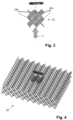
- the static mixer of the main mixing unit is designed, for example, as an X-mixer, helix mixer, T-mixer and/or quadro mixer.
- X-mixers are particularly preferred because they enable a particularly compact design in the present context.
- the designations are familiar to those skilled in the art.
- X-mixers are described for example in the US 4,062,524 or the US 2012/0106290 A1 .
- Helix mixers are in the US 3,664,638 described, while Quadro mixers in the EP 0 815 929 B1 and T-mixer in the EP 2 181 827 B1 are shown.
- the flow-influencing elements in the static mixer of the main mixing unit are X-shaped crossed webs, curved flat elements, helical elements and/or screw-shaped elements.
- Particularly preferred are X-shaped crossed webs, as these allow for a particularly compact construction in this context.
- the hollow body of the static mixer of the main mixing unit is preferably a tubular element.
- the main mixing unit comprises several static mixers arranged in parallel, wherein the several static mixers are in particular of identical construction. Due to the pre-distribution or pre-mixing of the fluids in the pre-mixing chamber, a local mixture is sufficient through static mixers connected in parallel.
- the parallel connection allows the cross-section of the individual static mixers to be reduced without increasing the pressure loss. With smaller mixer diameters, the length of the mixers can be reduced while maintaining the same mixing quality.
- the static mixer unit has a coupling device, in particular a screw connection, a clamp connection, a bayonet closure and/or a latching connection, for connecting the static mixer to one or more containers in which in particular the at least two fluids are present, and/or fluid lines from which in particular the at least two fluids are supplied.
- a coupling device in particular a screw connection, a clamp connection, a bayonet closure and/or a latching connection, for connecting the static mixer to one or more containers in which in particular the at least two fluids are present, and/or fluid lines from which in particular the at least two fluids are supplied.
- the static mixer units according to the invention can be manufactured in particular by 3D printing.
- the static mixer units according to the invention are made of plastic. However, for special purposes they can also be made of metal and/or other materials.
- a further aspect of the present invention relates to a kit of parts comprising (i) at least two, in particular exactly two, containers each with an outlet on the Containers, wherein the containers each contain one of at least two, in particular exactly two, different fluids, and (ii) a static mixer unit as described above, wherein the outlets of the containers are or can be connected to the static mixer unit in a fluid-conducting manner.
- a static mixer unit as described above, wherein the outlets of the containers are or can be connected to the static mixer unit in a fluid-conducting manner.
- the two containers can also be part of a common packaging, e.g. in a cartridge, and/or be designed as an integral part thereof.
- the static mixer unit preferably has a coupling device, in particular a screw connection, a clamp connection, a bayonet lock and/or a snap-in connection.
- the static mixer unit is further preferably connected via these to the containers and/or a packaging containing the containers.
- the static mixer unit used in the method is preferably a static mixer unit as described above. In a particular embodiment, this is equipped with one or more of the features described above as optional.
- the fluids are in particular liquids, gases and/or pasty masses.
- the first fluid and the second fluid may form a solution when mixed, one fluid being dissolved in the other, or the first fluid and the second fluid may form a dispersion when mixed, in particular a foam or an emulsion.
- the two fluids hardly or not at all dissolve in each other and one of the two fluids is finely distributed as a disperse phase, e.g. as a liquid or gaseous phase, in the other fluid, e.g. a liquid, which forms a continuous phase or the dispersion medium.
- a disperse phase e.g. as a liquid or gaseous phase
- the other fluid e.g. a liquid, which forms a continuous phase or the dispersion medium.
- the first fluid is, for example, a first component of a two-component adhesive and/or sealant and the second fluid is a second component of a two-component adhesive and/or sealant.
- the first fluid is a gas and the second fluid is a liquid, wherein a foam is preferably formed during mixing in the static mixer unit.
- a foam consists of gas bubbles finely distributed in a liquid.
- the first fluid is a liquid and the second fluid is a liquid that is not soluble in the first liquid, wherein an emulsion is preferably formed during mixing in the static mixer unit.
- an emulsion liquid droplets, which form the first fluid, for example, are finely distributed in another liquid, which forms the second fluid, for example.
- the fluids are guided through the cavity in particular as fluid streams in the shape of a sector of a circle and/or flow through it in this form.
- An additional aspect of the present invention relates to the use of a static mixer unit as described above for mixing two fluids, in particular liquids, gases and/or pasty masses.
- the static mixer unit is used to produce a solution or a dispersion, in particular a foam or an emulsion.
- the first fluid is a first component of a two-component adhesive and/or sealant and the second fluid is a second component of a two-component adhesive and/or sealant.
- one of the at least two fluids is a gas and a second of the at least two fluids is a liquid, and upon mixing a foam is formed.
- the at least two fluids are hardly or not at all soluble in each other and an emulsion is formed.
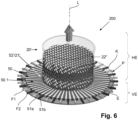
- the first inlets 51a and the second inlets 51b are arranged alternately in a peripheral region P of the premixing chamber 50, so that the first fluid F1 and the second fluid F2 enter the cavity of the premixing chamber 50 on a common circular line K.
- the fluids F1, F2 in the cylindrical cavity of the premixing chamber 50 can be guided to the outlet 52 from several different directions lying in a common premixing plane E.
- the helix mixer 10 is arranged in the region of the central outlet such that a main flow direction L of the fluids F1, F2 in the static mixer of the helix mixer 10 runs from the inlet 11 to the outlet 13 perpendicular to the premixing plane E of the premixing chamber 50 or the premixing unit.
- the two fluids F1, F2 are added alternately or alternately in the peripheral area P of the premixing chamber 50, radial partial flows are typically created that flow in a star shape to the outlet 52 or the inlet 11 of the helix mixer 10 or the main mixing unit.
- the number of mixing elements required for the helix mixer 10 can be reduced by around 30 - 50% while maintaining the same mixing quality.
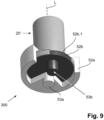
- Fig. 7 - 9 show partially cutaway representations of a possible implementation of the mixer unit 200 from Fig. 6 from different perspectives.
- the mixer unit 300 from the Fig. 7 - 9 has a hollow cylindrical premixing chamber 50, which has the first inlets 51a on the top for supplying the first fluid F1 and the second inlets 51b on the bottom for supplying the second fluid F2.
- the openings of the inlets 51a, 51b are rectangular and lead alternately into the cavity of the premixing chamber 50, so that the fluids F1, F2 can be introduced alternately from opposite directions or antiparallel into the cavity.
- All first inlets 51a are connected to a first supply chamber 52a in a fluid-conducting manner, so that the first fluid F1 can be introduced into the cavity of the premixing chamber 50 from above or from the side of the premixing chamber 50 facing the X-type mixer 20'.
- all second inlets 51b are fluidically connected to a first supply chamber 52b, so that the second fluid F2 can be introduced into the cavity of the premixing chamber 50 from below or from the side facing away from the X-type mixer 20'.
- the second supply chamber 52b has a plurality of first outlets 52b.1, which protrude into the plurality of first inlets 52b of the premixing chamber 50.
- the two supply chambers 52a, 52b each have an inlet opening 53a, 53b through which the first fluid F1 can be fed into the first supply chamber 52a and the second fluid F2 into the second supply chamber 52b.
- the second supply chamber 52b is designed as a substantially hollow cylindrical chamber and is arranged on the side of the premixing chamber 50 facing away from the X-type mixer 20'.
- the first supply chamber 53a is a chamber with a substantially annular cavity and surrounds the premixing chamber 50 and the second supply chamber 53b laterally, so that the first fluid F1 from the X-type mixer 20' side of the premixing chamber 50 facing away from the premixing chamber 50 and can be conveyed from the side of the premixing chamber 50 facing the X-type mixer 20' through the plurality of first inlets 52a into the cavity of the premixing chamber 50.
- Fig. 10 - 11 show partially cutaway representations of another more concrete implementation option of the mixer unit 200 from Fig. 6 from different perspectives.
- the mixer unit 400 from the Fig. 10 - 11 has the same X-mixer 20' as the mixer unit 300 but differs in terms of the premix unit.
- the mixer unit 400 has a premixing chamber 50' with a plate-shaped cavity with a central cylindrical region in the region of the outlet 52' or the inlet 21' of the X-mixer 20' and a peripheral ring-shaped region extending downwards, the central axis of the cylindrical region and the ring-shaped region being the same.
- a transition from the central cylindrical region to the peripheral ring-shaped region is rounded.
- the peripheral ring-shaped region can also be designed as a hollow sphere-shaped region, which extends into the Fig. 10 - 11 protruding downwards.
- the plurality of first inlets 51a' are arranged such that the first fluid F1 is introduced into the peripheral hollow sphere layer-shaped region of the cavity of the premixing chamber 50' via the inlet 53a' and the hollow cylindrical supply chamber 52a' from radial directions parallel to the premixing plane.
- the second inlets 51b' are arranged such that the second fluid F2 can be introduced into the peripheral hollow sphere layer-shaped region of the cavity of the premixing chamber 50' via the inlet 53b' and the annular supply chamber 52b' from a direction parallel to the main flow direction of the fluids in the X-mixer 20' or from below. As a result, neither of the two fluids needs to be guided past the premixing chamber.
- the mixer units shown can be manufactured from plastic in particular using 3D printing.
- the cartridge 500 is connected via a coupling device 401, e.g. a screw connection to the static mixer unit 400 from the Fig. 10 - 11 connected to it.
- the outlets of the cartridge 500 are connected to the static mixer unit 400 in a fluid-conducting manner, so that when the fluids are discharged from the containers 501a, 501b, the first fluid can be passed through the plurality of first inlets and the second fluid can be passed through the plurality of second inlets into the premixing chamber (50') of the premixing unit (VE) and then through the main mixing unit (HE) and mixed.
- Fig. 13 shows a variant of Fig. 5 in which, instead of a single static mixer, six identical static mixers 10 are arranged in parallel in the main mixing unit HE.
- the premixing unit VE is essentially identical in construction, as in Fig. 5 , but has a slightly larger outlet in the central area.
Landscapes
- Chemical & Material Sciences (AREA)
- Chemical Kinetics & Catalysis (AREA)
- Dispersion Chemistry (AREA)
Priority Applications (1)
| Application Number | Priority Date | Filing Date | Title |
|---|---|---|---|
| EP24221068.0A EP4509207A3 (fr) | 2024-12-18 | 2024-12-18 | Mélangeur statique compact et procédé de mélange d'au moins deux fluides |
Applications Claiming Priority (1)
| Application Number | Priority Date | Filing Date | Title |
|---|---|---|---|
| EP24221068.0A EP4509207A3 (fr) | 2024-12-18 | 2024-12-18 | Mélangeur statique compact et procédé de mélange d'au moins deux fluides |
Publications (2)
| Publication Number | Publication Date |
|---|---|
| EP4509207A2 true EP4509207A2 (fr) | 2025-02-19 |
| EP4509207A3 EP4509207A3 (fr) | 2025-07-02 |
Family
ID=93925763
Family Applications (1)
| Application Number | Title | Priority Date | Filing Date |
|---|---|---|---|
| EP24221068.0A Pending EP4509207A3 (fr) | 2024-12-18 | 2024-12-18 | Mélangeur statique compact et procédé de mélange d'au moins deux fluides |
Country Status (1)
| Country | Link |
|---|---|
| EP (1) | EP4509207A3 (fr) |
Citations (5)
| Publication number | Priority date | Publication date | Assignee | Title |
|---|---|---|---|---|
| US3664638A (en) | 1970-02-24 | 1972-05-23 | Kenics Corp | Mixing device |
| US4062524A (en) | 1973-06-06 | 1977-12-13 | Bayer Aktiengesellschaft | Apparatus for the static mixing of fluid streams |
| EP0815929B1 (fr) | 1996-07-05 | 2000-08-30 | Sulzer Chemtech AG | Mélangeur statique |
| US20120106290A1 (en) | 2008-12-10 | 2012-05-03 | Technische Universiteit Eindhoven | Static mixer comprising a static mixing element, method of mixing a fluid in a conduit and a formula for designing such a static mixing element |
| EP2181827B1 (fr) | 2008-10-17 | 2019-12-18 | Sulzer Mixpac AG | Mélangeur statique |
Family Cites Families (6)
| Publication number | Priority date | Publication date | Assignee | Title |
|---|---|---|---|---|
| DE10141459C2 (de) * | 2001-08-23 | 2003-08-07 | Polymaterials Ag | Verfahren und Vorrichtung zur Herstellung und Prüfung von Formkörpern |
| DK1973475T3 (da) * | 2006-01-17 | 2010-10-18 | Baxter Int | Blandeindretning, -system og -fremgangsmåde |
| GB2529040A (en) * | 2014-08-06 | 2016-02-10 | Greenthread Ltd | Apparatus and method for water treatment |
| EP4065262B1 (fr) * | 2019-11-29 | 2024-01-31 | Dow Silicones Corporation | Mélangeur statique |
| EP3970842A1 (fr) * | 2020-09-17 | 2022-03-23 | Sulzer Mixpac AG | Segment de mélange pour un mélangeur statique et mélangeur statique |
| KR102674288B1 (ko) * | 2022-04-13 | 2024-06-11 | 주식회사 케이시티 | Uvc 고도산화공정을 연계한 유체 또는 기체 혼합용 스태틱 믹서 |
-
2024
- 2024-12-18 EP EP24221068.0A patent/EP4509207A3/fr active Pending
Patent Citations (5)
| Publication number | Priority date | Publication date | Assignee | Title |
|---|---|---|---|---|
| US3664638A (en) | 1970-02-24 | 1972-05-23 | Kenics Corp | Mixing device |
| US4062524A (en) | 1973-06-06 | 1977-12-13 | Bayer Aktiengesellschaft | Apparatus for the static mixing of fluid streams |
| EP0815929B1 (fr) | 1996-07-05 | 2000-08-30 | Sulzer Chemtech AG | Mélangeur statique |
| EP2181827B1 (fr) | 2008-10-17 | 2019-12-18 | Sulzer Mixpac AG | Mélangeur statique |
| US20120106290A1 (en) | 2008-12-10 | 2012-05-03 | Technische Universiteit Eindhoven | Static mixer comprising a static mixing element, method of mixing a fluid in a conduit and a formula for designing such a static mixing element |
Also Published As
| Publication number | Publication date |
|---|---|
| EP4509207A3 (fr) | 2025-07-02 |
Similar Documents
| Publication | Publication Date | Title |
|---|---|---|
| EP0226879B1 (fr) | Mélangeur statique pour fluides comportant des composés de particules solides | |
| DE69716887T2 (de) | Mischer | |
| EP1799336B9 (fr) | Melangeur statique | |
| DE69505999T2 (de) | Verfahren und vorrichtung zur herstellung von geschlossen-zelligen schaumprodukten | |
| EP0526392B1 (fr) | Immixtion de petites quantités de fluides | |
| DE1557118B2 (fr) | ||
| DE1236479B (de) | Vorrichtung zum Mischen stroemender Medien, mit stillstehenden Leitelementen | |
| EP0526393A1 (fr) | dispositif d'immixtion | |
| WO2001076728A1 (fr) | Buse de moussage, de pulverisation ou d'atomisation | |
| EP0472491A1 (fr) | Dispositif de mélange laminaire statique dispositif d'additionnement ainsi que l'application du dispositif de mélange et de l'additionnement | |
| EP1278593B1 (fr) | Element de melange statique | |
| DE4313393C2 (de) | Statischer Mischer | |
| DE2419696A1 (de) | Mischvorrichtung | |
| DE2913940A1 (de) | Verfahren zum statischen mischen von fluiden medien und mischer hierzu | |
| EP1924346B1 (fr) | Elément mélangeur pour l'inversion et le mélange de matières en écoulement dans un canal d'écoulement, et ensemble et mélangeur comprenant de tels éléments mélangeurs | |
| EP1149626A1 (fr) | Elément de mélange statique, segment d'élément de mélange, mélangeur statique et lame de mélange ainsi que leur application | |
| WO2019020764A1 (fr) | Mélangeur | |
| EP3645149B1 (fr) | Distributeur de fluide | |
| DE4202591C2 (de) | Vorrichtung zum Vormischen von wenigstens zwei pastösen Massen | |
| EP4509207A2 (fr) | Mélangeur statique compact et procédé de mélange d'au moins deux fluides | |
| EP3338882A1 (fr) | Élément mélangeur à résistance et à action de mélange élevés | |
| EP1302236B1 (fr) | Segment de tuyau avec un post de alimentation pour un additif | |
| CH615839A5 (en) | Static mixer | |
| DE2642105A1 (de) | Statischer mischer | |
| DE3026039A1 (de) | Verfahren und vorrichtung zur innigen vermischung von medien gleichen oder verschiedenen aggregatzustandes |
Legal Events
| Date | Code | Title | Description |
|---|---|---|---|
| PUAI | Public reference made under article 153(3) epc to a published international application that has entered the european phase |
Free format text: ORIGINAL CODE: 0009012 |
|
| STAA | Information on the status of an ep patent application or granted ep patent |
Free format text: STATUS: THE APPLICATION HAS BEEN PUBLISHED |
|
| AK | Designated contracting states |
Kind code of ref document: A2 Designated state(s): AL AT BE BG CH CY CZ DE DK EE ES FI FR GB GR HR HU IE IS IT LI LT LU LV MC ME MK MT NL NO PL PT RO RS SE SI SK SM TR |
|
| PUAL | Search report despatched |
Free format text: ORIGINAL CODE: 0009013 |
|
| AK | Designated contracting states |
Kind code of ref document: A3 Designated state(s): AL AT BE BG CH CY CZ DE DK EE ES FI FR GB GR HR HU IE IS IT LI LT LU LV MC ME MK MT NL NO PL PT RO RS SE SI SK SM TR |
|
| RIC1 | Information provided on ipc code assigned before grant |
Ipc: B01F 25/431 20220101ALI20250528BHEP Ipc: B01F 25/4314 20220101ALI20250528BHEP Ipc: B01F 25/00 20220101AFI20250528BHEP |
|
| STAA | Information on the status of an ep patent application or granted ep patent |
Free format text: STATUS: THE APPLICATION IS DEEMED TO BE WITHDRAWN |