EP4509246A1 - Poudre d'alliage de cuivre pour fabrication additive et procédé de production de ladite poudre d'alliage de cuivre, et article fabriqué de manière additive d'alliage de cuivre et son procédé de production - Google Patents
Poudre d'alliage de cuivre pour fabrication additive et procédé de production de ladite poudre d'alliage de cuivre, et article fabriqué de manière additive d'alliage de cuivre et son procédé de production Download PDFInfo
- Publication number
- EP4509246A1 EP4509246A1 EP23803464.9A EP23803464A EP4509246A1 EP 4509246 A1 EP4509246 A1 EP 4509246A1 EP 23803464 A EP23803464 A EP 23803464A EP 4509246 A1 EP4509246 A1 EP 4509246A1
- Authority
- EP
- European Patent Office
- Prior art keywords
- copper alloy
- less
- additive manufacturing
- alloy powder
- additively manufactured
- Prior art date
- Legal status (The legal status is an assumption and is not a legal conclusion. Google has not performed a legal analysis and makes no representation as to the accuracy of the status listed.)
- Pending
Links
Images



Classifications
-
- B—PERFORMING OPERATIONS; TRANSPORTING
- B22—CASTING; POWDER METALLURGY
- B22F—WORKING METALLIC POWDER; MANUFACTURE OF ARTICLES FROM METALLIC POWDER; MAKING METALLIC POWDER; APPARATUS OR DEVICES SPECIALLY ADAPTED FOR METALLIC POWDER
- B22F1/00—Metallic powder; Treatment of metallic powder, e.g. to facilitate working or to improve properties
- B22F1/05—Metallic powder characterised by the size or surface area of the particles
-
- B—PERFORMING OPERATIONS; TRANSPORTING
- B33—ADDITIVE MANUFACTURING TECHNOLOGY
- B33Y—ADDITIVE MANUFACTURING, i.e. MANUFACTURING OF THREE-DIMENSIONAL [3D] OBJECTS BY ADDITIVE DEPOSITION, ADDITIVE AGGLOMERATION OR ADDITIVE LAYERING, e.g. BY 3D PRINTING, STEREOLITHOGRAPHY OR SELECTIVE LASER SINTERING
- B33Y10/00—Processes of additive manufacturing
-
- B—PERFORMING OPERATIONS; TRANSPORTING
- B22—CASTING; POWDER METALLURGY
- B22F—WORKING METALLIC POWDER; MANUFACTURE OF ARTICLES FROM METALLIC POWDER; MAKING METALLIC POWDER; APPARATUS OR DEVICES SPECIALLY ADAPTED FOR METALLIC POWDER
- B22F10/00—Additive manufacturing of workpieces or articles from metallic powder
- B22F10/20—Direct sintering or melting
- B22F10/28—Powder bed fusion, e.g. selective laser melting [SLM] or electron beam melting [EBM]
-
- B—PERFORMING OPERATIONS; TRANSPORTING
- B22—CASTING; POWDER METALLURGY
- B22F—WORKING METALLIC POWDER; MANUFACTURE OF ARTICLES FROM METALLIC POWDER; MAKING METALLIC POWDER; APPARATUS OR DEVICES SPECIALLY ADAPTED FOR METALLIC POWDER
- B22F10/00—Additive manufacturing of workpieces or articles from metallic powder
- B22F10/30—Process control
- B22F10/38—Process control to achieve specific product aspects, e.g. surface smoothness, density, porosity or hollow structures
-
- B—PERFORMING OPERATIONS; TRANSPORTING
- B22—CASTING; POWDER METALLURGY
- B22F—WORKING METALLIC POWDER; MANUFACTURE OF ARTICLES FROM METALLIC POWDER; MAKING METALLIC POWDER; APPARATUS OR DEVICES SPECIALLY ADAPTED FOR METALLIC POWDER
- B22F10/00—Additive manufacturing of workpieces or articles from metallic powder
- B22F10/60—Treatment of workpieces or articles after build-up
- B22F10/64—Treatment of workpieces or articles after build-up by thermal means
-
- B—PERFORMING OPERATIONS; TRANSPORTING
- B22—CASTING; POWDER METALLURGY
- B22F—WORKING METALLIC POWDER; MANUFACTURE OF ARTICLES FROM METALLIC POWDER; MAKING METALLIC POWDER; APPARATUS OR DEVICES SPECIALLY ADAPTED FOR METALLIC POWDER
- B22F9/00—Making metallic powder or suspensions thereof
- B22F9/02—Making metallic powder or suspensions thereof using physical processes
- B22F9/06—Making metallic powder or suspensions thereof using physical processes starting from liquid material
- B22F9/08—Making metallic powder or suspensions thereof using physical processes starting from liquid material by casting, e.g. through sieves or in water, by atomising or spraying
-
- B—PERFORMING OPERATIONS; TRANSPORTING
- B22—CASTING; POWDER METALLURGY
- B22F—WORKING METALLIC POWDER; MANUFACTURE OF ARTICLES FROM METALLIC POWDER; MAKING METALLIC POWDER; APPARATUS OR DEVICES SPECIALLY ADAPTED FOR METALLIC POWDER
- B22F9/00—Making metallic powder or suspensions thereof
- B22F9/02—Making metallic powder or suspensions thereof using physical processes
- B22F9/06—Making metallic powder or suspensions thereof using physical processes starting from liquid material
- B22F9/08—Making metallic powder or suspensions thereof using physical processes starting from liquid material by casting, e.g. through sieves or in water, by atomising or spraying
- B22F9/082—Making metallic powder or suspensions thereof using physical processes starting from liquid material by casting, e.g. through sieves or in water, by atomising or spraying atomising using a fluid
-
- B—PERFORMING OPERATIONS; TRANSPORTING
- B23—MACHINE TOOLS; METAL-WORKING NOT OTHERWISE PROVIDED FOR
- B23K—SOLDERING OR UNSOLDERING; WELDING; CLADDING OR PLATING BY SOLDERING OR WELDING; CUTTING BY APPLYING HEAT LOCALLY, e.g. FLAME CUTTING; WORKING BY LASER BEAM
- B23K35/00—Rods, electrodes, materials, or media, for use in soldering, welding, or cutting
- B23K35/02—Rods, electrodes, materials, or media, for use in soldering, welding, or cutting characterised by mechanical features, e.g. shape
- B23K35/0222—Rods, electrodes, materials, or media, for use in soldering, welding, or cutting characterised by mechanical features, e.g. shape for use in soldering or brazing
- B23K35/0244—Powders, particles or spheres; Preforms made therefrom
-
- B—PERFORMING OPERATIONS; TRANSPORTING
- B23—MACHINE TOOLS; METAL-WORKING NOT OTHERWISE PROVIDED FOR
- B23K—SOLDERING OR UNSOLDERING; WELDING; CLADDING OR PLATING BY SOLDERING OR WELDING; CUTTING BY APPLYING HEAT LOCALLY, e.g. FLAME CUTTING; WORKING BY LASER BEAM
- B23K35/00—Rods, electrodes, materials, or media, for use in soldering, welding, or cutting
- B23K35/22—Rods, electrodes, materials, or media, for use in soldering, welding, or cutting characterised by the composition or nature of the material
- B23K35/24—Selection of soldering or welding materials proper
- B23K35/30—Selection of soldering or welding materials proper with the principal constituent melting at less than 1550°C
- B23K35/302—Cu as the principal constituent
-
- B—PERFORMING OPERATIONS; TRANSPORTING
- B33—ADDITIVE MANUFACTURING TECHNOLOGY
- B33Y—ADDITIVE MANUFACTURING, i.e. MANUFACTURING OF THREE-DIMENSIONAL [3D] OBJECTS BY ADDITIVE DEPOSITION, ADDITIVE AGGLOMERATION OR ADDITIVE LAYERING, e.g. BY 3D PRINTING, STEREOLITHOGRAPHY OR SELECTIVE LASER SINTERING
- B33Y40/00—Auxiliary operations or equipment, e.g. for material handling
- B33Y40/10—Pre-treatment
-
- B—PERFORMING OPERATIONS; TRANSPORTING
- B33—ADDITIVE MANUFACTURING TECHNOLOGY
- B33Y—ADDITIVE MANUFACTURING, i.e. MANUFACTURING OF THREE-DIMENSIONAL [3D] OBJECTS BY ADDITIVE DEPOSITION, ADDITIVE AGGLOMERATION OR ADDITIVE LAYERING, e.g. BY 3D PRINTING, STEREOLITHOGRAPHY OR SELECTIVE LASER SINTERING
- B33Y70/00—Materials specially adapted for additive manufacturing
-
- B—PERFORMING OPERATIONS; TRANSPORTING
- B33—ADDITIVE MANUFACTURING TECHNOLOGY
- B33Y—ADDITIVE MANUFACTURING, i.e. MANUFACTURING OF THREE-DIMENSIONAL [3D] OBJECTS BY ADDITIVE DEPOSITION, ADDITIVE AGGLOMERATION OR ADDITIVE LAYERING, e.g. BY 3D PRINTING, STEREOLITHOGRAPHY OR SELECTIVE LASER SINTERING
- B33Y80/00—Products made by additive manufacturing
-
- C—CHEMISTRY; METALLURGY
- C22—METALLURGY; FERROUS OR NON-FERROUS ALLOYS; TREATMENT OF ALLOYS OR NON-FERROUS METALS
- C22C—ALLOYS
- C22C1/00—Making non-ferrous alloys
- C22C1/04—Making non-ferrous alloys by powder metallurgy
- C22C1/0425—Copper-based alloys
-
- C—CHEMISTRY; METALLURGY
- C22—METALLURGY; FERROUS OR NON-FERROUS ALLOYS; TREATMENT OF ALLOYS OR NON-FERROUS METALS
- C22C—ALLOYS
- C22C9/00—Alloys based on copper
- C22C9/01—Alloys based on copper with aluminium as the next major constituent
-
- C—CHEMISTRY; METALLURGY
- C22—METALLURGY; FERROUS OR NON-FERROUS ALLOYS; TREATMENT OF ALLOYS OR NON-FERROUS METALS
- C22F—CHANGING THE PHYSICAL STRUCTURE OF NON-FERROUS METALS AND NON-FERROUS ALLOYS
- C22F1/00—Changing the physical structure of non-ferrous metals or alloys by heat treatment or by hot or cold working
- C22F1/08—Changing the physical structure of non-ferrous metals or alloys by heat treatment or by hot or cold working of copper or alloys based thereon
-
- B—PERFORMING OPERATIONS; TRANSPORTING
- B22—CASTING; POWDER METALLURGY
- B22F—WORKING METALLIC POWDER; MANUFACTURE OF ARTICLES FROM METALLIC POWDER; MAKING METALLIC POWDER; APPARATUS OR DEVICES SPECIALLY ADAPTED FOR METALLIC POWDER
- B22F10/00—Additive manufacturing of workpieces or articles from metallic powder
- B22F10/30—Process control
- B22F10/34—Process control of powder characteristics, e.g. density, oxidation or flowability
-
- B—PERFORMING OPERATIONS; TRANSPORTING
- B22—CASTING; POWDER METALLURGY
- B22F—WORKING METALLIC POWDER; MANUFACTURE OF ARTICLES FROM METALLIC POWDER; MAKING METALLIC POWDER; APPARATUS OR DEVICES SPECIALLY ADAPTED FOR METALLIC POWDER
- B22F9/00—Making metallic powder or suspensions thereof
- B22F9/02—Making metallic powder or suspensions thereof using physical processes
- B22F9/06—Making metallic powder or suspensions thereof using physical processes starting from liquid material
- B22F9/08—Making metallic powder or suspensions thereof using physical processes starting from liquid material by casting, e.g. through sieves or in water, by atomising or spraying
- B22F9/082—Making metallic powder or suspensions thereof using physical processes starting from liquid material by casting, e.g. through sieves or in water, by atomising or spraying atomising using a fluid
- B22F2009/0824—Making metallic powder or suspensions thereof using physical processes starting from liquid material by casting, e.g. through sieves or in water, by atomising or spraying atomising using a fluid with a specific atomising fluid
-
- B—PERFORMING OPERATIONS; TRANSPORTING
- B22—CASTING; POWDER METALLURGY
- B22F—WORKING METALLIC POWDER; MANUFACTURE OF ARTICLES FROM METALLIC POWDER; MAKING METALLIC POWDER; APPARATUS OR DEVICES SPECIALLY ADAPTED FOR METALLIC POWDER
- B22F2301/00—Metallic composition of the powder or its coating
- B22F2301/10—Copper
-
- Y—GENERAL TAGGING OF NEW TECHNOLOGICAL DEVELOPMENTS; GENERAL TAGGING OF CROSS-SECTIONAL TECHNOLOGIES SPANNING OVER SEVERAL SECTIONS OF THE IPC; TECHNICAL SUBJECTS COVERED BY FORMER USPC CROSS-REFERENCE ART COLLECTIONS [XRACs] AND DIGESTS
- Y02—TECHNOLOGIES OR APPLICATIONS FOR MITIGATION OR ADAPTATION AGAINST CLIMATE CHANGE
- Y02P—CLIMATE CHANGE MITIGATION TECHNOLOGIES IN THE PRODUCTION OR PROCESSING OF GOODS
- Y02P10/00—Technologies related to metal processing
- Y02P10/25—Process efficiency
Definitions
- the present invention relates to a copper alloy powder for additive manufacturing and a manufacturing method thereof, and a copper alloy additively manufactured product and a manufacturing method thereof.
- Patent literatures 1 and 2 disclose a copper alloy powder for additive manufacturing, which contains 0.2 mass% or more to 1.3 mass% or less of aluminum and further contains copper and unavoidable impurities.
- the present invention enables to provide a technique of solving the above-described problem.
- One example aspect of the present invention provides a copper alloy powder for additive manufacturing used to create an additively manufactured product by an additive manufacturing method, wherein the copper alloy powder for additive manufacturing contains not less than 1.3 wt% to not more than 12.5 wt% of an aluminum element, and a balance is formed by copper and unavoidable impurities.
- Another example aspect of the present invention provides a manufacturing method of the above-described copper alloy powder for additive manufacturing, comprising:
- Still other example aspect of the present invention provides a copper alloy additively manufactured product additively manufactured by an additive manufacturing apparatus using the above-described copper alloy powder for additive manufacturing, wherein the copper alloy additively manufactured product contains not less than 1.3 wt% to not more than 12.5 wt% of an aluminum element, and a balance is formed by copper and unavoidable impurities.
- Yet other example aspect of the present invention provides a copper alloy additively manufactured product additively manufactured by an additive manufacturing apparatus using the above-described copper alloy powder for additive manufacturing,
- Still other example aspect of the present invention provides a manufacturing method of a copper alloy additively manufactured product, comprising:
- a copper alloy powder for additive manufacturing which can obtain a copper alloy additively manufactured product having a sufficient mechanical strength (an engineering stress, a proof stress, or a wear resistance), will be described. Before that, the current situation of copper alloy powders for additive manufacturing will be described.
- An additive manufacturing technique enables to produce a product that has a complex shape and is difficult to manufacture by a conventional processing technique, and this technique is expected to be applied in various fields.
- application of metal materials excellent in a mechanical characteristic is demanded.
- copper has a high electrical conductivity or thermal conductivity, and application of the additive manufacturing method to a product having a complex shape such as a heat sink or a heat exchanger is expected.
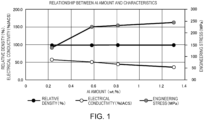
- the characteristics of the aluminum element containing copper alloy additively manufactured product in patent literatures 1 and 2 can be represented by a graph as shown in Fig. 1 . That is, in patent literatures 1 and 2, a copper alloy additively manufactured product having a relative density of 96% or more to 100% or less, an electrical conductivity of 30%IACS or more, and an engineering stress (maximum stress) of 130 MPa or more to 250 MPa or less can be obtained using a copper alloy powder containing 0.2 mass% or more to 1.3 mass% or less of an aluminum element.
- a copper alloy powder for additive manufacturing which has a particle shape, a particle size, an apparent density, and a flow rate suitable for an additive manufacturing method by an additive manufacturing apparatus, and can additively manufacture a copper alloy additively manufactured product having an excellent engineering stress or proof stress that is a mechanical strength, or an excellent wear resistance.
- a copper alloy powder capable of additive manufacturing by an additive manufacturing apparatus needs to have the following conditions.
- the copper alloy powder for additive manufacturing according to this example embodiment can be manufactured by, for example, a "rotating disc method", a "gas atomization method”, a “water atomization method”, a “plasma atomization method”, a “plasma rotating electrode method”, or the like.
- the "gas atomization method” is used.
- a gas such as helium, argon, or nitrogen is used as an atomizing gas, and the pressure and the flow rate of the gas are adjusted, thereby manufacturing a copper alloy powder.
- a similar copper alloy powder can also be manufactured using another manufacturing method.
- the manufactured copper alloy powder was classified into a predetermined particle size (for example, 10 ⁇ m or more to 45 ⁇ m or less).
- the copper alloy powder for additive manufacturing according to this example embodiment to which an aluminum element was added 0.6 wt% or more to 14.0 wt% or less, satisfied the above-described conditions for enabling additive manufacturing by an additive manufacturing apparatus, although the flow rate measurement (3) was impossible. That is, the powder satisfied all (1) the 50% particle size of copper alloy powder particles, (2) the apparent density of the copper alloy powder, and (3) the adhesion of the copper alloy powder, although the flow rate itself could not be measured.
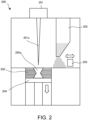
- Fig. 2 is a view showing an example of the schematic configuration of an additive manufacturing apparatus 200 according to this example embodiment.
- the additive manufacturing apparatus 200 includes an emitting mechanism 201 of an electron beam or laser beam 201a, a hopper 202 that is a powder tank, a squeegeeing blade 203 configured to form a powder bed by laying a powder in a predetermined thickness, and a table 204 that repetitively decreases by a predetermined thickness for laminating.
- a squeegeeing blade 203 By cooperation of the squeegeeing blade 203 and the table 204, an even powder laminated portion 205 having a predetermined thickness is generated.
- Each layer is irradiated with the electron beam or laser beam 201a based on slice data obtained from 3D-CAD data, and a metal powder (a copper alloy powder in this example embodiment) is molten, thereby manufacturing an additively manufactured product 205a.
- ED LP/(SS ⁇ HP ⁇ LT).
- LP laser output (W)
- SS laser scan speed (mm/s)
- HP laser scan pitch (mm)
- LT powder bed thickness (mm) (see Table 2).
- a useful additively manufactured product according to this example embodiment needs the following conditions. Note that the following conditions are conditions that a copper alloy additively manufactured product needs to obtain a desired mechanical strength.
- an additively manufactured product that satisfied the condition (1) relative density of 99.0% or more was manufactured.
- an additively manufactured product that satisfied (2) Vickers hardness of 90.0 Hv or more was manufactured.
- an additively manufactured product that satisfied (3) engineering stress of 260.0 MPa or more and (4) proof stress of 160.0 MPa or more was manufactured.
- an additively manufactured product that satisfied (5) wear amount of 0.02 g or less was manufactured.
- a copper alloy powder for additive manufacturing according to this example embodiment which contained 7.0 mass% or more to 12.5 mass% or less of an aluminum element, a copper alloy additively manufactured product having a relative density of 99.0% or more, a Vickers hardness of 150.0 Hv or more, an engineering stress (maximum stress) of 500 MPa or more, a proof stress of 180 MPa or more, and a wear amount of 0.01 g or less can be obtained.
- a copper alloy powder which satisfies the conditions of a copper alloy powder for additive manufacturing for enabling squeegeeing and whose additively manufactured product after additive manufacturing by the additive manufacturing apparatus has a sufficient relative density and a sufficient mechanical strength as a machine product or a component.
- a copper alloy powder for additive manufacturing which contains 1.3 wt% or more to 12.5 wt% or less of the aluminum element and whose balance is formed by copper and unavoidable impurities, is preferable.
- a copper alloy powder for additive manufacturing containing 1.7 wt% or more to 12.5 wt% or less of an aluminum element is more preferable.
- a copper alloy powder for additive manufacturing containing 7.0 wt% or more to 12.5 wt% or less of an aluminum element is further preferable.
- a copper alloy powder for additive manufacturing to which 1.3 wt% or more to 12.5 wt% or less of an aluminum element was added was provided, and a copper alloy additively manufactured product having a high density and an excellent mechanical strength could be obtained.
- the 50% particle size of the particles of the copper alloy powder measured by the laser diffraction method falls within the range of 3 ⁇ m or more to 200 ⁇ m or less, the surface of the powder bed does not roughen, and squeegeeing is easy because of a sufficient flow rate. Also, since the apparent density of the copper alloy powder is 3.5 g/cm 3 or more, the powder filling rate of the powder bed is sufficient, and an appropriate powder bed can be formed. Additionally, since the adhesion of the copper alloy powder is 0.600 kPa or less, powder supply from the supply hopper can be performed smoothly, and an appropriate powder bed can be formed.
- a copper alloy additively manufactured product whose relative density of the product created under the conditions set by the energy density calculated from the laser output, the laser scan speed, the laser scan pitch, and the powder bed thickness was 99.0% or more could be manufactured.
- a copper alloy additively manufactured product having a Vickers hardness of 90 Hv or more, an engineering stress of 260 MPa or more, a proof stress of 160 MPa or more, and a wear amount of 0.02 g or less could be manufactured.
- a copper alloy additively manufactured product having a relative density of 99.0% or more, a Vickers hardness of 150 Hv or more, an engineering stress of 500 MPa or more, a proof stress of 180 MPa or more, and a wear amount of 0.01 g or less could be manufactured.
- a tempering treatment is further performed for the copper alloy additively manufactured product additively manufactured using the copper alloy powder for additive manufacturing according to the first example embodiment, thereby improving the mechanical strength, particularly, the proof stress.
- manufacturing of the copper alloy powder for additive manufacturing and manufacturing of the copper alloy additively manufactured product using the copper alloy powder for additive manufacturing before the tempering treatment are the same as in the first example embodiment, and a repetitive description thereof will be omitted.
- a copper alloy powder for additive manufacturing containing 10.0 wt% of an aluminum element will be described as an example. However, the same effects can be obtained even in a copper alloy additively manufactured product additively manufactured from other copper alloy powder for additive manufacturing containing aluminum element.
- the copper alloy additively manufactured product additively manufactured using the copper alloy powder for additive manufacturing (aluminum element content: 10.0 wt%) according to the first example embodiment was held in a hydrogen atmosphere for 1 hr (60 min) while changing the temperature from 400°C to 600°C (400°C or more to 600°C or less), thereby performing the tempering treatment.
- the engineering stress linearly decreased from 894.98 MPa to 591.90 MPa, but the proof stress increased from 188.70 MPa or 253.60 MPa or more.
- a copper alloy powder for additive manufacturing which was obtained by further adding an iron element (Fe), a nickel element (Ni), and a manganese element (Mn) to the copper alloy powder for additive manufacturing according to the first example embodiment was manufactured.
- An additively manufactured product was created using the manufactured copper alloy powder for additive manufacturing.
- the solidification structure is made finer, and an evenly dispersed ⁇ -phase is obtained. This improves the "engineering stress (maximum stress)" and the "proof stress”.
- the mechanical characteristic can easily be improved by a heat treatment and particularly, the "proof stress” can be improved.
- the addition method of the iron element, the nickel element, and the manganese element in this example embodiment is the same as the aluminum element addition method according to the first example embodiment.
- a copper alloy powder for additive manufacturing containing 7.0 wt% or more to 12.5 wt% or less of an aluminum element, 1.0 wt% or more to 6.0 wt% or less of an iron element, 0.1 wt% or more to 6.0 wt% or less of a nickel element, and 0.1 wt% or more to 1.5 wt% or less of a manganese element was manufactured.
- the copper alloy powder for additive manufacturing according to this example embodiment satisfied the above-described conditions for enabling additive manufacturing by an additive manufacturing apparatus, although the flow rate measurement (3) was impossible. That is, the powder satisfied all (1) the 50% particle size of copper alloy powder particles, (2) the apparent density of the copper alloy powder, and (3) the adhesion of the copper alloy powder, although the flow rate itself could be measured.
- a used energy density ED J/mm 3
- ED LP/(SS ⁇ HP ⁇ LT).
- W laser output
- SS laser scan speed
- HP laser scan pitch
- LT powder bed thickness
- a copper alloy powder for additive manufacturing which contains 7.0 mass% or more to 12.5 mass% or less of an aluminum element, 1.0 wt% to more to 6.0 wt% or less of an iron element, 0.1 wt% or more to 6.0 wt% or less of a nickel element, and 0.1 wt% or more to 1.5 wt% or less of a manganese element, a copper alloy additively manufactured product having a relative density of 99.0% or more, a Vickers hardness of 150.0 Hv or more, an engineering stress (maximum stress) of 500 MPa or more, a proof stress of 180 MPa or more, and a wear amount of 0.01 g or less can be obtained.
- a copper alloy powder for additive manufacturing to which 7.0 mass% or more to 12.5 mass% or less of an aluminum element, 1.0 wt% to more to 6.0 wt% or less of an iron element, 0.1 wt% or more to 6.0 wt% or less of a nickel element, and 0.1 wt% or more to 1.5 wt% or less of a manganese element were added was provided, and a copper alloy additively manufactured product having a high density and an excellent mechanical strength could be obtained.
- the 50% particle size of the particles of the copper alloy powder measured by the laser diffraction method falls within the range of 3 ⁇ m or more to 200 ⁇ m or less, the surface of the powder bed does not roughen, and squeegeeing is easy because of a sufficient flow rate. Also, since the apparent density of the copper alloy powder is 3.5 g/cm 3 or more, the powder filling rate of the powder bed is sufficient, and an appropriate powder bed can be formed. Additionally, since the adhesion of the copper alloy powder is 0.600 kPa or less, powder supply from the supply hopper can be performed smoothly, and an appropriate powder bed can be formed.
- a copper alloy additively manufactured product whose relative density of the product created under the conditions set by the energy density calculated from the laser output, the laser scan speed, the laser scan pitch, and the powder bed thickness was 99.0% or more, and which had a Vickers hardness of 150 Hv or more, an engineering stress of 500 MPa or more, a proof stress of 180 MPa or more, and a wear amount of 0.01 g or less could be manufactured.
- a copper alloy powder to which an aluminum element was added was manufactured by a gas atomization method. Helium, argon, or nitrogen was used as an atomizing gas, and the pressure and the flow rate of the gas were adjusted, thereby manufacturing a copper alloy powder to which the aluminum element was added.
- Copper alloy powders were manufactured while changing the content of the aluminum element after addition to 0.6 wt% (Comparative Example 0), 1.3 wt% (Comparative Example 1), 2.0 wt% (Example 1), 5.0 wt% (Example 2), 7.0 wt% (Example 3), 10.0 wt% (Example 4), 12.0 wt% (Example 5), and 14.0 wt% (Comparative Example 2).
- the content of the aluminum element in each copper alloy powder to which the aluminum element was added was measured. Also, the apparent density (g/cm 3 ) of the copper alloy powder to which the aluminum element was added was measured in accordance with JIS Z 2504. The flow rate (sec/50 g) of the copper alloy powder to which the aluminum element was added was measured in accordance with JIS Z 2502. The 50% particle size ( ⁇ m) was measured by a laser diffraction method (Microtrac MT3300: available from MicrotracBEL). Table 1 shows the characteristics of the manufactured copper alloy powders according to Examples 1 to 5 and Comparative Examples 0, 1, and 2.
- a shearing test was conducted using Powder Rheometer FT4 (available from Freeman Technology), and the adhesion (kPa) of each obtained copper alloy powder was measured.
- each powder was a copper alloy powder that enabled squeegeeing, using a jig called a doctor blade or applicator, which is a jig formed by processing one surface of a metal block to form a gap and capable of applying paint or ink in a predetermined film thickness.
- Table 1 shows the characteristics of the manufactured copper alloy powders in Examples 1 to 5 and Comparative Examples 0, 1, and 2 and copper powders in Comparative Examples 3 to 5.
- Table 1 Composition Powder characteristics Squeegeeing possibility Element content (wt%) AD FR D50 Adhesion Cu Al (g/cm 3 ) (sec/50g) ( ⁇ m) (kPa) Comparative Example 0 Bal. 0.6 5.12 none. 25.3 0.48 ⁇ Comparative Example 1 Bal. 1.3 5.06 none. 25.3 0.38 ⁇ Example 1 Bal. 2.0 4.99 none. 25.3 0.56 ⁇
- Example 2 Bal. 5.0 4.72 none. 25.8 0.52 ⁇
- Example 3 Bal. 7.0 4.55 none. 24.1 0.33 ⁇
- Example 4 Bal. 10.0 4.35 none.
- the copper alloy powders for additive manufacturing according to Examples 1 to 5 and Comparative Examples 0, 1, and 2 satisfied the above-described conditions for enabling additive manufacturing by an additive manufacturing apparatus. That is, each powder satisfied (1) the 50% particle size (D50 in Table 1) of powder particles and (2) the apparent density (AD in Table 1) of the powder, and also satisfied (3) the adhesion, although the flow rate (FR) of the powders could not be measured (none.) (Examples 1 to 5 and Comparative Examples 0, 1, and 2), and squeegeeing was possible. On the other hand, squeegeeing was impossible with the powders (Comparative Examples 3 to 5) that did not satisfy any one of the conditions.
- FIG. 3 shows a BC map 310 and a KAM map 320 of a copper alloy additively manufactured product to which 7.0 wt% of an aluminum element was added, which were obtained by EBSD, and an optical microscope photograph 330 of a copper alloy additively manufactured product to which 10.0 wt% of an aluminum element was added.
- Table 3 Test items Maker Apparatus Model Conditions Electric conductivity NIHON MATECH CORPORATION SigmaCheck2 electrical conductivity defined based on electrical conductivity of standard soft annealed copper as 100%IACS Vickers hardness SHIMADZU CORPORATION micro hardness tester HMV-G21-DT test force: HV0.025 (245.2 mN) holding time: 10 sec Engineering stress ORIENTEC CO., LTD.
- Table 4 shows the characteristics of the copper alloy additively manufactured products measured by the testing apparatuses shown in Table 3.
- Table 4 Composition Squeegeeing possibility Production method Additively manufactured product characteristics Element content (wt%) Relative density % Vickers hardness Hv Maximum stress MPa Elongation % Proof stress MPa Wear amount g Electrical conductivity %IACS Cu Al Comparative Example 0 Bal. 0.6 ⁇ AM 99.6 84.8 233.83 46.8% 153.80 0.0189 49.7% Comparative Example 1 Bal. 1.3 ⁇ AM 99.8 83.3 254.39 42.4% 150.39 0.0415 34.7%
- Example 1 Bal. 2.0 ⁇ AM 99.9 94.9 270.02 40.4% 167.22 0.0135 27.8%
- Example 2 Bal.
- an additively manufactured product to which 10.0 wt% of an aluminum element was added exhibited very large work hardening, and its engineering stress also exhibited a very high value. Reversely, the proof stress did not greatly increase.
- the copper alloy additively manufactured product exhibits a plate-shaped ⁇ '-martensite structure. It is considered that the proof stress does not increase as compared to the large work hardening or engineering stress because of the martensitic transformation caused by the rapid solidification process at the time of additive manufacturing.
- Fig. 5 is a graph showing the relationship between the aluminum content of the copper alloy powder for additive manufacturing and the engineering stress and the proof stress of the copper alloy additively manufactured product based on the characteristic measurement result shown in Table 4 obtained in each of Examples 1 to 5 and Comparative Examples 0 and 1.
- Fig. 6 is a graph showing the relationship between the aluminum content of the copper alloy powder for additive manufacturing and the wear amount of the copper alloy additively manufactured product based on the characteristic measurement result shown in Table 4 obtained in each of Examples 1 to 5 and Comparative Examples 0 and 1.
- the mechanical strength of the copper alloy additively manufactured product additively manufactured from the copper alloy powder for additive manufacturing containing 1.3 wt% or more to 12.5 wt% or less of an aluminum element is very high. That is, a copper alloy additively manufactured product that satisfied a Vickers hardness of 90.0 Hv or more, an engineering stress (maximum stress) of 260 MPa or more, a proof stress of 160 MPa or more, and a wear amount of 0.02 g or less could be additively manufactured.
- Fig. 7 shows a rapid cooling phase diagram of a Cu-Al alloy and calculation of a threshold.
- Table 4 additive manufacturing was possible until an aluminum element content of 12.0 wt%.
- the aluminum element content was 14.0 wt%, cracks occurred at the time of additive manufacturing, and additive manufacturing was impossible.
- a rapid cooling phase diagram (710) of a Cu-Al alloy shown in Fig. 7 a solid line indicates an equilibrium phase diagram. If the cooling process includes rapid cooling, a phase diagram indicated by a broken line is obtained. Since additive manufacturing includes rapid cooling in the cooling process, a constituting phase of the phase diagram indicated by the broken line is obtained.
- an additively manufactured product is formed in a ⁇ 1'-phase if the aluminum element content is 12.5 wt% or less. However, if the aluminum element content exceeds 12.5 wt%, a y'-phase starts being precipitated. If the aluminum element content is 14.0 wt%, y'-single-phase is substantially obtained.
- the mechanical strength of the copper alloy additively manufactured product additively manufactured from the copper alloy powder for additive manufacturing containing 7.0 wt% or more to 12.5 wt% or less of an aluminum element is higher. That is, a copper alloy additively manufactured product that satisfied a Vickers hardness of 150.0 Hv or more, an engineering stress (maximum stress) of 500 MPa or more, a proof stress of 180 MPa or more, and a wear amount of 0.01 g or less could be additively manufactured.
- Table 5 shows a set of thresholds for evaluating the mechanical strength of a copper alloy additively manufactured product, which are set based on Examples 1 to 5. Note that “ ⁇ numerical value” indicates “not less than the numerical value”, and “numerical value ⁇ ” indicates “not more than the numerical value”.
- Hv Engineering stress
- MPa Proof stress
- Wear amount g
- the additively manufactured product to which 10.0 wt% of an aluminum element was added exhibited very large work hardening, and its engineering stress also exhibited a very high value. Reversely, the proof stress did not greatly increase. It is considered that this occurs because the additively manufactured product exhibits a plate-shaped ⁇ '-martensite structure, and martensitic transformation is caused by the rapid cooling solidification process at the time of additive manufacturing.
- tempering was performed at 400°C, 500°C, and 600°C for 1 hr, and characteristics associated with the mechanical strength were then measured.
- Table 6 shows the measurement result of the characteristics associated with the mechanical strength after the tempering treatment was performed for additively manufactured products to which an aluminum element was added 10.0 wt% and 12.0 wt%.
- Table 6 Composition Without heat treatment Tempering (400°C ⁇ 60 min) Tempering (500°C ⁇ 60 min) Tempering (600°C ⁇ 60 min) Element content (wt%) Maximum stress MPa Proof stress MPa Wear amount g Maximum stress MPa Proof stress MPa Wear amount g Maximum stress MPa Proof stress MPa Wear amount g Maximum stress MPa Proof stress MPa Wear amount g Maximum stress MPa Proof stress MPa Wear amount g Maximum stress MPa Proof stress MPa Wear amount g Cu Al Example 4 Bal.
- Fig. 8 is a graph of the measurement result of the engineering stress and the proof stress with respect to the tempering temperature.
- the engineering stress decreased along with the increase of the temperature but maintained 500 MPa or more (about 600 MPa), and the proof stress increased. This result suggests that the structure of the copper alloy additively manufactured product is fine.
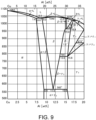
- Fig. 9 shows an equilibrium phase diagram of a Cu-Al alloy. From the equilibrium phase diagram of Fig. 9 , an ⁇ -phase single phase structure is exhibited at an aluminum element content of 9.0 wt% or less. At an aluminum element content of 9.4 to 15.6 wt%, a eutectoid phase formed by ( ⁇ + ⁇ 2 ) appears. In the ( ⁇ + ⁇ 2 ) region, the ⁇ -phase that is a high-temperature stable phase is rapidly cooled, thereby exhibiting a ⁇ '-phase at an aluminum element content of 10.0 wt%, and a ⁇ 1'-phase at an aluminum element content of 12.0 wt%. Note that each of the ⁇ '-phase and the ⁇ 1'-phase is a martensite structure.
- a copper alloy powder to which an aluminum element, an iron element, a nickel element, and a manganese element were added was manufactured by a gas atomization method. Helium, argon, or nitrogen was used as an atomizing gas, and the pressure and the flow rate of the gas were adjusted, thereby manufacturing a copper alloy powder to which the aluminum element, the iron element, the nickel element, and the manganese element were added.
- Copper alloy powders were manufactured while changing the content of the aluminum element after addition to 8.5 wt%, the content of the iron element to 3.0 wt%, the content of the nickel element to 0.5 wt%, and the content of the manganese element to 0.1 wt% (Example 6), the content of the aluminum element to 10.5 wt%, the content of the iron element to 3.1 wt%, the content of the nickel element to 2.0 wt%, and the content of the manganese element to 1.1 wt% (Example 7), the content of the aluminum element to 10.0 wt%, the content of the iron element to 5.0 wt%, the content of the nickel element to 5.0 wt%, and the content of the manganese element to 0.7 wt% (Example 8), and the content of the aluminum element to 9.0 wt%, the content of the iron element to 3.5 wt%, the content of the nickel element to 2.5 wt%, and the content of the manganese element to 1
- a shearing test was conducted using Powder Rheometer FT4 (available from Freeman Technology), and the adhesion (kPa) of each obtained copper alloy powder was measured.
- each powder was a copper alloy powder that enabled squeegeeing, using a jig called a doctor blade or applicator, which is a jig formed by processing one surface of a metal block to form a gap and capable of applying paint or ink in a predetermined film thickness.
- Table 7 shows the characteristics of the manufactured copper alloy powders in Examples 6 to 8 and Comparative Example 6.
- Composition Powder characteristics Squeegeeing possibility Element content (wt%) AD FR D50 Adhesion Cu Al Fe Ni Mn (g/cm 3 ) (sec/50g) ( ⁇ m) (kPa)
- Example 6 Bal. 8.5 3.0 0.5 0.1 4.28 none. 28.8 0.45 ⁇
- Example 7 Bal. 10.5 3.1 2.0 1.1 4.34 none. 25.6 0.37 ⁇
- Example 8 Bal. 10.0 5.0 5.0 0.7 4.15 none. 28.6 0.54 ⁇ Comparative Example 6 Bal. 9.0 3.5 2.5 11.0 4.22 none. 27.7 0.29 ⁇
- the copper alloy powders for additive manufacturing according to Examples 6 to 8 and Comparative Example 6 satisfied the above-described conditions for enabling additive manufacturing by an additive manufacturing apparatus. That is, each powder satisfied (1) the 50% particle size (D50 in Table 7) of powder particles and (2) the apparent density (AD in Table 7) of the powder, and also satisfied (3) the adhesion, although the flow rate (FR) of the powders could not be measured (none.) (Examples 6 to 8 and Comparative Example 6), and squeegeeing was possible.
- Example 6 CAC 701 aluminum bronze casting type 1 85.0 - 90.0 8.0 - 10.0 1.0 - 4.0 0.1 - 1.0 01-1.0 0.7 or less
- Example 7 CAC 702 aluminum bronze casting type 2 80.0 - 88.0 8.0 - 10.5 2.5 - 5.0 1.0 - 3.0 0.1 - 1.5 0.7 or less
- Example 8 CAC 703 aluminum bronze casting type 3 78.0 - 85.0 8.5 - 10.5 3.0 - 6.0 3.0 - 6.0 0.1 - 1.5 0.7 or less
- Comparative Example 6 CAC 704 aluminum bronze casting type 4 71.0 - 84.0 6.0-9.0 2.0 - 5.0 1.0 - 4.0 6.0-9.0 2.0 - 5.0 1.0 - 4.0
- an additively manufactured product was manufactured using a 3D additive manufacturing apparatus (powder sintering additive manufacturing/SLM: SLM280HL available from SLM Solutions). Note that as a sample of an additively manufactured product for characteristic measurement, an additively manufactured product with a rectangular parallelepiped shape having a width of 10 mm ⁇ a depth of 7 mm ⁇ a height of 5 mm was manufactured.
- Table 10 shows the characteristics of the copper alloy additively manufactured products created using the copper alloy powders according to Examples 6 to 8 and Comparative Example 6, which were measured by the testing apparatuses shown in Table 3.
- Composition Squeegeeing possibility Production method Additively manufactured product characteristics Element content (wt%) Relative density % Vickers hardness Hv Maximum stress MPa Elongation % Proof stress MPa Wear amount g Electrical conductivity %IACS Cu Al Fe Ni Mn
- Example 6 Bal. 8.5 3.0 0.5 0.1 ⁇ AM 99.9 204.8 650.01 40.0% 358.70 0.0049 7.1%
- Example 7 Bal. 10.5 3.1 2.0 1.1 ⁇ AM 99.9 313.5 601.87 13.5% 225.70 0.0034 6.2%
- Example 8 Bal. 10.0 5.0 5.0 0.7 ⁇ AM 99.8 444.9 1077.02 12.5% 220.80 0.0029 4.1% Comparative Example 6 Bal. 9.0 3.5 2.5 11.0 ⁇ AM Shaping was impossible because of cracks at the time of shaping
- the relationship between the aluminum content of the copper alloy powder for additive manufacturing and the engineering stress and the proof stress of the copper alloy additively manufactured product was added to Fig. 5 based on the characteristic measurement result shown in Table 10 obtained in each of Examples 6 to 8.
- the relationship between the aluminum content of the copper alloy powder for additive manufacturing and the wear amount of the copper alloy additively manufactured product was added to Fig. 6 based on the characteristic measurement result shown in Table 10 obtained in each of Examples 6 to 8.
- a copper alloy additively manufactured product that satisfied a Vickers hardness of 150.0 Hv or more, an engineering stress (maximum stress) of 500 MPa or more, a proof stress of 180 MPa or more, and a wear amount of 0.01 g or less could be additively manufactured.
- the corrosion resistance is excepted to be improved by adding the iron element, the nickel element, and the manganese element.
- Example 6 even if the aluminum content is low, the engineering stress (maximum stress) and the proof stress increase, and the elongation is obtained. For example, compared to Example 4 in which the aluminum content is 10 wt%, the elongation can be improved without reducing the strength in Examples 7 and 8 with almost equal aluminum contents.
- a copper alloy powder for additive manufacturing which can implement an excellent mechanical strength, and a copper alloy additively manufactured product having an excellent mechanical strength can be provided. It is also considered that performing a tempering treatment has an advantage for improving the characteristics, for example, improving the strength, and there is superiority as a manufacturing method.
- a copper alloy additively manufactured product according to the present invention can appropriately be used for components that need a particularly large mechanical strength (the Vickers hardness, the engineering stress, the proof stress, the wear amount, and the like), such as a bearing, a piston, a propeller for ship, and pumps.
- a particularly large mechanical strength the Vickers hardness, the engineering stress, the proof stress, the wear amount, and the like
Landscapes
- Chemical & Material Sciences (AREA)
- Engineering & Computer Science (AREA)
- Materials Engineering (AREA)
- Manufacturing & Machinery (AREA)
- Mechanical Engineering (AREA)
- Physics & Mathematics (AREA)
- Organic Chemistry (AREA)
- Metallurgy (AREA)
- Thermal Sciences (AREA)
- Crystallography & Structural Chemistry (AREA)
- Automation & Control Theory (AREA)
- Plasma & Fusion (AREA)
- Powder Metallurgy (AREA)
Applications Claiming Priority (2)
| Application Number | Priority Date | Filing Date | Title |
|---|---|---|---|
| JP2022077233 | 2022-05-09 | ||
| PCT/JP2023/016612 WO2023218985A1 (fr) | 2022-05-09 | 2023-04-27 | Poudre d'alliage de cuivre pour fabrication additive et procédé de production de ladite poudre d'alliage de cuivre, et article fabriqué de manière additive d'alliage de cuivre et son procédé de production |
Publications (2)
| Publication Number | Publication Date |
|---|---|
| EP4509246A1 true EP4509246A1 (fr) | 2025-02-19 |
| EP4509246A4 EP4509246A4 (fr) | 2025-09-10 |
Family
ID=88730432
Family Applications (1)
| Application Number | Title | Priority Date | Filing Date |
|---|---|---|---|
| EP23803464.9A Pending EP4509246A4 (fr) | 2022-05-09 | 2023-04-27 | Poudre d'alliage de cuivre pour fabrication additive et procédé de production de ladite poudre d'alliage de cuivre, et article fabriqué de manière additive d'alliage de cuivre et son procédé de production |
Country Status (6)
| Country | Link |
|---|---|
| US (1) | US20250319515A1 (fr) |
| EP (1) | EP4509246A4 (fr) |
| JP (1) | JPWO2023218985A1 (fr) |
| KR (1) | KR20250009973A (fr) |
| CN (1) | CN119156263A (fr) |
| WO (1) | WO2023218985A1 (fr) |
Families Citing this family (2)
| Publication number | Priority date | Publication date | Assignee | Title |
|---|---|---|---|---|
| JP2024002346A (ja) * | 2022-06-24 | 2024-01-11 | 株式会社豊田中央研究所 | 積層造形物およびその原料粉末 |
| CN120587489B (zh) * | 2025-08-05 | 2025-11-25 | 广东省科学院新材料研究所 | 增材制造锰铜合金及其制备方法和应用 |
Family Cites Families (12)
| Publication number | Priority date | Publication date | Assignee | Title |
|---|---|---|---|---|
| JPS56152902A (en) * | 1980-04-28 | 1981-11-26 | Fukuda Kinzoku Hakufun Kogyo Kk | Powder for sintered copper alloy containing aluminum |
| JP2517675B2 (ja) * | 1989-08-01 | 1996-07-24 | 日立粉末冶金株式会社 | 高負荷摺動用焼結銅合金 |
| JP4400696B2 (ja) * | 2007-10-18 | 2010-01-20 | 新東工業株式会社 | 銅合金粉末およびその製造方法 |
| CN102162079A (zh) * | 2011-03-30 | 2011-08-24 | 北京矿冶研究总院 | 一种热喷涂用低氧含量高收得率球形铝青铜合金粉末及制备方法 |
| WO2017011456A1 (fr) * | 2015-07-16 | 2017-01-19 | Velo3D, Inc. | Impression en trois dimensions à matériau tombant |
| JP6532396B2 (ja) | 2015-12-25 | 2019-06-19 | 株式会社ダイヘン | 銅合金粉末、積層造形物の製造方法および積層造形物 |
| US20180104745A1 (en) * | 2016-10-17 | 2018-04-19 | Ecole Polytechnique | Treatment of melt for atomization technology |
| JP2018146112A (ja) * | 2017-03-07 | 2018-09-20 | Ntn株式会社 | 過給機用焼結軸受 |
| CN109396453B (zh) * | 2018-12-21 | 2021-10-01 | 东莞市精研粉体科技有限公司 | 一种弥散强化铝青铜球形粉的制备方法 |
| JP6858807B2 (ja) * | 2019-04-26 | 2021-04-14 | Ntn株式会社 | 焼結軸受 |
| JP6924459B1 (ja) | 2020-11-11 | 2021-08-25 | 株式会社イデア・レコード | 予約受付制御装置、予約受付制御プログラム、及び予約受付制御方法 |
| CN114231967A (zh) * | 2021-12-27 | 2022-03-25 | 东莞市精研粉体科技有限公司 | 一种铝青铜合金-钢复合双金属耐磨轴承材料制造方法 |
-
2023
- 2023-04-27 KR KR1020247037425A patent/KR20250009973A/ko active Pending
- 2023-04-27 WO PCT/JP2023/016612 patent/WO2023218985A1/fr not_active Ceased
- 2023-04-27 JP JP2024520392A patent/JPWO2023218985A1/ja active Pending
- 2023-04-27 US US18/862,964 patent/US20250319515A1/en active Pending
- 2023-04-27 CN CN202380038983.5A patent/CN119156263A/zh active Pending
- 2023-04-27 EP EP23803464.9A patent/EP4509246A4/fr active Pending
Also Published As
| Publication number | Publication date |
|---|---|
| US20250319515A1 (en) | 2025-10-16 |
| EP4509246A4 (fr) | 2025-09-10 |
| KR20250009973A (ko) | 2025-01-20 |
| CN119156263A (zh) | 2024-12-17 |
| WO2023218985A1 (fr) | 2023-11-16 |
| JPWO2023218985A1 (fr) | 2023-11-16 |
Similar Documents
| Publication | Publication Date | Title |
|---|---|---|
| EP3705590B1 (fr) | Matériau d'alliage, produit utilisant ledit matériau d'alliage, et machine hydraulique ayant ledit produit | |
| EP4509246A1 (fr) | Poudre d'alliage de cuivre pour fabrication additive et procédé de production de ladite poudre d'alliage de cuivre, et article fabriqué de manière additive d'alliage de cuivre et son procédé de production | |
| KR101928329B1 (ko) | 나노 결정립 고 엔트로피 합금의 제조방법 및 이로부터 제조된 고 엔트로피 합금 | |
| US20190309402A1 (en) | Aluminum alloy products having fine eutectic-type structures, and methods for making the same | |
| WO2019161137A1 (fr) | Produits en alliage d'aluminium et leurs procédés de production | |
| CN104759830B (zh) | 生产性能增强的金属材料的方法 | |
| CN101056998B (zh) | 钛铝基合金 | |
| CN111057922A (zh) | 基于slm工艺用锰铜阻尼合金粉末及其制备方法 | |
| KR20220001374A (ko) | 고엔트로피 합금 및 이의 제조방법 | |
| Yin et al. | Nanostructural formation of fine grained aluminum alloy by severe plastic deformation at cryogenic temperature. | |
| Li et al. | Preparation, microstructure, and microhardness of selective laser-melted W–3Ta sample | |
| Bulut et al. | Effect of titanium on the structural, mechanical and surface properties of CoCrFeMnNiTix high entropy alloy fabricated by selective laser melting | |
| CN117187654A (zh) | 一种高致密度钨坦镍钛合金及其制备方法 | |
| Wei et al. | Room temperature ductile W-Y2O3 alloy with high thermal shock resistance | |
| EP2189548A1 (fr) | Matériau amortissant les contraintes | |
| Im et al. | A new strategy for metal additive manufacturing using an economical water-atomized iron powder for laser powder bed fusion | |
| EP4140623A1 (fr) | Corps moulé en alliage d'aluminium et son procédé de production | |
| CN102597301A (zh) | 含钛溅射靶的制造方法 | |
| Xu et al. | Fatigue properties of binary Ti-Ta metal-metal composite with lamellar microstructure | |
| Sopata et al. | The mechanical properties of the novel nanocrystalline refractory tantalum alloys | |
| Hwang et al. | The production of intermetallics based on NiAl by mechanical alloying | |
| Wang et al. | Laser assisted synthesis of Al0. 1CoCrFeNi High Entropy Alloy Coating: Microstructures and Properties | |
| Akisin et al. | Influence of Annealing Treatment on the Microstructure and Mechanical Properties of Cold-Sprayed CoCrFeNiMn High Entropy Alloy | |
| Çelik et al. | The effect of the amount of Y2O3 doped to the MA6000 alloy produced by mechanical alloying method on wear behavior | |
| JP3987471B2 (ja) | Al合金材料 |
Legal Events
| Date | Code | Title | Description |
|---|---|---|---|
| STAA | Information on the status of an ep patent application or granted ep patent |
Free format text: STATUS: THE INTERNATIONAL PUBLICATION HAS BEEN MADE |
|
| PUAI | Public reference made under article 153(3) epc to a published international application that has entered the european phase |
Free format text: ORIGINAL CODE: 0009012 |
|
| STAA | Information on the status of an ep patent application or granted ep patent |
Free format text: STATUS: REQUEST FOR EXAMINATION WAS MADE |
|
| 17P | Request for examination filed |
Effective date: 20241115 |
|
| AK | Designated contracting states |
Kind code of ref document: A1 Designated state(s): AL AT BE BG CH CY CZ DE DK EE ES FI FR GB GR HR HU IE IS IT LI LT LU LV MC ME MK MT NL NO PL PT RO RS SE SI SK SM TR |
|
| DAV | Request for validation of the european patent (deleted) | ||
| DAX | Request for extension of the european patent (deleted) | ||
| A4 | Supplementary search report drawn up and despatched |
Effective date: 20250808 |
|
| RIC1 | Information provided on ipc code assigned before grant |
Ipc: B22F 1/00 20220101AFI20250804BHEP Ipc: B22F 1/05 20220101ALI20250804BHEP Ipc: B22F 9/08 20060101ALI20250804BHEP Ipc: B22F 10/28 20210101ALI20250804BHEP Ipc: B22F 10/38 20210101ALI20250804BHEP Ipc: B22F 10/64 20210101ALI20250804BHEP Ipc: B33Y 10/00 20150101ALI20250804BHEP Ipc: B33Y 70/00 20200101ALI20250804BHEP Ipc: B33Y 80/00 20150101ALI20250804BHEP Ipc: C22C 9/01 20060101ALI20250804BHEP Ipc: C22F 1/00 20060101ALI20250804BHEP Ipc: C22F 1/08 20060101ALI20250804BHEP |