EP4509314A1 - Élément de construction, en particulier élément de panneau - Google Patents
Élément de construction, en particulier élément de panneau Download PDFInfo
- Publication number
- EP4509314A1 EP4509314A1 EP24189708.1A EP24189708A EP4509314A1 EP 4509314 A1 EP4509314 A1 EP 4509314A1 EP 24189708 A EP24189708 A EP 24189708A EP 4509314 A1 EP4509314 A1 EP 4509314A1
- Authority
- EP
- European Patent Office
- Prior art keywords
- component
- strip core
- profile
- styrene
- profile arrangement
- Prior art date
- Legal status (The legal status is an assumption and is not a legal conclusion. Google has not performed a legal analysis and makes no representation as to the accuracy of the status listed.)
- Pending
Links
Images

Classifications
-
- B—PERFORMING OPERATIONS; TRANSPORTING
- B32—LAYERED PRODUCTS
- B32B—LAYERED PRODUCTS, i.e. PRODUCTS BUILT-UP OF STRATA OF FLAT OR NON-FLAT, e.g. CELLULAR OR HONEYCOMB, FORM
- B32B27/00—Layered products comprising a layer of synthetic resin
- B32B27/30—Layered products comprising a layer of synthetic resin comprising vinyl (co)polymers; comprising acrylic (co)polymers
- B32B27/302—Layered products comprising a layer of synthetic resin comprising vinyl (co)polymers; comprising acrylic (co)polymers comprising aromatic vinyl (co)polymers, e.g. styrenic (co)polymers
-
- B—PERFORMING OPERATIONS; TRANSPORTING
- B32—LAYERED PRODUCTS
- B32B—LAYERED PRODUCTS, i.e. PRODUCTS BUILT-UP OF STRATA OF FLAT OR NON-FLAT, e.g. CELLULAR OR HONEYCOMB, FORM
- B32B21/00—Layered products comprising a layer of wood, e.g. wood board, veneer, wood particle board
- B32B21/04—Layered products comprising a layer of wood, e.g. wood board, veneer, wood particle board comprising wood as the main or only constituent of a layer, which is next to another layer of the same or of a different material
- B32B21/08—Layered products comprising a layer of wood, e.g. wood board, veneer, wood particle board comprising wood as the main or only constituent of a layer, which is next to another layer of the same or of a different material of synthetic resin
-
- A—HUMAN NECESSITIES
- A47—FURNITURE; DOMESTIC ARTICLES OR APPLIANCES; COFFEE MILLS; SPICE MILLS; SUCTION CLEANERS IN GENERAL
- A47B—TABLES; DESKS; OFFICE FURNITURE; CABINETS; DRAWERS; GENERAL DETAILS OF FURNITURE
- A47B96/00—Details of cabinets, racks or shelf units not covered by a single one of groups A47B43/00 - A47B95/00; General details of furniture
- A47B96/20—Furniture panels or like furniture elements
- A47B96/201—Edge features
-
- B—PERFORMING OPERATIONS; TRANSPORTING
- B32—LAYERED PRODUCTS
- B32B—LAYERED PRODUCTS, i.e. PRODUCTS BUILT-UP OF STRATA OF FLAT OR NON-FLAT, e.g. CELLULAR OR HONEYCOMB, FORM
- B32B3/00—Layered products comprising a layer with external or internal discontinuities or unevennesses, or a layer of non-planar shape; Layered products comprising a layer having particular features of form
- B32B3/02—Layered products comprising a layer with external or internal discontinuities or unevennesses, or a layer of non-planar shape; Layered products comprising a layer having particular features of form characterised by features of form at particular places, e.g. in edge regions
- B32B3/04—Layered products comprising a layer with external or internal discontinuities or unevennesses, or a layer of non-planar shape; Layered products comprising a layer having particular features of form characterised by features of form at particular places, e.g. in edge regions characterised by at least one layer folded at the edge, e.g. over another layer ; characterised by at least one layer enveloping or enclosing a material
-
- B—PERFORMING OPERATIONS; TRANSPORTING
- B32—LAYERED PRODUCTS
- B32B—LAYERED PRODUCTS, i.e. PRODUCTS BUILT-UP OF STRATA OF FLAT OR NON-FLAT, e.g. CELLULAR OR HONEYCOMB, FORM
- B32B7/00—Layered products characterised by the relation between layers; Layered products characterised by the relative orientation of features between layers, or by the relative values of a measurable parameter between layers, i.e. products comprising layers having different physical, chemical or physicochemical properties; Layered products characterised by the interconnection of layers
- B32B7/04—Interconnection of layers
- B32B7/12—Interconnection of layers using interposed adhesives or interposed materials with bonding properties
Definitions
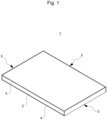
- the invention relates to a building element, in particular a panel element, comprising at least one carrier element with at least one cover layer, at least one profile element, wherein the profile element is fixed to at least one end face of the carrier element via at least one functional layer, according to the preamble of claim 1.
- Construction elements in particular panel elements such as table tops, worktops, cabinet doors, side walls of furniture such as cupboards, shelves, tables, etc. are generally made of wood-like materials and have decorated surfaces.
- the surfaces are covered with decorated foils, papers and the like, for example. Furthermore, the surfaces of the components can also be provided with printing and/or a color coating or varnish.
- the narrow front sides of the components must be completely covered to prevent the ingress of moisture and for reasons of appearance or design.
- edge strips edge bandings and edge bandings are used to cover the narrow front sides of such components, preferably made of thermoplastic materials.
- edge strips are attached mechanically, for example using automated devices.
- edge strips are attached to the relevant narrow front side of the building elements in these automated devices, so-called edge banding machines, and fixed by means of, for example, a functional layer.
- the width of the edge strips is generally greater than the thickness of the narrow front sides of the components, so that after the edge strips have been fixed, their protruding side edges are generally removed by material removal and this surface is subsequently optimized by polishing, for example.
- EP 1080854 A2 A method for attaching cover strips/edge strips to the front sides of furniture panels is disclosed.
- the method for attaching cover strips or edge strips made of thermoplastic material to the narrow front sides of furniture panels, in particular chipboard, fiberboard or similar wood-based panels, is implemented in such a way that the cover strips/edge strips are applied directly to the front sides and are adhesively bonded to the front sides.
- cover strips/edge strips can be welded to the narrow front sides of the furniture panels.
- the joint or the adhesive joint between the edge strip and the furniture panel should be sealed mechanically or thermally.
- the cover strips/edge strips are used with an overhang on both sides in relation to the respective narrow front sides, so that the overhangs are melted to seal the joint and the melted material of the cover strip or edge strip is then removed to create cover strips that are congruent with the front sides, for example by removing material using a scraper or the like.
- the multi-component lubricating oil with its high creeping ability penetrates into all cracks, particularly in the area of the white fracture areas, and wets this surface completely.
- the multi-component lubricating oil should ensure clean and smooth removal by the brushes, so that the white fracture areas and also glue or adhesive residues are completely removed.
- a structural element in particular a panel element, comprising at least one carrier element with at least one cover layer, at least one profile element, wherein the profile element is fixed to at least one end face of the carrier element via at least one functional layer, with at least one strip core made of at least one polymeric material, wherein the strip core has a front side and a rear side arranged opposite thereto, wherein the strip core has at least one narrow side in the longitudinal direction of the profile (L), wherein the material of the strip core is selected from the group of styrene-based polymers, such as polystyrene (PS) or styrene-butadiene copolymer with a predominantly styrene content (SB) or acrylonitrile-styrene-acrylic ester copolymers (ASA) or acrylonitrile-butadiene-styrene copolymers (ABS) or styrene-acrylonitrile (SAN), is characterized in the group of sty
- CPL laminate is a "continuous pressure laminate” which is produced in a continuous process from several layers of paper and resin, with thicknesses of around 300 ⁇ m.
- HPL laminate is a "high pressure laminate” which is produced in a high-pressure pressing process, in panel form from several layers of paper and resin, with thicknesses of around 500 ⁇ m.
- Resin-impregnated paper materials, resin-impregnated papers, e.g. melamine papers with thicknesses of around 30 to 100 ⁇ m.
- Another advantage is that better adhesion of the material of the strip core to cover layers made of polymer materials such as PET, PP, ABS can be achieved.
- a further advantage of the component is that the filler in the material of the strip core has an average particle size with a D50 value of approximately 0.2 to 25 ⁇ m, preferably 0.5 to 15 ⁇ m, particularly preferably 1 to 8 ⁇ m according to DIN 66165-1:2016-08.
- Another advantage of the component is that the filler in the material of the strip core has a particle size with a D98 value of approximately 15 ⁇ m, preferably less than 15 ⁇ m, particularly preferably less than 10 ⁇ m according to DIN 66165-1:2016-08.
- the component can therefore be manufactured economically and cost-effectively.
- the construction element is further designed such that the strip core and/or the at least one narrow side of the profile arrangement has at least partially a structured surface after at least one material-removing processing.
- the surface of the strip core and/or the at least one narrow side of the profile arrangement has an average roughness depth R z of approximately 0.3 ⁇ m to 15 ⁇ m, preferably 0.5 ⁇ m to 10 ⁇ m, particularly preferably 1 ⁇ m to 8 ⁇ m according to ISO 21920-2:2021-12 after material-removing processing. Furthermore, the surface of the at least one narrow side of the profile arrangement has an average roughness depth R z of preferably a maximum of 10 ⁇ m according to ISO 21920-2:2021-12 after material-removing processing.
- a further advantage of the component is that the surface of the strip core and/or of the at least one narrow side of the profile arrangement has a mean roughness value R a of approximately 5 ⁇ m to 40 ⁇ m, preferably approximately 10 ⁇ m to 25 ⁇ m, according to DIN EN ISO 4287:2010-07 after material-removing processing.
- the material of the strip core of the profile arrangement in particular can be manufactured or adjusted in such a way that it can be manufactured both economically and cost-effectively, can be easily attached to the narrow sides of building boards and has sufficient adhesion, in particular when printing and painting systems are subsequently applied.
- a further advantage of the component is that the profile arrangement attached to the front side of the carrier element has at least one bevel and/or at least one radius on at least one of its narrow sides arranged in the profile longitudinal direction (L). It is also advantageous in the component that the profile arrangement attached to the front side of the carrier element has at least one bevel and/or at least one radius on at least one of its narrow sides arranged in the profile longitudinal direction (L) after at least one material-removing machining operation.
- the component is designed such that the at least one chamfer and/or the at least one radius has at least partially a structured surface after a material-removing machining process.
- a further advantage of the component is that the at least one bevel and/or the at least one radius at least partially has a microporous foam structure after at least one material-removing processing.
- the at least one bevel and/or the at least one radius after at least one material-removing machining has an average roughness depth R z of about 0.3 ⁇ m to 15 ⁇ m, preferably 0.5 ⁇ m to 10 ⁇ m, particularly preferably 1 ⁇ m to 8 ⁇ m according to ISO 21920-2:2021-12.
- the The surface of the at least one chamfer and/or the at least one radius of the profile arrangement after material-removing machining has an average roughness depth R z of preferably a maximum of 10 ⁇ m in accordance with ISO 21920-2:2021-12.
- the at least one chamfer and/or the at least one radius has a mean roughness value R a of approximately 5 ⁇ m to 40 ⁇ m, preferably approximately 10 ⁇ m to 25 ⁇ m, according to DIN EN ISO 4287:2010-07 after at least one material-removing machining operation.
- the component is designed such that the polymeric material of the strip core of the profile arrangement has a density of approximately 0.2 g/cm 3 to approximately 0.85 g/cm 3 , preferably 0.40 g/cm 3 to 0.70 g/cm 3 in accordance with DIN EN ISO 1183-1:2019-09.
- the polymeric material of the strip core of the profile arrangement has components which at least partially have a density of approximately 0.2 g/cm 3 to approximately 0.85 g/cm 3 , preferably 0.40 g/cm 3 to 0.70 g/cm 3 in accordance with DIN EN ISO 1183-1:2019-09.
- the strip core and/or the at least one narrow side of the profile arrangement has a microporous foam structure after at least one material-removing processing.
- Another advantage of the component is that at least one surface of the carrier element and the profile arrangement attached to the front side have at least partially a coating.
- the component is further characterized by the fact that the material of the strip core has a melt flow index (MFI) of approximately 0.5 g to 60 g/10 min., particularly preferably 0.5 g to 50 g/10 min. according to DIN ISO 1133-1:2012-03 at 230 °C / 2.16 kg.
- MFI melt flow index
- the material of the strip core has a Shore D/3 hardness of approximately 45 to 70, preferably 50 to 68 according to DIN EN ISO 868:2003-10. This means that the profile arrangement can be arranged sufficiently firmly/stably on the component.
- the profile arrangement advantageously has an E-modulus of at least 1,400 MPa. Furthermore, the profile arrangement has a tensile strength of at least 30 MPa according to DIN EN ISO 527-1:2019-12.
- the component can therefore be manufactured easily and economically, particularly in automated manufacturing processes.
- the profile arrangement and/or the component has at least one identification element. This makes it easy to attach or read the origin or manufacturer of the component as well as material or environmental data, for example.
- the component is further characterized in that the material of the strip core contains at least one additive, partially containing inorganic and/or organic pigments, in an amount of about 0.01 to 5 wt. %, preferably 0.02 to 3.0 wt. %, based on the total amount.
- the additive of the strip core is selected from the group of metal oxides, metal phosphates and metal salts of organic anions.
- the back of the strip core of the profile arrangement has a functional layer at least in sections.
- This functional layer can advantageously be a so-called adhesion promoter layer and/or a so-called hot melt adhesive layer and/or a so-called polymer functional layer.
- the component is advantageously further designed such that the material of the strip core of the profile arrangement contains at least one of the following additives: Stabilizers to improve the resistance to light, UV radiation and weathering; Stabilizers to improve the thermal and thermo-oxidative resistance; Stabilizers to improve the hydrolytic resistance, Stabilizers to improve the acidolytic resistance, Lubricants, demolding aids, coloring additives, crystallization-regulating substances and nucleating agents, flame retardants, impact modifiers, fillers and/or plasticizers.
- additives Stabilizers to improve the resistance to light, UV radiation and weathering
- Stabilizers to improve the thermal and thermo-oxidative resistance
- Stabilizers to improve the hydrolytic resistance
- Stabilizers to improve the acidolytic resistance
- Lubricants, demolding aids coloring additives, crystallization-regulating substances and nucleating agents, flame retardants, impact modifiers, fillers and/or plasticizers.
- the component is designed such that at least one cover layer with a thickness of approximately 2 to 60 ⁇ m, preferably 5 to 30 ⁇ m, is arranged on the front side of the strip body of the profile element and/or on the component.
- the component and/or the profile arrangement can be manufactured using a generative manufacturing process, e.g. by a 3D printing process.
- the invention also includes a method for generating a data processing machine-readable, three-dimensional model for use in a manufacturing process for a component and/or a profile arrangement.
- the method also includes the input of data representing a component and/or a profile arrangement into a data processing machine and the use of these data to represent a component and/or a profile arrangement as three-dimensional models, wherein the three-dimensional model is suitable for use in the manufacture of a component and/or a profile arrangement.
- the component can be manufactured in whole or in part using a line-building or layer-building manufacturing process.
- a 3D data set can be used to great advantage during construction or production.
- the method also includes a technique in which the data entered by one or more 3D scanners, which function either contact-based or contactless, with the latter emitting energy onto a component and/or a profile arrangement and receiving the reflected energy, and a virtual three-dimensional model of a component and/or a profile arrangement is generated using computer-aided design software.
- the manufacturing process can be a generative powder bed process, in particular selective laser melting (SLM), selective laser sintering (SLS), selective heat sintering (SHS), selective electron beam melting (EBM / Electron Beam Additive Manufacturing - EBAM) or solidification of powder material using a binder (binder jetting).
- the manufacturing process can comprise a generative free-space process, in particular deposition welding, wax deposition modeling (WDM), contour crafting, metal powder deposition process (MPA), plastic powder deposition process, cold gas spraying, electron beam melting (EBW) or melt layering processes such as fused deposition modeling (FDM) or fused filament fabrication (FFF).
- the manufacturing process can comprise a generative liquid material process, in particular stereolithography (SLA), digital light processing (DLP), multi jet modeling (MJM), polyjet modeling or liquid composite molding (LCM). Furthermore, the manufacturing process can comprise other generative layer build-up processes, in particular laminated object modeling (LOM), 3D screen printing or light-controlled electrophoretic deposition.
- SLA stereolithography
- DLP digital light processing
- MJM multi jet modeling
- LCD liquid composite molding
- the manufacturing process can comprise other generative layer build-up processes, in particular laminated object modeling (LOM), 3D screen printing or light-controlled electrophoretic deposition.
- LOM laminated object modeling
- 3D screen printing or light-controlled electrophoretic deposition.
- the material of the strip core 6 is selected from the group acrylonitrile-butadiene-styrene copolymer (ABS).
- ABS group acrylonitrile-butadiene-styrene copolymer
- the component 1 is characterized in that the material of the strip core 6 has about 5 to 50 wt. %, preferably about 10 to 45 wt. %, particularly preferably 15 to 35 wt. %, based on its total weight, of at least one filler, wherein the filler is selected from the group of layered silicates, as well as carbonates or sulfates of barium and calcium, and the like.
- the material of the strip core 6 has about 25 wt. %, based on its total weight, of a filler selected from the group of layered silicates.
- the component 1 is characterized in that the filler in the material of the strip core 6 has an average particle size with a D50 value of approximately 0.2 to 15 ⁇ m, preferably 0.5 to 10 ⁇ m, particularly preferably 1 to 8 ⁇ m according to DIN 66165-1:2016-08.
- the filler in the material of the strip core 6 has an average particle size with a D50 value of approximately 1.5 ⁇ m according to DIN 66165-1:2016-08.
- the component 1 is further characterized in that the filler in the material of the strip core 6 has a particle size with a D98 value of approximately 15 ⁇ m, preferably less than 15 ⁇ m, particularly preferably less than 10 ⁇ m according to DIN 66165-1:2016-08.
- the component 1 is designed such that the strip core 6 and/or the at least one narrow side 8, 9 of the profile arrangement 5 has at least partially a structured surface after a material-removing processing.
- the component 1 is further designed such that the surface of the strip core 6 and/or the at least one narrow side 8,9 of the profile arrangement 5 has an average roughness depth R z of approximately 0.3 ⁇ m to 15 ⁇ m, preferably 0.5 ⁇ m to 10 ⁇ m, particularly preferably 1 ⁇ m to 8 ⁇ m according to ISO 21920-2:2021-12 after material-removing processing.
- the surface of the at least one narrow side 8,9 of the profile arrangement 5 has, after material-removing machining, an average roughness depth R z of preferably a maximum of 10 ⁇ m in accordance with ISO 21920-2:2021-12.
- the surface of the at least one narrow side 8,9 of the profile arrangement 5 has an average roughness depth R z of approximately 9.5 ⁇ m according to ISO 21920-2:2021-12 after material-removing machining.
- the component 1 is designed such that the surface of the strip core 6 and/or the at least one narrow side 8, 9 of the profile arrangement 5 has a mean roughness value R a of approximately 5 ⁇ m to 40 ⁇ m, preferably approximately 10 ⁇ m to 25 ⁇ m according to DIN EN ISO 4287:2010-07 after a material-removing machining process.
- the component 1 is designed such that the profile arrangement 5 attached to the front side 21 of the carrier element 2 has at least one chamfer 80 and/or at least one radius 90 on at least one of its narrow sides 8, 9 arranged in the profile longitudinal direction (L).
- the component 1 is designed such that the at least one chamfer 80 and/or the at least one radius 90 has at least partially a structured surface after a material-removing machining.
- the component 1 is further designed such that the material of the strip core 6 of the profile arrangement 5 has a melt flow index (MFI) of approximately 0.5 g to 60 g/10 min., particularly preferably 0.5 g to 50 g/10 min. according to DIN ISO 1133-1:2012-03 at 230 °C / 2.16 kg.
- MFI melt flow index
- the material of the strip core 6 has a melt flow index (MFI) of approximately 9 g/10 min. according to DIN ISO 1133-1:2012-03 at 230 °C / 2.16 kg.
- the component 1 is designed such that the material of the strip core 6 of the profile arrangement 5 has a Shore D/3 hardness of approximately 45 to 70, preferably 50 to 68, according to DIN EN ISO 868:2003-10.
- the material of the strip core 6 has a Shore D/3 hardness of approximately 60 according to DIN EN ISO 868:2003-10.
- the component 1 is designed such that at least one cover layer with a thickness of approximately 2 to 60 ⁇ m, preferably 5 to 30 ⁇ m, is arranged on the front side 3 of the profile element 5.
- the component 1 is designed such that a cover layer with a thickness of approximately 10 ⁇ m is arranged on the front side 3 of the profile element 5.
- the component 1 is characterized in that the material of the strip core 6 comprises approximately 5 to 50 wt. %, preferably approximately 10 to 45 wt. %, particularly preferably 15 to 35 wt. %, based on its total weight, of at least one filler, wherein the filler is selected from the group of layered silicates, as well as carbonates or sulfates of barium and calcium, and the like.
- the material of the strip core 6 comprises approximately 30 wt.%, based on its total weight, of a filler, wherein the filler is selected from the group of calcium carbonates.
- the component 1 is characterized in that the filler in the material of the strip core 6 has an average particle size with a D50 value of approximately 0.3 to 15 ⁇ m, preferably 0.5 to 10 ⁇ m, particularly preferably 1 to 8 ⁇ m according to DIN 66165-1:2016-08.
- the filler in the material of the strip core 6 has an average particle size with a D50 value of approximately 2 ⁇ m according to DIN 66165-1:2016-08.
- the component 1 is further characterized in that the filler in the material of the strip core 6 has a particle size with a D98 value of approximately 15 ⁇ m, preferably less than 15 ⁇ m, particularly preferably less than 10 ⁇ m according to DIN 66165-1:2016-08.
- the component 1 is designed such that the strip core 6 and/or the at least one narrow side 8, 9 of the profile arrangement 5 has at least partially a structured surface after a material-removing processing.
- the component 1 is further designed such that the surface of the strip core 6 and/or the at least one narrow side 8,9 of the profile arrangement 5 has an average roughness depth R z of approximately 0.3 ⁇ m to 15 ⁇ m, preferably 0.5 ⁇ m to 10 ⁇ m, particularly preferably 1 ⁇ m to 8 ⁇ m according to ISO 21920-2:2021-12 after material-removing processing.
- the surface of the at least one narrow side 8,9 of the profile arrangement 5 has, after material-removing machining, an average roughness depth R z of preferably a maximum of 10 ⁇ m in accordance with ISO 21920-2:2021-12.
- the surface of the at least one narrow side 8,9 of the profile arrangement 5 has an average roughness depth R z of approximately 2 ⁇ m according to ISO 21920-2:2021-12 after material-removing machining.
- the component 1 is designed such that the surface of the strip core 6 and/or the at least one narrow side 8, 9 of the profile arrangement 5 has a mean roughness value R a of approximately 5 ⁇ m to 40 ⁇ m, preferably approximately 10 ⁇ m to 25 ⁇ m according to DIN EN ISO 4287:2010-07 after a material-removing machining process.
- the component 1 is designed such that the profile arrangement 5 attached to the front side 21 of the carrier element 2 has at least one chamfer 80 and/or at least one radius 90 on at least one of its narrow sides 8, 9 arranged in the profile longitudinal direction (L).
- the component 1 is designed such that the at least one chamfer 80 and/or the at least one radius 90 has at least partially a structured surface after a material-removing machining.
- the component 1 is designed such that the at least one chamfer 80 and/or the at least one radius 90 has, after material-removing machining, an average roughness depth R z of approximately 0.3 ⁇ m to 15 ⁇ m, preferably 0.5 ⁇ m to 10 ⁇ m, particularly preferably 1 ⁇ m to 8 ⁇ m according to ISO 21920-2:2021-12.
- the surface of the at least one chamfer 80 and/or the at least one radius 90 of the profile arrangement has an average roughness depth R z of preferably a maximum of 10 ⁇ m according to ISO 21920-2:2021-12 after material-removing processing.
- the surface of the at least one chamfer 80 and/or the at least one radius 90 of the profile arrangement 5 has an average roughness depth R z of approximately 8.5 ⁇ m according to ISO 21920-2:2021-12 after material-removing processing.
- the profile arrangement 1 is further designed such that the material of the strip core 6 has a melt flow index (MFI) of approximately 0.5 g to 60 g/10 min., particularly preferably 0.5 g to 50 g/10 min. according to DIN ISO 1133-1:2012-03 at 230 °C / 2.16 kg.
- MFI melt flow index
- the material of the strip core 6 has a melt flow index (MFI) of approximately 15 g/10 min. according to DIN ISO 1133-1:2012-03 at 230 °C / 2.16 kg.
- the profile arrangement 1 is designed such that the material of the strip core 6 has a Shore D/3 hardness of approximately 45 to 70, preferably 50 to 68, according to DIN EN ISO 868:2003-10.
- the material of the strip core 6 has a Shore D/3 hardness of approximately 59 according to DIN EN ISO 868:2003-10.
- the component 1 is characterized in that the profile arrangement 5 is attached, in particular fixed, to at least one end face 21 of the carrier element 2.
- the component 1 is designed such that the profile arrangement 5 is integrally connected, in particular fixed, to the front side 21 of the carrier element 2 via a functional layer 7, which is arranged on the rear side 4 of the strip core 6 of the profile arrangement 5.
- the component 1 is advantageously designed such that the profile arrangement 5 attached to the front side 21 of the carrier element 2 has at least one chamfer 80 and/or at least one radius 90 on at least one of its narrow sides 8, 9 arranged in the profile longitudinal direction L.
- the component 1 is further designed such that it has at least one identification element.
- the component 1 is designed such that the identification element 40 is arranged on the rear side 4 of the strip core 6 of the profile arrangement 5.
- the identification element 40 is arranged on the front side 3 and/or inside the strip core 6 of the profile arrangement 5.
- the component 1 is advantageously designed such that at least one surface 20 of the carrier element 2 and the profile arrangement 5 attached to the front side 21 have at least partially a coating 30 on at least one of its narrow sides 8, 9 arranged in the profile longitudinal direction L.
- the coating 30 is arranged over the entire surface 20 of the carrier element 2, which is designed as the visible side, and at least partially covers the first narrow side 8 of the strip core 6 of the profile arrangement 5.
- the coating 30 covers the entire narrow side 8,9 of the strip core 6 of the profile arrangement 5.
- the coating 30 is designed such that it has the same/identical decoration as the front side 3 of the strip core 6 of the profile arrangement 5.
- the coating 30 can be designed as a printing and varnish system.
- a printing and varnish system In particular, when subsequently decorating the surfaces 20, 22 of the carrier element 2 with fixed profile arrangements 5, it is now possible for the first time to apply known printing and varnish systems cost-effectively, which also achieve sufficient adhesion to the material of the strip core 6 of the profile arrangement 5.
- the coating 30 is designed as a film, in particular as a polymeric film.
- the coating 30 formed as a polymer film advantageously has a thickness of approximately 5 to 100 ⁇ m, preferably 20 to 80 ⁇ m.
Landscapes
- Life Sciences & Earth Sciences (AREA)
- Engineering & Computer Science (AREA)
- Wood Science & Technology (AREA)
- Laminated Bodies (AREA)
Applications Claiming Priority (1)
| Application Number | Priority Date | Filing Date | Title |
|---|---|---|---|
| DE202023104643.6U DE202023104643U1 (de) | 2023-08-16 | 2023-08-16 | Bauelement, insbesondere Plattenelement |
Publications (1)
| Publication Number | Publication Date |
|---|---|
| EP4509314A1 true EP4509314A1 (fr) | 2025-02-19 |
Family
ID=91961884
Family Applications (1)
| Application Number | Title | Priority Date | Filing Date |
|---|---|---|---|
| EP24189708.1A Pending EP4509314A1 (fr) | 2023-08-16 | 2024-07-19 | Élément de construction, en particulier élément de panneau |
Country Status (2)
| Country | Link |
|---|---|
| EP (1) | EP4509314A1 (fr) |
| DE (1) | DE202023104643U1 (fr) |
Citations (6)
| Publication number | Priority date | Publication date | Assignee | Title |
|---|---|---|---|---|
| EP1080854A2 (fr) | 1999-08-25 | 2001-03-07 | W. Döllken & Co GmbH | Procédé pour fixer des bandes de recouvrement sur les chants de panneaux de meuble |
| DE10006661C1 (de) | 2000-02-15 | 2001-03-22 | Ott A H Gmbh | Verfahren zum Nachbearbeiten eines Übergangs einer Kunststoffzier- und schutzleiste in ein angrenzendes Flächenelement |
| DE202011051022U1 (de) * | 2011-08-18 | 2012-11-20 | Rehau Ag + Co. | Profilleiste |
| DE202015102073U1 (de) * | 2015-04-27 | 2015-05-28 | Döllken-Kunststoffverarbeitung Gmbh | Möbelplatte |
| DE202016103409U1 (de) * | 2016-06-28 | 2017-09-29 | Rehau Ag + Co | Kantenleiste für Möbelstücke |
| EP3670182A1 (fr) * | 2018-12-19 | 2020-06-24 | REHAU AG + Co | Composant, en particulier élément formant plaque |
Family Cites Families (4)
| Publication number | Priority date | Publication date | Assignee | Title |
|---|---|---|---|---|
| DE202009001546U1 (de) | 2009-02-10 | 2010-07-01 | Homag Holzbearbeitungssysteme Ag | Leichtbauplatte |
| DE202015100800U1 (de) | 2015-02-19 | 2015-02-26 | W. Döllken & Co. GmbH | Kantenleiste |
| DE202015104158U1 (de) | 2015-08-07 | 2015-08-18 | Döllken-Kunststoffverarbeitung Gmbh | Kantenleiste |
| EP3649892B1 (fr) | 2018-11-06 | 2021-12-29 | Fritz Egger GmbH & Co. OG | Baguette de bordure et son procédé de fabrication |
-
2023
- 2023-08-16 DE DE202023104643.6U patent/DE202023104643U1/de active Active
-
2024
- 2024-07-19 EP EP24189708.1A patent/EP4509314A1/fr active Pending
Patent Citations (6)
| Publication number | Priority date | Publication date | Assignee | Title |
|---|---|---|---|---|
| EP1080854A2 (fr) | 1999-08-25 | 2001-03-07 | W. Döllken & Co GmbH | Procédé pour fixer des bandes de recouvrement sur les chants de panneaux de meuble |
| DE10006661C1 (de) | 2000-02-15 | 2001-03-22 | Ott A H Gmbh | Verfahren zum Nachbearbeiten eines Übergangs einer Kunststoffzier- und schutzleiste in ein angrenzendes Flächenelement |
| DE202011051022U1 (de) * | 2011-08-18 | 2012-11-20 | Rehau Ag + Co. | Profilleiste |
| DE202015102073U1 (de) * | 2015-04-27 | 2015-05-28 | Döllken-Kunststoffverarbeitung Gmbh | Möbelplatte |
| DE202016103409U1 (de) * | 2016-06-28 | 2017-09-29 | Rehau Ag + Co | Kantenleiste für Möbelstücke |
| EP3670182A1 (fr) * | 2018-12-19 | 2020-06-24 | REHAU AG + Co | Composant, en particulier élément formant plaque |
Also Published As
| Publication number | Publication date |
|---|---|
| DE202023104643U1 (de) | 2024-11-20 |
Similar Documents
| Publication | Publication Date | Title |
|---|---|---|
| EP2930031B1 (fr) | Panneau décoratif en composite bois-plastique (WPC) doté d'un bord profilé peu poreuse et son procédé de fabrication | |
| DE102012112562B4 (de) | Fußbodenelement | |
| DE202013011790U1 (de) | Kantenleiste | |
| EP2759394A1 (fr) | Plaque de support pour panneau de décoration | |
| EP4127354B1 (fr) | Panneau pourvu de bord de panneau scellé et son procédé de fabrication | |
| DE102014010747B4 (de) | Verfahren zur Herstellung von Bauplatten, insbesondere Fußbodenpaneelen | |
| EP3115114B1 (fr) | Procede de fabrication d'une couche decorative et composant et procede de fabrication d'un composant | |
| EP3999293B1 (fr) | Panneaux à surface de peinture structurée | |
| EP4622504A1 (fr) | Agencement de profilé et panneau de meuble | |
| EP2616250A1 (fr) | Élément de construction intérieur destiné au revêtement et procédé de fabrication d'un élément de construction intérieur | |
| DE202020107571U1 (de) | Möbelfrontplatte | |
| EP4509314A1 (fr) | Élément de construction, en particulier élément de panneau | |
| DE102024121980A1 (de) | Bauelement, insbesondere Plattenelement | |
| EP3632700B1 (fr) | Feuille de protection contre l'usure structurée par impression numérique | |
| WO2021023436A1 (fr) | Bande de chant | |
| DE20016842U1 (de) | Profilleiste, insbesondere Kantenleiste für die Möbelindustrie | |
| DE102024124682A1 (de) | Verfahren zur Schmalflächenbeschichtung eines Plattenelementes | |
| DE102023123556A1 (de) | Profilanordnung und Gegenstand wie Möbelplatte | |
| DE102024124664A1 (de) | Verfahren zur Schmalflächenbeschichtung von Plattenelementen | |
| WO2026047117A1 (fr) | Procédé de revêtement de la face étroite d'un élément panneau | |
| EP4729304A1 (fr) | Procédé de fabrication d'un composant et utilisation d'un film dans un procédé de fabrication d'un composant pour la réduction d'impuretés | |
| EP4133144A1 (fr) | Panneau décoratif ayant des bords non parallèles à l'axe longitudinal et procédé de fabrication | |
| DE102018129870A1 (de) | Mehrschichtiger Verbundkörper | |
| WO2022063999A1 (fr) | Film anti-usure pour panneau décoratif | |
| EP4493407A1 (fr) | Corps composite multicouche |
Legal Events
| Date | Code | Title | Description |
|---|---|---|---|
| PUAI | Public reference made under article 153(3) epc to a published international application that has entered the european phase |
Free format text: ORIGINAL CODE: 0009012 |
|
| STAA | Information on the status of an ep patent application or granted ep patent |
Free format text: STATUS: THE APPLICATION HAS BEEN PUBLISHED |
|
| AK | Designated contracting states |
Kind code of ref document: A1 Designated state(s): AL AT BE BG CH CY CZ DE DK EE ES FI FR GB GR HR HU IE IS IT LI LT LU LV MC ME MK MT NL NO PL PT RO RS SE SI SK SM TR |
|
| STAA | Information on the status of an ep patent application or granted ep patent |
Free format text: STATUS: REQUEST FOR EXAMINATION WAS MADE |
|
| 17P | Request for examination filed |
Effective date: 20250818 |
|
| GRAP | Despatch of communication of intention to grant a patent |
Free format text: ORIGINAL CODE: EPIDOSNIGR1 |
|
| STAA | Information on the status of an ep patent application or granted ep patent |
Free format text: STATUS: GRANT OF PATENT IS INTENDED |
|
| RIC1 | Information provided on ipc code assigned before grant |
Ipc: B32B 27/30 20060101AFI20260312BHEP Ipc: C08L 23/00 20060101ALI20260312BHEP Ipc: A47B 96/20 20060101ALN20260312BHEP |