EP4509397A2 - Procédé d'évaluation de performance de propulsion de navire en mers réelles, programme d'évaluation de performance de propulsion de navire en mers réelles - Google Patents
Procédé d'évaluation de performance de propulsion de navire en mers réelles, programme d'évaluation de performance de propulsion de navire en mers réelles Download PDFInfo
- Publication number
- EP4509397A2 EP4509397A2 EP24221580.4A EP24221580A EP4509397A2 EP 4509397 A2 EP4509397 A2 EP 4509397A2 EP 24221580 A EP24221580 A EP 24221580A EP 4509397 A2 EP4509397 A2 EP 4509397A2
- Authority
- EP
- European Patent Office
- Prior art keywords
- ship
- condition
- actual
- performance
- fuel consumption
- Prior art date
- Legal status (The legal status is an assumption and is not a legal conclusion. Google has not performed a legal analysis and makes no representation as to the accuracy of the status listed.)
- Pending
Links
Images


Classifications
-
- B—PERFORMING OPERATIONS; TRANSPORTING
- B63—SHIPS OR OTHER WATERBORNE VESSELS; RELATED EQUIPMENT
- B63B—SHIPS OR OTHER WATERBORNE VESSELS; EQUIPMENT FOR SHIPPING
- B63B71/00—Designing vessels; Predicting their performance
-
- B—PERFORMING OPERATIONS; TRANSPORTING
- B63—SHIPS OR OTHER WATERBORNE VESSELS; RELATED EQUIPMENT
- B63B—SHIPS OR OTHER WATERBORNE VESSELS; EQUIPMENT FOR SHIPPING
- B63B49/00—Arrangements of nautical instruments or navigational aids
-
- B—PERFORMING OPERATIONS; TRANSPORTING
- B63—SHIPS OR OTHER WATERBORNE VESSELS; RELATED EQUIPMENT
- B63B—SHIPS OR OTHER WATERBORNE VESSELS; EQUIPMENT FOR SHIPPING
- B63B71/00—Designing vessels; Predicting their performance
- B63B71/10—Designing vessels; Predicting their performance using computer simulation, e.g. finite element method [FEM] or computational fluid dynamics [CFD]
-
- B—PERFORMING OPERATIONS; TRANSPORTING
- B63—SHIPS OR OTHER WATERBORNE VESSELS; RELATED EQUIPMENT
- B63B—SHIPS OR OTHER WATERBORNE VESSELS; EQUIPMENT FOR SHIPPING
- B63B79/00—Monitoring properties or operating parameters of vessels in operation
- B63B79/10—Monitoring properties or operating parameters of vessels in operation using sensors, e.g. pressure sensors, strain gauges or accelerometers
- B63B79/15—Monitoring properties or operating parameters of vessels in operation using sensors, e.g. pressure sensors, strain gauges or accelerometers for monitoring environmental variables, e.g. wave height or weather data
-
- B—PERFORMING OPERATIONS; TRANSPORTING
- B63—SHIPS OR OTHER WATERBORNE VESSELS; RELATED EQUIPMENT
- B63B—SHIPS OR OTHER WATERBORNE VESSELS; EQUIPMENT FOR SHIPPING
- B63B79/00—Monitoring properties or operating parameters of vessels in operation
- B63B79/20—Monitoring properties or operating parameters of vessels in operation using models or simulation, e.g. statistical models or stochastic models
-
- B—PERFORMING OPERATIONS; TRANSPORTING
- B63—SHIPS OR OTHER WATERBORNE VESSELS; RELATED EQUIPMENT
- B63B—SHIPS OR OTHER WATERBORNE VESSELS; EQUIPMENT FOR SHIPPING
- B63B79/00—Monitoring properties or operating parameters of vessels in operation
- B63B79/30—Monitoring properties or operating parameters of vessels in operation for diagnosing, testing or predicting the integrity or performance of vessels
-
- B—PERFORMING OPERATIONS; TRANSPORTING
- B63—SHIPS OR OTHER WATERBORNE VESSELS; RELATED EQUIPMENT
- B63B—SHIPS OR OTHER WATERBORNE VESSELS; EQUIPMENT FOR SHIPPING
- B63B79/00—Monitoring properties or operating parameters of vessels in operation
- B63B79/40—Monitoring properties or operating parameters of vessels in operation for controlling the operation of vessels, e.g. monitoring their speed, routing or maintenance schedules
-
- B—PERFORMING OPERATIONS; TRANSPORTING
- B63—SHIPS OR OTHER WATERBORNE VESSELS; RELATED EQUIPMENT
- B63H—MARINE PROPULSION OR STEERING
- B63H21/00—Use of propulsion power plant or units on vessels
- B63H21/12—Use of propulsion power plant or units on vessels the vessels being motor-driven
-
- B—PERFORMING OPERATIONS; TRANSPORTING
- B63—SHIPS OR OTHER WATERBORNE VESSELS; RELATED EQUIPMENT
- B63H—MARINE PROPULSION OR STEERING
- B63H21/00—Use of propulsion power plant or units on vessels
- B63H21/21—Control means for engine or transmission, specially adapted for use on marine vessels
-
- B—PERFORMING OPERATIONS; TRANSPORTING
- B63—SHIPS OR OTHER WATERBORNE VESSELS; RELATED EQUIPMENT
- B63H—MARINE PROPULSION OR STEERING
- B63H21/00—Use of propulsion power plant or units on vessels
- B63H21/21—Control means for engine or transmission, specially adapted for use on marine vessels
- B63H2021/216—Control means for engine or transmission, specially adapted for use on marine vessels using electric control means
-
- Y—GENERAL TAGGING OF NEW TECHNOLOGICAL DEVELOPMENTS; GENERAL TAGGING OF CROSS-SECTIONAL TECHNOLOGIES SPANNING OVER SEVERAL SECTIONS OF THE IPC; TECHNICAL SUBJECTS COVERED BY FORMER USPC CROSS-REFERENCE ART COLLECTIONS [XRACs] AND DIGESTS
- Y02—TECHNOLOGIES OR APPLICATIONS FOR MITIGATION OR ADAPTATION AGAINST CLIMATE CHANGE
- Y02T—CLIMATE CHANGE MITIGATION TECHNOLOGIES RELATED TO TRANSPORTATION
- Y02T70/00—Maritime or waterways transport
- Y02T70/10—Measures concerning design or construction of watercraft hulls
Definitions
- the present invention relates to an evaluation method of ship propulsive performance in actual seas, an evaluation program of ship propulsive performance in actual seas and an evaluation system of ship propulsive performance in actual seas for evaluation ship propulsive performance in actual seas.
- Evaluation of propulsive performance of a ship is made by estimation based on a tank test by a model ship, or based on ascertainment of sea trial in a relatively calm weather/marine weather condition.
- patent document 1 discloses a sailing support system of a ship which estimates ship performance in actual seas and feeds back the estimated information to an actual sailing based on data of a sailing monitoring system.
- Patent document 2 discloses a performance evaluation system of a ship for evaluation performance of a ship in each voyage using sailing data of a voyage information file and basic information which is inherent to a ship.
- Patent document 3 discloses a calculator system which analyzes propulsive performance of a ship based on a data group recorded when a ship sails in actual seas.
- Patent document 4 discloses a method for forming a simulation model itself which predicts performance of a ship to minimize a fuel consumption and for improving performance of the ship using the formed model.
- sailing data of a ship is accumulated, and propulsive performance of the ship is evaluated based on the accumulated sailing data. Therefore, propulsive performance in actual seas cannot be evaluated before the ship sails.
- propulsive performance of a ship is analyzed based on a data group which is recorded when the ship sails in actual seas. Therefore, propulsive performance in actual seas cannot be evaluated before the ship sails.
- a standard sailing model of the ship is set, a sailing condition of the ship and a ship condition of the ship are input to the standard sailing model, the standard sailing model to which the sailing condition and the ship condition are input, and the ship condition are applied to a previously verified calculating method of ship performance in actual seas, and ship propulsive performance in actual seas is evaluated.
- ship propulsive performance in actual seas can be evaluated also before the ship sails for example. Further, it is possible to precisely evaluate the ship propulsive performance in actual seas by using a previously verified the calculating method of ship performance in actual seas, and it is possible to evaluate ships under the same condition and with the same precision, and it is possible to compare objectively for example.
- a weather/marine weather condition is input to the standard sailing model as the sailing condition, and ship propulsive performance in actual seas is evaluated using the standard sailing model into which the weather/marine weather condition is input.
- the method includes a standard sailing model setting step for setting the standard sailing model, a condition inputting step for selecting a ship route, setting a loading condition, setting an evaluation period as sailing conditions, and inputting the ship condition, a ship response calculating step for applying, to the calculating method of ship performance in actual seas, at least one of an external force condition acting on a ship caused by weather/marine weather which differs depending upon the ship route, the external force condition of the ship which differs depending upon the loading condition, and a driving condition of the ship, as well as at least one of change of the external force condition caused by the evaluation period, and change of the driving condition, thereby calculating ship response, and a fuel consumption index deriving step for deriving an index concerning fuel consumption of the ship based on a calculation result of the ship response and an operation mode of a main engine, wherein ship propulsive performance in actual seas is evaluated.
- the weather/marine weather which differs depending upon the ship route is used by setting occurrence probability with respect to the weather/marine weather which corresponds to the selected ship route.
- the propulsive performance can be evaluated under a condition close to the actual operating condition by setting occurrence probability of the weather/marine weather.
- an aging deterioration rate including biological fouling of the ship or a propeller which differ depending upon the evaluation period is used as change of the external force condition and the driving condition caused by the evaluation period.
- aging deterioration of a ship's hull and a propeller caused by biological fouling is incorporated into a condition by using an aging deterioration rate including the biological fouling, and it is possible to evaluate propulsive performance under a condition which is closer to the actual operating condition.
- the aging deterioration rate including the biological fouling includes all of parameter values of aging deterioration related to aging deterioration including the biological fouling, such as slimes and marine organisms adhered to a ship's hull and a propeller, generation of rust and boss, and increase of friction resistance of the ship's hull caused by deterioration of a coating film and reduction of propulsion force and efficiency of a propeller.
- a deterioration rate of a driving system which drives the ship and which differs depending upon the evaluation period is used as change of the driving condition caused by the evaluation period.
- aging deterioration of the driving system is incorporated into the condition by using a deterioration rate of the driving system, and it is possible to evaluate the propulsive performance under a condition which is closer to the actual operating condition.
- the deterioration rate of a driving system includes all of parameter values related to a deterioration rate which is different depending upon an evaluation period such as wear and damage of a main engine, an air supply and exhaust system, a fuel supply system, a power transmission system and a propeller.
- an operation mode of the main engine is based on the driving condition which is set per the loading condition.
- the operation mode of the main engine caused by a trim and a draft which is different depending upon a loading condition can be set as the driving condition. Therefore, the operation mode of the main engine can be brought into a condition which is closer to the actual operating condition.
- operation mode of the main engine and a governor which relate to an operation mode of the main engine are set in the condition inputting step.
- the propulsive performance can be evaluated under a condition which is closer to the actual operating condition by setting the operation mode of the main engine and the governor such as an operating position of the main engine related to the operation mode of the main engine in actual seas.
- the governor corresponds to a mechanical governor or an electronic governor, and in a main engine which uses electricity, the governor corresponds to an inverter or voltage adjusting means.
- evaluation can be made under the same condition, a difference caused by fuel quality does not affect the evaluation and it is possible to make evaluation only by ship propulsive performance. Further, it is possible to make evaluation also based on an input of specific fuel consumption which is different from a standard specific fuel consumption.
- life cycle main engine fuel consumption which is based on a total fuel consumption of the main engine for a long period of the ship is derived as the index concerning the fuel consumption.
- a life cycle may be a period from actual service to docking, a period from docking to next docking, or a period during which multiple dockings are assumed.
- a computer is made to read the input of the condition inputting step in the evaluation method of ship propulsive performance in actual seas, the computer is made to execute the ship response calculating step and the fuel consumption index deriving step, and the computer is made to execute an index outputting step for outputting the index concerning the fuel consumption.
- life cycle main engine fuel consumption which is based on a total fuel consumption of a main engine for a long period of the ship is output as the index concerning the fuel consumption in the index outputting step.
- propulsive performance when a ship is operated for a long period from several years to several decades can appropriately be evaluated before sailing for example.
- At least a condition which is input in the condition inputting step is output in the index outputting step together with the index concerning the fuel consumption.
- an evaluation system of shippropulsive performance in actual seas includes standard sailing model setting means for setting a standard sailing model of the ship in actual seas, condition inputting means for selecting a ship route, setting a loading condition, setting an evaluation period as sailing conditions, and inputting a ship condition, ship response calculating means for applying the calculating method of ship performance in actual seas, at least one of an external force condition acting on a ship caused by weather/marine weather which differs depending upon the ship route, the external force condition of the ship which differs depending upon a loading condition, and a driving condition of the ship, as well as at least one of change of the external force condition caused by the evaluation period, and change of the driving condition, thereby calculating ship response, a fuel consumption index deriving means for deriving an index concerning fuel consumption of the ship based on a calculation result of the ship response and an operation mode of a main engine, and fuel consumption index outputting means for outputting the index concerning the fuel consumption.
- the system which evaluates propulsive performance while taking into consideration, weather/marine weather which is encountered by the ship in actual seas, an external force condition and a driving condition of ship which are different depending upon loading conditions of ships, and change of the external force condition and the driving condition of the ship. Therefore, it is possible to precisely evaluate the ship propulsive performance in actual seas before the ship sails for example. Further, it is possible to precisely evaluate the ship propulsive performance in actual seas as an index concerning fuel consumption, and it is possible to evaluate the fuel consumptions of ships under the same condition and with the same precision, and compare objectively for example.
- the fuel consumption index outputting means outputs the index concerning the fuel consumption together with a condition which is input by the condition inputting means.
- ship propulsive performance in actual seas can be evaluated also before the ship sails for example. Further, it is possible to precisely evaluate the ship propulsive performance in actual seas by using a previously verified calculating method of ship performance in actual seas, and it is possible to evaluate ship propulsive performance under the same condition and with the same precision, and it is possible to compare objectively for example.
- a weather/marine weather condition is input into a standard sailing model as a sailing condition and ship propulsive performance in actual seas is evaluated using the standard sailing model into which the weather/marine weather condition is input, if weather/marine weather in accordance with a ship route as the sailing condition is not incorporated for example, or if a target ship has a sailing policy to navigate while avoiding weather/marine weather which is anticipated to be worse, it is possible to make evaluation which is tailored to reality of the situation by inputting an arbitrary weather/marine weather condition.
- the evaluation method of ship propulsive performance in actual seas includes a standard sailing model setting step for setting the standard sailing model, a condition inputting step for selecting a ship route, setting a loading condition, setting an evaluation period as sailing conditions, and inputting the ship condition, a ship response calculating step for applying, to the calculating method of ship performance in actual seas, at least one of an external force condition acting on a ship caused by weather/marine weather which differs depending upon the ship route, the external force condition of the ship which differs depending upon the loading condition, and a driving condition of the ship, as well as at least one of change of the external force condition caused by the evaluation period, and change of the driving condition, thereby calculating ship response, and a fuel consumption index deriving step for deriving an index concerning fuel consumption of the ship based on a calculation result of the ship response and an operation mode of a main engine, wherein ship propulsive performance in actual seas is evaluated.
- the weather/marine weather which differs depending upon the ship route is used by setting occurrence probability with respect to the weather/marine weather which corresponds to the selected ship route. According to this, the propulsive performance can be evaluated under a condition close to the actual operating condition by setting occurrence probability of the weather/marine weather.
- An aging deterioration rate including biological fouling of the ship's hull or a propeller which differ depending upon the evaluation period is used as change of the external force condition and the driving condition caused by the evaluation period. According to this, aging deterioration of a ship's hull and a propeller caused by biological fouling is incorporated into a condition by using an aging deterioration rate including the biological fouling, and it is possible to evaluate propulsive performance under a condition which is closer to the actual operating condition.
- a deterioration rate of a driving system which drives the ship and which differs depending upon the evaluation period is used as change of the driving condition caused by the evaluation period. According to this, aging deterioration of the driving system is incorporated into the condition by using a deterioration rate of the driving system, and it is possible to evaluate the propulsive performance under a condition which is closer to the actual operating condition.
- the operation mode of the main engine is based on a driving condition is set per a loading condition. According to this, the operation mode of the main engine caused by a trim and a draft which is different depending upon a loading condition can be set as the driving condition. Therefore, the operation mode of the main engine can be brought into a condition which is closer to the actual operating condition.
- the operation mode of the main engine and a governor which relate to an operation mode of the main engine are set in the condition inputting step. According to this, the propulsive performance can be evaluated under the condition which is closer to the actual operating condition by setting the operation mode of the main engine and the governor such as an operating position of the main engine related to the operation mode of the main engine in actual seas.
- a standard specific fuel consumption or a specific fuel consumption which is input in the condition inputting step are used. According to this, since evaluation can be made under the same condition, a difference caused by fuel quality does not affect the evaluation and it is possible to make evaluation only by ship propulsive performance. Further, it is possible to make evaluation also based on an input of specific fuel consumption which is different from a standard specific fuel consumption.
- life cycle main engine fuel consumption which is based on a total fuel consumption of the main engine for a long period of the ship is derived as the index concerning the fuel consumption. According to this, propulsive performance when the ship is operated for a long period from several years to several decades can appropriately be evaluated before operation is started for example.
- an evaluation program of ship propulsive performance in actual seas of the present invention it is possible to evaluate propulsive performance while taking weather/marine weather which is encountered by the ship in actual seas into considerationwhich is encountered by the ship in actual seas, an external force condition and a driving condition of ship which are different depending upon loading conditions of ships, and change of the external force condition and the driving condition of the ship. Therefore, it is possible to provide a program which precisely evaluates the ship propulsive performance in actual seas before the ship sails for example, and which outputs an index concerning fuel consumption. Further, it is possible to precisely evaluate the ship propulsive performance in actual seas as an index concerning fuel consumption, and it is possible to evaluate the fuel consumptions of ships under the same condition and with the same precision, and compare in objectively for example.
- life cycle main engine fuel consumption which is based on a total fuel consumption of a main engine for a long period of the ship is output as the index concerning the fuel consumption in the index outputting step. According to this, propulsive performance when the ship is operated for a long period from several years to several decades can appropriately be evaluated before sailing for example.
- At least a condition which is input in the condition inputting step is output in the index outputting step together with the index concerning the fuel consumption. According to this, it becomes easy to consider based on what condition the index concerning the fuel consumption is obtained.
- an evaluation system of ship propulsive performance in actual seas of the present invention it is possible to provide the system which evaluates propulsive performance while taking weather/marine weather which is encountered by the ship in actual seas, into consideration, an external force condition and a driving condition of ship which are different depending upon loading conditions of ships, and change of the external force condition and the driving condition of the ship. Therefore, it is possible to precisely evaluate the ship propulsive performance in actual seas before the ship sails for example. Further, it is possible to precisely evaluate the ship propulsive performancein actual seas as an index concerning fuel consumption, and it is possible to evaluate the fuel consumptions of ships under the same condition and with the same precision, and compare objectively for example.
- the fuel consumption index outputting means outputs the index concerning the fuel consumption together with a condition which is input by the condition inputting means. According to this, it becomes easy to consider based on what condition the index concerning the fuel consumption is obtained.
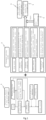
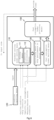
- Fig. 1 is a conceptual diagram of evaluation of ship propulsive performance in actual seas showing a conception of the evaluation method of ship propulsive performance in actual seas according to the embodiment.
- Fig. 1 shows a flow in which a previously verified calculating method 1 of ship performance in actual seas is prepared, and a ship propulsive performance index 3 for evaluating ship propulsive performance in actual seas is obtained using a standard sailing model 2.
- the previously verified calculating method 1 of ship performance in actual seas is a method in which all or a portion of a basic calculating method of ship performance in actual seas is previously sophisticated and verified as a calculating method, up to a level at which the ship propulsive performance index 3 which evaluates ship propulsive performance in actual seas is obtained, based on data obtained in actual seas, a simulation technique which is tailored to actual seas, or propulsive performance of an actual ship in actual seas.
- life cycle main engine fuel consumption 5 can be obtained by applying a specific fuel consumption 4. It is also possible to obtain a result of calculation, as the ship propulsive performance index 3, which is carried out using the calculating method 1 of ship performance in actual seas in accordance with a setting condition as a standard specific fuel consumption of the standard sailing model 2 without applying the specific fuel consumption 4.
- the calculating method 1 of ship performance in actual seas can apply waves, wind, ocean current, tidal current and the like as an external force factor which is caused by weather/marine weather encountered in actual seas, or an external force which is varied by drift, rudder and the like of a ship corresponding to the weather/marine weather to still water resistance as an external force acting on the ship for example, the calculating method 1 of ship performance in actual seas can calculate total resistance, and power curves obtained while taking propeller characteristics into consideration can be used in self-propulsion factors.
- the previously verified calculating method 1 of ship performance in actual seas it is possible to use a calculating method which is optimized from various data obtained in actual seas, a calculating method based on a simulation technique which is verified and evaluated by applying the technique in actual seas, or an evaluated calculating method while being compared with attained propulsive performance in actual seas.
- the ship propulsive performance index 3 of performance in actual seas can be obtained while taking, into consideration, setting of a ship route where the ship sails, an external force condition acting on the ship caused by a difference of the weather/marine weather caused by the set ship route, an external force condition and a driving condition caused by trim and draft which differs depending upon the setting of a loading condition, a driving condition which is different depending on the setting of ship's speed on a outward voyage and a homeward voyage, the setting of an operation mode of the main engine which coordinates with the latter driving condition, variation of the external force condition and the driving condition caused by aging deterioration which differs depending upon length of an actual service period caused by the setting of an evaluation period, and variation of the external force condition and the driving condition which is attributable to biological fouling caused by adhesion of marine organism which is different depending upon the actual service period and the docking interval.
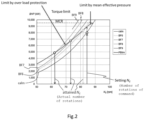
- Fig. 2 is a diagram showing an example of characteristics of the main engine output with respect to the main engine revolution with operation limits.
- an overload protection device are defined as an upper limit of the operation of the main engine, but there are some ships in which in addition to this, an upper limit of a fuel injection is designated by an fuel index (fuel index, "FI", hereinafter), and if the fuel injection exceeds the upper limit, operation to reduce the number of the engine revolution is executed.
- fuel index fuel index
- the FI is the fuel injection, and the value at the maximum continuous rating (MCR) is defined as 100%.
- MCR maximum continuous rating
- Fig. 2 shows characteristics of main engine output (BHP) with respect to the main engine revolution (N E ).
- the abscissa shows the main engine revolution (N E ) [rpm]
- the ordinate shows main engine output (BHP) [kW].
- This characteristic diagram can be obtained as power curves of a ship based on the calculating method 1 of ship performance in actual seas which assumes a specific ship in actual seas.
- BF is the Beaufort scale which is a scale of wind speed for classifying strength of wind in actual seas, and calm means when calm weather condition, and wind speed becomes higher as BF becomes greater.
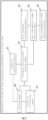
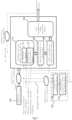
- Fig. 3 is a block diagram of the evaluation system of ship propulsive performance in actual seas according to the embodiment.
- the evaluation system of ship propulsive performance in actual seas includes standard sailing model setting means 10, condition inputting means 20, ship response calculating means 30, fuel consumption index deriving means 40, fuel consumption index outputting means 50, storing means 60 and condition calculating means 70.
- the standard sailing model 2 is set using the standard sailing model setting means 10.
- a ship route is selected, a loading condition is set, an evaluation period is set as sailing conditions, and a ship condition is input.
- the ship response calculating means 30 at least one of an external force condition acting on a ship caused by weather/marine weather which differs depending upon the ship route, the external force condition of the ship which differs depending upon the loading condition, and a driving condition of the ship, as well as at least one of change of the external force condition caused by the evaluation period, and change of the driving condition are applied to the calculating method 1 of ship performance in actual seas to calculate ship response.
- an index concerning fuel consumption of a ship is derived as the ship propulsive performance index 3 based on a calculation result of the ship response and an operation mode of the main engine. According to this, it is possible to evaluate propulsive performance in which weather/marine weather which is encounteredby the ship in actual seas, the external force condition and the driving condition of the ship which differs depending upon the loading condition of the ship, and change of the external force condition and the driving condition of the ship. Therefore, it is possible to precisely evaluation the ship propulsive performance in actual seas before the ship sails for example. It is possible to precisely evaluate the ship propulsive performance in actual seas as an index concerning fuel consumption, and it is possible to compared objectively fuel economies of ships under the same condition and with the same precision for example.
- the evaluation of ship propulsive performance in actual seas can also be utilized for determination of selection of a ship course or change fuel not only before the ship sails but while the ship sails, evaluation of the voyage and evaluation of the calculating method 1 of ship performance in actual seas by comparing between an index concerning fuel consumption derived after the ship sails and an index calculated from an actually consumed fuel amount. It is possible to calculate the ship response using the calculating method 1 of ship performance in actual seas, and only to evaluate the propulsive performance of the ship in actual seas.
- the condition inputting means 20 can commonly be used for inputting arbitrary weather/marine weather condition by a user as will be described later, and a biological fouling rate.
- Selection of a ship route, setting of the loading condition, setting an evaluation period, and input of a ship condition can appropriately change the selection, the setting and the input.
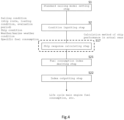
- Fig. 4 is a simplified flow chart of the evaluation method of ship propulsive performance in actual seas according to the embodiment.
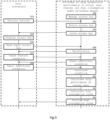
- Fig. 5 is a detailed flow chart of the evaluation method of ship propulsive performance in actual seas according to the embodiment.
- the evaluation system of ship propulsive performance in actual seas includes a computer in which the evaluation program of ship propulsive performance in actual seas is incorporated, and executes processing in the following steps.
- the standard sailing model 2 of a ship in actual seas is read in the computer by the standard sailing model setting means 10, and a model is set (standard sailing model setting step S1).
- the standard sailing model 2 is a standard sailing model used when ship propulsive performance in actual seas is evaluated.
- condition inputting step S2 the user inputs the ship condition using the condition inputting means 20 (ship condition inputting step S2-1), and selects the ship route, sets the loading condition and sets the evaluation period using the condition inputting means 20 (sailing condition inputting step S2-2) as the sailing condition.
- ship route selecting step S2-2-1 for selecting the ship route, and loading condition setting step S2-2-2 for setting the loading condition, and evaluation period setting step S2-2-3 for setting the evaluation period are carried out. According to this, the ship route, the loading condition and the evaluation period are set in the standard sailing model 2.
- the condition which is not set is automatically set to a fixed condition.
- setting of the operation mode of the main engine and the governor are received from the user per the loading condition and the driving condition.
- the user sets the operation mode of the main engine and the governor related to the operating position of the main engine for each of the outward voyage and the homeward voyage using the condition inputting means 20 (operation mode setting step S2-3).
- the operation mode of the main engine and the governor are constant of engine revolution, constant output of the main engine, constant ship speed, fuel index limit and the like.
- condition inputting step S2 input of the specific fuel consumption is received from the user.
- the user inputs an arbitrary specific fuel consumption using the condition inputting means 20 (specific fuel consumption inputting step S2-4).
- the user selects one or more of ship routes from the ship routes stored in the storing means 60.
- Examples of the ship routes are a North Pacific route, an Australian route and a European route, etc.
- a ship route is selected in the ship route selecting step S2-2-1, selection whether probability standard weather/marine weather condition is used for setting the weather/marine weather condition and the occurrence probability for the selected ship route is received from the user (standard weather/marine weather condition selecting step S3).
- standard weather/marine weather condition selecting step S3 selection whether probability standard weather/marine weather condition is used for setting the weather/marine weather condition and the occurrence probability for the selected ship route is received from the user.
- long-term statistic data corresponding to a ship route selected in the ship route selecting step S2-2-1 is extracted from the long-term statistic data of the standard weather/marine weather condition stored in the storing means 60 (long-term statistic data extracting step S4).
- the state of the weather/marine weather and the occurrence probability of the weather/marine weather condition are set to a ship route selected in the ship route selecting step S2-2-1 (weather/marine weather and occurrence probability setting step S6).
- the user can arbitrarily set the occurrence probability.
- the standard weather/marine weather condition selecting step S3 input of the weather/marine weather condition is received from the user.
- the user inputs an arbitrary weather/marine weather condition using the condition inputting means 20 (weather/marine weather condition inputting step S5). If the arbitrary weather/marine weather condition is input, the procedure is shifted to the weather/marine weather and occurrence probability setting step S6.
- Data concerning the weather/marine weather condition and the occurrence probability per a ship route which are set in the weather/marine weather and occurrence probability setting step S6 are sent to the ship response calculating means 30.
- the user sets a loading condition such as a full loaded condition and a ballast condition for each of the outward voyage and the homeward voyage. It is also possible to set multiple loading conditions for the outward voyage and the homeward voyage such as changing the loading condition per a discharge port.
- the loading condition setting step S2-2-2 setting of the driving condition per the loading condition is received from the user. If the loading condition is set, draft is determined, and an external force condition of the ship which is varied in accordance with the draft is set.
- the user inputs at least one of the main engine revolution, the main engine output, the main engine torque and speed using the condition inputting means 20 as a driving condition (driving condition setting step S7).
- the operation mode of the main engine is based on the driving condition which is set per the loading condition. Since the operation mode of the main engine which is attributable to the trim and the draft which differs depending upon the loading condition can be set as the driving condition, the operation mode of the main engine can be brought to a condition which is closer to the actual operating condition.
- Data of the driving condition per the loading condition which is set in the driving condition setting step S7 is sent to the ship response calculating means 30.
- the user sets a period during which ship propulsive performance in actual seas is evaluated.
- the evaluation period is a life cycle of the ship, and the evaluation period is generally set from several years to several decades, but the life cycle may be a period from actual service to docking, a period from docking to next docking, or a period during which multiple dockings are assumed.
- evaluation period setting step S2-2-3 setting of a docking interval, and selection whether standard aging deterioration rate is used are received from the user.
- the user sets the docking interval (docking interval setting step S8), and selects whether the standard aging deterioration rate is used (standard aging deterioration rate selecting step S13) using the condition inputting means 20.
- the user sets the interval during which the ship docks for maintenance.
- the condition calculating means 70 calculates a standard biological fouling rate based on the evaluation period and the like (standard biological fouling rate calculating step 10).
- the biological fouling rate is set for the respective ship's hull and propeller (biological fouling rate setting step S12).
- biological fouling rate setting step S12 By setting the biological fouling rate as one of variations of the external force condition and the driving condition in the set evaluation period, aging deterioration of the ship's hull and the propeller caused by the biological fouling is incorporated into the condition, and it is possible to evaluate the propulsive performance under a condition which is closer to the actual operating condition.
- the biological fouling rate includes parameter values of all of aging deteriorations related to aging deterioration including biological fouling, and examples of such parameter values are biofouling on the ship's hull and the propeller, generation of rust and boss, increase of a friction resistance the ship's hull caused by deterioration of a coating film and reduction of propulsion efficiency of the propeller.
- Data of the biological fouling rates of the ship's hull and the propeller which are set in the biological fouling rate setting step S12 is sent to the ship response calculating means 30.
- the condition calculating means 70 calculates the standard aging deterioration rate (standard aging deterioration rate calculating step S14).
- aging deterioration rates are set for the respective ship, the propeller, the main engine and the governor (aging deterioration rate setting step S16).
- the deterioration rates of the ship and the driving system are set as one of variations of the external force condition and the driving condition in a set evaluation period, the aging deterioration of the driving system is incorporated into the condition, and it is possible to make evaluation of the propulsive performance under a condition which is closer to the actual operating condition.
- the governor corresponds to a mechanical governor or an electronic governor, and in a main engine which uses electricity, the governor corresponds to an inverter or voltage adjusting means.
- a deterioration rate of the driving system includes all of parameter values related to deterioration rates which differs depending upon evaluation periods such as wear and damage of the main engine, the air supply and exhaust system, the fuel supply system, the power transmission system and the propeller.
- the standard aging deterioration rate selecting step S13 input of the aging deterioration rate is received from the user.
- the user inputs arbitrary aging deterioration rate using the condition inputting means 20 (aging deterioration rate inputting step S15). If the arbitrary aging deterioration rate is input, the procedure is shifted to the aging deterioration rate setting step S16.
- data of the aging deterioration rate which is set in the aging deterioration rate setting step S16 data of the aging deterioration rates of the ship, the propeller and the main engine is sent to the ship response calculating means 30, and the aging deterioration rate of the governor which exerts influence on the fuel injection is sent to the fuel consumption index deriving means 40.
- the ship response calculating means 30 calculates a ship response of each of the loading condition and the driving condition, the evaluation period and the weather/marine weather based on a state and occurrence probability of the weather/marine weather of the ship route, a driving condition per the loading condition, the biological fouling rate of the ship's hull and the propeller, and data of the aging deterioration rates of the ship, the propeller and the main engine (ship response calculating step S17).
- the ship response calculating means 30 In the calculation executed by the ship response calculating means 30, a fuel consumption of the main engine and operation mode of the main engine are not put into consideration. Therefore, it is possible to calculate the ship response from which influence of the specific fuel consumption of the main engine and the actuation characteristics of the main engine are removed.
- the calculating method 1 of ship performance in actual seas which is applied to the calculation of the ship response is a calculating method which is previously verified based on data collected by mounting a monitoring device in an actual ship and data obtained by a test result of a tank test carried out by a model ship. If the previously verified calculating method 1 of ship performance in actual seas is used, it is possible to precisely evaluate the ship propulsive performance in actual seas, and it is possible to evaluate ships under the same condition and with the same precision, and it is possible to compare objectively.
- the previously verified calculating method 1 of ship performance in actual seas includes all of a calculating method which is optimized from various data sets obtained in actual seas, a calculating method based on a simulation technique which is verified and evaluated by applying the same in actual seas, and a calculating method which is compared with attained propulsive performance in actual seas and which is evaluated and sophisticated.
- the condition calculating means 70 calculates the standard specific fuel consumption (standard specific fuel consumption calculating step S19).
- a specific fuel consumption (SFC) 4 is set based on the standard specific fuel consumption which is derived by calculation (specific fuel consumption setting step S20).
- the user can also correct a specific fuel consumption which is obtained by calculation. It is also possible to set a multiple specific fuel consumption 4. For example, it is also possible to the specific fuel consumption 4 according to kinds of fuel such as Marine Diesel oil, Marine Fuel oil and gas fuel, and set a multiple specific fuel consumption 4 while taking a difference of property into consideration even if the king of fuel is the same.
- the Marine Fuel oil which is mainly used in ships has variation in property depending upon production area and a difference of density of about 20% is generated. Therefore, there is a problem that conditions for evaluating the propulsive performance are unequal.
- the index concerning the fuel consumption of a ship as in this embodiment, by inputting and setting the specific fuel consumption 4 using the standard specific fuel consumption or arbitrary specific fuel consumption, it is possible to evaluate under the same condition. Therefore, a difference caused by fuel quality does not affectthe evaluation, and it is possible to evaluate only by ship propulsive performance.
- the ship response calculating means 30 it is also possible to calculate ship performance in actual seas of an individual ship while taking a specific fuel consumption of the main engine and operation mode of the main engine into consideration.
- the fuel consumption index deriving means 40 calculates the main engine number of revolution, the main engine output, the main engine torque, speed, a fuel consumption, drift angle and a rudder angle as a loading condition, a driving condition, evaluation period and weather/marine weather based on the set specific fuel consumption 4 and the aging deterioration rate of the governor and the like, and the fuel consumption index deriving means 40 derives an index concerning the fuel consumption of the ship as the ship propulsive performance index 3 of performance in actual seas (fuel consumption index deriving step S21).
- the index concerning the fuel consumption can be derived as the life cycle main engine fuel consumption 5 which shows fuel consumption of the main engine which is calculated from a total fuel consumption of the main engine, a total transportation distance and a total load capacity for a long period of the ship which is set as the evaluation period.
- the index concerning the fuel consumption includes, in addition to the life cycle main engine fuel consumption 5, fuel consumption of the main engine calculated from the total fuel consumption of the main engine, the total transportation distance and the total load capacity for the evaluation period, and any unit can be selected as a unit of the fuel consumption.
- a life cycle may be a period from actual service to docking, a period from docking to next docking, or a period during which multiple dockings are assumed.
- the fuel consumption index outputting means 50 outputs the index concerning the fuel consumption derived in the fuel consumption index deriving step S21 to a screen or paper (index outputting step S22).
- the fuel consumption index outputting means 50 also outputs a condition which is input in at least the condition inputting step S2 together with the index concerning the fuel consumption. According to this, it becomes easy for the user to consider under what condition the index concerning the fuel consumption is derived.
- the standard sailing model 2 of the ship in actual seas is set, a sailing condition of the ship and a ship condition of the ship are input to the standard sailing model 2, the standard sailing model 2 into which the sailing condition and the ship condition are input and the ship condition are applied to the previously verified calculating method 1 of ship performance in actual seas, and ship propulsive performance in actual seas is evaluated. According to this, it is possible to precisely evaluate the ship propulsive performance in actual seas also, for example, before the ship sails.
- a weather/marine weather condition is input to the standard sailing model 2 as a sailing condition, and ship propulsive performance in actual seas is evaluated using the standard sailing model 2 into which the weather/marine weather condition is input.
- the weather/marine weather which is tailored to the ship route as the sailing condition is not incorporated for example, or when a ship having the sailing policy such as navigation while avoiding weather/marine weather which is anticipated to become worse is a target, it is possible to evaluate in a manner more tailored to reality of the situation by inputting arbitrary weather/marine weather condition.
- this system obtains a ship propulsive performance index 3 of performance in actual seas which evaluates performance of a ship in actual seas using a previously verified calculating method 1 of ship performance in actual seas and a standard sailing model 2 of the ship.
- the ship propulsive performance index 3 it is possible to obtain a life cycle main engine fuel consumption 5 as the ship propulsive performance index 3 by applying a specific fuel consumption 4. It is also possible to obtain, together with the ship propulsive performance index 3 a calculation result which is carried out using the calculating method 1 of ship performance in actual seas which is tailored to a setting condition of the standard sailing model 2 without applying the specific fuel consumption 4.
- the calculating method 1 of ship performance in actual seas can apply waves, wind, ocean current, tidal current and the like as an external force factor which is caused by weather/marine weather encountered in actual seas, or an external force which is varied by drift, rudder and the like of a ship corresponding to the weather/marine weather to still water resistance as an external force acting on the ship for example, the calculating method 1 of ship performance in actual seas can calculate total resistance, and power curves obtained while taking propeller characteristics into consideration can be used in a self-propulsion factors.
- the precision of the calculating method 1 of ship propulsive performance in actual seas can be enhanced by using various data obtained through actual ship monitoring data acquired from actually sailing various kinds of ships, and data obtained through standard test in an actual seas model basin which emulates a real sea condition. It is also possible to precisely obtain an element which exerts influence on sailing in real sea condition such as added resistance in waves, self-propulsion factors in waves and wind resistance of a superstructure through a model test technique and a calculating technique, and it is possible to reflect the same to the calculating method 1 of ship performance in actual seas to enhance the precision.
- the previously verified calculating method 1 of ship performance in actual seas it is possible to use a calculating method which is optimized from various data obtained in actual seas, a calculating method based on a simulation technique which is verified and evaluated by applying the technique in actual seas, or an evaluated and sophisticated calculating method while being compared with attained propulsive performance in actual seas.
- the ship propulsive performance index 3 can be obtained while taking into consideration, the setting of the ship route, external forces acting on the ship in accordance with the weather/marine weather which differs depending upon the ship route, external forces condition and a driving condition tailored to a draft and a trim which differ depending upon the setting of the loading condition, a driving condition tailored to the setting of the ship speed in the outward voyage and the homeward voyage, the setting of the operation mode of the main engine which is associated with the driving condition, variations of the external force condition and the driving condition caused by aging deterioration which differs depending upon a length of the actual service period caused by setting of the evaluation period, and the external force condition and the driving condition which are attributable to the biological fouling caused by attachment of slimes and marine organism which differs depending upon the actual service period and docking interval.
- Fig. 6 is a block diagram showing an example of a providing system of ship propulsive performance in actual seas as this embodiment.
- the providing system of ship propulsive performance in actual seas of the embodiment includes standard sailing model setting means 110, condition inputting means 120, calculating means 130 of ship performance in actual seas, fuel consumption index deriving means 140, and fuel consumption index providing means 150.
- the providing system of ship propulsive performance in actual seas of the embodiment is mainly composed a computer and its peripheral device.
- the standard sailing model setting means 110 has a function for setting the standard sailing model 2.
- the standard sailing model setting means 110 includes storing means 111 and condition calculating means 112. Various information which is necessary for setting the standard sailing model 2 such as a ship routes and standard weather/marine weather condition are stored in the storing means 111.
- the condition calculating means 112 calculates a standard biological fouling rate and standard aging deterioration rate as will be described later.
- the condition inputting means 120 is used for inputting a sailing condition and a ship condition of the ship used by the standard sailing model 2.
- the condition inputting means 120 can also be used for inputting an arbitrary specific fuel consumption 4, the weather/marine weather condition and the biological fouling rate carried out by the user as will be described later.
- the condition inputting means 120 is an input device such as a keyboard and a touch panel.
- the calculating means 130 of ship performance in actual seas calculates, using the calculating method 1 of ship performance in actual seas, ship performance in actual seas of the ship in accordance with conditions of the standard sailing model 2 and the ship condition into which the sailing condition is input.
- the fuel consumption index deriving means 140 derives an index concerning fuel consumption of the ship as the ship propulsive performance index 3 based on a calculation result of the calculating means 130 of ship performance in actual seas.
- the fuel consumption index providing means 150 provides, to the user, the index concerning the fuel consumption of the ship derived by the fuel consumption index deriving means 140.
- the fuel consumption index providing means 150 provides as the index concerning the fuel consumption, to the user, at least one of main engine fuel consumption, a greenhouse gas exhaust index, a maintenance cost, and transportation efficiency index. According to this, the user can obtain the main engine fuel consumption, the greenhouse gas exhaust index, the maintenance cost and the transportation efficiency index as indexes which shows ship propulsive performance in actual seas objectively.
- the greenhouse gas exhaust index may be EEDI (Energy Efficiency Design Index) which is related a value showing an amount of CO 2 exhaust when a cargo of 1 ton through 1 mile at the time of designing, or may be EEOI (Energy Efficiency Operational Indicator) which is a value showing an amount of CO 2 exhaust by the actual operating condition while using a fuel usage amount and a voyage distance.
- the transportation efficiency index may be AER (Annual Efficiency Ratio) which is a value showing energy efficiency calculated using an actual cargo transportation amount of one year.
- the main engine fuel consumption, the greenhouse gas exhaust index, the maintenance cost and the transportation efficiency index are characterized in that they are indexes in which the evaluation period is taken into consideration.
- the fuel consumption index providing means 150 provides, to the user, the sailing condition and the ship condition which are input by the condition inputting means 120.
- the condition which is input by the condition inputting means 120 the user can easily cinsiderunder what condition, the index concerning the fuel consumption is derived.
- the system includes a computer in which a providing program of ship propulsive performance in actual seas is incorporated, and the processing is executed through the following steps.
- the computer reads the providing program of ship propulsive performance in actual seas is as one of processing, and executes the processing through the following steps, and this computer integrates arbitrary step in the following procedure as an individual program executed by another computer and the former computer executes the processing.
- the standard sailing model setting means 110 reads the standard sailing model 2 of the ship in actual seas and sets a model (standard sailing model setting step S1).
- the standard sailing model 2 is a standard sailing model which is used when performance ship propulsive performance in actual seas is evaluated.
- the standard sailing model setting means 110 receives, from the user, input of the sailing condition and the ship condition which are used by the standard sailing model 2.
- the user inputs the ship condition using the condition inputting means 120 (ship condition inputting step S2-1), and inputs the sailing condition using the condition inputting means 120 (sailing condition inputting step S2-2) as the condition inputting step S2.
- the ship condition which is input in the ship condition inputting step S2-1 is an important matter concerning the ship such as principal dimensions or hull shape.
- the sailing condition inputting step S2-2 includes the ship route selecting step S2-2-1 for selecting a ship route, the loading condition setting step S2-2-2 for setting the loading condition, and the evaluation period setting step S2-2-3 for setting the evaluation period.
- the ship route, the loading condition and the evaluation period are set in the standard sailing model 2.
- the sailing condition which is input by the user in the sailing condition inputting step S2-2 is conditions concerning the ship route, the loading condition and the evaluation period. According to this, it is possible to derive the index concerning fuel consumption which is tailored to the reality of the situation under a condition closer to the actual operating condition. It is possible to set one of or a combination of two of the ship route, the loading condition and the evaluation period. In this case, for a condition which is not set by the user, a fixed condition which is previously stored in the storing means 111 is automatically set.
- condition inputting step S2 setting of the operation mode of the main engine and the governor are received from the user per the loading condition and the driving condition.
- the user sets the operation mode of the main engine and the governor related to the operating position of the main engine as the operation mode of the main engine for each of the outward voyage and the homeward voyage using the condition inputting means 120 (operation mode setting step S2-3).
- the operation mode of the main engine and the governor are constant of engine revolution, constant output of the main engine, constant ship speed, and fuel index limit for example.
- condition inputting step S2 input of the specific fuel consumption is received from the user.
- the user inputs arbitrary specific fuel consumption using the condition inputting means 120 (specific fuel consumption inputting step S2-4) .
- the user selects one or more ship routes from multiple ship routes which are stored in the storing means 111.
- Examples of the ship routes are a North Pacific route, an Australian route, and a European route, etc.
- the standard sailing model setting means 110 receives, from the user, selection whether the standard weather/marine weather condition is used for setting a weather/marine weather condition and occurrence probability for the selected ship route (standard weather/marine weather condition selecting step S3).
- the occurrence probability of the weather/marine weather it is possible to evaluate the propulsive performance under a condition which is closer to the actual operating condition.
- frequency distribution is set from a statistical value in accordance with a ship route for example.
- the standard sailing model setting means 110 extracts long-term statistic data corresponding to a ship route selected in the ship route selecting step S2-2-1 from the long-term statistic data of the standard weather/marine weather condition stored in the storing means 111 (long-term statistic data extracting step S4).
- the standard sailing model setting means 110 sets the state of the weather/marine weather and the occurrence probability of the weather/marine weather condition to a ship route selected in the ship route selecting step S2-2-1 (weather/marine weather and occurrence probability setting step S6).
- the user can arbitrarily set the occurrence probability.
- the standard sailing model setting means 110 receives input of the weather/marine weather condition from the user.
- the user inputs an arbitrary weather/marine weather condition using the condition inputting means 120 (weather/marine weather condition inputting step S5). If the arbitrary weather/marine weather condition is input, the procedure is shifted to the weather/marine weather and occurrence probability setting step S6.
- Data concerning the weather/marine weather condition and the occurrence probability per a ship route which are set in the weather/marine weather and occurrence probability setting step S6 are sent to the calculating means 130 of ship performance in actual seas.
- the user sets a loading condition such as a full loaded condition and a ballast condition for each of the outward voyage and the homeward voyage. It is also possible to set multiple loading conditions for the outward voyage and the homeward voyage such as changing the loading condition per a discharge port.
- the standard sailing model setting means 110 receives setting of the driving condition per the loading condition from the user. If the loading condition is set, draft is determined, and an external force condition of the ship which is varied in accordance with the draft is set. The user inputs at least one of the main engine revolution, the main engine output, the main engine torque and speed using the condition inputting means 20 as a driving condition (driving condition setting step S7). The operation mode of the main engine is based on the driving condition which is set per the loading condition.
- the operation mode of the main engine which is attributable to the trim and the draft which differs depending upon the loading condition can be set as the driving condition, the operation mode of the main engine can be brought to a condition which is closer to the actual operating condition.
- the driving condition is changed in some cases in accordance with variation of a status halfway through voyage.
- Data of the driving condition per the loading condition which is set in the driving condition setting step S7 is sent to the calculating means 130 of ship performance in actual seas.
- the user sets a period during which ship propulsive performance in actual seas is evaluated.
- the evaluation period is a life cycle of the ship, and the evaluation period is set from several years to several decades, but the life cycle may be a period from actual service to docking, a period from docking to next docking, or a period during which multiple dockings are assumed, and it is possible to freely set the life cycle.
- the standard sailing model setting means 110 receives, from the user, setting of a docking interval, and selection whether standard aging deterioration rate is used.
- the user sets the docking interval (docking interval setting step S8), and selects whether the standard aging deterioration rate is used (standard aging deterioration rate selecting step S13) using the condition inputting means 120.
- the user sets the interval during which the ship docks for maintenance.
- the standard sailing model setting means 110 receives, from the user, selection whether a standard biological fouling rate is used for setting a biological fouling rate used when defacement such as ship caused by attachment of slims and marine organism such as Balanomorpha is estimated (standard biological fouling ratio selecting step S9).
- the condition calculating means 112 calculates a standard biological fouling rate based on the evaluation period (standard biological fouling rate calculating step 10) .
- the standard sailing model setting means 110 sets the biological fouling rate for the respective ship's hull and propeller (biological fouling rate setting step S12).
- biological fouling rate setting step S12 By setting the biological fouling rate as one of variations of the external force condition and the driving condition in the set evaluation period, aging deterioration of the ship's hull and the propeller caused by the biological fouling is incorporated into the condition, and it is possible to evaluate the propulsive performance under a condition which is closer to the actual operating condition.
- the biological fouling rate includes parameter values of all of aging deteriorations related to aging deterioration including biological fouling, and examples of such parameter values are biofouling on the ship's hull and the propeller, generation of rust and boss, increase of friction resistanceof the ship's hull caused by deterioration of a coating film and reduction of propulsion efficiencyof the propeller.
- the standard sailing model setting means 110 receives input of the biological fouling rate from the user.
- the user inputs arbitrary biological fouling rate using the condition inputting means 120 (biological fouling rate inputting step S11). If the arbitrary biological fouling rate is input, the procedure is shifted to the biological fouling rate setting step S12.
- Data of the biological fouling rates of the ship's hull and the propeller which are set in the biological fouling rate setting step S12 is sent to the calculating means 130 of ship performance in actual seas.
- the condition calculating means 112 calculates the standard aging deterioration rate (standard aging deterioration rate calculating step S14).
- the standard sailing model setting means 110 sets aging deterioration rates for the respective ship, the propeller, the main engine and the governor (aging deterioration rate setting step S16).
- the aging deterioration rate setting step S16 By setting the deterioration rates of the ship and the driving system as one of variations of the external force condition and the driving condition in a set evaluation period, the aging deterioration of the driving system is incorporated into the condition, and it is possible to make evaluation of the performance under a condition which is closer to the actual operating condition.
- the governor corresponds to a mechanical governor or an electronic governor, and in a main engine which uses electricity, the governor corresponds to an inverter or voltage adjusting means.
- a deterioration rate of the driving system includes all of parameter values related to deterioration rates which differs depending upon evaluation periods such as wear and damage of the main engine, the power transmission system, the air supply and exhaust system, the fuel supply system, and the propeller.
- the standard sailing model setting means 110 receives input of the aging deterioration rate from the user.
- the user inputs arbitrary aging deterioration rate using the condition inputting means 120 (aging deterioration rate inputting step S15). If the arbitrary aging deterioration rate is input, the procedure is shifted to the aging deterioration rate setting step S16.
- data of the aging deterioration rate which is set in the aging deterioration rate setting step S16 data of the aging deterioration rates of the ship, the propeller and the main engine is sent to the calculating means 130 of ship performance in actual seas, and the aging deterioration rate of the governor which exerts influence on the fuel injection is sent to the fuel consumption index deriving means 140.
- the calculating means 130 of ship performance in actual seas calculates a ship response of each of the loading condition and the driving condition, the evaluation period and the weather/marine weather based on a state and occurrence probability of the weather/marine weather of the ship route, a driving condition per the loading condition, the biological fouling rate of the ship's hull and the propeller, and data of the aging deterioration rates of the ship, the propeller and the main engine (ship response calculating step S17).
- the fuel consumption index deriving means 140 receives, from the user, selection whether the amount of standard fuel consumption should be used for setting the specific fuel consumption 4 (standard specific fuel consumption selecting step S18).
- the fuel consumption index deriving means 140 calculates the standard specific fuel consumption (standard specific fuel consumption calculating step S19).
- the condition calculating means 112 may calculate the standard specific fuel consumption.
- a specific fuel consumption (SFC) 4 is set based on the standard specific fuel consumption which is derived by calculation (specific fuel consumption setting step S20).
- the user can also correct a specific fuel consumption which is obtained by calculation. It is also possible to set multiple specific fuel consumption 4. For example, it is also possible to the specific fuel consumption 4 according to kinds of fuel such as Marine Diesel oil, Marine Fuel oil and gas fuel, and set multiple specific fuel consumption 4 while taking a difference of property into consideration even if the king of fuel is the same.
- the Marine Fuel oil which is mainly used in ships has variation in property depending upon production area and a difference of density of about 20% is generated. Therefore, there is a problem that conditions for evaluating the ship propulsive performance in actual seas of the ship are unequal.
- the standard specific fuel consumption or the arbitrary specific fuel consumption is used, and the specific fuel consumption 4 is input. According to this, since it is possible to evaluate under the same condition, a difference caused by fuel quality does not affect the evaluation, and it is possible to evaluate only by ship propulsive performance. It is also possible to calculate ship performance in actual seas of an individual ship while taking a specific fuel consumption of the main engine and operation mode of the main engine into consideration.
- the fuel consumption index deriving means 140 calculates the main engine number of revolution, the main engine output, the main engine torque, speed, a fuel consumption, a drift angle and a rudder angle as a loading condition, a driving condition, evaluation period and weather/marine weather based on the set specific fuel consumption 4 and the aging deterioration rate of the governor and the like, and the fuel consumption index deriving means 140 derives an index concerning the fuel consumption of the ship as the ship propulsive performance index 3 (fuel consumption index deriving step S21).
- the index concerning the fuel consumption can be derived as the life cycle main engine fuel consumption 5 which shows fuel consumption of the main engine which is calculated from a total fuel consumption of the main engine, a total transportation distance and a total load capacity for a long period of the ship which is set as the evaluation period.
- the index concerning the fuel consumption includes, in addition to the life cycle main engine fuel consumption 5, fuel economy of the main engine calculated from the total fuel consumption of the main engine, the total transportation distance and the total load capacity for the evaluation period, and any unit can be selected as a unit of the fuel consumption index.
- a life cycle may be a period from actual service to docking, a period from docking to next docking, or a period during which multiple dockings are assumed.
- the fuel consumption index providing means 150 provides the index concerning the fuel consumption derived in the fuel consumption index deriving step S21 (index providing step S22).
- this system includes the standard sailing model setting means 110 which sets a standard sailing model 2 of a ship in actual seas, the condition inputting means 120 which inputs a sailing condition used for the standard sailing model 2 and a condition of a ship of the ship, the calculating means 130 of ship performance in actual seas which calculates ship propulsive performance in actual seas in accordance with the standard sailing model 2 into the sailing condition is input and the ship condition, the fuel consumption index deriving means 140 which derives an index concerning fuel consumption of the ship based on a calculation result of the calculating means 130 of ship performance in actual seas, and the fuel consumption index providing means 150 which provides a derivation result of the index concerning the fuel consumption.
- the standard sailing model setting means 110 which sets a standard sailing model 2 of a ship in actual seas
- the condition inputting means 120 which inputs a sailing condition used for the standard sailing model 2 and a condition of a ship of the ship
- the calculating means 130 of ship performance in actual seas which calculates ship propulsive performance in actual seas
- An evaluation result of the ship propulsive performance in actual seas can be utilized also during sailing or after sailing in addition to utilization before sailing.
- the evaluation result can be utilized for selecting a ship route or for determining the change of fuel for example.
- the evaluation result can be utilized for evaluation of voyage by comparing an index concerning fuel consumption derived before sailing and an index calculated from a fuel amount which is actually consumed or for evaluation of the calculating method 1 of ship performance in actual seas.
- the evaluation result need not be utilized for actual sailing, and the evaluation result can be utilized only for evaluation of the ship propulsive performance in actual seas.
- Fig. 7 is a block diagram showing another example of the providing system of ship propulsive performance in actual seas according to the embodiment.
- the same symbols are allocated to members having the same functions as those in the above described examples, and description thereof will be omitted.
- the providing system of ship propulsive performance in actual seas includes the standard sailing model setting means 110, the condition inputting means 120, the calculating means 130 of ship performance in actual seas, the fuel consumption index deriving means 140, the fuel consumption index providing means 150, condition obtaining means 160, and performance prediction result providing means 170.
- the providing system of ship propulsive performance in actual seas in the example is mainly composed of a computer, a peripheral device thereof, and a communication line or a network.
- the condition inputting means 120, the standard sailing model setting means 110, the calculating means 130 of ship performance in actual seas and the fuel consumption index deriving means 140 are connected to each other through a specific communication line, and the user inputs the sailing condition and the ship condition through the communication line or the network.
- the fuel consumption index providing means 150 is connected to a terminal used by the user through the communication line or the network, and a derivation result of an index concerning fuel consumption is provided to the user through the communication line or the network. According to this, even if the user exists in a distant place, input of a condition from the user can be received through the communication line or the network, and provide, to the user, the index concerning fuel consumption of the ship in actual seas which is derived based on the input condition.
- the fuel consumption index providing means 150 provides the fuel index includes a case where the user goes to check a derivation result stored in the storing means or the like of the fuel consumption index providing means 150.
- the user may be a ship itself which is in actual service.
- the standard sailing model setting means 110 can receive, from the user, the input of a planned ship condition which is not in actual service as a ship condition.
- the fuel consumption index providing means 150 provides, to the user, a derivation result of the index concerning fuel consumption of the ship which is not in actual service.
- this system can receive the input of the planned ship condition from the user, and can provide, to the user, the index concerning fuel consumption of the ship which is not in actual service in actual seas which is derived based on the input planned ship condition.
- the user can review the ship condition of the ship which is not in actual service based on the provided index.
- the ship which is not in actual service is a ship before it is completed in which its scheme or design is considered or the ship is being constructed.
- the planned ship condition is a ship condition in which the ship which is not in actual service is scheduled.
- the fuel consumption index providing means 150 makes it possible to compare derivation results of indexes concerning fuel consumption of the ships which are not in actual service, and provides the derivation results to the user.
- this system receives inputs of planned ship conditions from the user, and can provide, to the user, indexes concerning fuel consumption of the ships which are not in actual service in actual seas which are respectively derived corresponding to the input planned ship conditions in a comparable manner. According to this, the user can easily compare ship propulsive performance in actual seas which are not in actual service.
- a sailing condition and a planned ship condition which are input by the user using the condition inputting means 120 are also sent to the condition obtaining means 160 provided in performance predicting means 155.
- the performance prediction result providing means 170 provides, to the user, a performance prediction result of a ship which is in accordance with the sailing condition and the planned ship condition obtained by the condition obtaining means 160, and sends the performance prediction result to the calculating means 130 of ship performance in actual seas.
- the performance predicting means 155 has the condition obtaining means 160 and the performance prediction result providing means 170.
- the performance predicting means 155 may have functions only to obtain a condition and provide a performance prediction result, or may also have a function to actually predict performance.
- the performance prediction result of a ship is a result in which performance of a ship is predicted from a view point which is different from an index concerning fuel consumption derived by the fuel consumption index deriving means 140 using the calculating method 1 of ship performance in actual seas and the standard sailing model 2, and the performance prediction result is derived by calculation carried out by computational fluid dynamics (CFD) which is numerical analysis/simulation technique, or a tank test which simulates real sea condition.
- CFD computational fluid dynamics
- this system can provide, to the user, a performance prediction result obtained by the tank test, numerical analysis/simulation technique executed by the performance predicting means 155 together with the index concerning fuel consumption in actual seas for the ship which is not in actual service. According to this, the user can evaluate the ship propulsive performance in actual seas of the ship which is not in actual service in more multifaceted manner. It is also possible to use a performance prediction result for the calculating means 130 of ship performance in actual seas to enhance the calculation precision of the calculating means 130 of ship performance in actual seas.
- the CFD and the tank test which are executed by the performance predicting means 155 can be carried out as a business as a CFD calculation institution or a tank test institution.
- a derivation result of an index concerning fuel consumption is provided from the fuel consumption index providing means 150 also to the CFD calculation institution which carries out the CFD or the tank test institution having a ship model basin .
- the CFD calculation institution and the water tank test institution can utilize the derivation result of the index concerning fuel consumption to enhance the precision of prediction of performance of a ship.
- Fig. 8 is a block diagram showing another example of the providing system of ship propulsive performance in actual seas according to the embodiment.
- the same symbols are allocated to members having the same functions as those in the above described examples, and description thereof will be omitted.
- the providing system of ship propulsive performance in actual seas includes the standard sailing model setting means 110, the condition inputting means 120, the calculating means 130 of ship performance in actual seas, the fuel consumption index deriving means 140, the fuel consumption index providing means 150, the condition obtaining means 160, sea trial result providing means 180, weather/marine weather data obtaining means 191 and sailing data obtaining means 192 as data obtaining means 190, data accumulating means 200, and standard sailing model changing means 210.
- the providing system of ship propulsive performance in actual seas in this example is mainly composed of a computer as a server, its peripheral device, a communication line or a network.
- the standard sailing model setting means 110, the calculating means 130 of ship performance in actual seas and the fuel consumption index deriving means 140 are possessed, as a server, by a provider of ship propulsive performance in actual seas which is a business operator of the ship propulsive performance in actual seas.
- the condition inputting means 120 and the server are connected to each other through the communication line or the network. If a sailing condition and a ship condition are input from the user, the server derives an index concerning fuel consumption in accordance with a standard sailing model to which a sailing condition is input and a ship condition.
- the fuel consumption index providing means 150 is connected to a terminal used by a user or a third party other than the user through the communication line or the network, and provides, to the user or the third party, a derivation result of an index concerning fuel consumption through the communication line or the network. Information of the derivation result of the index concerning fuel consumption can be provided to the third party if agreement of the user or the other party of the user is gained.
- the provider of ship propulsive performance in actual seas has the standard sailing model setting means 110 and the calculating means 130 of ship performance in actual seas as the server as in this example, the user can obtain the derivation result of the index concerning fuel consumption from the outside server. Therefore, it is possible to reduce introduction cost and management cost of a device. Since the provider of ship propulsive performance in actual seas derives the index concerning fuel consumption in an integrated fashion, it becomes easy to constantly keep the derivation precision of the index irrespective of the user.
- the fuel consumption index providing means 150 provides the index concerning fuel consumption of a target ship in actual seas also to a third party in addition to the user. Therefore, the third party also can know and evaluate the ship propulsive performance in actual seas of the ship based on the index received through the communication line or the network.
- the third party is a certification institution or a public institution which certifies an index concerning fuel consumption for the user, or a business operator of a chartered ship which charters a ship from a ship owner and carries out transportation.
- the user is a business operator who designs a ship, there can be many cases such as a case where a ship owner as an ordering party other than a shipbuilding company as the other party of the user becomes the third party.
- the designing business operator who designs a ship can receive a request from the ship building company or the ship owner, can subjectively utilize this system, can commonly have information together with the business operator itself or a client, and can design a ship having an excellent index concerning fuel consumption.
- the designing business operator receives a request from the shipbuilding company or the ship owner to design a portion of a ship, a sailing condition and a ship's hull condition which are not related to the portion are made the same, an index concerning fuel consumption when the portion is changed is obtained and it is possible to optimize the design of the portion of the ship.
- the fuel consumption index providing means 150 provides a calculation result of the calculating means 130 of ship performance in actual seas to the user or the third party.
- the calculation result of the calculating means 130 of ship performance in actual seas based on which the index is derived together with the index concerning fuel consumption, it becomes easy for the user to study a sailing configuration of a ship and review a maintenance period, make an estimation of the ship, and check an actual power curves.
- a calculation result of the ship propulsive performance calculating in actual seas means 130 can be provided by separately providing means to provide the calculation result without through the fuel consumption index providing means 150.
- the fuel consumption index providing means 150 provides, also to the third party, the sailing condition and the ship condition which are input by the condition inputting means 120.
- the third party can easily consider based under what condition the index concerning fuel consumption is derived.
- the standard sailing model setting means 110 can receive, from the user, the input of a designed ship condition of an actual service ship as the ship condition.
- the fuel consumption index providing means 150 provides a derivation result of the index concerning fuel consumption of the actual service ship to the user.
- this system can receive the input of the designed ship condition from the user, and provide, to the user, the index concerning fuel consumption of the actual service ship in actual seas which is derived based on the input designed ship condition.
- the user can select a ship route, and consider the maintenance period based on the provided index.
- the actual service ship is a ship whose construction is completed, and also includes a ship which is on the way to inspection before the actual service.
- the designed ship condition is a ship condition whose design concerning the actual service ship is completed.
- the actual service ship may be a ship itself as the user, and the system can be utilized when a ship is chartered, when purchase of a used ship is considered, and when a ship which is suitable for a ship route is considered.
- the fuel consumption index providing means 150 makes it possible to compare derivation results of indexes concerning fuel consumption of the multiple actual service ships, and provides the same to the user.
- this system can receive the inputs of the multiple designed ship conditions from the user, and can provide, to the user, the indexes concerning fuel consumption of actual service ships in actual seas respectively derived corresponding to the input multiple designed ship conditions. According to this, the user can easily compare the ship propulsive performance in actual seas of the actual service ships.
- the sea trial result providing means 180 provides, to the user, a sea trial result of a ship tailored to the sailing condition and the designed ship condition obtained by the condition obtaining means 160, and sends the sea trial result to the calculating means 130 of ship performance in actual seas .
- sea trial means 185 is provided with the condition obtaining means 160 and the sea trial result providing means 180.
- this system can provide, to the user, the sea trial result obtained by the sea trial means 185 together with the index concerning fuel consumption in actual seas for the actual service ship. According to this, the user can evaluate the ship propulsive performance in actual seas of the actual service ship in more multifaceted manner. It is also possible to use the sea trial result in the calculating means 130 of ship performance in actual seas to enhance the calculation precision of the calculating means 130 of ship performance in actual seas.
- the sea trial means 185 may have only functions for obtaining a condition and providing a sea trial result, or may also have a function for obtaining data caused by actual sea trial.
- a derivation result of the index concerning fuel consumption is provided from the fuel consumption index providing means 150 also to the sea trial institution which is the sea trial means 185. According to this, the sea trial institution can utilize the derivation result of the index concerning fuel consumption for enhancing the sea trial method.
- the weather/marine weather data obtaining means 191 and the sailing data obtaining means 192 are provided in a sailing ship for example.
- the weather/marine weather data obtaining means 191 obtains weather/marine weather data in actual seas.
- the sailing data obtaining means 192 obtains sailing data of a ship in actual seas.
- the sailing data is the main engine revolution, main engine torque and speed for example.
- the obtained weather/marine weather data in the real sea area and the sailing data can be utilized for enhancing precision of the calculating method 1 of ship performance in actual seas.
- the data obtaining means 190 may be limited to acquisition of the sailing data and acquisition of weather/marine weather data, or may also have a sensor function for actually obtaining data.
- the weather/marine weather data obtained by the weather/marine weather data obtaining means 191 and the sailing data obtained by the sailing data obtaining means 192 are accumulated in the data accumulating means 200.
- the data accumulating means 200 is a storing device such as a hard disk for example.
- the weather/marine weather data and the sailing data may be data obtained by a specific ship or data obtained by an unspecified ship, but it is preferable that the weather/marine weather data and the sailing data are obtained as a set. It is also possible that the weather/marine weather data obtained by the weather/marine weather data obtaining means 191 and the sailing data obtained by the sailing data obtaining means 192 are input as a sailing condition and a weather/marine weather condition by the condition inputting means 120 per a ship route. A ship operation company which sails a ship accumulates data, and the data can be put into service when the weather/marine weather condition corresponding to a ship route is input.
- the standard sailing model changing means 210 changes the standard sailing model 2 based on the weather/marine weather data and the sailing data accumulated in the data accumulating means 200.
- the contents of the changed standard sailing model 2 is stored in the storing means 111.
- the standard sailing model 2 is improved based on the accumulated weather/marine weather data and the sailing data, and it is possible to derive an index concerning fuel consumption more precisely and provide the index.
- a provider of ship propulsive performance in actual seas temporarily stops the provision of service of this system.
- the provider of ship propulsive performance in actual seas previously informs the user of stop of the system and then, the provider stops the provision.
- the provider of ship propulsive performance in actual seas previously verifies the change of the standard sailing model 2 and then, changes the standard sailing model 2.
- the standard sailing model 2 is changed based on determination of the provider of ship propulsive performance in actual seas, but the fact that the standard sailing model 2 is changed is informed also to the user and the like when the standard sailing model 2 is changed or when next ship propulsive performance in actual seas is provided, and version information is always provided to the user together with provision of an index concerning fuel consumption.
- Fig. 9 is a usage flow chart of an example of the providing system of ship propulsive performance in actual seas shown in Fig. 8 .
- a left side shows the user, and a right side shows the provider of ship propulsive performance in actual seas.
- a terminal used by the user, a server possessed by the provider of ship propulsive performance in actual seas (standard sailing model setting means 110, the calculating means 130 of ship performance in actual seas and fuel consumption index deriving means 140), and the fuel consumption index providing means 150 are connected to each other through the communication line or the network.
- the server previously produces an access key and manages the same (access key managing step S30).
- the user requests to utilize the service of the system from the terminal (service requesting step S31). If the server receives the request to utilize the service, the access key is selected (access key selecting step S32), and the access key is issued for the user (access key issuing step S33). The issued access key is displayed on the terminal of the user (access key displaying step S34),
- the obtained access key sends to the server (access key sending step S35) .
- the server certificates the user based on the received access key (certificating step S36). If the certification is completed, the user can utilize the system.
- the user inputs the sailing condition and the ship condition used in the standard sailing model 2 using the condition inputting means 120 (initial condition inputting step S37).
- the server receive the selection of a ship route and the setting of the loading condition, and checks the user whether standard weather/marine weather condition, a standard biological fouling rate, and a standard aging deterioration rate are used (additional condition checking step S38).
- additional condition checking step S38 checks the user whether standard weather/marine weather condition, a standard biological fouling rate, and a standard aging deterioration rate.
- the standard sailing model setting means 110 calculates the standard biological fouling rate and the standard aging deterioration rate using the condition calculating means 112 (condition calculating step S40).
- the calculating means 130 of ship performance in actual seas calculates the ship propulsive performance in actual seas in accordance with the standard sailing model 2 into which the sailing condition is input and the ship condition (calculating step S41 of ship propulsive performance in actual seas).
- a calculation result of the calculating means 130 of ship performance in actual seas is sent to the user and the fuel consumption index deriving means 140.
- the fuel consumption index deriving means 140 calculates an index concerning fuel consumption of the ship based on the received calculation result (fuel consumption index calculating step S42).
- the index concerning fuel consumption of the ship derived by the fuel consumption index deriving means 140 is provided from the fuel consumption index providing means 150 to the user (fuel consumption index providing step S43) .
- triple certification IEEE802.1X certification, Web certification, MAC certification
- a ship's name or an identification number of a ship can also be used for certification of the user, and it is also possible to use a ship condition which is associated with the ship's name and the identification number of the ship as a ship condition.
- a technical field of the present invention can be a providing system of ship propulsive performance in actual seas.
- An object of the invention is to provide a providing system of ship propulsive performance in actual seas capable of precisely evaluating ship propulsive performance in actual seas on the same scale also before the ship sails for example.
- a providing system of ship propulsive performance in actual seas comprising standard sailing model setting means for setting a standard sailing model of the ship in actual seas, condition inputting means for inputting a sailing condition used for the standard sailing model and a ship condition of the ship, calculating means of ship performance in actual seas for calculating ship performance in actual seas in accordance with the standard sailing model into which the sailing condition is input and the ship condition, fuel consumption index deriving means for deriving an index concerning fuel consumption of the ship based on a calculation result of calculating means of ship performance in actual seas, and fuel consumption index providing means for providing a derivation result of the index concerning the fuel consumption.
- condition inputting means allows a user to input the sailing condition and the ship condition through at least one of a communication line and a network
- the fuel consumption index providing means provides, to the user, a derivation result of the index concerning the fuel consumption through at least one of the communication line and the network.
- input of the planned ship condition is received from the user, and can provide, to the user, the index concerning the fuel consumption of the ship which is not in actual service in actual seas which is derived based on the input planned ship condition.
- the ship which is not in actual service is a ship before it is completed in which its scheme or design is considered or the ship is being constructed.
- the planned ship condition is a ship condition in which a ship which is not in actual service is scheduled.
- input of planned ship conditions is received from the user, and can provide, to the user, indexes concerning fuel consumption of ships which are not in actual service in actual seas which are respectively derived corresponding to the input planned ship conditions in a comparable manner.
- the input of the designed ship condition is received from the user, and provide, to the user, the index concerning the fuel consumption of the actual service of the ship in actual seas which is derived based on the input designed ship condition.
- the actual service of the ship is a ship whose construction is completed, and also includes a ship which is on the way to inspected before actual service.
- the designed ship condition is a ship condition whose design concerning the actual service ship is completed.
- inputs of designed ship conditions are received from the user, and can provide, to the user, indexes concerning fuel consumptions of actual service ships in actual seas respectively derived corresponding to the input designed ship conditions.
- condition obtaining means for obtaining the designed ship condition which is input as the sailing condition and the ship condition
- sea trial result providing means for providing a sea trial result of the ship which is tailored to the sailing condition and the designed ship condition.
- the fuel consumption index providing means provides, to a third party other than the user, a derivation result of an index concerning the fuel consumption through at least one of the communication line and the network.
- the index concerning the fuel consumption of a ship in actual seas is provided not only to the user but also to the third party, and the third party also can know and evaluate ship propulsive performance in actual seas of a ship based on the index received through the communication line or the network.
- the user can obtain a derivation result of an index concerning the fuel consumption from the outside server, it is possible to reduce an introduction cost and a management cost of a device.
- the provider of ship propulsive performance in actual seas can also possess fuel consumption index deriving means as a server and provide the derivation result of the index concerning the fuel consumption.
- the fuel consumption index providing means provides at least one of main engine fuel consumption, a greenhouse gas exhaust index, a maintenance cost, a transportation efficiency index as an index concerning the fuel consumption.
- the main engine fuel consumption, the greenhouse gas exhaust index, the maintenance cost and the transportation efficiency index as an index which objectively indicates performance of the ship in actual seas.
- this configuration it is possible to provide, to the user together with the index concerning the fuel consumption, the calculation result of the calculating means of ship performance in actual seas which becomes a base to derive the index. According to this, the user easily study sailing configuration of the ship and easily reviews a maintenance period, and easily check an actual power curves. It is possible to provide a condition which is input by the condition inputting means to the user. According to this, the user can easily consider under what condition the index concerning the fuel consumption is derived.
Landscapes
- Engineering & Computer Science (AREA)
- Combustion & Propulsion (AREA)
- Ocean & Marine Engineering (AREA)
- Mechanical Engineering (AREA)
- Chemical & Material Sciences (AREA)
- Physics & Mathematics (AREA)
- Theoretical Computer Science (AREA)
- General Engineering & Computer Science (AREA)
- Fluid Mechanics (AREA)
- Life Sciences & Earth Sciences (AREA)
- Atmospheric Sciences (AREA)
- Environmental & Geological Engineering (AREA)
- Radar, Positioning & Navigation (AREA)
- Remote Sensing (AREA)
- Probability & Statistics with Applications (AREA)
- Combined Controls Of Internal Combustion Engines (AREA)
- Testing Of Engines (AREA)
- Management, Administration, Business Operations System, And Electronic Commerce (AREA)
Applications Claiming Priority (4)
| Application Number | Priority Date | Filing Date | Title |
|---|---|---|---|
| JP2018093146 | 2018-05-14 | ||
| JP2018227939 | 2018-12-05 | ||
| PCT/JP2019/019144 WO2019221125A1 (fr) | 2018-05-14 | 2019-05-14 | Procédé, programme et système d'évaluation des performances de propulsion en zone maritime réelle pour navires |
| EP19804113.9A EP3795464A4 (fr) | 2018-05-14 | 2019-05-14 | Procédé, programme et système d'évaluation des performances de propulsion en zone maritime réelle pour navires |
Related Parent Applications (1)
| Application Number | Title | Priority Date | Filing Date |
|---|---|---|---|
| EP19804113.9A Division EP3795464A4 (fr) | 2018-05-14 | 2019-05-14 | Procédé, programme et système d'évaluation des performances de propulsion en zone maritime réelle pour navires |
Publications (2)
| Publication Number | Publication Date |
|---|---|
| EP4509397A2 true EP4509397A2 (fr) | 2025-02-19 |
| EP4509397A3 EP4509397A3 (fr) | 2025-06-11 |
Family
ID=68539700
Family Applications (2)
| Application Number | Title | Priority Date | Filing Date |
|---|---|---|---|
| EP19804113.9A Pending EP3795464A4 (fr) | 2018-05-14 | 2019-05-14 | Procédé, programme et système d'évaluation des performances de propulsion en zone maritime réelle pour navires |
| EP24221580.4A Pending EP4509397A3 (fr) | 2018-05-14 | 2019-05-14 | Procédé d'évaluation de performance de propulsion de navire en mers réelles, programme d'évaluation de performance de propulsion de navire en mers réelles |
Family Applications Before (1)
| Application Number | Title | Priority Date | Filing Date |
|---|---|---|---|
| EP19804113.9A Pending EP3795464A4 (fr) | 2018-05-14 | 2019-05-14 | Procédé, programme et système d'évaluation des performances de propulsion en zone maritime réelle pour navires |
Country Status (6)
| Country | Link |
|---|---|
| US (2) | US11981406B2 (fr) |
| EP (2) | EP3795464A4 (fr) |
| JP (2) | JP7378151B2 (fr) |
| KR (3) | KR20210008488A (fr) |
| CN (2) | CN112088122B (fr) |
| WO (1) | WO2019221125A1 (fr) |
Families Citing this family (14)
| Publication number | Priority date | Publication date | Assignee | Title |
|---|---|---|---|---|
| US10323147B1 (en) | 2016-05-26 | 2019-06-18 | Marathon Petroleum Company Lp | Asphalt composition containing ester bottoms |
| MX2022001012A (es) * | 2019-07-24 | 2022-07-12 | Marine Tech Llc | Sistema y metodo para optimizar el uso de combustible de un buque marino. |
| JP7397472B2 (ja) * | 2019-12-27 | 2023-12-13 | 国立研究開発法人 海上・港湾・航空技術研究所 | 船舶性能評価・提供システム |
| US12304377B2 (en) | 2020-05-21 | 2025-05-20 | Marathon Petroleum Company Lp | Systems and methods for venting tanks to enhance transporting asphalt |
| US12503205B2 (en) | 2021-09-02 | 2025-12-23 | Shell Usa, Inc. | Methods and systems for diagnosing maintenance needs of a sea-going vessel |
| CN113869783B (zh) * | 2021-10-15 | 2023-05-30 | 中远海运科技股份有限公司 | 一种船舶运营效率评估系统及方法 |
| KR102406756B1 (ko) * | 2022-02-15 | 2022-06-10 | 주식회사 오렌지씨큐리티 | 자율운항 선박의 사이버 보안규칙 인증 시스템 |
| US11598282B1 (en) | 2022-02-23 | 2023-03-07 | Atlantic Towing Limited | Systems and methods for optimizing vessel fuel consumption |
| JP2023160116A (ja) * | 2022-04-21 | 2023-11-02 | ナブテスコ株式会社 | 情報処理装置、制御装置、方法、及びプログラム |
| US12584745B2 (en) * | 2022-07-22 | 2026-03-24 | Navico, Inc. | Dynamic easyrouting utilizing onboard sensors |
| CN115432143A (zh) * | 2022-09-20 | 2022-12-06 | 北京云海明威科技有限公司 | 远洋船舶航次性能评估算法 |
| JP2024062802A (ja) * | 2022-10-25 | 2024-05-10 | ナブテスコ株式会社 | 船舶制御システム、外力ベクトル推定装置、船舶制御システムの制御方法、船舶制御システムの制御プログラム |
| CN115600911B (zh) * | 2022-11-11 | 2026-04-21 | 上海海事大学 | 一种基于设备劣化指数的船舶能效智能管理系统 |
| CN120893117A (zh) * | 2025-07-14 | 2025-11-04 | 招商局重工(江苏)有限公司 | 邮轮及客滚船安全返港功率估算方法 |
Citations (3)
| Publication number | Priority date | Publication date | Assignee | Title |
|---|---|---|---|---|
| JP2007296929A (ja) | 2006-04-28 | 2007-11-15 | Mitsubishi Heavy Ind Ltd | 船舶の性能評価システムおよび航海情報ファイル作成方法ならびにプログラム |
| JP2009286230A (ja) | 2008-05-28 | 2009-12-10 | Mitsui Eng & Shipbuild Co Ltd | 船舶の運航支援システムと船舶の運航支援方法 |
| JP2018034585A (ja) | 2016-08-30 | 2018-03-08 | 株式会社ディーゼルユナイテッド | 船舶の推進性能の解析 |
Family Cites Families (25)
| Publication number | Priority date | Publication date | Assignee | Title |
|---|---|---|---|---|
| JP4301861B2 (ja) * | 2002-05-20 | 2009-07-22 | 川崎重工業株式会社 | 移動体の操縦方法及び装置 |
| AU2003257037A1 (en) * | 2002-07-31 | 2004-02-16 | Tsx Products Corp. | Controller for automatically manipulating a horn signal for naviganional purposes |
| JP3760159B2 (ja) * | 2003-04-15 | 2006-03-29 | 欣三 井上 | 航行安全性評価方法、航行安全性評価システム及び航行安全性評価用プログラム |
| US20090048726A1 (en) * | 2007-08-14 | 2009-02-19 | Lofall Marine Systems, Llc | Vessel performance monitoring system and method |
| US7698024B2 (en) * | 2007-11-19 | 2010-04-13 | Integrated Power Technology Corporation | Supervisory control and data acquisition system for energy extracting vessel navigation |
| JP5276720B2 (ja) * | 2009-11-04 | 2013-08-28 | 川崎重工業株式会社 | 操船制御方法及び操船制御システム |
| JP2013531580A (ja) * | 2010-07-07 | 2013-08-08 | ニュー−ワールド マリタイム カンパニー リミテッド | 船舶運航指示最適化具現のためのエネルギー効率最適化を利用した船舶燃料節減システム、その方法及びその方法によるコンピュータープログラムを保存した記録媒体 |
| JP4934756B1 (ja) | 2011-11-10 | 2012-05-16 | 三井造船株式会社 | 船舶の最適航路計算システム、船舶の運航支援システム、船舶の最適航路計算方法、及び船舶の運航支援方法 |
| US20160147223A1 (en) * | 2012-03-27 | 2016-05-26 | Thomas Edwards | System and Method for Control of Autonomous Marine Vessels |
| EP2669172A1 (fr) | 2012-06-01 | 2013-12-04 | ABB Technology AG | Procédé et système pour prédire la performance d'un navire |
| EP2669173A1 (fr) * | 2012-06-01 | 2013-12-04 | ABB Technology AG | Procédé et système dýévaluation de performance de bateau |
| JP5953219B2 (ja) * | 2012-12-17 | 2016-07-20 | 大成建設株式会社 | 運航シミュレーション装置 |
| EP2994334A4 (fr) * | 2013-05-10 | 2016-12-28 | Caterpillar Marine Asset Intelligence Llc | Procédés d'optimisation des performances d'un bateau et dispositifs associés |
| WO2015045117A1 (fr) * | 2013-09-27 | 2015-04-02 | 日本郵船株式会社 | Dispositif de traitement de données pour générer des données indiquant les performances de navigation d'un navire, programme, support de stockage, et procédé de traitement de données |
| US20160265920A1 (en) * | 2013-10-31 | 2016-09-15 | Nippon Yusen Kabushiki Kaisha | Device, program, recording medium and method for facilitating determination of bunkering port and bunkering amount for ship |
| JP6181589B2 (ja) * | 2014-03-31 | 2017-08-16 | 株式会社Ihi | 計測値解析装置及び計測値解析方法 |
| JP6038094B2 (ja) * | 2014-10-17 | 2016-12-07 | 三菱重工業株式会社 | 船舶の推進性能予測装置及びその方法並びに船舶の運航支援システム |
| EP3241038B1 (fr) * | 2014-12-30 | 2019-05-29 | Centro per gli Studi di Tecnica Navale CETENA S.p.A. | Système de surveillance de la structure de la coque d'un navire intégré à un système d'aide à la décision de navigation |
| AU2016205934B2 (en) * | 2015-01-09 | 2020-02-27 | Bae Systems Plc | Monitoring energy usage of a surface maritime vessel |
| SG11201706864PA (en) * | 2015-02-23 | 2017-09-28 | Transocean Sedco Forex Ventures Ltd | Marine motion compensated draw-works real-time performance monitoring and prediction |
| KR20160106354A (ko) * | 2015-03-02 | 2016-09-12 | 주식회사 지노스 | 선박안전성평가모델을 이용한 선박 안전성 평가 방법 |
| CN109562819B (zh) * | 2016-08-09 | 2021-07-06 | 艾妮拉姆公司 | 用于确定海船的对水速度的方法和传感器系统 |
| US20180341729A1 (en) * | 2017-05-24 | 2018-11-29 | CDI Marine Company, LLC | Systems and methods for vessel fuel utilization |
| US11898846B2 (en) * | 2018-02-13 | 2024-02-13 | Wärtsilä Finland Oy | Apparatus, device and computer implemented method for providing marine vessel data of marine vessel with plurality of sensor devices |
| ES2991065T3 (es) * | 2019-02-07 | 2024-12-02 | Shell Int Research | Método y sistema para reducir el consumo de combustible de embarcaciones |
-
2019
- 2019-05-14 EP EP19804113.9A patent/EP3795464A4/fr active Pending
- 2019-05-14 US US17/054,944 patent/US11981406B2/en active Active
- 2019-05-14 KR KR1020207033457A patent/KR20210008488A/ko not_active Ceased
- 2019-05-14 WO PCT/JP2019/019144 patent/WO2019221125A1/fr not_active Ceased
- 2019-05-14 CN CN201980031037.1A patent/CN112088122B/zh active Active
- 2019-05-14 KR KR1020257009800A patent/KR20250044807A/ko active Pending
- 2019-05-14 KR KR1020247009883A patent/KR20240045356A/ko active Pending
- 2019-05-14 JP JP2020519859A patent/JP7378151B2/ja active Active
- 2019-05-14 EP EP24221580.4A patent/EP4509397A3/fr active Pending
- 2019-05-14 CN CN202410329527.2A patent/CN118062188A/zh active Pending
-
2023
- 2023-10-24 JP JP2023182193A patent/JP7576871B2/ja active Active
-
2024
- 2024-03-28 US US18/620,223 patent/US12233994B2/en active Active
Patent Citations (3)
| Publication number | Priority date | Publication date | Assignee | Title |
|---|---|---|---|---|
| JP2007296929A (ja) | 2006-04-28 | 2007-11-15 | Mitsubishi Heavy Ind Ltd | 船舶の性能評価システムおよび航海情報ファイル作成方法ならびにプログラム |
| JP2009286230A (ja) | 2008-05-28 | 2009-12-10 | Mitsui Eng & Shipbuild Co Ltd | 船舶の運航支援システムと船舶の運航支援方法 |
| JP2018034585A (ja) | 2016-08-30 | 2018-03-08 | 株式会社ディーゼルユナイテッド | 船舶の推進性能の解析 |
Also Published As
| Publication number | Publication date |
|---|---|
| JP7576871B2 (ja) | 2024-11-01 |
| US11981406B2 (en) | 2024-05-14 |
| US20240326963A1 (en) | 2024-10-03 |
| KR20240045356A (ko) | 2024-04-05 |
| JP7378151B2 (ja) | 2023-11-13 |
| CN118062188A (zh) | 2024-05-24 |
| JPWO2019221125A1 (ja) | 2021-05-27 |
| EP3795464A4 (fr) | 2022-03-09 |
| US12233994B2 (en) | 2025-02-25 |
| KR20250044807A (ko) | 2025-04-01 |
| CN112088122B (zh) | 2024-04-09 |
| US20210214057A1 (en) | 2021-07-15 |
| EP4509397A3 (fr) | 2025-06-11 |
| KR20210008488A (ko) | 2021-01-22 |
| WO2019221125A1 (fr) | 2019-11-21 |
| JP2023178394A (ja) | 2023-12-14 |
| CN112088122A (zh) | 2020-12-15 |
| EP3795464A1 (fr) | 2021-03-24 |
Similar Documents
| Publication | Publication Date | Title |
|---|---|---|
| US12233994B2 (en) | Providing system of ship propulsive performance in actual seas | |
| Lu et al. | A semi-empirical ship operational performance prediction model for voyage optimization towards energy efficient shipping | |
| Hinnenthal et al. | Robust Pareto-optimum routing of ships utilising deterministic and ensemble weather forecasts | |
| Li et al. | Model of speed optimization of oil tanker with irregular winds and waves for given route | |
| US20140336853A1 (en) | Methods for automatically optimizing ship performance and devices thereof | |
| Li et al. | Measuring environmental sustainability performance of freight transportation seaports in C hina: A data envelopment analysis approach based on the closest targets | |
| EP2400271A1 (fr) | Procédé d'agencement pour contrôler la consommation d'énergie dans un navire | |
| KR102689463B1 (ko) | 선박 위치정보 기반 탄소배출 모니터링 시스템 및 방법 | |
| Watson et al. | Green steaming: A methodology for estimating carbon emissions avoided | |
| CN113031492A (zh) | 船舶耗能设备的能耗监测系统及能耗监测方法 | |
| von Westarp | A new model for the calculation of the bunker fuel speed–consumption relation | |
| JP5543037B1 (ja) | 航行解析装置、航行解析方法、プログラム及び記録媒体 | |
| Cheng et al. | NOx emission calculations for bulk carriers by using engine power probabilities as weighting factors | |
| WO2015008381A1 (fr) | Dispositif d'affectation de navire, procédé d'affectation de navire, programme et support d'enregistrement | |
| JP5699246B1 (ja) | 配船支援装置、配船支援方法、プログラム及び記録媒体 | |
| Mao et al. | Theoretical development and validation of a fatigue model for ship routing | |
| Veber | The development of a ship emission prediction model for ships transiting ice-covered waters | |
| Gonzalez et al. | Case Study: Ship Performance Evaluation by Application of Big Data | |
| Plessas et al. | The Effect of Weather Uncertainties on Ship's Fuel Consumption | |
| Abhiroop et al. | Establishing EEDI Baselines and Assessing Fouling Impacts for Energy Efficiency in Inland Cargo Vessels | |
| Chen et al. | Sensitivity of Ship Voyage Optimizations to Various Energy Cost Models | |
| Rohan | ANALYSING SHIP FUEL USE AND CARBON EMISSION DYNAMICS USING MACHINE LEARNING TECHNIQUES | |
| Gillingham et al. | Supporting Information for The Long-run Environmental and Economic Impacts of Electrifying Wa-terborne Shipping in the United States | |
| Hjorth Simonsen et al. | DIRECT Weather Routing | |
| Brodl | Evaluating weather routing |
Legal Events
| Date | Code | Title | Description |
|---|---|---|---|
| PUAI | Public reference made under article 153(3) epc to a published international application that has entered the european phase |
Free format text: ORIGINAL CODE: 0009012 |
|
| STAA | Information on the status of an ep patent application or granted ep patent |
Free format text: STATUS: THE APPLICATION HAS BEEN PUBLISHED |
|
| AC | Divisional application: reference to earlier application |
Ref document number: 3795464 Country of ref document: EP Kind code of ref document: P |
|
| AK | Designated contracting states |
Kind code of ref document: A2 Designated state(s): AL AT BE BG CH CY CZ DE DK EE ES FI FR GB GR HR HU IE IS IT LI LT LU LV MC MK MT NL NO PL PT RO RS SE SI SK SM TR |
|
| REG | Reference to a national code |
Ref country code: DE Ref legal event code: R079 Free format text: PREVIOUS MAIN CLASS: B63B0079400000 Ipc: B63B0049000000 |
|
| PUAL | Search report despatched |
Free format text: ORIGINAL CODE: 0009013 |
|
| AK | Designated contracting states |
Kind code of ref document: A3 Designated state(s): AL AT BE BG CH CY CZ DE DK EE ES FI FR GB GR HR HU IE IS IT LI LT LU LV MC MK MT NL NO PL PT RO RS SE SI SK SM TR |
|
| RIC1 | Information provided on ipc code assigned before grant |
Ipc: B63B 79/40 20200101ALI20250507BHEP Ipc: B63B 79/00 20200101ALI20250507BHEP Ipc: B63B 49/00 20060101AFI20250507BHEP |
|
| STAA | Information on the status of an ep patent application or granted ep patent |
Free format text: STATUS: REQUEST FOR EXAMINATION WAS MADE |
|
| 17P | Request for examination filed |
Effective date: 20251120 |