EP4509831A2 - Procédés de chromatographie liquide/spectrométrie de masse pour l'analyse de molécules polaires - Google Patents
Procédés de chromatographie liquide/spectrométrie de masse pour l'analyse de molécules polaires Download PDFInfo
- Publication number
- EP4509831A2 EP4509831A2 EP24212046.7A EP24212046A EP4509831A2 EP 4509831 A2 EP4509831 A2 EP 4509831A2 EP 24212046 A EP24212046 A EP 24212046A EP 4509831 A2 EP4509831 A2 EP 4509831A2
- Authority
- EP
- European Patent Office
- Prior art keywords
- mobile phase
- mixed
- column
- acid
- chromatography method
- Prior art date
- Legal status (The legal status is an assumption and is not a legal conclusion. Google has not performed a legal analysis and makes no representation as to the accuracy of the status listed.)
- Pending
Links
Images









Classifications
-
- G—PHYSICS
- G01—MEASURING; TESTING
- G01N—INVESTIGATING OR ANALYSING MATERIALS BY DETERMINING THEIR CHEMICAL OR PHYSICAL PROPERTIES
- G01N30/00—Investigating or analysing materials by separation into components using adsorption, absorption or similar phenomena or using ion-exchange, e.g. chromatography or field flow fractionation
- G01N30/02—Column chromatography
- G01N30/88—Integrated analysis systems specially adapted therefor, not covered by a single one of the groups G01N30/04 - G01N30/86
-
- B—PERFORMING OPERATIONS; TRANSPORTING
- B01—PHYSICAL OR CHEMICAL PROCESSES OR APPARATUS IN GENERAL
- B01D—SEPARATION
- B01D15/00—Separating processes involving the treatment of liquids with solid sorbents; Apparatus therefor
- B01D15/08—Selective adsorption, e.g. chromatography
- B01D15/26—Selective adsorption, e.g. chromatography characterised by the separation mechanism
- B01D15/32—Bonded phase chromatography
- B01D15/325—Reversed phase
- B01D15/327—Reversed phase with hydrophobic interaction
-
- B—PERFORMING OPERATIONS; TRANSPORTING
- B01—PHYSICAL OR CHEMICAL PROCESSES OR APPARATUS IN GENERAL
- B01D—SEPARATION
- B01D15/00—Separating processes involving the treatment of liquids with solid sorbents; Apparatus therefor
- B01D15/08—Selective adsorption, e.g. chromatography
- B01D15/26—Selective adsorption, e.g. chromatography characterised by the separation mechanism
- B01D15/36—Selective adsorption, e.g. chromatography characterised by the separation mechanism involving ionic interaction, e.g. ion-exchange, ion-pair, ion-suppression or ion-exclusion
- B01D15/361—Ion-exchange
- B01D15/363—Anion-exchange
-
- B—PERFORMING OPERATIONS; TRANSPORTING
- B01—PHYSICAL OR CHEMICAL PROCESSES OR APPARATUS IN GENERAL
- B01D—SEPARATION
- B01D15/00—Separating processes involving the treatment of liquids with solid sorbents; Apparatus therefor
- B01D15/08—Selective adsorption, e.g. chromatography
- B01D15/26—Selective adsorption, e.g. chromatography characterised by the separation mechanism
- B01D15/38—Selective adsorption, e.g. chromatography characterised by the separation mechanism involving specific interaction not covered by one or more of groups B01D15/265 and B01D15/30 - B01D15/36, e.g. affinity, ligand exchange or chiral chromatography
- B01D15/3847—Multimodal interactions
-
- B—PERFORMING OPERATIONS; TRANSPORTING
- B01—PHYSICAL OR CHEMICAL PROCESSES OR APPARATUS IN GENERAL
- B01J—CHEMICAL OR PHYSICAL PROCESSES, e.g. CATALYSIS OR COLLOID CHEMISTRY; THEIR RELEVANT APPARATUS
- B01J20/00—Solid sorbent compositions or filter aid compositions; Sorbents for chromatography; Processes for preparing, regenerating or reactivating thereof
- B01J20/281—Sorbents specially adapted for preparative, analytical or investigative chromatography
-
- B—PERFORMING OPERATIONS; TRANSPORTING
- B01—PHYSICAL OR CHEMICAL PROCESSES OR APPARATUS IN GENERAL
- B01J—CHEMICAL OR PHYSICAL PROCESSES, e.g. CATALYSIS OR COLLOID CHEMISTRY; THEIR RELEVANT APPARATUS
- B01J20/00—Solid sorbent compositions or filter aid compositions; Sorbents for chromatography; Processes for preparing, regenerating or reactivating thereof
- B01J20/281—Sorbents specially adapted for preparative, analytical or investigative chromatography
- B01J20/286—Phases chemically bonded to a substrate, e.g. to silica or to polymers
- B01J20/287—Non-polar phases; Reversed phases
-
- G—PHYSICS
- G01—MEASURING; TESTING
- G01N—INVESTIGATING OR ANALYSING MATERIALS BY DETERMINING THEIR CHEMICAL OR PHYSICAL PROPERTIES
- G01N30/00—Investigating or analysing materials by separation into components using adsorption, absorption or similar phenomena or using ion-exchange, e.g. chromatography or field flow fractionation
- G01N30/02—Column chromatography
- G01N30/62—Detectors specially adapted therefor
- G01N30/72—Mass spectrometers
- G01N30/7233—Mass spectrometers interfaced to liquid or supercritical fluid chromatograph
-
- G—PHYSICS
- G01—MEASURING; TESTING
- G01N—INVESTIGATING OR ANALYSING MATERIALS BY DETERMINING THEIR CHEMICAL OR PHYSICAL PROPERTIES
- G01N30/00—Investigating or analysing materials by separation into components using adsorption, absorption or similar phenomena or using ion-exchange, e.g. chromatography or field flow fractionation
- G01N30/02—Column chromatography
- G01N2030/022—Column chromatography characterised by the kind of separation mechanism
- G01N2030/027—Liquid chromatography
-
- G—PHYSICS
- G01—MEASURING; TESTING
- G01N—INVESTIGATING OR ANALYSING MATERIALS BY DETERMINING THEIR CHEMICAL OR PHYSICAL PROPERTIES
- G01N30/00—Investigating or analysing materials by separation into components using adsorption, absorption or similar phenomena or using ion-exchange, e.g. chromatography or field flow fractionation
- G01N30/02—Column chromatography
- G01N30/88—Integrated analysis systems specially adapted therefor, not covered by a single one of the groups G01N30/04 - G01N30/86
- G01N2030/8809—Integrated analysis systems specially adapted therefor, not covered by a single one of the groups G01N30/04 - G01N30/86 analysis specially adapted for the sample
- G01N2030/8813—Integrated analysis systems specially adapted therefor, not covered by a single one of the groups G01N30/04 - G01N30/86 analysis specially adapted for the sample biological materials
- G01N2030/8818—Integrated analysis systems specially adapted therefor, not covered by a single one of the groups G01N30/04 - G01N30/86 analysis specially adapted for the sample biological materials involving amino acids
-
- G—PHYSICS
- G01—MEASURING; TESTING
- G01N—INVESTIGATING OR ANALYSING MATERIALS BY DETERMINING THEIR CHEMICAL OR PHYSICAL PROPERTIES
- G01N30/00—Investigating or analysing materials by separation into components using adsorption, absorption or similar phenomena or using ion-exchange, e.g. chromatography or field flow fractionation
- G01N30/02—Column chromatography
- G01N30/88—Integrated analysis systems specially adapted therefor, not covered by a single one of the groups G01N30/04 - G01N30/86
- G01N2030/8809—Integrated analysis systems specially adapted therefor, not covered by a single one of the groups G01N30/04 - G01N30/86 analysis specially adapted for the sample
- G01N2030/8813—Integrated analysis systems specially adapted therefor, not covered by a single one of the groups G01N30/04 - G01N30/86 analysis specially adapted for the sample biological materials
- G01N2030/8836—Integrated analysis systems specially adapted therefor, not covered by a single one of the groups G01N30/04 - G01N30/86 analysis specially adapted for the sample biological materials involving saccharides
-
- G—PHYSICS
- G01—MEASURING; TESTING
- G01N—INVESTIGATING OR ANALYSING MATERIALS BY DETERMINING THEIR CHEMICAL OR PHYSICAL PROPERTIES
- G01N30/00—Investigating or analysing materials by separation into components using adsorption, absorption or similar phenomena or using ion-exchange, e.g. chromatography or field flow fractionation
- G01N30/02—Column chromatography
- G01N30/88—Integrated analysis systems specially adapted therefor, not covered by a single one of the groups G01N30/04 - G01N30/86
- G01N2030/8809—Integrated analysis systems specially adapted therefor, not covered by a single one of the groups G01N30/04 - G01N30/86 analysis specially adapted for the sample
- G01N2030/884—Integrated analysis systems specially adapted therefor, not covered by a single one of the groups G01N30/04 - G01N30/86 analysis specially adapted for the sample organic compounds
Definitions
- the present disclosure relates to a liquid chromatography (LC)/mass spectrometry (MS) methods for the analysis of polar molecules. More specifically, the present disclosure relates to LC/MS methods for the analysis of phosphorylated sugars, amino acids, organic acids, and/or nucleotides.
- LC liquid chromatography
- MS mass spectrometry
- CSH charged surface hybrid
- a charged surface reversed phase material is a high purity chromatographic material (HPCM) having a chromatographic surface comprised of a hydrophobic surface group and one or more ionizable modifiers.
- HPCM high purity chromatographic material
- These charged surface reversed phase/mixed-mode materials can have a ratio of hydrophobic surface group:ionizable modifier in the HPCM from about 2.5:1 to about 350:1.
- the ratio of hydrophobic surface group:ionizable modifier is between about 4:1 to about 350:1 or from about 4:1 to about 22:1 or from about 5:1 to about 22:1.
- the charged surface reversed phase materials can have a concentration of ionizable modifier in the HPCM that is less than about 0.5 ⁇ mol/m 2 . In some embodiments, the concentration of ionizable modifier is between about 0.03 ⁇ mol/m 2 and 0.5 ⁇ mol/m 2 .
- the use of the CSH sorbents with a reversed-phase liquid chromatography column results in mixed-mode chromatography, where more than one form of interaction between the analyte and the stationary phase is used for separation of the sample.
- the use of the CSH sorbents results in both hydrophobic interactions between the analyte and the sorbent (e.g., from the hydrophobic surface group) as well as anion exchange interactions between the analyte and the sorbent (e.g., from the ionizable modifier).
- the technology is directed to a mixed-mode chromatographic method in which hydrophobic interactions are one of the forms of interactions used for the separation.
- the technology can be said to be a mixed-mode/reversed phase chromatography system and method.
- the technology relates to a mixed-mode chromatography method for the determination of phosphorylated sugars in a sample.
- the mixed-mode chromatography method includes obtaining a sample comprising at least one phosphorylated sugar.
- the sample is introduced onto a chromatography system that includes a column having a stationary phase material contained inside the column.
- the stationary phase material has a surface comprising a hydrophobic surface group and at least one ionizable modifier.
- the sample with a mobile phase eluent is flowed through the column.
- the at least one phosphorylated sugar is substantially resolved and retained within seven minutes.
- the mobile phase eluent includes water with an additive and acetonitrile with the additive.
- the mobile phase eluent has a pH less than 6.
- the at least one phosphorylated sugar is detected using a detector.
- the method can include one or more of the following embodiments.
- the pH of the mobile phase eluent is less than 5.
- the pH of the mobile phase eluent can be less than 3.
- the pH of the mobile phase eluent is between about 2.5 and 3.
- the pH of the mobile phase eluent can be about 2.7
- the additive is 0.1% formic acid.
- the additive can a mass spectrometry compatible buffer.
- the mass spectrometry compatible buffer can be, for example, ammonium formate, ammonium acetate, or ammonium bicarbonate.
- the mobile phase eluent comprises a mobile phase A consisting essentially of 0.1% formic acid in water and a mobile phase B consisting essentially of 0.1% formic acid in acetonitrile.
- the mobile phase eluent can have a linear or step gradient elution comprising a.) 100% mobile phase A, 0% mobile phase B at an initial time; b.) 70% mobile phase A, 30% mobile phase B at a time of 3 minutes; c.) 5% mobile phase A, 95% mobile phase B at a time of 3.5 minutes; d.) 5% mobile phase A, 95% mobile phase B at a time of 6.5 minutes; and e.) 100% mobile phase A, 0% mobile phase B at a time of 7 minutes.
- the sample with the mobile phase eluent can be flowed through the column at a rate from 0.2-1.0 mL/min. In some embodiments, the sample with the mobile phase eluent is flowed through the column at a rate of about 0.4 mL/min.
- the hydrophobic surface group can be a fluoro-phenyl functional group.
- the hydrophobic surface group can be a phenyl-hexyl functional group. In some embodiments, the hydrophobic surface group is a C 18 functional group.
- the detector can be a mass spectrometer.
- the technology in another aspect, relates to a mixed-mode chromatography method for the determination of amino acids in a sample.
- the mixed mode chromatography method includes obtaining a sample including at least one amino acid.
- the sample is introduced onto a chromatography system including a column having a stationary phase material contained inside the column.
- the stationary phase material has a surface comprising a hydrophobic surface group and at least one ionizable modifier.
- the sample with a mobile phase eluent is flowed through the column.
- the at least one amino acid is substantially resolved and retained within seven minutes.
- the mobile phase eluent includes water with an additive (e.g., 0.1% formic acid) and acetonitrile with the additive (e.g., 0.1% formic acid).
- the mobile phase eluent has a pH less than 6.
- the at least one amino acid is detected using a detector.
- the method can include one or more of the following embodiments.
- the pH of the mobile phase eluent is less than 5.
- the pH of the mobile phase eluent can be less than 3.
- the pH of the mobile phase eluent is between about 2.5 and 3.
- the pH of the mobile phase eluent can be about 2.7
- the additive is 0.1% formic acid.
- the additive can a mass spectrometry compatible buffer.
- the mobile phase eluent comprises a mobile phase A consisting essentially of 0.1% formic acid in water and a mobile phase B consisting essentially of 0.1% formic acid in acetonitrile.
- the mobile phase eluent can have a linear or step gradient elution comprising a.) 100% mobile phase A, 0% mobile phase B at an initial time; b.) 70% mobile phase A, 30% mobile phase B at a time of 3 minutes; c.) 5% mobile phase A, 95% mobile phase B at a time of 3.5 minutes; d.) 5% mobile phase A, 95% mobile phase B at a time of 6.5 minutes; and e.) 100% mobile phase A, 0% mobile phase B at a time of 7 minutes.
- the sample with the mobile phase eluent can be flowed through the column at a rate from 0.2-1.0 mL/min. In some embodiments, the sample with the mobile phase eluent is flowed through the column at a rate of about 0.4 mL/min.
- the hydrophobic surface group can be a fluoro-phenyl functional group.
- the hydrophobic surface group can be a phenyl-hexyl functional group. In some embodiments, the hydrophobic surface group is a C 18 functional group.
- the detector can be a mass spectrometer.
- the at least one amino acid is one or more of glutamate, glutamine, isoleucine, or leucine.
- the technology in another aspect, relates to a mixed-mode chromatography method for the determination of organic acids in a sample.
- the mixed mode chromatography method includes obtaining a sample comprising at least one organic acid.
- the sample is introduced onto a chromatography system including a column having a stationary phase material contained inside the column.
- the stationary phase material has a surface comprising a fluoro-phenyl hydrophobic surface group and an ionizable modifier.
- the sample with a mobile phase eluent is flowed through the column.
- the at least one organic acid is substantially resolved and retained within seven minutes.
- the mobile phase eluent includes a mobile phase A consisting essentially of 0.1 % formic acid in water and a mobile phase B consisting essentially of 0.1 % formic acid in acetonitrile.
- the mobile phase eluent has a pH less than 6.
- the at least one organic acid is detected using a detector.
- the method can include any of the embodiments described herein.
- the at least one organic acid can be one or more of isocitric acid, aconitic acid, a-ketoglutaric acid, lactic acid, or pyruvic acid.
- the technology allows for the separation of phosphorylated sugars, organic acids, amino acids and/or nucleotides in a quick manner, for example, under seven minutes.
- the technology allows for the separation of these analytes using common LC/MS techniques with standard mobile phases (e.g., water with 0.1% formic acid and acetonitrile with 0.1% formic acid), which are commonly available in analytical laboratories.
- high purity or “high purity chromatographic material” includes a material which is prepared form high purity precursors.
- high purity materials have reduced metal contamination and/or non-diminished chromatographic properties including, but not limited to, the acidity of surface silanols and the heterogeneity of the surface.
- chromatographic surface includes a surface which provides for chromatographic separation of a sample.
- the chromatographic surface is porous.
- a chromatographic surface can be the surface of a particle, a superficially porous material or a monolith.
- the chromatographic surface is composed of the surface of one or more particles, superficially porous materials or monoliths used in combination during a chromatographic separation.
- the chromatographic surface is non-porous.
- the term "ionizable modifier” includes a functional group which bears an electron donating or electron withdrawing group.
- the ionizable modifier contains one or more carboxylic acid groups, amino groups, imido groups, amido groups, pyridyl groups, imidazolyl groups, ureido groups, thionyl-ureido groups or aminosilane groups, or a combination thereof.
- the ionizable modifier contains a group bearing a nitrogen or phosphorous atom having a free electron lone pair.
- the ionizable modifier is covalently attached to the material surface and has an ionizable group. In some instances it is attached to the chromatographic material by chemical modification of a surface hybrid group.
- hydrophobic surface group includes a surface group on the chromatographic surface which exhibits hydrophobicity.
- a hydrophobic group can be a carbon bonded phase such as a C 4 to C 18 bonded phase.
- a hydrophobic surface group can contain an embedded polar group such that the external portion of the hydrophobic surface maintains hydrophobicity. In some instances it is attached to the chromatographic material by chemical modification of a surface hybrid group. In other instances the hydrophobic group can be C 4 -C 30 , embedded polar, chiral, phenylalkyl, or pentafluorophenyl bonding and coatings.
- hybrid including “hybrid inorganic/organic material,” includes inorganic-based structures wherein an organic functionality is integral to both the internal or “skeletal” inorganic structure as well as the hybrid material surface.
- the inorganic portion of the hybrid material may be, e.g., alumina, silica, titanium, cerium, or zirconium or oxides thereof, or ceramic material.
- Hybrid includes inorganic-based structures wherein an organic functionality is integral to both the internal or “skeletal” inorganic structure as well as the hybrid material surface.
- exemplary hybrid materials are shown in U.S. Pat. Nos. 4,017,528 , 6,528,167 , 6,686,035 and 7,175,913 , the contents of each of which are incorporated hereby by reference.
- surface modifiers include (typically) organic functional groups which impart a certain chromatographic functionality to a chromatographic stationary phase.
- the porous inorganic/organic hybrid materials possess both organic groups and silanol groups which may additionally be substituted or derivatized with a surface modifier.
- surface modified is used herein to describe the composite material of the present technology that possess both organic groups and silanol groups which may additionally be substituted or derivatized with a surface modifier.
- Surface modifiers include (typically) organic functional groups which impart a certain chromatographic functionality to a chromatographic stationary phase. Surface modifiers such as disclosed herein are attached to the base material, e.g., via derivatization or coating and later crosslinking, imparting the chemical character of the surface modifier to the base material.
- the organic groups of a hybrid material react to form an organic covalent bond with a surface modifier.
- the modifiers can form an organic covalent bond to the material's organic group via a number of mechanisms well known in organic and polymer chemistry including but not limited to nucleophilic, electrophilic, cycloaddition, free-radical, carbene, nitrene, and carbocation reactions.
- Organic covalent bonds are defined to involve the formation of a covalent bond between the common elements of organic chemistry including but not limited to hydrogen, boron, carbon, nitrogen, oxygen, silicon, phosphorus, sulfur, and the halogens.
- carbon-silicon and carbon-oxygen-silicon bonds are defined as organic covalent bonds, whereas silicon-oxygen-silicon bonds that are not defined as organic covalent bonds.
- a variety of synthetic transformations are well known in the literature, see, e.g., March, J. Advanced Organic Chemistry, 3rd Edition, Wiley, New York, 1985 .
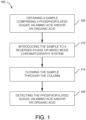
- FIG. 1 is a flow chart of a reversed phase or mixed-mode chromatography method 100 for the determination of phosphorylated sugars, amino acids, and/or organic acids in a sample.
- the amino acid is glutamate, glutamine, isoleucine, or leucine.
- the organic acid is a metabolite or intermediate of the tricarboxylic acid (TCA) cycle, for example, isocitric, citric, aconitic, a-ketoglutaric, succinic, malic, fumaric, lactic, pyruvic acid.
- TCA tricarboxylic acid
- the reversed-phase/mixed mode chromatography method 100 includes obtaining a sample that includes the phosphorylated sugars, amino acids, and/or organic acids 105.
- the sample includes phosphorylated sugars, amino acids, and organic acids.
- the sample can include one of a phosphorylated sugar, amino acid or organic acid, or any combination thereof.
- the sample includes multiple different types or sugars, amino acids, and/or organic acids.
- the sample can also include a nucleotide.
- FIG. 2 is a schematic of an exemplary reversed-phase or mixed-mode chromatography system 200.
- the reversed-phase or mixed-mode chromatography system 200 includes a mobile phase reservoir 205 that stores a mobile phase eluent or multiple mobile phase eluents.
- a pump 210 pumps the mobile phase eluent(s) from the mobile phase reservoir 205 to the reversed-phase or mixed-mode chromatography column 215.
- a sample 220 is introduced into the mobile phase eluent flow stream prior to the reversed-phase or mixed-mode chromatography column 215. The sample 220 and the mobile phase combine prior to entering the reversed-phase or mixed-mode chromatography column 215, and form a combined flow stream.
- the mobile phase eluent includes water with an additive and acetonitrile with an additive.
- the additive can be formic acid. In some embodiments, the additive is 0.1% formic acid.
- the additive can be a buffer that is compatible with mass spectrometry.
- the mobile phase eluent can consist of two separate mobile phases, mobile phase A and mobile phase B. Mobile phase A can consist essentially of 0.1% formic acid in water and mobile phase B can consist essentially of 0.1% formic acid in acetonitrile.
- the mobile phase eluent can have a linear or step gradient elution.
- the linear or step gradient elution can be a. 100% mobile phase A, 0% mobile phase B at an initial time; b. 70% mobile phase A, 30% mobile phase B at a time of 3 minutes; c. 5% mobile phase A, 95% mobile phase B at a time of 3.5 minutes; d. 5% mobile phase A, 95% mobile phase B at a time of 6.5 minutes; and e. 100% mobile phase A, 0% mobile phase B at a time of 7 minutes.
- the mobile phase eluent can have a flow rate between about 0.2 to about 1.0 mL/min.
- the mobile phase eluent flow rate can be about 0.2 mL/min, 0.3 mL/min, 0.4 mL/min, 0.5 mL/min, 0.6 mL/min, 0.7 mL/min, 0.8 mL/min, 0.9 mL/min, or 1.0 mL/min. These values can be used to define a range.
- the flow rate of the mobile phase eluent is about 0.40 mL/min.
- the mobile phase eluent has a pH less than 6. In some embodiments the pH of the mobile phase eluent is less than 5. In other embodiments, the pH of the mobile phase eluent is less than 3. The pH of the mobile phase eluent can be 2.7.
- the pH of the mobile phase eluent can be 2.0, 2.1, 2.2, 2.3, 2.4, 2.5, 2.6, 2.7, 2.8, 2.9, 3.0, 3.1, 3.2, 3.3, 3.4, 3.5, 3.6, 3.7, 3.8, 3.9, 4.0, 4.1, 4.2, 4.3, 4.4, 4.5, 4.6, 4.7, 4.8, 4.9, 5.0, 5.1, 5.2, 5.3, 5.4, 5.5, 5.6, 5.7, 5.8, 5.9, or 6.0. These values can be used to define a range.
- the reversed-phase or mixed-mode chromatography column 215 contains a stationary phase inside the column 215.
- the stationary phase material has a surface that includes a hydrophobic surface group and an ionizable modifier.
- the hydrophobic surface group contains a phenyl functional group.
- the phenyl functional group can include unsubstituted and substituted phenyl groups.
- the stationary phase can include a fluoro-phenyl functional group or a phenyl-hexyl functional group.
- the stationary phase material can include inorganic/organic hybrid particles or ethylene bridged hybrid particles.
- the mean particle size can measure about 0.1 ⁇ m, 0.2 ⁇ m, 0.3 ⁇ m, 0.4 ⁇ m, 0.5 ⁇ m, 0.6 ⁇ m, 0.7 ⁇ m, 0.8 ⁇ m, 0.9 ⁇ m, 1.0 ⁇ m, 1.1 ⁇ m, 1.2 ⁇ m, 1.3 ⁇ m, 1.4 ⁇ m, 1.5 ⁇ m, 1.6 ⁇ m, 1.7 ⁇ m, 1.8, ⁇ m, 1.9 ⁇ m, 2.0 ⁇ m, 2.1 ⁇ m, 2.2 ⁇ m, 2.3 ⁇ m, 2.4 ⁇ m, 2.5 ⁇ m, 2.6 ⁇ m, 2.7 ⁇ m, 2.8 ⁇ m, 2.9 ⁇ m, 3.0 ⁇ m, 3.1 ⁇ m, 3.2 ⁇ m, 3.3 ⁇ m, 3.4 ⁇ m, 3.5 ⁇ m, 3.6 ⁇ m, 3.7 ⁇ m, 3.8 ⁇ m, 3.9 ⁇ m, 4.0 ⁇ m, 4.1 ⁇ m, 4.2
- the functional group imparts a certain chromatographic functionality to a chromatographic stationary phase material.
- the hydrophobic surface group is attached to the base material (particle), for example, via derivatization or coating and later crosslinking, imparting the chemical character of the hydrophobic surface group or functional group to the base material (e.g., the inorganic/organic hybrid particles or ethylene bridged hybrid particles described above).
- the ionizable modifiers and hydrophobic surface groups can be applied to a base particle using a variety of methods. For example, starting with an unbonded based particle (e.g., ethylene bridged hybrid particle (BEH)), a small controlled charge can be applied to the BEH particle surface. The resulting charged surface hybrid (CSH) particle can be then bonded and sometimes endcapped with the functional group, for example, a fluoro-phenyl functional group, a phenyl-hexyl functional group or a C 18 functional group.
- BEH ethylene bridged hybrid particle
- CSH charged surface hybrid
- the inorganic/organic hybrid particles possess both organic groups and silanol groups which can additionally be substituted or derivatized with a surface modifier.
- Surface modifiers include (typically) organic functional groups which impart a certain chromatographic functionality to a chromatographic stationary phase.
- the surface modifier can be, for example, a C 18 group, unsubstituted and substituted phenyl groups, a fluoro-phenyl, or phenyl-hexyl functional group. Examples of these functional groups are shown below.
- Example of a stationary phase having a C 18 functional group Example of a stationary phase having a C 18 functional group.
- Example of a stationary phase having a fluoro-phenyl functional group Example of a stationary phase having a fluoro-phenyl functional group.
- Example of a stationary phase having a phenyl-hexyl functional group Example of a stationary phase having a phenyl-hexyl functional group.
- Table 1 shows the properties of charged surface hybrid (CSH) bonded with C 18 , fluoro-phenyl or phenyl-hexyl functional groups. TABLE 1: Properties of CSH Bonded Phases Surface Concentration ( ⁇ mol/m 2 ) Endcapping %C pH Range CSH C 18 2.3 yes 15.5 1 - 11 CSH Phenyl-Hexyl 2.3 yes 13.5 1 - 11 CSH Fluoro-Phenyl 2.3 no 10.2 1-8
- CSH bonded phases make them useful for separating polar acidic compounds (e.g., phosphorylated sugars, amino acids, organic acids, and/or nucleotides), which are typically poorly retained on reversed-phase columns. This is demonstrated for a number of different types of analytes in the Examples.
- polar acidic compounds e.g., phosphorylated sugars, amino acids, organic acids, and/or nucleotides
- the reversed-phase chromatography column 215 can have any inner diameter that allows for the efficient separation of acidic polar compounds, e.g., phosphorylated sugars, amino acids, organic acids, and/or nucleotides.
- the inner diameter of the chromatography column 215 can be, for example, 0.05 mm, 0.075 mm, 0.1 mm, 0.2 mm, 0.3 mm, 0.4 mm, 0.5 mm, 0.6 mm, 0.7 mm, 0.8 mm.
- the inner diameter of the reversed-phase chromatography column 215 is 2.1 mm.
- the reversed-phase chromatography column 215 can have any length that allows for the separation of acidic polar compounds, e.g., phosphorylated sugars, amino acids, organic acids, and/or nucleotides.
- the length can be, for example, about 5 mm, 10 mm, 20 mm, 25 mm, 30 mm, 35 mm, 40 mm, 45 mm, 50 mm, 55 mm, 60 mm, 65 mm, 70 mm, 75 mm, 80 mm, 85 mm, 90 mm, 95 mm, 100 mm, 105 mm, 110 mm, 115 mm, 120 mm, 125 mm 150 mm, 200 mm, 250 mm, or 300 mm. These values can be used to define a range.
- the length of the reversed-phase chromatography column 215 is 100 mm.
- the reversed-phase chromatography system 200 can have a detector 222 positioned downstream of the column 215.
- the detector 222 can be used to detect the acidic polar compounds, e.g., phosphorylated sugars, amino acids, organic acids, and/or nucleotides eluting from the reversed-phase or mixed-mode chromatography column 215.
- the detector 222 can be a mass spectrometer.
- the detector 222 is a tandem mass spectrometer (MS/MS).
- the detector can be a tandem quadrupole mass spectrometer.
- a data acquisition module 225 can be in communication with the detector 222.
- the data acquisition module 225 can be used, for example, to gather/collect and analyze data received from the detector 222.
- the data acquisition module 225 can be a computer having software installed to collect and analyze the data.
- the sample and mobile phase eluent are flowed 115 through the reversed-phase/mixed-mode chromatography column (e.g., column 215 of FIG. 2 ).
- the acidic polar compounds e.g., phosphorylated sugars, amino acids, organic acids, and/or nucleotides are substantially resolved and retained on the column.
- the phosphorylated sugars, amino acids, organic acids, and/or nucleotides are separated in about 7 minutes.
- the retention time, resolution from other analytes in the sample and selectivity of analytes in a chromatography separation can be influenced by a number of factors. These factors can include the strong eluent or mobile phase, the pH of the sample and mobile phase as well as the profile and duration of the gradient.
- a positively charged sorbent e.g., a CSH sorbent
- the mobile phase gradient can then be manipulated or changed to selectively release the negatively charged analytes to elute from the column. For example, decreasing the pH of the mobile phase eluent over time will result in the negatively charged analytes being released from the stationary phase material and will elute from the column.
- the phosphorylated sugars, amino acids, organic acids, and/or nucleotides are detected 120 using a detector or multiple detectors, for example, detector 222 of FIG. 2 .
- the detector can be used to detect the phosphorylated sugars, amino acids, organic acids, and/or nucleotides eluting from the reversed-phase/mixed mode chromatography column.
- the detector can be a mass spectrometer.
- TCA tricarboxylic acid
- metabolites and intermediates of the tricarboxylic acid (TCA) cycle for example, isocitric, citric, aconitic, a-ketoglutaric, succinic, malic, fumaric, lactic and pyruvic organic acids.
- TCA tricarboxylic acid
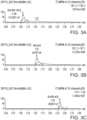
- FIGs. 3A-3I present MRM chromatograms of various TCA cycle metabolites and intermediates and the effectiveness of a mixed mode separations using a CSH C 18 column at 100 ⁇ M STD.
- FIG. 3A shows the MRM chromatogram for isocitric acid.
- FIG. 3B shows the MRM chromatogram for citric acid.
- FIG. 3C shows the MRM chromatogram for aconitic acid.
- FIG. 3D shows the MRM chromatogram for alpha ketoglutaric acid.
- FIG. 3E shows the MRM chromatogram for succinic acid.
- FIG. 3F shows the MRM chromatogram for malic acid.
- FIG. 3G shows the MRM chromatogram for fumaric acid.
- FIG. 3H shows the MRM chromatogram for lactic acid.
- FIG. 3I shows the MRM chromatogram for pyruvate acid.
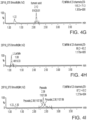
- FIGs. 4A-4I present MRM chromatograms of various TCA cycle metabolites and intermediates and the effectiveness of a mixed mode separations using a CSH phenyl hexyl column at 100 ⁇ M STD.
- FIG. 4A shows the MRM chromatogram for isocitric acid.
- FIG. 4B shows the MRM chromatogram for citric acid.
- FIG. 4C shows the MRM chromatogram for aconitic acid.
- FIG. 4D shows the MRM chromatogram for alpha ketoglutaric acid.
- FIG. 4E shows the MRM chromatogram for succinic acid.
- FIG. 4F shows the MRM chromatogram for malic acid.
- FIG. 4G shows the MRM chromatogram for fumaric acid.
- FIG. 4H shows the MRM chromatogram for lactic acid.
- FIG. 4I shows the MRM chromatogram for pyruvate acid.
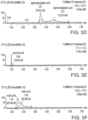
- FIGs. 5A-5I present MRM chromatograms of various TCA cycle metabolites and intermediates and the effectiveness of a mixed mode separations using a CSH fluoro phenyl column at 100 ⁇ M STD.
- FIG. 5A shows the MRM chromatogram for isocitric acid.
- FIG. 5B shows the MRM chromatogram for citric acid.
- FIG. 5C shows the MRM chromatogram for aconitic acid.
- FIG. 5D shows the MRM chromatogram for alpha ketoglutaric acid.
- FIG. 5E shows the MRM chromatogram for succinic acid.
- FIG. 5F shows the MRM chromatogram for malic acid.
- FIG. 5G shows the MRM chromatogram for fumaric acid.
- FIG. 5H shows the MRM chromatogram for lactic acid.
- FIG. 5I shows the MRM chromatogram for pyruvate acid.
- the metabolites in the TCA cycle are highly polar, most containing two or three carboxylic acid groups (see structures above).
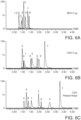
- the pK a values of the most acidic groups in these molecules range from approximately 2.8 to 3.8. They are poorly retained on conventional reversed-phase columns. It was determined that these compounds were retained on the three CSH materials, using a mobile phase containing 0.1% formic acid in water and in acetonitrile. As shown by comparing FIGS. 3A-I , 4A-I and 5A-I , the most promising results were obtained using the CSH phenyl hexyl column. While the CSH fluoro-phenyl column showed greater retention of these analytes, several exhibited poor peak shapes under these conditions.
- FIGs. 6A-C show chromatograms of the separation of TCA cycle metabolites using a BEH C 18 column ( FIG. 6A ), a CSH C 18 column ( FIG. 6B ) and a CSH phenyl-hexyl column ( FIG. 6C ).
- the columns were all 1.7 ⁇ m 2.1 x 100 mm columns.
- 1 is isocitric acid
- 2 is malic acid
- 3 is alpha-ketoglutaric acid
- 4 is lactic acid
- 5 is citric acid
- 6 is fumaric acid
- 7 is aconitric acid
- 8 succinic acid.
- the CSH columns have significant retention for anions when the mobile pH is less than 5, with retention increasing as the pH is decreased.
- the relative retention of anions increases from CSH C 18 ⁇ CSH phenyl-hexyl ⁇ CSH fluoro-phenyl.
- the ability to retain anions makes CSH columns useful for the separation of polar acids such as the TCA cycle metabolites.
- FIGs. 7A-7D show the analysis of amino acids using a CSH C 18 STD sorbent in a reversed phase column.
- FIG. 7A shows the MRM chromatogram for glutamic acid.
- FIG. 7B shows the MRM chromatogram for glutimine acid.
- FIG. 7C shows the MRM chromatogram for isoleucine acid.
- FIG. 7D shows the MRM chromatogram for leucine acid.
- FIGs. 8A-8D show the analysis of amino acids using a CSH phenyl hexyl STD sorbent in a reversed phase column.
- FIG. 8A shows the MRM chromatogram for glutamic acid.
- FIG. 8B shows the MRM chromatogram for glutimine acid.
- FIG. 8C shows the MRM chromatogram for isoleucine acid.
- FIG. 8D shows the MRM chromatogram for leucine acid.
- FIGs. 9A-9D show the analysis of amino acids using a CSH fluoro phenyl STD sorbent in a reversed phase column.
- FIG. 9A shows the MRM chromatogram for glutamic acid.
- FIG. 9B shows the MRM chromatogram for glutimine acid.
- FIG. 9C shows the MRM chromatogram for isoleucine acid.
- FIG. 9D shows the MRM chromatogram for leucine acid.
- the CSH phenyl hexyl column showed increased separation and retention for glutamate and glutamine compared to the CSH C 18 column.
- the CSH fluoro phenyl column showed increased separation and retention for glutamate and glutamine compared to both the CSH CSH C 18 column and the CSH phenyl hexyl column.
- FIGs. 10A-10D show the analysis of biomarkers using a CSH C 18 sorbent in a reversed phase column.
- FIG. 10A shows the MRM chromatogram for methylmalonic acid.
- FIG. 10B shows the MRM chromatogram for succinic acid.
- FIG. 10C shows the MRM chromatogram for aconitic acid.
- FIG. 10D shows the MRM chromatogram for itaconic acid.
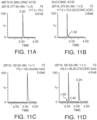
- FIGs. 11A-11D show the analysis of biomarkers using a CSH phenyl hexyl sorbent in a reversed phase column.
- FIG. 11A shows the MRM chromatogram for methylmalonic acid.
- FIG. 11B shows the MRM chromatogram for succinic acid.
- FIG. 11C shows the MRM chromatogram for aconitic acid.
- FIG. 11D shows the MRM chromatogram for itaconic acid.
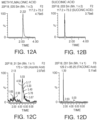
- FIGs. 12A-12D show the analysis of biomarkers using a CSH fluoro phenyl sorbent in a reversed phase column.
- FIG. 12A shows the MRM chromatogram for methylmalonic acid.
- FIG. 12B shows the MRM chromatogram for succinic acid.
- FIG. 12C shows the MRM chromatogram for aconitic acid.
- FIG. 12D shows the MRM chromatogram for itaconic acid.
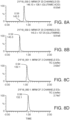
- Glucose 6 phosphate standards were prepared in water and diluted with water to make a solution of 100 ⁇ Molar. This analyte, structure shown below, was then separated using an ACQUITY ® UPLC ® I-Class LC system (commercially available from Waters Technologies Corporation, Milford, MA USA) coupled with a Xevo ® TQ S tandem quadrupole mass spectrometer operated in ESI negative mode and in MRM acquisition mode (commercially available from Waters Technologies Corporation, Milford, MA USA). Details of the method are described in Tables 8 and 9.
- FIG. 13A shows the analysis of glucose 6 phosphate using a CSH C 18 sorbent in a reversed phase column.
- FIG. 13B shows the analysis of glucose 6 phosphate using a CSH phenyl hexyl sorbent in a reversed phase column.
- FIG. 13C shows the analysis of glucose 6 phosphate using a CSH fluoro phenyl sorbent in a reversed phase column.
- the CSH fluoro phenyl sorbent showed increased separation and retention as compared to the CSH phenyl hexyl stationary phase material, which showed increased separation and retention as compared to the CSH C 18 stationary phase material.
Landscapes
- Chemical & Material Sciences (AREA)
- Analytical Chemistry (AREA)
- Chemical Kinetics & Catalysis (AREA)
- Life Sciences & Earth Sciences (AREA)
- Physics & Mathematics (AREA)
- Health & Medical Sciences (AREA)
- Biochemistry (AREA)
- General Health & Medical Sciences (AREA)
- General Physics & Mathematics (AREA)
- Immunology (AREA)
- Pathology (AREA)
- Organic Chemistry (AREA)
- Other Investigation Or Analysis Of Materials By Electrical Means (AREA)
- Treatment Of Liquids With Adsorbents In General (AREA)
Applications Claiming Priority (3)
| Application Number | Priority Date | Filing Date | Title |
|---|---|---|---|
| US201862711093P | 2018-07-27 | 2018-07-27 | |
| EP19773535.0A EP3829733B1 (fr) | 2018-07-27 | 2019-07-25 | Procédés de chromatographie liquide/spectrométrie de masse pour l'analyse de molécules polaires |
| PCT/IB2019/056379 WO2020021496A1 (fr) | 2018-07-27 | 2019-07-25 | Procédés de chromatographie liquide/spectrométrie de masse pour l'analyse de molécules polaires |
Related Parent Applications (2)
| Application Number | Title | Priority Date | Filing Date |
|---|---|---|---|
| EP19773535.0A Division EP3829733B1 (fr) | 2018-07-27 | 2019-07-25 | Procédés de chromatographie liquide/spectrométrie de masse pour l'analyse de molécules polaires |
| EP19773535.0A Division-Into EP3829733B1 (fr) | 2018-07-27 | 2019-07-25 | Procédés de chromatographie liquide/spectrométrie de masse pour l'analyse de molécules polaires |
Publications (2)
| Publication Number | Publication Date |
|---|---|
| EP4509831A2 true EP4509831A2 (fr) | 2025-02-19 |
| EP4509831A3 EP4509831A3 (fr) | 2025-03-19 |
Family
ID=68051858
Family Applications (2)
| Application Number | Title | Priority Date | Filing Date |
|---|---|---|---|
| EP24212046.7A Pending EP4509831A3 (fr) | 2018-07-27 | 2019-07-25 | Procédés de chromatographie liquide/spectrométrie de masse pour l'analyse de molécules polaires |
| EP19773535.0A Active EP3829733B1 (fr) | 2018-07-27 | 2019-07-25 | Procédés de chromatographie liquide/spectrométrie de masse pour l'analyse de molécules polaires |
Family Applications After (1)
| Application Number | Title | Priority Date | Filing Date |
|---|---|---|---|
| EP19773535.0A Active EP3829733B1 (fr) | 2018-07-27 | 2019-07-25 | Procédés de chromatographie liquide/spectrométrie de masse pour l'analyse de molécules polaires |
Country Status (4)
| Country | Link |
|---|---|
| US (1) | US11391707B2 (fr) |
| EP (2) | EP4509831A3 (fr) |
| CN (1) | CN112955239B (fr) |
| WO (1) | WO2020021496A1 (fr) |
Families Citing this family (5)
| Publication number | Priority date | Publication date | Assignee | Title |
|---|---|---|---|---|
| US11740211B2 (en) * | 2020-01-31 | 2023-08-29 | Waters Technologies Corporation | LC/MS adduct mitigation by vapor deposition coated surfaces |
| CN114280179B (zh) * | 2021-12-22 | 2024-03-15 | 北京美福润医药科技股份有限公司 | 艾塞那肽的前处理及其得到的His氨基酸洗脱液中异构体的检测方法 |
| CN114577936B (zh) * | 2022-03-03 | 2024-06-04 | 中科谱研(北京)科技有限公司 | 一种胶囊中β-烟酰胺单核苷酸的分离检测方法 |
| CN115575526A (zh) * | 2022-09-26 | 2023-01-06 | 大连工业大学 | 一种同时检测食物中22种有机酸的方法 |
| US20240139713A1 (en) * | 2022-10-31 | 2024-05-02 | Waters Technologies Corporation | Multi-component surface chemistry to eliminate retention loss in reversed-phase liquid chromatography |
Citations (4)
| Publication number | Priority date | Publication date | Assignee | Title |
|---|---|---|---|---|
| US4017528A (en) | 1973-11-16 | 1977-04-12 | Merck Patent Gesellschaft Mit Beschrankter Haftung | Preparation of organically modified silicon dioxides |
| US6528167B2 (en) | 2001-01-31 | 2003-03-04 | Waters Investments Limited | Porous hybrid particles with organic groups removed from the surface |
| US6686035B2 (en) | 1999-02-05 | 2004-02-03 | Waters Investments Limited | Porous inorganic/organic hybrid particles for chromatographic separations and process for their preparation |
| US20130319086A1 (en) | 2009-08-04 | 2013-12-05 | Waters Technologies Corporation | High purity chromatographic materials comprising an ionizable modifier |
Family Cites Families (20)
| Publication number | Priority date | Publication date | Assignee | Title |
|---|---|---|---|---|
| CA2419492C (fr) * | 2001-03-22 | 2005-07-05 | Vlaams Interuniversitair Instituut Voor Biotechnologie Vzw | Procedes et appareils destines a une analyse qualitative et quantitative sans gel du proteome et utilisations associees |
| US20060287834A1 (en) * | 2005-06-16 | 2006-12-21 | Kearney Paul E | Virtual mass spectrometry |
| EP1962097A1 (fr) * | 2007-02-23 | 2008-08-27 | SeQuant AB | Détection quantitative par spectrométrie de masse d'acide méthylmalonique et d'acide succinique utilisant l'interaction hydrophilique (hilic) sur une phase stationnaire zwittérionique |
| US20080220532A1 (en) * | 2007-03-08 | 2008-09-11 | Polylc Inc. | Separation of Charged Solutes by Electrostatic Repulsion-Hydrophilic Interaction Chromatography |
| CN102313785B (zh) * | 2011-08-04 | 2014-04-02 | 中粮生物化学(安徽)股份有限公司 | 一种柠檬酸发酵清液的分析方法 |
| US9096648B2 (en) * | 2011-08-19 | 2015-08-04 | Emd Millipore Corporation | Methods of reducing level of one or more impurities in a sample during protein purification |
| US9310344B2 (en) * | 2013-06-14 | 2016-04-12 | Dionex Corporation | HILIC/anion-exchange/cation-exchange multimodal media |
| CN103543236B (zh) * | 2013-10-12 | 2014-12-10 | 福建省农业科学院农业工程技术研究所 | 离子排斥色谱法测定发酵酒中有机酸含量的方法 |
| WO2016026286A1 (fr) | 2014-08-19 | 2016-02-25 | 行政院农业委员会农业药物毒物试验所 | Kit d'extraction rapide pour procédure de détection de résidus de pesticides dans un produit agricole et procédé permettant d'obtenir une solution mère de solution de détection à partir d'un échantillon de produit agricole |
| CN106198816A (zh) * | 2015-05-07 | 2016-12-07 | 华中科技大学 | 一种混合氨基酸含量测定方法 |
| EP4660315A3 (fr) * | 2015-05-29 | 2026-03-18 | CureVac Manufacturing GmbH | Procédé de production et de purification d'arn, comprenant au moins une étape de filtration à flux tangentiel |
| JP2018535197A (ja) * | 2015-10-09 | 2018-11-29 | ダイス モレキュルズ エスヴィー, エルエルシーDice Molecules Sv, Llc | タグ付きコンビナトリアルライブラリ化合物のLogDを推定する方法 |
| CN105510474A (zh) * | 2015-12-28 | 2016-04-20 | 福建省农业科学院农业工程技术研究所 | 一种同时测定果实或果酒中的有机酸和可溶性糖的方法 |
| JP7046814B2 (ja) | 2015-12-30 | 2022-04-04 | ジェネンテック, インコーポレイテッド | タンパク質製剤のためのトリプトファン誘導体の使用 |
| CN105699580A (zh) * | 2016-04-28 | 2016-06-22 | 河南大学 | 基于柱前衍生的lc-ms测定有机酸含量的方法 |
| CA3033856A1 (fr) * | 2016-08-15 | 2018-02-22 | Genzyme Corporation | Methodes de detection d'aav |
| CN106442758A (zh) * | 2016-08-31 | 2017-02-22 | 陈大为 | 非衍生化检测人体血浆中多种氨基酸的液相质谱方法 |
| US11092577B2 (en) | 2017-03-08 | 2021-08-17 | Waters Technologies Corporation | Polar pesticide determination using chromatography |
| US20190126241A1 (en) * | 2017-09-26 | 2019-05-02 | Waters Technologies Corporation | High purity chromatographic materials comprising an ionizable modifier for retention of acidic analytes |
| US11506581B2 (en) * | 2018-03-20 | 2022-11-22 | Agilent Technologies, Inc. | Mass spectrometry compatible salt formation for ionic liquid sample preparation |
-
2019
- 2019-07-25 EP EP24212046.7A patent/EP4509831A3/fr active Pending
- 2019-07-25 US US16/522,191 patent/US11391707B2/en active Active
- 2019-07-25 CN CN201980050095.9A patent/CN112955239B/zh active Active
- 2019-07-25 WO PCT/IB2019/056379 patent/WO2020021496A1/fr not_active Ceased
- 2019-07-25 EP EP19773535.0A patent/EP3829733B1/fr active Active
Patent Citations (5)
| Publication number | Priority date | Publication date | Assignee | Title |
|---|---|---|---|---|
| US4017528A (en) | 1973-11-16 | 1977-04-12 | Merck Patent Gesellschaft Mit Beschrankter Haftung | Preparation of organically modified silicon dioxides |
| US6686035B2 (en) | 1999-02-05 | 2004-02-03 | Waters Investments Limited | Porous inorganic/organic hybrid particles for chromatographic separations and process for their preparation |
| US6528167B2 (en) | 2001-01-31 | 2003-03-04 | Waters Investments Limited | Porous hybrid particles with organic groups removed from the surface |
| US7175913B2 (en) | 2001-01-31 | 2007-02-13 | Waters Investments Limited | Porous hybrid particles with organic groups removed from the surface |
| US20130319086A1 (en) | 2009-08-04 | 2013-12-05 | Waters Technologies Corporation | High purity chromatographic materials comprising an ionizable modifier |
Non-Patent Citations (7)
| Title |
|---|
| BAJAD ET AL., JOURNAL OF CHROMATOGRAPHY A, vol. 1125, 2006, pages 76 - 88 |
| HINDER ET AL., JOURNAL OF ENDROCRINOLOGY, vol. 213, 2013, pages 1 - 11 |
| LU ET AL., ANALYTICAL CHEMISTRY, vol. 82, 2010, pages 3212 - 3221 |
| LUO ET AL., JOURNAL OF CHROMATOGRAPHY B, vol. 1147, 2007, pages 153 - 164 |
| MARCH: "J. Advanced Organic Chemistry", 1985, WILEY |
| RUSTIN ET AL., BIOCHIMICA ET BIOPHYSICA ACTA, vol. 1361, 1997, pages 185 - 197 |
| TAN ET AL., ANALYTICAL BIOCHEMISTRY, vol. 465, 2014, pages 134 - 147 |
Also Published As
| Publication number | Publication date |
|---|---|
| CN112955239A (zh) | 2021-06-11 |
| CN112955239B (zh) | 2022-11-29 |
| US11391707B2 (en) | 2022-07-19 |
| EP4509831A3 (fr) | 2025-03-19 |
| EP3829733A1 (fr) | 2021-06-09 |
| EP3829733B1 (fr) | 2024-12-18 |
| US20200033304A1 (en) | 2020-01-30 |
| WO2020021496A1 (fr) | 2020-01-30 |
Similar Documents
| Publication | Publication Date | Title |
|---|---|---|
| EP3829733B1 (fr) | Procédés de chromatographie liquide/spectrométrie de masse pour l'analyse de molécules polaires | |
| Lenco et al. | Reversed-phase liquid chromatography of peptides for bottom-up proteomics: a tutorial | |
| Madera et al. | Combining lectin microcolumns with high-resolution separation techniques for enrichment of glycoproteins and glycopeptides | |
| Staub et al. | Intact protein analysis in the biopharmaceutical field | |
| Baghdady et al. | Online comprehensive high pH reversed phase× low pH reversed phase approach for two-dimensional separations of intact proteins in top-down proteomics | |
| US20230406880A1 (en) | Detection and quantification of glycosylated peptides | |
| Røberg-Larsen et al. | Liquid chromatography, a key tool for the advancement of single-cell omics analysis | |
| JP2010519532A (ja) | 両性イオン性固定相上でのhilicを用いたメチルマロン酸およびコハク酸の質量分析的定量的検出 | |
| Xiang et al. | Experimentally validating open tubular liquid chromatography for a peak capacity of 2000 in 3 h | |
| Kuzyk et al. | CE-MS for proteomics and intact protein analysis | |
| CN102305837A (zh) | 控制恩替卡韦及其中间体有关物质和异构体含量的检测方法 | |
| JP2007532880A (ja) | エナンチオマーの分離用組成物及び方法 | |
| Gu et al. | Rapid LC–MS/MS profiling of protein amino acids and metabolically related compounds for large-scale assessment of metabolic phenotypes | |
| Eßer et al. | Improving Chromatographic Results for Oligonucleotides With Column Hardware | |
| CN114624375A (zh) | 一种油炸薯片中羧甲基赖氨酸含量的检测方法 | |
| Turfus et al. | High Performance Liquid Chromatography and Ultra‐High Performance Liquid Chromatography Including Liquid Chromatography–Mass Spectrometry | |
| US12222334B2 (en) | Use of low-bind surface coatings for analysis of tyrosine kinase inhibitors | |
| US20250052730A1 (en) | Methods for Detecting a Protein in a Sample in a Fluidic Device Using Mass Spectrometry | |
| CA3105821C (fr) | Detection et quantification de peptides glycosyles | |
| Desai et al. | Advancements in liquid chromatography-mass spectrometry: method development and applications | |
| Jian et al. | Chromatographic separation methods | |
| Xiang | The Advancement of Narrow Open Tubular Liquid Chromatography | |
| Fountain et al. | A Strategic Approach to the Quantification of Therapeutic Peptides in Biological Fluids | |
| Jacobson | HILIC-MS analysis of protein glycosylation using nonporous silica | |
| Rojahn et al. | Solving Key Challenges in (Bio) pharmaceutical Analyses |
Legal Events
| Date | Code | Title | Description |
|---|---|---|---|
| PUAI | Public reference made under article 153(3) epc to a published international application that has entered the european phase |
Free format text: ORIGINAL CODE: 0009012 |
|
| STAA | Information on the status of an ep patent application or granted ep patent |
Free format text: STATUS: THE APPLICATION HAS BEEN PUBLISHED |
|
| REG | Reference to a national code |
Ref country code: DE Ref legal event code: R079 Free format text: PREVIOUS MAIN CLASS: G01N0030960000 Ipc: B01D0015160000 |
|
| PUAL | Search report despatched |
Free format text: ORIGINAL CODE: 0009013 |
|
| AC | Divisional application: reference to earlier application |
Ref document number: 3829733 Country of ref document: EP Kind code of ref document: P |
|
| AK | Designated contracting states |
Kind code of ref document: A2 Designated state(s): AL AT BE BG CH CY CZ DE DK EE ES FI FR GB GR HR HU IE IS IT LI LT LU LV MC MK MT NL NO PL PT RO RS SE SI SK SM TR |
|
| AK | Designated contracting states |
Kind code of ref document: A3 Designated state(s): AL AT BE BG CH CY CZ DE DK EE ES FI FR GB GR HR HU IE IS IT LI LT LU LV MC MK MT NL NO PL PT RO RS SE SI SK SM TR |
|
| RIC1 | Information provided on ipc code assigned before grant |
Ipc: G01N 30/96 20060101ALI20250207BHEP Ipc: B01D 15/32 20060101ALI20250207BHEP Ipc: G01N 30/72 20060101ALI20250207BHEP Ipc: G01N 30/56 20060101ALI20250207BHEP Ipc: B01J 20/281 20060101ALI20250207BHEP Ipc: G01N 30/34 20060101ALI20250207BHEP Ipc: B01D 15/38 20060101ALI20250207BHEP Ipc: B01D 15/36 20060101ALI20250207BHEP Ipc: B01D 15/20 20060101ALI20250207BHEP Ipc: B01D 15/16 20060101AFI20250207BHEP |
|
| STAA | Information on the status of an ep patent application or granted ep patent |
Free format text: STATUS: REQUEST FOR EXAMINATION WAS MADE |
|
| STAA | Information on the status of an ep patent application or granted ep patent |
Free format text: STATUS: EXAMINATION IS IN PROGRESS |
|
| 17P | Request for examination filed |
Effective date: 20250918 |
|
| 17Q | First examination report despatched |
Effective date: 20250924 |