EP4509931A2 - Verfahren zur herstellung einer rotationsoberfläche einer uhrenkomponente - Google Patents
Verfahren zur herstellung einer rotationsoberfläche einer uhrenkomponente Download PDFInfo
- Publication number
- EP4509931A2 EP4509931A2 EP24223348.4A EP24223348A EP4509931A2 EP 4509931 A2 EP4509931 A2 EP 4509931A2 EP 24223348 A EP24223348 A EP 24223348A EP 4509931 A2 EP4509931 A2 EP 4509931A2
- Authority
- EP
- European Patent Office
- Prior art keywords
- laser beam
- watch
- revolution
- less
- component
- Prior art date
- Legal status (The legal status is an assumption and is not a legal conclusion. Google has not performed a legal analysis and makes no representation as to the accuracy of the status listed.)
- Pending
Links
Images


Classifications
-
- B—PERFORMING OPERATIONS; TRANSPORTING
- B23—MACHINE TOOLS; METAL-WORKING NOT OTHERWISE PROVIDED FOR
- B23P—METAL-WORKING NOT OTHERWISE PROVIDED FOR; COMBINED OPERATIONS; UNIVERSAL MACHINE TOOLS
- B23P15/00—Making specific metal objects by operations not covered by a single other subclass or a group in this subclass
-
- G—PHYSICS
- G04—HOROLOGY
- G04B—MECHANICALLY-DRIVEN CLOCKS OR WATCHES; MECHANICAL PARTS OF CLOCKS OR WATCHES IN GENERAL; TIME PIECES USING THE POSITION OF THE SUN, MOON OR STARS
- G04B1/00—Driving mechanisms
- G04B1/10—Driving mechanisms with mainspring
- G04B1/16—Barrels; Arbors; Barrel axles
-
- G—PHYSICS
- G04—HOROLOGY
- G04B—MECHANICALLY-DRIVEN CLOCKS OR WATCHES; MECHANICAL PARTS OF CLOCKS OR WATCHES IN GENERAL; TIME PIECES USING THE POSITION OF THE SUN, MOON OR STARS
- G04B15/00—Escapements
- G04B15/14—Component parts or constructional details, e.g. construction of the lever or the escape wheel
-
- B—PERFORMING OPERATIONS; TRANSPORTING
- B23—MACHINE TOOLS; METAL-WORKING NOT OTHERWISE PROVIDED FOR
- B23K—SOLDERING OR UNSOLDERING; WELDING; CLADDING OR PLATING BY SOLDERING OR WELDING; CUTTING BY APPLYING HEAT LOCALLY, e.g. FLAME CUTTING; WORKING BY LASER BEAM
- B23K26/00—Working by laser beam, e.g. welding, cutting or boring
- B23K26/0093—Working by laser beam, e.g. welding, cutting or boring combined with mechanical machining or metal-working covered by other subclasses than B23K
-
- B—PERFORMING OPERATIONS; TRANSPORTING
- B23—MACHINE TOOLS; METAL-WORKING NOT OTHERWISE PROVIDED FOR
- B23K—SOLDERING OR UNSOLDERING; WELDING; CLADDING OR PLATING BY SOLDERING OR WELDING; CUTTING BY APPLYING HEAT LOCALLY, e.g. FLAME CUTTING; WORKING BY LASER BEAM
- B23K26/00—Working by laser beam, e.g. welding, cutting or boring
- B23K26/02—Positioning or observing the workpiece, e.g. with respect to the point of impact; Aligning, aiming or focusing the laser beam
- B23K26/06—Shaping the laser beam, e.g. by masks or multi-focusing
- B23K26/062—Shaping the laser beam, e.g. by masks or multi-focusing by direct control of the laser beam
- B23K26/0622—Shaping the laser beam, e.g. by masks or multi-focusing by direct control of the laser beam by shaping pulses
- B23K26/0624—Shaping the laser beam, e.g. by masks or multi-focusing by direct control of the laser beam by shaping pulses using ultrashort pulses, i.e. pulses of 1 ns or less
-
- B—PERFORMING OPERATIONS; TRANSPORTING
- B23—MACHINE TOOLS; METAL-WORKING NOT OTHERWISE PROVIDED FOR
- B23K—SOLDERING OR UNSOLDERING; WELDING; CLADDING OR PLATING BY SOLDERING OR WELDING; CUTTING BY APPLYING HEAT LOCALLY, e.g. FLAME CUTTING; WORKING BY LASER BEAM
- B23K26/00—Working by laser beam, e.g. welding, cutting or boring
- B23K26/352—Working by laser beam, e.g. welding, cutting or boring for surface treatment
-
- B—PERFORMING OPERATIONS; TRANSPORTING
- B23—MACHINE TOOLS; METAL-WORKING NOT OTHERWISE PROVIDED FOR
- B23K—SOLDERING OR UNSOLDERING; WELDING; CLADDING OR PLATING BY SOLDERING OR WELDING; CUTTING BY APPLYING HEAT LOCALLY, e.g. FLAME CUTTING; WORKING BY LASER BEAM
- B23K26/00—Working by laser beam, e.g. welding, cutting or boring
- B23K26/36—Removing material
- B23K26/362—Laser etching
-
- G—PHYSICS
- G04—HOROLOGY
- G04B—MECHANICALLY-DRIVEN CLOCKS OR WATCHES; MECHANICAL PARTS OF CLOCKS OR WATCHES IN GENERAL; TIME PIECES USING THE POSITION OF THE SUN, MOON OR STARS
- G04B13/00—Gearwork
- G04B13/02—Wheels; Pinions; Spindles; Pivots
-
- G—PHYSICS
- G04—HOROLOGY
- G04B—MECHANICALLY-DRIVEN CLOCKS OR WATCHES; MECHANICAL PARTS OF CLOCKS OR WATCHES IN GENERAL; TIME PIECES USING THE POSITION OF THE SUN, MOON OR STARS
- G04B31/00—Bearings; Point suspensions or counter-point suspensions; Pivot bearings; Single parts therefor
- G04B31/06—Manufacture or mounting processes
-
- G—PHYSICS
- G04—HOROLOGY
- G04D—APPARATUS OR TOOLS SPECIALLY DESIGNED FOR MAKING OR MAINTAINING CLOCKS OR WATCHES
- G04D3/00—Watchmakers' or watch-repairers' machines or tools for working materials
- G04D3/0074—Watchmakers' or watch-repairers' machines or tools for working materials for treatment of the material, e.g. surface treatment
- G04D3/0079—Watchmakers' or watch-repairers' machines or tools for working materials for treatment of the material, e.g. surface treatment for gearwork components
- G04D3/0084—Watchmakers' or watch-repairers' machines or tools for working materials for treatment of the material, e.g. surface treatment for gearwork components for axles, sleeves
-
- B—PERFORMING OPERATIONS; TRANSPORTING
- B23—MACHINE TOOLS; METAL-WORKING NOT OTHERWISE PROVIDED FOR
- B23K—SOLDERING OR UNSOLDERING; WELDING; CLADDING OR PLATING BY SOLDERING OR WELDING; CUTTING BY APPLYING HEAT LOCALLY, e.g. FLAME CUTTING; WORKING BY LASER BEAM
- B23K2103/00—Materials to be soldered, welded or cut
- B23K2103/50—Inorganic materials other than metals or composite materials
- B23K2103/52—Ceramics
Definitions
- the invention relates to a method for producing a surface of revolution of a watch component, more particularly a ceramic watch component.
- the invention also relates to a watch component obtained by such a production method.
- the invention also relates to a watch movement comprising such a watch component.
- the invention relates to a timepiece comprising such a watch component or such a watch movement.
- An alternative to machining ceramics by grinding is to machine ceramics by femtosecond laser ablation.
- the lasers used have ultra-short pulses (femtosecond laser) so as not to thermally affect the machined material.
- the equipment currently available for example for the production of hard metal electrodes or other small, generally metallic elements (such as micro-tweezers) use a laser emitting in the IR infrared (wavelength of 1030 nm). It has not been possible to obtain satisfactory results using this type of equipment: the roughness obtained at the machining exit is significant, it requires a very long specific tribofinishing to achieve the required roughness and despite the geometric conformity of the parts, the bending resistance performances are not in line with expectations.
- the bending resistance of pivots of axes of identical geometry was measured by applying a force using a knife at a given distance from the end of a pivot, the part being held in support at a bearing surface forming the interface between said pivot and the main body of the axis.
- the bending resistance of pivots of different axes is represented by the figure 9 , which indicates the stress levels at failure of the pivots of each of these axes.
- the measured stresses are correlated to the area of the section of each of the pivots at the location of application of the maximum force initiating the failure.
- the ground 3% yttria zirconia (ZRO 2 Y 2 O 3 3%) parts are thus more resistant than the 3% yttria zirconia (ZRO 2 Y 2 O 3 3%) parts machined by laser using the state-of-the-art femtosecond laser machining process, whether they have been subsequently polished or polished and then tribofinished.
- ceramic watch axes machined by femtosecond laser may exhibit unsatisfactory behavior in use, although they are dimensionally compliant.
- the aim of the invention is to provide a method for producing a surface of revolution of a ceramic watch component improving the methods known from the prior art.
- the invention proposes a method for producing a reliable component, in particular a balance staff or an axis of an escapement wheel or an axis of a seconds wheel or any other axis taking part in a wheel of a finishing chain of a watch movement, in a repeatable manner.
- the present invention also aims to accelerate and make the machining of ceramic more reliable so as to obtain components of the axis type with the required dimensions (diameter ⁇ 2 mm, tolerance to the micron) while guaranteeing adequate resistance to shocks.
- a watch component is defined by claim 12 or 13.
- a watch movement is defined by claim 14.
- a timepiece is defined by claim 15.
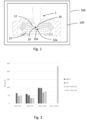
- the timepiece 200 is for example a wristwatch.
- the timepiece preferably comprises a watch case and a watch movement 100.
- the watch movement can be a mechanical movement, in particular an automatic movement.
- the watch movement comprises an embodiment of a watch component 1.
- the watch component is for example an axis, in particular a balance shaft of a watch oscillator of the sprung balance type or an axis of an escapement wheel or an axis of a seconds wheel.
- the diameter of the component in particular the maximum diameter of the component, is for example less than or equal to 2 mm.
- the watch component preferably comprises a pivot 10.
- pivot we mean a portion of component, in particular of axis, intended to cooperate, in particular to cooperate by contact, with a bearing, in particular a pivot jewel.
- This pivot may have at least one portion of cylindrical or conical or truncated geometry.
- the pivot is preferably arranged at one end of the axis.
- the pivot may, for example, be formed in the continuity of a portion of axis comprising a surface with a curved generatrix.
- the watch movement also includes a bearing 12, or even several bearings mounted on an element of the movement, in particular on a movement frame.
- the watch component is for example intended to cooperate, in particular to cooperate by contact, with the bearing 12.
- the watch component cooperates with the bearing 12 at the pivot 10.
- the watch component cooperates with the bearing 12 at a surface 20 of revolution located at the pivot 10.
- the diameter of a section of the surface 20 of revolution is for example less than or equal to 200 ⁇ m, or even less than or equal to 100 ⁇ m.
- the pivot may be axially delimited by a counter-pivot 13 at one end 10a of the pivot 10.
- the elements 12 and 13 may be arranged within the same element taking the form of a shock absorber body.
- the axis is preferably a balance shaft or an axis of an escapement wheel.
- the bearing comprises a bore.
- the bore and the surface of revolution are sized and/or arranged to have a limited functional clearance, for example of the order of 7 to 17 ⁇ m.
- the watch component comprises two pivots 10 to cooperate with two bearings 12 so as to guide the watch component relative to the bearings and more generally relative to the watch movement element on which the bearings are mounted.
- the watch component or a part of the watch component is made of ceramic.
- the surface 20 of revolution is made of ceramic, that is to say that the surface of revolution is formed or is located on a ceramic part of the component.
- the ceramic is a zirconia, in particular a yttria-containing zirconia, in particular a 3% yttria-containing zirconia, a monocrystalline alumina or an alumina-zirconia combination (ATZ).
- all or part of the watch component is made of ceramic, and comprises the surface 20 of revolution whose roughness Ra is less than or equal to 15 nm.
- the watch component comprises a pivot comprising said surface of revolution.
- the shear breaking stress of the pivot of the component is greater than 200 N.mm -2 , or even greater than 250 N.mm -2 .
- Such a method makes it possible to obtain watch components comprising a ceramic surface of revolution, which is geometrically compliant and which has adequate roughness after a tribofinishing of a reasonable duration, typically of the order of 10 hours.
- This tribofinishing step must be parameterized so as not to modify the geometry of the surface, in particular so as to avoid excessively rounding the end of the pivot(s) comprising said surface of revolution in order to maintain control of the contact zone between the pivot and the bearing. It is therefore essential that the initial roughness before this step is low enough to allow a tribofinishing step of a reasonable duration.
- the roughness Ra of the surface of revolution finally obtained is for example of the order of 10 to 15 nm.
- Such a process provides an alternative to machining ceramics by grinding and consists of machining the ceramic by femtosecond laser ablation without weakening its mechanical strength.
- the lasers used have ultra-short pulses (femtosecond laser) so as not to thermally affect the machined material, in wavelengths adapted so as not to affect the structure of the material.
- the method allows the production not only of the surface 20 of revolution of the watch component 1, but of the entire surface of the pivot comprising said surface 20, or even of all the surfaces of the watch component.
- the laser beam emits in the infrared with a wavelength between 800 nm and 1100 nm, ideally 1030 nm ⁇ 5 nm or in the green with a wavelength between 500 nm and 540 nm, ideally 515 nm ⁇ 2.55 nm or in the blue with a wavelength between 400 nm and 480 nm or in the ultraviolet with a wavelength less than 400 nm, ideally 343 nm ⁇ 25 nm.
- the machining step comprises a turning phase, i.e. a machining step in which the watch component is rotated about an axis of rotation and in which the laser beam is movable relative to this axis of rotation.
- a turning phase i.e. a machining step in which the watch component is rotated about an axis of rotation and in which the laser beam is movable relative to this axis of rotation. Any other kinematics is conceivable as long as the laser beam scans a surface of the component.
- the laser beam has an average energy per pulse (also called fluence) between 0.001 mJ and 2 mJ, preferably between 0.01 mJ and 0.5 mJ, or even between 0.04 and 0.05 mJ for the materials and dimensions tested.
- average energy per pulse also called fluence
- the lateral coverage rate i.e. perpendicular to the turning direction or perpendicular to the component axis, is defined by the part rotation speed and the laser frequency, and can be defined between 0% and 99.9%. It is preferably between 20% and 99.9%, ideally between 99.6% and 99.8%.
- the longitudinal coverage rate is defined by the beam scanning or carriage speed and the laser frequency, and can be set between 0 and 99.9%. It is preferably between 20 and 99.9%, ideally between 0% and 80.8%. It should be noted that a longitudinal coverage rate of 100% corresponds to cutting the part.
- the laser beam scans the first surface in a helical trajectory.
- the laser beam is applied in directions tangent to the first surface, or in directions substantially tangent to the first surface.
- the laser beam may be applied in directions normal to the first surface, or in directions substantially normal to the first surface.
- the laser beam has a diameter between 5 ⁇ m and 100 ⁇ m, preferably between 10 ⁇ m and 60 ⁇ m and ideally between 15 ⁇ m and 25 ⁇ m for the materials and dimensions tested.
- the duration of the tribofinishing step is less than 20 hours, preferably less than 10 hours.
- the tribofinishing step comprises a bulk polishing step.
- the tribofinishing step comprises the use of diamond abrasive particles with a size of the order of 1 ⁇ m.
- the tribofinishing step comprises the use of a ceramic carrier in the form of balls with a size of between 125 and 250 ⁇ m, with added water and an additive.
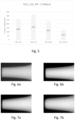
- the green lasers (Ref. 515) and UV lasers (Ref. 343) make it possible to obtain satisfactory roughnesses at the machining output, of the order of 50 nm, for various technical ceramics.
- the IR laser (Ref. 1030) makes it possible to obtain roughnesses at the machining output of the order of 50 to 100 nm, for various technical ceramics, provided that the configuration of the equipment allows the parameters to be optimized compared to the equipment and parameters known from the state of the art (Ref. 1030-C).
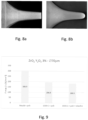
- Figures 6a and 7a represent the appearance of a 3% yttria zirconia pivot just after the machining step respectively with a green laser and with a UV laser.
- the Figures 6b and 7b represent the appearance of a 3% yttria zirconia pivot after the tribofinishing step applied respectively to pivots as illustrated in Figures 6a and 7a .
- the final roughness of the components illustrated on the Figures 4c , 6b and 7b are satisfactory, but the end of the pivot of the figure 4c is rounded; this change in geometry will influence the chronometric performance of the watch equipped with such a pivot.
- the resistance of pivots to bending is greater for watch components machined with the green laser (Ref. 515) compared to watch components machined with the IR laser (Ref. 1030) or the UV laser (Ref. 343).
- This test was carried out for watch components made of 3% yttria zirconia.
- the term “watch component” refers to the component produced by implementing the process regardless of its stage of production, i.e. the term “watch component” refers to the component before laser machining, after laser machining or even after tribofinishing, although the component undergoes modifications during the process.
- the surface 20 of revolution is here described specifically at the level of the pivot of a balance staff, but any other surface of revolution of a watch staff for which a particular geometry and/or roughness should be achieved can also be produced according to the same method.
- the method described above makes it possible to produce an axis of an escapement wheel set or an axis of a seconds wheel set or any other axis taking part in a wheel set of a finishing chain of a watch movement.
- Such an axle may comprise a first toothed portion 30.
- This portion 30 may be integral with the axle.
- the axle may be in the form of a shafted pinion.
- Such a shafted pinion may comprise a second portion 40 for receiving a wheel plate.
- such a shafted pinion may be made entirely of ceramic.
- first toothed portion 30 may be attached to a third portion for receiving the axis, for example by driving.
- the first toothed portion 30 may be metallic.
- the maximum diameter of the first toothed portion 30 is, for example, less than or equal to 2 mm.
- the teeth of the first portion 30 may have a conventional profile, such as a Treybal profile.
- a femtosecond laser beam (green or UV) allows a saving of time and an optimization of the properties of the final component, provided that certain machining conditions are respected. It is also possible that a femtosecond laser beam operating in the IR can also allow to obtain adequate results under certain conditions.
- ceramic means a homogeneous or substantially homogeneous material, including at the microscopic level.
- the ceramic is homogeneous in at least one direction, or even in all directions, over a distance greater than 6 ⁇ m, or even greater than 10 ⁇ m, or even greater than 20 ⁇ m.
- the ceramic does not have non-ceramic material in at least one direction, or even in all directions, over a distance greater than 6 ⁇ m, or even greater than 10 ⁇ m, or even greater than 20 ⁇ m.
- a metal component for example a component, in particular an axle, made of tungsten or tantalum or any other hard metal difficult to machine by conventional means, could benefit from such a method.
Landscapes
- Physics & Mathematics (AREA)
- Engineering & Computer Science (AREA)
- Optics & Photonics (AREA)
- Mechanical Engineering (AREA)
- General Physics & Mathematics (AREA)
- Plasma & Fusion (AREA)
- Manufacturing & Machinery (AREA)
- Compositions Of Oxide Ceramics (AREA)
- Laser Beam Processing (AREA)
Priority Applications (1)
| Application Number | Priority Date | Filing Date | Title |
|---|---|---|---|
| EP24223348.4A EP4509931A3 (de) | 2019-04-12 | 2019-04-12 | Verfahren zur herstellung einer rotationsoberfläche einer uhrenkomponente |
Applications Claiming Priority (2)
| Application Number | Priority Date | Filing Date | Title |
|---|---|---|---|
| EP24223348.4A EP4509931A3 (de) | 2019-04-12 | 2019-04-12 | Verfahren zur herstellung einer rotationsoberfläche einer uhrenkomponente |
| EP19169113.8A EP3722887A1 (de) | 2019-04-12 | 2019-04-12 | Herstellungsverfahren einer rotationsfläche einer uhrwerkskomponente |
Related Parent Applications (1)
| Application Number | Title | Priority Date | Filing Date |
|---|---|---|---|
| EP19169113.8A Division EP3722887A1 (de) | 2019-04-12 | 2019-04-12 | Herstellungsverfahren einer rotationsfläche einer uhrwerkskomponente |
Publications (2)
| Publication Number | Publication Date |
|---|---|
| EP4509931A2 true EP4509931A2 (de) | 2025-02-19 |
| EP4509931A3 EP4509931A3 (de) | 2025-04-23 |
Family
ID=66175333
Family Applications (2)
| Application Number | Title | Priority Date | Filing Date |
|---|---|---|---|
| EP24223348.4A Pending EP4509931A3 (de) | 2019-04-12 | 2019-04-12 | Verfahren zur herstellung einer rotationsoberfläche einer uhrenkomponente |
| EP19169113.8A Pending EP3722887A1 (de) | 2019-04-12 | 2019-04-12 | Herstellungsverfahren einer rotationsfläche einer uhrwerkskomponente |
Family Applications After (1)
| Application Number | Title | Priority Date | Filing Date |
|---|---|---|---|
| EP19169113.8A Pending EP3722887A1 (de) | 2019-04-12 | 2019-04-12 | Herstellungsverfahren einer rotationsfläche einer uhrwerkskomponente |
Country Status (4)
| Country | Link |
|---|---|
| US (1) | US12055893B2 (de) |
| EP (2) | EP4509931A3 (de) |
| JP (1) | JP7661011B2 (de) |
| CN (1) | CN111805169A (de) |
Families Citing this family (5)
| Publication number | Priority date | Publication date | Assignee | Title |
|---|---|---|---|---|
| EP3770699B1 (de) * | 2019-07-26 | 2025-03-26 | Comadur S.A. | Stein für ein uhrwerk, und sein herstellungsverfahren |
| EP3770698B1 (de) * | 2019-07-26 | 2025-03-12 | Comadur SA | Mineralstein vom monokristallinen typ mit einem kegel zur neuzentrierung eines zapfens, und sein herstellungsverfahren |
| EP4327165B1 (de) * | 2021-04-20 | 2026-07-22 | Acrotec R&D SA | Drehachse eines uhrwerks und verfahren zur herstellung einer solchen drehachse |
| WO2022223479A1 (fr) | 2021-04-20 | 2022-10-27 | Acrotec R&D Sa | Procede de fabrication d'un axe de pivotement de type horloger |
| JP7622572B2 (ja) * | 2021-07-12 | 2025-01-28 | セイコーエプソン株式会社 | 時計部品、時計及び時計部品の製造方法 |
Citations (2)
| Publication number | Priority date | Publication date | Assignee | Title |
|---|---|---|---|---|
| FR2871080A1 (fr) | 2004-06-08 | 2005-12-09 | Guy Semon | Procede de fabrication d'organes micromecaniques et nanomecaniques a l'aide d'un laser a impulsions courtes |
| EP3258325A1 (de) | 2016-06-13 | 2017-12-20 | Rolex Sa | Uhrenwelle |
Family Cites Families (21)
| Publication number | Priority date | Publication date | Assignee | Title |
|---|---|---|---|---|
| JPS5410770A (en) | 1977-06-27 | 1979-01-26 | Seiko Epson Corp | Electronic watch |
| CA2428187C (en) * | 2002-05-08 | 2012-10-02 | National Research Council Of Canada | Method of fabricating sub-micron structures in transparent dielectric materials |
| JP2011514664A (ja) | 2008-01-31 | 2011-05-06 | プレジデント アンド フェローズ オブ ハーバード カレッジ | パルスレーザ照射を介してドープされる材料の平坦面の工学 |
| JP5526870B2 (ja) | 2009-04-06 | 2014-06-18 | セイコーエプソン株式会社 | 時計輪列、および時計 |
| JP5362634B2 (ja) | 2010-03-29 | 2013-12-11 | Ntn株式会社 | 動圧軸受装置およびその製造方法 |
| CH704450B1 (fr) * | 2011-02-03 | 2015-08-28 | Nivarox Sa | Pièce de micromécanique complexe et son procédé de fabrication. |
| EP2607971A1 (de) | 2011-12-22 | 2013-06-26 | The Swatch Group Research and Development Ltd. | Verfahren zur Herstellung eines Bauteils |
| US20150049593A1 (en) | 2012-03-12 | 2015-02-19 | Rolex Sa | Method for engraving a timepiece component and timepiece component obtained using such a method |
| EP2717103B1 (de) * | 2012-10-04 | 2017-01-11 | The Swatch Group Research and Development Ltd. | Leuchtende Spiralfeder |
| JP6096065B2 (ja) | 2013-06-13 | 2017-03-15 | キヤノンマシナリー株式会社 | 摺動部材の製造方法 |
| CH708827A2 (fr) * | 2013-11-08 | 2015-05-15 | Nivarox Sa | Pièce de micromécanique creuse, à plusieurs niveaux fonctionnels et monobloc en un matériau à base d'un allotrope synthétique du carbone. |
| CH708998B1 (fr) * | 2013-12-16 | 2018-08-31 | Tgm Dev Sa C/O Etude Tissot | Composant horloger et procédé pour réduire le coefficient de frottement d'un composant horloger. |
| EP3126914B1 (de) * | 2014-04-04 | 2020-05-06 | Rolex Sa | Verfahren zur herstellung einer uhrenkomponente mit einem einsatz aus einem verbundmaterial und zugehörige uhrenkomponente und uhr |
| JP5917600B2 (ja) | 2014-06-02 | 2016-05-18 | キヤノンマシナリー株式会社 | 摺動部材の製造方法 |
| EP3067757A1 (de) * | 2015-03-13 | 2016-09-14 | The Swatch Group Research and Development Ltd. | Tribologischer mikrostrukturbehälter |
| EP3273303B1 (de) | 2016-07-19 | 2025-10-01 | Nivarox-FAR S.A. | Bauteil für uhrwerk |
| JP6862793B2 (ja) * | 2016-11-24 | 2021-04-21 | セイコーエプソン株式会社 | 時計用部品および時計 |
| US10688597B2 (en) | 2016-12-15 | 2020-06-23 | Tectus Corporation | Polishing optical elements with a femtosecond laser beam |
| CN109048054B (zh) * | 2018-09-27 | 2021-01-05 | 广东工业大学 | 一种多轴激光-磨料水射流精密抛光同步加工方法 |
| CH715613A1 (fr) * | 2018-12-06 | 2020-06-15 | Richemont Int Sa | Procédé de réalisation d'un axe de balancier et axe de balancier. |
| CN109514076B (zh) | 2018-12-18 | 2020-04-14 | 北京工业大学 | 一种皮秒-纳秒激光复合异步抛光陶瓷的工艺方法 |
-
2019
- 2019-04-12 EP EP24223348.4A patent/EP4509931A3/de active Pending
- 2019-04-12 EP EP19169113.8A patent/EP3722887A1/de active Pending
-
2020
- 2020-04-03 US US16/839,230 patent/US12055893B2/en active Active
- 2020-04-03 JP JP2020067277A patent/JP7661011B2/ja active Active
- 2020-04-10 CN CN202010280093.3A patent/CN111805169A/zh active Pending
Patent Citations (2)
| Publication number | Priority date | Publication date | Assignee | Title |
|---|---|---|---|---|
| FR2871080A1 (fr) | 2004-06-08 | 2005-12-09 | Guy Semon | Procede de fabrication d'organes micromecaniques et nanomecaniques a l'aide d'un laser a impulsions courtes |
| EP3258325A1 (de) | 2016-06-13 | 2017-12-20 | Rolex Sa | Uhrenwelle |
Non-Patent Citations (7)
| Title |
|---|
| ANONYMOUS: "Les pignons et leur importance dans l'industrie horlogère", LA SUISSE HORLOGÈRE - INTERNATIONAL EDITION, 1 January 1971 (1971-01-01), pages 83 - 85, XP093405718 |
| ANONYMOUS: "machine à rouler ST 119 SPS & AB", STRAUSAK, 1 January 2012 (2012-01-01), pages 1 - 7, XP093405687, Retrieved from the Internet <URL:https://www.strausak-mikro.ch/fileadmin/user_upload/Media/strausak/Factsheets/FR/ST_119_SPS_AB_F.pdf> |
| ANONYMOUS: "Ra-Rz Conversion DIN 47", SCRIBD, 1 January 2015 (2015-01-01), pages 1 - 2, XP093405724 |
| ANONYMOUS: "Revue internationale de l'horlogerie", ESKA, vol. 22, 15 November 1950 (1950-11-15), La Chaux de-fonds, pages 50 - 51, XP093405704 |
| NAKAMURA YOSHIHARU, HOJO SATORU, SATO HIDEAKI: "The effect of surface roughness on the Weibull distribution of porcelain strength", DENTAL MATERIALS JOURNAL, THE JAPANESE SOCIETY FOR DENTAL MATERIALS AND DEVICES, JP, vol. 29, no. 1, 1 January 2010 (2010-01-01), JP , pages 30 - 34, XP093405622, ISSN: 0287-4547, DOI: 10.4012/dmj.2009-059 |
| PERIN JAQUES: "Repères pour la formation et l'évaluation", BACCALAURÉAT PROFESSIONNEL MICROTECHNIQUES, 1 September 2004 (2004-09-01), pages 78 - 78, XP093405715 |
| VORBURGER T V, RAJA J: "Surface finish metrology tutorial", US DEPARTMENT OF COMMERCE - NISTIR 89-4088, 1 June 1990 (1990-06-01), pages 1 - 162, XP093405708 |
Also Published As
| Publication number | Publication date |
|---|---|
| CN111805169A (zh) | 2020-10-23 |
| US12055893B2 (en) | 2024-08-06 |
| US20200326656A1 (en) | 2020-10-15 |
| EP3722887A1 (de) | 2020-10-14 |
| JP2020180968A (ja) | 2020-11-05 |
| JP7661011B2 (ja) | 2025-04-14 |
| EP4509931A3 (de) | 2025-04-23 |
Similar Documents
| Publication | Publication Date | Title |
|---|---|---|
| EP3722887A1 (de) | Herstellungsverfahren einer rotationsfläche einer uhrwerkskomponente | |
| CH704016A2 (fr) | Assemblage d'une pièce ne comportant pas de domaine plastique. | |
| EP4018268B1 (de) | Verfahren zur herstellung eines uhrenlagers | |
| CH716071A2 (fr) | Procédé de réalisation d'une surface de révolution d'un composant horloger. | |
| EP3770698B1 (de) | Mineralstein vom monokristallinen typ mit einem kegel zur neuzentrierung eines zapfens, und sein herstellungsverfahren | |
| EP4386485A1 (de) | Verfahren zur herstellung einer uhrenkomponente | |
| EP4004653B1 (de) | Stein, insbesondere für ein uhrwerk, und sein herstellungsverfahren | |
| WO2024105218A1 (fr) | Procédé de préparation d'une pierre d'horlogerie en vue d'une mesure de la rugosité et procédé de mesure. | |
| EP4619830A1 (de) | Verfahren zum polieren eines uhrensteins und ausrüstung zur durchführung des verfahrens | |
| EP3112955B1 (de) | Herstellungsverfahren eines werkstücks, das einen modifizierten polierschritt umfasst | |
| WO2022223479A1 (fr) | Procede de fabrication d'un axe de pivotement de type horloger | |
| EP2889703B1 (de) | Herstellungsverfahren eines mechanischen bauteils aus diamant für das uhrwerk einer armbanduhr, und nach diesem verfahren hergestelltes bauteil | |
| EP2889702B1 (de) | Ankerplatte für die Bewegungshemmung einer Armbanduhr, und angepasstes Herstellungsverfahren | |
| EP4684903A1 (de) | Verfahren zur herstellung einer uhrenkomponente | |
| EP4619829A1 (de) | Verfahren und system zum waschen eines uhrensteins | |
| EP4619831A1 (de) | Uhrenstein mit geradem loch mit verbessertem oberflächenzustand | |
| WO2024074517A1 (fr) | Axe horloger | |
| WO2025219460A1 (fr) | Procédé de fabrication d'un pignon horloger | |
| CH716178B1 (fr) | Procédé de fabrication d'un palier horloger. | |
| WO2025219456A1 (fr) | Procédé de fabrication d'un composant horloger | |
| CH720233A2 (fr) | Pierre d'horlogerie comprenant un trou de pivotement présentant des stries principales | |
| EP4625063A1 (de) | Unruh für uhrwerk, und herstellungsverfahren einer solchen unruh | |
| CH716430A2 (fr) | Pierre minérale de type monocristalline munie d'un cone de recentrage d'un pivot, et son procédé de fabrication. | |
| CH711216A2 (fr) | Procédé de fabrication comportant une étape de décolletage. | |
| CH711214A2 (fr) | Procédé de fabrication d'une pièce comportant une étape de brunissage. |
Legal Events
| Date | Code | Title | Description |
|---|---|---|---|
| PUAI | Public reference made under article 153(3) epc to a published international application that has entered the european phase |
Free format text: ORIGINAL CODE: 0009012 |
|
| STAA | Information on the status of an ep patent application or granted ep patent |
Free format text: STATUS: THE APPLICATION HAS BEEN PUBLISHED |
|
| AC | Divisional application: reference to earlier application |
Ref document number: 3722887 Country of ref document: EP Kind code of ref document: P |
|
| AK | Designated contracting states |
Kind code of ref document: A2 Designated state(s): AL AT BE BG CH CY CZ DE DK EE ES FI FR GB GR HR HU IE IS IT LI LT LU LV MC MK MT NL NO PL PT RO RS SE SI SK SM TR |
|
| REG | Reference to a national code |
Ref country code: DE Ref legal event code: R079 Free format text: PREVIOUS MAIN CLASS: G04D0003000000 Ipc: G04B0001160000 |
|
| PUAL | Search report despatched |
Free format text: ORIGINAL CODE: 0009013 |
|
| AK | Designated contracting states |
Kind code of ref document: A3 Designated state(s): AL AT BE BG CH CY CZ DE DK EE ES FI FR GB GR HR HU IE IS IT LI LT LU LV MC MK MT NL NO PL PT RO RS SE SI SK SM TR |
|
| RIC1 | Information provided on ipc code assigned before grant |
Ipc: G04D 3/00 20060101ALI20250320BHEP Ipc: G04B 13/02 20060101ALI20250320BHEP Ipc: G04B 1/16 20060101AFI20250320BHEP |
|
| P01 | Opt-out of the competence of the unified patent court (upc) registered |
Free format text: CASE NUMBER: APP_23636/2025 Effective date: 20250517 |
|
| STAA | Information on the status of an ep patent application or granted ep patent |
Free format text: STATUS: REQUEST FOR EXAMINATION WAS MADE |
|
| 17P | Request for examination filed |
Effective date: 20251014 |
|
| GRAP | Despatch of communication of intention to grant a patent |
Free format text: ORIGINAL CODE: EPIDOSNIGR1 |
|
| STAA | Information on the status of an ep patent application or granted ep patent |
Free format text: STATUS: GRANT OF PATENT IS INTENDED |
|
| INTG | Intention to grant announced |
Effective date: 20260326 |
|
| TPAC | Observations filed by third parties |
Free format text: ORIGINAL CODE: EPIDOSNTIPA |
|
| GRAS | Grant fee paid |
Free format text: ORIGINAL CODE: EPIDOSNIGR3 |
|
| GRAA | (expected) grant |
Free format text: ORIGINAL CODE: 0009210 |
|
| STAA | Information on the status of an ep patent application or granted ep patent |
Free format text: STATUS: THE PATENT HAS BEEN GRANTED |