EP4509934A1 - Procédé et appareil de traitement de données pour l'ajustement automatique de paramètres d'un modèle mathématique - Google Patents
Procédé et appareil de traitement de données pour l'ajustement automatique de paramètres d'un modèle mathématique Download PDFInfo
- Publication number
- EP4509934A1 EP4509934A1 EP23191929.1A EP23191929A EP4509934A1 EP 4509934 A1 EP4509934 A1 EP 4509934A1 EP 23191929 A EP23191929 A EP 23191929A EP 4509934 A1 EP4509934 A1 EP 4509934A1
- Authority
- EP
- European Patent Office
- Prior art keywords
- parameters
- variables
- mathematical model
- differences
- computer
- Prior art date
- Legal status (The legal status is an assumption and is not a legal conclusion. Google has not performed a legal analysis and makes no representation as to the accuracy of the status listed.)
- Withdrawn
Links
Images
Classifications
-
- G—PHYSICS
- G05—CONTROLLING; REGULATING
- G05B—CONTROL OR REGULATING SYSTEMS IN GENERAL; FUNCTIONAL ELEMENTS OF SUCH SYSTEMS; MONITORING OR TESTING ARRANGEMENTS FOR SUCH SYSTEMS OR ELEMENTS
- G05B17/00—Systems involving the use of models or simulators of said systems
- G05B17/02—Systems involving the use of models or simulators of said systems electric
-
- C—CHEMISTRY; METALLURGY
- C21—METALLURGY OF IRON
- C21C—PROCESSING OF PIG-IRON, e.g. REFINING, MANUFACTURE OF WROUGHT-IRON OR STEEL; TREATMENT IN MOLTEN STATE OF FERROUS ALLOYS
- C21C5/00—Manufacture of carbon-steel, e.g. plain mild steel, medium carbon steel or cast steel or stainless steel
- C21C5/28—Manufacture of steel in the converter
- C21C5/30—Regulating or controlling the blowing
-
- C—CHEMISTRY; METALLURGY
- C21—METALLURGY OF IRON
- C21C—PROCESSING OF PIG-IRON, e.g. REFINING, MANUFACTURE OF WROUGHT-IRON OR STEEL; TREATMENT IN MOLTEN STATE OF FERROUS ALLOYS
- C21C5/00—Manufacture of carbon-steel, e.g. plain mild steel, medium carbon steel or cast steel or stainless steel
- C21C5/28—Manufacture of steel in the converter
- C21C5/42—Constructional features of converters
- C21C5/46—Details or accessories
- C21C5/4673—Measuring and sampling devices
-
- C—CHEMISTRY; METALLURGY
- C21—METALLURGY OF IRON
- C21C—PROCESSING OF PIG-IRON, e.g. REFINING, MANUFACTURE OF WROUGHT-IRON OR STEEL; TREATMENT IN MOLTEN STATE OF FERROUS ALLOYS
- C21C5/00—Manufacture of carbon-steel, e.g. plain mild steel, medium carbon steel or cast steel or stainless steel
- C21C5/52—Manufacture of steel in electric furnaces
- C21C2005/5288—Measuring or sampling devices
-
- C—CHEMISTRY; METALLURGY
- C21—METALLURGY OF IRON
- C21C—PROCESSING OF PIG-IRON, e.g. REFINING, MANUFACTURE OF WROUGHT-IRON OR STEEL; TREATMENT IN MOLTEN STATE OF FERROUS ALLOYS
- C21C2300/00—Process aspects
- C21C2300/06—Modeling of the process, e.g. for control purposes; CII
Definitions
- the invention described is in the field of computer-implemented mathematical models for monitoring and/or controlling steel production processes.
- the computer-implemented mathematical model is fed with input variables, which also include measured variables. After carrying out calculation steps, output variables are output, which are used to monitor, control and/or regulate the manufacturing processes.
- the invention comprises a system for data processing, a computer program product and a computer-readable storage medium.
- Electric arc furnaces EAF
- blown oxygen converters BOF
- AOD argon-oxygen decarburization
- a so-called process optimization system is used.
- the process optimization system can include monitoring/controlling/regulating the temperature, the chemical composition of the melt, the power consumption and the introduction of materials.
- Both sensors and mathematical models are used to record the process status. Mathematical models are used in particular when measurement technology is not able to record process parameters with the required quality.
- the metallurgical production process is controlled/regulated in real time based on the collected process data. This can improve production efficiency and the quality of the end product, reduce energy consumption and emissions, and increase production yield.
- Parameters can be used to set a model so that the prediction accuracy is as high as possible and the model reflects reality as well as possible. It is therefore particularly important that these parameters are set or optimized accordingly.
- the parameters used can be adjusted using techniques such as trial and error.
- the goal of the tuning phase is to find the best parameter set to minimize the deviation between the model predictions and the actual plant condition and thus improve the prediction accuracy of the mathematical model.
- Process optimization systems are used in metallurgical manufacturing processes. These systems contain mathematical models that simulate real physical and chemical processes. These models contain certain parameters that are set or optimized to simulate reality as accurately as possible. Some of these parameters depend on the plant and therefore have to be determined anew for each plant.
- the object of the invention is to provide a computer-implemented method which automatically adapts the mathematical model to the existing conditions and processes.
- At least one, preferably at least five input variables are fed to the computer-implemented method, whereby at least one, preferably at least three input variables is/are a measurement variable of a process variable, then calculations are carried out using calculation variables, finally the mathematical model outputs output variables.
- the parameters influence the calculations and thus the calculation variables and output variables.
- parameters are material-related correction values for specific enthalpies of input materials. In this case, it is a matter of differences between the values of specific enthalpies that are actually used for the calculations and their theoretical values.
- the calculation results of the mathematical model lead to the smallest possible deviations between the existing measured values of process variables and the corresponding calculated values.
- One such process variable is, for example, the temperature of a melt.
- the problem is solved by at least partially recording the input variables and the parameters, whereby the calculation variables include at least one process variable for which measurement variables are also available.
- At least one cost function of differences is determined, which evaluates the deviation between these measured variables and the corresponding calculated variables.
- a sensitivity vector is determined from the cost function of differences and the parameters, which indicates how the parameters influence the cost function of differences. New values for the parameters of the mathematical model are then determined using an optimization procedure using the sensitivity vector in such a way that the cost function of differences is minimized.
- the basis for automatic adjustment of parameters is a recording of process data. These are available in the form of measured variables as a function of time, such as the electrical energy input, consumption of process gases, etc., or are values from individual measurements or input values, such as measured temperatures or the scrap basket load.
- the starting point for the optimization procedure is a cost function of differences, which is formed, for example, from the difference between measured variables and calculated variables of process variables.
- T ( p ) a calculated value of a temperature as a mathematical function of a parameter vector p and T meas is a measured value of this temperature.
- calculation variables or their corresponding measurement variables can be included in the calculation of the cost function of differences.
- vectors of calculation variables and measurement variables are used, and a vector norm is calculated before the square is applied.
- cost functions of differences can be calculated, with each of these cost functions of differences depending on its own set of parameters.
- the calculation method described is carried out sequentially for all cost functions of differences.
- the parameters can be adjusted step by step so that the cost function of differences is minimized.
- Such an optimization step can be carried out in every time step, preferably when a new measured value is available.
- ⁇ is also referred to as the learning rate in the following.
- the learning rate indicates how quickly a parameter of the model is adapted to the respective process situation. If the learning rate is chosen too high, the calculation method can become unstable.
- ⁇ J ⁇ p i is also known as a sensitivity vector and indicates how strongly the change in certain parameters influences the change in the cost function of differences. This approach allows a multidimensional evaluation. For example, if several parameters influence the result, this is taken into account. If parameters have a smaller influence on the result, they are given a lower weighting by the sensitivity vector.
- the parameters of the mathematical model are at least partially loaded from a data storage device and/or are at least partially stored in a data storage device after application of the optimization method. In this way, it is possible to use both individual parameters and sets of parameters that have already been optimized in the past and to use them for the manufacturing process. These parameters or sets of parameters can also be used for future applications of the manufacturing process or can be further optimized.
- the computer-implemented method can be carried out online and/or offline.
- the measurement data belonging to a melt can first be analyzed and checked for plausibility, completeness and error-freeness.
- the computer-implemented method can also be carried out offline, independently of the manufacturing process.
- the parameters determined can be stored in the data storage and are thus available for an online execution of the mathematical model.
- the method for optimizing the parameters of the mathematical model is carried out by minimizing the cost function of differences by means of a gradient method.
- the method for optimizing the parameters of the mathematical model is carried out by minimizing the cost function of differences using the method of steepest descent according to equation 5.
- the change in the parameters per optimization step can be amplified or attenuated according to equation 5 via a so-called learning rate in the sense of a step size.
- the manufacturing process for liquid steel production involves the operation of an electric arc furnace or a converter for steel production.
- the mathematical model is a model that models the temperature in a melt and/or the carbon concentration in a melt and/or the phosphorus concentration in a melt as process variables.
- the parameters of the mathematical model for calculating the carbon concentration in the melt comprise one or more correction factors which describe the allocation ratio of oxygen introduced into the steelmaking process to carbon present in the steel bath for the calculation of an oxidation reaction.
- correction factors can be defined globally, i.e. the same for the entire range of possible carbon concentrations in the steel, or differently for specific ranges of carbon concentrations in the steel.
- the parameters of the mathematical model for calculating the temperature in the melt include material-related additive correction values for specific enthalpies of the substances used.
- the parameters of the mathematical model for calculating the temperature in the melt include correction factors for heat losses and/or energy input.
- the correction factors can be defined globally, i.e. the same for the entire duration of the production process in the electric arc furnace, or differently for certain time periods of the production process.
- the process variables of the mathematical model include heat losses due to thermal radiation from a melt to a furnace lid and/or an irradiated area of a furnace wall.
- a further object of the invention is to provide a data processing device/system comprising means for automatically adapting parameters of a mathematical model for monitoring and/or controlling/regulating a steelmaking process according to claims 1-12.
- the object of the invention is also achieved by a computer program product which comprises instructions which, when the program is executed by a computer, cause the computer to carry out the method/the steps of the method according to claims 1-12.
- a computer-readable storage medium which comprises instructions which, when executed by a computer, cause the computer to carry out the method/the steps of the method according to claims 1-12.
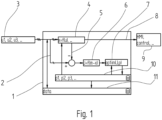
- Fig 1 a block diagram of a computer-implemented method for automatically adjusting parameters of a mathematical model 4 for monitoring and/or controlling a steel production process.
- Fig. 1 shows an embodiment of a computer-implemented method 1 for automatically adapting parameters 10 of a mathematical model 4 for monitoring and/or controlling/regulating 9 a manufacturing process for steel production.
- At least one input variable 3 is fed to the mathematical model 4, whereby at least one input variable is a measured variable 2 of a process variable and it outputs output variables 8.
- Typical input variables 3 can, for example, be time-varying measured values of an electrical energy input or consumption of process gases. Other input variables can also be measured values from individual specific temperature measurements, or describe a scrap basket load.
- the input variables 3 can also contain further information such as setpoints for certain process variables.
- the schematic representation in Fig. 1 shows that the input variables are split into measured variables 2 and other input variables.
- the other input variables are fed into the mathematical model 4.
- the measured variables 2 refer to process variables for which calculation variables 5 of the mathematical model are also available.
- the measured variables 2 of the Fig. 1 thus form only a subset of the input variables 3.
- the measured variables 2 subsequently play an important role, since they are compared with calculated variables 5 of the mathematical model 4.
- the mathematical model 4 includes parameters 10, which are understood as setting values. With their help, the mathematical model 4 can be used to set, for example, how much the addition of certain substances causes a temperature change in the liquid metal.
- the input variables 3 and the parameters 10 are at least partially recorded in the data memory 11. This makes it possible for parameters determined after parameter optimization to be stored there and to be available for future applications of the manufacturing process.
- the mathematical model 4 carries out calculations that are used to monitor or control/regulate the steel production process.
- process variables are used that are expressed in the mathematical model 4 by calculated variables 5.
- An example of such a calculation is equation 6.
- the calculated variables 5 therefore include at least one process variable for which measured variables 2 are also available.
- This is used to determine a cost function of differences 6 according to equation 1, which evaluates the deviation between these measured variables 2 and the corresponding calculated variables 5. From the cost function of differences 6 and the current values of the parameters 10, it is determined how the parameters 10 influence the cost function of differences 6.
- Equations 2-4 describe this calculation using the example of a temperature model. This calculation is carried out in each optimization step as part of the parameter optimization 7, whereby new values for the parameters 10 of the mathematical model 4 are determined in such a way that the cost function of differences 6 is minimized.
- the mathematical model 4 comprises equations and formulas and describes process variables 5 using calculation variables.
- One possible process variable is, for example, a Heat loss through thermal radiation to a furnace lid in the form of a quantity of heat.
- the LossFactor parameter and other parameters 10 of the mathematical model 4 are optimized.
- a cost function of differences 6 is minimized.
- the calculation of the cost function of differences 6 includes calculation variables 5 and measurement variables 2 of a process variable that is related to the heat loss through thermal radiation to the furnace lid. Q rad roof
- parameters 10 of the mathematical model 4 can be found which bring the measured and calculated variables of the process variables into as good a fit as possible with respect to the cost function of differences 6.
Landscapes
- Engineering & Computer Science (AREA)
- Chemical & Material Sciences (AREA)
- Manufacturing & Machinery (AREA)
- Materials Engineering (AREA)
- Metallurgy (AREA)
- Organic Chemistry (AREA)
- Physics & Mathematics (AREA)
- General Physics & Mathematics (AREA)
- Automation & Control Theory (AREA)
- Feedback Control In General (AREA)
Priority Applications (3)
| Application Number | Priority Date | Filing Date | Title |
|---|---|---|---|
| EP23191929.1A EP4509934A1 (fr) | 2023-08-17 | 2023-08-17 | Procédé et appareil de traitement de données pour l'ajustement automatique de paramètres d'un modèle mathématique |
| PCT/EP2024/071781 WO2025036716A1 (fr) | 2023-08-17 | 2024-08-01 | Procédé et dispositif de traitement de données pour ajuster automatiquement des paramètres dans un modèle mathématique |
| EP24752380.6A EP4762402A1 (fr) | 2023-08-17 | 2024-08-01 | Procédé et dispositif de traitement de données pour ajuster automatiquement des paramètres dans un modèle mathématique |
Applications Claiming Priority (1)
| Application Number | Priority Date | Filing Date | Title |
|---|---|---|---|
| EP23191929.1A EP4509934A1 (fr) | 2023-08-17 | 2023-08-17 | Procédé et appareil de traitement de données pour l'ajustement automatique de paramètres d'un modèle mathématique |
Publications (1)
| Publication Number | Publication Date |
|---|---|
| EP4509934A1 true EP4509934A1 (fr) | 2025-02-19 |
Family
ID=87695811
Family Applications (2)
| Application Number | Title | Priority Date | Filing Date |
|---|---|---|---|
| EP23191929.1A Withdrawn EP4509934A1 (fr) | 2023-08-17 | 2023-08-17 | Procédé et appareil de traitement de données pour l'ajustement automatique de paramètres d'un modèle mathématique |
| EP24752380.6A Pending EP4762402A1 (fr) | 2023-08-17 | 2024-08-01 | Procédé et dispositif de traitement de données pour ajuster automatiquement des paramètres dans un modèle mathématique |
Family Applications After (1)
| Application Number | Title | Priority Date | Filing Date |
|---|---|---|---|
| EP24752380.6A Pending EP4762402A1 (fr) | 2023-08-17 | 2024-08-01 | Procédé et dispositif de traitement de données pour ajuster automatiquement des paramètres dans un modèle mathématique |
Country Status (2)
| Country | Link |
|---|---|
| EP (2) | EP4509934A1 (fr) |
| WO (1) | WO2025036716A1 (fr) |
-
2023
- 2023-08-17 EP EP23191929.1A patent/EP4509934A1/fr not_active Withdrawn
-
2024
- 2024-08-01 WO PCT/EP2024/071781 patent/WO2025036716A1/fr not_active Ceased
- 2024-08-01 EP EP24752380.6A patent/EP4762402A1/fr active Pending
Non-Patent Citations (4)
| Title |
|---|
| HAY THOMAS ET AL: "A Review of Mathematical Process Models for the Electric Arc Furnace Process", STEEL RESEARCH INTERNATIONAL., vol. 92, no. 3, 1 March 2021 (2021-03-01), DE, pages 2000395, XP093067722, ISSN: 1611-3683, Retrieved from the Internet <URL:https://onlinelibrary.wiley.com/doi/full-xml/10.1002/srin.202000395> DOI: 10.1002/srin.202000395 * |
| RICHARD D. M. MACROSTY ET AL: "Dynamic Modeling of an Industrial Electric Arc Furnace", INDUSTRIAL & ENGINEERING CHEMISTRY RESEARCH, vol. 44, no. 21, 1 October 2005 (2005-10-01), pages 8067 - 8083, XP055422410, ISSN: 0888-5885, DOI: 10.1021/ie050101b * |
| TAKANO YUI ET AL: "Iterative Feedback Tuning for Regulatory Control Systems Using Identified Sensitivity Functions via Predictive Error Method", 2022 61ST ANNUAL CONFERENCE OF THE SOCIETY OF INSTRUMENT AND CONTROL ENGINEERS (SICE), THE SOCIETY OF INSTRUMENT AND CONTROL ENGINEERS - SICE, 6 September 2022 (2022-09-06), pages 46 - 51, XP034203270, DOI: 10.23919/SICE56594.2022.9905824 * |
| ZHANG ZHUOLUN ET AL: "Deep learning-based prediction framework of temperature control time for wide-thick slab hot rolling production", EXPERT SYSTEMS WITH APPLICATIONS, ELSEVIER, AMSTERDAM, NL, vol. 227, 19 April 2023 (2023-04-19), XP087330208, ISSN: 0957-4174, [retrieved on 20230419], DOI: 10.1016/J.ESWA.2023.120083 * |
Also Published As
| Publication number | Publication date |
|---|---|
| EP4762402A1 (fr) | 2026-06-24 |
| WO2025036716A1 (fr) | 2025-02-20 |
Similar Documents
| Publication | Publication Date | Title |
|---|---|---|
| DE112011101738B4 (de) | Mehrstufiges Prozessmodellierungsverfahren | |
| EP2742158B1 (fr) | Procédé permettant de faire fonctionner une ligne de recuit continu pour le traitement d'un produit laminé | |
| DE2735012C2 (fr) | ||
| EP2258939B1 (fr) | Procédé de réglage de la température d'une bougie de préchauffage | |
| DE102019003601A1 (de) | Vorrichtung zur Lebensdauervorhersage und Vorrichtung für maschinelles Lernen | |
| EP3642372B2 (fr) | Procédé permettant de faire fonctionner un four de recuit | |
| EP2054189A1 (fr) | Commande d'un dispositif de soudage | |
| EP0929374A1 (fr) | Dispositif pour le diagnostique predictif de la qualite actuelle du resultat du travail technique d'une installation technique, en particulier de la qualite actuelle des points de soudure realises par un robot de soudage par points | |
| WO1996028771A1 (fr) | Systeme de gestion integre intelligent | |
| DE102011012710A1 (de) | Schnelle Identifikation und Erzeugung von Prozessmodellen | |
| DE112014005434T5 (de) | Verfahren und Vorrichtung für intelligente Entscheidungen und Endpunktvorhersage für einen PS-Kupferkonverter-Blasprozess | |
| EP4268963B1 (fr) | Procédé et dispositif de fabrication à l'échelle industrielle d'une suspension pour une batterie | |
| EP3542229B1 (fr) | Dispositif et procédé de détermination des paramètres d'un dispositif de réglage | |
| EP1055180B1 (fr) | Procede et dispositif de conception d'un systeme technique | |
| EP2280323A1 (fr) | Procédé de commande pour un dispositif d'influence destiné à un produit de laminage | |
| WO2025036716A1 (fr) | Procédé et dispositif de traitement de données pour ajuster automatiquement des paramètres dans un modèle mathématique | |
| EP3928033B1 (fr) | Procédé de commande d'une turbine à gaz | |
| EP1890207A1 (fr) | Méthode de réaliser d'un modèle de processus | |
| DE102007059582B4 (de) | Verfahren und Vorrichtung zum Training des Bedienpersonals einer prozesstechnischen Anlage | |
| DE19641432C2 (de) | Verfahren und Einrichtung zur Vorausberechnung von vorab unbekannten Parametern eines industriellen Prozesses | |
| WO2024199897A1 (fr) | Procédé de fabrication de semi-conducteur avec modèle de fenêtre de traitement simulé | |
| DE10059567A1 (de) | Verfahren und Vorrichtung zur Berechnung von Prozessgrößen eines industriellen Prozesses | |
| DE1300319B (de) | Rechenverfahren zur Vorausbestimmung der zur optimalen Fuehrung eines technischen Prozesses notwendigen Stellgroessen | |
| EP2996001A1 (fr) | Procédé d'analyse assisté par ordinateur d'un ensemble de données provenant d'observations | |
| EP4404007A1 (fr) | Modèle de processus, procédé de développement et procédé de surveillance |
Legal Events
| Date | Code | Title | Description |
|---|---|---|---|
| PUAI | Public reference made under article 153(3) epc to a published international application that has entered the european phase |
Free format text: ORIGINAL CODE: 0009012 |
|
| STAA | Information on the status of an ep patent application or granted ep patent |
Free format text: STATUS: THE APPLICATION HAS BEEN PUBLISHED |
|
| AK | Designated contracting states |
Kind code of ref document: A1 Designated state(s): AL AT BE BG CH CY CZ DE DK EE ES FI FR GB GR HR HU IE IS IT LI LT LU LV MC ME MK MT NL NO PL PT RO RS SE SI SK SM TR |
|
| RAP3 | Party data changed (applicant data changed or rights of an application transferred) |
Owner name: PRIMETALS TECHNOLOGIES AUSTRIA GMBH |
|
| STAA | Information on the status of an ep patent application or granted ep patent |
Free format text: STATUS: REQUEST FOR EXAMINATION WAS MADE |
|
| 17P | Request for examination filed |
Effective date: 20250715 |
|
| STAA | Information on the status of an ep patent application or granted ep patent |
Free format text: STATUS: THE APPLICATION IS DEEMED TO BE WITHDRAWN |
|
| 18D | Application deemed to be withdrawn |
Effective date: 20250820 |