EP4510049A2 - Systeme und verfahren für risikobewusstsein mit maschinenlerntechniken - Google Patents
Systeme und verfahren für risikobewusstsein mit maschinenlerntechniken Download PDFInfo
- Publication number
- EP4510049A2 EP4510049A2 EP24223008.4A EP24223008A EP4510049A2 EP 4510049 A2 EP4510049 A2 EP 4510049A2 EP 24223008 A EP24223008 A EP 24223008A EP 4510049 A2 EP4510049 A2 EP 4510049A2
- Authority
- EP
- European Patent Office
- Prior art keywords
- modification
- risk level
- feature
- proposed modification
- previous
- Prior art date
- Legal status (The legal status is an assumption and is not a legal conclusion. Google has not performed a legal analysis and makes no representation as to the accuracy of the status listed.)
- Pending
Links
Images


Classifications
-
- G—PHYSICS
- G06—COMPUTING OR CALCULATING; COUNTING
- G06F—ELECTRIC DIGITAL DATA PROCESSING
- G06F8/00—Arrangements for software engineering
- G06F8/70—Software maintenance or management
- G06F8/71—Version control; Configuration management
-
- G—PHYSICS
- G06—COMPUTING OR CALCULATING; COUNTING
- G06F—ELECTRIC DIGITAL DATA PROCESSING
- G06F11/00—Error detection; Error correction; Monitoring
- G06F11/36—Prevention of errors by analysis, debugging or testing of software
- G06F11/3604—Analysis of software for verifying properties of programs
-
- G—PHYSICS
- G06—COMPUTING OR CALCULATING; COUNTING
- G06F—ELECTRIC DIGITAL DATA PROCESSING
- G06F11/00—Error detection; Error correction; Monitoring
- G06F11/30—Monitoring
- G06F11/32—Monitoring with visual or acoustical indication of the functioning of the machine
- G06F11/324—Display of status information
- G06F11/327—Alarm or error message display
-
- G—PHYSICS
- G06—COMPUTING OR CALCULATING; COUNTING
- G06N—COMPUTING ARRANGEMENTS BASED ON SPECIFIC COMPUTATIONAL MODELS
- G06N20/00—Machine learning
-
- G—PHYSICS
- G06—COMPUTING OR CALCULATING; COUNTING
- G06F—ELECTRIC DIGITAL DATA PROCESSING
- G06F11/00—Error detection; Error correction; Monitoring
- G06F11/004—Error avoidance
-
- G—PHYSICS
- G06—COMPUTING OR CALCULATING; COUNTING
- G06F—ELECTRIC DIGITAL DATA PROCESSING
- G06F11/00—Error detection; Error correction; Monitoring
- G06F11/008—Reliability or availability analysis
Definitions
- Various embodiments of the present disclosure relate generally to training and using a machine-learning based model to reduce and troubleshoot incidents in a system and, more particularly, to training and using a machine-learning based model to determine a risk level for a proposed modification to a system.
- Deploying, refactoring, or releasing software code has different kinds of associated risk depending on what code is being changed. Not having a clear view of how vulnerable or risky a certain code deployment may be increases the risk of system outages. Deploying code always includes risks for a company, and platform modernization is a continuous process. A technology shift is a big event for any product, and entails a large risk and opportunity for a software company. When performing such operations, there is a great need to ensure that code is refactored in the most vulnerable areas and that a correct test framework is in place before starting a transition to newly deployed code.
- the present disclosure is directed to overcoming one or more of these above-referenced challenges.
- systems and methods are disclosed for training and using a machine-learning based model to reduce and troubleshoot incidents in a system and, more particularly, to training and using a machine-learning based model to determine a risk level for a proposed modification to a system.
- An embodiment of the disclosure may be a method for training a machine-learning based model, the method comprising, performing by one or more processors, operations including: receiving first metadata regarding a previous modification to a system; extracting a first feature from the received first metadata; receiving second metadata regarding a previous incident related to the previous modification occurring in the system; extracting a second feature from the received second metadata; training the machine-learning based model to learn an association between the previous modification and the previous incident related to the previous modification, based on the extracted first feature and the extracted second feature; and automatically determining a risk level for the previous modification based on the extracted first feature, by using the trained machine-learning based model, based on the learned association between the previous modification and the previous incident related to the previous modification.
- An embodiment of the disclosure may be a method for determining a risk level for a proposed modification to a system, the method comprising, performing by one or more processors, operations including: receiving metadata regarding the proposed modification to the system; extracting a feature from the received metadata, the extracted feature corresponding to a feature of a trained machine-learning based model for determining the risk level for the proposed modification based on a learned association between the extracted feature and an incident occurring in the system; and automatically determining the risk level for the proposed modification based on the extracted feature, by using the trained machine-learning based model that was trained based on a first feature extracted from metadata regarding a previous modification to the system and a second feature extracted from metadata regarding a previous incident related to the previous modification occurring in the system, based on the learned association between the extracted feature and the incident occurring in the system.
- An embodiment of the disclosure may be a computer-implemented system for determining a risk level for a proposed modification to a system, the system comprising: a memory to store instructions; and a processor to execute the stored instructions to perform operations including: receiving metadata regarding the proposed modification to the system; extracting a feature from the received metadata, the extracted feature corresponding to a feature of a trained machine-learning based model for determining the risk level for the proposed modification based on a learned association between the extracted feature and an incident occurring in the system; and automatically determining the risk level for the proposed modification based on the extracted feature, by using the trained machine-learning based model that was trained based on a first feature extracted from metadata regarding a previous modification to the system and a second feature extracted from metadata regarding a previous incident related to the previous modification occurring in the system, based on the learned association between the extracted feature and the incident occurring in the system.
- an advantage to the disclosed systems and methods is that the disclosed systems and methods provide an end-to-end approach to incidents, as compared to current isolated improvements per department, which will lead to increased communication and focus on common problems.
- the disclosed systems and methods provides a solution for all departments in a company to supply data to be commonly available for insights to all departments. As a result, a team may take actions such as extra testing, extra staff during hardware and/or software deployment, and provide directions for refactoring code, for example.
- the disclosed systems and methods may provide intelligent alerts along the DevOps loop to mitigate incidents, reduce development bugs, and identify risks proactively in real-time.
- the disclosed systems and methods may be integrated with code repositories to alert developers when critical code segments are modified or provide auto-approve for less critical code segments, which will reduce long-term development maintenance.
- the disclosed systems and methods may be integrated with deployment and configuration management platforms to alert operations and service delivery personnel when configuration items are modified or auto-approve non-critical changes.
- the disclosed systems and methods may be used in test-automation, which may reduce time to release.
- the disclosed systems and methods may be used with incident management to alert incident handlers about potentially code-related or change-related incidents and provide valuable information to improve speed of resolution.
- the present disclosure relates to methods and systems for training and using a machine-learning based model to reduce and troubleshoot incidents in a system and, more particularly, to training and using a machine-learning based model to determine a risk level for a proposed modification to a system.
- subject matter may be embodied as methods, devices, components, or systems. Accordingly, embodiments may, for example, take the form of hardware, software, firmware or any combination thereof (other than software per se).
- the following detailed description is, therefore, not intended to be taken in a limiting sense.
- FIG. 1 depicts an exemplary system overview for risk aware software development and information technology operations (DevOps) using machine learning techniques, according to one or more embodiments.
- DevOps software development and information technology operations
- a Risk Aware System 100 may receive information over network 670 from DevOps System 190.
- DevOps System 190 may include at least one of an intake system 191, a development system 192, a release system 193, a deployment system 194, or an incident reporting system 195.
- the Risk Aware System 100 may use machine learning techniques to analyze the received information and display information on display 610.
- an API may be triggered to send metadata associated with the code segment to the AI engine residing in the cloud, which analyzes the metadata using a trained model, and may provide an alert and/or risk rating to a UI.
- the API may be exposed in a Cloud Environment Service and integrated/called from the DevOps system or code repository when new code would be checked in to the repository.
- code may be centrally organized in a managed/protected code repository.
- Metadata may be part of the "code commit". A file is changed by a developer and then committed and pushed into the central repository.
- the code repository tracks metadata of the commit such as user-name, file change, exact code modified/added/removed, dependencies of the code, timestamp, and reason for code change, for example. Metadata may be different across code repository platforms, but generally consists of the same core fields.
- the system includes the code repository (database) and also an "analytics database” that would be leveraged for visualization/UI display. In a real-time solution, each code update would trigger either an update to that analytics database directly or have a daily/weekly batch up.
- One of the machine learning techniques that may be useful and effective for the analysis is a neural network, which is a type of supervised machine learning. Nonetheless, it should be noted that other machine learning techniques and frameworks may be used to perform the methods contemplated by the present disclosure.
- the systems and methods may be realized using other types of supervised machine learning such as regression problems, random forest, etc., using unsupervised machine learning such as cluster algorithms, principal component analysis (PCA), etc., and/or using reinforcement learning.
- PCA principal component analysis
- the displayed information may include a determined risk level 121 for a first product in DevOps System 190, a determined risk level 122 for a second product in DevOps System 190, and a determined risk level 123 for a third product in DevOps System 190.
- the displayed information may also include specific alerts, e.g., an alert 131 and alert 132.
- Alert 131 may provide a first alert identifying, for example, a first proposed modification to DevOps System 190, may provide a first suggested action for reducing, for example, the determined risk level for the first proposed modification to the DevOps System 190, and may provide the determined risk level as a first score from 0 to 100.
- Alert 132 may provide a second alert identifying, for example, a second proposed modification to DevOps System 190, may provide a second suggested action for reducing, for example, the determined risk level for the second proposed modification to the DevOps System 190, and may provide the determined risk level as a second score from 0 to 100.
- the first and second proposed modifications may include at least one of a modification of a hardware component or a software component of DevOps System 190.
- FIG. 2 depicts a flowchart of a method 200 for training a machine-learning based model, according to one or more embodiments.
- the Risk Aware System 100 may receive first metadata regarding a previous modification to DevOps System 190, and in operation 220, may extract a first feature from the received first metadata.
- the Risk Aware System 100 may receive second metadata regarding a previous incident related to the previous modification occurring in the DevOps System 190, and in operation 240, may extract a second feature from the received second metadata.
- the first and second metadata may be provided from a database including first incident reports with information for each incident provided with an incident number, closed date/time, category, close code, close note, long description, short description, root cause, and assignment group.
- the first and second metadata may be provided from a database including second incident reports with information for each incident provided with an issue key, description, summary, label, issue type, fix version, environment, author, and comments.
- the first and second metadata may be provided from a database including third incident reports with information for each incident provided with a file name, script name, script type, script description, display identifier, message, committer type, committer link, properties, file changes, and branch information.
- the Risk Aware System 100 may train the machine-learning based model to learn an association between the previous modification and the previous incident related to the previous modification, based on the extracted first feature and the extracted second feature.
- the Risk Aware System 100 may automatically determine a risk level for the previous modification based on the extracted first feature, by using the trained machine-learning based model, based on the learned association between the previous modification and the previous incident related to the previous modification.
- topic modeling such as Latent Dirichlet Allocation or Neural Topic Modeling
- clustering such as Bidirectional Encoder Representations from Transformers or Hierarchical Density-Based Spatial Clustering of Applications with Noise
- Unsupervised learning may be done for incident descriptions, resolution notes, issue tracking tickets, and code repository commit messages, for example.
- Auto-labeling of the created clusters may be performed using topic modeling.
- the finalized clusters may be used as classes to train a supervised classifier model. Because the amount of data may be massive, various Deep Learning models such as Artificial Neural Network, Recurrent Neural Networks, and Long-Short Term Memory may be used. Using the final classification tags from the supervised model, an incident journey may be mapped.
- FIG. 3 depicts a flowchart of a method 300 for determining a risk level for a proposed modification to a DevOps System 190, according to one or more embodiments.
- the Risk Aware System 100 may receive metadata regarding the proposed modification to the DevOps System 190, and in operation 320, may extract a feature from the received metadata, the extracted feature corresponding to a feature of a trained machine-learning based model for determining the risk level for the proposed modification based on a learned association between the extracted feature and an incident occurring in the DevOps System 190.
- the Risk Aware System 100 may automatically determine the risk level for the proposed modification based on the extracted feature, by using the trained machine-learning based model that was trained based on a first feature extracted from metadata regarding a previous modification to the DevOps System 190 and a second feature extracted from metadata regarding a previous incident related to the previous modification occurring in the DevOps System 190, based on the learned association between the extracted feature and the incident occurring in the DevOps System 190.
- the risk level may be determined using dynamic thresholds (not fixed thresholds) that can vary by application/platform/code repository and change over time and/or by use of a multi-class (e.g. 3-class) classification model (machine-learning/statistical model based) approach that would have more flexibility than a traditional single value/dimension approach.
- dynamic thresholds not fixed thresholds
- multi-class classification model machine-learning/statistical model based
- the Risk Aware System 100 may provide an alert identifying the determined risk level for the proposed modification to the DevOps System 190.
- the Risk Aware System 100 may provide a suggested action for reducing the determined risk level for the proposed modification to the DevOps System 190.
- the Risk Aware System 100 may block the proposed modification from being implemented when the determined risk level is above a predetermined threshold.
- the Risk Aware System 100 may provide the determined risk level as a score from 0 to 100.
- Risk Aware System 100 may provide a risk identification model that will predict the degree of risk for every code change/commit. This may be accomplished by using the incident journey, so that the system may reverse engineer and identify the patterns in incoming incidents due to code changes, by training a risk classification model that will tag the code changes to a risk degree, and by using a threshold analysis for setting the risk degrees such as 1.5 Interquartile Range / 3 Interquartile Range and Receiver Operating Characteristic curve analysis.
- the thresholds may be dynamic and specific for a particular Assignment Group.
- the model may identify risks proactively in real-time as incident, issue ticket, and script data are collected.
- Risk Aware System 100 may provide a model that can proactively suggest code changes/resolutions for incoming incidents, by building a classification / probability prediction (for example, Multi-Layer Perceptron, Logistic Regression, or Artificial Neural Network) model to identify whether a new incident is code change related or not. If a new incident is code change related, the incident journey may be used to identify which part of the code that needs to be changed to fix the issue. In the code, the incident journey may identify which branch, file, or class or module should be changed.
- a classification / probability prediction for example, Multi-Layer Perceptron, Logistic Regression, or Artificial Neural Network
- FIG. 4 depicts a flowchart of a method 400 for determining a risk level for a proposed modification to code of a software component of a DevOps System 190, according to one or more embodiments.
- the Risk Aware System 100 may receive metadata regarding the proposed modification to code of the software component of the DevOps System 190, and in operation 420, may extract a feature from the received metadata, the extracted feature corresponding to a feature of a trained machine-learning based model for determining the risk level for the proposed modification based on a learned association between the extracted feature and an incident occurring in the DevOps System 190.
- the Risk Aware System 100 may automatically determine the risk level for the proposed modification based on the extracted feature, by using the trained machine-learning based model that was trained based on a first feature extracted from metadata regarding a previous modification to the DevOps System 190 and a second feature extracted from metadata regarding a previous incident related to the previous modification occurring in the DevOps System 190, based on the learned association between the extracted feature and the incident occurring in the DevOps System 190.
- the Risk Aware System 100 may determine whether the code is a critical code segment or a non-critical code segment. In operation 450, the Risk Aware System 100 may provide a suggested action for reducing the determined risk level for the proposed modification when the code is determined to be a non-critical code segment and the determined risk level is above a non-critical code predetermined threshold. In operation 460, the Risk Aware System 100 may block the proposed modification from being implemented when the code is determined to be a critical code segment and the determined risk level is above a critical code predetermined threshold.
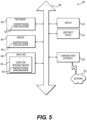
- FIG. 5 illustrates an implementation of a general computer system that may execute techniques presented herein.
- processor may refer to any device or portion of a device that processes electronic data, e.g., from registers and/or memory to transform that electronic data into other electronic data that, e.g., may be stored in registers and/or memory.
- a "computer,” a “computing machine,” a “computing platform,” a “computing device,” or a “server” may include one or more processors.
- FIG. 5 illustrates an implementation of a computer system 600.
- the computer system 600 can include a set of instructions that can be executed to cause the computer system 600 to perform any one or more of the methods or computer based functions disclosed herein.
- the computer system 600 may operate as a standalone device or may be connected, e.g., using a network, to other computer systems or peripheral devices.
- the computer system 600 may operate in the capacity of a server or as a client user computer in a server-client user network environment, or as a peer computer system in a peer-to-peer (or distributed) network environment.
- the computer system 600 can also be implemented as or incorporated into various devices, such as a personal computer (PC), a tablet PC, a set-top box (STB), a personal digital assistant (PDA), a mobile device, a palmtop computer, a laptop computer, a desktop computer, a communications device, a wireless telephone, a land-line telephone, a control system, a camera, a scanner, a facsimile machine, a printer, a pager, a personal trusted device, a web appliance, a network router, switch or bridge, or any other machine capable of executing a set of instructions (sequential or otherwise) that specify actions to be taken by that machine.
- the computer system 600 can be implemented using electronic devices that provide voice, video, or data communication. Further, while a computer system 600 is illustrated as a single system, the term "system” shall also be taken to include any collection of systems or sub-systems that individually or jointly execute a set, or multiple sets, of instructions to perform one or more computer functions.
- the computer system 600 may include a processor 602, e.g., a central processing unit (CPU), a graphics processing unit (GPU), or both.
- the processor 602 may be a component in a variety of systems.
- the processor 602 may be part of a standard personal computer or a workstation.
- the processor 602 may be one or more general processors, digital signal processors, application specific integrated circuits, field programmable gate arrays, servers, networks, digital circuits, analog circuits, combinations thereof, or other now known or later developed devices for analyzing and processing data.
- the processor 602 may implement a software program, such as code generated manually (i.e., programmed).
- the computer system 600 may include a memory 604 that can communicate via a bus 608.
- the memory 604 may be a main memory, a static memory, or a dynamic memory.
- the memory 604 may include, but is not limited to computer readable storage media such as various types of volatile and non-volatile storage media, including but not limited to random access memory, read-only memory, programmable read-only memory, electrically programmable read-only memory, electrically erasable read-only memory, flash memory, magnetic tape or disk, optical media and the like.
- the memory 604 includes a cache or random-access memory for the processor 602.
- the memory 604 is separate from the processor 602, such as a cache memory of a processor, the system memory, or other memory.
- the memory 604 may be an external storage device or database for storing data. Examples include a hard drive, compact disc (“CD”), digital video disc (“DVD”), memory card, memory stick, floppy disc, universal serial bus (“USB”) memory device, or any other device operative to store data.
- the memory 604 is operable to store instructions executable by the processor 602.
- the functions, acts or tasks illustrated in the figures or described herein may be performed by the processor 602 executing the instructions stored in the memory 604.
- the functions, acts or tasks are independent of the particular type of instructions set, storage media, processor or processing strategy and may be performed by software, hardware, integrated circuits, firm-ware, microcode and the like, operating alone or in combination.
- processing strategies may include multiprocessing, multitasking, parallel processing and the like.
- the computer system 600 may further include a display 610, such as a liquid crystal display (LCD), an organic light emitting diode (OLED), a flat panel display, a solid-state display, a cathode ray tube (CRT), a projector, a printer or other now known or later developed display device for outputting determined information.
- a display 610 such as a liquid crystal display (LCD), an organic light emitting diode (OLED), a flat panel display, a solid-state display, a cathode ray tube (CRT), a projector, a printer or other now known or later developed display device for outputting determined information.
- the display 610 may act as an interface for the user to see the functioning of the processor 602, or specifically as an interface with the software stored in the memory 604 or in the drive unit 606.
- the computer system 600 may include an input device 612 configured to allow a user to interact with any of the components of computer system 600.
- the input device 612 may be a number pad, a keyboard, or a cursor control device, such as a mouse, or a joystick, touch screen display, remote control, or any other device operative to interact with the computer system 600.
- the computer system 600 may also or alternatively include drive unit 606 implemented as a disk or optical drive.
- the drive unit 606 may include a computer-readable medium 622 in which one or more sets of instructions 624, e.g. software, can be embedded. Further, the instructions 624 may embody one or more of the methods or logic as described herein. The instructions 624 may reside completely or partially within the memory 604 and/or within the processor 602 during execution by the computer system 600.
- the memory 604 and the processor 602 also may include computer-readable media as discussed above.
- a computer-readable medium 622 includes instructions 624 or receives and executes instructions 624 responsive to a propagated signal so that a device connected to a network 670 can communicate voice, video, audio, images, or any other data over the network 670. Further, the instructions 624 may be transmitted or received over the network 670 via a communication port or interface 620, and/or using a bus 608.
- the communication port or interface 620 may be a part of the processor 602 or may be a separate component.
- the communication port or interface 620 may be created in software or may be a physical connection in hardware.
- the communication port or interface 620 may be configured to connect with a network 670, external media, the display 610, or any other components in computer system 600, or combinations thereof.
- connection with the network 670 may be a physical connection, such as a wired Ethernet connection or may be established wirelessly as discussed below.
- additional connections with other components of the computer system 600 may be physical connections or may be established wirelessly.
- the network 670 may alternatively be directly connected to a bus 608.
- While the computer-readable medium 622 is shown to be a single medium, the term “computer-readable medium” may include a single medium or multiple media, such as a centralized or distributed database, and/or associated caches and servers that store one or more sets of instructions.
- the term “computer-readable medium” may also include any medium that is capable of storing, encoding, or carrying a set of instructions for execution by a processor or that cause a computer system to perform any one or more of the methods or operations disclosed herein.
- the computer-readable medium 622 may be non-transitory, and may be tangible.
- the computer-readable medium 622 can include a solid-state memory such as a memory card or other package that houses one or more non-volatile read-only memories.
- the computer-readable medium 622 can be a random-access memory or other volatile rewritable memory. Additionally or alternatively, the computer-readable medium 622 can include a magneto-optical or optical medium, such as a disk or tapes or other storage device to capture carrier wave signals such as a signal communicated over a transmission medium.
- a digital file attachment to an e-mail or other self-contained information archive or set of archives may be considered a distribution medium that is a tangible storage medium. Accordingly, the disclosure is considered to include any one or more of a computer-readable medium or a distribution medium and other equivalents and successor media, in which data or instructions may be stored.
- dedicated hardware implementations such as application specific integrated circuits, programmable logic arrays and other hardware devices, can be constructed to implement one or more of the methods described herein.
- Applications that may include the apparatus and systems of various implementations can broadly include a variety of electronic and computer systems.
- One or more implementations described herein may implement functions using two or more specific interconnected hardware modules or devices with related control and data signals that can be communicated between and through the modules, or as portions of an application-specific integrated circuit. Accordingly, the present system encompasses software, firmware, and hardware implementations.
- the computer system 600 may be connected to a network 670.
- the network 670 may define one or more networks including wired or wireless networks.
- the wireless network may be a cellular telephone network, an 802.11, 802.16, 802.20, or WiMAX network.
- such networks may include a public network, such as the Internet, a private network, such as an intranet, or combinations thereof, and may utilize a variety of networking protocols now available or later developed including, but not limited to TCP/IP based networking protocols.
- the network 670 may include wide area networks (WAN), such as the Internet, local area networks (LAN), campus area networks, metropolitan area networks, a direct connection such as through a Universal Serial Bus (USB) port, or any other networks that may allow for data communication.
- WAN wide area networks
- LAN local area networks
- USB Universal Serial Bus
- the network 670 may be configured to couple one computing device to another computing device to enable communication of data between the devices.
- the network 670 may generally be enabled to employ any form of machine-readable media for communicating information from one device to another.
- the network 670 may include communication methods by which information may travel between computing devices.
- the network 670 may be divided into sub-networks. The sub-networks may allow access to all of the other components connected thereto or the sub-networks may restrict access between the components.
- the network 670 may be regarded as a public or private network connection and may include, for example, a virtual private network or an encryption or other security mechanism employed over the public Internet, or the like.
- the methods described herein may be implemented by software programs executable by a computer system.
- implementations can include distributed processing, component/object distributed processing, and parallel processing.
- virtual computer system processing can be constructed to implement one or more of the methods or functionality as described herein.
- an element described herein of an apparatus embodiment is an example of a means for carrying out the function performed by the element for the purpose of carrying out the disclosure.
- Coupled when used in the claims, should not be interpreted as being limited to direct connections only.
- the terms “coupled” and “connected,” along with their derivatives, may be used. It should be understood that these terms are not intended as synonyms for each other.
- the scope of the expression a device A coupled to a device B should not be limited to devices or systems wherein an output of device A is directly connected to an input of device B. It means that there exists a path between an output of A and an input of B which may be a path including other devices or means.
- Coupled may mean that two or more elements are either in direct physical or electrical contact, or that two or more elements are not in direct contact with each other but yet still co-operate or interact with each other.
Landscapes
- Engineering & Computer Science (AREA)
- Theoretical Computer Science (AREA)
- General Engineering & Computer Science (AREA)
- Software Systems (AREA)
- Physics & Mathematics (AREA)
- General Physics & Mathematics (AREA)
- Quality & Reliability (AREA)
- Medical Informatics (AREA)
- Data Mining & Analysis (AREA)
- Evolutionary Computation (AREA)
- Computer Vision & Pattern Recognition (AREA)
- Artificial Intelligence (AREA)
- Computing Systems (AREA)
- Mathematical Physics (AREA)
- Computer Security & Cryptography (AREA)
- Computer Hardware Design (AREA)
- Information Retrieval, Db Structures And Fs Structures Therefor (AREA)
- Stored Programmes (AREA)
- Management, Administration, Business Operations System, And Electronic Commerce (AREA)
- Debugging And Monitoring (AREA)
Applications Claiming Priority (3)
| Application Number | Priority Date | Filing Date | Title |
|---|---|---|---|
| US17/448,561 US11816476B2 (en) | 2021-09-23 | 2021-09-23 | Systems and methods for risk awareness using machine learning techniques |
| EP22786735.5A EP4315031B1 (de) | 2021-09-23 | 2022-09-20 | Systeme und verfahren für risikobewusstsein mit maschinenlerntechniken |
| PCT/US2022/076718 WO2023049704A1 (en) | 2021-09-23 | 2022-09-20 | Systems and methods for risk awareness using machine learning techniques |
Related Parent Applications (1)
| Application Number | Title | Priority Date | Filing Date |
|---|---|---|---|
| EP22786735.5A Division EP4315031B1 (de) | 2021-09-23 | 2022-09-20 | Systeme und verfahren für risikobewusstsein mit maschinenlerntechniken |
Publications (2)
| Publication Number | Publication Date |
|---|---|
| EP4510049A2 true EP4510049A2 (de) | 2025-02-19 |
| EP4510049A3 EP4510049A3 (de) | 2025-04-23 |
Family
ID=83688987
Family Applications (2)
| Application Number | Title | Priority Date | Filing Date |
|---|---|---|---|
| EP22786735.5A Active EP4315031B1 (de) | 2021-09-23 | 2022-09-20 | Systeme und verfahren für risikobewusstsein mit maschinenlerntechniken |
| EP24223008.4A Pending EP4510049A3 (de) | 2021-09-23 | 2022-09-20 | Systeme und verfahren für risikobewusstsein mit maschinenlerntechniken |
Family Applications Before (1)
| Application Number | Title | Priority Date | Filing Date |
|---|---|---|---|
| EP22786735.5A Active EP4315031B1 (de) | 2021-09-23 | 2022-09-20 | Systeme und verfahren für risikobewusstsein mit maschinenlerntechniken |
Country Status (4)
| Country | Link |
|---|---|
| US (3) | US11816476B2 (de) |
| EP (2) | EP4315031B1 (de) |
| CN (1) | CN117242427A (de) |
| WO (1) | WO2023049704A1 (de) |
Families Citing this family (5)
| Publication number | Priority date | Publication date | Assignee | Title |
|---|---|---|---|---|
| US11816476B2 (en) * | 2021-09-23 | 2023-11-14 | Fidelity Information Services, Llc | Systems and methods for risk awareness using machine learning techniques |
| US20240311274A1 (en) * | 2023-03-14 | 2024-09-19 | Jpmorgan Chase Bank, N.A. | Method and system for automated prediction of code riskiness |
| US12153909B1 (en) * | 2023-11-09 | 2024-11-26 | Morgan Stanley Services Group Inc. | Methods and systems of controlling deployment of software based upon an application reliability analysis |
| US20250190201A1 (en) * | 2023-12-08 | 2025-06-12 | Fidelity Information Services, Llc | System and method for determining potential issues with a software deployment |
| US20260099326A1 (en) * | 2024-10-08 | 2026-04-09 | Microsoft Technology Licensing, Llc. | Multi-agent code review comment generation |
Family Cites Families (27)
| Publication number | Priority date | Publication date | Assignee | Title |
|---|---|---|---|---|
| US9268665B2 (en) * | 2011-07-26 | 2016-02-23 | Trimble Navigation Limited | System and method for identifying fault prone computer code files |
| US9542176B2 (en) * | 2012-08-20 | 2017-01-10 | Microsoft Technology Licensing, Llc | Predicting software build errors |
| US9176729B2 (en) * | 2013-10-04 | 2015-11-03 | Avaya Inc. | System and method for prioritizing and remediating defect risk in source code |
| EP3063634A4 (de) * | 2013-10-30 | 2017-06-28 | Hewlett-Packard Enterprise Development LP | Risikoniveau von software-commits |
| US11151499B2 (en) * | 2015-12-22 | 2021-10-19 | International Business Machines Corporation | Discovering linkages between changes and incidents in information technology systems |
| US10044563B2 (en) * | 2015-12-22 | 2018-08-07 | International Business Machines Corporation | Automated change monitoring and improvement recommendation system for incident reduction in information technology infrastructure |
| US10157052B2 (en) * | 2016-09-29 | 2018-12-18 | Sap Se | Software change management |
| EP3330816A1 (de) * | 2016-12-05 | 2018-06-06 | Siemens Aktiengesellschaft | Verfahren zur softwareaktualisierung bei cloud-gateways, computerprogramm mit einer implementation des verfahrens und verarbeitungseinheit zur ausführung des verfahrens |
| US20180276105A1 (en) * | 2017-03-23 | 2018-09-27 | Fujitsu Limited | Active learning source code review framework |
| US10754640B2 (en) | 2017-03-24 | 2020-08-25 | Microsoft Technology Licensing, Llc | Engineering system robustness using bug data |
| US10635577B2 (en) * | 2017-04-07 | 2020-04-28 | International Business Machines Corporation | Integration times in a continuous integration environment based on statistical modeling |
| US10482000B2 (en) * | 2017-04-24 | 2019-11-19 | Microsoft Technology Licensing, Llc | Machine learned decision guidance for alerts originating from monitoring systems |
| US10691449B2 (en) * | 2017-04-27 | 2020-06-23 | Microsoft Technology Licensing, Llc | Intelligent automatic merging of source control queue items |
| EP3642714B1 (de) * | 2017-06-23 | 2023-03-15 | JPMorgan Chase Bank, N.A. | System und verfahren zur reduzierung von prädiktiven technologievorfällen |
| US10909022B2 (en) * | 2017-09-12 | 2021-02-02 | Facebook, Inc. | Systems and methods for identifying and tracking application performance incidents |
| WO2019067627A1 (en) * | 2017-09-27 | 2019-04-04 | Johnson Controls Technology Company | SYSTEMS AND METHODS OF RISK ANALYSIS |
| US10372438B2 (en) * | 2017-11-17 | 2019-08-06 | International Business Machines Corporation | Cognitive installation of software updates based on user context |
| US11455566B2 (en) * | 2018-03-16 | 2022-09-27 | International Business Machines Corporation | Classifying code as introducing a bug or not introducing a bug to train a bug detection algorithm |
| US11100064B2 (en) * | 2019-04-30 | 2021-08-24 | Commvault Systems, Inc. | Automated log-based remediation of an information management system |
| US11113185B2 (en) * | 2019-11-11 | 2021-09-07 | Adobe Inc. | Automated code testing for code deployment pipeline based on risk determination |
| US11379220B2 (en) * | 2019-11-25 | 2022-07-05 | International Business Machines Corporation | Vector embedding of relational code sets |
| US11276501B1 (en) * | 2020-02-24 | 2022-03-15 | BlueOwl, LLC | Systems and methods for determining a risk score using machine learning based at least in part upon collected sensor data |
| US11275640B2 (en) * | 2020-04-29 | 2022-03-15 | Kyndryl, Inc. | Computer error prevention and reduction |
| US11886276B2 (en) * | 2020-11-16 | 2024-01-30 | Servicenow, Inc. | Automatically correlating phenomena detected in machine generated data to a tracked information technology change |
| US11221908B1 (en) * | 2021-03-02 | 2022-01-11 | International Business Machines Corporation | Discovery of an inexplicit link between a change and an incident in a computing environment |
| US11809859B2 (en) * | 2021-03-25 | 2023-11-07 | Kyndryl, Inc. | Coordinated source code commits utilizing risk and error tolerance |
| US11816476B2 (en) * | 2021-09-23 | 2023-11-14 | Fidelity Information Services, Llc | Systems and methods for risk awareness using machine learning techniques |
-
2021
- 2021-09-23 US US17/448,561 patent/US11816476B2/en active Active
-
2022
- 2022-09-20 EP EP22786735.5A patent/EP4315031B1/de active Active
- 2022-09-20 WO PCT/US2022/076718 patent/WO2023049704A1/en not_active Ceased
- 2022-09-20 EP EP24223008.4A patent/EP4510049A3/de active Pending
- 2022-09-20 CN CN202280031198.2A patent/CN117242427A/zh active Pending
-
2023
- 2023-10-10 US US18/483,675 patent/US12524229B2/en active Active
-
2025
- 2025-12-22 US US19/429,678 patent/US20260119167A1/en active Pending
Also Published As
| Publication number | Publication date |
|---|---|
| US20240045671A1 (en) | 2024-02-08 |
| WO2023049704A1 (en) | 2023-03-30 |
| EP4315031B1 (de) | 2025-01-22 |
| US20260119167A1 (en) | 2026-04-30 |
| US12524229B2 (en) | 2026-01-13 |
| EP4510049A3 (de) | 2025-04-23 |
| US11816476B2 (en) | 2023-11-14 |
| US20230091520A1 (en) | 2023-03-23 |
| EP4315031A1 (de) | 2024-02-07 |
| CN117242427A (zh) | 2023-12-15 |
Similar Documents
| Publication | Publication Date | Title |
|---|---|---|
| US12524229B2 (en) | Systems and methods for risk awareness using machine learning techniques | |
| US11126493B2 (en) | Methods and systems for autonomous cloud application operations | |
| US20230092819A1 (en) | Systems and methods for determining cause of performance change using machine learning techniques | |
| CN115705406A (zh) | 关联干扰事件与事故或凭单 | |
| US20230325748A1 (en) | Systems and methods for identifying and resolving incidents in a system using an artificial intelligence model | |
| Dave | Unlocking the power of AI for Salesforce metadata: Migration strategies and business advantages | |
| CN121255895A (zh) | 一种计算机大数据信息处理系统 | |
| CN121031790A (zh) | 根因定位方法、装置、设备、介质和程序产品 | |
| US20250111286A1 (en) | Systems and methods for machine learning operations | |
| US20250110820A1 (en) | Systems and methods for a real time anomaly streaming module | |
| WO2023196471A1 (en) | Systems and methods for identifying and resolving incidents in a system using an artificial intelligence model | |
| US20250384382A1 (en) | System and Method for Review of Quality Records for Regulatory and Quality Compliance | |
| WO2025096601A1 (en) | Systems and methods for aggregating and generating a single incident profile | |
| EP4305566B1 (de) | Systeme und verfahren zur verbesserung der qualität eines modells der künstlichen intelligenz | |
| US20220083320A1 (en) | Maintenance of computing devices | |
| CN115686895A (zh) | 数据库异常诊断方法、装置、设备、介质和程序产品 | |
| US20250130880A1 (en) | Systems and methods for determining a list of configurable items for incident correlation | |
| US12118019B1 (en) | Smart data signals for artificial intelligence based modeling | |
| US20250363136A1 (en) | Systems and methods for determining similar incidents utilizing temporal associations | |
| US20260037548A1 (en) | Systems and methods for determining and updating knowledge graphs of information technology event data and configuration items | |
| CN120743541A (zh) | 基于深度学习的超售超卖策略优化方法及系统 | |
| CN121329604A (zh) | 基于绿色信贷的风险评估方法、装置、电子设备、介质和程序产品 |
Legal Events
| Date | Code | Title | Description |
|---|---|---|---|
| PUAI | Public reference made under article 153(3) epc to a published international application that has entered the european phase |
Free format text: ORIGINAL CODE: 0009012 |
|
| STAA | Information on the status of an ep patent application or granted ep patent |
Free format text: STATUS: THE APPLICATION HAS BEEN PUBLISHED |
|
| AC | Divisional application: reference to earlier application |
Ref document number: 4315031 Country of ref document: EP Kind code of ref document: P |
|
| AK | Designated contracting states |
Kind code of ref document: A2 Designated state(s): AL AT BE BG CH CY CZ DE DK EE ES FI FR GB GR HR HU IE IS IT LI LT LU LV MC MK MT NL NO PL PT RO RS SE SI SK SM TR |
|
| REG | Reference to a national code |
Ref country code: DE Ref legal event code: R079 Free format text: PREVIOUS MAIN CLASS: G06N0020000000 Ipc: G06F0008650000 |
|
| PUAL | Search report despatched |
Free format text: ORIGINAL CODE: 0009013 |
|
| AK | Designated contracting states |
Kind code of ref document: A3 Designated state(s): AL AT BE BG CH CY CZ DE DK EE ES FI FR GB GR HR HU IE IS IT LI LT LU LV MC MK MT NL NO PL PT RO RS SE SI SK SM TR |
|
| RIC1 | Information provided on ipc code assigned before grant |
Ipc: G06N 20/00 20190101ALI20250314BHEP Ipc: G06F 11/00 20060101ALI20250314BHEP Ipc: G06F 8/65 20180101AFI20250314BHEP |
|
| STAA | Information on the status of an ep patent application or granted ep patent |
Free format text: STATUS: REQUEST FOR EXAMINATION WAS MADE |
|
| 17P | Request for examination filed |
Effective date: 20251006 |
|
| STAA | Information on the status of an ep patent application or granted ep patent |
Free format text: STATUS: EXAMINATION IS IN PROGRESS |
|
| 17Q | First examination report despatched |
Effective date: 20260320 |