EP4510079A1 - Procédé d'injection de bruit dans des formes géométriques 2d decrites par des codes de chaîne de gratuit - Google Patents
Procédé d'injection de bruit dans des formes géométriques 2d decrites par des codes de chaîne de gratuit Download PDFInfo
- Publication number
- EP4510079A1 EP4510079A1 EP24150479.4A EP24150479A EP4510079A1 EP 4510079 A1 EP4510079 A1 EP 4510079A1 EP 24150479 A EP24150479 A EP 24150479A EP 4510079 A1 EP4510079 A1 EP 4510079A1
- Authority
- EP
- European Patent Office
- Prior art keywords
- chain codes
- noise
- chain
- alteration
- directional
- Prior art date
- Legal status (The legal status is an assumption and is not a legal conclusion. Google has not performed a legal analysis and makes no representation as to the accuracy of the status listed.)
- Pending
Links
Images



Classifications
-
- G—PHYSICS
- G06—COMPUTING OR CALCULATING; COUNTING
- G06T—IMAGE DATA PROCESSING OR GENERATION, IN GENERAL
- G06T11/00—Two-dimensional [2D] image generation
- G06T11/20—Drawing from basic elements
- G06T11/23—Drawing from basic elements using straight lines or curves
Definitions
- the invention belongs to the field of computer science and informatics. It relates to a method of supervised noise injection into 2D geometric shapes, described by Freeman chain codes. The method produces altered shapes with the embedded noise, and, consequently, enables the artificial augmentation of geometric shape datasets.
- the invention also relates to a computer program comprising executable instructions for performing the procedure as well as to a computer readable medium comprising said computer program.
- Noise usually represents an undesirable element of a signal. Therefore, in the past, many denoising methods were developed in order to diminish its presence. Unfortunately, none of the proposed techniques can entirely remove noise from a signal, resulting in signal processing techniques always operating on noisy signals. Noise is present in descriptions of digitalised geometric shapes as well. Even though it can emerge at different stages of shape processing (e.g., during geometric transformations or the digitalisation process), the existing methods, dealing with geometric shapes, primarily focus on deviations from their ideal measurements. Consequently, shape processing methods also operate on noisy data.
- Noise injection into training data is a common technique in the field of artificial neural networks, where it can be used either as a data augmentation or as a regularisation method. Both procedures are utilised to reduce the probability of local minima occurrences during the training phase of a neural network. Furthermore, noise injection can also successfully prevent overfitting of a neural network, as unlimited amounts of artificial samples could be produced using such approach.
- noise In terms of images, there are many known types of noise, such as Gaussian noise, salt-and-pepper noise, quantisation noise, shot noise, and photographic film grain.
- an arbitrary type of noise can be injected into an image.
- the main object of interest is not the whole image but only a set of shapes inside of it. Therefore, it is essential that noise is injected into separate geometric shapes instead into the entire image.
- the technical problem, addressed by the present invention is the development of a method for injecting noise into geometric shapes, described by eight- or four-directional Freeman chain codes.
- noise injection for the augmentation of audio samples during the training of acoustic models is proposed.
- Several types of augmentations may be applied to the data: stationary noise within a fixed spectrum, semi-stationary noise in a variable spectrum, non-stationary noise, and reverberation.
- Noise can be injected into audio data either in the time domain or in the frequency domain.
- different noise injection conditions such as reverberation models, distinct noise levels, distinct noise spectra, distinct patterns of non-stationary noise, or music residuals can be chosen for different audio samples.
- a part of the patent US11030487B2 describes the injection of noise into images as a data augmentation technique.
- the effective dynamic range of an image is reduced to a pre-defined signal strength or variance.
- spatially uncorrelated (Gaussian) or spatially correlated (Fourier phase-scrambled) noise is introduced to separate image channels.
- Different noise images are introduced to the red, green, and blue channels during the augmentation of the image chrominance, while the same noise image is introduced to the red, green, and blue channels during the augmentation of the image luminance.
- the patent US11257272B2 proposes a method for generating synthetic image data for machine learning and their augmentation using different approaches.
- One of the approaches is the injection of noise into raw generated images.
- a user-defined amount of Gaussian noise is distributed evenly throughout an entire image and/or to particular locations within the selected raw image.
- Noise injection for training artificial neural networks A comparison with weight decay and early stopping
- Medical Physics, 36, pp. 4810-4818, 2009, Zur et al. describe the noise injection into training data of artificial neural networks to reduce overfitting.
- a zero-mean Gaussian kernel is used for the data augmentation.
- a noise vector is added to training samples during the training iterations, which causes the training data to jitter in the feature space.
- the standard deviation of the noise kernel is based on the cross validation and is determined automatically during each training iteration.
- Noise estimation of natural images via statistical analysis and noise injection IEEE Transactions on Circuits and Systems for Video Technology, 25, pp. 1283-1294, 2014, by Tang et al. describes noise estimation of natural images using statistical analysis and noise injection.
- a noisy image is transformed to the transform space by the wavelet transform.
- kurtosis is calculated for each frequency index and used to estimate the degree of noise for the observed image.
- estimations can often be subpar. Therefore, noise is injected into the image, and the process of the estimation is repeated in order to increase the prediction accuracy.
- the noise is generated and injected into the image in the pixel domain, while the analysis of the image and the estimation of noise are performed in the wavelet domain.
- Noise level estimation for natural images based on scale-invariant kurtosis and piecewise stationarity also considers noise injection in order to enhance the estimation of noise in images.
- a noisy image is transformed into the linear transform domain, which enables the estimation of both Gaussian and non-Gaussian noise cases.
- the image is then divided into disjoint regions, and the noise estimation using kurtosis is performed.
- the next step is the injection of the independent and identically distributed noise into the noisy image to rectify the estimation error.
- the estimation of noise is performed again.
- Ma et al. used a similar approach in the paper "Efficient image noise estimation based on skewness invariance and adaptive noise injection", IET Image Processing, 14, pp. 1393-1401, 2020 .
- the proposed process contains a description of the adaptive noise injection in order to efficiently estimate the degree of noise in a noisy image.
- the image is transformed into the frequency domain, where the convolution with each filter from the 8x8 DCT basis is performed.
- Initial estimation of the noise level is based on the skewness of the transformed image.
- Gaussian noise is injected into the transformed noisy image as an estimation error correction strategy if the estimated degree of noise is lower than the defined threshold.
- the strategy assumes that the injected noise is independent of the noise-free image and of the noise that is present in the image.
- the goal and object of the invention is to establish a novel method for the noise injection into two-dimensional geometric shapes that are described by Freeman chain codes.
- the method operates on geometric shapes that can be either open or closed, and simple or self-intersecting.
- the technical problem is solved as defined in the independent claims. Preferred embodiments of the invention are defined in the dependent claims.
- the invention defines a sequence of steps for the injection of noise into geometric shapes that are described by one or more chains, which consist of Freeman chain code sequences.
- the Freeman chain code sequence type can be either eight-directional (F8) or four-directional (F4).
- the noise application is performed separately for each chain of the observed geometric shape, wherein consecutive pairs of chain codes are iterated through. Pairs are selected on a random basis with the user-defined probability, where the selection of a certain pair in a certain noise injection iteration does not prevent its selection in further noise injection iterations.
- a shape boundary alteration type is chosen for each selected pair according to the defined alteration rulesets for eight- and four-directional Freeman chain codes. There are seven different shape boundary alteration types in the case of eight-directional Freeman chain codes:
- a certain type of the alteration is selected based on directions defined by both chain codes in the observed chain code pair.
- the conditions are given in equations 1 and 2 for eight- and four- directional Freeman codes, respectively, as described further below.
- the suitable alteration is also selected based on directions defined by both chain codes in the observed chain code pair.
- the topology check of the geometric shape is performed based on the known methods from the field of Computational Geometry. The selected alteration is accepted if the topological characteristics of the shape (e.g., number of holes, number of self-intersections) are not changed. In such case, the original chain segment is replaced by the modified chain segment. In case the topology check indicates a change in the number of holes or self-intersections, the alteration is rejected and the original chain segment is not replaced. The process continues with the next random sequence pair regardless of the topology check outcome. The described method is repeated for other randomly selected pairs of chain codes in each chain of the observed geometric shape.
- the procedure for the noise injection into 2D geometric shapes described by Freeman chain codes comprises the following steps:
- steps c) - f) are repeated for the user-defined number of iterations.
- the degree of noise in the geometric shape is evaluated after each iteration using the Fractal Dimension evaluation metric.
- the method reaches a stop condition if the value of Fractal Dimension exceeds the user-defined maximum value. If such condition is fulfilled, the noise injection is stopped before the execution of the user-defined number of iterations.
- the invention comprehensively addresses the noise injection into 2D geometric shapes described by Freeman chain codes, where the injected noise does not alter the basic topological characteristics of geometric objects.
- the procedure is fast, easy to implement, and computationally undemanding. Furthermore, the procedure enables injection of arbitrary degrees of noise according to user demands, which increases its usability and the ability to generate diverse geometric shapes.
- the invention can be used for increasing the robustness and accuracy of various machine learning methods operating with geometric shapes. Its possible applications would be the enhanced recognition of internal body parts in medical images, more accurate classification of traffic signs and traffic signalisation, improved segmentation, and classification of objects in aerial data, and many others.
- the invention also relates to a computer program comprising executable instructions for performing the procedure as described above, as well as to a computer readable medium comprising said computer program.
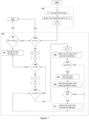
- Figure 1 shows the flowchart of the method for the injection of noise into 2D geometric shapes described by Freeman chain codes.
- the iterative noise injection procedure into the given geometric shape S is performed (block 102).
- chain code pairs c i,j and c i,j + 1 are selected with the user-defined probability ⁇ (block 106). If the selection is successful (block 107), the suitable type of the alteration is selected in the next step (block 108).
- the topology of S with the selected alteration is checked after that (block 109).
- c i,j and c i,j + 1 are replaced with the alteration (block 111) if the alteration does not change the topological characteristics of S (block 110).
- Such process is repeated for each C i ⁇ C (block 104).
- the fractal dimension FD of the altered shape is calculated (Mandelbrot, 1967) after the noise is injected into all chains (block 112). If FD equals or is larger than the user-defined maximum fractal dimension FD max , the injection of noise into S is finished (block 113). Otherwise, if the current iteration k does not equal the user-defined maximum number of iterations n, a new iteration of noise injection on the altered shape is performed (block 103).
- Figure 2 shows the possible movement directions from the currently observed pixel in the middle for an eight-directional Freeman chain code.
- Number 0 denotes the right movement
- number 2 the upward movement
- number 4 the left movement
- number 6 the downward movement
- numbers 1, 3, 5, and 7 indicate the diagonal movements.
- Figure 3 shows the possible movement directions from the currently observed pixel in the middle for a four-directional Freeman chain code.
- Number 0 denotes the right movement, number 1 the upward movement, number 3 the left movement, and number 4 the downward movement.
- FIG. 4 An example of the alteration for a 2D geometric shape is shown in Figure 4 .
- a pair of consecutive chain codes is selected on a random basis (block 401) in the beginning.
- an appropriate alteration is selected and applied to the geometric shape (block 402).
- the alteration is chosen according to the alteration rulesets where the selection is based on the chain code values.
- the ruleset for eight-directional Freeman chain codes is given in Equation 1, while the ruleset for four-directional Freeman chain codes is given in Equation 2.
- the input to the appropriate alteration ruleset is the pair of chain codes c i,j and c i,j + 1 where i denotes the index of the observed chain while j describes the index of the chain code inside the observed chain.
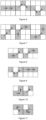
- Figure 5 illustrates the alteration REMOVE for a pair of opposite eight-directional Freeman chain codes, given in Equation 3.
- Block 501 displays the chain codes before the alteration while block 502 illustrates the chain code pair after the alteration.
- ⁇ REMOVE ⁇ ⁇
- Figure 6 illustrates the alteration PUSH for a pair of eight-directional Freeman chain codes with their respective chain codes c i,j and c i,j + 1 , given in Equation 4.
- Two equal consecutive chain codes are transformed into chain codes that form a turn.
- Two alteration options are possible (block 602 and block 603) from the initial situation (block 601), among which a certain alteration is chosen randomly.
- ⁇ PUSH c i , j ⁇ ⁇ c i , j + 1 mod 8 , c i , j + 7 mod 8 ⁇ ⁇ c i , j + 7 mod 8 , c i , j + 1 mod 8 ⁇
- the alteration FLIP triggers a pair of eight-directional Freeman chain codes c i,j and c i,j + 1 (block 801) to change their roles (block 802).
- the latter is given in Equation 6 and displayed in Figure 8 .
- ⁇ FLIP c i , j c i , j + 1 ⁇ c i , j + 1 , c i , j ⁇
- Figure 9 illustrates the alteration PULL for eight-directional Freeman chain codes.
- Block 901 displays an eight-directional Freeman chain code pair c i,j and c i,j + 1 while block 902 illustrates the selected chain code pair after the alteration, given in Equation 7.
- the alteration CUT transforms a pair of eight-directional Freeman chain codes c i,j and c i,j + 1 (block 1001) into a single chain code (block 1002), shown in Figure 10 .
- Figure 11 illustrates the alteration ROTATE, which rotates eight-directional c i,j and c i,j + 1 (block 1101) for an angle of 45° (block 1102).
- the latter is given in Equation 9, where one of two actions is selected according to certain conditions.
- Figure 13 illustrates the alteration REMOVE for a pair of opposite four-directional Freeman chain codes, as given in Equation 11.
- Block 1301 displays the chain codes before the alteration while block 1302 illustrates the chain code pair after the alteration.
- ⁇ REMOVE ⁇ ⁇
- the alteration FLIP changes the roles of chain codes c i,j and c i,j + 1 (block 1402) in a pair of four-directional Freeman chain codes (block 1401). The latter is given in Equation 12 and displayed in Figure 14 .
- ⁇ FLIP c i , j c i , j + 1 ⁇ c i , j + 1 , c i , j ⁇
- Figure 15 displays the topology check of a geometric shape after the appropriate alteration is selected.
- the procedure verifies whether the selected alteration (block 1502) changes the topological characteristics (e.g., number of holes) of the observed geometric shape (block 1501). In such case, the topological check rejects the selected alteration.
- the topology check is independent of basic properties of the geometric shape (e.g., number of self-intersections and openness) and the type of the Freeman chain code the geometric shape is encoded with.
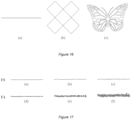
- Figure 16 shows the geometric shapes Line Segment (a), Twist (b), and Butterfly (c), on which the performance of the present method is tested.
- Each geometric shape was encoded with both eight- and four-directional Freeman chain codes (F4 and F8).
- the number of noise injection iterations is progressively increasing in the experiments.
- injection of noise into a test shape encoded with eight-directional Freeman chain codes (F8) is displayed in the upper row, while the injection of noise into a test shape encoded with four-directional Freeman chain codes (F4) is displayed in the lower row.
- (a) and (d) display the shape after 10 noise injection iterations, (b) and (e) after 50 noise injection iterations, while (c) and (f) after 100 noise injection iterations.
- Figure 17 shows results of noise injection for the Line Segment, wherein the injected noise increases from 10 to 100 iterations but does not alter the general shape of the line, which is still easily recognizable.
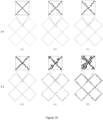
- Figure 18 shows the results for the Twist shaped from a self-intersecting line, which with several intersections eventually forms a cross formed by five squares, wherein some details of the injected noise are shown in separate detailed sections. As shown in these detailed sections, the shape of the initial geometrical shape is not changed.
Landscapes
- Physics & Mathematics (AREA)
- General Physics & Mathematics (AREA)
- Engineering & Computer Science (AREA)
- Theoretical Computer Science (AREA)
- Image Processing (AREA)
Priority Applications (1)
| Application Number | Priority Date | Filing Date | Title |
|---|---|---|---|
| EP24150479.4A EP4510079A1 (fr) | 2024-01-05 | 2024-01-05 | Procédé d'injection de bruit dans des formes géométriques 2d decrites par des codes de chaîne de gratuit |
Applications Claiming Priority (1)
| Application Number | Priority Date | Filing Date | Title |
|---|---|---|---|
| EP24150479.4A EP4510079A1 (fr) | 2024-01-05 | 2024-01-05 | Procédé d'injection de bruit dans des formes géométriques 2d decrites par des codes de chaîne de gratuit |
Publications (1)
| Publication Number | Publication Date |
|---|---|
| EP4510079A1 true EP4510079A1 (fr) | 2025-02-19 |
Family
ID=89474215
Family Applications (1)
| Application Number | Title | Priority Date | Filing Date |
|---|---|---|---|
| EP24150479.4A Pending EP4510079A1 (fr) | 2024-01-05 | 2024-01-05 | Procédé d'injection de bruit dans des formes géométriques 2d decrites par des codes de chaîne de gratuit |
Country Status (1)
| Country | Link |
|---|---|
| EP (1) | EP4510079A1 (fr) |
Citations (4)
| Publication number | Priority date | Publication date | Assignee | Title |
|---|---|---|---|---|
| US5982386A (en) * | 1996-04-02 | 1999-11-09 | Dainippon Screen Mfg. Co., Ltd. | Image boundary correction by fractal processing |
| US20210035563A1 (en) | 2019-07-30 | 2021-02-04 | Dolby Laboratories Licensing Corporation | Per-epoch data augmentation for training acoustic models |
| US11030487B2 (en) | 2018-09-05 | 2021-06-08 | Vanderbilt University | Noise-robust neural networks and methods thereof |
| US11257272B2 (en) | 2019-04-25 | 2022-02-22 | Lucid VR, Inc. | Generating synthetic image data for machine learning |
-
2024
- 2024-01-05 EP EP24150479.4A patent/EP4510079A1/fr active Pending
Patent Citations (4)
| Publication number | Priority date | Publication date | Assignee | Title |
|---|---|---|---|---|
| US5982386A (en) * | 1996-04-02 | 1999-11-09 | Dainippon Screen Mfg. Co., Ltd. | Image boundary correction by fractal processing |
| US11030487B2 (en) | 2018-09-05 | 2021-06-08 | Vanderbilt University | Noise-robust neural networks and methods thereof |
| US11257272B2 (en) | 2019-04-25 | 2022-02-22 | Lucid VR, Inc. | Generating synthetic image data for machine learning |
| US20210035563A1 (en) | 2019-07-30 | 2021-02-04 | Dolby Laboratories Licensing Corporation | Per-epoch data augmentation for training acoustic models |
Non-Patent Citations (10)
| Title |
|---|
| "Noise injection for training artificial neural networks: A comparison with weight decay and early stopping", MEDICAL PHYSICS, vol. 36, 2009, pages 4810 - 4818 |
| DONG ET AL.: "Noise level estimation for natural images based on scale-invariant kurtosis and piecewise stationarity", IEEE TRANSACTIONS ON IMAGE PROCESSING, vol. 26, 2016, pages 1017 - 1030 |
| FRANK P KUHL ET AL: "Elliptic Fourier Features of a Closed Contour", COMPUTER GRAPHICS AND IMAGE PROCESSING, US, vol. 18, no. 3, 1 March 1982 (1982-03-01), pages 236 - 258, XP001375204, ISSN: 0146-664X * |
| JI ET AL.: "Real-world super-resolution via kernel estimation and noise injection", PROCEEDINGS OF THE IEEE/CVF CONFERENCE ON COMPUTER VISION AND PATTERN RECOGNITION WORKSHOPS, 2020, pages 466 - 467 |
| MA ET AL.: "Efficient image noise estimation based on skewness invariance and adaptive noise injection", IET IMAGE PROCESSING, vol. 14, 2020, pages 1393 - 1401, XP006090435, DOI: 10.1049/iet-ipr.2019.1548 |
| RAHAMAN ET AL.: "Effects of label noise on performance of remote sensing and deep learning-based water body segmentation models", CYBERNETICS AND SYSTEMS, vol. 53, 2022, pages 581 - 606 |
| SAIZ-ABAJO ET AL.: "Ensemble methods and data augmentation by noise addition applied to the analysis of spectroscopic data", ANALYTICA CHIMICA ACTA, vol. 533, 2005, pages 147 - 159, XP004807246, DOI: 10.1016/j.aca.2004.10.086 |
| SUN ET AL.: "Multiscale generative adversarial network for real-world super-resolution", CONCURRENCY AND COMPUTATION: PRACTICE AND EXPERIENCE, vol. 33, 2021, pages e6430 |
| TANG ET AL.: "Noise estimation of natural images via statistical analysis and noise injection", IEEE TRANSACTIONS ON CIRCUITS AND SYSTEMS FOR VIDEO TECHNOLOGY, vol. 25, 2014, pages 1283 - 1294, XP011664745, DOI: 10.1109/TCSVT.2014.2380196 |
| VALLEZ NOELIA ET AL: "Diffeomorphic transforms for data augmentation of highly variable shape and texture objects", COMPUTER METHODS AND PROGRAMS IN BIOMEDICINE, ELSEVIER, AMSTERDAM, NL, vol. 219, 25 March 2022 (2022-03-25), XP087047780, ISSN: 0169-2607, [retrieved on 20220325], DOI: 10.1016/J.CMPB.2022.106775 * |
Similar Documents
| Publication | Publication Date | Title |
|---|---|---|
| Zhang et al. | Hierarchical density-aware dehazing network | |
| Kang et al. | Convolutional neural networks for no-reference image quality assessment | |
| Po et al. | A novel patch variance biased convolutional neural network for no-reference image quality assessment | |
| CN115619743A (zh) | Oled新型显示器件表面缺陷检测模型的构建方法及其应用 | |
| KR20210141060A (ko) | 머신러닝 기반의 이미지 이상 탐지 시스템 | |
| CN108229526A (zh) | 网络训练、图像处理方法、装置、存储介质和电子设备 | |
| CN113538263A (zh) | 基于改进DeblurGAN模型的去运动模糊方法、介质及设备 | |
| CN117197470B (zh) | 一种基于结肠镜图像的息肉分割方法、设备及介质 | |
| Athar et al. | Degraded reference image quality assessment | |
| Deshpande et al. | Super resolution and recognition of long range captured multi‐frame iris images | |
| Golestaneh et al. | No-reference image quality assessment via feature fusion and multi-task learning | |
| CN114820381A (zh) | 一种基于结构信息嵌入和注意力机制的数字图像修复方法 | |
| US7656942B2 (en) | Denoising signals containing impulse noise | |
| CN107292315B (zh) | 基于多尺度ltp特征的隐写分析方法和隐写分析装置 | |
| Khan et al. | MRI images enhancement using genetic programming based hybrid noise removal filter approach | |
| EP4510079A1 (fr) | Procédé d'injection de bruit dans des formes géométriques 2d decrites par des codes de chaîne de gratuit | |
| Ling et al. | The role of structure and textural information in image utility and quality assessment tasks | |
| Heydari et al. | A low complexity wavelet-based blind image quality evaluator | |
| CN118298194B (zh) | 一种面向相机光通信的条纹图像处理方法、装置及设备 | |
| Patnaik et al. | Remote sensing single-image super-resolution using convolutional block attention residual network with joint adversarial mechanisms | |
| Hepburn et al. | Enforcing perceptual consistency on generative adversarial networks by using the normalised laplacian pyramid distance | |
| Delepoulle et al. | A no-reference computer-generated images quality metric and its application to denoising | |
| Ooi et al. | Enhanced dense space attention network for super-resolution construction from single input image | |
| CN115880186A (zh) | 缺损图像复原方法、装置及电子设备 | |
| Singh et al. | Performance Analysis of Conditional GANs based Image-to-Image Translation Models for Low-Light Image Enhancement |
Legal Events
| Date | Code | Title | Description |
|---|---|---|---|
| PUAI | Public reference made under article 153(3) epc to a published international application that has entered the european phase |
Free format text: ORIGINAL CODE: 0009012 |
|
| STAA | Information on the status of an ep patent application or granted ep patent |
Free format text: STATUS: THE APPLICATION HAS BEEN PUBLISHED |
|
| AK | Designated contracting states |
Kind code of ref document: A1 Designated state(s): AL AT BE BG CH CY CZ DE DK EE ES FI FR GB GR HR HU IE IS IT LI LT LU LV MC ME MK MT NL NO PL PT RO RS SE SI SK SM TR |
|
| STAA | Information on the status of an ep patent application or granted ep patent |
Free format text: STATUS: REQUEST FOR EXAMINATION WAS MADE |
|
| 17P | Request for examination filed |
Effective date: 20250516 |
|
| REG | Reference to a national code |
Ref country code: DE Ref legal event code: R079 Free format text: PREVIOUS MAIN CLASS: G06T0011200000 Ipc: G06T0011230000 |
|
| GRAP | Despatch of communication of intention to grant a patent |
Free format text: ORIGINAL CODE: EPIDOSNIGR1 |
|
| STAA | Information on the status of an ep patent application or granted ep patent |
Free format text: STATUS: GRANT OF PATENT IS INTENDED |
|
| RIC1 | Information provided on ipc code assigned before grant |
Ipc: G06T 11/23 20260101AFI20260109BHEP |
|
| INTG | Intention to grant announced |
Effective date: 20260206 |