EP4510092A1 - Procédé et appareil d'extraction de contour de paume, et procédé et appareil de génération d'instruction de commande - Google Patents
Procédé et appareil d'extraction de contour de paume, et procédé et appareil de génération d'instruction de commande Download PDFInfo
- Publication number
- EP4510092A1 EP4510092A1 EP23810653.8A EP23810653A EP4510092A1 EP 4510092 A1 EP4510092 A1 EP 4510092A1 EP 23810653 A EP23810653 A EP 23810653A EP 4510092 A1 EP4510092 A1 EP 4510092A1
- Authority
- EP
- European Patent Office
- Prior art keywords
- palm
- bone
- bone point
- point
- contour
- Prior art date
- Legal status (The legal status is an assumption and is not a legal conclusion. Google has not performed a legal analysis and makes no representation as to the accuracy of the status listed.)
- Pending
Links
Images








Classifications
-
- G—PHYSICS
- G06—COMPUTING OR CALCULATING; COUNTING
- G06V—IMAGE OR VIDEO RECOGNITION OR UNDERSTANDING
- G06V40/00—Recognition of biometric, human-related or animal-related patterns in image or video data
- G06V40/10—Human or animal bodies, e.g. vehicle occupants or pedestrians; Body parts, e.g. hands
- G06V40/107—Static hand or arm
- G06V40/11—Hand-related biometrics; Hand pose recognition
-
- G—PHYSICS
- G06—COMPUTING OR CALCULATING; COUNTING
- G06F—ELECTRIC DIGITAL DATA PROCESSING
- G06F3/00—Input arrangements for transferring data to be processed into a form capable of being handled by the computer; Output arrangements for transferring data from processing unit to output unit, e.g. interface arrangements
- G06F3/01—Input arrangements or combined input and output arrangements for interaction between user and computer
-
- G—PHYSICS
- G06—COMPUTING OR CALCULATING; COUNTING
- G06Q—INFORMATION AND COMMUNICATION TECHNOLOGY [ICT] SPECIALLY ADAPTED FOR ADMINISTRATIVE, COMMERCIAL, FINANCIAL, MANAGERIAL OR SUPERVISORY PURPOSES; SYSTEMS OR METHODS SPECIALLY ADAPTED FOR ADMINISTRATIVE, COMMERCIAL, FINANCIAL, MANAGERIAL OR SUPERVISORY PURPOSES, NOT OTHERWISE PROVIDED FOR
- G06Q20/00—Payment architectures, schemes or protocols
- G06Q20/38—Payment protocols; Details thereof
- G06Q20/40—Authorisation, e.g. identification of payer or payee, verification of customer or shop credentials; Review and approval of payers, e.g. check credit lines or negative lists
-
- G—PHYSICS
- G06—COMPUTING OR CALCULATING; COUNTING
- G06T—IMAGE DATA PROCESSING OR GENERATION, IN GENERAL
- G06T13/00—Animation
- G06T13/80—Two-dimensional [2D] animation, e.g. using sprites
-
- G—PHYSICS
- G06—COMPUTING OR CALCULATING; COUNTING
- G06V—IMAGE OR VIDEO RECOGNITION OR UNDERSTANDING
- G06V10/00—Arrangements for image or video recognition or understanding
- G06V10/40—Extraction of image or video features
- G06V10/44—Local feature extraction by analysis of parts of the pattern, e.g. by detecting edges, contours, loops, corners, strokes or intersections; Connectivity analysis, e.g. of connected components
- G06V10/443—Local feature extraction by analysis of parts of the pattern, e.g. by detecting edges, contours, loops, corners, strokes or intersections; Connectivity analysis, e.g. of connected components by matching or filtering
-
- G—PHYSICS
- G06—COMPUTING OR CALCULATING; COUNTING
- G06V—IMAGE OR VIDEO RECOGNITION OR UNDERSTANDING
- G06V10/00—Arrangements for image or video recognition or understanding
- G06V10/40—Extraction of image or video features
- G06V10/44—Local feature extraction by analysis of parts of the pattern, e.g. by detecting edges, contours, loops, corners, strokes or intersections; Connectivity analysis, e.g. of connected components
- G06V10/457—Local feature extraction by analysis of parts of the pattern, e.g. by detecting edges, contours, loops, corners, strokes or intersections; Connectivity analysis, e.g. of connected components by analysing connectivity, e.g. edge linking, connected component analysis or slices
-
- G—PHYSICS
- G06—COMPUTING OR CALCULATING; COUNTING
- G06V—IMAGE OR VIDEO RECOGNITION OR UNDERSTANDING
- G06V10/00—Arrangements for image or video recognition or understanding
- G06V10/40—Extraction of image or video features
- G06V10/46—Descriptors for shape, contour or point-related descriptors, e.g. scale invariant feature transform [SIFT] or bags of words [BoW]; Salient regional features
-
- Y—GENERAL TAGGING OF NEW TECHNOLOGICAL DEVELOPMENTS; GENERAL TAGGING OF CROSS-SECTIONAL TECHNOLOGIES SPANNING OVER SEVERAL SECTIONS OF THE IPC; TECHNICAL SUBJECTS COVERED BY FORMER USPC CROSS-REFERENCE ART COLLECTIONS [XRACs] AND DIGESTS
- Y02—TECHNOLOGIES OR APPLICATIONS FOR MITIGATION OR ADAPTATION AGAINST CLIMATE CHANGE
- Y02P—CLIMATE CHANGE MITIGATION TECHNOLOGIES IN THE PRODUCTION OR PROCESSING OF GOODS
- Y02P90/00—Enabling technologies with a potential contribution to greenhouse gas [GHG] emissions mitigation
- Y02P90/30—Computing systems specially adapted for manufacturing
Definitions
- This application relates to the field of computer technologies, and in particular, to a method and apparatus for extracting a palm contour, a method and apparatus for generating an instruction for controlling an object, a computer device, a storage medium, and a computer program product.
- the palm extraction technology includes technical content of recognizing a palm contour from a palm image.
- various data processing is usually performed on pixel information of the palm image to extract the palm contour in the palm image, for example, binary processing and edge detection are performed on the palm image to extract the palm contour.
- the method for extracting a palm contour based on the pixel information of the palm image is susceptible to interference from image backgrounds, causing it impossible to extract an accurate palm contour.
- Embodiments of this application provide a method and apparatus for extracting a palm contour, a method and apparatus for generating an instruction for controlling an object, a computer device, a computer-readable storage medium, and a computer program product.
- a method for extracting a palm contour is performed by a computer device, and the method includes:
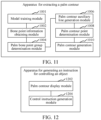
- An apparatus for extracting a palm contour includes:
- a computer device includes a memory and one or more processors, the memory having computer-readable instructions stored therein, and the one or more processors, when executing the computer-readable instructions, implementing the operations of the method for extracting a palm contour.
- a computer-readable storage medium has computer-readable instructions stored therein, the computer-readable instructions, when executed by one or more processors, implementing the operations of the method for extracting a palm contour.
- a computer program product includes computer-readable instructions, the computer-readable instructions, when executed by one or more processors, implementing the operations of the method for extracting a palm contour.
- a method for generating an instruction for controlling an object is performed by a computer device, and the method includes:
- An apparatus for generating an instruction for controlling an object includes:
- a computer device includes a memory and one or more processors, the memory having computer-readable instructions stored therein, and the one or more processors, when executing the computer-readable instructions, implementing the operations of the method for generating an instruction for controlling an object.
- a computer-readable storage medium has computer-readable instructions stored therein, the computer-readable instructions, when executed by one or more processors, implementing the operations of the method for generating an instruction for controlling an object.
- a computer program product includes computer-readable instructions, the computer-readable instructions, when executed by one or more processors, implementing the operations of the method for generating an instruction for controlling an object.
- a method for extracting a palm contour and a method for generating an instruction for controlling an object provided may be applied to an application environment shown in FIG. 1 .
- a terminal 102 may communicate with a server 104 via a network.
- a data storage system may store data that the server 104 needs to process.
- the data storage system may be integrated on the server 104, or placed on a cloud or another server.
- the terminal 102 may be, but not limited to, a desktop computer, a notebook computer, a smartphone, a tablet computer, an Internet of Things device, and a portable wearable device.
- the Internet of Things device may be a smart speaker, a smart television, a smart air conditioner, a smart in-vehicle device, or the like.
- the portable wearable device may be a smart watch, a smart band, a head-mounted device, or the like.
- the server 104 may be implemented as an independent server or as a server cluster including a plurality of servers or as a cloud server.
- both a terminal and a server may be configured to separately perform the method for extracting a palm contour and the method for generating an instruction for controlling an object provided in the embodiments of this application.
- palm bone points also known as palm keypoints
- palm keypoints refer to the key points that constitute or describe the skeletal structure of the palm, which are used to track and analyze gestures and palm movements.
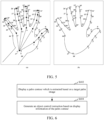
- 21 palm bone points are used to describe the skeletal structure of the palm (as shown in FIG. 3 ). These 21 palm bone points are: wrist point (dot 0 in FIG.
- thumb carpometacarpal joint point (dot 1 in FIG. 3 , which belongs to the thumb and carpometacarpal j oint), thumb metacarpophalangeal joint point (dot 2 in FIG. 3 , which belongs to the thumb and metacarpophalangeal joint), thumb proximal interphalangeal joint point (dot 3 in FIG. 3 , which belongs to the thumb and proximal interphalangeal joint), thumb tip (dot 4 in FIG. 3 , which belongs to the distal phalanx of the thumb), index finger metacarpophalangeal joint point (dot 5 in FIG.
- index finger proximal interphalangeal joint point (dot 6 in FIG. 3 , which belongs to the index finger and proximal interphalangeal joint), index finger distal interphalangeal joint point (dot 7 in FIG. 3 , which belongs to the index finger and distal interphalangeal joint), index finger tip (dot 8 in FIG. 3 , which belongs to the distal phalanx of the index finger), middle finger metacarpophalangeal joint point (dot 9 in FIG. 3 , which belongs to the middle finger and metacarpophalangeal j oint), middle finger proximal interphalangeal joint point (dot 10 in FIG.
- middle finger distal interphalangeal joint point (dot 11 in FIG. 3 , which belongs to the middle finger and distal interphalangeal joint), middle finger tip (dot 12 in FIG. 3 , which belongs to the distal phalanx of the middle finger), ring finger metacarpophalangeal joint point (dot 13 in FIG. 3 , which belongs to the ring finger and metacarpophalangeal joint), ring finger proximal interphalangeal joint point (dot 14 in FIG. 3 , which belongs to the ring finger and proximal interphalangeal joint), ring finger distal interphalangeal joint point (dot 15 in FIG.
- the bones of the palm can be divided into extra-finger bones and intra-finger bones.
- the intra-finger bones include the proximal phalanges, middle phalanges, and distal phalanges (for the thumb, only the proximal and distal phalanges), and the extra-finger bones include the carpal bones and metacarpal bones.
- the joints of the palm can be divided into the extra-finger j oint and intra-finger joints.
- the intra-finger joint refers to the joints inside the fingers, which allow the bending and extension of the fingers.
- intra-finger j oints include the metacarpophalangeal joint and the interphalangeal joint.
- intra-finger joints include the metacarpophalangeal joint, proximal interphalangeal joint, and distal interphalangeal joint.
- the extra-finger joint includes the carpometacarpal joint.
- a terminal can obtain bone point information for each of palm bone points in a target palm image, the bone point information including a position and a bone point type of the respective palm bone point, and determine a plurality of palm bone point groups from the palm bone points based on the bone point type of the respective palm bone point, each palm bone point group corresponding to at least one geometric processing type.
- the terminal can perform following steps to each of the palm bone point groups: generating at least one auxiliary line based on the positions of the palm bone points in the respective palm bone point group according to the corresponding geometric processing type; and determining at least one palm contour point on the generated at least one auxiliary line based on the positions of the palm bone points in the respective palm bone point group and a reference step length, to obtain a position of each of the determined at least one palm contour point corresponding to the respective palm bone point group.
- the terminal can generate the palm contour based on the position of each of the determined at least one palm contour point corresponding to the respective palm bone point group.
- the terminal can display the palm contour which is extracted based on the target palm image, and generate an object control instruction based on display information of the palm contour.
- the terminal and the server may also be configured to collaboratively perform the method for extracting a palm contour and the method for generating an instruction for controlling an object provided in the embodiments of this application.
- a server can obtain, from a terminal, bone point information for each of palm bone points in a target palm image, the bone point information including a position and a bone point type of the respective palm bone point, and determine a plurality of palm bone point groups from the palm bone points based on the bone point type of the respective palm bone point, each palm bone point group corresponding to at least one geometric processing type.
- the server can perform following steps to each of the palm bone point groups: generating at least one auxiliary line based on the positions of the palm bone points in the respective palm bone point group according to the corresponding geometric processing type; and determining at least one palm contour point on the generated at least one auxiliary line based on the positions of the palm bone points in the respective palm bone point group and a reference step length, to obtain a position of each of the determined at least one palm contour point corresponding to the respective palm bone point group.
- the server can generate the palm contour based on the position of each of the determined at least one palm contour point corresponding to the respective palm bone point group.
- the terminal can obtain the palm contour which is extracted based on the target palm image from the server, display the palm contour, and generate an object control instruction based on display information of the palm contour.
- the positions of the palm contour points are determined by performing geometry processing based on the bone point information for each of the palm bone points in the palm image, and the palm contour is generated based on the positions of the palm contour points.
- the palm contour can be extracted without the need to perform complex data processing on pixel information of the palm image, and has high extraction accuracy for being not susceptible to interference from image backgrounds. Extracting an accurate palm contour is also helpful to ensure accurate display, and further helpful to improve generation accuracy of the object control instruction.
- the object control instruction can be automatically generated based on the display information of the palm contour, which can also improve the generation efficiency of the object control instruction.
- a method for extracting a palm contour is provided.
- An example in which the method is applied to a computer device is used for description.
- the computer device may be the terminal 102 or the server 104 in FIG. 1 .
- the method for extracting a palm contour includes the following operations.
- S202 Obtain bone point information for each of palm bone points in a target palm image, the bone point information including a position and a bone point type of the respective palm bone point.
- the target palm image is a palm image from which a palm contour is to be extracted.
- the palm image is an image including a palm.
- the palm image may include only a palm.
- the palm image is an image obtained by capturing a palm region.
- the palm image may also include more body parts.
- the palm image is obtained by capturing a half body of an object with a palm raised.
- the palm image may be captured in real time.
- a palm photo captured in real time is used as the palm image; and a video frame including a palm in a video captured in real time is used as the palm image.
- the palm image may also be obtained from pre-captured data.
- a palm photo stored in a photo album is used as the palm image; and a video frame including a palm in a pre-edited video is used as the palm image.
- the palm image may be obtained by capturing a real palm, or may be obtained by capturing a virtual palm.
- the palm bone point is a bone point in a palm.
- the palm includes a plurality of palm bone points. Palm bone point recognition is performed on the palm image, to obtain bone point information for each of the palm bone points in the palm image.
- the bone point information includes a position and a bone point type of the respective palm bone point.
- the position of a palm bone point represents the position of the palm bone point in the palm image, and the bone point types are used for identifying types of the palm bone points.
- the computer device may obtain the target palm image locally or from another device, and perform palm bone point recognition on the target palm image in real time to obtain the bone point information for each of the palm bone points in the target palm image, or may directly obtain pre-recognized bone point information for each of the palm bone points in the target palm image locally or from another device. Further, the computer device may perform palm contour recognition on the target palm image based on the bone point information for each of the palm bone points, to obtain the palm contour in the target palm image.
- S204 Determine a plurality of palm bone point groups from the palm bone points based on the bone point type of the respective palm bone point, each palm bone point group corresponding to at least one geometry processing type.
- each palm bone point group can include at least two palm bone points.
- the geometry processing type is used for determining a geometry processing manner corresponding to the palm bone point group. Geometry processing is performed on the palm bone point group in the geometry processing manner corresponding to the palm bone point group, to obtain palm contour points corresponding to the palm bone point group.
- One palm bone point group may correspond to at least one geometry processing type.
- the computer device may match the palm bone points based on the bone point types, form successfully matched palm bone points into a palm bone point group, and finally obtain a plurality of palm bone point groups.
- Each palm bone point group corresponds to at least one geometry processing type.
- the computer device may determine palm bone points whose bone point types meet one of preset conditions as a palm bone point group, and finally obtain a plurality of palm bone point groups.
- the palm bone point groups determined based on different preset conditions correspond to different geometry processing types.
- Each palm bone point group may correspond to at least one geometry processing type.
- the preset conditions will be explained in detail below.
- the computer device can obtain a pre-established correspondence between the preset conditions and the geometry processing types. After determining a palm bone point group based on a preset condition, at least one geometry processing type corresponding to the palm bone point group can be determined based on the correspondence to be the at least one geometry processing type corresponding to the preset condition.
- the pre-established correspondence between the preset conditions and the geometry processing types can be obtained. After determining all palm bone point groups corresponding to all preset conditions, at least one geometry processing type corresponding to each palm bone point group can be determined based on the correspondence to be the at least one geometry processing type corresponding to the respective preset condition.
- At least one geometry processing type corresponding to the preset condition can be obtained based on the pre-established correspondence between the preset conditions and the geometry processing types, and then at least one geometry processing type corresponding to the palm bone point group can be determined to be the at least one geometry processing type.
- a geometry processing type corresponding to each of the preset conditions is obtained based on the pre-established correspondence between preset conditions and geometry processing types, and the geometry processing type corresponding to each palm bone point group is determined to be the respective geometry processing type.
- the computer device may obtain bone point type matching information.
- the bone point type matching information records matching relationships between the bone point types of the palm bone points. Based on the bone point type matching information, the computer device may quickly match the palm bone points based on the bone point types, to quickly obtain palm bone point groups.
- the bone point type matching information may further include geometry processing types respectively corresponding to the matching relationships, so that when a palm bone point group is determined based on one matching relationship, the at least one geometry processing type corresponding to the palm bone point group may be synchronously determined.
- the geometry processing type corresponding to the palm bone point group may be determined based on the bone point types of the palm bone points in the palm bone point group. For example, at least one target palm bone point type corresponding to each geometry processing type is preset. If the palm bone point group includes a target palm bone type, the geometry processing type corresponding to the target palm bone point type is used as the geometry processing type corresponding to the palm bone point group.
- the at least one geometry processing type corresponding to the palm bone point group may be determined based on the positions of the palm bone points in the palm bone point group. For example, a palm part in the palm image can be divided into a plurality of palm regions, each palm region corresponds to at least one geometry processing type, and the at least one geometry processing type corresponding to the palm region into which the palm bone point group falls is used as the at least one geometry processing type corresponding to the palm bone point group.
- connection relationships between the palm bone points there are connection relationships between the palm bone points.
- the connection relationships between the palm bone points and the bone point information of the palm bone points may be synchronously recognized.
- the computer device may first perform preliminary matching on the palm bone points based on the connection relationships to obtain a plurality of first palm bone point groups, then perform complementary matching on the palm bone points based on the bone point types to obtain a plurality of second palm bone point groups, and finally obtain the plurality of palm bone point groups based on the first palm bone point groups and the second palm bone point groups.
- dots in FIG. 3 represent palm bone points, including a total of 21 palm bone points
- connection lines between the dots in FIG. 3 represent the connection relationships between the palm bone points.
- the computer device may form adjacent palm bone points having the connection relationship into first palm bone point groups. For example, dot 0 and dot 1 are formed into a first palm bone point group, and dot 1 and dot 2 are formed into a first palm bone point group.
- the computer device may form the palm bone points corresponding to a preset bone point type into a second palm bone point group. For example, if the bone point type corresponding to dot 13 and dot 17 is the preset bone point type, dot 13 and dot 17 may be formed into a second palm bone point group.
- S206 For each of the palm bone point groups, generate at least one auxiliary line based on the positions of the palm bone points in the respective palm bone point group according to the corresponding geometric processing type.
- the auxiliary line can be a geometric line used to determine the palm contour point.
- the computer device may generate, based on the positions of the palm bone points in the palm bone point group, the at least one auxiliary line according to the geometry processing type.
- the computer device may determine a geometry processing manner and a geometry processing algorithm based on the geometry processing type corresponding to the palm bone point group, and perform data processing on the positions of the palm bone points in the palm bone point group through the geometry processing algorithm, to generate the at least one auxiliary line corresponding to the palm bone point group.
- the computer device may obtain the auxiliary lines respectively corresponding to the palm bone point groups.
- one palm bone point group may correspond to at least one auxiliary line.
- S208 For each of the palm bone point groups, determine at least one palm contour point on the generated at least one auxiliary line based on the positions of the palm bone points in the respective palm bone point group and a reference step length, to obtain a position of each of the determined at least one palm contour point corresponding to the respective palm bone point group.
- the reference step length can be a step length for moving along the auxiliary line.
- Each palm bone point group corresponds to a reference step length.
- the computer device may determine at least one palm contour point on the generated at least one auxiliary line corresponding to the palm bone point group based on the positions of the palm bone points in the palm bone point group and the reference step length corresponding to the palm bone point group, to obtain a position of each of the determined at least one palm contour point corresponding to the respective palm bone point group.
- the computer device may determine a movement start point on a generated auxiliary line corresponding to the palm bone point group based on the positions of the palm bone points in the palm bone point group, move the reference step length from the movement start point on the auxiliary line, and use a movement end point obtained by moving the reference step length as a palm contour point.
- the computer device may obtain a plurality of palm contour points and the position of each of the plurality of palm contour points.
- a palm image with a marked palm contour may be obtained as a reference palm image, and a general reference step length is determined based on the reference palm image.
- an auxiliary line corresponding to the reference palm image is determined based on the reference palm image, and an intersection point between the auxiliary line and the marked palm contour is used as a reference contour point.
- the reference contour point is an accurate palm contour point
- an accurate movement step length is determined based on a distance between the movement start point and the reference contour point
- the accurate movement step length is used as the reference step length.
- the computer device may obtain a plurality of reference palm images, and records different reference step lengths determined based on different reference palm images to obtain the general reference step length.
- an average value of the reference step lengths may be calculated as the general reference step length.
- the general reference step length may be directly obtained to determine the palm contour point in the palm image, or the general reference step length may be fine-tuned based on personalization information of the palm image to obtain a target reference step length, and the palm contour point in the palm image is determined based on the target reference step length.
- the personalization information of the palm image includes at least one of the data on palm size and palm depth.
- the reference step length can increase as the palm size corresponding to the target palm image increases.
- the palm size represents a size of the palm in the target palm image. For a larger palm, a longer reference step length needs to be moved on the auxiliary line to reach the accurate palm contour point.
- the palm size can include at least one of palm length or palm width.
- the reference step length can increase as the palm depth corresponding to the target palm image decreases.
- the palm depth represents a distance between the palm and an image collection device. When the distance is shorter, the palm depth is smaller, and when the distance is farther, the palm depth is larger. Smaller palm depth corresponding to the target palm image can lead to a smaller distance between the palm and the image collection device and a larger palm region presented in the target palm image. For a larger palm region, a longer reference step length needs to be moved on the auxiliary line to reach the accurate palm contour point.
- the target palm image may be a depth map, and each pixel value of the depth map represents a distance between a point in a scene and the image collection device.
- S208 Generate the palm contour based on the position of each of the determined at least one palm contour point corresponding to the respective palm bone point group.
- the computer device may connect the positions of the palm contour points, to obtain the palm contour corresponding to the target palm image.
- bone point information for each of palm bone points in a target palm image is obtained, the bone point information including a position and a bone point type of the respective palm bone point; a plurality of palm bone point groups are determined from the palm bone points based on the bone point type of the respective palm bone point, each palm bone point group corresponds to at least one geometric processing type; the following steps are performed to each of the palm bone point groups: generating at least one auxiliary line based on the positions of the palm bone points in the respective palm bone point group according to the corresponding geometric processing type, and determining at least one palm contour point on the generated at least one auxiliary line based on the positions of the palm bone points in the respective palm bone point group and a reference step length, to obtain a position of each of the determined at least one palm contour point corresponding to the respective palm bone point group; and the palm contour corresponding to the target palm image is generated based on the position of each of the determined at least one palm contour point corresponding to the respective palm bone point group.
- the bone point type can be determined by a finger parameter and an intra-finger joint parameter.
- the determining a plurality of palm bone point groups from the palm bone points based on the bone point type of the respective palm bone point includes: determining a first palm bone point group corresponding to a first geometry processing type, the first palm bone point group including adjacent palm bone points whose intra-finger joint parameter is a preset joint parameter; determining a second palm bone point group corresponding to a second geometry processing type, the second palm bone point group including adjacent palm bone points with the same finger parameter; and determining a third palm bone point group corresponding to a third geometry processing type, the third palm bone point group including a palm bone point with a preset bone point type and a palm bone point closest to the palm bone point with the preset bone point type.
- the bone point type can be determined by a finger parameter and an intra-finger joint parameter.
- the finger parameter represents a finger to which the palm bone point belongs.
- the palm bone points on different fingers may be distinguished based on the finger parameter.
- the intra-finger joint parameter represents a joint to which the palm bone point belongs in a finger. Different palm bone points on the same finger may be distinguished based on the intra-finger joint parameter.
- the preset joint parameter can be a preset specific intra-finger joint parameter.
- the preset bone point type can be a preset specific bone point type.
- the preset joint parameter and the preset bone point type may be set according to actual requirements.
- the adjacent palm bone points can be two palm bone points adjacent in position.
- the computer device may obtain adjacent palm bone points with the intra-finger joint parameter being the preset joint parameter from the palm bone points, and obtain the first palm bone point groups corresponding to the first geometry processing type.
- intra-finger joint parameters for dot 13, dot 17, dot 9, and dot 5 are metacarpodigital joints, that is, dot 13, dot 17, dot 9, and dot 5 are metacarpodigital joints corresponding to different fingers.
- a palm bone point group A1 which includes the adjacent dot 13 and dot 17and corresponds to the first geometry processing type can be obtained
- a palm bone point group A2which includes the adjacent dot 13 and dot 9and corresponds to the first geometry processing type can be obtained
- a palm bone point group A3 which includes the adjacent dot 9 and dot 5and corresponds to the first geometry processing type can be obtained.
- the computer device may obtain adjacent palm bone points with the same finger parameter from the palm bone points, and obtain the second palm bone point groups corresponding to the second geometry processing type.
- the finger parameter for dot 1, dot 2, dot 3, and dot 4 is the thumb, that is, dot 1, dot 2, dot 3, and dot 4 are different joints on the same finger
- a palm bone point group B 1 which includes the adjacent dot 1 and dot 2 and corresponds to the second geometry processing type can be obtained
- a palm bone point group B2 which includes the adjacent dot 2 and dot 3 and corresponds to the second geometry processing type
- a palm bone point group B3 which includes the adjacent dot 3 and dot 4 and corresponds to the second geometry processing type can be obtained.
- the computer device may obtain a palm bone point with the preset bone point type from the palm bone points as the preset bone point, obtain a palm bone point closest to the preset bone point, and obtain the third palm bone point group corresponding to the third geometry processing type.
- the bone point type for dot 0 is the preset bone point type
- dot 0 is the preset bone point
- dot 1 is the palm bone point closest to dot
- a palm bone point group C which includes dot 1 and dot 0 and corresponds to the third geometry processing type can be obtained.
- a first palm bone point group corresponding to a first geometry processing type is determined, the first palm bone point group includes adjacent palm bone points whose intra-finger joint parameter is a preset joint parameter; a second palm bone point group corresponding to a second geometry processing type is determined, the second palm bone point group includes adjacent palm bone points with the same finger parameter; and a third palm bone point group corresponding to a third geometry processing type is determined, the third palm bone point group includes a palm bone point with a preset bone point type and a palm bone point closest to the palm bone point with the preset bone point type.
- the bone point type can be determined by the finger parameter and the intra-finger joint parameter, and the palm bone point groups may be quickly obtained based on the bone point type of the respective palm bone point.
- the first geometry processing type can be used for determining palm contour points on an interdigit and a palm outer contour.
- the second geometry processing type can be used for determining a palm contour point on a finger contour edge.
- the third geometry processing type can be used for determining palm contour points on the finger contour edge and the palm outer contour.
- the generating at least one auxiliary line based on the positions of the palm bone points in the respective palm bone point group according to the corresponding geometric processing type includes:
- the auxiliary line type is a type of the auxiliary line corresponding to the palm bone point group.
- the bone point line segment is a line segment formed by the palm bone points in the palm bone point group. Geometry processing is used for generating the specific type of auxiliary line based on the bone point line segment.
- the computer device may first determine the at least one auxiliary line type for the at least one auxiliary line, and then generate the corresponding at least one auxiliary line.
- the computer device may determine the at least one auxiliary line type based on the respective geometry processing type corresponding to the respective palm bone point group, where each geometry processing type corresponds to at least one auxiliary line type.
- the computer device may generate a bone point line segment corresponding to the respective palm bone point group based on the position of the respective palm bone point in the respective palm bone point group. For example, a line segment can be determined by two points, two palm bone points may be obtained from a palm bone point group, and the positions of the two palm bone points are connected to generate the bone point line segment.
- a sequential order of determining the at least one auxiliary line type and generating the bone point line segment is not limited in this application.
- the computer device may perform geometry processing on the bone point line segment based on the respective auxiliary line type, thereby obtaining the at least one auxiliary line.
- the auxiliary line type is an extension line
- an extension line of the bone point line segment may be used as the auxiliary line.
- At least one auxiliary line type based on the respective geometry processing type corresponding to the respective palm bone point group is determined, a bone point line segment corresponding to the respective palm bone point group based on the position of the respective palm bone point in the respective palm bone point group is generated, and geometry processing on the bone point line segment based on the respective auxiliary line type is performed, to obtain the at least one auxiliary line corresponding to the respective palm bone point group.
- the auxiliary line type can be first determined, and then geometry processing can be performed on the bone point line segment generated based on the respective auxiliary line type, to quickly generate the corresponding auxiliary line.
- the geometry processing type can include any one of a first geometry processing type, a second geometry processing type, or a third geometry processing type
- an auxiliary line type corresponding to the first geometry processing type can include at least one of a mid-perpendicular line type or an extension line type
- an auxiliary line type corresponding to the second geometry processing type can include a normal line type
- an auxiliary line type corresponding to the third geometry processing type can include at least one of a normal line type or an extension line type.
- the geometry processing type includes any one of the first geometry processing type, the second geometry processing type, or the third geometry processing type.
- the auxiliary line type corresponding to the first geometry processing type includes at least one of a mid-perpendicular line type or an extension line type.
- the auxiliary line corresponding to the mid-perpendicular line type is a mid-perpendicular line.
- the mid-perpendicular line is a straight line passing through a midpoint of a line segment and perpendicular to the line segment.
- the auxiliary line corresponding to the extension line type is an extension line.
- the extension line is a straight line obtained by continuing to extend from an endpoint based on a line segment.
- the auxiliary line type corresponding to the second geometry processing type includes a normal line type.
- the auxiliary line corresponding to the normal line type is a normal line.
- a normal line of the line segment may also be referred to as a vertical line of the line segment, and the line segment and the corresponding normal line are perpendicular to each other.
- the auxiliary line type corresponding to the third geometry processing type includes at least one of a normal line type or an extension line type.
- different geometry processing types correspond to different auxiliary line types
- one geometry processing type may correspond to at least one auxiliary line type, which can effectively increase the number of palm contour points, thereby improving extraction accuracy of the palm contour.
- the performing geometry processing on the bone point line segment based on the respective auxiliary line type, to obtain the at least one auxiliary line corresponding to the respective palm bone point group includes: when the respective auxiliary line type is a mid-perpendicular line type, using a mid-perpendicular line of the bone point line segment as the auxiliary line; when the respective auxiliary line type is an extension line type, determining a target bone point from the palm bone points in the respective palm bone point group, and using an extension line that corresponds to the bone point line segment and starts at the target bone point as the auxiliary line; and when the respective auxiliary line type is a normal line type, determining the target bone point from the palm bone points in the respective palm bone point group, and using a normal line of the bone point line segment at the target bone point as the auxiliary line.
- the computer device may use the mid-perpendicular line of the bone point line segment as the auxiliary line.
- the computer device may select a palm bone point from the palm bone points in the corresponding palm bone point group as the target bone point, and use an extension line that corresponds to the bone point line segment and starts at the target bone point as the auxiliary line.
- the computer device may use a palm bone point closer to the center of the palm as the target bone point, or may use a palm bone point with a specified bone point type in the palm bone point group as the target bone point, or may respectively use each of the palm bone points in the palm bone point group as the target bone point.
- the computer device may select a palm bone point from the palm bone points in the corresponding palm bone point group as the target bone point, and use a normal line of the bone point line segment at the target bone point as the auxiliary line.
- the computer device may respectively use each of the palm bone points in the palm bone point group as the target bone point, thereby generating a plurality of auxiliary lines, or may select a palm bone point in the palm bone point group as the target bone point, thereby generating an auxiliary line.
- the palm bone point may be randomly selected, or a palm bone point closer to a fingertip may be selected.
- the respective auxiliary line type when the respective auxiliary line type is the mid-perpendicular line type, the mid-perpendicular line of the bone point line segment can be used as the auxiliary line; when the respective auxiliary line type is the extension line type, the target bone point can be determined from the palm bone points in the palm bone point group, and the extension line that corresponds to the bone point line segment and starts at the target bone point can be used as the auxiliary line; and when the respective auxiliary line type is the normal line type, the target bone point can be determined from the palm bone points in the palm bone point group, and the normal line of the bone point line segment at the target bone point can be used as the auxiliary line.
- different geometric methods may be used to quickly generate the corresponding auxiliary lines.
- the determining at least one palm contour point on the generated at least one auxiliary line based on the positions of the palm bone points in the respective palm bone point group and a reference step length, to obtain a position of each of the determined at least one palm contour point corresponding to the respective palm bone point group includes: generating, based on the position of the respective palm bone point in the respective palm bone point group, a bone point line segment corresponding to the respective palm bone point group; determining a reference point on the bone point line segment; and moving on the generated respective auxiliary line, starting from the reference point, in a movement direction corresponding to the respective auxiliary line, by the reference step length corresponding to the respective palm bone point group, to obtain a palm contour point and a position of the obtained palm contour point.
- the generated respective auxiliary line can be an auxiliary line corresponding to the palm bone point group.
- the computer device may determine the reference point from the bone point line segment, move on the generated respective auxiliary line, starting from the reference point, in a movement direction corresponding to the respective auxiliary line, by the reference step length, and use a movement end point as the palm contour point.
- the computer device may generate the bone point line segment corresponding to the respective palm bone point group based on the position of the respective palm bone point in the respective palm bone point group.
- the computer device may determine the reference point from the bone point line segment. For example, any endpoint of the bone point line segment may be used as the reference point, or an intersection point between the bone point line segment and the respective auxiliary line may be used as the reference point.
- the computer device may move on the generated respective auxiliary line, in a movement direction corresponding to the auxiliary line, by the reference step length corresponding to the respective palm bone point group, thereby determining the palm contour point and the position of the palm contour point.
- Each of the auxiliary lines of different types corresponds to a movement direction
- the auxiliary lines of the same type correspond to at least one movement direction.
- the reference step length increases as a length of the bone point line segment increases.
- the length of the bone point line segment may reflect the personalization information of the palm. A longer length of the line segment indicates a larger palm. For a larger palm, a longer reference step length needs to be moved on the auxiliary line to reach the accurate palm contour point.
- a bone point line segment corresponding to the respective palm bone point group can be generated; a reference point on the bone point line segment can be determined; and starting from the reference point, in a movement direction corresponding to the respective auxiliary line, the reference step length corresponding to the respective palm bone point group can be moved on the generated respective auxiliary line, to obtain a palm contour point and the position of the palm contour point.
- the corresponding reference step length is moved on the respective auxiliary line according to the movement direction corresponding to the auxiliary line, so that an accurate palm contour point can be quickly obtained.
- the respective auxiliary line can include at least one of a mid-perpendicular line, an extension line, or a normal line, a movement direction corresponding to the mid-perpendicular line can be a direction away from the center of a palm, a movement direction corresponding to the extension line can be an extension direction of the bone point line segment, and a movement direction corresponding to the normal line can be a direction perpendicular to the bone point line segment.
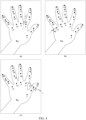
- the movement direction corresponding to the mid-perpendicular line can be a direction away from the center of the palm. That is, the palm contour point needs to be determined by moving the reference step length on the auxiliary line of the mid-perpendicular line type, in the direction away from the center of the palm.
- a dashed line in (a) represents a mid-perpendicular line
- an arrow represents a direction away from the center of the palm
- dot 15' represents a palm contour point determined by moving the reference step length on the mid-perpendicular line in the direction away from the center of the palm.
- the movement direction corresponding to the extension line can be the extension direction of the bone point line segment. That is, the palm contour point needs to be determined by moving the reference step length on the auxiliary line of the extension line type in the extension direction of the bone point line segment.
- a dashed line in (b) represents an extension line
- an arrow represents an extension direction of the bone point line segment
- dot 36' represents a palm contour point determined by moving the reference step length on the extension line according to the extension direction of the bone point line segment.
- the movement direction corresponding to the normal line can be the direction perpendicular to the bone point line segment. That is, the palm contour point needs to be determined by moving the reference step length on the auxiliary line of the normal line type in the direction perpendicular to the bone point line segment.
- a dashed line in (c) represents a normal line
- an arrow represents a direction perpendicular to the bone point line segment, i.e., a direction of the normal line
- dot 3'and dot 6' represent palm contour points determined by moving the reference step length on the normal line according to the direction perpendicular to the bone point line segment.
- the movement direction corresponding to the mid-perpendicular line can be the direction away from the center of the palm
- the movement direction corresponding to the extension line can be the extension direction of the bone point line segment
- the movement direction corresponding to the normal line can be the direction perpendicular to the bone point line segment.
- the auxiliary lines of different types correspond to different movement directions.
- each of the palm bone points can have a corresponding identifier.
- the generating the palm contour based on the position of each of the determined at least one palm contour point corresponding to the respective palm bone point group includes:
- the preset mapping information can include an mapping relationship between the identifiers of the palm bone points in the respective palm bone point group and the identifier of each of the at least one palm contour point determined based on the respective palm bone point group; and connecting the positions of the palm contour points in the order as indicated by the identifiers of the palm contour points, to obtain the palm contour corresponding to the target palm image.
- the identifier of a palm bone point can be used for uniquely identifying the palm bone point.
- the identifier of a palm contour point can indicate a sorting order for arranging the palm contour points.
- the preset mapping information can record an mapping relationship between the identifiers of the palm bone points in the respective palm bone point group and the identifier of each of the at least one palm contour point determined based on the respective palm bone point group. For example, a palm contour point generated based on palm bone point 0 and palm bone point 1 can be marked as 1', and palm contour points generated based on palm bone point 1 and palm bone point 2 can be marked as 2' and 7'.
- the palm contour points when generating the palm contour based on the position of each of the determined palm contour points, the palm contour points may be connected in order to obtain the palm contour.
- the computer device may obtain the preset mapping information, determine an identifier of each of the determined at least one palm contour point corresponding to the respective palm bone point group based on the identifiers of the palm bone points in the respective palm bone point group and preset mapping information, and finally obtain the identifier of each of the palm contour points. Further, the computer device may connect the positions of the palm contour points in the order as indicated by the identifiers of the palm contour points, to obtain a correct palm contour.
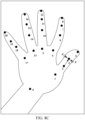
- FIG. 5 black dots in FIG. 5 represent palm bone points, and white dots represent palm contour points.
- FIG. 5 represents a target palm image. Palm contour points 1' to 38' may be obtained based on palm bone points 0 to 20.
- FIG. 5 represents a palm contour. The palm contour may be obtained by connecting the palm contour points 1' to 38' in order.
- the positions of the palm contour points may be smoothly connected or straightly connected.
- an identifier of each of the determined at least one palm contour point corresponding to the respective palm bone point group for indicating a sorting order of the respective palm contour point can be determined based on the identifiers of the palm bone points in the respective palm bone point group and preset mapping information, wherein the preset mapping information can include an mapping relationship between the identifiers of the palm bone points in the respective palm bone point group and the identifier of each of the at least one palm contour point determined based on the respective palm bone point group; and the positions of the palm contour points can be connected in the order as indicated by the identifiers of the palm contour points, to obtain the palm contour corresponding to the target palm image.
- the sorting identifiers of the palm contour points can be quickly determined through the preset mapping information, so that the palm contour points can be connected in order based on the identifiers of the palm contour points to generate an accurate palm contour.
- the obtaining the bone point information for each of palm bone points in the target palm image includes:
- the target recognition model can be a trained palm bone point recognition model.
- Input data of the palm bone point recognition model can be a palm image, and output data thereof can be the bone point information for each of the palm bone points in the palm image.
- the computer device may recognize the palm bone points based on a machine learning model.
- the computer device may obtain a pre-trained target recognition model and input the target palm image into the target recognition model, and through data processing of the model, the model may finally output the bone point information for each of the palm bone points.
- a training process of the target recognition model can include the following operations: obtaining a training data set, where the training data set includes a plurality of training palm images and training bone point information for each of the training palm images; selecting a current training palm image from the training data set; inputting the current palm image into an initial recognition model for predicting bone point information, to obtain predicted bone point information for the current training palm image; adjusting a model parameter of the initial recognition model based on a difference between the predicted bone point information and the training bone point information for the current training palm image, to obtain an intermediate recognition model; and using a next training palm image as the current palm image, using the intermediate recognition model as the initial recognition model, and going back to perform the operation of inputting the current palm image into the initial recognition model until a convergence condition is met, to obtain the target recognition model.
- the initial recognition model can be a to-be-trained palm bone point recognition model.
- the training palm image can be a palm image of which the bone point information is known.
- the current palm image can be any of the palm images in the training data set.
- the training bone point information can be accurate bone point information.
- the predicted bone point information is bone point information predicted by the model.
- the computer device may obtain the training data set, and perform model training on the initial recognition model based on the training data set, to obtain the target recognition model.
- a target training image in the training data set can be used as the input data of the palm bone point recognition model, and the training bone point information can be used as expected output data of the palm bone point recognition model.
- a training objective of the model is to make actual output data closer to the expected output data of the model, so that the model can output the predicted bone point information close to the training bone point information, to correctly recognize the palm bone points in the palm image.
- the computer device may randomly select a training palm image from the training data set as the current training palm image and input the current training palm image into the initial recognition model. Through data processing of the model, the model outputs the predicted bone point information for the current training palm image. Further, the computer device may generate loss information based on the difference between the predicted bone point information and the training bone point information for the current training palm image, performs back propagation based on the loss information, and adjusts the model parameter of the initial recognition model, thereby obtaining the intermediate recognition model.
- the computer device may obtain a next training palm image as a new current training palm image, uses the intermediate recognition model as a new initial recognition model, goes back to perform the operation of inputting the current training palm image into the initial recognition model to obtain the predicted bone point information for the current training palm image, to perform model iterative training, and continuously adjusts the model parameter through a plurality of times of model iterative training until a convergence condition is met, to obtain a target recognition model.
- the convergence condition may be at least one of conditions such as the loss information being less than a preset threshold or the number of model iterations being greater than a preset number of times. For example, if in a round of training, the loss information obtained through calculation based on the difference between the predicted bone point information and the training bone point information is less than the preset threshold, adjustment of the model parameter can be stopped, and a latest recognition model obtained through adjustment can be used as the target recognition model. For example, if the number of model iterations after a round of training is greater than the preset number of times, a latest recognition model obtained through adjustment can be used as the target recognition model.
- a current palm image determined in each round of training may include at least one training palm image.
- the palm bone points in the palm image are recognized by using the target recognition model, which can ensure recognition accuracy and recognition efficiency.
- an accurate target recognition model may be obtained through training.
- the palm contour is used for generating a palm animation.
- the palm animation may be generated based on the palm contour, and the palm animation is displayed.
- the computer device may collect the palm image in real time, recognize the palm contour in the palm image in real time, and display a dynamic palm contour to form a dynamic palm animation.
- the computer device may set a display parameter of the palm contour to generate the palm animation.
- the palm contour is displayed by using dynamically changing gradient colors.
- the computer device may set a display parameter of a closed region formed by the palm contour to generate the palm animation.
- the closed region formed by the palm contour is displayed by using dynamically changing rainbow colors.
- the palm contour extracted from the palm image may be used for generating the palm animation, thereby improving fun and interactivity.
- a method for generating an instruction for controlling an object is provided.
- An example in which the method is applied to a terminal is used for description.
- the method may also be applied to a server, or may be applied to a system including a terminal and a server, and is implemented through interaction between the terminal and the server.
- the method for generating an instruction for controlling an object includes the following operations:
- S602 Display a palm contour which is extracted based on a target palm image.
- An extraction process of the palm contour includes the following operations: obtaining bone point information for each of palm bone points in the target palm image, the bone point information including a position and a bone point type of the respective palm bone point; determining a plurality of palm bone point groups from the palm bone points based on the bone point type of the respective palm bone point, each palm bone point group corresponding to at least one geometric processing type; performing following steps to each of the palm bone point groups:-generating at least one auxiliary line based on the positions of the palm bone points in the respective palm bone point group according to the corresponding geometric processing type;- determining at least one palm contour point on the generated at least one auxiliary line based on the positions of the palm bone points in the respective palm bone point group and a reference step length, to obtain a position of each of the determined at least one palm contour point corresponding to the respective palm bone point group; and generating the palm contour based on the position of each of the determined at least one palm contour point corresponding to the respective palm bone point group.
- S604 Generate an object control instruction based on display information of the palm contour.
- the display information is used to reflect a display situation of the palm contour.
- the display information may include data of at least one of a display position, a display size, a display depth, and a display posture.
- the object control instruction is an instruction for controlling and operating an object.
- the controlled object may be a virtual object, for example, a virtual resource, a virtual person, or a virtual control.
- the controlled object may also be a physical object, for example, an electronic device or a mechanical device.
- the object control instruction may be a variety of control instructions.
- the object control instruction may be an instruction for enabling or disabling one or some functions of the object.
- the object control instruction may be a light-on instruction, a light-off instruction, a test start instruction, or a test abort instruction.
- the object control instruction may be an instruction for controlling the object to move.
- the object control instruction may be a transfer instruction for instructing the transfer of the virtual resource or a virtual person jumping instruction.
- the object control instruction may be an instruction for controlling to adjust an attribute parameter of the object.
- the object control instruction may be a paintbrush color adjustment instruction or a window size adjustment instruction.
- the terminal may display the palm contour which is extracted based on the target palm image, and generate the object control instruction based on the display information of the palm contour.
- the terminal may autonomously execute the object control instruction, and control the corresponding object through the object control instruction.
- the terminal may alternatively transmit the object control instruction to another device, and instruct the another device through the object control instruction to control the object.
- the object control instruction can be generated, and if the display information of the palm contour does not meet the preset condition, prompt information can be generated.
- the object control instruction may be generated if a position difference between a display position of the palm contour and a target display position is less than a preset threshold, the object control instruction may be generated if a display size of the palm contour is greater than a preset size; the object control instruction may be generated if a display depth difference of the palm contour is less than a preset difference; or the like.
- a closed region formed by the palm contour may be divided to obtain at least two sub-regions, depth average values corresponding to the sub-regions are counted, and a data difference between the depth average values is counted to obtain the display depth difference.
- the object control instruction may be generated if the display depth difference is less than the preset difference, it indicates that depth values corresponding to pixel points in a palm do not differ greatly and the palm is placed properly.
- the prompt information may prompt that the current palm is placed wrongly, or may prompt to move the palm.
- the object control instruction corresponding to the display information may be generated based on the display information of the palm contour.
- the corresponding object control instruction may be generated based on a display posture of the palm contour. For example, if the display posture of the palm contour is that the fingers are open, a function enable instruction is generated. If the display posture corresponding to the palm contour is that the fingers are close, a function disable instruction is generated.
- the palm contour which is extracted based on the target palm image can be displayed, and the object control instruction can be generated based on the display information of the palm contour.
- An extraction process of the palm contour can include the following operations: obtaining bone point information for each of palm bone points in the target palm image, the bone point information including a position and a bone point type of the respective palm bone point; determining a plurality of palm bone point groups from the palm bone points based on the bone point type of the respective palm bone point, each palm bone point group corresponding to at least one geometric processing type; performing following steps to each of the palm bone point groups: - generating at least one auxiliary line based on the positions of the palm bone points in the respective palm bone point group according to the corresponding geometric processing type;- determining at least one palm contour point on the generated at least one auxiliary line based on the positions of the palm bone points in the respective palm bone point group and a reference step length, to obtain a position of each of the determined at least one palm contour point
- the positions of the palm contour points are determined by performing geometry processing based on the bone point information for each of the palm bone points in the palm image, and the palm contour is generated based on the positions of the palm contour points.
- the palm contour can be extracted without the need to perform complex data processing on pixel information of the palm image, and has high extraction accuracy for being not susceptible to interference from image backgrounds. Extracting an accurate palm contour is also helpful to ensure accurate display, and further helpful to improve generation accuracy of the object control instruction.
- the object control instruction can be automatically generated based on the display information of the palm contour, which can also improve the generation efficiency of the object control instruction.
- the generating an object control instruction based on display information of the palm contour includes:
- generating the object control instruction when a position difference between a display position of the palm contour and a target display position is less than a preset threshold; and generating prompt information based on the position difference when the position difference is greater than or equal to the preset threshold, where the prompt information is configured to prompt to move the palm to reduce the position difference.
- the target display position can be an expected display position.
- the target display position may be set according to actual requirements.
- the prompt information may be presented in at least one expression form of a text, a speech, a picture, or a video.
- the display information can include a display position. If the position difference between the display position of the palm contour and the target display position is less than the preset threshold, which indicates that the palm contour is displayed at the expected position and the target position, the terminal can be triggered to generate the object control instruction. If the position difference between the display position of the palm contour and the target display position is greater than or equal to the preset threshold, which indicates that the palm contour is not displayed at the expected position and the target position, the terminal may generate the prompt information based on the position difference.
- the prompt information can be configured to prompt to move the palm to reduce the position difference, so that the palm contour may be finally displayed at the expected position.
- the terminal may determine the display position of the palm contour based on a spatial position of the palm. For example, if the palm is right above the image collection device, the palm contour can be displayed in the middle of a screen. If the palm is on the left of the image collection device, the palm contour can be displayed on the left of the screen. If the palm is on the right of the image collection device, the palm contour can be displayed on the right of the screen.
- the object control instruction is generated when the position difference between the display position of the palm contour and the target display position is less than the preset threshold; and the prompt information is generated based on the position difference when the position difference is greater than or equal to the preset threshold, where the prompt information is configured to prompt to move the palm to reduce the position difference.
- the object control instruction is generated only when the position difference between the display position of the palm contour and the target display position is small, which can avoid blindly generating the object control instruction, and ensure effective trigger and accurate trigger of the object control instruction.
- the prompt information can be generated to prompt to move the palm. Correct guidance can be implemented through the prompt information, so that the palm contour can be displayed at a correct position, thereby triggering the object control instruction.
- the target palm image is a palm image corresponding to a virtual resource transfer party
- the object control instruction is a transfer instruction for instructing the transfer of the virtual resource from a resource account of the virtual resource transfer party to a target account.
- the virtual resource transfer party can be a party that needs to transfer the virtual resource from the resource account. Opposed to the virtual resource transfer party can be a virtual resource receiving party.
- the virtual resource receiving party can be a party that receives the virtual resource.
- the resource account can be an account that may store the virtual resource.
- the virtual resource can be a resource that exists in an electronic account and can be circulated, such as a currency, a virtual red envelope, a game currency, or a virtual item.
- the target account can be an account that needs to receive the transferred virtual resource.
- the target account may be an individual account or a collective account.
- a terminal corresponding to the virtual resource transfer party or the virtual resource receiving party or another terminal may trigger to generate the transfer instruction based on the palm image, and the transfer instruction is used for instructing the transfer of the virtual resource from a resource account of the virtual resource transfer party to a target account.
- the terminal can collect a palm image corresponding to the virtual resource transfer party as the target palm image, extract a palm contour in the target palm image, and display the palm contour which is extracted based on the target palm image.
- the terminal can verify identity information of the virtual resource transfer party based on the target palm image.
- the transfer instruction can be generated if the verification succeeds, where the transfer instruction is used for instructing the transfer of the virtual resource from a resource account of the virtual resource transfer party to a target account, and verification failure prompt information can be generated if the verification fails.
- the terminal can generate prompt information based on the position difference, where the prompt information is configured to prompt to move the palm to reduce the position difference. Subsequently, after the palm is moved, if a new position difference determined by the terminal based on the new palm image is less than the preset threshold, the identity information of the virtual resource transfer party can be verified based on the new palm image, and if the verification succeeds, the transfer instruction can be generated.
- the palm contour extracted from the palm image may be used for triggering to generate the transfer instruction, which expands a trigger manner of the transfer instruction.
- the foregoing method for extracting a palm contour may be applied in a palm-scanning payment scenario.
- the method for extracting a palm contour is applied in the application scenario as follows:
- Palm bone points in a palm image can be recognized based on a machine learning algorithm.
- the palm image can be obtained through a camera, the palm image can be inputted into a trained machine learning model, and the model can output bone point information for each of the palm bone points in the palm image.
- the machine learning model may be integrated in an SDK (Software Development Kit).
- the bone point information includes position coordinates of the palm bone points.
- the position coordinates of the palm bone points may be mapped onto two-dimensional coordinates of a screen of a current operating system through a coordinate system in the SDK, and then a palm contour can be generated through the screen coordinates.
- the current operating system can include an android system, a windows system, and the like.
- FIG. 7A is a schematic diagram of a palm bone point recognition result. Referring to FIG. 7A , 21 palm bone points (palm bone point 0 to palm bone point 20) in the palm image are finally recognized.
- FIG. 7B is a schematic diagram of a palm contour point recognition result. Referring to FIG. 7B , 38 palm contour points (palm contour point 1' to palm contour point 38') are recognized based on the 21 palm bone points.
- Coordinates of a palm outer contour on an extension line can be obtained by using the extension line (which may also be referred to as an extension line) of two palm bone points and a relative coefficient (which may also be referred to as a reference step length).
- the extension line which may also be referred to as an extension line
- a relative coefficient which may also be referred to as a reference step length.
- palm contour point 37' is determined on an extension line generated based on palm bone point 0 and palm bone point 1. Palm contour point 37' is a palm outer contour point.
- a calculation process of the coordinates of the palm outer contour is as follows:
- Interdigit coordinates on a mid-perpendicular line can be obtained by using a mid-perpendicular line of two palm bone points and a relative coefficient.
- palm contour point 29' is determined on a mid-perpendicular line generated based on palm bone point 13 and palm bone point 17. Palm contour point 29' is a palm interdigit point.
- palm contour point 29', palm contour point 22', and palm contour point 15' are palm interdigit points.
- palm contour point 29' is determined in a clockwise direction. If palm bone point 17 is used as a start point and palm bone point 13 is used as an end point, palm contour point 29' is determined in a counterclockwise direction.
- a finger contour edge on the normal vector can be obtained according to a relative coefficient.
- palm contour point 3' and palm contour point 6' are determined on a normal vector generated based on palm bone point 2 and palm bone point 3
- palm contour point 3' and palm contour point 6' are finger contour edge points.
- a calculation process of the coordinates of the finger contour edge is as follows:
- Target point coordinate X:X Yb ⁇ Ya Xb ⁇ Xa 2 + Yb ⁇ Ya 2 ⁇ k + Xb
- Target point coordinate Y:Y Xa ⁇ Xb Xb ⁇ Xa 2 + Yb ⁇ Ya 2 ⁇ k + Yb
- palm contour point 2' to palm contour point 7', palm contour point 9' to palm contour point 14', palm contour point 16' to palm contour point 21', palm contour point 23' to palm contour point 28', and palm contour point 30' to palm contour point 35' are finger contour edge points.
- k in the foregoing formula is a relative coefficient.
- FIG. 8D is a schematic diagram of a palm contour. Referring to FIG. 8D , 38 palm contour points are connected to obtain the palm contour.
- a palm-scanning animation may be generated based on the palm contour, to improve an interactive sense and a scientific sense brought to a user by palm-scanning payment.
- 1002 in FIG. 9 represents a palm contour displayed on a screen
- 1004 represents a target display position on the screen. If the palm contour is not displayed at the target display position, the user is prompted to move the palm to the target display position. If the palm contour is displayed at the target display position, a user identity is verified based on the palm image. After the verification succeeds, payment is performed.
- the palm contour point is determined based on the palm bone point, to generate the palm contour.
- the palm bone points are not susceptible to interference from image backgrounds, and extracting the palm contour from the image based on the palm bone points can ensure extraction accuracy of the palm contour.
- determining the palm contour points by using the geometric method can also ensure efficiency of data processing, ensure recognition performance, and improve the extraction efficiency of the palm contour.
- Operations in flowcharts involved in the foregoing embodiments are displayed in sequence based on indication of arrows, but the operations are not necessarily performed in sequence based on a sequence indicated by the arrows. Unless indicated clearly, the operations do not need to be performed in a strict sequence, and can be performed in another sequence.
- at least some operations in the flowcharts involved in the foregoing embodiments may include a plurality of operations or a plurality of stages, and these operations or stages are not necessarily performed at the same moment, but may be performed at different moments.
- the operations or stages are not necessarily performed in sequence, but may be performed by turn or alternately with other operations or at least part of operations or stages in other operations.
- the embodiments of this application further provide an apparatus for extracting a palm contour which is configured to implement the foregoing method for extracting a palm contour, and further provides an apparatus for generating an instruction for controlling an object which is configured to implement the foregoing method for generating an instruction for controlling an object.
- An implementation solution to the problem provided by the apparatus is similar to the implementation solution described in the foregoing method. Therefore, for specific limitations in one or more embodiments of the apparatus for extracting a palm contour provided below, reference may be made to the foregoing limitations on the method for extracting a palm contour. For specific limitations in one or more embodiments of the apparatus for generating an instruction for controlling an object provided below, reference may be made to the foregoing limitations on the method for generating an instruction for controlling an object. Details are not described herein again.
- An apparatus for extracting a palm contour including: a bone point information obtaining module 1002, a palm bone point group determination module 1004, a palm contour auxiliary line generation module 1006, a palm contour point determination module 1008, and a palm contour generation module 1010.
- the bone point information obtaining module 1002 is configured to obtain bone point information for each of palm bone points in a target palm image, the bone point information including a position and a bone point type of the respective palm bone point.
- the palm bone point group determination module 1004 is configured to determine a plurality of palm bone point groups from the palm bone points based on the bone point type of the respective palm bone point, each palm bone point group corresponding to at least one geometric processing type.
- the palm contour auxiliary line generation module 1006 is configured to, for each of the palm bone point groups, generate at least one auxiliary line based on the positions of the palm bone points in the respective palm bone point group according to the corresponding geometric processing type.
- the palm contour point determination module 1008 is configured to, for each of the palm bone point groups, determine at least one palm contour point on the generated at least one auxiliary line based on the positions of the palm bone points in the respective palm bone point group and a reference step length, to obtain a position of each of the determined at least one palm contour point corresponding to the respective palm bone point group.
- the palm contour generation module 1010 is configured to generate the palm contour based on the position of each of the determined at least one palm contour point corresponding to the respective palm bone point group.
- the bone point type can be determined by a finger parameter and an intra-finger joint parameter.
- the palm bone point group determination module 1004 can be further configured to: determine a first palm bone point group corresponding to a first geometry processing type, the first palm bone point group comprising adjacent palm bone points whose intra-finger joint parameter is a preset joint parameter; determine a second palm bone point group corresponding to a second geometry processing type, the second palm bone point group comprising adjacent palm bone points with the same finger parameter; and determine a third palm bone point group corresponding to a third geometry processing type, the third palm bone point group comprising a palm bone point with a preset bone point type and a palm bone point closest to the palm bone point with the preset bone point type.
- the palm contour auxiliary line generation module 1006 can be further configured to: determine at least one auxiliary line type based on the respective geometry processing type corresponding to the respective palm bone point group; generate a bone point line segment corresponding to the respective palm bone point group based on the position of the respective palm bone point in the respective palm bone point group; and perform geometry processing on the bone point line segment based on the respective auxiliary line type, to obtain the at least one auxiliary line corresponding to the respective palm bone point group.
- the geometry processing type can include any one of a first geometry processing type, a second geometry processing type, or a third geometry processing type
- an auxiliary line type corresponding to the first geometry processing type can include at least one of a mid-perpendicular line type or an extension line type
- an auxiliary line type corresponding to the second geometry processing type can include a normal line type
- an auxiliary line type corresponding to the third geometry processing type can include at least one of a normal line type or an extension line type.
- the palm contour auxiliary line generation module 1006 can be further configured to: when the respective auxiliary line type is a mid-perpendicular line type, use a mid-perpendicular line of the bone point line segment as the auxiliary line; when the respective auxiliary line type is an extension line type, determine a target bone point from the palm bone points in the palm bone point group, and use an extension line that corresponds to the bone point line segment and starts at the target bone pointas the auxiliary line; and when the respective auxiliary line type is a normal line type, determine the target bone point from the palm bone points in the palm bone point group, and use a normal line of the bone point line segment at the target bone point as the auxiliary line.
- the palm contour point determination module 1008 is further configured to: generate, based on the position of the palm bone point in the respective palm bone point group, a bone point line segment corresponding to the respective palm bone point group; determine a reference point from the bone point line segment; and move on the generated respective auxiliary line, starting from the reference point, in a movement direction corresponding to the respective auxiliary line, by the reference step length corresponding to the respective palm bone point group, to obtain a palm contour point and a position of the obtained palm contour point.
- the respective auxiliary line can include at least one of a mid-perpendicular line, an extension line, or a normal line, a movement direction corresponding to the mid-perpendicular line can be a direction away from the center of a palm, a movement direction corresponding to the extension line can be an extension direction of the bone point line segment, and a movement direction corresponding to the normal line can be a direction perpendicular to the bone point line segment.
- each of the palm bone points can have a corresponding identifier.
- the palm contour generation module 1010 can be further configured to: determine, based on the identifiers of the palm bone points in the respective palm bone point group and preset mapping information, an identifier of each of the determined at least one palm contour point corresponding to the respective palm bone point group for indicating a sorting order of the respective palm contour point, wherein the preset mapping information can include an mapping relationship between the identifiers of the palm bone points in the respective palm bone point group and the identifier of each of the at least one palm contour point determined based on the respective palm bone point group; and connect the positions of the palm contour points in the order as indicated by the identifiers of the palm contour points, to obtain the palm contour corresponding to the target palm image.
- the bone point information obtaining module 1002 can be further configured to input the target palm image into a target recognition model that has been trained to recognize bone point information, to obtain the bone point information for each of the palm bone points.
- the apparatus for extracting a palm contour can further include: a model training module 1001, configured to: obtain a training data set, where the training data set includes a plurality of training palm images and training bone point information for each of the training palm images; select a current training palm image from the training data set; input the current palm image into an initial recognition model for predicting bone point information, to obtain predicted bone point information for the current training palm image; adjust a model parameter of the initial recognition model based on a difference between the predicted bone point information and the training bone point information for the current training palm image, to obtain an intermediate recognition model; and use a next training palm image as the current palm image, use the intermediate recognition model as the initial recognition model, and go back to perform the operation of inputting the current palm image into the initial recognition model until a convergence condition is met, to obtain the target recognition model.
- a model training module 1001 configured to: obtain a training data set, where the training data set includes a plurality of training palm images and training bone point information for each of the training palm images; select a current training palm image
- the palm contour is used for generating a palm animation.
- an apparatus for generating an instruction for controlling an object including: a palm contour display module 1202 and a control instruction generation module 1204.
- the palm contour display module 1202 is configured to display a palm contour which is extracted based on a target palm image.
- the control instruction generation module 1204 is configured to generate an object control instruction based on display information of the palm contour.
- An extraction process of the palm contour includes the following operations: obtaining bone point information for each of palm bone points in the target palm image, the bone point information including a position and a bone point type of the respective palm bone point; determining a plurality of palm bone point groups from the palm bone points based on the bone point type of the respective palm bone point, each palm bone point group corresponding to at least one geometric processing type; performing following steps to each of the palm bone point groups: - generating at least one auxiliary line based on the positions of the palm bone points in the respective palm bone point group according to the corresponding geometric processing type; - determining at least one palm contour point on the generated at least one auxiliary line based on the positions of the palm bone points in the respective palm bone point group and a reference step length, to obtain a position of each of the determined at least one palm contour point corresponding to the respective palm bone point group; and generating the palm contour based on the position of each of the determined at least one palm contour point corresponding to the respective palm bone point group.
- the positions of the palm contour points are determined by performing geometry processing based on the bone point information for each of the palm bone points in the palm image, and the palm contour is generated based on the positions of the palm contour points.
- the palm contour is extracted without the need to perform complex data processing on pixel information of the palm image, and has high extraction accuracy for being not susceptible to interference from image backgrounds. Extracting an accurate palm contour is also helpful to ensure accurate display, and further helpful to improve generation accuracy of the object control instruction.
- the object control instruction is automatically generated based on the display information of the palm contour, which can also improve the generation efficiency of the object control instruction.
- control instruction generation module 1204 can be further configured to: generate the object control instruction when a position difference between a display position of the palm contour and a target display position is less than a preset threshold; and generate prompt information based on the position difference when the position difference is greater than or equal to the preset threshold, where the prompt information is configured to prompt to move the palm to reduce the position difference.
- the target palm image is a palm image corresponding to a virtual resource transfer party
- the object control instruction is a transfer instruction for instructing the transfer of the virtual resource from a resource account of the virtual resource transfer party to a target account.
- All or some of the modules in the foregoing apparatus for extracting a palm contour and apparatus for generating an instruction for controlling an object may be implemented by software, hardware, and a combination thereof.
- the foregoing modules may be built in or independent of one or more processors of a computer device in a hardware form, or may be stored in a memory of the computer device in a software form, so that the one or more processors invoke and perform the operations corresponding to the foregoing modules.
- a computer device may be a server, and may have an internal structure diagram shown in FIG. 13 .
- the computer device includes a processor, a memory, an input/output (I/O for short) interface, and a communication interface.
- the processor, the memory, and the input/output interface are connected through a system bus, and the communication interface is connected to the system bus through the input/output interface.
- the processor of the computer device is configured to provide computing and control capabilities.
- the memory of the computer device includes a non-volatile storage medium and an internal memory.
- the non-volatile storage medium stores an operating system, computer-readable instructions, and a database.
- the internal memory provides an environment for running of the operating system and the computer-readable instructions in the non-volatile storage medium.
- the database of the computer device is configured to store data such as the target recognition model, the reference step length, the preset mapping relationship, and the like.
- the input/output interface of the computer device is configured to exchange information between the processor and an external device.
- the communication interface of the computer device is configured to communicate with an external terminal through a network connection.
- the computer-readable instructions are executed by the processor to implement a method for extracting a palm contour or a method for generating an instruction for controlling an object.
- a computer device may be a terminal, and may have an internal structure diagram shown in FIG. 14 .
- the computer device includes a processor, a memory, an input/output interface, a communication interface, a display unit, and an input apparatus.
- the processor, the memory, and the input/output interface are connected through a system bus, and the communication interface, the display unit, and the input apparatus are connected to the system bus through the input/output interface.
- the processor of the computer device is configured to provide computing and control capabilities.
- the memory of the computer device includes a non-volatile storage medium and an internal memory.
- the non-volatile storage medium stores an operating system and computer-readable instructions.
- the internal memory provides an environment for running of the operating system and the computer-readable instructions in the non-volatile storage medium.
- the input/output interface of the computer device is configured to exchange information between the processor and an external device.
- the communication interface of the computer device is configured to communicate with an external terminal in a wired or a wireless manner, and the wireless manner may be implemented by using WIFI, a mobile cellular network, NFC (near field communication), or other technologies.
- the computer-readable instructions are executed by the processor to implement a method for extracting a palm contour or a method for generating an instruction for controlling an object.
- the display unit of the computer device is configured to form a visible picture, and may be a display screen, a projection apparatus, or a virtual reality imaging apparatus.
- the display screen may be a liquid crystal display screen or an electronic ink display screen.
- the input apparatus of the computer device may be a touch layer covering the display screen, or may be a key, a trackball, or a touch pad disposed on a housing of the computer device, or may be an external keyboard, a touch pad, a mouse, or the like.
- FIG. 13 and FIG. 14 is merely a block diagram of a part of a structure related to the solutions of this application and does not limit the computer device to which the solutions of this application are applied.
- the computer device may include more or fewer components than those in the drawings, or some components are combined, or a different component deployment is used.
- a computer device including a memory and one or more processors, the memory having computer-readable instructions stored therein, the computer-readable instructions, when executed by the one or more processors, implementing the operations in the foregoing method embodiments.
- a computer-readable storage medium having computer-readable instructions stored therein, the computer-readable instructions, when executed by one or more processors, implementing the operations in the foregoing method embodiments.
- a computer program product includes computer-readable instructions, the computer-readable instructions, when executed by one or more processors, implementing the operations of the foregoing method embodiments.
- the user information including, but not limited to, user equipment information, user personal information, and the like
- data including, but not limited to, data for analysis, stored data, displayed data, and the like
- involved in this application all are information and data that are authorized by the user or fully authorized by each party, and the collection, use, and processing of relevant data need to comply with relevant laws and regulations of relevant countries and regions.
- a person of ordinary skill in the art may understand that all or some of the procedures of the methods of the foregoing embodiments may be implemented by computer-readable instructions instructing relevant hardware.
- the computer-readable instructions may be stored in a non-volatile computer-readable storage medium.
- the non-volatile memory may include a read-only memory (ROM), a magnetic tape, a floppy disk, a flash memory, an optical memory, a high-density embedded non-volatile memory, a resistive random access memory (ReRAM), a magnetoresistive random access memory (MRAM), a ferroelectric random access memory (FRAM), a phase change memory (PCM), a graphene memory, and the like.
- the volatile memory may include a random access memory (RAM) or an external cache.
- the RAM is available in a plurality of forms, such as a static random access memory (SRAM) or a dynamic random access memory (DRAM).
- the database involved in the embodiments provided in this application may include at least one of a relational database and a non-relational database.
- the non-relational database may include a blockchain-based distributed database, but is not limited thereto.
- the processor involved in the embodiments provided in this application may be a general-purpose processor, a central processing unit, a graphics processing unit, a digital signal processor, a programmable logic device, a quantum computing-based data processing logic device, and are not limited thereto.
Landscapes
- Engineering & Computer Science (AREA)
- Theoretical Computer Science (AREA)
- Physics & Mathematics (AREA)
- General Physics & Mathematics (AREA)
- Multimedia (AREA)
- Business, Economics & Management (AREA)
- Computer Vision & Pattern Recognition (AREA)
- Human Computer Interaction (AREA)
- General Engineering & Computer Science (AREA)
- Accounting & Taxation (AREA)
- Computer Security & Cryptography (AREA)
- General Business, Economics & Management (AREA)
- Strategic Management (AREA)
- Finance (AREA)
- Image Analysis (AREA)
Applications Claiming Priority (2)
| Application Number | Priority Date | Filing Date | Title |
|---|---|---|---|
| CN202210587233.0A CN117173734B (zh) | 2022-05-27 | 2022-05-27 | 手掌轮廓提取、控制指令生成方法、装置和计算机设备 |
| PCT/CN2023/083956 WO2023226578A1 (fr) | 2022-05-27 | 2023-03-27 | Procédé et appareil d'extraction de contour de paume, et procédé et appareil de génération d'instruction de commande |
Publications (2)
| Publication Number | Publication Date |
|---|---|
| EP4510092A1 true EP4510092A1 (fr) | 2025-02-19 |
| EP4510092A4 EP4510092A4 (fr) | 2025-08-27 |
Family
ID=88918386
Family Applications (1)
| Application Number | Title | Priority Date | Filing Date |
|---|---|---|---|
| EP23810653.8A Pending EP4510092A4 (fr) | 2022-05-27 | 2023-03-27 | Procédé et appareil d'extraction de contour de paume, et procédé et appareil de génération d'instruction de commande |
Country Status (5)
| Country | Link |
|---|---|
| US (1) | US20240362948A1 (fr) |
| EP (1) | EP4510092A4 (fr) |
| JP (1) | JP7745112B2 (fr) |
| CN (1) | CN117173734B (fr) |
| WO (1) | WO2023226578A1 (fr) |
Family Cites Families (16)
| Publication number | Priority date | Publication date | Assignee | Title |
|---|---|---|---|---|
| US8620024B2 (en) * | 2010-09-17 | 2013-12-31 | Sony Corporation | System and method for dynamic gesture recognition using geometric classification |
| JP5796523B2 (ja) * | 2012-03-27 | 2015-10-21 | 富士通株式会社 | 生体情報取得装置、生体情報取得方法、生体情報取得制御プログラム |
| JP6155786B2 (ja) * | 2013-04-15 | 2017-07-05 | オムロン株式会社 | ジェスチャ認識装置、ジェスチャ認識方法、電子機器、制御プログラムおよび記録媒体 |
| US20150347833A1 (en) * | 2014-06-03 | 2015-12-03 | Mark Ries Robinson | Noncontact Biometrics with Small Footprint |
| KR102429865B1 (ko) * | 2015-06-17 | 2022-08-05 | 한국전자통신연구원 | 사용자 인증 장치 |
| JP6658188B2 (ja) * | 2016-03-24 | 2020-03-04 | 富士通株式会社 | 画像処理装置、画像処理方法および画像処理プログラム |
| JP6723061B2 (ja) * | 2016-04-15 | 2020-07-15 | キヤノン株式会社 | 情報処理装置、情報処理装置の制御方法およびプログラム |
| US10379613B2 (en) * | 2017-05-16 | 2019-08-13 | Finch Technologies Ltd. | Tracking arm movements to generate inputs for computer systems |
| CN110059522B (zh) * | 2018-01-19 | 2021-06-25 | 北京市商汤科技开发有限公司 | 人体轮廓关键点检测方法、图像处理方法、装置及设备 |
| CN111402290B (zh) * | 2020-02-29 | 2023-09-12 | 华为技术有限公司 | 一种基于骨骼关键点的动作还原方法以及装置 |
| CN112083800B (zh) * | 2020-07-24 | 2024-04-30 | 青岛小鸟看看科技有限公司 | 基于自适应手指关节规则滤波的手势识别方法及系统 |
| CN112198962B (zh) * | 2020-09-30 | 2023-04-28 | 聚好看科技股份有限公司 | 一种与虚拟现实设备交互的方法及虚拟现实设备 |
| CN114612928A (zh) * | 2020-12-09 | 2022-06-10 | 华为技术有限公司 | 手势识别方法及其电子设备和可读介质 |
| CN112926423B (zh) * | 2021-02-07 | 2023-08-25 | 青岛小鸟看看科技有限公司 | 捏合手势检测识别方法、装置及系统 |
| CN113238650B (zh) * | 2021-04-15 | 2023-04-07 | 青岛小鸟看看科技有限公司 | 手势识别和控制的方法、装置及虚拟现实设备 |
| CN114299604B (zh) * | 2021-11-23 | 2024-07-12 | 河北汉光重工有限责任公司 | 一种基于二维图像的手骨骼捕捉、手势判别方法 |
-
2022
- 2022-05-27 CN CN202210587233.0A patent/CN117173734B/zh active Active
-
2023
- 2023-03-27 JP JP2024555917A patent/JP7745112B2/ja active Active
- 2023-03-27 EP EP23810653.8A patent/EP4510092A4/fr active Pending
- 2023-03-27 WO PCT/CN2023/083956 patent/WO2023226578A1/fr not_active Ceased
-
2024
- 2024-07-08 US US18/766,447 patent/US20240362948A1/en active Pending
Also Published As
| Publication number | Publication date |
|---|---|
| CN117173734B (zh) | 2025-02-18 |
| US20240362948A1 (en) | 2024-10-31 |
| JP7745112B2 (ja) | 2025-09-26 |
| CN117173734A (zh) | 2023-12-05 |
| WO2023226578A1 (fr) | 2023-11-30 |
| EP4510092A4 (fr) | 2025-08-27 |
| JP2025511566A (ja) | 2025-04-16 |
Similar Documents
| Publication | Publication Date | Title |
|---|---|---|
| CN108205655B (zh) | 一种关键点预测方法、装置、电子设备及存储介质 | |
| US11816880B2 (en) | Face recognition method and apparatus, computer device, and storage medium | |
| KR20200118076A (ko) | 생체 검출 방법 및 장치, 전자 기기 및 저장 매체 | |
| WO2021120834A1 (fr) | Support, dispositif informatique, appareil et procédé de reconnaissance gestuelle basée sur la biométrique | |
| US12430782B2 (en) | Item display method, apparatus, and device, and storage medium | |
| CN108762505B (zh) | 基于手势的虚拟对象控制方法、装置、存储介质和设备 | |
| CN108171152A (zh) | 深度学习人眼视线估计方法、设备、系统及可读存储介质 | |
| CN109635752B (zh) | 人脸关键点的定位方法、人脸图像处理方法和相关装置 | |
| CN114445853A (zh) | 一种视觉手势识别系统识别方法 | |
| CN113052078A (zh) | 空中书写轨迹识别方法、装置、存储介质及电子设备 | |
| CN111240476A (zh) | 基于增强现实的交互方法、装置、存储介质和计算机设备 | |
| CN109117760A (zh) | 图像处理方法、装置、电子设备和计算机可读介质 | |
| WO2019000817A1 (fr) | Procédé de commande et équipement électronique pour la reconnaissance de geste de la main | |
| Alam et al. | ASL champ!: a virtual reality game with deep-learning driven sign recognition | |
| TW202314646A (zh) | 數位服裝產生 | |
| CN114360047A (zh) | 举手手势识别方法、装置、电子设备及存储介质 | |
| CN115061577A (zh) | 手部投影交互方法、系统及存储介质 | |
| CN111444928A (zh) | 关键点检测的方法、装置、电子设备及存储介质 | |
| US20140071076A1 (en) | Method and system for gesture recognition | |
| JP2015102897A (ja) | 画像認識装置、及び画像認識方法 | |
| CN108830928A (zh) | 三维模型的映射方法、装置、终端设备和可读存储介质 | |
| CN116529789A (zh) | 使用用户触摸与指纹传感器的搭配进行指纹注册 | |
| US20240362948A1 (en) | Palm contour extraction method and apparatus, and control instruction generation method and apparatus | |
| KR102532848B1 (ko) | 바디 쉐입 기반의 아바타 생성 방법 및 장치 | |
| CN114998554B (zh) | 三维卡通人脸建模方法及装置 |
Legal Events
| Date | Code | Title | Description |
|---|---|---|---|
| STAA | Information on the status of an ep patent application or granted ep patent |
Free format text: STATUS: THE INTERNATIONAL PUBLICATION HAS BEEN MADE |
|
| PUAI | Public reference made under article 153(3) epc to a published international application that has entered the european phase |
Free format text: ORIGINAL CODE: 0009012 |
|
| STAA | Information on the status of an ep patent application or granted ep patent |
Free format text: STATUS: REQUEST FOR EXAMINATION WAS MADE |
|
| 17P | Request for examination filed |
Effective date: 20241115 |
|
| AK | Designated contracting states |
Kind code of ref document: A1 Designated state(s): AL AT BE BG CH CY CZ DE DK EE ES FI FR GB GR HR HU IE IS IT LI LT LU LV MC ME MK MT NL NO PL PT RO RS SE SI SK SM TR |
|
| REG | Reference to a national code |
Ref country code: DE Ref legal event code: R079 Free format text: PREVIOUS MAIN CLASS: G06V0040200000 Ipc: G06V0040100000 |
|
| A4 | Supplementary search report drawn up and despatched |
Effective date: 20250725 |
|
| RIC1 | Information provided on ipc code assigned before grant |
Ipc: G06V 40/10 20220101AFI20250721BHEP Ipc: G06V 10/46 20220101ALI20250721BHEP |
|
| DAV | Request for validation of the european patent (deleted) | ||
| DAX | Request for extension of the european patent (deleted) |