EP4510231A1 - Verfahren zur herstellung eines positivelektrodenaktivmaterials und positivelektrodenaktivmaterial - Google Patents
Verfahren zur herstellung eines positivelektrodenaktivmaterials und positivelektrodenaktivmaterial Download PDFInfo
- Publication number
- EP4510231A1 EP4510231A1 EP23820080.2A EP23820080A EP4510231A1 EP 4510231 A1 EP4510231 A1 EP 4510231A1 EP 23820080 A EP23820080 A EP 23820080A EP 4510231 A1 EP4510231 A1 EP 4510231A1
- Authority
- EP
- European Patent Office
- Prior art keywords
- positive electrode
- zirconium
- electrode active
- active material
- aluminum
- Prior art date
- Legal status (The legal status is an assumption and is not a legal conclusion. Google has not performed a legal analysis and makes no representation as to the accuracy of the status listed.)
- Pending
Links
Images


Classifications
-
- C—CHEMISTRY; METALLURGY
- C01—INORGANIC CHEMISTRY
- C01G—COMPOUNDS CONTAINING METALS NOT COVERED BY SUBCLASSES C01D OR C01F
- C01G53/00—Compounds of nickel
- C01G53/80—Compounds containing nickel, with or without oxygen or hydrogen, and containing one or more other elements
- C01G53/82—Compounds containing nickel, with or without oxygen or hydrogen, and containing two or more other elements
-
- C—CHEMISTRY; METALLURGY
- C01—INORGANIC CHEMISTRY
- C01G—COMPOUNDS CONTAINING METALS NOT COVERED BY SUBCLASSES C01D OR C01F
- C01G53/00—Compounds of nickel
- C01G53/05—Hydroxides; Oxyhydroxides
-
- H—ELECTRICITY
- H01—ELECTRIC ELEMENTS
- H01M—PROCESSES OR MEANS, e.g. BATTERIES, FOR THE DIRECT CONVERSION OF CHEMICAL ENERGY INTO ELECTRICAL ENERGY
- H01M4/00—Electrodes
- H01M4/02—Electrodes composed of, or comprising, active material
- H01M4/36—Selection of substances as active materials, active masses, active liquids
- H01M4/48—Selection of substances as active materials, active masses, active liquids of inorganic oxides or hydroxides
- H01M4/52—Selection of substances as active materials, active masses, active liquids of inorganic oxides or hydroxides of nickel, cobalt or iron
- H01M4/525—Selection of substances as active materials, active masses, active liquids of inorganic oxides or hydroxides of nickel, cobalt or iron of mixed oxides or hydroxides containing iron, cobalt or nickel for inserting or intercalating light metals, e.g. LiNiO2, LiCoO2 or LiCoOxFy
-
- C—CHEMISTRY; METALLURGY
- C01—INORGANIC CHEMISTRY
- C01G—COMPOUNDS CONTAINING METALS NOT COVERED BY SUBCLASSES C01D OR C01F
- C01G53/00—Compounds of nickel
- C01G53/40—Complex oxides containing nickel and at least one other metal element
- C01G53/42—Complex oxides containing nickel and at least one other metal element containing alkali metals, e.g. LiNiO2
-
- C—CHEMISTRY; METALLURGY
- C01—INORGANIC CHEMISTRY
- C01G—COMPOUNDS CONTAINING METALS NOT COVERED BY SUBCLASSES C01D OR C01F
- C01G53/00—Compounds of nickel
- C01G53/40—Complex oxides containing nickel and at least one other metal element
- C01G53/42—Complex oxides containing nickel and at least one other metal element containing alkali metals, e.g. LiNiO2
- C01G53/44—Complex oxides containing nickel and at least one other metal element containing alkali metals, e.g. LiNiO2 containing manganese
-
- C—CHEMISTRY; METALLURGY
- C01—INORGANIC CHEMISTRY
- C01G—COMPOUNDS CONTAINING METALS NOT COVERED BY SUBCLASSES C01D OR C01F
- C01G53/00—Compounds of nickel
- C01G53/40—Complex oxides containing nickel and at least one other metal element
- C01G53/42—Complex oxides containing nickel and at least one other metal element containing alkali metals, e.g. LiNiO2
- C01G53/44—Complex oxides containing nickel and at least one other metal element containing alkali metals, e.g. LiNiO2 containing manganese
- C01G53/50—Complex oxides containing nickel and at least one other metal element containing alkali metals, e.g. LiNiO2 containing manganese of the type (MnO2)n-, e.g. Li(NixMn1-x)O2 or Li(MyNixMn1-x-y)O2
- C01G53/502—Complex oxides containing nickel and at least one other metal element containing alkali metals, e.g. LiNiO2 containing manganese of the type (MnO2)n-, e.g. Li(NixMn1-x)O2 or Li(MyNixMn1-x-y)O2 containing lithium and cobalt
- C01G53/504—Complex oxides containing nickel and at least one other metal element containing alkali metals, e.g. LiNiO2 containing manganese of the type (MnO2)n-, e.g. Li(NixMn1-x)O2 or Li(MyNixMn1-x-y)O2 containing lithium and cobalt with the molar ratio of nickel with respect to all the metals other than alkali metals higher than or equal to 0.5, e.g. Li(MzNixCoyMn1-x-y-z)O2 with x ≥ 0.5
- C01G53/506—Complex oxides containing nickel and at least one other metal element containing alkali metals, e.g. LiNiO2 containing manganese of the type (MnO2)n-, e.g. Li(NixMn1-x)O2 or Li(MyNixMn1-x-y)O2 containing lithium and cobalt with the molar ratio of nickel with respect to all the metals other than alkali metals higher than or equal to 0.5, e.g. Li(MzNixCoyMn1-x-y-z)O2 with x ≥ 0.5 with the molar ratio of nickel with respect to all the metals other than alkali metals higher than or equal to 0.8, e.g. Li(MzNixCoyMn1-x-y-z)O2 with x ≥ 0.8
-
- H—ELECTRICITY
- H01—ELECTRIC ELEMENTS
- H01M—PROCESSES OR MEANS, e.g. BATTERIES, FOR THE DIRECT CONVERSION OF CHEMICAL ENERGY INTO ELECTRICAL ENERGY
- H01M10/00—Secondary cells; Manufacture thereof
- H01M10/05—Accumulators with non-aqueous electrolyte
- H01M10/052—Li-accumulators
-
- H—ELECTRICITY
- H01—ELECTRIC ELEMENTS
- H01M—PROCESSES OR MEANS, e.g. BATTERIES, FOR THE DIRECT CONVERSION OF CHEMICAL ENERGY INTO ELECTRICAL ENERGY
- H01M4/00—Electrodes
- H01M4/02—Electrodes composed of, or comprising, active material
- H01M4/13—Electrodes for accumulators with non-aqueous electrolyte, e.g. for lithium-accumulators; Processes of manufacture thereof
- H01M4/131—Electrodes based on mixed oxides or hydroxides, or on mixtures of oxides or hydroxides, e.g. LiCoOx
-
- H—ELECTRICITY
- H01—ELECTRIC ELEMENTS
- H01M—PROCESSES OR MEANS, e.g. BATTERIES, FOR THE DIRECT CONVERSION OF CHEMICAL ENERGY INTO ELECTRICAL ENERGY
- H01M4/00—Electrodes
- H01M4/02—Electrodes composed of, or comprising, active material
- H01M4/36—Selection of substances as active materials, active masses, active liquids
- H01M4/48—Selection of substances as active materials, active masses, active liquids of inorganic oxides or hydroxides
- H01M4/50—Selection of substances as active materials, active masses, active liquids of inorganic oxides or hydroxides of manganese
- H01M4/505—Selection of substances as active materials, active masses, active liquids of inorganic oxides or hydroxides of manganese of mixed oxides or hydroxides containing manganese for inserting or intercalating light metals, e.g. LiMn2O4 or LiMn2OxFy
-
- C—CHEMISTRY; METALLURGY
- C01—INORGANIC CHEMISTRY
- C01P—INDEXING SCHEME RELATING TO STRUCTURAL AND PHYSICAL ASPECTS OF SOLID INORGANIC COMPOUNDS
- C01P2002/00—Crystal-structural characteristics
- C01P2002/50—Solid solutions
- C01P2002/52—Solid solutions containing elements as dopants
-
- C—CHEMISTRY; METALLURGY
- C01—INORGANIC CHEMISTRY
- C01P—INDEXING SCHEME RELATING TO STRUCTURAL AND PHYSICAL ASPECTS OF SOLID INORGANIC COMPOUNDS
- C01P2002/00—Crystal-structural characteristics
- C01P2002/80—Crystal-structural characteristics defined by measured data other than those specified in group C01P2002/70
- C01P2002/88—Crystal-structural characteristics defined by measured data other than those specified in group C01P2002/70 by thermal analysis data, e.g. TGA, DTA, DSC
-
- C—CHEMISTRY; METALLURGY
- C01—INORGANIC CHEMISTRY
- C01P—INDEXING SCHEME RELATING TO STRUCTURAL AND PHYSICAL ASPECTS OF SOLID INORGANIC COMPOUNDS
- C01P2004/00—Particle morphology
- C01P2004/60—Particles characterised by their size
- C01P2004/61—Micrometer sized, i.e. from 1-100 micrometer
-
- C—CHEMISTRY; METALLURGY
- C01—INORGANIC CHEMISTRY
- C01P—INDEXING SCHEME RELATING TO STRUCTURAL AND PHYSICAL ASPECTS OF SOLID INORGANIC COMPOUNDS
- C01P2006/00—Physical properties of inorganic compounds
- C01P2006/40—Electric properties
-
- H—ELECTRICITY
- H01—ELECTRIC ELEMENTS
- H01M—PROCESSES OR MEANS, e.g. BATTERIES, FOR THE DIRECT CONVERSION OF CHEMICAL ENERGY INTO ELECTRICAL ENERGY
- H01M10/00—Secondary cells; Manufacture thereof
- H01M10/05—Accumulators with non-aqueous electrolyte
- H01M10/052—Li-accumulators
- H01M10/0525—Rocking-chair batteries, i.e. batteries with lithium insertion or intercalation in both electrodes; Lithium-ion batteries
-
- H—ELECTRICITY
- H01—ELECTRIC ELEMENTS
- H01M—PROCESSES OR MEANS, e.g. BATTERIES, FOR THE DIRECT CONVERSION OF CHEMICAL ENERGY INTO ELECTRICAL ENERGY
- H01M4/00—Electrodes
- H01M4/02—Electrodes composed of, or comprising, active material
- H01M2004/021—Physical characteristics, e.g. porosity, surface area
-
- H—ELECTRICITY
- H01—ELECTRIC ELEMENTS
- H01M—PROCESSES OR MEANS, e.g. BATTERIES, FOR THE DIRECT CONVERSION OF CHEMICAL ENERGY INTO ELECTRICAL ENERGY
- H01M4/00—Electrodes
- H01M4/02—Electrodes composed of, or comprising, active material
- H01M2004/026—Electrodes composed of, or comprising, active material characterised by the polarity
- H01M2004/028—Positive electrodes
-
- Y—GENERAL TAGGING OF NEW TECHNOLOGICAL DEVELOPMENTS; GENERAL TAGGING OF CROSS-SECTIONAL TECHNOLOGIES SPANNING OVER SEVERAL SECTIONS OF THE IPC; TECHNICAL SUBJECTS COVERED BY FORMER USPC CROSS-REFERENCE ART COLLECTIONS [XRACs] AND DIGESTS
- Y02—TECHNOLOGIES OR APPLICATIONS FOR MITIGATION OR ADAPTATION AGAINST CLIMATE CHANGE
- Y02E—REDUCTION OF GREENHOUSE GAS [GHG] EMISSIONS, RELATED TO ENERGY GENERATION, TRANSMISSION OR DISTRIBUTION
- Y02E60/00—Enabling technologies; Technologies with a potential or indirect contribution to GHG emissions mitigation
- Y02E60/10—Energy storage using batteries
Definitions
- the present invention relates to a method of preparing a positive electrode active material and the positive electrode active material.
- An aspect of the present invention provides a method of preparing a positive electrode active material in which, specifically, there is less zirconium present in an agglomerated state on a surface, and an amount of each of aluminum and zirconium present in the inside is higher than an amount of each of aluminum and zirconium present on the surface.
- the present invention provides a method of preparing a positive electrode active material, the positive electrode active material, a positive electrode, and a lithium secondary battery.
- a positive electrode active material in which there is less zirconium present in an agglomerated state on a surface, and an amount of each of aluminum and zirconium present in the inside is higher than an amount of each of aluminum and zirconium present on the surface, may be provided.
- the positive electrode active material according to the present invention may improve performance of a battery when used in the battery.
- on means not only a case in which one component is formed directly on an upper surface of another component, but also includes a case in which intervening components may also be present.
- the present inventors have found that, in a case in which zirconium is first doped when a composite transition metal hydroxide is prepared, since distribution of zirconium in a finally prepared positive electrode active material may not only be controlled, but distribution of aluminum added when sintering is performed may also be controlled, performance of a battery is improved when the positive electrode active material is used in the battery, thereby leading to the completion of the present invention.
- a method of mixing a doping element raw material together and sintering was used in a step of mixing and sintering a composite transition metal hydroxide precursor and a lithium-containing raw material, but the present invention is characterized in that distribution of zirconium may not only be controlled, but distribution of aluminum, which is added in the step of mixing and sintering the precursor and the lithium-containing raw material, may also be controlled by first doping the composite transition metal hydroxide precursor with zirconium, that is, by first doping zirconium during preparation of composite transition metal hydroxide.
- the present invention provides a method of preparing a positive electrode active material which includes steps of: (A) preparing a composite transition metal hydroxide containing zirconium by a co-precipitation reaction while adding a transition metal-containing solution containing at least one selected from nickel, cobalt, and manganese, a zirconium-containing raw material, an ammonium cationic complexing agent, and a basic solution into a reactor; and (B) preparing a lithium composite transition metal oxide by mixing the composite transition metal hydroxide containing zirconium with a lithium-containing raw material and an aluminum-containing raw material and sintering the mixture, wherein the lithium composite transition metal oxide includes zirconium, aluminum, and at least one selected from nickel, cobalt, and manganese.
- the method of preparing a positive electrode active material according to the present invention may further include a step of: (C) forming a coating layer by mixing a coating element-containing raw material with the lithium composite transition metal oxide and performing a heat treatment.
- the method of preparing a positive electrode active material according to the present invention includes the step of (A) preparing a composite transition metal hydroxide containing zirconium by a co-precipitation reaction while adding a transition metal-containing solution containing at least one selected from nickel, cobalt, and manganese, a zirconium-containing raw material, an ammonium cationic complexing agent, and a basic solution into a reactor.
- Step A is a step of nucleation and growth of composite transition metal hydroxide particles, as a positive electrode active material precursor, through a precipitation reaction while adding the transition metal-containing solution, the zirconium-containing raw material, the ammonium cationic complexing agent, and the basic solution into the reactor.
- the transition metal-containing solution may contain 60 mol% or more of nickel (Ni) among total metals.
- the transition metal-containing solution may contain 60 mol% or more, 70 mol% or more, 80 mol% or more, or 85 mol% or more of the nickel (Ni) among the total metals to improve capacity.
- the transition metal-containing solution may include at least one selected from a nickel raw material, a cobalt raw material, and a manganese raw material.
- the nickel raw material may be nickel-containing acetic acid salts, nitrates, sulfates, halides, sulfides, hydroxides, oxides, or oxyhydroxides, and may specifically be Ni(OH) 2 , NiO, NiOOH, NiCO 3 • 2Ni(OH) 2 • 4H 2 O, NiC 2 O 2 • 2H 2 O, Ni(NO 3 ) 2 • 6H 2 O, NiSO 4 , NiSO 4 • 6H 2 O, Ni(SO 3 ) 2 , or a combination thereof, but the present invention is not limited thereto.
- the cobalt raw material may be cobalt-containing acetic acid salts, nitrates, sulfates, halides, sulfides, hydroxides, oxides, or oxyhydroxides, and may specifically be Co(OH) 2 , CoOOH, Co(OCOCH 3 ) 2 • 4H 2 O, Co(NO 3 ) 2 • 6H 2 O, CoSO 4 , Co(SO 4 ) 2 • 7H 2 O, Co(SO 3 ) 2 , or a combination thereof, but the present invention is not limited thereto.
- the manganese raw material may be manganese-containing acetic acid salts, nitrates, sulfates, halides, sulfides, hydroxides, oxides, or oxyhydroxides, and may specifically be Mn 2 O 3 , MnO 2 , Mn 3 O 4 , MnCO 3 , Mn(NO 3 ) 2 , MnSO 4 , Mn(SO 3 ) 2 , manganese acetate, manganese dicarboxylate, manganese citrate, a fatty acid manganese salt, a manganese oxyhydroxide, manganese chloride, or a combination thereof, but the present invention is not limited thereto.
- the transition metal-containing solution may be prepared by adding at least one selected from a nickel-containing raw material, a cobalt-containing raw material, and a manganese-containing raw material to a solvent, specifically, water, or a mixed solvent of an organic solvent (e.g., alcohol, etc.) which may be uniformly mixed with the water, but the present invention is not limited thereto.
- a solvent specifically, water, or a mixed solvent of an organic solvent (e.g., alcohol, etc.) which may be uniformly mixed with the water, but the present invention is not limited thereto.
- the zirconium-containing raw material may be at least one selected from zirconium hydroxide, zirconium sulfate, zirconium acetate, zirconium nitrate, zirconium halide, zirconium sulfide, and zirconium oxyhydroxide.
- the zirconium-containing raw material may specifically be zirconium hydroxide, zirconium sulfate, or a combination thereof, and may more specifically be zirconium sulfate.
- zirconium may be co-precipitated with transition metals included in the transition metal-containing solution under the same conditions as those of the transition metals included in the transition metal-containing solution.
- the zirconium-containing raw material may be added such that an amount of zirconium is 1,000 ppm to 9,000 ppm, specifically, 1,000 ppm, 1,500 ppm, 2,000 ppm or more, 7,000 ppm, 8,000 ppm, or 9,000 ppm or less based on a total weight of the composite transition metal hydroxide containing zirconium.
- an amount of zirconium is 1,000 ppm to 9,000 ppm, specifically, 1,000 ppm, 1,500 ppm, 2,000 ppm or more, 7,000 ppm, 8,000 ppm, or 9,000 ppm or less based on a total weight of the composite transition metal hydroxide containing zirconium.
- life characteristics may be further improved.
- the zirconium-containing raw material may be added by being included in the transition metal-containing solution containing at least one selected from nickel, cobalt, and manganese. That is, the transition metal-containing solution may include zirconium and at least one selected from nickel, cobalt, and manganese.
- the ammonium cationic complexing agent may include NH 4 OH, (NH 4 ) 2 SO 4 , NH 4 NO 3 , NH 4 Cl, CH 3 COONH 4 , NH 4 CO 3 , or a combination thereof, but the present invention is not limited thereto.
- the ammonium cationic complexing agent may also be used in the form of an aqueous solution, and, in this case, water or a mixture of water and an organic solvent (e.g., alcohol), which may be uniformly mixed with the water, may be used as a solvent.
- the basic solution may include a hydroxide of an alkali metal or an alkaline earth metal, such as NaOH, KOH, or Ca(OH) 2 , a hydrate thereof, or an alkaline compound of a combination thereof, as a precipitant.
- the basic solution may also be used in the form of an aqueous solution, and, in this case, water or a mixture of water and an organic solvent (e.g., alcohol), which may be uniformly mixed with the water, may be used as a solvent.
- an organic solvent e.g., alcohol
- the transition metal-containing solution, the zirconium-containing raw material, the ammonium cationic complexing agent, and the basic solution may be continuously added into the reactor.
- the co-precipitation reaction may be performed in an inert atmosphere.
- the co-precipitation reaction may be performed after nitrogen gas is purged into the reactor to remove dissolved oxygen.
- the co-precipitation reaction may be performed at a pH of 12.0 to 13.0, particularly 12.0 to 12.5, and more particularly 12.0 to 12.2, in order to make a particle size of the composite transition metal hydroxide small and uniform.
- the co-precipitation reaction may be performed at a temperature of 40°C to 60°C, particularly 45°C to 55°C, and more particularly 48°C to 52°C. In a case in which the co-precipitation reaction is performed at a temperature within the above range, since energy required for the co-precipitation reaction may be provided, a smooth co-precipitation reaction may occur.
- the co-precipitation reaction may be performed for 25 hours, 35 hours, 45 hours or more, 60 hours, 70 hours, or 80 hours or less. In this case, uniform particles may be formed.
- the composite transition metal hydroxide prepared according to step (A) may have a composition represented by Formula 1 below.
- Formula 1 Ni a1 Co b1 Mn c1 Zr d1 M 1 e1 (OH) 2
- the transition metal-containing solution may be prepared by adding an M 1 element-containing raw material to the solvent together.
- the method of preparing a positive electrode active material according to the present invention includes the step of (B) preparing a lithium composite transition metal oxide by mixing the composite transition metal hydroxide containing zirconium with a lithium-containing raw material and an aluminum-containing raw material and sintering the mixture.
- the lithium composite transition metal oxide includes zirconium, aluminum, and at least one selected from nickel, cobalt, and manganese.
- the composite transition metal hydroxide contains zirconium
- distribution of aluminum in the lithium composite transition metal oxide prepared through the sintering of step (B) may be controlled and the prepared lithium composite transition metal oxide may have a weight ratio of aluminum present in inside to aluminum present on a surface of greater than 1.0 and a weight ratio of zirconium present in the inside to zirconium present on the surface of greater than 1.0.
- initial resistance initial direct current internal resistance (DCIR)
- life characteristics, and thermal stability of a battery including the positive electrode active material prepared according to the present invention may all be improved.
- the surface may be a region within 1 ⁇ m from the outermost portion of the lithium composite transition metal oxide.
- the lithium-containing raw material may be lithium-containing carbonates (e.g., lithium carbonate, etc.), hydrates (e.g., lithium hydroxide hydrate (LiOH ⁇ H 2 O), etc.), hydroxides (e.g., lithium hydroxide, etc.), nitrates (e.g., lithium nitrate (LiNO 3 ), etc.), or chlorides (e.g., lithium chloride (LiCl), etc.).
- lithium-containing carbonates e.g., lithium carbonate, etc.
- hydrates e.g., lithium hydroxide hydrate (LiOH ⁇ H 2 O), etc.
- hydroxides e.g., lithium hydroxide, etc.
- nitrates e.g., lithium nitrate (LiNO 3 ), etc.
- chlorides e.g., lithium chloride (LiCl), etc.
- the aluminum-containing raw material is added to improve the initial resistance characteristics, life characteristics, and thermal stability of the battery, and the aluminum-containing raw material may be aluminum-containing acetate, nitrate, sulfate, halide, sulfide, hydroxide, oxide, or oxyhydroxide.
- the aluminum-containing raw material may be at least one selected from aluminum hydroxide, aluminum oxide, aluminum sulfate, aluminum acetate, aluminum nitrate, aluminum halide, aluminum sulfide, and aluminum oxyhydroxide.
- the aluminum-containing raw material may specifically be aluminum hydroxide, aluminum oxide, or a combination thereof, and may more specifically be aluminum hydroxide.
- the aluminum-containing raw material may be added such that an amount of aluminum is 1,000 ppm to 9,000 ppm, specifically, 1,000 ppm, 1,500 ppm, 2,000 ppm or more, 7,000 ppm, 8,000 ppm, or 9,000 ppm or less based on a total weight of the lithium composite transition metal oxide.
- an amount of aluminum is 1,000 ppm to 9,000 ppm, specifically, 1,000 ppm, 1,500 ppm, 2,000 ppm or more, 7,000 ppm, 8,000 ppm, or 9,000 ppm or less based on a total weight of the lithium composite transition metal oxide.
- the mixing of the composite transition metal hydroxide containing zirconium, the lithium-containing raw material, and the aluminum-containing raw material may be performed by solid-phase mixing.
- a mixing ratio of the composite transition metal hydroxide to the lithium-containing raw material may be determined within a range that satisfies the atomic fraction of each component in the finally prepared positive electrode active material.
- the composite transition metal hydroxide and the lithium-containing raw material may be mixed in amounts such that a molar ratio of transition metal:Li is in a range of 1:0.9 to 1:1.2, specifically, 1:0.95 to 1:1.1.
- a positive electrode active material exhibiting excellent capacity characteristics may be prepared.
- the sintering of step (B) may be performed at a temperature of 680°C to 900°C, specifically, 680°C, 690°C, 700°C or more, 870°C, 880°C, 890°C, 900°C or less.
- a positive electrode active material exhibiting excellent capacity characteristics may be prepared.
- the sintering may be performed in an oxygen atmosphere for a stable reaction between lithium and transition metal, particularly, nickel and the formation of a stable structure.
- the sintering may be performed for 15 hours, 17 hours, 20 hours or more, 30 hours, 33 hours, or 35 hours or less.
- a positive electrode active material exhibiting excellent capacity characteristics may be prepared.
- the lithium composite transition metal oxide prepared according to step (B) may have a composition represented by Formula 2 below.
- Formula 2 Li 1+x Ni a2 Co b2 Mn c2 Zr d2 Al e2 M 2 f2 O 2
- the method of preparing a positive electrode active material according to the present invention may further include the step of: (C) forming a coating layer by mixing a coating element-containing raw material with the lithium composite transition metal oxide and performing a heat treatment.
- a metallic element included in the coating element-containing raw material may be B, W, molybdenum (Mo), chromium (Cr), niobium (Nb), Mg, Hf, Ta, La, Ti, Sr, Ba, Ce, F, P, S, and yttrium (Y).
- the coating element-containing raw material may be an acetate, nitrate, sulfate, halide, sulfide, hydroxide, oxide, or oxyhydroxide containing the metallic element.
- boric acid H 3 BO 3
- the coating element-containing raw material may be included in a weight of 200 ppm to 2,000 ppm based on the lithium transition metal oxide. In a case in which the amount of the coating element-containing raw material is within the above range, capacity of the battery may be improved, and long-term performance characteristics of the battery may be improved by suppressing a direct reaction between the electrolyte solution and the lithium transition metal oxide by the coating layer formed.
- the heat treatment of step (C) may be performed at a temperature of 200°C to 400°C. In a case in which the heat-treatment temperature is within the above range, a coating layer may be formed while maintaining structural stability of the transition metal oxide. The heat treatment of step (C) may be performed for 1 hour to 10 hours. In a case in which the heat-treatment time is within the above range, an appropriate coating layer may be formed and production efficiency may be improved.
- the present invention provides a positive electrode active material including a lithium composite transition metal oxide which includes zirconium, aluminum, and at least one selected from nickel, cobalt, and manganese,
- a weight ratio of aluminum present in inside to aluminum present on a surface is greater than 1.0, and a weight ratio of zirconium present in the inside to zirconium present on the surface is greater than 1.0.
- the positive electrode active material according to the present invention may be prepared by the above-described method of preparing a positive electrode active material.
- the lithium composite transition metal oxide may have the composition represented by Formula 2.
- the surface may be a region within 1 ⁇ m from the outermost portion of the lithium composite transition metal oxide.
- the structural stability is not only improved, but it may also act as an HF scavenger, the life characteristics, resistance characteristics, and thermal stability of the battery may all be improved.
- the lithium composite transition metal oxide does not include zirconium
- the lithium composite transition metal oxide does not include aluminum there are problems, such as a decrease in thermal stability, a decrease in life characteristics, and an increase in resistance of the battery, due to degradation such as an increase in side reaction.
- the weight ratio of the aluminum present in the inside to the aluminum present on the surface is greater than 1.0, the side reaction with the electrolyte solution is decreased to improve the cycle characteristics, but, if the weight ratio is 1.0 or less, the degradation of the positive electrode active material is accelerated by the side reaction with the electrolyte solution, and, as a result, there is a problem in that the cycle characteristics are degraded.
- the weight ratio of the zirconium present in the inside to the zirconium present on the surface is greater than 1.0, it contributes to lattice stabilization to improve the cycle characteristics, but, if the weight ratio is 1.0 or less, there is a problem in that zirconium oxide present on the surface is increased to increase resistance.
- the lithium composite transition metal oxide may include zirconium in an amount of 1,000 ppm to 9,000 ppm, specifically, 1,000 ppm, 1,500 ppm, 2,000 ppm or more, 7,000 ppm, 8,000 ppm, or 9,000 ppm or less.
- the life characteristics may be improved due to an increase in structural stability.
- the lithium composite transition metal oxide may include aluminum in an amount of 1,000 ppm to 9,000 ppm, specifically, 1,000 ppm, 1,500 ppm, 2,000 ppm or more, 7,000 ppm, 8,000 ppm, or 9,000 ppm or less.
- the degradation of the positive electrode active material may be suppressed due to a decrease in the side reaction with the electrolyte solution.
- the lithium composite transition metal oxide may have a composition represented by Formula 2 below.
- Formula 2 Li 1+x Ni a2 Co b2 Mn c2 Zr d2 Al e2 M 2 f2 O 2
- the positive electrode active material may have an average particle diameter (D 50 ) of 3 ⁇ m to 20 ⁇ m, specifically, 3 ⁇ m, 4 ⁇ m, 5 ⁇ m, 6 ⁇ m, 7 ⁇ m, 8 ⁇ m, 9 ⁇ m, 10 ⁇ m or more, 15 ⁇ m, 16 ⁇ m, 17 ⁇ m, 18 ⁇ m, 19 ⁇ m, or 20 ⁇ m or less.
- D 50 average particle diameter
- the present invention may provide a positive electrode for a lithium secondary battery which includes the above-described positive electrode active material.
- the positive electrode includes a positive electrode collector, and a positive electrode active material layer which is disposed on at least one surface of the positive electrode collector and includes the above-described positive electrode active material.
- the positive electrode collector is not particularly limited as long as it has conductivity without causing adverse chemical changes in the battery, and, for example, stainless steel, aluminum, nickel, titanium, fired carbon, or aluminum or stainless steel that is surface-treated with one of carbon, nickel, titanium, silver, or the like may be used. Also, the positive electrode collector may typically have a thickness of 3 ⁇ m to 500 ⁇ m, and microscopic irregularities may be formed on the surface of the collector to improve the adhesion of the positive electrode active material.
- the positive electrode collector for example, may be used in various shapes such as that of a film, a sheet, a foil, a net, a porous body, a foam body, a non-woven fabric body, and the like.
- the positive electrode active material layer may include a conductive agent and a binder together with the positive electrode active material.
- the positive electrode active material may be included in an amount of 80 wt% to 99 wt%, more specifically, 85 wt% to 98 wt% based on a total weight of the positive electrode active material layer.
- the positive electrode active material is included in an amount within the above range, excellent capacity characteristics may be obtained.
- the conductive agent is used to provide conductivity to the electrode, wherein any conductive agent may be used without particular limitation as long as it has suitable electron conductivity without causing adverse chemical changes in the battery.
- the conductive agent may be graphite such as natural graphite or artificial graphite; carbon based materials such as carbon black, acetylene black, Ketjen black, channel black, furnace black, lamp black, thermal black, and carbon fibers; powder or fibers of metal such as copper, nickel, aluminum, and silver; conductive whiskers such as zinc oxide whiskers and potassium titanate whiskers; conductive metal oxides such as titanium oxide; or conductive polymers such as polyphenylene derivatives, and any one thereof or a mixture of two or more thereof may be used.
- the conductive agent may be included in an amount of 1 wt% to 30 wt% based on the total weight of the positive electrode active material layer.
- the binder improves the adhesion between the positive electrode active material particles and the adhesion between the positive electrode active material and the current collector.
- the binder may be polyvinylidene fluoride (PVDF), polyvinylidene fluoride-hexafluoropropylene copolymer (PVDF-co-HFP), polyvinyl alcohol, polyacrylonitrile, carboxymethyl cellulose (CMC), starch, hydroxypropyl cellulose, regenerated cellulose, polyvinylpyrrolidone, tetrafluoroethylene, polyethylene, polypropylene, an ethylene-propylene-diene polymer (EPDM), a sulfonated-EPDM, a styrene-butadiene rubber (SBR), a fluorine rubber, or various copolymers thereof, and any one thereof or a mixture of two or more thereof may be used.
- the binder may be included in an amount of 1 wt% to 30 wt% based
- the positive electrode may be prepared according to a typical method of preparing a positive electrode except that the above-described positive electrode active material is used. Specifically, a positive electrode material mixture, which is prepared by dissolving or dispersing the positive electrode active material as well as optionally the binder and the conductive agent in a solvent, is coated on the positive electrode collector, and the positive electrode may then be prepared by drying and rolling the coated positive electrode collector. In this case, types and amounts of the positive electrode active material, the binder, and the conductive agent are the same as those previously described. Also, as another method, the positive electrode may be prepared by casting the positive electrode material mixture on a separate support and then laminating a film separated from the support on the positive electrode collector.
- the solvent may be a solvent normally used in the art, and may include dimethyl sulfoxide (DMSO), isopropyl alcohol, N-methylpyrrolidone (NMP), acetone, or water, and any one thereof or a mixture of two or more thereof may be used.
- An amount of the solvent used may be sufficient if the solvent may dissolve or disperse the positive electrode active material, the conductive agent, and the binder in consideration of a coating thickness of a slurry and manufacturing yield, and may allow to have a viscosity that may provide excellent thickness uniformity during the subsequent coating for the preparation of the positive electrode.
- an electrochemical device including the positive electrode may be prepared.
- the electrochemical device may specifically be a battery or a capacitor, and may more specifically be a lithium secondary battery.
- the lithium secondary battery specifically includes a positive electrode, a negative electrode disposed to face the positive electrode, a separator disposed between the positive electrode and the negative electrode, and an electrolyte, and, since the positive electrode is the same as described above, detailed descriptions thereof will be omitted and the remaining configurations will be only described in detail below.
- the lithium secondary battery may further optionally include a battery container accommodating an electrode assembly of the positive electrode, the negative electrode, and the separator, and a sealing member sealing the battery container.
- the negative electrode includes a negative electrode collector and a negative electrode active material layer disposed on the negative electrode collector.
- the negative electrode collector is not particularly limited as long as it has high conductivity without causing adverse chemical changes in the battery, and, for example, copper, stainless steel, aluminum, nickel, titanium, fired carbon, copper or stainless steel that is surface-treated with one of carbon, nickel, titanium, silver, or the like, and an aluminum-cadmium alloy may be used.
- the negative electrode collector may typically have a thickness of 3 ⁇ m to 500 ⁇ m, and, similar to the positive electrode collector, microscopic irregularities may be formed on the surface of the collector to improve the adhesion of a negative electrode active material.
- the negative electrode collector for example, may be used in various shapes such as that of a film, a sheet, a foil, a net, a porous body, a foam body, a non-woven fabric body, and the like.
- the negative electrode active material layer optionally includes a binder and a conductive agent in addition to the negative electrode active material.
- a compound capable of reversibly intercalating and deintercalating lithium may be used as the negative electrode active material.
- the negative electrode active material may be a carbonaceous material such as artificial graphite, natural graphite, graphitized carbon fibers, and amorphous carbon; a metallic compound alloyable with lithium such as silicon (Si), aluminum (Al), tin (Sn), lead (Pb), zinc (Zn), bismuth (Bi), indium (In), magnesium (Mg), gallium (Ga), cadmium (Cd), a Si alloy, a Sn alloy, or an Al alloy; a metal oxide which may be doped and undoped with lithium such as SiO ⁇ (0 ⁇ 2), SnO 2 , vanadium oxide, and lithium vanadium oxide; or a composite including the metallic compound and the carbonaceous material such as a Si-C composite or a Sn-C composite, and any one thereof or a mixture of two or more thereof may be used.
- a metallic lithium thin film may be used as the negative electrode active material.
- both low crystalline carbon and high crystalline carbon may be used as the carbon material.
- Typical examples of the low crystalline carbon may be soft carbon and hard carbon
- typical examples of the high crystalline carbon may be irregular, planar, flaky, spherical, or fibrous natural graphite or artificial graphite, Kish graphite, pyrolytic carbon, mesophase pitch-based carbon fibers, meso-carbon microbeads, mesophase pitches, and high-temperature sintered carbon such as petroleum or coal tar pitch derived cokes.
- the negative electrode active material may be included in an amount of 80 wt% to 99 wt% based on a total weight of the negative electrode active material layer.
- the binder is a component that assists in the binding between the conductive agent, the active material, and the current collector, wherein the binder may typically be added in an amount of 0.1 wt% to 10 wt% based on the total weight of the negative electrode active material layer.
- binder may be polyvinylidene fluoride (PVDF), polyvinyl alcohol, carboxymethylcellulose (CMC), starch, hydroxypropylcellulose, regenerated cellulose, polyvinylpyrrolidone, tetrafluoroethylene, polyethylene, polypropylene, an ethylene-propylene-diene polymer (EPDM), a sulfonated-EPDM, a styrene-butadiene rubber, a nitrile-butadiene rubber, a fluoro rubber, and various copolymers thereof.
- PVDF polyvinylidene fluoride
- CMC carboxymethylcellulose
- EPDM ethylene-propylene-diene polymer
- sulfonated-EPDM a styrene-butadiene rubber
- nitrile-butadiene rubber a fluoro rubber
- the conductive agent is a component for further improving conductivity of the negative electrode active material, wherein the conductive agent may be added in an amount of 10 wt% or less, preferably, 5 wt% or less based on the total weight of the negative electrode active material layer.
- the conductive agent is not particularly limited as long as it has conductivity without causing adverse chemical changes in the battery, and, for example, a conductive material such as: graphite such as natural graphite or artificial graphite; carbon black such as acetylene black, Ketjen black, channel black, furnace black, lamp black, and thermal black; conductive fibers such as carbon fibers or metal fibers; metal powder such as fluorocarbon powder, aluminum powder, and nickel powder; conductive whiskers such as zinc oxide whiskers and potassium titanate whiskers; conductive metal oxide such as titanium oxide; or polyphenylene derivatives may be used.
- a conductive material such as: graphite such as natural graphite or artificial graphite; carbon black such as acetylene black, Ketjen black, channel black, furnace black, lamp black, and thermal black; conductive fibers such as carbon fibers or metal fibers; metal powder such as fluorocarbon powder, aluminum powder, and nickel powder; conductive whiskers such as zinc oxide whiskers and potassium titanate whiskers;
- the negative electrode active material layer may be prepared by coating a negative electrode material mixture, which is prepared by dissolving or dispersing optionally the binder and the conductive agent as well as the negative electrode active material in a solvent, on the negative electrode collector and drying the coated negative electrode collector, or may be prepared by casting the negative electrode material mixture on a separate support and then laminating a film separated from the support on the negative electrode collector.
- the separator separates the negative electrode and the positive electrode and provides a movement path of lithium ions
- any separator may be used as the separator without particular limitation as long as it is typically used in a lithium secondary battery, and particularly, a separator having high moisture-retention ability for an electrolyte as well as low resistance to the transfer of electrolyte ions is preferable.
- a porous polymer film for example, a porous polymer film prepared from a polyolefin-based polymer, such as an ethylene homopolymer, a propylene homopolymer, an ethylene/butene copolymer, an ethylene/hexene copolymer, and an ethylene/methacrylate copolymer, or a laminated structure having two or more layers thereof may be used.
- a typical porous nonwoven fabric for example, a nonwoven fabric formed of high melting point glass fibers or polyethylene terephthalate fibers may be used.
- a coated separator including a ceramic component or a polymer material may be used to secure heat resistance or mechanical strength, and the separator having a single layer or multilayer structure may be optionally used.
- the electrolyte used in the present invention may include an organic liquid electrolyte, an inorganic liquid electrolyte, a solid polymer electrolyte, a gel-type polymer electrolyte, a solid inorganic electrolyte, or a molten-type inorganic electrolyte which may be used in the preparation of the lithium secondary battery, but the present invention is not limited thereto.
- the electrolyte may include an organic solvent and a lithium salt.
- any organic solvent may be used as the organic solvent without particular limitation so long as it may function as a medium through which ions involved in an electrochemical reaction of the battery may move.
- an ester-based solvent such as methyl acetate, ethyl acetate, ⁇ -butyrolactone, and ⁇ -caprolactone
- an ether-based solvent such as dibutyl ether or tetrahydrofuran
- a ketone-based solvent such as cyclohexanone
- an aromatic hydrocarbon-based solvent such as benzene and fluorobenzene
- a carbonate-based solvent such as dimethyl carbonate (DMC), diethyl carbonate (DEC), methylethyl carbonate (MEC), ethylmethyl carbonate (EMC), ethylene carbonate (EC), and propylene carbonate (PC)
- an alcohol-based solvent such as ethyl alcohol and isopropyl alcohol
- nitriles such as R-CN (where R is
- the carbonate-based solvent is preferable, and a mixture of a cyclic carbonate (e.g., ethylene carbonate or propylene carbonate) having high ionic conductivity and high dielectric constant, which may increase charge/discharge performance of the battery, and a low-viscosity linear carbonate-based compound (e.g., ethylmethyl carbonate, dimethyl carbonate, or diethyl carbonate) is more preferable.
- a cyclic carbonate e.g., ethylene carbonate or propylene carbonate
- a low-viscosity linear carbonate-based compound e.g., ethylmethyl carbonate, dimethyl carbonate, or diethyl carbonate
- the performance of the electrolyte solution may be excellent when the cyclic carbonate and the chain carbonate are mixed in a volume ratio of about 1:1 to about 1:9.
- the lithium salt may be used without particular limitation as long as it is a compound capable of providing lithium ions used in the lithium secondary battery. Specifically, LiPF 6 , LiClO 4 , LiAsF 6 , LiBF 4 , LiSbF 6 , LiAlO 4 , LiAlCl 4 , LiCF 3 SO 3 , LiC 4 F 9 SO 3 , LiN(C 2 F 5 SO 3 ) 2 , LiN(C 2 F 5 SO 2 ) 2 , LiN(CF 3 SO 2 ) 2 , LiCl, LiI, or LiB(C 2 O 4 ) 2 may be used as the lithium salt.
- the lithium salt may be used in a concentration range of 0.1 M to 2.0 M. Since the electrolyte may have appropriate conductivity and viscosity when the concentration of the lithium salt is included within the above range, excellent performance of the electrolyte may be obtained and lithium ions may effectively move.
- At least one additive for example, a halo-alkylene carbonate-based compound such as difluoroethylene carbonate, pyridine, triethylphosphite, triethanolamine, cyclic ether, ethylenediamine, n-glyme, hexaphosphorictriamide, a nitrobenzene derivative, sulfur, a quinone imine dye, N-substituted oxazolidinone, N,N-substituted imidazolidine, ethylene glycol dialkyl ether, an ammonium salt, pyrrole, 2-methoxy ethanol, or aluminum trichloride, may be further included in the electrolyte in addition to the electrolyte components.
- the additive may be included in an amount of 0.1 wt% to 5 wt% based on a total weight of the electrolyte.
- the lithium secondary battery including the positive electrode active material according to the present invention exhibits high initial efficiency, low initial resistance, excellent cycle characteristics, and thermal stability
- the lithium secondary battery is suitable for portable devices, such as mobile phones, notebook computers, and digital cameras, and electric cars such as hybrid electric vehicles (HEVs).
- portable devices such as mobile phones, notebook computers, and digital cameras
- electric cars such as hybrid electric vehicles (HEVs).
- a battery module including the lithium secondary battery as a unit cell and a battery pack including the battery module are provided.
- the battery module or the battery pack may be used as a power source of at least one medium and large sized device of a power tool; electric cars including an electric vehicle (EV), a hybrid electric vehicle, and a plug-in hybrid electric vehicle (PHEV); or a power storage system.
- electric cars including an electric vehicle (EV), a hybrid electric vehicle, and a plug-in hybrid electric vehicle (PHEV); or a power storage system.
- EV electric vehicle
- PHEV plug-in hybrid electric vehicle
- a shape of the lithium secondary battery of the present invention is not particularly limited, but a cylindrical type using a can, a prismatic type, a pouch type, or a coin type may be used.
- the lithium secondary battery according to the present invention may not only be used in a battery cell that is used as a power source of a small device, but may also be used as a unit cell in a medium and large sized battery module including a plurality of battery cells.
- NiSO 4 , CoSO 4 , MnSO 4 , and Zr(SO 4 ) 2 were mixed in deionized water in amounts such that a molar ratio of nickel:cobalt:manganese:zirconium was 93.6:2:4:0.4 to prepare a transition metal aqueous solution with a concentration of 2.4 M. Also, a NaOH aqueous solution with a concentration of 25 wt% and a NH 4 OH aqueous solution with a concentration of 9 wt% were prepared.
- the Zr(SO 4 ) 2 was added such that an amount of zirconium was 4,500 ppm based on a total weight of a positive electrode active material precursor to be prepared.
- a co-precipitation reaction was performed at 50°C and a pH of 11.6 for 48 hours while the transition metal aqueous solution, the NaOH aqueous solution, and the NH 4 OH aqueous solution were continuously added at rates of 23.9 L/hr, 14.4 L/hr, and 3.38 L/hr, respectively, to prepare a positive electrode active material precursor having a composition of Ni 0.936 Co 0.02 Mn 0.04 Zr 0.004 (OH) 2 .
- the positive electrode active material precursor, LiOH, and Al(OH) 3 were mixed in a molar ratio of 1:1.05:0.015 and sintered at 755°C for 27 hours in an oxygen atmosphere to prepare a positive electrode active material (average particle diameter (D 50 ): 13 ⁇ m).
- the positive electrode active material included 4,000 ppm of zirconium and 4,000 ppm of aluminum based on a total weight.
- NiSO 4 , CoSO 4 , MnSO 4 , and Zr(SO 4 ) 2 were mixed in deionized water in amounts such that a molar ratio of nickel:cobalt:manganese:zirconium was 94.6:2:3:0.4 to prepare a transition metal aqueous solution with a concentration of 2.4 M. Also, a NaOH aqueous solution with a concentration of 25 wt% and a NH 4 OH aqueous solution with a concentration of 9 wt% were prepared.
- the Zr(SO 4 ) 2 was added such that an amount of zirconium was 4,500 ppm based on a total weight of a positive electrode active material precursor to be prepared.
- a co-precipitation reaction was performed at 50°C and a pH of 11.6 for 48 hours while the transition metal aqueous solution, the NaOH aqueous solution, and the NH 4 OH aqueous solution were continuously added at rates of 23.9 L/hr, 14.4 L/hr, and 3.38 L/hr, respectively, to prepare a positive electrode active material precursor having a composition of Ni 0.946 Co 0.02 Mn 0.03 Zr 0.004 (OH) 2 .
- the positive electrode active material precursor, LiOH, and Al(OH) 3 were mixed in a molar ratio of 1:1.05:0.015 and sintered at 735°C for 27 hours in an oxygen atmosphere to prepare a positive electrode active material (average particle diameter (D 50 ): 15 ⁇ m).
- the positive electrode active material included 4,000 ppm of zirconium and 4,000 ppm of aluminum based on a total weight.
- a positive electrode active material precursor having a composition of Ni 0.936 Co 0.02 Mn 0.04 Zr 0.004 (OH) 2 was prepared in the same manner as in Example 1.
- the positive electrode active material precursor, LiOH, and Al(OH) 3 were mixed in a molar ratio of 1:1.05:0.010 and sintered at 755°C for 27 hours in an oxygen atmosphere to prepare a positive electrode active material (average particle diameter (D 50 ): 13 ⁇ m).
- the positive electrode active material included 4,000 ppm of zirconium and 2,500 ppm of aluminum based on a total weight.
- NiSO 4 , CoSO 4 , and MnSO 4 were mixed in deionized water in amounts such that a molar ratio of nickel:cobalt:manganese was 94:2:4 to prepare a transition metal aqueous solution with a concentration of 2.4 M. Also, a NaOH aqueous solution with a concentration of 25 wt% and a NH 4 OH aqueous solution with a concentration of 9 wt% were prepared.
- a co-precipitation reaction was performed at 50°C and a pH of 11.6 for 48 hours while the transition metal aqueous solution, the NaOH aqueous solution, and the NH 4 OH aqueous solution were continuously added at rates of 23.9 L/hr, 14.4 L/hr, and 3.38 L/hr, respectively, to prepare a positive electrode active material precursor having a composition of Ni 0.94 CO 0.02 Mn 0.04 (OH) 2 .
- the positive electrode active material precursor, LiOH, Al(OH) 3 , and ZrO 2 were mixed in a molar ratio of 1:1.05:0.015:0.004 and sintered at 755°C for 27 hours in an oxygen atmosphere to prepare a positive electrode active material (average particle diameter (D 50 ): 13 ⁇ m).
- the positive electrode active material included 4,000 ppm of zirconium and 4,000 ppm of aluminum based on a total weight.
- NiSO 4 , CoSO 4 , and MnSO 4 were mixed in deionized water in amounts such that a molar ratio of nickel:cobalt:manganese was 95:2:3 to prepare a transition metal aqueous solution with a concentration of 2.4 M. Also, a NaOH aqueous solution with a concentration of 25 wt% and a NH 4 OH aqueous solution with a concentration of 9 wt% were prepared.
- a co-precipitation reaction was performed at 50°C and a pH of 11.6 for 48 hours while the transition metal aqueous solution, the NaOH aqueous solution, and the NH 4 OH aqueous solution were continuously added at rates of 23.9 L/hr, 14.4 L/hr, and 3.38 L/hr, respectively, to prepare a positive electrode active material precursor having a composition of Ni 0.95 Co 0.o2 Mn 0.03 (OH) 2 .
- the positive electrode active material precursor, LiOH, Al(OH) 3 , and ZrO 2 were mixed in a molar ratio of 1:1.05:0.015:0.004 and sintered at 735°C for 27 hours in an oxygen atmosphere to prepare a positive electrode active material (average particle diameter (D 50 ): 15 ⁇ m).
- the positive electrode active material included 4,000 ppm of zirconium and 4,000 ppm of aluminum based on a total weight.
- a positive electrode active material precursor having a composition of Ni 0.936 Co 0.02 Mn 0.04 Zr 0.004 (OH) 2 was prepared in the same manner as in Example 1.
- the positive electrode active material precursor and LiOH were mixed in a molar ratio of 1:1.05 and sintered at 755°C for 27 hours in an oxygen atmosphere to prepare a positive electrode active material (average particle diameter (D 50 ): 13 ⁇ m).
- the positive electrode active material included 4,000 ppm of zirconium based on a total weight.
- NiSO 4 , CoSO 4 , MnSO 4 , and AlSO 4 were mixed in deionized water in amounts such that a molar ratio of nickel:cobalt:manganese:aluminum was 92.5:2:6:1.5 to prepare a transition metal aqueous solution with a concentration of 2.4 M. Also, a NaOH aqueous solution with a concentration of 25 wt% and a NH 4 OH aqueous solution with a concentration of 9 wt% were prepared.
- the AlSO 4 was added such that an amount of aluminum was 4,000 ppm based on a total weight of a positive electrode active material precursor to be prepared.
- a co-precipitation reaction was performed at 50°C and a pH of 11.6 for 48 hours while the transition metal aqueous solution, the NaOH aqueous solution, and the NH 4 OH aqueous solution were continuously added at rates of 23.9 L/hr, 14.4 L/hr, and 3.38 L/hr, respectively, to prepare a positive electrode active material precursor having a composition of Ni 0.925 Co 0.02 Mn 0.04 Al 0.015 (OH) 2 .
- the positive electrode active material precursor, LiOH, and ZrO 2 were mixed in a molar ratio of 1:1.05:0.004 and sintered at 755°C for 27 hours in an oxygen atmosphere to prepare a positive electrode active material (average particle diameter (D 50 ): 13 ⁇ m).
- the positive electrode active material included 4,000 ppm of zirconium and 4,000 ppm of aluminum based on a total weight.
- Amounts (wt%) of Al and Zr elements present in the inside and surface of each of the positive electrode active materials of Example 1, Comparative Example 1, and Comparative Example 4 were confirmed by using an EPMA (Electron Probe MicroAnalyzer) (JXA-8350F, JEOL Ltd.) (accelerating voltage: 15 kV, probe current: 100 nA), and the results thereof are presented in Table 1.
- EPMA Electro Probe MicroAnalyzer
- JXA-8350F JXA-8350F, JEOL Ltd.
- probe current 100 nA
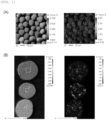
- the amounts of the elements present on the surface of each of the positive electrode active materials of Example 1, Comparative Example 1, and Comparative Example 4 were values obtained by EPMA mapping of an entire surface image of the positive electrode active material of Example 1 in FIG. 1(A) , values obtained by EPMA mapping of an entire surface image of the positive electrode active material of Comparative Example 1 in FIG. 2(A) , and values obtained by EPMA mapping of an entire surface image of the positive electrode active material of Comparative Example 4 in FIG. 3(A) .
- the amounts of the elements present in the inside of each of the positive electrode active materials of Example 1, Comparative Example 1, and Comparative Example 4 were an average value of values obtained by EPMA mapping of the inside of each of red squares in a cross-sectional image of the positive electrode active material of Example 1 in FIG. 1(B) , an average value of values obtained by EPMA Mapping of the inside of each of squares 1 to 6 in a cross-sectional image of the positive electrode active material of Comparative Example 1 in FIG. 2(B) , and an average value of values obtained by EPMA Mapping of the inside of each of squares 1 to 8 in a cross-sectional image of the positive electrode active material of Comparative Example 4 in FIG. 3(B) .
- FIG. 1(A) is an EPMA mapping image of the surface of the positive electrode active material of Example 1
- FIG. 1(B) is an EPMA mapping image of the cross-section of the positive electrode active material of Example 1.
- FIG. 2(A) is an EPMA mapping image of the surface of the positive electrode active material of Comparative Example 1
- FIG. 2(B) is an EPMA mapping image of the cross-section of the positive electrode active material of Comparative Example 1.
- FIG. 3(A) is an EPMA mapping image of the surface of the positive electrode active material of Comparative Example 4
- FIG. 3(B) is an EPMA mapping image of the cross-section of the positive electrode active material of Comparative Example 4.
- the positive electrode active material of Example 1 had less zirconium that was present in an agglomerated state on the surface, and the amount of each of the aluminum and zirconium present in the inside was higher than the amount of each of the aluminum and zirconium present on the surface.
- the positive electrode active materials of Comparative Examples 1 and 4 had a large amount of zirconium that was present in an agglomerated state on the surface, and larger amounts of the aluminum and zirconium elements than those of the example were present on the surfaces of the positive electrode active materials.
- Lithium secondary batteries were prepared using the positive electrode active materials prepared in Examples 1 to 3 and Comparative Examples 1 to 4, and initial efficiency, initial resistance (DCIR), capacity retention, resistance increase rate, and DSC onset temperature were evaluated for each lithium secondary battery.
- a positive electrode slurry was prepared by mixing each of the positive electrode active materials prepared in Examples 1 to 3 and Comparative Examples 1 to 4, a SuperC 65 conductive agent, and a KF1120 binder in an N-methylpyrrolidone (NMP) solvent at a weight ratio of 96.5:1.5:2.0.
- NMP N-methylpyrrolidone
- One surface of an aluminum current collector was coated with the positive electrode slurry, dried at 130°C, and then rolled to prepare a positive electrode.
- a lithium (Li) metal disk was used as a negative electrode active material.
- each lithium secondary battery was prepared by disposing the electrode assembly in a battery case, and then injecting an electrolyte solution into the battery case.
- an electrolyte solution in which 1 M LiPF 6 was dissolved in an organic solvent of EC/EMC/DMC (3/3/4, vol%), was injected to prepare the lithium secondary battery.
- Each lithium secondary battery prepared as described above was charged at a constant current of 0.2 C to 4.25 V at 25°C and discharged at a constant current of 0.2 C to 2.5 V to obtain initial charge capacity and initial discharge capacity, and a percentage of the initial discharge capacity to the initial charge capacity was set as an initial efficiency (%), and the initial efficiencies are presented in Table 2 below.
- thermal stability was evaluated as follows. Specifically, after each lithium secondary battery prepared as described above was charged at a constant current of 0.2 C to 4.25 V at 25°C, discharged at a constant current of 0.2 C to 2.5 V, and then charged again at a constant current of 0.2 C to 4.25 V, each lithium secondary battery was disassembled to separate only the positive electrode, the positive electrode was disposed in a battery case for DSC, and an electrolyte solution, in which 1M LiPF 6 was dissolved in an organic electrolyte (EC/EMC/DMC (3/3/4, vol%), was added into the battery case for DSC such that an amount of the electrolyte solution was 30 parts by weight based on 100 parts by weight of the total positive electrode to prepare a battery for DSC.
- an electrolyte solution in which 1M LiPF 6 was dissolved in an organic electrolyte (EC/EMC/DMC (3/3/4, vol%)
- the batteries including the positive electrode active materials of Examples 1 to 3 had high initial efficiency, low initial resistance, and excellent cycle characteristics and thermal stability. Specifically, it may be confirmed that the battery including the positive electrode active material of Example 1 had higher initial efficiency, lower initial resistance, and lower resistance increase rate than the batteries including the positive electrode active materials of Comparative Examples 1 and 4 in which a doping method was only different. Also, it may be confirmed that the battery including the positive electrode active material of Example 2 had higher initial efficiency, lower initial resistance, and lower resistance increase rate than the battery including the positive electrode active material of Comparative Example 2 in which a doping method was only different.
- a positive electrode active material in which a weight ratio of the aluminum present in the inside to the aluminum present on the surface was greater than 1.0 and a weight ratio of the zirconium present in the inside to the zirconium present on the surface was greater than 1.0, was prepared as a result.
Landscapes
- Chemical & Material Sciences (AREA)
- Organic Chemistry (AREA)
- Inorganic Chemistry (AREA)
- Chemical Kinetics & Catalysis (AREA)
- Electrochemistry (AREA)
- General Chemical & Material Sciences (AREA)
- Engineering & Computer Science (AREA)
- Materials Engineering (AREA)
- Manufacturing & Machinery (AREA)
- Battery Electrode And Active Subsutance (AREA)
- Inorganic Compounds Of Heavy Metals (AREA)
Applications Claiming Priority (2)
| Application Number | Priority Date | Filing Date | Title |
|---|---|---|---|
| KR20220069033 | 2022-06-07 | ||
| PCT/KR2023/007731 WO2023239144A1 (ko) | 2022-06-07 | 2023-06-07 | 양극 활물질의 제조 방법 및 양극 활물질 |
Publications (2)
| Publication Number | Publication Date |
|---|---|
| EP4510231A1 true EP4510231A1 (de) | 2025-02-19 |
| EP4510231A4 EP4510231A4 (de) | 2025-12-17 |
Family
ID=89118640
Family Applications (1)
| Application Number | Title | Priority Date | Filing Date |
|---|---|---|---|
| EP23820080.2A Pending EP4510231A4 (de) | 2022-06-07 | 2023-06-07 | Verfahren zur herstellung eines positivelektrodenaktivmaterials und positivelektrodenaktivmaterial |
Country Status (7)
| Country | Link |
|---|---|
| US (1) | US20250343230A1 (de) |
| EP (1) | EP4510231A4 (de) |
| JP (1) | JP2025518195A (de) |
| KR (2) | KR102814402B1 (de) |
| CN (1) | CN119156722A (de) |
| CA (1) | CA3255214A1 (de) |
| WO (1) | WO2023239144A1 (de) |
Families Citing this family (1)
| Publication number | Priority date | Publication date | Assignee | Title |
|---|---|---|---|---|
| US20250236536A1 (en) * | 2024-01-24 | 2025-07-24 | Samsung Sdi Co., Ltd. | Positive electrode active materials, preparation methods thereof, positive electrodes, and rechargeable lithium batteries |
Family Cites Families (12)
| Publication number | Priority date | Publication date | Assignee | Title |
|---|---|---|---|---|
| KR100437340B1 (ko) * | 2002-05-13 | 2004-06-25 | 삼성에스디아이 주식회사 | 리튬 이차 전지용 양극 활물질의 제조 방법 |
| JP5132360B2 (ja) * | 2008-02-28 | 2013-01-30 | Agcセイミケミカル株式会社 | リチウムイオン二次電池正極活物質用リチウムコバルト複合酸化物の製造方法 |
| KR101748963B1 (ko) * | 2014-12-05 | 2017-06-19 | 주식회사 엘지화학 | 양극 활물질, 이의 제조방법, 및 이를 포함하는 리튬 이차전지 |
| KR20180089030A (ko) * | 2017-01-31 | 2018-08-08 | 주식회사 엘지화학 | 고전압용 리튬 코발트 산화물을 포함하는 리튬 이차전지용 양극 활물질 및 이를 제조하는 방법 |
| KR102335313B1 (ko) * | 2017-09-08 | 2021-12-06 | 주식회사 엘지에너지솔루션 | 리튬 이차전지용 양극 활물질의 제조방법, 이와 같이 제조된 양극 활물질 및 이를 포함하는 리튬 이차전지 |
| KR102165118B1 (ko) * | 2017-10-26 | 2020-10-14 | 주식회사 엘지화학 | 이차전지용 양극 활물질, 그 제조방법 및 이를 포함하는 리튬 이차전지 |
| KR102302038B1 (ko) * | 2018-05-11 | 2021-09-15 | 주식회사 엘지화학 | 리튬 이차전지용 양극 활물질, 이의 제조방법, 이를 포함하는 리튬 이차전지용 양극 및 리튬 이차전지 |
| CN109336193B (zh) * | 2018-10-21 | 2022-02-08 | 圣戈莱(北京)科技有限公司 | 多元素原位共掺杂三元材料前驱体及其制备方法和应用 |
| US12136732B2 (en) * | 2018-11-30 | 2024-11-05 | Posco Holdings Inc. | Cathode active material for lithium secondary battery, and lithium secondary battery comprising same |
| US20220238874A1 (en) * | 2019-05-31 | 2022-07-28 | Sumitomo Metal Mining Co., Ltd. | Positive-electrode active material precursor for lithium-ion secondary battery, positive-electrode active material for lithium-ion secondary battery, methods of manufacturing thereof, and lithium-ion secondary battery |
| CN111422919B (zh) * | 2019-12-19 | 2023-04-21 | 蜂巢能源科技有限公司 | 四元正极材料及其制备方法、正极、电池 |
| CN113582249B (zh) * | 2021-07-26 | 2022-08-12 | 江西佳纳能源科技有限公司 | 一种掺杂金属元素的三元前驱体及其制备方法和应用 |
-
2023
- 2023-06-07 JP JP2024570553A patent/JP2025518195A/ja active Pending
- 2023-06-07 WO PCT/KR2023/007731 patent/WO2023239144A1/ko not_active Ceased
- 2023-06-07 CN CN202380040397.4A patent/CN119156722A/zh active Pending
- 2023-06-07 CA CA3255214A patent/CA3255214A1/en active Pending
- 2023-06-07 KR KR1020230072807A patent/KR102814402B1/ko active Active
- 2023-06-07 US US18/867,561 patent/US20250343230A1/en active Pending
- 2023-06-07 EP EP23820080.2A patent/EP4510231A4/de active Pending
-
2025
- 2025-05-22 KR KR1020250066571A patent/KR20250077431A/ko active Pending
Also Published As
| Publication number | Publication date |
|---|---|
| KR20230168603A (ko) | 2023-12-14 |
| CA3255214A1 (en) | 2025-03-27 |
| CN119156722A (zh) | 2024-12-17 |
| EP4510231A4 (de) | 2025-12-17 |
| KR20250077431A (ko) | 2025-05-30 |
| US20250343230A1 (en) | 2025-11-06 |
| KR102814402B1 (ko) | 2025-05-30 |
| WO2023239144A1 (ko) | 2023-12-14 |
| JP2025518195A (ja) | 2025-06-12 |
Similar Documents
| Publication | Publication Date | Title |
|---|---|---|
| US12100829B2 (en) | Positive electrode active material for secondary battery, method of preparing the same, and lithium secondary battery including the positive electrode active material | |
| KR102176633B1 (ko) | 리튬 이차전지용 양극 활물질, 그 제조방법 및 이를 포함하는 리튬 이차전지 | |
| CN111095630B (zh) | 二次电池用正极活性材料、其制备方法以及包含其的锂二次电池 | |
| EP3609003A1 (de) | Positivelektrodenmaterial mit lithiummangan, positivelektrodenaktivmaterial mit spinellstruktur, positivelektrode und lithiumsekundärbatterie | |
| US20260081137A1 (en) | Method of Preparing Positive Electrode Material for Lithium Secondary Battery and Positive Electrode Material for Lithium Secondary Battery Prepared Thereby | |
| US20220190326A1 (en) | Positive Electrode Active Material for Secondary Battery, Method of Preparing the Same, and Lithium Secondary Battery Including the Positive Electrode Active Material | |
| EP4325600B1 (de) | Verfahren zur herstellung eines kathodenaktivmaterials für eine lithiumsekundärbatterie und damit hergestelltes kathodenaktivmaterial | |
| KR102565001B1 (ko) | 양극 활물질 전구체, 이의 제조방법 및 이를 이용한 양극 활물질의 제조방법 | |
| EP4235861A1 (de) | Positivelektrodenaktivmaterialvorläufer, verfahren zur herstellung davon und positivelektrodenaktivmaterial | |
| US20240170663A1 (en) | Positive Electrode Active Material and Preparation Method Thereof | |
| EP3915945A1 (de) | Kathodenaktivmaterialvorläufer für sekundärbatterie, kathodenaktivmaterial, herstellungsverfahren dafür und lithiumsekundärbatterie damit | |
| CN117529452B (zh) | 锂二次电池用正极活性材料的制备方法和由此制备的正极活性材料 | |
| EP4254554A1 (de) | Kathodenaktivmaterial, kathode damit und sekundärbatterie | |
| EP3892590B1 (de) | Verfahren zur herstellung eines positivelektrodenaktivmaterials für sekundärbatterien | |
| EP4588896A1 (de) | Verfahren zur herstellung eines positivelektrodenaktivmaterialvorläufers, positivelektrodenaktivmaterialvorläufer und verfahren zur herstellung eines positivelektrodenaktivmaterials | |
| EP3892589B1 (de) | Verfahren zur herstellung eines positivelektroden-aktivmaterials für lithiumsekundärbatterie und positivelektroden-aktivmaterial hergestellt durch diese methode | |
| EP4174989B1 (de) | Positivelektrodenaktivmaterialvorläufer und verfahren zur herstellung davon | |
| KR20250077431A (ko) | 양극 활물질의 제조 방법 및 양극 활물질 | |
| EP4167323A1 (de) | Kathodenaktivmaterialvorläufer und herstellungsverfahren dafür | |
| EP4708389A1 (de) | Positivelektrodenaktivmaterial, verfahren zur herstellung davon, positivelektrode damit und lithiumsekundärbatterie |
Legal Events
| Date | Code | Title | Description |
|---|---|---|---|
| STAA | Information on the status of an ep patent application or granted ep patent |
Free format text: STATUS: THE INTERNATIONAL PUBLICATION HAS BEEN MADE |
|
| PUAI | Public reference made under article 153(3) epc to a published international application that has entered the european phase |
Free format text: ORIGINAL CODE: 0009012 |
|
| STAA | Information on the status of an ep patent application or granted ep patent |
Free format text: STATUS: REQUEST FOR EXAMINATION WAS MADE |
|
| 17P | Request for examination filed |
Effective date: 20241115 |
|
| AK | Designated contracting states |
Kind code of ref document: A1 Designated state(s): AL AT BE BG CH CY CZ DE DK EE ES FI FR GB GR HR HU IE IS IT LI LT LU LV MC ME MK MT NL NO PL PT RO RS SE SI SK SM TR |
|
| DAV | Request for validation of the european patent (deleted) | ||
| DAX | Request for extension of the european patent (deleted) | ||
| A4 | Supplementary search report drawn up and despatched |
Effective date: 20251119 |
|
| RIC1 | Information provided on ipc code assigned before grant |
Ipc: H01M 4/525 20100101AFI20251113BHEP Ipc: H01M 4/505 20100101ALI20251113BHEP Ipc: H01M 4/131 20100101ALI20251113BHEP Ipc: H01M 10/0525 20100101ALI20251113BHEP Ipc: C01G 53/00 20250101ALI20251113BHEP Ipc: H01M 4/02 20060101ALI20251113BHEP |