EP4510321A1 - Batterie anti-explosion - Google Patents
Batterie anti-explosion Download PDFInfo
- Publication number
- EP4510321A1 EP4510321A1 EP24166418.4A EP24166418A EP4510321A1 EP 4510321 A1 EP4510321 A1 EP 4510321A1 EP 24166418 A EP24166418 A EP 24166418A EP 4510321 A1 EP4510321 A1 EP 4510321A1
- Authority
- EP
- European Patent Office
- Prior art keywords
- shell
- explosion
- score
- mounting hole
- proof
- Prior art date
- Legal status (The legal status is an assumption and is not a legal conclusion. Google has not performed a legal analysis and makes no representation as to the accuracy of the status listed.)
- Pending
Links
- 235000015110 jellies Nutrition 0.000 claims abstract description 42
- 239000008274 jelly Substances 0.000 claims abstract description 42
- 230000004308 accommodation Effects 0.000 claims abstract description 21
- 239000000463 material Substances 0.000 claims abstract description 6
- 238000007789 sealing Methods 0.000 claims description 90
- 230000000149 penetrating effect Effects 0.000 claims description 2
- 238000000034 method Methods 0.000 description 14
- 238000010586 diagram Methods 0.000 description 6
- 238000003466 welding Methods 0.000 description 6
- 238000004519 manufacturing process Methods 0.000 description 5
- 230000009286 beneficial effect Effects 0.000 description 3
- 230000009172 bursting Effects 0.000 description 2
- 230000000694 effects Effects 0.000 description 2
- 239000003792 electrolyte Substances 0.000 description 2
- 238000004880 explosion Methods 0.000 description 2
- 238000002347 injection Methods 0.000 description 2
- 239000007924 injection Substances 0.000 description 2
- 230000001788 irregular Effects 0.000 description 2
- 238000010147 laser engraving Methods 0.000 description 2
- 239000007788 liquid Substances 0.000 description 2
- RYGMFSIKBFXOCR-UHFFFAOYSA-N Copper Chemical compound [Cu] RYGMFSIKBFXOCR-UHFFFAOYSA-N 0.000 description 1
- 229910000831 Steel Inorganic materials 0.000 description 1
- XAGFODPZIPBFFR-UHFFFAOYSA-N aluminium Chemical compound [Al] XAGFODPZIPBFFR-UHFFFAOYSA-N 0.000 description 1
- 229910052782 aluminium Inorganic materials 0.000 description 1
- 230000004888 barrier function Effects 0.000 description 1
- 238000003486 chemical etching Methods 0.000 description 1
- 238000004891 communication Methods 0.000 description 1
- 239000004020 conductor Substances 0.000 description 1
- 229910052802 copper Inorganic materials 0.000 description 1
- 239000010949 copper Substances 0.000 description 1
- 230000007547 defect Effects 0.000 description 1
- 238000005530 etching Methods 0.000 description 1
- 238000009434 installation Methods 0.000 description 1
- 239000011810 insulating material Substances 0.000 description 1
- 230000010354 integration Effects 0.000 description 1
- 238000000465 moulding Methods 0.000 description 1
- 239000010959 steel Substances 0.000 description 1
- 239000000126 substance Substances 0.000 description 1
- 230000007704 transition Effects 0.000 description 1
- 238000007514 turning Methods 0.000 description 1
Images


Classifications
-
- H—ELECTRICITY
- H01—ELECTRIC ELEMENTS
- H01M—PROCESSES OR MEANS, e.g. BATTERIES, FOR THE DIRECT CONVERSION OF CHEMICAL ENERGY INTO ELECTRICAL ENERGY
- H01M10/00—Secondary cells; Manufacture thereof
- H01M10/04—Construction or manufacture in general
- H01M10/0431—Cells with wound or folded electrodes
-
- H—ELECTRICITY
- H01—ELECTRIC ELEMENTS
- H01M—PROCESSES OR MEANS, e.g. BATTERIES, FOR THE DIRECT CONVERSION OF CHEMICAL ENERGY INTO ELECTRICAL ENERGY
- H01M50/00—Constructional details or processes of manufacture of the non-active parts of electrochemical cells other than fuel cells, e.g. hybrid cells
- H01M50/10—Primary casings; Jackets or wrappings
- H01M50/102—Primary casings; Jackets or wrappings characterised by their shape or physical structure
- H01M50/107—Primary casings; Jackets or wrappings characterised by their shape or physical structure having curved cross-section, e.g. round or elliptic
-
- H—ELECTRICITY
- H01—ELECTRIC ELEMENTS
- H01M—PROCESSES OR MEANS, e.g. BATTERIES, FOR THE DIRECT CONVERSION OF CHEMICAL ENERGY INTO ELECTRICAL ENERGY
- H01M50/00—Constructional details or processes of manufacture of the non-active parts of electrochemical cells other than fuel cells, e.g. hybrid cells
- H01M50/10—Primary casings; Jackets or wrappings
- H01M50/131—Primary casings; Jackets or wrappings characterised by physical properties, e.g. gas permeability, size or heat resistance
- H01M50/133—Thickness
-
- H—ELECTRICITY
- H01—ELECTRIC ELEMENTS
- H01M—PROCESSES OR MEANS, e.g. BATTERIES, FOR THE DIRECT CONVERSION OF CHEMICAL ENERGY INTO ELECTRICAL ENERGY
- H01M50/00—Constructional details or processes of manufacture of the non-active parts of electrochemical cells other than fuel cells, e.g. hybrid cells
- H01M50/10—Primary casings; Jackets or wrappings
- H01M50/14—Primary casings; Jackets or wrappings for protecting against damage caused by external factors
- H01M50/143—Fireproof; Explosion-proof
-
- H—ELECTRICITY
- H01—ELECTRIC ELEMENTS
- H01M—PROCESSES OR MEANS, e.g. BATTERIES, FOR THE DIRECT CONVERSION OF CHEMICAL ENERGY INTO ELECTRICAL ENERGY
- H01M50/00—Constructional details or processes of manufacture of the non-active parts of electrochemical cells other than fuel cells, e.g. hybrid cells
- H01M50/10—Primary casings; Jackets or wrappings
- H01M50/147—Lids or covers
- H01M50/148—Lids or covers characterised by their shape
- H01M50/152—Lids or covers characterised by their shape for cells having curved cross-section, e.g. round or elliptic
-
- H—ELECTRICITY
- H01—ELECTRIC ELEMENTS
- H01M—PROCESSES OR MEANS, e.g. BATTERIES, FOR THE DIRECT CONVERSION OF CHEMICAL ENERGY INTO ELECTRICAL ENERGY
- H01M50/00—Constructional details or processes of manufacture of the non-active parts of electrochemical cells other than fuel cells, e.g. hybrid cells
- H01M50/10—Primary casings; Jackets or wrappings
- H01M50/172—Arrangements of electric connectors penetrating the casing
- H01M50/174—Arrangements of electric connectors penetrating the casing adapted for the shape of the cells
- H01M50/179—Arrangements of electric connectors penetrating the casing adapted for the shape of the cells for cells having curved cross-section, e.g. round or elliptic
-
- H—ELECTRICITY
- H01—ELECTRIC ELEMENTS
- H01M—PROCESSES OR MEANS, e.g. BATTERIES, FOR THE DIRECT CONVERSION OF CHEMICAL ENERGY INTO ELECTRICAL ENERGY
- H01M50/00—Constructional details or processes of manufacture of the non-active parts of electrochemical cells other than fuel cells, e.g. hybrid cells
- H01M50/10—Primary casings; Jackets or wrappings
- H01M50/183—Sealing members
- H01M50/186—Sealing members characterised by the disposition of the sealing members
- H01M50/188—Sealing members characterised by the disposition of the sealing members the sealing members being arranged between the lid and terminal
-
- H—ELECTRICITY
- H01—ELECTRIC ELEMENTS
- H01M—PROCESSES OR MEANS, e.g. BATTERIES, FOR THE DIRECT CONVERSION OF CHEMICAL ENERGY INTO ELECTRICAL ENERGY
- H01M50/00—Constructional details or processes of manufacture of the non-active parts of electrochemical cells other than fuel cells, e.g. hybrid cells
- H01M50/30—Arrangements for facilitating escape of gases
- H01M50/342—Non-re-sealable arrangements
- H01M50/3425—Non-re-sealable arrangements in the form of rupturable membranes or weakened parts, e.g. pierced with the aid of a sharp member
-
- H—ELECTRICITY
- H01—ELECTRIC ELEMENTS
- H01M—PROCESSES OR MEANS, e.g. BATTERIES, FOR THE DIRECT CONVERSION OF CHEMICAL ENERGY INTO ELECTRICAL ENERGY
- H01M50/00—Constructional details or processes of manufacture of the non-active parts of electrochemical cells other than fuel cells, e.g. hybrid cells
- H01M50/50—Current conducting connections for cells or batteries
- H01M50/543—Terminals
- H01M50/552—Terminals characterised by their shape
- H01M50/559—Terminals adapted for cells having curved cross-section, e.g. round, elliptic or button cells
-
- H—ELECTRICITY
- H01—ELECTRIC ELEMENTS
- H01M—PROCESSES OR MEANS, e.g. BATTERIES, FOR THE DIRECT CONVERSION OF CHEMICAL ENERGY INTO ELECTRICAL ENERGY
- H01M50/00—Constructional details or processes of manufacture of the non-active parts of electrochemical cells other than fuel cells, e.g. hybrid cells
- H01M50/50—Current conducting connections for cells or batteries
- H01M50/543—Terminals
- H01M50/564—Terminals characterised by their manufacturing process
- H01M50/567—Terminals characterised by their manufacturing process by fixing means, e.g. screws, rivets or bolts
-
- Y—GENERAL TAGGING OF NEW TECHNOLOGICAL DEVELOPMENTS; GENERAL TAGGING OF CROSS-SECTIONAL TECHNOLOGIES SPANNING OVER SEVERAL SECTIONS OF THE IPC; TECHNICAL SUBJECTS COVERED BY FORMER USPC CROSS-REFERENCE ART COLLECTIONS [XRACs] AND DIGESTS
- Y02—TECHNOLOGIES OR APPLICATIONS FOR MITIGATION OR ADAPTATION AGAINST CLIMATE CHANGE
- Y02E—REDUCTION OF GREENHOUSE GAS [GHG] EMISSIONS, RELATED TO ENERGY GENERATION, TRANSMISSION OR DISTRIBUTION
- Y02E60/00—Enabling technologies; Technologies with a potential or indirect contribution to GHG emissions mitigation
- Y02E60/10—Energy storage using batteries
-
- Y—GENERAL TAGGING OF NEW TECHNOLOGICAL DEVELOPMENTS; GENERAL TAGGING OF CROSS-SECTIONAL TECHNOLOGIES SPANNING OVER SEVERAL SECTIONS OF THE IPC; TECHNICAL SUBJECTS COVERED BY FORMER USPC CROSS-REFERENCE ART COLLECTIONS [XRACs] AND DIGESTS
- Y02—TECHNOLOGIES OR APPLICATIONS FOR MITIGATION OR ADAPTATION AGAINST CLIMATE CHANGE
- Y02P—CLIMATE CHANGE MITIGATION TECHNOLOGIES IN THE PRODUCTION OR PROCESSING OF GOODS
- Y02P70/00—Climate change mitigation technologies in the production process for final industrial or consumer products
- Y02P70/50—Manufacturing or production processes characterised by the final manufactured product
Definitions
- the present application relates to the field of power supply devices, and in particular to a battery.
- Batteries are widely used in many fields, and demands for battery safety are getting higher and higher.
- a battery is at high temperature, overcharged or short-circuited, a large amount of gas will be generated inside the battery, which will cause the pressure inside the battery case to rise sharply.
- explosion-proof structures are usually provided on the battery cases, and thus the gas inside the batteries may be exhausted through the explosion-proof structures to release the pressure.
- the first type adopts a pressure-relief through hole provided in the case, and a bursting disc covering the pressure-relief through hole as an explosion-proof valve.
- the second type has the case scored to form an explosion-proof score in the case.
- the two type of structures in the related art have following defects.
- a gap exists between the bursting disc and the pressure-relief through hole, which affects the sealing of the battery.
- the explosion-proof score is generally scored according to operators' experience, and explosion-proof score with too large or insufficient depth is possibly formed.
- the present application provides a battery to solve the technical problems above.
- the present application provides a battery including a jelly roll and a case.
- the case includes a first shell and a second shell; the first shell has an accommodation cavity therein, the first shell is provided with an opening communicated with the accommodation cavity, the jelly roll is disposed in the accommodation cavity, and the second shell blocks the opening.
- An explosion-proof score is provided in the first shell and/or the second shell.
- a burst pressure of the explosion-proof score is P
- a tensile strength of a material of the case is ⁇ b
- a diameter of the first shell is D
- a wall thickness of the case is H
- a depth of the explosion-proof score is h.
- the explosion-proof score is provided in the case, and the explosion-proof score 211 is equivalent to a locally thinned portion provided on the case and may be used for gas exhausting and pressure relief when the pressure inside the case is too high, to avoid the battery from exploding, so that the battery has a relatively high safety, and there is no need to provide a through hole for installing an explosion-proof valve on the case. As a result, the sealing of the battery is improved.
- connection In the description of the present application, unless otherwise clearly specified and limited, terms “connected”, “connect” and “fix” should be understood in a generalized manner, for example, may be understood as fixed connection, detachable connection, or integration; or may be understood as mechanical connection or electrical connection; or may also be a direct connection or an indirect connection by means of a medium, or internal communication of two elements or a mutual relationship between two elements.
- connection may be understood as fixed connection, detachable connection, or integration; or may be understood as mechanical connection or electrical connection; or may also be a direct connection or an indirect connection by means of a medium, or internal communication of two elements or a mutual relationship between two elements.
- a first feature being “above” or “below” a second feature may include that the first feature directly contacts the second feature, and may also include that the first feature does not directly contact with the second feature but contacts the second feature through additional feature between the first feature and the second feature.
- the first feature being “above”, “on”, and “on top of” the second feature includes the first feature being directly above and diagonally above the second feature, or indicates that a horizontal height of the first feature is higher than a horizontal height of the second feature.
- the first feature being “below”, “under”, and “beneath” the second feature includes the first feature being directly below and diagonally below the second feature, or indicates that a horizontal height of the first feature is lower than a horizontal height of the second feature.
- orientations or positional relationships indicated by terms “up”, “down”, “right”, etc. are based on the orientations or position relationships shown in the accompanying drawings, and are only for the convenience of describing the embodiments and simplifying the description, rather than implying or indicating that the device or the component referred to must have a particular orientation or constructed and operated in a particular orientation, and thus these terms cannot be understood as limiting the present application.
- terms “first” and “second” are only used for distinguishing in description and have no special meaning.
- the battery has a relatively simple structure, high sealing performance and high safety.
- the battery may be a cylindrical battery, a prismatic battery, a triangular prism battery, a special-shaped battery, or any one of variously shaped batteries.
- specific embodiments of the cylindrical battery are described in detail below.
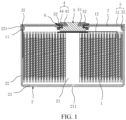
- the battery includes a jelly roll 1 and a case.
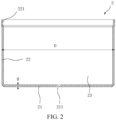
- the case includes a first shell 2 and a second shell 3.
- the first shell 2 has an accommodation cavity 23, and the first shell 2 is provided with an opening communicated with the accommodation cavity 23.
- the jelly roll 1 is disposed in the accommodation cavity, and the second shell 3 blocks the opening.
- An explosion-proof score 211 is provided in the first shell 2 and/or the second shell 3.
- a burst pressure of the explosion-proof score 211 is P
- a tensile strength of a material of the case is ⁇ b
- a diameter of the first shell 2 is D
- a wall thickness of the case is H
- a depth of the explosion-proof score 211 is h.
- the explosion-proof score 211 is provided in the case, and the explosion-proof score 211 is equivalent to a locally thinned portion provided on the case and may be used for gas exhausting and pressure relief when pressure inside the case is too high to avoid the battery from exploding, so that the battery has a relatively high safety, and there is no need to provide a through hole for installing an explosion-proof valve on the case. As a result, the sealing of the battery is improved.
- the explosion-proof score 211 may be made by mechanical turning, laser engraving, chemical etching, die stamping, etc.
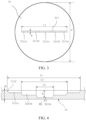
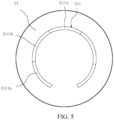
- the explosion-proof score 211 includes at least two score grooves 2111. All score grooves 2111 are arranged in steps along a depth direction of the explosion-proof score 211. A sum of depths of all score grooves 2111 is equal to the depth h of the explosion-proof score 211. It will be understood that, the explosion-proof score 211 may be a score with steps having different depths, which reduces the difficulty of etching the explosion-proof score 211 in the case. Different score grooves are located in different depths of the explosion-proof score 211, which may reduce the probability of liquid leakage caused by the portion of the case corresponding to the score being easily damaged due to assembly. As a result, the sealing of the battery is improved.
- a difference between depths of any two score grooves 2111 is ⁇ h, and ⁇ h is in a range of -0.02 mm to 0.01 mm (-0.02 mm ⁇ ⁇ h ⁇ 0.01 mm).
- ⁇ h may be -0.02 mm, -0.015 mm, -0.01 mm, -0.005 mm, 0 mm, 0.005 mm, or 0.01 mm, etc.
- a wall of the score groove 2111 is a first sloped surface 2112, and the first sloped surface 2112 extends from a bottom of the score groove 2111 toward an opening of the score groove 2111 and is inclined away from a center line O1 of the explosion-proof score 211. Therefore, the wall of the score groove 2111 may serve as a transition surface, which may reduce stress concentration and also reduce the difficulty of processing. In other embodiments, the bottom and the wall of the score groove 2111 are arranged to be perpendicular to each other.
- the explosion-proof score 211 can be arranged in steps along the length direction thereof, which is beneficial to the manufacturing of the explosion-proof score 211.
- widths of the score grooves are equal to each other. In other embodiments, widths of all score grooves may be different from each other.
- the explosion-proof score 211 is provided with three score grooves 2111, and the three score grooves 2111 are a first score groove 2111a, a second score groove 2111b and a third score groove 2111c.
- the second score groove 2111b is at a recessed bottom of the first score groove 2111a
- the third score groove 2111c is at a recessed bottom of the second score groove 2111b.
- Three score grooves 2111 with different depths are etched, so that three thinned portions with different thinness are formed on the case. As a result, multi-stage break may occur when the pressure inside the case is too high.
- the explosion-proof score 211 play a role of safety and explosion proof.
- the bottom of the third score groove 2111c is the thinnest, which is a first weak portion
- a portion between the wall of the second score groove 2111b and the wall of the third score groove 2111c is a second weak portion
- a portion between the wall of the first score groove 2111a and the wall of the second score groove 2111b is a third weak portion.
- extension directions of the lengths of the first score groove 2111a, the second score groove 2111b and the third score groove 2111c are the same.
- the length of the first score groove 2111a is L1
- the length of the second score groove 2111b is L2
- the length of the third score groove 2111c is L3, and L1 > L2 > L3.
- the three score grooves 2111 have gradient changes in the length direction. That is, the depths of the three score grooves 2111 in the length direction are changed, which can improve the stability of pressure relief.
- the three score grooves 2111 have gradient changes in a width direction. That is, widths of all score grooves are different from each other.
- the three score grooves 2111 have gradient changes in the width direction and in the length direction.
- the number of the score grooves 2111 may also be set to two, four or another number, which is not limited to the embodiments above.
- a cross section of the explosion-proof score 211 is arc-shaped.
- the thinness of the explosion-proof score 211 gradually changes along a depth direction thereof. Therefore, under extreme conditions such as high pressure, the explosion-proof score 211 may also be broken to form pressure relief channels having different areas according to a level of the pressure, so as to effectively relieve pressure.
- the explosion-proof score 211 is arranged in an outer sidewall of the first shell 2, and the inner sidewall of the first shell 2 corresponding to the explosion-proof score 211 is of a planar structure.
- the inner sidewall of the first shell 2 is not affected by the explosion-proof score 211, which facilitates better installation of the jelly roll 1.
- the space outside the first shell 2 is relatively large, which facilitates the manufacturing of the explosion-proof score 211.
- the explosion-proof score 211 may be arranged in the inner sidewall of the first shell 2.
- the depth of the explosion-proof score 211 is h, and h is in a range of 0.13 mm to 0.155 mm (i.e., 0.13 mm ⁇ h ⁇ 0.155 mm).
- the battery has a better explosion-proof performance when the depth of the explosion-proof score 211 is in this range.
- the depth h of the explosion-proof score 211 may be 0.13 mm, 0.135 mm, 0.14 mm, 0.145 mm, 0.15 mm or 0.155 mm, etc.
- the width of the explosion-proof score 211 is W, and W is in a range of 0.1 mm to 0.5 mm (i.e., 0.1 mm ⁇ W ⁇ 0.5 mm).
- the battery has a better explosion-proof performance when the width of the explosion-proof score 211 is in this range.
- the width W of the explosion-proof score 211 may be in a range of 0.1 mm to 0.3 mm.
- the width W of the explosion-proof score 211 may be 0.1 mm, 0.11 mm, 0.12 mm, 0.13 mm, 0.14 mm, 0.15 mm, 0.16 mm, 0.17 mm, 0.18 mm, 0.19 mm, 0.2 mm, 0.21 mm, 0.22 mm, 0.23 mm, 0.24 mm, 0.25 mm, 0.26 mm, 0.27 mm, 0.28 mm, 0.29 mm or 0.3 mm, etc.
- the explosion-proof score 211 is in a shape of a straight line.
- the explosion-proof score 211 is in a shape of "-".
- the explosion-proof score 211 has a simple shape and is easy to be manufactured.
- the explosion-proof score 211 is in a shape of a curve.
- the length and area of the explosion-proof score 211 may be increased in a limited space of the first shell 2, thereby increasing the explosion-proof effect and improving the safety performance of the battery.
- the explosion-proof score 211 may be S-shaped, C-shaped, Z-shaped, annular or in other shape with a certain curvature; or the explosion-proof score 211 may also be in other irregular shape.
- one or more explosion-proof scores 211 may be provided in the first shell 2, and the one or more explosion-proof scores 211 may be strip-shaped or dot-shaped. In the case where the explosion-proof scores 211 are dot-shaped, the explosion-proof scores 211 are arranged in an array.
- the first shell 2 includes a base plate 21 and a first enclosing plate 22 surrounding the base plate 21, the base plate 21 and the first enclosing plate 22 are connected to form the accommodation cavity 23, and the explosion-proof score 211 is arranged in the base plate 21.
- the base plate 21 is generally located at a bottom of the battery, and thus the explosion-proof score 211 is difficult to be seen, thereby improving the aesthetics of the battery.
- the first shell 2 has only one opening at an end of the accommodation cavity 23. In other embodiments, the first shell 2 is provided with openings at both ends of the accommodation cavity 23, and the openings each are blocked by a second shell 3.
- the explosion-proof scores 211 are arc-shaped, and the explosion-proof scores 211 are evenly distributed around a center of the base plate 21.
- the explosion-proof performance of the battery may be improved, and in another aspect, the aesthetics of the battery may be improved.
- the number of the score grooves 2111 may be set to two, three, four or other number, which is not limited to the embodiment.
- the first shell includes a base plate 21 and a first enclosing plate 22 surrounding the base plate 21, the base plate 21 and the first enclosing plate 22 are connected to form the accommodation cavity 23, and the explosion-proof score 211 is arranged in the first enclosing plate 22.
- the location of the explosion-proof score 211 may be set according to actual needs, which is not specifically limited herein.
- the wall thickness of the case is H, and H is in a range of 0.17 mm to 0.19 mm (i.e., 0.17 mm ⁇ H ⁇ 0.19 mm).
- the wall thickness H of the case may be 0.17 mm, 0.171 mm, 0.172 mm, 0.173 mm, 0.174 mm, 0.175 mm, 0.176 mm, 0.177 mm, 0.178 mm, 0.179 mm, 0.18 mm, 0.181 mm, 0.182 mm, 0.183 mm, 0.184 mm, 0.185 mm, 0.186 mm, 0.187 mm, 0.188 mm, 0.189 mm or 0.19 mm, etc.
- the burst pressure of the explosion-proof score 211 is P, and P is in a range of 1.6 Mpa to 5 Mpa (i.e., 1.6 Mpa ⁇ P ⁇ 5 Mpa).
- the burst pressure P of the explosion-proof score 211 may be 1.6 Mpa, 1.8 Mpa, 2 Mpa, 2.2 Mpa, 2.4 Mpa, 2.5 Mpa, 2.6 Mpa, 2.8 Mpa, 3 Mpa, 3.2 Mpa, 3.4 Mpa, 3.5 Mpa, 3.6 Mpa, 3.8 Mpa, 4 Mpa, 4.2 Mpa, 4.4 Mpa, 4.5 Mpa, 4.6 Mpa, 4.7 Mpa, 4.8 Mpa or 5Mpa.
- the diameter of the case is D, and D is in a range of 5.5 mm to 15 mm (i.e., 5.5 mm ⁇ D ⁇ 15 mm).
- the diameter D of the case may be 5.5 mm, 6 mm, 6.5 mm, 7 mm, 7.5 mm, 8 mm, 8.5 mm, 9 mm, 9.5 mm, 10 mm, 10.5 mm, 11 mm, 11.5 mm, 12 mm, 12.5 mm, 13 mm, 13.5 mm, 14 mm, 14.5 mm or 15 mm, etc.
- the explosion-proof score 211 is linear, and the explosion-proof score 211 is located at the middle part of the base plate 21.
- a wall thickness H of the base plate 21 is in a range of 0.17 mm to 0.19 mm
- the depth h of the explosion-proof score 211 is in a range of 0.13 mm to 0.15 mm
- the width W of the explosion-proof score 211 is in a range of 0.2 mm to 0.3 mm
- the burst pressure P is in a range of 1.6 Mpa to 2.6 Mpa
- the diameter D of the case is in the range of 5.5 mm to 15 mm (i.e., 5.5 mm ⁇ D ⁇ 15 mm).
- the explosion-proof score 211 is arc-shaped, an arc angle of the explosion-proof score 211 is 120 degrees, and the explosion-proof score 211 is located at the middle part of the base plate 21.
- the wall thickness H of the base plate 21 is in the range of 0.17 mm to 0.19 mm
- the depth h of the explosion-proof score 211 is in a range of 0.135 mm to 0.155 mm
- the width W of the explosion-proof score 211 is in a range of 0.1 mm to 0.5 mm
- the burst pressure P is in a range of 2.6 Mpa to 5 Mpa
- the diameter D of the case is in the range of 5.5 mm to 15 mm (i.e., 5.5 mm ⁇ D ⁇ 15 mm).
- the depth and width of the explosion-proof score 211 are determined by the thickness D of the case and the burst pressure.
- the battery further includes a fixing block 4, a pole 5 and a sealing member 6.
- the second shell 3 is provided with a first mounting hole 311 penetrating therethrough.
- the fixing block 4 is disposed on a side of the second shell 3 away from the jelly roll 1, and the fixing block 4 includes a first body 43.
- An outer sidewall of the first body 43 is provided with a first projecting ring 44, and a thickness of the first body 43 is greater than a thickness of the first projecting ring 44; and the first body 43 is provided with a second mounting hole 41 corresponding to the first mounting hole 311.
- the pole 5 is disposed on a side of the second shell 3 facing the jelly roll 1, and the pole 5 partially passes through the first mounting hole 311 and the second mounting hole 41 to be riveted to the first body 43.
- An outer sidewall of the pole 5 is provided with a first step surface 51 and a second step surface 52 that are arranged at an interval, and a surface of the first body 43 facing the second shell 3 abuts against the first step surface 51.
- the sealing member 6 is partially sandwiched between a hole wall of the first mounting hole 311 and the outer sidewall of the pole 5, and the first projecting ring 44 and the second step surface 52 abut against two opposite surfaces of the sealing member, respectively.
- the pole 5 is riveted to the second mounting hole 41 of the fixing block 4, and the first step surface 51 of the pole 5 abuts against the first body 43 of the fixing block 4, thereby ensuring the connection stability between the pole 5 and the fixing block 4.
- the first projecting ring 44 and the second step surface 52 of the pole 5 squeeze the sealing member 6 in a direction, and the hole wall of the first mounting hole 311 of the second shell 3 and the pole 5 squeeze the sealing member 6 in another direction.
- the sealing of the battery is improved by the sealing member 6 squeezed in two directions at an angle.
- the explosion-proof score is disposed on a hole wall of the first shell 2, and the explosion-proof score 211 is equivalent to a locally thinned portion of the first shell 2 and may be used for gas exhausting and pressure relief when the pressure inside the first shell 2 is too high to avoid the battery from exploding, and thus the battery has a relatively high safety. With this design, there is no need to provide a through hole in the first shell 2 for installing an explosion-proof valve, which further improves the sealing of the battery.
- the end of the pole 5 needs to be squeezed by a riveting equipment, and thus the end of the pole 5 is deformed to form a structure fitting with the second mounting hole 41 for fixing. Therefore, during the riveting process, the fixing block 4 will also be subjected to a certain force. In a case where the fixing block 4 is too thin, the fixing block 4 will be deformed due to insufficient strength. In a case where the fixing block 4 is too thick, the weight and volume of the battery will be increased, which is not in line with the lightweight design.
- the fixing block 4 is designed to be of a structure having the projecting ring, such that a step structure is formed between the first projecting ring 44 and the first body 43, and the thickness of the first body 43 is greater than that of the first projecting ring 44, thereby the strength of the first body 43 is relatively high and meets the strength requirement of the first body 43 for being riveting with the pole 5.
- the first projecting ring 44 is relatively thin, which may reduce the weight and volume of the fixing block 4.
- the step structure of the fixing block 4 cooperates with the step surface of the pole 5 to squeeze the sealing member 6, and thus the fixing block 4 and the pole 5 are compact and have a good sealing performance.
- the sealing member 6 is a sealing ring, and the sealing ring is of a rotary structure.
- the sealing member may seal a periphery of the first mounting hole 311 with a good sealing effect.
- the first projecting ring 44 and the first step surface 51 squeeze the sealing member 6 in an axial direction of the sealing member 6, and the hole wall of the first mounting hole 311 and the outer sidewall of the pole 5 squeeze the sealing member 6 in a radial direction of the sealing member 6, and thus the sealing member 6 is squeezed by squeezing forces in two perpendicular directions, thereby further improving the sealing performance of the sealing member 6.
- the sealing member 6 may be in other shape, such as a square or an irregular shape.
- the first shell 2 may be made of steel, aluminum, copper or other material(s).
- the first shell 2 may serve as an outermost layer of a bare cell, and the first shell 2 directly contacts the jelly roll 1.
- the shape of the first shell 2 may be a cylinder, a triangular prism, a quadrangular prism or other shape, and the shape of the first shell 2 is not limited to the embodiment.
- the jelly roll 1 includes a positive electrode sheet, a negative electrode sheet, a diaphragm and tabs.
- the jelly roll 1 is a wound jelly roll 1, which is abbreviated as a wound core.
- the positive electrode sheet, the diaphragm and the negative electrode sheet are sequentially stacked and then wound together to form the wound core.
- the jelly roll 1 may be a laminated jelly roll formed by sequentially stacked positive electrode sheets, diaphragms and negative electrode sheets, or have other jelly roll structure familiar to those skilled in the art.
- the second mounting hole 41 is a second sloped surface 411, and the second sloped surface 411 extends from an end of the second mounting hole 41 adjacent to the second step surface 52 to another end of the second mounting hole 41 away from the second step surface 52 and is inclined away from a center line O2 of the second mounting hole 41. Therefore, with this design, the second mounting hole 41 has an outwardly expanding second sloped surface 411, which is beneficial to rivet connection between the pole 5 and the fixing block 4. As a result, the connection between the pole 5 and the fixing block 4 is improved.
- the portion of the hole wall of the second mounting hole 41 being the second sloped surface 411 means that part of the hole wall is the second sloped surface 411, and the portion of the hole wall may be a straight surface, a curved surface, or a surface of other shape.
- the hole wall of the second mounting holes 41 may be the second sloped surface 411.
- the second mounting hole 41 is a tapered hole with a big end and a small end, and the big end is located at an end surface of the first body 43 away from the second step surface 52.
- the tapered hole is formed by the second sloped surface 411.
- the second mounting hole 41 includes the tapered hole and a straight hole that are communicated with each other, and the tapered hole is located at an end of the first body 43 away from the jelly roll 1. It will be noted that, for the big end and the small end of the tapered hole, a diameter of the big end is larger than a diameter of the small end.
- the end of the first body 43 away from the jelly roll 1 is provided with a countersunk groove, and the second mounting hole 41 penetrates through a bottom of the countersunk groove.
- the end of the pole 5 may be squeezed to have a shape fitting with the countersunk groove.
- the pole 5 includes a second body 53, and an outer sidewall of the second body 53 is provided with a second projecting ring 54.
- the second body 53 passes through the first mounting hole 311 and is riveted to the second mounting hole 41.
- An end surface of the second projecting ring 54 facing the fixing block 4 is the first step surface 51; and an outer sidewall of the second projecting ring 54 is provided with a third projecting ring 55, and an end surface of the second projecting ring 54 facing the fixing block 4 is the second step surface 52.
- the pole 5 is also a rotary structure.
- a diameter of the first body 43 is less than a diameter of the second projecting ring 54, and the diameter of the second projecting ring 54 is less than a diameter of the third projecting ring 55, so that a cross section of the pole 5 is in an inverted T shape.
- the pole 5, the sealing member 6 and the fixing block 4 are mutually matched and fixed, and the structures are compact.
- a side surface of the first projecting ring 44 facing the second shell 3 is a third step surface 42, and the third step surface 42 and the second step surface 52 squeeze the sealing member 6 in the axial direction of the sealing member 6.
- the second body 53, the second projecting ring 54 and the third projecting ring 55 may be integrally formed by a cold heading process.
- the second body 53 of the pole 5 is cylindrical, and the second body 53 is inserted into the second mounting hole 41. Then, an end of the second body 53 is squeezed by the riveting equipment to be deformed. As a result, as shown in FIG. 11 , the dovetail portion is formed to be fitted with the tapered hole.
- the cross section of the sealing member 6 is U-shaped, and the sealing member 6 includes at least a first sealing portion 61, a second sealing portion 62 and a third sealing portion 63.
- the second sealing portion 62 and the third sealing portion 63 are arranged at two opposite ends of the first sealing portion 61, respectively.
- the first sealing portion 61 is sandwiched between the hole wall of the first mounting hole 311 and the outer sidewall of the pole 5, so that the sealing member 6 is radially squeezed.
- the second sealing portion 62 is sandwiched between the first projecting ring 44 and the second shell 3, and the third sealing portion 63 is sandwiched between the second step surface 52 and the second shell 3, so that the sealing member 6 is axially squeezed.
- a squeezed state of the sealing member as shown in FIG. 11 is obtained.
- a first extension portion 64 and a second extension portion 65 are separated so that a slot is formed, and the second shell 3 is partially inserted into the slot to improve the stability between the second shell 3 and the sealing member 6.
- first extension portion 64 is arranged on an end of the second sealing portion 62 away from the first sealing portion 61, and the first extension portion 64 extends away from the second shell 3; and the second extension portion 65 is arranged on an end of the third sealing portion 63 away from the first sealing portion 61, and the second extension portion 65 extends away from the second shell 3.
- a cross section of the sealing portion 6 is zigzaggd, and the shape of the sealing portion 6 is in the squeezed state.
- the first extension portion 64 abuts against an outer sidewall of the fixing block 4, and the second extension portion 65 abuts against the outer sidewall of the pole 5 to further improve the sealing of the battery.
- only the first extension portion 64 may be provided at the second sealing portion 62, or only the second extension portion 65 may be provided at the third sealing portion 63.
- the sealing member 6 and the second shell 3 are integrally injection molded, thereby further improving the sealing performance thereof.
- the sealing member 6 is I-shaped.
- the cross section is zigzagged.
- the second shell 3 includes a plate body 31 and a bended structure 32 disposed at an outer periphery of the plate body 31, and the first mounting hole 311 is arranged in the plate body 31.
- the first shell 2 includes a base plate 21 and a first enclosing plate 22 surrounding the base plate 21, and the base plate 21 and the first enclosing plate 22 are connected to form the accommodation cavity 23; and the bended structure 32 is fixedly connected to an inner sidewall of the first enclosing plate 22.
- the bended structure 32 of the second shell 3 engages with the first enclosing plate 22, and thus the contacting area between the second shell 3 and the first shell 2 is increased.
- the second shell 3 can block the opening of the first shell 2, and thus the heat generated by laser welding can be effectively isolated such that the welding heat is avoided from affecting structures inside the battery.
- an end of the first enclosing plate 22 away from the base plate 21 is provided with a flared portion 221, and the flared portion 221 is hermetically connected to the bended structure 32 to further increase the contacting area.
- a side surface of the plate body 31 away from the jelly roll 1 is provided with a concave limiting groove 312, the first mounting hole 311 penetrates through a bottom of the limiting groove 312, and the fixing block 4 is arranged in the limiting groove 312.
- the limiting groove 312 may limit the fixing block 4 and improve the stability of the fixing block 4.
- the fixing block 4 partially protrudes from the side surface of the plate body 31 away from the jelly roll 1. With this design, the fixing block 4 is ensured with the sufficient thickness to have enough strength.
- the bended structure 32 includes a first bended portion 321 and a second bended portion 322, the first bended portion 321 is connected to the plate body 31 and extends towards the inside of the battery, and the second bended portion 322 is connected to an end of the first bended portion 321 away from the plate body 31 and extends towards the outside of the battery.
- the second bended portion 322 extends along a same direction as an inner wall of the flared portion 221.
- the second bended portion 322 and the flared portion 221 may fully contact each other, which improves the welding quality of the second shell 3 and the first shell 2.
- the first bended portion 321 and the second bended portion 322 form a double-layer barrier, which further reduces the influence of welding on the jelly roll 1.
- a surface of the bended structure 32 away from the base plate 21 is arranged flush with the side surface of the plate body 31 away from the base plate 21. More specifically, a surface of the second bended portion 322 away from the base plate 21 is flush with both the surface of the bended structure 32 away from the base plate 21 and the side surface of the plate body 31 away from the base plate 21, so that a certain height difference exists between the end surface of the second bended portion 322 and the end surface of the fixing block 4. As a result, the risk of short circuit caused by an overlap of conductors during the production and service of the battery is reduced, thereby improving the safety of the battery.
- the jelly roll 1 is provided with the first tab 11, the bended structure 32 is welded with the first enclosing plate, and the first tab 11 is sandwiched between the bended structure 32 and the inner sidewall of the first enclosing plate 22, so that there is no need for the first tab 11 being fixed by an ejector pin, which reduces a space occupied by the ejector pin in the welding process, enables the jelly roll 1 to be made relatively large, and improves the energy density of the battery.
- the first tab 11 extends from the jelly roll 1 to a position between the first shell 2 and the bended structure 32, and there is no need to arrange the first tab 11 in the first shell 2, thereby further improving the energy density of the battery.
- the jelly roll 1 is provided with the first tab 11 and a second tab 12, one of which is a positive tab and the other one is a negative tab.
- the first tab 11 is welded to the first shell 2 and the second tab 12 is electrically connected to the pole 5.
- the second shell 3 includes the plate body 31 and a second enclosing plate (not shown in the figures) disposed on a side of the plate body 31.
- the second enclosing plate is connected to the first enclosing plate 22, and the second enclosing plate surrounds the first enclosing plate 22.
- the second enclosing plate is welded to the first enclosing plate 22, so that the second shell 3 can better cover the first shell 2.
- the sealing of the battery is improved.
- the second enclosing plate is arranged inside the first enclosing plate 22. That is, the first enclosing plate 22 surrounds the second enclosing plate, and the second enclosing plate is provided with the bended structure 32.
- the battery further includes an insulating sheet 7, and the insulating sheet 7 is disposed between the jelly roll 1 and the second shell 3.
- the insulating sheet 7 can play an insulating role and avoid the jelly roll 1 from being directly connected to the second shell 3.
- a main material of the insulating sheet 7 is one of PP, PE, PET, PVC or another insulating material well known to those skilled in the art or a combination thereof.
- the limiting groove 312 is integrally formed with the stamping process of the plate body, so that a projecting portion 313 is formed at a position corresponding to the limiting groove 312 on a side of the plate body adjacent to the jelly roll 1.
- the insulating sheet 7 is an insulating ring, and the insulating ring is located between the projecting portion 313 and the bended structure.
- the insulating sheet 7 may also be in a shape of a square, a circle or other shape, which is not limited to the embodiment.
- the production process of the battery includes, for example, the following steps.
- the injection molded sealing member 6 shown in FIG. 3 is formed around the hole wall of the first mounting hole 311 of the second shell 3.
- the insulating sheet 7 is bonded to the inside of the second shell 3.
- the explosion-proof score 211 is made in the outer surface of the first shell 2 by laser engraving.
- the jelly roll 1 is provided and put into the first shell 2, the first tab 11 of the jelly roll 1 is sandwiched between the bended structure 32 of the second shell 3 and the flared portion 221 of the first shell 2, and the second tab 12 of the jelly roll 1 is connected to the pole 5.
- the electrolyte is injected into the first shell 2.
- the second shell 3 is covered by a molding die, so that the second shell 3 is embedded in the flared portion 221 of the first shell 2, and then a portion of the first tab 11 exposed from the first shell 2 is cut off.
- the first shell 2 and the second shell 3 are sealed and welded by circumferential laser welding along the flared portion 221 to form the battery provided in the embodiment of the present disclosure.
Landscapes
- Chemical & Material Sciences (AREA)
- Chemical Kinetics & Catalysis (AREA)
- Electrochemistry (AREA)
- General Chemical & Material Sciences (AREA)
- Engineering & Computer Science (AREA)
- Manufacturing & Machinery (AREA)
- Gas Exhaust Devices For Batteries (AREA)
Applications Claiming Priority (1)
| Application Number | Priority Date | Filing Date | Title |
|---|---|---|---|
| CN202321977814.1U CN220439810U (zh) | 2023-07-25 | 2023-07-25 | 电池 |
Publications (1)
| Publication Number | Publication Date |
|---|---|
| EP4510321A1 true EP4510321A1 (fr) | 2025-02-19 |
Family
ID=89686696
Family Applications (1)
| Application Number | Title | Priority Date | Filing Date |
|---|---|---|---|
| EP24166418.4A Pending EP4510321A1 (fr) | 2023-07-25 | 2024-03-26 | Batterie anti-explosion |
Country Status (4)
| Country | Link |
|---|---|
| US (1) | US20250038347A1 (fr) |
| EP (1) | EP4510321A1 (fr) |
| CN (1) | CN220439810U (fr) |
| WO (1) | WO2025020512A1 (fr) |
Families Citing this family (6)
| Publication number | Priority date | Publication date | Assignee | Title |
|---|---|---|---|---|
| CN220439810U (zh) * | 2023-07-25 | 2024-02-02 | 惠州亿纬锂能股份有限公司 | 电池 |
| CN222355356U (zh) * | 2024-04-08 | 2025-01-14 | 惠州亿纬动力电池有限公司 | 电池壳体、电池及电池包 |
| WO2025236632A1 (fr) * | 2024-05-13 | 2025-11-20 | 惠州亿纬锂能股份有限公司 | Boîtier de batterie, batterie unique et bloc-batterie |
| CN121238149A (zh) * | 2024-06-27 | 2025-12-30 | 宁德时代新能源科技股份有限公司 | 电池单体、电池及用电装置 |
| WO2026084450A1 (fr) * | 2024-10-18 | 2026-04-23 | 주식회사 엘지에너지솔루션 | Élément de batterie, bloc-batterie et véhicule comprenant celui-ci |
| CN120749337B (zh) * | 2025-08-29 | 2025-10-31 | 蜂巢能源科技股份有限公司 | 电芯壳体及电芯 |
Citations (5)
| Publication number | Priority date | Publication date | Assignee | Title |
|---|---|---|---|---|
| CN210245599U (zh) * | 2019-07-16 | 2020-04-03 | 常州微宙电子科技有限公司 | 一种针式锂离子电池 |
| CN212434721U (zh) * | 2020-06-22 | 2021-01-29 | 欣旺达电动汽车电池有限公司 | 锂离子电池外壳及锂离子电池 |
| WO2022198676A1 (fr) * | 2021-03-26 | 2022-09-29 | 宁德新能源科技有限公司 | Pôle, batterie et dispositif électronique |
| EP4096009A1 (fr) * | 2021-02-09 | 2022-11-30 | Contemporary Amperex Technology Co., Limited | Batterie, dispositif électrique, ainsi que procédé et dispositif de fabrication de batterie |
| CN115966852A (zh) * | 2023-03-03 | 2023-04-14 | 惠州亿纬锂能股份有限公司 | 电池 |
Family Cites Families (4)
| Publication number | Priority date | Publication date | Assignee | Title |
|---|---|---|---|---|
| CN215816251U (zh) * | 2021-09-10 | 2022-02-11 | 厦门海辰新能源科技有限公司 | 用于电池的防爆阀、电池以及储能装置 |
| CN216980795U (zh) * | 2022-05-12 | 2022-07-15 | 比亚迪股份有限公司 | 电池、电池模组、电池包和车辆 |
| CN217848219U (zh) * | 2022-07-01 | 2022-11-18 | 惠州锂威新能源科技有限公司 | 一种电池的防爆外壳、电池及用电设备 |
| CN220439810U (zh) * | 2023-07-25 | 2024-02-02 | 惠州亿纬锂能股份有限公司 | 电池 |
-
2023
- 2023-07-25 CN CN202321977814.1U patent/CN220439810U/zh active Active
-
2024
- 2024-02-21 WO PCT/CN2024/077927 patent/WO2025020512A1/fr active Pending
- 2024-03-26 EP EP24166418.4A patent/EP4510321A1/fr active Pending
- 2024-05-31 US US18/679,455 patent/US20250038347A1/en active Pending
Patent Citations (6)
| Publication number | Priority date | Publication date | Assignee | Title |
|---|---|---|---|---|
| CN210245599U (zh) * | 2019-07-16 | 2020-04-03 | 常州微宙电子科技有限公司 | 一种针式锂离子电池 |
| CN212434721U (zh) * | 2020-06-22 | 2021-01-29 | 欣旺达电动汽车电池有限公司 | 锂离子电池外壳及锂离子电池 |
| EP4096009A1 (fr) * | 2021-02-09 | 2022-11-30 | Contemporary Amperex Technology Co., Limited | Batterie, dispositif électrique, ainsi que procédé et dispositif de fabrication de batterie |
| WO2022198676A1 (fr) * | 2021-03-26 | 2022-09-29 | 宁德新能源科技有限公司 | Pôle, batterie et dispositif électronique |
| EP4318787A1 (fr) * | 2021-03-26 | 2024-02-07 | Ningde Amperex Technology Ltd. | Pôle, batterie et dispositif électronique |
| CN115966852A (zh) * | 2023-03-03 | 2023-04-14 | 惠州亿纬锂能股份有限公司 | 电池 |
Also Published As
| Publication number | Publication date |
|---|---|
| CN220439810U (zh) | 2024-02-02 |
| WO2025020512A1 (fr) | 2025-01-30 |
| US20250038347A1 (en) | 2025-01-30 |
Similar Documents
| Publication | Publication Date | Title |
|---|---|---|
| EP4510321A1 (fr) | Batterie anti-explosion | |
| US20210367310A1 (en) | Battery | |
| EP3764418B1 (fr) | Ensemble capuchon et batterie secondaire | |
| EP1011156B1 (fr) | Accumulateur avec soupape de sûreté | |
| KR102902140B1 (ko) | 원통형 2차 전지 | |
| CN106207073B (zh) | 方形充电电池及其制造方法 | |
| MX2008011710A (es) | Bateria secundaria cilindrica de carga y descarga a alta velocidad. | |
| KR100914115B1 (ko) | 이차전지 | |
| EP1705732A1 (fr) | Accumulateur au lithium | |
| EP3731297B1 (fr) | Module de batterie | |
| KR101023880B1 (ko) | 이차 전지 | |
| EP4080658B1 (fr) | Appareil de sécurité et batterie | |
| JP2006012831A (ja) | 二次電池,二次電池のキャップ組立体,及び二次電池の安全バルブの取り付け方法 | |
| US20040234846A1 (en) | Secondary battery | |
| KR100599748B1 (ko) | 이차 전지와 이차 전지의 캡 조립체 및 이에 사용되는안전밸브 설치 방법 | |
| CN118765462A (zh) | 圆筒形电池 | |
| US20120208075A1 (en) | Secondary Battery | |
| KR20160015778A (ko) | 내진동 특성이 향상된 원통형 전지 | |
| KR102694300B1 (ko) | 원통형 이차전지 캔 및 그 제조방법 | |
| JP2024535302A (ja) | 電気化学装置及び電気使用設備 | |
| KR100274937B1 (ko) | 리튬 이온전지의 케이스 | |
| KR20180102305A (ko) | 바이메탈로 이루어진 전류 차단 부재를 포함하는 캡 어셈블리 | |
| CN223039088U (zh) | 端盖组件、电池单体、电池模组及电池 | |
| KR100667944B1 (ko) | 이차 전지와 이에 사용되는 안전밸브 설치 방법 | |
| KR200228355Y1 (ko) | 각형전지의캡조립체 |
Legal Events
| Date | Code | Title | Description |
|---|---|---|---|
| PUAI | Public reference made under article 153(3) epc to a published international application that has entered the european phase |
Free format text: ORIGINAL CODE: 0009012 |
|
| STAA | Information on the status of an ep patent application or granted ep patent |
Free format text: STATUS: REQUEST FOR EXAMINATION WAS MADE |
|
| 17P | Request for examination filed |
Effective date: 20240327 |
|
| AK | Designated contracting states |
Kind code of ref document: A1 Designated state(s): AL AT BE BG CH CY CZ DE DK EE ES FI FR GB GR HR HU IE IS IT LI LT LU LV MC ME MK MT NL NO PL PT RO RS SE SI SK SM TR |