EP4510429A1 - Procédé et appareil de refroidissement d'un ensemble rotor - Google Patents
Procédé et appareil de refroidissement d'un ensemble rotor Download PDFInfo
- Publication number
- EP4510429A1 EP4510429A1 EP23204294.5A EP23204294A EP4510429A1 EP 4510429 A1 EP4510429 A1 EP 4510429A1 EP 23204294 A EP23204294 A EP 23204294A EP 4510429 A1 EP4510429 A1 EP 4510429A1
- Authority
- EP
- European Patent Office
- Prior art keywords
- wall
- rotor
- collar
- radially
- disc
- Prior art date
- Legal status (The legal status is an assumption and is not a legal conclusion. Google has not performed a legal analysis and makes no representation as to the accuracy of the status listed.)
- Pending
Links
Images





Classifications
-
- H—ELECTRICITY
- H02—GENERATION; CONVERSION OR DISTRIBUTION OF ELECTRIC POWER
- H02K—DYNAMO-ELECTRIC MACHINES
- H02K9/00—Arrangements for cooling or ventilating
- H02K9/19—Arrangements for cooling or ventilating for machines with closed casing and closed-circuit cooling using a liquid cooling medium, e.g. oil
-
- H—ELECTRICITY
- H02—GENERATION; CONVERSION OR DISTRIBUTION OF ELECTRIC POWER
- H02K—DYNAMO-ELECTRIC MACHINES
- H02K9/00—Arrangements for cooling or ventilating
- H02K9/19—Arrangements for cooling or ventilating for machines with closed casing and closed-circuit cooling using a liquid cooling medium, e.g. oil
- H02K9/193—Arrangements for cooling or ventilating for machines with closed casing and closed-circuit cooling using a liquid cooling medium, e.g. oil with provision for replenishing the cooling medium; with means for preventing leakage of the cooling medium
-
- H—ELECTRICITY
- H02—GENERATION; CONVERSION OR DISTRIBUTION OF ELECTRIC POWER
- H02K—DYNAMO-ELECTRIC MACHINES
- H02K1/00—Details of the magnetic circuit
- H02K1/06—Details of the magnetic circuit characterised by the shape, form or construction
- H02K1/22—Rotating parts of the magnetic circuit
- H02K1/32—Rotating parts of the magnetic circuit with channels or ducts for flow of cooling medium
-
- H—ELECTRICITY
- H02—GENERATION; CONVERSION OR DISTRIBUTION OF ELECTRIC POWER
- H02K—DYNAMO-ELECTRIC MACHINES
- H02K15/00—Processes or apparatus specially adapted for manufacturing, assembling, maintaining or repairing of dynamo-electric machines
- H02K15/08—Forming windings by laying conductors into or around core parts
-
- H—ELECTRICITY
- H02—GENERATION; CONVERSION OR DISTRIBUTION OF ELECTRIC POWER
- H02K—DYNAMO-ELECTRIC MACHINES
- H02K3/00—Details of windings
- H02K3/04—Windings characterised by the conductor shape, form or construction, e.g. with bar conductors
- H02K3/24—Windings characterised by the conductor shape, form or construction, e.g. with bar conductors with channels or ducts for cooling medium between the conductors
-
- H—ELECTRICITY
- H02—GENERATION; CONVERSION OR DISTRIBUTION OF ELECTRIC POWER
- H02K—DYNAMO-ELECTRIC MACHINES
- H02K3/00—Details of windings
- H02K3/46—Fastening of windings on the stator or rotor structure
-
- H—ELECTRICITY
- H02—GENERATION; CONVERSION OR DISTRIBUTION OF ELECTRIC POWER
- H02K—DYNAMO-ELECTRIC MACHINES
- H02K3/00—Details of windings
- H02K3/46—Fastening of windings on the stator or rotor structure
- H02K3/50—Fastening of winding heads, equalising connectors, or connections thereto
- H02K3/51—Fastening of winding heads, equalising connectors, or connections thereto applicable to rotors only
-
- H—ELECTRICITY
- H02—GENERATION; CONVERSION OR DISTRIBUTION OF ELECTRIC POWER
- H02K—DYNAMO-ELECTRIC MACHINES
- H02K7/00—Arrangements for handling mechanical energy structurally associated with dynamo-electric machines, e.g. structural association with mechanical driving motors or auxiliary dynamo-electric machines
- H02K7/18—Structural association of electric generators with mechanical driving motors, e.g. with turbines
- H02K7/1807—Rotary generators
- H02K7/1823—Rotary generators structurally associated with turbines or similar engines
-
- F—MECHANICAL ENGINEERING; LIGHTING; HEATING; WEAPONS; BLASTING
- F05—INDEXING SCHEMES RELATING TO ENGINES OR PUMPS IN VARIOUS SUBCLASSES OF CLASSES F01-F04
- F05D—INDEXING SCHEME FOR ASPECTS RELATING TO NON-POSITIVE-DISPLACEMENT MACHINES OR ENGINES, GAS-TURBINES OR JET-PROPULSION PLANTS
- F05D2220/00—Application
- F05D2220/70—Application in combination with
- F05D2220/76—Application in combination with an electrical generator
-
- H—ELECTRICITY
- H02—GENERATION; CONVERSION OR DISTRIBUTION OF ELECTRIC POWER
- H02K—DYNAMO-ELECTRIC MACHINES
- H02K1/00—Details of the magnetic circuit
- H02K1/06—Details of the magnetic circuit characterised by the shape, form or construction
- H02K1/22—Rotating parts of the magnetic circuit
- H02K1/26—Rotor cores with slots for windings
-
- H—ELECTRICITY
- H02—GENERATION; CONVERSION OR DISTRIBUTION OF ELECTRIC POWER
- H02K—DYNAMO-ELECTRIC MACHINES
- H02K19/00—Synchronous motors or generators
- H02K19/16—Synchronous generators
-
- H—ELECTRICITY
- H02—GENERATION; CONVERSION OR DISTRIBUTION OF ELECTRIC POWER
- H02K—DYNAMO-ELECTRIC MACHINES
- H02K3/00—Details of windings
- H02K3/46—Fastening of windings on the stator or rotor structure
- H02K3/50—Fastening of winding heads, equalising connectors, or connections thereto
-
- H—ELECTRICITY
- H02—GENERATION; CONVERSION OR DISTRIBUTION OF ELECTRIC POWER
- H02K—DYNAMO-ELECTRIC MACHINES
- H02K3/00—Details of windings
- H02K3/46—Fastening of windings on the stator or rotor structure
- H02K3/52—Fastening salient pole windings or connections thereto
- H02K3/527—Fastening salient pole windings or connections thereto applicable to rotors only
-
- H—ELECTRICITY
- H02—GENERATION; CONVERSION OR DISTRIBUTION OF ELECTRIC POWER
- H02K—DYNAMO-ELECTRIC MACHINES
- H02K5/00—Casings; Enclosures; Supports
- H02K5/04—Casings or enclosures characterised by the shape, form or construction thereof
- H02K5/20—Casings or enclosures characterised by the shape, form or construction thereof with channels or ducts for flow of cooling medium
- H02K5/203—Casings or enclosures characterised by the shape, form or construction thereof with channels or ducts for flow of cooling medium specially adapted for liquids, e.g. cooling jackets
-
- H—ELECTRICITY
- H02—GENERATION; CONVERSION OR DISTRIBUTION OF ELECTRIC POWER
- H02K—DYNAMO-ELECTRIC MACHINES
- H02K99/00—Subject matter not provided for in other groups of this subclass
- H02K99/10—Generators
Definitions
- Electric machines such as electric motors or electric generators, are used in energy conversion. Such electrical machines operate through the interaction of magnetic fields, and current carrying conductors generate the force or electricity respectively.
- an electrical motor converts electrical energy into mechanical energy.
- an electrical generator converts mechanical energy into electrical energy.
- aspects of the disclosure can be implemented in any environment using an electric machine regardless of whether the electric machine provides a driving force or generates electricity.
- an electric motor will be generally referred to as an electric machine, electric machine assembly, or similar language, which is meant to clarify that one or more stator/rotor combinations can be included in the machine. While this description is primarily directed toward an electric machine providing power generation, it is also applicable to an electric machine providing a driving force or an electric machine providing both a driving force and power generation. Further, while this description is primarily directed toward an aircraft environment, aspects of the disclosure are applicable in any environment using an electric machine. Thus, a brief summary of a contemplated environment should aid in a more complete understanding.
- axial refers to a dimension along a longitudinal axis of a generator or along a longitudinal axis of a component disposed within the generator.
- radial refers to a dimension extending between a center longitudinal axis, an outer circumference, or a circular or annular component disposed thereof.
- proximal refers to moving in a direction toward the center longitudinal axis, or a component being relatively closer to the center longitudinal axis as compared to another component.
- a "wet” cavity generator includes a cavity housing the rotor and stator that is exposed to free liquid coolant (e.g., coolant freely moving within the cavity).
- a “dry” cavity generator the rotor and stator can be cooled by coolant contained within limited in fluidly sealed passages (e.g., non-freely moving about the cavity).
- underlie denotes a relative position radially closer to a rotational axis of a rotatable shaft.
- overlie denotes a relative position radially farther from the rotational axis of the rotatable shaft.
- electrically insulative refers to a material that exhibits a low electrical conductivity (for example, less than about 10-8 siemens per meter (S/m)).
- the rotor assembly can include a rotatable element defining a central rotational axis and defining a periphery.
- a set of rotor windings can be wound about the periphery.
- exemplary aspects will be described herein in the form of an electrical machine, specifically a generator, for a gas turbine engine and having a rotor assembly. It will be appreciated, however, that the electrical machine can be in the form of a generator, a motor, a permanent magnet generator (PMG), or a starter/generator (S/G), and the like, in non-limiting examples.
- PMG permanent magnet generator
- S/G starter/generator
- conventional wound-rotor generators are a major source of electrical energy for industrial and commercial applications. They are commonly used to convert the mechanical power output of steam turbines, gas turbines, reciprocating engines and hydro turbines into electrical power.
- these electrical machines include a central rotatable assembly or "rotor” that is circumscribed by a stationary assembly or “stator”. A small air gap separates the rotor and stator.
- the rotor includes a rotatable shaft and a "rotor core" having one or more sets of conductive rotor windings.
- the rotor windings can be axially wound around a set of posts or rotor teeth defining slots therebetween.
- the number of sets of rotor windings typically define the number of electrical phases of the electrical machine.
- a portion of the windings (e.g., an end turn portion) of conventional rotors typically extend past or overhang the rotor.
- the rotor winding end turns in some electric machines are supported and/or covered by a housing, cover, or other structure.
- the rotor core can be oil cooled.
- the rotor core of conventional electric machines is driven to rotate by a source of rotation, such as a mechanical or electrical machine, which for some aircraft may be a gas turbine engine.
- a source of rotation such as a mechanical or electrical machine, which for some aircraft may be a gas turbine engine.
- the rotors are often rotated at relatively high revolutions per minute (rpm) (e.g., 20,000 -500,000 rpm).
- rotors typically require rugged construction to tolerate such forces over long periods of time, and despite this rugged construction, such rotors typically need to remain balanced to minimize vibration of the rotor windings, to reduce the risk of failures associated with improper balancing and deflection or relative movement of the rotor windings at high rotational speeds.
- conventional rotor end windings support structures are typically not continuous in the winding end turn region, with open areas or gaps within or between supporting elements. At higher rotational speeds, such discontinuous architectures in the winding end turn support structures can result in windage losses. Windage losses limit or reduce the operating efficiency of the generator, resulting in a need for additional oil cooling or a reduction in operating speed.
- heat is generated in the rotor due to the flow of current through the windings, and changing magnetic fields present in the rotor, causing the temperature to rise in the rotor. It is desirable to cool the rotor to protect the electrical machine from heat related damage and to increase the electrical machine power density to allow for more power from a smaller physically sized electric motor.
- FIG. 1 illustrates a gas turbine engine 10 having an accessory gear box (AGB) 12 and an electrical machine or generator 14 according to an aspect of the disclosure.
- the gas turbine engine 10 can be a turbofan engine, such as a General Electric GEnx or CF6 series engine, commonly used in modern commercial and military aviation or it could be a variety of other known gas turbine engines such as a turboprop or turboshaft.
- the AGB 12 can be coupled to a turbine shaft (not shown) of the gas turbine engine 10 by way of a mechanical power take off 16.
- the gas turbine engine 10 can be any suitable gas turbine engine used in modern aviation or it could be a variety of other known gas turbine engines such as a turboprop or turboshaft.
- gas turbine engine 10 The type and specifics of the gas turbine engine 10 are not germane to the disclosure and will not be described further herein. While a generator 14 is shown and described, aspects of the disclosure are not so limited, and aspects can include any electrical machine, such as, without limitation, a motor, or generator.
- FIG. 2 more clearly illustrates a non-limiting example of generator 14 and its housing 18 in accordance with aspects of the disclosure.
- the generator 14 can include a clamping interface 20, used to clamp the generator 14 to the AGB (not shown). Multiple electrical connections can be provided on the exterior of the generator 14 to provide for the transfer of electrical power to and from the generator 14. The electrical connections can be further connected by cables to an electrical power distribution node of an aircraft having the gas turbine engine 10 to power various items on the aircraft, such as lights and seat-back monitors.
- the generator 14 can include a liquid coolant system for cooling or dissipating heat generated by components of the generator 14 or by components proximate to the generator 14, one non-limiting example of which can be the gas turbine engine 10.
- the generator 14 can include a liquid cooling system using oil as a coolant.
- the liquid cooling system can include a cooling fluid inlet port 82 and a cooling fluid outlet port 84 for controlling the supply of coolant to the generator 14.
- the cooling fluid inlet port 82 and cooling fluid outlet port 84 can be utilized for cooling at least a portion of a rotor or stator of the generator 14.
- the liquid cooling system can also include a second coolant outlet port 91, shown at a rotatable shaft portion of the generator 14.
- the liquid cooling system can include a rotatable shaft coolant inlet port 94 or a generator coolant outlet port 95.
- aspects of the disclosure can further include other liquid cooling system components, such as a liquid coolant reservoir fluidly coupled with the cooling fluid inlet port 82, the rotatable shaft coolant inlet port 94, the cooling fluid outlet port 84, or the generator coolant outlet port 95, and a liquid coolant pump (not shown) to forcibly supply the coolant through the ports 82, 84, 94, 95 or generator 14.
- a liquid coolant reservoir fluidly coupled with the cooling fluid inlet port 82, the rotatable shaft coolant inlet port 94, the cooling fluid outlet port 84, or the generator coolant outlet port 95
- a liquid coolant pump not shown
- FIG. 3 is a cross-sectional view of the generator 14 shown in FIG. 2 taken along line III-III.
- a rotatable shaft 40 is located within the generator 14 and is the primary structure for supporting a variety of components.
- the rotatable shaft 40 can have a single diameter or one that can vary along its length.
- the rotatable shaft 40 is supported by spaced bearings 42 and 44 and configured to rotate about a rotational axis 41.
- Several of the elements of the generator 14 have a fixed component and a rotating component, with the fixed component fixed relative to the housing 18 and with the rotating component being provided on, or rotatably fixed relative to the rotatable shaft 40.
- Examples of these elements can include an electrical machine 50, housed within a cavity 51.
- the rotating component can comprise a rotor 52, and the corresponding fixed component comprises a stator 54 or stator core. In this manner, the rotor 52 is disposed on and corotates with the rotatable shaft 40.
- the fixed components can be mounted to any suitable part of the housing 18. Collectively, the fixed components define an interior through which the rotatable shaft 40 extends and rotates relative thereto.
- the rotor 52 can have a set of rotor poles
- the stator 54 can have a set of stator poles.
- the set of rotor poles can generate a set of magnetic fields relative to the set of stator poles, such that the rotation of the rotor magnetic fields relative to the stator poles generate current in the respective stator components.
- At least one of the rotor poles and stator poles can be formed by a core with a post and wire wound about the post to form a rotor winding or coil, with the rotor winding having at least one winding end turn.
- Aspects of the disclosure shown include at least one set of stator windings 90 arranged longitudinally along the housing 18, that is, in parallel with housing 18 and the rotational axis 41.
- the set of stator windings 90 can also include a set of stator winding end turns 92 extending axially beyond opposing ends of a longitudinal length of a stator 54.
- the components of the generator 14 can be any combination of known generators.
- the 50 can be either a synchronous or asynchronous generator.
- there can be other accessories driven from the same rotatable shaft 40 such as the liquid coolant pump, a fluid compressor, or a hydraulic pump.
- the generator 14 can use a cooling fluid, such as oil, as a coolant, and thus can include a cooling system 80.
- the cooling fluid or oil can be used to dissipate heat generated by the electrical and mechanical functions of the generator 14.
- the cooling system 80 using a cooling fluid can also provide for lubrication of the generator 14.
- the generator 14 can be an oil-cooled, wet cavity type cooling system 80 including the cooling fluid inlet port 82 and the cooling fluid outlet port 84 for controlling the supply of the cooling fluid to the cooling system 80.
- the cooling system 80 can further include, for example, a cooling fluid reservoir 86 and various cooling passages.
- the rotatable shaft 40 can provide one or more channels or paths for coolant or fluid coolant flow 85 (shown schematically as arrows) for the rotor 52, as well as the second coolant outlet port 91, wherein residual, unused, or unspent oil can be discharged from the rotatable shaft 40.
- the fluid coolant flow 85 can further be directed, exposed, sprayed, or otherwise deposited onto the set of stator windings 90, the set of stator winding end turns 92, or onto alternative or additional components.
- the fluid coolant flow 85 can flow from the rotatable shaft 40 radially outward toward the set of stator windings 90 or the set of stator winding end turns 92. In this sense, the coolant can cool the respective set of stator windings 90 or set of stator winding end turns 92.
- FIG. 4 illustrates a partially exploded perspective view of a rotor assembly 96 such as for a main electrodynamic machine, with some parts omitted for clarity.
- the rotor assembly 96 can include a rotor core 100, such as a laminated rotor core 100, rotatably connected to co-rotate with the rotatable shaft 40 about the rotational axis 41.
- the rotor assembly 96 can include at least one end winding support assembly 140.
- the end winding support assembly 140 is coupled to the rotatable shaft 40 for rotation therewith.
- Each end winding support assembly 140 can respectively include a first collar 141, a second collar 142, a coupling disc 143, and a support disc 144, respectively.
- the end winding support assembly 140 can include a coolant distribution ring 145. Further, in still other aspects, the end winding support assembly can include a spacer disc 146.
- the first collar 141 can include a first wall 151 and a second wall 152.
- the second collar 142 can include a third wall 253 and a fourth wall 254.
- the coupling disc 143 can include a fifth wall 155 and a sixth wall 156.
- each of the first, second, third, fourth, fifth, and sixth walls 151-156 can be annular.
- the rotor assembly 96 can further define an axial first end 102 and an axial second end 104, axially spaced from the first end 102.
- the rotor assembly 96 can include at least one rotor pole 106 defined by a rotor post 108 and formed when at least a portion of the rotor core 100 is wound with one or more sets of conductive rotor wiring or rotor windings 110 or coils about a respective rotor post 108.
- FIG. 4 an aspect having four rotor poles 106 is shown, with three rotor poles 106 being visible in the illustration.
- rotor assembly 96 can alternatively have fewer than four rotor poles 106, or more than four rotor poles 106, without departing from the scope of the disclosure, and aspects can be adapted to rotor assemblies 96 having any desired number of rotor poles 106.
- the rotor windings 110 wound around the rotor post 108 can define a respective axial winding portion 111 extending axially along the rotor core 100, and respective rotor winding end turns 112 extending axially beyond the rotor core 100.
- each rotor post 108 can radially underlie a respective set of rotor windings 110.
- rotor windings 110 or the rotor winding end turns 112 can refer to a set of or plural windings or end turns, an end turn can include only one of the set of rotor windings 110, or only one portion of the set of rotor windings 110 extending axially beyond the rotor core 100, such as only at the first end 102 or the second end 104.
- Each set of rotor winding end turns 112 can define a respective loop or arcuate bight portion 113 overhanging or extending axially beyond the rotor core 100.
- each bight portion 113 can further define a respective channel 116 extending radially therethrough.
- each channel 116 can have a respective circumferential width defined by a circumferential width of corresponding rotor post 108.
- a set of radially extending end turn passages 114 can be defined by gaps formed between immediately adjacent rotor winding end turns 112. The rotor end turn passages 114 are arranged in fluid communication with the second collar 142 and the support disc 144.
- any geometric cross section can be included in aspects of the disclosure, including by not limited to circular, ovate, square, and the like.
- the set of rotor windings 110 includes a layer of electrically insulating material (not shown) external to, and enveloping the set of rotor windings 110, to electrically isolate the set of rotor windings 110 from another set of rotor windings 110 and nearby conductive parts.
- a respective end winding support assembly 140 can be coupled to each end of the rotatable shaft 40 of the rotor assembly 96 such that a rotation of the rotatable shaft 40 causes a rotation of the end winding support assemblies 140.
- a respective end winding support assembly 140 can be coupled to an end (e.g., either the first end 102 or the second end 104) of the rotor assembly 96.
- a respective end winding support assembly 140 can be rotatably coupled to the rotatable shaft 40 at both the first end 102 and the second end 104 of the rotor assembly 96.
- the first wall 151 can be arranged facing an end 102, 104 of the rotor core 100 and can define a first bore 161.
- the second wall 152 can be coupled to the first wall 151 and extend axially inward therefrom toward the rotor core 100.
- the second wall 152 is arranged to radially overlie a rotor winding end turn 112 of the rotor windings relative to the rotational axis 41 of the rotatable shaft 40.
- the second collar 142 can be disposed between the first collar 141 and the rotor core 100.
- the third wall 253 can be arranged confronting or facing an end 102, 104 the rotor core 100 and can define a second bore 162.
- the fourth wall 254 can be coupled to the third wall 253 and extend axially inward therefrom toward the rotor core 100.
- the fourth wall 254 is radially disposed between the rotor winding end turns 112 and the second wall 152 of the first collar 141.
- the fourth wall 254 can be further arranged to radially overlie a rotor winding end turn 112 relative to the rotational axis 41 of the rotatable shaft 40.
- the coupling disc 143 fifth wall 155 is arranged confronting or facing a respective end 102, 104 of the rotor core 100.
- the sixth wall 156 is coupled to the fifth wall 155 and extends axially therefrom toward the rotor core 100.
- the sixth wall 156 can circumferentially surround and be coupled to the rotatable shaft 40.
- the support disc 144 can circumferentially surround and be coupled to the rotatable shaft 40.
- the support disc 144 can be disposed between the rotor core 100 and the second collar 142.
- the support disc 144 can include a radially outer periphery 189.
- the radially outer periphery 189 can define a set of first slots 185 or gaps therethrough.
- the first slots 185 can be circumferentially spaced from each other about the support disc 144.
- the first slots 185 can be sized to operatively receive a respective rotor winding 110 axially therein.
- a portion of the support disc 144 can be disposed within one or more of the channels 116 defined by the rotor winding end turns 112, with the rotor winding end turns 112 disposed in a respective first slot 185.
- FIG. 4 depicts a non-limiting example of the end winding support assembly 140 configured for a 4-pole rotor assembly 96, other aspects are not so limited. It will be appreciated that aspects as disclosed herein are not limited to any specific number of rotor poles, and aspects of end winding support assembly 140 can be adapted to rotor assemblies 96 having any desired number of poles.
- FIG. 5 depicts a perspective view of the first collar 141 of FIG. 4 .
- the first wall 151 can define an axially inward-facing (e.g., facing toward the rotor core 100 of FIG.4 ) annular first surface 151a and an opposing axially outward-facing (e.g., facing away from the rotor core 100 of FIG. 4 ) annular second surface 151b.
- the first wall 151 can further include a radially inward-facing annular third surface 151c defining the first bore 161.
- the third surface 151c can extend from the first surface 151a to the second surface 151b.
- the first bore 161 can be sized to receive the rotatable shaft 40 therethrough.
- the second wall 152 can have a radially inward-facing (e.g., toward the rotor core 100 of FIG. 4 ) annular fourth surface 152a and an opposing radially outward-facing (e.g., away from the rotor core 100 of FIG. 4 ) annular fifth surface 152b.
- the fifth surface 152b can define a first diameter D1.
- FIG. 6 depicts a perspective view of the second collar 142 of FIG. 4 .
- the second collar 142 is electrically insulative.
- the third wall 253 can define an axially-inward-facing annular sixth surface 253a (e.g., facing toward the rotor core 100 of FIG. 4 ) and an opposing axially outward-facing annular seventh surface 253b (e.g., facing away from the rotor core 100 of FIG. 4 ).
- the third wall 253 can further include a radially inward-facing annular eighth surface 253c defining the second bore 162.
- the eighth surface 253c can extend axially from the sixth surface 253a to the seventh surface 253b.
- the second bore 162 can be sized to receive the rotatable shaft 40 therethrough.
- the fourth wall 254 can have a radially outward-facing ninth surface 254a (e.g., facing away from the rotor core 100 shown in FIG. 4 ) and an opposing radially inward-facing tenth surface 254b (e.g., facing toward the rotor core 100).
- the sixth surface 253a of the third wall 253 can define a set of first grooves 255 thereon.
- the first grooves 255 can have a circumferential width and extend radially across the sixth surface 253a, for example extending from the eighth surface 253c to ninth surface 254a of the fourth wall 254.
- the first grooves 255 are circumferentially spaced from each other.
- the tenth surface 254b of the fourth wall 254 can define a set of second grooves 256.
- the second grooves 256 can be arranged in fluid communication with the set of first grooves 255.
- the second grooves 256 have a circumferential width and can extend axially across the tenth surface 254b, for example extending from the sixth surface 253a to an opposing end at an axial extent of the fourth wall 254.
- the second grooves 256 are circumferentially spaced from each other.
- the second grooves 256 can be tapered.
- one or more of the second grooves 256 can be shallower at the tenth surface 254b than at the diametric end at the radial extent of the fourth wall 254.
- the first and second grooves 255, 256 can define coolant collection surfaces.
- the tenth surface 254b of the fourth wall 254 can define a set of third grooves 257.
- the third grooves 257 have an axial width and extend circumferentially along the tenth surface 254b.
- the third grooves 257 are axially spaced from each other.
- the third grooves 257 can be arranged in fluid communication with the set of second grooves 256, or the set of first grooves 255, or both.
- the third grooves 257 and second grooves 256 are arranged at an angle with respect to each other.
- the third grooves 257 can be arranged orthogonally with respect to the second grooves 256.
- the third grooves 257 can be arranged at any desired angle (e.g., non-parallel) with respect to the second grooves 256.
- the third grooves 257 can define coolant collection surfaces.
- FIG. 7A depicts a more detailed perspective view of the coupling disc 143 of FIG. 4
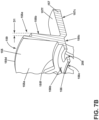
- FIG. 7B is a cross-section of a portion of the coupling disc 143 of FIG. 7A taken along line IV-IV.
- the fifth wall 155 and sixth wall 156 can cooperatively define a third bore 163 sized to receive the rotatable shaft 40 therethrough.
- the fifth wall 155 can define an axially inward-facing eleventh surface 155a (e.g., facing axially toward the rotor core 100 of FIG.
- the fifth wall 155 can further include a radially inward-facing thirteenth surface 155c (e.g., facing radially toward the rotor core 100 of FIG. 4 ) and an opposing radially outward-facing fourteenth surface 155d (e.g., facing radially away from the rotor core 100 of FIG. 4 ).
- the fourteenth surface 155d can define a radially outer periphery 159 of the coupling disc 143.
- the radially inward-facing thirteenth surface 155c can define a third bore 163.
- the thirteenth surface 155c can extend from the eleventh surface 155a to the twelfth surface 155b.
- the twelfth surface 155b can define a recess 155e or seat portion defined thereon.
- the recess 155e can be annular and arranged along the radially outer periphery 159 of the coupling disc 143 (e.g., on the twelfth surface 155b).
- the recess 155e can be recessed from an adjacent or abutting portion of the twelfth surface155b by a depth D1.
- the depth D1 can be based on a thickness of the first wall 151 of the first collar 141 (shown in FIG. 5 ).
- the recess 155e or seat portion can provide a seating surface for the first wall 151.
- the coupling disc 143 can define a lip 155f.
- the lip 155f can be coupled to the eleventh surface 155a and extend axially therefrom.
- the lip 155f is arranged to confront the eighth surface 253c of the second collar 142 (shown in FIG. 6 ).
- the lip 155f can be annular and arranged to circumferentially surround the third bore 163.
- the sixth wall 156 can extend axially inward (e.g., axially toward the rotor core 100 of FIG. 4 ) from the eleventh surface 155a.
- the sixth wall 156 can include an annular radially inward-facing fifteenth surface 156c and an opposing annular radially outward-facing sixteenth surface 156b.
- the sixth wall 156 can define a set of apertures 258 therethrough.
- the apertures 258 can extend from the fifteenth surface 156c to the sixteenth surface 156b.
- the apertures 258 can be circumferentially spaced from each other about the sixth wall 156.
- the sixth wall 156 can cooperate with the radially inward-facing thirteenth surface 155c to further define the third bore 163.
- the fifteenth surface 156c can be concentrically aligned with the thirteenth surface 155c of the fifth wall 155.
- the fifteenth surface 156c, or the thirteenth surface 155c, or both can define the third bore 163.
- the coupling disc 143 can further include an annular seventh wall 157.
- the seventh wall 157 can circumferentially surround the rotatable shaft 40.
- the seventh wall 157 can be coupled to the twelfth surface 155b and extend axially outward therefrom (e.g., facing away from the rotor core 100 of FIG.4 ).
- the seventh wall 157 can cooperate with the fifteenth surface 156c, or the thirteenth surface 155c, or both to further define the third bore 163.
- the seventh wall 157 can include an annular radially inward-facing seventeenth surface 157c and an opposing annular radially outward-facing eighteenth surface 157f.
- the seventeenth surface 157c can be concentrically aligned with the thirteenth surface 155c of the fifth wall 155.
- Fig. 8 depicts a non-limiting aspect of the support disc 144.
- the support disc 144 can comprise an annular disc having a first face 181 and an opposing second face 182.
- the first face 181 can be arranged facing or confronting an end 102, 104 of the rotor core 100 (shown in FIG. 4 ).
- the second face 182 can be axially outward-facing, (e.g., facing axially away from the rotor core 100 of FIG. 4 ).
- the support disc 144 can define a fourth bore 164 sized to receive the rotatable shaft 40 (shown in FIG. 4 ) therethrough.
- the support disc 144 can comprise a radially inward-facing, nineteenth surface 186 (e.g., facing toward the rotatable shaft 40 of FIG. 4 ).
- the support disc 144 can include a radially outwardly facing, twentieth surface 187 that opposes the nineteenth surface 186.
- the twentieth surface 187 can define a second diameter D2.
- the twentieth surface 187 can define the radially outer periphery 189.
- the nineteenth and twentieth surfaces 186, 187 can extend axially between the first face 181 and second face 182.
- the twentieth surface 187 can define the set of first slots 185 or gaps therethrough.
- the first slots 185 can be circumferentially spaced from each other about the radially outer periphery 189 of the support disc 144.
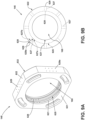
- FIG. 9A depicts a perspective view of a non-limiting aspect of the coolant distribution ring 145
- FIG. 9B depicts a cross section of another aspect of the coolant distribution ring 145.
- the coolant distribution ring 145 can comprise an annular disc having a third face 631 and an opposing fourth face 632.
- the third face 631 can be arranged facing an end 102, 104 of the rotor core 100 (shown in FIG. 4 ), and the fourth face 632 can be axially outward-facing, (e.g., facing axially away from the rotor core 100 of FIG. 4 ).
- the coolant distribution ring 145 can comprise a radially inward-facing, twenty-first surface 621 (e.g., facing toward the rotatable shaft 40 of FIG. 4 ).
- the twenty-first surface 621 can define a fifth bore 165 sized to receive the rotatable shaft 40 (shown in FIG. 4 ) therethrough.
- the coolant distribution ring 145 can include a radially outwardly facing, twenty-second surface 622 opposing the twenty-first surface 621.
- the twenty-second surface 622 can be an outer perimetric surface.
- the twenty-first surface 621 and twenty-second surface 622 can axially extend between the third face 631 and fourth face 632.
- the twenty-first surface 621 can be a relatively smooth surface.
- the twenty-first surface 621 can define a set of channels or fourth grooves 625 thereon. When assembled, the fourth grooves 625 can be arranged in fluid communication with the rotatable shaft 40 ( FIG. 4 ). As such the set of fourth grooves 625 can cooperatively define a coolant reservoir.
- the coolant distribution ring 145 can further define a set of channels 627 extending radially therethrough in fluid communication with the twenty-first surface 621.
- the channels 627 can extend from a first end 627a disposed at the twenty-first surface 621 to an opposing second end 627b at the twenty-second surface 622.
- Each channel 627 can comprise a coolant inlet 628 defined on the twenty-first surface 621, and a corresponding coolant outlet 629 defined on the twenty-second surface 622, at the opposing second end 627b.
- the channels 627 can be circumferentially spaced about the coolant distribution ring 145.
- the channels 627 can be sized to allow the fluid coolant flow 85 (not shown) therethrough.
- the channels 627 can further be in fluid communication with a respective coolant outlet 629.
- At least a subset of the coolant outlets 629 can define a respective spray nozzle 629a at a radially distal end.
- the spray nozzles 629a can be disposed at circumferentially spaced intervals on the twenty-second surface 622.
- FIG. 10 depicts a perspective view of a non-limiting aspect of the spacer disc 146.
- the spacer disc 146 can comprise an annular disc having a first face 781 and an opposing second face 782.
- the spacer disc 146 can be formed from an electrically insulative material.
- the spacer disc 146 can electrically insulate the support disc from the coolant distribution ring 145 or other electrically conductive parts.
- a radially outer surface of the spacer disc 146 can be coated with an electrically insulative material.
- the first face 781 can be arranged facing an end 102, 104 of the rotor core 100 (shown in FIG. 4 ).
- the second face 182 can be axially outward-facing, (e.g., facing axially away from the rotor core 100 of FIG. 4 ).
- the spacer disc 146 can define a sixth bore 166 sized to receive the rotatable shaft 40 (shown in FIG. 4 ) therethrough.
- the spacer disc 146 can comprise a radially inward-facing, twenty-third surface 786 (e.g., facing toward the rotatable shaft 40 of FIG. 4 ).
- the spacer disc 146 can include a radially outwardly facing, twenty-fourth surface 787 that opposes the twenty-third surface 786.
- the twenty-fourth surface 787 can define a third diameter D3.
- the third diameter D3 is less than the second diameter D2 of the support disc 144 (shown in FIG. 8 ).
- the twenty-fourth surface 787 can define a radially outer periphery 789 of the spacer disc 146.
- the twenty-third and twenty-fourth surfaces 786, 787 can axially extend between the first face 781 and second face 782.
- the twenty-fourth surface 787 can define a set of second slots 785 or gaps therethrough.
- the second slots 785 can be circumferentially spaced from each other about the radially outer periphery 789 of the spacer disc 146.
- the second slots 785 can be sized to operatively receive a respective rotor winding 110 axially therein.
- FIG. 11A depicts a perspective view of the assembled rotor assembly 96 of FIG. 4
- FIG. 11B is a cross-section of a portion of the rotor assembly 96 of FIG. 11A taken along line V-V, with some parts (e.g., the rotor winding end turns 112, and coolant distribution ring 145) omitted for clarity.
- the first wall 151 of the first collar 141 can be coupled along the third surface 151c to the fifth wall 155 of the coupling disc 143 along the radially outer periphery 159.
- the radially outward-facing fourteenth surface 155d of the fifth wall 155 can be coupled to the third surface 151c of the first collar 141.
- a radially inboard portion of the first wall 151 can be disposed in the annular recess 155e or seat portion defined along the radially outer periphery 159 of the coupling disc 143 in a nested relationship.
- the recess 155e When assembled, the recess 155e can receive a portion of the first wall 151 therein, such that the first surface 151a of the first wall 151 and the twelfth surface 155b of the fifth wall 155 can cooperatively define a continuous axially outward-facing surface 158 via the nested relationship.
- the continuous axially outward-facing surface 158 By arranging the continuous axially outward-facing surface 158, undesired gaps, openings, or other discontinuities at the corresponding end 102, 104 of the rotor core 100 can be reduced over conventional arrangements, and consequent beneficial reductions in windage losses can be obtained.
- the first collar 141 can also be coupled to the support disc 144.
- the first collar 141 can be coupled along the fifth surface 152b to the radially outer periphery 189 (e.g., the twentieth surface 187) of the support disc 144.
- the first collar 141 can be coupled to the support disc 144 via an interference, friction, or press-fit engagement between the first collar 141 and the support disc 144.
- the first diameter D1 can be arranged to be less than or equal to the second diameter D2, to enable a press fit between the second wall 152 of the first collar 141 and the fourth wall 254 of the second collar 142.
- Other aspects are not so limited, and it is contemplated that the first collar 141 can be coupled to the support disc 144 by any desired affixing mechanisms.
- the second collar 142 can optionally be coupled to the support disc 144.
- the second collar 142 can be coupled along the eighth surface 253c to the lip 155f of the coupling disc 143.
- the second collar 142 can be coupled along the eighth surface 253c to the sixteenth surface 156d of the coupling disc 143.
- the second collar 142 can be coupled to the coupling disc 143 via an interference, friction, or press-fit engagement between the second collar 142 and the coupling disc 143.
- Other aspects are not so limited, and it is contemplated that the second collar 142 can be coupled to the coupling disc 143 by any desired affixing mechanisms.
- the second collar 142 can be disposed between the first collar 141 and the support disc 144 without being coupled to the coupling disc 143.
- the coupling disc 143 is coupled to the rotatable shaft 40.
- the coupling disc 143 can be coupled to the rotatable shaft 40 via one or more of the fifth, sixth, and seventh walls 155, 156, 157 (shown in FIG. 7 ).
- the coupling disc 143 can be fixed to the rotatable shaft 40 along the radially inward-facing thirteenth surface 155c, fifteenth surface 156c, seventeenth surface 157c (shown in FIG. 7 ), or combinations thereof, using one or more bolts, screws, pins, keys, splines, or other known fasteners (not shown).
- the coupling disc 143 can be coupled to the rotatable shaft 40 via an interference, friction, or press-fit engagement between the coupling disc 143 and the rotatable shaft 40.
- Other aspects are not so limited, and it is contemplated that the coupling disc 143 can be rotatably coupled to the rotatable shaft 40 by any desired affixing mechanisms. It will be appreciated that when so coupled, a rotation of the rotatable shaft 40 will result in a corresponding rotation of the coupling disc 143.
- the support disc 144 is coupled to the rotatable shaft 40.
- the support disc 144 can be fixed to the rotatable shaft 40 along the nineteenth surface 186 using one or more bolts, screws, pins, keys, splines, or other known fasteners (not shown).
- the support disc 144 can be coupled to the rotatable shaft 40 via an interference, friction, or press-fit engagement between the support disc 144 and the rotatable shaft 40.
- Other aspects are not so limited, and it is contemplated that the support disc 144 can be rotatably coupled to the rotatable shaft 40 by any desired affixing mechanisms.
- FIG. 12 schematically illustrates a portion another exemplary aspect of the rotor assembly 96 for better understanding the arrangement and operation of various aspects.
- the aspect depicted in FIG. 12 is similar to the aspect shown in FIG. 11B with one notable difference being the second collar 142 is not coupled to the sixth wall 156 of the coupling disc 143.
- the end winding support assembly 140 includes the first collar 141, second collar 142, coupling disc 143, support disc 144, coolant distribution ring 145, and spacer disc 146.
- the coupling disc 143 and support disc 144 are shown rotatably coupled to the rotatable shaft 40.
- the first and second collars 141, 142 and coolant distribution ring 145 are shown circumferentially surrounding and coupled to the coupling disc 143.
- the coolant distribution ring 145 can be fixedly coupled to the coupling disc 143 using one or more bolts, screws, pins, keys, or other known fasteners.
- the coolant distribution ring 145 can be coupled to the coupling disc 143 via an interference, friction, or press-fit engagement between the first coolant distribution ring 145 and the coupling disc 143.
- the twenty-first surface 621 of the coolant distribution ring 145 can be fixedly coupled to the twelfth surface 155b of the coupling disc 143.
- the set of apertures 258 can be in fluid communication with the twelfth surface 155b.
- coolant distribution ring 145 can be rotatably coupled to the coupling disc 143 by any desired affixing mechanisms. It will be appreciated that when so coupled, a rotation of the coupling disc 143 will result in rotation of the coolant distribution ring 145.
- An annular gap or cavity 275 is radially defined between the outer periphery or radially outwardly facing, twenty-second surface 622 of the coolant distribution ring 145 and the radially inward-facing ninth surface 254a of the fourth wall 254 of the second collar 142.
- the cavity 275 can axially extend between the spacer disc 146 and the third wall 253 of the second collar 142.
- the rotor winding end turns 112 are disposed to extend into the cavity 275.
- the coolant distribution ring 145 is disposed to at least partially underlie the rotor winding end turns 112.
- underlie denotes a relative position radially closer to the rotational axis 41 of the rotatable shaft 40.
- the twenty-second surface 622 is arranged proximal to and facing the rotor winding end turns 112.
- the second collar 142 can at least partially overlie the rotor winding end turns 112.
- "overlie” denotes a relative position radially farther from the rotational axis 41 of the rotatable shaft 40.
- the coolant distribution ring 145 and second collar 142 can cooperatively support, or otherwise limit a radial movement of the rotor winding end turns 112 disposed within the cavity 275. Additionally, the spacer disc 146 and second collar 142 can cooperatively support, or otherwise limit an axial movement of each rotor winding end turn 112 disposed within the cavity 275.
- a portion of the rotor windings 110 axially extending from the rotor core 100 can be disposed in the set of first slots 185 of the support disc 144 and extend axially therethrough.
- a portion of each rotor winding 110 can axially extend from the rotor core 100 and axially through a respective first slot 185.
- a circumferentially width of each first slot 185 can be configured to retainably receive the rotor winding 110 therein. In this way, the support disc 144 can support, or otherwise limit a lateral movement of each rotor winding 110 disposed within a respective first slot 185.
- each rotor winding 110 can be further disposed in the set of second slots 785 to extend axially therethrough.
- a portion of each rotor winding 110 can axially extend from the rotor core 100 and axially through a respective second slot 785.
- a circumferentially width of each second slot 785 can be configured to retainably receive the rotor winding 110 therein. In this way, the spacer disc 146 can support, or otherwise limit a lateral movement of each rotor winding 110 disposed within a respective second slot 785.
- the fluid coolant flow 85 to can enter the rotatable shaft 40 of the rotor assembly 96 via one of the cooling fluid inlet ports 82, coolant inlet port 94, or both.
- the end winding support assembly 140 is arranged to enable the fluid coolant flow (indicated by solid arrows) 85 to flow radially therethrough.
- the fluid coolant flow 85 is conveyed from the rotatable shaft 40 to the cavity 275 and the set of rotor winding end turns 112.
- the fluid coolant flow 85 can subsequently be delivered from the end winding support assembly 140 axially toward the rotor core 100 or radially toward the stator windings 90, or both.
- the rotatable shaft 40 can define a first coolant conduit 250 fluidly connected with a source of coolant 251.
- the source of coolant 251 can be, but is not limited to, the cooling fluid inlet port 82 ( FIG. 3 ).
- the direction or location of the source of coolant 251 is not limited by the illustration and can be disposed in any location that is fluidly coupled to the first coolant conduit 250. It is further contemplated that additional conduit, pumps, valves, or other devices can be included to fluidly connect the source of coolant 251 and the first coolant conduit 250 without departing from the scope of the disclosure.
- the fluid coolant flow 85 can be conveyed through the rotatable shaft 40 via the first coolant conduit 250.
- the first coolant conduit 250 can include a radially extending portion 259.
- the radially extending portion 259 can fluid couple the first coolant conduit 250 and the coupling disc 143.
- the fluid coolant flow 85 can flow radially outward through the radially extending portion 259 from the rotational axis 41 toward the coupling disc 143 due to the centrifugal force effects of the rotatable shaft 40.
- the coupling disc 143 can receive the fluid coolant flow 85 from the first coolant conduit 250, via the radially extending portion 259 of the first coolant conduit 250, at the thirteenth surface 155c or fifteenth surface 156c, or both.
- the fluid coolant flow 85 can collect on or at the thirteenth surface 155c or fifteenth surface 156c, or both, and be centrifugally conveyed radially outward through the set of apertures 258 to the coolant distribution ring 145.
- the fluid coolant flow 85 can be centrifugally conveyed through the coolant distribution ring 145.
- the fluid coolant flow 85 can be centrifugally conveyed from the twenty-first surface 621 to the twenty-second surface 622 via the set of channels 627.
- the channels 627 can be in fluid communication with the rotatable shaft 40, or the set of fourth grooves 625, or both, to receive the fluid coolant flow 85 therefrom.
- the fluid coolant flow 85 can be centrifugally conveyed from the coolant distribution ring to the cavity 275.
- the coolant can be radially expelled from the channels 627 to the cavity 275 via the coolant outlets 629.
- the coolant outlets 629 are arranged to provide the fluid coolant flow 85 radially outwardly therefrom.
- the coolant outlet 629 can be configured to operatively spray finely atomized particles of coolant fluid toward the rotor winding end turns 112 and end turn passages 114 within the cavity 275.
- the fluid coolant flow 85 is centrifugally conveyed to the end turn passages 114 between the rotor winding end turns 112. Fluid can flow radially outward through the end turn passages 114 that pass between the rotor winding end turns 112 which transfers heat from the set of rotor windings 110 into the coolant by conduction.
- the fluid coolant flow 85 can be expelled radially from the rotor end turn passages 114 and received by the second collar 142.
- the fluid coolant flow 85 can be received by the sixth surface 253a of the third wall 253 or the tenth surface 254b of the fourth wall 254, or both.
- the fluid coolant flow 85 can be received in the fluid collection surfaces of second grooves 256, third grooves 257 or both.
- the fluid coolant flow 85 received in the third grooves 257 can be centrifugally conveyed to the second grooves 256.
- the fluid coolant flow 85 received in the first grooves 255 can be centrifugally conveyed to the second grooves 256.
- one or more of the second grooves 256 can be tapered along the tenth surface 254b to define an angle 268 relative to the rotational axis 41, such that the second groove 256 can receive and redirect the fluid coolant flow 85 axially outward from the rotor end turn passages 114 and toward the support disc 144, and expelled from the cavity 275.
- the fluid coolant flow 85 can be expelled radially from the second collar 142 and the radial rotor end turn passages 114.
- the fluid coolant flow 85 redirected by the second collar 142 can be delivered axially inward from the cavity 275 and through the set of first slots 185.
- FIG. 13 illustrates a method 700 of cooling the set of rotor winding end turns 112 of the rotor assembly 96.
- the method 700 can be applied to any electrical machine. While the method will be described herein, for ease of understanding, in terms of the rotor assembly 96 of FIGS. 4-11 , other aspects are not so limited and method 700 can be implemented with any electrical machine without departing from the scope of the disclosure.
- the method 700 includes disposing a set of rotor windings 110 extending from a rotor core 100 into a respective slot 185 defined in the support disc 144 coupled to the rotatable shaft 40 extending from the rotor core 100.
- the method 700 can include, at 720, coupling the first wall 151 of the first collar 141 to the coupling disc 143 circumferentially surrounding and coupled to the rotatable shaft 40, and the second wall 152 of the first collar 141 to a radially outer periphery 189 of the support disc 144.
- a non-limiting example of coupling the second wall 152 of the first collar 141 to the radially outer periphery 189 of the support disc 144 can include a press fit.
- the method 700 can include at 730, coupling the third wall 253 of the second collar 142 to the coupling disc 143, between the first wall 151 and the support disc 144.
- a non-limiting example of coupling the third wall 253 of the second collar 142 to the coupling disc 143 can include a press fit.
- the method 700 can include at 740, disposing a set of rotor winding end turns 112 into the cavity 275 extending radially between the coolant distribution ring 145 and the fourth wall 254 of the second collar 142.
- the cavity can extend axially between the support disc 144 and third wall 253 of the second collar 142.
- the cavity 275 can extend radially between the coolant distribution ring 145 and fourth wall 254 of the second collar 142.
- the method 700 can include at 745, delivering a fluid coolant flow 85 radially outward from the rotatable shaft 40 to the coupling disc 143.
- a non-limiting example of delivering the fluid coolant flow 85 to the coupling disc 143 can include delivering the fluid coolant flow 85 through the rotatable shaft 40 via the first coolant conduit 250.
- the first coolant conduit 250 can include the radially extending portion 259 through which the fluid coolant flow 85 can flow radially outward from the rotational axis 41 due to the centrifugal force effects of the rotatable shaft 40.
- the method 700 can include at 750, delivering the fluid coolant flow 85 through the coupling disc 143 to the coolant distribution ring 145.
- the fluid coolant flow 85 can be delivered radially outward through the set of apertures 258 defined through the sixth wall 156 of the coupling disc 143 due to the centrifugal force effects of the rotatable shaft 40 driving a rotation of the coupling disc 143.
- the method 700 can include at 755, delivering the fluid coolant flow 85 radially outward through the coolant distribution ring 145 to the cavity 275.
- the fluid coolant flow 85 can be delivered radially outward through the set of channels 627 extending radially through coolant distribution ring 145 due to the centrifugal force effects of the rotatable shaft 40 driving a rotation of the coolant distribution ring 145.
- the method 700 can include at 760, delivering the fluid coolant flow 85 radially through end turn passages 114 defined between adjacent rotor winding end turns 112. Heat from the set of rotor winding end turns 112 is transferred by conduction to the fluid coolant flow 85. The conduction of heat to the fluid coolant flow 85 can result in the fluid coolant flow 85 removing heat from the rotor assembly 96.
- the method 700 can include at 765, delivering the fluid coolant flow 85 from the end turn passages 114 to the fourth wall 254 of the second collar 142.
- the method 700 can include at 770, delivering the fluid coolant flow 85 from the cavity 275 through the respective slot 185 defined in the support disc 144.
- the delivering the fluid coolant flow 85 axially inward from the cavity 275 can include delivering the fluid coolant flow 85 axially inward toward the rotor core 100, or radially outward toward the stator 54, or both.
- the sequence depicted is for illustrative purposes only and is not meant to limit the method 700 in any way as it is understood that the portions of the method can proceed in a different logical order, additional or intervening portions can be included, or described portions of the method can be divided into multiple portions, or described portions of the method can be omitted without detracting from the described method.
- one aspect of the disclosure contemplates coolant conduits that extend along alternative portions or lengths of the set of rotor windings.
- the windings or the coolant conduits can further include intervening thermally conductive layers to assist in thermal conduction while, for example, avoiding an electrically conductive relationship between respective components.
- the design and placement of the various components such as valves, pumps, or conduits can be rearranged such that a number of different in-line configurations could be realized.
- aspects as disclosed herein improve upon existing methods by securing, protecting, and constraining the rotor winding end turns 112. Aspects as disclosed herein prevent movement of the rotor winding end turns 112 and provide mechanical and electrical isolation between the rotor winding end turns 112 and nearby parts.
- the aspects disclosed herein provide method and apparatus for cooling a set of rotor windings or a set of rotor winding end turns during electric machine operations (e.g., motor or generator operations).
- electric machine operations e.g., motor or generator operations.
- One advantage that may be realized in the above aspects is that the above-described aspects have significantly improved thermal conduction to remove heat from the set of rotor windings or the set of rotor winding end turns.
- the improved thermal conductivity between the set of rotor winding end turns and the coolant conduits coupled with the coolant channels provide for heat removal in a much more effective fashion from the rotor winding end turns to the coolant.
- the increased thermal dissipation of the rotor winding end turns allows for a higher speed rotation of the rotor, which may otherwise generate too much heat.
- the higher speed rotation may result in improved power generation or improved generator efficiency without increasing generator size.
- Reduced thermal losses in the electric machine allows for greater efficiency and greater power density of the generator.
- the above-described rotor end winding support assembly can provide additional physical stability and improved cooling to the rotor winding end turns.
- the stability and cooling provided by the aspects as described herein allow an increase in performance and reliability.
- a support assembly for a set of rotor winding end turns extending from a rotor core of an electrical machine having a rotatable shaft comprising: a first collar including a first wall having an annular first surface facing an axial end of the rotor core, an opposing annular second surface, and an annular third surface defining a first bore extending from the annular first surface to the annular second surface, the first collar further including an annular second wall coupled to the first wall and extending axially therefrom toward the rotor core arranged to radially overlie the rotor winding end turns, the annular second wall having an radially outward facing annular fourth surface, and an opposing annular fifth surface facing the rotor winding end turns; a second collar axially disposed between the rotor core and the first collar, including a third wall disposed between the first wall and the rotor winding end turns, the third wall having an annular sixth surface facing the axial end of the rotor core, an opposing seventh surface,
- the support assembly of any preceding clause further comprising a support disc defining a fourth bore sized to receive the rotatable shaft therethrough, and a radially outer periphery, the support disc further defining a set of radially extending first slots sized to receive a respective rotor winding axially therein, the support disc coupled to the rotatable shaft at the fourth bore, and disposed axially between the rotor core and the second collar; and wherein the annular fifth surface of the first collar is coupled to the radially outer periphery of the support disc.
- annular fifth surface of the first collar is coupled to the radially outer periphery of the support disc via an interference fit.
- a coolant distribution ring defining a central fifth bore, and circumferentially surrounding and coupled to the annular sixth wall of the coupling disc, the coolant distribution ring radially disposed between the annular sixth wall and an end turn of the rotor windings.
- coolant distribution ring includes a set of radially extending channels defined therethrough in fluid communication with the set of rotor winding end turns.
- annular sixth wall of the coupling disc defines a set of apertures extending radially therethrough in fluid communication with the coolant distribution ring.
- annular fourth wall of the second collar includes a radially inward facing tenth surface defining a set of axially extending grooves, in fluid communication with the coolant distribution ring.
- the radially inward facing tenth surface further defines a set of circumferentially extending grooves, in fluid communication with the axially extending grooves.
- the support assembly of any preceding clause further comprising a spacer disc disposed axially between the support disc and the coolant distribution ring and rotatably coupled to the rotatable shaft, the spacer disc further including a radially outer surface defining a set of radially extending, circumferentially spaced second slots sized to receive a respective rotor winding therein.
- a method of cooling a set of rotor winding end turns of a rotor core of an electrical machine comprising: disposing a set of rotor windings extending from the rotor core into a respective first slot defined in a support disc coupled to a rotatable shaft extending from the rotor core; coupling a first wall of a first collar to a coupling disc circumferentially surrounding and coupled to the rotatable shaft, and coupling a second wall of the first collar to a radial outer periphery of the support disc; coupling a third wall of a second collar to the coupling disc, between the first wall and the spacer disc; disposing a set of rotor winding end turns into a cavity defined radially between a coolant distribution ring and a fourth wall of the second collar coupled to the third wall and extending axially therefrom toward the rotor core, and defined axially between the support disc and the third wall of the second collar; delivering a fluid coolant flow radially outward
- delivering the fluid coolant flow from the cavity includes delivering the fluid coolant flow axially inward and radially outward.
- the support assembly (140) of any preceding clause further comprising a support disc (144) defining a fourth bore (164) sized to receive the rotatable shaft (40) therethrough, and a radially outer periphery (189), the support disc (144) further defining a set of radially extending first slots (185) sized to receive a respective rotor winding (110) axially therein, the support disc (144) coupled to the rotatable shaft (40) at the fourth bore (164), and disposed axially between the rotor core (100) and the second collar (142); and wherein the fifth surface (152b) of the first collar (141) is coupled to the radially outer periphery of the support disc (144).
- a cavity (275) is radially defined between the coolant distribution ring (145) and the second collar (142), and wherein the rotor winding end turns (112) extend into the cavity (275).
- coolant distribution ring (145) includes a set of radially extending channels (627) defined therethrough in fluid communication with the set of rotor winding end turns (112) (112).
- the support assembly (140) of any preceding clause further comprising a spacer disc (146) disposed axially between the support disc (144) and the coolant distribution ring (145) and rotatably coupled to the rotatable shaft (40), the spacer disc (146) further including a radially outer surface (787) defining a set of radially extending, circumferentially spaced second slots (785) sized to receive a respective rotor winding (110) therein.
- delivering the fluid coolant flow (85) from the cavity (275) includes delivering the fluid coolant flow axially inward and radially outward.
Landscapes
- Engineering & Computer Science (AREA)
- Power Engineering (AREA)
- Manufacturing & Machinery (AREA)
- Motor Or Generator Cooling System (AREA)
- Iron Core Of Rotating Electric Machines (AREA)
Applications Claiming Priority (1)
| Application Number | Priority Date | Filing Date | Title |
|---|---|---|---|
| IN202311054914 | 2023-08-16 |
Publications (1)
| Publication Number | Publication Date |
|---|---|
| EP4510429A1 true EP4510429A1 (fr) | 2025-02-19 |
Family
ID=88417042
Family Applications (1)
| Application Number | Title | Priority Date | Filing Date |
|---|---|---|---|
| EP23204294.5A Pending EP4510429A1 (fr) | 2023-08-16 | 2023-10-18 | Procédé et appareil de refroidissement d'un ensemble rotor |
Country Status (3)
| Country | Link |
|---|---|
| US (1) | US20250062657A1 (fr) |
| EP (1) | EP4510429A1 (fr) |
| CN (1) | CN119496339A (fr) |
Citations (4)
| Publication number | Priority date | Publication date | Assignee | Title |
|---|---|---|---|---|
| EP3629449A1 (fr) * | 2018-09-27 | 2020-04-01 | Ge Aviation Systems Llc, Inc. | Procédé et appareil pour refroidir un ensemble rotor |
| EP3675332A1 (fr) * | 2018-12-27 | 2020-07-01 | Ge Aviation Systems Llc, Inc. | Rotor pour machine électrique |
| EP4220902A1 (fr) * | 2022-01-28 | 2023-08-02 | GE Aviation Systems LLC | Procédé et appareil de refroidissement d'un ensemble rotor |
| EP4220907A1 (fr) * | 2022-01-28 | 2023-08-02 | GE Aviation Systems LLC | Procédé et appareil de refroidissement d'un ensemble rotor |
Family Cites Families (35)
| Publication number | Priority date | Publication date | Assignee | Title |
|---|---|---|---|---|
| US2712085A (en) * | 1955-06-28 | M willyoung | ||
| GB164903A (en) * | 1920-04-01 | 1921-06-23 | Gustaf Adolf Juhlin | Improvements relating to dynamo-electric machines |
| GB529045A (en) * | 1938-05-11 | 1940-11-13 | British Thomson Houston Co Ltd | Improvements in and relating to dynamo electric machines |
| GB747065A (en) * | 1953-05-11 | 1956-03-28 | Gen Electric | Improvements in rotors of electric generators |
| US2796540A (en) * | 1953-07-13 | 1957-06-18 | Vickers Electrical Co Ltd | Dynamo electric machines |
| US3189769A (en) * | 1961-08-01 | 1965-06-15 | Gen Electric | Dynamoelectric machine rotor cooling |
| US3296470A (en) * | 1964-02-03 | 1967-01-03 | Vsesouzny Nii Elecktromekhanik | Liquid cooling of generator rotor windings |
| US3891877A (en) * | 1973-04-16 | 1975-06-24 | Aron Beniaminovich Shapiro | Directly liquid cooled rotor winding for a non-salient pole synchronous electric machine |
| US4091301A (en) * | 1974-07-08 | 1978-05-23 | Bbc Brown Boveri & Company Limited | Rotor end-winding support for high-speed electrical machine such as a turbo-generator |
| JPS5850091B2 (ja) * | 1975-03-05 | 1983-11-08 | 株式会社日立製作所 | カイテンデンキノカイテンシ |
| US4177398A (en) * | 1975-07-11 | 1979-12-04 | Fridman Vladimir M | Shroud for mounting rotor end winding in electric machine |
| US4368399A (en) * | 1981-08-17 | 1983-01-11 | Westinghouse Electric Corp. | Rotor end turn winding and support structure |
| US4486676A (en) * | 1984-01-16 | 1984-12-04 | Electric Power Research Institute, Inc. | Superconducting rotor with end turn region intermittent support and cooling assembly |
| US4967465A (en) * | 1989-01-03 | 1990-11-06 | General Electric Company | Method of assembling and disassembling a rotor retaining ring system |
| GB9505072D0 (en) * | 1995-03-14 | 1995-05-03 | Lucas Ind Plc | A winding end support for a rotary electrical component |
| EP0894358B1 (fr) * | 1996-04-17 | 1999-11-24 | Siemens Aktiengesellschaft | Enroulement de rotor pour machine electrique |
| GB9811457D0 (en) * | 1998-05-29 | 1998-07-29 | Johnson Electric Sa | Rotor |
| US6864617B1 (en) * | 2003-10-02 | 2005-03-08 | General Electric Company | Retaining system for a rotor of a dynamoelectric machine |
| US6972507B1 (en) * | 2004-05-21 | 2005-12-06 | General Electric Company | End winding restraint in an electrical machine |
| US8115352B2 (en) * | 2009-03-17 | 2012-02-14 | General Electric Company | Dynamoelectric machine coil spacerblock having flow deflecting channel in coil facing surface thereof |
| US8084902B2 (en) * | 2009-05-06 | 2011-12-27 | Hamilton Sundstrand Corporation | End plates for high speed generator applications |
| CN103026592A (zh) * | 2010-07-14 | 2013-04-03 | 布鲁萨电子公司 | 用于电动机、尤其用于同步马达的转子 |
| US8525376B2 (en) * | 2010-10-01 | 2013-09-03 | General Electric Company | Dynamoelectric machine coil spaceblock having flow deflecting structure in coil facing surface thereof |
| US8222780B2 (en) * | 2010-10-25 | 2012-07-17 | General Electric Company | Generator rotor main lead support and lead path configuration |
| CN103580348B (zh) * | 2013-11-12 | 2016-04-13 | 中电电机股份有限公司 | 汽轮发电机转子端部线圈组合垫块支撑结构 |
| US9812917B2 (en) * | 2014-10-07 | 2017-11-07 | Hamilton Sundstrand Corporation | End turn support and cooling fixture |
| US10277086B2 (en) * | 2014-11-26 | 2019-04-30 | Siemens Energy, Inc. | Thermo pump-cooled generator end windings with internal cooling passages |
| EP3829035B1 (fr) * | 2018-07-26 | 2022-04-06 | Mitsubishi Electric Corporation | Rotor pour machine électrique tournante |
| CN209659087U (zh) * | 2018-12-04 | 2019-11-19 | 哈尔滨电机厂有限责任公司 | 一种大型同步调相机转子端部挡风板结构 |
| CN115176402B (zh) * | 2020-02-28 | 2025-08-05 | 三菱发电机株式会社 | 旋转电机 |
| BR112022024153A2 (pt) * | 2020-05-29 | 2022-12-27 | Weg Equipamentos Eletricos S/A | Rotor, máquina elétrica girante e dispositivo de retenção axial |
| DE102021129951A1 (de) * | 2021-11-17 | 2023-05-17 | Bayerische Motoren Werke Aktiengesellschaft | Stützeinrichtung für einen Rotor einer elektrischen Maschine eines Kraftfahrzeugs sowie elektrische Maschine für ein Kraftfahrzeug |
| US11837917B2 (en) * | 2022-01-28 | 2023-12-05 | Ge Aviation Systems Llc | Method and apparatus for cooling a rotor assembly |
| US12206292B2 (en) * | 2022-01-28 | 2025-01-21 | Ge Aviation Systems Llc | Method and apparatus for cooling a rotor assembly |
| US12451742B2 (en) * | 2022-04-19 | 2025-10-21 | Ge Aviation Systems Llc | Method and apparatus for cooling a rotor assembly |
-
2023
- 2023-10-18 EP EP23204294.5A patent/EP4510429A1/fr active Pending
- 2023-11-17 CN CN202311535357.5A patent/CN119496339A/zh active Pending
- 2023-12-14 US US18/540,226 patent/US20250062657A1/en active Pending
Patent Citations (4)
| Publication number | Priority date | Publication date | Assignee | Title |
|---|---|---|---|---|
| EP3629449A1 (fr) * | 2018-09-27 | 2020-04-01 | Ge Aviation Systems Llc, Inc. | Procédé et appareil pour refroidir un ensemble rotor |
| EP3675332A1 (fr) * | 2018-12-27 | 2020-07-01 | Ge Aviation Systems Llc, Inc. | Rotor pour machine électrique |
| EP4220902A1 (fr) * | 2022-01-28 | 2023-08-02 | GE Aviation Systems LLC | Procédé et appareil de refroidissement d'un ensemble rotor |
| EP4220907A1 (fr) * | 2022-01-28 | 2023-08-02 | GE Aviation Systems LLC | Procédé et appareil de refroidissement d'un ensemble rotor |
Also Published As
| Publication number | Publication date |
|---|---|
| CN119496339A (zh) | 2025-02-21 |
| US20250062657A1 (en) | 2025-02-20 |
Similar Documents
| Publication | Publication Date | Title |
|---|---|---|
| EP3675332B1 (fr) | Rotor pour machine électrique | |
| EP3629449B1 (fr) | Procédé et appareil pour refroidir un ensemble rotor | |
| US12206292B2 (en) | Method and apparatus for cooling a rotor assembly | |
| US11984766B2 (en) | Method and apparatus for cooling a rotor assembly | |
| US10381900B2 (en) | Method and assembly of an electric machine | |
| US12126224B2 (en) | Method and apparatus for cooling a rotor assembly | |
| US10756598B2 (en) | Method and apparatus for cooling a rotor assembly | |
| US12451742B2 (en) | Method and apparatus for cooling a rotor assembly | |
| US20260018950A1 (en) | Method and apparatus for cooling a rotor assembly | |
| EP4220896A1 (fr) | Ensemble rotor et procédé pour une machine électrique | |
| EP4510429A1 (fr) | Procédé et appareil de refroidissement d'un ensemble rotor | |
| US20250038599A1 (en) | Rotor assembly and method of cooling | |
| US20190190336A1 (en) | Method and apparatus for cooling a rotor assembly | |
| US12573909B2 (en) | Electrical machine having a lead retention assembly | |
| CN116961289A (zh) | 用于冷却转子组件的方法和设备 |
Legal Events
| Date | Code | Title | Description |
|---|---|---|---|
| PUAI | Public reference made under article 153(3) epc to a published international application that has entered the european phase |
Free format text: ORIGINAL CODE: 0009012 |
|
| STAA | Information on the status of an ep patent application or granted ep patent |
Free format text: STATUS: THE APPLICATION HAS BEEN PUBLISHED |
|
| AK | Designated contracting states |
Kind code of ref document: A1 Designated state(s): AL AT BE BG CH CY CZ DE DK EE ES FI FR GB GR HR HU IE IS IT LI LT LU LV MC ME MK MT NL NO PL PT RO RS SE SI SK SM TR |
|
| STAA | Information on the status of an ep patent application or granted ep patent |
Free format text: STATUS: REQUEST FOR EXAMINATION WAS MADE |
|
| 17P | Request for examination filed |
Effective date: 20250701 |
|
| STAA | Information on the status of an ep patent application or granted ep patent |
Free format text: STATUS: EXAMINATION IS IN PROGRESS |
|
| 17Q | First examination report despatched |
Effective date: 20251009 |