EP4510565A1 - Procédé de décodage, procédé de codage, dispositif de décodage et dispositif de codage - Google Patents
Procédé de décodage, procédé de codage, dispositif de décodage et dispositif de codage Download PDFInfo
- Publication number
- EP4510565A1 EP4510565A1 EP23788202.2A EP23788202A EP4510565A1 EP 4510565 A1 EP4510565 A1 EP 4510565A1 EP 23788202 A EP23788202 A EP 23788202A EP 4510565 A1 EP4510565 A1 EP 4510565A1
- Authority
- EP
- European Patent Office
- Prior art keywords
- prediction
- partition
- current block
- block
- mode
- Prior art date
- Legal status (The legal status is an assumption and is not a legal conclusion. Google has not performed a legal analysis and makes no representation as to the accuracy of the status listed.)
- Pending
Links
Images









































Classifications
-
- H—ELECTRICITY
- H04—ELECTRIC COMMUNICATION TECHNIQUE
- H04N—PICTORIAL COMMUNICATION, e.g. TELEVISION
- H04N19/00—Methods or arrangements for coding, decoding, compressing or decompressing digital video signals
- H04N19/10—Methods or arrangements for coding, decoding, compressing or decompressing digital video signals using adaptive coding
- H04N19/102—Methods or arrangements for coding, decoding, compressing or decompressing digital video signals using adaptive coding characterised by the element, parameter or selection affected or controlled by the adaptive coding
- H04N19/103—Selection of coding mode or of prediction mode
- H04N19/105—Selection of the reference unit for prediction within a chosen coding or prediction mode, e.g. adaptive choice of position and number of pixels used for prediction
-
- H—ELECTRICITY
- H04—ELECTRIC COMMUNICATION TECHNIQUE
- H04N—PICTORIAL COMMUNICATION, e.g. TELEVISION
- H04N19/00—Methods or arrangements for coding, decoding, compressing or decompressing digital video signals
- H04N19/10—Methods or arrangements for coding, decoding, compressing or decompressing digital video signals using adaptive coding
- H04N19/102—Methods or arrangements for coding, decoding, compressing or decompressing digital video signals using adaptive coding characterised by the element, parameter or selection affected or controlled by the adaptive coding
- H04N19/119—Adaptive subdivision aspects, e.g. subdivision of a picture into rectangular or non-rectangular coding blocks
-
- H—ELECTRICITY
- H04—ELECTRIC COMMUNICATION TECHNIQUE
- H04N—PICTORIAL COMMUNICATION, e.g. TELEVISION
- H04N19/00—Methods or arrangements for coding, decoding, compressing or decompressing digital video signals
- H04N19/10—Methods or arrangements for coding, decoding, compressing or decompressing digital video signals using adaptive coding
- H04N19/134—Methods or arrangements for coding, decoding, compressing or decompressing digital video signals using adaptive coding characterised by the element, parameter or criterion affecting or controlling the adaptive coding
- H04N19/136—Incoming video signal characteristics or properties
-
- H—ELECTRICITY
- H04—ELECTRIC COMMUNICATION TECHNIQUE
- H04N—PICTORIAL COMMUNICATION, e.g. TELEVISION
- H04N19/00—Methods or arrangements for coding, decoding, compressing or decompressing digital video signals
- H04N19/10—Methods or arrangements for coding, decoding, compressing or decompressing digital video signals using adaptive coding
- H04N19/134—Methods or arrangements for coding, decoding, compressing or decompressing digital video signals using adaptive coding characterised by the element, parameter or criterion affecting or controlling the adaptive coding
- H04N19/157—Assigned coding mode, i.e. the coding mode being predefined or preselected to be further used for selection of another element or parameter
- H04N19/159—Prediction type, e.g. intra-frame, inter-frame or bidirectional frame prediction
-
- H—ELECTRICITY
- H04—ELECTRIC COMMUNICATION TECHNIQUE
- H04N—PICTORIAL COMMUNICATION, e.g. TELEVISION
- H04N19/00—Methods or arrangements for coding, decoding, compressing or decompressing digital video signals
- H04N19/10—Methods or arrangements for coding, decoding, compressing or decompressing digital video signals using adaptive coding
- H04N19/169—Methods or arrangements for coding, decoding, compressing or decompressing digital video signals using adaptive coding characterised by the coding unit, i.e. the structural portion or semantic portion of the video signal being the object or the subject of the adaptive coding
- H04N19/17—Methods or arrangements for coding, decoding, compressing or decompressing digital video signals using adaptive coding characterised by the coding unit, i.e. the structural portion or semantic portion of the video signal being the object or the subject of the adaptive coding the unit being an image region, e.g. an object
- H04N19/176—Methods or arrangements for coding, decoding, compressing or decompressing digital video signals using adaptive coding characterised by the coding unit, i.e. the structural portion or semantic portion of the video signal being the object or the subject of the adaptive coding the unit being an image region, e.g. an object the region being a block, e.g. a macroblock
-
- H—ELECTRICITY
- H04—ELECTRIC COMMUNICATION TECHNIQUE
- H04N—PICTORIAL COMMUNICATION, e.g. TELEVISION
- H04N19/00—Methods or arrangements for coding, decoding, compressing or decompressing digital video signals
- H04N19/50—Methods or arrangements for coding, decoding, compressing or decompressing digital video signals using predictive coding
- H04N19/503—Methods or arrangements for coding, decoding, compressing or decompressing digital video signals using predictive coding involving temporal prediction
- H04N19/51—Motion estimation or motion compensation
- H04N19/573—Motion compensation with multiple frame prediction using two or more reference frames in a given prediction direction
-
- H—ELECTRICITY
- H04—ELECTRIC COMMUNICATION TECHNIQUE
- H04N—PICTORIAL COMMUNICATION, e.g. TELEVISION
- H04N19/00—Methods or arrangements for coding, decoding, compressing or decompressing digital video signals
- H04N19/50—Methods or arrangements for coding, decoding, compressing or decompressing digital video signals using predictive coding
- H04N19/503—Methods or arrangements for coding, decoding, compressing or decompressing digital video signals using predictive coding involving temporal prediction
- H04N19/51—Motion estimation or motion compensation
- H04N19/577—Motion compensation with bidirectional frame interpolation, i.e. using B-pictures
Definitions
- the present disclosure relates to a decoding method, an encoding method, a decoder, and an encoder.
- H.261 and MPEG-1 With advancement in video coding technology, from H.261 and MPEG-1 to H.264/AVC (Advanced Video Coding), MPEG-LA, H.265/HEVC (High Efficiency Video Coding) and H.266/VVC (Versatile Video Codec), there remains a constant need to provide improvements and optimizations to the video coding technology to process an ever-increasing amount of digital video data in various applications.
- the present disclosure relates to further advancements, improvements and optimizations in video coding.
- Non Patent Literature (NPL) 1 relates to one example of a conventional standard regarding the above-described video coding technology.
- NPL 2 relates to a new proposal regarding the video coding technology.
- NPL 1 H.265 (ISO/IEC 23008-2 HEVC)/HEVC (High Efficiency Video Coding)
- NPL 2 Yi-Wen Chen, et al., "AHG12:Enhanced bi-directional motion compensation", JVET-Y0125, JVET (Joint Video Experts Team) of ITU-T SG16WP3 and ISO/IEC JTC 1/SC29, 25th Meeting, teleconference, January 12 through 21, 2022
- the element is, for example, a filter, a block, a size, a motion vector, a reference picture, or a reference block.
- the present disclosure provides, for example, a configuration or a method which can contribute to at least one of increase in coding efficiency, increase in image quality, reduction in processing amount, reduction in circuit scale, appropriate selection of an element or an operation, etc. It is to be noted that the present disclosure may encompass possible configurations or methods which can contribute to advantages other than the above advantages.
- a decoding method is a decoding method of decoding a current block of a video from a bitstream.
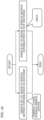
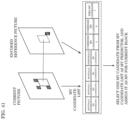
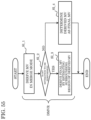
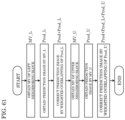
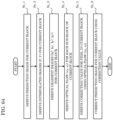
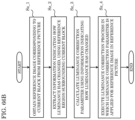
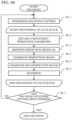
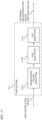
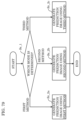
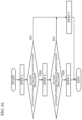
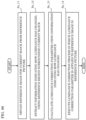
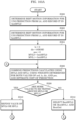
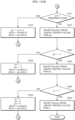
- the decoding method includes: decoding, from the bitstream, a prediction mode indicator indicating whether bi/uni mixed prediction is to be performed for the current block; decoding, from the bitstream, two instances of motion information for the current block; and when the prediction mode indicator indicates that the bi/uni mixed prediction is to be performed for the current block, (i) for a first partition, performing first prediction using one of the two instances, the first partition being part of the current block, the first prediction being uni-prediction, and (ii) for a second partition, performing second prediction using both of the two instances, the second partition being part of the current block, the second prediction being bi-prediction.
- each of embodiments, or each of part of constituent elements and methods in the present disclosure enables, for example, at least one of the following: improvement in coding efficiency, enhancement in image quality, reduction in processing amount of encoding/decoding, reduction in circuit scale, improvement in processing speed of encoding/decoding, etc.
- each of embodiments, or each of part of constituent elements and methods in the present disclosure enables, in encoding and decoding, appropriate selection of an element or an operation.
- the element is, for example, a filter, a block, a size, a motion vector, a reference picture, or a reference block.
- the present disclosure includes disclosure regarding configurations and methods which may provide advantages other than the above-described ones. Examples of such configurations and methods include a configuration or method for improving coding efficiency while reducing increase in processing amount.
- a configuration or method according to an aspect of the present disclosure enables, for example, at least one of the following: improvement in coding efficiency, enhancement in image quality, reduction in processing amount, reduction in circuit scale, improvement in processing speed, appropriate selection of an element or an operation, etc. It is to be noted that the configuration or method according to an aspect of the present disclosure may provide advantages other than the above-described ones.
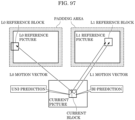
- a geometric partitioning mode may be used.
- the geometric partitioning mode is also referred to GPM or a GPM mode.
- GPM GPM
- Prediction for the block is generated by combining prediction for one of the partitions and prediction for the other of the partitions. This may improve the prediction accuracy.
- uni-prediction is used as the prediction for the partition.
- the prediction accuracy may be further improved by using bi-prediction as the prediction for the partition.
- bi-prediction may increase instances such as a reference image and a motion vector for use in the prediction, complicate the processing, and increase the processing amount.
- a decoding method of Example 1 is a decoding method of decoding a current block of a video from a bitstream.
- the decoding method includes: decoding, from the bitstream, a prediction mode indicator indicating whether bi/uni mixed prediction is to be performed for the current block; decoding, from the bitstream, two instances of motion information for the current block; and when the prediction mode indicator indicates that the bi/uni mixed prediction is to be performed for the current block, (i) for a first partition, performing first prediction using one of the two instances, the first partition being part of the current block, the first prediction being uni-prediction, and (ii) for a second partition, performing second prediction using both of the two instances, the second partition being part of the current block, the second prediction being bi-prediction.
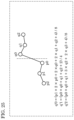
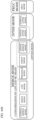
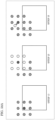
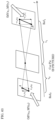
- a decoding method of Example 2 may be the decoding method of Example 1, in which two partitions in the current block, namely the first partition and the second partition, are determined according to a geometric partitioning mode, the current block is partitioned into the two partitions along a boundary, and the boundary is a line separating the two partitions.
- the geometric partitioning mode it may be possible to generate a prediction image of the current block by combining the bi-predicted partition and the uni-predicted partition. Accordingly, in the geometric partitioning mode, it may be possible to apply the bi-prediction to the prediction for the partition while preventing the complication of the processing and the increase in the processing amount.
- a decoding method of Example 3 may be the decoding method of Example 2, further including decoding, from the bitstream, a partition indicator indicating at least one of (i) which of the two partitions is the first partition or (ii) which of the two partitions is the second partition.
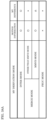
- a decoding method of Example 4 may be the decoding method of Example 1 or 2, further including decoding, from the bitstream, a partition indicator indicating: (i) a position and a direction of a boundary between two partitions in the current block, namely the first partition and the second partition, the boundary being a line separating the two partitions; and (ii) which of the two instances is to be used for prediction for the first partition.
- a decoding method of Example 5 may be the decoding method of Example 4, in which the partition indicator further indicates at least one of (i) which of the two partitions is the first partition or (ii) which of the two partitions is the second partition.
- a decoding method of Example 6 may be the decoding method of Example 2 or 4, further including setting each of the two partitions as the first partition or the second partition based on at least one of a size or a shape of at least one of the two partitions.
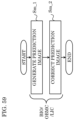
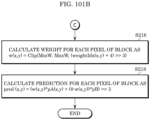
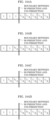
- a decoding method of Example 7 may be the decoding method of any of Examples 1 to 6, in which in the first prediction and in the second prediction, the first prediction for the current block is performed using one of the two instances, third prediction for the current block is performed using the other of the two instances, the third prediction being uni-prediction, and a weighted linear combination of the first prediction and the third prediction is performed, for at least part of the first partition, a weight ratio of the first prediction is set to 1, and a weight ratio of the third prediction is set to 0, and for at least part of the second partition, the weight ratio of the third prediction is set to a maximum ratio less than 1 in the current block, and the weight ratio of the first prediction is set to a difference between 1 and the weight ratio of the third prediction.
- a decoding method of Example 8 may be the decoding method of Example 7, in which for the at least part of the second partition, the weight ratio of the third prediction is set to 0.5, and the weight ratio of the first prediction is set to 0.5.
- a decoding method of Example 9 may be the decoding method of Example 7 or 8, in which for a boundary region between the at least part of the first partition and the at least part of the second partition and including a boundary between the first partition and the second partition, each of the weight ratio of the first prediction and the weight ratio of the third prediction is set to gradually change from a ratio set for the at least part of the first partition to a ratio set for the at least part of the second partition.
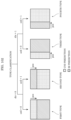
- a decoding method of Example 10 may be the decoding method of any of Examples 1 to 9, further including: for a first sub-block, storing one of the two instances that is to be used for prediction for the first partition, the first sub-block belonging to at least part of the first partition; and for a second sub-block, storing both of the two instances, the second sub-block belonging to at least one of: a boundary region between the at least part of the first partition and at least part of the second partition and including a boundary between the first partition and the second partition; or the at least part of the second partition.
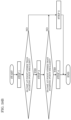
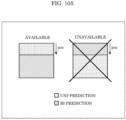
- a decoding method of Example 11 may be the decoding method of any of Examples 1 to 10, in which when at least one of the first partition or the second partition is of a predetermined shape, the bi/uni mixed prediction is not performed.
- a decoding method of Example 12 may be the decoding method of Example 11, in which the predetermined shape is a shape implementable by normal block splitting different from partition splitting in the bi/uni mixed prediction.
- an encoding method of Example 13 is an encoding method of encoding a current block of a video into a bitstream.
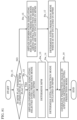
- the encoding method includes: when bi/uni mixed prediction is to be performed for the current block, (i) for a first partition, performing first prediction using one of two instances of motion information for the current block, the first partition being part of the current block, the first prediction being uni-prediction, and (ii) for a second partition, performing second prediction using both of the two instances, the second partition being part of the current block, the second prediction being bi-prediction; encoding, into the bitstream, a prediction mode indicator indicating whether the bi/uni mixed prediction is to be performed for the current block; and encoding the two instances into the bitstream.
- an encoding method of Example 14 may be the encoding method of Example 13, in which two partitions in the current block, namely the first partition and the second partition, are determined according to a geometric partitioning mode, the current block is partitioned into the two partitions along a boundary, and the boundary is a line separating the two partitions.
- the geometric partitioning mode it may be possible to generate a prediction image of the current block by combining the bi-predicted partition and the uni-predicted partition. Accordingly, in the geometric partitioning mode, it may be possible to apply the bi-prediction to the prediction for the partition while preventing the complication of the processing and the increase in the processing amount
- an encoding method of Example 15 may be the encoding method of Example 14, further including encoding, into the bitstream, a partition indicator indicating at least one of (i) which of the two partitions is the first partition or (ii) which of the two partitions is the second partition.
- an encoding method of Example 16 may be the encoding method of Example 13 or 14, further including encoding, into the bitstream, a partition indicator indicating: (i) a position and a direction of a boundary between two partitions in the current block, namely the first partition and the second partition, the boundary being a line separating the two partitions; and (ii) which of the two instances is to be used for prediction for the first partition.
- an encoding method of Example 17 may be the encoding method of Example 16, in which the partition indicator further indicates at least one of (i) which of the two partitions is the first partition or (ii) which of the two partitions is the second partition.
- an encoding method of Example 18 may be the encoding method of Example 14 or 16, further including setting each of the two partitions as the first partition or the second partition based on at least one of a size or a shape of at least one of the two partitions.
- an encoding method of Example 19 may be the encoding method of any of Examples 13 to 18, in which in the first prediction and in the second prediction, the first prediction for the current block is performed using one of the two instances, third prediction for the current block is performed using the other of the two instances, the third prediction being uni-prediction, and a weighted linear combination of the first prediction and the third prediction is performed, for at least part of the first partition, a weight ratio of the first prediction is set to 1, and a weight ratio of the third prediction is set to 0, and for at least part of the second partition, the weight ratio of the third prediction is set to a maximum ratio less than 1 in the current block, and the weight ratio of the first prediction is set to a difference between 1 and the weight ratio of the third prediction.
- an encoding method of Example 20 may be the encoding method of Example 19, in which for the at least part of the second partition, the weight ratio of the third prediction is set to 0.5, and the weight ratio of the first prediction is set to 0.5.
- an encoding method of Example 21 may be the encoding method of Example 19 or 20, in which for a boundary region between the at least part of the first partition and the at least part of the second partition and including a boundary between the first partition and the second partition, each of the weight ratio of the first prediction and the weight ratio of the third prediction is set to gradually change from a ratio set for the at least part of the first partition to a ratio set for the at least part of the second partition.
- an encoding method of Example 22 may be the encoding method of any of Examples 13 to 21, further including: for a first sub-block, storing one of the two instances that is to be used for prediction for the first partition, the first sub-block belonging to at least part of the first partition; and for a second sub-block, storing both of the two instances, the second sub-block belonging to at least one of: a boundary region between the at least part of the first partition and at least part of the second partition and including a boundary between the first partition and the second partition; or the at least part of the second partition.
- an encoding method of Example 23 may be the encoding method of any of Examples 13 to 22, in which when at least one of the first partition or the second partition is of a predetermined shape, the bi/uni mixed prediction is not performed.
- an encoding method of Example 24 may be the encoding method of Example 23, in which the predetermined shape is a shape implementable by normal block splitting different from partition splitting in the bi/uni mixed prediction.
- a non-transitory computer readable medium of Example 25 is a non-transitory computer readable medium for a computer, storing a bitstream that causes the computer to execute a decoding process of decoding a current block using a motion vector, in which the decoding process includes: decoding, from the bitstream, a prediction mode indicator indicating whether bi/uni mixed prediction is to be performed for the current block; decoding, from the bitstream, two instances of motion information for the current block; and when the prediction mode indicator indicates that the bi/uni mixed prediction is to be performed for the current block, (i) for a first partition, performing first prediction using one of the two instances, the first partition being part of the current block, the first prediction being uni-prediction, and (ii) for a second partition, performing second prediction using both of the two instances, the second partition being part of the current block, the second prediction being bi-prediction.
- a decoder of Example 26 is a decoder that decodes a current block of a video from a bitstream.
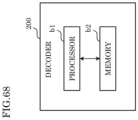
- the decoder includes circuitry and memory coupled to the circuitry.
- the circuitry decodes, from the bitstream, a prediction mode indicator indicating whether bi/uni mixed prediction is to be performed for the current block; decodes, from the bitstream, two instances of motion information for the current block; and when the prediction mode indicator indicates that the bi/uni mixed prediction is to be performed for the current block, (i) for a first partition, performs first prediction using one of the two instances, the first partition being part of the current block, the first prediction being uni-prediction, and (ii) for a second partition, performs second prediction using both of the two instances, the second partition being part of the current block, the second prediction being bi-prediction.
- an encoder of Example 27 is an encoder that encodes a current block of a video into a bitstream.
- the encoder includes circuitry and memory coupled to the circuitry.
- the circuitry when bi/uni mixed prediction is to be performed for the current block, (i) for a first partition, performs first prediction using one of two instances of motion information for the current block, the first partition being part of the current block, the first prediction being uni-prediction, and (ii) for a second partition, performs second prediction using both of the two instances, the second partition being part of the current block, the second prediction being bi-prediction; encodes, into the bitstream, a prediction mode indicator indicating whether the bi/uni mixed prediction is to be performed for the current block; and encodes the two instances into the bitstream.
- the decoder of Example 28 includes an inputter, an entropy decoder, an inverse quantizer, an inverse transformer, an intra predictor, an inter predictor, a loop filter unit, and an outputter.
- the inputter receives an encoded bitstream.
- the entropy decoder applies variable length decoding on the encoded bitstream to derive quantized coefficients.
- the inverse quantizer inverse quantizes the quantized coefficients to derive transform coefficients.
- the inverse transformer inverse transforms the transformed coefficients to derive prediction errors.
- the intra predictor generates prediction signals of a current block included in the current picture, using reference pixels included in the current picture.
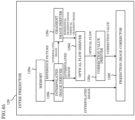
- the inter predictor generates prediction signals of a current block included in the current picture, using a reference block included in a reference picture different from the current picture.
- the loop filter unit applies a filter to a reconstructed block in a current block included in the current picture.
- the current picture is then output from the outputter.
- the entropy decoder decodes, from the bitstream, a prediction mode indicator indicating whether bi/uni mixed prediction is to be performed for the current block; decodes, from the bitstream, two instances of motion information for the current block; and when the prediction mode indicator indicates that the bi/uni mixed prediction is to be performed for the current block, (i) for a first partition, performs first prediction using one of the two instances, the first partition being part of the current block, the first prediction being uni-prediction, and (ii) for a second partition, performs second prediction using both of the two instances, the second partition being part of the current block, the second prediction being bi-prediction.
- the encoder of Example 29 includes an inputter, a splitter, an intra predictor, an inter predictor, a loop filter, a transformer, a quantizer, an entropy encoder, and an outputter.
- the inputter receives a current picture.
- the splitter splits the current picture into multiple blocks.
- the intra predictor generates prediction signals of a current block included in the current picture, using reference pixels included in the current picture.
- the inter predictor generates prediction signals of a current block included in the current picture, using a reference block included in a reference picture different from the current picture.
- the loop filter unit applies a filter to a reconstructed block in a current block included in the current picture.
- the transformer generates transformed coefficients by transforming prediction errors between original signals of the current block included in the current picture and prediction signals generated by either the intra predictor or the inter predictor.
- the quantizer quantizes the transform coefficients to generate quantized coefficients.
- the entropy encoder applies variable length encoding on the quantized coefficients to generate an encoded bitstream. The quantized coefficients to which the variable length encoding has been applied and the encoded bitstream including control information are then output from the outputter.
- the entropy encoder when bi/uni mixed prediction is to be performed for the current block, (i) for a first partition, performs first prediction using one of two instances of motion information for the current block, the first partition being part of the current block, the first prediction being uni-prediction, and (ii) for a second partition, performs second prediction using both of the two instances, the second partition being part of the current block, the second prediction being bi-prediction; encodes, into the bitstream, a prediction mode indicator indicating whether the bi/uni mixed prediction is to be performed for the current block; and encodes the two instances into the bitstream.
- An image is a data unit configured with a set of pixels, is a picture or includes blocks smaller than a picture. Images include a still image in addition to a video.
- a picture is an image processing unit configured with a set of pixels, and is also referred to as a frame or a field.
- a block is a processing unit which is a set of a particular number of pixels.
- the block is also referred to as indicated in the following examples.
- the shapes of blocks are not limited. Examples include a rectangle shape of M ⁇ N pixels and a square shape of M ⁇ M pixels for the first place, and also include a triangular shape, a circular shape, and other shapes. (examples of blocks)
- a pixel or sample is a smallest point of an image. Pixels or samples include not only a pixel at an integer position but also a pixel at a sub-pixel position generated based on a pixel at an integer position.
- a pixel value or sample value is an eigen value of a pixel. Pixel or sample values naturally include a luma value, a chroma value, an RGB gradation level and also covers a depth value, or a binary value of 0 or 1.
- a flag indicates one or more bits, and may be, for example, a parameter or index represented by two or more bits. Alternatively, the flag may indicate not only a binary value represented by a binary number but also a multiple value represented by a number other than the binary number.
- a signal is the one symbolized or encoded to convey information.
- Signals include a discrete digital signal and an analog signal which takes a continuous value.
- a stream or bitstream is a digital data string or a digital data flow.
- a stream or bitstream may be one stream or may be configured with a plurality of streams having a plurality of hierarchical layers.
- a stream or bitstream may be transmitted in serial communication using a single transmission path, or may be transmitted in packet communication using a plurality of transmission paths.
- Differences include an absolute value of a difference (
- Sums include an absolute value of a sum (
- a phrase "based on something” means that a thing other than the something may be considered.
- “based on” may be used in a case in which a direct result is obtained or a case in which a result is obtained through an intermediate result.
- a phrase "something used” or “using something” means that a thing other than the something may be considered.
- “used” or “using” may be used in a case in which a direct result is obtained or a case in which a result is obtained through an intermediate result.
- limit or “restriction/restrict/restricted” can be rephrased as “does not permit/allow” or “being not permitted/allowed”.
- “being not prohibited/forbidden” or “being permitted/allowed” does not always mean “obligation”.
- chroma may be used instead of the term chrominance.
- An adjective represented by the symbol or subscript Y or L, specifying that a sample array or single sample is representing the monochrome signal related to the primary colors.
- the term luma may be used instead of the term luminance.
- Embodiments of an encoder and a decoder will be described below.
- the embodiments are examples of an encoder and a decoder to which the processes and/or configurations presented in the description of aspects of the present disclosure are applicable.
- the processes and/or configurations can also be implemented in an encoder and a decoder different from those according to the embodiments. For example, regarding the processes and/or configurations as applied to the embodiments, any of the following may be implemented:
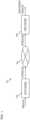
- FIG. 1 is a schematic diagram illustrating one example of a configuration of a transmission system according to an embodiment.
- Transmission system Trs is a system which transmits a stream generated by encoding an image and decodes the transmitted stream.
- Transmission system Trs like this includes, for example, encoder 100, network Nw, and decoder 200 as illustrated in FIG. 1 .
- Encoder 100 generates a stream by encoding the input image, and outputs the stream to network Nw.
- the stream includes, for example, the encoded image and control information for decoding the encoded image.
- the image is compressed by the encoding.
- a previous image before being encoded and being input to encoder 100 is also referred to as the original image, the original signal, or the original sample.
- the image may be a video or a still image.
- the image is a generic concept of a sequence, a picture, and a block, and thus is not limited to a spatial region having a particular size and to a temporal region having a particular size unless otherwise specified.
- the image is an array of pixels or pixel values, and the signal representing the image or pixel values are also referred to as samples.
- the stream may be referred to as a bitstream, an encoded bitstream, a compressed bitstream, or an encoded signal.
- the encoder may be referred to as an image encoder or a video encoder.
- the encoding method performed by encoder 100 may be referred to as an encoding method, an image encoding method, or a video encoding method.
- Network Nw transmits the stream generated by encoder 100 to decoder 200.
- Network Nw may be the Internet, the Wide Area Network (WAN), the Local Area Network (LAN), or any combination of these networks.
- Network Nw is not always limited to a bi-directional communication network, and may be a uni-directional communication network which transmits broadcast waves of digital terrestrial broadcasting, satellite broadcasting, or the like.
- network Nw may be replaced by a medium such as a Digital Versatile Disc (DVD) and a Blu-Ray Disc (BD) (R), etc. on which a stream is recorded.
- DVD Digital Versatile Disc
- BD Blu-Ray Disc
- Decoder 200 generates, for example, a decoded image which is an uncompressed image by decoding a stream transmitted by network Nw.
- the decoder decodes a stream according to a decoding method corresponding to an encoding method by encoder 100.
- the decoder may also be referred to as an image decoder or a video decoder, and that the decoding method performed by decoder 200 may also be referred to as a decoding method, an image decoding method, or a video decoding method.
- FIG. 2 is a diagram illustrating one example of a hierarchical structure of data in a stream.
- a stream includes, for example, a video sequence.
- the video sequence includes a video parameter set (VPS), a sequence parameter set (SPS), a picture parameter set (PPS), supplemental enhancement information (SEI), and a plurality of pictures.
- VPS video parameter set
- SPS sequence parameter set
- PPS picture parameter set
- SEI Supplemental enhancement information
- a VPS includes: a coding parameter which is common between some of the plurality of layers; and a coding parameter related to some of the plurality of layers included in the video or an individual layer.
- An SPS includes a parameter which is used for a sequence, that is, a coding parameter which decoder 200 refers to in order to decode the sequence.
- the coding parameter may indicate the width or height of a picture. It is to be noted that a plurality of SPSs may be present.
- a PPS includes a parameter which is used for a picture, that is, a coding parameter which decoder 200 refers to in order to decode each of the pictures in the sequence.
- the coding parameter may include a reference value for the quantization width which is used to decode a picture and a flag indicating application of weighted prediction. It is to be noted that a plurality of PPSs may be present. Each of the SPS and the PPS may be simply referred to as a parameter set.
- a picture may include a picture header and at least one slice.
- a picture header includes a coding parameter which decoder 200 refers to in order to decode the at least one slice.
- a slice includes a slice header and at least one brick.
- a slice header includes a coding parameter which decoder 200 refers to in order to decode the at least one brick.
- a brick includes at least one coding tree unit (CTU).
- CTU coding tree unit
- a picture may not include any slice and may include a tile group instead of a slice.
- the tile group includes at least one tile.
- a brick may include a slice.
- a CTU is also referred to as a super block or a basis splitting unit. As illustrated in (e) of FIG. 2 , a CTU like this includes a CTU header and at least one coding unit (CU). A CTU header includes a coding parameter which decoder 200 refers to in order to decode the at least one CU.
- a CU may be split into a plurality of smaller CUs.
- a CU includes a CU header, prediction information, and residual coefficient information.
- Prediction information is information for predicting the CU
- the residual coefficient information is information indicating a prediction residual to be described later.
- a CU is basically the same as a prediction unit (PU) and a transform unit (TU), it is to be noted that, for example, an SBT to be described later may include a plurality of TUs smaller than the CU.
- the CU may be processed for each virtual pipeline decoding unit (VPDU) included in the CU.
- the VPDU is, for example, a fixed unit which can be processed at one stage when pipeline processing is performed in hardware.
- a stream may not include part of the hierarchical layers illustrated in FIG. 2 .
- the order of the hierarchical layers may be exchanged, or any of the hierarchical layers may be replaced by another hierarchical layer.
- a picture which is a target for a process which is about to be performed by a device such as encoder 100 or decoder 200 is referred to as a current picture.
- a current picture means a current picture to be encoded when the process is an encoding process
- a current picture means a current picture to be decoded when the process is a decoding process.
- a CU or a block of CUs which is a target for a process which is about to be performed by a device such as encoder 100 or decoder 200 is referred to as a current block.
- a current block means a current block to be encoded when the process is an encoding process
- a current block means a current block to be decoded when the process is a decoding process.
- a picture may be configured with one or more slice units or tile units in order to decode the picture in parallel.
- Slices are basic encoding units included in a picture.
- a picture may include, for example, one or more slices.
- a slice includes one or more successive coding tree units (CTUs).
- CTUs successive coding tree units
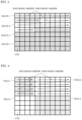
- FIG. 3 is a diagram illustrating one example of a slice configuration.
- a picture includes 11 ⁇ 8 CTUs, and is split into four slices (slices 1 to 4).
- Slice 1 includes sixteen CTUs
- slice 2 includes twenty-one CTUs
- slice 3 includes twenty-nine CTUs
- slice 4 includes twenty-two CTUs.
- each CTU in the picture belongs to one of the slices.
- the shape of each slice is a shape obtained by splitting the picture horizontally.
- a boundary of each slice does not need to coincide with an image end, and may coincide with any of the boundaries between CTUs in the image.
- the processing order of the CTUs in a slice (an encoding order or a decoding order) is, for example, a raster-scan order.
- a slice includes a slice header and encoded data. Features of the slice may be written in the slice header. The features include a CTU address of a top CTU in the slice, a slice type, etc.
- a tile is a unit of a rectangular region included in a picture.
- Each of tiles may be assigned with a number referred to as TileId in raster-scan order.
- FIG. 4 is a diagram illustrating one example of a tile configuration.
- a picture includes 11 ⁇ 8 CTUs, and is split into four tiles of rectangular regions (tiles 1 to 4).
- the processing order of CTUs is changed from the processing order in the case where no tile is used.
- no tile is used, a plurality of CTUs in a picture are processed in raster-scan order.
- a plurality of tiles are used, at least one CTU in each of the plurality of tiles is processed in raster-scan order. For example, as illustrated in FIG.
- the processing order of the CTUs included in tile 1 is the order which starts from the left-end of the first column of tile 1 toward the right-end of the first column of tile 1 and then starts from the left-end of the second column of tile 1 toward the right-end of the second column of tile 1.
- one tile may include one or more slices, and one slice may include one or more tiles.
- a picture may be configured with one or more tile sets.
- a tile set may include one or more tile groups, or one or more tiles.
- a picture may be configured with only one of a tile set, a tile group, and a tile.
- an order for scanning a plurality of tiles for each tile set in raster scan order is assumed to be a basic encoding order of tiles.
- a set of one or more tiles which are continuous in the basic encoding order in each tile set is assumed to be a tile group.
- Such a picture may be configured by splitter 102 (see FIG. 7 ) to be described later.
- FIGs. 5 and 6 are diagrams illustrating examples of scalable stream structures.
- encoder 100 may generate a temporally/spatially scalable stream by dividing each of a plurality of pictures into any of a plurality of layers and encoding the picture in the layer. For example, encoder 100 encodes the picture for each layer, thereby achieving scalability where an enhancement layer is present above a base layer. Such encoding of each picture is also referred to as scalable encoding.
- decoder 200 is capable of switching image quality of an image which is displayed by decoding the stream. In other words, decoder 200 determines up to which layer to decode based on internal factors such as the processing ability of decoder 200 and external factors such as a state of a communication bandwidth.
- decoder 200 is capable of decoding a content while freely switching between low resolution and high resolution.
- the user of the stream watches a video of the stream halfway using a smartphone on the way to home, and continues watching the video at home on a device such as a TV connected to the Internet.
- a device such as a TV connected to the Internet.
- each of the smartphone and the device described above includes decoder 200 having the same or different performances.
- the device decodes layers up to the higher layer in the stream, the user can watch the video at high quality at home.
- encoder 100 does not need to generate a plurality of streams having different image qualities of the same content, and thus the processing load can be reduced.
- the enhancement layer may include meta information based on statistical information on the image.
- Decoder 200 may generate a video whose image quality has been enhanced by performing super-resolution imaging on a picture in the base layer based on the metadata.
- Super-resolution imaging may be any of improvement in the Signal-to-Noise (SN) in the same resolution and increase in resolution.
- Metadata may include information for identifying a linear or a non-linear filter coefficient, as used in a super-resolution process, or information identifying a parameter value in a filter process, machine learning, or a least squares method used in super-resolution processing.
- a configuration may be provided in which a picture is divided into, for example, tiles in accordance with, for example, the meaning of an object in the picture.
- decoder 200 may decode only a partial region in a picture by selecting a tile to be decoded.
- an attribute of the object person, car, ball, etc.
- a position of the object in the picture may be stored as metadata.
- decoder 200 is capable of identifying the position of a desired object based on the metadata, and determining the tile including the object.
- the metadata may be stored using a data storage structure different from image data, such as SEI in HEVC. This metadata indicates, for example, the position, size, or color of a main object.
- Metadata may be stored in units of a plurality of pictures, such as a stream, a sequence, or a random access unit.
- decoder 200 is capable of obtaining, for example, the time at which a specific person appears in the video, and by fitting the time information with picture unit information, is capable of identifying a picture in which the object is present and determining the position of the object in the picture.
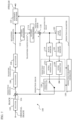
- FIG. 7 is a block diagram illustrating one example of a configuration of encoder 100 according to this embodiment.
- Encoder 100 encodes an image in units of a block.
- encoder 100 is an apparatus which encodes an image in units of a block, and includes splitter 102, subtractor 104, transformer 106, quantizer 108, entropy encoder 110, inverse quantizer 112, inverse transformer 114, adder 116, block memory 118, loop filter 120, frame memory 122, intra predictor 124, inter predictor 126, prediction controller 128, and prediction parameter generator 130. It is to be noted that intra predictor 124 and inter predictor 126 are configured as part of a prediction executor.
- FIG. 8 is a block diagram illustrating a mounting example of encoder 100.
- Encoder 100 includes processor a1 and memory a2.
- the plurality of constituent elements of encoder 100 illustrated in FIG. 7 are mounted on processor a1 and memory a2 illustrated in FIG. 8 .
- Processor a1 is circuitry which performs information processing and is accessible to memory a2.
- processor a1 is dedicated or general electronic circuitry which encodes an image.
- Processor a1 may be a processor such as a CPU.
- processor a1 may be an aggregate of a plurality of electronic circuits.
- processor a1 may take the roles of two or more constituent elements other than a constituent element for storing information out of the plurality of constituent elements of encoder 100 illustrated in FIG. 7 , etc.
- Memory a2 is dedicated or general memory for storing information that is used by processor a1 to encode the image.
- Memory a2 may be electronic circuitry, and may be connected to processor a1.
- memory a2 may be included in processor a1.
- memory a2 may be an aggregate of a plurality of electronic circuits.
- memory a2 may be a magnetic disc, an optical disc, or the like, or may be represented as storage, a medium, or the like.
- memory a2 may be non-volatile memory, or volatile memory.
- memory a2 may store an image to be encoded or a stream corresponding to an encoded image.
- memory a2 may store a program for causing processor a1 to encode an image.
- memory a2 may take the roles of two or more constituent elements for storing information out of the plurality of constituent elements of encoder 100 illustrated in FIG. 7 . More specifically, memory a2 may take the roles of block memory 118 and frame memory 122 illustrated in FIG. 7 . More specifically, memory a2 may store a reconstructed image (specifically, a reconstructed block, a reconstructed picture, or the like).
- encoder 100 not all of the plurality of constituent elements indicated in FIG. 7 , etc. may be implemented, and not all the processes described above may be performed. Part of the constituent elements indicated in FIG. 7 may be included in another device, or part of the processes described above may be performed by another device.
- FIG. 9 is a flow chart illustrating one example of an overall encoding process performed by encoder 100.
- splitter 102 of encoder 100 splits each of pictures included in an original image into a plurality of blocks having a fixed size (128 ⁇ 128 pixels) (Step Sa_1).
- Splitter 102 selects a splitting pattern for the fixed-size block (Step Sa_2).
- splitter 102 further splits the fixed-size block into a plurality of blocks which form the selected splitting pattern.
- Encoder 100 performs, for each of the plurality of blocks, Steps Sa_3 to Sa_9 for the block.
- Step Sa_4 subtractor 104 generates the difference between a current block and a prediction image as a prediction residual. It is to be noted that the prediction residual is also referred to as a prediction error.
- transformer 106 transforms the prediction image and quantizer 108 quantizes the result, to generate a plurality of quantized coefficients (Step Sa_5).
- entropy encoder 110 encodes (specifically, entropy encodes) the plurality of quantized coefficients and a prediction parameter related to generation of a prediction image to generate a stream (Step Sa_6).
- inverse quantizer 112 performs inverse quantization of the plurality of quantized coefficients and inverse transformer 114 performs inverse transform of the result, to restore a prediction residual (Step Sa_7).
- adder 116 adds the prediction image to the restored prediction residual to reconstruct the current block (Step Sa_8). In this way, the reconstructed image is generated.
- the reconstructed image is also referred to as a reconstructed block, and, in particular, that a reconstructed image generated by encoder 100 is also referred to as a local decoded block or a local decoded image.
- loop filter 120 performs filtering of the reconstructed image as necessary (Step Sa_9).
- Encoder 100 determines whether encoding of the entire picture has been finished (Step Sa_10). When determining that the encoding has not yet been finished (No in Step Sa_10), processes from Step Sa_2 are executed repeatedly.
- encoder 100 selects one splitting pattern for a fixed-size block, and encodes each block according to the splitting pattern in the above-described example, it is to be noted that each block may be encoded according to a corresponding one of a plurality of splitting patterns. In this case, encoder 100 may evaluate a cost for each of the plurality of splitting patterns, and, for example, may select the stream obtained by encoding according to the splitting pattern which yields the smallest cost as a stream which is output finally.
- Steps Sa_1 to Sa_10 may be performed sequentially by encoder 100, or two or more of the processes may be performed in parallel or may be reordered.
- the encoding process by encoder 100 is hybrid encoding using prediction encoding and transform encoding.
- prediction encoding is performed by an encoding loop configured with subtractor 104, transformer 106, quantizer 108, inverse quantizer 112, inverse transformer 114, adder 116, loop filter 120, block memory 118, frame memory 122, intra predictor 124, inter predictor 126, and prediction controller 128.
- the prediction executor configured with intra predictor 124 and inter predictor 126 is part of the encoding loop.
- Splitter 102 splits each of pictures included in the original image into a plurality of blocks, and outputs each block to subtractor 104.
- splitter 102 first splits a picture into blocks of a fixed size (for example, 128 ⁇ 128 pixels).
- the fixed-size block is also referred to as a coding tree unit (CTU).
- CTU coding tree unit
- Splitter 102 then splits each fixed-size block into blocks of variable sizes (for example, 64 ⁇ 64 pixels or smaller), based on recursive quadtree and/or binary tree block splitting. In other words, splitter 102 selects a splitting pattern.
- the variable-size block is also referred to as a coding unit (CU), a prediction unit (PU), or a transform unit (TU). It is to be noted that, in various kinds of mounting examples, there is no need to differentiate between CU, PU, and TU; all or some of the blocks in a picture may be processed in units of a CU, a PU, or a
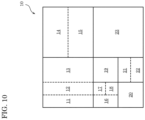
- FIG. 10 is a diagram illustrating one example of block splitting according to this embodiment.
- the solid lines represent block boundaries of blocks split by quadtree block splitting
- the dashed lines represent block boundaries of blocks split by binary tree block splitting.
- block 10 is a square block having 128 ⁇ 128 pixels. This block 10 is first split into four square 64 ⁇ 64 pixel blocks (quadtree block splitting).
- the upper-left 64 ⁇ 64 pixel block is further vertically split into two rectangle 32 ⁇ 64 pixel blocks, and the left 32 ⁇ 64 pixel block is further vertically split into two rectangle 16 ⁇ 64 pixel blocks (binary tree block splitting).
- the upper-left square 64 ⁇ 64 pixel block is split into two 16 ⁇ 64 pixel blocks 11 and 12 and one 32 ⁇ 64 pixel block 13.
- the upper-right square 64 ⁇ 64 pixel block is horizontally split into two rectangle 64 ⁇ 32 pixel blocks 14 and 15 (binary tree block splitting).
- the lower-left square 64 ⁇ 64 pixel block is first split into four square 32 ⁇ 32 pixel blocks (quadtree block splitting). The upper-left block and the lower-right block among the four square 32 ⁇ 32 pixel blocks are further split.
- the upper-left square 32 ⁇ 32 pixel block is vertically split into two rectangle 16 ⁇ 32 pixel blocks, and the right 16 ⁇ 32 pixel block is further horizontally split into two 16 ⁇ 16 pixel blocks (binary tree block splitting).
- the lower-right 32 ⁇ 32 pixel block is horizontally split into two 32 ⁇ 16 pixel blocks (binary tree block splitting).
- the upper-right square 32 ⁇ 32 pixel block is horizontally split into two rectangle 32 ⁇ 16 pixel blocks (binary tree block splitting).
- the lower-left square 64 ⁇ 64 pixel block is split into rectangle16 ⁇ 32 pixel block 16, two square 16 ⁇ 16 pixel blocks 17 and 18, two square 32 ⁇ 32 pixel blocks 19 and 20, and two rectangle 32 ⁇ 16 pixel blocks 21 and 22.
- the lower-right 64 ⁇ 64 pixel block 23 is not split.
- block 10 is split into thirteen variable-size blocks 11 through 23 based on recursive quadtree and binary tree block splitting. Such splitting is also referred to as quad-tree plus binary tree splitting (QTBT).
- quad-tree plus binary tree splitting QTBT
- one block is split into four or two blocks (quadtree or binary tree block splitting), but splitting is not limited to these examples.
- one block may be split into three blocks (ternary block splitting).
- Splitting including such ternary block splitting is also referred to as multi type tree (MBT) splitting.
- MBT multi type tree
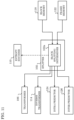
- FIG. 11 is a diagram illustrating one example of a configuration of splitter 102.
- splitter 102 may include block splitting determiner 102a.
- Block splitting determiner 102a may perform the following processes as examples.
- block splitting determiner 102a collects block information from either block memory 118 or frame memory 122, and determines the above-described splitting pattern based on the block information.
- Splitter 102 splits the original image according to the splitting pattern, and outputs at least one block obtained by the splitting to subtractor 104.
- block splitting determiner 102a outputs a parameter indicating the above-described splitting pattern to transformer 106, inverse transformer 114, intra predictor 124, inter predictor 126, and entropy encoder 110.
- Transformer 106 may transform a prediction residual based on the parameter.
- Intra predictor 124 and inter predictor 126 may generate a prediction image based on the parameter.
- entropy encoder 110 may entropy encodes the parameter.
- the parameter related to the splitting pattern may be written in a stream as indicated below as one example.
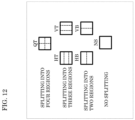
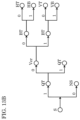
- FIG. 12 is a diagram illustrating examples of splitting patterns.
- Examples of splitting patterns include: splitting into four regions (QT) in which a block is split into two regions both horizontally and vertically; splitting into three regions (HT or VT) in which a block is split in the same direction in a ratio of 1:2:1; splitting into two regions (HB or VB) in which a block is split in the same direction in a ratio of 1:1; and no splitting (NS).
- the splitting pattern does not have any block splitting direction in the case of splitting into four regions and no splitting, and that the splitting pattern has splitting direction information in the case of splitting into two regions or three regions.
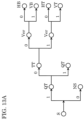
- FIGs. 13A and 13B are each a diagram illustrating one example of a syntax tree of a splitting pattern.
- S Split flag
- QT QT flag
- Information indicating which one of splitting into three regions and two regions is to be performed TT: TT flag or BT: BT flag
- information indicating a division direction Ver: Vertical flag or Hor: Horizontal flag
- each of at least one block obtained by splitting according to such a splitting pattern may be further split repeatedly in a similar process.
- whether splitting is performed whether splitting into four regions is performed, which one of the horizontal direction and the vertical direction is the direction in which a splitting method is to be performed, which one of splitting into three regions and splitting into two regions is to be performed may be recursively determined, and the determination results may be encoded in a stream according to the encoding order disclosed by the syntax tree illustrated in FIG. 13A .
- information items respectively indicating S, QT, TT, and Ver are arranged in the listed order in the syntax tree illustrated in FIG. 13A
- information items respectively indicating S, QT, Ver, and BT may be arranged in the listed order.
- FIG. 13B first, information indicating whether to perform splitting (S: Split flag) is present, and information indicating whether to perform splitting into four regions (QT: QT flag) is present next.
- Information indicating the splitting direction (Ver: Vertical flag or Hor: Horizontal flag) is present next, and lastly, information indicating which one of splitting into two regions and splitting into three regions is to be performed (BT: BT flag or TT: TT flag) is present.
- splitting patterns described above are examples, and splitting patterns other than the described splitting patterns may be used, or part of the described splitting patterns may be used.
- Subtractor 104 subtracts a prediction image (prediction image that is input from prediction controller 128) from the original image in units of a block input from splitter 102 and split by splitter 102. In other words, subtractor 104 calculates prediction residuals of a current block. Subtractor 104 then outputs the calculated prediction residuals to transformer 106.
- the original signal is an input signal which has been input to encoder 100 and represents an image of each picture included in a video (for example, a luma signal and two chroma signals).
- Transformer 106 transforms prediction residuals in spatial domain into transform coefficients in frequency domain, and outputs the transform coefficients to quantizer 108. More specifically, transformer 106 applies, for example, a predefined discrete cosine transform (DCT) or discrete sine transform (DST) to prediction residuals in spatial domain.
- DCT discrete cosine transform
- DST discrete sine transform
- transformer 106 may adaptively select a transform type from among a plurality of transform types, and transform prediction residuals into transform coefficients by using a transform basis function corresponding to the selected transform type.
- This sort of transform is also referred to as explicit multiple core transform (EMT) or adaptive multiple transform (AMT).
- EMT explicit multiple core transform
- AMT adaptive multiple transform
- a transform basis function is also simply referred to as a basis.
- the transform types include, for example, DCT-II, DCT-V, DCT-VIII, DST-I, and DST-VII. It is to be noted that these transform types may be represented as DCT2, DCT5, DCT8, DST1, and DST7.
- FIG. 14 is a chart illustrating transform basis functions for each transform type. In FIG. 14 , N indicates the number of input pixels. For example, selection of a transform type from among the plurality of transform types may depend on a prediction type (one of intra prediction and inter prediction), and may depend on an intra prediction mode.
- EMT flag or an AMT flag Information indicating whether to apply such EMT or AMT
- information indicating the selected transform type is normally signaled at the CU level. It is to be noted that the signaling of such information does not necessarily need to be performed at the CU level, and may be performed at another level (for example, at the sequence level, picture level, slice level, brick level, or CTU level).
- transformer 106 may re-transform the transform coefficients (which are transform results). Such re-transform is also referred to as adaptive secondary transform (AST) or non-separable secondary transform (NSST). For example, transformer 106 performs re-transform in units of a sub-block (for example, 4 ⁇ 4 pixel sub-block) included in a transform coefficient block corresponding to an intra prediction residual.
- AST adaptive secondary transform
- NSST non-separable secondary transform
- transformer 106 performs re-transform in units of a sub-block (for example, 4 ⁇ 4 pixel sub-block) included in a transform coefficient block corresponding to an intra prediction residual.
- Information indicating whether to apply NSST and information related to a transform matrix for use in NSST are normally signaled at the CU level. It is to be noted that the signaling of such information does not necessarily need to be performed at the CU level, and may be performed at another level (for example, at the sequence level, picture level, slice level, brick level, or
- Transformer 106 may employ a separable transform and a non-separable transform.
- a separable transform is a method in which a transform is performed a plurality of times by separately performing a transform for each of directions according to the number of dimensions of inputs.
- a non-separable transform is a method of performing a collective transform in which two or more dimensions in multidimensional inputs are collectively regarded as a single dimension.
- the non-separable transform when an input is a 4 ⁇ 4 pixel block, the 4 ⁇ 4 pixel block is regarded as a single array including sixteen elements, and the transform applies a 16 ⁇ 16 transform matrix to the array.
- an input block of 4 ⁇ 4 pixels is regarded as a single array including sixteen elements, and then a transform (hypercube givens transform) in which givens revolution is performed on the array a plurality of times may be performed.
- the transform types of transform basis functions to be transformed into the frequency domain according to regions in a CU can be switched. Examples include a spatially varying transform (SVT).
- SVT spatially varying transform
- FIG. 15 is a diagram illustrating one example of SVT.
- CUs are split into two equal regions horizontally or vertically, and only one of the regions is transformed into the frequency domain.
- a transform type can be set for each region.
- DST7 and DST8 are used.
- DST7 and DCT8 may be used for the region at position 0.
- DST7 is used for the region at position 1.
- DST7 and DCT8 are used for the region at position 0.
- DST7 is used for the region at position 1.
- splitting method may include not only splitting into two regions but also splitting into four regions.
- the splitting method can be more flexible. For example, information indicating the splitting method may be encoded and may be signaled in the same manner as the CU splitting. It is to be noted that SVT is also referred to as sub-block transform (SBT).
- MTS multiple transform selection
- a transform type that is DST7, DCT8, or the like can be selected, and the information indicating the selected transform type may be encoded as index information for each CU.
- IMTS implement MTS
- IMTS implement MTS
- IMTS orthogonal transform of the rectangle shape is performed using DST7 for the short side and DST2 for the long side.
- orthogonal transform of the rectangle shape is performed using DCT2 when MTS is effective in a sequence and using DST7 when MTS is ineffective in the sequence.
- DCT2 and DST7 are mere examples.
- Other transform types may be used, and it is also possible to change the combination of transform types for use to a different combination of transform types.
- IMTS may be used only for intra prediction blocks, or may be used for both intra prediction blocks and inter prediction block.
- the three processes of MTS, SBT, and IMTS have been described above as selection processes for selectively switching transform types for use in orthogonal transform. However, all of the three selection processes may be made effective, or only part of the selection processes may be selectively made effective. Whether each of the selection processes is made effective can be identified based on flag information or the like in a header such as an SPS. For example, when all of the three selection processes are effective, one of the three selection processes is selected for each CU and orthogonal transform of the CU is performed.
- the selection processes for selectively switching the transform types may be selection processes different from the above three selection processes, or each of the three selection processes may be replaced by another process as long as at least one of the following four functions [1] to [4] can be achieved.
- Function [1] is a function for performing orthogonal transform of the entire CU and encoding information indicating the transform type used in the transform.
- Function [2] is a function for performing orthogonal transform of the entire CU and determining the transform type based on a predetermined rule without encoding information indicating the transform type.
- Function [3] is a function for performing orthogonal transform of a partial region of a CU and encoding information indicating the transform type used in the transform.
- Function [4] is a function for performing orthogonal transform of a partial region of a CU and determining the transform type based on a predetermined rule without encoding information indicating the transform type used in the transform.
- whether each of MTS, IMTS, and SBT is applied may be determined for each processing unit. For example, whether each of MTS, IMTS, and SBT is applied may be determined for each sequence, picture, brick, slice, CTU, or CU.
- a tool for selectively switching transform types in the present disclosure may be rephrased by a method for selectively selecting a basis for use in a transform process, a selection process, or a process for selecting a basis.
- the tool for selectively switching transform types may be rephrased by a mode for adaptively selecting a transform type.
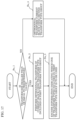
- FIG. 16 is a flow chart illustrating one example of a process performed by transformer 106.
- transformer 106 determines whether to perform orthogonal transform (Step St_1).
- transformer 106 selects a transform type for use in orthogonal transform from a plurality of transform types (Step St_2).
- Transformer 106 performs orthogonal transform by applying the selected transform type to the prediction residual of a current block (Step St_3).
- Transformer 106 then outputs information indicating the selected transform type to entropy encoder 110, so as to allow entropy encoder 110 to encode the information (Step St_4).
- transformer 106 when determining not to perform orthogonal transform (No in Step St_1), transformer 106 outputs information indicating that no orthogonal transform is performed, so as to allow entropy encoder 110 to encode the information (Step St_5). It is to be noted that whether to perform orthogonal transform in Step St_1 may be determined based on, for example, the size of a transform block, a prediction mode applied to the CU, etc. Alternatively, orthogonal transform may be performed using a predefined transform type without encoding information indicating the transform type for use in orthogonal transform.
- FIG. 17 is a flow chart illustrating another example of a process performed by transformer 106. It is to be noted that the example illustrated in FIG. 17 is an example of orthogonal transform in the case where transform types for use in orthogonal transform are selectively switched as in the case of the example illustrated in FIG. 16 .
- a first transform type group may include DCT2, DST7, and DCT8.
- a second transform type group may include DCT2.
- the transform types included in the first transform type group and the transform types included in the second transform type group may partly overlap with each other, or may be totally different from each other.
- transformer 106 determines whether a transform size is smaller than or equal to a predetermined value (Step Su_1).
- transformer 106 performs orthogonal transform of the prediction residual of the current block using the transform type included in the first transform type group (Step Su_2).
- transformer 106 outputs information indicating the transform type to be used among at least one transform type included in the first transform type group to entropy encoder 110, so as to allow entropy encoder 110 to encode the information (Step Su_3).
- transformer 106 performs orthogonal transform of the prediction residual of the current block using the second transform type group (Step Su_4).
- the information indicating the transform type for use in orthogonal transform may be information indicating a combination of the transform type to be applied vertically in the current block and the transform type to be applied horizontally in the current block.
- the first type group may include only one transform type, and the information indicating the transform type for use in orthogonal transform may not be encoded.
- the second transform type group may include a plurality of transform types, and information indicating the transform type for use in orthogonal transform among the one or more transform types included in the second transform type group may be encoded.
- a transform type may be determined based only on a transform size. It is to be noted that such determinations are not limited to the determination as to whether the transform size is smaller than or equal to the predetermined value, and other processes are also possible as long as the processes are for determining a transform type for use in orthogonal transform based on the transform size.
- Quantizer 108 quantizes the transform coefficients output from transformer 106. More specifically, quantizer 108 scans, in a determined scanning order, the transform coefficients of the current block, and quantizes the scanned transform coefficients based on quantization parameters (QP) corresponding to the transform coefficients. Quantizer 108 then outputs the quantized transform coefficients (hereinafter also referred to as quantized coefficients) of the current block to entropy encoder 110 and inverse quantizer 112.
- QP quantization parameters
- a determined scanning order is an order for quantizing/inverse quantizing transform coefficients.
- a determined scanning order is defined as ascending order of frequency (from low to high frequency) or descending order of frequency (from high to low frequency).
- a quantization parameter is a parameter defining a quantization step (quantization width). For example, when the value of the quantization parameter increases, the quantization step also increases. In other words, when the value of the quantization parameter increases, an error in quantized coefficients (quantization error) increases.
- a quantization matrix may be used for quantization.
- quantization matrices may be used correspondingly to frequency transform sizes such as 4 ⁇ 4 and 8 ⁇ 8, prediction modes such as intra prediction and inter prediction, and pixel components such as luma and chroma pixel components.
- quantization means digitalizing values sampled at predetermined intervals correspondingly to predetermined levels.
- quantization may be represented as other expressions such as rounding and scaling.
- Methods using quantization matrices include a method using a quantization matrix which has been set directly at the encoder 100 side and a method using a quantization matrix which has been set as a default (default matrix).
- a quantization matrix suitable for features of an image can be set by directly setting a quantization matrix. This case, however, has a disadvantage of increasing a coding amount for encoding the quantization matrix.
- a quantization matrix to be used to quantize the current block may be generated based on a default quantization matrix or an encoded quantization matrix, instead of directly using the default quantization matrix or the encoded quantization matrix.
- the quantization matrix may be encoded, for example, at the sequence level, picture level, slice level, brick level, or CTU level.
- quantizer 108 scales, for each transform coefficient, for example a quantization width which can be calculated based on a quantization parameter, etc., using the value of the quantization matrix.
- the quantization process performed without using any quantization matrix may be a process of quantizing transform coefficients based on a quantization width calculated based on a quantization parameter, etc. It is to be noted that, in the quantization process performed without using any quantization matrix, the quantization width may be multiplied by a predetermined value which is common for all the transform coefficients in a block.
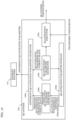
- FIG. 18 is a block diagram illustrating one example of a configuration of quantizer 108.
- quantizer 108 includes difference quantization parameter generator 108a, predicted quantization parameter generator 108b, quantization parameter generator 108c, quantization parameter storage 108d, and quantization executor 108e.
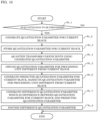
- FIG. 19 is a flow chart illustrating one example of quantization performed by quantizer 108.
- quantizer 108 may perform quantization for each CU based on the flow chart illustrated in FIG. 19 . More specifically, quantization parameter generator 108c determines whether to perform quantization (Step Sv_1). Here, when determining to perform quantization (Yes in Step Sv_1), quantization parameter generator 108c generates a quantization parameter for a current block (Step Sv_2), and stores the quantization parameter into quantization parameter storage 108d (Step Sv_3).
- quantization executor 108e quantizes transform coefficients of the current block using the quantization parameter generated in Step Sv_2 (Step Sv_4).
- Predicted quantization parameter generator 108b then obtains a quantization parameter for a processing unit different from the current block from quantization parameter storage 108d (Step Sv_5).
- Predicted quantization parameter generator 108b generates a predicted quantization parameter of the current block based on the obtained quantization parameter (Step Sv_6).
- Difference quantization parameter generator 108a calculates the difference between the quantization parameter of the current block generated by quantization parameter generator 108c and the predicted quantization parameter of the current block generated by predicted quantization parameter generator 108b (Step Sv_7).
- the difference quantization parameter is generated by calculating the difference.
- Difference quantization parameter generator 108a outputs the difference quantization parameter to entropy encoder 110, so as to allow entropy encoder 110 to encode the difference quantization parameter (Step Sv_8).
- the difference quantization parameter may be encoded, for example, at the sequence level, picture level, slice level, brick level, or CTU level.
- the initial value of the quantization parameter may be encoded at the sequence level, picture level, slice level, brick level, or CTU level.
- the quantization parameter may be generated using the initial value of the quantization parameter and the difference quantization parameter.
- quantizer 108 may include a plurality of quantizers, and may apply dependent quantization in which transform coefficients are quantized using a quantization method selected from a plurality of quantization methods.
- FIG. 20 is a block diagram illustrating one example of a configuration of entropy encoder 110.
- Entropy encoder 110 generates a stream by entropy encoding the quantized coefficients input from quantizer 108 and a prediction parameter input from prediction parameter generator 130.
- CABAC context-based adaptive binary arithmetic coding
- entropy encoder 110 includes binarizer 110a, context controller 110b, and binary arithmetic encoder 110c.
- Binarizer 110a performs binarization in which multi-level signals such as quantized coefficients and a prediction parameter are transformed into binary signals. Examples of binarization methods include truncated Rice binarization, exponential Golomb codes, and fixed length binarization.
- Context controller 110b derives a context value according to a feature or a surrounding state of a syntax element, that is, an occurrence probability of a binary signal. Examples of methods for deriving a context value include bypass, referring to a syntax element, referring to an upper and left adjacent blocks, referring to hierarchical information, and others.
- Binary arithmetic encoder 110c arithmetically encodes the binary signal using the derived context value.
- FIG. 21 is a diagram illustrating a flow of CABAC in entropy encoder 110.
- initialization is performed in CABAC in entropy encoder 110.
- initialization in binary arithmetic encoder 110c and setting of an initial context value are performed.
- binarizer 110a and binary arithmetic encoder 110c execute binarization and arithmetic encoding of a plurality of quantization coefficients in a CTU sequentially.
- context controller 110b updates the context value each time arithmetic encoding is performed.
- Context controller 110b then saves the context value as a post process. The saved context value is used, for example, to initialize the context value for the next CTU.
- Inverse quantizer 112 inverse quantizes quantized coefficients which have been input from quantizer 108. More specifically, inverse quantizer 112 inverse quantizes, in a determined scanning order, quantized coefficients of the current block. Inverse quantizer 112 then outputs the inverse quantized transform coefficients of the current block to inverse transformer 114.
- Inverse transformer 114 restores prediction errors by inverse transforming the transform coefficients which have been input from inverse quantizer 112. More specifically, inverse transformer 114 restores the prediction residuals of the current block by performing an inverse transform corresponding to the transform applied to the transform coefficients by transformer 106. Inverse transformer 114 then outputs the restored prediction residuals to adder 116.
- the restored prediction residuals do not match the prediction errors calculated by subtractor 104.
- the restored prediction residuals normally include quantization errors.
- Adder 116 reconstructs the current block by adding the prediction residuals which have been input from inverse transformer 114 and prediction images which have been input from prediction controller 128. Consequently, a reconstructed image is generated. Adder 116 then outputs the reconstructed image to block memory 118 and loop filter 120.
- Block memory 118 is storage for storing a block which is included in a current picture and is referred to in intra prediction. More specifically, block memory 118 stores a reconstructed image output from adder 116.
- Frame memory 122 is, for example, storage for storing reference pictures for use in inter prediction, and is also referred to as a frame buffer. More specifically, frame memory 122 stores a reconstructed image filtered by loop filter 120.
- Loop filter 120 applies a loop filter to a reconstructed image output by adder 116, and outputs the filtered reconstructed image to frame memory 122.
- a loop filter is a filter used in an encoding loop (in-loop filter).
- loop filters include, for example, an adaptive loop filter (ALF), a deblocking filter (DF or DBF), a sample adaptive offset (SAO), etc.
- FIG. 22 is a block diagram illustrating one example of a configuration of loop filter 120.
- loop filter 120 includes deblocking filter executor 120a, SAO executor 120b, and ALF executor 120c.
- Deblocking filter executor 120a performs a deblocking filter process of the reconstructed image.
- SAO executor 120b performs a SAO process of the reconstructed image after being subjected to the deblocking filter process.
- ALF executor 120c performs an ALF process of the reconstructed image after being subjected to the SAO process.
- the ALF and deblocking filter processes are described later in detail.
- the SAO process is a process for enhancing image quality by reducing ringing (a phenomenon in which pixel values are distorted like waves around an edge) and correcting deviation in pixel value.
- loop filter 120 does not always need to include all the constituent elements disclosed in FIG. 22 , and may include only part of the constituent elements.
- loop filter 120 may be configured to perform the above processes in a processing order different from the one disclosed in FIG. 22 .
- a least square error filter for removing compression artifacts is applied. For example, one filter selected from among a plurality of filters based on the direction and activity of local gradients is applied for each of 2 ⁇ 2 pixel sub-blocks in the current block.
- each sub-block (for example, each 2 ⁇ 2 pixel sub-block) is categorized into one out of a plurality of classes (for example, fifteen or twenty-five classes).
- the categorization of the sub-block is based on, for example, gradient directionality and activity.
- each sub-block is categorized into one out of a plurality of classes.
- gradient directionality D is calculated by comparing gradients of a plurality of directions (for example, the horizontal, vertical, and two diagonal directions).
- gradient activity A is calculated by adding gradients of a plurality of directions and quantizing the result of the addition.
- the filter to be used for each sub-block is determined from among the plurality of filters based on the result of such categorization.
- the filter shape to be used in an ALF is, for example, a circular symmetric filter shape.
- FIG. 23A through FIG. 23C illustrate examples of filter shapes used in ALFs.
- FIG. 23A illustrates a 5 ⁇ 5 diamond shape filter
- FIG. 23B illustrates a 7 ⁇ 7 diamond shape filter
- FIG. 23C illustrates a 9 ⁇ 9 diamond shape filter.
- Information indicating the filter shape is normally signaled at the picture level. It is to be noted that the signaling of such information indicating the filter shape does not necessarily need to be performed at the picture level, and may be performed at another level (for example, at the sequence level, slice level, brick level, CTU level, or CU level).
- the ON or OFF of the ALF is determined, for example, at the picture level or CU level.
- the decision of whether to apply the ALF to luma may be made at the CU level, and the decision of whether to apply ALF to chroma may be made at the picture level.
- Information indicating ON or OFF of the ALF is normally signaled at the picture level or CU level. It is to be noted that the signaling of information indicating ON or OFF of the ALF does not necessarily need to be performed at the picture level or CU level, and may be performed at another level (for example, at the sequence level, slice level, brick level, or CTU level).
- one filter is selected from the plurality of filters, and an ALF process of a sub-block is performed.
- a coefficient set of coefficients to be used for each of the plurality of filters (for example, up to the fifteenth or twenty-fifth filter) is normally signaled at the picture level. It is to be noted that the coefficient set does not always need to be signaled at the picture level, and may be signaled at another level (for example, the sequence level, slice level, brick level, CTU level, CU level, or sub-block level).
- FIG. 23D is a diagram illustrating an example where Y samples (first component) are used for a cross component ALF (CCALF) for Cb and a CCALF for Cr (components different from the first component).
- FIG. 23E is a diagram illustrating a diamond shaped filter.
- CC-ALF operates by applying a linear, diamond shaped filter ( FIGs. 23D , 23E ) to a luma channel for each chroma component.
- the filter coefficients may be transmitted in the APS, scaled by a factor of 2 ⁇ 10, and rounded for fixed point representation.
- the application of the filters is controlled on a variable block size and signaled by a context-coded flag received for each block of samples.
- the block size along with a CC-ALF enabling flag is received at the slice-level for each chroma component.
- Syntax and semantics for CC-ALF are provided in the Appendix. In the contribution, the following block sizes (in chroma samples) were supported: 16 ⁇ 16, 32 ⁇ 32, 64 ⁇ 64, and 128 ⁇ 128.
- FIG. 23F is a diagram illustrating an example for a joint chroma CCALF (JC-CCALF).
- JC-CCALF One example of JC-CCALF, where only one CCALF filter will be used to generate one CCALF filtered output as a chroma refinement signal for one color component only, while a properly weighted version of the same chroma refinement signal will be applied to the other color component. In this way, the complexity of existing CCALF is reduced roughly by half.
- the weight value is coded into a sign flag and a weight index.
- the weight index (denoted as weight_index) is coded into 3 bits, and specifies the magnitude of the JC-CCALF weight JcCcWeight. It cannot be equal to 0.
- the magnitude of JcCcWeight is determined as follows.
- the block-level on/off control of ALF filtering for Cb and Cr are separate. This is the same as in CCALF, and two separate sets of block-level on/off control flags will be coded. Different from CCALF, herein, the Cb, Cr on/off control block sizes are the same, and thus, only one block size variable is coded.
- loop filter 120 performs a filter process on a block boundary in a reconstructed image so as to reduce distortion which occurs at the block boundary.
- FIG. 24 is a block diagram illustrating one example of a specific configuration of deblocking filter executor 120a.
- deblocking filter executor 120a includes: boundary determiner 1201; filter determiner 1203; filter executor 1205; process determiner 1208; filter characteristic determiner 1207; and switches 1202, 1204, and 1206.
- Boundary determiner 1201 determines whether a pixel to be deblock filtered (that is, a current pixel) is present around a block boundary. Boundary determiner 1201 then outputs the determination result to switch 1202 and process determiner 1208.
- switch 1202 In the case where boundary determiner 1201 has determined that a current pixel is present around a block boundary, switch 1202 outputs an unfiltered image to switch 1204. In the opposite case where boundary determiner 1201 has determined that no current pixel is present around a block boundary, switch 1202 outputs an unfiltered image to switch 1206. It is to be noted that the unfiltered image is an image configured with a current pixel and at least one surrounding pixel located around the current pixel.
- Filter determiner 1203 determines whether to perform deblocking filtering of the current pixel, based on the pixel value of at least one surrounding pixel located around the current pixel. Filter determiner 1203 then outputs the determination result to switch 1204 and process determiner 1208.
- switch 1204 In the case where filter determiner 1203 has determined to perform deblocking filtering of the current pixel, switch 1204 outputs the unfiltered image obtained through switch 1202 to filter executor 1205. In the opposite case where filter determiner 1203 has determined not to perform deblocking filtering of the current pixel, switch 1204 outputs the unfiltered image obtained through switch 1202 to switch 1206.
- filter executor 1205 executes, for the current pixel, deblocking filtering having the filter characteristic determined by filter characteristic determiner 1207. Filter executor 1205 then outputs the filtered pixel to switch 1206.
- switch 1206 selectively outputs a pixel which has not been deblock filtered and a pixel which has been deblock filtered by filter executor 1205.
- Process determiner 1208 controls switch 1206 based on the results of determinations made by boundary determiner 1201 and filter determiner 1203. In other words, process determiner 1208 causes switch 1206 to output the pixel which has been deblock filtered when boundary determiner 1201 has determined that the current pixel is present around the block boundary and filter determiner 1203 has determined to perform deblocking filtering of the current pixel. In addition, in a case other than the above case, process determiner 1208 causes switch 1206 to output the pixel which has not been deblock filtered. A filtered image is output from switch 1206 by repeating output of a pixel in this way. It is to be noted that the configuration illustrated in FIG. 24 is one example of a configuration in deblocking filter executor 120a. Deblocking filter executor 120a may have another configuration.
- FIG. 25 is a diagram illustrating an example of a deblocking filter having a symmetrical filtering characteristic with respect to a block boundary.
- one of two deblocking filters having different characteristics that is, a strong filter and a weak filter is selected using pixel values and quantization parameters, for example.
- the strong filter pixels p0 to p2 and pixels q0 to q2 are present across a block boundary as illustrated in FIG. 25 , the pixel values of the respective pixels q0 to q2 are changed to pixel values q'0 to q'2 by performing computations according to the expressions below.
- q ′ 0 p 1 + 2 ⁇ p 0 + 2 ⁇ q 0 + 2 ⁇ q 1 + q 2 + 4 / 8
- q ′ 1 p 0 + q 0 + q 1 + q 2 + 2 / 4
- q ′ 2 p 0 + q 0 + q 1 + 3 ⁇ q 2 + 2 ⁇ q 3 + 4 / 8
- p0 to p2 and q0 to q2 are the pixel values of respective pixels p0 to p2 and pixels q0 to q2.
- q3 is the pixel value of neighboring pixel q3 located at the opposite side of pixel q2 with respect to the block boundary.
- coefficients which are multiplied with the respective pixel values of the pixels to be used for deblocking filtering are filter coefficients.
- clipping may be performed so that the calculated pixel values do not change over a threshold value.
- the pixel values calculated according to the above expressions are clipped to a value obtained according to "a pre-computation pixel value ⁇ 2 ⁇ a threshold value" using the threshold value determined based on a quantization parameter. In this way, it is possible to prevent excessive smoothing.
- FIG. 26 is a diagram for illustrating one example of a block boundary on which a deblocking filter process is performed.
- FIG. 27 is a diagram illustrating examples of Bs values.
- the block boundary on which the deblocking filter process is performed is, for example, a boundary between CUs, PUs, or TUs having 8 ⁇ 8 pixel blocks as illustrated in FIG. 26 .
- the deblocking filter process is performed, for example, in units of four rows or four columns.
- boundary strength (Bs) values are determined as indicated in FIG. 27 for block P and block Q illustrated in FIG. 26 .
- the deblocking filter process for a chroma signal is performed when a Bs value is 2.
- the deblocking filter process for a luma signal is performed when a Bs value is 1 or more and a determined condition is satisfied. It is to be noted that conditions for determining Bs values are not limited to those indicated in FIG. 27 , and a Bs value may be determined based on another parameter.
- FIG. 28 is a flow chart illustrating one example of a process performed by a predictor of encoder 100. It is to be noted that the predictor, as one example, includes all or part of the following constituent elements: intra predictor 124; inter predictor 126; and prediction controller 128.
- the prediction executor includes, for example, intra predictor 124 and inter predictor 126.
- the predictor generates a prediction image of a current block (Step Sb_1).
- the prediction image is, for example, an intra prediction image (intra prediction signal) or an inter prediction image (inter prediction signal). More specifically, the predictor generates the prediction image of the current block using a reconstructed image which has been already obtained for another block through generation of a prediction image, generation of a prediction residual, generation of quantized coefficients, restoring of a prediction residual, and addition of a prediction image.
- the reconstructed image may be, for example, an image in a reference picture or an image of an encoded block (that is, the other block described above) in a current picture which is the picture including the current block.
- the encoded block in the current picture is, for example, a neighboring block of the current block.
- FIG. 29 is a flow chart illustrating another example of a process performed by the predictor of encoder 100.
- the predictor generates a prediction image using a first method (Step Sc_1a), generates a prediction image using a second method (Step Sc_1b), and generates a prediction image using a third method (Step Sc_1c).
- the first method, the second method, and the third method may be mutually different methods for generating a prediction image.
- Each of the first to third methods may be an inter prediction method, an intra prediction method, or another prediction method.
- the above-described reconstructed image may be used in these prediction methods.
- the predictor evaluates the prediction images generated in Steps Sc_1a, Sc_1b, and Sc_1c (Step Sc_2). For example, the predictor calculates costs C for the prediction images generated in Step Sc_1a, Sc_1b, and Sc_1c, and evaluates the prediction images by comparing the costs C of the prediction images.
- D indicates compression artifacts of a prediction image, and is represented as, for example, a sum of absolute differences between the pixel value of a current block and the pixel value of a prediction image.
- R indicates a bit rate of a stream.
- ⁇ indicates, for example, a multiplier according to the method of Lagrange multiplier.
- the predictor selects one of the prediction images generated in Steps Sc_1a, Sc_1b, and Sc_1c (Step Sc_3).
- the predictor selects a method or a mode for obtaining a final prediction image.
- the predictor selects the prediction image having the smallest cost C, based on costs C calculated for the prediction images.
- the evaluation in Step Sc_2 and the selection of the prediction image in Step Sc_3 may be made based on a parameter which is used in an encoding process.
- Encoder 100 may transform information for identifying the selected prediction image, the method, or the mode into a stream. The information may be, for example, a flag or the like.
- decoder 200 is capable of generating a prediction image according to the method or the mode selected by encoder 100, based on the information. It is to be noted that, in the example illustrated in FIG. 29 , the predictor selects any of the prediction images after the prediction images are generated using the respective methods. However, the predictor may select a method or a mode based on a parameter for use in the above-described encoding process before generating prediction images, and may generate a prediction image according to the method or mode selected.
- the first method and the second method may be intra prediction and inter prediction, respectively, and the predictor may select a final prediction image for a current block from prediction images generated according to the prediction methods.
- FIG. 30 is a flow chart illustrating another example of a process performed by the predictor of encoder 100.
- the predictor generates a prediction image using intra prediction (Step Sd_1a), and generates a prediction image using inter prediction (Step Sd_1b).
- the prediction image generated by intra prediction is also referred to as an intra prediction image
- the prediction image generated by inter prediction is also referred to as an inter prediction image.
- the predictor evaluates each of the intra prediction image and the inter prediction image (Step Sd_2). Cost C described above may be used in the evaluation.
- the predictor may then select the prediction image for which the smallest cost C has been calculated among the intra prediction image and the inter prediction image, as the final prediction image for the current block (Step Sd_3). In other words, the prediction method or the mode for generating the prediction image for the current block is selected.
- Intra predictor 124 generates a prediction image (that is, intra prediction image) of a current block by performing intra prediction (also referred to as intra frame prediction) of the current block by referring to a block or blocks in the current picture which is or are stored in block memory 118. More specifically, intra predictor 124 generates an intra prediction image by performing intra prediction by referring to pixel values (for example, luma and/or chroma values) of a block or blocks neighboring the current block, and then outputs the intra prediction image to prediction controller 128.
- pixel values for example, luma and/or chroma values
- intra predictor 124 performs intra prediction by using one mode from among a plurality of intra prediction modes which have been predefined.
- the intra prediction modes normally include one or more non-directional prediction modes and a plurality of directional prediction modes.
- the one or more non-directional prediction modes include, for example, planar prediction mode and DC prediction mode defined in the H.265/HEVC standard.
- the plurality of directional prediction modes include, for example, the thirty-three directional prediction modes defined in the H.265/HEVC standard. It is to be noted that the plurality of directional prediction modes may further include thirty-two directional prediction modes in addition to the thirty-three directional prediction modes (for a total of sixty-five directional prediction modes).
- FIG. 31 is a diagram illustrating sixty-seven intra prediction modes in total used in intra prediction (two non-directional prediction modes and sixty-five directional prediction modes). The solid arrows represent the thirty-three directions defined in the H.265/HEVC standard, and the dashed arrows represent the additional thirty-two directions (the two non-directional prediction modes are not illustrated in FIG. 31 ).
- a luma block may be referred to in intra prediction of a chroma block.
- a chroma component of the current block may be predicted based on a luma component of the current block.
- Such intra prediction is also referred to as cross-component linear model (CCLM).
- CCLM cross-component linear model
- the intra prediction mode for a chroma block in which such a luma block is referred to (also referred to as, for example, a CCLM mode) may be added as one of the intra prediction modes for chroma blocks.
- Intra predictor 124 may correct intra-predicted pixel values based on horizontal/vertical reference pixel gradients.
- the intra prediction which accompanies this sort of correcting is also referred to as position dependent intra prediction combination (PDPC).
- Information indicating whether to apply PDPC (referred to as, for example, a PDPC flag) is normally signaled at the CU level. It is to be noted that the signaling of such information does not necessarily need to be performed at the CU level, and may be performed at another level (for example, at the sequence level, picture level, slice level, brick level, or CTU level).
- FIG. 32 is a flow chart illustrating one example of a process performed by intra predictor 124.
- Intra predictor 124 selects one intra prediction mode from a plurality of intra prediction modes (Step Sw_1). Intra predictor 124 then generates a prediction image according to the selected intra prediction mode (Step Sw_2). Next, intra predictor 124 determines most probable modes (MPMs) (Step Sw_3). MPMs include, for example, six intra prediction modes. Two modes among the six intra prediction modes may be planar mode and DC prediction mode, and the other four modes may be directional prediction modes. Intra predictor 124 determines whether the intra prediction mode selected in Step Sw_1 is included in the MPMs (Step Sw_4).
- intra predictor 124 when determining that the intra prediction mode selected in Step Sw_1 is included in the MPMs (Yes in Step Sw_4), intra predictor 124 sets an MPM flag to 1 (Step Sw_5), and generates information indicating the selected intra prediction mode among the MPMs (Step Sw_6). It is to be noted that the MPM flag set to 1 and the information indicating the intra prediction mode are encoded as prediction parameters by entropy encoder 110.
- intra predictor 124 When determining that the selected intra prediction mode is not included in the MPMs (No in Step Sw_4), intra predictor 124 sets the MPM flag to 0 (Step Sw_7). Alternatively, intra predictor 124 does not set any MPM flag. Intra predictor 124 then generates information indicating the selected intra prediction mode among at least one intra prediction mode which is not included in the MPMs (Step Sw_8). It is to be noted that the MPM flag set to 0 and the information indicating the intra prediction mode are encoded as prediction parameters by entropy encoder 110. The information indicating the intra prediction mode indicates, for example, any one of 0 to 60.
- Inter predictor 126 generates a prediction image (inter prediction image) by performing inter prediction (also referred to as inter frame prediction) of the current block by referring to a block or blocks in a reference picture which is different from the current picture and is stored in frame memory 122. Inter prediction is performed in units of a current block or a current sub-block in the current block.
- the sub-block is included in the block and is a unit smaller than the block.
- the size of the sub-block may be 4 ⁇ 4 pixels, 8 ⁇ 8 pixels, or another size.
- the size of the sub-block may be switched for a unit such as slice, brick, picture, etc.
- inter predictor 126 performs motion estimation in a reference picture for a current block or a current sub-block, and finds out a reference block or a reference sub-block which best matches the current block or current sub-block. Inter predictor 126 then obtains motion information (for example, a motion vector) which compensates a motion or a change from the reference block or the reference sub-block to the current block or the current sub-block. Inter predictor 126 generates an inter prediction image of the current block or the current sub-block by performing motion compensation (or motion prediction) based on the motion information. Inter predictor 126 outputs the generated inter prediction image to prediction controller 128.
- motion information for example, a motion vector
- the motion information used in motion compensation may be signaled as inter prediction images in various forms.
- a motion vector may be signaled.
- the difference between a motion vector and a motion vector predictor may be signaled.
- FIG. 33 is a diagram illustrating examples of reference pictures.
- FIG. 34 is a conceptual diagram illustrating examples of reference picture lists.
- Each reference picture list is a list indicating at least one reference picture stored in frame memory 122. It is to be noted that, in FIG. 33 , each of rectangles indicates a picture, each of arrows indicates a picture reference relationship, the horizontal axis indicates time, I, P, and B in the rectangles indicate an intra prediction picture, a uni-prediction picture, and a bi-prediction picture, respectively, and numerals in the rectangles indicate a decoding order. As illustrated in FIG.
- the decoding order of the pictures is an order of I0, P1, B2, B3, and B4, and the display order of the pictures is an order of I0, B3, B2, B4, and P1.
- the reference picture list is a list representing reference picture candidates.
- one picture (or a slice) may include at least one reference picture list.
- one reference picture list is used when a current picture is a uni-prediction picture, and two reference picture lists are used when a current picture is a bi-prediction picture.
- picture B3 which is current picture currPic has two reference picture lists which are the L0 list and the L1 list.
- reference picture candidates for current picture currPic are I0, P1, and B2, and the reference picture lists (which are the L0 list and the L1 list) indicate these pictures.
- Inter predictor 126 or prediction controller 128 specifies which picture in each reference picture list is to be actually referred to in form of a reference picture index refIdxLx.
- reference pictures P1 and B2 are specified by reference picture indices refIdxL0 and refIdxL1.
- Such a reference picture list may be generated for each unit such as a sequence, picture, slice, brick, CTU, or CU.
- a reference picture index indicating a reference picture to be referred to in inter prediction may be signaled at the sequence level, picture level, slice level, brick level, CTU level, or CU level.
- a common reference picture list may be used in a plurality of inter prediction modes.
- FIG. 35 is a flow chart illustrating a basic processing flow of inter prediction.
- inter predictor 126 generates a prediction signal (Steps Se_1 to Se_3).
- subtractor 104 generates the difference between a current block and a prediction image as a prediction residual (Step Se_4).
- inter predictor 126 in the generation of the prediction image, generates the prediction image through, for example, determination of a motion vector (MV) of the current block (Steps Se_1 and Se_2) and motion compensation (Step Se_3). Furthermore, in determination of an MV, inter predictor 126 determines the MV through, for example, selection of a motion vector candidate (MV candidate) (Step Se_1) and derivation of an MV (Step Se_2). The selection of the MV candidate is made by means of, for example, inter predictor 126 generating an MV candidate list and selecting at least one MV candidate from the MV candidate list. It is to be noted that MVs derived in the past may be added to the MV candidate list.
- inter predictor 126 may further select at least one MV candidate from the at least one MV candidate, and determine the selected at least one MV candidate as the MV for the current block.
- inter predictor 126 may determine the MV for the current block by performing estimation in a reference picture region specified by each of the selected at least one MV candidate. It is to be noted that the estimation in the reference picture region may be referred to as motion estimation.
- Steps Se_1 to Se_3 are performed by inter predictor 126 in the above-described example, a process that is, for example, Step Se_1, Step Se_2, or the like may be performed by another constituent element included in encoder 100.
- an MV candidate list may be generated for each process in inter prediction mode, or a common MV candidate list may be used in a plurality of inter prediction modes.
- the processes in Steps Se_3 and Se_4 correspond to Steps Sa_3 and Sa_4 illustrated in FIG. 9 , respectively.
- the process in Step Se_3 corresponds to the process in Step Sd_1b in FIG. 30 .
- FIG. 36 is a flow chart illustrating one example of MV derivation.
- Inter predictor 126 may derive an MV for a current block in a mode for encoding motion information (for example, an MV).
- the motion information may be encoded as a prediction parameter, and may be signaled.
- the encoded motion information is included in a stream.
- inter predictor 126 may derive an MV in a mode in which motion information is not encoded. In this case, no motion information is included in the stream.
- MV derivation modes include a normal inter mode, a normal merge mode, a FRUC mode, an affine mode, etc. which are described later.
- Modes in which motion information is encoded among the modes include the normal inter mode, the normal merge mode, the affine mode (specifically, an affine inter mode and an affine merge mode), etc.
- motion information may include not only an MV but also MV predictor selection information which is described later.
- Modes in which no motion information is encoded include the FRUC mode, etc.
- Inter predictor 126 selects a mode for deriving an MV of the current block from the plurality of modes, and derives the MV of the current block using the selected mode.
- FIG. 37 is a flow chart illustrating another example of MV derivation.
- Inter predictor 126 may derive an MV for a current block in a mode in which an MV difference is encoded.
- the MV difference is encoded as a prediction parameter, and is signaled.
- the encoded MV difference is included in a stream.
- the MV difference is the difference between the MV of the current block and the MV predictor. It is to be noted that the MV predictor is a motion vector predictor.
- inter predictor 126 may derive an MV in a mode in which no MV difference is encoded. In this case, no encoded MV difference is included in the stream.
- the MV derivation modes include the normal inter mode, the normal merge mode, the FRUC mode, the affine mode, etc. which are described later.
- Modes in which an MV difference is encoded among the modes include the normal inter mode, the affine mode (specifically, the affine inter mode), etc.
- Modes in which no MV difference is encoded include the FRUC mode, the normal merge mode, the affine mode (specifically, the affine merge mode), etc.
- Inter predictor 126 selects a mode for deriving an MV of the current block from the plurality of modes, and derives the MV for the current block using the selected mode.
- FIGs. 38A and 38B are each a diagram illustrating one example of categorization of modes for MV derivation.
- MV derivation modes are roughly categorized into three modes according to whether to encode motion information and whether to encode MV differences.
- the three modes are inter mode, merge mode, and frame rate up-conversion (FRUC) mode.
- the inter mode is a mode in which motion estimation is performed, and in which motion information and an MV difference are encoded.
- the inter mode includes affine inter mode and normal inter mode.
- the merge mode is a mode in which no motion estimation is performed, and in which an MV is selected from an encoded surrounding block and an MV for the current block is derived using the MV.
- the merge mode is a mode in which, basically, motion information is encoded and no MV difference is encoded.
- the merge modes include normal merge mode (also referred to as normal merge mode or regular merge mode), merge with motion vector difference (MMVD) mode, combined inter merge/intra prediction (CIIP) mode, triangle mode, ATMVP mode, and affine merge mode.
- MMVD merge with motion vector difference
- CIIP combined inter merge/intra prediction
- an MV difference is encoded exceptionally in the MMVD mode among the modes included in the merge modes.
- the affine merge mode and the affine inter mode are modes included in the affine modes.
- the affine mode is a mode for deriving, as an MV of a current block, an MV of each of a plurality of sub-blocks included in the current block, assuming affine transform.
- the FRUC mode is a mode which is for deriving an MV of the current block by performing estimation between encoded regions, and in which neither motion information nor any MV difference is encoded. It is to be noted that the respective modes will be described later in detail.
- the categorization of the modes illustrated in FIGs. 38A and 38B are examples, and categorization is not limited thereto.
- the CIIP mode is categorized into inter modes.
- the normal inter mode is an inter prediction mode for deriving an MV of a current block by finding out a block similar to the image of the current block from a reference picture region specified by an MV candidate.
- an MV difference is encoded.
- FIG. 39 is a flow chart illustrating an example of inter prediction by normal inter mode.
- inter predictor 126 obtains a plurality of MV candidates for a current block based on information such as MVs of a plurality of encoded blocks temporally or spatially surrounding the current block (Step Sg_1). In other words, inter predictor 126 generates an MV candidate list.
- inter predictor 126 extracts N (an integer of 2 or larger) MV candidates from the plurality of MV candidates obtained in Step Sg_1, as motion vector predictor candidates according to a predetermined priority order (Step Sg_2). It is to be noted that the priority order is determined in advance for each of the N MV candidates.
- inter predictor 126 selects one MV predictor candidate from the N MV predictor candidates as the MV predictor for the current block (Step Sg_3).
- inter predictor 126 encodes, in a stream, MV predictor selection information for identifying the selected MV predictor.
- inter predictor 126 outputs the MV predictor selection information as a prediction parameter to entropy encoder 110 through prediction parameter generator 130.
- inter predictor 126 derives an MV of a current block by referring to an encoded reference picture (Step Sg_4). At this time, inter predictor 126 further encodes, in the stream, the difference value between the derived MV and the MV predictor as an MV difference. In other words, inter predictor 126 outputs the MV difference as a prediction parameter to entropy encoder 110 through prediction parameter generator 130.
- the encoded reference picture is a picture including a plurality of blocks which have been reconstructed after being encoded.
- inter predictor 126 generates a prediction image for the current block by performing motion compensation of the current block using the derived MV and the encoded reference picture (Step Sg_5).
- the processes in Steps Sg_1 to Sg_5 are executed on each block. For example, when the processes in Steps Sg_1 to Sg_5 are executed on each of all the blocks in the slice, inter prediction of the slice using the normal inter mode finishes. For example, when the processes in Steps Sg_1 to Sg_5 are executed on each of all the blocks in the picture, inter prediction of the picture using the normal inter mode finishes.
- inter prediction of the slice using the normal inter mode may finish when part of the blocks are subjected to the processes.
- inter prediction of the picture using the normal inter mode may finish when the processes in Steps Sg_1 to Sg_5 are executed on part of the blocks in the picture.
- the prediction image is an inter prediction signal as described above.
- information indicating the inter prediction mode (normal inter mode in the above example) used to generate the prediction image is, for example, encoded as a prediction parameter in an encoded signal.
- the MV candidate list may be also used as a list for use in another mode.
- the processes related to the MV candidate list may be applied to processes related to the list for use in another mode.
- the processes related to the MV candidate list include, for example, extraction or selection of an MV candidate from the MV candidate list, reordering of MV candidates, or deletion of an MV candidate.
- the normal merge mode is an inter prediction mode for selecting an MV candidate from an MV candidate list as an MV for a current block, thereby deriving the MV. It is to be noted that the normal merge mode is a merge mode in a narrow meaning and is also simply referred to as a merge mode. In this embodiment, the normal merge mode and the merge mode are distinguished, and the merge mode is used in a broad meaning.
- FIG. 40 is a flow chart illustrating an example of inter prediction by normal merge mode.
- inter predictor 126 obtains a plurality of MV candidates for a current block based on information such as MVs of a plurality of encoded blocks temporally or spatially surrounding the current block (Step Sh_1). In other words, inter predictor 126 generates an MV candidate list.
- inter predictor 126 selects one MV candidate from the plurality of MV candidates obtained in Step Sh_1, thereby deriving an MV for the current block (Step Sh_2).
- inter predictor 126 encodes, in a stream, MV selection information for identifying the selected MV candidate.
- inter predictor 126 outputs the MV selection information as a prediction parameter to entropy encoder 110 through prediction parameter generator 130.
- inter predictor 126 generates a prediction image for the current block by performing motion compensation of the current block using the derived MV and the encoded reference picture (Step Sh_3).
- the processes in Steps Sh_1 to Sh_3 are executed, for example, on each block. For example, when the processes in Steps Sh_1 to Sh_3 are executed on each of all the blocks in the slice, inter prediction of the slice using the normal merge mode finishes. In addition, when the processes in Steps Sh_1 to Sh_3 are executed on each of all the blocks in the picture, inter prediction of the picture using the normal merge mode finishes.
- Steps Sh_1 to Sh_3 may be subjected to the processes in Steps Sh_1 to Sh_3 and inter prediction of the slice using the normal merge mode may finish when part of the blocks are subjected to the processes.
- inter prediction of the picture using the normal merge mode may finish when the processes in Steps Sh_1 to Sh_3 are executed on part of the blocks in the picture.
- information indicating the inter prediction mode (normal merge mode in the above example) used to generate the prediction image is, for example, encoded as a prediction parameter in a stream.
- FIG. 41 is a diagram for illustrating one example of an MV derivation process for a current picture by normal merge mode.
- inter predictor 126 generates an MV candidate list in which MV candidates are registered.
- MV candidates include: spatially neighboring MV candidates which are MVs of a plurality of encoded blocks located spatially surrounding a current block; temporally neighboring MV candidates which are MVs of surrounding blocks on which the position of a current block in an encoded reference picture is projected; combined MV candidates which are MVs generated by combining the MV value of a spatially neighboring MV predictor and the MV value of a temporally neighboring MV predictor; and a zero MV candidate which is an MV having a zero value.
- inter predictor 126 selects one MV candidate from a plurality of MV candidates registered in an MV candidate list, and determines the MV candidate as the MV of the current block.
- entropy encoder 110 writes and encodes, in a stream, merge_idx which is a signal indicating which MV candidate has been selected.
- the MV candidates registered in the MV candidate list described in FIG. 41 are examples.
- the number of MV candidates may be different from the number of MV candidates in the diagram, the MV candidate list may be configured in such a manner that some of the kinds of the MV candidates in the diagram may not be included, or that one or more MV candidates other than the kinds of MV candidates in the diagram are included.
- a final MV may be determined by performing a dynamic motion vector refreshing (DMVR) to be described later using the MV of the current block derived by normal merge mode.
- DMVR dynamic motion vector refreshing
- MMVD mode one MV candidate is selected from an MV candidate list as in the case of normal merge mode, an MV difference is encoded.
- MMVD may be categorized into merge modes together with normal merge mode. It is to be noted that the MV difference in MMVD mode does not always need to be the same as the MV difference for use in inter mode. For example, MV difference derivation in MMVD mode may be a process that requires a smaller amount of processing than the amount of processing required for MV difference derivation in inter mode.
- a combined inter merge / intra prediction (CIIP) mode may be performed.
- the mode is for overlapping a prediction image generated in inter prediction and a prediction image generated in intra prediction to generate a prediction image for a current block.
- merge_idx is MV selection information.
- FIG. 42 is a diagram for illustrating one example of an MV derivation process for a current picture by HMVP merge mode.
- an MV for, for example, a CU which is a current block is determined by selecting one MV candidate from an MV candidate list generated by referring to an encoded block (for example, a CU).
- another MV candidate may be registered in the MV candidate list.
- the mode in which such another MV candidate is registered is referred to as HMVP mode.
- MV candidates are managed using a first-in first-out (FIFO) buffer for HMVP, separately from the MV candidate list for normal merge mode.
- FIFO first-in first-out
- FIFO buffer motion information such as MVs of blocks processed in the past are stored newest first.
- the MV for the newest block that is the CU processed immediately before
- the MV of the oldest CU that is, the CU processed earliest
- HMVP1 is the MV for the newest block
- HMVP5 is the MV for the oldest MV.
- Inter predictor 126 then, for example, checks whether each MV managed in the FIFO buffer is an MV different from all the MV candidates which have been already registered in the MV candidate list for normal merge mode starting from HMVP1. When determining that the MV is different from all the MV candidates, inter predictor 126 may add the MV managed in the FIFO buffer in the MV candidate list for normal merge mode as an MV candidate. At this time, the MV candidate registered from the FIFO buffer may be one or more.
- HMVP mode By using the HMVP mode in this way, it is possible to add not only the MV of a block which neighbors the current block spatially or temporally but also an MV for a block processed in the past. As a result, the variation of MV candidates for normal merge mode is expanded, which increases the probability that coding efficiency can be increased.
- the MV may be motion information.
- information stored in the MV candidate list and the FIFO buffer may include not only MV values but also reference picture information, reference directions, the numbers of pictures, etc.
- the block is, for example, a CU.
- the MV candidate list and the FIFO buffer illustrated in FIG. 42 are examples.
- the MV candidate list and FIFO buffer may be different in size from those in FIG. 42 , or may be configured to register MV candidates in an order different from the one in FIG. 42 .
- the process described here is common between encoder 100 and decoder 200.
- HMVP mode can be applied for modes other than the normal merge mode.
- motion information such as MVs of blocks processed in affine mode in the past may be stored newest first, and may be used as MV candidates.
- the mode obtained by applying HMVP mode to affine mode may be referred to as history affine mode.
- Motion information may be derived at the decoder 200 side without being signaled from the encoder 100 side.
- motion information may be derived by performing motion estimation at the decoder 200 side.
- motion estimation is performed without using any pixel value in a current block.
- Modes in which motion estimation is performed at the decoder 200 side in this way include a frame rate up-conversion (FRUC) mode, a pattern matched motion vector derivation (PMMVD) mode, etc.
- FRUC frame rate up-conversion
- PMMVD pattern matched motion vector derivation
- a list which indicates, as MV candidates, MVs for encoded blocks each of which neighbors the current block spatially or temporally is generated by referring to the MVs (the list may be an MV candidate list, and be also used as the MV candidate list for normal merge mode) (Step Si_1).
- a best MV candidate is selected from the plurality of MV candidates registered in the MV candidate list (Step Si_2). For example, the evaluation values of the respective MV candidates included in the MV candidate list are calculated, and one MV candidate is selected as the best MV candidate based on the evaluation values.
- a motion vector for the current block is then derived (Step Si_4). More specifically, for example, the selected best MV candidate is directly derived as the MV for the current block.
- the MV for the current block may be derived using pattern matching in a surrounding region of a position which is included in a reference picture and corresponds to the selected best MV candidate. In other words, estimation using the pattern matching in a reference picture and the evaluation values may be performed in the surrounding region of the best MV candidate, and when there is an MV that yields a better evaluation value, the best MV candidate may be updated to the MV that yields the better evaluation value, and the updated MV may be determined as the final MV for the current block. Update to the MV that yields the better evaluation value may not be performed.
- inter predictor 126 generates a prediction image for the current block by performing motion compensation of the current block using the derived MV and the encoded reference picture (Step Si_5).
- the processes in Steps Si_1 to Si_5 are executed, for example, on each block. For example, when the processes in Steps Si_1 to Si_5 are executed on each of all the blocks in the slice, inter prediction of the slice using the FRUC mode finishes. For example, when the processes in Steps Si_1 to Si_5 are executed on each of all the blocks in the picture, inter prediction of the picture using the FRUC mode finishes.
- inter prediction of the slice using the FRUC mode may finish when part of the blocks are subjected to the processes.
- inter prediction of the picture using the FRUC mode may finish when the processes in Steps Si_1 to Si_5 are executed on part of the blocks included in the picture.
- Each sub-block may be processed similarly to the above-described case of processing each block.
- Evaluation values may be calculated according to various kinds of methods. For example, a comparison is made between a reconstructed image in a region in a reference picture corresponding to an MV and a reconstructed image in a determined region (the region may be, for example, a region in another reference picture or a region in a neighboring block of a current picture, as indicated below). The difference between the pixel values of the two reconstructed images may be used for an evaluation value of the MV. It is to be noted that an evaluation value may be calculated using information other than the value of the difference.
- one MV candidate included in an MV candidate list (also referred to as a merge list) is selected as a starting point for estimation by pattern matching.
- a first pattern matching or a second pattern matching may be used as the pattern matching.
- the first pattern matching and the second pattern matching may be referred to as bilateral matching and template matching, respectively.
- the pattern matching is performed between two blocks which are located along a motion trajectory of a current block and included in two different reference pictures. Accordingly, in the first pattern matching, a region in another reference picture located along the motion trajectory of the current block is used as a determined region for calculating the evaluation value of the above-described MV candidate.
- FIG. 44 is a diagram for illustrating one example of the first pattern matching (bilateral matching) between the two blocks in the two reference pictures located along the motion trajectory.
- two motion vectors MV0, MV1 are derived by estimating a pair which best matches among pairs of two blocks which are included in the two different reference pictures (Ref0, Ref1) and located along the motion trajectory of the current block (Cur block).
- a difference between the reconstructed image at a specified position in the first encoded reference picture (Ref0) specified by an MV candidate and the reconstructed image at a specified position in the second encoded reference picture (Ref1) specified by a symmetrical MV obtained by scaling the MV candidate at a display time interval is derived for the current block, and an evaluation value is calculated using the value of the obtained difference. It is excellent to select, as the best MV, the MV candidate which yields the best evaluation value among the plurality of MV candidates.
- the motion vectors (MV0, MV1) specifying the two reference blocks are proportional to temporal distances (TD0, TD1) between the current picture (Cur Pic) and the two reference pictures (Ref0, Ref1). For example, when the current picture is temporally located between the two reference pictures and the temporal distances from the current picture to the respective two reference pictures are equal to each other, mirror-symmetrical bi-directional MVs are derived in the first pattern matching.
- the second pattern matching pattern matching is performed between a block in a reference picture and a template in the current picture (the template is a block neighboring the current block in the current picture (the neighboring block is, for example, an upper and/or left neighboring block(s))). Accordingly, in the second pattern matching, the block neighboring the current block in the current picture is used as the determined region for calculating the evaluation value of the above-described MV candidate.
- FIG. 45 is a diagram for illustrating one example of pattern matching (template matching) between a template in a current picture and a block in a reference picture.
- the MV for the current block (Cur block) is derived by estimating, in the reference picture (Ref0), the block which best matches the block neighboring the current block in the current picture (Cur Pic). More specifically, the difference between a reconstructed image in an encoded region which neighbors both left and above or either left or above and a reconstructed image which is in a corresponding region in the encoded reference picture (Ref0) and is specified by an MV candidate is derived, and an evaluation value is calculated using the value of the obtained difference. It is excellent to select, as the best MV candidate, the MV candidate which yields the best evaluation value among the plurality of MV candidates.
- Such information indicating whether to apply the FRUC mode may be signaled at the CU level.
- information indicating an applicable pattern matching method may be signaled at the CU level. It is to be noted that the signaling of such information does not necessarily need to be performed at the CU level, and may be performed at another level (for example, at the sequence level, picture level, slice level, brick level, CTU level, or sub-block level).
- the affine mode is a mode for generating an MV using affine transform.
- an MV may be derived in units of a sub-block based on motion vectors of a plurality of neighboring blocks. This mode is also referred to as an affine motion compensation prediction mode.
- FIG. 46A is a diagram for illustrating one example of MV derivation in units of a sub-block based on MVs of a plurality of neighboring blocks.
- the current block includes sixteen 4 ⁇ 4 pixel sub-blocks.
- motion vector v 0 at an upper-left corner control point in the current block is derived based on an MV of a neighboring block
- motion vector v 1 at an upper-right corner control point in the current block is derived based on an MV of a neighboring sub-block.
- x and y indicate the horizontal position and the vertical position of the sub-block, respectively, and w indicates a predetermined weighting coefficient.
- Such information indicating the affine mode may be signaled at the CU level. It is to be noted that the signaling of such information does not necessarily need to be performed at the CU level, and may be performed at another level (for example, at the sequence level, picture level, slice level, brick level, CTU level, or sub-block level).
- the affine mode may include several modes for different methods for deriving MVs at the upper-left and upper-right corner control points.
- the affine modes include two modes which are the affine inter mode (also referred to as an affine normal inter mode) and the affine merge mode.
- FIG. 46B is a diagram for illustrating one example of MV derivation in units of a sub-block in affine mode in which three control points are used.
- the current block includes, for example, sixteen 4 ⁇ 4 pixel sub-blocks.
- motion vector v 0 at an upper-left corner control point in the current block is derived based on an MV of a neighboring block.
- motion vector v 1 at an upper-right corner control point in the current block is derived based on an MV of a neighboring block
- motion vector v 2 at a lower-left corner control point for the current block is derived based on an MV of a neighboring block.
- x and y indicate the horizontal position and the vertical position of the sub-block, respectively, and each of w and h indicates a predetermined weighting coefficient.
- w may indicate the width of a current block
- h may indicate the height of the current block.
- Affine modes in which different numbers of control points (for example, two and three control points) are used may be switched and signaled at the CU level. It is to be noted that information indicating the number of control points in affine mode used at the CU level may be signaled at another level (for example, the sequence level, picture level, slice level, brick level, CTU level, or sub-block level).
- such an affine mode in which three control points are used may include different methods for deriving MVs at the upper-left, upper-right, and lower-left corner control points.
- the affine modes in which three control points are used include two modes which are affine inter mode and affine merge mode, as in the case of affine modes in which two control points are used.
- each sub-block included in the current block may not be limited to 4 ⁇ 4 pixels, and may be another size.
- the size of each sub-block may be 8 ⁇ 8 pixels.
- FIGs. 47A, 47B , and 47C are each a conceptual diagram for illustrating one example of MV derivation at control points in an affine mode.
- MV predictors at respective control points for a current block are calculated based on a plurality of MVs corresponding to blocks encoded according to the affine mode among encoded block A (left), block B (upper), block C (upper-right), block D (lower-left), and block E (upper-left) which neighbor the current block. More specifically, encoded block A (left), block B (upper), block C (upper-right), block D (lower-left), and block E (upper-left) are checked in the listed order, and the first effective block encoded according to the affine mode is identified. The MV at each control point for the current block is calculated based on the plurality of MVs corresponding to the identified block.
- motion vectors v 3 and v 4 projected at the upper-left corner position and the upper-right corner position of the encoded block including block A are derived.
- Motion vector v 0 at the upper-left control point and motion vector v 1 at the upper-right control point for the current block are then calculated from derived motion vectors v 3 and v 4 .
- motion vectors v 3 , v 4 , and v 5 projected at the upper-left corner position, the upper-right corner position, and the lower-left corner position of the encoded block including block A are derived.
- Motion vector v 0 at the upper-left control point for the current block, motion vector v 1 at the upper-right control point for the current block, and motion vector v 2 at the lower-left control point for the current block are then calculated from derived motion vectors v 3 , v 4 , and v 5 .
- the MV derivation methods illustrated in FIGs. 47A to 47C may be used in the MV derivation at each control point for the current block in Step Sk_1 illustrated in FIG. 50 described later, or may be used for MV predictor derivation at each control point for the current block in Step Sj_1 illustrated in FIG. 51 described later.
- FIGs. 48A and 48B are each a conceptual diagram for illustrating another example of MV derivation at control points in affine mode.
- FIG. 48A is a diagram for illustrating an affine mode in which two control points are used.
- an MV selected from MVs at encoded block A, block B, and block C which neighbor the current block is used as motion vector v 0 at the upper-left corner control point for the current block.
- an MV selected from MVs of encoded block D and block E which neighbor the current block is used as motion vector v 1 at the upper-right corner control point for the current block.
- FIG. 48B is a diagram for illustrating an affine mode in which three control points are used.
- an MV selected from MVs at encoded block A, block B, and block C which neighbor the current block is used as motion vector v 0 at the upper-left corner control point for the current block.
- an MV selected from MVs of encoded block D and block E which neighbor the current block is used as motion vector v 1 at the upper-right corner control point for the current block.
- an MV selected from MVs of encoded block F and block G which neighbor the current block is used as motion vector v 2 at the lower-left corner control point for the current block.
- the MV derivation methods illustrated in FIGs. 48A and 48B may be used in the MV derivation at each control point for the current block in Step Sk_1 illustrated in FIG. 50 described later, or may be used for MV predictor derivation at each control point for the current block in Step Sj_1 illustrated in FIG. 51 described later.
- affine modes in which different numbers of control points may be switched and signaled at the CU level
- the number of control points for an encoded block and the number of control points for a current block may be different from each other.
- FIGs. 49A and 49B are each a conceptual diagram for illustrating one example of a method for MV derivation at control points when the number of control points for an encoded block and the number of control points for a current block are different from each other.
- a current block has three control points at the upper-left corner, the upper-right corner, and the lower-left corner, and block A which neighbors to the left of the current block has been encoded according to an affine mode in which two control points are used.
- motion vectors v 3 and v 4 projected at the upper-left corner position and the upper-right corner position in the encoded block including block A are derived.
- Motion vector v 0 at the upper-left corner control point and motion vector v 1 at the upper-right corner control point for the current block are then calculated from derived motion vectors v 3 and v 4 .
- motion vector v 2 at the lower-left corner control point is calculated from derived motion vectors v 0 and v 1 .
- a current block has two control points at the upper-left corner and the upper-right corner, and block A which neighbors to the left of the current block has been encoded according to an affine mode in which three control points are used.
- motion vectors v 3 , v 4 , and v 5 projected at the upper-left corner position in the encoded block including block A, the upper-right corner position in the encoded block, and the lower-left corner position in the encoded block are derived.
- Motion vector v 0 at the upper-left corner control point for the current block and motion vector v 1 at the upper-right corner control point for the current block are then calculated from derived motion vectors v 3 , v 4 , and v 5 .
- the MV derivation methods illustrated in FIGs. 49A and 49B may be used in the MV derivation at each control point for the current block in Step Sk_1 illustrated in FIG. 50 described later, or may be used for MV predictor derivation at each control point for the current block in Step Sj_1 illustrated in FIG. 51 described later.
- FIG. 50 is a flow chart illustrating one example of the affine merge mode.
- inter predictor 126 derives MVs at respective control points for a current block (Step Sk_1).
- the control points are an upper-left corner point of the current block and an upper-right corner point of the current block as illustrated in FIG. 46A , or an upper-left corner point of the current block, an upper-right corner point of the current block, and a lower-left corner point of the current block as illustrated in FIG. 46B .
- inter predictor 126 may encode MV selection information for identifying two or three derived MVs in a stream.
- inter predictor 126 checks encoded block A (left), block B (upper), block C (upper-right), block D (lower-left), and block E (upper-left) in the listed order, and identifies the first effective block encoded according to the affine mode.
- Inter predictor 126 derives the MV at the control point using the identified first effective block encoded according to the identified affine mode. For example, when block A is identified and block A has two control points, as illustrated in FIG. 47B , inter predictor 126 calculates motion vector v 0 at the upper-left corner control point of the current block and motion vector v 1 at the upper-right corner control point of the current block from motion vectors v 3 and v 4 at the upper-left corner of the encoded block including block A and the upper-right corner of the encoded block.
- inter predictor 126 calculates motion vector v 0 at the upper-left corner control point of the current block and motion vector v 1 at the upper-right corner control point of the current block by projecting motion vectors v 3 and v 4 at the upper-left corner and the upper-right corner of the encoded block onto the current block.
- inter predictor 126 calculates motion vector v 0 at the upper-left corner control point of the current block, motion vector v 1 at the upper-right corner control point of the current block, and motion vector v 2 at the lower-left corner control point of the current block from motion vectors v 3 , v 4 , and v 5 at the upper-left corner of the encoded block including block A, the upper-right corner of the encoded block, and the lower-left corner of the encoded block.
- inter predictor 126 calculates motion vector v 0 at the upper-left corner control point of the current block, motion vector v 1 at the upper-right corner control point of the current block, and motion vector v 2 at the lower-left corner control point of the current block by projecting motion vectors v 3 , v 4 , and v 5 at the upper-left corner, the upper-right corner, and the lower-left corner of the encoded block onto the current block.
- MVs at three control points may be calculated when block A is identified and block A has two control points
- MVs at two control points may be calculated when block A is identified and block A has three control points
- inter predictor 126 performs motion compensation of each of a plurality of sub-blocks included in the current block.
- inter predictor 126 calculates an MV for each of the plurality of sub-blocks as an affine MV, using either two motion vectors v 0 and v 1 and the above expression (1A) or three motion vectors v 0 , v 1 , and v 2 and the above expression (1B) (Step Sk_2).
- Inter predictor 126 then performs motion compensation of the sub-blocks using these affine MVs and encoded reference pictures (Step Sk_3).
- Steps Sk_2 and Sk_3 When the processes in Steps Sk_2 and Sk_3 are executed for each of all the sub-blocks included in the current block, the process for generating a prediction image using the affine merge mode for the current block finishes. In other words, motion compensation of the current block is performed to generate a prediction image of the current block.
- the above-described MV candidate list may be generated in Step Sk_1.
- the MV candidate list may be, for example, a list including MV candidates derived using a plurality of MV derivation methods for each control point.
- the plurality of MV derivation methods may be any combination of the MV derivation methods illustrated in FIGs. 47A to 47C , the MV derivation methods illustrated in FIGs. 48A and 48B , the MV derivation methods illustrated in FIGs. 49A and 49B , and other MV derivation methods.
- MV candidate lists may include MV candidates in a mode in which prediction is performed in units of a sub-block, other than the affine mode.
- an MV candidate list including MV candidates in an affine merge mode in which two control points are used and an affine merge mode in which three control points are used may be generated as an MV candidate list.
- an MV candidate list including MV candidates in the affine merge mode in which two control points are used and an MV candidate list including MV candidates in the affine merge mode in which three control points are used may be generated separately.
- an MV candidate list including MV candidates in one of the affine merge mode in which two control points are used and the affine merge mode in which three control points are used may be generated.
- the MV candidate(s) may be, for example, MVs for encoded block A (left), block B (upper), block C (upper-right), block D (lower-left), and block E (upper-left), or an MV for an effective block among the blocks.
- index indicating one of the MVs in an MV candidate list may be transmitted as MV selection information.
- FIG. 51 is a flow chart illustrating one example of an affine inter mode.
- inter predictor 126 derives MV predictors (v 0 , v 1 ) or (v 0 , v 1 , v 2 ) of respective two or three control points for a current block (Step Sj_1).
- the control points are an upper-left corner point for the current block, an upper-right corner point of the current block, and a lower-left corner point for the current block as illustrated in FIG. 46A or FIG. 46B .
- inter predictor 126 derives the MV predictors (v 0 , v 1 ) or (v 0 , v 1 , v 2 ) at respective two or three control points for the current block by selecting MVs of any of the blocks among encoded blocks in the vicinity of the respective control points for the current block illustrated in either FIG. 48A or FIG. 48B .
- inter predictor 126 encodes, in a stream, MV predictor selection information for identifying the selected two or three MV predictors.
- inter predictor 126 may determine, using a cost evaluation or the like, the block from which an MV as an MV predictor at a control point is selected from among encoded blocks neighboring the current block, and may write, in a bitstream, a flag indicating which MV predictor has been selected.
- inter predictor 126 outputs, as a prediction parameter, the MV predictor selection information such as a flag to entropy encoder 110 through prediction parameter generator 130.
- inter predictor 126 performs motion estimation (Steps Sj_3 and Sj_4) while updating the MV predictor selected or derived in Step Sj_1 (Step Sj_2).
- inter predictor 126 calculates, as an affine MV, an MV of each of sub-blocks which corresponds to an updated MV predictor, using either the expression (1A) or expression (1B) described above (Step Sj_3).
- Inter predictor 126 then performs motion compensation of the sub-blocks using these affine MVs and encoded reference pictures (Step Sj_4).
- the processes in Steps Sj_3 and Sj_4 are executed on all the blocks in the current block each time an MV predictor is updated in Step Sj_2.
- inter predictor 126 determines the MV predictor which yields the smallest cost as the MV at a control point in a motion estimation loop (Step Sj_5). At this time, inter predictor 126 further encodes, in the stream, the difference value between the determined MV and the MV predictor as an MV difference. In other words, inter predictor 126 outputs the MV difference as a prediction parameter to entropy encoder 110 through prediction parameter generator 130.
- inter predictor 126 generates a prediction image for the current block by performing motion compensation of the current block using the determined MV and the encoded reference picture (Step Sj_6).
- the above-described MV candidate list may be generated in Step Sj_1.
- the MV candidate list may be, for example, a list including MV candidates derived using a plurality of MV derivation methods for each control point.
- the plurality of MV derivation methods may be any combination of the MV derivation methods illustrated in FIGs. 47A to 47C , the MV derivation methods illustrated in FIGs. 48A and 48B , the MV derivation methods illustrated in FIGs. 49A and 49B , and other MV derivation methods.
- the MV candidate list may include MV candidates in a mode in which prediction is performed in units of a sub-block, other than the affine mode.
- an MV candidate list including MV candidates in an affine inter mode in which two control points are used and an affine inter mode in which three control points are used may be generated as an MV candidate list.
- an MV candidate list including MV candidates in the affine inter mode in which two control points are used and an MV candidate list including MV candidates in the affine inter mode in which three control points are used may be generated separately.
- an MV candidate list including MV candidates in one of the affine inter mode in which two control points are used and the affine inter mode in which three control points are used may be generated.
- the MV candidate(s) may be, for example, MVs for encoded block A (left), block B (upper), block C (upper-right), block D (lower-left), and block E (upper-left), or an MV for an effective block among the blocks.
- index indicating one of the MV candidates in an MV candidate list may be transmitted as MV predictor selection information.
- Inter predictor 126 generates one rectangular prediction image for a rectangular current block in the above example.
- inter predictor 126 may generate a plurality of prediction images each having a shape different from a rectangle for the rectangular current block, and may combine the plurality of prediction images to generate the final rectangular prediction image.
- the shape different from a rectangle may be, for example, a triangle.
- FIG. 52A is a diagram for illustrating generation of two triangular prediction images.
- Inter predictor 126 generates a triangular prediction image by performing motion compensation of a first partition having a triangular shape in a current block by using a first MV of the first partition, to generate a triangular prediction image. Likewise, inter predictor 126 generates a triangular prediction image by performing motion compensation of a second partition having a triangular shape in a current block by using a second MV of the second partition, to generate a triangular prediction image. Inter predictor 126 then generates a prediction image having the same rectangular shape as the rectangular shape of the current block by combining these prediction images.
- a first prediction image having a rectangular shape corresponding to a current block may be generated as a prediction image for a first partition, using a first MV.
- a second prediction image having a rectangular shape corresponding to a current block may be generated as a prediction image for a second partition, using a second MV.
- a prediction image for the current block may be generated by performing a weighted addition of the first prediction image and the second prediction image. It is to be noted that the part which is subjected to the weighted addition may be a partial region across the boundary between the first partition and the second partition.
- FIG. 52B is a conceptual diagram for illustrating examples of a first portion of a first partition which overlaps with a second partition, and first and second sets of samples which may be weighted as part of a correction process.
- the first portion may be, for example, one fourth of the width or height of the first partition.
- the first portion may have a width corresponding to N samples adjacent to an edge of the first partition, where N is an integer greater than zero, and N may be, for example, the integer 2.
- the left example of FIG. 52B shows a rectangular partition having a rectangular portion with a width which is one fourth of the width of the first partition, with the first set of samples including samples outside of the first portion and samples inside of the first portion, and the second set of samples including samples within the first portion.
- the center example of FIG. 52B shows a rectangular partition having a rectangular portion with a height which is one fourth of the height of the first partition, with the first set of samples including samples outside of the first portion and samples inside of the first portion, and the second set of samples including samples within the first portion.
- the right example of FIG. 52B shows a triangular partition having a polygonal portion with a height which corresponds to two samples, with the first set of samples including samples outside of the first portion and samples inside of the first portion, and the second set of samples including samples within the first portion.
- the first portion may be a portion of the first partition which overlaps with an adjacent partition.
- FIG. 52C is a conceptual diagram for illustrating a first portion of a first partition, which is a portion of the first partition that overlaps with a portion of an adjacent partition. For ease of illustration, a rectangular partition having an overlapping portion with a spatially adjacent rectangular partition is shown. Partitions having other shapes, such as triangular partitions, may be employed, and the overlapping portions may overlap with a spatially or temporally adjacent partition.
- a prediction image may be generated for at least one partition using intra prediction.
- FIG. 53 is a flow chart illustrating one example of a triangle mode.
- inter predictor 126 splits the current block into the first partition and the second partition (Step Sx_1).
- inter predictor 126 may encode, in a stream, partition information which is information related to the splitting into the partitions as a prediction parameter.
- inter predictor 126 may output the partition information as the prediction parameter to entropy encoder 110 through prediction parameter generator 130.
- inter predictor 126 obtains a plurality of MV candidates for a current block based on information such as MVs of a plurality of encoded blocks temporally or spatially surrounding the current block (Step Sx_2). In other words, inter predictor 126 generates an MV candidate list.
- Inter predictor 126 selects the MV candidate for the first partition and the MV candidate for the second partition as a first MV and a second MV, respectively, from the plurality of MV candidates obtained in Step Sx_2 (Step Sx_3).
- inter predictor 126 encodes, in a stream, MV selection information for identifying the selected MV candidate, as a prediction parameter.
- inter predictor 126 outputs the MV selection information as a prediction parameter to entropy encoder 110 through prediction parameter generator 130.
- inter predictor 126 generates a first prediction image by performing motion compensation using the selected first MV and an encoded reference picture (Step Sx_4). Likewise, inter predictor 126 generates a second prediction image by performing motion compensation using the selected second MV and an encoded reference picture (Step Sx_5).
- inter predictor 126 generates a prediction image for the current block by performing a weighted addition of the first prediction image and the second prediction image (Step Sx_6).
- first partition and the second partition are triangles in the example illustrated in FIG. 52A
- first partition and the second partition may be trapezoids, or other shapes different from each other.
- the current block includes two partitions in the example illustrated in FIG. 52A
- the current block may include three or more partitions.
- first partition and the second partition may overlap with each other.
- first partition and the second partition may include the same pixel region.
- a prediction image for a current block may be generated using a prediction image in the first partition and a prediction image in the second partition.
- a prediction image may be generated for at least one partition using intra prediction.
- the MV candidate list for selecting the first MV and the MV candidate list for selecting the second MV may be different from each other, or the MV candidate list for selecting the first MV may be also used as the MV candidate list for selecting the second MV.
- partition information may include an index indicating the splitting direction in which at least a current block is split into a plurality of partitions.
- the MV selection information may include an index indicating the selected first MV and an index indicating the selected second MV
- One index may indicate a plurality of pieces of information. For example, one index collectively indicating a part or the entirety of partition information and a part or the entirety of MV selection information may be encoded.
- FIG. 54 is a diagram illustrating one example of an ATMVP mode in which an MV is derived in units of a sub-block.
- the ATMVP mode is a mode categorized into the merge mode. For example, in the ATMVP mode, an MV candidate for each sub-block is registered in an MV candidate list for use in normal merge mode.
- a temporal MV reference block associated with a current block is identified in an encoded reference picture specified by an MV (MV0) of a neighboring block located at the lower-left position with respect to the current block.
- MV MV0
- the MV used to encode the region corresponding to the sub-block in the temporal MV reference block is identified.
- the MV identified in this way is included in an MV candidate list as an MV candidate for the sub-block in the current block.
- the sub-block is subjected to motion compensation in which the MV candidate is used as the MV for the sub-block. In this way, a prediction image for each sub-block is generated.
- the block located at the lower-left position with respect to the current block is used as a surrounding MV reference block in the example illustrated in FIG. 54 , it is to be noted that another block may be used.
- the size of the sub-block may be 4 ⁇ 4 pixels, 8 ⁇ 8 pixels, or another size.
- the size of the sub-block may be switched for a unit such as a slice, brick, picture, etc.
- FIG. 55 is a diagram illustrating a relationship between a merge mode and DMVR.
- Inter predictor 126 derives an MV for a current block according to the merge mode (Step Sl_1). Next, inter predictor 126 determines whether to perform estimation of an MV that is motion estimation (Step Sl_2). Here, when determining not to perform motion estimation (No in Step Sl_2), inter predictor 126 determines the MV derived in Step Sl_1 as the final MV for the current block (Step Sl_4). In other words, in this case, the MV for the current block is determined according to the merge mode.
- inter predictor 126 derives the final MV for the current block by estimating a surrounding region of the reference picture specified by the MV derived in Step Sl_1 (Step Sl_3).
- the MV for the current block is determined according to the DMVR.
- FIG. 56 is a conceptual diagram for illustrating another example of DMVR for determining an MV.
- MV candidates (L0 and L1) are selected for the current block.
- a reference pixel is identified from a first reference picture (L0) which is an encoded picture in the L0 list according to the MV candidate (L0).
- a reference pixel is identified from a second reference picture (L1) which is an encoded picture in the L1 list according to the MV candidate (L1).
- a template is generated by calculating an average of these reference pixels.
- each of the surrounding regions of MV candidates of the first reference picture (L0) and the second reference picture (L1) are estimated using the template, and the MV which yields the smallest cost is determined to be the final MV.
- the cost may be calculated, for example, using a difference value between each of the pixel values in the template and a corresponding one of the pixel values in the estimation region, the values of MV candidates, etc.
- FIG. 57 is a conceptual diagram for illustrating another example of DMVR for determining an MV Unlike the example of DMVR illustrated in FIG. 56 , in the example illustrated in FIG. 57 , costs are calculated without generating any template.
- inter predictor 126 estimates a surrounding region of a reference block included in each of reference pictures in the L0 list and L1 list, based on an initial MV which is an MV candidate obtained from each MV candidate list. For example, as illustrated in FIG. 57 , the initial MV corresponding to the reference block in the L0 list is InitMV_L0, and the initial MV corresponding to the reference block in the L1 list is InitMV_L1.
- inter predictor 126 firstly sets a search position for the reference picture in the L0 list. Based on the position indicated by the vector difference indicating the search position to be set, specifically, the initial MV (that is, InitMV_L0), the vector difference to the search position is MVd_L0.
- Inter predictor 126 determines the estimation position in the reference picture in the L1 list. This search position is indicated by the vector difference to the search position from the position indicated by the initial MV (that is, InitMV_L1). More specifically, inter predictor 126 determines the vector difference as MVd_L1 by mirroring of MVd_L0. In other words, inter predictor 126 determines the position which is symmetrical with respect to the position indicated by the initial MV to be the search position in each reference picture in the L0 list and the L1 list. Inter predictor 126 calculates, for each search position, the total sum of the absolute differences (SADs) between values of pixels at search positions in blocks as a cost, and finds out the search position that yields the smallest cost.
- SADs absolute differences
- FIG. 58A is a diagram illustrating one example of motion estimation in DMVR
- FIG. 58B is a flow chart illustrating one example of the motion estimation.
- inter predictor 126 calculates the cost between the search position (also referred to as a starting point) indicated by the initial MV and eight surrounding search positions. Inter predictor 126 then determines whether the cost at each of the search positions other than the starting point is the smallest. Here, when determining that the cost at the search position other than the starting point is the smallest, inter predictor 126 changes a target to the search position at which the smallest cost is obtained, and performs the process in Step 2. When the cost at the starting point is the smallest, inter predictor 126 skips the process in Step 2 and performs the process in Step 3.
- inter predictor 126 performs the search similar to the process in Step 1, regarding, as a new starting point, the search position after the target change according to the result of the process in Step 1. Inter predictor 126 then determines whether the cost at each of the search positions other than the starting point is the smallest. Here, when determining that the cost at the search position other than the starting point is the smallest, inter predictor 126 performs the process in Step 4. When the cost at the starting point is the smallest, inter predictor 126 performs the process in Step 3.
- inter predictor 126 regards the search position at the starting point as the final search position, and determines the difference between the position indicated by the initial MV and the final search position to be a vector difference.
- inter predictor 126 determines the pixel position at sub-pixel accuracy at which the smallest cost is obtained, based on the costs at the four points located at upper, lower, left, and right positions with respect to the starting point in Step 1 or Step 2, and regards the pixel position as the final search position.
- the pixel position at the sub-pixel accuracy is determined by performing weighted addition of each of the four upper, lower, left, and right vectors ((0, 1), (0, -1), (-1, 0), and (1, 0)), using, as a weight, the cost at a corresponding one of the four search positions.
- Inter predictor 126 determines the difference between the position indicated by the initial MV and the final search position to be the vector difference.
- Motion compensation involves a mode for generating a prediction image, and correcting the prediction image.
- the mode is, for example, BIO, OBMC, and LIC to be described later.
- FIG. 59 is a flow chart illustrating one example of generation of a prediction image.
- Inter predictor 126 generates a prediction image (Step Sm_1), and corrects the prediction image according to any of the modes described above (Step Sm_2).
- FIG. 60 is a flow chart illustrating another example of generation of a prediction image.
- Inter predictor 126 derives an MV of a current block (Step Sn_1). Next, inter predictor 126 generates a prediction image using the MV (Step Sn_2), and determines whether to perform a correction process (Step Sn_3). Here, when determining to perform a correction process (Yes in Step Sn_3), inter predictor 126 generates the final prediction image by correcting the prediction image (Step Sn_4). It is to be noted that, in LIC described later, luminance and chrominance may be corrected in Step Sn_4. When determining not to perform a correction process (No in Step Sn_3), inter predictor 126 outputs the prediction image as the final prediction image without correcting the prediction image (Step Sn_5).
- an inter prediction image may be generated using motion information for a neighboring block in addition to motion information for the current block obtained by motion estimation. More specifically, an inter prediction image may be generated for each sub-block in a current block by performing weighted addition of a prediction image based on the motion information obtained by motion estimation (in a reference picture) and a prediction image based on the motion information of the neighboring block (in the current picture).
- Such inter prediction (motion compensation) is also referred to as overlapped block motion compensation (OBMC) or an OBMC mode.
- OBMC mode information indicating a sub-block size for OBMC (referred to as, for example, an OBMC block size) may be signaled at the sequence level.
- information indicating whether to apply the OBMC mode (referred to as, for example, an OBMC flag) may be signaled at the CU level. It is to be noted that the signaling of such information does not necessarily need to be performed at the sequence level and CU level, and may be performed at another level (for example, at the picture level, slice level, brick level, CTU level, or sub-block level).
- FIGs. 61 and 62 are a flow chart and a conceptual diagram for illustrating an outline of a prediction image correction process performed by OBMC.
- a prediction image (Pred) by normal motion compensation is obtained using an MV assigned to a current block.
- the arrow "MV" points a reference picture, and indicates what the current block of the current picture refers to in order to obtain the prediction image.
- a prediction image (Pred_L) is obtained by applying a motion vector (MV_L) which has been already derived for the encoded block neighboring to the left of the current block to the current block (re-using the motion vector for the current block).
- the motion vector (MV_L) is indicated by an arrow "MV_L” indicating a reference picture from a current block.
- a first correction of a prediction image is performed by overlapping two prediction images Pred and Pred_L. This provides an effect of blending the boundary between neighboring blocks.
- a prediction image (Pred_U) is obtained by applying an MV (MV_U) which has been already derived for the encoded block neighboring above the current block to the current block (re-using the MV for the current block).
- the MV (MV_U) is indicated by an arrow "MV_U" indicating a reference picture from a current block.
- a second correction of a prediction image is performed by overlapping the prediction image Pred_U to the prediction images (for example, Pred and Pred_L) on which the first correction has been performed. This provides an effect of blending the boundary between neighboring blocks.
- the prediction image obtained by the second correction is the one in which the boundary between the neighboring blocks has been blended (smoothed), and thus is the final prediction image of the current block.
- the correction method may be three- or more-path correction method using also the right neighboring block and/or the lower neighboring block.
- the region in which such overlapping is performed may be only part of a region near a block boundary instead of the pixel region of the entire block.
- the prediction image correction process according to OBMC for obtaining one prediction image Pred from one reference picture by overlapping additional prediction images Pred_L and Pred_U has been described above.
- a similar process may be applied to each of the plurality of reference pictures.
- the obtained corrected prediction images are further overlapped to obtain the final prediction image.
- a current block unit may be a PU or a sub-block unit obtained by further splitting the PU.
- encoder 100 may determine whether the current block belongs to a region having complicated motion. Encoder 100 sets the obmc_flag to a value of "1" when the block belongs to a region having complicated motion and applies OBMC when encoding, and sets the obmc_flag to a value of "0" when the block does not belong to a region having complicated motion and encodes the block without applying OBMC. Decoder 200 switches between application and non-application of OBMC by decoding the obmc_flag written in a stream.
- MV derivation method is described.
- a mode for deriving an MV based on a model assuming uniform linear motion is described.
- This mode is also referred to as a bi-directional optical flow (BIO) mode.
- this bi-directional optical flow may be written as BDOF instead of BIO.
- FIG. 63 is a diagram for illustrating a model assuming uniform linear motion.
- (vx, vy) indicates a velocity vector
- ⁇ 0 and ⁇ 1 indicate temporal distances between a current picture (Cur Pic) and two reference pictures (Ref 0 , Ref 1 ).
- (MVx 0 , MVy 0 ) indicates an MV corresponding to reference picture Ref 0
- (MVx 1 , MVy 1 ) indicates an MV corresponding to reference picture Ref 1 .
- This optical flow equation shows that the sum of (i) the time derivative of the luma value, (ii) the product of the horizontal velocity and the horizontal component of the spatial gradient of a reference image, and (iii) the product of the vertical velocity and the vertical component of the spatial gradient of a reference image is equal to zero.
- a motion vector of each block obtained from, for example, an MV candidate list may be corrected in units of a pixel, based on a combination of the optical flow equation and Hermite interpolation.
- a motion vector may be derived on the decoder 200 side using a method other than deriving a motion vector based on a model assuming uniform linear motion.
- a motion vector may be derived in units of a sub-block based on MVs of a plurality of neighboring blocks.
- FIG. 64 is a flow chart illustrating one example of inter prediction according to BIO.
- FIG. 65 is a diagram illustrating one example of a configuration of inter predictor 126 which performs inter prediction according to BIO.
- inter predictor 126 includes, for example, memory 126a, interpolated image deriver 126b, gradient image deriver 126c, optical flow deriver 126d, correction value deriver 126e, and prediction image corrector 126f. It is to be noted that memory 126a may be frame memory 122.
- Inter predictor 126 derives two motion vectors (M0, M1), using two reference pictures (Ref 0 , Ref 1 ) different from the picture (Cur Pic) including a current block. Inter predictor 126 then derives a prediction image for the current block using the two motion vectors (M0, M1) (Step Sy_1). It is to be noted that motion vector M0 is motion vector (MVx 0 , MVy 0 ) corresponding to reference picture Ref 0 , and motion vector M1 is motion vector (MVx 1 , MVy 1 ) corresponding to reference picture Ref 1 .
- interpolated image deriver 126b derives interpolated image I 0 for the current block, using motion vector M0 and reference picture L0 by referring to memory 126a.
- interpolated image deriver 126b derives interpolated image I 1 for the current block, using motion vector M1 and reference picture L1 by referring to memory 126a (Step Sy_2).
- interpolated image I 0 is an image included in reference picture Ref 0 and to be derived for the current block
- interpolated image I 1 is an image included in reference picture Ref 1 and to be derived for the current block.
- Each of interpolated image I 0 and interpolated image I 1 may be the same in size as the current block.
- each of interpolated image I 0 and interpolated image I 1 may be an image larger than the current block.
- interpolated image I 0 and interpolated image I 1 may include a prediction image obtained by using motion vectors (M0, M1) and reference pictures (L0, L1) and applying a motion compensation filter.
- gradient image deriver 126c derives gradient images (Ix 0 , Ix 1 , Iy 0 , Iy 1 ) of the current block, from interpolated image I 0 and interpolated image I 1 . It is to be noted that the gradient images in the horizontal direction are (Ix 0 , Ix 1 ), and the gradient images in the vertical direction are (Iy 0 , Iy 1 ). Gradient image deriver 126c may derive each gradient image by, for example, applying a gradient filter to the interpolated images. It is only necessary that a gradient image indicate the amount of spatial change in pixel value along the horizontal direction or the vertical direction.
- optical flow deriver 126d derives, for each sub-block of the current block, an optical flow (vx, vy) which is a velocity vector, using the interpolated images (I 0 , I 1 ) and the gradient images (Ix 0 , Ix 1 , Iy 0 , Iy 1 ).
- the optical flow indicates coefficients for correcting the amount of spatial pixel movement, and may be referred to as a local motion estimation value, a corrected motion vector, or a corrected weighting vector.
- a sub-block may be 4 ⁇ 4 pixel sub-CU. It is to be noted that the optical flow derivation may be performed for each pixel unit, or the like, instead of being performed for each sub-block.
- inter predictor 126 corrects a prediction image for the current block using the optical flow (vx, vy).
- correction value deriver 126e derives a correction value for the value of a pixel included in a current block, using the optical flow (vx, vy) (Step Sy_5).
- Prediction image corrector 126f may then correct the prediction image for the current block using the correction value (Step Sy_6).
- the correction value may be derived in units of a pixel, or may be derived in units of a plurality of pixels or in units of a sub-block.
- BIO process flow is not limited to the process disclosed in FIG. 64 . Only part of the processes disclosed in FIG. 64 may be performed, or a different process may be added or used as a replacement, or the processes may be executed in a different processing order.
- FIG. 66A is a diagram for illustrating one example of a prediction image generation method using a luminance correction process performed by LIC.
- FIG. 66B is a flow chart illustrating one example of a prediction image generation method using the LIC.
- inter predictor 126 derives an MV from an encoded reference picture, and obtains a reference image corresponding to the current block (Step Sz_1).
- inter predictor 126 extracts, for the current block, information indicating how the luma value has changed between the current block and the reference picture (Step Sz_2). This extraction is performed based on the luma pixel values of the encoded left neighboring reference region (surrounding reference region) and the encoded upper neighboring reference region (surrounding reference region) in the current picture, and the luma pixel values at the corresponding positions in the reference picture specified by the derived MVs.
- Inter predictor 126 calculates a luminance correction parameter, using the information indicating how the luma value has changed (Step Sz_3).
- Inter predictor 126 generates a prediction image for the current block by performing a luminance correction process in which the luminance correction parameter is applied to the reference image in the reference picture specified by the MV (Step Sz_4).
- the prediction image which is the reference image in the reference picture specified by the MV is subjected to the correction based on the luminance correction parameter.
- luminance may be corrected, or chrominance may be corrected.
- a chrominance correction parameter may be calculated using information indicating how chrominance has changed, and a chrominance correction process may be performed.
- the shape of the surrounding reference region illustrated in FIG. 66A is one example; another shape may be used.
- the prediction image may be generated after performing a luminance correction process of the reference images obtained from the reference pictures in the same manner as described above.
- One example of a method for determining whether to apply LIC is a method for using a lic_flag which is a signal indicating whether to apply the LIC.
- encoder 100 determines whether the current block belongs to a region having a luminance change. Encoder 100 sets the lic_flag to a value of "1" when the block belongs to a region having a luminance change and applies LIC when encoding, and sets the lic_flag to a value of "0" when the block does not belong to a region having a luminance change and performs encoding without applying LIC. Decoder 200 may decode the lic_flag written in the stream and decode the current block by switching between application and non-application of LIC in accordance with the flag value.
- One example of a different method of determining whether to apply a LIC process is a determining method in accordance with whether a LIC process has been applied to a surrounding block.
- inter predictor 126 determines whether an encoded surrounding block selected in MV derivation in merge mode has been encoded using LIC.
- Inter predictor 126 performs encoding by switching between application and non-application of LIC according to the result. It is to be noted that, also in this example, the same processes are applied to processes at the decoder 200 side.
- the luminance correction (LIC) process has been described with reference to FIGs. 66A and 66B , and is further described below.
- inter predictor 126 derives an MV for obtaining a reference image corresponding to a current block from a reference picture which is an encoded picture.
- part of the surrounding reference regions illustrated in FIG. 66A may be used.
- a region having a determined number of pixels extracted from each of upper neighboring pixels and left neighboring pixels may be used as a surrounding reference region.
- the surrounding reference region is not limited to a region which neighbors the current block, and may be a region which does not neighbor the current block.
- the surrounding reference region in the reference picture may be a region specified by another MV in a current picture, from a surrounding reference region in the current picture.
- the other MV may be an MV in a surrounding reference region in the current picture.
- decoder 200 performs similar operations.
- LIC may be applied not only to luma but also to chroma.
- a correction parameter may be derived individually for each of Y, Cb, and Cr, or a common correction parameter may be used for any of Y, Cb, and Cr.
- the LIC process may be applied in units of a sub-block.
- a correction parameter may be derived using a surrounding reference region in a current sub-block and a surrounding reference region in a reference sub-block in a reference picture specified by an MV of the current sub-block.
- Prediction controller 128 selects one of an intra prediction image (an image or a signal output from intra predictor 124) and an inter prediction image (an image or a signal output from inter predictor 126), and outputs the selected prediction image to subtractor 104 and adder 116.
- Prediction parameter generator 130 may output information related to intra prediction, inter prediction, selection of a prediction image in prediction controller 128, etc. as a prediction parameter to entropy encoder 110.
- Entropy encoder 110 may generate a stream, based on the prediction parameter which is input from prediction parameter generator 130 and quantized coefficients which are input from quantizer 108.
- the prediction parameter may be used in decoder 200. Decoder 200 may receive and decode the stream, and perform the same processes as the prediction processes performed by intra predictor 124, inter predictor 126, and prediction controller 128.
- the prediction parameter may include (i) a selection prediction signal (for example, an a prediction type, or a prediction mode used by intra predictor 124 or inter predictor 126), or (ii) an optional index, a flag, or a value which is based on a prediction process performed in each of intra predictor 124, inter predictor 126, and prediction controller 128, or which indicates the prediction process.
- a selection prediction signal for example, an a prediction type, or a prediction mode used by intra predictor 124 or inter predictor 126
- FIG. 67 is a block diagram illustrating a configuration of decoder 200 according to this embodiment.
- Decoder 200 is an apparatus which decodes a stream that is an encoded image in units of a block.
- decoder 200 includes entropy decoder 202, inverse quantizer 204, inverse transformer 206, adder 208, block memory 210, loop filter 212, frame memory 214, intra predictor 216, inter predictor 218, prediction controller 220, prediction parameter generator 222, and splitting determiner 224. It is to be noted that intra predictor 216 and inter predictor 218 are configured as part of a prediction executor.
- FIG. 68 is a block diagram illustrating a mounting example of decoder 200.
- Decoder 200 includes processor b1 and memory b2.
- the plurality of constituent elements of decoder 200 illustrated in FIG. 67 are mounted on processor b1 and memory b2 illustrated in FIG. 68 .
- Processor b1 is circuitry which performs information processing and is accessible to memory b2.
- processor b1 is a dedicated or general electronic circuit which decodes a stream.
- Processor b1 may be a processor such as a CPU.
- processor b1 may be an aggregate of a plurality of electronic circuits.
- processor b1 may take the roles of two or more constituent elements other than a constituent element for storing information out of the plurality of constituent elements of decoder 200 illustrated in FIG. 67 , etc.
- Memory b2 is dedicated or general memory for storing information that is used by processor b1 to decode a stream.
- Memory b2 may be electronic circuitry, and may be connected to processor b1.
- memory b2 may be included in processor b1.
- memory b2 may be an aggregate of a plurality of electronic circuits.
- memory b2 may be a magnetic disc, an optical disc, or the like, or may be represented as a storage, a medium, or the like.
- memory b2 may be non-volatile memory, or volatile memory.
- memory b2 may store an image or a stream.
- memory b2 may store a program for causing processor b1 to decode a stream.
- memory b2 may take the roles of two or more constituent elements for storing information out of the plurality of constituent elements of decoder 200 illustrated in FIG. 67 , etc. More specifically, memory b2 may take the roles of block memory 210 and frame memory 214 illustrated in FIG. 67 . More specifically, memory b2 may store a reconstructed image (specifically, a reconstructed block, a reconstructed picture, or the like).
- decoder 200 not all of the plurality of constituent elements illustrated in FIG. 67 , etc. may be implemented, and not all the processes described above may be performed. Part of the constituent elements indicated in FIG. 67 , etc. may be included in another device, or part of the processes described above may be performed by another device.
- decoder 200 performs the same processes as performed by some of the constituent elements included in encoder 100, and thus the same processes are not repeatedly described in detail.
- inverse quantizer 204, inverse transformer 206, adder 208, block memory 210, frame memory 214, intra predictor 216, inter predictor 218, prediction controller 220, and loop filter 212 included in decoder 200 perform similar processes as performed by inverse quantizer 112, inverse transformer 114, adder 116, block memory 118, frame memory 122, intra predictor 124, inter predictor 126, prediction controller 128, and loop filter 120 included in encoder 100, respectively.
- FIG. 69 is a flow chart illustrating one example of an overall decoding process performed by decoder 200.
- splitting determiner 224 in decoder 200 determines a splitting pattern of each of a plurality of fixed-size blocks (128 ⁇ 128 pixels) included in a picture, based on a parameter which is input from entropy decoder 202 (Step Sp_1). This splitting pattern is a splitting pattern selected by encoder 100. Decoder 200 then performs processes of Steps Sp_2 to Sp_6 for each of a plurality of blocks of the splitting pattern.
- Entropy decoder 202 decodes (specifically, entropy decodes) encoded quantized coefficients and a prediction parameter of a current block (Step Sp_2).
- inverse quantizer 204 performs inverse quantization of the plurality of quantized coefficients and inverse transformer 206 performs inverse transform of the result, to restore prediction residuals of the current block (Step Sp_3).
- the prediction executor including all or part of intra predictor 216, inter predictor 218, and prediction controller 220 generates a prediction image of the current block (Step Sp_4).
- adder 208 adds the prediction image to a prediction residual to generate a reconstructed image (also referred to as a decoded image block) of the current block (Step Sp_5).
- loop filter 212 performs filtering of the reconstructed image (Step Sp_6).
- Decoder 200 determines whether decoding of the entire picture has been finished (Step Sp_7). When determining that the decoding has not yet been finished (No in Step Sp_7), decoder 200 repeatedly executes the processes starting with Step Sp_1.
- Steps Sp_1 to Sp_7 may be performed sequentially by decoder 200, or two or more of the processes may be performed in parallel. The processing order of the two or more of the processes may be modified.
- FIG. 70 is a diagram illustrating a relationship between splitting determiner 224 and other constituent elements. Splitting determiner 224 may perform the following processes as examples.
- splitting determiner 224 collects block information from block memory 210 or frame memory 214, and furthermore obtains a parameter from entropy decoder 202. Splitting determiner 224 may then determine the splitting pattern of a fixed-size block, based on the block information and the parameter. Splitting determiner 224 may then output information indicating the determined splitting pattern to inverse transformer 206, intra predictor 216, and inter predictor 218. Inverse transformer 206 may perform inverse transform of transform coefficients, based on the splitting pattern indicated by the information from splitting determiner 224. Intra predictor 216 and inter predictor 218 may generate a prediction image, based on the splitting pattern indicated by the information from splitting determiner 224.
- FIG. 71 is a block diagram illustrating one example of a configuration of entropy decoder 202.
- Entropy decoder 202 generates quantized coefficients, a prediction parameter, and a parameter related to a splitting pattern, by entropy decoding the stream.
- CABAC is used in the entropy decoding.
- entropy decoder 202 includes, for example, binary arithmetic decoder 202a, context controller 202b, and debinarizer 202c.
- Binary arithmetic decoder 202a arithmetically decodes the stream using a context value derived by context controller 202b to a binary signal.
- Context controller 202b derives a context value according to a feature or a surrounding state of a syntax element, that is, an occurrence probability of a binary signal, in the same manner as performed by context controller 110b of encoder 100.
- Debinarizer 202c performs debinarization for transforming the binary signal output from binary arithmetic decoder 202a to a multi-level signal indicating quantized coefficients as described above. This binarization is performed according to the binarization method described above.
- entropy decoder 202 outputs quantized coefficients of each block to inverse quantizer 204.
- Entropy decoder 202 may output a prediction parameter included in a stream (see FIG. 1 ) to intra predictor 216, inter predictor 218, and prediction controller 220.
- Intra predictor 216, inter predictor 218, and prediction controller 220 are capable of executing the same prediction processes as those performed by intra predictor 124, inter predictor 126, and prediction controller 128 at the encoder 100 side.
- FIG. 72 is a diagram illustrating a flow of CABAC in entropy decoder 202.
- initialization is performed in CABAC in entropy decoder 202.
- initialization in binary arithmetic decoder 202a and setting of an initial context value are performed.
- Binary arithmetic decoder 202a and debinarizer 202c then execute arithmetic decoding and debinarization of, for example, encoded data of a CTU.
- context controller 202b updates the context value each time arithmetic decoding is performed.
- Context controller 202b then saves the context value as a post process. The saved context value is used, for example, to initialize the context value for the next CTU.
- Inverse quantizer 204 inverse quantizes quantized coefficients of a current block which are inputs from entropy decoder 202. More specifically, inverse quantizer 204 inverse quantizes the quantized coefficients of the current block, based on quantization parameters corresponding to the quantized coefficients. Inverse quantizer 204 then outputs the inverse quantized transform coefficients (that are transform coefficients) of the current block to inverse transformer 206.
- FIG. 73 is a block diagram illustrating one example of a configuration of inverse quantizer 204.
- Inverse quantizer 204 includes, for example, quantization parameter generator 204a, predicted quantization parameter generator 204b, quantization parameter storage 204d, and inverse quantization executor 204e.
- FIG. 74 is a flow chart illustrating one example of inverse quantization performed by inverse quantizer 204.
- Inverse quantizer 204 may perform an inverse quantization process as one example for each CU based on the flow illustrated in FIG. 74 . More specifically, quantization parameter generator 204a determines whether to perform inverse quantization (Step Sv_11). Here, when determining to perform inverse quantization (Yes in Step Sv_11), quantization parameter generator 204a obtains a difference quantization parameter for the current block from entropy decoder 202 (Step Sv_12).
- predicted quantization parameter generator 204b then obtains a quantization parameter for a processing unit different from the current block from quantization parameter storage 204d (Step Sv_13). Predicted quantization parameter generator 204b generates a predicted quantization parameter of the current block based on the obtained quantization parameter (Step Sv_14).
- Quantization parameter generator 204a then adds the difference quantization parameter for the current block obtained from entropy decoder 202 and the predicted quantization parameter for the current block generated by predicted quantization parameter generator 204b (Step Sv_15). This addition generates a quantization parameter for the current block. In addition, quantization parameter generator 204a stores the quantization parameter for the current block in quantization parameter storage 204d (Step Sv_16).
- inverse quantization executor 204e inverse quantizes the quantized coefficients of the current block into transform coefficients, using the quantization parameter generated in Step Sv_15 (Step Sv_17).
- the difference quantization parameter may be decoded at the bit sequence level, picture level, slice level, brick level, or CTU level.
- the initial value of the quantization parameter may be decoded at the sequence level, picture level, slice level, brick level, or CTU level.
- the quantization parameter may be generated using the initial value of the quantization parameter and the difference quantization parameter.
- inverse quantizer 204 may include a plurality of inverse quantizers, and may inverse quantize the quantized coefficients using an inverse quantization method selected from a plurality of inverse quantization methods.
- Inverse transformer 206 restores prediction residuals by inverse transforming the transform coefficients which are inputs from inverse quantizer 204.
- inverse transformer 206 inverse transforms the transform coefficients of the current block based on information indicating the parsed transform type.
- inverse transformer 206 applies a secondary inverse transform to the transform coefficients.
- FIG. 75 is a flow chart illustrating one example of a process performed by inverse transformer 206.
- inverse transformer 206 determines whether information indicating that no orthogonal transform is performed is present in a stream (Step St_11).
- inverse transformer 206 obtains information indicating the transform type decoded by entropy decoder 202 (Step St_12).
- Step St_13 the transform type used for the orthogonal transform in encoder 100
- Inverse transformer 206 then performs inverse orthogonal transform using the determined transform type (Step St_14).
- FIG. 76 is a flow chart illustrating another example of a process performed by inverse transformer 206.
- inverse transformer 206 determines whether a transform size is smaller than or equal to a predetermined value (Step Su_11).
- inverse transformer 206 obtains, from entropy decoder 202, information indicating which transform type has been used by encoder 100 among at least one transform type included in the first transform type group (Step Su_12). It is to be noted that such information is decoded by entropy decoder 202 and output to inverse transformer 206.
- inverse transformer 206 determines the transform type used for the orthogonal transform in encoder 100 (Step Su_13). Inverse transformer 206 then inverse orthogonal transforms the transform coefficients of the current block using the determined transform type (Step Su_14). When determining that a transform size is not smaller than or equal to the predetermined value (No in Step Su_11), inverse transformer 206 inverse transforms the transform coefficients of the current block using the second transform type group (Step Su_15).
- inverse orthogonal transform by inverse transformer 206 may be performed according to the flow illustrated in FIG. 75 or FIG. 76 for each TU as one example.
- inverse orthogonal transform may be performed by using a predefined transform type without decoding information indicating a transform type used for orthogonal transform.
- the transform type is specifically DST7, DCT8, or the like.
- inverse orthogonal transform an inverse transform basis function corresponding to the transform type is used.
- Adder 208 reconstructs the current block by adding a prediction residual which is an input from inverse transformer 206 and a prediction image which is an input from prediction controller 220. In other words, a reconstructed image of the current block is generated. Adder 208 then outputs the reconstructed image of the current block to block memory 210 and loop filter 212.
- Block memory 210 is storage for storing a block which is included in a current picture and is referred to in intra prediction. More specifically, block memory 210 stores a reconstructed image output from adder 208.
- Loop filter 212 applies a loop filter to the reconstructed image generated by adder 208, and outputs the filtered reconstructed image to frame memory 214 and a display device, etc.
- one filter from among a plurality of filters is selected based on the direction and activity of local gradients, and the selected filter is applied to the reconstructed image.
- FIG. 77 is a block diagram illustrating one example of a configuration of loop filter 212. It is to be noted that loop filter 212 has a configuration similar to the configuration of loop filter 120 of encoder 100.
- loop filter 212 includes deblocking filter executor 212a, SAO executor 212b, and ALF executor 212c.
- Deblocking filter executor 212a performs a deblocking filter process of the reconstructed image.
- SAO executor 212b performs a SAO process of the reconstructed image after being subjected to the deblocking filter process.
- ALF executor 212c performs an ALF process of the reconstructed image after being subjected to the SAO process.
- loop filter 212 does not always need to include all the constituent elements disclosed in FIG. 77 , and may include only part of the constituent elements.
- loop filter 212 may be configured to perform the above processes in a processing order different from the one disclosed in FIG. 77 .
- Frame memory 214 is, for example, storage for storing reference pictures for use in inter prediction, and is also referred to as a frame buffer. More specifically, frame memory 214 stores a reconstructed image filtered by loop filter 212.
- FIG. 78 is a flow chart illustrating one example of a process performed by a predictor of decoder 200. It is to be noted that the prediction executor includes all or part of the following constituent elements: intra predictor 216; inter predictor 218; and prediction controller 220. The prediction executor includes, for example, intra predictor 216 and inter predictor 218.
- the predictor generates a prediction image of a current block (Step Sq_1).
- This prediction image is also referred to as a prediction signal or a prediction block.
- the prediction signal is, for example, an intra prediction signal or an inter prediction signal.
- the predictor generates the prediction image of the current block using a reconstructed image which has been already obtained for another block through generation of a prediction image, restoration of a prediction residual, and addition of a prediction image.
- the predictor of decoder 200 generates the same prediction image as the prediction image generated by the predictor of encoder 100. In other words, the prediction images are generated according to a method common between the predictors or mutually corresponding methods.
- the reconstructed image may be, for example, an image in a reference picture, or an image of a decoded block (that is, the other block described above) in a current picture which is the picture including the current block.
- the decoded block in the current picture is, for example, a neighboring block of the current block.
- FIG. 79 is a flow chart illustrating another example of a process performed by the predictor of decoder 200.
- the predictor determines either a method or a mode for generating a prediction image (Step Sr_1).
- the method or mode may be determined based on, for example, a prediction parameter, etc.
- the predictor When determining a first method as a mode for generating a prediction image, the predictor generates a prediction image according to the first method (Step Sr_2a). When determining a second method as a mode for generating a prediction image, the predictor generates a prediction image according to the second method (Step Sr_2b). When determining a third method as a mode for generating a prediction image, the predictor generates a prediction image according to the third method (Step Sr_2c).
- the first method, the second method, and the third method may be mutually different methods for generating a prediction image.
- Each of the first to third methods may be an inter prediction method, an intra prediction method, or another prediction method.
- the above-described reconstructed image may be used in these prediction methods.
- FIG. 80A and FIG. 80B illustrate a flow chart illustrating another example of a process performed by a predictor of decoder 200.
- the predictor may perform a prediction process according to the flow illustrated in FIG. 80A and FIG. 80B as one example.
- intra block copy illustrated in FIG. 80A and FIG. 80B is one mode which belongs to inter prediction, and in which a block included in a current picture is referred to as a reference image or a reference block. In other words, no picture different from the current picture is referred to in intra block copy.
- the PCM mode illustrated in FIG. 80A is one mode which belongs to intra prediction, and in which no transform and quantization is performed.
- Intra predictor 216 performs intra prediction by referring to a block in a current picture stored in block memory 210, based on the intra prediction mode parsed from the stream, to generate a prediction image of a current block (that is, an intra prediction image). More specifically, intra predictor 216 performs intra prediction by referring to pixel values (for example, luma and/or chroma values) of a block or blocks neighboring the current block to generate an intra prediction image, and then outputs the intra prediction image to prediction controller 220.
- pixel values for example, luma and/or chroma values
- intra predictor 216 may predict the chroma component of the current block based on the luma component of the current block.
- intra predictor 216 corrects intra predicted pixel values based on horizontal/vertical reference pixel gradients.
- FIG. 81 is a diagram illustrating one example of a process performed by intra predictor 216 of decoder 200.
- Intra predictor 216 firstly determines whether an MPM flag indicating 1 is present in the stream (Step Sw_11). Here, when determining that the MPM flag indicating 1 is present (Yes in Step Sw_11), intra predictor 216 obtains, from entropy decoder 202, information indicating the intra prediction mode selected in encoder 100 among MPMs (Step Sw_12). It is to be noted that such information is decoded by entropy decoder 202 and output to intra predictor 216. Next, intra predictor 216 determines an MPM (Step Sw_13). MPMs include, for example, six intra prediction modes. Intra predictor 216 then determines the intra prediction mode which is included in a plurality of intra prediction modes included in the MPMs and is indicated by the information obtained in Step Sw_12 (Step Sw_14).
- intra predictor 216 When determining that no MPM flag indicating 1 is present (No in Step Sw_11), intra predictor 216 obtains information indicating the intra prediction mode selected in encoder 100 (Step Sw_15). In other words, intra predictor 216 obtains, from entropy decoder 202, information indicating the intra prediction mode selected in encoder 100 from among at least one intra prediction mode which is not included in the MPMs. It is to be noted that such information is decoded by entropy decoder 202 and output to intra predictor 216. Intra predictor 216 then determines the intra prediction mode which is not included in a plurality of intra prediction modes included in the MPMs and is indicated by the information obtained in Step Sw_15 (Step Sw_17).
- Intra predictor 216 generates a prediction image according to the intra prediction mode determined in Step Sw_14 or Step Sw_17 (Step Sw_18).
- Inter predictor 218 predicts the current block by referring to a reference picture stored in frame memory 214. Prediction is performed in units of a current block or a current sub-block in the current block. It is to be noted that the sub-block is included in the block and is a unit smaller than the block. The size of the sub-block may be 4 ⁇ 4 pixels, 8 ⁇ 8 pixels, or another size. The size of the sub-block may be switched for a unit such as a slice, brick, picture, etc.
- inter predictor 218 generates an inter prediction image of a current block or a current sub-block by performing motion compensation using motion information (for example, an MV) parsed from a stream (for example, a prediction parameter output from entropy decoder 202), and outputs the inter prediction image to prediction controller 220.
- motion information for example, an MV
- a prediction parameter output from entropy decoder 202 for example, a prediction parameter output from entropy decoder 202
- inter predictor 218 When the information parsed from the stream indicates that the OBMC mode is to be applied, inter predictor 218 generates the inter prediction image using motion information of a neighboring block in addition to motion information of the current block obtained through motion estimation.
- inter predictor 218 derives motion information by performing motion estimation in accordance with the pattern matching method (bilateral matching or template matching) parsed from the stream. Inter predictor 218 then performs motion compensation (prediction) using the derived motion information.
- inter predictor 218 derives an MV based on a model assuming uniform linear motion.
- inter predictor 218 derives an MV for each sub-block, based on the MVs of a plurality of neighboring blocks.
- FIG. 82 is a flow chart illustrating one example of MV derivation in decoder 200.
- Inter predictor 218 determines, for example, whether to decode motion information (for example, an MV). For example, inter predictor 218 may make the determination according to the prediction mode included in the stream, or may make the determination based on other information included in the stream. Here, when determining to decode motion information, inter predictor 218 derives an MV for a current block in a mode in which the motion information is decoded. When determining not to decode motion information, inter predictor 218 derives an MV in a mode in which no motion information is decoded.
- decode motion information for example, an MV.
- MV derivation modes include a normal inter mode, a normal merge mode, a FRUC mode, an affine mode, etc. which are described later. Modes in which motion information is decoded among the modes include the normal inter mode, the normal merge mode, the affine mode (specifically, an affine inter mode and an affine merge mode), etc. It is to be noted that motion information may include not only an MV but also MV predictor selection information which is described later. Modes in which no motion information is decoded include the FRUC mode, etc. Inter predictor 218 selects a mode for deriving an MV for the current block from the plurality of modes, and derives the MV for the current block using the selected mode.
- FIG. 83 is a flow chart illustrating another example of MV derivation in decoder 200.
- inter predictor 218 may determine whether to decode an MV difference, that is for example, may make the determination according to the prediction mode included in the stream, or may make the determination based on other information included in the stream.
- inter predictor 218 may derive an MV for a current block in a mode in which the MV difference is decoded. In this case, for example, the MV difference included in the stream is decoded as a prediction parameter.
- inter predictor 218 When determining not to decode any MV difference, inter predictor 218 derives an MV in a mode in which no MV difference is decoded. In this case, no encoded MV difference is included in the stream.
- the MV derivation modes include the normal inter mode, the normal merge mode, the FRUC mode, the affine mode, etc. which are described later.
- Modes in which an MV difference is encoded among the modes include the normal inter mode and the affine mode (specifically, the affine inter mode), etc.
- Modes in which no MV difference is encoded include the FRUC mode, the normal merge mode, the affine mode (specifically, the affine merge mode), etc.
- Inter predictor 218 selects a mode for deriving an MV for the current block from the plurality of modes, and derives the MV for the current block using the selected mode.
- inter predictor 218 derives an MV based on the information parsed from the stream and performs motion compensation (prediction) using the MV.
- FIG. 84 is a flow chart illustrating an example of inter prediction by normal inter mode in decoder 200.
- Inter predictor 218 of decoder 200 performs motion compensation for each block. At this time, first, inter predictor 218 obtains a plurality of MV candidates for a current block based on information such as MVs of a plurality of decoded blocks temporally or spatially surrounding the current block (Step Sg_11). In other words, inter predictor 218 generates an MV candidate list.
- inter predictor 218 extracts N (an integer of 2 or larger) MV candidates from the plurality of MV candidates obtained in Step Sg_11, as motion vector predictor candidates (also referred to as MV predictor candidates) according to the predetermined ranks in priority order (Step Sg_12). It is to be noted that the ranks in priority order are determined in advance for the respective N MV predictor candidates.
- inter predictor 218 decodes the MV predictor selection information from the input stream, and selects one MV predictor candidate from the N MV predictor candidates as the MV predictor for the current block using the decoded MV predictor selection information (Step Sg_13).
- inter predictor 218 decodes an MV difference from the input stream, and derives an MV for the current block by adding a difference value which is the decoded MV difference and the selected MV predictor (Step Sg_14).
- inter predictor 218 generates a prediction image for the current block by performing motion compensation of the current block using the derived MV and the decoded reference picture (Step Sg_15).
- the processes in Steps Sg_11 to Sg_15 are executed on each block. For example, when the processes in Steps Sg_11 to Sg_15 are executed on each of all the blocks in the slice, inter prediction of the slice using the normal inter mode finishes. For example, when the processes in Steps Sg_11 to Sg_15 are executed on each of all the blocks in the picture, inter prediction of the picture using the normal inter mode finishes.
- inter prediction of the slice using the normal inter mode may finish when part of the blocks are subjected to the processes.
- inter prediction of the picture using the normal inter mode may finish when the processes in Steps Sg_11 to Sg_15 are executed on part of the blocks in the picture.
- inter predictor 218 derives an MV and performs motion compensation (prediction) using the MV.
- FIG. 85 is a flow chart illustrating an example of inter prediction by normal merge mode in decoder 200.
- inter predictor 218 obtains a plurality of MV candidates for a current block based on information such as MVs of a plurality of decoded blocks temporally or spatially surrounding the current block (Step Sh_11). In other words, inter predictor 218 generates an MV candidate list.
- inter predictor 218 selects one MV candidate from the plurality of MV candidates obtained in Step Sh_11, thereby deriving an MV for the current block (Step Sh_12). More specifically, inter predictor 218 obtains MV selection information included as a prediction parameter in a stream, and selects the MV candidate identified by the MV selection information as the MV for the current block.
- inter predictor 218 generates a prediction image for the current block by performing motion compensation of the current block using the derived MV and the decoded reference picture (Step Sh_13).
- the processes in Steps Sh_11 to Sh_13 are executed, for example, on each block. For example, when the processes in Steps Sh_11 to Sh_13 are executed on each of all the blocks in the slice, inter prediction of the slice using the normal merge mode finishes. In addition, when the processes in Steps Sh_11 to Sh_13 are executed on each of all the blocks in the picture, inter prediction of the picture using the normal merge mode finishes.
- inter prediction of the slice using the normal merge mode may finish when part of the blocks are subjected to the processes.
- inter prediction of the picture using the normal merge mode may finish when the processes in Steps Sh_11 to Sh_13 are executed on part of the blocks in the picture.
- inter predictor 218 derives an MV in the FRUC mode and performs motion compensation (prediction) using the MV.
- the motion information is derived at the decoder 200 side without being signaled from the encoder 100 side.
- decoder 200 may derive the motion information by performing motion estimation. In this case, decoder 200 performs motion estimation without using any pixel value in a current block.
- FIG. 86 is a flow chart illustrating an example of inter prediction by FRUC mode in decoder 200.
- inter predictor 218 generates a list indicating MVs of decoded blocks spatially or temporally neighboring the current block by referring to the MVs as MV candidates (the list is an MV candidate list, and may be used also as an MV candidate list for normal merge mode (Step Si_11).
- a best MV candidate is selected from the plurality of MV candidates registered in the MV candidate list (Step Si_12). For example, inter predictor 218 calculates the evaluation value of each MV candidate included in the MV candidate list, and selects one of the MV candidates as the best MV candidate based on the evaluation values. Based on the selected best MV candidate, inter predictor 218 then derives an MV for the current block (Step Si_14).
- the selected best MV candidate is directly derived as the MV for the current block.
- the MV for the current block may be derived using pattern matching in a surrounding region of a position which is included in a reference picture and corresponds to the selected best MV candidate.
- estimation using the pattern matching in a reference picture and the evaluation values may be performed in the surrounding region of the best MV candidate, and when there is an MV that yields a better evaluation value, the best MV candidate may be updated to the MV that yields the better evaluation value, and the updated MV may be determined as the final MV for the current block. Update to the MV that yields the better evaluation value may not be performed.
- inter predictor 218 generates a prediction image for the current block by performing motion compensation of the current block using the derived MV and the decoded reference picture (Step Si_15).
- the processes in Steps Si_11 to Si_15 are executed, for example, on each block. For example, when the processes in Steps Si_11 to Si_15 are executed on each of all the blocks in the slice, inter prediction of the slice using the FRUC mode finishes. For example, when the processes in Steps Si_11 to Si_15 are executed on each of all the blocks in the picture, inter prediction of the picture using the FRUC mode finishes.
- Each sub-block may be processed similarly to the above-described case of processing each block.
- inter predictor 218 derives an MV in the affine merge mode and performs motion compensation (prediction) using the MV
- FIG. 87 is a flow chart illustrating an example of inter prediction by the affine merge mode in decoder 200.
- inter predictor 218 derives MVs at respective control points for a current block (Step Sk_11).
- the control points are an upper-left corner point of the current block and an upper-right corner point of the current block as illustrated in FIG. 46A , or an upper-left corner point of the current block, an upper-right corner point of the current block, and a lower-left corner point of the current block as illustrated in FIG. 46B .
- inter predictor 218 checks decoded block A (left), block B (upper), block C (upper-right), block D (lower-left), and block E (upper-left) in this order, and identifies the first effective block decoded according to the affine mode.
- Inter predictor 218 derives the MV at the control point using the identified first effective block decoded according to the affine mode. For example, when block A is identified and block A has two control points, as illustrated in FIG. 47B , inter predictor 218 calculates motion vector v 0 at the upper-left corner control point of the current block and motion vector v 1 at the upper-right corner control point of the current block by projecting motion vectors v 3 and v 4 at the upper-left corner and the upper-right corner of the decoded block including block A onto the current block. In this way, the MV at each control point is derived.
- MVs at three control points may be calculated when block A is identified and block A has two control points
- MVs at two control points may be calculated when block A is identified and when block A has three control points.
- inter predictor 218 may derive the MV at each control point for the current block using the MV selection information.
- inter predictor 218 performs motion compensation of each of a plurality of sub-blocks included in the current block.
- inter predictor 218 calculates an MV for each of the plurality of sub-blocks as an affine using either two motion vectors v 0 and v 1 and the above expression (1A) or three motion vectors v 0 , v 1 , and v 2 and the above expression (1B) (Step Sk_12).
- Inter predictor 218 then performs motion compensation of the sub-blocks using these affine MVs and decoded reference pictures (Step Sk_13).
- Steps Sk_12 and Sk_13 When the processes in Steps Sk_12 and Sk_13 are executed for each of all the sub-blocks included in the current block, the inter prediction using the affine merge mode for the current block finishes. In other words, motion compensation of the current block is performed to generate a prediction image of the current block.
- the above-described MV candidate list may be generated in Step Sk_11.
- the MV candidate list may be, for example, a list including MV candidates derived using a plurality of MV derivation methods for each control point.
- the plurality of MV derivation methods may be any combination of the MV derivation methods illustrated in FIGs. 47A to 47C , the MV derivation methods illustrated in FIGs. 48A and 48B , the MV derivation methods illustrated in FIGs. 49A and 49B , and other MV derivation methods.
- an MV candidate list may include MV candidates in a mode in which prediction is performed in units of a sub-block, other than the affine mode.
- an MV candidate list including MV candidates in an affine merge mode in which two control points are used and an affine merge mode in which three control points are used may be generated as an MV candidate list.
- an MV candidate list including MV candidates in the affine merge mode in which two control points are used and an MV candidate list including MV candidates in the affine merge mode in which three control points are used may be generated separately.
- an MV candidate list including MV candidates in one of the affine merge mode in which two control points are used and the affine merge mode in which three control points are used may be generated.
- inter predictor 218 derives an MV in the affine inter mode and performs motion compensation (prediction) using the MV.
- FIG. 88 is a flow chart illustrating an example of inter prediction by the affine inter mode in decoder 200.
- inter predictor 218 derives MV predictors (v 0 , v 1 ) or (v 0 , v 1 , v 2 ) of respective two or three control points for a current block (Step Sj_11).
- the control points are an upper-left corner point of the current block, an upper-right corner point of the current block, and a lower-left corner point of the current block as illustrated in FIG. 46A or FIG. 46B .
- Inter predictor 218 obtains MV predictor selection information included as a prediction parameter in the stream, and derives the MV predictor at each control point for the current block using the MV identified by the MV predictor selection information. For example, when the MV derivation methods illustrated in FIGs. 48A and 48B are used, inter predictor 218 derives the motion vector predictors (v 0 , v 1 ) or (v 0 , v 1 , v 2 ) at control points for the current block by selecting the MV of the block identified by the MV predictor selection information among decoded blocks in the vicinity of the respective control points for the current block illustrated in either FIG. 48A or FIG. 48B .
- inter predictor 218 obtains each MV difference included as a prediction parameter in the stream, and adds the MV predictor at each control point for the current block and the MV difference corresponding to the MV predictor (Step Sj_12). In this way, the MV at each control point for the current block is derived.
- inter predictor 218 performs motion compensation of each of a plurality of sub-blocks included in the current block.
- inter predictor 218 calculates an MV for each of the plurality of sub-blocks as an affine using either two motion vectors v 0 and v 1 and the above expression (1A) or three motion vectors v 0 , v 1 , and v 2 and the above expression (1B) (Step Sj_13).
- Inter predictor 218 then performs motion compensation of the sub-blocks using these affine MVs and decoded reference pictures (Step Sj_14).
- Steps Sj_13 and Sj_14 When the processes in Steps Sj_13 and Sj_14 are executed for each of all the sub-blocks included in the current block, the inter prediction using the affine merge mode for the current block finishes. In other words, motion compensation of the current block is performed to generate a prediction image of the current block.
- Step Sj_11 may be generated in Step Sj_11 as in Step Sk_11.
- inter predictor 218 derives an MV in the triangle mode and performs motion compensation (prediction) using the MV
- FIG. 89 is a flow chart illustrating an example of inter prediction by the triangle mode in decoder 200.
- inter predictor 218 splits the current block into a first partition and a second partition (Step Sx_11). At this time, inter predictor 218 may obtain, from the stream, partition information which is information related to the splitting as a prediction parameter. Inter predictor 218 may then split a current block into a first partition and a second partition according to the partition information.
- inter predictor 218 obtains a plurality of MV candidates for a current block based on information such as MVs of a plurality of decoded blocks temporally or spatially surrounding the current block (Step Sx_12). In other words, inter predictor 218 generates an MV candidate list.
- Inter predictor 218 selects the MV candidate for the first partition and the MV candidate for the second partition as a first MV and a second MV, respectively, from the plurality of MV candidates obtained in Step Sx_11 (Step Sx_13). At this time, inter predictor 218 may obtain, from the stream, MV selection information for identifying each selected MV candidate, as a prediction parameter. Inter predictor 218 may then select the first MV and the second MV according to the MV selection information.
- inter predictor 218 generates a first prediction image by performing motion compensation using the selected first MV and a decoded reference picture (Step Sx_14). Likewise, inter predictor 218 generates a second prediction image by performing motion compensation using the selected second MV and a decoded reference picture (Step Sx_15).
- inter predictor 218 generates a prediction image for the current block by performing a weighted addition of the first prediction image and the second prediction image (Step Sx_16).
- inter predictor 218 performs motion estimation using DMVR.
- FIG. 90 is a flow chart illustrating an example of motion estimation by DMVR in decoder 200.
- Inter predictor 218 derives an MV for a current block according to the merge mode (Step Sl_11). Next, inter predictor 218 derives the final MV for the current block by searching the region surrounding the reference picture indicated by the MV derived in Sl_11 (Step Sl_12). In other words, the MV of the current block is determined according to the DMVR.
- FIG. 91 is a flow chart illustrating a specific example of motion estimation by DMVR in decoder 200.
- inter predictor 218 calculates the cost between the search position (also referred to as a starting point) indicated by the initial MV and eight surrounding search positions. Inter predictor 218 then determines whether the cost at each of the search positions other than the starting point is the smallest. Here, when determining that the cost at one of the search positions other than the starting point is the smallest, inter predictor 218 changes a target to the search position at which the smallest cost is obtained, and performs the process in Step 2 illustrated in FIG. 58A . When the cost at the starting point is the smallest, inter predictor 218 skips the process in Step 2 illustrated in FIG. 58A and performs the process in Step 3.
- inter predictor 218 performs search similar to the process in Step 1, regarding the search position after the target change as a new starting point according to the result of the process in Step 1. Inter predictor 218 then determines whether the cost at each of the search positions other than the starting point is the smallest. Here, when determining that the cost at one of the search positions other than the starting point is the smallest, inter predictor 218 performs the process in Step 4. When the cost at the starting point is the smallest, inter predictor 218 performs the process in Step 3.
- inter predictor 218 regards the search position at the starting point as the final search position, and determines the difference between the position indicated by the initial MV and the final search position to be a vector difference.
- inter predictor 218 determines the pixel position at sub-pixel accuracy at which the smallest cost is obtained, based on the costs at the four points located at upper, lower, left, and right positions with respect to the starting point in Step 1 or Step 2, and regards the pixel position as the final search position.
- the pixel position at the sub-pixel accuracy is determined by performing weighted addition of each of the four upper, lower, left, and right vectors ((0, 1), (0, -1), (-1, 0), and (1, 0)), using, as a weight, the cost at a corresponding one of the four search positions.
- Inter predictor 218 determines the difference between the position indicated by the initial MV and the final search position to be the vector difference.
- inter predictor 218 corrects the prediction image based on the mode for the correction.
- the mode is, for example, one of BIO, OBMC, and LIC described above.
- FIG. 92 is a flow chart illustrating one example of generation of a prediction image in decoder 200.
- Inter predictor 218 generates a prediction image (Step Sm_11), and corrects the prediction image according to any of the modes described above (Step Sm_12).
- FIG. 93 is a flow chart illustrating another example of generation of a prediction image in decoder 200.
- Inter predictor 218 derives an MV for a current block (Step Sn_11). Next, inter predictor 218 generates a prediction image using the MV (Step Sn_12), and determines whether to perform a correction process (Step Sn_13). For example, inter predictor 218 obtains a prediction parameter included in the stream, and determines whether to perform a correction process based on the prediction parameter. This prediction parameter is, for example, a flag indicating whether each of the above-described modes is to be applied.
- inter predictor 218 when determining to perform a correction process (Yes in Step Sn_13), inter predictor 218 generates the final prediction image by correcting the prediction image (Step Sn_14).
- the luminance and chrominance of the prediction image may be corrected in Step Sn_14.
- inter predictor 218 outputs the final prediction image without correcting the prediction image (Step Sn_15).
- inter predictor 218 corrects the prediction image according to the OBMC.
- FIG. 94 is a flow chart illustrating an example of correction of a prediction image by OBMC in decoder 200. It is to be noted that the flow chart in FIG. 94 indicates the correction flow of a prediction image using the current picture and the reference picture illustrated in FIG. 62 .
- inter predictor 218 obtains a prediction image (Pred) by normal motion compensation using an MV assigned to the current block.
- inter predictor 218 obtains a prediction image (Pred_L) by applying a motion vector (MV_L) which has been already derived for the decoded block neighboring to the left of the current block to the current block (re-using the motion vector for the current block). Inter predictor 218 then performs a first correction of a prediction image by overlapping two prediction images Pred and Pred_L. This provides an effect of blending the boundary between neighboring blocks.
- Pred_L a prediction image
- MV_L motion vector
- inter predictor 218 obtains a prediction image (Pred_U) by applying an MV (MV_U) which has been already derived for the decoded block neighboring above the current block to the current block (re-using the motion vector for the current block).
- Inter predictor 218 then performs a second correction of the prediction image by overlapping the prediction image Pred_U to the prediction images (for example, Pred and Pred_L) on which the first correction has been performed. This provides an effect of blending the boundary between neighboring blocks.
- the prediction image obtained by the second correction is the one in which the boundary between the neighboring blocks has been blended (smoothed), and thus is the final prediction image of the current block.
- inter predictor 218 corrects the prediction image according to the BIO.
- FIG. 95 is a flow chart illustrating an example of correction of a prediction image by the BIO in decoder 200.
- inter predictor 218 derives two motion vectors (M0, M1), using two reference pictures (Ref 0 , Ref 1 ) different from the picture (Cur Pic) including a current block. Inter predictor 218 then derives a prediction image for the current block using the two motion vectors (M0, M1) (Step Sy_11). It is to be noted that motion vector M0 is a motion vector (MVx 0 , MVy 0 ) corresponding to reference picture Ref 0 , and motion vector M1 is a motion vector (MVx 1 , MVy 1 ) corresponding to reference picture Ref 1 .
- inter predictor 218 derives interpolated image I 0 for the current block using motion vector M0 and reference picture L0.
- inter predictor 218 derives interpolated image I 1 for the current block using motion vector M1 and reference picture L1 (Step Sy_12).
- interpolated image I 0 is an image included in reference picture Ref 0 and to be derived for the current block
- interpolated image I 1 is an image included in reference picture Ref 1 and to be derived for the current block.
- Each of interpolated image I 0 and interpolated image I 1 may be the same in size as the current block. Alternatively, each of interpolated image I 0 and interpolated image I 1 may be an image larger than the current block.
- interpolated image I 0 and interpolated image I 1 may include a prediction image obtained by using motion vectors (M0, M1) and reference pictures (L0, L1) and applying a motion compensation filter.
- inter predictor 218 derives gradient images (Ix 0 , Ix 1 , Iy 0 , Iy 1 ) of the current block, from interpolated image I 0 and interpolated image I 1 (Step Sy_13). It is to be noted that the gradient images in the horizontal direction are (Ix 0 , Ix 1 ), and the gradient images in the vertical direction are (Iy 0 , Iy 1 ). Inter predictor 218 may derive the gradient images by, for example, applying a gradient filter to the interpolated images.
- the gradient images may be the ones each of which indicates the amount of spatial change in pixel value along the horizontal direction or the amount of spatial change in pixel value along the vertical direction.
- inter predictor 218 derives, for each sub-block of the current block, an optical flow (vx, vy) which is a velocity vector, using the interpolated images (I 0 , I 1 ) and the gradient images (Ix 0 , Ix 1 , Iy 0 , Iy 1 ).
- a sub-block may be 4 ⁇ 4 pixel sub-CU.
- inter predictor 218 corrects a prediction image for the current block using the optical flow (vx, vy). For example, inter predictor 218 derives a correction value for the value of a pixel included in a current block, using the optical flow (vx, vy) (Step Sy_15). Inter predictor 218 may then correct the prediction image for the current block using the correction value (Step Sy_16). It is to be noted that the correction value may be derived in units of a pixel, or may be derived in units of a plurality of pixels or in units of a sub-block.
- BIO process flow is not limited to the process disclosed in FIG. 95 . Only part of the processes disclosed in FIG. 95 may be performed, or a different process may be added or used as a replacement, or the processes may be executed in a different processing order.
- inter predictor 218 corrects the prediction image according to the LIC.
- FIG. 96 is a flow chart illustrating an example of correction of a prediction image by the LIC in decoder 200.
- inter predictor 218 obtains a reference image corresponding to a current block from a decoded reference picture using an MV (Step Sz_11).
- inter predictor 218 extracts, for the current block, information indicating how the luma value has changed between the current picture and the reference picture (Step Sz_12). This extraction is performed based on the luma pixel values for the decoded left neighboring reference region (surrounding reference region) and the decoded upper neighboring reference region (surrounding reference region), and the luma pixel values at the corresponding positions in the reference picture specified by the derived MVs. Inter predictor 218 calculates a luminance correction parameter, using the information indicating how the luma value changed (Step Sz_13).
- Inter predictor 218 generates a prediction image for the current block by performing a luminance correction process in which the luminance correction parameter is applied to the reference image in the reference picture specified by the MV (Step Sz_14).
- the prediction image which is the reference image in the reference picture specified by the MV is subjected to the correction based on the luminance correction parameter.
- luminance may be corrected, or chrominance may be corrected.
- Prediction controller 220 selects either an intra prediction image or an inter prediction image, and outputs the selected image to adder 208.
- the configurations, functions, and processes of prediction controller 220, intra predictor 216, and inter predictor 218 at the decoder 200 side may correspond to the configurations, functions, and processes of prediction controller 128, intra predictor 124, and inter predictor 126 at the encoder 100 side.
- the present disclosure provides an extension of motion compensation for video coding by allowing a mix of uni-predicted and bi-predicted sub-blocks within a coded block using only two motion vectors for bi-directional motion compensation.
- the concept may also be applied to a Geometric Partitioning Mode (GPM).
- GPS Geometric Partitioning Mode
- uni-directional prediction is applied to one of two partitions obtained by GPM, using one of two signaled motion candidates, as the prediction in GPM.
- Bi-directional prediction is applied to the other of the two partitions, using two signaled motion candidates.
- a partition obtained by GPM may also referred to as a GPM partition.
- Encoder 100 and decoder 200 may predict data blocks within an image using data obtained from already encoded pictures and signaled motion information.
- the motion information may comprise a reference picture index pointing at an already encoded/decoded picture (reference picture) among a list of already encoded/decoded pictures, together with a motion vector pointing at the relevant block (reference block) in the already encoded/decoded picture.
- One instance of the motion information may point at one reference picture in the past of the current picture in display order, and the other instance of motion information may point at another reference picture in the future of the current picture in display order.
- the display order corresponds to output order or input order.
- the instance of the motion information may include a motion vector, a reference picture index, etc.
- prediction may be applied to a block using two instances of the motion information.
- each of the two instances points at a reference picture located prior or after the current picture in display order.
- a prediction using two reference pictures may not be limited to one of the reference pictures being located prior to and the other reference picture being located after the current picture in display order. Accordingly, inter prediction using one reference block of one reference image may be referred to as uni-prediction, and inter prediction using two reference blocks of two reference pictures may be referred to as bi-prediction.
- pred(x, y) represents the value of the bi-prediction for the pixel located in row y and in column x of the current block.
- the bi-prediction pred(x, y) is a combination of the two uni-predictions pA(x, y) and pB(x, y) combined using weights w(x, y).
- the minimum value of w(x, y) is 0, and the maximum value of w(x, y) is 1.
- w(x, y) may be set to 1/2 for all pixels of a current block.
- the weights w(x, y) are not limited this, and there are other schemes which may apply weights different from 1/2. However, the weights are typically constant for an entire block, i.e. w(x, y) is not necessarily a function of x and y.
- a reference block indicated by motion information may not be entirely included in the reference picture.
- the reference block may be partially located outside the reference picture.
- the reference block may be partially located inside the reference picture and partially located in a padding area surrounding the reference picture. Such a situation is disclosed in NPL 2.
- NPL 2 proposes that bi-prediction is performed only for a portion of the current block, for which the corresponding portion of the reference block is located within the reference picture, and uni-prediction is performed for a portion of the current block, for which the corresponding portion of the reference block is not located within the reference picture.
- uni-prediction uses motion information pointing at a reference block within the reference picture.
- the block is predicted by mixing uni-prediction and bi-prediction within the same block.
- the prediction disclosed in NPL 2 is only used when a motion vector points at a location outside of the reference picture boundary.
- the portion of the current block which is associated with the outside of the picture boundary by one of two motion vectors uses uni-prediction instead of bi-prediction.
- bi-prediction is utilized for the other portion of the current block.
- FIG. 97 is a conceptual diagram illustrating bi/uni mixed prediction (mixed bi/uni-prediction) when a reference block is partially located outside of the reference picture. In the lower part of FIG. 97 , a current picture and a current block within the current picture are illustrated.
- a first instance of motion information indicates a first reference block (L0 reference block) of a first reference picture (L0 reference picture), as indicated by the arrow pointing to the reference block of the reference picture illustrated in the upper left portion of FIG. 97 .
- a second instance of motion information indicates a second reference block (L1 reference block) of a second reference picture (L1 reference picture), as indicated by the arrow pointing to the reference block of the reference picture illustrated in the upper right portion of FIG. 97 .
- L0 reference block is partially located outside L0 reference picture. Accordingly, it is difficult to perform bi-prediction for a corresponding portion of the current block. In view of this, for this portion of the current block, uni-prediction is performed using only the second instance of motion information pointing at L1 reference block which is entirely included in L1 reference picture. For the other portion of the current block, bi-directional prediction is performed using two instances of motion information, pointing at L0 reference block and L1 reference block, respectively.
- the two portions of the current block are separated by a dashed line in the current block.
- the value of w(x, y) depends on the position of the pixel in the block, as well as the position of the reference pixel in the reference picture.
- a pixel of a reference block corresponding to a pixel of a current block is located at an equivalent position, i.e., at a same relative position with respect to the boundaries of the respective blocks.
- the weight may be set to 0 for pixels of the current block whose corresponding pixels in L0 reference block are located outside L0 reference picture. Furthermore, the weight may be set to 1/2 for pixels of the current block whose corresponding pixels in the reference block are located within the reference picture.
- Decoder 200 can determine which reference pixels are within the reference picture, and thus no individual signaling is performed for the bi/uni mixed prediction.
- GPM Geometric Partitioning Mode
- FIG. 98 is a conceptual diagram illustrating examples of the geometric partitioning mode. Specifically, FIG. 98 illustrates examples of the allowed geometric partitioning mode in VVC (Versatile Video Coding).
- the geometric partitioning mode include 64 split types defined by the distance and the angle of the partitioning line. Each split type may be identified by an index denoted by number in FIG. 98 .
- the index number for identifying a split type in the geometric partitioning mode may be treated merely as the geometric partitioning mode number.
- the geometric partitioning mode may represent a GPM index.
- Each split type in the geometric partitioning mode may be also referred to as a partition type.
- the geometric partitioning mode is divided into sub-modes identified by their respective indexes.
- the geometric partitioning mode includes sub-modes identified by their respective indexes.
- Each sub-mode in the geometric partitioning mode may be merely referred to as a geometric partitioning mode.
- white areas denote areas of the block in which w(x, y) is equal to 1
- black areas denote areas of the block in which w(x, y) is equal to 0.
- the value of w(x, y) for the pixel located in the vicinity of the boundary between two partitions, i.e., the white area and the black area, is between 0 and 1.
- Equation (3) described above is used to calculate the prediction of the current block.
- the prediction of the current block is composed by two uni-predictions.
- One of the uni-predictions uses a first instance corresponding to motion information (first motion information) indicating a first reference block for one of the two partitions.
- the other of the uni-predictions uses a second instance corresponding to motion information (second motion information) indicating a second reference block for the other of the two partitions.
- a smooth transition between the two uni-predictions may be achieved by setting weights w(x, y) for pixel positions, so as to gradually change from the weight for one of the uni-predictions to the weight for the other of the uni-predictions.
- the geometric partitioning mode is included in the merge mode.
- a motion vector predictor is basically used as a motion vector without encoding a motion vector difference between the motion vector and the motion vector predictor.
- a reference picture and a motion vector used for another block is also used for the current block.
- two merge candidates are selected among merge candidates that are determined based on motion information used by neighboring blocks, the last encoded blocks, co-located blocks in reference pictures, or the like.
- the merge candidates determined based on motion information used by neighboring blocks are referred to as spatial merge candidates.
- the merge candidates determined based on motion information used by the last encoded blocks are referred to as history-based merge candidates.
- the merge candidates determined based on motion information used by co-located blocks in reference pictures are referred to as temporal merge candidates.
- the two partitions based on the geometric partitioning mode as illustrated in FIG. 98 are predicted using the two merge candidates.
- Each partition uses only one motion vector in a prediction per the partition.
- merge candidates for the geometric partitioning mode are uni-directional motion vectors and corresponding reference pictures.
- ECM enhanced compression model
- a motion vector of a selected merge candidate may be refined. For this purpose, for each of the two merge candidates, a flag indicating whether GPM-MMVD is to be applied to the merge candidate is signaled.
- refinement information for the motion vector is further signaled.
- a pair of distance and direction to be applied to the motion vector may be signaled as the refinement information.
- candidate distances (1/4-pel, 1/2pel, 1-pel, 2-pel, 3-pel, 4-pel, 6-pel, 8-pel, 16-pel
- candidate directions four horizontal/vertical directions and four diagonal directions
- GPM-TM a template is constructed using already coded neighboring samples of the block according to the geometric partitioning mode. This template is then predicted using the merge candidates, and the motion information is further refined for each merge candidate by minimizing the difference between the predicted template and the actual already encoded template.
- GPM-MMVD and GPM-TM are mutually exclusive in ECM.
- the geometric partitioning mode is extended to allow for applying a mix of bi- and uni-predicted partitions instead of a mix of two uni-predicted partitions.
- the GPM uses a partitioning mode as well as two motion vector candidates taken among a list of merge candidates for the current block.
- the weights for the combination of two predictions may be specified in multiple ways for the GPM.
- the two prediction are prediction A corresponding to pA in Equation (3) and prediction B corresponding to pB in Equation (3).
- the two partitions for the bi/uni mixed prediction correspond to the two GPM partitions.
- Equation (4) differs from Equation (3) described above in that the weight w(x, y) is multiplied by 8 to provide a finer granularity.
- the maximum value of w(x, y) is set to 8
- the minimum value of w(x, y) is set to 0.
- FIG. 99A is a conceptual diagram illustrating an example of applying the uni-prediction to both of two partitions determined according to the geometric partitioning mode (GPM). Specifically, FIG. 99A illustrates the current block partitioned according to the partition type identified by GPM index 15 shown in FIG. 98 .
- the weights are illustrated using hatching density, and the weights decreases as the hatching density increases.
- the lowest hatching portion corresponds to the largest weight portion
- the highest hatching portion corresponds to the smallest weight portion.
- the hatching portion with intermediate density corresponds to the intermediate weight portion.
- the weights of a lower left partition are set to the minimum weight
- the weights of the upper right partition are set to the maximum weight.
- the weights are set so as to gradually change from the minimum weight to the maximum weight.
- the prediction of the block is calculated using the uni-prediction for the lower left partition and another uni-prediction for the upper right partition. In the boundary region, a gradual transition between the two uni-predictions is realized.
- FIG. 99B is a conceptual diagram illustrating an example of applying the uni-prediction to one of two partitions and the bi-prediction to the other of the two partitions.
- the weights of a lower left partition are set to an intermediate weight, e.g., a specific ratio of the maximum weight.
- the specific ratio is 1/2.
- the present disclosure is not limited to 1/2, and the ratio of the maximum weight may be set to another value.
- the weights of the upper right partition are set to the maximum weight. In a boundary region in the vicinity of the boundary separating the two partitions, the weights are set so as to gradually change from the intermediate weight to the maximum weight.
- the prediction of the block is calculated using the bi-prediction for the lower left partition and the uni-prediction for the upper right partition.
- FIG. 99C is a conceptual diagram illustrating an example of applying the uni-prediction to one of two partitions and the bi-prediction to the other of the two partitions.
- the weights of a lower left partition are set to the minimum weight.
- the weights of the upper right partition are set to an intermediate weight, e.g., a specific ratio of the maximum weight.
- the specific ratio is 1/2.
- the present disclosure is not limited to 1/2, and the ratio of the maximum weight may be set to another value.
- the weights are set so as to gradually change from the minimum weight to the intermediate weight.
- the prediction of the block is calculated using the uni-prediction for the lower left partition and the bi-prediction for the upper right partition.
- weights for two predictions A and B are determined based on the value of variable weightIdx that depends on the position of each pixel within the block and the GPM index.
- An example of the calculation of weightIdx is shown in Equation (5).
- [MATH. 6] weightIdx x y 32 ⁇ x + offsetX ⁇ 1 + 1 ⁇ disLut disX + y + offsetY ⁇ 1 + 1 ⁇ disLut disY
- disLut is a look-up table, which is specified in VVC, for example.
- offsetX and offsetY correspond to the horizontal offset and the vertical offset of the partitioning line with respect to the center of the block, respectively, and are determined by the block size and the GPM index.
- disX, disY and the subtraction/addition operation are determined by only the GPM index.
- disLut[disX] and disLut[disY] correspond to a horizontal change and a vertical change in weight, respectively.
- FIG. 99A illustrates a weight distribution w(x, y) according to a GPM corresponding to a combination of two uni-predicted partitions, in which the same weights as specified in VVC are used.
- the weights for the GPM may be calculated using following Equation (6).
- the upper right uni-predicted partition which corresponds to w(x, y) equal to 8 in Equation (6)
- the lower left uni-predicted partition which corresponds to w(x, y) equal to 0 in Equation (6)
- uses prediction B [MATH. 7]
- w x y 0 if weightIdx x y + 4 ⁇ 3 ⁇ 0 8 if weightIdx x y + 4 ⁇ 3 > 8 weightIdx x y + 4 ⁇ 3 otherwise
- FIG. 99B illustrates a weight distribution w(x, y) corresponding to a combination of a uni-predicted partition and a bi-predicted partition, in which bi-prediction is applied to the lower left partition and uni-prediction is applied to the upper right partition.
- the weights shown in FIG. 99B may be calculated using following Equation (7).
- the value of w(x, y) for the bi-predicted partition is equal to 4 which corresponds to a ratio of 1/2 of the maximum weight.
- w x y 4 if weightIdx x y + 4 ⁇ 3 ⁇ 4 8 if weightIdx x y + 4 ⁇ 3 > 8 weightIdx x y + 4 ⁇ 3 otherwise
- FIG. 99C illustrates a weight distribution w(x, y) corresponding to a combination of a uni-predicted partition and a bi-predicted partition, in which bi-prediction is applied to the upper right partition and uni-prediction is applied to the lower left partition.
- the weights shown in FIG. 99C may be calculated using following Equation (8).
- the value of w(x, y) for the bi-predicted partition is equal to 4 which corresponds to a ratio of 1/2 of the maximum weight.
- w x y 0 if weightIdx x y + 4 ⁇ 3 ⁇ 0 4 if weightIdx x y + 4 ⁇ 3 > 4 weightIdx x y + 4 ⁇ 3 otherwise
- the motion information for a block is stored and used in the prediction of neighboring blocks. For example, when a merge mode is applied to a block, the motion information may be copied from a neighboring block without signaling the reference picture index and the motion vector for the prediction of that block. For this purpose, after encoding or decoding a block using GPMs, the motion information may be stored.
- motion information storage with GPM prediction may be stored according to the following ways.
- the motion information applied to prediction for one of two partitions is stored for all the sub-blocks belonging to the one of the two partitions.
- the motion information applied to prediction for the other of the two partitions is stored for all the sub-blocks belonging to the other of the two partitions.
- the motion information applied to prediction for one of two partitions and the motion information applied to prediction for the other of the two partitions are stored for all the sub-blocks belonging to the boundary region between the two partitions.
- artificial bi-prediction motion information may be created based on the motion information applied to prediction for one of two partitions and the motion information applied to prediction for the other of the two partitions.
- the motion information may be stored for all the sub-blocks belonging to the boundary region and the partition that applies bi-prediction.
- artificial bi-prediction motion information may be created by combining the two merge candidates.
- the bi-prediction motion information may be created by combining the two merge candidates.
- both merge candidates point to the same reference picture list, one of the two merge candidates may be selected and stored.
- the artificial bi-prediction motion information is stored for all the sub-blocks belonging to the lower left partition and the boundary region.
- the artificial bi-prediction motion information refers to motion information stored in a format similar to the format applied for storing motion information of a bi-predicted block (a block whose prediction is calculated by performing bi-prediction for the entire block).
- Only the motion information applied to uni-prediction of the partition is stored for all the sub-blocks belonging to the uni-predicted partition, as for GPM in VVC.
- one instance of motion information is stored for sub-blocks belonging to the upper right partition.
- two instances of motion information point to different reference picture lists, two instances of motion information are stored for sub-blocks belonging to the lower left partition or the boundary region.
- the artificial bi-prediction motion information is stored for all the sub-blocks belonging to the upper right partition and the boundary region.
- Only the motion information applied to uni-prediction of the partition is stored for all the sub-blocks belonging to the uni-predicted partition, as for GPM in VVC.
- one instance of motion information is stored for sub-blocks belonging to the lower left partition.
- two instances of motion information point to different reference picture lists, two instances of motion information are stored for sub-blocks belonging to the upper right partition or the boundary region.
- the sub-blocks used for storing motion information according to the GPM of VVC have a size of 4x4, the present disclosure is not limited this size.
- the size of the sub-blocks may be any other size, e.g., 8 ⁇ 8, 4 ⁇ 8, 8 ⁇ 4, or 16 ⁇ 16.
- the sub-blocks belonging to the partition or the boundary region are sub-blocks mostly included in the partition or the boundary region, and sub-blocks mainly included in the partition or the boundary region.
- the sub-block may be determined as belonging to the partition or the boundary region.
- the sub-block when at least one pixel of the sub-block is included in the partition or the boundary region, the sub-block may be determined as belonging to the partition or the boundary region.
- the sub-block when at least a specific proportion of pixels among pixels of the sub-block are included in the partition or the boundary region, the sub-block may be determined as belonging to the partition or the boundary region.
- the sub-block when at least half of the pixels of the sub-block are included in the partition or the boundary region, the sub-block may be determined as belonging to the partition or the boundary region.
- the present disclosure is not limited to this, and any other proportion may be used for determining whether a sub-block belongs to the partition or the boundary region.
- the GPM may be extended by two additional possible predictions ( FIG. 99B and FIG. 99C ).
- the usage of these two additional possible predictions may be signaled within the bitstream.
- a prediction mode indicator indicating whether bi/uni mixed prediction is to be performed for the current block may be signaled.
- This prediction mode indicator may be added to the bitstream as a flag indicating whether the GPM for the bi/uni mixed prediction is used instead of the standard GPM that combines two uni-predicted partitions.
- This prediction mode indicator is expressed as merge_gpm_mix_bi_uni_flag in the example of Table 1 described below.
- a partition indicator may be further included in the bitstream.
- the partition indicator indicates which of the two partitions is the uni-predicted partition (first partition) and/or which of the two partitions is the bi-predicted partition (second partition).
- This partition indicator may be implemented as a second flag to signal whether bi-prediction is used for one of two partitions.
- the partition indicator is expressed as merge_gpm_mix_bi_uni_part_B in the example of Table 1 described below.
- Table 1 shows an example of syntax to be signaled when the bi/uni mixed prediction is used for the GPM of VVC, together with additional modes such as GPM-MMVD or GPM-TM.
- merge_gpm_mix_bi_uni_flag if (merge_gpm_mix_bi_uni_flag) merge_gpm_mix_bi_uni_part_B merge_gpm_mmvd_flag_A if (merge_gpm_mmvd_flag_A) merge_gpm_mmvd_step_A merge_gpm_direction_flag_A merge_gpm_mmvd_flag_B if (merge_gpm_mmvd_flag_B) merge_gpm_mmvd_step_B merge_gpm_direction_flag_B if (!merge_gpm_mmvd_flag_A && !merge_gpm_mmvd_flag_B) merge_gpm_
- GPM-MMVD is a GPM with a motion vector difference
- GPM-TM is a GPM with template matching.
- GPM-MMVD allows for including additional information in the bitstream to modify the motion vectors of a merge candidates to be applied.
- GPM-TM allows for refinement of merge candidates to be applied by testing the quality of the prediction on a neighboring template with a form that depends on a GPM mode to be applied.
- the additional typical syntax with two flags for the GPM of bi/uni mixed prediction is indicated in bold font in Table 1.
- the two flags for the GPM of bi/uni mixed prediction are merge_gpm_mix_bi_uni_flag corresponding to the prediction mode indicator, and merge_gpm_mix_bi_uni_part_B corresponding to the partition indicator.
- Table 1 shows signaling of two flags for the GPM of bi/uni mixed prediction before signaling of GPM-MMVD, GPM-TM, a GPM mode to be applied, and merge candidates to be applied, this order is just an example.
- two flags for the GPM of bi/uni mixed prediction may be signaled after the signaling of information on GPM-MMVD and/or GPM-TM.
- two flags for the GPM of bi/uni mixed prediction may be signaled after the signaling of the merge candidates, after the GPM mode, or even at the end. Since two flags for the GPM of bi/uni mixed prediction may only affect the calculation of the weights for two predictions, the signaling of the two flags may be independent from the other information relating to GPM.
- FIG. 100A and FIG. 100B are a flow chart illustrating the operation of determining parameters of the geometric partitioning mode. Specifically, FIG. 100A and FIG. 100B indicate a flow of the operation of searching the values of the typical syntax elements in Table 1 according to a rate-distortion cost when encoder 100 encodes a current block using GPM.
- the rate-distortion cost is an evaluated value which depends on a code amount and degradation in image quality.
- the rate-distortion cost increases as the code amount increases.
- the rate-distortion cost also increases as degradation in image quality increases. The lower the rate-distortion cost is, the better.
- encoder 100 sets variable mixBiUni to 0, variable BestMBUCost to constant MAXCOST, and variable BestMixBiUni to 0 (S100).
- variable mixBiUni represents one of the three GPM types illustrated in FIG. 99A through FIG. 99C .
- Variable BestMBUCost represents the best rate-distortion cost over the three GPM types.
- Constant MAXCOST is any large value for obtaining a cost value lower than constant MAXCOST, and for example may represent the maximum value that can be stored for a cost in encoder 100.
- Variable BestMixBiUni represents the value of variable mixBiUni with the lowest rate-distortion cost.
- encoder 100 loops over all possible geometric partitioning modes (such as the Geometric Partitioning Modes of VVC as illustrated in FIG. 98 ). Encoder 100 then determines two partitions partA[GPMode] and partB[GPMode] in a block for each geometric partitioning mode GPMode (S102). Here, encoder 100 may determine two partitions partA[GPMode] and partB[GPMode] based on GPMode and mixBiUni.
- geometric partitioning modes such as the Geometric Partitioning Modes of VVC as illustrated in FIG. 98 .
- the determined partitions partA[GPMode] and partB[GPMode] may be different.
- the two partitions are typically two partitions on opposite sides of the boundary specified by GPMode. Examples of these two partitions are the two regions in FIG. 98 , i.e., a region corresponding to the white portion and a region corresponding to the black portion.
- the boundary region may be assigned to either one or both of the two partitions.
- one of the two partitions is a region of the whole block. Specifically, when variable mixBiUni is equal to 1, partition partA is set to the whole block. When variable mixBiUni is equal to 2, partition partB is set to the whole block.
- encoder 100 loops over all possible geometric partitioning modes again. For each geometric partitioning mode GPMode, encoder 100 further loops over all the merge candidates. Encoder 100 then applies a merge candidate to the determined two partitions partA[GPMode] and partB[GPMode], and calculates a cost independently.
- Encoder 100 selects, for each value of geometric partitioning mode GPMode, most promising merge candidates for partitions partA[GPMode] and partB[GPMode] (S104).
- the most promising merge candidates are each a merge candidate for which the estimated rate-distortion cost when the merge candidate is applied to prediction for the partition under test is the lowest.
- encoder 100 tests, for each geometric partitioning mode GPMode, combinations of most promising merge candidates for the prediction of the whole block by combining the predictions for partition partA[GPMode] and partition partB[GPMode]. Based on the estimated rate-distortion cost, encoder 100 determines a list of most promising geometric partitioning modes with combinations of most promising merge candidates (S106).
- the list of most promising geometric partitioning modes with combinations of most promising merge candidates is tested in more detail by calculating the actual rate-distortion cost when each geometric partitioning mode is applied to the current block.
- the best geometric partitioning mode and two merge candidates are selected based on the calculated rate-distortion costs (S108).
- syntax element merge_gpm_partition_idx corresponds to GPMode.
- syntax element merge_gpm_idxA corresponds to a merge candidate applied to partA[GPMode].
- syntax element merge_gpm_idxB corresponds to a merge candidate applied to partB[GPMode].
- encoder 100 tests candidates for GPM-MMVD and GPM-TM (S110). Specifically, encoder 100 repeats the above three steps S104, S106, and S108 for the prediction candidates of GPM-MMVD and GPM-TM.
- encoder 100 stores the best cost value (e.g., the lowest cost value) as variable BestRDVal[mixBiUni].
- Encoder 100 also stores the best parameters corresponding to the best cost value (S112).
- the stored parameters include GPMode, two merge candidates for the two partitions, GPM-MMVD parameters, and GPM-TM parameters.
- Encoder 100 then compares variable BestRDVal[mixBiUni] to variable BestMBUCost (S114). When variable BestRDVal[mixBiUni] is lower than variable BestMBUCost (Yes in step S114), the stored parameter corresponds to a better candidate. In this case, encoder 100 sets variable BestMBUCost to variable BestRDVal[mixBiUni], and sets variable BestMixBiUni to variable mixBiUni (S116).
- variable BestRDVal[mixBiUni] is not lower than variable BestMBUCost (No in step S114)
- encoder 100 skips the step of updating variable BestMBUCost and variable BestMixBiUni (S116).
- encoder 100 checks whether variable mixBiUni is lower than 2 (S118). In this manner, it is checked whether all values have been tested for variable mixBiUni.
- encoder 100 increments variable mixBiUni by 1 (S120). Encoder 100 repeats steps including and following the step of determining two partitions partA[GPMode] and partB[GPMode] for each geometric partitioning mode GPMode (S102) based on variable mixBiUni.
- variable mixBiUni When variable mixBiUni is not lower than 2 (No in S118), all the values of variable mixBiUni have been tested. In this case, encoder 100 determines syntax elements merge_gpm_mix_bi_uni_flag and merge_gpm_mix_bi_uni-partB in Table 1 using variable BestMixBiUni (S122). As described above, variable BestMixBiUni represents variable mixBiUni with the lowest rate-distortion cost.
- the syntax element merge_gpm_mix_bi_uni_flag is set to 0 when variable BestMixBiUni is 0, and to 1 when variable BestMixBiUni is not 0.
- syntax element merge_gpm_mix_bi_uni_partB is set to an integer obtained by dividing variable BestMixBiUni by 2 and rounding down the result.
- syntax element merge_gpm_mix_bi_uni_partB is equal to 0 when variable BestMixBiUni is 1, and equal to 1 when variable BestMixBiUni is 2.
- syntax element merge_gpm_mix_bi_uni-partB may be left undefined or set to a standard value. Also in this case, an indication for which of the two partitions bi-prediction is performed on may not be required. Accordingly, in this case, syntax element merge_gpm_mix_bi_uni-partB may not be encoded into the bitstream.
- encoder 100 outputs the best GPM mode characteristics (i.e. the values of the syntax elements), and ends the operation.
- bi-predicted partition and uni-predicted partition are determined according to the rate-distortion cost.
- a portion of one of two reference blocks may not be included in the reference picture.
- a partition including a region corresponding to a portion not included in the reference picture may be determined as the uni-predicted partition.
- encoder 100 may determine whether two reference blocks each have an outside portion which is not included in the reference picture. When one of the two reference blocks has an outside portion which is not included in the reference picture, encoder 100 may determine a partition including a region corresponding to the outside portion as the uni-predicted partition. Encoder 100 may determine a partition not including a region corresponding to the outside portion as the bi-predicted partition.
- a method performed by encoder 100 for encoding a current block of a video into a bitstream may include, for example, Step 1 through Step 5 indicated below.
- Step 1 is the step of determining a first partition and a second partition of the current block.
- Step 2 is the step of determining two instances of motion information.
- Step 3 is the step of performing bi/uni mixed prediction for the current block, in which for the first partition of the current block, a first prediction is performed using one of two instances of motion information, and for the second partition of the current block, a second prediction is performed using two instances of motion information.
- Step 4 is the step of encoding, into the bitstream, a prediction mode indicator indicating that bi/uni mixed prediction is to be performed for the current block.
- Step 5 is the step of encoding, into the bitstream, the two instances of motion information.
- FIG. 101A and FIG. 101B illustrate a flow chart illustrating an operation of generating a prediction image according to parameters of the geometric partitioning mode. Specifically, FIG. 101A and FIG. 101B illustrate a flow of a typical operation for decoder 200 to decode a block according to the GPM. The inputs to this operation are the syntax elements as shown in Table 1, and read from the bitstream.
- decoder 200 derives a first set of motion information based on the syntax elements corresponding to the first set of motion information, and calculates prediction pA for a block using the first set of motion information (S200).
- the first set of motion information corresponds to a first instance of motion information, and includes reference picture index refIdxA and motion vector mvA.
- the syntax elements corresponding to the first set of motion information are syntax elements merge_gpm_idxA, merge_gpm_mmvd_flag_A, merge_gpm_mmvd_step_A, merge_gpm_direction_flag_A, and merge_gpm_tm_flag in Table 1.
- Decoder 200 also derives a second set of motion information based on the syntax elements corresponding to the second set of motion information, and calculates prediction pB for a block using the second set of motion information (S202).
- the second set of motion information corresponds to a second instance of motion information, and includes reference picture index refIdxB and motion vector mvB.
- the syntax elements corresponding to the second set of motion information are syntax elements merge_gpm_idxB, merge_gpm_mmvd_flag_B, merge_gpm_mmvd_step_B, merge_gpm_direction_flag_B, and merge_gpm_tm_flag in the example of Table 1.
- decoder 200 calculates variable weightIdx(x, y) for each pixel of the block (S204).
- (x, y) indicates the coordinates within the block
- x corresponds to the column of pixels within the block
- y corresponds to the row of pixels within the block.
- Variable weightIdx(x, y) is an index indicating the weights, and depends on the position of each pixel and the index of the geometric partitioning mode.
- the index of the geometric partitioning mode corresponds to syntax element merge_gpm_partition_idx in Table 1.
- variable weightIdx(x, y) may be calculated using Equation (5).
- decoder 200 determines whether syntax element merge_gpm_mix_bi_uni_flag is equal to 1. When syntax element merge_gpm_mix_bi_uni_flag is not equal to 1, i.e., equal to 0, (No in Step S206), decoder 200 sets the weight for calculating prediction using GPM for two uni-predicted partitions. Specifically, decoder 200 sets variable MinW to 0, and variable MaxW to 8 (S214).
- variable MinW represents the minimum value for the weight to be applied to pA.
- Variable MaxW represents the maximum value for the weight to be applied to pA.
- decoder 200 sets the weight for calculating prediction using GPM for bi/uni mixed prediction. For this purpose, first, decoder 200 determines whether syntax element merge_gpm_mix_bi_uni-partB is equal to 1 (S208). In other words, decoder 200 determines which of two partitions in GPM is the bi-predicted partition.
- decoder 200 sets the weight for applying prediction pA to the whole block. Specifically, decoder 200 sets variable MinW to 4, and variable MaxW to 8 (S212).
- the minimum value for the weight to be applied to pA is set to a value intermediate between the original minimum value and the original maximum value. Accordingly, for a partition on which uni-prediction has been originally performed based on prediction pB, bi-prediction is performed based on prediction pA and prediction pB.
- decoder 200 sets the weight for applying prediction pB to the whole block. Specifically, decoder 200 sets variable MinW to 0, and variable MaxW to 4 (S210).
- the maximum value for the weight to be applied to pA is set to a value intermediate between the original minimum value and the original maximum value. Accordingly, for a partition on which uni-prediction has been originally performed based on prediction pA, bi-prediction is performed based on prediction pA and prediction pB.
- decoder 200 calculates weights w(x, y) to be applied to prediction pA for each pixel of the block (S216). Weights w(x, y) depend on weightIdx(x, y), MinW, and MaxW calculated in the previous steps. Weights w(x, y) are calculated by an integer division of variable weightIdx(x, y) by 8 and by clipping the result to variable MinW and variable MaxW.
- weights w(x, y) are set to variable MinW when being lower than MinW, and to variable MaxW when being greater than MaxW. This calculation corresponds to Equation (6) through Equation (8).
- decoder 200 calculates the prediction for the block using Equation (4), weights w(x, y), prediction pA, and prediction pB (S218). Decoder 200 then outputs the prediction for the block and ends the operation.
- a method performed by decoder 200 for decoding a current block of a video into a bitstream may include, for example, Step 1 through Step 3 indicated below.
- Step 1 is the step of decoding, from the bitstream, a prediction mode indicator indicating whether bi/uni mixed prediction is to be performed for the current block.
- Step 2 is the step of decoding, from the bitstream, two instances of motion information.
- Step 3 is the step of calculating prediction for the current block.
- the prediction mode indicator indicates that bi/uni mixed prediction is to be performed for the current block
- bi/uni mixed prediction is performed. Specifically, in this case, for a first partition of the current block, a first prediction is performed using one of the two instances of motion information, and for a second partition of the current block, a second prediction is performed using the two instances of motion information.
- the prediction of the block may be improved by performing bi/uni mixed prediction for a current block partitioned into two partitions using GPM. For example, prediction for a block located at a boundary between objects may be improved.
- bi-prediction and uni-prediction may be used for the background and the foreground, respectively, or uni-prediction and bi-prediction may be used for the background and the foreground, respectively.
- the weights applied to the prediction are not limited to the weights as described above.
- the weights different from the above weights may be applied to the prediction.
- the two weights applied to two predictions may always be equal to 0 and 1/2 or to 1/2 and 1 in relation to Equation (3).
- the two weights applied to two predictions may always be equal to 0 and 4 or to 4 and 8 in relation to Equation (4).
- the weights may change instantly at the boundary between the two partitions instead of a gradual change from uni-prediction to bi-prediction.
- the weights may gradually change between 0 and 4 or between 4 and 8.
- the precision of the weights may be increased from 8 to 16 or even 32, with or without gradual change between the weights.
- bi-prediction may be performed only for a smaller one of two partitions in the geometric partitioning mode.
- bi-prediction may be performed only for a larger one of two partitions in the geometric partitioning mode.
- the number of applicable patterns of bi/uni mixed prediction is halved, so that only one flag (the prediction mode indicator) may be signaled instead of two flags (the prediction mode indicator and the partition indicator).
- Whether bi-prediction is to be performed for the smaller or the larger partition may be predetermined, or may be determined based on the applied geometric partitioning mode (the index of the geometric partitioning mode). Specifically, a different rule may be applied to a different geometric partitioning mode. In other words, in some geometric partitioning modes, bi-prediction may be available for the smaller partition. In other modes, bi-prediction may be available for the larger partition.
- two partitions of the same size may be specified.
- the partitioning line may be a diagonal line of a block.
- which partition is to be bi-predicted may be determined by a predefined look-up table, for example.
- bi/uni mixed prediction may be unavailable. In this case, when one of these geometric partitioning modes is applied to prediction, signaling for bi/uni mixed prediction may be skipped. In this case, whether to signal a flag for bi/uni mixed prediction (the prediction mode indicator) depends on the geometric partitioning mode, so that the flag for bi/uni mixed prediction may be signaled after signaling of the geometric partitioning mode (merge_gpm_partition_idx).
- each partition may have a specific shape.
- the rectangular block is partitioned by the partitioning line into two partitions as described below.
- the partition having the triangular shape may be determined as the bi-predicted partition.
- the other partition may be determined as the uni-predicted partition.
- the partition having the triangular shape may be determined as the uni-predicted partition.
- the other partition may be determined as the bi-predicted partition.
- the partition having a smaller size may be determined as the bi-predicted partition.
- the other partition may be determined as the uni-predicted partition.
- the partition having a smaller size may be determined as the uni-predicted partition.
- the other partition may be determined as the bi-predicted partition.
- a predetermined partition or a partition determined depending on the geometric partitioning mode may be set as the bi-predicted partition.
- the other partition may be determined as the uni-predicted partition.
- a predetermined partition or a partition determined depending on the geometric partitioning mode may be set as the bi-predicted partition, regardless of the size and/or shape of the partitions. For example, it may be determined for each geometric partitioning mode which of the two partitions is the bi-predicted partition and which of the two partitions is the uni-predicted partition.
- bi/uni mixed prediction in GPM is used with GPM-MMVD or GPM-TM.
- GPM-MMVD and GPM-TM information may not be signaled.
- bi/uni mixed prediction is applied to the block with motion vectors pointing outside the boundaries of the reference pictures.
- the applying of bi/uni mixed prediction is not limited to such a block.
- the applying of bi/uni mixed prediction is not necessarily limited to the block of the merge mode or the GPM mode. Accordingly, it may be signaled for which pixels bi-prediction is to be used and for which pixels uni-prediction is to be used.
- FIG. 102 is a conceptual diagram illustrating examples of bi/uni mixed prediction in new partition splitting different from the geometric partitioning mode.
- two motion vectors per block for bi/uni mixed prediction are signaled in the bitstream.
- only one of the motion vectors rather than both motion vectors is applied to one of two partitions of the block. Both motion vectors are applied to the other of two partitions of the block.
- FIG. 102 illustrates bi/uni mixed prediction for block partitioned into two partitions by a horizontal or vertical partitioning line.
- This bi/uni mixed prediction may be applied, for example, by extending bi-prediction of VVC.
- a partition indicator for identifying the uni-predicted partition (first partition) and the bi-predicted partition (second partition) may be signaled in the bitstream.
- the partition indicator may include parameter pos indicating the position of the boundary between the uni-predicted partition and the bi-predicted partition in the current block and direction dir indicating the direction of the boundary.
- the partition indicator also may include parameter ord indicating which of the two partitions is the uni-predicted partition and which of the two partitions is the bi-predicted partition.
- the partition indicator also includes parameter ls (not shown in FIG. 102 ) indicating which of motion information corresponding to reference picture list L0 and motion information corresponding to reference picture list L1 is to be used for prediction of the uni-predicted partition.
- parameter ls indicates which of two instances of motion information is to be used for the uni-prediction of the first partition.
- reference picture list L0 primarily includes reference pictures preceding the current picture in the display order.
- Reference picture list L1 primarily includes reference pictures following the current picture in the display order.
- Syntax element inter_pred_idc indicates which of L0 prediction, L1 prediction, and bi-prediction is used for the current block.
- L0 prediction is prediction based on reference picture list L0
- L1 prediction is prediction based on reference picture list L1
- bi-prediction is prediction based on both reference picture lists L0 and L1.
- Constant value PRED_BI indicates bi-prediction. Accordingly, syntax element inter_pred_idc equal to constant value PRED_BI means that the block is bi-predicted.
- Syntax element mix_bi_uni_flag indicates whether bi/uni mixed prediction is applied to the block. Specifically, when syntax element mix_bi_uni_flag is 0, bi/uni mixed prediction is not used. In this case, the same bi-prediction as VVC may be used. For example, weights of 1/2 are used for all pixels in the block according to Equation (3).
- syntax element mix_bi_uni_flag 1
- bi/uni mixed prediction is used. In this case, additional information indicating how the two predictions are combined and how the weights are calculated is signaled.
- the direction of the boundary between the bi-predicted partition and the uni-predicted partition is signaled using syntax element dir_mix_bi_uni_flag corresponding to dir in FIG. 102 .
- This information may take either one of two values (vertical and horizontal). Accordingly, this information corresponds to one flag.
- syntax element pos_mix_bi_uni corresponding to pos in FIG. 102 .
- syntax element dir_mix_bi_uni_flag represents partitioning in the vertical direction
- syntax element pos_mix_bi_uni may take any value between 1 and the width of the block minus 1.
- syntax element dir_mix_bi_uni_flag represents partitioning in the horizontal direction
- syntax element pos_mix_bi_uni may take any value between 1 and the height of the block minus 1.
- which of the two partitions is the bi-predicted partition and which of the two partitions is the uni-predicted partition may be signaled using syntax element ord_mix_bi_uni_flag corresponding to ord in FIG. 102 .
- which of the two reference picture lists is used for the uni-predicted part of the block, i.e., which of the two instances of motion information is to be used for uni-prediction of the first partition, may be signaled using syntax element list_uni_flag.
- the partitioning is not limited to the vertical or horizontal boundary. Any other boundary may be applied.
- the boundary may be set to one of vertical, horizontal, and diagonal directions.
- the boundary may be determined by a distance from the center of the block to the boundary and an angle with respect to a predetermined reference direction.
- the weights for combining two predictions in Equation (3) may be calculated using Equation (9).
- dir 0 represents partitioning the block in the horizontal direction, i.e., the block is partitioned along the horizontally extending partitioning line.
- dir 1 represents partitioning the block in the vertical direction, i.e., the block is partitioned along the vertically extending partitioning line.
- Variable hgt represents the height of the block as the number of pixels
- variable wdt represents the width of the block as the number of pixels.
- Variable y denotes a row of pixels
- variable x denotes a column of pixels.
- prediction pA in Equation (3) corresponds to L0 prediction
- prediction pB in Equation (3) corresponds to L1 prediction.
- weight w(x, y) calculated in Equation (9) is applied to L0 prediction
- (1 - w(x, y)) is applied to L1 prediction.
- prediction pA is applied to the whole block, and the weights w(x, y) may be equal to 1/2 or 1.
- prediction pA is applied to both the uni-predicted partition and the bi-predicted partition.
- the weights w(x, y) are equal to 1 for the uni-predicted partition, and 1/2 for the bi-predicted partition.
- prediction pB is applied to the whole block, and the weight w(x, y) may be equal to 1/2 or 0.
- prediction pB is applied to both the uni-predicted partition and the bi-predicted partition.
- the weights w(x, y) are equal to 0 for the uni-predicted partition, and 1/2 for the bi-predicted partition.
- variable ord When variable ord is equal to 0 and variable dir is equal to 0 (horizontal partitioning), as illustrated in the first type of FIG. 102 , uni-prediction is applied to the upper partition of the block and bi-prediction is applied to the lower partition of the block.
- variable ord When variable ord is equal to 1 and variable dir is equal to 0 (horizontal partitioning), as illustrated in the second type of FIG. 102 , bi-prediction is applied to the upper partition of the block and uni-prediction is applied to the lower partition of the block.
- variable ord When variable ord is equal to 0 and variable dir is equal to 1 (vertical partitioning), as illustrated in the third type of FIG. 102 , uni-prediction is applied to the left partition of the block and bi-prediction is applied to the right partition of the block.
- variable ord is equal to 1 and variable dir is equal to 1 (vertical partitioning)
- bi-prediction is applied to the left partition of the block and uni-prediction is applied to the right partition of the block.
- motion information is stored for further usage, such as to determine merge candidates for neighboring blocks.
- motion information may be stored in a similar manner to Aspect 1.
- the motion information may be stored for 4 ⁇ 4 sub-blocks of the block or sub-blocks having a size different from 4 ⁇ 4.
- Uni-prediction motion information i.e., one instance of motion information
- Bi-prediction motion information i.e., two instances of motion information, is stored for the sub-blocks belonging to the bi-predicted partition or the boundary region between the two partitions.
- neighboring blocks that use a merge mode may have merge candidates including either the uni-prediction motion information, the bi-prediction motion information, or both of them.
- FIG. 103A and FIG. 103B are a flow chart illustrating an operation of determining parameters of partition splitting. Specifically, FIG. 103A and FIG. 103B illustrate a flow of an operation of searching the values of typical syntax elements in Table 2 according to a rate-distortion cost when encoder 100 encodes the current block using bi/uni mixed prediction.
- encoder 100 determines the motion information for uni-prediction from reference picture list L0, and stores, in variable InitMVL0, a motion vector and a reference picture index corresponding to the determined motion information (S300). Encoder 100 also determines the motion information for uni-prediction from reference picture list L1, and stores, in variable InitMVL1, a motion vector and a reference picture index corresponding to the determined motion information (S302).
- encoder 100 initializes variables ls, dir, pos, MVLO, and MVL 1 (S304).
- encoder 100 initializes variable ls representing the instance used for the uni-predicted partition, to 0 indicating reference picture list L0. Encoder 100 also initializes variable dir representing the direction for partitioning the block, to 0 denoting the horizontal direction. Encoder 100 also initializes variable pos representing the distance from the upper edge or the left edge of the block to the boundary, to 0 corresponding to pure bi-predication or uni-prediction.
- Encoder 100 also initializes variables MVLO and MVL1 representing the two motion vectors currently under test, to determined variables InitMVLO and InitMVL1, respectively.
- encoder 100 finds the motion vectors and order of the uni-predicted and bi-predicted partitions in the block. For this purpose, encoder 100 performs test using variable MVLO and variable MVL1.
- encoder 100 calculates two prediction using variables MVLO and MVL1 corresponding to two instances. Encoder 100 calculates the weights for ls, dir, pos, ord, and each ord (0 or 1) using Equation (9). Encoder 100 then calculates prediction for the block by combining the calculated two predictions using the calculated weights. Encoder 100 then estimates the cost of the final prediction for comparison with other possibilities (S306).
- Encoder 100 determines whether the motion vector can be further refined. In other words, encoder 100 determines whether the values around variable MVLO or variable MVL 1 are tested (S308). Encoder 100 refines only one motion vector at a time, typically only one motion vector applied to the whole block. For example, encoder 100 refines the value of variable MVL 0 when variable ls is equal to 0, and the value of variable MVL 1 when variable ls is equal to 1.
- refinement may be applied according to a search algorithm, such as the diamond search pattern, around variable InitMVLO or variable InitMVL1.
- the diamond search algorithm uses a diamond search point pattern to test 8 pixel positions located at (
- a cost is estimated for multiple reference blocks located around the reference block indicated by the motion vector (and the reference block itself).
- the reference block to be used for prediction is set to the reference block having the lowest cost.
- encoder 100 When more values are to be tested according to the applied search algorithm (Yes in Step S308), encoder 100 performs the refinement of the motion vector according to the search algorithm (S310). After all the refinement values around the initial motion vector have been tested (No in Step S308), encoder 100 estimates the best cost among all the searched motion vector candidates.
- encoder 100 stores the best value corresponding to the best cost, for a set of variables ls, dir, and pos.
- encoder 100 determines the best value for variable MVLO and stores it in variable BestMVL0. Moreover, when ls is equal to 1, encoder 100 determines the best value for variable MVL1 and stores it in variable BestMVL1. Encoder 100 also determines the best value for variable ord and stores it in variable BestOrd. In this manner, encoder 100 selects variable BestMVL0 or variable BestMVL1, and selects variable BestOrd (S312).
- encoder 100 determines whether all allowed values for pos have been tested. In other words, encoder 100 determines whether variable pos is lower than the threshold size (S314).
- the threshold size is the height of the block when variable dir is equal to 0 (horizontal), and the width of the block when variable dir is equal to 1 (vertical).
- encoder 100 When variable pos is lower than the threshold size (Yes in Step S314), encoder 100 adds 1 to the value of variable pos, and reinitializes variables MVLO and MVL1 to variables InitMVLO and InitMVL1, respectively (S316). After this, encoder 100 restarts the process of identifying the values of variables BestMVLO, BestMVL1, and BestOrd for a new value of variable pos.
- encoder 100 can estimate the best cost, and stores, in variable BestPos, the best value of variable pos corresponding to the best cost. In this manner, encoder 100 selects variable BestPos from among the values of variable pos (S318).
- encoder 100 determines whether both values for variable dir (horizontal and vertical) have been tested. Specifically, encoder 100 determines whether variable dir is equal to 1 (S320).
- encoder 100 sets variable dir to 1 denoting the vertical direction, and reinitializes variable pos to 0 and variables MVLO and MVL1 to variables InitMVLO and InitMVL1, respectively (S322). After this, encoder 100 restarts the process of identifying the values of variables BestPos, BestMVLO, BestMVL1, and BestOrd for a new value of variable dir.
- encoder 100 can estimate the best cost, and stores, in variable BestDir, the best value of variable dir corresponding to the best cost. In this manner, encoder 100 selects variable BestDir from among the values of variable dir (S324).
- encoder 100 determines whether both values for variable ls (L0 and L1) have been tested. Specifically, encoder 100 determines whether variable ls is equal to 1 (S326).
- encoder 100 sets variable ls to 1 denoting reference picture list L1, and reinitializes variables dir, pos, MVLO, and MVL1. Specifically, encoder 100 reinitializes variable dir to 0, variable pos to 0, and variables MVLO and MVL1 to variables InitMVLO and InitMVL1, respectively (S328). After this, encoder 100 restarts the process of identifying the values of variables BestDir, BestPos, BestMVLO, BestMVL1, and BestOrd for a new value of variable ls.
- encoder 100 can estimate the best cost, and stores, in variable BestLs, the best value of variable ls corresponding to the best cost. In this manner, encoder 100 selects variable BestLs from among the values of variable ls (S330).
- Encoder 100 then outputs variables BestLs, BestDir, BestPos, BestOrd, BestMVLO, and BestMVL1 corresponding to the best rate-distortion cost, and ends the operation.
- bi-predicted partition and uni-predicted partition are determined according to the rate-distortion cost.
- a part of one of two reference blocks may not be included in the reference picture.
- a partition including a region corresponding to a portion not included in the reference picture may be determined as the uni-predicted partition.
- encoder 100 may determine whether two reference blocks each have an outside portion which is not included in the reference picture. When one of the two reference blocks has an outside portion which is not included in the reference picture, encoder 100 may determine a partition including a region corresponding to the outside portion as the uni-predicted partition. Encoder 100 may determine a partition not including a region corresponding to the outside portion as the bi-predicted partition.
- Decoder 200 for decoding a block using bi/uni mixed prediction reads, from the bitstream, the syntax elements corresponding to variables dir, pos, ord, ls, and the like in Table 2. Decoder 200 then determines the weight w(x, y) for each pixel using, for example, Equation (9). Decoder 200 also calculates two uni-predictions based on, for example, two instances of motion information. Decoder 200 then calculates the final prediction using, for example, Equation (3).
- prediction of a block may be improved.
- prediction for a block located at a boundary between objects may be improved.
- bi-prediction and uni-prediction may be used for the background and the foreground, respectively, or uni-prediction and bi-prediction may be used for the background and the foreground, respectively.
- two weights of 0 and 1/2 or 1/2 and 1 are applied to two uni-predictions.
- the two weights applied to the two uni-predictions may be modified to two values other than 0 and 1/2 or 1/2 and 1, to enable a more gradual change between the two partitions within a block.
- FIG. 104A, FIG. 104B, FIG. 104C, and FIG. 104D each are a conceptual diagram illustrating an example of the weight applied to each pixel of two partitions determined by vertical partitioning. Specifically, each figure illustrates weights for each row of pixels within a block to which vertical partitioning is applied since variable dir is equal to 1.
- variable ord is equal to 0, and thus uni-prediction is applied to the left partition and bi-prediction is applied to the right partition.
- variable pos is equal to 3, and thus the boundary between the partitions is set at between the third pixel from the left of the block and the fourth pixel from the left of the block. In these examples, the boundary between two partitions is indicated by a bold vertical line.
- variable ls is equal to 0, and thus uni-prediction based on reference picture list L0 is performed.
- the weights of 1 and 1/2 are applied based on Equation (9).
- the weights more gradually change between uni-prediction and bi-prediction using the weight of 3/4.
- the weights even more gradually change using the weights of 7/8 and 3/4.
- the weights gradually change using the weights of 7/8 and 3/4 in the bi-predicted partition to ensure a pure uni-prediction for the first partition.
- weights illustrated in FIG. 104A through FIG. 104D are mere examples, and other weights may be used.
- the amount of information to be signaled may be reduced when bi/uni mixed prediction is used in a block.
- uni-prediction may be allowed only for a smaller partition in the block.
- the smaller partition can be automatically determined based on the position of the boundary (variable pos). Accordingly, variable ord specifying the order of uni-prediction and bi-prediction in the block may not be signaled.
- uni-prediction may be allowed only for a larger partition in the block.
- the larger partition can be automatically determined based on the position of the boundary (variable pos). Accordingly, variable ord specifying the order of uni-prediction and bi-prediction in the block may not be signaled.
- FIG. 105 is a conceptual diagram illustrating an example in which bi-prediction is allowed only for the larger one of two partitions. Accordingly, in this example, uni-prediction is performed for the smaller one of two partitions in a block, and bi-prediction is performed for the larger one of the two partitions in the block.
- the allowed values of the position of the boundary between bi-prediction and uni-prediction may be constrained.
- pos may take any value between 1 and width minus 1 or height minus 1 depending on the partitioning direction of a vertical or horizontal direction.
- the same prediction behavior could be achieved in another way, such as partitioning the block into smaller blocks using a multi-type tree and encoding one of the blocks with uni-prediction and the other one with bi-prediction. Accordingly, some positions may not be useful.
- variable pos is equal to a value obtained by dividing the width by 2 in the vertical partitioning or a value obtained by dividing the height by 2 in the horizontal partitioning
- the boundary is located in the middle of the block.
- Such partitioning could also be achieved by binary-tree partitioning in a vertical or horizontal direction and a different motion prediction mode selection for two new blocks.
- the range of variable pos may be constrained to exclude multiples of width/4 or height/4. Furthermore, the range of variable pos may also exclude multiples of width/N or height/N.
- N is a divisor of the width or height.
- the partitioning direction between bi-predicted partition and uni-predicted partition may be different from the horizontal or vertical direction.
- variable dir indicating the direction of the boundary may take more values than just two values of 0 and 1.
- such a direction of the boundary may be indicated by a dedicated partition indicator in the bitstream, which may be implemented using multiple flags, for example.
- syntax element inter_pred_idc when syntax element inter_pred_idc is equal to constant value PRED_BI indicating a bi-prediction mode, syntax element mix_bi_uni_flag is used to signal whether bi/uni mixed prediction is to be performed.
- constant value PRED_MIX indicating bi/uni mixed prediction may be introduced in inter_pred_idc as an additional value. In this case, constant value PRED_BI is not modified.
- syntax element inter_pred_idc being equal to constant value PRED_MIX corresponds to syntax element mix_bi_uni_flag being equal to 1. Accordingly, when syntax element inter_pred_idc is equal to constant value PRED_MIX, syntax elements corresponding to variables dir, pos, ord, and ls are signaled.
- bi/uni mixed prediction may be applied to the merged block.
- syntax elements relating to usage of bi/uni mixed prediction and variables dir, pos, ord, and ls are added to the syntax structure of the merged block.
- bi/uni mixed prediction is implemented by modifying an existing video coding standard such as VVC, in particular in respect to GPM and bi-prediction.
- VVC video coding standard
- the aspect of bi/uni mixed prediction is not limited to using VVC or another video coding standard. Specific or general examples of the bi/uni mixed prediction are described below.
- a method of decoding a current block of a video from a bitstream is provided.
- the current block is partitioned into two partition.
- a prediction mode indicator indicating whether bi/uni mixed prediction is to be performed for the current block is decoded.
- two instances of motion information are decoded. Subsequently, a prediction for the current block is calculated.
- a first prediction and a second prediction are performed.
- the first prediction is calculated using one of two instances of motion information for the first partition of the current block.
- the second prediction is calculated using two instances of motion information for the second partition of the current block.
- the prediction mode indicator may be a dedicated flag as described in Aspect 1 or Aspect 2.
- the prediction mode indicator is not limited to the dedicated flag, and a general-purpose flag is also possible.
- Each of two instances of motion information may include a reference picture index indicating a reference picture and a motion vector indicating the location of a reference block within the reference picture.
- the instances may relate to merge candidates selected from a merge candidate list, for example.
- one instance of the motion information is used for uni-prediction for a first partition of the current block. For example, only the first instance of motion information or only the second instance of motion information may be used for the prediction for the first partition. In other words, the predicted samples for the first partition may be calculated using only one of the two instances of motion information.
- the prediction mode indicator indicates that bi/uni mixed prediction is to be performed
- two instances of the motion information are used for the prediction for a second partition of the current block.
- each of the instances of motion information indicates a reference block entirely included in a reference picture.
- the bi/uni mixed prediction may not only be utilized when a reference block is partially located outside the reference image, but also be utilized when two reference blocks are located in their respective reference pictures. In this manner, even when bi-prediction can be performed for the entire current block, the bi/uni mixed prediction allows for an improved prediction of the current block.
- two partitions of the current block are determined according to a geometric partitioning mode, and the block is partitioned into two partitions along a boundary.
- the boundary is a line separating the two partitions.
- the boundary may be specified by an angle with respect to the horizontal or vertical direction and a distance from the center of the block.
- the method of specifying the boundary is not limited to the angle with respect to the horizontal or vertical direction and the distance from the center of the block.
- the boundary may be specified by two positions within the block. In this case, the two positions may be two positions at the edges of the block. Moreover, in this case, the boundary may be the line connecting the two positions.
- the two positions may be specified by pixel coordinates, for example.
- a pixel of a block which itself would be partitioned by the boundary, i.e., a pixel through which the boundary passes, may be associated with the partition in which the center of the pixel is located.
- the GPM to which bi/uni mixed prediction is applied may be a GPM according to VVC.
- the GPM to which bi/uni mixed prediction is applied is not limited to the GPM according to VVC.
- the bi/uni mixed prediction may be applied to any GPM in which the current block is partitioned into two partitions.
- the resultant two partitions may be set as the first partition and the second partition. For one of the partitions, which is set as the first partition, uni-prediction is performed, whereas for the other partition, which is set as the second partition, bi-prediction is performed.
- Which of the two partitions is set as the first partition and which of the two partitions is set as the second partition may be predetermined, determined based on the size of the partitions, or indicated in the bitstream.
- the decoding method may include decoding, from the bitstream, a partition indicator indicating which of the two partitions is the first partition and/or which of the two partitions is the second partition.
- splitting of the current block may be explicitly signaled in the bitstream.
- the decoding method may include decoding, from the bitstream, a partition indicator indicating a position and a direction of a boundary between two partitions of the current block.
- the boundary is a line separating the two partitions.
- the partition indicator may further indicate the instance of motion information to be used for calculating the prediction for the first partition.
- the line may be specified by an angle with respect to a horizontal or vertical direction and a distance from the center of the current block.
- the information for partitioning a current block into two partitions may be included in the bitstream.
- the current block may then be partitioned into the two partitions based on the information.
- two instances of motion information are obtained from the bitstream.
- the two instances of motion information are used for bi-prediction of the second partition.
- One of the two instances of motion information is used for uni-prediction of the first partition.
- An indicator indicating which of the two instances of motion information is to be used for uni-prediction of the first partition may be included in the bitstream.
- which of the two partitions is to be uni-predicted and which of the two partitions is to be bi-predicted may be determined based on the size and/or shape of the two partitions, or indicated in the bitstream, for example.
- the partition indicator may indicate which of the two partitions is the first partition and/or which of the two partitions is the second partition.
- each partition may be set as the first partition or the second partition based on the size and/or shape of at least one of the two partitions of the current block.
- the smaller partition may be set as the first partition, and the larger partition may be set as the second partition.
- the larger partition may be set as the first partition, and the smaller partition may be set as the second partition.
- whether the smaller partition or the larger partition is to be set as the first partition may depend on a GPM mode to be applied. In other words, for specific GPM modes, the smaller partition may be set as the first partition, whereas, for specific other GPM modes, the larger partition may be set as the first partition.
- the prediction for the current block may be calculated using a weighted linear combination of the first prediction and the second prediction.
- the two predictions may be combined according to a GPM mode.
- the first prediction for the current block is calculated using one of two instances of motion information.
- the third prediction for the current block is calculated using the other of the two instances of motion information.
- the prediction for the current block is then calculated using a weighted linear combination of the first prediction and the third prediction.
- a weight associated with the first prediction is set to the maximum weight.
- a weight associated with the third prediction is set to a specific weight lower than the maximum weight and higher than the minimum weight, and a weight associated with the first prediction is set to a value complementary to the specific weight.
- the specific weight is one-half of the maximum weight.
- a weight associated with the third prediction is set to one-half of the maximum weight
- a weight associated with the first prediction is set to one-half of the maximum weight.
- the first prediction that is the uni-prediction for the current block may be calculated using the first motion information.
- the third prediction that is the uni-prediction for the current block may be calculated using the second motion information.
- the final prediction for the current block may be then calculated using a weighted linear combination of the two uni-predictions.
- the maximum weight is used. Accordingly, the prediction for the first partition is identical to the first prediction, or substantially corresponds to the first prediction.
- the prediction for the second partition corresponds to a weighted combination of the two uni-predictions (the first prediction and the third prediction). Accordingly, the prediction for the second partition is bi-prediction (the second prediction) corresponding to a combination of two uni-predictions. For example, the weights may be set to one-half of the maximum weight. Accordingly, the prediction for the second partition is identical to the bi-prediction, or substantially corresponds to the bi-prediction.
- the transition from the uni-predicted partition to the bi-predicted partition is not necessarily instant.
- weights may be set to gradually change from the weights of the portion of the first partition to the weights of the portion of the second partition.
- the prediction for the portion corresponding to the first partition is uni-prediction
- the prediction for the portion corresponding to the second partition is bi-prediction using specific weights.
- the weights gradually change to prevent an instant change in prediction from uni-prediction to bi-prediction.
- the boundary region may be set, for instance, according to a GPM mode to be applied.
- the boundary region may be set depending on a distance from the boundary separating the two partitions. For instance, a pixel whose distance from the boundary is less than a threshold may be set as a pixel of the boundary region.
- the threshold may be set to 1, 2, 3, or any other value.
- the boundary region may be located only on one side of the boundary. For example, the boundary region may be entirely included in the first partition or the second partition.
- the decoding method may further include storing one instance of motion information for sub-blocks belonging to the first partition.
- the decoding method may further include storing two instances of motion information for sub-blocks belonging to the second partition, and/or sub-blocks belonging to the boundary region between a portion of the first partition and a portion of the second partition.
- a sub-block is at least a portion of the current block.
- a sub-block may have a size of 4 ⁇ 4 pixels, for example.
- the size of a sub-block is not limited to the size of 4 ⁇ 4 pixels, any other size is also possible.
- a sub-block may be included on a partition. For example, when the number of pixels within the partition among the pixels included in a sub-block is larger than the number of pixels outside the partition, the sub-block may be regarded as being included in the partition. When the number of pixels within the partition among the pixels included in a sub-block is equal to the number of pixels outside the partition, the sub-block may be regarded as being included in a predetermined one partition among the partitions at least partially overlapping with the sub-block.
- a method of encoding a current block of a video into a bitstream is provided.
- the current block is partitioned into two partitions. Moreover, a first partition and a second partition are determined. Moreover, two instances of motion information are determined. Furthermore, bi/uni mixed prediction for the current block is calculated.
- a first prediction is calculated using one of the two instances of motion information
- a second prediction is calculated using the two instances of motion information.
- a prediction mode indicator indicating that the bi/uni mixed prediction is to be performed for the current block and the two instances of motion information are encoded into the bitstream.
- each of the instances of motion information indicates a reference block entirely included in a reference picture.
- two partitions of the current block are determined according to a geometric partitioning mode.
- the block is then partitioned into two partitions along a boundary.
- the boundary is a line separating the two partitions.
- the boundary may be specified by an angle with respect to the horizontal or vertical direction and a distance from the center of the block.
- the method of specifying the boundary is not limited to the angle with respect to the horizontal or vertical direction and the distance from the center of the block.
- the boundary may be specified by two positions within the block. In this case, the two positions may be two positions at the edges of the block. Moreover, in this case, the boundary may be the line connecting the two positions.
- the two positions may be specified by pixel coordinates, for example.
- a pixel of a block which itself would be partitioned by the boundary, i.e., a pixel through which the boundary passes, may be associated with the partition in which the center of the pixel is located.
- the encoding method may include encoding, into the bitstream, a partition indicator indicating which of the two partitions is the first partition and/or which of the two partitions is the second partition.
- the encoding method further includes determining a position and a direction of a boundary between two partitions of the current block, and determining the instance of motion information to be used for calculating the prediction for the first partition.
- the encoding method may further include encoding, into the bitstream, a partition indicator indicating the position and direction of the boundary and the two instances of motion information.
- the boundary may be a line separating the two partitions.
- the boundary may be specified by an angle with respect to a horizontal or vertical direction and a distance from the center of the block.
- the encoding method may further include determining which of the two partitions is the first partition and/or which of the two partitions is the second partition.
- the partition indicator may further indicate which of the two partitions is the first partition and/or which of the two partitions is the second partition.
- the encoding method may include setting each partition as the first partition or the second partition based on the size and/or shape of at least one of the two partitions of the current block.
- the prediction for the current block may be calculated using a weighted linear combination of the first prediction and the second prediction.
- the two predictions may be combined according to a GPM mode.
- the first prediction for the current block is calculated using one of two instances of motion information.
- the third prediction for the current block is calculated using the other of the two instances of motion information.
- the prediction for the current block is then calculated using a weighted linear combination of the first prediction and the third prediction.
Landscapes
- Engineering & Computer Science (AREA)
- Multimedia (AREA)
- Signal Processing (AREA)
- Compression Or Coding Systems Of Tv Signals (AREA)
Applications Claiming Priority (2)
| Application Number | Priority Date | Filing Date | Title |
|---|---|---|---|
| EP22168239.6A EP4262202A1 (fr) | 2022-04-13 | 2022-04-13 | Codeur, décodeur, procédé de codage et procédé de décodage |
| PCT/JP2023/013862 WO2023199783A1 (fr) | 2022-04-13 | 2023-04-03 | Procédé de décodage, procédé de codage, dispositif de décodage et dispositif de codage |
Publications (2)
| Publication Number | Publication Date |
|---|---|
| EP4510565A1 true EP4510565A1 (fr) | 2025-02-19 |
| EP4510565A4 EP4510565A4 (fr) | 2025-07-16 |
Family
ID=81308092
Family Applications (2)
| Application Number | Title | Priority Date | Filing Date |
|---|---|---|---|
| EP22168239.6A Pending EP4262202A1 (fr) | 2022-04-13 | 2022-04-13 | Codeur, décodeur, procédé de codage et procédé de décodage |
| EP23788202.2A Pending EP4510565A4 (fr) | 2022-04-13 | 2023-04-03 | Procédé de décodage, procédé de codage, dispositif de décodage et dispositif de codage |
Family Applications Before (1)
| Application Number | Title | Priority Date | Filing Date |
|---|---|---|---|
| EP22168239.6A Pending EP4262202A1 (fr) | 2022-04-13 | 2022-04-13 | Codeur, décodeur, procédé de codage et procédé de décodage |
Country Status (4)
| Country | Link |
|---|---|
| US (1) | US20250024036A1 (fr) |
| EP (2) | EP4262202A1 (fr) |
| CN (1) | CN119032560A (fr) |
| WO (1) | WO2023199783A1 (fr) |
Families Citing this family (1)
| Publication number | Priority date | Publication date | Assignee | Title |
|---|---|---|---|---|
| WO2025087415A1 (fr) * | 2023-10-27 | 2025-05-01 | Douyin Vision Co., Ltd. | Procédé, appareil et support de traitement vidéo |
Family Cites Families (5)
| Publication number | Priority date | Publication date | Assignee | Title |
|---|---|---|---|---|
| CN101822056B (zh) * | 2007-10-12 | 2013-01-02 | 汤姆逊许可公司 | 用于视频编解码几何划分的双向预测模式划分的方法和装置 |
| JP6825506B2 (ja) * | 2017-07-19 | 2021-02-03 | 富士通株式会社 | 動画像符号化装置、動画像符号化方法、動画像符号化用コンピュータプログラム、動画像復号装置及び動画像復号方法ならびに動画像復号用コンピュータプログラム |
| KR20210062055A (ko) * | 2018-09-21 | 2021-05-28 | 인터디지털 브이씨 홀딩스 인코포레이티드 | 양방향 예측을 사용하는 비디오 인코딩 및 디코딩을 위한 방법 및 장치 |
| WO2020142685A1 (fr) * | 2019-01-03 | 2020-07-09 | Beijing Dajia Internet Information Technology Co., Ltd. | Codage vidéo avec prédiction triangulaire |
| JP2021106309A (ja) * | 2019-12-26 | 2021-07-26 | シャープ株式会社 | 動画像復号装置および動画像符号化装置 |
-
2022
- 2022-04-13 EP EP22168239.6A patent/EP4262202A1/fr active Pending
-
2023
- 2023-04-03 CN CN202380033084.6A patent/CN119032560A/zh active Pending
- 2023-04-03 EP EP23788202.2A patent/EP4510565A4/fr active Pending
- 2023-04-03 WO PCT/JP2023/013862 patent/WO2023199783A1/fr not_active Ceased
-
2024
- 2024-10-01 US US18/903,251 patent/US20250024036A1/en active Pending
Also Published As
| Publication number | Publication date |
|---|---|
| WO2023199783A1 (fr) | 2023-10-19 |
| US20250024036A1 (en) | 2025-01-16 |
| CN119032560A (zh) | 2024-11-26 |
| EP4510565A4 (fr) | 2025-07-16 |
| EP4262202A1 (fr) | 2023-10-18 |
Similar Documents
| Publication | Publication Date | Title |
|---|---|---|
| EP3941063A1 (fr) | Dispositif de codage, dispositif de décodage, procédé de codage et procédé de décodage | |
| EP3826305A1 (fr) | Dispositif de codage, dispositif de décodage, procédé de codage, et procédé de décodage | |
| EP3907990A1 (fr) | Dispositif de codage, dispositif de décodage, procédé de codage et procédé de décodage | |
| US12542912B2 (en) | Encoder, decoder, and medium | |
| EP3958561A1 (fr) | Dispositif de codage, dispositif de décodage, procédé de codage et procédé de décodage | |
| EP4037317A1 (fr) | Dispositif de codage, dispositif de décodage, procédé de codage et procédé de décodage | |
| EP4131963A1 (fr) | Dispositif de codage, dispositif de décodage, procédé de codage, et procédé de décodage | |
| EP4075807A1 (fr) | Dispositif de codage, dispositif de décodage, procédé de codage et procédé de décodage | |
| EP4027645A1 (fr) | Dispositif de codage, dispositif de décodage, procédé de codage et procédé de décodage | |
| EP4510567A1 (fr) | Procédé de décodage, procédé de codage, dispositif de décodage et dispositif de codage | |
| EP4380160A2 (fr) | Codeur, décodeur, procédé de codage et procédé de décodage | |
| EP4106332A1 (fr) | Dispositif de codage, dispositif de décodage, procédés de codage et de décodage | |
| EP4156689A1 (fr) | Dispositif de codage, dispositif de décodage, procédé de codage et procédé de décodage | |
| US20250024036A1 (en) | Decoding method, encoding method, decoder, and, encoder | |
| EP4030758A1 (fr) | Dispositif de codage, dispositif de décodage, procédé de codage et procédé de décodage | |
| EP3849196B1 (fr) | Dispositif de codage, dispositif de décodage, procédé de codage et procédé de décodage | |
| EP4366309A1 (fr) | Procédé d'encodage, procédé de traitement de train de bits, dispositif d'encodage et dispositif de traitement de train de bits | |
| EP4075806B1 (fr) | Dispositif de codage, dispositif de décodage, procédé de codage et procédé de décodage | |
| US20220295106A1 (en) | Encoder, decoder, encoding method, and decoding method | |
| EP4124043A1 (fr) | Dispositif et procédé de traitement d'image, dispositif de transmission de train de bits, et support de stockage non temporaire | |
| EP4117292A1 (fr) | Dispositif de codage, dispositif de décodage, procédé de codage et procédé de décodage | |
| EP4030763A1 (fr) | Dispositif de codage, dispositif de décodage, procédé de codage, et procédé de décodage | |
| EP4030764A1 (fr) | Dispositif de codage, dispositif de décodage, procédé de codage et procédé de décodage | |
| EP3975566A1 (fr) | Dispositif de codage, dispositif de décodage, procédé de codage, et procédé de décodage | |
| EP4030757B1 (fr) | Dispositif de codage, dispositif de décodage, procédé de codage et procédé de décodage |
Legal Events
| Date | Code | Title | Description |
|---|---|---|---|
| STAA | Information on the status of an ep patent application or granted ep patent |
Free format text: STATUS: THE INTERNATIONAL PUBLICATION HAS BEEN MADE |
|
| PUAI | Public reference made under article 153(3) epc to a published international application that has entered the european phase |
Free format text: ORIGINAL CODE: 0009012 |
|
| STAA | Information on the status of an ep patent application or granted ep patent |
Free format text: STATUS: REQUEST FOR EXAMINATION WAS MADE |
|
| 17P | Request for examination filed |
Effective date: 20241002 |
|
| AK | Designated contracting states |
Kind code of ref document: A1 Designated state(s): AL AT BE BG CH CY CZ DE DK EE ES FI FR GB GR HR HU IE IS IT LI LT LU LV MC ME MK MT NL NO PL PT RO RS SE SI SK SM TR |
|
| REG | Reference to a national code |
Ref country code: DE Ref legal event code: R079 Free format text: PREVIOUS MAIN CLASS: H04N0019109000 Ipc: H04N0019105000 |
|
| A4 | Supplementary search report drawn up and despatched |
Effective date: 20250616 |
|
| RIC1 | Information provided on ipc code assigned before grant |
Ipc: H04N 19/105 20140101AFI20250610BHEP Ipc: H04N 19/119 20140101ALI20250610BHEP Ipc: H04N 19/136 20140101ALI20250610BHEP Ipc: H04N 19/176 20140101ALI20250610BHEP Ipc: H04N 19/573 20140101ALI20250610BHEP Ipc: H04N 19/577 20140101ALI20250610BHEP |
|
| DAV | Request for validation of the european patent (deleted) | ||
| DAX | Request for extension of the european patent (deleted) |