EP4510584A1 - Compression d'images multiplans - Google Patents
Compression d'images multiplans Download PDFInfo
- Publication number
- EP4510584A1 EP4510584A1 EP23194075.0A EP23194075A EP4510584A1 EP 4510584 A1 EP4510584 A1 EP 4510584A1 EP 23194075 A EP23194075 A EP 23194075A EP 4510584 A1 EP4510584 A1 EP 4510584A1
- Authority
- EP
- European Patent Office
- Prior art keywords
- frame sequence
- frame
- sequence
- image
- mpi
- Prior art date
- Legal status (The legal status is an assumption and is not a legal conclusion. Google has not performed a legal analysis and makes no representation as to the accuracy of the status listed.)
- Pending
Links
Images





Classifications
-
- H—ELECTRICITY
- H04—ELECTRIC COMMUNICATION TECHNIQUE
- H04N—PICTORIAL COMMUNICATION, e.g. TELEVISION
- H04N19/00—Methods or arrangements for coding, decoding, compressing or decompressing digital video signals
- H04N19/50—Methods or arrangements for coding, decoding, compressing or decompressing digital video signals using predictive coding
- H04N19/597—Methods or arrangements for coding, decoding, compressing or decompressing digital video signals using predictive coding specially adapted for multi-view video sequence encoding
-
- H—ELECTRICITY
- H04—ELECTRIC COMMUNICATION TECHNIQUE
- H04N—PICTORIAL COMMUNICATION, e.g. TELEVISION
- H04N19/00—Methods or arrangements for coding, decoding, compressing or decompressing digital video signals
- H04N19/85—Methods or arrangements for coding, decoding, compressing or decompressing digital video signals using pre-processing or post-processing specially adapted for video compression
-
- H—ELECTRICITY
- H04—ELECTRIC COMMUNICATION TECHNIQUE
- H04N—PICTORIAL COMMUNICATION, e.g. TELEVISION
- H04N19/00—Methods or arrangements for coding, decoding, compressing or decompressing digital video signals
- H04N19/10—Methods or arrangements for coding, decoding, compressing or decompressing digital video signals using adaptive coding
- H04N19/102—Methods or arrangements for coding, decoding, compressing or decompressing digital video signals using adaptive coding characterised by the element, parameter or selection affected or controlled by the adaptive coding
- H04N19/117—Filters, e.g. for pre-processing or post-processing
-
- H—ELECTRICITY
- H04—ELECTRIC COMMUNICATION TECHNIQUE
- H04N—PICTORIAL COMMUNICATION, e.g. TELEVISION
- H04N19/00—Methods or arrangements for coding, decoding, compressing or decompressing digital video signals
- H04N19/10—Methods or arrangements for coding, decoding, compressing or decompressing digital video signals using adaptive coding
- H04N19/102—Methods or arrangements for coding, decoding, compressing or decompressing digital video signals using adaptive coding characterised by the element, parameter or selection affected or controlled by the adaptive coding
- H04N19/119—Adaptive subdivision aspects, e.g. subdivision of a picture into rectangular or non-rectangular coding blocks
-
- H—ELECTRICITY
- H04—ELECTRIC COMMUNICATION TECHNIQUE
- H04N—PICTORIAL COMMUNICATION, e.g. TELEVISION
- H04N19/00—Methods or arrangements for coding, decoding, compressing or decompressing digital video signals
- H04N19/10—Methods or arrangements for coding, decoding, compressing or decompressing digital video signals using adaptive coding
- H04N19/134—Methods or arrangements for coding, decoding, compressing or decompressing digital video signals using adaptive coding characterised by the element, parameter or criterion affecting or controlling the adaptive coding
- H04N19/136—Incoming video signal characteristics or properties
-
- H—ELECTRICITY
- H04—ELECTRIC COMMUNICATION TECHNIQUE
- H04N—PICTORIAL COMMUNICATION, e.g. TELEVISION
- H04N19/00—Methods or arrangements for coding, decoding, compressing or decompressing digital video signals
- H04N19/10—Methods or arrangements for coding, decoding, compressing or decompressing digital video signals using adaptive coding
- H04N19/169—Methods or arrangements for coding, decoding, compressing or decompressing digital video signals using adaptive coding characterised by the coding unit, i.e. the structural portion or semantic portion of the video signal being the object or the subject of the adaptive coding
- H04N19/17—Methods or arrangements for coding, decoding, compressing or decompressing digital video signals using adaptive coding characterised by the coding unit, i.e. the structural portion or semantic portion of the video signal being the object or the subject of the adaptive coding the unit being an image region, e.g. an object
- H04N19/172—Methods or arrangements for coding, decoding, compressing or decompressing digital video signals using adaptive coding characterised by the coding unit, i.e. the structural portion or semantic portion of the video signal being the object or the subject of the adaptive coding the unit being an image region, e.g. an object the region being a picture, frame or field
-
- H—ELECTRICITY
- H04—ELECTRIC COMMUNICATION TECHNIQUE
- H04N—PICTORIAL COMMUNICATION, e.g. TELEVISION
- H04N19/00—Methods or arrangements for coding, decoding, compressing or decompressing digital video signals
- H04N19/10—Methods or arrangements for coding, decoding, compressing or decompressing digital video signals using adaptive coding
- H04N19/169—Methods or arrangements for coding, decoding, compressing or decompressing digital video signals using adaptive coding characterised by the coding unit, i.e. the structural portion or semantic portion of the video signal being the object or the subject of the adaptive coding
- H04N19/182—Methods or arrangements for coding, decoding, compressing or decompressing digital video signals using adaptive coding characterised by the coding unit, i.e. the structural portion or semantic portion of the video signal being the object or the subject of the adaptive coding the unit being a pixel
-
- H—ELECTRICITY
- H04—ELECTRIC COMMUNICATION TECHNIQUE
- H04N—PICTORIAL COMMUNICATION, e.g. TELEVISION
- H04N19/00—Methods or arrangements for coding, decoding, compressing or decompressing digital video signals
- H04N19/46—Embedding additional information in the video signal during the compression process
- H04N19/463—Embedding additional information in the video signal during the compression process by compressing encoding parameters before transmission
-
- H—ELECTRICITY
- H04—ELECTRIC COMMUNICATION TECHNIQUE
- H04N—PICTORIAL COMMUNICATION, e.g. TELEVISION
- H04N19/00—Methods or arrangements for coding, decoding, compressing or decompressing digital video signals
- H04N19/70—Methods or arrangements for coding, decoding, compressing or decompressing digital video signals characterised by syntax aspects related to video coding, e.g. related to compression standards
Definitions
- Various example embodiments relate generally to multiplane imaging (MPI) and, more specifically but not exclusively, to compression of multiplane images for storage and/or transmission.
- MPI multiplane imaging
- Image compression is a process applied to an image file with the purpose of reducing the file size in bytes without degrading the image quality to a level below a selected quality threshold. By reducing the file size, more images can be stored in a given memory volume. The compressed images also take less bandwidth to transmit over a communication channel, thereby beneficially reducing network congestion and speeding up content delivery.
- Multiplane images embody a relatively new approach to storing volumetric content.
- MPI can be used to render both still images and video and represents a three-dimensional (3D) scene within a view frustum using, e.g., 8, 16, or 32 planes of texture and transparency (alpha) information per camera.
- Example applications of MPI include computer vision and graphics, image editing, photo animation, robotics, and virtual reality.
- One embodiment provides an MPI video encoder configured to use a conventional video-compression codec, such as a High Efficiency Video Coding (HEVC) codec or an MPEG-4 Advanced Video Coding (AVC) codec, and further configured to apply to texture and alpha sublayers of multiplane images various sets of preprocessing operations directed at improving compressibility of frame sequences representing an MPI video.
- Example preprocessing operations include, but are not limited to, applying a fill process, thresholding RGB channels based on the corresponding alpha channel, blurring images, computing pixelwise difference values of frames, and computing pixelwise product values of frames.
- Another embodiment provides a compatible MPI video decoder.
- a method of compressing an MPI video comprising: splitting the MPI video into a first frame sequence and a second frame sequence, the first frame sequence being a sequence of texture frames, with each of the texture frames representing a respective layer of a corresponding multiplane image of the MPI video, the second frame sequence being a sequence of alpha frames, with each of the alpha frames corresponding to a respective one of the texture frames of the first sequence; applying a first set of preprocessing operations to convert the first frame sequence into a third frame sequence, the first set including operations according to which a pixel value in a frame of the third frame sequence is determined based on a comparison of a corresponding pixel value of the corresponding alpha frame of the second frame sequence with a first threshold value; applying a second set of preprocessing operations to convert the second frame sequence into a fourth frame sequence, the second set including operations according to which a pixel value in a frame of the fourth frame sequence is determined based on a comparison of a corresponding corresponding corresponding corresponding corresponding corresponding
- an apparatus for compressing an MPI video comprising: at least one processor; and at least one memory including program code, wherein the at least one memory and the program code are configured to, with the at least one processor, cause the apparatus at least to: split the MPI video into a first frame sequence and a second frame sequence, the first frame sequence being a sequence of texture frames, with each of the texture frames representing a respective layer of a corresponding multiplane image of the MPI video, the second frame sequence being a sequence of alpha frames, with each of the alpha frames corresponding to a respective one of the texture frames of the first sequence; apply a first set of preprocessing operations to convert the first frame sequence into a third frame sequence, the first set including operations according to which a pixel value in a frame of the third frame sequence is determined based on a comparison of a corresponding pixel value of the corresponding alpha frame of the second frame sequence with a first threshold value; apply a second set of preprocessing operations to convert the second frame sequence into
- a method of rendering an MPI video comprising: receiving (i) a first compressed frame sequence having encoded therein a sequence of texture frames, with each of the texture frames representing a respective layer of a corresponding multiplane image of the MPI video, (ii) a second compressed frame sequence having encoded therein a sequence of alpha frames, with each of the alpha frames corresponding to a respective one of the texture frames, and (iii) a compressed sequence of source images; applying video decompression to the first compressed frame sequence, the second compressed frame sequence, and the compressed sequence of source images to generate a first uncompressed frame sequence, a second uncompressed frame sequence, and an uncompressed sequence of source images; applying a first set of postprocessing operations to the first uncompressed frame sequence to recover the sequence of texture frames; applying a second set of postprocessing operations to the second uncompressed frame sequence to recover the sequence of alpha frames; and combining corresponding pairs of frames from the recovered sequence of texture frames and the recovered sequence
- an apparatus for rendering an MPI video comprising: at least one processor; and at least one memory including program code, wherein the at least one memory and the program code are configured to, with the at least one processor, cause the apparatus at least to: receive (i) a first compressed frame sequence having encoded therein a sequence of texture frames, with each of the texture frames representing a respective layer of a corresponding multiplane image of the MPI video, (ii) a second compressed frame sequence having encoded therein a sequence of alpha frames, with each of the alpha frames corresponding to a respective one of the texture frames, and (iii) a compressed sequence of source images; apply video decompression to the first compressed frame sequence, the second compressed frame sequence, and the compressed sequence of source images to generate a first uncompressed frame sequence, a second uncompressed frame sequence, and an uncompressed sequence of source images; apply a first set of postprocessing operations to the first uncompressed frame sequence to recover the sequence of texture frames; apply a second
- This disclosure and aspects thereof can be embodied in various forms, including hardware, devices or circuits controlled by computer-implemented methods, computer program products, computer systems and networks, user interfaces, and application programming interfaces; as well as hardware-implemented methods, signal processing circuits, memory arrays, application specific integrated circuits (ASICs), field programmable gate arrays (FPGAs), and the like.
- ASICs application specific integrated circuits
- FPGAs field programmable gate arrays
- Lossy compression reduces the image file size by permanently removing some information, which becomes irreversibly lost.
- a representative example of lossy compression is the JPEG format used extensively on the web and in digital photography.
- Lossless compression reduces the image file size without removing critical data and results in a compressed image that can be restored to its original state with no degradation or distortion.
- lossless compression does not typically reduce the file size as much as lossy compression.
- lossless compression is typically used in situations where image quality is more important than disk space or network performance, such as for product images or sselling artwork.
- FIG. 1 depicts an example process of a video delivery pipeline (100), showing various stages from video/image capture to video/image-content display according to an embodiment.
- a sequence of video/image frames (102) may be captured or generated using an image-generation block (105).
- the frames (102) may be digitally captured (e.g., by a digital camera) or generated by a computer (e.g., using computer animation) to provide video and/or image data (107).
- the frames (102) may be captured on film by a film camera.
- the film may be translated into a digital format to provide the video/image data (107).
- the image-generation block (105) includes generating an MPI image or video.
- the data (107) may be edited to provide a video/image production stream (112).
- the data of the video/image production stream (112) may be provided to a processor (or one or more processors, such as a central processing unit, CPU) at a post-production block (115) for post-production editing.
- the post-production editing of the block (115) may include, e.g., adjusting or modifying colors or brightness in particular areas of an image to enhance the image quality or achieve a particular appearance for the image in accordance with the video creator's creative intent.
- This part of post-production editing is sometimes referred to as "color timing" or “color grading.”
- Other editing e.g., scene selection and sequencing, image cropping, addition of computer-generated visual special effects, removal of artifacts, etc.
- operations performed at the block (115) include enhancing texture and/or alpha channels in multiplane images/video.
- video and/or images may be viewed on a reference display (125).
- the data of the final version (117) may be delivered to a coding block (120) for being further delivered downstream to decoding and playback devices, such as television sets, set-top boxes, movie theaters, and the like.
- the coding block (120) may include audio and video encoders, such as those defined by the ATSC, DVB, DVD, Blu-Ray, and other delivery formats, to generate a coded bitstream (122).
- the coded bitstream (122) is decoded by a decoding unit (130) to generate a corresponding decoded signal (132) representing a copy or a close approximation of the signal (117).
- the receiver may be attached to a target display (140) that may have somewhat or completely different characteristics than the reference display (125).
- a display management (DM) block (135) may be used to map the decoded signal (132) to the characteristics of the target display (140) by generating a display-mapped signal (137).
- the decoding unit (130) and display management block (135) may include individual processors or may be based on a single integrated processing unit.
- a codec used in the coding block (120) and/or the decoding block (130) enables video/image data processing and compression/decompression.
- the compression is used in the coding block (120) to make the corresponding file(s) or stream(s) smaller.
- the decoding process carried out by the decoding block (130) typically includes decompressing the received video/image data file(s) or streams(s) into a form usable for playback and/or further editing.
- Example coding/decoding operations that can be used in the coding block (120) and the decoding unit (130) according to various embodiments are described in more details below.
- a multiplane image comprises multiple image planes, with each of the image planes being a "snapshot" of the 3D scene at a certain depth with respect to the camera position.
- Information stored in each plane includes the texture information (e.g., represented by the R, G, B values) and transparency information (e.g., represented by the alpha (A) values).
- R, G, B stand for red, green, and blue, respectively.
- the three texture components can be (Y, Cb, Cr), or (I, Ct, Cp), or another functionally similar set of values.
- a multiplane image can be generated. For example, two or more input images from two or more cameras located at different known viewpoints can be co-processed to generate a corresponding multiplane image. Alternatively, a multiplane image can be generated using a source image captured by a single camera.
- FIG. 2 pictorially illustrates a 3D scene representation using a multiplane image (200) according to an embodiment.
- the multiplane image (200) has D planes or layers (P0, P1, ..., P(D-1)), where D is an integer greater than one.
- the planes (layers) are indexed such that the most remote layer, from the reference camera position (RCP), is indexed as the 0-th layer and is at a distance (or depth) d 0 from the RCP along the Z dimension of the 3D scene. The index is incremented by one for each next layer located closer to the RCP.
- the plane (layer) that is the closest to the RCP has the index value (D-1) and is at a distance (or depth) d D-1 from the RCP along the Z dimension.
- Each of the planes (P0, P1, ..., P(D-1)) is orthogonal to a base plane (202) which is parallel to the XZ-coordinate plane.
- the RCP is at a vertical height h above the base plane (202).
- the XYZ triad shown in FIG. 2 indicates the general orientation of the multiplane image (200) and the planes (P0, P1, ..., P(D-1)) with respect to the X, Y, and Z dimensions of the 3D scene.
- the number D can be 32, 16, 8, or any other suitable integer greater than one.
- the color component e.g., RGB
- C i s the color component
- W the width (X dimension) of the layer.
- the pixel value at location ( x , y ) for the color channel c is represented as C i s x y c .
- the ⁇ value for the i th layer is A i s . .
- the pixel value (x, y ) in the alpha layer is represented as A i s x y .
- the depth distance between the i th layer to the reference camera position is d i .
- a multiplane image such as the multiplane image (200)
- an MPI-rendering algorithm can generate a viewable image corresponding to the RCP or to a new virtual camera position that is different from the RCP.
- An example MPI-rendering algorithm (often referred to as the "MPI viewer") that can be used for this purpose may include the steps of warping and compositing. Other suitable MPI viewers may also be used.
- the rendered multiplane image (200) can be viewed, e.g., on the reference display (125).
- K s and K t represent the intrinsic camera model for the reference view and the target view, respectively.
- R and t represent the extrinsic camera model for rotation and translation, respectively.
- n denotes the normal vector [0 0 1] T .
- a denotes the distance to a plane that is fronto-parallel to the source camera at depth ⁇ d i .
- the MPI-rendering algorithm can also be used to generate the viewable image C s corresponding to the RCP.
- the single camera transmission scenario only one MPI is fed through a bitstream.
- a goal for this situation is to optimally merge the layers of the original MPI such that the quality of this MPI after local warping is preserved.
- multiple MPIs captured in different camera positions are encoded in the compressed bitstream.
- the information in these MPIs is jointly used to generate global novel views for positions located between the original camera positions.
- information from multiple cameras can be used jointly to generate a single MPI to be transmitted.
- the multiple camera transmission scenario is typically used, e.g., as explained below.
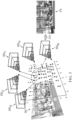
- FIG. 3 pictorially illustrates a process of generating a novel view of a 3D scene (302) according to one example.
- the 3D scene (302) is captured using forty-two RCPs (1, 2, ..., 42).
- the novel view that is being generated corresponds to a camera position (50).
- the four closest RCPs to the camera position (50) are the RCPs (11, 12, 18, 19).
- the corresponding multiplane images are multiplane images (200 11 , 200 12 , 200 18 , 200 19 ).
- a multiplane image (200 50 ) corresponding to the camera position (50) is generated by correspondingly warping the multiplane images (200 11 , 200 12 , 200 18 , 200 19 ) and then merging the resulting warped multiplane images.
- a viewable image (312) of the 3D scene (302) is generated by applying the compositing step (310) of the MPI-rendering algorithm to the multiplane image (200 50 ).
- a 3D scene such as the 3D scene (302) may be captured using any suitably selected number of RCPs.
- the locations of such RCPs can also be variously selected, e.g., based on the creative intent.
- RCPs when a novel view, such as the viewable image (312) is rendered, only several neighboring RCPs are used for the rendering.
- neighboring views are referred to as the "active views.”
- the number of active views is four.
- a different (from four) number of active views may similarly be used.
- the number of active views is a selectable parameter.
- some example embodiments are described herein below in reference to four active views.
- the set of active views may change over time when the camera position (50) moves. In some examples, the number of active views may change over time when the camera position (50) moves.
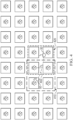
- FIG. 4 is a block diagram illustrating a change of the set of active views over time according to one example.
- a 3D scene is captured using a rectangular array of forty RCPs arranged in five rows and eight columns.
- a dashed arrow (402) represents a movement trajectory of the novel camera position (50) during the time interval starting at the time t 0 and ending at the time ti for virtual view synthesis.
- the set of active views includes the four views encompassed by the dashed box (410).
- the set of active views includes the four views encompassed by the dotted box (420).
- the set of active views changes from being the set in the dashed box (410) to being the set in the dotted box (420).
- a corresponding video encoder can be a High Efficiency Video Coding (HEVC) encoder, an MPEG-4 Advanced Video Coding (AVC) encoder, or any other suitable existing video encoder.
- HEVC High Efficiency Video Coding
- AVC MPEG-4 Advanced Video Coding
- the disclosed compression methods can be appropriately modified and/or extended to support MPI representations incorporating multiple views in a single MPI stack.
- MPI layers for M- camera positions, with N layers each, are denoted as RGB m n , & A m n , where m ⁇ 0 to M ⁇ 1 , n ⁇ 0 to N ⁇ 1 Since an MPI layer has four (R, G, B, A) channels with associated transparency data for each pixel, one can split the corresponding data into RGB texture frames and alpha (A) frames and compress those frames separately to generate different respective compressed bitstreams.
- FIG. 5 is a block diagram illustrating an MPI encoder (500) according to an embodiment.
- the MPI encoder (500) transforms an MPI video (502) into a coded bitstream (532).
- the MPI video (502) includes a sequence of multiplane images (200) corresponding to a sequence of times.
- the MPI video (502) corresponds to a single view or has two or more components corresponding to multiple views (also see FIGS. 3-4 ).
- the MPI video (502) is conveyed via the video/image stream (112) or (117).
- the coded bitstream (532) is transmitted to the corresponding MPI decoder via the coded bitstream (122).
- preprocessing operations performed in the preprocessing block (510) include: (i) splitting each layer of a multiplane image (200) into a respective RGB texture frame and a respective alpha frame; (ii) applying a first set of preprocessing operations to a resulting stream of RGB texture frames to generate a preprocessed texture-frame stream (512); (iii) applying a second set of preprocessing operations to a resulting stream of alpha frames to generate a preprocessed alpha-frame stream (514); and (iv) optionally, generating a source video stream (516) carrying 2D image frames representing the view from the corresponding RCP.
- the source video stream (516) is absent.
- Each of the video streams (512, 514, 516) has a format compatible with a video encoder (520).
- additional preprocessing operations performed in the preprocessing block (510) may include, but are not limited to, normalization, reshaping, padding, scaling, and refinement applied to at least one of a texture channel and an alpha channel. Representative examples of such additional preprocessing operations that can be implemented in the preprocessing block (510) are described, e.g., in U.S. Provisional Patent Application No. 63/357,669, filed on July 1, 2022 , which is incorporated herein by reference in its entirety.
- the video encoder (520) operates to covert each of the video streams (512, 514, 516), e.g., by applying suitable video compression thereto, into a corresponding one of compressed video streams (522, 524, 526).
- the video encoder (520) further operates to generate a corresponding video metadata stream (528).
- the video encoder (520) can be an HEVC encoder, an MPEG-4 AVC encoder, or any other suitable video encoder.
- a multiplexer (MUX) (530) operates to generate the coded bitstream (532) by suitably multiplexing the bitstreams (522, 524, 526, 528).
- FIG. 6 is a block diagram illustrating an MPI decoder (600) according to an embodiment.
- the MPI decoder (600) is designed to be compatible with the corresponding MPI encoder (500).
- the MPI decoder (600) receives the coded bitstream (532) generated by the corresponding MPI encoder (500) as an input and generates an MPI video (602) corresponding to a camera position (606) as an output.
- the camera position (606) is specified to the MPI decoder (600) by the viewer and can be the same as one of the RCPs (also see FIG. 3 ) or be different from any of the RCPs.
- the camera position (606) can be a function of time (also see FIG. 4 ).
- a demultiplexer (DMUX) (630) of the MPI decoder (600) demultiplexes the received coded bitstream (532) to recover the bitstreams (522, 524, 526, 528).
- a video decoder (620) of the MPI decoder (600) is compatible with the video encoder (520) of the MPI encoder (500) and operates to decompress the video bitstreams (522, 524, 526) using the video metadata stream (528), thereby generating video bitstreams (612, 614, 616).
- bitstreams (612, 614, 616) When lossy compression is used, one or more of the bitstreams (612, 614, 616) is not an exact copy of the corresponding one of the bitstreams (512, 514, 516) but rather is a relatively close approximation thereof.
- each of the bitstreams (612, 614, 616) When lossless compression is used, each of the bitstreams (612, 614, 616) is a copy of the corresponding one of the bitstreams (512, 514, 516). In either case, the bitstreams (612, 614, 616) lend themselves to postprocessing operations performed in a postprocessing block (610) of the MPI decoder (600). An output of the post-processing block (610) is an MPI video stream (608).
- a synthesis block (604) renders the MPI video stream (608) to generate a viewable video (602) corresponding to the camera position (606).
- the rendering operations performed in the synthesis block (604) include some or all of the following: warping multiplane images (200) corresponding to one or more of the active RCPs, merging warped multiplane images, and compositing the pertinent sequence of MPI images to generate the viewable video (602).
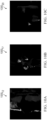
- FIGS. 7A-7C pictorially illustrate several RGB texture frames generated in the preprocessing block (510) of the MPI encoder (500) according to one example.
- the corresponding multiplane image (200) is an image of a female violinist playing her violin while being seated on a stool in a house porch.
- the shown RGB texture frames, labeled (700 12 , 700 17 , 700 20 ) correspond to the 12-th, 17-th, and 20-th layers, respectively, of the corresponding multiplane image (200) and are produced by applying alpha-thresholding operations to the corresponding "raw" frames of that multiplane image (200).
- Such thresholding operations are typically used in a process of compressing MPI textures through a block-based video codec, such as an HEVC codec.
- each of the texture frames (700 12 , 700 17 , 700 20 ) has a different respective set of substantially arbitrarily shaped edges evident from the example shown in FIGS. 7A-7C .
- the corresponding compressed bitstream carries a significant number of bits that encode those edges.
- the inventor(s) determined that transmission of those bits does not contribute in a meaningful way to the quality of the corresponding reconstructed MPI image for the decoded MPI video (602) while disadvantageously reducing the effective compression ratio, i.e., the ratio between the uncompressed size and the corresponding compressed size of the frame.
- the preprocessing block (510) is configured to substantially eliminate the intra-image edges illustrated in FIGS. 7A-7C by applying to the RGB texture frames, such as the frames (700 12 , 700 17 , 700 20 ), a texture-fill operation described in more detail below.
- the texture-fill operation substantially removes such intra-image edges by filling some regions of the texture frame with the source image data extracted from the corresponding portions of the source video frame, thereby providing substantial continuity and/or completeness to the different texture layers.
- a corresponding texture-fill operation includes using the alpha frame for the layer to perform an incorporation ("fill") of the source pixel values into the RGB texture at locations where alpha values are smaller than a selected fixed threshold value.
- the texture-fill operation also includes applying a Gaussian blur operation to the pixel values of the source image frame to reduce high-frequency content therein and then using the resulting blurred source pixel values for the actual fill of the pertinent regions of RGB texture frame.
- an RGB texture frame for the video bitstream (512) is generated by: (i) using the actual RGB pixel value of the corresponding MPI layer when the alpha value for that pixel is greater than the fixed threshold value ( alpha_threshold ); and (ii) using the Gaussian-blurred RGB source pixel value when the alpha value for that pixel is smaller than or equal to the fixed threshold value.
- alpha_threshold the fixed threshold value
- Gaussian-blurred RGB source pixel value when the alpha value for that pixel is smaller than or equal to the fixed threshold value.
- other than (5 ⁇ 5) kernel sizes can similarly be used.
- other suitable blur operations that differ from the above-indicated Gaussian blur operation can also be used.
- FIGS. 8A-8C pictorially illustrate RGB texture frames generated in the preprocessing block (510) of the MPI encoder (500) using the above-described texture-fill operations according to one example.
- the shown texture frames labeled (800 12 , 800 17 , 800 20 ), correspond to the texture frames (700 12 , 700 17 , 700 20 ), respectively, of FIGS. 7A-7C .
- the above-described intra-image edges are substantially eliminated and there exists a relatively high level of correlation between the frames (800 12 , 800 17 , 800 20 ), which beneficially translates into better compressibility of the preprocessed texture-frame stream (512).
- the source video bitstream (516) is not produced (is absent).
- the corresponding coded bitstream (532) is generated in the MUX (530) by multiplexing only the bitstreams (522, 524, 528).
- the decoded texture-frame stream (612) and the decoded alpha-frame stream (614) are sufficient for generating the MPI video (602) corresponding to a novel camera position (606).
- the preprocessing block (510) is configured to leverage correlations between MPI layers of a multiplane image (200) and the corresponding source image captured at that RPC. For example, such correlations can be used to encode only important differences between the textures for each layer at every camera view.
- Corresponding preprocessing operations performed in the preprocessing block (510) may include: (i) for each MPI layer of a multiplane image (200), thresholding both the source camera image and the texture frame of that MPI layer based on the alpha frame of that MPI layer; and (ii) computing the difference between the thresholded source camera image and the thresholded texture frame of the MPI layer.
- Eqs. (15) and (16) define the above-mentioned thresholding operations; and Eqs. (17) and (18) define the above-mentioned difference operations.
- the fixed threshold value ( alpha_threshold ) used in Eqs. (15) and (16) may be the same as or different from the fixed threshold value ( alpha _ threshold ) used in Eq. (14), as Eqs. (15)-(16) and Eq. (14) represent different respective embodiments of texture preprocessing operations implemented in the preprocessing block (510).
- DR dynamic range
- HVS human visual system
- DR may relate to a capability of the human visual system (HVS) to perceive a range of intensity (e.g., luminance, luma) in an image, e.g., from darkest blacks (darks) to brightest whites (highlights).
- DR relates to a "scene-referred” intensity.
- DR may also relate to the ability of a display device to render, adequately or approximately, an intensity range of a particular breadth.
- DR relates to a "display-referred" intensity.
- a particular sense is explicitly specified to have particular significance at any point in the description herein, it should be inferred that the term may be used in either sense, e.g., interchangeably.
- HDR high dynamic range
- EDR enhanced dynamic range
- VDR visual dynamic range
- n ⁇ 8 e.g., 24-bit color JPEG images
- SDR standard dynamic range
- FIGS. 9A-9C pictorially illustrate RGB difference texture frames generated in the preprocessing block (510) of the MPI encoder (500) using the above-described difference operations according to one example.
- the shown texture frames labeled (900 12 , 900 17 , 900 20 ), correspond to the texture frames (700 12 , 700 17 , 700 20 ), respectively, of FIGS. 7A-7C .
- the non-zero content in the frames (900 12 , 900 17 , 900 20 ) is sparce, which beneficially translates into better compressibility of the preprocessed texture-frame stream (512).
- the MPI encoder (500) incorporates an encode-decode loop and is configured to use the decoded source image outputted by that loop to compute the S(i,j) with Eq. (15) and then to compute Diff_Texture ( i,j ) with Eq. (17).
- the source video bitstream (516) is encoded, and the resulting encoded bitstream (526) is transmitted to the MPI decoder (600) as indicated in FIGS. 5-6 .
- the MPI encoder (500) is configured to introduce spatial and/or temporal correlation between alpha frames via a corresponding set of preprocessing operations performed in the preprocessing block (510).
- set of preprocessing operations includes: (i) multiplying an alpha frame and the corresponding source image and (ii) normalizing the values of the resulting product frame to 8-bit.
- such set of preprocessing operations also includes converting the RGB source image into a single-channel grayscale image.
- such set of preprocessing operations also includes applying a Gaussian blur operation either to the RGB source image prior to the grayscale conversion or to the single-channel grayscale image produced by the grayscale conversion.
- the blur operation beneficially removes at least some of the high-frequency components from the preprocessed frame.
- the blurred source data may be clipped to be between a pre-determined float error threshold value a selected fixed maximum (e.g., 8-bit) value.
- PremultiplyA i j A i j ⁇ BlurSGray i j ⁇ 1 255.0 where Eq.
- Eq. (19) defines thresholding operations; Eq. (20) defines the above-mentioned grayscale conversion; Eq. (21) defines the above-mentioned Gaussian blur operations with a (5 ⁇ 5) pixel kernel; Eq. (22) defines the above-mentioned clipping operations; and Eq. (23) defines the above-mentioned frame-multiplication operation with 8-bit normalization.
- Eq. (19) is the same as Eq. (15).
- Other suitable normalization and maximum values can be used for EDR or HDR content.
- other than (5 ⁇ 5) kernel sizes can similarly be used.
- other suitable blur operations that differ from the above-indicated Gaussian blur operation can also be used.
- FIGS. 10A-10C pictorially illustrate preprocessed alpha frames generated in the preprocessing block (510) of the MPI encoder (500) using the above-described alpha-frame preprocessing operations according to one example.
- the preprocessed alpha frames (1000 12 , 1000 17 , 1000 20 ) exhibit better compression ratios in the video encoder (520) of the MPI encoder (500) than the corresponding original alpha frames (not explicitly shown).
- the source video bitstream (516) is encoded, and the resulting encoded bitstream (526) is transmitted to the MPI decoder (600) as indicated in FIGS. 5-6 .
- the MPI decoder (600) uses the received source video bitstream (516) and the received encoded bitstream (526) to produce the decoded alpha-frame stream (614).
- the following additional operations may be implemented to the global quality of MPI images for the MPI video (602) and or compression ratios for the compressed video streams (522, 524, 526):
- FIG. 11 is a block diagram illustrating a computing device (1100) used in the video delivery pipeline (100) according to an embodiment.
- the device (1100) can be used, e.g., to implement the MPI encoder (500) or the MPI decoder (600).
- the computing device (1100) comprises input/output (I/O) devices (1110), a processing engine (1120), and a memory (1130).
- the I/O devices (1110) may be used to enable the device (1100) to receive various input signals (1102) and to output various output signals (1104).
- the I/O devices (1110) may be operatively connected to send and receive signals via the communication channel used to transmit information between the MPI encoder (500) and the MPI decoder (600).
- the memory (1130) may have buffers to receive data. Once the data are received, the memory (1130) may provide parts of the data to the processing engine (1120) for processing therein.
- the processing engine (1120) includes a processor (1122) and a memory (1124).
- the memory (1124) may store therein program code, which when executed by the processor (1122) enables the processing engine (1120) to perform various data processing operations, including but not limited to at least some operations of the above-described MPI methods.
- an apparatus for compressing an MPI video comprising: at least one processor; and at least one memory including program code, wherein the at least one memory and the program code are configured to, with the at least one processor, cause the apparatus at least to: split the MPI video into a first frame sequence and a second frame sequence, the first frame sequence being a sequence of texture frames, with each of the texture frames representing a respective layer of a corresponding multiplane image of the MPI video, the second frame sequence being a sequence of alpha frames, with each of the alpha frames corresponding to a respective one of the texture frames of the first sequence; apply a first set of preprocessing operations to convert the first frame sequence into a third frame sequence, the first set including operations according to which a pixel value in a frame of the third frame sequence is determined based on a comparison of a corresponding pixel value of
- a method of compressing an MPI video comprising: splitting the MPI video into a first frame sequence and a second frame sequence, the first frame sequence being a sequence of texture frames, with each of the texture frames representing a respective layer of a corresponding multiplane image of the MPI video, the second frame sequence being a sequence of alpha frames, with each of the alpha frames corresponding to a respective one of the texture frames of the first sequence; applying a first set of preprocessing operations to convert the first frame sequence into a third frame sequence, the first set including operations according to which a pixel value in a frame of the third frame sequence is determined based on a comparison of a corresponding pixel value of the corresponding alpha frame of the second frame sequence with a first threshold value; applying a second set of preprocessing operations to convert the second frame sequence into a fourth frame sequence, the
- the method further comprises applying video compression to a sequence of source images corresponding to the MPI video.
- the method further comprises generating a metadata stream signaling parameters of the video compression; generating an output bitstream by multiplexing the compressed third frame sequence, the compressed fourth frame sequence, the compressed sequence of source images, and the metadata stream; and transmitting the output bitstream through a communication channel.
- the first set comprises: generating a corresponding blurred image by applying a blur transformation to the corresponding source image; and when the corresponding pixel value of the corresponding alpha frame of the second frame sequence is smaller than the first threshold value, assigning a corresponding pixel value from the corresponding blurred image to be the pixel value in the frame of the third frame sequence.
- the first set further comprises: when the corresponding pixel value of the corresponding alpha frame of the second frame sequence is greater than the first threshold value, transferring a corresponding pixel value from the first frame sequence to the third frame sequence.
- the blur transformation is a Gaussian blur transformation with a square kernel including more than one pixel.
- the first set comprises generating a first thresholded image by nulling in the corresponding source image all pixel values for which the corresponding pixel value of the corresponding alpha frame of the second frame sequence is smaller than the first threshold value.
- the first set further comprises generating a second thresholded image by nulling in a corresponding texture frame of the first sequence all pixel values for which the corresponding pixel value of the corresponding alpha frame of the second frame sequence is smaller than the first threshold value.
- the first set further comprises: computing pixelwise difference values between the first thresholded image and the second thresholded image; and computing a corresponding frame for the third frame sequence by adding a fixed offset value to the computed pixelwise difference values, wherein the fixed offset value is selected based on an image resolution.
- the second set comprises generating a first thresholded image by nulling in the corresponding source image all pixel values for which the corresponding pixel value of the corresponding alpha frame of the second frame sequence is smaller than the second threshold value.
- the second set further comprises converting the first thresholded image into a corresponding grayscale image.
- the second set further comprises generating a corresponding blurred image by applying a blur transformation to the corresponding grayscale image.
- the second set further comprises: computing pixelwise product values using the first thresholded image and the corresponding blurred image; and computing a corresponding frame for the third frame sequence by applying normalization and clipping operations to the computed pixelwise product values, wherein the normalization and clipping operations are configured based on an image resolution.
- the MPI video is one of a plurality of MPI videos corresponding to different respective camera positions of a plurality of camera positions arranged around a scene captured in the MPI video.
- a non-transitory computer-readable medium storing instructions that, when executed by an electronic processor, cause the electronic processor to perform operations comprising any one of the above methods of compressing an MPI video.
- a method of rendering an MPI video comprising: receiving (i) a first compressed frame sequence having encoded therein a sequence of texture frames, with each of the texture frames representing a respective layer of a corresponding multiplane image of the MPI video, (ii) a second compressed frame sequence having encoded therein a sequence of alpha frames, with each of the alpha frames corresponding to a respective one of the texture frames, and (iii) a compressed sequence of source images; applying video decompression to the first compressed frame sequence, the second compressed frame sequence, and the compressed sequence of source images to generate a first uncompressed frame sequence, a second uncompressed frame sequence, and an uncompressed sequence of source images; applying a first set of postprocessing operations to the first uncompressed frame sequence to recover the sequence of texture frames; applying a second set of postprocessing operations to
- the method further comprises generating a viewable video corresponding to a novel camera position based on the sequence of four-channel frames.
- the MPI video is one of a plurality of MPI videos corresponding to different respective camera positions of a plurality of camera positions arranged around a scene captured in the MPI video.
- a non-transitory computer-readable medium storing instructions that, when executed by an electronic processor, cause the electronic processor to perform operations comprising any one of the above methods of rendering an MPI video.
- an apparatus for rendering an MPI video comprising: at least one processor; and at least one memory including program code, wherein the at least one memory and the program code are configured to, with the at least one processor, cause the apparatus at least to: receive (i) a first compressed frame sequence having encoded therein a sequence of texture frames, with each of the texture frames representing a respective layer of a corresponding multiplane image of the MPI video, (ii) a second compressed frame sequence having encoded therein a sequence of alpha frames, with each of the alpha frames corresponding to a respective one of the texture frames, and (iii) a compressed sequence of source images; apply video decompression to the first compressed frame sequence, the second compressed frame sequence, and the compressed sequence of source images to generate a first uncompressed frame sequence, a second uncompressed frame sequence, and an uncompressed
- Some embodiments may be implemented as circuit-based processes, including possible implementation on a single integrated circuit.
- Some embodiments can be embodied in the form of methods and apparatuses for practicing those methods. Some embodiments can also be embodied in the form of program code recorded in tangible media, such as magnetic recording media, optical recording media, solid state memory, floppy diskettes, CD-ROMs, hard drives, or any other non-transitory machine-readable storage medium, wherein, when the program code is loaded into and executed by a machine, such as a computer, the machine becomes an apparatus for practicing the patented invention(s).
- Some embodiments can also be embodied in the form of program code, for example, stored in a non-transitory machine-readable storage medium including being loaded into and/or executed by a machine, wherein, when the program code is loaded into and executed by a machine, such as a computer or a processor, the machine becomes an apparatus for practicing the patented invention(s).
- program code segments When implemented on a general-purpose processor, the program code segments combine with the processor to provide a unique device that operates analogously to specific logic circuits.
- figure numbers and/or figure reference labels in the claims is intended to identify one or more possible embodiments of the claimed subject matter in order to facilitate the interpretation of the claims. Such use is not to be construed as necessarily limiting the scope of those claims to the embodiments shown in the corresponding figures.
- Couple refers to any manner known in the art or later developed in which energy is allowed to be transferred between two or more elements, and the interposition of one or more additional elements is contemplated, although not required. Conversely, the terms “directly coupled,” “directly connected,” etc., imply the absence of such additional elements.
- the term compatible means that the element communicates with other elements in a manner wholly or partially specified by the standard and would be recognized by other elements as sufficiently capable of communicating with the other elements in the manner specified by the standard.
- the compatible element does not need to operate internally in a manner specified by the standard.
- processors may be provided through the use of dedicated hardware as well as hardware capable of executing software in association with appropriate software.
- the functions may be provided by a single dedicated processor, by a single shared processor, or by a plurality of individual processors, some of which may be shared.
- processor or “controller” should not be construed to refer exclusively to hardware capable of executing software, and may implicitly include, without limitation, digital signal processor (DSP) hardware, network processor, application specific integrated circuit (ASIC), field programmable gate array (FPGA), read only memory (ROM) for storing software, random access memory (RAM), and nonvolatile storage. Other hardware, conventional and/or custom, may also be included.
- DSP digital signal processor
- ASIC application specific integrated circuit
- FPGA field programmable gate array
- ROM read only memory
- RAM random access memory
- nonvolatile storage nonvolatile storage.
- Other hardware conventional and/or custom, may also be included.
- any switches shown in the figures are conceptual only. Their function may be carried out through the operation of program logic, through dedicated logic, through the interaction of program control and dedicated logic, or even manually, the particular technique being selectable by the implementer as more specifically understood from the context.
- circuit may refer to one or more or all of the following: (a) hardware-only circuit implementations (such as implementations in only analog and/or digital circuitry); (b) combinations of hardware circuits and software, such as (as applicable): (i) a combination of analog and/or digital hardware circuit(s) with software/firmware and (ii) any portions of hardware processor(s) with software (including digital signal processor(s)), software, and memory(ies) that work together to cause an apparatus, such as a mobile phone or server, to perform various functions); and (c) hardware circuit(s) and or processor(s), such as a microprocessor(s) or a portion of a microprocessor(s), that requires software (e.g., firmware) for operation, but the software may not be present when it is not needed for operation.”
- firmware firmware
- circuitry also covers an implementation of merely a hardware circuit or processor (or multiple processors) or portion of a hardware circuit or processor and its (or their) accompanying software and/or firmware.
- circuitry also covers, for example and if applicable to the particular claim element, a baseband integrated circuit or processor integrated circuit for a mobile device or a similar integrated circuit in server, a cellular network device, or other computing or network device.
- any block diagrams herein represent conceptual views of illustrative circuitry embodying the principles of the disclosure.
- any flow charts, flow diagrams, state transition diagrams, pseudo code, and the like represent various processes which may be substantially represented in computer readable medium and so executed by a computer or processor, whether or not such computer or processor is explicitly shown.
Landscapes
- Engineering & Computer Science (AREA)
- Multimedia (AREA)
- Signal Processing (AREA)
- Compression Or Coding Systems Of Tv Signals (AREA)
Priority Applications (1)
| Application Number | Priority Date | Filing Date | Title |
|---|---|---|---|
| US18/805,864 US20250063208A1 (en) | 2023-08-17 | 2024-08-15 | Compression of multiplane images |
Applications Claiming Priority (1)
| Application Number | Priority Date | Filing Date | Title |
|---|---|---|---|
| US202363520198P | 2023-08-17 | 2023-08-17 |
Publications (1)
| Publication Number | Publication Date |
|---|---|
| EP4510584A1 true EP4510584A1 (fr) | 2025-02-19 |
Family
ID=87863392
Family Applications (1)
| Application Number | Title | Priority Date | Filing Date |
|---|---|---|---|
| EP23194075.0A Pending EP4510584A1 (fr) | 2023-08-17 | 2023-08-29 | Compression d'images multiplans |
Country Status (2)
| Country | Link |
|---|---|
| US (1) | US20250063208A1 (fr) |
| EP (1) | EP4510584A1 (fr) |
Families Citing this family (1)
| Publication number | Priority date | Publication date | Assignee | Title |
|---|---|---|---|---|
| US12457318B2 (en) * | 2021-06-02 | 2025-10-28 | Dolby Laboratories Licensing Corporation | Method, encoder, and display device for representing a three-dimensional scene and depth-plane data thereof |
Citations (2)
| Publication number | Priority date | Publication date | Assignee | Title |
|---|---|---|---|---|
| WO2021257992A1 (fr) * | 2020-06-19 | 2021-12-23 | Intel Corporation | Compression d'image multiplans |
| WO2022069522A1 (fr) * | 2020-09-30 | 2022-04-07 | Interdigital Ce Patent Holdings, Sas | Procédé et appareil pour signaler la profondeur de vidéo volumétrique basée sur des images multiplans |
Family Cites Families (5)
| Publication number | Priority date | Publication date | Assignee | Title |
|---|---|---|---|---|
| JP4748230B2 (ja) * | 2009-02-17 | 2011-08-17 | カシオ計算機株式会社 | 撮像装置、撮像方法及び撮像プログラム |
| US10911732B2 (en) * | 2019-01-14 | 2021-02-02 | Fyusion, Inc. | Free-viewpoint photorealistic view synthesis from casually captured video |
| US11423309B2 (en) * | 2020-03-20 | 2022-08-23 | Purdue Research Foundation | System and method for latency reduction in an optical imaging system |
| CN118103750A (zh) * | 2021-08-31 | 2024-05-28 | 伊鲁米纳公司 | 具有增强的孔成像分辨率的流动池 |
| EP4693168A3 (fr) * | 2022-02-28 | 2026-04-08 | Hologic, Inc. | Système et procédé d'imagerie numérique |
-
2023
- 2023-08-29 EP EP23194075.0A patent/EP4510584A1/fr active Pending
-
2024
- 2024-08-15 US US18/805,864 patent/US20250063208A1/en active Pending
Patent Citations (2)
| Publication number | Priority date | Publication date | Assignee | Title |
|---|---|---|---|---|
| WO2021257992A1 (fr) * | 2020-06-19 | 2021-12-23 | Intel Corporation | Compression d'image multiplans |
| WO2022069522A1 (fr) * | 2020-09-30 | 2022-04-07 | Interdigital Ce Patent Holdings, Sas | Procédé et appareil pour signaler la profondeur de vidéo volumétrique basée sur des images multiplans |
Non-Patent Citations (5)
| Title |
|---|
| "Test model 16 for MPEG immersive video", no. n22695, 27 May 2023 (2023-05-27), XP030310873, Retrieved from the Internet <URL:https://dms.mpeg.expert/doc_end_user/documents/142_Antalya/wg11/MDS22695_WG04_N00347.zip WG04N0347_TMIV16.docx> [retrieved on 20230527] * |
| J-R OHM: "Meeting Report of the 31st JVET Meeting", no. JVET-AE1000 ; m64589, 16 August 2023 (2023-08-16), XP030311732, Retrieved from the Internet <URL:https://jvet-experts.org/doc_end_user/documents/31_Geneva/wg11/JVET-AE1000-v4.zip JVET-AE1000-v3.docx> [retrieved on 20230816] * |
| KIM (LGE) C ET AL: "[AHG8] De-noising filter as pre-processing for machine task", no. JVET-AE0081, 15 July 2023 (2023-07-15), XP030311273, Retrieved from the Internet <URL:https://jvet-experts.org/doc_end_user/documents/31_Geneva/wg11/JVET-AE0081-v6.zip JVET-AE0081-v5.docx> [retrieved on 20230715] * |
| LU (DOLBY) T ET AL: "AHG9: Multiplane Image Information SEI", no. JVET-AE0066, 15 July 2023 (2023-07-15), XP030311227, Retrieved from the Internet <URL:https://jvet-experts.org/doc_end_user/documents/31_Geneva/wg11/JVET-AE0066-v5.zip JVET-AE0066-v3-clean.docx> [retrieved on 20230715] * |
| WENXIU SUN ET AL: "An overview of free viewpoint Depth-Image-Based Rendering (DIBR)ion/xam", pages 1 - 8, XP007921284, Retrieved from the Internet <URL:http://ihome.ust.hk/~eeshine/files/sun_apsipa10.pdf> [retrieved on 20121114] * |
Also Published As
| Publication number | Publication date |
|---|---|
| US20250063208A1 (en) | 2025-02-20 |
Similar Documents
| Publication | Publication Date | Title |
|---|---|---|
| US10750179B2 (en) | Decomposition of residual data during signal encoding, decoding and reconstruction in a tiered hierarchy | |
| US10575005B2 (en) | Video coding and delivery with both spatial and dynamic range scalability | |
| US11983904B2 (en) | Method for compressing point clouds | |
| CN115191116A (zh) | 使用嵌入信令来校正信号损伤 | |
| US11711535B2 (en) | Video-based point cloud compression model to world signaling information | |
| US10334256B2 (en) | Video compression method | |
| US12356006B2 (en) | Method and apparatus for encoding volumetric video represented as a multiplane image | |
| KR20230078685A (ko) | 다중평면 이미지 기반 볼류메트릭 비디오의 깊이를 시그널링하기 위한 방법 및 장치 | |
| US20150237323A1 (en) | 3d video representation using information embedding | |
| EP4222958B1 (fr) | Procédé et appareil de codage et de décodage d'une ou de plusieurs vues d'une scène | |
| US10827161B2 (en) | Depth codec for 3D-video recording and streaming applications | |
| KR20190020848A (ko) | 하이 다이내믹 레인지 이미지들을 인코딩하고, 디코딩하고, 표현하기 위한 기법들 | |
| US12615379B2 (en) | Embedding data within transformed coefficients using bit partitioning operations | |
| WO2021064289A2 (fr) | Bande de garde de profondeur adaptative | |
| US20250063208A1 (en) | Compression of multiplane images | |
| WO2023110562A1 (fr) | Procédés et dispositifs de codage et décodage progressifs d'images à plans multiples | |
| EP4349012A1 (fr) | Codage vidéo à plage dynamique élevée activé par rotation | |
| US12603982B2 (en) | Stereoscopic high dynamic range video | |
| WO2022073816A1 (fr) | Procédé et appareil de reconstruction d'une carte d'occupation d'une trame de nuage de points | |
| CN119563316A (zh) | 具有叠加区域的信号处理 | |
| US20070064275A1 (en) | Apparatus and method for compressing images | |
| US12439096B2 (en) | Context-based reshaping algorithms for encoding video data | |
| WO2011094164A1 (fr) | Systèmes d'optimisation d'image utilisant des informations de zone | |
| CN113228665A (zh) | 用于处理配置数据的方法、设备、计算机程序和计算机可读介质 | |
| Tran et al. | Spherical LSB Data Hiding in 360° Videos Using Morphological Operations |
Legal Events
| Date | Code | Title | Description |
|---|---|---|---|
| PUAI | Public reference made under article 153(3) epc to a published international application that has entered the european phase |
Free format text: ORIGINAL CODE: 0009012 |
|
| STAA | Information on the status of an ep patent application or granted ep patent |
Free format text: STATUS: THE APPLICATION HAS BEEN PUBLISHED |
|
| AK | Designated contracting states |
Kind code of ref document: A1 Designated state(s): AL AT BE BG CH CY CZ DE DK EE ES FI FR GB GR HR HU IE IS IT LI LT LU LV MC ME MK MT NL NO PL PT RO RS SE SI SK SM TR |
|
| P01 | Opt-out of the competence of the unified patent court (upc) registered |
Free format text: CASE NUMBER: APP_30098/2025 Effective date: 20250624 |
|
| STAA | Information on the status of an ep patent application or granted ep patent |
Free format text: STATUS: REQUEST FOR EXAMINATION WAS MADE |
|
| 17P | Request for examination filed |
Effective date: 20250818 |