EP4512310A1 - Systèmes de capteur de biomarqueur de fluide interstitiel à micro-aiguilles intégrées et procédés associés - Google Patents
Systèmes de capteur de biomarqueur de fluide interstitiel à micro-aiguilles intégrées et procédés associés Download PDFInfo
- Publication number
- EP4512310A1 EP4512310A1 EP24193300.1A EP24193300A EP4512310A1 EP 4512310 A1 EP4512310 A1 EP 4512310A1 EP 24193300 A EP24193300 A EP 24193300A EP 4512310 A1 EP4512310 A1 EP 4512310A1
- Authority
- EP
- European Patent Office
- Prior art keywords
- isf
- patch
- layer
- wearable
- sensor
- Prior art date
- Legal status (The legal status is an assumption and is not a legal conclusion. Google has not performed a legal analysis and makes no representation as to the accuracy of the status listed.)
- Pending
Links
Images





Classifications
-
- A—HUMAN NECESSITIES
- A61—MEDICAL OR VETERINARY SCIENCE; HYGIENE
- A61B—DIAGNOSIS; SURGERY; IDENTIFICATION
- A61B5/00—Measuring for diagnostic purposes; Identification of persons
- A61B5/145—Measuring characteristics of blood in vivo, e.g. gas concentration or pH-value ; Measuring characteristics of body fluids or tissues, e.g. interstitial fluid or cerebral tissue
- A61B5/14532—Measuring characteristics of blood in vivo, e.g. gas concentration or pH-value ; Measuring characteristics of body fluids or tissues, e.g. interstitial fluid or cerebral tissue for measuring glucose, e.g. by tissue impedance measurement
-
- A—HUMAN NECESSITIES
- A61—MEDICAL OR VETERINARY SCIENCE; HYGIENE
- A61B—DIAGNOSIS; SURGERY; IDENTIFICATION
- A61B5/00—Measuring for diagnostic purposes; Identification of persons
- A61B5/145—Measuring characteristics of blood in vivo, e.g. gas concentration or pH-value ; Measuring characteristics of body fluids or tissues, e.g. interstitial fluid or cerebral tissue
- A61B5/14507—Measuring characteristics of blood in vivo, e.g. gas concentration or pH-value ; Measuring characteristics of body fluids or tissues, e.g. interstitial fluid or cerebral tissue specially adapted for measuring characteristics of body fluids other than blood
- A61B5/1451—Measuring characteristics of blood in vivo, e.g. gas concentration or pH-value ; Measuring characteristics of body fluids or tissues, e.g. interstitial fluid or cerebral tissue specially adapted for measuring characteristics of body fluids other than blood for interstitial fluid
- A61B5/14514—Measuring characteristics of blood in vivo, e.g. gas concentration or pH-value ; Measuring characteristics of body fluids or tissues, e.g. interstitial fluid or cerebral tissue specially adapted for measuring characteristics of body fluids other than blood for interstitial fluid using means for aiding extraction of interstitial fluid, e.g. microneedles or suction
-
- A—HUMAN NECESSITIES
- A61—MEDICAL OR VETERINARY SCIENCE; HYGIENE
- A61B—DIAGNOSIS; SURGERY; IDENTIFICATION
- A61B5/00—Measuring for diagnostic purposes; Identification of persons
- A61B5/145—Measuring characteristics of blood in vivo, e.g. gas concentration or pH-value ; Measuring characteristics of body fluids or tissues, e.g. interstitial fluid or cerebral tissue
- A61B5/14503—Measuring characteristics of blood in vivo, e.g. gas concentration or pH-value ; Measuring characteristics of body fluids or tissues, e.g. interstitial fluid or cerebral tissue invasive, e.g. introduced into the body by a catheter or needle or using implanted sensors
-
- A—HUMAN NECESSITIES
- A61—MEDICAL OR VETERINARY SCIENCE; HYGIENE
- A61B—DIAGNOSIS; SURGERY; IDENTIFICATION
- A61B5/00—Measuring for diagnostic purposes; Identification of persons
- A61B5/145—Measuring characteristics of blood in vivo, e.g. gas concentration or pH-value ; Measuring characteristics of body fluids or tissues, e.g. interstitial fluid or cerebral tissue
- A61B5/14507—Measuring characteristics of blood in vivo, e.g. gas concentration or pH-value ; Measuring characteristics of body fluids or tissues, e.g. interstitial fluid or cerebral tissue specially adapted for measuring characteristics of body fluids other than blood
- A61B5/1451—Measuring characteristics of blood in vivo, e.g. gas concentration or pH-value ; Measuring characteristics of body fluids or tissues, e.g. interstitial fluid or cerebral tissue specially adapted for measuring characteristics of body fluids other than blood for interstitial fluid
-
- A—HUMAN NECESSITIES
- A61—MEDICAL OR VETERINARY SCIENCE; HYGIENE
- A61B—DIAGNOSIS; SURGERY; IDENTIFICATION
- A61B5/00—Measuring for diagnostic purposes; Identification of persons
- A61B5/145—Measuring characteristics of blood in vivo, e.g. gas concentration or pH-value ; Measuring characteristics of body fluids or tissues, e.g. interstitial fluid or cerebral tissue
- A61B5/14546—Measuring characteristics of blood in vivo, e.g. gas concentration or pH-value ; Measuring characteristics of body fluids or tissues, e.g. interstitial fluid or cerebral tissue for measuring analytes not otherwise provided for, e.g. ions, cytochromes
-
- A—HUMAN NECESSITIES
- A61—MEDICAL OR VETERINARY SCIENCE; HYGIENE
- A61B—DIAGNOSIS; SURGERY; IDENTIFICATION
- A61B5/00—Measuring for diagnostic purposes; Identification of persons
- A61B5/145—Measuring characteristics of blood in vivo, e.g. gas concentration or pH-value ; Measuring characteristics of body fluids or tissues, e.g. interstitial fluid or cerebral tissue
- A61B5/1468—Measuring characteristics of blood in vivo, e.g. gas concentration or pH-value ; Measuring characteristics of body fluids or tissues, e.g. interstitial fluid or cerebral tissue using chemical or electrochemical methods, e.g. by polarographic means
- A61B5/1473—Measuring characteristics of blood in vivo, e.g. gas concentration or pH-value ; Measuring characteristics of body fluids or tissues, e.g. interstitial fluid or cerebral tissue using chemical or electrochemical methods, e.g. by polarographic means invasive, e.g. introduced into the body by a catheter
-
- A—HUMAN NECESSITIES
- A61—MEDICAL OR VETERINARY SCIENCE; HYGIENE
- A61B—DIAGNOSIS; SURGERY; IDENTIFICATION
- A61B5/00—Measuring for diagnostic purposes; Identification of persons
- A61B5/145—Measuring characteristics of blood in vivo, e.g. gas concentration or pH-value ; Measuring characteristics of body fluids or tissues, e.g. interstitial fluid or cerebral tissue
- A61B5/1468—Measuring characteristics of blood in vivo, e.g. gas concentration or pH-value ; Measuring characteristics of body fluids or tissues, e.g. interstitial fluid or cerebral tissue using chemical or electrochemical methods, e.g. by polarographic means
- A61B5/1486—Measuring characteristics of blood in vivo, e.g. gas concentration or pH-value ; Measuring characteristics of body fluids or tissues, e.g. interstitial fluid or cerebral tissue using chemical or electrochemical methods, e.g. by polarographic means using enzyme electrodes, e.g. with immobilised oxidase
- A61B5/14865—Measuring characteristics of blood in vivo, e.g. gas concentration or pH-value ; Measuring characteristics of body fluids or tissues, e.g. interstitial fluid or cerebral tissue using chemical or electrochemical methods, e.g. by polarographic means using enzyme electrodes, e.g. with immobilised oxidase invasive, e.g. introduced into the body by a catheter or needle or using implanted sensors
-
- A—HUMAN NECESSITIES
- A61—MEDICAL OR VETERINARY SCIENCE; HYGIENE
- A61B—DIAGNOSIS; SURGERY; IDENTIFICATION
- A61B5/00—Measuring for diagnostic purposes; Identification of persons
- A61B5/68—Arrangements of detecting, measuring or recording means, e.g. sensors, in relation to patient
- A61B5/6801—Arrangements of detecting, measuring or recording means, e.g. sensors, in relation to patient specially adapted to be attached to or worn on the body surface
- A61B5/683—Means for maintaining contact with the body
- A61B5/6832—Means for maintaining contact with the body using adhesives
- A61B5/6833—Adhesive patches
-
- A—HUMAN NECESSITIES
- A61—MEDICAL OR VETERINARY SCIENCE; HYGIENE
- A61B—DIAGNOSIS; SURGERY; IDENTIFICATION
- A61B5/00—Measuring for diagnostic purposes; Identification of persons
- A61B5/68—Arrangements of detecting, measuring or recording means, e.g. sensors, in relation to patient
- A61B5/6846—Arrangements of detecting, measuring or recording means, e.g. sensors, in relation to patient specially adapted to be brought in contact with an internal body part, i.e. invasive
- A61B5/6847—Arrangements of detecting, measuring or recording means, e.g. sensors, in relation to patient specially adapted to be brought in contact with an internal body part, i.e. invasive mounted on an invasive device
- A61B5/685—Microneedles
-
- A—HUMAN NECESSITIES
- A61—MEDICAL OR VETERINARY SCIENCE; HYGIENE
- A61B—DIAGNOSIS; SURGERY; IDENTIFICATION
- A61B2562/00—Details of sensors; Constructional details of sensor housings or probes; Accessories for sensors
- A61B2562/16—Details of sensor housings or probes; Details of structural supports for sensors
-
- A—HUMAN NECESSITIES
- A61—MEDICAL OR VETERINARY SCIENCE; HYGIENE
- A61B—DIAGNOSIS; SURGERY; IDENTIFICATION
- A61B2562/00—Details of sensors; Constructional details of sensor housings or probes; Accessories for sensors
- A61B2562/16—Details of sensor housings or probes; Details of structural supports for sensors
- A61B2562/164—Details of sensor housings or probes; Details of structural supports for sensors the sensor is mounted in or on a conformable substrate or carrier
Definitions
- the subject matter described herein relates generally to wearable sensing systems and, more particularly, to wearable systems for sensing biomolecules in the interstitial fluid of a user.
- biochemical data may be important for certain medical conditions. For example, monitoring of biomarkers or drugs administered to the user may enable a user being monitored or a medical professional to medically intervene when the biomarkers indicate that medical intervention could be advantageous and/or necessary to properly manage a medical condition. Poor management of these medical conditions may result in short-term or long-term injury to the user. Similarly, biomarkers may be monitored to evaluate the performance of a user during athletic, military, or cognitive activities.
- the ability to detect and quantify biomarkers in situ and in real-time enables the user or observers to implement changes in the short-term or long-term to augment performance or prevent degradation of performance (e.g., maintaining hydration, ensuring proper rest, increasing or decreasing training/task load, administering of pharmaceuticals or supplements to enhance performance, etc.).
- biochemical monitoring devices monitor the blood of the user.
- biochemical monitoring devices typically include at least one needle or microneedle that penetrates the skin of the user and channel the blood to sensing devices that are located on the surface of the skin.
- the sensing devices detect and report the presence and/or concentration of biomarkers in the blood to the user or the medical professional.
- the blood is typically continually replenished and must be disposed of after the sensing devices have analyzed the blood.
- a wick absorbs the blood, and the wick is discarded after the wick cannot absorb any more blood. As such, the wick is typically frequently replaced in order to continually monitor and analyze the blood.
- biochemical monitoring devices monitor the ISF of the user subcutaneously.
- biochemical monitoring devices typically include an applicator with at least one needle that penetrates the skin of the user and deposits at least one sensing device deep within the tissue (e.g., in subcutaneous fat for continuous glucose monitoring).
- the sensing device is communicatively coupled to electronics positioned supracutaneously that report the detected biomarkers to the user or the medical professional.
- the sensing device penetrates the skin, the cells adjacent the sensing device may be irritated by the sensing device, and, as such, may produce ISF proximate the sensing device that could distort the concentrations of certain inflammation-related biomarkers detected by the sensing device.
- Approximating language may be applied to modify any quantitative representation that could permissibly vary without resulting in a change in the basic function to which it is related. Accordingly, a value modified by a term or terms, such as “about,” “substantially,” and “approximately,” are not to be limited to the precise value specified. In at least some instances, the approximating language may correspond to the precision of an instrument for measuring the value.
- range limitations may be combined and/or interchanged, such ranges are identified and include all the sub-ranges contained therein unless context or language indicates otherwise.
- the ISF that flows to the sensors is continually equilibrated with the surrounding ISF without requiring mechanical mechanisms to replenish the ISF.
- embedding the sensors in the dermis enables the wearable ISF sensing device to detect biomarkers without drawing fluid out of the body of the user, reducing the cleanup and disposal of bodily fluids as the result of biomarker detection and measurement.
- capillary pressure and the compressive force generated during insertion will cause ISF to flow into the channel such that a fluid motive device, such as a vacuum pump or mechanical compression, is not required to replenish the ISF at the sensors.
- passive diffusion from the ISF and equilibration with the ISF inside the channel replenishes the ISF at the sensors.
- the wearable ISF sensing device enables detection of biomarkers while reducing cleanup and disposal of bodily fluids and reducing the equipment required to measure biomarkers within the ISF. Additionally, directly measuring ISF in the interstitial space reduces the lag time between changes in biomarker concentration and read-out.
- FIG. 1 is a plan view of an exemplary embodiment of a wearable ISF sensing module 100 and FIG. 2 is an exploded perspective view of wearable ISF sensing module 100.
- wearable ISF sensing module 100 is formed of a plurality of layers 102-110 laminated together to form a patch component 112 and a plurality of microneedles 114 integrally formed with patch component 112 for insertion into the skin of the user and sensing the ISF of the user, as described in detail below.
- Patch component 112 supports microneedles 114 during insertion into the skin of the user and adheres wearable ISF sensing module 100 to the skin of the user, as described below.
- Microneedles 114 detect and measure at least one biomarker within the ISF of the user, enabling wearable ISF sensing module 100 to monitor a medical condition and/or performance metric based on the data collected by microneedles 114.
- wearable ISF sensing module 100 is disposable (i.e., wearable ISF sensing module 100 is generally used once). In an alternative embodiment, at least a portion of wearable ISF sensing module 100 may be reusable (i.e., wearable ISF sensing module 100 may be used for multiple uses).
- Wearable ISF sensing module 100 includes a top patch layer or first patch layer 102, a first adhesive layer 104, an electronics module component layer 106, a second adhesive layer 108, and a bottom patch layer or second patch layer 110 laminated together to form wearable ISF sensing module 100.
- Adhesive layers 104 and 108 attach top patch layer 102, electronics module component layer 106, and bottom patch layer 110.
- Top patch layer 102 and bottom patch layer 110 structurally support electronics module component layer 106, and electronics module component layer 106 senses the ISF of the user and reports the collected data to the user and/or a medical professional as described herein.
- microneedles 114 are sized and shaped to enable the ISF of the user to flow to electronics module component layer 106 to enable electronics module component layer 106 to detect the ISF.
- top patch layer 102, first adhesive layer 104, electronics module component layer 106, second adhesive layer 108, and bottom patch layer 110 are arranged in a layered configuration and laminated.
- Bottom patch layer 110 is the base layer that is attached to the user's skin.
- Second adhesive layer 108 is applied on top of bottom patch layer 110 and adheres bottom patch layer 110 to electronics module component layer 106 such that second adhesive layer 108 is positioned between bottom patch layer 110 and electronics module component layer 106.
- First adhesive layer 104 is applied on top of electronics module component layer 106 and adheres electronics module component layer 106 to top patch layer 102 such that first adhesive layer 104 is positioned between top patch layer 102 and electronics module component layer 106.
- first adhesive layer 104 and second adhesive layer 108 are curable adhesives that are positioned between top patch layer 102, electronics module component layer 106, and bottom patch layer 110 as described above.
- first adhesive layer 104 and second adhesive layer 108 are sheets of curable adhesives that are positioned between top patch layer 102, electronics module component layer 106, and bottom patch layer 110 as described above.
- Wearable ISF sensing module 100 is laminated by heating first adhesive layer 104 and second adhesive layer 108 until first adhesive layer 104 and second adhesive layer 108 are thermocured, bonding top patch layer 102, electronics module component layer 106, and bottom patch layer 110.
- first adhesive layer 104 and second adhesive layer 108 are pressure sensitive adhesives that are applied to top patch layer 102 and bottom patch layer 110.
- Wearable ISF sensing module 100 is laminated by pressing top patch layer 102 and first adhesive layer 104 to electronics module component layer 106 and bottom patch layer 110 and second adhesive layer 108 to electronics module component layer 106 such that the pressure sensitive adhesives bond top patch layer 102, electronics module component layer 106, and bottom patch layer 110 together.
- Patch component 112 of bottom patch layer 110 is attached to the user's skin using an adhesive surface 116 or foam. Alternatively, in some embodiments, patch component 112 may be integrated into clothing and held in place using a suction device or compression clothing. Patch component 112 of bottom patch layer 110 may be affixed to various portions of the user's body, including, but not limited to, the torso, legs, back, neck, arms, etc.
- patch component 112 of bottom patch layer 110 may be placed on the lower back (e.g., above the waistline, below the rib cage, and adjacent to the spine on either side), on the upper back (e.g., above or on the scapula), on the chest (e.g., below the pectoral muscle or centrally over the sternum), on the lower leg (e.g., over the gastrocnemius or on the lateral face over the tibialis anterior muscle), or on the upper leg (e.g., on the inner thigh).
- the lower back e.g., above the waistline, below the rib cage, and adjacent to the spine on either side
- the upper back e.g., above or on the scapula
- the chest e.g., below the pectoral muscle or centrally over the sternum
- the lower leg e.g., over the gastrocnemius or on the lateral face over the tibialis anterior muscle
- the upper leg e.g.
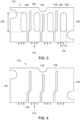
- Wearable ISF sensing module 100 includes a plurality of wearable ISF sensing modules 118 that are separable from each other such that each wearable ISF sensing modules 118 operates independently of the other wearable ISF sensing modules 118.
- wearable ISF sensing module 100 includes four wearable ISF sensing modules 118 that are separable from each other.
- wearable ISF sensing module 100 may include any number of wearable ISF sensing modules 118 that enable wearable ISF sensing module 100 to operate as described herein. Wearable ISF sensing modules 118 are separated from each other after layers 102-110 have been laminated together to form wearable ISF sensing module 100.
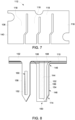
- wearable ISF sensing modules 118 are separated from each other prior to being shipped to the user. In alternative embodiments, wearable ISF sensing modules 118 are separated from each other by the user and/or medial professional after wearable ISF sensing module 100 is shipped to the user. As shown in FIGS. 1-3 and 7 , top patch layer 102 and bottom patch layer 110 define a plurality of separation slots 120 between wearable ISF sensing modules 118 and enable wearable ISF sensing modules 118 to be separated from each other.
- top patch layer 102 and bottom patch layer 110 each have a patch layer thickness 136 of approximately 75 ⁇ m
- electronics module component layer 106 has an electronics module component layer thickness 138 of approximately 25 ⁇ m
- first and second adhesive layers 104 and 108 each have an adhesive layer thickness 140 of approximately 25 ⁇ m such that patch component 112 and microneedles 114 have a thickness 142 of approximately 325 ⁇ m.
- patch component 112 has a rectangular shape.
- patch component 112 may have any shape that enables wearable ISF sensing module 100 to operate as described herein including, without limitation, an elliptical shape, an elongated shape, a circular shape, and/or any other shape that enables wearable ISF sensing module 100 to operate as described herein.
- the user may want to conceal that they have a certain medical condition and may want to disguise wearable ISF sensing module 100.
- wearable ISF sensing module 100 and patch component 112 may be sized and shaped like a common adhesive bandage, or mounted to an insertion device of appropriate size.
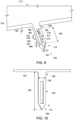
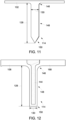
- Microneedles 114 each include a microneedle base 146, a body 148, and a tip 150.
- Microneedle base 146 is attached to patch component 112
- body 148 is attached to microneedle base 146
- tip 150 is attached to body 148.
- Wearable ISF sensing module 100 is formed such that microneedle base 146 extends from patch component 112 and is substantially coplanar with patch component 112. Additionally, body 148 extends from microneedle base 146 and tip 150 extends from body 148 such that microneedle base 146, body 148, and tip 150 are substantially coplanar with patch component 112. Microneedles 114 may then be bent to an appropriate angle for insertion into the skin of the user.
- microneedles 114 each include a first surface 152, a second surface 154 opposite first surface 152, a third surface 156, and a fourth surface 158 opposite third surface 156.
- First surface 152 and second surface 154 each have a length that is equal to microneedle length 128 and a width that is equal to microneedle width 130.
- Third surface 156 and fourth surface 158 each have a length that is equal to microneedle length 128 and a width that is equal to thickness 142.
- first surface 152, second surface 154, third surface 156, and fourth surface 158 each have a flat or planar profile.
- microneedles 114 each include at least one surface that has a flat or planar profile.
- microneedles 114 each include four surfaces that each have a flat or planar profile.
- the first, second, third, and fourth materials are the same material.
- the first, second, third, and fourth materials may be stainless steel or an alloy of stainless steel.
- the first, second, third, and fourth materials may be a polymer.
- each of the first, second, third, and fourth materials may be selected based on the function of the component they form.
- the third and fourth materials, forming body 148 and tip 150 respectively may be a material with a hardness (the measure of the resistance to localized plastic deformation induced by either mechanical indentation or abrasion) greater than the hardness of the second material because body 148 and tip 150 puncture the skin of the user.
- the second material may be a material that has greater pliability than the first, third, and fourth materials because microneedle base 146 bends.
- electronics module component layer 106 includes a substrate 168, at least one electrical circuit 170, sensors 144, and communication and energy management components.
- FIG. 13 is a block diagram of an exemplary electronics architecture of the communication and energy management components.
- the communication and energy management components described above may include an on-patch control module 172, an off-patch control module 174, and a cable (not shown) communicatively coupling electrical circuit 170, sensors 144, and/or on-patch control module 172 to off-patch control module 174.
- Electronics module component layer 106 may include any of on-patch control module 172, off-patch control module 174, and the cable.
- Off-patch control module 174 may include data storage, power management, and communications components, as described herein.
- On-patch control module 172 may also be referred to herein as an analog-to-digital signal module. Performing the analog to digital conversion close to sensor 144 minimizes noise and spurious signals that may interfere with signals generated by sensors 144, as well as piezoelectric voltages generated in the connection cables.
- the distributed configuration of electronics module component layer 106 enables reducing the footprint and weight of the portion of electronics module component layer 106 in direct contact with the skin (i.e., on-patch control module 172).
- on-patch control module 172 may be relatively light-weight and have a thin form factors, increasing user comfort and improving robustness of attaching patch component 112 to the user and of wearable ISF sensing module 100 itself. Further, because on-patch control module 172 is separate from off-patch control module 174, off-patch control module 174 may be positioned remotely from patch component 112. Alternatively, on-patch control module 172 and off-patch control module 174 are incorporated in the same component, and are not located remotely from one another. As another alternative, in some embodiments, on-patch control module 172 and off-patch control module 174 are located remotely from one another, but are not communicatively coupled using the cable. Instead, in such embodiments, on-patch control module 172 and off-patch control module 174 communicate with each other wirelessly, using any suitable wireless communications protocol.
- Off-patch control module 174 may be positioned remotely from on-patch control module 172 using the cable.
- off-patch control module 174 may be stored in a pocket of a garment (e.g., pants or shirt), or may be attached, for example, to a belt or a heart-rate monitor strap (e.g., using a clip or hook and loop fasteners).
- off-patch control module 174 includes a memory device and a microcontroller (MCU) 180.
- Off-patch control module 174 may also include a wireless communications unit 182 (e.g., a Bluetooth unit), a sensor data interface unit 184, a battery unit 186, and a microneedle actuation unit 188.
- Battery unit 186 may be rechargeable, for example, using induction charging.
- memory device 180 may be a microSD card or other data storage device that is removably insertable into or permanently installed in off-patch control module 174.
- Off-patch control module 174 may be capable of wireless communication with a remote computing device (e.g., a mobile computing device) using Bluetooth communications or alternative approaches such as direct Wi-Fi. Further, off-patch control module 174 may be capable of bi-directional communication, allowing off-patch control module 174 or the remote computing device to store and recall prior data in the event of a communications breakdown.
- a remote computing device e.g., a mobile computing device
- Bluetooth communications e.g., Bluetooth communications or alternative approaches such as direct Wi-Fi.
- off-patch control module 174 may be capable of bi-directional communication, allowing off-patch control module 174 or the remote computing device to store and recall prior data in the event of a communications breakdown.
- off-patch control module 174 communicates with an associated software application installed on the computing device.
- the software application may include multiple functions that assist a user in using wearable ISF sensing module 100.
- the software application may upload all data to a cloud storage system, include algorithms for analyzing trends in the data, and enable users to customize the data analysis.
- the software application may also enable data (in a raw form or subsequent to analysis) to be displayed on the computing device.
- the software application (or off-patch control module 174 itself) may analyze the biochemical data collected by wearable ISF sensing module 100. Further, the software application may generate an alarm when the biomarkers deviate from an expected range. Further, data may be stored on off-patch control module 174 as a backup and downloaded to the computing device upon re-establishment of communications.
- substrate 168 includes a patch attached to patch component 112 of top patch layer 102 and bottom patch layer 110.
- substrate 168 is formed of polyethylene terephthalate (PET) and is attached to patch component 112 of top patch layer 102 and bottom patch layer 110 as described above.
- Electrical circuit 170, sensors 144, and/or on-patch control module 172 may be printed on substrate 168, and substrate 168 may be attached to patch component 112 of top patch layer 102 and bottom patch layer 110.
- At least a portion of substrate may be laminated to patch component 112 of top patch layer 102 and bottom patch layer 110 to maintain a position of electrical circuit 170, sensors 144, and/or on-patch control module 172 on substrate 168 and/or patch component 112 of top patch layer 102 and bottom patch layer 110 during use.
- wearable ISF sensing module 100 does not include substrate 168. Rather, electrical circuit 170, sensors 144, and/or on-patch control module 172 may be printed directly on patch component 112 of top patch layer 102 and/or bottom patch layer 110.
- electrical circuit 170, sensors 144, and/or on-patch control module 172 are printed on both sides of substrate 168 and bottom patch layer 110 is sized and shaped like top patch layer 102 such that electrical circuit 170, sensors 144, and/or on-patch control module 172 are accessible on both sides of substrate 168. That is, substrate 168 may have electrical circuit 170, sensors 144, and/or on-patch control module 172 on both sides of substrate 168 such that wearable ISF sensing module 100 is double sided, increasing the monitoring capabilities of wearable ISF sensing module 100. Sensors 144 positioned on opposite sides of substrate 168 may be configured to monitor the same biomarker or different biomarkers.
- Electrical circuit 170 communicatively couples sensors 144 to on-patch control module 172 and/or off-patch control module 174.
- electrical circuit 170 may be any circuit that transmits data from sensors 144 to on-patch control module 172 and/or off-patch control module 174.
- each wearable ISF sensing module 100 includes twelve microneedles 114, and each microneedle 114 includes at least one sensor 144 positioned at least partially on body 148 and tip 150. Each sensor 144 is positioned on body 148 and/or tip 150 such that sensors 144 are embedded in the dermis of the user's skin when microneedles 114 are inserted into the user's skin. In the exemplary embodiment, each sensor 144 includes a bio sensor for sensing a biomarker within the ISF.
- each wearable ISF sensing modules 118 includes three microneedles 114 and each microneedle 114 includes at least one sensor 144 such that electronics module component layer 106 of each wearable ISF sensing modules 118 includes a first sensor 190, a second sensor 192, and a third sensor 194.
- first, second, and third sensors 190, 192, and 194 are the same sensors for detecting and measuring the same biomarkers. More specifically, first, second, and third sensors 190, 192, and 194 may be configured to measure the same biochemical species and report the results (either the data from all three sensors 190, 192, and 194 or an average of all three sensors 190, 192, and 194) to the user and/or medical professional.
- first, second, and third sensors 190, 192, and 194 are different sensors for detecting and measuring the different biomarkers.
- 2-electrode biosensor 196 and/or 3-electrode biosensor 198 may detect ISF using a plurality of electroanalytical detection methods including, but not limited to, chronoamperometry, cyclic voltammetry, square wave voltammetry, and/or any other electroanalytical detection method that enables sensors 144 to operate as described herein. Additionally, the biomarker that is to be detected at least partially determines the type of sensor 144 embedded on microneedles 114. Additionally, sensors 144 may include other types and/or classes of biosensors. For example, sensors 144 may include field-effect transistor biosensor (not shown) and/or any other type of sensor that enables wearable ISF sensing module 100 to operate as described herein.
- a fluid motive device such as a vacuum pump, is not required to continually replenish the ISF flowing to electrodes 200, 202, 204, 206, and/or 208.
- the embodiments described herein include systems and methods for wearable ISF sensing devices.
- the device includes a plurality of layers laminated together to form a patch component and at least one microneedle extending from the patch component.
- the layers include a first patch layer, a first adhesive layer, an electronics module component layer, a second adhesive layer, and a second patch layer.
- the first and second patch layers structurally support the electronics module component layer, and the first and second adhesive layers laminate the first and second patch layers to the electronics module component layer. Lamination of the layers ensures that the microneedles remain intact as they are inserted into the skin of the user.
- the microneedles of the wearable ISF sensing devices described herein are structurally stronger than previous microneedles and remain intact as they monitor biomarkers within the user's ISF.
- the microneedle includes a microneedle base, a body, and a tip.
- the microneedle has a substantially flat or planar profile and a slot is defined within the body of the microneedle.
- the slot has a first opening and a second opening.
- the electronics module component layer includes a sensor positioned over the second opening such that the sensor and the slot define a channel that channels ISF to the sensor.
- the microneedle and the sensor are inserted into the user's skin such that the sensor is positioned within the dermis of the user's skin.
- the ISF flows into the channel from adjacent tissue, and the sensor detects and measures biomarkers within the ISF.
- the user, observer, trainer, coach, and/or a medical professional may then monitor a medical condition or performance/readiness metric based on the data collected by the sensor.
- the wearable ISF sensing device enables detection of biomarkers while reducing cleanup and disposal of bodily fluids and reducing the equipment required to measure biomarkers within the ISF. Additionally, directly measuring ISF in the interstitial space reduces the lag time between changes in biomarker concentration and read-out.
- An exemplary technical effect of the methods, systems, and apparatus described herein includes at least one of: (a) detecting biomarkers within ISF; (b) reducing cleanup and disposal of bodily fluids associated with biomarker detection; (c) reducing the equipment required to measure biomarkers within the ISF; and (d) reducing the error associated with detection of biomarkers within ISF.
- Exemplary embodiments for wearable ISF sensing devices are described herein.
- the systems and methods are not limited to the specific embodiments described herein, but rather, components of systems and/or steps of the methods may be utilized independently and separately from other components and/or steps described herein.
- the methods may also be used in combination with other systems, and are not limited to practice with only the systems described herein. Rather, the exemplary embodiment can be implemented and utilized in connection with many other systems.
Landscapes
- Health & Medical Sciences (AREA)
- Life Sciences & Earth Sciences (AREA)
- Physics & Mathematics (AREA)
- Surgery (AREA)
- General Health & Medical Sciences (AREA)
- Engineering & Computer Science (AREA)
- Biomedical Technology (AREA)
- Heart & Thoracic Surgery (AREA)
- Medical Informatics (AREA)
- Molecular Biology (AREA)
- Biophysics (AREA)
- Animal Behavior & Ethology (AREA)
- Pathology (AREA)
- Public Health (AREA)
- Veterinary Medicine (AREA)
- Optics & Photonics (AREA)
- Chemical & Material Sciences (AREA)
- Chemical Kinetics & Catalysis (AREA)
- General Chemical & Material Sciences (AREA)
- Emergency Medicine (AREA)
- Measurement Of The Respiration, Hearing Ability, Form, And Blood Characteristics Of Living Organisms (AREA)
Applications Claiming Priority (1)
| Application Number | Priority Date | Filing Date | Title |
|---|---|---|---|
| US18/456,193 US20250064349A1 (en) | 2023-08-25 | 2023-08-25 | Microneedle-integrated interstitial fluid biomarker sensor systems and methods thereof |
Publications (1)
| Publication Number | Publication Date |
|---|---|
| EP4512310A1 true EP4512310A1 (fr) | 2025-02-26 |
Family
ID=92264062
Family Applications (1)
| Application Number | Title | Priority Date | Filing Date |
|---|---|---|---|
| EP24193300.1A Pending EP4512310A1 (fr) | 2023-08-25 | 2024-08-07 | Systèmes de capteur de biomarqueur de fluide interstitiel à micro-aiguilles intégrées et procédés associés |
Country Status (3)
| Country | Link |
|---|---|
| US (1) | US20250064349A1 (fr) |
| EP (1) | EP4512310A1 (fr) |
| CN (1) | CN119498823A (fr) |
Families Citing this family (1)
| Publication number | Priority date | Publication date | Assignee | Title |
|---|---|---|---|---|
| US20260026744A1 (en) * | 2024-07-25 | 2026-01-29 | Panther Life Sciences Corporation | Microneedle array systems and devices, and methods associated with manufacturing and use |
Citations (6)
| Publication number | Priority date | Publication date | Assignee | Title |
|---|---|---|---|---|
| US20050139469A1 (en) * | 2003-10-31 | 2005-06-30 | Davies Oliver W.H. | Electrochemical test strip for reducing the effect of direct and mediated interference current |
| US20100230285A1 (en) * | 2009-02-26 | 2010-09-16 | Abbott Diabetes Care Inc. | Analyte Sensors and Methods of Making and Using the Same |
| US20170127989A1 (en) * | 2008-03-31 | 2017-05-11 | Abbott Diabetes Care Inc. | Shallow implantable analyte sensor with rapid physiological response |
| WO2021076933A1 (fr) * | 2019-10-16 | 2021-04-22 | Jason Michael Strohmaier | Dispositifs corporels de biologie délocalisée pour évaluer l'activité immunitaire à partir d'un fluide interstitiel et procédés d'utilisation de ceux-ci |
| WO2021216186A2 (fr) * | 2020-02-21 | 2021-10-28 | The Regents Of The University Of California | Patch capteur à réseau de micro-aiguilles pour la détection continue d'analytes multiples |
| US20230003725A1 (en) * | 2019-12-12 | 2023-01-05 | Joseph Wang | Devices and methods for aptamer-assisted microneedle-based monitoring of biomarkers |
Family Cites Families (3)
| Publication number | Priority date | Publication date | Assignee | Title |
|---|---|---|---|---|
| US9987427B1 (en) * | 2014-06-24 | 2018-06-05 | National Technology & Engineering Solutions Of Sandia, Llc | Diagnostic/drug delivery “sense-respond” devices, systems, and uses thereof |
| CN117858659A (zh) * | 2021-07-07 | 2024-04-09 | 加利福尼亚大学董事会 | 可穿戴的非侵入性的微针传感器 |
| JP7141625B1 (ja) * | 2021-09-17 | 2022-09-26 | リンテック株式会社 | マイクロニードルパッチ及びマイクロニードル構造体 |
-
2023
- 2023-08-25 US US18/456,193 patent/US20250064349A1/en active Pending
-
2024
- 2024-08-07 EP EP24193300.1A patent/EP4512310A1/fr active Pending
- 2024-08-20 CN CN202411143512.3A patent/CN119498823A/zh active Pending
Patent Citations (6)
| Publication number | Priority date | Publication date | Assignee | Title |
|---|---|---|---|---|
| US20050139469A1 (en) * | 2003-10-31 | 2005-06-30 | Davies Oliver W.H. | Electrochemical test strip for reducing the effect of direct and mediated interference current |
| US20170127989A1 (en) * | 2008-03-31 | 2017-05-11 | Abbott Diabetes Care Inc. | Shallow implantable analyte sensor with rapid physiological response |
| US20100230285A1 (en) * | 2009-02-26 | 2010-09-16 | Abbott Diabetes Care Inc. | Analyte Sensors and Methods of Making and Using the Same |
| WO2021076933A1 (fr) * | 2019-10-16 | 2021-04-22 | Jason Michael Strohmaier | Dispositifs corporels de biologie délocalisée pour évaluer l'activité immunitaire à partir d'un fluide interstitiel et procédés d'utilisation de ceux-ci |
| US20230003725A1 (en) * | 2019-12-12 | 2023-01-05 | Joseph Wang | Devices and methods for aptamer-assisted microneedle-based monitoring of biomarkers |
| WO2021216186A2 (fr) * | 2020-02-21 | 2021-10-28 | The Regents Of The University Of California | Patch capteur à réseau de micro-aiguilles pour la détection continue d'analytes multiples |
Non-Patent Citations (3)
| Title |
|---|
| HEIFLER OMRI ET AL: "Clinic-on-a-Needle Array toward Future Minimally Invasive Wearable Artificial Pancreas Applications", vol. 15, no. 7, 22 June 2021 (2021-06-22), US, pages 12019 - 12033, XP093234975, ISSN: 1936-0851, Retrieved from the Internet <URL:https://pubs.acs.org/doi/pdf/10.1021/acsnano.1c03310> [retrieved on 20241216], DOI: 10.1021/acsnano.1c03310 * |
| HUA JIANGBO ET AL: "Skin-Attachable Sensors for Biomedical Applications", vol. 1, no. 1, 3 October 2021 (2021-10-03), pages 256 - 268, XP093234499, ISSN: 2731-4812, Retrieved from the Internet <URL:https://link.springer.com/content/pdf/10.1007/s44174-022-00018-z.pdf> [retrieved on 20241213], DOI: 10.1007/s44174-022-00018-z * |
| RIBET FEDERICO: "Integrated microsystems for continuous glucose monitoring, interstitial fluid sampling and digital microfluidics", THESIS, 14 February 2020 (2020-02-14), pages 1 - 109, XP055848499, ISBN: 978-91-7-873415-3 * |
Also Published As
| Publication number | Publication date |
|---|---|
| US20250064349A1 (en) | 2025-02-27 |
| CN119498823A (zh) | 2025-02-25 |
Similar Documents
| Publication | Publication Date | Title |
|---|---|---|
| Salim et al. | Recent advances in noninvasive flexible and wearable wireless biosensors | |
| US10201279B2 (en) | Sweat sensing device communication security and compliance | |
| Yang et al. | Wearable and flexible electronics for continuous molecular monitoring | |
| CA3053362C (fr) | Dispositif medical pouvant etre porte sur le corps | |
| McCaul et al. | Challenges and opportunities in wearable technology for biochemical analysis in sweat | |
| CN105873514B (zh) | 动态血糖采集装置及主机 | |
| Coyle et al. | Wearable bio and chemical sensors | |
| JP7483081B2 (ja) | 医療用センサシステム、特に、連続グルコースモニタリングシステム | |
| CN113164104B (zh) | 多位置囊状部 | |
| EP4512310A1 (fr) | Systèmes de capteur de biomarqueur de fluide interstitiel à micro-aiguilles intégrées et procédés associés | |
| US20250000414A1 (en) | Physicochemical-sensing electronic skin for stress response monitoring | |
| CN110831500A (zh) | 医疗系统 | |
| US20250064348A1 (en) | Wearable device for on-demand interstitial fluid biomarker sensing with a microneedle-integrated sensor | |
| EP4447796B1 (fr) | Dispositif portable pour la surveillance continue de paramètres de santé | |
| ES3041691T3 (en) | A wearable device for continuous monitoring of health parameters | |
| WO2023247957A1 (fr) | Capteur biométrique portable | |
| CN110876624A (zh) | 一种分析物监测与自动给药系统 | |
| Medagedara et al. | Review of Recent Advances in Non-invasive, Flexible, Wearable Sweat Monitoring Sensors | |
| CN110879240A (zh) | 一种分析物监测系统 | |
| EP4732766A1 (fr) | Système de mesure de calcul de fluide biologique avec des électrodes réutilisables faisant face à la peau | |
| WO2024123262A1 (fr) | Article chaussant intelligent pour mesurer le taux de sucre et la température | |
| Glennon | Development and application of a wearable device for real time potentiometric determination of electrolytes in sweat | |
| HK40017210A (en) | Medical sensor system, in particular continuous glucose monitoring system | |
| HK40017838A (en) | Body-wearable medical device |
Legal Events
| Date | Code | Title | Description |
|---|---|---|---|
| PUAI | Public reference made under article 153(3) epc to a published international application that has entered the european phase |
Free format text: ORIGINAL CODE: 0009012 |
|
| STAA | Information on the status of an ep patent application or granted ep patent |
Free format text: STATUS: REQUEST FOR EXAMINATION WAS MADE |
|
| 17P | Request for examination filed |
Effective date: 20240807 |
|
| AK | Designated contracting states |
Kind code of ref document: A1 Designated state(s): AL AT BE BG CH CY CZ DE DK EE ES FI FR GB GR HR HU IE IS IT LI LT LU LV MC ME MK MT NL NO PL PT RO RS SE SI SK SM TR |
|
| RAP1 | Party data changed (applicant data changed or rights of an application transferred) |
Owner name: GE PRECISION HEALTHCARE LLC |
|
| STAA | Information on the status of an ep patent application or granted ep patent |
Free format text: STATUS: EXAMINATION IS IN PROGRESS |
|
| 17Q | First examination report despatched |
Effective date: 20260303 |