EP4512367A1 - Dentalvorrichtung mit integrierten fluidischen kanälen und verfahren zur herstellung der dentalvorrichtung - Google Patents
Dentalvorrichtung mit integrierten fluidischen kanälen und verfahren zur herstellung der dentalvorrichtung Download PDFInfo
- Publication number
- EP4512367A1 EP4512367A1 EP23192561.1A EP23192561A EP4512367A1 EP 4512367 A1 EP4512367 A1 EP 4512367A1 EP 23192561 A EP23192561 A EP 23192561A EP 4512367 A1 EP4512367 A1 EP 4512367A1
- Authority
- EP
- European Patent Office
- Prior art keywords
- dental device
- channel
- opening
- teeth
- mouth
- Prior art date
- Legal status (The legal status is an assumption and is not a legal conclusion. Google has not performed a legal analysis and makes no representation as to the accuracy of the status listed.)
- Withdrawn
Links
Images


Classifications
-
- A—HUMAN NECESSITIES
- A61—MEDICAL OR VETERINARY SCIENCE; HYGIENE
- A61C—DENTISTRY; APPARATUS OR METHODS FOR ORAL OR DENTAL HYGIENE
- A61C19/00—Dental auxiliary appliances
- A61C19/06—Implements for therapeutic treatment
- A61C19/063—Medicament applicators for teeth or gums, e.g. treatment with fluorides
-
- A—HUMAN NECESSITIES
- A61—MEDICAL OR VETERINARY SCIENCE; HYGIENE
- A61C—DENTISTRY; APPARATUS OR METHODS FOR ORAL OR DENTAL HYGIENE
- A61C17/00—Devices for cleaning, polishing, rinsing or drying teeth, teeth cavities or prostheses; Saliva removers; Dental appliances for receiving spittle
- A61C17/02—Rinsing or air-blowing devices, e.g. using fluid jets or comprising liquid medication
- A61C17/0211—Rinsing or air-blowing devices, e.g. using fluid jets or comprising liquid medication specially adapted for rinsing the teeth of at least one jaw simultaneously
-
- A—HUMAN NECESSITIES
- A61—MEDICAL OR VETERINARY SCIENCE; HYGIENE
- A61F—FILTERS IMPLANTABLE INTO BLOOD VESSELS; PROSTHESES; DEVICES PROVIDING PATENCY TO, OR PREVENTING COLLAPSING OF, TUBULAR STRUCTURES OF THE BODY, e.g. STENTS; ORTHOPAEDIC, NURSING OR CONTRACEPTIVE DEVICES; FOMENTATION; TREATMENT OR PROTECTION OF EYES OR EARS; BANDAGES, DRESSINGS OR ABSORBENT PADS; FIRST-AID KITS
- A61F5/00—Orthopaedic methods or devices for non-surgical treatment of bones or joints; Nursing devices ; Anti-rape devices
- A61F5/56—Devices for preventing snoring
- A61F5/566—Intra-oral devices
-
- B—PERFORMING OPERATIONS; TRANSPORTING
- B33—ADDITIVE MANUFACTURING TECHNOLOGY
- B33Y—ADDITIVE MANUFACTURING, i.e. MANUFACTURING OF THREE-DIMENSIONAL [3D] OBJECTS BY ADDITIVE DEPOSITION, ADDITIVE AGGLOMERATION OR ADDITIVE LAYERING, e.g. BY 3D PRINTING, STEREOLITHOGRAPHY OR SELECTIVE LASER SINTERING
- B33Y80/00—Products made by additive manufacturing
-
- A—HUMAN NECESSITIES
- A61—MEDICAL OR VETERINARY SCIENCE; HYGIENE
- A61C—DENTISTRY; APPARATUS OR METHODS FOR ORAL OR DENTAL HYGIENE
- A61C13/00—Dental prostheses; Making same
- A61C13/01—Palates or other bases or supports for the artificial teeth; Making same
-
- A—HUMAN NECESSITIES
- A61—MEDICAL OR VETERINARY SCIENCE; HYGIENE
- A61C—DENTISTRY; APPARATUS OR METHODS FOR ORAL OR DENTAL HYGIENE
- A61C17/00—Devices for cleaning, polishing, rinsing or drying teeth, teeth cavities or prostheses; Saliva removers; Dental appliances for receiving spittle
- A61C17/16—Power-driven cleaning or polishing devices
- A61C17/22—Power-driven cleaning or polishing devices with brushes, cushions, cups, or the like
- A61C17/228—Self-contained intraoral toothbrush, e.g. mouth-guard toothbrush without handle
-
- A—HUMAN NECESSITIES
- A61—MEDICAL OR VETERINARY SCIENCE; HYGIENE
- A61C—DENTISTRY; APPARATUS OR METHODS FOR ORAL OR DENTAL HYGIENE
- A61C7/00—Orthodontics, i.e. obtaining or maintaining the desired position of teeth, e.g. by straightening, evening, regulating, separating, or by correcting malocclusions
- A61C7/08—Mouthpiece-type retainers or positioners, e.g. for both the lower and upper arch
-
- A—HUMAN NECESSITIES
- A63—SPORTS; GAMES; AMUSEMENTS
- A63B—APPARATUS FOR PHYSICAL TRAINING, GYMNASTICS, SWIMMING, CLIMBING, OR FENCING; BALL GAMES; TRAINING EQUIPMENT
- A63B2209/00—Characteristics of used materials
-
- A—HUMAN NECESSITIES
- A63—SPORTS; GAMES; AMUSEMENTS
- A63B—APPARATUS FOR PHYSICAL TRAINING, GYMNASTICS, SWIMMING, CLIMBING, OR FENCING; BALL GAMES; TRAINING EQUIPMENT
- A63B71/00—Games or sports accessories not covered in groups A63B1/00 - A63B69/00
- A63B71/08—Body-protectors for players or sportsmen, i.e. body-protecting accessories affording protection of body parts against blows or collisions
- A63B71/085—Mouth or teeth protectors
Definitions
- the present invention is related to a dental device used to cover at least part of the teeth, gums and other parts of the mouth such as an aligner tray, a retainer tray, a mouthguard, a nightguard, and similar.
- Said device has integrated micro or macro-fluidic channels and reservoirs which can contain one or multiple beneficial substances such as antibacterial liquid, fluoride, vitamins, flavor or other substances.
- the present invention is also related to a method for manufacturing said dental device and to methods for circulating a substance and/or saliva and oxygen through the dental device.
- Clear aligners as disclosed for example in document US 2022/0374119 A1 play a significant role in the dental industry, particularly in orthodontics and the treatment of teeth misalignment. They are advanced products that are almost invisible and are used for moderate or mild correction of orthodontic problems. As an alternative to traditional metal braces, clear aligners provide patients with a discreet and comfortable option for straightening their teeth. Usually, a set of 7-10 aligners is manufactured, each one being unique and contributing to an incremental movement of the teeth from the initial position to the final desired state. Each aligner is worn for about 2 weeks and is then replaced with the subsequent aligner in the series.
- Classical aligners are made by 3D printing molds which represent the negative of the aligner, and then thermoforming sheet of polymer on top of them. Afterwards, the set of aligners is cut out from the sheet and postprocessed. This is somewhat limiting the geometry and the precision of the manufactured aligner since supplementary features are difficult to add.
- the dental device aims to provide a dental device overcoming the drawbacks of the prior art.
- the dental device according to the invention comprises at least one channel provided in the wall of said dental device.
- Said channel comprises a cavity defined within the wall of said dental device and at least one opening connecting said cavity to the exterior.
- channel is used here as a generic term and should not be interpreted as a geometric limitation implying any type of shape or ratio concerning the dimensions of the cavity or the opening.
- the channel may advantageously be coated or preferably filled, or partially filled with a beneficial fluid, such as an antibacterial agent, specific medication, fluoride, remineralization agents, vitamins, flavour or other substances.
- a beneficial fluid such as an antibacterial agent, specific medication, fluoride, remineralization agents, vitamins, flavour or other substances.
- the channel may be especially designed to act as a fluid reservoir that slowly releases said beneficial fluid onto the surface of the teeth or gums or more generally in the mouth during the use of the aligner.
- the channel may advantageously comprise two or more openings facilitating the circulation of liquids and/or air through the dental device.
- the channel may only act as a saliva and oxygen pathway to the teeth and gums, the provision of an added beneficial fluid being optional.
- the present invention is related to a dental device intended to cover at least part of a teeth and optionally at least part of gums or other surfaces of a mouth for repositioning, retaining, protecting and/or treating said teeth and optionally said gums or other surfaces of the mouth, said dental device comprising a channel provided in the wall of said dental device, said channel comprising a cavity defined within the wall of said dental device and at least one opening connecting said cavity to the exterior.
- a conventional aligner is simply coated on the surface, the active time of the coating is very limited. But by integrating fluidic channels in the aligner, this duration can be significantly increased, fine-tuned and even customized per customer requirements. Additionally, multiple channel paths with various inward/outward facing geometries can be designed to serve different functions. These include various drugs/medications, antibacterials, fluoride for enhanced teeth remineralization, vitamins, flavor releasing channels, simple oxygen/saliva pathways or others. Various substances can be used to treat different dental issues, for example:
- the dental device has one or several of the following features:
- the invention also relates to a kit comprising the dental device and at least one plug or film intended to cover the at least one opening. Indeed the dental device and the plug or film could be provided separately.
- said device is not limited only to aligners, but to the whole family of similar products which are used to cover the teeth such as retainers, a mouthguard, a nightguard, and similar devices.
- the dental device according to the invention can be advantageously manufactured by 3D printing, for example, by techniques such as SLA (Stereolithography), DLP (Digital Light Processing) and FDM (Fused Deposition Modelling) techniques.
- SLA Stepolithography
- DLP Digital Light Processing
- FDM Field Deposition Modelling
- the invention relates to a method for manufacturing the dental device as aforementioned, the method comprising a step of manufacturing the dental device with the channel provided in the wall of said dental device by additive manufacturing, said at least one opening of the channel being manufactured during this step or during a further step of micro-machining.
- the dental device comprises several openings provided in one channel or several channels, at least one of the several openings being manufactured during the further step of micro-machining.
- the invention also relates to methods for circulating a substance and/or saliva and oxygen through the dental device in view of releasing said substance and/or saliva and oxygen inside the mouth.
- the invention relates to a method for circulating a substance in the dental device mounted inside the mouth for covering at least part of the teeth and optionally at least part of gums or other surfaces of the mouth, the method comprising before use a step of filling at least partially the cavity with the substance via the at least one opening and a step of releasing said substance inside the mouth through the at least one opening.
- the invention relates to a method for circulating saliva and oxygen in the dental device mounted inside the mouth for covering at least part of the teeth and optionally at least part of gums or other surfaces of the mouth, said dental device comprising at least one opening acting as a channel inlet oriented in opposite direction to the teeth and at least one opening acting as a channel outlet oriented toward the teeth, said saliva and oxygen circulating between the channel inlet and the channel outlet to be released in the direction of the teeth.
- the dental device according to the invention is designed to cover at least part of the teeth and optionally at least part of the gums and/or other surfaces of the mouth for repositioning, retaining, protecting and/or treating said teeth and optionally said gums and/or other surfaces of the mouth.
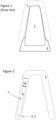
- the dental device 1 comprises at least one channel 7 comprising a cavity 6 defined within the wall of the dental device 1, and at least one opening 4, 5 connecting said inner cavity 6 with the exterior (see for example Figure 2 ).
- the cavity 6 may act as a reservoir for a beneficial fluid.
- the opening 4, 5 can be used as an inlet to introduce said beneficial fluid in the cavity 6.
- the opening 4, 5 may also allow a slow release of the fluid into the mouth when the dental device is worn by a user.
- a same opening can be used as inlet and outlet or at least two distinct openings can respectively be used as inlet, also called channel inlet with the reference number 4, and as outlet, also called channel outlet with the reference number 5.
- the width W of the channel cavity 6 is limited by the width of the wall of the dental device 1, which is typically in the order of 1 mm, but can be also made thicker (2 or 3 mm) as long as it does not become too cumbersome to wear for a user. Typically, the cavity width will be lower than 1 mm, preferably between 50 and 500 micrometers.
- the dental device can comprise one, two, three, four or more channels which are not in fluidic communication, with each channel delivering a different substance or a same substance for a better control and localized delivery of the substance as illustrated hereafter. For each channel, the dental device can comprise one, two, three, four or more openings.
- the size and number of the openings can be adapted to the nature of the beneficial fluid and to the intended use of the dental device. If the openings are too large and the beneficial fluid exhibits a relatively low viscosity and / or low surface tension, it may pour too rapidly out of the reservoir. If on the other hand the openings are too small, or too few, the circulation of the beneficial fluid, air or saliva may be hindered and be ineffective. Typically, the diameter of the openings with a circular cross section will be below 1 mm and can be as low as a few tens of micrometers.
- the openings can be provided as a plurality of micro-pores at the wall of the dental device, in communication with the cavity.
- the openings can be configured to face the teeth, the gums or any other desired part of the mouth, the orientation of the openings being dependent on their role.
- One or more openings can form connectors to introduce a syringe or similar device, also called tool.
- the connector facilitates the rinsing and cleaning of the channel after production by connecting the syringe or similar device.
- the connector can be used as an inlet for loading a substance in the cavity.
- the connector can be integrated by design to the dental device and form an elongated hole provided through the dental device to accommodate the syringe or similar device.
- it can be a sacrificial connector connected at the channel opening and monolithically manufactured by 3D printing with the dental device. Such a sacrificial connector can be easily removed after playing its role of cleaner or inlet by cutting it off from the main body of the aligner along a designed cut-off line.
- Integrated elastic one-way valves, caps or lids at openings acting as channel inlet or outlet can be designed and manufactured. These valves allow the beneficial liquid to be poured in the channels during the manufacturing of the dental device, but afterwards prevent the release of the liquid through the channel inlets.
- plugs or films can be used to temporarily plug the channel inlets or the channel outlets, and to be removed before use. These plugs and films can be dissolvable in saliva, and thus be dissolved briefly upon the start of the dental device's use.
- the substance fills at least partially the channel and could possibly only form a coating on the walls of the channel.
- the channel is not filled with any substance before use, said channel being provided for the circulation of the saliva and oxygen to the teeth.
- reinforcement can be provided inside the channel. This allows to increase the ratio between the width of the channel and the thickness of the wall of the dental device without reducing the rigidity and mechanical properties of the device.
- the reinforcement can adopt different shapes. It may comprise one or more reinforcement beams across the cavity, provided at key positions where the device wall is expected to be exposed to significant mechanical stress. Alternatively, or in addition, the reinforcement may comprise a permeable lattice within the cavity, defined for instance as an open-cell structure. Further geometries such as reinforcement walls with holes, meshes, and others might be used as well.
- the dental device is made up of polymeric material and can be manufactured by any techniques of 3D printing such as for example SLA, DLP and FDM techniques.
- the polymeric material can be a biocompatible photocurable resin such as the commercially available Biomed Clear (Formlabs), Figure 4 TM MED-AMB 10 (3D Systems), KeySplint Soft Classic (KeyStone), Dental Clear PRO (Harz Labs), DSG (LuxCreo) or others.
- the aligner could also be manufactured out of a rubber.
- said dental device is manufactured out of a shape memory polymer like the commercially available TC-85DAC (Graphy), Biocompatible Shape Memory resin (3Dresyns), Clear (ODS) or others.
- the polymer can be activated at a predefined temperature so that the dental device retrieves its initial shape. This is advantageous since these devices may lose their original shape by normal wear or accidentally as a result of inadequate manipulation.
- a 3D printing process can be used to create a device of the invention directly comprising the openings of the channels, defined in the 3D-printed design file. This has the advantage of the simplicity of a one-step fabrication process.
- micromachining we refer to any known technique suitable for producing small holes in the wall of the dental device, including for example: piercing, drilling or laser ablation. This approach has the advantage of enabling better control of the size and shape of micro-metric holes than could be achieved with the limited resolution of some 3D-printing machines.
- FIG 2 an embodiment of the dental device 1 with one integrated channel 7 is represented.
- the integrated channel 7 forms the reservoir 6 with a single opening 4, 5, which can be first used as inlet for filling the reservoir 6 with a beneficial substance, and then, during use, as outlet to deliver the beneficial substance to the teeth.
- the opening is defined on the side of the device wall which faces the teeth and gums when the device is worn.
- the beneficial fluid with a possible medical effect can be locally released in this region, the release being driven by simple diffusion through the opening 4,5.
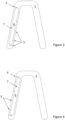
- the dental device 1 also comprises a single channel 7 provided with a cavity 6 defined within the wall of the dental device 1.
- several openings 4, 5 communicate the cavity 6 with the exterior.
- the opening 4 can be used as an inlet to introduce a beneficial fluid in the cavity 6, whereas the openings 5, facing the teeth when the device is worn, can act as outlets releasing the beneficial fluid at the interface with the teeth and gums.
- the device of Figure 3 may also be used without the addition of any substance.
- the channel 7 can be beneficial simply by allowing the circulation of air and saliva from the outer side of the dental device 1 to the inner side in contact with the teeth.
- additional openings 4 (not represented) on the outer surface of the dental device 1 to enhance the circulation of fluids.
- the channel outlets 5 are facing the mouth in the opposite direction to the teeth. In such an embodiment the integrated channel would most likely be used for flavor containing substances.
- the channel inlet 4 is integrated by design to the dental device 1 to form a connector 11. This will facilitate the rinsing and cleaning of the integrated channel after production by connecting syringes and similar devices. As well, this integrated inlet is used for loading the substance in the reservoir.
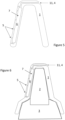
- Figure 6 shows a different embodiment where the dental device 1 covers at least some of the teeth 2 but also at least part or all of the gums 3 and other surfaces in the mouth.
- a dental device can be used to selectively bring medication or other beneficial substances to gums 3 or other parts of the mouth in order to treat other dental issues.
- Such a design of the dental device covering at least part of the gums can as well be applied to all the other embodiments of the invention.
- the dental device 1 has multiple integrated channels 7a, 7b, 7c, 7d which are not in fluidic communication. These channels are designed to contain different beneficial substances, or for a better control and localized delivery of the same substance.
- a first channel 7a has an inlet 4a, the reservoir 6a and mouth-facing outlets 5a, which would most likely be used for flavor containing substance.
- the second channel 7b has an inlet 4b forming a connector 11, the reservoir 6b and outlets 5b which are facing the teeth. This channel would most likely be used for antibacterial liquid, drugs, or fluoride.
- Other channels might be also included, such as the third and fourth channels 7c, 7d which are seen just as a tubes in this cross section.
- a reinforcement 21 can be defined within the channel 7 as shown in Figure 8 .
- the reinforcement 21 may comprise one or more reinforcement beams across the cavity 6, provided at key positions where the device wall is expected to be exposed to significant mechanical stress.
- the reinforcement may comprise a permeable lattice within the cavity, defined for instance as an open-cell structure.
- Some examples of such open-cell structures which can be implemented as permeable reinforcement lattices 21 are shown in Figure 9 .
- the reinforcement structures 21, whether defined as beams or lattices, may be advantageously fabricated simultaneously and by means of the same additive manufacturing process as the rest of the dental device 1.
- a dental device 1 with an integrated channel 7 and a reinforcement 21 is also covering at least part of the gums 3 and has channels outlets 5 facing zones of interest on the gums 3.
- the part of the dental device 1 in direct contact with the teeth 2 is provided with a reinforcement structure 21. This confers a degree of rigidity to the structure which may be needed to apply pressure on the teeth as required in orthodontic treatments.
- the part of the dental device 1 in direct contact with the gums 3 can be designed with low rigidity, to reduce and distribute the pressure on the gums 3, increasing the comfort for the user and reducing the risk of damaging these sensitive parts.
- a dental device 1 covering teeth 2 and gums 3 on both sides has two channels 7a, 7b with respective inlets 4a, 4b, and reservoirs 6a, 6b.
- reinforcements 21 with, for example, permeable lattices are used to reinforce the rigidity of the dental device 1.
- Integrated channels 7a, 7b and their inlets 4a, 4b are located on the opposite sides of the teeth 2, and in this particular case, the reservoir 6a of the channel 7a delivers beneficial substances to the gums 3 via outlets 5a, while the reservoir 6b of the channel 7b is oriented towards the teeth 2 via outlets 5b.
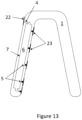
- a sacrificial connector 8 is added to the dental device 1. This has the same role as the integrated connector 11 described in Figure 5 .
- the advantage of the sacrificial connector is that after the dental device has been cleaned and filled up with a beneficial substance, it can be easily removed by cutting/breaking it off along a cut line 9, thus leaving the outer surface compact as compared to the integrated connector 11 presented in Figure 5 .
- the cut line 9 can be defined by zones which have been weakened by design on purpose, thus facilitating the removal of connectors 8.
- an integrated elastic one way valve, cap or lid 22 on the channel inlet 4 is designed and manufactured.
- This valve allows the beneficial liquid to be poured in the channel during the manufacturing of the dental device, but afterwards prevents the liquid to be released - namely through the channel inlet.
- Plugs or films 23 can be used to temporarily plug the channel outlets 5, and to be removed before use. These plugs and films can be also dissolvable in saliva, and thus be dissolved briefly upon the start of the dental device's use.
Landscapes
- Health & Medical Sciences (AREA)
- Life Sciences & Earth Sciences (AREA)
- Animal Behavior & Ethology (AREA)
- General Health & Medical Sciences (AREA)
- Public Health (AREA)
- Veterinary Medicine (AREA)
- Dentistry (AREA)
- Epidemiology (AREA)
- Engineering & Computer Science (AREA)
- Nursing (AREA)
- Pulmonology (AREA)
- Orthopedic Medicine & Surgery (AREA)
- Otolaryngology (AREA)
- Biomedical Technology (AREA)
- Heart & Thoracic Surgery (AREA)
- Vascular Medicine (AREA)
- Chemical & Material Sciences (AREA)
- Manufacturing & Machinery (AREA)
- Materials Engineering (AREA)
- Oral & Maxillofacial Surgery (AREA)
- Dental Tools And Instruments Or Auxiliary Dental Instruments (AREA)
Priority Applications (5)
| Application Number | Priority Date | Filing Date | Title |
|---|---|---|---|
| EP23192561.1A EP4512367A1 (de) | 2023-08-22 | 2023-08-22 | Dentalvorrichtung mit integrierten fluidischen kanälen und verfahren zur herstellung der dentalvorrichtung |
| EP24710434.2A EP4766289A1 (de) | 2023-08-22 | 2024-03-13 | Dentalvorrichtung mit integrierten fluidischen kanälen und verfahren zur herstellung der dentalvorrichtung |
| PCT/EP2024/056739 WO2025040271A1 (en) | 2023-08-22 | 2024-03-13 | Dental device with integrated fluidic channels and method for manufacturing said dental device |
| EP24759166.2A EP4766290A1 (de) | 2023-08-22 | 2024-08-22 | Dentalvorrichtung mit integriertem fluidischem reservoir und verfahren zur herstellung der dentalvorrichtung |
| PCT/EP2024/073583 WO2025017218A1 (en) | 2023-08-22 | 2024-08-22 | Dental device with integrated fluidic reservoir and method for manufacturing said dental device |
Applications Claiming Priority (1)
| Application Number | Priority Date | Filing Date | Title |
|---|---|---|---|
| EP23192561.1A EP4512367A1 (de) | 2023-08-22 | 2023-08-22 | Dentalvorrichtung mit integrierten fluidischen kanälen und verfahren zur herstellung der dentalvorrichtung |
Publications (1)
| Publication Number | Publication Date |
|---|---|
| EP4512367A1 true EP4512367A1 (de) | 2025-02-26 |
Family
ID=87762507
Family Applications (1)
| Application Number | Title | Priority Date | Filing Date |
|---|---|---|---|
| EP23192561.1A Withdrawn EP4512367A1 (de) | 2023-08-22 | 2023-08-22 | Dentalvorrichtung mit integrierten fluidischen kanälen und verfahren zur herstellung der dentalvorrichtung |
Country Status (2)
| Country | Link |
|---|---|
| EP (1) | EP4512367A1 (de) |
| WO (1) | WO2025040271A1 (de) |
Citations (8)
| Publication number | Priority date | Publication date | Assignee | Title |
|---|---|---|---|---|
| EP1318761B1 (de) | 2000-09-21 | 2011-01-19 | Align Technology, Inc. | System zur gleichzeitigen zahnrepositionierung und substanzverabreichung |
| WO2016120799A1 (en) * | 2015-01-29 | 2016-08-04 | Koninklijke Philips N.V. | Mouthpiece with directed fluid jets |
| WO2018018098A1 (en) | 2016-07-28 | 2018-02-01 | Dentech Orthodontics Limited | A teeth aligner system |
| WO2018096524A1 (en) * | 2016-11-28 | 2018-05-31 | Allan Coopersmith | Animal dental hygienic device |
| WO2020020824A1 (de) * | 2018-07-23 | 2020-01-30 | Herrmann Apparatebau Gmbh | Desinfektionsmundstück |
| WO2020223353A1 (en) * | 2019-05-02 | 2020-11-05 | Huafeng Wen | Systems and methods for customized and personalized oral irrigator |
| WO2022020274A1 (en) * | 2020-07-21 | 2022-01-27 | Fresh Health Inc. | Systems and methods for manufacturing personalized oral care devices |
| US20220374119A1 (en) | 2005-04-29 | 2022-11-24 | Align Technology, Inc. | Treatment of teeth by aligners |
Family Cites Families (5)
| Publication number | Priority date | Publication date | Assignee | Title |
|---|---|---|---|---|
| DE3601787A1 (de) * | 1986-01-22 | 1987-07-23 | Cox Kirsten | Verfahren zum applizieren von wirkstoffen und dafuer geeigneten applikator |
| US5194003A (en) * | 1988-06-13 | 1993-03-16 | Transpharm Group, Inc. | Removable device for delivering beneficial agents orally |
| US5090903A (en) * | 1991-01-18 | 1992-02-25 | Taylor Roy M | Dental prosthesis with controlled fluid dispensing means |
| WO2014093850A1 (en) * | 2012-12-13 | 2014-06-19 | Robert Davidson | Mouthguard for the delivery of active ingredients |
| US12527656B2 (en) * | 2021-03-26 | 2026-01-20 | HydrOral, SAS | Oral diffusing device |
-
2023
- 2023-08-22 EP EP23192561.1A patent/EP4512367A1/de not_active Withdrawn
-
2024
- 2024-03-13 WO PCT/EP2024/056739 patent/WO2025040271A1/en not_active Ceased
Patent Citations (8)
| Publication number | Priority date | Publication date | Assignee | Title |
|---|---|---|---|---|
| EP1318761B1 (de) | 2000-09-21 | 2011-01-19 | Align Technology, Inc. | System zur gleichzeitigen zahnrepositionierung und substanzverabreichung |
| US20220374119A1 (en) | 2005-04-29 | 2022-11-24 | Align Technology, Inc. | Treatment of teeth by aligners |
| WO2016120799A1 (en) * | 2015-01-29 | 2016-08-04 | Koninklijke Philips N.V. | Mouthpiece with directed fluid jets |
| WO2018018098A1 (en) | 2016-07-28 | 2018-02-01 | Dentech Orthodontics Limited | A teeth aligner system |
| WO2018096524A1 (en) * | 2016-11-28 | 2018-05-31 | Allan Coopersmith | Animal dental hygienic device |
| WO2020020824A1 (de) * | 2018-07-23 | 2020-01-30 | Herrmann Apparatebau Gmbh | Desinfektionsmundstück |
| WO2020223353A1 (en) * | 2019-05-02 | 2020-11-05 | Huafeng Wen | Systems and methods for customized and personalized oral irrigator |
| WO2022020274A1 (en) * | 2020-07-21 | 2022-01-27 | Fresh Health Inc. | Systems and methods for manufacturing personalized oral care devices |
Also Published As
| Publication number | Publication date |
|---|---|
| WO2025040271A1 (en) | 2025-02-27 |
Similar Documents
| Publication | Publication Date | Title |
|---|---|---|
| JP3640963B2 (ja) | 歯科用処置用具 | |
| US6276935B1 (en) | Medical reservoir system | |
| WO2025017218A1 (en) | Dental device with integrated fluidic reservoir and method for manufacturing said dental device | |
| US11419710B2 (en) | Systems, apparatuses and methods for substance delivery from dental appliance | |
| EP2981228B1 (de) | Ausrichtungssystem für zahnregulierungsdraht und verfahren | |
| US8393897B2 (en) | Methods and devices for diastema closure | |
| JP7511927B2 (ja) | ユーザーの口腔内に液体を分配するためのデバイス | |
| US4676752A (en) | Gingival breath deodorizer and bite guard | |
| US12527656B2 (en) | Oral diffusing device | |
| TWI578968B (zh) | Sustained release dosage form of artificial braces | |
| US20240041576A1 (en) | Dental prosthesis, associated semi-finished product and kit | |
| US20220249210A1 (en) | Cosmetic dental structure and method of fabrication thereof | |
| CN110769774A (zh) | 一种适应解剖的覆盖件装置 | |
| WO2022225634A1 (en) | Clear aligner attachment system and method | |
| US11963842B2 (en) | Appliances for intraoral delivery of agents | |
| JP2012192002A (ja) | ドラッグデリバリーマウスピースおよび歯科用ドラッグデリバリー装置 | |
| WO2025040271A1 (en) | Dental device with integrated fluidic channels and method for manufacturing said dental device | |
| JP2018068628A (ja) | 入れ歯 | |
| WO2026041252A1 (en) | Dental device with integrated fluidic reservoir and microchannels, and method for manufacturing said dental device | |
| AU2004318680A1 (en) | Device and method for vacuum assisted dental impression | |
| CN109803557A (zh) | 刷子 | |
| US20250255709A1 (en) | Application nozzle for discharging a dental active substance in the oral cavity of a patient, and active substance applicator having such an application nozzle | |
| JP7016137B2 (ja) | マウスピース | |
| JPH0810337A (ja) | 薬剤の体内注入装置 | |
| US20170281324A1 (en) | Dental treatment tray device |
Legal Events
| Date | Code | Title | Description |
|---|---|---|---|
| PUAI | Public reference made under article 153(3) epc to a published international application that has entered the european phase |
Free format text: ORIGINAL CODE: 0009012 |
|
| STAA | Information on the status of an ep patent application or granted ep patent |
Free format text: STATUS: THE APPLICATION HAS BEEN PUBLISHED |
|
| AK | Designated contracting states |
Kind code of ref document: A1 Designated state(s): AL AT BE BG CH CY CZ DE DK EE ES FI FR GB GR HR HU IE IS IT LI LT LU LV MC ME MK MT NL NO PL PT RO RS SE SI SK SM TR |
|
| STAA | Information on the status of an ep patent application or granted ep patent |
Free format text: STATUS: THE APPLICATION IS DEEMED TO BE WITHDRAWN |
|
| 18D | Application deemed to be withdrawn |
Effective date: 20250827 |