EP4512948A1 - Appareil d'entretien du linge doté d'une commande - Google Patents
Appareil d'entretien du linge doté d'une commande Download PDFInfo
- Publication number
- EP4512948A1 EP4512948A1 EP24193980.0A EP24193980A EP4512948A1 EP 4512948 A1 EP4512948 A1 EP 4512948A1 EP 24193980 A EP24193980 A EP 24193980A EP 4512948 A1 EP4512948 A1 EP 4512948A1
- Authority
- EP
- European Patent Office
- Prior art keywords
- washing liquid
- laundry
- tub
- period
- designed
- Prior art date
- Legal status (The legal status is an assumption and is not a legal conclusion. Google has not performed a legal analysis and makes no representation as to the accuracy of the status listed.)
- Pending
Links
Images



Classifications
-
- D—TEXTILES; PAPER
- D06—TREATMENT OF TEXTILES OR THE LIKE; LAUNDERING; FLEXIBLE MATERIALS NOT OTHERWISE PROVIDED FOR
- D06F—LAUNDERING, DRYING, IRONING, PRESSING OR FOLDING TEXTILE ARTICLES
- D06F33/00—Control of operations performed in washing machines or washer-dryers
- D06F33/30—Control of washing machines characterised by the purpose or target of the control
- D06F33/32—Control of operational steps, e.g. optimisation or improvement of operational steps depending on the condition of the laundry
- D06F33/34—Control of operational steps, e.g. optimisation or improvement of operational steps depending on the condition of the laundry of water filling
-
- D—TEXTILES; PAPER
- D06—TREATMENT OF TEXTILES OR THE LIKE; LAUNDERING; FLEXIBLE MATERIALS NOT OTHERWISE PROVIDED FOR
- D06F—LAUNDERING, DRYING, IRONING, PRESSING OR FOLDING TEXTILE ARTICLES
- D06F39/00—Details of washing machines not specific to a single type of machines covered by groups D06F9/00 - D06F27/00
- D06F39/02—Devices for adding soap or other washing agents
- D06F39/022—Devices for adding soap or other washing agents in a liquid state
-
- D—TEXTILES; PAPER
- D06—TREATMENT OF TEXTILES OR THE LIKE; LAUNDERING; FLEXIBLE MATERIALS NOT OTHERWISE PROVIDED FOR
- D06F—LAUNDERING, DRYING, IRONING, PRESSING OR FOLDING TEXTILE ARTICLES
- D06F33/00—Control of operations performed in washing machines or washer-dryers
- D06F33/30—Control of washing machines characterised by the purpose or target of the control
-
- D—TEXTILES; PAPER
- D06—TREATMENT OF TEXTILES OR THE LIKE; LAUNDERING; FLEXIBLE MATERIALS NOT OTHERWISE PROVIDED FOR
- D06F—LAUNDERING, DRYING, IRONING, PRESSING OR FOLDING TEXTILE ARTICLES
- D06F34/00—Details of control systems for washing machines, washer-dryers or laundry dryers
- D06F34/14—Arrangements for detecting or measuring specific parameters
-
- D—TEXTILES; PAPER
- D06—TREATMENT OF TEXTILES OR THE LIKE; LAUNDERING; FLEXIBLE MATERIALS NOT OTHERWISE PROVIDED FOR
- D06F—LAUNDERING, DRYING, IRONING, PRESSING OR FOLDING TEXTILE ARTICLES
- D06F39/00—Details of washing machines not specific to a single type of machines covered by groups D06F9/00 - D06F27/00
- D06F39/04—Heating arrangements
-
- D—TEXTILES; PAPER
- D06—TREATMENT OF TEXTILES OR THE LIKE; LAUNDERING; FLEXIBLE MATERIALS NOT OTHERWISE PROVIDED FOR
- D06F—LAUNDERING, DRYING, IRONING, PRESSING OR FOLDING TEXTILE ARTICLES
- D06F2103/00—Parameters monitored or detected for the control of domestic laundry washing machines, washer-dryers or laundry dryers
- D06F2103/16—Washing liquid temperature
-
- D—TEXTILES; PAPER
- D06—TREATMENT OF TEXTILES OR THE LIKE; LAUNDERING; FLEXIBLE MATERIALS NOT OTHERWISE PROVIDED FOR
- D06F—LAUNDERING, DRYING, IRONING, PRESSING OR FOLDING TEXTILE ARTICLES
- D06F2103/00—Parameters monitored or detected for the control of domestic laundry washing machines, washer-dryers or laundry dryers
- D06F2103/18—Washing liquid level
-
- D—TEXTILES; PAPER
- D06—TREATMENT OF TEXTILES OR THE LIKE; LAUNDERING; FLEXIBLE MATERIALS NOT OTHERWISE PROVIDED FOR
- D06F—LAUNDERING, DRYING, IRONING, PRESSING OR FOLDING TEXTILE ARTICLES
- D06F2105/00—Systems or parameters controlled or affected by the control systems of washing machines, washer-dryers or laundry dryers
- D06F2105/06—Recirculation of washing liquids, e.g. by pumps or diverting valves
-
- D—TEXTILES; PAPER
- D06—TREATMENT OF TEXTILES OR THE LIKE; LAUNDERING; FLEXIBLE MATERIALS NOT OTHERWISE PROVIDED FOR
- D06F—LAUNDERING, DRYING, IRONING, PRESSING OR FOLDING TEXTILE ARTICLES
- D06F2105/00—Systems or parameters controlled or affected by the control systems of washing machines, washer-dryers or laundry dryers
- D06F2105/10—Temperature of washing liquids; Heating means therefor
-
- D—TEXTILES; PAPER
- D06—TREATMENT OF TEXTILES OR THE LIKE; LAUNDERING; FLEXIBLE MATERIALS NOT OTHERWISE PROVIDED FOR
- D06F—LAUNDERING, DRYING, IRONING, PRESSING OR FOLDING TEXTILE ARTICLES
- D06F39/00—Details of washing machines not specific to a single type of machines covered by groups D06F9/00 - D06F27/00
- D06F39/40—Steam generating arrangements
Definitions
- the present invention relates to a laundry care appliance with a control system.
- the laundry held in the washing drum must be heated so that a sufficiently high cleaning effect is achieved upon contact with the washing liquid.
- this is achieved by introducing a significant amount of washing liquid into the tub, which is sufficient for the rotating washing drum to move through the washing liquid, so that contact is provided between the washing liquid and the laundry in the washing drum. If the washing liquid in the tub is now heated, the heated washing liquid transfers heat to the laundry in the washing drum.
- Such heating of the laundry is also referred to below as "conventional heating" of the laundry.
- This conventional heating of a significant amount of washing liquid which is usually carried out in conventional laundry care appliances, has the disadvantage that a large amount of water is consumed for each laundry care process and also a large amount of energy is consumed for heating.
- the object underlying the invention is to provide a laundry care appliance which can be operated with reduced water and energy consumption.
- the object according to the invention is achieved by a laundry care appliance, with a tub for receiving washing liquid, wherein the tub has a drain opening and a feed element, a pump which is fluidically connected to the drain opening and the feed element, a washing liquid feed device which is designed to feed washing liquid to the tub, a laundry drum for receiving laundry, wherein the laundry drum is arranged in the tub, a fill level sensor which is designed to detect a fill level of washing liquid in the tub, a heating element for heating the washing liquid received in the tub and a controller which is connected in terms of control technology to the washing liquid supply device, the fill level sensor, the heating element and the pump, wherein the controller is designed to activate the washing liquid supply device for supplying washing liquid into the tub during a supply period, wherein the controller is designed to activate the pump for pumping the supplied washing liquid out of the drain opening and for feeding the pumped-out washing liquid again through the feed element into the tub during the supply period and/or a wetting period following the supply period, in which the washing liquid supply
- the control system activates the heating element to heat the remaining washing liquid in the tub to the increased target temperature and to at least partially evaporate it in order to generate the water vapor atmosphere in the tub.
- the increased target temperature of the washing liquid is in particular at least more than 70°C, in particular more than 80°C.
- control system uses a temperature sensor of the laundry care appliance to detect when the temperature of the washing liquid in the tub has reached the increased target temperature.
- the increased target temperature can be controlled in particular via the heating period during which a hysteresis is active.
- the heating element is only activated by the control when the level of the washing liquid in the tub is between the minimum level threshold and the maximum level threshold.
- the maximum fill level threshold is below the lowest area of the washing drum, ensuring that the washing liquid heated to the increased target temperature does not come into direct contact with the laundry in the washing drum. to avoid burning in stubborn dirt or to prevent damage to the textiles.
- the minimum fill level threshold is above the heating element to ensure that the heating element does not run dry and become damaged.
- the heating element is located in a lower area, particularly the sump, of the laundry appliance's suds container.
- the filling level of the washing liquid does not exceed the maximum filling level threshold during the evaporation period, a significantly reduced amount of water and also significantly reduced energy for heating the laundry are required compared to conventional laundry care processes, so that the water consumption in the washing process and the overall energy consumption of the laundry care appliance can be significantly reduced.
- the laundry is preferably heated to a washing temperature that is lower than the increased target temperature.
- the duration of the evaporation period is preferably determined depending on a selected washing program, a selected washing temperature, a selected or recorded type of laundry and/or a recorded amount of laundry.
- the specified duration can be determined from tests and is stored in the control system as a parameter.
- a laundry care appliance is a device that is used for laundry care, such as a washing machine or a washer-dryer.
- a laundry care appliance is understood to be a household laundry care appliance.
- a laundry care appliance that is used as part of household management and with which laundry is treated in household quantities.
- the laundry care appliance has a drum drive for rotating the laundry drum, wherein the control is designed to drive the drum drive for rotating the laundry drum during the feed time period and/or during the wetting time period and/or during the evaporation time period to activate, in particular, to rotate the laundry drum alternately in both directions of rotation.
- control is designed to activate the drum drive to rotate the laundry drum at a reduced drum speed during the feed time period and/or during the wetting time period and/or during the evaporation time period, wherein the reduced drum speed is lower than a system speed at which the laundry rests against the laundry drum due to the centrifugal force acting on it in order to prevent the washing liquid from being expelled from the laundry again.
- the controller is designed to heat the heating element during the evaporation period to an increased target temperature of more than 70°C, preferably more than 75°C, more preferably more than 78°C, even more preferably more than 80°C, and most preferably to an increased target temperature of 82°C.
- the laundry care appliance has a temperature sensor which is arranged in the tub and is designed to detect a temperature of the washing liquid in the tub, wherein the control is designed to heat the heating element during the evaporation period during a heating interval until the temperature detected by the temperature sensor corresponds to the target temperature, and wherein the control is designed to heat the heating element to maintain the target temperature for a predetermined period of time after the target temperature is reached.
- the controller is designed to heat the heating element during the evaporation period during the heating interval until the temperature detected by the temperature sensor is in a target temperature range which is limited by a minimum target temperature threshold and a maximum target temperature threshold, wherein the controller is designed to keep the heating element in the target temperature range for a predetermined period of time after reaching the target temperature range.
- the controller is designed to end an active evaporation period, to deactivate a heating element activated during the evaporation period and to activate the heating element during a heating period if the level of washing liquid in the tub detected by the level sensor exceeds the maximum level threshold before or during the evaporation period, wherein the controller is designed to regulate the heating element during the heating period such that a reduced target temperature is reached which is sufficient to effectively heat the laundry due to direct contact of the washing liquid with the laundry, wherein the reduced target temperature is in particular in a range between 20°C and 65°C, preferably between 40°C and 60°C.
- the reduced target temperature is lower than the increased target temperature and can also preferably be equal to the washing temperature at which the laundry is to be washed in the following washing period.
- the heating element is not heated to the increased target temperature in order to avoid damaging the laundry. Rather, in this case the heating element is heated to a reduced target temperature so that the washing liquid is only heated to a reduced target temperature which, however, is sufficient to effectively heat the laundry due to the direct contact between the washing liquid with the high fill level and the laundry.
- a heating period is understood to be the period in which the washing liquid is heated to the reduced target temperature with the heating element or in which the laundry is heated conventionally.
- the controller is designed to activate the washing liquid supply device at least once before or during the evaporation period to supply a further amount of washing liquid into the tub if the level of washing liquid in the tub detected by the level sensor falls below the minimum level threshold value, wherein the controller is designed to activate the heating element during the evaporation period if the level of washing liquid in the tub detected by the level sensor after the at least one supply of the further amount of washing liquid is between the minimum level threshold value and the maximum level threshold value, and wherein the controller is designed to regulate the heating element such that the increased target temperature is reached.
- control is designed to activate the washing liquid supply device at least once before or during the heating period to supply a further amount of washing liquid into the tub if the level of washing liquid in the tub detected by the level sensor falls below the maximum level threshold value, and to activate the heating element during the heating period and to regulate the heating element in such a way that the reduced target temperature is reached if the level of washing liquid in the tub detected by the level sensor exceeds the maximum level threshold value after the further amount of washing liquid has been supplied at least once, wherein the reduced target temperature is in particular in a range between 20°C and 65°C, preferably between 40°C and 60°C.
- the laundry care appliance has a drum drive for rotating the laundry drum, wherein the control is designed to activate the drum drive for rotating the laundry drum at an expulsion speed, which is in particular between 80 revolutions per minute and 160 revolutions per minute, after the additional amount of washing liquid has been fed into the tub at least once and before the heating element is activated, in order to at least partially expel washing liquid from the laundry.
- the rotation of the laundry drum at the expulsion speed can also be repeated several times before the heating element is activated.
- control is designed to activate the washing liquid supply device at least once during a section for heating the washing liquid to supply a further amount of washing liquid into the tub if the level of washing liquid in the tub detected by the level sensor falls below the minimum level threshold value.
- the supply of the further amount of washing liquid can be carried out several times during the section, in particular twice, three times or four times.
- This provides the technical advantage that effective evaporation compensation is achieved and that the heating element is prevented from running dry each time the washing liquid is heated with the heating element.
- control is designed to deactivate the heating element after reaching the target temperature, in particular after the predetermined time period, and to end the evaporation period.
- control is designed to activate the pump during a washing period following the evaporation period in order to pump the washing liquid around and to wet the laundry held in the washing drum with the pumped washing liquid.
- the laundry care appliance has a drum drive for rotating the laundry drum, wherein the control is designed to activate the drum drive for rotating the laundry drum during the washing period, in particular at an expulsion speed at which the laundry is applied to the laundry drum due to the centrifugal force acting on it in order to expel washing liquid bound to the laundry.
- the maximum fill level threshold is below the lowest area of the laundry drum.
- the minimum fill level threshold is above the uppermost area of the heating element.
- This provides the technical advantage of preventing the heating element from running dry.
- the laundry care appliance has a drum drive for rotating the laundry drum, wherein the control is designed, after activating the pump during the feed time period and/or the wetting time period and before activating the heating element, to activate the drum drive for rotating the laundry drum at an expulsion speed, which is in particular between 80 revolutions per minute and 160 revolutions per minute, in order to at least partially expel washing liquid from the laundry.
- the rotation of the laundry drum at the expulsion speed can also be repeated several times before activating the heating element.
- the control is particularly designed, after activating the drum drive, in particular after activating the drum drive to partially expel washing liquid from the laundry, to activate the washing liquid supply device at least once to supply a predetermined amount of washing liquid, for example 0.5 liters, into the tub if the level of washing liquid in the tub detected by the level sensor after the laundry drum has rotated at the expulsion speed falls below the minimum level threshold value, wherein the control is designed to activate the heating element if the level of washing liquid in the tub detected by the level sensor after the predetermined amount of washing liquid has been supplied at least once is between the minimum level threshold value and the maximum level threshold value, and wherein the control is designed to regulate the heating element such that an increased target temperature is reached.
- a predetermined amount of washing liquid for example 0.5 liters
- the saturation of the laundry can be checked and by adding the predetermined amount of washing liquid, it can be ensured that the laundry is sufficiently saturated and that the level of washing liquid in the tub is in the desired range.
- the predetermined amount of water is preferably determined in such a way that the maximum fill level threshold cannot be exceeded when the washing liquid is added, i.e. the predetermined amount of washing liquid is smaller than the volume between the minimum and maximum fill level threshold resulting from the geometry of the tub.
- the predetermined amount of washing liquid is selected from a range of 0.25 to 1 liter.
- the at least one supply of the predetermined amount of washing liquid includes in particular the multiple supply of the predetermined amount of washing liquid, in particular two, three or four times supplying the predetermined amount of washing liquid.
- the controller is designed in particular to deactivate a heating element activated during an evaporation period, to end the evaporation heating period and to activate the heating element during a subsequent heating period if the level of washing liquid in the tub detected by the level sensor is above the maximum level threshold after a further supply of washing liquid, and wherein the controller is designed to regulate the heating element in the subsequent heating period such that a reduced target temperature is reached.
- the fill level is optimal for evaporation of the washing liquid even after repeated predetermined addition of washing liquid
- a reduced target temperature is used. An optimal fill level for evaporation of the washing liquid is reached when the heating element is completely covered with washing liquid and the fill level is below the washing drum.
- the object according to the invention is achieved by a method for heating laundry in a laundry care appliance, wherein the laundry care appliance has a tub for receiving washing liquid, wherein the tub has a drain opening and a feed element, a pump which is fluidically connected to the drain opening and the feed element, a washing liquid feed device which is designed to feed washing liquid to the tub, a laundry drum for receiving laundry, wherein the laundry drum is arranged in the tub, a fill level sensor which is designed to detect a fill level of washing liquid in the tub, a heating element for heating the washing liquid received in the tub and a controller which is control-technically connected to the washing liquid feed device, the fill level sensor, the heating element and the pump, wherein the method comprises the following method steps, activating the washing liquid feed device by the controller during a feed time period for feeding washing liquid into the tub, activating the pump by the controller during the supply time period and/or a wetting time period following the supply time period, in which in particular the washing liquid supply device is deactivated, for pump
- control system checks the saturation of the laundry with washing liquid.
- the washing liquid is expelled by a sufficiently high rotation of the washing drum, thus ensuring that the laundry is sufficiently wetted.
- This can be achieved, for example, by detecting the fill level by checking whether the fill level is still below the minimum fill level threshold after expulsion, in which case it is assumed that the laundry is not sufficiently wetted, and by checking whether the fill level after this step is above the maximum fill level threshold, in which case it is assumed that the laundry is too heavily wetted.
- this provides the ideal fill level without adding large amounts of washing liquid or having to pump out a certain amount of washing liquid.
- inventions characterized as advantageous embodiments for the laundry care appliance according to the first aspect are also advantageous embodiments for the method according to the second aspect and vice versa.
- Fig. 1 shows a schematic view of a general laundry care appliance 100, such as a washing machine.
- the laundry care appliance 100 comprises a dispenser tray 101 into which laundry care substance, in particular detergent or other liquid substances, can be filled.
- the laundry care appliance 100 has an appliance housing 102.
- the laundry care appliance 100 comprises an appliance door 103 for loading the laundry care appliance 100 with laundry.
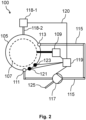
- Fig. 2 shows a schematic view of a laundry care appliance with a control according to an embodiment.
- the laundry care appliance 100 has a suds container 105 for holding washing liquid, and has a laundry drum 107 for holding laundry.
- the laundry drum 107 is arranged in the suds container 105.
- the laundry care appliance 100 has a drum drive 109 for rotating the laundry drum 107.
- the suds container 105 has a drain opening 111.
- the laundry care appliance 100 has a feed element 113.
- the drain opening 111 is fluidly connected to the feed element 113 by a liquid line 115, wherein a pump 117 for pumping washing liquid through the liquid line 115 is arranged in the liquid line 115.
- the pump 117 can pump washing liquid through the drain opening 111 from the tub 105 during a Fig. 2 pumping process (not shown) into the liquid line 115 and re-feed the washing liquid through the liquid line 115 and through the feed element 113 to the tub 105 and the laundry drum 107.
- the washing liquid can be effectively pumped through the liquid line 115 during a laundry care process or during the execution of a laundry care program and re-fed to the laundry in the laundry drum 107.
- the laundry care appliance 100 has a washing liquid supply device 118-1 for supplying washing liquid into the tub 105, wherein the washing liquid supply device 118-1 is connected to the tub 105 by a supply line 118-2.
- the washing liquid supply device 118-1 comprises a Fig. 2 not shown dispensing tray 101 of the laundry care appliance 100 and/or a Fig. 2 not shown fresh water connection of the laundry care appliance 100, wherein the controller 119 is designed to activate a washing liquor inlet via the dispensing tray 101 and/or the fresh water connection in order to supply washing liquor and/or fresh water as washing liquid into the laundry drum 107.
- the laundry care appliance 100 further comprises a level sensor 121, which is designed to detect a level of washing liquid in the tub 105, and further comprises a heating element 123 for heating the washing liquid held in the tub 105.
- the laundry care appliance 100 further comprises a controller 119, which is connected to the pump 117, to the drum drive 109, to the washing liquid supply device 118-1, to the level sensor 121 and to the heating element 123, each via a control connection 120.
- the laundry care appliance 100 further comprises an outlet line 125 which is fluidically connected to the liquid line 115.
- the pump 117 is designed to pump liquid during a Fig. 2 to pump washing liquid through the drain opening 111 from the tub 105, through the liquid line 115 and through the outlet line 125 from the laundry care appliance 100 during a pumping process (not shown), wherein in particular two separate pumps 117 are used, one pump 117 for the pumping process through the outlet line 125 and a further pump 117 for the pumping process.
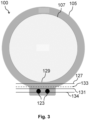
- Fig. 3 shows a schematic view of different filling levels of washing liquid in a tub according to an embodiment.
- a laundry drum 107 arranged in a tub 105 and a heating element 123 arranged in the tub 105 are shown only schematically.
- the object of the present invention is to ensure a significant reduction in water consumption and energy consumption during a laundry care process by heating the laundry held in the laundry drum 107 not with warm water but with steam, whereby the amount of water required can be reduced by up to 40% and whereby a significant energy saving effect can also be achieved.
- the heating element 123 In order to generate water vapor, the heating element 123 must heat the washing liquid held in the tub 105 to a target temperature, in particular of more than 80°C, so that part of the washing liquid evaporates and in the tub 105 a water vapor atmosphere is generated which can effectively heat the laundry held in the laundry drum 107.
- the heating element 123 must be prevented from running dry, so that the level of the washing liquid must always be above the heating element 123 during a corresponding heating.
- a corresponding Fig. 3 The minimum fill level threshold value 131 shown is thus above the heating element 123.
- the target filling level 133 shown by a dashed line must lie between the minimum filling level threshold value 131 and the maximum filling level threshold value 127.
- an additional fill level threshold value 134 is shown, which can also be taken into account by the control 119, in particular for checking the saturation of the laundry.
- this additional fill level threshold value 134 is below the heating element 123. If the additional fill level threshold value 134 is not reached, it can be determined that there is no free washing liquid in the lower area of the tub 105. In particular, failure to reach the additional fill level threshold value 134 after a supply of a predetermined amount of water, for example 0.5 liters, and after rotation of the laundry drum 107 with the pump 117 activated to pump the washing liquid around, if necessary, indicates that the laundry is not yet completely saturated. If, on the other hand, the additional fill level threshold value 134 is exceeded, it can be determined that part of the Washing liquid is no longer absorbed by the laundry, i.e. the laundry is completely saturated.
- the saturation can also be checked in an analogous manner by checking the minimum fill level threshold value 131.
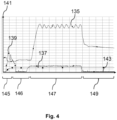
- Fig. 4 shows a graphical representation of an evaporation period following a supply period according to an embodiment.
- Fig. 4 shows a temporal representation of a temperature of the washing liquid in a suds container 105 (see the first curve 135 highlighted by circles), an amount of washing liquid supplied to the suds container 105 by a washing liquid supply device 118-1 (see the second curve 137 highlighted by squares) and the fill level of washing liquid in the suds container 105 (see the third curve 139 highlighted by triangles), which are plotted along the ordinate axis 141 as a function of time, which is indicated along the abscissa axis 143.
- the in Fig. 4 The process shown begins with a feed time period 145 during which the control 119 of the laundry care appliance 100 activates a washing liquid feed device 118-1 for feeding washing liquid into the tub 105, as indicated by the rise of the second curve 137 and as indicated by the rise of the fill level in the tub 105 according to the third curve 139 from the Fig. 4 can be removed.
- the controller 119 further activates the pump 117 so that the washing liquid supplied during the supply period 145 is pumped out of the drain opening 111 and the pumped-out washing liquid is fed again to the tub 105 by the feed element 113 in order to pump the washing liquid around and wet the laundry held in the laundry drum 107 with the pumped-out washing liquid.
- the pump 117 remains activated for pumping.
- This can be seen from the third curve 139 from the Fig. 4
- the feed time period 145 and the wetting time period 146 can also be understood together as a feed time period in which the washing liquid feed device 118-1 is only activated temporarily. In this case, the wetting time period can also be omitted.
- the controller 119 activates the heating element 123 if the filling level of washing liquid in the tub 105 detected by the filling level sensor 121 is between the minimum filling level threshold value 131 and the maximum filling level threshold value 127.
- the water vapor atmosphere results in a particularly effective energy transfer to the laundry in the washing drum and the water and energy consumption of the laundry care appliance 100 can be significantly reduced, while at the same time the laundry is advantageously wetted and a favorable laundry care result is achieved.
- the controller 119 activates the washing liquid supply device 118-1 at least once before and/or during the evaporation period 147 to supply a further amount of washing liquid into the tub 105.
- the control 119 checks whether the filling level detected by the filling level sensor 121 of washing liquid in the tub 105 after the additional amount of washing liquid has been added at least once is between the minimum fill level threshold value 131 and the maximum fill level threshold value 127, whereupon the controller 119 activates the heating element 123 to heat to the increased target temperature during the evaporation period 147.
- control system 119 can supply a further amount of washing liquid into the tub 105 several times, in particular up to four times, wherein in particular the drum drive 109 is activated to rotate the laundry drum 107 at different speeds.
- the controller 119 is designed to deactivate a heating element 123 activated during the evaporation time section 147, to terminate the evaporation heating section 147 and to switch it on during a subsequent time section not included in Fig. 4 to activate the heating element 123 during the heating period shown, wherein the controller 119 is designed to regulate the heating element 123 such that a reduced target temperature is reached during the heating period, wherein the reduced target temperature is in particular in a range between 20°C and 65°C, preferably in a range between 40°C and 60°C.
- washing liquid is supplied before the activation of the heating element 123, so that direct contact is established between the washing liquid and the laundry in the laundry.
- the laundry is thus heated conventionally if the minimum fill level threshold value 131 is still not reached or the maximum fill level 127 is exceeded after washing liquid has been supplied several times, in particular four times.
- the reduced target temperature prevents temperature-related damage to the laundry.
- the evaporation time section 147 is followed by the washing time section 149, during which the pump 117 is activated to pump the washing liquid and to wash the laundry held in the washing drum 107 with the to wet the pumped-over washing liquid.
- the level of washing liquid in the tub drops and the temperature of the washing liquid is also equalized by contact between the laundry and the washing liquid.
- Fig. 5 shows a schematic representation of a method 200 for heating laundry in a laundry care appliance.
- the method 200 comprises, as a first method step, the activation 201 of the washing liquid supply device 118-1 by the controller 119 during a supply time period 145 for supplying washing liquid into the tub 105.
- the method 200 comprises, as a second method step, the activation 203 of the pump 117 by the controller 119 during the supply time period 145 to pump out the supplied washing liquid from the drain opening 111 and to re-supply the pumped-out washing liquid through the supply element 113 to the tub 105 in order to pump the washing liquid around and to wet the laundry held in the laundry drum 107 with the pumped-over washing liquid.
- the washing liquid is expelled by a sufficiently high rotation of the washing drum 107, so that it is ensured that the laundry is sufficiently wetted.
- This can be achieved, for example, by detecting the fill level by checking whether the fill level after this step is still below the minimum fill level threshold value 131, so that in this case it is assumed that the laundry is not sufficiently wetted, or by checking whether the fill level after this step is above the maximum fill level threshold value 129, so that in this case it is assumed that the laundry is too heavily wetted.
- the ideal fill level quantity is provided in this way without adding large quantities of washing liquid or having to pump out a certain amount of washing liquid.
- the method 200 comprises, as a third method step, the activation 205 of the heating element 123 by the controller 119 during an evaporation period 147 following the supply period 145, when the level of washing liquid in the tub 105 detected by the level sensor 121 is between a minimum level threshold 131 and a maximum level threshold 127.
- the method 200 comprises, as a fourth method step, the regulation 207 of the heating element 123 by the controller 119 such that an increased target temperature is reached, which causes a portion of the washing liquid to evaporate during the evaporation period 147 and a water vapor atmosphere to form in the tub 105.
- the method 200 may include a further step not included in the Fig. 5 shown method step for wetting the laundry held in the laundry drum 107 with washing liquid, in which the washing liquid supply device 118-1 is deactivated and in which the pump 117 can be activated for wetting the laundry with the pumped-around washing liquid.
- Fig. 6 shows a further schematic representation of a method 300 for heating laundry in a laundry care appliance.
- the method 300 shown includes the Fig. 5 shown process steps 201, 203, 205 and 207.
- a first process decision is made by querying 301 of initial parameters, which can be setting values such as a treatment temperature, a program setting (white/colored laundry, easy-care, wool, etc.) of a selected laundry care program, and/or which measured values recorded at the beginning of a laundry care program, such as load quantity, type of laundry.
- initial parameters can be setting values such as a treatment temperature, a program setting (white/colored laundry, easy-care, wool, etc.) of a selected laundry care program, and/or which measured values recorded at the beginning of a laundry care program, such as load quantity, type of laundry.
- 5 shown method 200 comprising the method steps 201, 203, 205 and 207 for heating the washing liquid to an increased target temperature or a method for heating the washing liquid to a reduced target temperature (conventional heating of the laundry) comprising a fifth method step 309 for activating the washing liquid supply device 118-1 and a sixth method step 311 and for activating and regulating the heating element 123 to the reduced target temperature.
- the query 301 of the initial parameters can be used to ensure that the laundry is only heated by evaporating the washing liquid if the laundry or type of laundry to be treated is suitable for this or if there is no particularly large amount of laundry to be treated for which no or only a small saving in water and/or energy is to be expected.
- a filling level of washing liquid is set in the tub 105 or in the laundry drum 107, which is sufficient to enable the laundry to be heated by direct contact of the washing liquid with the laundry.
- a filling level is reached, for example, when the filling level in the tub 105 is above the maximum filling level threshold value 127.
- the fill level is detected with the fill level sensor and compared with the minimum fill level threshold value 131 in a second method decision 303. If the detected fill level is less than the fill level threshold value 131, the laundry has not yet been fully used and the method steps 201 and 203 are repeated n times, with a predetermined amount being fed again when the washing liquid feed device 118-1 is activated again, for example 0.5 liters. This is followed in a third method decision 305 by a query as to whether n (number of repetitions) is equal to the maximum number N.
- a fourth process decision 307 checks whether the fill level is between the minimum fill level threshold 131 and the maximum fill level threshold 127. If it is determined that the detected fill level is between the minimum fill level threshold 131 and the maximum fill level threshold 127, process steps 205 and 207 are carried out to heat the washing liquid to the increased target temperature, or otherwise a conventional heating of the laundry is carried out with process steps 309 and 311 to heat the washing liquid to the reduced target temperature, whereby process step 309 can be omitted if the maximum fill level threshold 127 has already been exceeded.
- a washing time period 149 can follow after the method step 207 or after the method step 311.
Landscapes
- Engineering & Computer Science (AREA)
- Textile Engineering (AREA)
- Control Of Washing Machine And Dryer (AREA)
Applications Claiming Priority (1)
| Application Number | Priority Date | Filing Date | Title |
|---|---|---|---|
| DE102023208056.7A DE102023208056A1 (de) | 2023-08-23 | 2023-08-23 | Wäschepflegegerät mit einer Steuerung |
Publications (1)
| Publication Number | Publication Date |
|---|---|
| EP4512948A1 true EP4512948A1 (fr) | 2025-02-26 |
Family
ID=92302695
Family Applications (1)
| Application Number | Title | Priority Date | Filing Date |
|---|---|---|---|
| EP24193980.0A Pending EP4512948A1 (fr) | 2023-08-23 | 2024-08-09 | Appareil d'entretien du linge doté d'une commande |
Country Status (3)
| Country | Link |
|---|---|
| EP (1) | EP4512948A1 (fr) |
| CN (1) | CN119507170A (fr) |
| DE (1) | DE102023208056A1 (fr) |
Citations (4)
| Publication number | Priority date | Publication date | Assignee | Title |
|---|---|---|---|---|
| US8291731B2 (en) * | 2005-05-31 | 2012-10-23 | Lg Electronics Inc. | Washing machine generating and using the steam |
| US20120266391A1 (en) * | 2005-05-31 | 2012-10-25 | Lg Electronics Inc. | Method for controlling a washing machine |
| DE102017103183A1 (de) * | 2017-02-16 | 2018-08-16 | Miele & Cie. Kg | Verfahren zum Betreiben eines Waschautomaten und Waschautomat |
| EP3623519B1 (fr) * | 2018-09-14 | 2022-11-30 | Miele & Cie. KG | Procédé de fonctionnement d'un appareil de nettoyage |
Family Cites Families (2)
| Publication number | Priority date | Publication date | Assignee | Title |
|---|---|---|---|---|
| EP2471997A1 (fr) * | 2012-03-14 | 2012-07-04 | V-Zug AG | Sèche-linge ou automate de lavage avec dispositif de vaporisation |
| DE102013104075A1 (de) * | 2013-04-23 | 2014-10-23 | Miele & Cie. Kg | Verfahren zum Betreiben einer Waschmaschine und Waschmaschine |
-
2023
- 2023-08-23 DE DE102023208056.7A patent/DE102023208056A1/de active Pending
-
2024
- 2024-08-09 EP EP24193980.0A patent/EP4512948A1/fr active Pending
- 2024-08-21 CN CN202411149261.XA patent/CN119507170A/zh active Pending
Patent Citations (4)
| Publication number | Priority date | Publication date | Assignee | Title |
|---|---|---|---|---|
| US8291731B2 (en) * | 2005-05-31 | 2012-10-23 | Lg Electronics Inc. | Washing machine generating and using the steam |
| US20120266391A1 (en) * | 2005-05-31 | 2012-10-25 | Lg Electronics Inc. | Method for controlling a washing machine |
| DE102017103183A1 (de) * | 2017-02-16 | 2018-08-16 | Miele & Cie. Kg | Verfahren zum Betreiben eines Waschautomaten und Waschautomat |
| EP3623519B1 (fr) * | 2018-09-14 | 2022-11-30 | Miele & Cie. KG | Procédé de fonctionnement d'un appareil de nettoyage |
Also Published As
| Publication number | Publication date |
|---|---|
| CN119507170A (zh) | 2025-02-25 |
| DE102023208056A1 (de) | 2025-02-27 |
Similar Documents
| Publication | Publication Date | Title |
|---|---|---|
| EP2246469B1 (fr) | Procédé de functionnement d'un lave-linge et lave-linge doté d'une pompe à circulation et d'une phase d'essorage | |
| EP3004448B1 (fr) | Procédé de fonctionnement d'une machine à laver à humidité résiduelle du linge améliorée et machine à laver adaptée dans ce but | |
| EP1861537B1 (fr) | Processus de mouillage du linge dans un lave-linge commande par programme, et lave-linge | |
| DE19908804C5 (de) | Verfahren zum Betrieb einer Waschmaschine und automatisch gesteuerte Waschmaschine hierfür | |
| EP3481987B1 (fr) | Appareil de traitement de ligne avec un contrôle et procédé de commande correspondant | |
| EP3739100B1 (fr) | Appareil de traitement du linge doté d'une commande du dispositif d'alimentation en liquide de lavage et procédé de soin du linge correspondant | |
| EP3701073B1 (fr) | Appareil d'entretien du linge équipé d'une commande | |
| DE102016225146B3 (de) | Wäschepflegegerät mit einer Steuerung | |
| DE102016212525A1 (de) | Wäschepflegegerät mit einer Steuerung | |
| DE102020208729A1 (de) | Wäschepflegegerät mit einer Steuerung | |
| EP2471997A1 (fr) | Sèche-linge ou automate de lavage avec dispositif de vaporisation | |
| WO2018007144A1 (fr) | Appareil d'entretien du linge équipé d'une commande | |
| EP2044252A1 (fr) | Procédé de traitement de linge, ainsi que machine à laver appropriée à cet effet | |
| EP4060108B1 (fr) | Appareil d'entretien du linge doté d'une commande | |
| EP3739099B1 (fr) | Appareil de traitement du linge doté d'une commande et procédé correspondant pour l'entretien du linge | |
| DE102023208056A1 (de) | Wäschepflegegerät mit einer Steuerung | |
| EP3186429A1 (fr) | Appareil d'entretien du linge avec un dispositif d'acheminement | |
| EP4056745A1 (fr) | Appareil d'entretien du linge doté d'une commande | |
| DE102020131598A1 (de) | Verfahren zum Betreiben eines Textilbehandlungsgeräts mit mindestens zwei Heizelementen, Steuereinrichtung und Textilbehandlungsgerät | |
| DE102023211567A1 (de) | Wäschepflegegerät mit einer Steuerung | |
| DE102023203443A1 (de) | Wäschepflegegerät mit einer Steuerung | |
| EP4095307A1 (fr) | Appareil d'entretien du linge doté d'une commande | |
| DE102023212509A1 (de) | Wäschepflegegerät mit einer Steuerung | |
| EP4022118B1 (fr) | Appareil de traitement de linge comprenant un dispositif de commande | |
| DE102019205240A1 (de) | Wäschepflegegerät mit einer Steuerung |
Legal Events
| Date | Code | Title | Description |
|---|---|---|---|
| PUAI | Public reference made under article 153(3) epc to a published international application that has entered the european phase |
Free format text: ORIGINAL CODE: 0009012 |
|
| STAA | Information on the status of an ep patent application or granted ep patent |
Free format text: STATUS: THE APPLICATION HAS BEEN PUBLISHED |
|
| AK | Designated contracting states |
Kind code of ref document: A1 Designated state(s): AL AT BE BG CH CY CZ DE DK EE ES FI FR GB GR HR HU IE IS IT LI LT LU LV MC ME MK MT NL NO PL PT RO RS SE SI SK SM TR |
|
| STAA | Information on the status of an ep patent application or granted ep patent |
Free format text: STATUS: REQUEST FOR EXAMINATION WAS MADE |
|
| 17P | Request for examination filed |
Effective date: 20250826 |