EP4513100A1 - Innenraumluftreinigungssystem - Google Patents
Innenraumluftreinigungssystem Download PDFInfo
- Publication number
- EP4513100A1 EP4513100A1 EP23200057.0A EP23200057A EP4513100A1 EP 4513100 A1 EP4513100 A1 EP 4513100A1 EP 23200057 A EP23200057 A EP 23200057A EP 4513100 A1 EP4513100 A1 EP 4513100A1
- Authority
- EP
- European Patent Office
- Prior art keywords
- gas
- filter
- air pollution
- cadr
- indoor
- Prior art date
- Legal status (The legal status is an assumption and is not a legal conclusion. Google has not performed a legal analysis and makes no representation as to the accuracy of the status listed.)
- Pending
Links
Images









Classifications
-
- F—MECHANICAL ENGINEERING; LIGHTING; HEATING; WEAPONS; BLASTING
- F24—HEATING; RANGES; VENTILATING
- F24F—AIR-CONDITIONING; AIR-HUMIDIFICATION; VENTILATION; USE OF AIR CURRENTS FOR SCREENING
- F24F8/00—Treatment, e.g. purification, of air supplied to human living or working spaces otherwise than by heating, cooling, humidifying or drying
- F24F8/10—Treatment, e.g. purification, of air supplied to human living or working spaces otherwise than by heating, cooling, humidifying or drying by separation, e.g. by filtering
- F24F8/108—Treatment, e.g. purification, of air supplied to human living or working spaces otherwise than by heating, cooling, humidifying or drying by separation, e.g. by filtering using dry filter elements
-
- F—MECHANICAL ENGINEERING; LIGHTING; HEATING; WEAPONS; BLASTING
- F24—HEATING; RANGES; VENTILATING
- F24F—AIR-CONDITIONING; AIR-HUMIDIFICATION; VENTILATION; USE OF AIR CURRENTS FOR SCREENING
- F24F11/00—Control or safety arrangements
- F24F11/50—Control or safety arrangements characterised by user interfaces or communication
- F24F11/56—Remote control
-
- F—MECHANICAL ENGINEERING; LIGHTING; HEATING; WEAPONS; BLASTING
- F24—HEATING; RANGES; VENTILATING
- F24F—AIR-CONDITIONING; AIR-HUMIDIFICATION; VENTILATION; USE OF AIR CURRENTS FOR SCREENING
- F24F11/00—Control or safety arrangements
- F24F11/50—Control or safety arrangements characterised by user interfaces or communication
- F24F11/56—Remote control
- F24F11/58—Remote control using Internet communication
-
- F—MECHANICAL ENGINEERING; LIGHTING; HEATING; WEAPONS; BLASTING
- F24—HEATING; RANGES; VENTILATING
- F24F—AIR-CONDITIONING; AIR-HUMIDIFICATION; VENTILATION; USE OF AIR CURRENTS FOR SCREENING
- F24F11/00—Control or safety arrangements
- F24F11/62—Control or safety arrangements characterised by the type of control or by internal processing, e.g. using fuzzy logic, adaptive control or estimation of values
- F24F11/63—Electronic processing
- F24F11/65—Electronic processing for selecting an operating mode
-
- F—MECHANICAL ENGINEERING; LIGHTING; HEATING; WEAPONS; BLASTING
- F24—HEATING; RANGES; VENTILATING
- F24F—AIR-CONDITIONING; AIR-HUMIDIFICATION; VENTILATION; USE OF AIR CURRENTS FOR SCREENING
- F24F11/00—Control or safety arrangements
- F24F11/70—Control systems characterised by their outputs; Constructional details thereof
- F24F11/72—Control systems characterised by their outputs; Constructional details thereof for controlling the supply of treated air, e.g. its pressure
-
- F—MECHANICAL ENGINEERING; LIGHTING; HEATING; WEAPONS; BLASTING
- F24—HEATING; RANGES; VENTILATING
- F24F—AIR-CONDITIONING; AIR-HUMIDIFICATION; VENTILATION; USE OF AIR CURRENTS FOR SCREENING
- F24F11/00—Control or safety arrangements
- F24F11/70—Control systems characterised by their outputs; Constructional details thereof
- F24F11/72—Control systems characterised by their outputs; Constructional details thereof for controlling the supply of treated air, e.g. its pressure
- F24F11/79—Control systems characterised by their outputs; Constructional details thereof for controlling the supply of treated air, e.g. its pressure for controlling the direction of the supplied air
-
- F—MECHANICAL ENGINEERING; LIGHTING; HEATING; WEAPONS; BLASTING
- F24—HEATING; RANGES; VENTILATING
- F24F—AIR-CONDITIONING; AIR-HUMIDIFICATION; VENTILATION; USE OF AIR CURRENTS FOR SCREENING
- F24F11/00—Control or safety arrangements
- F24F11/88—Electrical aspects, e.g. circuits
-
- F—MECHANICAL ENGINEERING; LIGHTING; HEATING; WEAPONS; BLASTING
- F24—HEATING; RANGES; VENTILATING
- F24F—AIR-CONDITIONING; AIR-HUMIDIFICATION; VENTILATION; USE OF AIR CURRENTS FOR SCREENING
- F24F11/00—Control or safety arrangements
- F24F11/89—Arrangement or mounting of control or safety devices
-
- F—MECHANICAL ENGINEERING; LIGHTING; HEATING; WEAPONS; BLASTING
- F24—HEATING; RANGES; VENTILATING
- F24F—AIR-CONDITIONING; AIR-HUMIDIFICATION; VENTILATION; USE OF AIR CURRENTS FOR SCREENING
- F24F8/00—Treatment, e.g. purification, of air supplied to human living or working spaces otherwise than by heating, cooling, humidifying or drying
- F24F8/20—Treatment, e.g. purification, of air supplied to human living or working spaces otherwise than by heating, cooling, humidifying or drying by sterilisation
-
- F—MECHANICAL ENGINEERING; LIGHTING; HEATING; WEAPONS; BLASTING
- F24—HEATING; RANGES; VENTILATING
- F24F—AIR-CONDITIONING; AIR-HUMIDIFICATION; VENTILATION; USE OF AIR CURRENTS FOR SCREENING
- F24F2110/00—Control inputs relating to air properties
- F24F2110/50—Air quality properties
-
- F—MECHANICAL ENGINEERING; LIGHTING; HEATING; WEAPONS; BLASTING
- F24—HEATING; RANGES; VENTILATING
- F24F—AIR-CONDITIONING; AIR-HUMIDIFICATION; VENTILATION; USE OF AIR CURRENTS FOR SCREENING
- F24F2110/00—Control inputs relating to air properties
- F24F2110/50—Air quality properties
- F24F2110/65—Concentration of specific substances or contaminants
- F24F2110/66—Volatile organic compounds [VOC]
-
- F—MECHANICAL ENGINEERING; LIGHTING; HEATING; WEAPONS; BLASTING
- F24—HEATING; RANGES; VENTILATING
- F24F—AIR-CONDITIONING; AIR-HUMIDIFICATION; VENTILATION; USE OF AIR CURRENTS FOR SCREENING
- F24F8/00—Treatment, e.g. purification, of air supplied to human living or working spaces otherwise than by heating, cooling, humidifying or drying
- F24F8/10—Treatment, e.g. purification, of air supplied to human living or working spaces otherwise than by heating, cooling, humidifying or drying by separation, e.g. by filtering
- F24F8/15—Treatment, e.g. purification, of air supplied to human living or working spaces otherwise than by heating, cooling, humidifying or drying by separation, e.g. by filtering by chemical means
- F24F8/158—Treatment, e.g. purification, of air supplied to human living or working spaces otherwise than by heating, cooling, humidifying or drying by separation, e.g. by filtering by chemical means using active carbon
Definitions
- the present disclosure relates to an indoor air cleaning system, and more particularly to an indoor air cleaning system suitable for the gas state in the indoor field to reach the cleanliness of cleanroom classes.
- Suspended particles are solid particles or droplets contained in the air. Since the sizes of the suspended particles are really small, the suspended particles may enter the lungs of human body through the nasal hair in the nasal cavity easily, thus causing inflammation in the lungs, asthma or cardiovascular disease. If other pollutant compounds are attached to the suspended particles, it will further increase the harm to the respiratory system. In recent years, the problem of air pollution is getting worse. In particular, the concentration of particle matters (e.g., PM2.5) is often too high. Therefore, the monitoring to the concentration of the gas suspended particles is taken more and more seriously. However, the gas flows unstably due to variable wind direction and air volume, and the general gas-quality monitoring station is located in a fixed place. Under this circumstance, it is impossible for people to check the concentration of suspended particles in current environment.
- PM2.5 concentration of particle matters
- a gas sensor In order to confirm the quality of the air, it is feasible to use a gas sensor to detect the air surrounding in the environment. If the detection information is provided in real time to warn the people in the environment, it is helpful of avoiding the harm and facilitates the people to escape the hazard immediately. Thus, it prevents the hazardous gas exposed in the environment from affecting the human health and causing the harm. Therefore, it is a very good application to use a gas sensor to detect the air in the surrounding environment.
- the indoor air-conditioning conditions and the pollution sources are the major factors affecting the indoor air quality. It is necessary to intelligently and quickly detect indoor air pollution sources in various indoor fields, effectively remove the indoor air pollution to form a clean and safe breathing gas state, and monitor indoor air quality in real time anytime, anywhere. Certainly, if the concentration of the suspended particles in the indoor space field is strictly controlled according to the "clean room" standard, it allows to avoid the introduction, generation and retention of suspended particles, and the temperature and humidity in the indoor space field are controlled within the required range.
- the number of suspended particles in the air pollution of the indoor space field is used to distinguish their classifications, and the suspended particles ⁇ 0.5 ⁇ m in per one cubic meter are accounted, so as to determine if the indoor space field meets the clean room requirements for safe breathing.
- the clean rooms can be divided into two types of: positive pressure and negative pressure.
- the positive pressure clean rooms are used in the semiconductor industry, mainly to prevent outdoor dust pollution
- the negative pressure clean rooms are used in hospitals or some biotechnology factories. Due to the fear of bacteria leakage, the indoor air pressure relative to the outdoor air pressure must be negative.
- a large amount of air exchange has to be utilized in both of positive pressure and negative pressure ones to achieve indoor cleanliness, and the installation cost of these clean room equipment is quite expensive.
- One object of the present disclosure is to provide an indoor air cleaning system.
- the gas detector can monitor and determine the air pollution at any time, and output an air pollution information.
- the cloud computing server receives the air pollution information, stores the air pollution information to an air pollution database, implements artificial intelligence calculation to determine the location of the air pollution position, and issues a control command to the cleaning device for the actuation operation, so that a directional circular airflow is generated, and the air pollution is rapidly guided to pass through the cleaning device multiple times for filtration, complete purification and sterilization.
- the gas state of the indoor field can reach a cleanliness of clean room class.
- an indoor air cleaning system includes at least one gas detector, at least one cleaning device and a cloud computing server.
- the at least one gas detector is disposed in an indoor field for detecting air pollution and outputting air pollution information.
- the at least one cleaning device includes a fan, a filter and a sterilization component.
- the fan is actuated to guide the air pollution to pass through the filter for filtration, and pass through the sterilization component for sterilization, wherein the fan has a specific clean air delivery rate (CADR) for generating a directional circular airflow, and the filter comprises a high efficiency particulate air (HEPA) filter screen.
- ACR clean air delivery rate
- HEPA high efficiency particulate air
- the cloud computing server receives the air pollution information, stores the air pollution information to a database, and intelligently computes and selects according to the air pollution information to output a control command to the fan of the cleaning device for actuation operation, whereby the fan of the cleaning device generates a directional circular airflow, and the air pollution is rapidly guided to pass through the filter multiple times for filtration and complete purification and through the sterilization component for sterilization, so that gas state in the indoor field reaches a cleanliness of clean room class.
- the present disclosure provides an indoor air cleaning system.
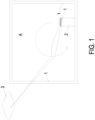
- the indoor air cleaning system includes at least one gas detector 1, at least one cleaning device 2 and a cloud computing server 3.
- the at least one gas detector 1 is disposed in an indoor field A for detecting air pollution and outputting air pollution information.
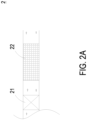
- the at least one cleaning device 2 includes a fan 21, a filter 22 and a sterilization component 23.
- the fan 21 is controlled and enabled to guide the air pollution to pass through the filter 22 for filtration, and guide the air pollution to pass through the sterilization component 23 for sterilization.
- the filter 22 includes a high efficiency particulate air (HEPA) filter screen.
- HEPA high efficiency particulate air
- the cloud computing server 3 receives the air pollution information, stores the air pollution information to a database, and intelligently computing (AI computing) and intelligently selecting according to the air pollution information to output a control command to the fan 21 of the cleaning device 2 for actuation operation.
- AI computing intelligently computing
- the fan 21 of the cleaning device 2 generates a directional circular airflow (As shown in the dotted line circulating airflow path in FIG. 1 ), and the air pollution is rapidly guided to pass through the filter 22 multiple times for filtration and complete purification and through the sterilization component 23 for sterilization. Consequently, the gas state in the indoor field A reaches a cleanliness of clean room class.
- the gas detector 1 is disposed in the indoor field A for detecting the air pollution and outputting the air pollution information.
- the gas detector 1 includes a gas detection module installed therein.
- the gas detector 1 can be configured with an external power terminal, and the external power terminal can be directly inserted into the power interface in the indoor field A for actuating the operation and detecting the air pollution.
- the gas detection module without external power supply terminals is directly disposed on the device (the cleaning device 2), and connected to the power supply for actuating the operation and detecting the air pollution.
- the air pollution is at least one selected from the group consisting of particulate matter, carbon monoxide, carbon dioxide, ozone, sulfur dioxide, nitrogen dioxide, lead, total volatile organic compounds (TVOC), formaldehyde, bacteria, fungi, virus and a combination thereof.
- particulate matter carbon monoxide, carbon dioxide, ozone, sulfur dioxide, nitrogen dioxide, lead, total volatile organic compounds (TVOC), formaldehyde, bacteria, fungi, virus and a combination thereof.
- the gas detection module includes a controlling circuit board 11, a gas detection main part 12, a microprocessor 13 and a communicator 14.
- the gas detection main part 12, the microprocessor 13 and the communicator 14 are integrally packaged on the controlling circuit board 11 and electrically connected to each other.
- the microprocessor 13 and the communicator 14 are mounted on the controlling circuit board 11.
- the microprocessor 13 controls the driving signal of the gas detection main part 12 for enabling the detection.
- the gas detection main part 12 detects the air pollution and outputs the air pollution information
- the microprocessor 14 receives, processes and provides the air pollution information to the communicator 14 for a communication transmission externally, and transmitting to the cloud computing server 3.
- the communication transmission is a wireless communication transmission.
- the wireless communication transmission is one selected from the group consisting of a Wi-Fi communication transmission, a Bluetooth communication transmission, a radio frequency identification communication transmission and a near field communication (NFC) transmission.
- the communicator 14 of the gas detection module communicates with the cloud computing server 3 through the Internet of Things (IOT).
- IOT Internet of Things
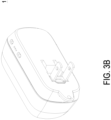
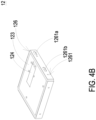
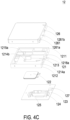
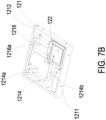
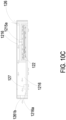
- the gas detection main part 12 includes a base 121, a piezoelectric actuator 122, a driving circuit board 123, a laser component 124, a particulate sensor 125, and an outer cover 126.
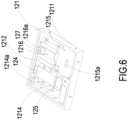
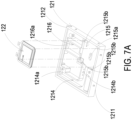
- the base 121 includes a first surface 1211, a second surface 1212, a laser loading region 1213, a gas-inlet groove 1214, a gas-guiding-component loading region 1215 and a gas-outlet groove 1216.
- the first surface 1211 and the second surface 1212 are two surfaces opposite to each other.
- the laser loading region 1213 is hollowed out from the first surface 1211 toward the second surface 1212.
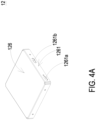
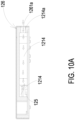
- the outer cover 126 covers the base 121 and includes a side plate 1261.
- the side plate 1261 has an inlet opening 1261a and an outlet opening 1261b.
- the gas-inlet groove 1214 is concavely formed from the second surface 1212 and disposed adjacent to the laser loading region 1213.
- the gas-inlet groove 1214 includes a gas-inlet 1214a and two lateral walls.
- the gas-inlet 1214a is in communication with an environment outside the base 121, and is spatially corresponding in position to an inlet opening 1261a of the outer cover 126.
- Two transparent windows 1214b are opened on the two lateral walls of the gas-inlet groove 1214 and are in communication with the laser loading region 1213. Therefore, the first surface 1211 of the base 121 is covered and attached by the outer cover 126, and the second surface 1212 is covered and attached by the driving circuit board 123, so that an inlet path is defined by the gas-inlet groove 1214.
- the gas-guiding-component loading region 1215 mentioned above is concavely formed from the second surface 1212 and in communication with the gas-inlet groove 1214.
- a ventilation hole 1215a penetrates a bottom surface of the gas-guiding-component loading region 1215.
- the gas-guiding-component loading region 1215 includes four positioning protrusions 1215b disposed at four corners of the gas-guiding-component loading region 1215, respectively.
- the gas-outlet groove 1216 includes a gas-outlet 1216a, and the gas-outlet 1216a is spatially corresponding to the outlet opening 1261b of the outer cover 126.
- the gas-outlet groove 1216 includes a first section 1216b and a second section 1216c.
- the first section 1216b is concavely formed out from the first surface 1211 in a region spatially corresponding to a vertical projection area of the gas-guiding-component loading region 1215.
- the second section 1216c is hollowed out from the first surface 1211 to the second surface 1212 in a region where the first surface 1211 is extended from the vertical projection area of the gas-guiding-component loading region 1215.
- the first section 1216b and the second section 1216c are connected to form a stepped structure.
- the first section 1216b of the gas-outlet groove 1216 is in communication with the ventilation hole 1215a of the gas-guiding-component loading region 1215
- the second section 1216c of the gas-outlet groove 1216 is in communication with the gas-outlet 1216a.
- the laser component 124 and the particulate sensor 125 are disposed on and electrically connected to the driving circuit board 123 and located within the base 121.
- the driving circuit board 123 is intentionally omitted.
- the laser component 124 is accommodated in the laser loading region 1213 of the base 121, and the particulate sensor 125 is accommodated in the gas-inlet groove 1214 of the base 121 and is aligned to the laser component 124.
- the laser component 124 is spatially corresponding to the transparent window 1214b, therefore, a light beam emitted by the laser component 124 passes through the transparent window 1214b and is irradiated into the gas-inlet groove 1214.
- a light beam path emitted from the laser component 124 passes through the transparent window 1214b and extends in an orthogonal direction perpendicular to the gas-inlet groove 1214.
- a projecting light beam emitted from the laser component 124 passes through the transparent window 1214b and enters the gas-inlet groove 1214 to irradiate the suspended particles contained in the gas passing through the gas-inlet groove 1214.
- the scattered light spots are received and calculated by the particulate sensor 125 to obtain the gas detection information.
- the piezoelectric actuator 122 is accommodated in the square-shaped gas-guiding-component loading region 1215 of the base 121.
- the gas-guiding-component loading region 1215 of the base 121 is in fluid communication with the gas-inlet groove 1214.
- the piezoelectric actuator 122 is enabled, the gas in the gas-inlet groove 1214 is inhaled by the piezoelectric actuator 122, so that the gas flows into the piezoelectric actuator 122, and is transported into the gas-outlet groove 1216 through the ventilation hole 1215a of the gas-guiding-component loading region 1215.
- the driving circuit board 123 covers the second surface 1212 of the base 121
- the laser component 124 is positioned and disposed on the driving circuit board 123, and is electrically connected to the driving circuit board 123.
- the particulate sensor 125 is also positioned and disposed on the driving circuit board 123 and electrically connected to the driving circuit board 123.
- the inlet opening 1261a is spatially corresponding to the gas-inlet 1214a of the base 121
- the outlet opening 126lb is spatially corresponding to the gas-outlet 1216a of the base 121.
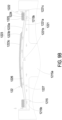
- the piezoelectric actuator 122 includes a gas-injection plate 1221, a chamber frame 1222, an actuator element 1223, an insulation frame 1224 and a conductive frame 1225.
- the gas-injection plate 1221 is made by a flexible material and includes a suspension plate 1221a and a hollow aperture 1221b.
- the suspension plate 1221a is a sheet structure and is permitted to undergo a bending deformation.
- the shape and the size of the suspension plate 1221a are accommodated in the inner edge of the gas-guiding-component loading region 1215, but not limited thereto.
- the hollow aperture 1221b passes through a center of the suspension plate 1221a, so as to allow the gas to flow therethrough.
- the shape of the suspension plate 1221a is selected from the group consisting of a square, a circle, an ellipse, a triangle and a polygon, but not limited thereto.
- the chamber frame 1222 is carried and stacked on the gas-injection plate 1221.
- the shape of the chamber frame 1222 is corresponding to the gas-injection plate 1221.
- the actuator element 1223 is carried and stacked on the chamber frame 1222.
- a resonance chamber 1226 is collaboratively defined by the actuator element 1223, the chamber frame 1222 and the suspension plate 1221a and is formed between the actuator element 1223, the chamber frame 1222 and the suspension plate 1221a.
- the insulation frame 1224 is carried and stacked on the actuator element 1223 and the appearance of the insulation frame 1224 is similar to that of the chamber frame 1222.
- the conductive frame 1225 is carried and stacked on the insulation frame 1224, and the appearance of the conductive frame 1225 is similar to that of the insulation frame 1224.
- the conductive frame 1225 includes a conducting pin 1225a and a conducting electrode 1225b.
- the conducting pin 1225a is extended outwardly from an outer edge of the conductive frame 1225, and the conducting electrode 1225b is extended inwardly from an inner edge of the conductive frame 1225.
- the actuator element 1223 further includes a piezoelectric carrying plate 1223a, an adjusting resonance plate 1223b and a piezoelectric plate 1223c.
- the piezoelectric carrying plate 1223a is carried and stacked on the chamber frame 1222.
- the adjusting resonance plate 1223b is carried and stacked on the piezoelectric carrying plate 1223a.
- the piezoelectric plate 1223c is carried and stacked on the adjusting resonance plate 1223b.
- the adjusting resonance plate 1223b and the piezoelectric plate 1223c are accommodated in the insulation frame 1224.
- the conducting electrode 1225b of the conductive frame 1225 is electrically connected to the piezoelectric plate 1223c.
- the piezoelectric carrying plate 1223a and the adjusting resonance plate 1223b are made by a conductive material.
- the piezoelectric carrying plate 1223a includes a piezoelectric pin 1223d.
- the piezoelectric pin 1223d and the conducting pin 1225a are electrically connected to a driving circuit (not shown) of the driving circuit board 123, so as to receive a driving signal, such as a driving frequency and a driving voltage.
- a circuit is formed by the piezoelectric pin 1223d, the piezoelectric carrying plate 1223a, the adjusting resonance plate 1223b, the piezoelectric plate 1223c, the conducting electrode 1225b, the conductive frame 1225 and the conducting pin 1225a for transmitting the driving signal.
- the insulation frame 1224 is insulated between the conductive frame 1225 and the actuator element 1223, so as to avoid the occurrence of a short circuit. Thereby, the driving signal is transmitted to the piezoelectric plate 1223c.
- the piezoelectric plate 1223c After receiving the driving signal such as the driving frequency and the driving voltage, the piezoelectric plate 1223c deforms due to the piezoelectric effect, and the piezoelectric carrying plate 1223a and the adjusting resonance plate 1223b are further driven to generate the bending deformation in the reciprocating manner.
- the driving signal such as the driving frequency and the driving voltage
- the adjusting resonance plate 1223b is located between the piezoelectric plate 1223c and the piezoelectric carrying plate 1223a and served as a cushion between the piezoelectric plate 1223c and the piezoelectric carrying plate 1223a.
- the vibration frequency of the piezoelectric carrying plate 1223a is adjustable.
- the thickness of the adjusting resonance plate 1223b is greater than the thickness of the piezoelectric carrying plate 1223a, and the vibration frequency of the actuator element 1223 can be adjusted by adjusting the thickness of the adjusting resonance plate 1223b.
- the gas-injection plate 1221, the chamber frame 1222, the actuator element 1223, the insulation frame 1224 and the conductive frame 1225 are stacked and positioned in the gas-guiding-component loading region 1215 sequentially, so that the piezoelectric actuator 122 is supported and positioned in the gas-guiding-component loading region 1215.
- a plurality of clearances 1221c are defined between the suspension plate 1221a of the gas-injection plate 1221 and an inner edge of the gas-guiding-component loading region 1215 for gas flowing therethrough.
- a flowing chamber 1227 is formed between the gas-injection plate 1221 and the bottom surface of the gas-guiding-component loading region 1215.
- the flowing chamber 1227 is in communication with the resonance chamber 1226 between the actuator element 1223, the chamber frame 1222 and the suspension plate 1221a through the hollow aperture 1221b of the gas-injection plate 1221.
- the suspension plate 1221a of the gas-injection plate 1221 is driven to move away from the bottom surface of the gas-guiding-component loading region 1215 by the piezoelectric plate 1223c.
- the volume of the flowing chamber 1227 is expanded rapidly, the internal pressure of the flowing chamber 1227 is decreased to form a negative pressure, and the gas outside the piezoelectric actuator 122 is inhaled through the clearances 1221c and enters the resonance chamber 1226 through the hollow aperture 1221b. Consequently, the pressure in the resonance chamber 1226 is increased to generate a pressure gradient.
- the piezoelectric plate 1223c is driven to generate the bending deformation in a reciprocating manner.
- the gas pressure inside the resonance chamber 1226 is lower than the equilibrium gas pressure after the converged gas is ejected out, the gas is introduced into the resonance chamber 1226 again.
- the vibration frequency of the gas in the resonance chamber 1226 is controlled to be close to the vibration frequency of the piezoelectric plate 1223c, so as to generate the Helmholtz resonance effect to achieve the gas transportation at high speed and in large quantities.
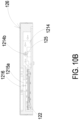
- the gas is inhaled through the gas-inlet 1214a on the outer cover 126, flows into the gas-inlet groove 1214 of the base 121 through the gas-inlet 1214a, and is transported to the position of the particulate sensor 125.
- the piezoelectric actuator 122 is enabled continuously to inhale the gas into the inlet path, and facilitate the gas outside the gas detection module to be introduced rapidly, flow stably, and transported above the particulate sensor 125.
- a projecting light beam emitted from the laser component 124 passes through the transparent window 1214b to irritate the suspended particles contained in the gas flowing above the particulate sensor 125 in the gas-inlet groove 1214.
- the scattered light spots are received and calculated by the particulate sensor 125 for obtaining related information about the sizes and the concentration of the suspended particles contained in the gas.
- the gas above the particulate sensor 125 is continuously driven and transported by the piezoelectric actuator 122, flows into the ventilation hole 1215a of the gas-guiding-component loading region 1215, and is transported to the gas-outlet groove 1216.
- the gas is continuously transported into the gas-outlet groove 1216 by the piezoelectric actuator 122, and thus the gas in the gas-outlet groove 1216 is pushed to discharge through the gas-outlet 1216a and the outlet opening 1261b.
- the gas detector 1 of the present disclosure not only can detect the particulate matters in the gas, but also can detect the gas characteristics of the introduced gas, for example, to determine whether the gas is formaldehyde, ammonia, carbon monoxide, carbon dioxide, oxygen, ozone, or the like. Therefore, in one or some embodiments, the gas detector 1 of the present disclosure further includes a gas sensor 127 positioned and disposed on the driving circuit board 123, electrically connected to the driving circuit board 123, and accommodated in the gas-outlet groove 1216, so as to detect the air pollution introduced into the gas-outlet groove 1216.
- the gas sensor 127 includes a volatile-organic-compound sensor for detecting the information of carbon dioxide (CO 2 ) or volatile organic compounds (TVOC).
- the gas sensor 127 includes a formaldehyde sensor for detecting the information of formaldehyde (HCHO) gas.
- the gas sensor 127 includes a bacteria sensor for detecting the information of bacteria or fungi.
- the gas sensor 127 includes a virus sensor for detecting the information of virus in the gas.
- the gas sensor 127 is a temperature and humidity sensor for detecting the temperature and humidity information of the gas.
- the cleaning device 2 includes a fan 21, a filter 22 and a sterilization component 23.
- the fan 21 is controlled and enabled to guide the air pollution to pass through the filter 22 for filtration, and guide the air pollution to pass through the sterilization component 23 for sterilization.
- the filter 22 includes a high efficiency particulate air (HEPA) filter screen, which is configured to absorb the chemical smoke, the bacteria, the dust particles and the pollen contained in the air pollution, so that the air pollution introduced into the filter 22 is filtered and purified to achieve the effect of filtering and purification.
- HEPA high efficiency particulate air
- the fan 21 can be arranged on the front side of the filter 22, and the fan 21 can also be arranged on the rear side of the filter 22.
- the sterilization component 23 includes a decomposition layer coated on the filter 22 to sterilize in chemical means.
- the decomposition layer includes an activated carbon 231 configured to remove organic and inorganic substances in air pollution, and remove colored and odorous substances.
- the decomposition layer includes a cleansing factor containing chlorine dioxide layer 232 configured to inhibit viruses, bacteria, fungi, influenza A, influenza B, enterovirus and norovirus in the air pollution, and the inhibition ratio can reach 99% and more, thereby reducing the cross-infection of viruses.
- the decomposition layer includes an herbal protective layer 233 extracted from ginkgo and Japanese Rhus chinensis configured to resist allergy effectively and destroy a surface protein of influenza virus (such as H1N1 influenza virus) passing therethrough.
- the decomposition layer includes a silver ion 234 configured to inhibit viruses, bacteria and fungi contained in the air pollution.
- the decomposition layer includes a zeolite 235 configured to remove ammonia nitrogen, heavy metals, organic pollutants, Escherichia coli, phenol, chloroform and anionic surfactants.
- the sterilization component 23 includes a light irradiation element combined with the filter 22 to sterilize in chemical means.
- the light irradiation element is a photo-catalyst unit including a photo catalyst 236 and an ultraviolet lamp 237.
- the photo catalyst 236 is irradiated by the ultraviolet lamp 237, the light energy is converted into the chemical energy, thereby decomposes harmful gases and disinfects bacteria contained in the air pollution, so as to achieve the effects of filtering and purifying.
- the light irradiation element is a photo-plasma unit including a nanometer irradiation tube 238.
- the sterilization component 23 includes a decomposition unit combined with the filter 22 to sterilized in chemical means.
- the decomposition unit is a negative ion unit 239 with s a dust collecting plate.
- the decomposition unit is a plasma ion unit 230.
- the oxygen molecules and water molecules contained in the air pollution are decomposed into positive hydrogen ions (H + ) and negative oxygen ions (O 2- ) by the plasma ion.
- the substances attached with water around the ions are adhered on the surface of viruses and bacteria and converted into OH radicals with extremely strong oxidizing power, thereby removing hydrogen (H) from the protein on the surface of viruses and bacteria, and thus decomposing (oxidizing) the protein, so as to filter the introduced air pollution and achieve the effects of filtering and purifying.
- the gas detector 1 is directly installed in the cleaning device 2, and the gas detection module of the cleaning device 2 is configured to connect the power supply and the controlling and driving circuit, so that the communicator 14 of the gas detection module and the cloud computing server 3 are in data communication with each other.
- a control commend is issued to control the enablement of the fan 21 of the cleaning device 2 and adjust the air volume of the fan by the cloud computing server 3. Therefore, the actuation, time period and speed of the fan 21 of the cleaning device 2 can be controlled and adjusted according to the air pollution information at any time to filter the air pollution and perform the sterilization and purification.
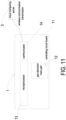
- the cloud computing server 3 includes a wireless network cloud computing service module 31, a cloud control service unit 32, a device management unit 33 and an application program unit 34.
- the wireless network cloud computing service module 31 receives the air pollution information of the indoor field A, receives the communication information of the cleaning device 2 and transmits the control commands. Moreover, the wireless network cloud computing service module 31 receives the air pollution information of the indoor field A and transmits it to the cloud control service unit 32 to store and form an air pollution database.
- At least one gas detector 1 and at least one cleaning device 2 are disposed in the indoor field A, so that the gas detector 1 can monitor and determine the air pollution at any time, and output the air pollution information. Then, the air pollution information can be received through the cloud computing server 3 and stored in an air pollution database of data. Furthermore, an artificial intelligence calculation is implemented to determine the location of air pollution, and a control command is issued to transmit to the actuation operation of the cleaning device 2. Whereby, a directional circular airflow is generated in the indoor field A, and the air pollution is rapidly guided to pass through the cleaning device 2 multiple times for filtration, complete purification and sterilization. Through the detecting-cleaning prevention effectiveness of locating the air pollution, guiding the air pollution, and complete purifying the air pollution in the indoor field A, the gas state of the indoor field A can reach the cleanliness of clean room class.
- the air pollution safety detection value is determined through the stored air pollution database and the intelligent calculation of the cloud computing server 3, and then the control command is transmitted to the cleaning device 2 for the actuation operation.
- the safety detection value includes at least one selected from the group consisting of a concentration of PM2.5 which is less than 10 ⁇ g/m 3 , a concentration of carbon dioxide (CO 2 ) which is less than 1000 ppm, a concentration of total volatile organic compounds (TVOC) which is less than 0.56 ppm, a concentration of formaldehyde (HCHO) which is less than 0.08 ppm, a colony-forming unit of bacteria which is less than 1500 CFU/m 3 , a colony-forming unit of fungi which is less than 1000 CFU/m 3 , a concentration of sulfur dioxide which is less than 0.075 ppm, a concentration of nitrogen dioxide which is less than 0.1 ppm, a concentration of carbon monoxide which is less than 9 ppm, a concentration of ozone which is
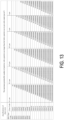
- the present disclosure formulates a comparison table of the cleanliness of clean room classes relative to the required grades for the air pollution of the indoor space field, so as to illustrate the gas state of the indoor field A and the cleanliness of clean room class achieved by the air cleaning system of the present disclosure.
- the number of suspended particles in the air pollution of the indoor space field is used to distinguish their classifications, and the suspended particles ⁇ 0.5 ⁇ m in per one cubic meter are accounted.
- the clean room class 1 to class 9 in the comparison table are completely the same as the ISO standard clean room class 1 to class 9, and the clean room class 10 to class 20 are also standardized.
- the filter 22 includes an ultra low particulate air (ULPA) filter of U17, the fan 21 of the cleaning device 2 having the specific CADR of the fan greater than CADR 1500 is actuated to generate the directional circular airflow in the indoor field A, and the air pollution of the indoor field A is rapidly guided to pass through the filter 22 multiple times for filtration and complete purification and through the sterilization component 23 for sterilization, so that the gas state in the indoor field A reaches the cleanliness of clean room class 2.
- ULPA ultra low particulate air
- the filter 22 includes an ultra low particulate air (ULPA) filter of U16, the fan 21 of the cleaning device 2 having the specific CADR of the fan greater than CADR 1000 is actuated to generate the directional circular airflow in the indoor field A, and the air pollution of the indoor field A is rapidly guided to pass through the filter 22 multiple times for filtration and complete purification and through the sterilization component 23 for sterilization, so that the gas state in the indoor field A reaches the cleanliness of clean room class 3.
- ULPA ultra low particulate air
- the filter 22 includes an ultra low particulate air (ULPA) filter of U15
- the fan 21 of the cleaning device 2 having the specific CADR of the fan greater than CADR 1000 is actuated to generate the directional circular airflow in the indoor field A
- the air pollution of the indoor field A is rapidly guided to pass through the filter 22 multiple times for filtration and complete purification and through the sterilization component 23 for sterilization, so that the gas state in the indoor field A reaches the cleanliness of clean room class 4 to class 5.
- ULPA ultra low particulate air
- the filter 22 includes a high efficiency particulate air (HEPA) filter of H14, the fan 21 of the cleaning device 2 having the specific CADR of the fan greater than CADR 600 is actuated to generate the directional circular airflow in the indoor field A, and the air pollution of the indoor field A is rapidly guided to pass through the filter 22 multiple times for filtration and complete purification and through the sterilization component 23 for sterilization, so that the gas state in the indoor field A reaches the cleanliness of clean room class 6.
- HEPA high efficiency particulate air
- the filter comprises a high efficiency particulate air (HEPA) filter of H13
- the fan of the cleaning device having the specific CADR of the fan greater than CADR 600 is actuated to generate the directional circular airflow in the indoor field, and the air pollution is rapidly guided to pass through the filter multiple times for filtration and complete purification and through the sterilization component for sterilization, so that the gas state in the indoor field reaches the cleanliness of clean room class 7 to class 8.
- HEPA high efficiency particulate air
- the filter 22 includes a high efficiency particulate air (HEPA) filter of H12
- the fan 21 of the cleaning device 2 having the specific CADR of the fan greater than CADR 600 is actuated to generate the directional circular airflow in the indoor field A, and the air pollution of the indoor field A is rapidly guided to pass through the filter 22 multiple times for filtration and complete purification and through the sterilization component 23 for sterilization, so that the gas state in the indoor field A reaches the cleanliness of clean room class 9.
- HEPA high efficiency particulate air
- the filter 22 includes a high efficiency particulate air (HEPA) filter of H12
- the fan 21 of the cleaning device 2 having the specific CADR of the fan less than CADR 600 is actuated to generate the directional circular airflow in the indoor field A
- the air pollution of the indoor field A is rapidly guided to pass through the filter 22 multiple times for filtration and complete purification and through the sterilization component 23 for sterilization, so that the gas state in the indoor field A reaches the cleanliness of clean room class 10 to class 11.
- HEPA high efficiency particulate air
- the filter 22 includes a high efficiency particulate air (HEPA) filter of H11
- the fan 21 of the cleaning device 2 having the specific CADR of the fan less than CADR 600 is actuated to generate the directional circular airflow in the indoor field A
- the air pollution of the indoor field A is rapidly guided to pass through the filter 22 multiple times for filtration and complete purification and through the sterilization component 23 for sterilization, so that the gas state in the indoor field A reaches the cleanliness of clean room class 12 to class 15.
- HEPA high efficiency particulate air
- the filter 22 includes a high efficiency particulate air (HEPA) filter of H10, the fan 21 of the cleaning device 2 having the specific CADR of the fan less than CADR 600 is actuated to generate the directional circular airflow in the indoor field A, and the air pollution of the indoor field A is rapidly guided to pass through the filter 22 multiple times for filtration and complete purification and through the sterilization component 23 for sterilization, so that the gas state in the indoor field A reaches the cleanliness of clean room class 16 to class 20.
- HEPA high efficiency particulate air
- the present disclosure provides an indoor air cleaning system.
- the gas detector can monitor and determine the air pollution at any time, and output an air pollution information.
- the cloud computing server receives the air pollution information, stores the air pollution information to an air pollution database, implements artificial intelligence calculation to determine the location of the air pollution position, and issues a control command to the cleaning device for the actuation operation, so that a directional circular airflow is generated, and the air pollution is rapidly guided to pass through the cleaning device multiple times for filtration, complete purification and sterilization.
- the gas state of the indoor field can reach a cleanliness of clean room class.
- the indoor air cleaning system of the present disclosure uses the filter with the HEPA filter screen to filter the air pollution, the fan has a specific clean air delivery rate (CADR) for generating a directional circular airflow, and the directional circular airflow is generated continuously in the indoor field.
- CDR specific clean air delivery rate
- the air pollution is rapidly guided to pass through the filter multiple times for filtration and complete purification and through the sterilization component for sterilization, so that the indoor space field can meet the requirements of the clean room, and the impact and injury of human health caused by the gas hazards in the environment can be avoided. It allows the indoor field of the home and the office to achieve the required cleanliness of clean room class at a price lower than 1/4 ⁇ 1/10 of the cost of setting up the positive-pressure clean room in the general semiconductor industry or the negative-pressure clean room in the hospitals or a biotechnology plants.
- the present disclosure includes the industrial applicability and the inventive steps.
Landscapes
- Engineering & Computer Science (AREA)
- Chemical & Material Sciences (AREA)
- Combustion & Propulsion (AREA)
- Mechanical Engineering (AREA)
- General Engineering & Computer Science (AREA)
- Signal Processing (AREA)
- Human Computer Interaction (AREA)
- Fuzzy Systems (AREA)
- Mathematical Physics (AREA)
- Physics & Mathematics (AREA)
- Disinfection, Sterilisation Or Deodorisation Of Air (AREA)
- Ventilation (AREA)
- Air Conditioning Control Device (AREA)
- Filtering Materials (AREA)
- Investigating Or Analysing Materials By Optical Means (AREA)
Applications Claiming Priority (1)
| Application Number | Priority Date | Filing Date | Title |
|---|---|---|---|
| TW112131534A TWI898250B (zh) | 2023-08-22 | 2023-08-22 | 室內空氣潔淨系統 |
Publications (1)
| Publication Number | Publication Date |
|---|---|
| EP4513100A1 true EP4513100A1 (de) | 2025-02-26 |
Family
ID=88207379
Family Applications (1)
| Application Number | Title | Priority Date | Filing Date |
|---|---|---|---|
| EP23200057.0A Pending EP4513100A1 (de) | 2023-08-22 | 2023-09-27 | Innenraumluftreinigungssystem |
Country Status (5)
| Country | Link |
|---|---|
| US (1) | US20250067451A1 (de) |
| EP (1) | EP4513100A1 (de) |
| JP (1) | JP2025031417A (de) |
| CN (1) | CN119508928A (de) |
| TW (1) | TWI898250B (de) |
Citations (6)
| Publication number | Priority date | Publication date | Assignee | Title |
|---|---|---|---|---|
| EP3581854A1 (de) * | 2018-06-15 | 2019-12-18 | Samsung Electronics Co., Ltd. | Endgerätevorrichtung und verfahren zur übertragung eines steuerungsbefehls davon |
| US20220120655A1 (en) * | 2020-10-16 | 2022-04-21 | Microjet Technology Co., Ltd. | Method of preventing and handling indoor air pollution |
| US20220170661A1 (en) * | 2020-12-01 | 2022-06-02 | AirPure Control Systems, LLC | Feedback-driven air treatment system for new and existing buildings |
| EP4015925A1 (de) * | 2020-12-21 | 2022-06-22 | Microjet Technology Co., Ltd | Verfahren zur filterung von innenraumluftverschmutzung |
| US20220196277A1 (en) * | 2020-12-21 | 2022-06-23 | Microjet Technology Co., Ltd. | Method for intelligently preventing and handling indoor air pollution |
| US20230235914A1 (en) * | 2022-01-24 | 2023-07-27 | Microjet Technology Co., Ltd. | Air purifier for preventing air pollution |
Family Cites Families (5)
| Publication number | Priority date | Publication date | Assignee | Title |
|---|---|---|---|---|
| CN105683666B (zh) * | 2013-10-29 | 2018-10-26 | 三菱电机株式会社 | 空气净化器 |
| CN207113088U (zh) * | 2017-08-01 | 2018-03-16 | 西安航天神舟建筑设计院有限公司 | 一种洁净厂房及净化系统 |
| CN108061343A (zh) * | 2018-01-19 | 2018-05-22 | 宁波曙翔新材料股份有限公司 | 混流洁净装置及具有混流结构的洁净屏 |
| TWM607253U (zh) * | 2020-10-21 | 2021-02-01 | 元皓能源股份有限公司 | 可應用於不同場域之環境偵測聯網控制構造 |
| TWI812043B (zh) * | 2022-03-04 | 2023-08-11 | 研能科技股份有限公司 | 空污偵測防治系統 |
-
2023
- 2023-08-22 TW TW112131534A patent/TWI898250B/zh active
- 2023-08-28 CN CN202311090675.5A patent/CN119508928A/zh active Pending
- 2023-09-01 JP JP2023142552A patent/JP2025031417A/ja active Pending
- 2023-09-08 US US18/243,746 patent/US20250067451A1/en active Pending
- 2023-09-27 EP EP23200057.0A patent/EP4513100A1/de active Pending
Patent Citations (6)
| Publication number | Priority date | Publication date | Assignee | Title |
|---|---|---|---|---|
| EP3581854A1 (de) * | 2018-06-15 | 2019-12-18 | Samsung Electronics Co., Ltd. | Endgerätevorrichtung und verfahren zur übertragung eines steuerungsbefehls davon |
| US20220120655A1 (en) * | 2020-10-16 | 2022-04-21 | Microjet Technology Co., Ltd. | Method of preventing and handling indoor air pollution |
| US20220170661A1 (en) * | 2020-12-01 | 2022-06-02 | AirPure Control Systems, LLC | Feedback-driven air treatment system for new and existing buildings |
| EP4015925A1 (de) * | 2020-12-21 | 2022-06-22 | Microjet Technology Co., Ltd | Verfahren zur filterung von innenraumluftverschmutzung |
| US20220196277A1 (en) * | 2020-12-21 | 2022-06-23 | Microjet Technology Co., Ltd. | Method for intelligently preventing and handling indoor air pollution |
| US20230235914A1 (en) * | 2022-01-24 | 2023-07-27 | Microjet Technology Co., Ltd. | Air purifier for preventing air pollution |
Also Published As
| Publication number | Publication date |
|---|---|
| JP2025031417A (ja) | 2025-03-07 |
| TW202509399A (zh) | 2025-03-01 |
| CN119508928A (zh) | 2025-02-25 |
| US20250067451A1 (en) | 2025-02-27 |
| TWI898250B (zh) | 2025-09-21 |
Similar Documents
| Publication | Publication Date | Title |
|---|---|---|
| US20220196269A1 (en) | Method of filtering indoor air pollution | |
| US20220280897A1 (en) | Method for detecting and filtering indoor polluted gas | |
| EP4445989A1 (de) | Verfahren zur reinigung von luftverschmutzung in einem innenraum bis in der nähe von null | |
| EP4446664A1 (de) | Luftreiniger | |
| EP4513099A1 (de) | Innenraumluftreinigungssystem | |
| EP4675187A1 (de) | Innenraumluftreinigungssystem mit vernetzungsmechanismus | |
| EP4513100A1 (de) | Innenraumluftreinigungssystem | |
| US20220370946A1 (en) | Air pollution prevention device for baby carriage | |
| EP4521033A1 (de) | Innenraumluftreinigungssystem | |
| EP4560211A1 (de) | Innenraumluftreinigungssystem mit trennungserfassungs- und -verhinderungsmechanismus | |
| EP4553389A1 (de) | Luftverschmutzungsvermeidungssystem für kücheneinheit im innenraumbereich | |
| EP4509766A1 (de) | Luftverschmutzungsschutzsystem für badezimmerraum | |
| EP4682433A1 (de) | Netzwerkmechanismussystem zur innenraumluftreinigung | |
| EP4542125A1 (de) | Innenraumluftreinigungssystem | |
| EP4542127A1 (de) | Innenraumluftreinigungssystem | |
| EP4682434A1 (de) | Montierbare gebläsefilteranordnung | |
| EP4491960A1 (de) | System zur verhinderung von innenraumluftverschmutzung | |
| EP4682436A1 (de) | Montierbare gasaustauschvorrichtung | |
| EP4491959A2 (de) | System zur verhinderung von innenraumluftverschmutzung | |
| EP4696945A1 (de) | Überdrucksteuerungsverfahren für ein innenraumluftreinigungsnetzwerkmechanismussystem | |
| US20250035334A1 (en) | Indoor air pollution prevention system | |
| EP4696941A1 (de) | Netzwerkmechanismussystem zur innenraumluftreinigung | |
| EP4446665A1 (de) | Abgasventilator | |
| EP4711685A1 (de) | Netzwerkmechanismussystem zur innenraumluftreinigung | |
| EP4717988A1 (de) | Intelligentes ki-babyreinigungsraumsystem |
Legal Events
| Date | Code | Title | Description |
|---|---|---|---|
| PUAI | Public reference made under article 153(3) epc to a published international application that has entered the european phase |
Free format text: ORIGINAL CODE: 0009012 |
|
| STAA | Information on the status of an ep patent application or granted ep patent |
Free format text: STATUS: THE APPLICATION HAS BEEN PUBLISHED |
|
| AK | Designated contracting states |
Kind code of ref document: A1 Designated state(s): AL AT BE BG CH CY CZ DE DK EE ES FI FR GB GR HR HU IE IS IT LI LT LU LV MC ME MK MT NL NO PL PT RO RS SE SI SK SM TR |
|
| STAA | Information on the status of an ep patent application or granted ep patent |
Free format text: STATUS: REQUEST FOR EXAMINATION WAS MADE |
|
| 17P | Request for examination filed |
Effective date: 20250825 |