EP4513142A2 - Procédé et système informatique pour fournir un itinéraire ou une durée d'itinéraire pour un voyage d'un emplacement source à un emplacement cible - Google Patents
Procédé et système informatique pour fournir un itinéraire ou une durée d'itinéraire pour un voyage d'un emplacement source à un emplacement cible Download PDFInfo
- Publication number
- EP4513142A2 EP4513142A2 EP24211603.6A EP24211603A EP4513142A2 EP 4513142 A2 EP4513142 A2 EP 4513142A2 EP 24211603 A EP24211603 A EP 24211603A EP 4513142 A2 EP4513142 A2 EP 4513142A2
- Authority
- EP
- European Patent Office
- Prior art keywords
- bus
- prospect
- graph
- duration
- travel
- Prior art date
- Legal status (The legal status is an assumption and is not a legal conclusion. Google has not performed a legal analysis and makes no representation as to the accuracy of the status listed.)
- Pending
Links
Images









Classifications
-
- G—PHYSICS
- G01—MEASURING; TESTING
- G01C—MEASURING DISTANCES, LEVELS OR BEARINGS; SURVEYING; NAVIGATION; GYROSCOPIC INSTRUMENTS; PHOTOGRAMMETRY OR VIDEOGRAMMETRY
- G01C21/00—Navigation; Navigational instruments not provided for in groups G01C1/00 - G01C19/00
- G01C21/20—Instruments for performing navigational calculations
-
- G—PHYSICS
- G01—MEASURING; TESTING
- G01C—MEASURING DISTANCES, LEVELS OR BEARINGS; SURVEYING; NAVIGATION; GYROSCOPIC INSTRUMENTS; PHOTOGRAMMETRY OR VIDEOGRAMMETRY
- G01C21/00—Navigation; Navigational instruments not provided for in groups G01C1/00 - G01C19/00
- G01C21/26—Navigation; Navigational instruments not provided for in groups G01C1/00 - G01C19/00 specially adapted for navigation in a road network
- G01C21/34—Route searching; Route guidance
- G01C21/3407—Route searching; Route guidance specially adapted for specific applications
- G01C21/3423—Multimodal routing
-
- G—PHYSICS
- G01—MEASURING; TESTING
- G01C—MEASURING DISTANCES, LEVELS OR BEARINGS; SURVEYING; NAVIGATION; GYROSCOPIC INSTRUMENTS; PHOTOGRAMMETRY OR VIDEOGRAMMETRY
- G01C21/00—Navigation; Navigational instruments not provided for in groups G01C1/00 - G01C19/00
- G01C21/26—Navigation; Navigational instruments not provided for in groups G01C1/00 - G01C19/00 specially adapted for navigation in a road network
- G01C21/34—Route searching; Route guidance
- G01C21/3407—Route searching; Route guidance specially adapted for specific applications
- G01C21/343—Calculating itineraries
-
- G—PHYSICS
- G01—MEASURING; TESTING
- G01C—MEASURING DISTANCES, LEVELS OR BEARINGS; SURVEYING; NAVIGATION; GYROSCOPIC INSTRUMENTS; PHOTOGRAMMETRY OR VIDEOGRAMMETRY
- G01C21/00—Navigation; Navigational instruments not provided for in groups G01C1/00 - G01C19/00
- G01C21/26—Navigation; Navigational instruments not provided for in groups G01C1/00 - G01C19/00 specially adapted for navigation in a road network
- G01C21/34—Route searching; Route guidance
- G01C21/3446—Details of route searching algorithms, e.g. Dijkstra, A*, arc-flags or using precalculated routes
-
- G—PHYSICS
- G01—MEASURING; TESTING
- G01C—MEASURING DISTANCES, LEVELS OR BEARINGS; SURVEYING; NAVIGATION; GYROSCOPIC INSTRUMENTS; PHOTOGRAMMETRY OR VIDEOGRAMMETRY
- G01C21/00—Navigation; Navigational instruments not provided for in groups G01C1/00 - G01C19/00
- G01C21/26—Navigation; Navigational instruments not provided for in groups G01C1/00 - G01C19/00 specially adapted for navigation in a road network
- G01C21/34—Route searching; Route guidance
- G01C21/3453—Special cost functions, i.e. other than distance or default speed limit of road segments
-
- G—PHYSICS
- G01—MEASURING; TESTING
- G01C—MEASURING DISTANCES, LEVELS OR BEARINGS; SURVEYING; NAVIGATION; GYROSCOPIC INSTRUMENTS; PHOTOGRAMMETRY OR VIDEOGRAMMETRY
- G01C21/00—Navigation; Navigational instruments not provided for in groups G01C1/00 - G01C19/00
- G01C21/26—Navigation; Navigational instruments not provided for in groups G01C1/00 - G01C19/00 specially adapted for navigation in a road network
- G01C21/34—Route searching; Route guidance
- G01C21/3453—Special cost functions, i.e. other than distance or default speed limit of road segments
- G01C21/3492—Special cost functions, i.e. other than distance or default speed limit of road segments employing speed data or traffic data, e.g. real-time or historical
-
- G—PHYSICS
- G01—MEASURING; TESTING
- G01C—MEASURING DISTANCES, LEVELS OR BEARINGS; SURVEYING; NAVIGATION; GYROSCOPIC INSTRUMENTS; PHOTOGRAMMETRY OR VIDEOGRAMMETRY
- G01C21/00—Navigation; Navigational instruments not provided for in groups G01C1/00 - G01C19/00
- G01C21/26—Navigation; Navigational instruments not provided for in groups G01C1/00 - G01C19/00 specially adapted for navigation in a road network
- G01C21/34—Route searching; Route guidance
- G01C21/36—Input/output arrangements for on-board computers
- G01C21/3667—Display of a road map
- G01C21/367—Details, e.g. road map scale, orientation, zooming, illumination, level of detail, scrolling of road map or positioning of current position marker
-
- G—PHYSICS
- G01—MEASURING; TESTING
- G01C—MEASURING DISTANCES, LEVELS OR BEARINGS; SURVEYING; NAVIGATION; GYROSCOPIC INSTRUMENTS; PHOTOGRAMMETRY OR VIDEOGRAMMETRY
- G01C21/00—Navigation; Navigational instruments not provided for in groups G01C1/00 - G01C19/00
- G01C21/26—Navigation; Navigational instruments not provided for in groups G01C1/00 - G01C19/00 specially adapted for navigation in a road network
- G01C21/34—Route searching; Route guidance
- G01C21/36—Input/output arrangements for on-board computers
- G01C21/3667—Display of a road map
- G01C21/3673—Labelling using text of road map data items, e.g. road names, POI names
-
- G—PHYSICS
- G06—COMPUTING OR CALCULATING; COUNTING
- G06Q—INFORMATION AND COMMUNICATION TECHNOLOGY [ICT] SPECIALLY ADAPTED FOR ADMINISTRATIVE, COMMERCIAL, FINANCIAL, MANAGERIAL OR SUPERVISORY PURPOSES; SYSTEMS OR METHODS SPECIALLY ADAPTED FOR ADMINISTRATIVE, COMMERCIAL, FINANCIAL, MANAGERIAL OR SUPERVISORY PURPOSES, NOT OTHERWISE PROVIDED FOR
- G06Q10/00—Administration; Management
- G06Q10/04—Forecasting or optimisation specially adapted for administrative or management purposes, e.g. linear programming or "cutting stock problem"
- G06Q10/047—Optimisation of routes or paths, e.g. travelling salesman problem
Definitions
- the variable denotes a fastest travel duration for getting from c to c' by the bus line e stochastically.
- a lowest expectation candidate is just a candidate with a smallest median value of its interval.
- the random variable is conditioned on an arrival time of the rider at a location of c.
- FIG. 5 shows two bus lines e 1 and e 2 , each using distinct bus stops, and having different walk durations.
- T c , c' , e 1 through T c , c' , e n be respective fastest travel duration random variables, as defined before.
- the random variables of different bus lines are independent. That is T c,c',e i is independent from T c,c',e j for any two distinct bus lines e i and e j .
- the random variables are independent uniform on a common interval [ x , y ]. Then an expected minimum is ( y + n ⁇ x )/( n + 1).
- we compute the expectation through a mathematical formula, approximate integration, random sampling, or other approximation algorithm or a heuristic for an expected minimum. When an approximation algorithm is used, then our method no longer produces shortest routes, but instead produces approximately shortest routes.
- T c,c',s,s' be a random variable of fastest travel duration from c to c' using walks and subway rides. As illustrated in FIG. 6 , there is a walk from c to s, a path in the graph SUBWAY STATION s ⁇ SUBWAY_FROM_TO_s_s' -+ SUBWAY_STATION_s', and a walk from s' to c'. A distribution of this variable can be established from constituent distributions. In one embodiment, we condition the random variable on a departure time from c.
- T c,c',s,s' is uniformly distributed on an interval [ x, y ] , where the interval tips are
- any one subway random variable together with all bus line random variables are independent.
- FIG. 8 illustrates probability distributions conditioned on a time when the rider arrives at c (the source of a prospect edge).
- c the source of a prospect edge
- prospect travel is defined in terms of:
- a random variable T i is distributed uniformly on an interval. In one embodiment, a random variable T i is conditioned on an arrival time at c that falls within a specific time window, or a probability distribution of arrival time at c.
- T 1 ,..., T k we determine a list of vehicle stops near c and durations of walks to these stops from c, and a list of vehicle stops near c' and duration of walks from these stops to c', and then for each pair of vehicle stops on the two lists, we determine a travel duration random variable.
- a probability mass which can be used to determine an arrival time that can be achieved with a specific probability.
- Examples of such components include: a random variable of a duration of travel between a pair of vehicle stops; an expected minimum of two or more travel duration random variables; a probability distribution of a minimum of at least two travel duration random variables; or a path or a travel duration between a pair of vehicle stops.
- FIG. 9 illustrates an embodiment of the process of adding prospect edges to graph G0, in the case when any wait duration is uniformly distributed on an interval [0, 2-WaitGetOn] for the respective edge, and a ride duration is deterministic.
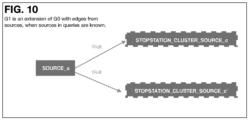
- the source locations of routing queries are known in advance. For example, suppose that we are interested in finding a shortest route from every restaurant in the metropolitan area, and the restaurant locations are known. This can be achieved with the help of an extended graph G0.
- G1 The resulting graph is denoted G1 (it includes G0).
- G1 can be used to compute shortest paths from any SOURCEs to any STOPSTATION _ CLUSTER _ TARGET _ c. In one embodiment, some paths are pre-computed, stored, and retrieved from storage when a query is posed.
- the target locations of routing queries are known in advance, and we extend G0 with prospect edges to the targets.
- this traversal could be merged into a traversal when computing prospect edges in G0.
- G2 The resulting graph is denoted G2 (it includes G0).
- G2 can be used to compute shortest paths from any STOPSTATION CLUSTER SOURCE c to any TARGET _ t. In one embodiment, some paths are pre-computed, stored, and retrieved from storage when a query is posed.
- the target locations of routing queries are known in advance, but the source is revealed only when a query is posed.
- the source locations of routing queries are known in advance, but a target is revealed only when a query is posed.
- the graph G1 of Section 4.3.1 is used to compute a shortest ride.
- the posed query be ( s, t ), for a source SOURCE_s in the graph G1, and an arbitrary target location t that may be not represented in the graph.
- a shortest path from s to t may involve just one bus or only subways. In that case we need not consider prospect edges.
- This quantity denotes a shortest travel duration from s to t that involves a penultimate vehicle.
- B ( s, t ) is the other candidate for a shortest travel duration from s to t.
- a response to the query is a minimum of the two candidates: min ⁇ A ( s , t ), B ( s, t ) ⁇ .
- we use a more general notion of a prospect edge When travel involves multiple vehicles and waits, a shortest path search in a graph may traverse multiple prospect edges, and these prospect edges along the path will together abstract a sequence of more than one wait and ride. To capture this multiplicity, in one embodiment, we use a more general notion of a depth- d prospect edge that abstracts a sequence of at most d waits&rides. For example, a path c - walk 1 - wait 1 - bus 1 - walk 2 - wait 2 - bus 2 - walk 3 - c ' could be abstracted as a depth-2 prospect edge from c to c '. In one embodiment, we add depth- d prospect edges for d larger than 1 to our graphs.
- our method constructs routes given a departure time. For example, consider the case when the rider wishes to begin travel at 8 AM on a Tuesday.
- a routing query specifies a departure time, in addition to the source and target locations of travel.
- the source is a STOPSTATION _ CLUSTER_SOURCE_s
- the target is a STOPSTATION_CLUSTER _ TARGET _ t.
- our method constructs routes given an arrival deadline. For example, consider the case when the rider wishes to arrive at the target before 9 AM on a Tuesday. This is equivalent to departure from the target at 9 AM, but going back in time and space. This can be simply abstracted through an appropriately reversed construction of any of our graphs (buses and subways travel in reverse time and space).
- a desired probability p of arrival we use a random variable A denoting an arrival time of the rider at c .
- T 1 ,... , T k of travel duration we determine a distribution of arrival time at c ' using the prospect travel, min( A + T 1 , ... , A + T k ) .
- a routing answer including a maximum walk duration, a maximum number of transfers, a maximum wait duration, a restriction to specific types of vehicles (e.g., use only express bus and subway).
- Our invention realizes these requirements by an appropriate modification of graphs and a shortest paths algorithm on the graphs.
- our method is applied to an imperfect graph.
- the weight of an edge WaitGetOn could inexactly reflect an expected wait duration for a subway, perhaps because we estimated the duration incorrectly, or there could be vertices and edges for a bus that does not exist in the metropolitan area, perhaps because the bus route was just cancelled by the city government while our method was not yet able to notice the cancellation, or we sampled the expectation of the minimum of choices with a large error, or used an approximate mathematical formula/algorithm.
- the steps of our method are applied in other order.
- One of the embodiments of the invention is a computer system that answers routing queries.
- the system answers queries for a shortest route between locations, given a departure time: any query is in the form (source, target, minuteOfDay). An answer is in the form of a route with durations and choices. An illustration of the embodiment is in FIG. 13 .
- module means a computer (sub)system that provides some specific functionality.
- Our choice of partitioning the computer system into the specific modules is exemplary, not mandatory. Those of ordinary skill in the art will notice that the system can be organized into modules in other manner without departing from the scope of the invention.
- One module of the system reads information about the metropolitan transportation system from a plurality of data sources (1201). The module determines which vehicles, routes, or their parts, are consider fixed timetable, and which non-fixed timetable. The module computes routes for fixed timetable vehicles. The module also computes distributions of wait and ride durations conditioned on time for non-fixed timetable vehicles.
- the output is passed to a module (1204) that computes prospect edges. That module queries information about walks from a plurality of data sources (1203). For selected prospect clusters c and c' and arrival times of the rider at c, the module computes the weight P ( c , c ') of the prospect edge and the choices, using random variables conditioned on the rider arrival time at c. The results are stored in storage (1205).
- the modules (1202) and (1204) operate continuously. As a result, the system maintains a fresh model of the transportation system.
- module (1206) pre-computes shortest paths.
- the module constructs graphs that link locations at times by reading prospect edges from (1205) and non-prospect edges from (1202). Shortest paths algorithms are applied to the graphs to compute paths for selected queries in the form (stop/station cluster source, stop/station cluster target, minuteOfDay). The results are stored, so that a result can be looked up from storage (1207) when needed later.
- the query answering module (1208) answers queries.
- a query source, target, minuteOfDay
- the module computes a shortest path following Section 4.
- the module contacts (1203) to determine walks between the source and the target, and the stop/station clusters.
- the module looks up relevant pre-computed shortest paths from (1207).
- the module requests a shortest path from module (1206), and may store the resulting shortest path in storage (1207) for future use.
- the module (1208) also looks up choices and times from (1205). These walks, shortest paths and choices are combined to generate an answer to the query (1210).
- aspects of the invention may take form of a hardware embodiment, a software embodiment, or a combination of the two. Steps of the invention, including blocks of any flowchart, may be executed out of order, partially concurrently or served from a cache, depending on functionality and optimization. Aspects may take form of a sequential system, or parallel/distributed system, where each component embodies some aspect, possibly redundantly with other components, and components may communicate, for example using a network of any kind.
- a computer program carrying out operations for aspects of the invention may be written in any programming language, including C++, Java or JavaScript. Any program may execute on an arbitrary hardware platform, including a Central Processing Unit (CPU), and a Graphics Processing Unit (GPU), and associated memory and storage devices.
- a program may execute aspects of the invention on one or more software platforms, including, but not limited to: a smartphone running Android or iOS operating systems, or a web browser, including Firefox, Chrome, Internet Explorer, or Safari.
- One of the embodiments of the invention is a service product available to users through a user-facing device, such as a smartphone application or a webpage. It will be obvious to anyone of ordinary skill in the art that the invention is not limited to these devices. It will also be obvious that the presentation of the service in our drawings can be modified (including rearranging, resizing, changing colors, shape, adding or removing components) without departing from the scope of the invention.
- the service is accessed though a smartphone application.
- a user specifies a departure time, and a source and a target, by interacting with the User Interface of the application on the smartphone.
- the service then generates a route, and renders a representation of the route on the smartphone.
- FIG. 14 illustrates an example result for a query from A to L departing at 8 AM.
- the service reports which choice yields a shortest travel duration currently.
- the system highlights this faster choice (illustrated by 1401 on the route), or shows the travel duration by the choice, or depicts a current wait duration (illustrated by 1402 near D).
- this faster choice is computed given the current positions of the vehicles.
- this report is rendered when the user is currently near the location of the choice; for example, when the user is about to depart from A, the service may render that in the current conditions, it is faster to get to F via D and E, rather than via B and C.
- the service depicts a current wait duration for each choice from among the choices at a location (illustrated by 1403 near F), or an expected ride duration for each choice (illustrated by 1404). This may help the user decide by themselves which choice to take, even if not optimal.
- the service reports one expected wait duration for all the choices at a location.
- the duration is an expected wait duration assuming the user will board the choice that achieves an expected minimum travel duration (illustrated by 1405 near H).
- this report is rendered when vehicle positions are uncertain, for example for a segment of the route far down the road compared to the current position of the user. This informs the user how long they will idle at a stop/station waiting for a vehicle.
- the service reports a duration of prospect travel between two locations (illustrated by 1406 on the route). This is the value denoted P ( c, c ') in Section 4.
- the service responds to the user with at least one of:
Landscapes
- Engineering & Computer Science (AREA)
- Radar, Positioning & Navigation (AREA)
- Remote Sensing (AREA)
- Automation & Control Theory (AREA)
- Physics & Mathematics (AREA)
- General Physics & Mathematics (AREA)
- Business, Economics & Management (AREA)
- Human Resources & Organizations (AREA)
- Strategic Management (AREA)
- Economics (AREA)
- Game Theory and Decision Science (AREA)
- Development Economics (AREA)
- Entrepreneurship & Innovation (AREA)
- Marketing (AREA)
- Operations Research (AREA)
- Quality & Reliability (AREA)
- Tourism & Hospitality (AREA)
- General Business, Economics & Management (AREA)
- Theoretical Computer Science (AREA)
- Traffic Control Systems (AREA)
- Navigation (AREA)
- Management, Administration, Business Operations System, And Electronic Commerce (AREA)
- Train Traffic Observation, Control, And Security (AREA)
Applications Claiming Priority (7)
| Application Number | Priority Date | Filing Date | Title |
|---|---|---|---|
| US201762608586P | 2017-12-21 | 2017-12-21 | |
| US201862613779P | 2018-01-05 | 2018-01-05 | |
| US201862659157P | 2018-04-18 | 2018-04-18 | |
| KR1020180045558A KR101974109B1 (ko) | 2017-12-21 | 2018-04-19 | 출발지 위치로부터 목적지 위치로의 여정에 대한 루트 또는 루트 소요 시간을 제공하기 위한 방법 및 컴퓨터 시스템 |
| US16/180,050 US10712162B2 (en) | 2017-12-21 | 2018-11-05 | Method and a computer system for providing a route or a route duration for a journey from a source location to a target location |
| EP18814732.6A EP3593091A1 (fr) | 2017-12-21 | 2018-11-07 | Procédé et système informatique pour fournir un itinéraire ou une durée d'itinéraire pour un voyage d'un emplacement source à un emplacement cible |
| PCT/US2018/059517 WO2019125625A1 (fr) | 2017-12-21 | 2018-11-07 | Procédé et système informatique pour fournir un itinéraire ou une durée d'itinéraire pour un voyage d'un emplacement source à un emplacement cible |
Related Parent Applications (1)
| Application Number | Title | Priority Date | Filing Date |
|---|---|---|---|
| EP18814732.6A Division EP3593091A1 (fr) | 2017-12-21 | 2018-11-07 | Procédé et système informatique pour fournir un itinéraire ou une durée d'itinéraire pour un voyage d'un emplacement source à un emplacement cible |
Publications (2)
| Publication Number | Publication Date |
|---|---|
| EP4513142A2 true EP4513142A2 (fr) | 2025-02-26 |
| EP4513142A3 EP4513142A3 (fr) | 2025-04-30 |
Family
ID=66285578
Family Applications (2)
| Application Number | Title | Priority Date | Filing Date |
|---|---|---|---|
| EP24211603.6A Pending EP4513142A3 (fr) | 2017-12-21 | 2018-11-07 | Procédé et système informatique pour fournir un itinéraire ou une durée d'itinéraire pour un voyage d'un emplacement source à un emplacement cible |
| EP18814732.6A Ceased EP3593091A1 (fr) | 2017-12-21 | 2018-11-07 | Procédé et système informatique pour fournir un itinéraire ou une durée d'itinéraire pour un voyage d'un emplacement source à un emplacement cible |
Family Applications After (1)
| Application Number | Title | Priority Date | Filing Date |
|---|---|---|---|
| EP18814732.6A Ceased EP3593091A1 (fr) | 2017-12-21 | 2018-11-07 | Procédé et système informatique pour fournir un itinéraire ou une durée d'itinéraire pour un voyage d'un emplacement source à un emplacement cible |
Country Status (19)
| Country | Link |
|---|---|
| US (2) | US10712162B2 (fr) |
| EP (2) | EP4513142A3 (fr) |
| JP (2) | JP7618129B2 (fr) |
| KR (2) | KR101974109B1 (fr) |
| CN (2) | CN111065894A (fr) |
| AU (1) | AU2018388686B2 (fr) |
| BR (1) | BR112020005864B1 (fr) |
| CA (2) | CA3060360A1 (fr) |
| CL (1) | CL2019002484A1 (fr) |
| EA (1) | EA202090999A1 (fr) |
| IL (2) | IL271698B (fr) |
| MA (1) | MA47748A (fr) |
| PE (1) | PE20200903A1 (fr) |
| PH (1) | PH12019502919A1 (fr) |
| PL (1) | PL431247A1 (fr) |
| SG (1) | SG11202005476YA (fr) |
| TW (2) | TWI735292B (fr) |
| WO (1) | WO2019125625A1 (fr) |
| ZA (1) | ZA202002926B (fr) |
Families Citing this family (20)
| Publication number | Priority date | Publication date | Assignee | Title |
|---|---|---|---|---|
| US20170286884A1 (en) | 2013-03-15 | 2017-10-05 | Via Transportation, Inc. | System and Method for Transportation |
| EP3631707B1 (fr) * | 2017-05-22 | 2026-03-11 | Via Transportation, Inc. | Systèmes et procédés de gestion de véhicules de covoiturage |
| US12461537B2 (en) | 2018-01-08 | 2025-11-04 | Via Transportation, Inc. | Accounting for driver reaction time when providing driving instructions |
| US11361361B2 (en) * | 2018-02-20 | 2022-06-14 | Grzegorz Malewicz | Method and an apparatus for searching or comparing sites using routes or route lengths between sites and places within a transportation system |
| US11346681B2 (en) * | 2019-02-13 | 2022-05-31 | Grzegorz Malewicz | Method and an apparatus for searching or comparing sites using routes or route lengths between sites and places within a transportation system |
| CN110793535A (zh) * | 2019-08-22 | 2020-02-14 | 腾讯科技(深圳)有限公司 | 一种通勤线路规划方法、装置 |
| JP7238714B2 (ja) * | 2019-09-18 | 2023-03-14 | トヨタ自動車株式会社 | 情報処理装置、情報処理方法、およびプログラム |
| CN110975288B (zh) * | 2019-11-20 | 2023-08-29 | 中国人民解放军国防科技大学 | 基于跳点路径搜索的几何容器数据压缩方法及系统 |
| CN111461287A (zh) * | 2020-02-25 | 2020-07-28 | 上海大学 | 一种基于残差图卷积的共享单车空闲车桩预测方法 |
| CN111815057B (zh) * | 2020-07-13 | 2024-04-26 | 携程旅游信息技术(上海)有限公司 | 路径行程自动规划方法、系统、设备及存储介质 |
| US11550827B2 (en) * | 2020-09-22 | 2023-01-10 | International Business Machines Corporation | Graph enabled location optimization |
| CN112562378B (zh) * | 2020-12-01 | 2023-04-18 | 平安科技(深圳)有限公司 | 公交车调度方法、装置、计算机设备及介质 |
| US12572995B2 (en) | 2021-05-07 | 2026-03-10 | Via Transportation, Inc. | Systems and methods for plan determination |
| TWI789876B (zh) * | 2021-08-19 | 2023-01-11 | 奇點無限有限公司 | 最低風險路線的產生方法 |
| US12412130B1 (en) * | 2022-02-16 | 2025-09-09 | Waymo Llc | Arranging tour trips using autonomous vehicles |
| US12675527B2 (en) | 2022-08-17 | 2026-07-07 | Via Transportation, Inc. | Systems and methods for reachability of different destinations |
| TWI846124B (zh) * | 2022-11-01 | 2024-06-21 | 南開科技大學 | 自由旅行行程的行程推薦與建立系統及其方法 |
| KR102529163B1 (ko) * | 2022-12-21 | 2023-05-08 | (주)와이오엘 | 경로탐색 알고리즘 기반의 수출입화물 운송 경로 최적화 시스템 및 방법 |
| JPWO2025173507A1 (fr) * | 2024-02-16 | 2025-08-21 | ||
| CN121119324B (zh) * | 2024-04-28 | 2026-06-09 | 书行科技(北京)有限公司 | 行程设置方法、装置、电子设备和计算机可读存储介质 |
Family Cites Families (53)
| Publication number | Priority date | Publication date | Assignee | Title |
|---|---|---|---|---|
| EP0987665A3 (fr) * | 1998-07-30 | 2000-10-25 | Visteon Technologies, LLC | Système, méthode et appareil de navigation pour véhicule |
| JP2000230838A (ja) * | 1999-02-10 | 2000-08-22 | Kenwood Corp | カーナビゲーションシステム |
| US7418338B2 (en) * | 2002-12-24 | 2008-08-26 | Navitime Japan Co., Ltd. | Road information provision server, road information provision system, road information provision method, route search server, route search system, and route search method |
| JP4400104B2 (ja) * | 2003-06-18 | 2010-01-20 | 株式会社エクォス・リサーチ | 最短時間経路探索方法 |
| US20060161337A1 (en) * | 2005-01-19 | 2006-07-20 | Ping-Chung Ng | Route planning process |
| US7957871B1 (en) * | 2005-09-29 | 2011-06-07 | Hopstop.com, Inc. | Methods and apparatuses for navigation in urban environments |
| US7573866B2 (en) * | 2006-08-30 | 2009-08-11 | Mitsubishi Electric Research Laboratories, Inc. | Method for finding optimal paths using a stochastic network model |
| KR20090000417A (ko) * | 2007-06-28 | 2009-01-07 | 엘지전자 주식회사 | 정보 단말기를 이용한 경로와 교통 수단을 제공하는 방법과시스템 |
| RU2377658C1 (ru) * | 2008-11-14 | 2009-12-27 | Андрей Валентинович Сабайдаш | Способ определения оптимального маршрута движения транспортного средства |
| US8417409B2 (en) * | 2009-11-11 | 2013-04-09 | Google Inc. | Transit routing system for public transportation trip planning |
| US8681635B2 (en) * | 2009-12-31 | 2014-03-25 | Mapquest, Inc. | Computer-implemented systems and methods for planning a route |
| JP5216034B2 (ja) * | 2010-02-22 | 2013-06-19 | セイコープレシジョン株式会社 | フォーカルプレーンシャッタ及び光学機器 |
| JP5562691B2 (ja) * | 2010-03-18 | 2014-07-30 | 株式会社豊田中央研究所 | 渋滞時間算出装置、出発時刻算出装置、渋滞なし時間算出装置、及びプログラム |
| JP2011232167A (ja) * | 2010-04-27 | 2011-11-17 | Clarion Co Ltd | ナビゲーション装置 |
| US8185302B2 (en) * | 2010-08-26 | 2012-05-22 | Ford Global Technologies, Llc | Conservational vehicle routing |
| JP5789268B2 (ja) * | 2010-11-26 | 2015-10-07 | インターナショナル・ビジネス・マシーンズ・コーポレーションInternational Business Machines Corporation | 経路選択システム、方法及びプログラム |
| DE102011015775A1 (de) * | 2011-04-01 | 2012-10-04 | Volkswagen Aktiengesellschaft | Verfahren und Vorrichtung zum Durchführen einer Reiseroutenplanung für ein Fahrzeug |
| KR101255029B1 (ko) * | 2011-07-26 | 2013-04-17 | 한국철도기술연구원 | 대중교통 스케줄을 고려한 복합 대중교통수단의 경로 정보 제공 시스템 |
| US9594772B2 (en) * | 2011-07-27 | 2017-03-14 | International Business Machines Corporation | Multi-modal journey planner |
| JP2013053987A (ja) * | 2011-09-06 | 2013-03-21 | Internatl Business Mach Corp <Ibm> | 運転者にとって好ましい経路を選択して表示する方法、装置及びコンピュータプログラム |
| JP5824695B2 (ja) * | 2011-10-12 | 2015-11-25 | 新潟市 | 経路算出方法及び経路算出装置 |
| GB2499795A (en) * | 2012-02-28 | 2013-09-04 | Ibm | Routing in a network, based on travel and waiting time |
| US9255809B2 (en) * | 2012-03-30 | 2016-02-09 | Global Eagle Entertainment Inc. | System and method for integrated trip planning based on fixed and flexible itinerary components |
| US9097535B2 (en) * | 2012-05-09 | 2015-08-04 | Google Inc. | Public transportation journey planning |
| US10521473B2 (en) * | 2012-05-21 | 2019-12-31 | Kent State University | Shortest path computation in large networks |
| JP5974716B2 (ja) * | 2012-08-03 | 2016-08-23 | トヨタ自動車株式会社 | カーシェアリングシステムの運用計画システム、運用計画方法 |
| US9459108B2 (en) * | 2012-08-31 | 2016-10-04 | International Business Machines Corporation | Hedging risk in journey planning |
| JP5902607B2 (ja) * | 2012-12-27 | 2016-04-13 | トヨタ自動車株式会社 | 旅行時間情報提供装置、旅行時間情報提供方法 |
| US8909475B2 (en) * | 2013-03-08 | 2014-12-09 | Zzzoom, LLC | Generating transport routes using public and private modes |
| DE102013207895A1 (de) * | 2013-04-30 | 2014-10-30 | Kuka Laboratories Gmbh | Fahrerloses Transportfahrzeug, System mit einem Rechner und einem fahrerlosen Transportfahrzeug, Verfahren zum Betreiben eines fahrerlosen Transportfahrzeugs |
| US9110464B2 (en) * | 2013-11-21 | 2015-08-18 | Intelligrated Headquarters Llc | Route builder |
| US8949028B1 (en) * | 2013-12-02 | 2015-02-03 | Ford Global Technologies, Llc | Multi-modal route planning |
| JP6366296B2 (ja) * | 2014-02-21 | 2018-08-01 | 株式会社ゼンリン | 経路探索装置および経路探索方法 |
| US9482542B2 (en) * | 2014-03-24 | 2016-11-01 | International Business Machines Corporation | Stochastic route planning in public transport |
| KR20150144958A (ko) * | 2014-06-18 | 2015-12-29 | 하인크코리아(주) | 사용자용 경로 안내 장치 및 방법 |
| KR101597772B1 (ko) * | 2014-07-03 | 2016-02-25 | 조형민 | 실시간 대중교통 도착예정시간 산출방법 |
| US9404760B2 (en) * | 2014-08-04 | 2016-08-02 | Xerox Corporation | Efficient route planning in public transportation networks |
| US10175054B2 (en) * | 2015-01-11 | 2019-01-08 | Microsoft Technology Licensing, Llc | Predicting and utilizing variability of travel times in mapping services |
| US10620010B2 (en) * | 2015-02-05 | 2020-04-14 | Moovit App Global Ltd | Public and ordered transportation trip planning |
| GB201503227D0 (en) * | 2015-02-26 | 2015-04-15 | Tomtom Int Bv | Methods and systems for generating routing policies and routes |
| DE102015205901A1 (de) * | 2015-04-01 | 2016-10-06 | Bayerische Motoren Werke Aktiengesellschaft | Verfahren zur Berechnung einer Route für ein Landfahrzeug |
| CN105023426B (zh) * | 2015-05-18 | 2017-06-30 | 南京邮电大学 | 一种城市公交路线选择方法 |
| US9726502B2 (en) * | 2015-08-31 | 2017-08-08 | Sap Se | Route planner for transportation systems |
| US20170132544A1 (en) * | 2015-11-10 | 2017-05-11 | Xerox Corporation | Method and system for stochastic optimization of public transport schedules |
| CN107024217B (zh) * | 2016-02-01 | 2019-06-11 | 北京迈维出行科技有限公司 | 城际交通的路线规划的方法、装置及系统 |
| WO2017160276A1 (fr) * | 2016-03-15 | 2017-09-21 | Ford Global Technologies Llc | Système de planification de voyage multi-jours, multi-personnes et multimodal |
| CN107238391A (zh) * | 2016-03-28 | 2017-10-10 | 高德软件有限公司 | 一种公交出行路线的推荐方法及装置 |
| US11562300B2 (en) * | 2016-06-10 | 2023-01-24 | Conduent Business Services, Llc | System and method for optimal automated booking of on-demand transportation in multi-modal journeys |
| CN106781468B (zh) * | 2016-12-09 | 2018-06-15 | 大连理工大学 | 基于建成环境和低频浮动车数据的路段行程时间估计方法 |
| CN106898142B (zh) * | 2017-03-07 | 2019-07-02 | 北京航空航天大学 | 一种考虑路段相关性的路径行程时间可靠度计算方法 |
| US10274329B2 (en) * | 2017-04-04 | 2019-04-30 | Here Global B.V. | Method and apparatus for providing a minimum overlapping alternative path |
| US10546255B2 (en) * | 2017-05-05 | 2020-01-28 | Conduent Business Services, Llc | Efficient optimization of schedules in a public transportation system |
| WO2019011423A1 (fr) * | 2017-07-12 | 2019-01-17 | Deutsche Post Ag | Système d'acheminement perfectionné |
-
2018
- 2018-04-19 KR KR1020180045558A patent/KR101974109B1/ko active Active
- 2018-11-05 US US16/180,050 patent/US10712162B2/en not_active Expired - Fee Related
- 2018-11-07 EA EA202090999A patent/EA202090999A1/ru unknown
- 2018-11-07 MA MA047748A patent/MA47748A/fr unknown
- 2018-11-07 JP JP2020524268A patent/JP7618129B2/ja active Active
- 2018-11-07 AU AU2018388686A patent/AU2018388686B2/en active Active
- 2018-11-07 CN CN201880039978.5A patent/CN111065894A/zh active Pending
- 2018-11-07 EP EP24211603.6A patent/EP4513142A3/fr active Pending
- 2018-11-07 EP EP18814732.6A patent/EP3593091A1/fr not_active Ceased
- 2018-11-07 WO PCT/US2018/059517 patent/WO2019125625A1/fr not_active Ceased
- 2018-11-07 PE PE2020000808A patent/PE20200903A1/es unknown
- 2018-11-07 SG SG11202005476YA patent/SG11202005476YA/en unknown
- 2018-11-07 PL PL431247A patent/PL431247A1/pl unknown
- 2018-11-07 BR BR112020005864-5A patent/BR112020005864B1/pt not_active IP Right Cessation
- 2018-11-07 CA CA3060360A patent/CA3060360A1/fr active Pending
- 2018-11-07 CA CA3251936A patent/CA3251936A1/en active Pending
- 2018-11-07 CN CN202111011536.XA patent/CN114076606A/zh active Pending
-
2019
- 2019-04-08 TW TW109124923A patent/TWI735292B/zh active
- 2019-04-08 TW TW108112149A patent/TWI704522B/zh not_active IP Right Cessation
- 2019-04-18 KR KR1020190045438A patent/KR102514131B1/ko active Active
- 2019-08-28 CL CL2019002484A patent/CL2019002484A1/es unknown
- 2019-11-18 PH PH12019502919A patent/PH12019502919A1/en unknown
- 2019-12-24 IL IL271698A patent/IL271698B/en active IP Right Grant
-
2020
- 2020-05-19 ZA ZA2020/02926A patent/ZA202002926B/en unknown
- 2020-06-03 US US16/891,104 patent/US11204252B2/en active Active
- 2020-11-26 IL IL279023A patent/IL279023B/en unknown
-
2021
- 2021-10-15 JP JP2021169879A patent/JP7618130B2/ja active Active
Non-Patent Citations (2)
| Title |
|---|
| HAJIAN MOHAMMAD ET AL: "Modeling wildfire propagation with the stochastic shortest path: A fast simulation approach", ENVIRONMENTAL MODELLING & SOFTWARE ELSEVIER, AMSTERDAM, NL, vol. 82, 29 April 2016 (2016-04-29), pages 73 - 88, XP029579908, ISSN: 1364-8152, DOI: 10.1016/J.ENVSOFT.2016.03.012 * |
| KEY R.: "Routing in stochastic networks", NETWORKING, SENSING AND CONTROL, 2005. PROCEEDINGS. 2005 IEEE TUCSON, AZ, USA MARCH 19-22, 2005 PISCATAWAY, NJ, USA,IEEE, 19 March 2005 (2005-03-19), pages 861 - 866, XP010813393, ISBN: 9780780388123, DOI: 10.1109/ICNSC.2005.1461305 * |
Also Published As
Similar Documents
| Publication | Publication Date | Title |
|---|---|---|
| US11204252B2 (en) | Method and a computer system for providing a route or a route duration for a journey from a source location to a target location | |
| US8862386B2 (en) | System and method for journey planning, finding K shortest paths through a time/space network | |
| Voigt et al. | Crowdsourced logistics: The pickup and delivery problem with transshipments and occasional drivers | |
| Yarkoni et al. | Quantum shuttle: traffic navigation with quantum computing | |
| US9778051B2 (en) | Diversified route planning for public transportation network | |
| US20170167882A1 (en) | System and method for generating available ride-share paths in a transportation network | |
| EP2847546B1 (fr) | Planification d'itinéraires de transport public | |
| US11182871B2 (en) | System and apparatus for ridesharing | |
| Horn | Procedures for planning multi-leg journeys with fixed-route and demand-responsive passenger transport services | |
| US20180268371A1 (en) | Branch-And-Price-And-Check Model For The Vehicle Routing Problem With Location Resource Constraints | |
| Qiu et al. | Demi-flexible operating policies to promote the performance of public transit in low-demand areas | |
| US9273970B2 (en) | Systems and methods for generating a plurality of trip patterns | |
| US8972190B1 (en) | Systems and methods for generating transit trips | |
| CN109118752A (zh) | 信息处理方法、信息处理系统以及程序 | |
| KR102696587B1 (ko) | 운송 관련 서비스에 대한 요청을 관리하기 위한 통신 서버 장치, 방법, 및 통신 시스템 | |
| Trozzi et al. | Effects of countdown displays in public transport route choice under severe overcrowding | |
| Rouhieh et al. | Optimizing route choice in multimodal transportation networks | |
| Laura et al. | Data driven synchronization strategies of a bus line in a transit network | |
| Lam et al. | Developing A Network Algorithm for Demand Responsive Transit Service in A Rural Area of Sweden | |
| EA040136B1 (ru) | Способ построения маршрута или продолжительности маршрута для поездки от начального пункта до конечного пункта (варианты) | |
| Nuzzolo et al. | Time-dependent Shortest Hyperpaths for Dynamic Routing on Transit Networks |
Legal Events
| Date | Code | Title | Description |
|---|---|---|---|
| PUAI | Public reference made under article 153(3) epc to a published international application that has entered the european phase |
Free format text: ORIGINAL CODE: 0009012 |
|
| STAA | Information on the status of an ep patent application or granted ep patent |
Free format text: STATUS: REQUEST FOR EXAMINATION WAS MADE |
|
| 17P | Request for examination filed |
Effective date: 20241108 |
|
| AC | Divisional application: reference to earlier application |
Ref document number: 3593091 Country of ref document: EP Kind code of ref document: P |
|
| AK | Designated contracting states |
Kind code of ref document: A2 Designated state(s): AL AT BE BG CH CY CZ DE DK EE ES FI FR GB GR HR HU IE IS IT LI LT LU LV MC MK MT NL NO PL PT RO RS SE SI SK SM TR |
|
| PUAL | Search report despatched |
Free format text: ORIGINAL CODE: 0009013 |
|
| AK | Designated contracting states |
Kind code of ref document: A3 Designated state(s): AL AT BE BG CH CY CZ DE DK EE ES FI FR GB GR HR HU IE IS IT LI LT LU LV MC MK MT NL NO PL PT RO RS SE SI SK SM TR |
|
| RIC1 | Information provided on ipc code assigned before grant |
Ipc: G01C 21/34 20060101AFI20250324BHEP |
|
| RIN1 | Information on inventor provided before grant (corrected) |
Inventor name: MALEWICZ, GRZEGORZ |
|
| STAA | Information on the status of an ep patent application or granted ep patent |
Free format text: STATUS: EXAMINATION IS IN PROGRESS |
|
| 17Q | First examination report despatched |
Effective date: 20260508 |