EP4513236A1 - Schätzung der wahrscheinlichkeitsdichtefunktion einer fahrzeugsensorpunktwolke auf basis von sichtsensordaten - Google Patents
Schätzung der wahrscheinlichkeitsdichtefunktion einer fahrzeugsensorpunktwolke auf basis von sichtsensordaten Download PDFInfo
- Publication number
- EP4513236A1 EP4513236A1 EP24194299.4A EP24194299A EP4513236A1 EP 4513236 A1 EP4513236 A1 EP 4513236A1 EP 24194299 A EP24194299 A EP 24194299A EP 4513236 A1 EP4513236 A1 EP 4513236A1
- Authority
- EP
- European Patent Office
- Prior art keywords
- point cloud
- cloud distribution
- sensor point
- estimated
- sensor data
- Prior art date
- Legal status (The legal status is an assumption and is not a legal conclusion. Google has not performed a legal analysis and makes no representation as to the accuracy of the status listed.)
- Pending
Links
Images




Classifications
-
- G—PHYSICS
- G01—MEASURING; TESTING
- G01S—RADIO DIRECTION-FINDING; RADIO NAVIGATION; DETERMINING DISTANCE OR VELOCITY BY USE OF RADIO WAVES; LOCATING OR PRESENCE-DETECTING BY USE OF THE REFLECTION OR RERADIATION OF RADIO WAVES; ANALOGOUS ARRANGEMENTS USING OTHER WAVES
- G01S7/00—Details of systems according to groups G01S13/00, G01S15/00, G01S17/00
- G01S7/02—Details of systems according to groups G01S13/00, G01S15/00, G01S17/00 of systems according to group G01S13/00
- G01S7/41—Details of systems according to groups G01S13/00, G01S15/00, G01S17/00 of systems according to group G01S13/00 using analysis of echo signal for target characterisation; Target signature; Target cross-section
- G01S7/417—Details of systems according to groups G01S13/00, G01S15/00, G01S17/00 of systems according to group G01S13/00 using analysis of echo signal for target characterisation; Target signature; Target cross-section involving the use of neural networks
-
- G—PHYSICS
- G06—COMPUTING OR CALCULATING; COUNTING
- G06V—IMAGE OR VIDEO RECOGNITION OR UNDERSTANDING
- G06V20/00—Scenes; Scene-specific elements
- G06V20/50—Context or environment of the image
- G06V20/56—Context or environment of the image exterior to a vehicle by using sensors mounted on the vehicle
- G06V20/58—Recognition of moving objects or obstacles, e.g. vehicles or pedestrians; Recognition of traffic objects, e.g. traffic signs, traffic lights or roads
-
- G—PHYSICS
- G06—COMPUTING OR CALCULATING; COUNTING
- G06V—IMAGE OR VIDEO RECOGNITION OR UNDERSTANDING
- G06V10/00—Arrangements for image or video recognition or understanding
- G06V10/70—Arrangements for image or video recognition or understanding using pattern recognition or machine learning
- G06V10/72—Data preparation, e.g. statistical preprocessing of image or video features
-
- G—PHYSICS
- G01—MEASURING; TESTING
- G01S—RADIO DIRECTION-FINDING; RADIO NAVIGATION; DETERMINING DISTANCE OR VELOCITY BY USE OF RADIO WAVES; LOCATING OR PRESENCE-DETECTING BY USE OF THE REFLECTION OR RERADIATION OF RADIO WAVES; ANALOGOUS ARRANGEMENTS USING OTHER WAVES
- G01S13/00—Systems using the reflection or reradiation of radio waves, e.g. radar systems; Analogous systems using reflection or reradiation of waves whose nature or wavelength is irrelevant or unspecified
- G01S13/86—Combinations of radar systems with non-radar systems, e.g. sonar, direction finder
- G01S13/867—Combination of radar systems with cameras
-
- G—PHYSICS
- G01—MEASURING; TESTING
- G01S—RADIO DIRECTION-FINDING; RADIO NAVIGATION; DETERMINING DISTANCE OR VELOCITY BY USE OF RADIO WAVES; LOCATING OR PRESENCE-DETECTING BY USE OF THE REFLECTION OR RERADIATION OF RADIO WAVES; ANALOGOUS ARRANGEMENTS USING OTHER WAVES
- G01S13/00—Systems using the reflection or reradiation of radio waves, e.g. radar systems; Analogous systems using reflection or reradiation of waves whose nature or wavelength is irrelevant or unspecified
- G01S13/88—Radar or analogous systems specially adapted for specific applications
- G01S13/89—Radar or analogous systems specially adapted for specific applications for mapping or imaging
-
- G—PHYSICS
- G01—MEASURING; TESTING
- G01S—RADIO DIRECTION-FINDING; RADIO NAVIGATION; DETERMINING DISTANCE OR VELOCITY BY USE OF RADIO WAVES; LOCATING OR PRESENCE-DETECTING BY USE OF THE REFLECTION OR RERADIATION OF RADIO WAVES; ANALOGOUS ARRANGEMENTS USING OTHER WAVES
- G01S13/00—Systems using the reflection or reradiation of radio waves, e.g. radar systems; Analogous systems using reflection or reradiation of waves whose nature or wavelength is irrelevant or unspecified
- G01S13/88—Radar or analogous systems specially adapted for specific applications
- G01S13/93—Radar or analogous systems specially adapted for specific applications for anti-collision purposes
- G01S13/931—Radar or analogous systems specially adapted for specific applications for anti-collision purposes of land vehicles
-
- G—PHYSICS
- G06—COMPUTING OR CALCULATING; COUNTING
- G06N—COMPUTING ARRANGEMENTS BASED ON SPECIFIC COMPUTATIONAL MODELS
- G06N3/00—Computing arrangements based on biological models
- G06N3/02—Neural networks
- G06N3/04—Architecture, e.g. interconnection topology
- G06N3/044—Recurrent networks, e.g. Hopfield networks
-
- G—PHYSICS
- G06—COMPUTING OR CALCULATING; COUNTING
- G06N—COMPUTING ARRANGEMENTS BASED ON SPECIFIC COMPUTATIONAL MODELS
- G06N3/00—Computing arrangements based on biological models
- G06N3/02—Neural networks
- G06N3/04—Architecture, e.g. interconnection topology
- G06N3/0464—Convolutional networks [CNN, ConvNet]
-
- G—PHYSICS
- G06—COMPUTING OR CALCULATING; COUNTING
- G06N—COMPUTING ARRANGEMENTS BASED ON SPECIFIC COMPUTATIONAL MODELS
- G06N3/00—Computing arrangements based on biological models
- G06N3/02—Neural networks
- G06N3/04—Architecture, e.g. interconnection topology
- G06N3/0499—Feedforward networks
-
- G—PHYSICS
- G06—COMPUTING OR CALCULATING; COUNTING
- G06V—IMAGE OR VIDEO RECOGNITION OR UNDERSTANDING
- G06V10/00—Arrangements for image or video recognition or understanding
- G06V10/70—Arrangements for image or video recognition or understanding using pattern recognition or machine learning
- G06V10/74—Image or video pattern matching; Proximity measures in feature spaces
- G06V10/75—Organisation of the matching processes, e.g. simultaneous or sequential comparisons of image or video features; Coarse-fine approaches, e.g. multi-scale approaches; using context analysis; Selection of dictionaries
- G06V10/751—Comparing pixel values or logical combinations thereof, or feature values having positional relevance, e.g. template matching
-
- G—PHYSICS
- G06—COMPUTING OR CALCULATING; COUNTING
- G06V—IMAGE OR VIDEO RECOGNITION OR UNDERSTANDING
- G06V10/00—Arrangements for image or video recognition or understanding
- G06V10/70—Arrangements for image or video recognition or understanding using pattern recognition or machine learning
- G06V10/82—Arrangements for image or video recognition or understanding using pattern recognition or machine learning using neural networks
-
- G—PHYSICS
- G06—COMPUTING OR CALCULATING; COUNTING
- G06V—IMAGE OR VIDEO RECOGNITION OR UNDERSTANDING
- G06V20/00—Scenes; Scene-specific elements
- G06V20/50—Context or environment of the image
- G06V20/56—Context or environment of the image exterior to a vehicle by using sensors mounted on the vehicle
-
- G—PHYSICS
- G01—MEASURING; TESTING
- G01S—RADIO DIRECTION-FINDING; RADIO NAVIGATION; DETERMINING DISTANCE OR VELOCITY BY USE OF RADIO WAVES; LOCATING OR PRESENCE-DETECTING BY USE OF THE REFLECTION OR RERADIATION OF RADIO WAVES; ANALOGOUS ARRANGEMENTS USING OTHER WAVES
- G01S13/00—Systems using the reflection or reradiation of radio waves, e.g. radar systems; Analogous systems using reflection or reradiation of waves whose nature or wavelength is irrelevant or unspecified
- G01S13/86—Combinations of radar systems with non-radar systems, e.g. sonar, direction finder
- G01S13/865—Combination of radar systems with lidar systems
-
- G—PHYSICS
- G01—MEASURING; TESTING
- G01S—RADIO DIRECTION-FINDING; RADIO NAVIGATION; DETERMINING DISTANCE OR VELOCITY BY USE OF RADIO WAVES; LOCATING OR PRESENCE-DETECTING BY USE OF THE REFLECTION OR RERADIATION OF RADIO WAVES; ANALOGOUS ARRANGEMENTS USING OTHER WAVES
- G01S17/00—Systems using the reflection or reradiation of electromagnetic waves other than radio waves, e.g. lidar systems
- G01S17/86—Combinations of lidar systems with systems other than lidar, radar or sonar, e.g. with direction finders
-
- G—PHYSICS
- G01—MEASURING; TESTING
- G01S—RADIO DIRECTION-FINDING; RADIO NAVIGATION; DETERMINING DISTANCE OR VELOCITY BY USE OF RADIO WAVES; LOCATING OR PRESENCE-DETECTING BY USE OF THE REFLECTION OR RERADIATION OF RADIO WAVES; ANALOGOUS ARRANGEMENTS USING OTHER WAVES
- G01S17/00—Systems using the reflection or reradiation of electromagnetic waves other than radio waves, e.g. lidar systems
- G01S17/88—Lidar systems specially adapted for specific applications
- G01S17/93—Lidar systems specially adapted for specific applications for anti-collision purposes
- G01S17/931—Lidar systems specially adapted for specific applications for anti-collision purposes of land vehicles
-
- G—PHYSICS
- G01—MEASURING; TESTING
- G01S—RADIO DIRECTION-FINDING; RADIO NAVIGATION; DETERMINING DISTANCE OR VELOCITY BY USE OF RADIO WAVES; LOCATING OR PRESENCE-DETECTING BY USE OF THE REFLECTION OR RERADIATION OF RADIO WAVES; ANALOGOUS ARRANGEMENTS USING OTHER WAVES
- G01S13/00—Systems using the reflection or reradiation of radio waves, e.g. radar systems; Analogous systems using reflection or reradiation of waves whose nature or wavelength is irrelevant or unspecified
- G01S13/88—Radar or analogous systems specially adapted for specific applications
- G01S13/93—Radar or analogous systems specially adapted for specific applications for anti-collision purposes
- G01S13/931—Radar or analogous systems specially adapted for specific applications for anti-collision purposes of land vehicles
- G01S2013/9323—Alternative operation using light waves
-
- G—PHYSICS
- G01—MEASURING; TESTING
- G01S—RADIO DIRECTION-FINDING; RADIO NAVIGATION; DETERMINING DISTANCE OR VELOCITY BY USE OF RADIO WAVES; LOCATING OR PRESENCE-DETECTING BY USE OF THE REFLECTION OR RERADIATION OF RADIO WAVES; ANALOGOUS ARRANGEMENTS USING OTHER WAVES
- G01S7/00—Details of systems according to groups G01S13/00, G01S15/00, G01S17/00
- G01S7/48—Details of systems according to groups G01S13/00, G01S15/00, G01S17/00 of systems according to group G01S17/00
- G01S7/4802—Details of systems according to groups G01S13/00, G01S15/00, G01S17/00 of systems according to group G01S17/00 using analysis of echo signal for target characterisation; Target signature; Target cross-section
Definitions
- Radar data is often used to improve vehicle safety.
- radar-based object avoidance and collision avoidance are often utilized in vehicles in order to notify drivers of nearby objects, such when the driver is parking a vehicle, or even to automatically apply a vehicle's brakes when an impending collision is detected.
- radar data can be inaccurate and typically suffers from performance degradation in cluttered environments, which can result in false alarms due to ghost object detections, such as reflections from an actual object due to a static guard rail in the street.
- One point of difficulty in utilizing machine learning to improve radar data is that machine learning techniques typically require a large amount of training data, which can be difficult to obtain, in order to train deep learning networks to be useful for improving radar data or related systems. Accordingly, it is desirable to identify practical ways to leverage machine learning to improve radar data or related systems.
- FIGS. 1-9 illustrate techniques for using machine learning to produce vehicle location sensor data from vision sensor data.
- machine learning techniques typically require a large amount of well-labeled training data, which can be difficult to obtain, in order to train deep learning networks to be useful for improving sensor data or related systems.
- large amounts of well-labeled training data are not typically readily available for, e.g., radar applications, large amounts of well-labeled training data are available for, e.g., vision sensor data of roads.
- a deep learning network can be trained to produce estimated sensor point cloud distributions (i.e., from vision sensor data alone).
- a sensor point cloud distribution refers to a collection of data points typically generated using a sensor, such as a radar or LiDAR sensor, where each point represents a detected object's position in three-dimensional space, often along with additional attributes such as velocity or cross-section.
- a sensor such as a radar or LiDAR sensor
- Using a deep learning network trained in this way vehicles with limited or no radar or other sensor functionality can be equipped with a vision sensor to produce estimated vehicle location sensor point cloud distributions (i.e., an estimated distribution of points of interest that should be detectable using a sensor such as a radar or LiDAR sensor). These estimated vehicle location sensor point cloud distributions can then be used to improve vehicle safety through vehicle controls or driver notifications and/or to produce enhanced sensor data.
- FIG. 1 illustrates a method 100 of training a deep learning network to produce an estimated sensor point cloud distribution based on vision sensor data in accordance with some embodiments.
- FIG. 1 is discussed in connection with FIG. 2 , which provides a representation of one or more photographic image 200, which may include one or more camera images, alongside a corresponding estimated sensor point cloud distribution 250 with overlaid training data 254.
- the deep learning network is first trained using labeled training imagery 102 (see, e.g., the photographic image 200 of FIG.
- training data 103 which may include sensor data such as a ground truth point cloud (e.g., a low-resolution known distribution of points of interest that are detected using a sensor such as a radar or LiDAR sensor) corresponding to (e.g., co-centered with) the training imagery 102 (see, e.g., the training data 254 of FIG. 2 ).
- sensor data such as a ground truth point cloud (e.g., a low-resolution known distribution of points of interest that are detected using a sensor such as a radar or LiDAR sensor) corresponding to (e.g., co-centered with) the training imagery 102 (see, e.g., the training data 254 of FIG. 2 ).
- a ground truth point cloud e.g., a low-resolution known distribution of points of interest that are detected using a sensor such as a radar or LiDAR sensor
- the training imagery 102 is provided as an input to a deep learning network, in this case a convolutional neural network (CNN) model 104, although it is noted that other types of deep learning networks can be used in place of or in addition to a CNN model, such as a Multi-Layer Perceptron model or a Recurrent Neural Network model, among others.
- CNN convolutional neural network
- the CNN model 104 processes the training imagery 102 (see, e.g., the photographic image 200 of FIG.
- PDF probability density function
- Gaussian mixture model parameters or other statistical modeling parameters such as mean, variance, and weight parameters
- PDF 109 an estimated PDF 109 (see, e.g., the estimated sensor point cloud distribution 250 of FIG. 2 ) corresponding to the training imagery 102.
- the other training data 103 includes point clouds at a first resolution, and the estimated sensor point cloud distribution 250 has a second resolution higher than the first resolution.
- a PDF is a function whose value at any given sample (or point) in the sample space (the set of possible values taken by a random variable) can be interpreted as providing a relative likelihood that the value of the random variable would be equal to that sample. Accordingly, the value of a PDF at two different samples can be used to infer, in any particular draw of the random variable, how much more likely it is that the random variable would be close to one sample compared to the other sample.
- the estimated PDF 109 should (after sufficient training of the deep learning network) include higher likelihood values in regions where sensor points are likely to be found and lower likelihood values otherwise.
- the estimated PDF 109 provides estimated regions of high and low likelihood of sensor points derived from the training imagery 102 but does not include the training data 254 shown in FIG. 2 .
- the estimated sensor point cloud distribution 350 of FIG. 3 is shown in the estimated sensor point cloud distribution 350 of FIG. 3 .
- the deep learning network is first trained by comparing the estimated PDF 109 to the other training data 103 and modifying the CNN model 104 to maximize the likelihood of the other training data 103 (e.g., the training data 254 of FIG. 2 ) in the estimated PDF 109 (e.g., the estimated sensor point cloud distribution 250 of FIG. 2 ).
- the estimated PDF 109 is compared 110 with the other training data 103 to compute a conditional probability (a type of probability that results from updating a prior probability with information summarized by the likelihood via an application of Bayes' rule), after which a loss function 112 is used to compute a loss function 114, which gauges a difference between the PDF 109 and the other training data 103 and maximizes a posteriori probability of the other training data to the estimated sensor point cloud distribution (e.g., PDF 109).
- the loss function 114 is compared to a threshold 116, which may be predetermined or dynamically controlled.
- the threshold 116 controls a number of iterations, allowing training to be limited to a predetermined number of iterations.
- a sensor point cloud is generated from the estimated sensor point cloud distribution as a realization with likelihood values that exceed a threshold. Such embodiments may include comparing the estimated sensor point cloud distribution with the other training data corresponding to the vision sensor training data to obtain a loss function, generating a sensor point cloud from the estimated sensor point cloud distribution as a realization, and comparing likelihood values in the sensor point cloud with a predetermined threshold to determine whether training of the deep learning network is complete.
- the CNN model 104 is updated based on the loss function, and when the threshold 116 is met, the method 100 of training of the CNN model 104 is complete. However, if the threshold 116 is not met or further training is otherwise desired, the method 100 provides the same or different training imagery 102 to the CNN model 104 and the training process is repeated, with each iteration aiming to further minimize any differences between regions of high likelihood in the estimated PDF 109 (e.g., the estimated sensor point cloud distribution 250 of FIG. 2 ) and the other training data 103 (e.g., the training data 254 of FIG. 2 or different training data corresponding to different training imagery).
- the estimated PDF 109 e.g., the estimated sensor point cloud distribution 250 of FIG. 2
- the other training data 103 e.g., the training data 254 of FIG. 2 or different training data corresponding to different training imagery.
- the training imagery 102 may be prerecorded imagery or live imagery recorded by an on-board vehicle system, which may include one or more sensors (e.g., photographic, radar, etc.).
- the other training data 103 which may include the training data 254 shown in FIG. 2 , may be prerecorded or live sensor data recorded by an on-board vehicle system.
- the other training data 103 and/or estimated PDF 109 include 2-4 dimensions, such as range, azimuth, elevation, and Doppler (i.e., relative speed) information.
- an estimated sensor point cloud distribution such as the estimated sensor point cloud distribution 250 of FIG. 2 is a radar point cloud distribution including estimated radar points having range, azimuth, elevation, and Doppler information
- the other training data 103 includes radar points having range and azimuth information.
- the estimated PDF 109 is generated using a parametric Gaussian mixture model (GMM), as shown in Equation 1, where K represents the number of components in the GMM, represents each Gaussian, and p( x ) is the resulting point cloud PDF.
- GMM parametric Gaussian mixture model
- Parameters ⁇ i and ⁇ i which are vectors and matrices, respectively, can include from 2-4 dimensions, while ⁇ i is a weighting parameter for each Gaussian .
- Equation 2 must be satisfied, forcing the weighting parameters ⁇ i for each Gaussian to sum to 1.
- the Gaussians are defined by Equation 3.
- N x ⁇ ⁇ ⁇ i ⁇ i 1 2 ⁇ K ⁇ i exp ⁇ 1 2 x ⁇ ⁇ ⁇ ⁇ i T ⁇ i ⁇ 1 x ⁇ ⁇ ⁇ ⁇ i
- the loss function 114 is computed using Equation 4, where L is the loss, N represents the number of points in the point cloud x , ⁇ represents GMM parameters as determined by the deep learning network (e.g., CNN model 104), and ⁇ is a tuning parameter usable to tune properties of the PDF p (e.g., to provide a sharpening effect).
- FIG. 3 illustrates a method 300 of producing an estimated sensor point cloud distribution based on vision sensor data in accordance with some embodiments. Similar to the training example of FIG. 1 but with the training steps omitted, as can be seen in FIG. 3 , rather than the training imagery 102, live imagery 302 is provided as an input to a trained deep learning network, in this case the CNN model 104 trained using the training method 100 of FIG. 1 . The CNN model 104 processes the live imagery 302 (similar to the photographic image 200 of FIG.
- the live imagery 302 can include still images and/or videos or sets of images) to produce one or more PDF parameters 306, which are then used (e.g., in a Gaussian mixture model or other statistical model) to estimate a PDF 108, which can be used to generate an estimated sensor point cloud distribution 350 corresponding to the live imagery 302 by inference, e.g., with high- or super-resolution, without requiring any sensor data to be provided corresponding to the live imagery 302.
- the method 100 of FIG. 1 may be performed by a training system separate from any vehicle or in an on-board vehicle system
- the method 300 and other methods described hereinbelow for generating estimated sensor point cloud distributions may be performed partially or completely by an on-board vehicle system.
- some portions of the methods may be performed by external (e.g., cloud or server-based) computing systems.
- live imagery 302 is obtained using an on-board vehicle system while analysis of the live imagery 302 by the CNN model 104, generation of the PDF model parameters 306, estimating the PDF 108, and/or generating the estimated sensor point cloud distribution 350 are performed by external computing systems in communication (e.g., WiFi or cellular) with the on-board vehicle system.
- FIG. 4 illustrates a method 400 of producing an estimated sensor point cloud distribution based on vision sensor data and other sensor data in accordance with some embodiments.
- the method 400 is identical to the method 300 with the exception of live sensor data 402.
- estimating the PDF 108 can include consideration of the live sensor data 402.
- the estimated PDF and/or estimated sensor point cloud distribution 450 is created or modified based on the live sensor data 402 in addition to the live imagery 302.
- a correlation between the live sensor data 402 and the estimated PDF or the estimated sensor point cloud distribution 450 is determined and the estimated PDF or estimated sensor point cloud distribution 450 is created or modified based on the correlation.
- the estimated PDF or estimated sensor point cloud distribution 450 may be modified based on the identified correlation, e.g., by further increasing the likelihood of the high likelihood region corresponding to a sensor point in the live sensor data 402 and/or increasing a confidence level associated with the high likelihood region corresponding to a sensor point in the live sensor data 402.
- the estimated PDF or estimated sensor point cloud distribution 450 may be modified based on the lack of an identified correlation, e.g., by increasing the likelihood of the low likelihood region corresponding to a sensor point in the live sensor data 402 and/or decreasing a confidence level associated with the low likelihood region corresponding to a sensor point in the live sensor data 402.
- the estimated PDF or estimated sensor point cloud distribution 450 may be modified based on the lack of an identified correlation, e.g., by decreasing the likelihood of the high likelihood region lacking any coinciding sensor points in the live sensor data 402 and/or decreasing a confidence level associated with the high likelihood region lacking any coinciding sensor points in the live sensor data 402.
- live imagery and “live” sensor data are referred to herein for clarity and convenience, previously recorded imagery, and optionally previously recorded sensor data corresponding to that recorded imagery, can be used in place of "live” imagery and data in various methods disclosed herein to generate estimated PDFs and/or estimated sensor point cloud distributions for the recorded imagery and data.
- the estimated sensor point cloud distribution can be used as the basis for any of a number of applications, ranging from notifying an occupant of a vehicle of an approaching object or a turn identified in the estimated sensor point cloud distribution to directly controlling a vehicle, e.g., applying brakes or acceleration to avoid colliding with an approaching object or automatedly turning, e.g., via the steering wheel, when an upcoming turn is identified.
- the estimated sensor point cloud distribution is used to improve live sensor data.
- an estimated PDF or estimated sensor point cloud distribution is modified based on live sensor data to produce an improved estimated sensor point cloud distribution.
- the estimated PDF or estimated sensor point cloud distribution is used to increase the granularity and/or dimensionality of live sensor data, e.g., by adding sensor points and/or converting 2D (or 3D) live sensor data to 3D (or 4D) live sensor data.
- the estimated PDF or estimated sensor point cloud distribution is used, along with corresponding vision sensor data, as training data for other machine learning applications.
- methods disclosed herein are not only usable for producing sensor data from vision sensor data for the purposes of utilizing that sensor data in a live or "real-time" application, but also for producing vast quantities of sensor data for vision sensor data in order to enable further deep learning applications that may require such quantities of corresponding sensor data and vision sensor data.
- an estimated vehicle location sensor point cloud distribution where only vehicles are identified as high likelihood regions.
- vehicle location sensor point cloud distributions the same methods described above (e.g., methods 100, 300, 400, 500) can be used, but with different other training data 103 specific to vehicle locations and a different loss function.
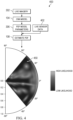
- FIG. 6 illustrates a photographic image alongside a corresponding estimated sensor point cloud distribution with overlaid training data including vehicle location training data.
- a deep learning network can be trained to produce estimated vehicle location sensor point cloud distributions based only on vision sensor data.
- a different loss function from that specified in Equation 4 above is used, such as that specified below in Equation 5.
- a loss function similar to the one presented in Equation 5 a deep learning network can be trained to provide a maximized likelihood in a region of an estimated PDF or estimated sensor point cloud distribution wherever a training vehicle location sensor point is located while forcing other regions to minimum values.
- FIG. 7 illustrates a method 700 of producing an estimated vehicle location sensor point cloud distribution based on vision sensor data in accordance with some embodiments. Similar to the training example of FIG. 1 but with the training steps omitted, as can be seen in FIG. 7 , rather than using training imagery 102, live imagery 302 is provided as an input to a trained deep learning network, in this case the CNN model 104 trained using the training method 100 of FIG. 1 with vehicle location training data like the vehicle location training data 654 of FIG. 6 . The CNN model 104 processes the live imagery 302 (similar to the photographic image 200 of FIG.
- the live imagery 302 can include still images and/or videos or sets of images) to produce one or more vehicle location PDF parameters 706, which are then used (e.g., in a Gaussian mixture model or other statistical model) to estimate a vehicle location PDF 108, which can be used to generate an estimated vehicle location sensor point cloud distribution 750 corresponding to the live imagery 302 without requiring any sensor data to be provided corresponding to the live imagery 302.
- the method 700 is able to produce the estimated vehicle location sensor point cloud distribution 750 where only vehicles or vehicle-adjacent regions are identified as high likelihood regions.
- the vehicle location PDF 108 and/or estimated vehicle location sensor point cloud distribution 750 are modified based on live sensor data 402 in a similar way to how the PDF 108 and/or estimated sensor point cloud distribution 450 are updated based on live sensor data 402, as discussed above with reference to FIG. 4 .
- general (e.g., non-vehicle specific) estimated sensor point cloud distributions such as the estimated sensor point cloud distributions 350 or 450 of FIGS. 3 and 4 (or corresponding general PDFs) are compared with an estimated vehicle location sensor point cloud distribution such as the vehicle location sensor point cloud distribution 750 of FIG. 7 (or corresponding vehicle PDFs) in order to identify vehicles, environmental objects, and ghost objects (e.g., false positives) with higher confidence.
- an estimated vehicle location sensor point cloud distribution includes a high likelihood region coinciding with a high likelihood region of a general estimated sensor point cloud distribution, it can be deduced that this coinciding region corresponds to a vehicle with reasonably high confidence.
- an estimated vehicle location sensor point cloud distribution includes a low likelihood region coinciding with a high likelihood region of a general estimated sensor point cloud distribution, it can be deduced that this coinciding region corresponds to an environmental object with reasonably high confidence.
- an estimated vehicle location point cloud distribution includes a low likelihood region coinciding with a low likelihood region of a general estimated sensor point cloud distribution, it can be deduced that this coinciding region corresponds to a ghost object with reasonably high confidence. Accordingly, by comparing estimated vehicle location sensor point cloud distributions with general estimated sensor point cloud distributions, ghost objects can be eliminated or assigned a lower confidence value, while vehicles and/or environmental objects can be identified and/or assigned higher confidence values.
- the posterior probability of each point in the co-centered sensor point cloud distribution is evaluated on both PDFs. If p 1 ( x
- a collection of polar coordinates, z that do not have a point in an estimated sensor point cloud distribution in close vicinity, and for which p 2 ( z
- the estimated vehicle location sensor point cloud distribution or the general sensor point cloud distribution is modified based on the comparison, e.g., to eliminate ghost objects and/or increase confidence values for vehicles and/or environmental objects.
- one or more parameters of the CNN models 104 can be shared between the CNN model 104 used to produce general estimated sensor point cloud distributions and the CNN model 104 used to produce estimated vehicle location sensor point cloud distributions.
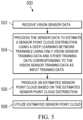
- FIG. 8 illustrates a method 800 of producing and using an estimated vehicle location sensor point cloud distribution based on vision sensor data in accordance with some embodiments.
- the method 800 includes, at block 802, receiving vision sensor data, such as the photographic image 200 of FIG. 6 .
- the method 800 includes processing the vision sensor data to estimate a vehicle location sensor point cloud distribution, such as point cloud PDFs or other parameters, where the processing is performed using a deep learning network trainable using only vision sensor training imagery and vehicle location training data corresponding to the vision sensor training imagery as input training data, such as a deep learning network trained using the method 100 of FIG. 1 .
- the method 800 includes producing an estimated vehicle location sensor point cloud distribution based on the estimated vehicle location sensor point cloud distribution similar to the estimated vehicle location sensor point cloud distribution 750 of FIG. 7 .
- the method 800 includes utilizing the estimated sensor point cloud distribution.
- estimated vehicle location sensor point cloud distributions can be used as the basis for any of a number of applications (potentially in combination with general estimated sensor point cloud distributions, as discussed above), ranging from notifying an occupant of a vehicle of an approaching vehicle to directly controlling a vehicle, e.g., applying brakes to avoid colliding with an approaching vehicle.
- the estimated vehicle location sensor point cloud distribution is used to improve live sensor data, or an estimated vehicle location PDF or estimated vehicle location sensor point cloud distribution is modified based on live sensor data to produce an improved estimated vehicle location sensor point cloud distribution.
- the estimated vehicle location PDF or estimated vehicle location sensor point cloud distribution is used to increase the granularity and/or dimensionality of live sensor data, e.g., by adding sensor points and/or converting 2D (or 3D) live sensor data to 3D (or 4D) live sensor data.
- the estimated vehicle location PDF or estimated vehicle location sensor point cloud distribution is used, along with corresponding vision sensor data, as training data for other machine learning applications.
- methods disclosed herein are not only usable for producing estimated vehicle location sensor data from vision sensor data for the purposes of utilizing that estimated vehicle location sensor data in a live or "real-time" application, but also for producing vast quantities of estimated vehicle location sensor data for vision sensor data in order to enable further deep learning applications that may require such quantities of corresponding sensor data and vision sensor data.
- FIG. 9 illustrates a method 900 of producing and using an estimated vehicle location sensor point cloud distribution based on vision sensor data in accordance with some embodiments.
- the method 900 includes, at block 902, receiving vision sensor data, such as the photographic image 200 of FIG. 6 .
- the method 900 includes processing the vision sensor data to produce an estimated vehicle or object location sensor point cloud distribution, which may be produced using techniques described hereinabove such as those of method 800.
- the method 900 includes receiving a general sensor point cloud distribution corresponding to the vision sensor data, which may be generated based on sensor data located in or on a vehicle or received from another source, such as an automated road or highway sensor broadcast.
- the method 900 includes comparing the general sensor point cloud distribution with the estimated object location sensor point cloud distribution.
- the method 900 includes identifying a vehicle, an environmental object, or a ghost object in the general sensor point cloud distribution based on the comparison, which may include comparing confidences and/or likelihoods of an estimated object or vehicle location sensor point cloud distribution and a general sensor point cloud distribution as discussed hereinabove. Accordingly, the method 900 provides for a fusion of method 300 of FIG. 3 and method 700 of FIG.
- a CNN such as CNN 104 to train a parametric estimation model such as a GMM to obtain a probability distribution of first point cloud distributions (e.g., estimated sensor point cloud distribution 450) and second detection/vehicle point cloud distributions (e.g., estimated vehicle location sensor point cloud distribution 750).
- a posteriori point cloud distributions including, e.g., vehicle, environmental object, and/or ghost objects, are then obtained based on the trained machine learning model such as CNN 104, enabling classification or weighting (e.g., confidence weighting) of points in the a posteriori point cloud distribution based on whether the points therein are more likely to be vehicles, environmental objects, and/or ghost objects.
- a deep learning network can be trained to produce estimated vehicle location sensor point cloud distributions from, e.g., vision sensor data alone.
- vehicles with limited or no sensor functionality can be equipped with a camera to produce estimated vehicle location sensor point cloud distributions.
- estimated vehicle location sensor point cloud distributions can then be compared with general sensor point cloud distributions to improve detection of vehicles, environmental objects, and ghost objects, and subsequently used to improve vehicle safety through vehicle controls or driver notifications and/or to produce enhanced sensor data.
- a method comprising: receiving vision sensor data; processing the vision sensor data to produce an estimated object location sensor point cloud distribution; receiving a general sensor point cloud distribution corresponding to the vision sensor data; comparing the general sensor point cloud distribution with the estimated object location sensor point cloud distribution; and identifying a vehicle, an environmental object, or a ghost object in the general sensor point cloud distribution based on the comparison.
- the vision sensor data includes one or more camera images.
- the general sensor point cloud distribution is a radar point cloud distribution including one or more of: range, azimuth, elevation, and Doppler information.
- the general sensor point cloud distribution includes radar points having range and azimuth information
- the estimated object location sensor point cloud distribution includes estimated radar points having range, azimuth, elevation, and Doppler information.
- the method further comprises modifying the estimated object location sensor point cloud distribution or the general sensor point cloud distribution based on the comparison.
- the modifying includes increasing or decreasing a confidence level associated with a region of the general sensor point cloud distribution.
- the method further comprises identifying a vehicle in the general sensor point cloud distribution when the estimated object location sensor point cloud distribution includes a high likelihood region coinciding with a high likelihood region of the general sensor point cloud distribution.
- the method further comprises providing a notification to an occupant of a vehicle based on the comparison.
- the set of executable instructions further manipulate the at least one processor to: modify the estimated object location sensor point cloud distribution or the general sensor point cloud distribution based on the comparison.
- the modifying includes increasing or decreasing a confidence level associated with a region of the general sensor point cloud distribution.
- the vision sensor data is the vision sensor training data
- the method further comprising: comparing the estimated vehicle location sensor point cloud distribution with the other training data corresponding to the vision sensor training data to obtain a loss function; and updating the deep learning network based on the loss function.
- certain aspects of the techniques described above may be implemented by one or more processors of a processing system executing software.
- the software comprises one or more sets of executable instructions stored or otherwise tangibly embodied on a non-transitory computer readable storage medium.
- the software can include the instructions and certain data that, when executed by the one or more processors, manipulate the one or more processors to perform one or more aspects of the techniques described above.
- the non-transitory computer readable storage medium can include, for example, a magnetic or optical disk storage device, solid state storage devices such as Flash memory, a cache, random access memory (RAM) or other non-volatile memory device or devices, and the like.
- the executable instructions stored on the non-transitory computer readable storage medium may be in source code, assembly language code, object code, or other instruction format that is interpreted or otherwise executable by one or more processors.
- a computer readable storage medium may include any storage medium, or combination of storage media, accessible by a computer system during use to provide instructions and/or data to the computer system.
- Such storage media can include, but is not limited to, optical media (e.g., compact disc (CD), digital versatile disc (DVD), Blu-Ray disc), magnetic media (e.g., floppy disk, magnetic tape, or magnetic hard drive), volatile memory (e.g., random access memory (RAM) or cache), non-volatile memory (e.g., read-only memory (ROM) or Flash memory), or microelectromechanical systems (MEMS)-based storage media.
- optical media e.g., compact disc (CD), digital versatile disc (DVD), Blu-Ray disc
- magnetic media e.g., floppy disk, magnetic tape, or magnetic hard drive
- volatile memory e.g., random access memory (RAM) or cache
- non-volatile memory e.g., read-only memory (ROM) or Flash memory
- MEMS microelectro
Landscapes
- Engineering & Computer Science (AREA)
- Physics & Mathematics (AREA)
- Theoretical Computer Science (AREA)
- General Physics & Mathematics (AREA)
- Remote Sensing (AREA)
- Radar, Positioning & Navigation (AREA)
- Evolutionary Computation (AREA)
- Artificial Intelligence (AREA)
- Multimedia (AREA)
- Health & Medical Sciences (AREA)
- General Health & Medical Sciences (AREA)
- Software Systems (AREA)
- Computing Systems (AREA)
- Computer Vision & Pattern Recognition (AREA)
- Databases & Information Systems (AREA)
- Medical Informatics (AREA)
- Computer Networks & Wireless Communication (AREA)
- Data Mining & Analysis (AREA)
- Computational Linguistics (AREA)
- General Engineering & Computer Science (AREA)
- Molecular Biology (AREA)
- Biophysics (AREA)
- Biomedical Technology (AREA)
- Life Sciences & Earth Sciences (AREA)
- Mathematical Physics (AREA)
- Electromagnetism (AREA)
- Image Analysis (AREA)
Applications Claiming Priority (1)
| Application Number | Priority Date | Filing Date | Title |
|---|---|---|---|
| US18/238,007 US20250069408A1 (en) | 2023-08-25 | 2023-08-25 | Vehicle sensor point cloud probability density function estimation based on vision sensor data |
Publications (1)
| Publication Number | Publication Date |
|---|---|
| EP4513236A1 true EP4513236A1 (de) | 2025-02-26 |
Family
ID=92409002
Family Applications (1)
| Application Number | Title | Priority Date | Filing Date |
|---|---|---|---|
| EP24194299.4A Pending EP4513236A1 (de) | 2023-08-25 | 2024-08-13 | Schätzung der wahrscheinlichkeitsdichtefunktion einer fahrzeugsensorpunktwolke auf basis von sichtsensordaten |
Country Status (3)
| Country | Link |
|---|---|
| US (1) | US20250069408A1 (de) |
| EP (1) | EP4513236A1 (de) |
| CN (1) | CN119516220A (de) |
Citations (2)
| Publication number | Priority date | Publication date | Assignee | Title |
|---|---|---|---|---|
| US20210063578A1 (en) * | 2019-08-30 | 2021-03-04 | Nvidia Corporation | Object detection and classification using lidar range images for autonomous machine applications |
| US20220083792A1 (en) * | 2020-09-17 | 2022-03-17 | Robert Bosch Gmbh | Method and device for providing data for creating a digital map |
Family Cites Families (4)
| Publication number | Priority date | Publication date | Assignee | Title |
|---|---|---|---|---|
| KR102695526B1 (ko) * | 2019-06-19 | 2024-08-14 | 삼성전자주식회사 | 레이더의 해상도 향상 방법 및 장치 |
| US11189049B1 (en) * | 2020-10-16 | 2021-11-30 | Ford Global Technologies, Llc | Vehicle neural network perception and localization |
| WO2022147783A1 (zh) * | 2021-01-08 | 2022-07-14 | 中国科学院深圳先进技术研究院 | 脑结构三维重建方法、装置及终端设备 |
| US12073507B2 (en) * | 2022-07-09 | 2024-08-27 | Adobe Inc. | Point-based neural radiance field for three dimensional scene representation |
-
2023
- 2023-08-25 US US18/238,007 patent/US20250069408A1/en active Pending
-
2024
- 2024-08-13 EP EP24194299.4A patent/EP4513236A1/de active Pending
- 2024-08-19 CN CN202411136541.7A patent/CN119516220A/zh active Pending
Patent Citations (2)
| Publication number | Priority date | Publication date | Assignee | Title |
|---|---|---|---|---|
| US20210063578A1 (en) * | 2019-08-30 | 2021-03-04 | Nvidia Corporation | Object detection and classification using lidar range images for autonomous machine applications |
| US20220083792A1 (en) * | 2020-09-17 | 2022-03-17 | Robert Bosch Gmbh | Method and device for providing data for creating a digital map |
Also Published As
| Publication number | Publication date |
|---|---|
| CN119516220A (zh) | 2025-02-25 |
| US20250069408A1 (en) | 2025-02-27 |
Similar Documents
| Publication | Publication Date | Title |
|---|---|---|
| US11687087B2 (en) | Systems and methods for shared cross-modal trajectory prediction | |
| EP3940487B1 (de) | Schätzung der kollisionswahrscheinlichkeit mit steigendem schweregrad für autonome fahrzeuge | |
| US9129519B2 (en) | System and method for providing driver behavior classification at intersections and validation on large naturalistic data sets | |
| US11481913B2 (en) | LiDAR point selection using image segmentation | |
| US10336252B2 (en) | Long term driving danger prediction system | |
| US20150336575A1 (en) | Collision avoidance with static targets in narrow spaces | |
| US20240367685A1 (en) | Rare example mining for autonomous vehicles | |
| JP6418574B2 (ja) | 危険度推定装置、危険度推定方法及び危険度推定用コンピュータプログラム | |
| US11443622B2 (en) | Systems and methods for mitigating a risk of being followed by a vehicle | |
| US20250259535A1 (en) | Car-On-Map (CAROM) Air Framework for Vehicle Localization and Traffic Scene Reconstruction Using Aerial Video | |
| EP4456041A1 (de) | Erkennung von sicherheitsrelevanten verkehrskonflikten | |
| Park et al. | Robust lane-change recognition based on an adaptive hidden Markov model using measurement uncertainty | |
| EP4513226A1 (de) | Schätzung der wahrscheinlichkeitsdichtefunktion einer sensorpunktwolke auf basis von sichtsensordaten | |
| US20250263093A1 (en) | Method for improving safety of autonomous driving by recognizing damaged motor vehicles and risky drivers | |
| EP4219261B1 (de) | Schätzung der risikoexposition für autonome fahrzeuge | |
| EP4220581B1 (de) | Schätzung der risikoexposition für autonome fahrzeuge | |
| EP4219262B1 (de) | Fahrzeuginternes system zur schätzung der risikoexposition für ein autonomes fahrzeug | |
| EP4513236A1 (de) | Schätzung der wahrscheinlichkeitsdichtefunktion einer fahrzeugsensorpunktwolke auf basis von sichtsensordaten | |
| Manoharan et al. | Survey on various lane and driver detection techniques based on image processing for hilly terrain | |
| Iqbal et al. | Adjacent vehicle collision warning system using image sensor and inertial measurement unit | |
| Lizarazo | Identification of failure-caused traffic conflicts in tracking systems: A general framework | |
| Zhang et al. | Braking Detection and Prediction with Inter-vehicle Distance Estimated from Driving Videos | |
| US20240370695A1 (en) | Rare example mining for autonomous vehicles | |
| US12548248B2 (en) | Late-to-early temporal fusion for point clouds | |
| Ortalda et al. | Safe Driving Mechanism: Detection, Recognition and Avoidance of Road Obstacles. |
Legal Events
| Date | Code | Title | Description |
|---|---|---|---|
| PUAI | Public reference made under article 153(3) epc to a published international application that has entered the european phase |
Free format text: ORIGINAL CODE: 0009012 |
|
| STAA | Information on the status of an ep patent application or granted ep patent |
Free format text: STATUS: THE APPLICATION HAS BEEN PUBLISHED |
|
| AK | Designated contracting states |
Kind code of ref document: A1 Designated state(s): AL AT BE BG CH CY CZ DE DK EE ES FI FR GB GR HR HU IE IS IT LI LT LU LV MC ME MK MT NL NO PL PT RO RS SE SI SK SM TR |
|
| STAA | Information on the status of an ep patent application or granted ep patent |
Free format text: STATUS: REQUEST FOR EXAMINATION WAS MADE |
|
| 17P | Request for examination filed |
Effective date: 20250826 |