EP4513334A1 - Speicherverwaltungsverfahren und elektronische vorrichtung - Google Patents
Speicherverwaltungsverfahren und elektronische vorrichtung Download PDFInfo
- Publication number
- EP4513334A1 EP4513334A1 EP23849252.4A EP23849252A EP4513334A1 EP 4513334 A1 EP4513334 A1 EP 4513334A1 EP 23849252 A EP23849252 A EP 23849252A EP 4513334 A1 EP4513334 A1 EP 4513334A1
- Authority
- EP
- European Patent Office
- Prior art keywords
- application
- memory
- background
- running status
- service
- Prior art date
- Legal status (The legal status is an assumption and is not a legal conclusion. Google has not performed a legal analysis and makes no representation as to the accuracy of the status listed.)
- Pending
Links
Images








Classifications
-
- G—PHYSICS
- G06—COMPUTING OR CALCULATING; COUNTING
- G06F—ELECTRIC DIGITAL DATA PROCESSING
- G06F9/00—Arrangements for program control, e.g. control units
- G06F9/06—Arrangements for program control, e.g. control units using stored programs, i.e. using an internal store of processing equipment to receive or retain programs
- G06F9/46—Multiprogramming arrangements
- G06F9/50—Allocation of resources, e.g. of the central processing unit [CPU]
- G06F9/5005—Allocation of resources, e.g. of the central processing unit [CPU] to service a request
- G06F9/5011—Allocation of resources, e.g. of the central processing unit [CPU] to service a request the resources being hardware resources other than CPUs, Servers and Terminals
- G06F9/5016—Allocation of resources, e.g. of the central processing unit [CPU] to service a request the resources being hardware resources other than CPUs, Servers and Terminals the resource being the memory
-
- G—PHYSICS
- G06—COMPUTING OR CALCULATING; COUNTING
- G06F—ELECTRIC DIGITAL DATA PROCESSING
- G06F12/00—Accessing, addressing or allocating within memory systems or architectures
- G06F12/02—Addressing or allocation; Relocation
- G06F12/0223—User address space allocation, e.g. contiguous or non contiguous base addressing
- G06F12/023—Free address space management
-
- G—PHYSICS
- G06—COMPUTING OR CALCULATING; COUNTING
- G06F—ELECTRIC DIGITAL DATA PROCESSING
- G06F12/00—Accessing, addressing or allocating within memory systems or architectures
- G06F12/02—Addressing or allocation; Relocation
- G06F12/08—Addressing or allocation; Relocation in hierarchically structured memory systems, e.g. virtual memory systems
-
- G—PHYSICS
- G06—COMPUTING OR CALCULATING; COUNTING
- G06F—ELECTRIC DIGITAL DATA PROCESSING
- G06F9/00—Arrangements for program control, e.g. control units
- G06F9/06—Arrangements for program control, e.g. control units using stored programs, i.e. using an internal store of processing equipment to receive or retain programs
- G06F9/46—Multiprogramming arrangements
- G06F9/48—Program initiating; Program switching, e.g. by interrupt
-
- G—PHYSICS
- G06—COMPUTING OR CALCULATING; COUNTING
- G06F—ELECTRIC DIGITAL DATA PROCESSING
- G06F9/00—Arrangements for program control, e.g. control units
- G06F9/06—Arrangements for program control, e.g. control units using stored programs, i.e. using an internal store of processing equipment to receive or retain programs
- G06F9/46—Multiprogramming arrangements
- G06F9/48—Program initiating; Program switching, e.g. by interrupt
- G06F9/4806—Task transfer initiation or dispatching
- G06F9/4843—Task transfer initiation or dispatching by program, e.g. task dispatcher, supervisor, operating system
- G06F9/485—Task life-cycle, e.g. stopping, restarting, resuming execution
-
- G—PHYSICS
- G06—COMPUTING OR CALCULATING; COUNTING
- G06F—ELECTRIC DIGITAL DATA PROCESSING
- G06F9/00—Arrangements for program control, e.g. control units
- G06F9/06—Arrangements for program control, e.g. control units using stored programs, i.e. using an internal store of processing equipment to receive or retain programs
- G06F9/46—Multiprogramming arrangements
- G06F9/50—Allocation of resources, e.g. of the central processing unit [CPU]
-
- G—PHYSICS
- G06—COMPUTING OR CALCULATING; COUNTING
- G06F—ELECTRIC DIGITAL DATA PROCESSING
- G06F9/00—Arrangements for program control, e.g. control units
- G06F9/06—Arrangements for program control, e.g. control units using stored programs, i.e. using an internal store of processing equipment to receive or retain programs
- G06F9/46—Multiprogramming arrangements
- G06F9/50—Allocation of resources, e.g. of the central processing unit [CPU]
- G06F9/5005—Allocation of resources, e.g. of the central processing unit [CPU] to service a request
- G06F9/5011—Allocation of resources, e.g. of the central processing unit [CPU] to service a request the resources being hardware resources other than CPUs, Servers and Terminals
- G06F9/5022—Mechanisms to release resources
-
- G—PHYSICS
- G06—COMPUTING OR CALCULATING; COUNTING
- G06F—ELECTRIC DIGITAL DATA PROCESSING
- G06F2212/00—Indexing scheme relating to accessing, addressing or allocation within memory systems or architectures
- G06F2212/10—Providing a specific technical effect
- G06F2212/1016—Performance improvement
- G06F2212/1024—Latency reduction
-
- G—PHYSICS
- G06—COMPUTING OR CALCULATING; COUNTING
- G06F—ELECTRIC DIGITAL DATA PROCESSING
- G06F2212/00—Indexing scheme relating to accessing, addressing or allocation within memory systems or architectures
- G06F2212/10—Providing a specific technical effect
- G06F2212/1041—Resource optimization
- G06F2212/1044—Space efficiency improvement
-
- G—PHYSICS
- G06—COMPUTING OR CALCULATING; COUNTING
- G06F—ELECTRIC DIGITAL DATA PROCESSING
- G06F2212/00—Indexing scheme relating to accessing, addressing or allocation within memory systems or architectures
- G06F2212/40—Specific encoding of data in memory or cache
- G06F2212/401—Compressed data
Definitions
- This application relates to the field of terminal technologies, and in particular, to a memory management method and an electronic device.
- embodiments of this application provide a memory management method and an electronic device.
- memory management can be performed by using a service or a functional module of an application as a granularity. This improves memory management performance of the electronic device.
- the application actually does not release the memory data, and memory pressure of a system is still high.
- the application does not need to actively release the memory data.
- the electronic device may automatically process the memory data of the some functional modules or the non-critical service of the application. In this way, memory pressure of the system is relieved.
- the electronic device reclaims the corresponding memory data from the some functional modules or the non-critical service of the application, so that a total memory occupied by the application is reduced. Therefore, a probability that the application is killed or abnormally exited is greatly reduced.
- the target service includes a first service and/or a second service
- a memory associated with the first service includes a first partial memory
- a memory associated with the second service includes a second partial memory
- the first partial memory is a page that is not referenced by the first application in a first time period.
- the second partial memory is a compressed page that is not referenced by the first application in a second time period.
- the application is switched from the foreground running status to the background playing status.
- the first partial memory includes the memory referenced by the render thread and the memory referenced by the user interface thread.
- the first partial memory is not referenced by the first application in a time period from t1 to t2.
- the mobile phone may reclaim the memories referenced by non-critical services such as the render thread and the user interface thread.
- the navigation application is switched from the background playing status to a background service status.
- the first partial memory includes a memory referenced by a surface (surface) and media (media).
- the first partial memory is not referenced by the navigation application in a time period from t2 to t3.
- the mobile phone may reclaim the memory referenced by the non-critical services such as the surface and the media.
- the navigation application is switched from the background service status to a background cache status.
- the first partial memory includes a memory referenced by a service (service)
- the second partial memory includes the memory referenced by the render thread and the memory referenced by the user interface thread.
- the first partial memory is not referenced by the navigation application in a time period from t3 to t4, and the second partial memory is not referenced by the navigation application in a time period from t1 to t3 (the second time period).
- the mobile phone may reclaim the memories referenced by the non-critical services such as the service, the render thread, and the user interface thread.
- the navigation application is switched from the background cache status to a shallow frozen status.
- the second partial memory includes the memory referenced by the service, the media, and the surface.
- the memory of the service is not referenced by the navigation application in the time period from t3 to t4 (the second time period), and memories of the media and the surface are not referenced by the navigation application in a time period from t2 to t4 (the second time period).
- the mobile phone may reclaim the memory referenced by the non-critical services such as the service, the media, and the surface.
- the navigation application is switched from the shallow frozen status to a deep frozen status.
- the first partial memory includes a memory referenced by an object (object), a class (class), and a method (method). Memories of the object, class, and method are not referenced by the navigation application in a time period from t5 to t6 (the first time period).
- the mobile phone may reclaim the memory referenced by the non-critical services such as the object, the class, and the method.
- duration of the second time period is greater than duration of the first time period.
- the memory of the first service is processed in a first compression manner
- the memory of the second service is processed in a second compression manner
- the second running status includes a first background running status.
- a partial memory referenced by the first application includes: when detecting that the running status of the first application is switched from the first running status to the first background running status, compressing the first partial memory associated with the first service.
- the first partial memory may be the memory that is not referenced by the application in a short period of time (for example, the first time period).
- the memory data may be compressed, and stored in compressed space, to save partial memory space.
- the second running status includes a first background running status.
- a partial memory referenced by the first application includes: when detecting that the running status of the first application is switched from the first running status to the first background running status, swapping the second partial memory associated with the second service to disk space.
- the second partial memory may be the memory that is not referenced by the application in a long period of time (for example, the second time period).
- the compressed memory data may be swapped, for example, swapped to disk space (for example, a flash component) by using a flushing mechanism, to reduce memory usage.
- disk space for example, a flash component
- the first running status is a foreground running status.
- the first running status is a second background running status.
- the method further includes:
- the processing a partial memory referenced by the first application includes:
- the method further includes:
- the first background running status includes the following statuses: a background playing status, a background service status, a background cache status, a shallow frozen status, and a deep frozen status.
- the first application executes a first task in a background.
- the background playing status means that the application is switched to the background for running and no graphical interface is presented, but a function or task of the application is still running.
- a music application runs a music playing task (an example of the first task) in the background
- the navigation application runs a navigation task in the background.
- the first application provides a background service in the background, and does not execute the first task in the background.
- the first application is a background service application.
- the background service application mainly implements background data collection, message push, or a resident interruption waiting service, for example, a Bluetooth connection.
- the application may push a message in the background.
- the application may collect some data, to push some messages to the user.
- the first application does not execute the first task in the background and does not provide the background service, and duration in which the first application is in a background running status reaches first duration.
- the first application does not execute the first task in the background and does not provide the background service, and the duration in which the first application is in the background running status reaches second duration, where the second duration is greater than the first duration.
- the first application does not execute the first task in the background and does not provide the background service, and the duration in which the first application is in the background running status reaches third duration, where the third duration is greater than the second duration.
- the first service includes a service related to interface display.
- the service related to interface display includes non-critical services executed by the render thread and the user interface thread.
- the electronic device may reclaim the memory referenced by the render thread and the memory referenced by the user interface thread of the application, to reduce memory usage of the application.
- the first service includes a service corresponding to the first task (a task that is not executed by the first application in the background).
- the first application usually does not execute services corresponding to the media and the surface in the background.
- the electronic device may compress the memory referenced by the media and the surface, to obtain compressed memory data.
- the first service includes the background service
- the second service includes the service related to interface display.
- the application no longer executes the background service (for example, a service), and does not switch to the foreground display interface for a long period of time.
- the first service includes the background service
- the second service includes the services executed by the render thread and the user interface thread.
- the electronic device may compress a related memory of a service that is not referenced by the application in a short period of time, to obtain compressed memory data.
- the electronic device may swap compressed memory related to the render thread and the user interface thread that are not referenced by the application for a long period of time.
- the second service includes the service corresponding to the first task and the background service.
- the second service includes media, a surface (the service corresponding to the first task), and a service (the background service).
- the electronic device may swap compressed memory of the media, the surface, and the service that are not referenced by the application for a long period of time.
- the first service includes a service corresponding to an object, a class, or a method.
- the electronic device may compress the memory referenced by the object, the class, and the method.
- a memory management apparatus is provided.
- the apparatus is used in an electronic device or a component (for example, a chip system) supporting a function of an electronic device.
- the apparatus includes: a processing unit, configured to: detect a running status of a first application; and process a partial memory referenced by the first application when detecting that the running status of the first application is switched from a first running status to a second running status, where the partial memory is a memory associated with a target service of the first application, and the target service is a non-critical service of the first application in the second running status.
- the processing when detecting that the running status of the first application is switched from a first running status to a second running status, a partial memory referenced by the first application includes: when detecting that the running status of the first application is switched from the first running status to the second running status, and duration in which the first application is in the second running status reaches a first threshold, processing the partial memory referenced by the first application.
- the target service includes a first service and/or a second service
- a memory associated with the first service includes a first partial memory
- a memory associated with the second service includes a second partial memory
- the first partial memory is a page that is not referenced by the first application in a first time period.
- the second partial memory is a compressed page that is not referenced by the first application in a second time period.
- duration of the second time period is greater than duration of the first time period.
- the second running status includes a first background running status
- the processing, when detecting that the running status of the first application is switched from a first running status to a second running status, a partial memory referenced by the first application includes: when detecting that the running status of the first application is switched from the first running status to the first background running status, compressing the first partial memory associated with the first service.
- the second running status includes a first background running status
- the processing, when detecting that the running status of the first application is switched from a first running status to a second running status, a partial memory referenced by the first application includes: when detecting that the running status of the first application is switched from the first running status to the first background running status, swapping the second partial memory associated with the second service to disk space.
- the first background running status includes the following statuses: a background playing status, a background service status, a background cache status, a shallow frozen status, and a deep frozen status.
- the page may be decompressed from the compressed space, and a decompressed page is allocated to the process for use.
- an interface connection relationship between the modules shown in this embodiment of the present invention is merely an example for description, and does not constitute a limitation on the structure of the electronic device 100a.
- the electronic device 100a may alternatively use an interface connection manner different from that in the foregoing embodiment, or use a combination of a plurality of interface connection manners.
- the charging management module 140 is configured to receive charging input from the charger.
- the charger may be a wireless charger, or may be a wired charger.
- the charging management module 140 may receive charging input from the wired charger through the USB interface 130.
- the charging management module 140 may receive wireless charging input through a wireless charging coil of the electronic device 100a.
- the charging management module 140 may further supply power to the terminal by using the power management module 141.
- the power management module 141 is configured to connect the battery 142, the charging management module 140, and the processor 110.
- the power management module 141 receives an input from the battery 142 and/or the charging management module 140, and supplies power to the processor 110, the internal memory 121, the display 194, the camera 193, the wireless communication module 160, and the like.
- the power management module 141 may be further configured to monitor parameters such as a battery capacity, a quantity of battery cycles, and a battery health status (electric leakage or impedance).
- the power management module 141 may also be disposed in the processor 110.
- the power management module 141 and the charging management module 140 may also be disposed in a same component.
- the antenna 1 and the antenna 2 are configured to transmit and receive electromagnetic wave signals.
- Each antenna in the electronic device 100a may be configured to cover one or more communication frequency bands. Different antennas may be further multiplexed to improve antenna utilization.
- the antenna 1 may be multiplexed as a diversity antenna of a wireless local area network. In other embodiments, the antenna may be used in combination with a tuning switch.
- the modem processor may include a modulator and a demodulator.
- the modulator is configured to modulate a to-be-sent low-frequency baseband signal into a medium-high frequency signal.
- the demodulator is configured to demodulate the received electromagnetic wave signal into the low-frequency baseband signal. Then, the demodulator transmits the demodulated low-frequency baseband signal to the baseband processor for processing.
- the low-frequency baseband signal is processed by the baseband processor and then transferred to the application processor.
- the application processor outputs a sound signal through an audio device (which is not limited to the speaker 170A, the receiver 170B, or the like), or displays an image or a video through the display 194.
- the modem processor may be an independent component.
- the modem processor may be independent of the processor 110, and is disposed in a same component as the mobile communication module 150 or another function module.
- the wireless communication module 160 may provide a wireless communication solution that is applied to the electronic device 100a, and that includes a wireless local area network (wireless local area network, WLAN) (for example, a wireless fidelity (wireless fidelity, Wi-Fi) network), Bluetooth (Bluetooth, BT), a global navigation satellite system (global navigation satellite system, GNSS), frequency modulation (frequency modulation, FM), a near field communication (near field communication, NFC) technology, an infrared (infrared, IR) technology, or the like.
- the wireless communication module 160 may be one or more components that integrate at least one communication processing module.
- the wireless communication module 160 receives an electromagnetic wave through the antenna 2, performs frequency modulation and filtering processing on the electromagnetic wave signal, and sends a processed signal to the processor 110.
- the wireless communication module 160 may further receive a to-be-sent signal from the processor 110, perform frequency modulation and amplification on the signal, and convert the signal into an electromagnetic wave for radiation through the antenna 2.
- the electronic device 100a may establish a wireless connection to another terminal or server through the wireless communication module 160 (for example, a WLAN module) and the antenna 2, to implement communication between the electronic device 100a and the another terminal or server.
- the wireless communication module 160 for example, a WLAN module
- the antenna 1 of the electronic device 100a is coupled to the mobile communication module 150, and the antenna 2 is coupled to the wireless communication module 160, so that the electronic device 100a can communicate with a network and another device by using a wireless communication technology.
- the wireless communication technology may include a global system for mobile communications (global system for mobile communications, GSM), a general packet radio service (general packet radio service, GPRS), code division multiple access (code division multiple access, CDMA), wideband code division multiple access (wideband code division multiple access, WCDMA), time-division code division multiple access (time-division code division multiple access, TD-SCDMA), long term evolution (long term evolution, LTE), BT, a GNSS, the WLAN, the NFC, the FM, the IR technology, and/or the like.
- GSM global system for mobile communications
- GPRS general packet radio service
- code division multiple access code division multiple access
- CDMA wideband code division multiple access
- WCDMA wideband code division multiple access
- the GNSS may include a global positioning system (global positioning system, GPS), a global navigation satellite system (global navigation satellite system, GLONASS), a BeiDou navigation satellite system (BeiDou navigation satellite system, BDS), a quasi-zenith satellite system (quasi-zenith satellite system, QZSS), and/or a satellite based augmentation system (satellite based augmentation systems, SBAS).
- GPS global positioning system
- GLONASS global navigation satellite system
- BeiDou navigation satellite system BeiDou navigation satellite system
- BDS BeiDou navigation satellite system
- QZSS quasi-zenith satellite system
- SBAS satellite based augmentation system
- the electronic device 100a may implement a display function through the GPU, the display 194, the application processor, and the like.
- the GPU is a microprocessor for image processing, and is connected to the display 194 and the application processor.
- the GPU is used to perform mathematical and geometric calculations, and render an image.
- the processor 110 may include one or more GPUs that execute program instructions to generate or change display information.
- the display 194 is configured to display an image, a video, and the like.
- the display 194 includes a display panel.
- the display panel may be a liquid crystal display (liquid crystal display, LCD), an organic light-emitting diode (organic light-emitting diode, OLED), an active-matrix organic light emitting diode (active-matrix organic light emitting diode, AMOLED), a flexible light-emitting diode (flex light-emitting diode, FLED), a mini-LED, a micro-LED, a micro-OLED, a quantum dot light emitting diode (quantum dot light emitting diodes, QLED), or the like.
- the electronic device 100a may include one or N displays 194, where N is a positive integer greater than 1.
- the electronic device 100a may implement an image shooting function by using the ISP, the camera 193, the video codec, the GPU, the display 194, the application processor, and the like.
- the ISP is configured to process data fed back by the camera 193. For example, during image shooting, a shutter is opened, and light is transferred to a photosensitive element of the camera through a lens. An optical signal is converted into an electrical signal, and the photosensitive element of the camera transfers the electrical signal to the ISP for processing, to convert the electrical signal into a visible image.
- the ISP may further perform algorithm optimization on noise, brightness, and complexion of the image.
- the ISP may further optimize parameters such as exposure and a color temperature of a photographing scenario.
- the ISP may be disposed in the camera 193.
- the camera 193 is configured to capture a static image or a video. An optical image of an object is generated through the lens, and is projected onto the photosensitive element.
- the photosensitive element may be a charge coupled device (charge coupled device, CCD) or a complementary metal-oxide-semiconductor (complementary metal-oxide-semiconductor, CMOS) phototransistor.
- CCD charge coupled device
- CMOS complementary metal-oxide-semiconductor
- the light-sensitive element converts an optical signal into an electrical signal, and then transmits the electrical signal to the ISP to convert the electrical signal into a digital image signal.
- the ISP outputs the digital image signal to the DSP for processing.
- the DSP converts the digital image signal into an image signal in a standard format like RGB or YUV.
- the electronic device 100a may include one or N cameras 193, where N is a positive integer greater than 1.
- the digital signal processor is configured to process a digital signal, and may process another digital signal in addition to the digital image signal. For example, when the electronic device 100a selects a frequency, the digital signal processor is configured to perform Fourier transformation on frequency energy.
- the video codec is used to compress or decompress digital video.
- the electronic device 100a may support one or more video codecs. In this way, the electronic device 100a may play or record videos in a plurality of encoding formats, for example, moving picture experts group (moving picture experts group, MPEG) 1, MPEG 2, MPEG 3, and MPEG 4.
- MPEG moving picture experts group
- the NPU is a neural-network (neural-network, NN) computing processor, quickly processes input information by referring to a structure of a biological neural network, for example, a transfer mode between human brain neurons, and may further continuously perform self-learning.
- Applications such as intelligent cognition of the electronic device 100a may be implemented through the NPU, for example, image recognition, facial recognition, speech recognition, and text understanding.
- the external memory interface 120 may be configured to connect to an external memory card, for example, a Micro SD card, to expand a storage capability of the electronic device 100a.
- the external memory card communicates with the processor 110 through the external memory interface 120, to implement a data storage function. For example, files such as music and videos can be saved on the external memory card.
- the internal memory 121 may be configured to store computer-executable program code, where the executable program code includes instructions.
- the internal memory 121 may include a program storage area and a data storage area.
- the program storage area may store an operating system, an application required by at least one function (for example, a sound playing function or an image playing function), and the like.
- the data storage area may store data (such as audio data and an address book) created during use of the electronic device 100a, and the like.
- the internal memory 121 may include a high-speed random access memory, and may further include a nonvolatile memory, for example, at least one magnetic disk storage device, a flash storage device, or a universal flash storage (universal flash storage, UFS).
- the processor 110 runs instructions stored in the internal memory 121 and/or instructions stored in the memory disposed in the processor, to perform various function applications and data processing of the electronic device 100a.
- the electronic device 100a can implement an audio function like music playing or recording by using the audio module 170, the speaker 170A, the receiver 170B, the microphone 170C, the headset jack 170D, the application processor, and the like.
- the audio module 170 is configured to convert digital audio information into an analog audio signal for output, and is also configured to convert analog audio input into a digital audio signal.
- the audio module 170 may be further configured to code and decode an audio signal.
- the audio module 170 may be disposed in the processor 110, or some functional modules of the audio module 170 are disposed in the processor 110.
- the speaker 170A also referred to as a "loudspeaker" is configured to convert an audio electrical signal into a sound signal.
- the electronic device 100a may be used to listen to music or answer a call in a hands-free mode over the speaker 170A.
- the receiver 170B also referred to as an "earpiece", is configured to convert an audio electrical signal into a sound signal.
- the receiver 170B may be put close to a human ear to listen to a voice.
- the microphone 170C also referred to as a "mike” or a “mic”, is configured to convert a sound signal into an electrical signal.
- a user may make a sound near the microphone 170C through the mouth of the user, to input a sound signal to the microphone 170C.
- the electronic device 100a may be provided with at least one microphone 170C.
- two microphones 170C may be disposed in the electronic device 100a, to collect a sound signal and implement a noise reduction function.
- three, four, or more microphones 170C may alternatively be disposed in the electronic device 100a, to collect a sound signal, implement noise reduction, and identify a sound source, so as to implement a directional recording function and the like.
- the headset interface 170D is configured to connect to a wired headset.
- the headset jack 170D may be a USB interface 130, or may be a 3.5 mm open mobile terminal platform (open mobile terminal platform, OMTP) standard interface, or a cellular telecommunications industry association of the USA (cellular telecommunications industry association of the USA, CTIA) standard interface.
- the button 190 includes a power button, a volume button, and the like.
- the button 190 may be a mechanical button. It can also be a touch button.
- the electronic device 100a may receive a button input, and generate a button signal input related to a user setting and function control of the electronic device 100a.
- the motor 191 may generate a vibration prompt.
- the motor 191 may be used for an incoming call vibration prompt and a touch vibration feedback.
- touch operations performed on different applications may correspond to different vibration feedback effects.
- the motor 191 may also correspond to different vibration feedback effects for touch operations performed on different areas of the display 194.
- Different application scenarios for example, a time reminder, information receiving, an alarm clock, a game
- the touch vibration feedback effect can also be customized.
- the indicator 192 may be an indicator light, and may be configured to indicate a charging status and a power change, or may be configured to indicate a message, a missed call, a notification, and the like.
- the SIM card interface 195 is configured to connect to a SIM card.
- the SIM card may be inserted into the SIM card interface 195, or removed from the SIM card interface 195, to implement contact and separation from the electronic device 100a.
- the electronic device 100a may support one or N SIM card interfaces, where N is a positive integer greater than 1.
- the SIM card interface 195 may support a nano-SIM card, a micro-SIM card, a SIM card, and the like.
- a plurality of cards may be inserted into the same SIM card interface 195 at the same time. Types of the plurality of cards may be the same or different.
- the SIM card interface 195 may also be compatible with different types of SIM cards.
- the SIM card interface 195 may also be compatible with an external memory card.
- the electronic device 100a interacts with a network through the SIM card, to implement functions such as calling and data communication.
- the electronic device 100a uses an eSIM, namely, an embedded SIM card.
- the eSIM card may be embedded in the electronic device 100a, and cannot be separated from the electronic device 100a.
- the electronic device may have more or fewer components than the structure shown in FIG. 5 , or combine some components, or split some components, or have different component arrangements.
- the illustrated components may be implemented in hardware, software, or a combination of software and hardware.
- a software system of the electronic device 100a may use a layered architecture, an event-driven architecture, a microkernel architecture, a microservice architecture, or a cloud architecture.
- an Android ® system with a layered architecture is used as an example to describe the software structure of the electronic device 100a.
- FIG. 4 is a block diagram of a software structure of an electronic device 100a according to an embodiment of the present invention.
- a layered architecture software is divided into several layers, and each layer has a clear role and task.
- the layers communicate with each other through a software interface.
- the Android system is divided into four layers: an application layer, an application framework layer, an Android runtime (Android runtime) and system library, and a kernel layer from top to bottom.
- the application layer may include a series of application packages.
- the application packages may include applications such as Camera, Gallery, Calendar, Call, Map, Navigation, WLAN, Bluetooth, Music, Videos, and Messages.
- One or more applications may run in the electronic device, and each application has at least one corresponding process.
- One process has at least one thread executing a task (task).
- a plurality of threads run in the electronic device.
- the threads include a Java thread and a C/C++ thread.
- the electronic device may allocate a processing unit (for example, a CPU core) to the thread according to a specific policy. After the processing unit is allocated to the thread, the thread may execute a corresponding task through the processing unit.
- a processing unit for example, a CPU core
- the application framework layer provides an application programming interface (application programming interface, API) and a programming framework for an application at the application layer.
- the application framework layer includes some predefined functions.
- the application framework layer may include a first service, a virtual machine, a direct memory allocator, and an mmap interface.
- the first service is used to detect a running status of an application, and send a notification message to a memory management module at the kernel layer when it is detected that the running status of the application is switched.
- the notification message indicates the running status of the application.
- the memory management module manages a memory of one or more functional modules of the application based on the running status of the application.
- a memory of each functional module may be managed based on a granularity of a functional module or a service type in the application. For example, for a first component of the application, a memory of the first component is managed in a first manner. For a second component of the application, a memory of the second component is managed in a second manner.
- the component includes but is not limited to any one or more of the following: an activity (activity), a fragment (fragment), a service (service), a content provider (ContentProvider), and a broadcast receiver.
- the thread of the application includes but is not limited to one or more of the following: a render (Render) thread and a user interface (user interface, UI) thread.
- different functional modules may correspond to different service types.
- a service type corresponding to the render thread and the UI thread may be interface display.
- the running status of the application includes but is not limited to any one or more of the following: a foreground running status, a background playing status, a background service status, a background cache status, a shallow frozen status, and a deep frozen status.
- the foreground running status means that the application is running in a foreground.
- the application may usually present a graphical interface (for example, a UI), and a user may interact with the application through the UI.
- a graphical interface for example, a UI
- the background playing status means that the application is switched to a background for running and no graphical interface is presented, but a function or task of the application is still running.
- a music application runs a music playing task in the background
- a navigation application runs a navigation task in the background.
- the background service status refers to a background service application.
- the background service application mainly implements background data collection, message push, or a resident interruption waiting service, for example, a Bluetooth connection.
- the application may push a message in the background.
- the application may collect some data, to push some messages to the user.
- the background cache status means that after the application is switched to the background, the application usually no longer runs a task, and the user does not operate the application in a short period of time (for example, first duration).
- the application resides in the background of the system to mainly ensure that a previous browsing record of the application running in the foreground can be retained when the application is switched from the background to the foreground. In this way, the user can continue to operate the application and browse corresponding content.
- the shallow frozen status means that after the application is switched to the background, the application no longer runs a task, and the user has not operated the application for a specific period of time (for example, second duration).
- the background application responds to a system behavior only when some specific system events occur, for example, responds to the system to perform resolution conversion.
- the second duration is greater than the first duration.
- the application does not run a task, and a difference between the three statuses lies in duration in which the application resides in the background.
- the running status of the application is the background cache status.
- the running status of the application is the shallow frozen status.
- the running status of the application is the deep frozen status.
- the application When the application is in the background cache status, if the application is still not operated by the user (not running a task) after the second duration expires, the application may be switched to the shallow frozen status. When the application is in the shallow frozen status, if the application is still not operated by the user (not running a task) after the third duration expires, the application may be switched to the deep frozen status.
- the electronic device may detect the running status of the application, and perform memory, based on the running status of the application, on the memory referenced by the functional module of the application. For example, when the first service detects that the music application is switched from the background service status to the background cache status, the first service may send a notification message to the memory management module at the kernel layer, to indicate a running status of the music application. After receiving the notification message, the memory management module manages a memory of one or more functional modules of the music application based on the running status of the music application.
- the memory management module may compress a memory page of a functional module used for display to obtain a compressed memory page, so that when the application is switched back to the foreground, the memory page can be quickly decompressed and used to implement an interface display function.
- the memory management module may perform a swap operation on the compressed memory page of the functional module used for display, for example, swap (or referred to as flush) the compressed memory page to a storage component (like a flash)
- the memory management module may further perform a compression operation on memories of some other functional modules (functional modules other than the functional module used for display) of the application.
- memories of the different functional modules are processed in different manners, to ensure performance of the application in a corresponding running status as much as possible, and improve a free memory of the electronic device.
- the electronic device may compress memory data used by the functional module (for example, the render thread) that is of the application and that is used for interface display, and does process memory data used by some functional modules (for example, a service) that support background running.
- the functional module for example, the render thread
- some functional modules for example, a service
- the virtual machine is configured to manage an on-heap memory.
- the virtual machine invokes the mmap interface to allocate the on-heap memory.
- the operating system records the on-heap memory allocated by the virtual machine.
- the direct memory allocator is configured to allocate a direct memory.
- the virtual machine invokes the mmap interface to allocate the direct memory.
- a hardware abstraction layer includes a streaming media memory allocator.
- the streaming media memory allocator is configured to allocate a streaming media memory.
- the streaming media memory allocator includes a dma_buf memory allocator or an ION memory allocator.
- the kernel layer is a layer between hardware and software.
- the kernel layer may include at least a display driver, a camera driver, an audio driver, and a sensor driver.
- the kernel layer may include the memory management module, configured to manage memories of the application. For example, after the notification message (indicating the running status of the application) is received from the first service, the memory management module manages the memory of the one or more functional modules of the application based on the running status of the application.
- the software architecture shown in FIG. 4 is merely an example.
- a software architecture of the electronic device may alternatively be in another form.
- the first service is deployed at another layer.
- the software architecture of the electronic device is not limited in embodiments of this application.
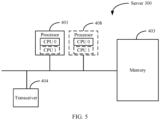
- FIG. 5 shows another possible structure of an electronic device.
- the electronic device may include a processor 401 (optionally, including a processor 408), a memory 403, a transceiver 404, and the like.
- a path may be included between the foregoing components, and is used to transmit information between the foregoing components.
- the transceiver 404 is configured to communicate with another device or a communication network through a protocol like the Ethernet or a WLAN.
- a physical memory in the electronic device may be divided into a plurality of memory units.
- the memory unit includes but is not limited to a memory page.
- the following embodiments are mainly described by using an example in which the memory page is a memory unit.
- the technical solutions in embodiments of this application are not limited thereto.
- a life cycle of an application may be detected, and a memory is managed based on the life cycle of the application.
- the memory data may be compressed, and stored in compressed space, to save partial memory space.
- the compressed memory data may be swapped, for example, swapped to disk space (for example, a flash component) by using a flushing mechanism.
- the life cycle of the application includes one or more of the following running phases: foreground running, background playing, background service, background cache, shallow frozen, and deep frozen.
- That the application is in the foreground running phase may mean that a running status of the application is a foreground running status.
- that the application is in the background playing phase may mean that the running status of the application is a background playing status.
- That the application is in the background service phase may mean that the running status of the application is a background service status.
- That the application is in the background cache phase may mean that the running status of the application is a background cache status.
- That the application is in the shallow frozen phase may mean that the running status of the application is a shallow frozen status.
- That the application is in the deep frozen phase may mean that the running status of the application is a deep frozen status.
- a navigation application in a mobile phone is used as an example. As shown in FIG. 6 , it is assumed that the navigation application initially runs in a foreground. To ensure normal running of the navigation application in the foreground, the mobile phone may not process a memory of the navigation application.
- the mobile phone detects an operation performed by a user for switching the navigation application to a background for running. It is assumed that the navigation application still runs a navigation function in the background, for example, determining a navigation route and playing a navigation route voice. In this case, it is determined that the navigation application enters the background playing status.
- a graphical interface is no longer displayed (a display function is no longer executed). Therefore, a memory related to interface display may be processed.
- processing the memory related to interface display may be implemented as follows: Memory data that is of the application and that is related to interface display is compressed to obtain compressed memory data related to interface display, and the compressed memory data related to interface display is stored in compressed space, instead of being swapped to disk space (for example, a flash component). In this way, it can be avoided that the application is delayed to switch back to the foreground for running due to long time consumption caused by re-reading data from a disk.
- the mobile phone may process the memory data related to interface display.
- the memory data related to interface display includes but is not limited to memory data related to a user interface thread and memory data related to a render thread.
- the mobile phone detects the navigation application running in the background, and the navigation application no longer runs core functions such as navigation. For example, a current navigation task is complete, and the user does not add a new navigation task. In this case, the mobile phone may determine that the navigation application enters the background service status. When the navigation application is in the background service status, the navigation task/function is no longer run. Therefore, the mobile phone may process memory data related to the core functions such as navigation based on previous memory processing (namely, processing of the memory data related to interface display).
- the navigation function includes but is not limited to determining a navigation route and playing a navigation audio.
- processing the memory data related to the core functions such as navigation may be implemented as: compressing the memory data related to the core functions such as navigation, and storing compressed memory data related to the core functions such as navigation into the compressed space.
- the mobile phone may further process the memory data related to the core functions (for example, navigation) of the application, the memory data related to the navigation function includes but is not limited to memory data related to a surface thread and memory data related to a media thread.
- the mobile phone may swap the memory data that is of the navigation application and that is used for interface display to the disk space (for example, a flash component).
- the mobile phone swaps the memory data related to interface display (for example, the memory data related to the render thread and the memory data related to the user interface thread) into the disk space.
- the memory data related to interface display for example, the memory data related to the render thread and the memory data related to the user interface thread
- the mobile phone may compress memory data used by the service.
- the mobile phone may further compress related memory data used by the media and the surface.
- the navigation application continues to run in the background.
- a moment t4 if duration in which the navigation application runs in the background reaches second duration, the navigation application enters the shallow frozen status. In this status, a possibility that the navigation application is active in the background is greatly reduced. Therefore, in a possible implementation, the mobile phone may fully swap memory data other than on-heap memory data of a Java virtual machine to the disk space (for example, a flash component).
- the mobile phone swaps the memory data related to the user interface thread, the render thread, the surface, the media, and the service to the disk space.
- a memory of an inactive background application can be processed as much as possible, to increase a quantity of free memories of the entire mobile phone, so as to improve running performance of the entire mobile phone.
- the navigation application continues to run in the background.
- the navigation application enters the deep frozen status. If the navigation application is in the deep frozen status, it indicates that the navigation application is not used by the user again in a long period of time. Based on this, the mobile phone may predict that the navigation application is still not used by the user again in a long period of time in the future.
- the mobile phone may compress the on-heap memory data of the Java virtual machine of the navigation application in the deep frozen status, and store compressed on-heap memory data to the compressed space. In this way, memory usage of the on-heap memory data can be reduced.
- the on-heap memory data is compressed to the compressed space (not swapped to the flash component)
- the compressed on-heap memory data only needs to be decompressed, and the on-heap memory data does not need to be swapped back from the disk space, so that a delay caused by swapping back the on-heap memory data can be avoided, and frame freezing can be reduced when the user switches the navigation application back to the foreground.
- the on-heap memory data (such as memory data related to a method, a class, and an object) of the Java virtual machine can be compressed, and a compression result can be stored in the compressed space.
- the electronic device may detect the life cycle of the application, and process, based on a phase of the life cycle in which the application is located, memory data used by some functional modules corresponding to the application.
- the memory processing is performed based on a granularity of a functional module of the application, precision of memory processing is higher.
- the memory data used by the some functional modules (for example, a functional module that is not used temporarily) of the application is processed, without affecting normal running of the entire application, so that a keepalive degree of the application can be improved, and a probability that the application is killed or abnormally exited can be reduced.
- the electronic device may process only a memory referenced by some functional modules of the background applications. In this way, when survival of the background applications is ensured as much as possible, the memory of the applications is released to a large extent. This enhances smoothness and stability of the electronic device (avoiding memory thrashing), and improves memory management efficiency of the electronic device.
- the application actually does not release the memory data, and memory pressure of a system is still high.
- the application does not need to actively release the memory data.
- the electronic device may automatically process the memory data of the some functional modules of the application. In this way, memory pressure of the system is relieved.
- the electronic device processes the corresponding memory data from the some functional modules of the application, so that a total memory occupied by the application is reduced. Therefore, a probability that the application is killed or abnormally exited is greatly reduced.
- the electronic device may implement memory management based on a virtual memory (virtual memory) technology.
- a thread initiates a memory allocation request.
- the electronic device allocates a virtual memory area (virtual memory area, VMA) and a physical memory to the thread through a memory allocator.
- VMA virtual memory area
- the physical memory may include one or more linked lists, and each linked list includes one or more memory pages.
- the electronic device may mark the allocated VMA.
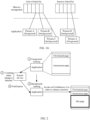
- FIG. 7 shows VMAs allocated by the memory allocator of the electronic device to a user interface (UI) thread and a render thread.
- a VMA corresponding to the UI thread and a VMA corresponding to the render thread may have different identifiers, to distinguish between the threads associated with the VMAs.
- the memory allocator may transfer identification information of the VMA to a memory management module, and the memory management module may distinguish, based on the identification information of the VMA, between threads associated with different VMAs.
- the electronic device may further mark a memory page in the allocated physical memory.
- different marks are set for memory pages referenced by different functional modules.
- a mark of a memory page referenced by the UI thread is set to a mark 1
- a mark of a memory page referenced by the render thread is set to a mark 2.
- functional modules for example, threads
- service types associated with different memory pages may be distinguished.
- a virtual address A' of a to-be-referenced memory page may be carried in a use request, and the virtual address A' includes an offset (offset).
- the electronic device may obtain, by querying a page table, a base address of a physical address A corresponding to the virtual address A', calculate the physical address A based on the base address and the offset in the virtual address A', and further address the physical address A of the memory page, so that the thread can use a memory page in the physical address A.
- the electronic device may manage, based on the running status of the application, memory data used by one or more functional modules of the application.
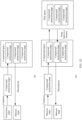
- FIG. 8 shows an example procedure of a memory management method according to an embodiment of this application. As shown in FIG. 8 , the method includes the following steps.
- S101 A first service detects that a running status of an application changes.
- the first service is located at a framework layer.
- S102 The first service sends a message A to a memory management module.
- the message A indicates that the running status changes.
- a message is used for a function means that the message may be used for the function, but the message is not dedicated to the function.
- the memory management module is located at a kernel layer.
- the memory management module sends a message B to a processing thread.
- the processing thread processes, based on a functional module (or a service type) associated with a memory page, a memory page referenced by the application.
- the processing thread processes as many non-critical memory pages (or referred to as unimportant memory pages) referenced by the application as possible, and processes as few critical memory pages as possible.
- a manner of classifying a critical memory page and a non-critical memory page is related to a functional module (or a service type) associated with a memory page in a specific running status.
- a service related to interface display is considered as a non-critical service, in other words, an application functional module related to interface display is considered as a non-critical functional module.
- a memory page related to interface display (for example, a memory page referenced by a UI thread, a render thread, or a layer composition thread) may be considered as a non-critical memory page.
- an electronic device may process as many memory pages related to interface display as possible, to reduce memory pressure of the electronic device and improve performance of the electronic device.
- a memory page related to interface display, a surface, media, and a service may be considered as non-critical memory pages.
- the electronic device may process the non-critical memory pages.
- the electronic device may compress the non-critical memory page, and store the non-critical memory page in compressed space.
- the electronic device may swap the non-critical memory page, and store the non-critical memory page in disk space.
- the electronic device may wake up the processing thread (for example, kswapd). For example, as shown in FIG. 9 , the processing thread may process, based on a current running status of the navigation application, a memory referenced by one or more functional modules of the application.
- the processing thread may scan, based on a VMA of a UI thread of the navigation application, a linked list 1 to which the VMA is mapped; scan, based on a VMA of a render thread of the navigation application, a linked list 2 to which the VMA is mapped; scan, based on a VMA of a surface of the navigation application, a linked list 3 to which the VMA is mapped; scan, based on a VMA of media of the navigation application, a linked list 4 to which the VMA is mapped; and scan, based on a VMA of a service of the navigation application, a linked list 5 to which the VMA is mapped.
- the processing thread may swap compressed memory pages (for example, memory pages A and B) related to the UI thread into the disk space.
- the processing thread may swap the memory page (for example, a memory page C) into the disk space.
- the processing thread may compress the memory page (for example, a memory page D) into the compressed space.
- the processing thread may compress a processable memory page (a memory page related to the media) in the linked list 4 into the compressed space, and compress a processable memory page (a memory page related to the service) in the linked list 5 into the compressed space.
- FIG. 9 is described by using an example in which a VMA of one functional module corresponds to one linked list.
- a VMA of one functional module may correspond to a plurality of linked lists, or VMAs of a plurality of functional modules correspond to one linked list, or VMAs of a plurality of functional modules correspond to a plurality of linked lists.
- VMAs of the UI thread and the render thread of the application are mapped to the linked list 1, and a VMA of another functional module of the application is mapped to the linked list 2.
- a mapping relationship between a VMA of a functional module and a physical memory is not limited in embodiments of this application.
- the electronic device may wake up the processing thread, and the processing thread may process, based on the current running status of the navigation application, the memory referenced by the one or more functional modules of the application.
- the processing thread may scan, based on the VMA of the UI thread of the navigation application, the linked list 1 to which the VMA is mapped, and swap a memory page (namely, a memory page referenced by the UI thread) that is in the linked list 1 and that meets the processing condition into the disk space.
- the processing thread may swap a memory page (for example, a memory page referenced by the render thread, the surface, the media, or the service) referenced by another functional module of the navigation application.
- the electronic device may process a partial memory of the application based on the running status of the application.
- the electronic device may delay processing.
- the electronic device may perform memory processing after a period of time since the running status of the application is switched, to ensure that the running status of the application is stable. For example, as shown in FIG. 11 , the application enters the background playing status at a moment t1. To prevent the user from switching the application back to the foreground for running in a short period of time, the electronic device may delay processing for a period of time.
- the electronic device predicts that the application may not be switched back to the foreground in a short time period in the future.
- the electronic device may process a memory (for example, a memory referenced by the render thread or the UI thread) related to interface display at a moment t1'.
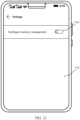
- the electronic device may provide a setting portal for memory management, and the user may set a function related to memory management by using the setting portal.
- the electronic device displays a setting interface 110 (an example of a first interface).
- the interface 110 includes a setting option 1101, and the setting option 1101 is used to enable or disable a memory management function.
- the electronic device may manage, based on the running status of the application and by using a functional module as a granularity, the memory referenced by the one or more functional modules of the application.
- the electronic device may always enable the memory management function.
- the electronic device may automatically enable the memory management function when a specific condition is met.
- Table 2 shows performance indicators of the electronic device in a case in which the memory management function is enabled and a case in which the memory management function is disabled.
- Table 2 Performance indicator Disable the memory management function Enable the memory management function Average quantity of background keep-alive applications 11.38 22 Average quantity of intervals (another application is restarted) 9 20 Launch rate 0.87 0.96 Heavy duty camera-start Hot start 1607.64 1664.03 Cold start 1597.55 1560.97 Heavy duty camera-mode switching Switch from image shooting to video recording 1198.44 1155.46 Switch from image shooting to a portrait mode 1096.34 837.71 Heavy duty camera-switch between front and rear cameras Switch from a rear camera to a front camera 953.7 1007.51 Switch from the front camera to the rear camera 1247.21 1268.95
- the running status of the application may alternatively be classified in another manner.
- the foregoing technical solution may be used, to process a partial memory of the application (a memory of a non-critical service in a corresponding running status) based on the running status of the application (or a phase of the life cycle of the application).
- a plurality of embodiments of this application may be combined, and a combined solution is implemented.
- some operations in procedures of the foregoing method embodiments are randomly combined, and/or a sequence of some operations is randomly changed.
- an execution sequence between steps of each process is merely an example, and does not constitute a limitation on an execution sequence between the steps.
- the steps may alternatively be performed in another execution sequence. It is not intended to indicate that the execution order is the only order in which these operations can be performed.
- a person of ordinary skill in the art may learn various manners of permutating the operations described in this specification.
- process details related to an embodiment in this specification are also applicable to another embodiment in a similar manner, or different embodiments may be used in combination.
- steps in the method embodiments may be equivalently replaced with other possible steps.
- some steps in the method embodiments may be optional, and may be deleted in some use scenarios.
- another possible step may be added to the method embodiments.
- an electronic device in embodiments of this application includes corresponding hardware structures and/or software modules for performing the functions.
- embodiments of this application can be implemented in a form of hardware or a combination of hardware and computer software. Whether a function is performed by hardware or hardware driven by computer software depends on particular applications and design constraints of the technical solutions. A person skilled in the art may use different methods to implement the described functions for each particular application, but it should not be considered that the implementation falls beyond the scope of the technical solutions in embodiments of this application.
- the electronic device may be divided into functional units based on the foregoing method examples.
- each function unit may be obtained through division based on each corresponding function, or two or more functions may be integrated into one processing unit.
- the integrated unit may be implemented in a form of hardware, or may be implemented in a form of a software function unit. It should be noted that, in this embodiment of this application, division into the units is an example, and is merely a logical function division. In actual implementation, another division manner may be used.
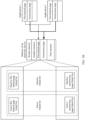
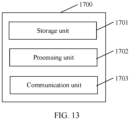
- FIG. 13 is a block diagram of a memory management apparatus according to an embodiment of this application.
- the apparatus may be the foregoing first electronic device or a component having a corresponding function.
- An apparatus 1700 may exist in a form of software, or may be a chip that can be used in a device.
- the apparatus 1700 includes a processing unit 1702.
- the processing unit 1702 may be configured to support S101, S104, and the like shown in FIG. 8 , and/or configured to perform another process of the solution described in this specification.
- the apparatus 1700 may further include a communication unit 1703.
- the communication unit 1703 may be further divided into a sending unit (not shown in FIG. 13 ) and a receiving unit (not shown in FIG. 13 ).
- the sending unit is configured to support the apparatus 1700 in sending information to another electronic device.
- the receiving unit is configured to support the apparatus 1700 in receiving information from the another electronic device.
- the apparatus 1700 may further include a storage unit 1701, configured to store program code and data of the apparatus 1700.
- the data may include but is not limited to original data, intermediate data, or the like.
- the processing unit 1702 may be a controller or the processor 401 and/or 408 shown in FIG. 5 , for example, may be a central processing unit (Central Processing Unit, CPU), a general purpose processor, a digital signal processor (Digital Signal Processor, DSP), an application-specific integrated circuit (Application-Specific Integrated Circuit, ASIC), a field-programmable gate array (Field-Programmable Gate Array, FPGA) or another programmable logic device, a transistor logic device, a hardware component, or any combination thereof.
- the processing unit 1702 may implement or execute various example logical blocks, modules, and circuits described with reference to content disclosed in this application.
- the processor may be a combination of processors implementing a computing function, for example, a combination of one or more microprocessors, or a combination of a DSP and a microprocessor.
- the communication unit 1703 may include the transceiver 404 shown in FIG. 5 , and may further include a transceiver circuit, a radio frequency component, and the like.
- the storage unit 1701 may be a memory 403 shown in FIG. 5 .
- An embodiment of this application further provides an electronic device, including one or more processors and one or more memories.
- the one or more memories are coupled to the one or more processors.
- the one or more memories are configured to store computer program code, and the computer program code includes computer instructions.
- the electronic device executes the computer instructions, the electronic device is enabled to perform the foregoing related method steps, to implement the method in the foregoing embodiment.
- An embodiment of this application further provides a chip system.
- the chip system includes a processor, the processor is coupled to a memory, and the memory is configured to store a program or instructions.
- the program or the instructions is/are executed by the processor, the chip system is enabled to implement the method according to any one of the foregoing method embodiments.
- processors in the chip system there may be one or more processors in the chip system.
- the processor may be implemented by using hardware, or may be implemented by using software.
- the processor When the processor is implemented by using the hardware, the processor may be a logic circuit, an integrated circuit, or the like.
- the processor When the processor is implemented by using the software, the processor may be a general-purpose processor, and is implemented by reading software code stored in the memory.
- the memory may be integrated with the processor, or may be disposed separately from the processor.
- the memory may be a non-transitory processor, for example, a read-only memory ROM.
- the memory and the processor may be integrated into a same chip, or may be separately disposed on different chips.
- a type of the memory and a manner of disposing the memory and the processor are not specifically limited in this application.
- the chip system may be a field programmable gate array (field programmable gate array, FPGA), an application-specific integrated chip (application-specific integrated circuit, ASIC), a system on chip (system on chip, SoC), a central processing unit (central processing unit, CPU), a network processor (network processor, NP), a digital signal processor (digital signal processor, DSP), a micro controller unit (micro controller unit, MCU), a programmable controller (programmable logic device, PLD), or another integrated chip.
- field programmable gate array field programmable gate array
- ASIC application-specific integrated circuit
- SoC system on chip
- CPU central processing unit
- CPU central processing unit
- NP network processor
- DSP digital signal processor
- micro controller unit micro controller unit
- MCU micro controller unit
- PLD programmable logic device
- Embodiments of this application further provide a computer-readable storage medium.
- the computer-readable storage medium stores computer instructions.
- the computer instructions When the computer instructions are run on an electronic device, the electronic device is enabled to perform the related method steps, to implement the method in the foregoing embodiment.
- An embodiment of this application further provides a computer program product.
- the computer program product runs on a computer, the computer is enabled to perform the foregoing related steps, to implement the method in the foregoing embodiment.
- an embodiment of this application further provides an apparatus.
- the apparatus may be specifically a component or a module.
- the apparatus may include a processor and a memory that are connected.
- the memory is configured to store computer-executable instructions.
- the processor may execute the computer-executable instructions stored in the memory, to enable the apparatus to perform the methods in the foregoing method embodiments.
- the electronic device, the computer-readable storage medium, the computer program product, or the chip provided in embodiments of this application is configured to perform the corresponding method provided above. Therefore, for beneficial effects that can be achieved, refer to the beneficial effects of the corresponding method provided above. Details are not described herein again.
- the electronic device includes a corresponding hardware and/or software module for performing each function.
- this application can be implemented in a form of hardware or a combination of hardware and computer software. Whether a function is performed by hardware or hardware driven by computer software depends on particular applications and design constraints of the technical solutions. A person skilled in the art may use different methods to implement the described functions for each particular application with reference to embodiments, but it should not be considered that the implementation falls beyond the scope of this application.
- the electronic device may be divided into functional modules based on the foregoing method examples.
- each functional module may be obtained through division based on each function, or two or more functions may be integrated into one processing module.
- the integrated module may be implemented in a form of hardware. It should be noted that, in this embodiment, division into the modules is an example and is merely logical function division. In actual implementation, another division manner may be used.
- the disclosed apparatuses and methods may be implemented in other manners.
- the described terminal device embodiment is merely an example.
- division into the modules and the units is merely logical function division and may be other division in actual implementation.
- a plurality of units or components may be combined or integrated into another system, or some features may be ignored or not performed.
- the displayed or discussed mutual couplings or direct couplings or communication connections may be implemented through some interfaces.
- the indirect couplings or communication connections between the modules or units may be implemented in electronic, mechanical, or other forms.
- the units described as separate parts may or may not be physically separate, and parts displayed as units may or may not be physical units, may be located in one position, or may be distributed on a plurality of network units. Some or all of the units may be selected based on actual requirements to achieve the objectives of the solutions of embodiments.
- each of the units may exist alone physically, or two or more units are integrated into one unit.
- the integrated unit may be implemented in a form of hardware, or may be implemented in a form of a software function unit.
- the integrated unit When the integrated unit is implemented in the form of the software functional unit and sold or used as an independent product, the integrated unit may be stored in a computer-readable storage medium.
- the computer software product is stored in a storage medium, and includes several instructions for instructing a computer device (which may be a personal computer, a server, a network device, or the like) or a processor to perform all or some of the steps of the methods described in embodiments of this application.
- the foregoing storage medium includes any medium that can store program code, for example, a flash memory, a removable hard disk, a read-only memory, a random access memory, a magnetic disk, or an optical disc.
Landscapes
- Engineering & Computer Science (AREA)
- Theoretical Computer Science (AREA)
- Software Systems (AREA)
- Physics & Mathematics (AREA)
- General Engineering & Computer Science (AREA)
- General Physics & Mathematics (AREA)
- Information Retrieval, Db Structures And Fs Structures Therefor (AREA)
- Memory System Of A Hierarchy Structure (AREA)
Applications Claiming Priority (2)
| Application Number | Priority Date | Filing Date | Title |
|---|---|---|---|
| CN202210912594.8A CN117519959B (zh) | 2022-07-30 | 2022-07-30 | 内存管理方法及电子设备 |
| PCT/CN2023/109436 WO2024027544A1 (zh) | 2022-07-30 | 2023-07-26 | 内存管理方法及电子设备 |
Publications (2)
| Publication Number | Publication Date |
|---|---|
| EP4513334A1 true EP4513334A1 (de) | 2025-02-26 |
| EP4513334A4 EP4513334A4 (de) | 2025-08-13 |
Family
ID=89765051
Family Applications (1)
| Application Number | Title | Priority Date | Filing Date |
|---|---|---|---|
| EP23849252.4A Pending EP4513334A4 (de) | 2022-07-30 | 2023-07-26 | Speicherverwaltungsverfahren und elektronische vorrichtung |
Country Status (3)
| Country | Link |
|---|---|
| EP (1) | EP4513334A4 (de) |
| CN (2) | CN117519959B (de) |
| WO (1) | WO2024027544A1 (de) |
Families Citing this family (4)
| Publication number | Priority date | Publication date | Assignee | Title |
|---|---|---|---|---|
| CN117971712B (zh) * | 2024-03-29 | 2024-06-18 | 阿里云计算有限公司 | 内存回收方法、装置、电子设备、存储介质及程序产品 |
| CN121166329A (zh) * | 2024-06-19 | 2025-12-19 | 华为技术有限公司 | 内存管理方法、电子设备及计算机可读存储介质 |
| CN119025390B (zh) * | 2024-06-25 | 2025-11-04 | 荣耀终端股份有限公司 | 一种性能策略管理方法及电子设备 |
| CN119576583B (zh) * | 2025-01-24 | 2025-07-11 | 荣耀终端股份有限公司 | 一种内存管理方法、电子设备和计算机可读存储介质 |
Family Cites Families (11)
| Publication number | Priority date | Publication date | Assignee | Title |
|---|---|---|---|---|
| US8812725B2 (en) * | 2012-05-18 | 2014-08-19 | Cisco Technology Inc. | System and method for latency reduction in a network environment |
| US10552179B2 (en) * | 2014-05-30 | 2020-02-04 | Apple Inc. | Resource management with dynamic resource policies |
| CN105808447B (zh) * | 2016-03-29 | 2019-01-29 | 海信集团有限公司 | 一种终端设备的内存回收方法和装置 |
| CN107220076B (zh) * | 2016-09-27 | 2018-10-30 | 华为技术有限公司 | 一种内存回收方法及装置 |
| CN114153570A (zh) * | 2017-08-11 | 2022-03-08 | 华为技术有限公司 | 一种应用切换方法及装置 |
| CN111198759B (zh) * | 2018-11-16 | 2024-04-19 | 深圳市优必选科技有限公司 | 一种内存优化方法、系统、终端设备及可读存储介质 |
| CN113590500B (zh) * | 2020-04-30 | 2024-10-11 | 华为技术有限公司 | 一种内存管理方法及终端设备 |
| CN111966492B (zh) * | 2020-08-05 | 2024-02-02 | Oppo广东移动通信有限公司 | 内存回收方法、装置、电子设备及计算机可读存储介质 |
| CN112433831A (zh) * | 2020-11-17 | 2021-03-02 | 珠海格力电器股份有限公司 | 应用冻结方法、存储介质及电子设备 |
| CN116244067B (zh) * | 2021-06-10 | 2024-05-03 | 荣耀终端有限公司 | 虚拟内存管理方法和电子设备 |
| CN113918287A (zh) * | 2021-11-11 | 2022-01-11 | 杭州逗酷软件科技有限公司 | 启动应用程序的方法、装置、终端设备及存储介质 |
-
2022
- 2022-07-30 CN CN202210912594.8A patent/CN117519959B/zh active Active
- 2022-07-30 CN CN202510181158.1A patent/CN120295752A/zh active Pending
-
2023
- 2023-07-26 EP EP23849252.4A patent/EP4513334A4/de active Pending
- 2023-07-26 WO PCT/CN2023/109436 patent/WO2024027544A1/zh not_active Ceased
Also Published As
| Publication number | Publication date |
|---|---|
| CN117519959A (zh) | 2024-02-06 |
| WO2024027544A1 (zh) | 2024-02-08 |
| EP4513334A4 (de) | 2025-08-13 |
| CN117519959B (zh) | 2025-01-14 |
| CN120295752A (zh) | 2025-07-11 |
Similar Documents
| Publication | Publication Date | Title |
|---|---|---|
| EP4513334A1 (de) | Speicherverwaltungsverfahren und elektronische vorrichtung | |
| EP4239477A1 (de) | Verwaltungsverfahren für virtuellen speicher und elektronische vorrichtung | |
| CN114116191B (zh) | 内存冷页的处理方法及电子设备 | |
| US20230385112A1 (en) | Memory Management Method, Electronic Device, and Computer-Readable Storage Medium | |
| US12079118B2 (en) | Method and electronic device to reclaim physical page using active and inactive lists | |
| CN114461375B (zh) | 内存资源管理方法及电子设备 | |
| CN114461589B (zh) | 读取压缩文件的方法、文件系统及电子设备 | |
| CN114461588A (zh) | 调节预读窗口的方法及电子设备 | |
| CN115525404A (zh) | 释放内存的方法、设备和存储介质 | |
| CN116820734A (zh) | 一种控制内存的方法和电子设备 | |
| CN116860429A (zh) | 内存管理方法及电子设备 | |
| CN114489469B (zh) | 一种数据读取方法、电子设备及存储介质 | |
| CN118819381A (zh) | 文件存储方法及电子设备 | |
| CN119357073A (zh) | 内存处理方法及相关装置 | |
| EP4553658A1 (de) | Speicherverwaltungsverfahren und elektronische vorrichtung | |
| WO2022111711A1 (zh) | 进程间通信方法和装置 | |
| CN120670338B (zh) | 一种内存管理方法与电子设备 | |
| CN118447141B (zh) | 图像显示方法及相关装置 | |
| HK40068154A (en) | Memory cold page processing method and electronic device | |
| CN116932178A (zh) | 内存管理方法及电子设备 | |
| HK40068957B (zh) | 一种内存的管理方法及电子设备 | |
| CN120687223A (zh) | 内存分配的方法和电子设备 | |
| CN119025125A (zh) | 管理共享库的方法、装置以及电子设备 |
Legal Events
| Date | Code | Title | Description |
|---|---|---|---|
| STAA | Information on the status of an ep patent application or granted ep patent |
Free format text: STATUS: THE INTERNATIONAL PUBLICATION HAS BEEN MADE |
|
| PUAI | Public reference made under article 153(3) epc to a published international application that has entered the european phase |
Free format text: ORIGINAL CODE: 0009012 |
|
| STAA | Information on the status of an ep patent application or granted ep patent |
Free format text: STATUS: REQUEST FOR EXAMINATION WAS MADE |
|
| 17P | Request for examination filed |
Effective date: 20241118 |
|
| AK | Designated contracting states |
Kind code of ref document: A1 Designated state(s): AL AT BE BG CH CY CZ DE DK EE ES FI FR GB GR HR HU IE IS IT LI LT LU LV MC ME MK MT NL NO PL PT RO RS SE SI SK SM TR |
|
| A4 | Supplementary search report drawn up and despatched |
Effective date: 20250714 |
|
| RIC1 | Information provided on ipc code assigned before grant |
Ipc: G06F 9/50 20060101AFI20250708BHEP |
|
| DAV | Request for validation of the european patent (deleted) | ||
| DAX | Request for extension of the european patent (deleted) |