EP4513465A1 - Procédé de communication par voie hertzienne pour la transmission de messages de sécurité sur une infrastructure non sécurisée - Google Patents
Procédé de communication par voie hertzienne pour la transmission de messages de sécurité sur une infrastructure non sécurisée Download PDFInfo
- Publication number
- EP4513465A1 EP4513465A1 EP23306398.1A EP23306398A EP4513465A1 EP 4513465 A1 EP4513465 A1 EP 4513465A1 EP 23306398 A EP23306398 A EP 23306398A EP 4513465 A1 EP4513465 A1 EP 4513465A1
- Authority
- EP
- European Patent Office
- Prior art keywords
- safety
- router
- acd
- application message
- ground
- Prior art date
- Legal status (The legal status is an assumption and is not a legal conclusion. Google has not performed a legal analysis and makes no representation as to the accuracy of the status listed.)
- Pending
Links
Images


Classifications
-
- H—ELECTRICITY
- H04—ELECTRIC COMMUNICATION TECHNIQUE
- H04W—WIRELESS COMMUNICATION NETWORKS
- H04W12/00—Security arrangements; Authentication; Protecting privacy or anonymity
- H04W12/03—Protecting confidentiality, e.g. by encryption
- H04W12/033—Protecting confidentiality, e.g. by encryption of the user plane, e.g. user's traffic
-
- G—PHYSICS
- G08—SIGNALLING
- G08G—TRAFFIC CONTROL SYSTEMS
- G08G5/00—Traffic control systems for aircraft
- G08G5/20—Arrangements for acquiring, generating, sharing or displaying traffic information
- G08G5/26—Transmission of traffic-related information between aircraft and ground stations
-
- H—ELECTRICITY
- H04—ELECTRIC COMMUNICATION TECHNIQUE
- H04B—TRANSMISSION
- H04B7/00—Radio transmission systems, i.e. using radiation field
- H04B7/14—Relay systems
- H04B7/15—Active relay systems
- H04B7/185—Space-based or airborne stations; Stations for satellite systems
- H04B7/18502—Airborne stations
- H04B7/18506—Communications with or from aircraft, i.e. aeronautical mobile service
-
- H—ELECTRICITY
- H04—ELECTRIC COMMUNICATION TECHNIQUE
- H04B—TRANSMISSION
- H04B7/00—Radio transmission systems, i.e. using radiation field
- H04B7/14—Relay systems
- H04B7/15—Active relay systems
- H04B7/185—Space-based or airborne stations; Stations for satellite systems
- H04B7/18502—Airborne stations
- H04B7/18506—Communications with or from aircraft, i.e. aeronautical mobile service
- H04B7/18508—Communications with or from aircraft, i.e. aeronautical mobile service with satellite system used as relay, i.e. aeronautical mobile satellite service
-
- H—ELECTRICITY
- H04—ELECTRIC COMMUNICATION TECHNIQUE
- H04L—TRANSMISSION OF DIGITAL INFORMATION, e.g. TELEGRAPHIC COMMUNICATION
- H04L63/00—Network architectures or network communication protocols for network security
- H04L63/12—Applying verification of the received information
- H04L63/123—Applying verification of the received information received data contents, e.g. message integrity
-
- H—ELECTRICITY
- H04—ELECTRIC COMMUNICATION TECHNIQUE
- H04L—TRANSMISSION OF DIGITAL INFORMATION, e.g. TELEGRAPHIC COMMUNICATION
- H04L67/00—Network arrangements or protocols for supporting network services or applications
- H04L67/01—Protocols
- H04L67/12—Protocols specially adapted for proprietary or special-purpose networking environments, e.g. medical networks, sensor networks, networks in vehicles or remote metering networks
-
- H—ELECTRICITY
- H04—ELECTRIC COMMUNICATION TECHNIQUE
- H04W—WIRELESS COMMUNICATION NETWORKS
- H04W12/00—Security arrangements; Authentication; Protecting privacy or anonymity
- H04W12/10—Integrity
- H04W12/106—Packet or message integrity
-
- H—ELECTRICITY
- H04—ELECTRIC COMMUNICATION TECHNIQUE
- H04W—WIRELESS COMMUNICATION NETWORKS
- H04W4/00—Services specially adapted for wireless communication networks; Facilities therefor
- H04W4/30—Services specially adapted for particular environments, situations or purposes
- H04W4/40—Services specially adapted for particular environments, situations or purposes for vehicles, e.g. vehicle-to-pedestrians [V2P]
- H04W4/42—Services specially adapted for particular environments, situations or purposes for vehicles, e.g. vehicle-to-pedestrians [V2P] for mass transport vehicles, e.g. buses, trains or aircraft
Definitions
- This invention relates generally to the field of avionics systems. More specifically, the present invention relates to an Air Ground Communication Method for Transmitting Safety Messages Over Non Safety Infrastructure.
- ACARS over IP is an option that has recently been implemented for sending some of the aforementioned communications.
- AolP harnesses the advantages of ACARS while also utilizing the growing availability and decreasing cost of broadband cellular connectivity on the ground, and IP capable airborne radio communication via a satellite (Satcom) connectivity when airborne.
- Satcom satellite
- Avionics communication systems can employ several network subsystems for various topologies, domains and information.
- one subsystem may be associated with the Aircraft Control Domain (ACD), which may be configured to carry data such as flight critical parameters for the avionics system.
- ACD Aircraft Control Domain
- the ACD might carry data communications, navigation and surveillance (CNS) data for air traffic management (ATM), flight information and alerting, and direct Airline Operations Communications (AOC) that also affect aircraft safety, regularity and efficiency.
- CCS navigation and surveillance
- ATM air traffic management
- AOC Airline Operations Communications
- Another subsystem may be associated with the Airline Information Services Domain (AISD), which may be configured to carry data for the operation of the aircraft, but which does not have a bearing on the control of the aircraft.
- ALSD Airline Information Services Domain
- AlSO platforms may be used to support applications and content for either flight or cabin crew use.
- PIESD Passenger Information and Entertainment Services Domain
- An avionics communication system may involve additional wiring and other network components to accommodate devices in the subsystems.
- CMUs Communication Management Units
- HF high frequency
- VHF very high frequency
- CPDLC controller pilot data link communications
- a method for transmitting safety-critical data from an aircraft control domain, ACD, router to a ground system via a Virtual Safety Radio, VSR, provided by a cross-router, X-router, interface between the ACD router and one or more non-safety communication domain routers comprising: determining, by the VSR, that at least one non-safety media link of at least one non-safety communication medias of the one or more non-safety communication domain routers is available for conveying safety traffic from the ACD; responsive to the determination that at least one non-safety media link is available, receiving, by a communication stack of the ACD router, an application message; and sending, via the VSR, the application message to the ground system through the at least one available non-safety media link.
- VSR Virtual Safety Radio
- Such a method allows for the use of non-safety communication medias for safety traffic, by interconnecting safety (e.g. ACD) and non-safety (e.g. AlSO) communication routers, by an X-Router (cross router) link.
- safety e.g. ACD
- non-safety e.g. AlSO
- X-Router cross router
- a VSR is a "virtual safety radio", from the perspective of the ACD router, provided by an x-router interface.
- the VSR emulates a safety radio such that the ACD sees, in addition to its traditional safety medias (such as the HF, VDL and/or SATCOM links 113), and through the same interface as a legacy radio so as to avoid router impact, the VSR, when there is a suitable AlSO link available.
- the ACD router can therefore send application messages through the VSR, as if it was the legacy radio, but the VSR may advantageously make use of non-safety communication medias in order to improve available bandwidth.
- the step of determining that at least one non-safety media link is available for conveying safety traffic from the ACD may comprise active and/or passive link probing. This allows the availability and quality of service (QoS) provided by the non-safety links to be assessed, as well as direct information from the applicable medias to be obtained
- the method may further comprise selecting, by the VSR, the most optimal of the at least one non-safety media link by a Multi-Link Engine, MLE, based on a media status of the media link and the link probing result, and wherein the application message is sent via the selected non-safety media link.
- MLE Multi-Link Engine
- the method may further comprise, prior to sending the application message, securing the application message using cryptography methods. In doing so, it is possible to ensure the confidentiality and integrity of the transfer to the ground.
- Metadata information Prior to sending the application message, metadata information may be added to the application message. This may be done by the MLE as above.
- the method may comprise receiving, by the ground system, the application message. This completes a transfer from air to ground.
- a ground endpoint may then decapsulate, the application message, verify the application message, and forward, the decapsulated application message to a ground gateway of the ground system through a secure network.
- the ground endpoint may be, for example, a ground VPN Endpoint, and/or a Ground Tunnel Endpoint.
- the step of forwarding the decapsulated application message to a ground gateway of the ground system through a secure network may comprise, reading metadata of the received application message regarding the desired destination ground gateway and, forwarding the application message to the desired destination ground gateway. This ensures deliverance of the message.
- Th VSR may receive an acknowledgement from the ground system indicating that the application message has been received, and if no acknowledgement is received within a time threshold, then the VSR may report the link failure to the ACD router. The ACD router may then resend the message by a known safety media, so as to ensure delivery of the message within a necessary timespan.
- the non-safety communication medias may be communication medias of one or more Airline Information Services Domain, AlSO, and/or Passenger Information and Entertainment Services Domain, PIESD.
- a method for transmitting safety-critical data from a ground system to an aircraft control domain, ACD, router via a Virtual Safety Radio, VSR, provided by a cross-router, X-router, interface between the ACD router and one or more non-safety communication domain routers comprising: determining, by a ground gateway of the ground system that at least one non-safety media link of the non-safety communication medias is available for conveying safety traffic to the ACD, responsive to the determination that at least one non-safety media link is available, receiving, by a communication stack of the ground system, an application message, sending the application message via the at least one available non-safety media link, receiving, by the VSR through the at least one available non-safety media link, the application message, and transmitting the application message from the VSR to the ACD router.
- VSR Virtual Safety Radio
- the second aspect allows for the use of non-safety communication medias for safety traffic, but this time for uplink communications.
- the VSR may receive the message via one of the non-safety medias, and transmit the message to the ACD router through a legacy radio interface, as if it were transmitted via safety means, over the X-router link. This results in optimized air/ground safety communication by making use of the non-dedicated high bandwidth infrastructure.
- a system for air ground communication by transmitting safety messages over non safety infrastructure comprising an aircraft control domain, ACD, router; a non-safety communication router in communication with at least one non-safety communication medias ; and a cross-router, X-router, interface configured to provide a Virtual Safety Radio, VSR; wherein the VSR is configured to: determine that at least one non-safety media link of the non-safety communication medias is available for conveying safety traffic from the ACD, send an application message that is received by a communication stack of the ACD router via the at least one available non-safety media link.
- VSR Virtual Safety Radio
- the non-safety communication router may be an Airline Information Services Domain, AlSO, router and/or a Passenger Information and Entertainment Services Domain, PIESD, router.
- the X-router interface may be a partition of the ACD router, or a partition of the non-safety communication router.
- the system may further comprise a ground gateway configured to receive the application message via the at least one available non-safety media link.
- ACD router and AISD router
- teachings could additionally or alternatively applied to another kind of domain router, such as a PIESD router.
- the routers may operate on any suitable system.
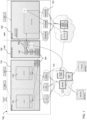
- Figure 1 shows an architecture 100 which may allow for safety-critical data, e.g. from the ACD, to be transmitted via non-safety communication medias 123 (such as cellular 5G or cabin Satcom) for safety traffic by interconnecting safety (i.e. ACD) and non-safety (i.e. AlSO and/or PIESD) communication routers 110, 120.
- the architecture utilises a cross router (X-router) interface 140 to determine whether the non-safety routers 120 may be used to transmit safety traffic as a Virtual Safety Radio (VSR) 130.
- VSR Virtual Safety Radio
- the VSR 130 can be physical or logical (i.e. not necessarily dedicated hardware). In addition it may be a partition on either router, depending on the implementation details.
- Such a system can mitigate any safety risks that would otherwise be associated by sending safety-critical data via non-safety means by monitoring the usage of the non-safety communication means for safety traffic. For example, if traffic sent by a non-safety means (e.g. any of the non-safety links 123) is not acknowledged by the receiving peer within a predefined time, the VSR may identify a link failure and alert the ACD router. The ACD router may then re-send the traffic using the safety communication means 113, in order to ensure delivery. In such a way, datalink traffic performance goals may be met.
- a non-safety means e.g. any of the non-safety links 123
- the VSR may identify a link failure and alert the ACD router.
- the ACD router may then re-send the traffic using the safety communication means 113, in order to ensure delivery. In such a way, datalink traffic performance goals may be met.
- the AISD/PEISD domains cannot be trusted. Therefore, the X-router system should be physically or logically isolated from the AISD.
- the ACD router may have connectivity with critical systems such as the flight management system (FMS) and ACMS (Aircraft Condition Monitoring System).
- FMS flight management system
- ACMS Aircraft Condition Monitoring System
- the X-router function may be seen as a subnetwork interface configured to provide the expected level of performance.
- the X-router function may be seen as similar to an AolP architecture, where the network protocols such as ACARS A618 or ATN/OSI CLNP are applied between the aircraft and the ground without the need of a proxy.
- the architecture 100 shows a split of the same function where the X-router ACD feature (Link Probing, security endpoint%) hosted close to the AISD router 120, and therefore has a minimum impact for the ACD router 110.
- the X-router ACD feature Link Probing, security endpoint
- the X-router subnetwork 140 within the ACD router 110 can establish its own secured air-ground link independently of the communication stacks above.
- Such an approach ensures the independence between the X-router security and the communication stacks which do not have security (such as ACARS and ATN/OSI).
- the X-router interface may be provided for legacy architectures based on old generation systems like the CMU and the air traffic services unit (ATSU). Therefore, the X-router interface may be retrofitted onto existing architectures, in order to improve the throughput of safety information.
- legacy architectures based on old generation systems like the CMU and the air traffic services unit (ATSU). Therefore, the X-router interface may be retrofitted onto existing architectures, in order to improve the throughput of safety information.
- Such an architecture 100 aims at optimizing the usage of all the available air-ground communication medias (i.e. both safety medias 113, and non-safety medias 123) to convey all applications communication flows.
- the architecture 100 may send at least some of the ACARS and/or ATN/OSI traffic (i.e. safety traffic) via available AISD and/or PIESD available links.
- Such traffic can be downlinks and/or uplinks, as the service providers may also use the available AISD/PIESD links to send uplinks to ACD applications.
- the architecture enables the ACD router to select which kind of ACARS and/or ATN/OSI traffic it will convey via the AISD/PIESD.
- the architecture may convey Sub Network Dependent Convergence Functions (SNDCF) frames over the AISD network to the ground systems.
- SNDCF Sub Network Dependent Convergence Functions
- the SNDCF traffic has to be conveyed through the ATN/OSI air-ground routers.
- a similar concept may apply to ATN/IPS traffic.
- A618 blocks up to 220 Bytes
- the A618 traffic may then be conveyed through the ground ACARS processor.
- the safety traffic needs to comply to Required Communication Performance (RCP) requirements and Required Surveillance Performance (RSP) requirements, notably defined in the RTCA DO-350A/EUROCAE ED-228A.
- RCP Required Communication Performance
- RSP Required Surveillance Performance
- the ACD router has the opportunity to use the AISD links to complete the application transaction in a short timeframe owing to the performance of commercial links and, in case the transaction is not properly completed, to have remaining time to perform the transaction thanks to safety links.
- an X-router arrangement for example in an architecture similar to the architecture 100 seen in Figure 1 , it is possible to transmit safety information through non-safety channels. Specifically, by providing the X-router function at the boundary between the ACD and AISD, and it is possible to meet ACD requirements, whilst utilising the AISD channels. In general, such an X-router interface allows for the AISD (or PIESD) router to report its media detailed status to the ACD router.
- the X-router interface may determine that, at least one AISD link is available for conveying ACD traffic, and is seen as a Virtual Safety Radio (VSR).
- VSR Virtual Safety Radio
- the X-router interface provides a virtual "safety radio", from the perspective of the ACD router.
- the VSR emulates a safety radio such that the ACD sees, in addition to its traditional safety medias (such as the HF, VDL and/or SATCOM links 113), and through the same interface as a legacy radio so as to avoid router impact, the VSR, when there is a suitable AlSO link available.
- the application message may then then be received by the ACD communication stack, and over the X-router link the ACD router then uses the VSR (i.e. the available AISD link) to send the message.
- VSR i.e. the available AISD link
- the ACD router may alternatively use a known ACD link to send the message (within any latency requirements).
- the X-router interface may not allow for data to be sent between applications flows and may additionally ensure that data received from an air-ground link is not sent back over another air-ground link.
- such an X-router interface may offer the Hyperconnected ATM for different types of safety traffic, such as FANS 1/A: ACARS-based traffic, as well as ATN B1/B2: ATN/OSI based traffic or later on ATN/IPS-based traffic.
- FANS 1/A ACARS-based traffic
- ATN B1/B2 ATN/OSI based traffic or later on ATN/IPS-based traffic.
- the X-router may be designed to operate with ACARS/OSI ACD routers, as well as ACARS/IPS ACD routers.
- the X-router interface may be configured to authenticate all flows from untrusted areas (such as the AISD domain and/or the ground network) wanting to communicate with it so as to ensure that the X-router can authenticate the data.
- untrusted areas such as the AISD domain and/or the ground network
- the X-router interface can secure the communication between it and the external sources, so as to ensure the data integrity when interacting with outside of the X-router.
- the X-router interface may ensure a secure data storage so as to ensure protection of sensitive data (e.g. utilising keys Certainly at rest.
- the X-router may validate the data from all inputs, may be implemented in segregated area (physically or logically), and may be continually monitored to detect problems in real time.
- the ACD router 110 needs to rely on valid information regarding the link availability and performance.
- the ACD router cannot rely completely on the information provided by the AISD router 120 regarding link status. For example, if the integrity of the information provided regarding the non-safety link status cannot be guaranteed, then there is a risk that some links might be declared as fully operational whereas they are not available. In such a case, the ACD router may try to use these links, when they are actually unsuitable for use.
- a link probing function is defined for the Virtual Safety Radio 130 to assess the availability and quality of service (QoS) provided by the non-safety links.
- QoS quality of service
- the VSR 130 may probe links in 2 different ways: Active probing, which relies on specific messages being sent on the link for the probing.
- the active probing protocol may be done above User Datagram Protocol (UDP) and IPv6/IPv4 (which is the communication network that may be used by the AISD router).
- UDP User Datagram Protocol
- IPv6/IPv4 which is the communication network that may be used by the AISD router.
- Such active probing needs to be done between trusted domains.
- the link probing is done between the VSR 130 and the ground trusted domain (i.e. the ATN domain).
- link probing may be an active request/response/response protocol embedded in the secured connection.
- There may be one secured session inside the X-router feature for all the AISD links.
- the easiest way to do active probing may be to have a probing application that will be using the secured session.
- the app may be as simple as a 3 steps Air request/Ground response/Air response protocol initiated by the aircraft with a timestamp to measure the RTT of the specific link, using, for example, the following parameters:
- the timestamp provided by the aircraft is not reliable as there may be other sources than the GPS clock.
- active probing may utilise 3 steps.
- the linkID is properly defined between the aircraft and the ground end-point to identify precisely which link is tested.
- the passive probing relies on existing protocol, owing to protocol analysis. Nevertheless this is dependent on the underlying protocols which can be connectionless and there is no way to measure the timing between a request and an answer.
- the passive probing can rely on transport protocols (such as COTP4), control plane protocols (IDRP, routing%) but also on E2E protocols used at the application traffic being sent over the secured session. For example, is a protocol with acknowledgements which can be easily analysed to detect link quality degradation.
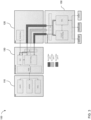
- FIG. 2 illustrates the architecture 100, and particularly the ACD router, in more detail.
- the ACARS Router 111 and ATN/OSI 112 router may utilise legacy ARINC protocols/ATN/OSI protocols.
- the VSR 130 may be seen as a new medium in addition to the SATCOM or the HF link, connected via an A429 link, owing to the routing policy defined on the ACD.
- the decision to go to a specific link 123 depends the availability and the quality of service on that link, for example, as determined by link probing described above.
- VSR Virtual Safety Radio
- ATN/OSI partition is dedicated to air traffic control (ATC) messages that are received/sent from/to the ground.
- ATC air traffic control
- the medium used for ATC messages may be VHF or SATCOM.
- a SATCOM link may be emulated by the VSR to communicate with the ground.
- the sat dispatcher analyses the message from ground and sends it to the OSI stack and it sends the message for the OSI stack before sending it to the SATCOM before sending to the ground.
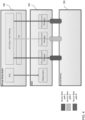
- FIG. 3 shows a functional diagram of 1 to N secure data paths that are provided by the VSR 130.
- the VSR is a component of the system that provides reliable data paths for the ACD to send messages to the ground.
- the VSR partition may be a DAL D or DAL C component which hosts the link probing feature (active and/or passive), the Link Security feature, the radio emulation and optionally a Multi-Link Engine feature.
- the VSR may be hosted either on an AISD partition, on an ACD partition or even on a dedicated LRU. Nevertheless, when the VSR component is a partition being hosted by the AISD or ACD partition, a strong segregation between each other must be enforced (i.e. the function of the VSR strongly isolated from the other domains).
- the function of the VSR may act as a legacy (i.e. safety) radio (HF or Satcom) from the ACD point of view, thereby allowing the VSR to convey ACARS, ATN/OSI traffic etc., all of which are information that typically is only distributed via safety means.
- HF safety radio
- link probing allows the VSR to obtain reliable information concerning the AISD link availability, while a Multi-Link Engine (MLE) can consolidate the link probing result with the AISD Media Status (media quality, theorical bandwidth etc.).
- MLE Multi-Link Engine
- the media status traffic between the AISD router (i.e. the non-trusted domain) and the VSR component (the X-Router interface) can be strongly isolated so as to avoid attack path between both domains.
- the Radio Emulation of the VSR may then interact with the ACD domain so as to simulate the radio interface (e.g. the HF, Satcom etc. of the ACD).
- the MLE When hosted on the VSR, the MLE oversees routing the ACD to ground messages to the correct AISD link.
- the MLE may add metadata information when sending the messages to the ground gateway so that the ground gateway is able to route the message to the right destination.
- the VSR secures the traffic sent from the ACD to the AISD.
- the VSR ensures the integrity and authenticity of the data sent to/received from the AISD domain before forwarding the data to the ACD domain. All traffic may be sanitized with input validation filtering.
- the VSR may also encrypt the data to ensure the confidentiality and integrity of the transfer to the ground.
- the secure message created by the VSR allows for a reliable source of information between the VSR and the Ground Gateway, which are both on a trusted network.
- Figure 4 shows an architecture of the AISD router 120 which may support the X-router interface.
- the AISD may be configured to share the media status (i.e. information such as media quality, theorical bandwidth, etc.), which may be used by the MLE to determine the ideal route(s) to be used to the ground.
- media status i.e. information such as media quality, theorical bandwidth, etc.
- the AISD can provide one or more secure data paths.
- the AISD may provide several secure tunnels to send/receive communication to/from the ground.
- Each tunnel is configured to utilise a specific AISD media, thereby allowing the MLE to select the optimal media to be used to send the data to the ground gateway.
- Each tunnel within the AISD is segregated so that the ACD traffic is sent to the ground using the expected media.
- the AISD may secure the AISD/ground communication using tunnelling/data encapsulation technologies such as IPSEC.
- tunnelling may ensure the authentication, integrity and confidentiality of the data exchange between the AISD and the Ground VPN EndPoint.
- FIG. 5 shows an example architecture of the ground system.
- the Ground system is generally composed by two parts:
- the Ground Tunnel Endpoint receives the AISD Data. It decapsulates the traffic and may forward the traffic to the Ground Gateway through a secure network.
- the endpoint provides an API allowing the Ground Gateway to send an uplink message to a specific aircraft through a specific media.
- the endpoint maintains a list of connected aircraft/media, and can report these statuses to the Ground Gateway, so that the Ground Gateway is able to route uplink messages through the correct media of the AISD.
- the Ground Gateway may check the integrity/authenticity of the received message. Then the metadata associated to the secure message are used to route the received traffic to the ACARS or ATN/OSI or other protocol endpoints.
- the Ground Gateway will apply similar management as Airborne equipment for AISD link probing by performing both Active and Passive link probing. This will allow the Ground Gateway to make media selection for uplink messages based on actual link QoS information.
- the ground gateway 150 contains similar management functions as the VSR 130.
- the Ground Gateway will respond to Air Link probing requests sent by the VSR.
- the final VSR response to Ground feedback will allow the ground gateway to determine the round trip delay from its side as Air and Ground clocks may not be aligned (3 steps active link probing).
- the Ground Gateway will collect Ground/Air communication message/acknowledgement statistics to monitor the various communication links with the VSR.
- the systems and methods herein allow for the use of non-safety communication medias for safety traffic, by interconnecting safety (e.g. ACD) and non-safety (e.g. AlSO) communication routers.
- safety e.g. ACD
- non-safety e.g. AlSO
- This results in optimized air/ground safety communication by making use of the non-dedicated high bandwidth infrastructure.
- dedicated safety means such as VHF
- the traffic in these means can be reduced in congested areas.
- the air/ground communication cost may be drastically reduced. Further, aircraft safety and security may be ensured.
Landscapes
- Engineering & Computer Science (AREA)
- Computer Security & Cryptography (AREA)
- Computer Networks & Wireless Communication (AREA)
- Signal Processing (AREA)
- Aviation & Aerospace Engineering (AREA)
- Computing Systems (AREA)
- General Physics & Mathematics (AREA)
- Physics & Mathematics (AREA)
- General Health & Medical Sciences (AREA)
- Medical Informatics (AREA)
- Health & Medical Sciences (AREA)
- Astronomy & Astrophysics (AREA)
- General Engineering & Computer Science (AREA)
- Computer Hardware Design (AREA)
- Data Exchanges In Wide-Area Networks (AREA)
Priority Applications (2)
| Application Number | Priority Date | Filing Date | Title |
|---|---|---|---|
| EP23306398.1A EP4513465A1 (fr) | 2023-08-21 | 2023-08-21 | Procédé de communication par voie hertzienne pour la transmission de messages de sécurité sur une infrastructure non sécurisée |
| US18/809,014 US20250069511A1 (en) | 2023-08-21 | 2024-08-19 | Air ground communication method for transmitting safety messages over non safety infrastructure |
Applications Claiming Priority (1)
| Application Number | Priority Date | Filing Date | Title |
|---|---|---|---|
| EP23306398.1A EP4513465A1 (fr) | 2023-08-21 | 2023-08-21 | Procédé de communication par voie hertzienne pour la transmission de messages de sécurité sur une infrastructure non sécurisée |
Publications (1)
| Publication Number | Publication Date |
|---|---|
| EP4513465A1 true EP4513465A1 (fr) | 2025-02-26 |
Family
ID=88697674
Family Applications (1)
| Application Number | Title | Priority Date | Filing Date |
|---|---|---|---|
| EP23306398.1A Pending EP4513465A1 (fr) | 2023-08-21 | 2023-08-21 | Procédé de communication par voie hertzienne pour la transmission de messages de sécurité sur une infrastructure non sécurisée |
Country Status (2)
| Country | Link |
|---|---|
| US (1) | US20250069511A1 (fr) |
| EP (1) | EP4513465A1 (fr) |
Citations (1)
| Publication number | Priority date | Publication date | Assignee | Title |
|---|---|---|---|---|
| CA2644619A1 (fr) * | 2007-11-21 | 2009-05-21 | Honeywell International Inc. | Utilisation de liaisons de donnees pour fins aeronautiques, sans compromis de securite et de protection |
-
2023
- 2023-08-21 EP EP23306398.1A patent/EP4513465A1/fr active Pending
-
2024
- 2024-08-19 US US18/809,014 patent/US20250069511A1/en active Pending
Patent Citations (1)
| Publication number | Priority date | Publication date | Assignee | Title |
|---|---|---|---|---|
| CA2644619A1 (fr) * | 2007-11-21 | 2009-05-21 | Honeywell International Inc. | Utilisation de liaisons de donnees pour fins aeronautiques, sans compromis de securite et de protection |
Non-Patent Citations (1)
| Title |
|---|
| BERNSMED KARIN ET AL: "Security requirements for SATCOM datalink systems for future air traffic management", 2017 IEEE/AIAA 36TH DIGITAL AVIONICS SYSTEMS CONFERENCE (DASC), IEEE, 17 September 2017 (2017-09-17), pages 1 - 10, XP033248923, DOI: 10.1109/DASC.2017.8102083 * |
Also Published As
| Publication number | Publication date |
|---|---|
| US20250069511A1 (en) | 2025-02-27 |
Similar Documents
| Publication | Publication Date | Title |
|---|---|---|
| CN101803328B (zh) | 用于远程航空电子应用程序的acars路由器 | |
| EP2063550B2 (fr) | Utilisation de liaisons de données à des fins aéronautiques sans compromettre la sûreté et la sécurité | |
| US8656162B2 (en) | Aeronautical security management over broadband air/ground network | |
| EP1784964B1 (fr) | Systeme et procede de transmission de messages acars par liaison de communication de donnees tcp/ip | |
| CA2666567C (fr) | Systeme de communication radio pour un echange de messages acars | |
| US20090082013A1 (en) | System and method for wireless routing of data from an aircraft | |
| US10819418B2 (en) | Systems and methods for secure communications over broadband datalinks | |
| Mäurer et al. | L-band digital aeronautical communications system (LDACS) | |
| US10412051B2 (en) | System and method for satellite communications link | |
| US20150222351A1 (en) | Satcom data unit with wireless device | |
| Depoorter et al. | Designing the air–ground data links for future air traffic control communications | |
| CN110635837A (zh) | 一种支持多种网络传输地空数据的系统及方法 | |
| CN109495289B (zh) | 接收数据的电子设备和方法、通信系统和计算机存储介质 | |
| US9560174B2 (en) | Network routing overlay | |
| EP4513465A1 (fr) | Procédé de communication par voie hertzienne pour la transmission de messages de sécurité sur une infrastructure non sécurisée | |
| Signore et al. | The aeronautical telecommunication network (ATN) | |
| Mäurer et al. | RFC 9372: L-band digital aeronautical communications system (LDACS) | |
| Luong et al. | Seamless handover in SDN-based future avionics networks with network coding and LISP mobility protocol | |
| Zaruba et al. | Hyperconnected ATM Concept and Challenges | |
| Stinson | Internet protocol (IP) over link-16 | |
| Parkes et al. | Mercury surface simulation for Bepi Colombo lander | |
| CA2644619A1 (fr) | Utilisation de liaisons de donnees pour fins aeronautiques, sans compromis de securite et de protection | |
| Slywczak | Enhancing In-Flight Transoceanic Communications Using Swift-64 Packet Mode Service |
Legal Events
| Date | Code | Title | Description |
|---|---|---|---|
| PUAI | Public reference made under article 153(3) epc to a published international application that has entered the european phase |
Free format text: ORIGINAL CODE: 0009012 |
|
| STAA | Information on the status of an ep patent application or granted ep patent |
Free format text: STATUS: THE APPLICATION HAS BEEN PUBLISHED |
|
| AK | Designated contracting states |
Kind code of ref document: A1 Designated state(s): AL AT BE BG CH CY CZ DE DK EE ES FI FR GB GR HR HU IE IS IT LI LT LU LV MC ME MK MT NL NO PL PT RO RS SE SI SK SM TR |
|
| STAA | Information on the status of an ep patent application or granted ep patent |
Free format text: STATUS: REQUEST FOR EXAMINATION WAS MADE |
|
| 17P | Request for examination filed |
Effective date: 20250821 |