EP4513876A1 - Dispositif d'émission pour données de nuage de points, procédé mis en oeuvre par le dispositif d'émission, dispositif de réception pour données de nuage de points, et procédé mis en oeuvre par le dispositif de réception - Google Patents
Dispositif d'émission pour données de nuage de points, procédé mis en oeuvre par le dispositif d'émission, dispositif de réception pour données de nuage de points, et procédé mis en oeuvre par le dispositif de réception Download PDFInfo
- Publication number
- EP4513876A1 EP4513876A1 EP23792247.1A EP23792247A EP4513876A1 EP 4513876 A1 EP4513876 A1 EP 4513876A1 EP 23792247 A EP23792247 A EP 23792247A EP 4513876 A1 EP4513876 A1 EP 4513876A1
- Authority
- EP
- European Patent Office
- Prior art keywords
- track
- point cloud
- box
- unit
- temporal level
- Prior art date
- Legal status (The legal status is an assumption and is not a legal conclusion. Google has not performed a legal analysis and makes no representation as to the accuracy of the status listed.)
- Pending
Links
Images




Classifications
-
- H—ELECTRICITY
- H04—ELECTRIC COMMUNICATION TECHNIQUE
- H04N—PICTORIAL COMMUNICATION, e.g. TELEVISION
- H04N19/00—Methods or arrangements for coding, decoding, compressing or decompressing digital video signals
- H04N19/30—Methods or arrangements for coding, decoding, compressing or decompressing digital video signals using hierarchical techniques, e.g. scalability
- H04N19/31—Methods or arrangements for coding, decoding, compressing or decompressing digital video signals using hierarchical techniques, e.g. scalability in the temporal domain
-
- H—ELECTRICITY
- H04—ELECTRIC COMMUNICATION TECHNIQUE
- H04N—PICTORIAL COMMUNICATION, e.g. TELEVISION
- H04N21/00—Selective content distribution, e.g. interactive television or video on demand [VOD]
- H04N21/40—Client devices specifically adapted for the reception of or interaction with content, e.g. set-top-box [STB]; Operations thereof
- H04N21/43—Processing of content or additional data, e.g. demultiplexing additional data from a digital video stream; Elementary client operations, e.g. monitoring of home network or synchronising decoder's clock; Client middleware
- H04N21/434—Disassembling of a multiplex stream, e.g. demultiplexing audio and video streams, extraction of additional data from a video stream; Remultiplexing of multiplex streams; Extraction or processing of SI; Disassembling of packetised elementary stream
- H04N21/4348—Demultiplexing of additional data and video streams
-
- H—ELECTRICITY
- H04—ELECTRIC COMMUNICATION TECHNIQUE
- H04N—PICTORIAL COMMUNICATION, e.g. TELEVISION
- H04N19/00—Methods or arrangements for coding, decoding, compressing or decompressing digital video signals
- H04N19/10—Methods or arrangements for coding, decoding, compressing or decompressing digital video signals using adaptive coding
- H04N19/102—Methods or arrangements for coding, decoding, compressing or decompressing digital video signals using adaptive coding characterised by the element, parameter or selection affected or controlled by the adaptive coding
- H04N19/132—Sampling, masking or truncation of coding units, e.g. adaptive resampling, frame skipping, frame interpolation or high-frequency transform coefficient masking
-
- H—ELECTRICITY
- H04—ELECTRIC COMMUNICATION TECHNIQUE
- H04N—PICTORIAL COMMUNICATION, e.g. TELEVISION
- H04N19/00—Methods or arrangements for coding, decoding, compressing or decompressing digital video signals
- H04N19/10—Methods or arrangements for coding, decoding, compressing or decompressing digital video signals using adaptive coding
- H04N19/102—Methods or arrangements for coding, decoding, compressing or decompressing digital video signals using adaptive coding characterised by the element, parameter or selection affected or controlled by the adaptive coding
- H04N19/124—Quantisation
-
- H—ELECTRICITY
- H04—ELECTRIC COMMUNICATION TECHNIQUE
- H04N—PICTORIAL COMMUNICATION, e.g. TELEVISION
- H04N19/00—Methods or arrangements for coding, decoding, compressing or decompressing digital video signals
- H04N19/10—Methods or arrangements for coding, decoding, compressing or decompressing digital video signals using adaptive coding
- H04N19/169—Methods or arrangements for coding, decoding, compressing or decompressing digital video signals using adaptive coding characterised by the coding unit, i.e. the structural portion or semantic portion of the video signal being the object or the subject of the adaptive coding
- H04N19/17—Methods or arrangements for coding, decoding, compressing or decompressing digital video signals using adaptive coding characterised by the coding unit, i.e. the structural portion or semantic portion of the video signal being the object or the subject of the adaptive coding the unit being an image region, e.g. an object
-
- H—ELECTRICITY
- H04—ELECTRIC COMMUNICATION TECHNIQUE
- H04N—PICTORIAL COMMUNICATION, e.g. TELEVISION
- H04N19/00—Methods or arrangements for coding, decoding, compressing or decompressing digital video signals
- H04N19/50—Methods or arrangements for coding, decoding, compressing or decompressing digital video signals using predictive coding
- H04N19/597—Methods or arrangements for coding, decoding, compressing or decompressing digital video signals using predictive coding specially adapted for multi-view video sequence encoding
-
- H—ELECTRICITY
- H04—ELECTRIC COMMUNICATION TECHNIQUE
- H04N—PICTORIAL COMMUNICATION, e.g. TELEVISION
- H04N19/00—Methods or arrangements for coding, decoding, compressing or decompressing digital video signals
- H04N19/70—Methods or arrangements for coding, decoding, compressing or decompressing digital video signals characterised by syntax aspects related to video coding, e.g. related to compression standards
-
- H—ELECTRICITY
- H04—ELECTRIC COMMUNICATION TECHNIQUE
- H04N—PICTORIAL COMMUNICATION, e.g. TELEVISION
- H04N21/00—Selective content distribution, e.g. interactive television or video on demand [VOD]
- H04N21/20—Servers specifically adapted for the distribution of content, e.g. VOD servers; Operations thereof
- H04N21/23—Processing of content or additional data; Elementary server operations; Server middleware
- H04N21/234—Processing of video elementary streams, e.g. splicing of video streams or manipulating encoded video stream scene graphs
- H04N21/2343—Processing of video elementary streams, e.g. splicing of video streams or manipulating encoded video stream scene graphs involving reformatting operations of video signals for distribution or compliance with end-user requests or end-user device requirements
-
- H—ELECTRICITY
- H04—ELECTRIC COMMUNICATION TECHNIQUE
- H04N—PICTORIAL COMMUNICATION, e.g. TELEVISION
- H04N21/00—Selective content distribution, e.g. interactive television or video on demand [VOD]
- H04N21/20—Servers specifically adapted for the distribution of content, e.g. VOD servers; Operations thereof
- H04N21/23—Processing of content or additional data; Elementary server operations; Server middleware
- H04N21/234—Processing of video elementary streams, e.g. splicing of video streams or manipulating encoded video stream scene graphs
- H04N21/2343—Processing of video elementary streams, e.g. splicing of video streams or manipulating encoded video stream scene graphs involving reformatting operations of video signals for distribution or compliance with end-user requests or end-user device requirements
- H04N21/234327—Processing of video elementary streams, e.g. splicing of video streams or manipulating encoded video stream scene graphs involving reformatting operations of video signals for distribution or compliance with end-user requests or end-user device requirements by decomposing into layers, e.g. base layer and one or more enhancement layers
-
- H—ELECTRICITY
- H04—ELECTRIC COMMUNICATION TECHNIQUE
- H04N—PICTORIAL COMMUNICATION, e.g. TELEVISION
- H04N21/00—Selective content distribution, e.g. interactive television or video on demand [VOD]
- H04N21/20—Servers specifically adapted for the distribution of content, e.g. VOD servers; Operations thereof
- H04N21/23—Processing of content or additional data; Elementary server operations; Server middleware
- H04N21/236—Assembling of a multiplex stream, e.g. transport stream, by combining a video stream with other content or additional data, e.g. inserting a URL [Uniform Resource Locator] into a video stream, multiplexing software data into a video stream; Remultiplexing of multiplex streams; Insertion of stuffing bits into the multiplex stream, e.g. to obtain a constant bit-rate; Assembling of a packetised elementary stream
- H04N21/23605—Creation or processing of packetized elementary streams [PES]
-
- H—ELECTRICITY
- H04—ELECTRIC COMMUNICATION TECHNIQUE
- H04N—PICTORIAL COMMUNICATION, e.g. TELEVISION
- H04N21/00—Selective content distribution, e.g. interactive television or video on demand [VOD]
- H04N21/40—Client devices specifically adapted for the reception of or interaction with content, e.g. set-top-box [STB]; Operations thereof
- H04N21/43—Processing of content or additional data, e.g. demultiplexing additional data from a digital video stream; Elementary client operations, e.g. monitoring of home network or synchronising decoder's clock; Client middleware
- H04N21/44—Processing of video elementary streams, e.g. splicing a video clip retrieved from local storage with an incoming video stream or rendering scenes according to encoded video stream scene graphs
- H04N21/4402—Processing of video elementary streams, e.g. splicing a video clip retrieved from local storage with an incoming video stream or rendering scenes according to encoded video stream scene graphs involving reformatting operations of video signals for household redistribution, storage or real-time display
-
- H—ELECTRICITY
- H04—ELECTRIC COMMUNICATION TECHNIQUE
- H04N—PICTORIAL COMMUNICATION, e.g. TELEVISION
- H04N21/00—Selective content distribution, e.g. interactive television or video on demand [VOD]
- H04N21/80—Generation or processing of content or additional data by content creator independently of the distribution process; Content per se
- H04N21/81—Monomedia components thereof
- H04N21/816—Monomedia components thereof involving special video data, e.g 3D video
-
- H—ELECTRICITY
- H04—ELECTRIC COMMUNICATION TECHNIQUE
- H04N—PICTORIAL COMMUNICATION, e.g. TELEVISION
- H04N21/00—Selective content distribution, e.g. interactive television or video on demand [VOD]
- H04N21/80—Generation or processing of content or additional data by content creator independently of the distribution process; Content per se
- H04N21/85—Assembly of content; Generation of multimedia applications
- H04N21/854—Content authoring
- H04N21/85406—Content authoring involving a specific file format, e.g. MP4 format
-
- H—ELECTRICITY
- H04—ELECTRIC COMMUNICATION TECHNIQUE
- H04N—PICTORIAL COMMUNICATION, e.g. TELEVISION
- H04N19/00—Methods or arrangements for coding, decoding, compressing or decompressing digital video signals
- H04N19/10—Methods or arrangements for coding, decoding, compressing or decompressing digital video signals using adaptive coding
- H04N19/169—Methods or arrangements for coding, decoding, compressing or decompressing digital video signals using adaptive coding characterised by the coding unit, i.e. the structural portion or semantic portion of the video signal being the object or the subject of the adaptive coding
- H04N19/17—Methods or arrangements for coding, decoding, compressing or decompressing digital video signals using adaptive coding characterised by the coding unit, i.e. the structural portion or semantic portion of the video signal being the object or the subject of the adaptive coding the unit being an image region, e.g. an object
- H04N19/174—Methods or arrangements for coding, decoding, compressing or decompressing digital video signals using adaptive coding characterised by the coding unit, i.e. the structural portion or semantic portion of the video signal being the object or the subject of the adaptive coding the unit being an image region, e.g. an object the region being a slice, e.g. a line of blocks or a group of blocks
Definitions
- the present disclosure relates to a method and device for processing point cloud content.
- Point cloud content is expressed as a point cloud which is a set of points belonging to a coordinate system representing a three-dimensional space.
- the point cloud content may represent three-dimensional media and is used to provide various services such as virtual reality (VR), augmented reality (AR), mixed reality (MR) and self-driving services. Since tens of thousands to hundreds of thousands of point data are required to express point cloud content, a method of efficiently processing a vast amount of point data is required.
- the present disclosure provides a device and method for efficiently processing point cloud data.
- the present disclosure provides a point cloud data processing method and device for solving latency and encoding/decoding complexity.
- the present disclosure provides a device and methods for supporting temporal scalability in the carriage of geometry-based point cloud compressed data.
- the present disclosure proposes a device and methods for efficiently storing a G-PCC bitstream in a single track in a file or divisionally storing it in a plurality of tracks and providing a point cloud content service providing signaling thereof.
- the present disclosure proposes a device and methods for processing a file storage technique to support efficient access to a stored G-PCC bitstream.
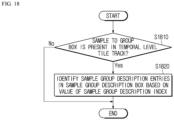
- a method performed by a reception device of point cloud data may comprise obtaining a geometry-based point cloud compression (G-PCC) file including the point cloud data and obtaining a sample group description box with a predetermined group type from the G-PCC file. Based on the sample group description box being present in a track in the G-PCC file, an entry count in the sample group description box may be equal to a value obtained by adding 1 to a highest temporal level identifier value included in the track.
- G-PCC geometry-based point cloud compression
- a reception device of point cloud data may comprise a memory and at least one processor.
- the at least one processor may obtain a geometry-based point cloud compression (G-PCC) file including the point cloud data and obtain a sample group description box with a predetermined group type from the G-PCC file. Based on the sample group description box being present in a track in the G-PCC file, an entry count in the sample group description box may be equal to a value obtained by adding 1 to a highest temporal level identifier value included in the track.
- G-PCC geometry-based point cloud compression
- a method performed by a transmission device of point cloud data may comprise generating a sample group description box with a predetermined group type and generating the G-PCC file by including the sample group description box and the point cloud data. Based on the sample group description box being present in a track in the G-PCC file, an entry count in the sample group description box may be equal to a value obtained by adding 1 to a highest temporal level identifier value included in the track.
- a transmission device of point cloud data may comprise a memory and at least one processor.
- the at least one processor may generate a sample group description box with a predetermined group type and generate the G-PCC file by including the sample group description box and the point cloud data. Based on the sample group description box being present in a track in the G-PCC file, an entry count in the sample group description box may be equal to a value obtained by adding 1 to a highest temporal level identifier value included in the track.
- the device and method according to embodiments of the present disclosure may process point cloud data with high efficiency.
- the device and method according to embodiments of the present disclosure may provide a high-quality point cloud service.
- the device and method according to embodiments of the present disclosure may provide point cloud content for providing universal services such as a VR service and a self-driving service.
- the device and method according to embodiments of the present disclosure may provide temporal scalability for effectively accessing a desired component among G-PCC components.
- the device and method according to the embodiments of the present disclosure may support temporal scalability, such that data may be manipulated at a high level consistent with a network function or a decoder function, and thus performance of a point cloud content provision system can be improved.
- the device and method according to the embodiments of the present disclosure may solve the problem that a sample group description entry for an unreferenced index is included in a sample group description box, and thus efficiency may be improved.
- a component when a component is “connected”, “coupled” or “linked” to another component, it may include not only a direct connection relationship but also an indirect connection relationship in which another component exists in therebetween.
- a component when it is said that a component “includes” or “has” another component, this indicates that the other components are not excluded, but may be further included unless specially described.
- first, second, etc. are used only for the purpose of distinguishing one component from other components, and, unless otherwise specified, the order or importance of the components is not limited. Accordingly, within the scope of the present disclosure, a first component in one embodiment may be referred to as a second component in another embodiment, and, similarly, a second component in one embodiment is referred to as a first component in another embodiment.
- components that are distinguished from each other are for clearly explaining features thereof, and do not necessarily mean that the components are separated. That is, a plurality of components may be integrated to form one hardware or software unit, or one component may be distributed to form a plurality of hardware or software units. Accordingly, even if not specifically mentioned, such integrated or distributed embodiments are also included in the scope of the present disclosure.
- components described in various embodiments do not necessarily mean essential components, and some thereof may be optional components. Accordingly, an embodiment composed of a subset of components described in one embodiment is also included in the scope of the present disclosure. In addition, embodiments including other components in addition to components described in various embodiments are also included in the scope of the present disclosure.
- the present disclosure relates to encoding and decoding of point cloud-related data, and terms used in the present disclosure may have general meanings commonly used in the technical field to which the present disclosure belongs unless they are newly defined in the present disclosure.
- the term “/” and “,” should be interpreted to indicate “and/or.”
- the expression “A/B” and “A, B” may mean “A and/or B.”
- “A/B/C” and “A/B/C” may mean “at least one of A, B, and/or C.”
- the term “or” should be interpreted to indicate “and/or.”
- the expression “A or B” may comprise 1) only “A”, 2) only “B”, and/or 3) both "A and B”.
- the term “or” should be interpreted to indicate "additionally or alternatively.”
- the present disclosure relates to compression of point cloud-related data.
- Various methods or embodiments of the present disclosure may be applied to a point cloud compression or point cloud coding (PCC) standard (e.g., G-PCC or V-PCC standard) of a moving picture experts group (MPEG) or a next-generation video/image coding standard.
- PCC point cloud compression or point cloud coding
- a "point cloud” may mean a set of points located in a three-dimensional space.
- point cloud content is expressed as a point cloud, and may mean a "point cloud video/image”.
- the 'point cloud video/image' is referred to as a 'point cloud video'.
- a point cloud video may include one or more frames, and one frame may be a still image or a picture. Accordingly, the point cloud video may include a point cloud image/frame/picture, and may be referred to as any one of a "point cloud image", a "point cloud frame", and a "point cloud picture".
- point cloud data may mean data or information related to each point in the point cloud.
- Point cloud data may include geometry and/or attribute.
- the point cloud data may further include metadata.
- the point cloud data may be referred to as “point cloud content data” or “point cloud video data” or the like.
- point cloud data may be referred to as "point cloud content”, “point cloud video”, “G-PCC data”, and the like.
- a point cloud object corresponding to point cloud data may be represented in a box shape based on a coordinate system, and the box shape based on the coordinate system may be referred to as a bounding box. That is, the bounding box may be a rectangular cuboid capable of accommodating all points of the point cloud, and may be a cuboid including a source point cloud frame.
- geometry includes the position (or position information) of each point, and the position may be expressed by parameters (e.g., for example, an x-axis value, a y-axis value, and a z-axis value) representing a three-dimensional coordinate system (e.g., a coordinate system consisting of an x-axis, y-axis, and z-axis).
- parameters e.g., for example, an x-axis value, a y-axis value, and a z-axis value
- the geometry may be referred to as "geometric information”.
- the attribute may include properties of each point, and the properties may include one or more of texture information, color (RGB or YCbCr), reflectance (r), transparency, etc. of each point.
- the attribute may be referred to as "attribute information”.
- Metadata may include various data related to acquisition in an acquisition process to be described later.
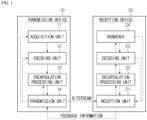
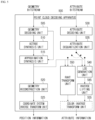
- FIG. 1 illustrates an example of a system for providing point cloud content (hereinafter, referred to as a 'point cloud content provision system') according to embodiments of the present disclosure.
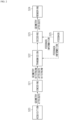
- FIG. 2 illustrates an example of a process in which the point cloud content provision system provides point cloud content.
- the point cloud content provision system may include a transmission device 10 and a reception device 20.
- the point cloud content provision system may perform an acquisition process S20, an encoding process S21, a transmission process S22, a decoding process S23, a rendering process S24 and/or a feedback process S25 shown in FIG.2 by operation of the transmission device 10 and the reception device 20.
- the transmission device 10 acquires point cloud data and outputs a bitstream through a series of processes (e.g., encoding process) for the acquired point cloud data (source point cloud data), in order to provide point cloud content.
- the point cloud data may be output in the form of a bitstream through an encoding process.
- the transmission device 10 may transmit the output bitstream in the form of a file or streaming (streaming segment) to the reception device 20 through a digital storage medium or a network.
- the digital storage medium may include a variety of storage media such as USB, SD, CD, DVD, Blu-ray, HDD, and SSD.
- the reception device 20 may process (e.g., decode or reconstruct) the received data (e.g., encoded point cloud data) into source point cloud data and render it.
- the point cloud content may be provided to the user through these processes, and the present disclosure may provide various embodiments necessary to effectively perform a series of these processes.
- the transmission device 10 may include an acquisition unit 11, an encoding unit 12, an encapsulation processing unit 13 and a transmission unit 14, and the reception device 20 may include a reception unit 21, a decapsulation processing unit 22, a decoding unit 23, and a rendering unit 24.
- the acquisition unit 11 may perform a process S20 of acquiring a point cloud video through a capturing, synthesizing or generating process. Accordingly, the acquisition unit 11 may be referred to as a 'point cloud video acquisition unit'.
- Point cloud data (geometry and/or attribute, etc.) for a plurality of points may be generated by the acquisition process (S20). Also, through the acquisition process (S20), metadata related to the acquisition of the point cloud video may be generated. Also, mesh data (e.g., triangular data) indicating connection information between point clouds may be generated by the acquisition process (S20).
- the metadata may include initial viewing orientation metadata.
- the initial viewing orientation metadata may indicate whether the point cloud data is data representing the front or the back.
- the metadata may be referred to as "auxiliary data" that is metadata for the point cloud.
- the acquired point cloud video may include the polygon file format or the Stanford triangle format (PLY) file. Since the point cloud video has one or more frames, the acquired point cloud video may include one or more PLY files.
- the PLY file may include point cloud data of each point.
- the acquisition unit 11 may be composed of a combination of camera equipment capable of acquiring depth (depth information) and RGB cameras capable of extracting color information corresponding to the depth information.
- the camera equipment capable of acquiring the depth information may be a combination of an infrared pattern projector and an infrared camera.
- the acquisition unit 11 may be composed of a LiDAR, and the LiDAR may use a radar system for measuring the position coordinates of a reflector by measuring a time required for a laser pulse to be emitted and returned after being reflected.
- the acquisition unit 110 may extract a shape of geometry composed of points in a three-dimensional space from the depth information, and may extract an attribute representing a color or reflection of each point from the RGB information.
- a method of extracting (or capturing, acquiring, etc.) a point cloud video there may be an inward-facing method of capturing a central object and an outward-facing method of capturing an external environment.
- the encoding unit 12 may perform the encoding process (S21) of encoding the data (e.g., geometry, attribute and/or metadata, and/or mesh data, etc.) generated by the acquisition unit 11 into one or more bitstreams. Accordingly, the encoding unit 12 may be referred to as a 'point cloud video encoder'. The encoding unit 12 may encode the data generated by the acquisition unit 11 in series or in parallel.
- S21 encoding process
- the encoding unit 12 may encode the data generated by the acquisition unit 11 in series or in parallel.
- the encoding process S21 performed by the encoding unit 12 may be geometry-based point cloud compression (G-PCC).
- the encoding unit 12 may perform a series of procedures such as prediction, transform, quantization, and entropy coding for compression and coding efficiency.
- the encoded point cloud data may be output in the form of a bitstream.
- the encoding unit 12 may partition the point cloud data into geometry and attribute and encode them as described below.
- the output bitstream may include a geometry bitstream including the encoded geometry and an attribute bitstream including the encoded attribute.
- the output bitstream may further include one or more of a metadata bitstream including metadata, an auxiliary bitstream including auxiliary data, and a mesh data bitstream including mesh data.
- the encoding process (S21) will be described in more detail below.
- a bitstream including the encoded point cloud data may be referred to as a 'point cloud bitstream' or a 'point cloud video bitstream'.
- the encapsulation processing unit 13 may perform a process of encapsulating one or more bitstreams output from the decoding unit 12 in the form of a file or a segment. Accordingly, the encapsulation processing unit 13 may be referred to as a 'file/segment encapsulation module'. Although the drawing shows an example in which the encapsulation processing unit 13 is composed of a separate component/module in relation to the transmission unit 14, the encapsulation processing unit 13 may be included in the transmission unit 14 in some embodiments.
- the encapsulation processing unit 13 may encapsulate the data in a file format such as ISO Base Media File Format (ISOBMFF) or process the data in the form of other DASH segments.
- the encapsulation processing unit 13 may include metadata in a file format. Metadata may be included, for example, in boxes of various levels in the ISOBMFF file format, or as data in a separate track within the file.
- the encapsulation processing unit 130 may encapsulate the metadata itself into a file.
- the metadata processed by the encapsulation processing unit 13 may be transmitted from a metadata processing unit not shown in the drawing.
- the metadata processing unit may be included in the encoding unit 12 or may be configured as a separate component/module.
- the transmission unit 14 may perform the transmission process (S22) of applying processing (processing for transmission) according to a file format to the 'encapsulated point cloud bitstream'.
- the transmission unit 140 may transmit the bitstream or a file/segment including the bitstream to the reception unit 21 of the reception device 20 through a digital storage medium or a network. Accordingly, the transmission unit 14 may be referred to as a 'transmitter' or a 'communication module'.
- the transmission unit 14 may process point cloud data according to an arbitrary transmission protocol.
- 'processing the point cloud data according to the arbitrary transmission protocol' may be 'processing for transmission'.
- the processing for transmission may include processing for transmission through a broadcast network, processing for transmission through a broadband, and the like.
- the transmission unit 14 may receive not only point cloud data but also metadata from the metadata processing unit, and may perform processing for transmission on the transmitted metadata.
- the processing for transmission may be performed by the transmission processing unit, and the transmission processing unit may be included in the transmission unit 14 or configured as a component/module separate from the transmission unit 14.
- the reception unit 21 may receive the bitstream transmitted by the transmission device 10 or a file/segment including the bitstream. Depending on the transmitted channel, the reception unit 21 may receive a bitstream or a file/segment including the bitstream through a broadcast network, or may receive a bitstream or a file/segment including the bitstream through a broadband. Alternatively, the reception unit 21 may receive a bitstream or a file/segment including the bitstream through a digital storage medium.
- the reception unit 21 may perform processing according to a transmission protocol on the received bitstream or the file/segment including the bitstream.
- the reception unit 21 may perform a reverse process of transmission processing (processing for transmission) to correspond to processing for transmission performed by the transmission device 10.
- the reception unit 21 may transmit the encoded point cloud data among the received data to the decapsulation processing unit 22 and may transmit metadata to a metadata parsing unit.
- the metadata may be in the form of a signaling table. In some embodiments, the reverse process of the processing for transmission may be performed in the reception processing unit.
- Each of the reception processing unit, the decapsulation processing unit 22, and the metadata parsing unit may be included in the reception unit 21 or may be configured as a component/module separate from the reception unit 21.
- the decapsulation processing unit 22 may decapsulate the point cloud data (i.e., a bitstream in a file format) in a file format received from the reception unit 21 or a reception processing unit. Accordingly, the decapsulation processing unit 22 may be referred to as a 'file/segment decapsulation module'.
- the decapsulation processing unit 22 may acquire a point cloud bitstream or a metadata bitstream by decapsulating files according to ISOBMFF or the like.
- metadata (metadata bitstream) may be included in the point cloud bitstream.
- the acquired point cloud bitstream may be transmitted to the decoding unit 23, and the acquired metadata bitstream may be transmitted to the metadata processing unit.
- the metadata processing unit may be included in the decoding unit 23 or may be configured as a separate component/module.
- the metadata obtained by the decapsulation processing unit 23 may be in the form of a box or track in a file format. If necessary, the decapsulation processing unit 23 may receive metadata required for decapsulation from the metadata processing unit.
- the metadata may be transmitted to the decoding unit 23 and used in the decoding process (S23), or may be transmitted to the rendering unit 24 and used in the rendering process (S24).
- the decoding unit 23 may receive the bitstream and perform operation corresponding to the operation of the encoding unit 12, thereby performing the decoding process (S23) of decoding the point cloud bitstream (encoded point cloud data). Accordingly, the decoding unit 23 may be referred to as a 'point cloud video decoder'.
- the decoding unit 23 may partition the point cloud data into geometry and attribute and decode them. For example, the decoding unit 23 may reconstruct (decode) geometry from a geometry bitstream included in the point cloud bitstream, and restore (decode) attribute based on the reconstructed geometry and an attribute bitstream included in the point cloud bitstream. A three-dimensional point cloud video/image may be reconstructed based on position information according to the reconstructed geometry and attribute (such as color or texture) according to the decoded attribute.
- the decoding process (S23) will be described in more detail below.
- the rendering unit 24 may perform the rendering process S24 of rendering the reconstructed point cloud video. Accordingly, the rendering unit 24 may be referred to as a 'renderer'.
- the rendering process S24 may refer to a process of rendering and displaying point cloud content in a 3D space.
- the rendering process S24 may perform rendering according to a desired rendering method based on the position information and attribute information of the points decoded through the decoding process.
- the feedback process S25 may include a process of transmitting various feedback information that may be acquired during the rendering process S24 or the display process to the transmission device 10 or to other components in the reception device 20.
- the feedback process S25 may be performed by one or more of the components included in the reception device 20 of FIG. 1 or may be performed by one or more of the components shown in FIG 8 .
- the feedback process S25 may be performed by a 'feedback unit' or a 'sensing/tracking unit'.
- FIG. 3 illustrates an example of a point cloud encoding apparatus 300 according to embodiments of the present disclosure.
- the point cloud encoding apparatus 300 of FIG. 3 may correspond to the encoding unit 12 of FIG. 1 in terms of the configuration and function.
- the point cloud encoding apparatus 300 may include a coordinate system transform unit 305, a geometry quantization unit 310, an octree analysis unit 315, an approximation unit 320, a geometry encoding unit 325, a reconstruction unit 330, and an attribute transform unit 340, a RAHT transform unit 345, an LOD generation unit 350, a lifting unit 355, an attribute quantization unit 360, an attribute encoding unit 365, and/or a color transform unit 335.
- the point cloud data acquired by the acquisition unit 11 may undergo processes of adjusting the quality of the point cloud content (e.g., lossless, lossy, near-lossless) according to the network situation or application.
- each point of the acquired point cloud content may be transmitted without loss, but, in that case, real-time streaming may not be possible because the size of the point cloud content is large. Therefore, in order to provide the point cloud content smoothly, a process of reconstructing the point cloud content according to a maximum target bitrate is required.
- Processes of adjusting the quality of the point cloud content may be processes of reconstructing and encoding the position information (position information included in the geometry information) or color information (color information included in the attribute information) of the points.
- a process of reconstructing and encoding position information of points may be referred to as geometry coding, and a process of reconstructing and encoding attribute information associated with each point may be referred to as attribute coding.
- Geometry coding may include a geometry quantization process, a voxelization process, an octree analysis process, an approximation process, a geometry encoding process, and/or a coordinate system transform process. Also, geometry coding may further include a geometry reconstruction process. Attribute coding may include a color transform process, an attribute transform process, a prediction transform process, a lifting transform process, a RAHT transform process, an attribute quantization process, an attribute encoding process, and the like.
- the coordinate system transform process may correspond to a process of transforming a coordinate system for positions of points. Therefore, the coordinate system transform process may be referred to as 'transform coordinates'.
- the coordinate system transform process may be performed by the coordinate system transform unit 305.
- the coordinate system transform unit 305 may transform the positions of the points from the global space coordinate system to position information in a three-dimensional space (e.g., a three-dimensional space expressed in coordinate system of the X-axis, Y-axis, and Z-axis).
- Position information in the 3D space may be referred to as 'geometric information'.
- the geometry quantization process may correspond to a process of quantizing the position information of points, and may be performed by the geometry quantization unit 310.
- the geometry quantization unit 310 may find position information having minimum (x, y, z) values among the position information of the points, and subtract position information having the minimum (x, y, z) positions from the position information of each point.
- the geometry quantization unit 310 may multiply the subtracted value by a preset quantization scale value, and then adjust (lower or raise) the result to a near integer value, thereby performing the quantization process.
- the voxelization process may correspond to a process of matching geometry information quantized through the quantization process to a specific voxel present in a 3D space.
- the voxelization process may also be performed by the geometry quantization unit 310.
- the geometry quantization unit 310 may perform octree-based voxelization based on position information of the points, in order to reconstruct each point to which the quantization process is applied.
- a voxel may mean a space for storing information on points present in 3D, similarly to a pixel, which is a minimum unit having information on a 2D image/video.
- the voxel is a hybrid word obtained by combining a volume and a pixel.
- the voxel may estimate spatial coordinates from a positional relationship with a voxel group, and may have color or reflectance information similarly to a pixel.
- Only one point may not exist (match) in one voxel. That is, information related to a plurality of points may exist in one voxel. Alternatively, information related to a plurality of points included in one voxel may be integrated into one point information. Such adjustment can be performed selectively.
- the position value of the center point of the voxel may be set based on the position values of points existing in the voxel, and an attribute transform process related thereto needs to be performed. For example, the attribute transform process may be adjusted to the position value of points included in the voxel or the center point of the voxel, and the average value of the color or reflectance of neighbor points within a specific radius.
- the octree analysis unit 315 may use an octree to efficiently manage the area/position of the voxel.
- the octree analysis unit 315 may partition the area until the leaf node becomes a voxel, and may use an octree data structure capable of managing eight children node areas for efficient management according to the size and position of the area.
- the octree may be expressed as an occupancy code
- the octree analysis unit 315 may express the occupancy code of the node as 1 when a point is included in each node and express the occupancy code of the node as 0 when the point is not included.
- the geometry encoding process may correspond to a process of performing entropy coding on the occupancy code.
- the geometry encoding process may be performed by the geometry encoding unit 325.
- the geometry encoding unit 325 may perform entropy coding on the occupancy code.
- the generated occupancy code may be immediately encoded or may be encoded through an intra/inter coding process to increase compression efficiency.
- the reception device 20 may reconstruct the octree through the occupancy code.
- the point cloud encoding apparatus 300 may directly transmit the positions of points only for the specific area, or reconfigure positions of points within the specific area based on the voxel using a surface model, instead of partitioning a node (specific node) corresponding to this specific area into 8 sub-nodes (children nodes) for the specific area (a specific area that does not correspond to a leaf node).
- a mode for directly transmitting the position of each point for a specific node may be a direct mode.
- the point cloud encoding apparatus 300 may check whether conditions for enabling the direct mode are satisfied.
- the conditions for enabling the direct mode are: 1) the option to use the direct mode shall be enabled, 2) the specific node does not correspond to a leaf node, and 3) points below a threshold shall exist within the specific node, and 4) the total number of points to be directly transmitted does not exceed a limit value.
- the point cloud encoding apparatus 300 may entropy-code and transmit the position value of the point directly for the specific node through the geometry encoding unit 325.
- a mode in which a position of a point in a specific area is reconstructed based on a voxel using a surface model may be a trisoup mode.
- the trisoup mode may be performed by the approximation unit 320.
- the approximation unit 320 may determine a specific level of the octree and reconstruct the positions of points in the node area based on the voxel using the surface model from the determined specific level.
- the point cloud encoding apparatus 300 may selectively apply the trisoup mode. Specifically, the point cloud encoding apparatus 300 may designate a level (specific level) to which the trisoup mode is applied, when the trisoup mode is used. For example, when the specified specific level is equal to the depth (d) of the octree, the trisoup mode may not be applied. That is, the designated specific level shall be less than the depth value of the octree.
- a three-dimensional cubic area of nodes of the designated specific level is called a block, and one block may include one or more voxels.
- a block or voxel may correspond to a brick.
- Each block may have 12 edges, and the approximation unit 320 may check whether each edge is adjacent to an occupied voxel having a point. Each edge may be adjacent to several occupied voxels.
- a specific position of an edge adjacent to a voxel is called a vertex, and, when a plurality of occupied voxels are adjacent to one edge, the approximation unit 320 may determine an average position of the positions as a vertex.
- the point cloud encoding apparatus 300 may entropy-code the starting points (x, y, z) of the edge, the direction vector ( ⁇ x, ⁇ y, ⁇ z) of the edge and position value of the vertex (relative position values within the edge) through the geometry encoding unit 325, when a vertex is present.
- the geometry reconstruction process may correspond to a process of generating a reconstructed geometry by reconstructing an octree and/or an approximated octree.
- the geometry reconstruction process may be performed by the reconstruction unit 330.
- the reconstruction unit 330 may perform a geometry reconstruction process through triangle reconstruction, up-sampling, voxelization, and the like.
- the reconstruction unit 330 may reconstruct a triangle based on the starting point of the edge, the direction vector of the edge and the position value of the vertex.
- the reconstruction unit 330 may perform an upsampling process for voxelization by adding points in the middle along the edge of the triangle.
- the reconstruction unit 330 may generate additional points based on an upsampling factor and the width of the block. These points may be called refined vertices.
- the reconstruction unit 330 may voxel the refined vertices, and the point cloud encoding apparatus 300 may perform attribute coding based on the voxelized position value.
- the geometry encoding unit 325 may increase compression efficiency by applying context adaptive arithmetic coding.
- the geometry encoding unit 325 may directly entropy-code the occupancy code using the arithmetic code.
- the geometry encoding unit 325 adaptively performs encoding based on occupancy of neighbor nodes (intra coding), or adaptively performs encoding based on the occupancy code of a previous frame (inter-coding).
- the frame may mean a set of point cloud data generated at the same time.
- Intra coding and inter coding are optional processes and thus may be omitted.
- Attribute coding may correspond to a process of coding attribute information based on reconstructed geometry and geometry before coordinate system transform (source geometry). Since the attribute may be dependent on the geometry, the reconstructed geometry may be utilized for attribute coding.
- the attribute may include color, reflectance, and the like.
- the same attribute coding method may be applied to information or parameters included in the attribute. Color has three elements, reflectance has one element, and each element can be processed independently.
- Attribute coding may include a color transform process, an attribute transform process, a prediction transform process, a lifting transform process, a RAHT transform process, an attribute quantization process, an attribute encoding process, and the like.
- the prediction transform process, the lifting transform process, and the RAHT transform process may be selectively used, or a combination of one or more thereof may be used.
- position values for points existing in the voxel are set to the center point of the voxel in order to display them by integrating them into one point information for the voxel. Accordingly, a process of transforming the values of attributes related to the points may be required. Also, even when the trisoup mode is performed, the attribute transform process may be performed.
- the attribute transform process may correspond to a process of transforming the attribute based on a position on which geometry coding is not performed and/or reconstructed geometry.
- the attribute transform process may correspond to a process of transforming the attribute having a point of the position based on the position of a point included in a voxel.
- the attribute transform process may be performed by the attribute transform unit 340.
- the attribute transform unit 340 may calculate the central position value of the voxel and an average value of the attribute values of neighbor points within a specific radius. Alternatively, the attribute transform unit 340 may apply a weight according to a distance from the central position to the attribute values and calculate an average value of the attribute values to which the weight is applied. In this case, each voxel has a position and a calculated attribute value.
- the prediction transform process may correspond to a process of predicting an attribute value of a current point based on attribute values of one or more points (neighbor points) adjacent to the current point (a point corresponding to a prediction target).
- the prediction transform process may be performed by a level-of-detail (LOD) generation unit 350.
- LOD level-of-detail
- Prediction transform is a method to which the LOD transform technique is applied, and the LOD generation unit 350 may calculate and set the LOD value of each point based on the LOD distance value of each point.
- the LOD generation unit 350 may generate a predictor for each point for prediction transform. Accordingly, when there are N points, N predictors may be generated.
- the neighbor points may be points existing within a distance set for each LOD from the current point.
- the predictor may multiply the attribute values of neighbor points by the 'set weight value', and set a value obtained by averaging the attribute values multiplied by the weight value as the predicted attribute value of the current point.
- An attribute quantization process may be performed on a residual attribute value obtained by subtracting the predicted attribute value of the current point from the attribute value of the current point.
- the lifting transform process may correspond to a process of reconstructing points into a set of detail levels through the LOD generation process, like the prediction transform process.
- the lifting transform process may be performed by the lifting unit 355.
- the lifting transform process may also include a process of generating a predictor for each point, a process of setting the calculated LOD in the predictor, a process of registering neighbor points, and a process of setting a weight according to distances between the current point and the neighbor points.
- the RAHT transform process may correspond to a method of predicting attribute information of nodes at a higher level using attribute information associated with a node at a lower level of the octree. That is, the RATH transform process may correspond to an attribute information intra coding method through octree backward scan.
- the RAHT transform process may be performed by the RAHT transform unit 345.
- the RAHT transform unit 345 scans the entire area in the voxel, and may perform the RAHT transform process up to the root node while summing (merging) the voxel into a larger block at each step. Since the RAHT transform unit 345 performs a RAHT transform process only on an occupied node, in the case of an empty node that is not occupied, the RAHT transform process may be performed on a node at a higher level immediately above it.
- the attribute quantization process may correspond to a process of quantizing the attribute output from the RAHT transform unit 345, the LOD generation unit 350, and/or the lifting unit 355.
- the attribute quantization process may be performed by the attribute quantization unit 360.
- the attribute encoding process may correspond to a process of encoding a quantized attribute and outputting an attribute bitstream.
- the attribute encoding process may be performed by the attribute encoding unit 365.
- FIG. 4 illustrates an example of a point cloud decoding apparatus 400 according to an embodiment of the present disclosure.
- the point cloud decoding apparatus 400 of FIG. 4 may correspond to the decoding unit 23 of FIG. 1 in terms of configuration and function.
- the point cloud decoding apparatus 400 may perform a decoding process based on data (bitstream) transmitted from the transmission device 10.
- the decoding process may include a process of reconstructing (decoding) a point cloud video by performing operation corresponding to the above-described encoding operation on the bitstream.
- the decoding process may include a geometry decoding process and an attribute decoding process.
- the geometry decoding process may be performed by a geometry decoding unit 410
- an attribute decoding process may be performed by an attribute decoding unit 420. That is, the point cloud decoding apparatus 400 may include the geometry decoding unit 410 and the attribute decoding unit 420.
- the geometry decoding unit 410 may reconstruct geometry from a geometry bitstream, and the attribute decoder 420 may reconstruct attribute based on the reconstructed geometry and the attribute bitstream. Also, the point cloud decoding apparatus 400 may reconstruct a three-dimensional point cloud video (point cloud data) based on position information according to the reconstructed geometry and attribute information according to the reconstructed attribute.
- FIG. 5 illustrates a specific example of a point cloud decoding apparatus 500 according to another embodiment of the present disclosure.
- the point cloud decoding apparatus 500 includes a geometry decoding unit 505, an octree synthesis unit 510, an approximation synthesis unit 515, a geometry reconstruction unit 520, and a coordinate system inverse transform unit 525, an attribute decoding unit 530, an attribute dequantization unit 535, a RATH transform unit 550, an LOD generation unit 540, an inverse lifting unit 545, and/or a color inverse transform unit 555.
- the geometry decoding unit 505, the octree synthesis unit 510, the approximation synthesis unit 515, the geometry reconstruction unit 520 and the coordinate system inverse transform unit 550 may perform geometry decoding.
- Geometry decoding may be performed as a reverse process of the geometry coding described with reference to FIGS. 1 to 3 .
- Geometry decoding may include direct coding and trisoup geometry decoding. Direct coding and trisoup geometry decoding may be selectively applied.
- the geometry decoding unit 505 may decode the received geometry bitstream based on arithmetic coding. Operation of the geometry decoding unit 505 may correspond to a reverse process of operation performed by the geometry encoding unit 335.
- the octree synthesis unit 510 may generate an octree by obtaining an occupancy code from the decoded geometry bitstream (or information on a geometry obtained as a result of decoding). Operation of the octree synthesis unit 510 may correspond to a reverse process of operation performed by the octree analysis unit 315.
- the approximation synthesis unit 515 may synthesize a surface based on the decoded geometry and/or the generated octree, when trisoup geometry encoding is applied.
- the geometry reconstruction unit 520 may reconstruct geometry based on the surface and the decoded geometry. When direct coding is applied, the geometry reconstruction unit 520 may directly bring and add position information of points to which direct coding is applied. In addition, when trisoup geometry encoding is applied, the geometry reconstruction unit 520 may reconstruct the geometry by performing reconstruction operation, for example, triangle reconstruction, up-sampling, voxelization operation and the like.
- the reconstructed geometry may include a point cloud picture or frame that does not include attributes.
- the coordinate system inverse transform unit 550 may acquire positions of points by transforming the coordinate system based on the reconstructed geometry. For example, the coordinate system inverse transform unit 550 may inversely transform the positions of points from a three-dimensional space (e.g., a three-dimensional space expressed by the coordinate system of X-axis, Y-axis, and Z-axis, etc.) to position information of the global space coordinate system.
- a three-dimensional space e.g., a three-dimensional space expressed by the coordinate system of X-axis, Y-axis, and Z-axis, etc.
- the attribute decoding unit 530 may decode an attribute bitstream based on arithmetic coding. For example, when there is no neighbor point in the predictor of each point and thus the attribute value of the current point is directly entropy-encoded, the attribute decoding unit 530 may decode the attribute value (non-quantized attribute value) of the current point. As another example, when there are neighbor points in the predictor of the current points and thus the quantized residual attribute value is entropy-encoded, the attribute decoding unit 530 may decode the quantized residual attribute value.
- the attribute dequantization unit 535 may dequantize the decoded attribute bitstream or information on the attribute obtained as a result of decoding, and output dequantized attributes (or attribute values). For example, when the quantized residual attribute value is output from the attribute decoding unit 530, the attribute dequantization unit 535 may dequantize the quantized residual attribute value to output the residual attribute value.
- the dequantization process may be selectively applied based on whether the attribute is encoded in the point cloud encoding apparatus 300. That is, when there is no neighbor point in the predictor of each point and thus the attribute value of the current point is directly encoded, the attribute decoding unit 530 may output the attribute value of the current point that is not quantized, and the attribute encoding process may be skipped.
- the RATH transform unit 550, the LOD generation unit 540, and/or the inverse lifting unit 545 may process the reconstructed geometry and dequantized attributes.
- the RATH transform unit 550, the LOD generation unit 540, and/or the inverse lifting unit 545 may selectively perform decoding operation corresponding to the encoding operation of the point cloud encoding apparatus 300.
- the color inverse transform unit 555 may perform inverse transform coding for inverse transforming s color value (or texture) included in the decoded attributes. Operation of the inverse color transform unit 555 may be selectively performed based on whether the color transform unit 335 operates.
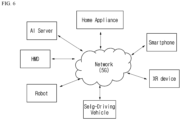
- FIG. 6 illustrates an example of a structure capable of interworking with a method/device for transmitting and receiving point cloud data according to embodiments of the present disclosure.
- FIG. 6 illustrates a configuration in which at least one of a server (AI Server), a robot, a self-driving vehicle, an XR device, a smartphone, a home appliance and/ or a HMD is connected to a cloud network.
- a server AI Server
- the robot, the self-driving vehicle, the XR device, the smartphone, or the home appliance may be referred to as a device.
- the XR device may correspond to a point cloud data device (PCC) according to embodiments or may interwork with the PCC device.
- PCC point cloud data device
- the cloud network may refer to a network that forms part of the cloud computing infrastructure or exists within the cloud computing infrastructure.
- the cloud network may be configured using a 3G network, a 4G or Long Term Evolution (LTE) network, or a 5G network.
- LTE Long Term Evolution
- the server may be connected to at least one of the robot, the self-driving vehicle, the XR device, the smartphone, the home appliance, and/or the HMD through a cloud network, and may help at least a part of processing of the connected devices.
- the HMD may represent one of the types in which an XR device and/or the PCC device according to embodiments may be implemented.
- the HMD type device according to the embodiments may include a communication unit, a control unit, a memory unit, an I/O unit, a sensor unit, and a power supply unit.
- the XR/PCC device may be implemented by a HMD, a HUD provided in a vehicle, a TV, a mobile phone, a smartphone, a computer, a wearable device, a home appliance, a digital signage, a vehicle, a fixed robot or a mobile robot, etc., by applying PCC and/or XR technology.
- the XR/PCC device may obtain information on a surrounding space or a real object by analyzing 3D point cloud data or image data acquired through various sensors or from an external device to generate position (geometric) data and attribute data for 3D points, and render and output an XR object to be output.
- the XR/PCC device may output an XR object including additional information on the recognized object in correspondence with the recognized object.
- the XR/PCC device may be implemented by a mobile phone or the like by applying PCC technology.
- a mobile phone can decode and display point cloud content based on PCC technology.
- the self-driving vehicle may be implemented by a mobile robot, a vehicle, an unmanned aerial vehicle, etc. by applying PCC technology and XR technology.
- the self-driving vehicle to which the XR/PCC technology is applied may mean a self-driving vehicle equipped with a unit for providing an XR image or a self-driving vehicle which is subjected to control/interaction within the XR image.
- the self-driving vehicle which is subjected to control/interaction within the XR image is distinguished from the XR device and may be interwork with each other.
- the self-driving vehicle equipped with a unit for providing an XR/PCC image may acquire sensor information from sensors including a camera, and output an XR/PCC image generated based on the acquired sensor information.
- the self-driving vehicle has a HUD and may provide a passenger with an XR/PCC object corresponding to a real object or an object in a screen by outputting an XR/PCC image.
- the XR/PCC object when the XR/PCC object is output to the HUD, at least a portion of the XR/PCC object may be output so as to overlap an actual object to which a passenger's gaze is directed.
- the XR/PCC object when the XR/PCC object is output to a display provided inside the self-driving vehicle, at least a portion of the XR/PCC object may be output to overlap the object in the screen.
- the self-driving vehicle may output XR/PCC objects corresponding to objects such as a lane, other vehicles, traffic lights, traffic signs, two-wheeled vehicles, pedestrians, and buildings.
- VR technology is display technology that provides objects or backgrounds in the real world only as CG images.
- AR technology refers to technology that shows a virtual CG image on top of an actual object image.
- MR technology is similar to AR technology described above in that a mixture and combination of virtual objects in the real world is shown.
- AR technology the distinction between real objects and virtual objects made of CG images is clear, and virtual objects are used in a form that complements the real objects, whereas, in MR technology, virtual objects are regarded as equivalent to real objects unlike the AR technology.
- applying the MR technology described above is a hologram service.
- VR, AR and MR technologies may be integrated and referred to as XR technology.
- Point cloud data may represent volumetric encoding of a point cloud consisting of a sequence of frames (point cloud frames).
- Each point cloud frame may include the number of points, the positions of the points, and the attributes of the points. The number of points, the positions of the points, and the attributes of the points may vary from frame to frame.
- Each point cloud frame may mean a set of three-dimensional points specified by zero or more attributes and Cartesian coordinates (x, y, z) of three-dimensional points in a particular time instance.
- the Cartesian coordinates (x, y, z) of the three-dimensional points may be a position or a geometry.
- the present disclosure may further perform a space partition process of partitioning the point cloud data into one or more 3D blocks before encoding the point cloud data.
- the 3D block may mean whole or part of a 3D space occupied by the point cloud data.
- the 3D block may be one or more of a tile group, a tile, a slice, a coding unit (CU), a prediction unit (PU), or a transform unit (TU).
- a tile corresponding to a 3D block may mean whole or part of the 3D space occupied by the point cloud data.
- a slice corresponding to a 3D block may mean whole or part of a 3D space occupied by the point cloud data.
- a tile may be partitioned into one or more slices based on the number of points included in one tile.
- a tile may be a group of slices with bounding box information. The bounding box information of each tile may be specified in a tile inventory (or a tile parameter set, a tile parameter set (TPS)).
- a tile may overlap another tile in the bounding box.
- a slice may be a unit of data on which encoding is independently performed, or a unit of data on which decoding is independently performed.
- a slice may be a set of points that may be independently encoded or decoded.
- a slice may be a series of syntax elements representing part or whole of a coded point cloud frame.
- Each slice may include an index for identifying a tile to which the slice belongs.
- the spatially partitioned 3D blocks may be processed independently or non-independently.
- spatially partitioned 3D blocks may be encoded or decoded independently or non-independently, respectively, and may be transmitted or received independently or non-independently, respectively.
- the spatially partitioned 3D blocks may be quantized or dequantized independently or non-independently, and may be transformed or inversely transformed independently or non-independently, respectively.
- spatially partitioned 3D blocks may be rendered independently or non-independently.
- encoding or decoding may be performed in units of slices or units of tiles.
- quantization or dequantization may be performed differently for each tile or slice, and may be performed differently for each transformed or inversely transformed tile or slice.
- the process of processing the 3D blocks is performed in real time and the process is performed with low latency.
- random access and parallel encoding or parallel decoding in a three-dimensional space occupied by point cloud data may be enabled, and errors accumulated in the encoding or decoding process may be prevented.
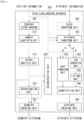
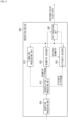
- FIG. 7 is a block diagram illustrating an example of a transmission device 700 for performing a space partition process according to embodiments of the present disclosure.
- the transmission device 700 may include a space partition unit 705 for performing a space partition process, a signaling processing unit 710, a geometry encoder 715, an attribute encoder 720, and an encapsulation processing unit 725 and/or a transmission processing unit 730.
- the space partition unit 705 may perform a space partition process of partitioning the point cloud data into one or more 3D blocks based on a bounding box and/or a sub-bounding box.
- point cloud data may be partitioned into one or more tiles and/or one or more slices.
- the point cloud data may be partitioned into one or more tiles, and each partitioned tile may be further partitioned into one or more slices, through a space partition process.
- the signaling processing unit 710 may generate and/or process (e.g., entropy-encode) signaling information and output it in the form of a bitstream.
- a bitstream (in which signaling information is encoded) output from the signaling processing unit is referred to as a 'signaling bitstream'.
- the signaling information may include information for space partition or information on space partition. That is, the signaling information may include information related to the space partition process performed by the space partition unit 705.
- the point cloud data When the point cloud data is partitioned into one or more 3D blocks, information for decoding some point cloud data corresponding to a specific tile or a specific slice among the point cloud data may be required.
- information related to 3D spatial areas may be required.
- the spatial access may mean extracting, from a file, only necessary partial point cloud data in the entire point cloud data.
- the signaling information may include information for decoding some point cloud data, information related to 3D spatial areas for supporting spatial access, and the like.
- the signaling information may include 3D bounding box information, 3D spatial area information, tile information, and/or tile inventory information.
- the signaling information may be provided from the space partition unit 705, the geometry encoder 715, the attribute encoder 720, the transmission processing unit 725, and/or the encapsulation processing unit 730.
- the signaling processing unit 710 may provide the feedback information fed back from the reception device 800 of FIG. 8 to the space partition unit 705, the geometry encoder 715, the attribute encoder 720, the transmission processing unit 725 and/or the encapsulation processing unit 730.
- the signaling information may be stored and signaled in a sample in a track, a sample entry, a sample group, a track group, or a separate metadata track.
- the signaling information may be signaled in units of sequence parameter sets (SPSs) for signaling of a sequence level, geometry parameter sets (GPSs) for signaling of geometry coding information, and attribute parameter sets (APSs) for signaling of attribute coding information, tile parameter sets (TPSs) (or tile inventory) for signaling of a tile level, etc.
- SPSs sequence parameter sets
- GPSs geometry parameter sets
- APSs attribute parameter sets
- TPSs tile parameter sets
- the signaling information may be signaled in units of coding units such as slices or tiles.
- positions (position information) of the 3D blocks may be output to the geometry encoder 715, and attributes (attribute information) of the 3D blocks may be output to the attribute encoder 720.
- the geometry encoder 715 may construct an octree based on the position information, encode the constructed octree, and output a geometry bitstream. Also, the geometry encoder 715 may reconstruct the octree and/or the approximated octree and output it to the attribute encoder 720. The reconstructed octree may be reconstructed geometry. The geometry encoder 715 may perform all or some of operations performed by the coordinate system transform unit 305, the geometry quantization unit 310, the octree analysis unit 315, the approximation unit 320, the geometry encoding unit 325 and/or the reconstruction unit 330 of FIG. 3 .
- the attribute encoder 720 may output an attribute bitstream by encoding an attribute based on the reconstructed geometry.
- the attribute encoder 720 may perform all or some of operations performed by the attribute transform unit 340, the RAHT transform unit 345, the LOD generation unit 350, the lifting unit 355, the attribute quantization unit 360, the attribute encoding unit 365 and/or the color transform nit 335 of FIG. 3 .
- the encapsulation processing unit 725 may encapsulate one or more input bitstreams into a file or segment. For example, the encapsulation processing unit 725 may encapsulate each of the geometry bitstream, the attribute bitstream, and the signaling bitstream, or multiplex and encapsulate the geometry bitstream, the attribute bitstream, and the signaling bitstream. In some embodiments, the encapsulation processing unit 725 may encapsulate a bitstream (G-PCC bitstream) consisting of a sequence of a type-length-value (TLV) structure into a file. TLV (or TLV encapsulation) structures constituting the G-PCC bitstream may include a geometry bitstream, an attribute bitstream, a signaling bitstream, and the like.
- G-PCC bitstream bitstream
- TLV (or TLV encapsulation) structures constituting the G-PCC bitstream may include a geometry bitstream, an attribute bitstream, a signaling bitstream, and the like.
- the G-PCC bitstream may be generated by the encapsulation processing unit 725 or generated by the transmission processing unit 730.
- the encapsulation processing unit 725 may perform all or some of operations performed by the encapsulation processing unit 13 of FIG. 1 .
- the transmission processing unit 730 may process an encapsulated bitstream or file/segment according to an arbitrary transmission protocol.
- the transmission processing unit 730 may perform all or some of operations performed by the transmission unit 14 and the transmission processing unit described with reference to FIG. 1 .
- FIG. 8 is a block diagram illustrating an example of a reception device 800 according to embodiments of the present disclosure.
- the reception device 800 may perform operations corresponding to the operations of the transmission device 700 for performing space partition.
- the reception device 800 may include a reception processing unit 805, a decapsulation processing unit 810, a signaling processing unit 815, a geometry decoder 820, an attribute encoder 825, and/or a post-processing unit 830.
- the reception processing unit 805 may receive a file/segment in which a G-PCC bitstream is encapsulated, a G-PCC bitstream or a bitstream, and perform processing according to a transport protocol on them.
- the reception processing unit 805 may perform all or some of operations performed by the reception unit 21 and the reception processing unit described with reference to FIG. 1 .
- the decapsulation processing unit 810 may acquire a G-PCC bitstream by performing a reverse process of operations performed by the encapsulation processing unit 725.
- the decapsulation processing unit 810 may acquire a G-PCC bitstream by decapsulating a file/segment.
- the decapsulation processing unit 810 may acquire a signaling bitstream and output it to the signaling processing unit 815, acquire a geometry bitstream and output it to the geometry decoder 820, and acquire an attribute bitstream and output it to the attribute decoder 825.
- the decapsulation processing unit 810 may perform all or some of operations performed by the decapsulation processing unit 22 of FIG. 1 .
- the signaling processing unit 815 may parse and decode signaling information by performing a reverse process of operations performed by the signaling processing unit 710.
- the signaling processing unit 815 may parse and decode signaling information from a signaling bitstream.
- the signaling processing unit 815 may provide the decoded signaling information to the geometry decoder 820, the attribute decoder 820, and/or the post-processing unit 830.
- the geometry decoder 820 may reconstruct geometry from the geometry bitstream by performing a reverse process of operations performed by the geometry encoder 715.
- the geometry decoder 820 may reconstruct geometry based on signaling information (parameters related to the geometry).
- the reconstructed geometry may be provided to the attribute decoder 825.
- the attribute decoder 825 may reconstruct attribute from the attribute bitstream by performing a reverse process of the operations performed by the attribute encoder 720.
- the attribute decoder 825 may reconstruct the attribute based on the signaling information (parameters related to the attribute) and the reconstructed geometry.
- the post-processing unit 830 may reconstruct point cloud data based on the reconstructed geometry and the reconstructed attribute. Reconstruction of point cloud data may be performed through a process of matching the reconstructed geometry with the reconstructed attribute. In some embodiments, when the reconstructed point cloud data is in units of tiles and/or slices, the post-processing unit 830 may reconstruct the bounding box of the point cloud data, by performing a reverse process of the space partition process of the transmission device 700 based on signaling information.
- the post-processing unit 830 may reconstruct part of the bounding box, by combining some slices and/or some tiles based on the signaling information.
- some slices and/or some tiles used to reconstruct the bounding box may be slices and/or some tiles related to a 3D spatial area in which spatial access is desired.
- the G-PCC bitstream composed of TLV encapsulation structures may be transmitted to the reception device without change, or may be encapsulated and transmitted to the reception device.
- the encapsulation processing unit 725 may encapsulate a G-PCC bitstream composed of TLV encapsulation structures in the form of a file/segment and transmit it.
- the decapsulation processing unit 810 may acquire a G-PCC bitstream by decapsulating the encapsulated file/segment.
- the G-PCC bitstream may be encapsulated in an ISOBMFF-based file format.
- the G-PCC bitstream may be stored in a single track or multiple tracks in the ISOBMFF file.
- the single track or multiple tracks in a file may be referred to as "tracks" or "G-PCC tracks”.
- the ISOBMFF-based file may be referred to as a container, a container file, a media file, a G-PCC file, and the like.
- the file may be composed of boxes and/or information that may be referred to as ftyp, moov, mdat, and the like.
- the ftyp box may provide file type or file compatibility related information for the file.
- the reception device may identify the file by referring to the ftyp box.
- the mdat box is also called a media data box and may include actual media data.
- a geometry slice or coded geometry bitstream
- zero or more attribute slices or coded attribute bitstream
- the moov box is also called a movie box, and may include metadata for media data of the file.
- the moov box may include information necessary for decoding and playback of the media data, and may include information on tracks and samples of the file.
- the moov box may act as a container for all metadata.
- the moov box may be a box of the uppermost layer among metadata-related boxes.
- the moov box may include a track (trak) box providing information related to a track of a file
- the trak box may include a media (mdia) box (MediaBox) providing media information of the track, and a track reference container (tref) box for linking (referencing) the track and a sample of a file corresponding to the track.
- the media box MediaBox may include a media information container (minf) box that provides information on the media data and a handler (hdlr) box that indicates a stream type.
- the minf box may include a sample table (stbl) box that provides metadata related to a sample of the mdat box.
- the stbl box may include a sample description (stsd) box that provides information on a used coding type and initialization information required for the coding type.
- a sample description (stsd) box may include a sample entry for a track.
- signaling information or metadata
- SPS SPS
- GPS GPS
- APS APS
- tile inventory may be included in a sample entry of a moov box or a sample of an mdat box in a file.
- the encapsulation processing unit mentioned in the present disclosure may generate a sample group by grouping one or more samples.
- the encapsulation processing unit, the metadata processing unit, or the signaling processing unit mentioned in the present disclosure may signal signaling information associated with a sample group in a sample, a sample group, or a sample entry. That is, the sample group information associated with the sample group may be added to a sample, a sample group, or a sample entry.
- the sample group information may be 3D bounding box sample group information, 3D region sample group information, 3D tile sample group information, 3D tile inventory sample group information, and the like.
- the encapsulation processing unit mentioned in the present disclosure may generate a track group by grouping one or more tracks.
- the encapsulation processing unit, the metadata processing unit, or the signaling processing unit mentioned in the present disclosure may signal signaling information associated with a track group in a sample, a track group, or a sample entry. That is, the track group information associated with the track group may be added to a sample, track group or sample entry.
- the track group information may be 3D bounding box track group information, point cloud composition track group information, spatial region track group information, 3D tile track group information, 3D tile inventory track group information, and the like.
- FIG. 9 is a diagram for explaining an ISOBMFF-based file including a single track.
- (a) of FIG. 9 illustrates an example of the layout of an ISOBMFF-based file including a single track
- (b) of FIG. 9 illustrates an example of a sample structure of a mdat box when a G-PCC bitstream is stored in a single track of a file.
- FIG. 10 is a diagram for explaining an ISOBMFF-based file including multiple tracks.
- (a) of FIG. 10 illustrates an example of the layout of an ISOBMFF-based file including multiple tracks
- (b) of FIG. 10 illustrates an example of a sample structure of a mdat box when a G-PCC bitstream is stored in a single track of a file.
- the stsd box (SampleDescriptionBox) included in the moov box of the file may include a sample entry for a single track storing the G-PCC bitstream.
- the SPS, GPS, APS, tile inventory may be included in a sample entry in a moov box or a sample in an mdat box in a file.
- geometry slices and zero or more attribute slices may be included in the sample of the mdat box in the file.
- each sample may contain multiple G-PCC components. That is, each sample may be composed of one or more TLV encapsulation structures.
- a sample entry of a single track may be defined as follows.
- the sample entry type 'gpe1' or 'gpeg' is mandatory, and one or more sample entries may be present.
- the G-PCC track may use a VolumetricVisualSampleEntry having a sample entry type of 'gpe1' or 'gpeg'.
- the sample entry of the G-PCC track may include a G-PCC decoder configuration box GPCCConfigurationBox, and the G-PCC decoder configuration box may include a G-PCC decoder configuration record (GPCCDecoderConfigurationRecord()).
- GPCCDecoderConfigurationRecord() may include at least one of configuration Version, profile_idc, profile_compatibility_flags, level_idc, numOfSetupUnitArrays, SetupUnitType, completeness, numOfSepupUnit, or setupUnit.
- the setupUnit array field included in GPCCDecoderConfigurationRecord() may include TLV encapsulation structures including one SPS.
- all parameter sets e.g., SPS, GPS, APS, tile inventory, may be included in the array of setupUints. If the sample entry type is 'gpeg', the above parameter sets may be included in the array (i.e., sample entry) of setupUints or included in the stream (i.e., sample).
- a G-PCC sample entry (GPCCSampleEntry) having a sample entry type of 'gpe1' may include GPCCConfigurationBox, 3DBoundingBoxInfoBox(), CubicRegionInfoBox(), and TileInventoryBox().
- 3DBoundingBoxInfoBox() may indicate 3D bounding box information of point cloud data related to samples carried by the track.
- CubicRegionInfoBox() may indicate information on one or more spatial regions of point cloud data carried by samples in the track.
- TileInventoryBox() may indicate 3D tile inventory information of point cloud data carried by samples in the track.
- the sample may include TLV encapsulation structures including a geometry slice.
- a sample may include TLV encapsulation structures including one or more parameter sets.
- a sample may include TLV encapsulation structures including one or more attribute slices.
- each geometry slice or attribute slice may be mapped to an individual track.
- a geometry slice may be mapped to track 1
- an attribute slice may be mapped to track 2.
- the track (track 1) carrying the geometry slice may be referred to as a geometry track or a G-PCC geometry track
- the track (track 2) carrying the attribute slice may be referred to as an attribute track or a G-PCC attribute track.
- the geometry track may be defined as a volumetric visual track carrying a geometry slice
- the attribute track may be defined as a volumetric visual track carrying an attribute slice.
- a track carrying part of a G-PCC bitstream including both a geometry slice and an attribute slice may be referred to as a multiplexed track.
- each sample in the track may include at least one TLV encapsulation structure carrying data of a single G-PCC component.
- each sample contains neither geometry nor attributes, and may not contain multiple attributes.
- Multi-track encapsulation of a G-PCC bitstream may enable a G-PCC player to effectively access one of the G-PCC components.
- a G-PCC bitstream is carried by multiple tracks, in order for a G-PCC player to effectively access one of the G-PCC components, the following conditions need to be satisfied.
- GPCCComponentTypeBox may include GPCCComponentTypeStruct(). If a GPCCComponentTypeBox is present in the sample entry of tracks carrying part or whole of the G-PCC bitstream, then GPCCComponentTypeStruct() may specify the type (e.g., geometry, attribute) of one or more G-PCC components carried by each track. For example, if the value of the gpcc_type field included in GPCCComponentTypeStruct() is 2, it may indicate a geometry component, and if it is 4, it may indicate an attribute component. In addition, when the value of the gpcc_type field indicates 4, that is, an attribute component, an AttrIdx field indicating an attribute identifier signaled to SPS( ) may be further included.
- GPCCComponentTypeBox may include GPCCComponentTypeStruct(). If a GPCCComponentTypeBox is present in the sample entry of tracks carrying part or whole of the G-PCC bitstream, then
- the syntax of the sample entry may be defined as follows.
- the sample entry type 'gpc1', 'gpcg', 'gpc1' or 'gpcg' is mandatory, and one or more sample entries may be present.
- Multiple tracks e.g., geometry or attribute tracks
- Multiple tracks may use a VolumetricVisualSampleEntry having a sample entry type of 'gpc1', 'gpcg', 'gpc1' or 'gpcg'.
- all parameter sets may be present in the setupUnit array.
- the parameter set is present in the array or stream.
- the GPCCComponentTypeBox shall not be present.
- the SPS, GPS and tile inventory may be present in the SetupUnit array of the track carrying the G-PCC geometry bitstream. All relevant APSs may be present in the SetupUnit array of the track carrying the G-PCC attribute bitstream.
- an SPS, GPS, APS or tile inventory may be present in the array or stream.
- the GPCCComponentTypeBox shall be present.
- a track reference tool may be used.
- One TrackReferenceTypeBoxes may be added to a TrackReferenceBox in the TrackBox of a G-PCC track.
- the TrackReferenceTypeBox may contain an array of track_IDs specifying the tracks referenced by the G-PCC track.
- Temporal scalability may refer to a function that allows the possibility of extracting one or more subsets of independently coded frames.
- temporal scalability may refer to a function of dividing G-PCC data into a plurality of different temporal levels and independently processing each G-PCC frame belonging to different temporal levels. If temporal scalability is supported, the G-PCC player (or the transmission device and/or the reception device of the present disclosure) may effectively access a desired component (target component) among G-PCC components.
- target component target component among G-PCC components.
- temporal scalability support at the system level may be expressed as more flexible temporal sub-layering.
- the system the point cloud content provision system
- the system that processes G-PCC data can manipulate data at a high level to match network capability or decoder capability, the performance of the point cloud content provision system can be improved.
- Temporal level sample grouping may provide codec-independent sample grouping and be used to group samples in a track according to a temporal level.
- the track, in which the samples are carried may be a "temporal level track” or “temporal level tile track”. Samples belonging to one temporal level have no codec dependency in relation with samples belonging to another temporal level.
- a tele which is also referred to as a temporal level sample group, may be used to indicate a temporal level identifier value.
- a tele sample group is information used for connecting a sample in a track to a temporal level identifier value, and temporal scalability for a G-PCC file may be supported by the tele sample group. If G-PCC data are carried using multiple temporal tracks, the tele sample group may be present only in tracks carrying geometry data.
- a tele sample group may include a sample group description box and a sample group description index.
- the sample group description box may include at least one entry (sample group description entry).
- the sample group description index may be included in a sample to group box, and the sample to group box may be included in a same track as a track including the sample group description entry.
- a proposed method is that a sample description box should signal sample description for every temporal level signaled in a GPCC scalability information box GPCCScalabilityInfoBox.
- the proposal is that, irrespective of an actual number of temporal levels in a tile track, as many 'tele' sample group description entries as temporal levels described in a GPCC scalability information box present in a tile base track should be included in a sample group description box.
- this proposal also has the redundancy described in 2.
- the present disclosure proposes methods for solving the problem that a 'tele' sample group description entry for an unreferenced sample group description index is included in a sample group description box and the redundancy problem of tele sample group description entry.
- Embodiment 1 proposes a method for defining a count of entries to solve the problem of the existing method.
- FIG. 11 is a flowchart for describing a transmission method according to Embodiment 1 of the present disclosure
- FIG. 12 is a flowchart for describing a reception method according to Embodiment 1 of the present disclosure.
- a transmission device 10 may generate a sample group description box (S1110).
- the sample group description box may have a predetermined group type.
- the predetermined group type may be tele.
- the transmission device 100 may generate a G-PCC file (S1120).
- the G-PCC file may include the sample group description box and point cloud data.
- the sample group description box may include at least one entry.
- a count of entries (entry count) included in the sample group description box may be equal to a value obtained by adding 1 to a highest temporal level identifier value included in the track or may be equal to or greater than the value obtained by adding 1 to the highest temporal level identifier value.
- a reception device 20 may obtain a G-PCC file (S1210).
- the G-PCC file may include a sample group description box and point cloud data.
- the reception device 20 may obtain the sample group description box from the G-PCC file (S1220).
- the sample group description box may have a predetermined group type.
- the predetermined group type may be tele.
- the sample group description box may include at least one entry.
- a count of entries (entry count) included in the sample group description box may be equal to a value obtained by adding 1 to a highest temporal level identifier value included in the track or may be equal to or greater than the value obtained by adding 1 to the highest temporal level identifier value.
- Embodiment 2 proposes a method for deriving a highest temporal level identifier value.
- FIG. 13 is a flowchart for describing a transmission method according to Embodiment 2
- FIG. 14 is a flowchart for describing a reception method according to Embodiment 2.
- the transmission device 10 may determine whether a track, that is, a track including a sample group description box is a temporal level track (S1310).
- the transmission device 10 may set a highest temporal level identifier value as a highest value among temporal level identifiers present in a scalability information box (S1320). That is, the highest temporal level identifier value may be set to be equal to the highest value among the temporal level identifiers present in the scalability information box, when the track is a temporal level track.
- the temporal level identifiers present in the scalability information box may be present in a list form.
- the scalability information box may be a GPCC scalability information box GPCCTileScalabilityInfoBox.
- the transmission device 10 may terminate a process of setting a highest temporal level identifier value.
- the transmission device 10 may perform processes of setting a highest temporal level identifier value, based on whether the track is a temporal tile track (refer to FIG. 15 ).
- the reception device 20 may determine whether a track, that is, a track including a sample group description box is a temporal level track (S1410).
- the reception device 20 may determine a highest temporal level identifier value as a highest value among temporal level identifiers present in a scalability information box (S1420). That is, the highest temporal level identifier value may be determined as a value equal to the highest value among the temporal level identifiers present in the scalability information box, when the track is a temporal level track.
- the temporal level identifiers present in the scalability information box may be present in a list form.
- the reception device 20 may terminate a process of determining a highest temporal level identifier value.
- the reception device 20 may perform processes of determining a highest temporal level identifier value, based on whether the track is a temporal tile track (refer to FIG. 16 ).
- a highest temporal level identifier value may be set and determined based on whether a track is a temporal level tile track.
- FIG. 15 is a flowchart for describing an example of setting a highest temporal level identifier value based on whether a track is a temporal level tile track
- FIG. 16 is a flowchart for describing an example of determining a highest temporal level identifier value based on whether a track is a temporal level tile track.
- the transmission device 10 may determine whether a track, that is, a track including a sample group description box is a temporal level tile track (S1510).
- the transmission device 10 may derive a highest temporal level identifier value based on whether a tile scalability information box is present in the temporal level tile track (S1520).
- the tile scalability information box may be a GPCC tile scalability information box GPCCTileScalabilityInfoBox.
- the transmission device 10 may set a highest temporal level identifier value as a highest value among temporal level identifiers present in the tile scalability information box (S1530). That is, the highest temporal level identifier value may be set to a value equal to the highest value among the temporal level identifiers present in the tile scalability information box.
- the temporal level identifiers present in the tile scalability information box may be present in a list form.
- the transmission device 10 may set the highest temporal level identifier value as a highest value among temporal level identifiers present in a GPCC scalability information box in a tile base track (S1540). That is, the highest temporal level identifier value may be set to a value equal to the highest value among the temporal level identifiers present in the GPCC scalability information box in the tile base track.
- the temporal level identifiers present in the GPCC scalability information box in the tile base track may be present in a list form.
- the reception device 20 may determine a track, that is, a track including a sample group description box is a temporal level tile track (S1610).
- the reception device 20 may derive a highest temporal level identifier value based on whether a tile scalability information box is present in the temporal level tile track (S1620).
- the tile scalability information box may be a GPCC tile scalability information box GPCCTileScalabilityInfoBox.
- the reception device 20 may determine a highest temporal level identifier value as a highest value among temporal level identifiers present in the tile scalability information box (S1630). That is, the highest temporal level identifier value may be determined as a value equal to the highest value among the temporal level identifiers present in the tile scalability information box.
- the temporal level identifiers present in the tile scalability information box may be present in a list form.
- the reception device 20 may determine the highest temporal level identifier value as a highest value among temporal level identifiers present in a GPCC scalability information box in a tile base track (S1640). That is, the highest temporal level identifier value may be determined as a value equal to the highest value among the temporal level identifiers present in the GPCC scalability information box in the tile base track.
- the temporal level identifiers present in the GPCC scalability information box in the tile base track may be present in a list form.
- Embodiment 3 proposes a method for identifying sample group description entries in a sample group description box based on a value of a sample group description index.
- FIG. 17 is a flowchart for describing a transmission method according to Embodiment 3
- FIG. 18 is a flowchart for describing a reception method according to Embodiment 3.
- the transmission device 10 may determine whether a sample to group box is present in a temporal level tile track (S1710).
- a tele sample group description box may be present in a tile base track but may not be present in the temporal level tile track. In this case, the tele sample group description box may be present in a tile base track referencing the temporal level tile track.
- the transmission device 10 may set a value of a sample group description index (e.g., group_description_index) to indicate tele sample group description entries in the tele sample group description box (S1720).
- a sample group description index e.g., group_description_index
- the reception device 20 may determine whether a sample to group box is present in a temporal level tile track (S1810).
- a tele sample group description box may be present in a tile base track but may not be present in the temporal level tile track. In this case, the tele sample group description box may be present in a tile base track referencing the temporal level tile track.
- a value of a sample group description index may indicate tele sample group description entries in the tele sample group description box. Accordingly, based on the value of the sample group description index, the reception device 20 may identify the tele sample group description entries in the tele sample group description box.
- the scope of the disclosure includes software or machine-executable commands (e.g., an operating system, an application, firmware, a program, etc.) for enabling operations according to the methods of various embodiments to be executed on an apparatus or a computer, a non-transitory computer-readable medium having such software or commands stored thereon and executable on the apparatus or the computer.
- software or machine-executable commands e.g., an operating system, an application, firmware, a program, etc.
- the embodiments of the present disclosure may be used to provide point cloud content.
- the embodiments of the present disclosure may be used to encode/decode point cloud data.
Landscapes
- Engineering & Computer Science (AREA)
- Multimedia (AREA)
- Signal Processing (AREA)
- Computer Security & Cryptography (AREA)
- Compression Or Coding Systems Of Tv Signals (AREA)
Applications Claiming Priority (2)
| Application Number | Priority Date | Filing Date | Title |
|---|---|---|---|
| US202263334061P | 2022-04-22 | 2022-04-22 | |
| PCT/KR2023/005480 WO2023204676A1 (fr) | 2022-04-22 | 2023-04-21 | Dispositif d'émission pour données de nuage de points, procédé mis en œuvre par le dispositif d'émission, dispositif de réception pour données de nuage de points, et procédé mis en œuvre par le dispositif de réception |
Publications (2)
| Publication Number | Publication Date |
|---|---|
| EP4513876A1 true EP4513876A1 (fr) | 2025-02-26 |
| EP4513876A4 EP4513876A4 (fr) | 2026-03-11 |
Family
ID=88420300
Family Applications (1)
| Application Number | Title | Priority Date | Filing Date |
|---|---|---|---|
| EP23792247.1A Pending EP4513876A4 (fr) | 2022-04-22 | 2023-04-21 | Dispositif d'émission pour données de nuage de points, procédé mis en oeuvre par le dispositif d'émission, dispositif de réception pour données de nuage de points, et procédé mis en oeuvre par le dispositif de réception |
Country Status (5)
| Country | Link |
|---|---|
| US (1) | US20250294151A1 (fr) |
| EP (1) | EP4513876A4 (fr) |
| KR (1) | KR20250002571A (fr) |
| CN (1) | CN119366192A (fr) |
| WO (1) | WO2023204676A1 (fr) |
Families Citing this family (1)
| Publication number | Priority date | Publication date | Assignee | Title |
|---|---|---|---|---|
| WO2024020050A1 (fr) * | 2022-07-18 | 2024-01-25 | Bytedance Inc. | Drap et edrap dans le format isobmff |
Family Cites Families (7)
| Publication number | Priority date | Publication date | Assignee | Title |
|---|---|---|---|---|
| KR20210108951A (ko) * | 2018-12-28 | 2021-09-03 | 소니그룹주식회사 | 정보 처리 장치 및 정보 처리 방법 |
| EP3712854B1 (fr) * | 2019-03-19 | 2024-07-24 | Nokia Technologies Oy | Procédé et appareil de stockage et de signalisation de données en nuage de points statiques |
| WO2021002633A2 (fr) * | 2019-07-04 | 2021-01-07 | 엘지전자 주식회사 | Dispositif de transmission de données de nuage de points, procédé de transmission de données de nuage de points, dispositif de réception de données de nuage de points et procédé de réception de données de nuage de points |
| WO2021064293A1 (fr) * | 2019-10-02 | 2021-04-08 | Nokia Technologies Oy | Procédé et appareil de stockage et de signalisation de descriptions d'entrée de sous-échantillons |
| EP4131961A4 (fr) * | 2020-04-13 | 2023-09-13 | LG Electronics, Inc. | Dispositif d'émission de données de nuage de points, procédé d'émission de données de nuage de points, dispositif de réception de données de nuage de points, et procédé de réception de données de nuage de points |
| KR102355634B1 (ko) * | 2020-04-14 | 2022-02-08 | 엘지전자 주식회사 | 포인트 클라우드 데이터 송신 장치, 포인트 클라우드 데이터 송신 방법, 포인트 클라우드 데이터 수신 장치 및 포인트 클라우드 데이터 수신 방법 |
| EP4193602A1 (fr) * | 2020-08-07 | 2023-06-14 | Vid Scale, Inc. | Pistes de mosaïque pour des données de nuage de points basées sur la géométrie |
-
2023
- 2023-04-21 US US18/858,875 patent/US20250294151A1/en active Pending
- 2023-04-21 CN CN202380046766.0A patent/CN119366192A/zh active Pending
- 2023-04-21 WO PCT/KR2023/005480 patent/WO2023204676A1/fr not_active Ceased
- 2023-04-21 KR KR1020247038408A patent/KR20250002571A/ko active Pending
- 2023-04-21 EP EP23792247.1A patent/EP4513876A4/fr active Pending
Also Published As
| Publication number | Publication date |
|---|---|
| EP4513876A4 (fr) | 2026-03-11 |
| WO2023204676A1 (fr) | 2023-10-26 |
| US20250294151A1 (en) | 2025-09-18 |
| CN119366192A (zh) | 2025-01-24 |
| KR20250002571A (ko) | 2025-01-07 |
Similar Documents
| Publication | Publication Date | Title |
|---|---|---|
| US12120328B2 (en) | Transmission device of point cloud data and method performed by transmission device, and reception device of point cloud data and method performed by reception device | |
| KR102796754B1 (ko) | 포인트 클라우드 데이터의 전송 장치와 이 전송 장치에서 수행되는 방법 및, 포인트 클라우드 데이터의 수신 장치와 이 수신 장치에서 수행되는 방법 | |
| EP4436177A1 (fr) | Dispositif de transmission pour données de nuage de points, procédé mis en ?uvre par un dispositif de transmission, dispositif de réception pour des données de nuage de points, et procédé mis en ?uvre par le dispositif de réception | |
| EP4451692A1 (fr) | Dispositif de transmission pour des données de nuage de points, procédé mis en ?uvre par ledit dispositif de transmission, dispositif de réception pour des données de nuage de points, et procédé mis en ?uvre par ledit dispositif de réception | |
| EP4513876A1 (fr) | Dispositif d'émission pour données de nuage de points, procédé mis en oeuvre par le dispositif d'émission, dispositif de réception pour données de nuage de points, et procédé mis en oeuvre par le dispositif de réception | |
| EP4557739A1 (fr) | Dispositif de transmission pour des données de nuage de points, procédé mis en ?uvre par le dispositif de transmission, dispositif de réception pour des données de nuage de points et procédé mis en ?uvre par le dispositif de réception | |
| US20250159262A1 (en) | Transmission device for point cloud data, method performed by transmission device, reception device for point cloud data and method performed by reception device | |
| EP4451691A1 (fr) | Dispositif de transmission pour données de nuage de points et procédé mis en oeuvre par un dispositif de transmission, et dispositif de réception pour données de nuage de points et procédé mis en oeuvre par un dispositif de réception | |
| US20250259333A1 (en) | Transmission device for point cloud data, method performed by transmission device, reception device for point cloud data, and method performed by reception device | |
| US12574534B2 (en) | Transmission device for point cloud data and method performed by transmission device, and reception device for point cloud data and method performed by reception device | |
| US20250252607A1 (en) | Transmission device for point cloud data and method performed by same transmission device, and reception device for point cloud data and method performed by same reception device | |
| US12548203B2 (en) | Transmission device of point cloud data and method performed in same transmission device, and reception device of point cloud data and method performed in same reception device | |
| US20250227271A1 (en) | Point cloud data transmission device and method performed by transmission device, and point cloud data reception device and method performed by reception device | |
| CN118511531A (zh) | 点云数据发送装置和由发送装置执行的方法及点云数据接收装置和由接收装置执行的方法 | |
| CN118251892A (zh) | 点云数据的发送装置、由发送装置执行的方法、点云数据的接收装置和由接收装置执行的方法 | |
| CN118318448A (zh) | 点云数据的发送装置和由发送装置执行的方法及点云数据的接收装置和由接收装置执行的方法 |
Legal Events
| Date | Code | Title | Description |
|---|---|---|---|
| STAA | Information on the status of an ep patent application or granted ep patent |
Free format text: STATUS: THE INTERNATIONAL PUBLICATION HAS BEEN MADE |
|
| PUAI | Public reference made under article 153(3) epc to a published international application that has entered the european phase |
Free format text: ORIGINAL CODE: 0009012 |
|
| STAA | Information on the status of an ep patent application or granted ep patent |
Free format text: STATUS: REQUEST FOR EXAMINATION WAS MADE |
|
| 17P | Request for examination filed |
Effective date: 20241022 |
|
| AK | Designated contracting states |
Kind code of ref document: A1 Designated state(s): AL AT BE BG CH CY CZ DE DK EE ES FI FR GB GR HR HU IE IS IT LI LT LU LV MC ME MK MT NL NO PL PT RO RS SE SI SK SM TR |
|
| DAV | Request for validation of the european patent (deleted) | ||
| DAX | Request for extension of the european patent (deleted) | ||
| A4 | Supplementary search report drawn up and despatched |
Effective date: 20260209 |
|
| RIC1 | Information provided on ipc code assigned before grant |
Ipc: H04N 21/236 20110101AFI20260203BHEP Ipc: H04N 21/434 20110101ALI20260203BHEP Ipc: H04N 21/81 20110101ALI20260203BHEP Ipc: H04N 19/597 20140101ALI20260203BHEP Ipc: H04N 19/124 20140101ALI20260203BHEP Ipc: H04N 19/70 20140101ALI20260203BHEP |