EP4516121A1 - Aerosolerzeugender artikel mit einem substrat mit tabakfreien pflanzenpartikeln - Google Patents
Aerosolerzeugender artikel mit einem substrat mit tabakfreien pflanzenpartikeln Download PDFInfo
- Publication number
- EP4516121A1 EP4516121A1 EP23386082.4A EP23386082A EP4516121A1 EP 4516121 A1 EP4516121 A1 EP 4516121A1 EP 23386082 A EP23386082 A EP 23386082A EP 4516121 A1 EP4516121 A1 EP 4516121A1
- Authority
- EP
- European Patent Office
- Prior art keywords
- aerosol
- millimetres
- generating
- rod
- generating article
- Prior art date
- Legal status (The legal status is an assumption and is not a legal conclusion. Google has not performed a legal analysis and makes no representation as to the accuracy of the status listed.)
- Withdrawn
Links
Images

Classifications
-
- A—HUMAN NECESSITIES
- A24—TOBACCO; CIGARS; CIGARETTES; SIMULATED SMOKING DEVICES; SMOKERS' REQUISITES
- A24B—MANUFACTURE OR PREPARATION OF TOBACCO FOR SMOKING OR CHEWING; TOBACCO; SNUFF
- A24B15/00—Chemical features or treatment of tobacco; Tobacco substitutes, e.g. in liquid form
- A24B15/18—Treatment of tobacco products or tobacco substitutes
- A24B15/28—Treatment of tobacco products or tobacco substitutes by chemical substances
- A24B15/30—Treatment of tobacco products or tobacco substitutes by chemical substances by organic substances
- A24B15/302—Treatment of tobacco products or tobacco substitutes by chemical substances by organic substances by natural substances obtained from animals or plants
-
- A—HUMAN NECESSITIES
- A24—TOBACCO; CIGARS; CIGARETTES; SIMULATED SMOKING DEVICES; SMOKERS' REQUISITES
- A24B—MANUFACTURE OR PREPARATION OF TOBACCO FOR SMOKING OR CHEWING; TOBACCO; SNUFF
- A24B13/00—Tobacco for pipes, for cigars, e.g. cigar inserts, or for cigarettes; Chewing tobacco; Snuff
- A24B13/02—Flakes or shreds of tobacco
-
- A—HUMAN NECESSITIES
- A24—TOBACCO; CIGARS; CIGARETTES; SIMULATED SMOKING DEVICES; SMOKERS' REQUISITES
- A24B—MANUFACTURE OR PREPARATION OF TOBACCO FOR SMOKING OR CHEWING; TOBACCO; SNUFF
- A24B15/00—Chemical features or treatment of tobacco; Tobacco substitutes, e.g. in liquid form
- A24B15/10—Chemical features of tobacco products or tobacco substitutes
- A24B15/16—Chemical features of tobacco products or tobacco substitutes of tobacco substitutes
-
- A—HUMAN NECESSITIES
- A24—TOBACCO; CIGARS; CIGARETTES; SIMULATED SMOKING DEVICES; SMOKERS' REQUISITES
- A24D—CIGARS; CIGARETTES; TOBACCO SMOKE FILTERS; MOUTHPIECES OF CIGARS OR CIGARETTES; MANUFACTURE OF TOBACCO SMOKE FILTERS OR MOUTHPIECES
- A24D1/00—Cigars; Cigarettes
- A24D1/20—Cigarettes specially adapted for simulated smoking devices
Definitions
- the present invention relates to an aerosol-generating article comprising an aerosol-generating substrate comprising non-tobacco plant particles and to an aerosol-generating system comprising a heating element for heating such aerosol-generating articles.
- the aerosol-generating substrate produces an inhalable aerosol upon heating.
- a number of prior art documents disclose aerosol-generating devices for consuming aerosol-generating articles.
- Such devices include, for example, electrically heated aerosol-generating devices in which an aerosol is generated by the transfer of heat from one or more electrical heater elements of the aerosol-generating device to the aerosol-generating substrate of a heated aerosol-generating article.
- electrically heated aerosol-generating devices have been proposed that comprise an internal heater blade which is adapted to be inserted into the aerosol-generating substrate.
- Use of an aerosol-generating article in combination with an external heating system is also known.
- WO 2020/115151 describes the provision of one or more heating elements arranged around the periphery of the aerosol-generating article when the aerosol-generating article is received in a cavity of the aerosol-generating device.
- inductively heatable aerosol-generating articles comprising an aerosol-generating substrate and a susceptor arranged within the aerosol-generating substrate have been proposed by WO 2015/176898 .
- aerosol-generating substrates For example, with some aerosol-generating substrates, it can be difficult to deliver sufficient aerosol to a user. This may be particularly true with aerosol-generating substrates that contain a relatively high proportion of non-tobacco components.
- Some aerosol-generating articles comprise a flavourant that is delivered to the consumer during use of the article to provide a different sensory experience to the consumer, for example to enhance the flavour of aerosol.
- a flavourant can be used to deliver a gustatory sensation (taste), an olfactory sensation (smell), or both a gustatory and an olfactory sensation to the user inhaling the aerosol. It is known to provide heated aerosol-generating articles that include flavourants.
- the one or more flavourants are typically mixed with the tobacco in the tobacco rod in order to provide additional flavour to the aerosol generated upon heating the tobacco.
- Such flavourants are often in the form of liquid flavourants, such as essential oils.
- liquid flavourants can have low stability due to the volatilisation of flavour compounds prior to use of the article.
- Another potential issue encountered with liquid flavourants is that it can be difficult to provide a sufficient level of flavour within the aerosol, particularly in view of the low temperatures used in heating.
- an aerosol-generating article with a substrate providing improved flavour and organoleptic properties, in particular to provide improved non-tobacco flavour to the consumer, comparable to the flavour provided in a combustible cigarette.
- the present disclosure relates to an aerosol-generating article.
- the aerosol-generating article may comprise a rod of aerosol-generating substrate.
- the aerosol-generating article may comprise a downstream section provided downstream of the rod of the aerosol-generating substrate.
- the downstream section may comprise at least one hollow tubular element abutting a downstream end of the rod of aerosol-generating substrate.
- the rod of aerosol-generating substrate may comprise shredded tobacco material.
- the rod of aerosol-generating substrate may comprise non-tobacco plant particles dispersed within the shredded tobacco material.
- the non-tobacco plant particles may have a cut width of between 0.1 millimetres to 0.5 millimetres.
- the aerosol-generating system may comprise an aerosol-generating article as described above.
- the aerosol-generating system may comprise an aerosol-generating device configured to heat the aerosol-generating substrate of the aerosol-generating article.
- the aerosol-generating device may comprise a housing defining a cavity configured to receive the aerosol-generating article.
- an aerosol-generating article comprising a rod of aerosol-generating substrate.
- the aerosol-generating article comprises a downstream section provided downstream of the rod of the aerosol-generating substrate.
- the downstream section comprises at least one hollow tubular element abutting a downstream end of the rod of aerosol-generating substrate.
- the rod of aerosol-generating substrate comprises shredded tobacco material.
- the rod of aerosol-generating substrate comprises non-tobacco plant particles dispersed within the shredded tobacco material.
- the non-tobacco plant particles have a cut width of between 0.1 millimetres to 0.5 millimetres.
- an aerosol-generating system comprising an aerosol-generating article as described above.
- the aerosol-generating system comprises an aerosol-generating device configured to heat the aerosol-generating substrate of the aerosol-generating article.
- the aerosol-generating device comprises a housing defining a cavity configured to receive the aerosol-generating article.
- the inventors of the present invention have found that through the incorporation of non-tobacco plant particles into the aerosol-generating substrate, it is advantageously possible to produce an aerosol which provides a novel sensory experience.
- Such an aerosol provides unique flavours and may provide improved organoleptic properties.
- clove particles may be incorporated at a sufficient level to provide the desired clove flavour whilst maintaining sufficient tobacco material to provide the desired level of nicotine to the consumer.
- non-tobacco plant particles has been advantageously found to be a more stable way to incorporate flavour into the substrate and the resultant aerosol.
- the improved stability of the non-tobacco plant particles compared to other flavourants such as liquid flavourants enables the delivery of flavour into the aerosol during use to be optimised.
- aerosol-generating articles according to the present invention may be manufactured with the same external dimensions as known aerosol-generating articles. Therefore users of aerosol-generating articles according to the invention can use them with existing aerosol-generating devices.
- a further advantage of aerosol-generating articles according to the invention is that since the dimensions of the articles are substantially unchanged, they can be packaged in existing packaging solutions. Aerosol-generating articles according to the present invention can be manufactured efficiently and at high speed using existing manufacturing techniques and machinery.
- a further advantage of aerosol-generating articles according to the present invention is that the inclusion of non-tobacco plant particles having a cut width of between 0.1 millimetres to 0.5 millimetres is beneficial for manufacturing purposes and for the homogeneity of the aerosol-generating substrate. At cut widths above 0.5 millimetres, manufacturing becomes more challenging and the homogeneity of the non-tobacco plant particles within the rod of aerosol-generating substrate decreases.
- aerosol-generating substrate refers to a substrate capable of releasing volatile compounds that can form an aerosol. Such volatile compounds may be released by heating the aerosol-generating substrate.
- An aerosol-generating substrate is typically part of an aerosol-generating article.
- an aerosol-generating article refers to an article comprising an aerosol-generating substrate that is capable of releasing volatile compounds that can form an aerosol.
- an aerosol-generating article may be an article that generates an aerosol that is directly inhalable by the user drawing or puffing on a mouthpiece at a mouth end or downstream end of the aerosol-generating article, an aerosol-generating device, or an aerosol-generating system.
- An aerosol-generating article may be disposable.
- aerosol-generating device refers to a device that interacts with an aerosol-generating substrate to generate an aerosol.
- the aerosol-generating device is a device that interacts with an aerosol-generating substrate to generate an inhalable aerosol that is directly inhalable into a user's lungs thorough the user's mouth.
- aerosol-generating system typically refers to the combination of an aerosol-generating device with an aerosol-generating substrate, preferably where the aerosol-generating substrate is comprised in an aerosol-generating article.
- aerosol-generating substrate and the aerosol-generating device cooperate to generate an aerosol.
- aerosol is used to describe a dispersion of solid particles, or liquid droplets, or a combination of solid particles and liquid droplets, in a gas.
- the aerosol may be visible or invisible.
- the aerosol may include vapours of substances that are ordinarily liquid or solid at room temperature as well as solid particles, or liquid droplets, or a combination of solid particles and liquid droplets.
- length refers to the maximum dimension of a feature in a longitudinal direction of the feature.
- the term “length” denotes the dimension of a component of the aerosol-generating system in the longitudinal direction, from the component's furthest upstream point to the component's furthest downstream point. For example, it may be used to denote the dimension of aerosol-generating substrate or of any elongate tubular elements in the longitudinal direction.
- the term “plug” denotes a generally cylindrical element having a substantially polygonal, circular, oval or elliptical cross-section.
- the term “rod” refers to a generally cylindrical element of substantially polygonal cross-section and preferably of circular, oval or elliptical cross-section.
- a rod may have a length greater than or equal to the length of a plug.
- a rod has a length that is greater than the length of a plug.
- a rod may comprise one or more plugs, preferably aligned longitudinally.
- upstream and downstream describe the relative positions of elements, or portions of elements, of the aerosol-generating system in relation to the direction in which the aerosol is transported through the aerosol-generating article during use. During use, air is drawn through the aerosol-generating article in the longitudinal direction.
- the term “hollow tubular element” denotes a generally elongate element defining a lumen or airflow passage along a longitudinal axis thereof.
- tubular will be used in the following with reference to a tubular element having a substantially cylindrical cross-section and defining at least one airflow conduit establishing an uninterrupted fluid communication between an upstream end of the tubular element and a downstream end of the tubular element.
- the hollow tubular element may be an individual, discrete element of the aerosol-generating article which has a defined length and thickness.
- the non-tobacco plant particles are selected from one or more of: clove, star anise, rosemary, peppermint, sage, chamomile, and lavender.
- the non-tobacco plant particles are selected from clove, star anise and rosemary. More preferably, the non-tobacco plant particles are clove particles.
- cloves are effectively dried flower buds and stems of Syzygium aromaticum , a tree in the family Myrtaceae , and are commonly used as a spice. Accordingly, each clove comprises a calyx of sepals and a corolla of unopened petals, which form a ball-like portion attached to the calyx.
- the term "clove particles” encompasses particles derived from Syzygium aromaticum buds and stems and may include whole cloves, ground or crushed cloves, or cloves that have been otherwise physically processed to reduce the particle size.
- clove particles in the rod of aerosol-generating substrate is desirable in certain markets as it provides a unique organoleptic user-experience, which is popular with some users.
- the content of non-tobacco plant particles in the rod of aerosol-generating substrate is preferably less than or equal to 40 percent by weight on a dry weight basis. More preferably, the content of non-tobacco plant particles in the rod of aerosol-generating substrate is preferably less than or equal to 30 percent by weight on a dry weight basis. More preferably, the content of non-tobacco plant particles in the rod of aerosol-generating substrate is preferably less than or equal to 25 percent by weight on a dry weight basis.
- the content of non-tobacco plant particles in the rod of aerosol-generating substrate is at least 5percent by weight on a dry weight basis. More preferably, the content of non-tobacco plant particles in the rod of aerosol-generating substrate is at least 10 percent by weight on a dry weight basis. More preferably, the content of non-tobacco plant particles in the rod of aerosol-generating substrate is at least 15 percent by weight on a dry weight basis. More preferably, the content of non-tobacco plant particles in the rod of aerosol-generating substrate is at least 20 percent by weight on a dry weight basis.
- the content of non-tobacco plant materials in the rod of the aerosol-generating substrate is preferably between 5 percent and 40 percent by weight, or between 10 percent and 30 percent by weight, or between 15 percent and 25 percent by weight, or between 20 percent and 25 percent by weight, on a dry weight basis.
- the inventors have found that providing a rod of aerosol-generating substrate having a content of non-tobacco particles falling within the above ranges can help with the generation of an aerosol with a good balance of flavour to the user.
- the aerosol generated from such a rod of aerosol-generating substrate advantageously has good flavour from the non-tobacco particles whilst still providing acceptable delivery of nicotine and tobacco flavour.
- the non-tobacco plant particles in the rod of aerosol-generating substrate may be derived from non-tobacco plant portions prior to being cut to the desired cut width.
- the non-tobacco plant portions may be leaves, flower buds, seeds or any other suitable plant material.
- the non-tobacco plant particles may be whole cloves.
- the non-tobacco plant particles have a cut width of less than or equal to 0.5 millimetres. More preferably, the non-tobacco plant particles have a cut width of less than or equal to 0.45 millimetres. More preferably, the non-tobacco plant particles have a cut width of less than or equal to 0.39 millimetres.
- the non-tobacco plant particles have a cut width of at least 0.1 millimetres. More preferably, the non-tobacco plant particles have a cut width of at least 0.2 millimetres. More preferably, the non-tobacco plant particles have a cut width of at least 0.3 millimetres.
- the non-tobacco plant particles may have a cut width of between 0.1 millimetres and 0.5 millimetres, or between 0.15 millimetres and 0.45 millimetres, or between 0.2 millimetres and 0.39 millimetres.
- the non-tobacco plant particles are flattened non-tobacco plant particles.
- the non-tobacco plant particles may be subjected to a flattening process.
- the flattening process may result in thinner non-tobacco plant particles.
- the flattening process may comprise passing the non-tobacco plant portions between two rollers. The gap between the two rollers may be adjusted to regulate the degree of flattening of the non-tobacco material. The speed at which the non-tobacco plant portions are fed through the rollers may be adjusted to regulate the quality and degree of flattening of the non-tobacco particles.
- the flattening process may be performed prior to the non-tobacco plant particles being cut to the desired cut width.
- a bulk storage phase may precede the flattening process of the non-tobacco plant particles.
- the bulk storage phase may occur in a bulk storage silo.
- the process for preparing the flattened non-tobacco plant particles may further comprise the step of drying the non-tobacco plant particles.
- the step of drying the non-tobacco plant particles may be performed after the non-tobacco plant particles have been cut to the desired cut-width.
- the flattening process may help to achieve a more homogenous distribution of the non-tobacco plant particles in the rod of aerosol-generating substrate.
- This more homogenous distribution of the non-tobacco plant particles in the rod of aerosol-generating substrate may in turn result in an improved sensory experience for the consumer.
- a more homogenous distribution of the non-tobacco plant particles in the rod of aerosol-generating substrate may result in increased and more consistent delivery of flavour to the consumer.
- the flattening process may be performed on wet whole cloves having a moisture content of around 30 percent and an average diameter of approximately between 2 millimetres and 3 millimetres.
- the whole cloves may have a thickness of between 0.3 millimetres and 1 millimetre.
- the whole cloves may have a thickness of between 0.5 millimetres and 0.9 millimetres. More preferably, after the flattening process the whole cloves may have a thickness of 0.7 millimetres.
- the cut clove particles may retain the thickness of the flattened whole cloves.
- the shredded tobacco material is tobacco cut filler, as described in more detail below.
- cut filler is used to describe to a blend of shredded plant material, such as tobacco plant material, including, in particular, one or more of leaf lamina, processed stems and ribs, homogenised plant material.
- the cut filler also comprises other after-cut, filler tobacco or casing.
- the cut filler comprises at least 25 percent of plant leaf lamina, more preferably, at least 50 percent of plant leaf lamina, still more preferably at least 75 percent of plant leaf lamina and most preferably at least 90 percent of plant leaf lamina.
- the plant material is one of tobacco, mint, tea and cloves. Most preferably, the plant material is tobacco.
- the invention is equally applicable to other plant material that has the ability to release substances upon the application of heat that can subsequently form an aerosol.
- the cut filler comprises tobacco plant material comprising lamina of one or more of bright tobacco, dark tobacco, aromatic tobacco and filler tobacco.
- tobacco describes any plant member of the genus Nicotiana. Bright tobaccos are tobaccos with a generally large, light coloured leaves.
- the content of shredded tobacco material in the rod of aerosol-generating substrate is preferably less than or equal to 90 percent by weight on a dry weight basis. More preferably, the content of shredded tobacco material in the rod of aerosol-generating substrate is preferably less than or equal to 85 percent by weight on a dry weight basis. More preferably, the content of shredded tobacco material in the rod of aerosol-generating substrate is preferably less than or equal to 80 percent by weight on a dry weight basis.
- the content of shredded tobacco material in the rod of aerosol-generating substrate is at least 40 percent by weight on a dry weight basis. More preferably, the content of shredded tobacco material in the rod of aerosol-generating substrate is at least 50 percent by weight on a dry weight basis. More preferably, the content of shredded tobacco material in the rod of aerosol-generating substrate is at least 60 percent by weight on a dry weight basis.
- the ratio of the content of non-tobacco plant particles to shredded tobacco material in the rod of aerosol-generating substrate is preferably less than or equal to 0.4. More preferably, the ratio of the content of non-tobacco plant particles to shredded tobacco material in the rod of aerosol-generating substrate is preferably less than or equal to 0.35. More preferably, the ratio of the content of non-tobacco plant particles to shredded tobacco material in the rod of aerosol-generating substrate is preferably less than or equal to 0.3.
- the ratio of the content of non-tobacco plant particles to shredded tobacco material in the rod of aerosol-generating substrate is at least 0.1. More preferably, the ratio of the content of non-tobacco plant particles to shredded tobacco material in the rod of aerosol-generating substrate is at least 0.15. More preferably, the ratio of the content of non-tobacco plant particles to shredded tobacco material in the rod of aerosol-generating substrate is at least 0.17.
- the ratio of the content of non-tobacco plant particles to shredded tobacco material in the rod of aerosol-generating substrate is preferably between 0.1 and 0.4, or between 0.15 and 0.35, or between 0.17 and 0.3.
- the shredded tobacco material suitable to be used with the present invention generally may resemble shredded tobacco material used for conventional smoking articles.
- the cut width of the shredded tobacco material preferably is between 0.3 millimetres and 2.0 millimetres, more preferably, the cut width of the shredded tobacco material is between 0.5 millimetres and 1.5 millimetres and most preferably, the cut width of the shredded tobacco material is between 0.8 millimetres and 1.2 millimetres.
- the cut width may play a role in the distribution of heat inside the rod of aerosol-generating substrate. Also, the cut width may play a role in the resistance to draw of the article. Further, the cut width may impact the overall density of the aerosol-generating substrate as a whole.
- the ratio of a cut width of the non-tobacco plant particles to a cut width of the shredded tobacco material may be between 0.05 and 1.7, or between 0.13 and 0.1, or between 0.25 and 0.6.
- the aerosol-generating substrate comprises one or more aerosol formers.
- Suitable aerosol formers for inclusion in the aerosol-generating substrate are known in the art and include, but are not limited to: polyhydric alcohols, such as triethylene glycol, propylene glycol, 1 ,3-butanediol and glycerol; esters of polyhydric alcohols, such as glycerol mono-, di- or triacetate; and aliphatic esters of mono-, di- or polycarboxylic acids, such as dimethyl dodecanedioate and dimethyl tetradecanedioate.
- the aerosol former comprises one or more of glycerine and propylene glycol.
- the aerosol former may consist of glycerine or propylene glycol or of a combination of glycerine and propylene glycol.
- the aerosol-generating substrate preferably has an aerosol former content of less than or equal to 30 percent by weight on a dry weight basis. More preferably, the aerosol-generating substrate has an aerosol former content of less than or equal to 25 percent by weight on a dry weight basis. More preferably, the aerosol-generating substrate has an aerosol former content of less than or equal to 20 percent by weight on a dry weight basis.
- the aerosol-generating substrate has an aerosol former content of at least 5 percent by weight on a dry weight basis. More preferably, the aerosol-generating substrate has an aerosol former content of at least 10 percent by weight on a dry weight basis. More preferably, the aerosol-generating substrate has an aerosol former content of at least 12 percent by weight on a dry weight basis. More preferably, the aerosol-generating substrate has an aerosol former content of at least 15 percent by weight on a dry weight basis.
- the aerosol former content of the aerosol-generating substrate is preferably between 5 percent and 30 percent by weight, or between 10 percent and 25 percent by weight, or between 12 percent and 20 percent by weight, or between about 15 percent and about 20 percent by weight, on a dry weight basis.
- the aerosol-generating substrate comprises glycerol as an aerosol former.
- the aerosol-generating substrate may comprise between 5 percent and 30 percent by weight of glycerol, or between 10 percent and 25 percent by weight of glycerol, or between 12 percent and 20 percent by weight of glycerol, or between 15 percent and 20 percent by weight of glycerol, on a dry weight basis.
- dry weight refers to the weight of a particular non-water component relative to the sum of the weights of all non-water components in a mixture, expressed as a percentage.
- the composition of aqueous mixtures may be referred to by "percentage dry weight.” This refers to the weight of the non-water components relative to the weight of the entire aqueous mixture, expressed as a percentage.
- the shredded tobacco material is soaked with aerosol former. Soaking the shredded tobacco material can be done by spraying or by other suitable application methods.
- the aerosol former may be applied to the blend during preparation of the shredded tobacco material.
- the aerosol former may be applied to the blend in the direct conditioning casing cylinder (DCCC).
- DCCC direct conditioning casing cylinder
- Conventional machinery can be used for applying an aerosol former to the shredded tobacco material.
- the rod of aerosol-generating substrate has a weight of less than or equal to 300 milligrams. More preferably, the rod of aerosol-generating substrate has a weight of less than or equal to 250 milligrams. More preferably, the rod of aerosol-generating substrate has a weight of less than or equal to 220 milligrams.
- the rod of aerosol-generating substrate preferably has a weight of between 150 milligrams and 300 milligrams, or between 170 milligrams and 250 milligrams, or between 170 milligrams and 220 milligrams.
- a relatively high weight of the rod of aerosol-generating substrate advantageously results in an extended experience duration for a user.
- the duration of the experience for a user may be doubled.
- the delivery of aerosol from the aerosol-generating article may be maintained within a normal range that is expected from a user due to the presence of a higher proportion of aerosol-generating substrate in the article.
- the shredded tobacco material in the rod of aerosol-generating substrate has a weight of less than or equal to 200 milligrams. More preferably, the shredded tobacco material in the rod of aerosol-generating substrate has a weight of less than or equal to 180 milligrams. More preferably, the shredded tobacco material in the rod of aerosol-generating substrate has a weight of less than or equal to 160 milligrams.
- the shredded tobacco material in the rod of aerosol-generating substrate has a weight of greater than 100 milligrams. More preferably, the shredded tobacco material in the rod of aerosol-generating substrate has a weight of greater than 120 milligrams. More preferably, the shredded tobacco material in the rod of aerosol-generating substrate has a weight of greater than 140 milligrams.
- the shredded tobacco material in the rod of aerosol-generating substrate preferably has a weight of between 100 milligrams and 200 milligrams, or between 120 milligrams and 180 milligrams, or between 140 milligrams and 160 milligrams.
- This amount of shredded tobacco material typically allows for sufficient material for the formation of an aerosol.
- the non-tobacco plant particles in the rod of aerosol-generating substrate have a weight of less than or equal to 60 milligrams. More preferably, the non-tobacco plant particles in the rod of aerosol-generating substrate have a weight of less than or equal to 50 milligrams. More preferably, the non-tobacco plant particles in the rod of aerosol-generating substrate have a weight of less than or equal to 40 milligrams.
- the non-tobacco plant particles in the rod of aerosol-generating substrate have a weight of greater than 10 milligrams. More preferably, the non-tobacco plant particles in the rod of aerosol-generating substrate have a weight of greater than 20 milligrams. More preferably, the non-tobacco plant particles in the rod of aerosol-generating substrate have a weight of greater than 30 milligrams.
- the shredded tobacco material in the rod of aerosol-generating substrate may have a weight of between 10 milligrams and 60 milligrams, or between 20 milligrams and 50 milligrams, or between 30 milligrams and 40 milligrams.
- the shredded tobacco material in the rod of aerosol-generating substrate may have a weight of between 10 milligrams and 60 milligrams, or between 30 milligrams and 60 milligrams, or between 45 milligrams and 60 milligrams.
- a ratio of the weight of the rod of aerosol-generating substrate to the weight of the aerosol-generating article is less than or equal to 0.5. More preferably, the ratio of the weight of the rod of aerosol-generating substrate to the weight of the aerosol-generating article is less than or equal to 0.48. More preferably, the ratio of the weight of the rod of aerosol-generating substrate to the weight of the aerosol-generating article is less than or equal to 0.46.
- the ratio of the weight of the rod of aerosol-generating substrate to the weight of the aerosol-generating article is at least 0.3. More preferably, the ratio of the weight of the rod of aerosol-generating substrate to the weight of the aerosol-generating article is at least 0.35. More preferably, the ratio of the weight of the rod of aerosol-generating substrate to the weight of the aerosol-generating article is at least 0.4.
- the ratio of the weight of the rod of aerosol-generating substrate to the weight of the aerosol-generating article is preferably between 0.3 and 0.5, or between 0.35 and 0.48, or between 0.4 and 0.46.
- the rod of aerosol-generating substrate may have an average density of less than or equal to 700 milligrams per cubic centimetre.
- the rod of aerosol-generating substrate may have an average density of less than or equal to 600 milligrams per cubic centimetre. More preferably, the rod of aerosol-generating substrate may have an average density of less than or equal to 500 milligrams per cubic centimetre. More preferably, the rod of aerosol-generating substrate may have an average density of less than or equal to 450 milligrams per cubic centimetre.
- the rod of aerosol-generating substrate may have an average density of at least 100 milligrams per cubic centimetre. More preferably, rod of aerosol-generating substrate may have an average density of at least 200 milligrams per cubic centimetre. More preferably, rod of aerosol-generating substrate may have an average density of at least 300 milligrams per cubic centimetre. More preferably, rod of aerosol-generating substrate may have an average density of at least 400 milligrams per cubic centimetre.
- the rod of aerosol-generating substrate preferably has an average density of between 100 milligrams per cubic centimetre and 700 milligrams per cubic centimetre, or between 200 milligrams per cubic centimetre and 600 milligrams per cubic centimetre, or between 300 milligrams per cubic centimetre and 500 milligrams per cubic centimetre, or between 400 milligrams per cubic centimetre and 450 milligrams per cubic centimetre.
- density refers to the bulk density of the aerosol-generating substrate. This can be calculated by measuring the total weight of the aerosol-generating substrate and dividing this by the volume of the rod of aerosol-generating substrate (excluding any wrapper).
- increasing the density of the aerosol-generating substrate may increase the weight of the aerosol-generating substrate.
- Increasing the weight of the aerosol-generating substrate may consequently increase the ratio of the weight of the aerosol-generating substrate to the weight of the aerosol-generating article.
- the inventors of the present invention have found that a relatively high density of the rod of aerosol-generating substrate advantageously results in an extended experience duration for a user. For example, the duration of the experience for a user may be doubled. Despite the increased experience duration, the delivery of aerosol from the aerosol-generating article may be maintained within a normal range that is expected from a user due to the presence of a higher proportion by weight of aerosol-generating substrate in the article.
- the rod of aerosol-forming substrate further comprises a heating element arranged to heat the shredded tobacco material and the non-tobacco plant particles.
- the heating element may be one or more susceptor elements.
- the rod of aerosol-generating substrate has a length of less than 20 millimetres. More preferably, the rod of aerosol-generating substrate has a length of less than 18 millimetres. More preferably, the rod of aerosol-generating substrate has a length of less than 15 millimetres. More preferably, the rod of aerosol-generating substrate has a length of less than 13 millimetres.
- the rod of aerosol-generating substrate has a length of at least 6 millimetres. More preferably, the rod of aerosol-generating substrate has a length of at least 10 millimetres. More preferably, the rod of aerosol-generating substrate has a length of at least 15 millimetres.
- the rod of aerosol-generating substrate has a length of between 6 millimetres and 20 millimetres, or between 10 millimetres and 18 millimetres, or between 12 millimetres and 17 millimetres.
- a ratio of the length of the rod of aerosol-generating substrate to the length of the aerosol-generating article is less than 0.4. More preferably, the ratio of the length of the rod of aerosol-generating substrate to the length of the aerosol-generating article is less than 0.35. More preferably, the ratio of the length of the rod of aerosol-generating substrate to the length of the aerosol-generating article is less than 0.3.
- the ratio of the length of the rod of aerosol-generating substrate to the length of the aerosol-generating article is at least 0.15. More preferably, the ratio of the length of the rod of aerosol-generating substrate to the length of the aerosol-generating article is at least 0.2. More preferably, the ratio of the length of the rod of aerosol-generating substrate to the length of the aerosol-generating article is at least 0.25. More preferably, the ratio of the length of the rod of aerosol-generating substrate to the length of the aerosol-generating article is at least 0.3.
- the ratio of the length of the rod of aerosol-generating substrate to the length of the aerosol-generating article may be between 0.15 and 0.4, or between 0.2 and 0.35, or between 0.25 and 0.3, or between 0.3 and 0.4.
- the rod of aerosol-generating substrate preferably has an external diameter that is approximately equal to the external diameter of the aerosol-generating article.
- the “external diameter of the rod of aerosol-generating substrate” may be calculated as the average of a plurality of measurements of the diameter of the rod of aerosol-generating substrate taken at different locations along the length of the rod of aerosol-generating substrate.
- the rod of aerosol-generating substrate has an external diameter of at least about 5 millimetres. More preferably, the rod of aerosol-generating substrate has an external diameter of at least about 6 millimetres. Even more preferably, the rod of aerosol-generating substrate has an external diameter of at least about 7 millimetres.
- the rod of aerosol-generating substrate preferably has an external diameter of less than or equal to about 12 millimetres. More preferably, the rod of aerosol-generating substrate has an external diameter of less than or equal to about 10 millimetres. Even more preferably, the rod of aerosol-generating substrate has an external diameter of less than or equal to about 8 millimetres.
- the rod of aerosol-generating substrate has an external diameter from about 5 millimetres to about 12 millimetres, preferably from about 6 millimetres to about 12 millimetres, more preferably from about 7 millimetres to about 12 millimetres. In other embodiments, the rod of aerosol-generating substrate has an external diameter from about 5 millimetres to about 12 millimetres, preferably from about 6 millimetres to about 10 millimetres, more preferably from about 7 millimetres to about 10 millimetres.
- the rod of aerosol-generating substrate has an external diameter from about 5 millimetres to about 8 millimetres, preferably from about 6 millimetres to about 8 millimetres, more preferably from about 7 millimetres to about 8 millimetres.
- the rod of aerosol-generating substrate has an external diameter of less than about 7.5 millimetres.
- the rod of aerosol-generating substrate may an external diameter of about 7.2 millimetres.
- aerosol-generating articles of aerosol-generating systems comprise a downstream section provided downstream of the rod of aerosol-generating substrate.
- the downstream section is preferably located immediately downstream of the rod of aerosol-generating substrate.
- the downstream section of the aerosol-generating article preferably extends between the rod of aerosol-generating substrate and the downstream end of the aerosol-generating article.
- the downstream section may comprise one or more elements, each of which will be described in more detail within the present disclosure.
- a length of the downstream section is preferably between 20 millimetres and 70 millimetres, or between 25 millimetres and 60 millimetres, or between 30 millimetres and 50 millimetres.
- the downstream section comprises a hollow tubular element provided downstream of the rod of aerosol-generating substrate.
- the hollow tubular element may advantageously provide an aerosol-cooling element for the aerosol-generating article.
- the hollow tubular element is provided immediately downstream of the rod of aerosol-generating substrate. In other words, the hollow tubular element abuts a downstream end of the rod of aerosol-generating substrate.
- the hollow tubular element may define an upstream end of the downstream section of the aerosol-generating article.
- the downstream end of the aerosol-generating article may coincide with the downstream end of the downstream section.
- the downstream section of the aerosol-generating article comprises a single hollow tubular element.
- the downstream section of the aerosol-generating article may comprise only one hollow tubular element.
- the downstream section comprises two or more hollow tubular elements, as described below.
- a hollow tubular element provides an unrestricted flow channel. This means that the hollow tubular element provides a negligible level of RTD.
- the term "negligible level of RTD” is used to describe an RTD of less than 1 millimetres H 2 O per 10 millimetres of length of the hollow tubular element, preferably less than 0.4 millimetres H 2 O per 10 millimetres of length of the hollow tubular element, more preferably less than 0.1 millimetres H 2 O per 10 millimetres of length of the hollow tubular element.
- the RTD of a hollow tubular element is preferably less than or equal to 10 millimetres H 2 O, or less than or equal to 5 millimetres H 2 O, or less than or equal to 2.5 millimetres H 2 O, or less than or equal to 2 millimetres H 2 O, or less than or equal to 1 millimetre H 2 O.
- the RTD of a hollow tubular element may be at least 0 millimetres H 2 O, or at least 0.25 millimetres H 2 O or at least 0.5 millimetres H 2 O or at least 1 millimetre H 2 O.
- the flow channel should therefore be free from any components that would obstruct the flow of air in a longitudinal direction.
- the flow channel is substantially empty and particularly preferably the flow channel is empty.
- the aerosol-generating article comprises a ventilation zone.
- the ventilation zone is preferably provided at a location along the hollow tubular element of the downstream section.
- the aerosol-generating article preferably comprises a ventilation zone at a location along the hollow tubular element.
- Such, or any, ventilation zone preferably extends through the peripheral wall of the hollow tubular element. As such, fluid communication is established between the flow channel internally defined by the hollow tubular element and the outer environment.
- the ventilation zone is further described within the present disclosure.
- the hollow tubular element of the downstream section has a length of between 10 millimetres and 50 millimetres, or between 15 millimetres and 40 millimetres, or between 17 millimetres and 25 millimetres.
- the wall thickness of the hollow tubular element is between 100 micrometres and 2 millimetres, or between 150 micrometres and 1.5 millimetres, or between 200 micrometres and 1.25 millimetres.
- the hollow tubular element preferably has an external diameter that is approximately equal to the external diameter of the rod of aerosol-generating substrate and to the external diameter of the aerosol-generating article.
- the external diameter of the hollow tubular element is between 5 millimetres and 12 millimetres, more preferably between 6 millimetres and 10 millimetres, more preferably between 7 millimetres and 8 millimetres.
- the external diameter of the hollow tubular element may be less than 7 millimetres, for example, between 5 millimetres and 7 millimetres, or between 6 millimetres and 7 millimetres.
- the hollow tubular element may have a constant internal diameter along a length of the hollow tubular element.
- the internal diameter of the hollow tubular element may vary along the length of the hollow tubular element.
- the hollow tubular element preferably has an internal diameter of at least 2 millimetres.
- the hollow tubular element may have an internal diameter of at least 3 millimetres, at least 4 millimetres, or at least 5 millimetres.
- the hollow tubular element preferably has an internal diameter of no more than 10 millimetres.
- the hollow tubular element may have an internal diameter of no more than 9 millimetres, no more than 8 millimetres, or no more than 7 millimetres.
- the hollow tubular element preferably has an internal diameter of between 2 millimetres and 10 millimetres, between 3 millimetres and 9 millimetres, between 4 millimetres and 8 millimetres, or between 5 millimetres and 7 millimetres.
- the hollow tubular element of the downstream section may have an internal volume of between 260 cubic millimetres and 800 cubic millimetres. More preferably, the hollow tubular element of the downstream section may have an internal volume of between 300 cubic millimetres and 800 cubic millimetres. More preferably, the hollow tubular element of the downstream section may have an internal volume of between 500 cubic millimetres and 800 cubic millimetres. More preferably, the hollow tubular element of the downstream section may have an internal volume of between 700 cubic millimetres and 800 cubic millimetres.
- the lumen or cavity of the hollow tubular element preferably has any cross sectional shape.
- the lumen of the hollow tubular element may have a circular cross sectional shape.
- the hollow tubular element preferably comprises a paper-based material.
- the hollow tubular element preferably comprises at least one layer of paper.
- the paper is preferably very rigid paper.
- the paper is preferably crimped paper, such as crimped heat resistant paper or crimped parchment paper.
- the hollow tubular element comprises cardboard.
- the hollow tubular element is preferably a cardboard tube.
- the hollow tubular element is preferably formed from cardboard.
- the hollow tubular element preferably a paper tube.
- the hollow tubular element is preferably a tube formed from spirally wound paper.
- the hollow tubular element is preferably formed from a plurality of layers of the paper.
- the paper preferably has a basis weight of at least 50 grams per square meter, at least 60 grams per square meter, at least 70 grams per square meter, or at least 90 grams per square meter.
- the hollow tubular element preferably comprises a polymeric material.
- the hollow tubular element preferably comprises a polymeric film.
- the polymeric film preferably comprises a cellulosic film.
- the hollow tubular element preferably comprises low density polyethylene (LDPE) or polyhydroxyalkanoate (PHA) fibres.
- the hollow tube preferably comprises cellulose acetate tow.
- the hollow tubular element comprises cellulose acetate tow
- the cellulose acetate tow preferably has a denier per filament of between 2 and 4 and a total denier of between 25,000 and 40,000.
- the aerosol-generating article of the aerosol-generating systems according to the present invention comprises a ventilation zone at a location along the downstream section.
- the ventilation zone is preferably provided at a location along the hollow tubular element.
- the ventilation zone typically comprises a plurality of perforations through the peripheral wall of the hollow tubular element.
- the ventilation zone comprises at least one circumferential row of perforations.
- the ventilation zone comprises two circumferential rows of perforations.
- the perforations may be formed online during manufacturing of the aerosol-generating article.
- each circumferential row of perforations comprises from 8 to 30 perforations.
- An aerosol-generating article of the aerosol-generating systems of the present invention preferably has a ventilation level of at least 25 percent.
- ventilation level is used throughout the present specification to denote a volume ratio between of the airflow admitted into the aerosol-generating article via the ventilation zone (ventilation airflow) and the sum of the aerosol airflow and the ventilation airflow. The greater the ventilation level, the higher the dilution of the aerosol flow delivered to the consumer.
- the aerosol-generating article preferably has a ventilation level of at least 25 percent, more preferably at least 30 percent, even more preferably at least 40 percent, even more preferably at least 50 percent.
- An aerosol-generating article of the present invention preferably has a ventilation level of up to 90 percent.
- an aerosol-generating article in accordance with the present invention has a ventilation level of less than or equal to 80 percent, more preferably less than or equal to 70 percent, even more preferably less than or equal to 60 percent.
- an aerosol-generating article of the present invention preferably has a ventilation level from 25 percent to 90 percent, preferably from 30 percent to 80 percent, more preferably from 40 percent to 70 percent, even more preferably from 50 percent to 60 percent.
- the downstream section further comprises a downstream filter segment.
- the downstream filter segment preferably extends to a downstream end of the downstream section.
- the downstream filter segment is preferably located at the downstream end of the aerosol-generating article.
- the downstream end of the downstream filter segment preferably defines the downstream end of the aerosol-generating article.
- the downstream filter segment is preferably located downstream of a hollow tubular element, which is described above.
- the downstream filter segment preferably extends between the hollow tubular element and the downstream end of the aerosol-generating article.
- the downstream filter segment is preferably a solid plug, which may also be described as a 'plain' plug and is non-tubular.
- the filter segment therefore preferably has a substantially uniform transverse cross section.
- the downstream filter segment is preferably formed of a fibrous filtration material.
- the fibrous filtration material may be for filtering the aerosol that is generated from the aerosol-generating substrate. Suitable fibrous filtration materials would be known to the skilled person.
- the at least one downstream filter segment comprises a cellulose acetate filter segment formed of cellulose acetate tow.
- the downstream section includes a single downstream filter segment.
- the downstream section includes two or more downstream filter segments axially aligned in an abutting end to end relationship with each other.
- the downstream filter segment has a low particulate filtration efficiency.
- the downstream filter segment is circumscribed by a plug wrap.
- the downstream filter segment is unventilated such that air does not enter the aerosol-generating article along the downstream filter segment.
- the downstream filter segment is preferably connected to one or more of the adjacent upstream components of the aerosol-generating article by means of a tipping wrapper.
- the downstream filter segment preferably has an external diameter that is approximately equal to the external diameter of the aerosol-generating article.
- the external diameter of a downstream filter segment may be substantially the same as the external diameter of the hollow tubular element.
- the external diameter of the downstream filter segment is between 5 millimetres and 12 millimetres, more preferably between 6 millimetres and 10 millimetres, more preferably between 7 millimetres and 8 millimetres. In some embodiments, the external diameter of the downstream filter segment may be less than 7 millimetres, for example, between 5 millimetres and 7 millimetres, or between 6 millimetres and 7 millimetres.
- the downstream filter segment is preferably formed of a fibrous filtration material.
- the downstream filter segment is preferably formed of a porous material.
- the downstream filter segment is preferably formed of a biodegradable material.
- the downstream filter segment is preferably formed of a cellulose material, such as cellulose acetate.
- the downstream filter segment may be formed of a polylactic acid based material.
- the downstream filter segment may be formed of a bioplastic material, preferably a starch-based bioplastic material.
- the downstream filter segment may be made by injection moulding or by extrusion.
- the length of the downstream filter segment is preferably between 5 millimetres and 25 millimetres, or between 10 millimetres and 25 millimetres, or between 5 millimetres and 20 millimetres, or between 10 millimetres and 20 millimetres.
- the downstream section further comprises one or more additional hollow tubular elements.
- the downstream section comprises a hollow tubular support element upstream of the hollow tubular element described above.
- the hollow tubular support element abuts the downstream end of the rod of aerosol-generating substrate.
- the hollow tubular support element abuts the upstream end of the hollow tubular element.
- the hollow tubular support element and the hollow tubular element are adjacent to each other and together provide a hollow tubular section within the downstream section.
- the hollow tubular support element is preferably formed from any suitable material or combination of materials.
- the support element may be formed from one or more materials selected from the group consisting of: cellulose acetate; cardboard; crimped paper, such as crimped heat resistant paper or crimped parchment paper; and polymeric materials, such as low density polyethylene (LDPE).
- LDPE low density polyethylene
- the support element is formed from cellulose acetate.
- Other suitable materials include polyhydroxyalkanoate (PHA) fibres.
- the hollow tubular support element comprises a hollow acetate tube.
- the hollow tubular support element preferably has an external diameter that is approximately equal to the external diameter of the rod of aerosol-generating substrate and to the external diameter of the aerosol-generating article.
- the external diameter of the hollow tubular support element is between 5 millimetres and 12 millimetres, more preferably between 6 millimetres and 10 millimetres, more preferably between 7 millimetres and 8 millimetres. In some embodiments, the external diameter of the hollow tubular support element may be less than 7 millimetres, for example, between 5 millimetres and 7 millimetres, or between 6 millimetres and 7 millimetres.
- the hollow tubular support element may have a wall thickness of at least 1 millimetre, preferably at least 1.5 millimetres, more preferably at least 2 millimetres.
- the hollow tubular support element may have a length of from 5 millimetres to 15 millimetres, preferably from 6 millimetres to 15 millimetres, more preferably from 7 millimetres to 15 millimetres.
- the support element has a length from 5 millimetres to 12 millimetres, preferably from 6 millimetres to 12 millimetres, more preferably from 7 millimetres to 12 millimetres.
- the support element has a length from 5 millimetres to 10 millimetres, preferably from 6 millimetres to 10 millimetres, more preferably from 7 millimetres to 10 millimetres.
- the hollow tubular support element comprises a peripheral wall having a density of less than 200 mg per cubic centimetre, more preferably less than 175 mg per cubic centimetre, more preferably less than 150 mg per cubic centimetre, more preferably less than 140 mg per cubic centimetre, more preferably less than 130 mg per cubic centimetre.
- downstream section may further comprise a downstream hollow tubular element downstream of the hollow tubular element.
- An aerosol-generating article preferably further comprises an upstream section provided upstream of the rod of aerosol-generating substrate.
- the upstream section is preferably located immediately upstream of the rod of aerosol-generating substrate.
- the upstream section preferably extends between the upstream end of the aerosol-generating article and the rod of aerosol-generating substrate.
- the upstream section preferably comprises at least one upstream element.
- the upstream element may be located upstream of the rod of aerosol-generating substrate. Suitable upstream elements are described within the present disclosure.
- An upstream end of the upstream element preferably defines an upstream end of the aerosol-generating article.
- the upstream element may advantageously prevent direct contact with the solid aerosol-generating substrate.
- the upstream element preferably comprises a plug of porous material.
- the upstream element may comprise a cellulose acetate plug.
- the upstream element preferably has any desired shape.
- the upstream element may be substantially cylindrical.
- the upstream element is preferably formed of a hollow tubular segment defining a longitudinal cavity providing an unrestricted flow channel.
- the upstream element preferably has any desired transverse cross-section.
- the support element may have a substantially circular, oval or elliptical transverse cross-section.
- the upstream element preferably has any desired length.
- the upstream element may have a length of between 1 millimetre and 10 millimetres, between 1 millimetre and 8 millimetres, or between 1 millimetre and 6 millimetres.
- the upstream element may have a length of between 3 millimetres and 10 millimetres, between 3 millimetres and 8 millimetres, or between 3 millimetres and 6 millimetres.
- the longitudinal cavity of the hollow tubular segment preferably has any desired diameter.
- the longitudinal cavity of the hollow tubular segment may have a diameter of between 5 millimetres and 10 millimetres, between 6 millimetres and 9 millimetres, or between 7 millimetres and 8 millimetres.
- the longitudinal cavity of the hollow tubular segment may have a diameter that is substantially the same as the width of the aerosol-generating article.
- the hollow tubular segment has a wall thickness of less than 2 millimetres, more preferably less than 1.5 millimetres and more preferably less than about 1.25 millimetres.
- the aerosol-generating article preferably has an overall length of from 40 millimetres to 80 millimetres, or from 40 millimetres to about 70 millimetres, or from 40 millimetres to about 60 millimetres, or from 45 millimetres to about 80 millimetres, or from about 45 millimetres to about 70 millimetres, or from 45 millimetres to 60 millimetres, or from 50 millimetres to 80 millimetres, or from 50 millimetres to about 70 millimetres or from about 50 millimetres to about 60 millimetres.
- an overall length of the aerosol-generating article is about 45 millimetres.
- the aerosol-generating article preferably has an external diameter of from about 5 millimetres to about 12 millimetres, or from about 6 millimetres to about 12 millimetres, or from about 7 millimetres to about 12 millimetres, or from about 5 millimetres to about 10 millimetres, or from about 6 millimetres to about 10 millimetres, or from about 7 millimetres to about 10 millimetres, or from about 5 millimetres to about 8 millimetres, or from about 6 millimetres to about 8 millimetres, or from about 7 millimetres to about 8 millimetres.
- the aerosol-generating article has an external diameter of less than 7 millimetres.
- the external diameter of the aerosol-generating article may be substantially uniform over the whole length of the article, prior to insertion of the aerosol-generating article into the aerosol-generating device.
- different portions of the aerosol-generating article may have different external diameters.
- the rod of aerosol-generating substrate may have a different external diameter after insertion of the aerosol-generating article into the aerosol-generating device.
- the aerosol-generating article further comprise a paper wrapper circumscribing the rod of aerosol-generating substrate and at least a portion of the hollow tubular element.
- a paper wrapper circumscribing the rod of aerosol-generating substrate and at least a portion of the hollow tubular element.
- one or more other components of the aerosol-generating article are individually circumscribed by their own wrapper.
- a paper wrapper preferably has a grammage of at least 15 gsm (grams per square metre), preferably at least 20 gsm, more preferably at least 30 gsm.
- the paper wrapper may have a grammage of less than or equal to 70 gsm, preferably less than or equal to 50 gsm, preferably less than or equal to 40 gsm.
- the paper wrapper may have a grammage from 15 gsm to 70 gsm, preferably from 20 gsm to 50 gsm, more preferably from 30 gsm to 40 gsm. In a preferred embodiment, the paper wrapper may have a grammage of 39 gsm.
- the paper wrapper may have a thickness of at least 25 micrometres, preferably at least 30 micrometres, more preferably at least 35 micrometres.
- the paper wrapper may have a thickness of less than or equal to 100 micrometres, preferably less than or equal to 60 micrometres, more preferably less than or equal to 50 micrometres.
- the paper wrapper may have a thickness from 25 micrometres to 100 micrometres, preferably from 30 micrometres to 60 micrometres, more preferably from 35 micrometres to 50 micrometres. In a preferred embodiment, the paper wrapper may have a thickness of 45 micrometres.
- the paper wrapper is a substantially non-porous wrapper.
- At least one of the components of the aerosol-generating article is wrapped in a hydrophobic wrapper.
- hydrophobic refers to a surface exhibiting water repelling properties.
- the “water contact angle” is the angle, conventionally measured through the liquid, where a liquid/vapour interface meets a solid surface. It quantifies the wettability of a solid surface by a liquid via the Young equation. Hydrophobicity or water contact angle may be determined by utilizing TAPPI T558 test method and the result is presented as an interfacial contact angle and reported in "degrees" and can range from near zero to near 180 degrees.
- the hydrophobic wrapper is one including a paper layer having a water contact angle of about 30 degrees or greater, and preferably about 35 degrees or greater, or about 40 degrees or greater, or about 45 degrees or greater.
- the paper layer may comprise a layer of comprise PVOH (polyvinyl alcohol) or silicon on its inner surface.
- PVOH polyvinyl alcohol
- the PVOH may be applied to the paper layer as a surface coating, or the paper layer may comprise a surface treatment comprising PVOH or silicon.
- the aerosol-generating article further comprises a tipping wrapper circumscribing the mouthpiece element and at least a portion of the hollow tubular element.
- the tipping paper has a length of between 20 millimetres and 30 millimetres.
- the tipping wrapper has a thickness of less than 50 micrometres.
- the wrapper may comprise a sweetener.
- the sweetener may be located on an outer surface of the wrapper.
- the sweetener may be located at a downstream end of the wrapper.
- the resistance to draw (RTD) of the rod of aerosol-generating substrate is preferably less than or equal to about 100 millimetres H 2 O. More preferably, the RTD of the rod of aerosol-generating substrate is less than or equal to about 80 millimetres H 2 O. More preferably, the RTD of the rod of aerosol-generating substrate is less than or equal to about 70 millimetres H 2 O. More preferably, the RTD of the rod of aerosol-generating substrate is less than or equal to about 60 millimetres H 2 O. More preferably, the RTD of the rod of aerosol-generating substrate is less than or equal to about 50 millimetres H 2 O.
- the RTD of the rod of aerosol-generating substrate is preferably at least about 20 millimetres H 2 O. More preferably, the RTD of the rod of aerosol-generating substrate is at least about 30 millimetres H 2 O. More preferably, the RTD of the rod of aerosol-generating substrate is at least about 40 millimetres H 2 O. More preferably, the RTD of the rod of aerosol-generating substrate is at least about 50 millimetres H 2 O. More preferably, the RTD of the rod of aerosol-generating substrate is at least about 60 millimetres H 2 O.
- the RTD of the rod of aerosol-generating substrate is from about 20 millimetres H 2 O to about 60 millimetres H 2 O, preferably from about 30 millimetres H 2 O to about 50 millimetres H 2 O, preferably from about 40 millimetres H 2 O to about 45 millimetres H 2 O. In other embodiments, the RTD of the rod of aerosol-generating substrate is from about 40 millimetres H 2 O to about 100 millimetres H 2 O, preferably from about 50 millimetres H 2 O to about 80 millimetres H 2 O preferably from about 60 millimetres H 2 O to about 70 millimetres H 2 O.
- this may be the case for articles that are intended to be inserted the cavity of an aerosol-generating device such that the aerosol-generating substrate is externally heated, as described herein.
- the RTD of an upstream element is preferably less than or equal to about 10 millimetres H 2 O. More preferably, the RTD of an upstream element is less than or equal to about 5 millimetres H 2 O. Even more preferably, the RTD of an upstream element is less than or equal to about 2.5 millimetres H 2 O. Even more preferably, the RTD of the upstream element is less than or equal to about 2 millimetres H 2 O.
- the RTD of an upstream element may be at least 0.1 millimetres H 2 O, or at least about 0.25 millimetres H 2 O or at least about 0.5 millimetres H 2 O.
- the RTD of an upstream element is from about 0.1 millimetres H 2 O to about 10 millimetres H 2 O, preferably from about 0.25 millimetres H 2 O to about 10 millimetres H 2 O, preferably from about 0.5 millimetres H 2 O to about 10 millimetres H 2 O. In other embodiments, the RTD of an upstream element is from about 0.1 millimetres H 2 O to about 5 millimetres H 2 O, preferably from about 0.25 millimetres H 2 O to about 5 millimetres H 2 O preferably from about 0.5 millimetres H 2 O to about 5 millimetres H 2 O.
- the RTD of an upstream element is from about 0.1 millimetres H 2 O to about 2.5 millimetres H 2 O, preferably from about 0.25 millimetres H 2 O to about 2.5 millimetres H 2 O, more preferably from about 0.5 millimetres H 2 O to about 2.5 millimetres H 2 O.
- the RTD of an upstream element is from about 0.1 millimetres H 2 O to about 2 millimetres H 2 O, preferably from about 0.25 millimetres H 2 O to about 2 millimetres H 2 O, more preferably from about 0.5 millimetres H 2 O to about 2 millimetres H 2 O.
- the RTD of an upstream element is about 1 millimetre H 2 O.
- an upstream element has an RTD of less than about 2 millimetres H 2 O per millimetre of length, more preferably less than about 1.5 millimetres H 2 O per millimetre of length, more preferably less than about 1 millimetre H 2 O per millimetre of length, more preferably less than about 0.5 millimetres H 2 O per millimetre of length, more preferably less than about 0.3 millimetres H 2 O per millimetre of length, more preferably less than about 0.2 millimetres H 2 O per millimetre of length.
- the combined RTD of the upstream section, or upstream element thereof, and the rod of aerosol-generating substrate is less than about 15 millimetres H 2 O, more preferably less than about 12 millimetres H 2 O, more preferably less than about 10 millimetres H 2 O.
- the RTD characteristics of the downstream section may be wholly or mostly attributed to the RTD characteristics of the mouthpiece element of the downstream section.
- the RTD of the mouthpiece element of the downstream section may wholly define the RTD of the downstream section.
- the RTD of the mouthpiece element may be at least about 0 millimetres H 2 O.
- the RTD of the mouthpiece element may be at least about 3 millimetres H 2 O.
- the RTD of the mouthpiece element may be at least about 4 millimetres H 2 O.
- the RTD of the mouthpiece element may be at least about 6 millimetres H 2 O.
- the RTD of the mouthpiece element may be no greater than about 12 millimetres H 2 O.
- the RTD of the mouthpiece element may be no greater than about 11 millimetres H 2 O.
- the RTD of the mouthpiece element may be no greater than about 10 millimetres H 2 O.
- the RTD of the mouthpiece element may be greater than or equal to about 0 millimetres H 2 O and less than about 12 millimetres H 2 O.
- the RTD of the mouthpiece element may be greater than or equal to about 3 millimetres H 2 O and less than about 12 millimetres H 2 O.
- the RTD of the mouthpiece element may be greater than or equal to about 0 millimetres H 2 O and less than about 11 millimetres H 2 O.
- the RTD of the mouthpiece element may be greater than or equal to about 4 millimetres H 2 O and less than about 11 millimetres H 2 O. Even more preferably, the RTD of the mouthpiece element may be greater than or equal to about 6 millimetres H 2 O and less than about 10 millimetres H 2 O. Preferably, the RTD of the mouthpiece element may be about 8 millimetres H 2 O.
- the aerosol-generating article may have a RTD of at least 40 millimetres H2O.
- the aerosol-generating article may have a RTD of at least 50 millimetres H2O.
- the aerosol-generating article may have a RTD of at least 55 millimetres H2O.
- the aerosol-generating article may have a RTD of less than or equal to 60 millimetres H2O.
- the aerosol-generating article may have a RTD of less than or equal to 65 millimetres H2O.
- the aerosol-generating article may have a RTD of less than or equal to 75 millimetres H2O.
- the aerosol-generating article may have a RTD of between 40 millimetres H2O and 75 millimetres H2O.
- the aerosol-generating article may have a RTD of between 50 millimetres H2O and 65 millimetres H2O.
- the aerosol-generating article may have a RTD of between 55 millimetres H2O and 60 millimetres H2O.
- aerosol-generating systems comprise an aerosol-generating article as described above and an aerosol-generating device configured to heat the aerosol-generating substrate of the aerosol-generating article, the aerosol-generating device comprising a housing defining a cavity configured to receive the aerosol-generating article.
- the aerosol-generating device may further comprise a heating chamber for receiving the aerosol-generating article.
- the aerosol-generating device may further comprise a heating element provided at or about the periphery of the heating chamber.
- the heating chamber may extend between an upstream end and a mouth, or downstream end.
- the upstream end of the heating chamber may be a closed end and the mouth, or downstream, end of the heating chamber may be an open end.
- An aerosol-generating article may be inserted into the heating chamber via the open end of the heating chamber.
- the heating chamber may be cylindrical in shape so as to conform to the same shape of an aerosol-generating article.
- the expression “received within” may refer to the fact that a component or element is fully or partially received within another component or element.
- the expression “aerosol-generating article is received within the heating chamber” refers to the aerosol-generating article being fully or partially received within the heating chamber of the aerosol-generating article.
- the aerosol-generating article may abut the upstream end of the heating chamber.
- the aerosol-generating article may be in substantial proximity to the upstream end of the heating chamber.
- the upstream end of the heating chamber may be defined by an end-wall.
- the length of the heating chamber may be the same as or greater than the length of the aerosol-forming substrate section.
- the length of the heating chamber may be the same as or greater than the combined length of the upstream section or element and rod of aerosol-forming substrate section.
- the length of the heating chamber is such that at least 75 percent of the length of the aerosol-forming substrate section is inserted or received within the heating chamber, when the aerosol-generating article is received with the aerosol-generating device. This maximises the length of the aerosol-forming substrate section along which the aerosol-forming substrate can be heated during use, thereby optimising the generation of aerosol from the aerosol-forming substrate and reducing tobacco waste.
- the length of the heating chamber may be between 15 millimetres and 80 millimetres. Preferably, the length of the heating chamber is between 20 millimetres and 70 millimetres. More preferably, the length of the heating chamber is between 25 millimetres and 60 millimetres. More preferably, the length of the device is between 25 millimetres and 50 millimetres.
- the length of the heating chamber may be between 25 millimetres and 29 millimetres. Preferably, the length of the heating chamber is between 25 millimetres and 29 millimetres. More preferably, the length of the heating chamber is between 26 millimetres and 29 millimetres. Even more preferably, the length of the heating chamber is 27 millimetres or 28 millimetres.
- a diameter of the heating chamber may be between 4 millimetres and 10 millimetres.
- a diameter of the heating chamber may be between 5 millimetres and 9 millimetres.
- a diameter of the heating chamber may be between 6 millimetres and 8 millimetres.
- a diameter of the heating chamber may be between 6 millimetres and 7 millimetres.
- a diameter of the heating chamber may be substantially the same as or greater than a diameter of the aerosol-generating article.
- a diameter of the heating chamber may be the same as a diameter of the aerosol-generating article in order to establish a tight fit with the aerosol-generating article.
- the at least one heating element may be any suitable type of heating element.
- the device comprises only one heating element.
- the device comprises a plurality of heating elements.
- the heater may comprise at least one resistive heating element.
- the heater comprises a plurality of resistive heating elements.
- the at least one heating element may be controlled to operate within a defined operating temperature range, below a maximum operating temperature.
- An operating temperature range between about 150 degrees Celsius and about 300 degrees Celsius in the heating chamber (or device cavity) is preferable.
- the operating temperature range of the at least one heating element may be between about 150 degrees Celsius and about 250 degrees Celsius.
- the operating temperature range of the at least one heating element may be between about 150 degrees Celsius and about 200 degrees Celsius. More preferably, the operating temperature range of the at least one heating element may be between about 180 degrees Celsius and about 200 degrees Celsius.
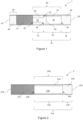
- the aerosol-generating article 1 shown in Figure 1 comprises a rod of aerosol-generating substrate 12, a downstream section 14 located downstream of the rod of aerosol-generating substrate 12 and an upstream section 16 located upstream of the rod of aerosol-generating substrate 12. As shown in Figure 1 , the aerosol-generating article 1 has an upstream end 18 and a downstream end 20.
- the aerosol-generating article 1 may have an overall length of 45 millimetres and an external diameter of 7.2 millimetres.
- the downstream section 14 of the aerosol-generating article 1 comprises a support element 22 located immediately downstream of the rod of aerosol-generating substrate 12, an aerosol-cooling element 24 located immediately downstream of the support element 22, and a mouthpiece element 42 located immediately downstream of the aerosol-cooling element 24.
- the support element 22 and the aerosol-cooling element 24 together define an intermediate hollow section 50 of the aerosol-generating article 1.
- the support element 22 comprises a first hollow tubular element 26.
- the first hollow tubular element 26 is in the form of a hollow cylindrical tube made of cellulose acetate.
- the first hollow tubular element 26 defines an internal cavity 28 that extends from an upstream end 30 of the first hollow tubular element to a downstream end 32 of the first hollow tubular element 20.
- the first hollow tubular element 26 may have a length of 8 millimetres and an external diameter of 6.9 millimetres.
- the first hollow tubular element 26 may have an internal diameter of 1.9 millimetres.
- the aerosol-cooling element 24 comprises a second hollow tubular element 34.
- the second hollow tubular element 34 is in the form of a hollow cylindrical tube made of cellulose acetate.
- the second hollow tubular element 34 defines an internal cavity 36 that extends from an upstream end 38 of the second hollow tubular element to a downstream end 40 of the second hollow tubular element 34.
- the second hollow tubular element 34 may have a length of 13 millimetres and an external diameter of 6.9 millimetres.
- the second hollow tubular element 34 may have an internal diameter of 3.25 millimetres.
- the aerosol-generating article 1 comprises a ventilation zone 60 provided at a location along the second hollow tubular element 34.
- the ventilation zone may be provided 2 millimetres from the upstream end of the second hollow tubular element 34.
- a ventilation level of the aerosol-generating article 1 may be 35 percent.
- the mouthpiece element 42 is in the form of a cylindrical plug of low-density cellulose acetate.
- the mouthpiece element 42 may have a length of 7 millimetres and an external diameter of 6.9 millimetres.
- the rod of aerosol-generating substrate 12 comprises tobacco cut filer within which clove particles are dispersed.
- the clove particles may have a cut width of 0.39 millimetres.
- the rod of aerosol-generating substrate 12 may have a length of 12 millimetres and an external diameter of 6.9 millimetres.
- the upstream section 16 of the aerosol-generating article 1 comprises an upstream element 46 located immediately upstream of the rod of aerosol-generating substrate 12.
- the upstream element 46 is in the form of a cylindrical plug of cellulose acetate circumscribed by a stiff wrapper.
- the upstream element 46 may have a length of 5 millimetres and an external diameter of 6.9 millimetres.
- a user draws on the mouthpiece element 42 of the aerosol-generating article 1.
- air is drawn into the aerosol-generating article 1 through the upstream end 18.
- the drawn air passes through the upstream element 46 to the rod of aerosol-generating substrate 12.
- Heating of the rod of aerosol-generating substrate releases volatile and semi-volatile compounds, which form an aerosol that is entrained in the drawn air as it flows through the rod of aerosol-generating substrate 12.
- the drawn air and entrained aerosol pass through the intermediate hollow section 50 of the aerosol-generating article 1, where they cool and condense.
- the cooled aerosol then passes through the mouthpiece element 42 of the aerosol-generating article 1 and into the mouth of the user.
- aerosol-generating article 1 shown Figure 1 is only one example of an embodiment of an aerosol-generating article according to the first aspect of the invention and that other embodiments are possible.
- the aerosol-generating article 2 shown in Figure 2 comprises a rod of aerosol-generating substrate 212, a downstream section 214 located downstream of the rod of aerosol-generating substrate 212. As shown in Figure 2 , the aerosol-generating article 2 has an upstream end 218 and a downstream end 220.
- the aerosol-generating article 2 may have an overall length of 45 millimetres and an external diameter of 7.2 millimetres.
- the downstream section 214 of the aerosol-generating article 2 comprises an aerosol-cooling element 224 located immediately downstream of the rod of aerosol-generating substrate 212, and a mouthpiece element 42 located immediately downstream of the aerosol-cooling element 224.
- the aerosol-cooling element 224 defines an intermediate hollow section 250 of the aerosol-generating article 2.
- the aerosol-cooling element 224 comprises a hollow tubular element 234.
- the hollow tubular element 234 is in the form of a hollow cylindrical tube made of cellulose acetate.
- the hollow tubular element 234 defines an internal cavity 236 that extends from an upstream end 238 of the hollow tubular element to a downstream end 240 of the hollow tubular element 234.
- the hollow tubular element 234 may have a length of 18 millimetres and an external diameter of 6.9 millimetres.
- the hollow tubular element 234 may have an internal diameter of 3.25 millimetres.
- the mouthpiece element 242 is in the form of a cylindrical plug of low-density cellulose acetate.
- the mouthpiece element 242 may have a length of 7 millimetres and an external diameter of 6.9 millimetres.
- the rod of aerosol-generating substrate 212 comprises tobacco cut filer within which clove particles are dispersed.
- the clove particles may have a cut width of 0.39 millimetres.
- the rod of aerosol-generating substrate 212 may have a length of 17 millimetres and an external diameter of 6.9 millimetres.
- a user draws on the mouthpiece element 242 of the aerosol-generating article 2.
- air is drawn into the aerosol-generating article 1 through the upstream end 218.
- the drawn air passes to the rod of aerosol-generating substrate 212.
- Heating of the rod of aerosol-generating substrate releases volatile and semi-volatile compounds, which form an aerosol that is entrained in the drawn air as it flows through the rod of aerosol-generating substrate 212.
- the drawn air and entrained aerosol pass through the intermediate hollow section 250 of the aerosol-generating article 1, where they cool and condense.
- the cooled aerosol then passes through the mouthpiece element 242 of the aerosol-generating article 2 and into the mouth of the user.
- aerosol-generating article 2 shown Figure 2 is only one example of an embodiment of an aerosol-generating article according to the second aspect of the invention and that other embodiments are possible.
- the aerosol-generating article 3 shown in Figure 3 is of a similar construction to the aerosol-generating article of Figure 2 .
- Like reference numerals are used where appropriate and for brevity, the description of like components will not be repeated.
- the aerosol-generating article 3 comprises an upstream section 316 located upstream of the rod of aerosol-generating substrate 312.
- the upstream section 316 of the aerosol-generating article 1 comprises an upstream element 346 located immediately upstream of the rod of aerosol-generating substrate 312.
- the upstream element 346 is in the form of a cylindrical plug of cellulose acetate circumscribed by a stiff wrapper.
- the upstream element 346 may have a length of 5 millimetres, an external diameter of 6.9 millimetres and an internal diameter of 5.1 millimetres.
- the aerosol-generating article 1 comprises a ventilation zone 360 provided at a location along the second hollow tubular element 334.
- a ventilation level of the aerosol-generating article 1 may be 35 percent.
- aerosol-generating article 3 shown Figure 3 is only one example of an embodiment of an aerosol-generating article according to the second aspect of the invention and that other embodiments are possible.
Landscapes
- Chemical & Material Sciences (AREA)
- Chemical Kinetics & Catalysis (AREA)
- General Chemical & Material Sciences (AREA)
- Life Sciences & Earth Sciences (AREA)
- Agronomy & Crop Science (AREA)
- Botany (AREA)
- Health & Medical Sciences (AREA)
- General Health & Medical Sciences (AREA)
- Toxicology (AREA)
- Manufacture Of Tobacco Products (AREA)
Priority Applications (3)
| Application Number | Priority Date | Filing Date | Title |
|---|---|---|---|
| EP23386082.4A EP4516121A1 (de) | 2023-09-01 | 2023-09-01 | Aerosolerzeugender artikel mit einem substrat mit tabakfreien pflanzenpartikeln |
| CN202480053016.0A CN121712408A (zh) | 2023-09-01 | 2024-09-03 | 包括具有非烟草植物颗粒的基质的气溶胶生成制品 |
| PCT/EP2024/074587 WO2025046151A1 (en) | 2023-09-01 | 2024-09-03 | Aerosol-generating article comprising a substrate with non-tobacco plant particles |
Applications Claiming Priority (1)
| Application Number | Priority Date | Filing Date | Title |
|---|---|---|---|
| EP23386082.4A EP4516121A1 (de) | 2023-09-01 | 2023-09-01 | Aerosolerzeugender artikel mit einem substrat mit tabakfreien pflanzenpartikeln |
Publications (1)
| Publication Number | Publication Date |
|---|---|
| EP4516121A1 true EP4516121A1 (de) | 2025-03-05 |
Family
ID=88097319
Family Applications (1)
| Application Number | Title | Priority Date | Filing Date |
|---|---|---|---|
| EP23386082.4A Withdrawn EP4516121A1 (de) | 2023-09-01 | 2023-09-01 | Aerosolerzeugender artikel mit einem substrat mit tabakfreien pflanzenpartikeln |
Country Status (3)
| Country | Link |
|---|---|
| EP (1) | EP4516121A1 (de) |
| CN (1) | CN121712408A (de) |
| WO (1) | WO2025046151A1 (de) |
Citations (7)
| Publication number | Priority date | Publication date | Assignee | Title |
|---|---|---|---|---|
| WO1990000019A2 (en) * | 1988-06-30 | 1990-01-11 | Gbe International Plc | Improvements in or relating to the preparation of cigarette fillings |
| WO2015176898A1 (en) | 2014-05-21 | 2015-11-26 | Philip Morris Products S.A. | Aerosol-generating article with internal susceptor |
| EP3075266A1 (de) * | 2015-04-02 | 2016-10-05 | PT. Gudang Garam Tbk. | Verfahren zur herstellung eines aerosolbildenden artikels mit rekonstituiertem tabakmaterial, aerosolbildender artikel mit dem rekonstituierten tabakmaterial und verwendung eines aerosolbildenden artikels mit rekonstituiertem tabakmaterial |
| WO2016174013A1 (en) * | 2015-04-28 | 2016-11-03 | Philip Morris Products S.A. | Clove-containing flavourant material |
| WO2020115151A1 (en) | 2018-12-06 | 2020-06-11 | Philip Morris Products S.A. | Aerosol-generating article with high aerosol former content |
| US20210329964A1 (en) * | 2018-10-08 | 2021-10-28 | Philip Morris Products S.A. | Clove-containing aerosol-generating substrate |
| JP2023522505A (ja) * | 2021-03-16 | 2023-05-31 | 深▲せん▼市智叶生物科技有限公司 | 機能性顆粒の製造方法、フィルタ及び電子タバコ |
-
2023
- 2023-09-01 EP EP23386082.4A patent/EP4516121A1/de not_active Withdrawn
-
2024
- 2024-09-03 WO PCT/EP2024/074587 patent/WO2025046151A1/en active Pending
- 2024-09-03 CN CN202480053016.0A patent/CN121712408A/zh active Pending
Patent Citations (7)
| Publication number | Priority date | Publication date | Assignee | Title |
|---|---|---|---|---|
| WO1990000019A2 (en) * | 1988-06-30 | 1990-01-11 | Gbe International Plc | Improvements in or relating to the preparation of cigarette fillings |
| WO2015176898A1 (en) | 2014-05-21 | 2015-11-26 | Philip Morris Products S.A. | Aerosol-generating article with internal susceptor |
| EP3075266A1 (de) * | 2015-04-02 | 2016-10-05 | PT. Gudang Garam Tbk. | Verfahren zur herstellung eines aerosolbildenden artikels mit rekonstituiertem tabakmaterial, aerosolbildender artikel mit dem rekonstituierten tabakmaterial und verwendung eines aerosolbildenden artikels mit rekonstituiertem tabakmaterial |
| WO2016174013A1 (en) * | 2015-04-28 | 2016-11-03 | Philip Morris Products S.A. | Clove-containing flavourant material |
| US20210329964A1 (en) * | 2018-10-08 | 2021-10-28 | Philip Morris Products S.A. | Clove-containing aerosol-generating substrate |
| WO2020115151A1 (en) | 2018-12-06 | 2020-06-11 | Philip Morris Products S.A. | Aerosol-generating article with high aerosol former content |
| JP2023522505A (ja) * | 2021-03-16 | 2023-05-31 | 深▲せん▼市智叶生物科技有限公司 | 機能性顆粒の製造方法、フィルタ及び電子タバコ |
Also Published As
| Publication number | Publication date |
|---|---|
| CN121712408A (zh) | 2026-03-20 |
| WO2025046151A8 (en) | 2025-04-10 |
| WO2025046151A1 (en) | 2025-03-06 |
Similar Documents
| Publication | Publication Date | Title |
|---|---|---|
| US12310399B2 (en) | Non-combustible heating-type smoking article, electric heating-type smoking system, and method for producing non-combustible heating-type smoking article | |
| JP7056997B2 (ja) | エアロゾル形成ロッドの製造方法及び製造装置 | |
| CN116322388A (zh) | 具有低rtd的带有下游区段的气溶胶生成制品 | |
| JP2026034549A (ja) | 改善された構成を有するエアロゾル発生物品 | |
| CN113993398A (zh) | 包括管状过滤器的吸烟物品及其制造方法 | |
| CN112423607A (zh) | 卷烟 | |
| EP4225078B1 (de) | Aerosolerzeugender artikel mit rohrförmigem element und ventilation | |
| JP7808040B2 (ja) | 新規の構成を有するエアロゾル発生物品 | |
| US20230346008A1 (en) | Aerosol-generating article with low resistance to draw and improved flavour delivery | |
| US20230404136A1 (en) | Aerosol-generating article with tubular element | |
| KR20230080457A (ko) | 낮은 흡인 저항 및 개선된 향미 전달을 갖는 에어로졸 발생 물품 | |
| JP2026016499A (ja) | 改善された構成を有するエアロゾル発生物品 | |
| EP4225067B1 (de) | Aerosolerzeugungsartikel mit belüftung | |
| JP2023544746A (ja) | 通気を有するエアロゾル発生物品 | |
| CA3195173A1 (en) | Aerosol-generating article with tubular element having an opening | |
| EP4516121A1 (de) | Aerosolerzeugender artikel mit einem substrat mit tabakfreien pflanzenpartikeln | |
| JP2023544040A (ja) | 前部端プラグ付きエアロゾル発生物品 | |
| US12616237B2 (en) | Aerosol-generating article with ventilation | |
| WO2025099188A1 (en) | Aerosol-generating article with substrate containing tobacco and first and second non-tobacco plant flavour particles | |
| WO2025099190A1 (en) | Aerosol-generating article with substrate containing tobacco and first and second non-tobacco plant flavour particles | |
| WO2025099189A1 (en) | Aerosol-generating article with substrate containing tobacco and first and second non-tobacco plant flavour particles | |
| WO2025242518A1 (en) | Aerosol-generating article with aerosol-generating element including core body and shell portion | |
| JP2025537587A (ja) | 開口部を有する管状要素を備えるエアロゾル発生物品 | |
| CN121127147A (zh) | 风味吸入器过滤器、用于生产其的方法以及风味吸入器 | |
| JP2025536704A (ja) | 下流管状要素を有するエアロゾル発生物品 |
Legal Events
| Date | Code | Title | Description |
|---|---|---|---|
| PUAI | Public reference made under article 153(3) epc to a published international application that has entered the european phase |
Free format text: ORIGINAL CODE: 0009012 |
|
| STAA | Information on the status of an ep patent application or granted ep patent |
Free format text: STATUS: THE APPLICATION HAS BEEN PUBLISHED |
|
| AK | Designated contracting states |
Kind code of ref document: A1 Designated state(s): AL AT BE BG CH CY CZ DE DK EE ES FI FR GB GR HR HU IE IS IT LI LT LU LV MC ME MK MT NL NO PL PT RO RS SE SI SK SM TR |
|
| STAA | Information on the status of an ep patent application or granted ep patent |
Free format text: STATUS: THE APPLICATION IS DEEMED TO BE WITHDRAWN |
|
| 18D | Application deemed to be withdrawn |
Effective date: 20250906 |