EP4516202A1 - Verfahren zur montage von gelenkabschnitten eines flexiblen endoskops und vorrichtung zur durchführung des verfahrens - Google Patents
Verfahren zur montage von gelenkabschnitten eines flexiblen endoskops und vorrichtung zur durchführung des verfahrens Download PDFInfo
- Publication number
- EP4516202A1 EP4516202A1 EP24197522.6A EP24197522A EP4516202A1 EP 4516202 A1 EP4516202 A1 EP 4516202A1 EP 24197522 A EP24197522 A EP 24197522A EP 4516202 A1 EP4516202 A1 EP 4516202A1
- Authority
- EP
- European Patent Office
- Prior art keywords
- rivet
- receiving hole
- articulation section
- ear
- section
- Prior art date
- Legal status (The legal status is an assumption and is not a legal conclusion. Google has not performed a legal analysis and makes no representation as to the accuracy of the status listed.)
- Pending
Links
Images



Classifications
-
- A—HUMAN NECESSITIES
- A61—MEDICAL OR VETERINARY SCIENCE; HYGIENE
- A61B—DIAGNOSIS; SURGERY; IDENTIFICATION
- A61B1/00—Instruments for performing medical examinations of the interior of cavities or tubes of the body by visual or photographical inspection, e.g. endoscopes; Illuminating arrangements therefor
- A61B1/00064—Constructional details of the endoscope body
- A61B1/0011—Manufacturing of endoscope parts
-
- A—HUMAN NECESSITIES
- A61—MEDICAL OR VETERINARY SCIENCE; HYGIENE
- A61B—DIAGNOSIS; SURGERY; IDENTIFICATION
- A61B1/00—Instruments for performing medical examinations of the interior of cavities or tubes of the body by visual or photographical inspection, e.g. endoscopes; Illuminating arrangements therefor
- A61B1/005—Flexible endoscopes
-
- A—HUMAN NECESSITIES
- A61—MEDICAL OR VETERINARY SCIENCE; HYGIENE
- A61B—DIAGNOSIS; SURGERY; IDENTIFICATION
- A61B1/00—Instruments for performing medical examinations of the interior of cavities or tubes of the body by visual or photographical inspection, e.g. endoscopes; Illuminating arrangements therefor
- A61B1/005—Flexible endoscopes
- A61B1/0051—Flexible endoscopes with controlled bending of insertion part
- A61B1/0055—Constructional details of insertion parts, e.g. vertebral elements
-
- A—HUMAN NECESSITIES
- A61—MEDICAL OR VETERINARY SCIENCE; HYGIENE
- A61B—DIAGNOSIS; SURGERY; IDENTIFICATION
- A61B1/00—Instruments for performing medical examinations of the interior of cavities or tubes of the body by visual or photographical inspection, e.g. endoscopes; Illuminating arrangements therefor
- A61B1/005—Flexible endoscopes
- A61B1/008—Articulations
Definitions
- the invention relates to an endoscope and, more particularly, to a flexible endoscope and to a method of joining articulation sections of a flexible endoscope.
- the conventional articulation section systems for an endoscope shaft employ an assembly method centered around the use of rivets to create a flexible and maneuverable structure.
- Such articulation section systems include several articulation sedections interconnected through rivets, with each rivet featuring two heads.
- the rivets are inserted into corresponding holes within the joining rings or ears from the inner side of the articulation sections, and subsequently, a second head is formed from the outer side.
- a primary issue of such articulation section systems relates to the clearance between the rivet body and the two joining ring holes or ears, which adversely affects its torque resistance. Additionally, maintaining precise control over the dimensions of the rivet's cylindrical body during assembly may be difficult, leading to uncertainties in the clearance between the rivet head and the articulation sections.
- US8579801 (B2 ) and US8834356 (B2 ) are said to present a method that can ensure better and consistent guaranteed clearance between the rivets and the section rings, thereby enhancing the overall performance and reliability of conventional endoscope shaft articulation sections.
- the method involves aligning fastener holes of two endoscope articulation section frame members with each other on a mandrel.
- the mandrel has a front end and a rear end.
- a fastener (rivet) is inserted into the fastener holes, wherein the fastener holes are aligned by moving the two endoscope articulation section frame members on the mandrel from the front end.
- a portion of the fastener is pushed by a linear cam feature on the mandrel to move a body of the fastener in the fastener holes of the endoscope deflection section frame members based on a linear movement of the two endoscope articulation section frame members with each other on the mandrel.
- the fastener is welded from an outside direction of the frame members, to an exterior side of one of the endoscope articulation section frame members to thereby pivotably attach the endoscope deflection section frame members to each other.
- the linear cam method has the disadvantage that the assembler must move the articulation section frame members to be joined along with the rivets along the assembly mandrel. This requires a great deal of moving components that all need to be aligned while in motion.
- a method comprises providing a first articulation section (also referred to as a next to be connected articulation section) comprising a first section connection edge with an inner ear comprising a recessed rivet receiving portion having an inner rivet receiving hole and having an opposite section edge.
- a second articulation section (also referred to as the further adjacent articulation section ) is provided that comprises a second section connection edge with an outer ear comprising an outer rivet receiving portion having an outer rivet receiving hole and having an opposite section edge.
- the first articulation section is placed on a cam assembly tooling mandrel and loading pin, the loading pin having a cam surface configured to contact with a head of a rivet.
- a rivet shaft of a rivet is inserted into the inner rivet receiving hole of the inner ear, wherein the head of the rivet is located at an interior side of the inner ear and facing the cam surface.
- the second articulation section is disposed adjacent to the first articulation section with the outer rivet receiving hole of the outer ear aligned with the inner rivet receiving hole of the inner ear.
- the loading pin is rotated to press the cam surface of the loading pin against the head of the rivet to move the rivet shaft partially through inner rivet receiving hole of the inner ear and into and partially through the outer rivet receiving hole of the outer ear.
- the rivet is subsequently fixedly connected to the second articulation section.
- the rivet is advantageously fixedly connected to the second (further adjacent) articulation section by welding the rivet, particularly the rivet shaft, to the outer ear of the second articulation section.
- the first section connection edge of the first (next to be connected) articulation section further comprises another inner ear comprising another recessed rivet receiving portion having an another inner rivet receiving hole.
- the second section connection edge of the second (further adjacent) articulation section further comprises another outer ear comprising an another outer rivet receiving portion having another outer rivet receiving hole. Another rivet is provided.
- Another rivet shaft of the other rivet is inserted into the other inner rivet receiving hole of the other inner ear.
- Another head of the other rivet is located at an interior side of the inner ear and facing the cam surface, wherein the cam surface is configured to contact with the head of the rivet and also to contact a head of the other rivet.
- the rotation of the loading pin presses the cam surface of the loading pin against both the head of the rivet to move the rivet shaft into and partially through the outer rivet receiving hole of the outer ear and also the head of the other rivet to move the other rivet shaft into and partially through the other outer rivet receiving hole of the other outer ear.
- the method may comprise:
- Fixedly connecting the first rivet to the second articulation section comprises welding the first rivet to the first outer ear of the second articulation section; and fixedly connecting the second rivet to the second articulation section comprises welding the second rivet to the second outer ear of the second articulation section.
- a method which entails the alignment of rivet holes in two endoscope articulation sections with each other.
- a rivet is inserted into these rivet holes, with one end (head) of the rivet positioned on the interior side of the first articulation section and the opposite end extending to the exterior side of the second articulation section.
- a rotating cam is inserted into the articulation sections to align them and to contact the rivet head, thereby aligning the rivet relative to the articulation sections while maintaining the necessary clearance between the rivet head and the inner ring ear.
- the rivet is securely fixed to the second articulation section.
- FIG. 1 shows a perspective view of an endoscope 10 assembled with the method of assembling articulation sections according to this disclosure.
- the endoscope 10 may be a ureteroscope or other suitable type of endoscope that includes articulated sections.
- the endoscope 10 generally comprises a handle or control 12 and a deflection section 16 that is located at a distal end of the handle 12.
- the endoscope 10 has a shaft 14 with the deflection section 16.
- a control system 20 to control the active deflection section 16 extends from the handle 12 to the deflection section 16.
- the control system 20 can comprise, for example, a pair of control wires, two wire sheaths, and an actuator 26. One end of the wires are connected to the actuator 26 and an opposite second end of the wires are connected to the distal end of the active deflection section 16.
- the handle 12 has a user operated slide or lever 28.
- the lever 28 is connected to the actuator 26.
- the actuator 26 is adapted to pull and release the two wires of the control system 20.
- the actuator 26 may be a drum or pulley, for example, rotatably connected to the handle 12 to pull one wire while releasing the other.
- the actuator may also be a rocker arm adapted to pull and release the wires of the control system 20.
- the control system 20 may also have two or more pairs of control wires.
- the handle can have additional actuators and corresponding controls to drive the additional pairs of control wires to bend the deflection section in different plane(s).
- the handle 12 may have knobs with rack and pinion mechanisms or other suitable user operated controls for the control system.
- the flexible shaft 14 with deflection section 16 includes the control wires of the control system 20, a fiber optical image bundle or video sensor electrical cable, a working channel, and a fiber optical illumination bundle or electrical wires to illumination LEDs or lights at an objective head 30.
- a port 40 for inserting accessory instruments (not shown) into the working channel is located on the handle 12.
- the handle 12 also has an electrical cable 50 for connection to another device, such as a video monitor for example.
- the endoscope 10 could have an eyepiece.
- the flexible shaft may house different systems therein.
- the deflection section or steering/articulation section 16 generally comprises a frame that has a cover 32 and the objective head 30.
- the cover 32 also extends over the entire shaft 14, or over a portion or there may be different sections that have different cover portions.
- the frame has at least one portion comprising articulation sections 60 that are disposed adjacent to each other and are articulated to each other.
- the articulation sections 60 are comprised of stainless steel.
- the articulation sections 60 could be comprised of another material such as plastic or a shape memory alloy material, such as Tinel or Nitinol.
- the articulation sections 60 each comprise a one-piece member, but could be comprised of multiple members.
- Each articulation section 60 has a first side connection edge 62, such as a proximal side connection edge, and a second side connection edges, such as a distal side connection edge 64.
- the first side connection edge 62 has an inner ear (recessed rivet receiving portion) 66 that defines a inner rivet receiving hole 68.
- the second side connection edge 64 has an outer ear (outer rivet receiving portion) 70 that defines an outer rivet receiving hole 72.
- the articulation sections 60 are disposed adjacent to each other and are connected by rivets 90 so as to provide an articulated connection ( Figures 2 and 3 ).
- the articulation sections 60 may have an identical configuration or this configuration may vary based on different size or other considerations.
- essentially identical articulation section 60 are connected to each other based on principles of the method according to this disclosure.
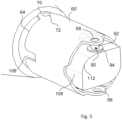
- a next to be connected articulation section (first articulation section) 60' which is to be connected to a further adjacent articulation section (second articulation section) 60" is placed on a mandrel portion 106 of the cam assembly tooling mandrel and loading pin 100.
- the cam assembly tooling mandrel and loading pin 100 has the mandrel portion 106, for supporting the cylindrical inner surface of the next to be connected articulation section 60' and the loading pin portion 108, that has the cam surface 112 discussed further below.
- the next to be connected articulation section 60' is disposed with the first side connection edge 62 having the inner ear 66 at upper and lower locations, exposed for connection.
- the cam assembly tooling mandrel and loading pin 100 is shown with the to be connected articulation section 60 on the mandrel portion 106. As shown in Figure 11 , the cam assembly tooling mandrel and loading pin 100 is supported by support block 120 with a support portion 124 and is rotated by actuator 122 as indicated by rotation arrow 126.
- a rivet 90 is positioned with a rivet shaft (cylindrical body) 92 in the inner rivet receiving hole 68 of the next to be connected articulation section 60'.
- the positioned rivet head 94 of the rivet 90 is shown adjacent to and in contact with the cam surface 112 of the loading pin 108.
- Figures 8, 9 and 10 show further articulation sections 60.
- a left most further articulation sections 60" has the second side connection edge 64 facing the first side connection edge 62 of next to be connected articulation section 60'.
- the second side connection edge 64 has the outer rivet receiving hole 72 of the outer ear 70.
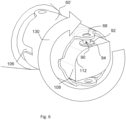
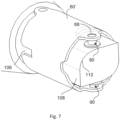
- Figure 6 shows the same state of the arrangement of articulation section 60 to be connected on the cam assembly tooling loading pin 100 and indicates a step of rotating the articulation section 60' to be connected as shown by arrow 130. From the state shown in Fig. 6 , the next to be connected articulation section 60' is rotated by 180° to position the next to be connected articulation section 60' in a position as shown in Figure 7 . A rivet shaft 92 of another rivet 90 is inserted in another inner rivet receiving hole 68, at the opposite side of the first side connection edge 62. After the other rivet 90 is positioned as shown in Figure 7 , two rivets are disposed in the respective inner rivet receiving holes 68 (one at top one at bottom) as can be seen in Figure 7 .
- the method may include rotation of articulation section 60 to be connected with the assembly tooling mandrel and loading pin 100, this is not required as the second rivet may be simply inserted at the lower rivet receiving hole 68 without rotation of the arrangement of articulation section 60 to be connected on the cam assembly tooling mandrel and loading pin 100.
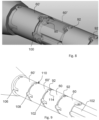
- Figures 8 and 9 show the further step of placing the further articulation sections 60 at a location immediately adjacent to the next to be connected articulation section 60'.
- the left most further articulation section or adjacent further articulation section 60" is shown as transparent.
- the further articulation sections 60 are shown with respective rivets in a pre-weld connected state.
- These further articulation sections 60 are carried by support mandrel 102 and positioned at the location with the left most (adjacent) further articulation section 60" immediately adjacent to the next to be connected articulation section 60'.
- Figure 11 shows the pre-assembly 110, including the nect to be connected articulation section 60' and adjacent further articulation section 60" with aligned holes 698, 72 and with respective rivets 90 inserted only into the inner rivet receiving holes 68.
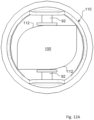
- This pre-assembly 110 is also shown in Figure 12A in cross-section.
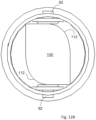
- the actuator 122 of support block 120 is rotated as indicated by rotation arrow 126. This rotates the assembly tooling mandrel and loading pin 100 such that the loading pin 108 with cam surface 112 rotates.
- Figure 12B shows the loading pin 108 rotated, which results in the cam surface 112 pressing against the head 94 of the rivet 90 at each side.
- This rotation by 90° of the loading pin 108 results in each rivet shaft 92 being pressed through the inner rivet receiving hole 68 of the inner ear 66 and through the outer rivet receiving hole 72 of the outer ear 70.
- the cam surface 112 of the loaded pin 100 is pressed against the head 94 of each rivet 90 so as to position each rivet 90 in a pre-weld position at a known location with known clearance as shown in Figure 8B.
- each rivet 90 is fixedly connected to the adjacent further articulation section 60, in particular to the outer ear 70.
- the fixing of each rivet 90 to the adjacent articulation section comprises welding the rivet to the further adjacent articulation section 60" at a region of the rivet shaft (cylindrical body) 92 adjacent to the outer ear 70.
- each articulated connection is brought to first a pre-weld state and subsequently each rivet shaft (cylindrical body) 92 of each rivet 90 is welded to a respective outer ear 70. This may be done with the rivets at one side of the chain of articulated connection in the pre-weld state being welded, one after another and subsequently rivets at the other side of the chain of articulated connection in the pre-weld state being welded, one after another.
- the fixedly connected articulation sections 60 form a fixedly joined articulation section chain that comprises a plurality of such articulation sections 60, one after another.
- these articulation sections 60 may be of identical configuration but may also have varying axial extent.
- the first connection edges 62 of the articulation sections 60 may all be identical and the second connection edges 64 of the articulation sections 60 may be identical except for the distal last second side connection edge 64, which may have a different configuration (see Figures 2 and 3 ).
- the first connection edge 62 of the chain of articulation section 60 may connect to a shaft section having a different configuration, namely without a second section connection edge 64 as this differently configured shaft section is not in the chain and acts to form the first articulated joint.
- upper and lower rivets 90 are shown connecting each of the articulation sections 60 to be connected and adjacent further articulation section 60 after positioned with aligned holes 68 and 72, it may be possible to implement the flexible shaft at least partially with a single rivet.
- the invention advantageously allows plural rivets to be accurately positioned based on a single rotational movement of the cam assembly tooling loading pin 100.
- the disclosed method is particularly advantageous as to accurately positioning first and second rivets for welding without a need to linearly move the articulation sections 60 along with positioned rivets 90 along an assembly mandrel.
Landscapes
- Health & Medical Sciences (AREA)
- Life Sciences & Earth Sciences (AREA)
- Surgery (AREA)
- Engineering & Computer Science (AREA)
- Biomedical Technology (AREA)
- Molecular Biology (AREA)
- Pathology (AREA)
- Radiology & Medical Imaging (AREA)
- Nuclear Medicine, Radiotherapy & Molecular Imaging (AREA)
- Biophysics (AREA)
- Physics & Mathematics (AREA)
- Heart & Thoracic Surgery (AREA)
- Medical Informatics (AREA)
- Optics & Photonics (AREA)
- Animal Behavior & Ethology (AREA)
- General Health & Medical Sciences (AREA)
- Public Health (AREA)
- Veterinary Medicine (AREA)
- Manufacturing & Machinery (AREA)
- Rehabilitation Therapy (AREA)
- Endoscopes (AREA)
Applications Claiming Priority (1)
| Application Number | Priority Date | Filing Date | Title |
|---|---|---|---|
| US202363535712P | 2023-08-31 | 2023-08-31 |
Publications (1)
| Publication Number | Publication Date |
|---|---|
| EP4516202A1 true EP4516202A1 (de) | 2025-03-05 |
Family
ID=92633064
Family Applications (1)
| Application Number | Title | Priority Date | Filing Date |
|---|---|---|---|
| EP24197522.6A Pending EP4516202A1 (de) | 2023-08-31 | 2024-08-30 | Verfahren zur montage von gelenkabschnitten eines flexiblen endoskops und vorrichtung zur durchführung des verfahrens |
Country Status (2)
| Country | Link |
|---|---|
| US (1) | US20250072721A1 (de) |
| EP (1) | EP4516202A1 (de) |
Citations (4)
| Publication number | Priority date | Publication date | Assignee | Title |
|---|---|---|---|---|
| EP0439931A1 (de) * | 1989-12-28 | 1991-08-07 | Kabushiki Kaisha Machida Seisakusho | Verfahren zur Herstellung einer Biegeeinrichtung, insbesondere für ein Endoskop oder einen chirurgischen Katheter |
| JP2002045332A (ja) * | 2000-08-01 | 2002-02-12 | Olympus Optical Co Ltd | 湾曲管の組立用冶具と組立方法 |
| WO2007148577A1 (ja) * | 2006-06-19 | 2007-12-27 | Olympus Corporation | 内視鏡の挿入部の製造方法 |
| US8579801B2 (en) | 2009-08-10 | 2013-11-12 | Gyrus Acmi, Inc. | Endoscope riveted deflection section frame |
-
2024
- 2024-08-28 US US18/817,624 patent/US20250072721A1/en active Pending
- 2024-08-30 EP EP24197522.6A patent/EP4516202A1/de active Pending
Patent Citations (6)
| Publication number | Priority date | Publication date | Assignee | Title |
|---|---|---|---|---|
| EP0439931A1 (de) * | 1989-12-28 | 1991-08-07 | Kabushiki Kaisha Machida Seisakusho | Verfahren zur Herstellung einer Biegeeinrichtung, insbesondere für ein Endoskop oder einen chirurgischen Katheter |
| JP2002045332A (ja) * | 2000-08-01 | 2002-02-12 | Olympus Optical Co Ltd | 湾曲管の組立用冶具と組立方法 |
| WO2007148577A1 (ja) * | 2006-06-19 | 2007-12-27 | Olympus Corporation | 内視鏡の挿入部の製造方法 |
| US8579801B2 (en) | 2009-08-10 | 2013-11-12 | Gyrus Acmi, Inc. | Endoscope riveted deflection section frame |
| US20140024898A1 (en) * | 2009-08-10 | 2014-01-23 | Gyrus Acmi, Inc. | Endoscope Riveted Deflection Section Frame |
| US8834356B2 (en) | 2009-08-10 | 2014-09-16 | Gyrus Acmi, Inc. | Endoscope riveted deflection section frame |
Also Published As
| Publication number | Publication date |
|---|---|
| US20250072721A1 (en) | 2025-03-06 |
Similar Documents
| Publication | Publication Date | Title |
|---|---|---|
| US8834356B2 (en) | Endoscope riveted deflection section frame | |
| JP6989594B2 (ja) | 手首構造 | |
| US7951165B2 (en) | Endoscopic medical instrument and related methods of use | |
| US5928136A (en) | Articulated vertebra for endoscopes and method to make it | |
| US6613068B2 (en) | Endoscopic treatment instrument | |
| EP1090581B1 (de) | Biegsame Röhre und dessen Herstellung | |
| US20080132761A1 (en) | Articulation Section | |
| US20090264918A1 (en) | Clevis assemblies for medical instruments and methods of manufacture of same | |
| JP3655785B2 (ja) | 内視鏡用処置具 | |
| US20110034771A1 (en) | Endoscope resilient deflection section frame | |
| EP4516202A1 (de) | Verfahren zur montage von gelenkabschnitten eines flexiblen endoskops und vorrichtung zur durchführung des verfahrens | |
| CN119896435A (zh) | 内窥镜操控线张紧方法 | |
| JPH10248796A (ja) | 内視鏡の湾曲管 | |
| CN116322554A (zh) | 机器人手术器械底盘 | |
| JP3264467B2 (ja) | 内視鏡における操作ワイヤ固定装置 | |
| JP7175396B2 (ja) | 内視鏡用処置具 | |
| EP4637504A1 (de) | Ablenksteuerungsmechanismus für ein medizinisches gerät, medizinisches gerät, wartungsverfahren und verfahren zur montage eines ablenksteuerungsmechanismus oder eines medizinischen geräts | |
| US20250072987A1 (en) | A robotic surgical instrument | |
| JP2002045332A (ja) | 湾曲管の組立用冶具と組立方法 | |
| EP4373431A1 (de) | Robotisches chirurgisches instrument | |
| WO2025240254A1 (en) | Elevators for medical devices | |
| JPH05317246A (ja) | 内視鏡用処置具 | |
| JPH0554345B2 (de) | ||
| JPH11346995A (ja) | 内視鏡 |
Legal Events
| Date | Code | Title | Description |
|---|---|---|---|
| PUAI | Public reference made under article 153(3) epc to a published international application that has entered the european phase |
Free format text: ORIGINAL CODE: 0009012 |
|
| STAA | Information on the status of an ep patent application or granted ep patent |
Free format text: STATUS: THE APPLICATION HAS BEEN PUBLISHED |
|
| AK | Designated contracting states |
Kind code of ref document: A1 Designated state(s): AL AT BE BG CH CY CZ DE DK EE ES FI FR GB GR HR HU IE IS IT LI LT LU LV MC ME MK MT NL NO PL PT RO RS SE SI SK SM TR |
|
| STAA | Information on the status of an ep patent application or granted ep patent |
Free format text: STATUS: REQUEST FOR EXAMINATION WAS MADE |
|
| 17P | Request for examination filed |
Effective date: 20250905 |