EP4516213A1 - Vorrichtung zur beurteilung eines biologischen zustands, verfahren zur beurteilung eines biologischen zustands, computerprogramm und aufzeichnungsmedium - Google Patents
Vorrichtung zur beurteilung eines biologischen zustands, verfahren zur beurteilung eines biologischen zustands, computerprogramm und aufzeichnungsmedium Download PDFInfo
- Publication number
- EP4516213A1 EP4516213A1 EP23796408.5A EP23796408A EP4516213A1 EP 4516213 A1 EP4516213 A1 EP 4516213A1 EP 23796408 A EP23796408 A EP 23796408A EP 4516213 A1 EP4516213 A1 EP 4516213A1
- Authority
- EP
- European Patent Office
- Prior art keywords
- inflection
- gradient
- blood pressure
- biological
- biological state
- Prior art date
- Legal status (The legal status is an assumption and is not a legal conclusion. Google has not performed a legal analysis and makes no representation as to the accuracy of the status listed.)
- Pending
Links
Images

















Classifications
-
- A—HUMAN NECESSITIES
- A61—MEDICAL OR VETERINARY SCIENCE; HYGIENE
- A61B—DIAGNOSIS; SURGERY; IDENTIFICATION
- A61B5/00—Measuring for diagnostic purposes; Identification of persons
- A61B5/02—Detecting, measuring or recording for evaluating the cardiovascular system, e.g. pulse, heart rate, blood pressure or blood flow
- A61B5/021—Measuring pressure in heart or blood vessels
-
- A—HUMAN NECESSITIES
- A61—MEDICAL OR VETERINARY SCIENCE; HYGIENE
- A61B—DIAGNOSIS; SURGERY; IDENTIFICATION
- A61B5/00—Measuring for diagnostic purposes; Identification of persons
- A61B5/02—Detecting, measuring or recording for evaluating the cardiovascular system, e.g. pulse, heart rate, blood pressure or blood flow
- A61B5/024—Measuring pulse rate or heart rate
- A61B5/02405—Determining heart rate variability
-
- A—HUMAN NECESSITIES
- A61—MEDICAL OR VETERINARY SCIENCE; HYGIENE
- A61B—DIAGNOSIS; SURGERY; IDENTIFICATION
- A61B5/00—Measuring for diagnostic purposes; Identification of persons
- A61B5/40—Detecting, measuring or recording for evaluating the nervous system
- A61B5/4029—Detecting, measuring or recording for evaluating the nervous system for evaluating the peripheral nervous systems
- A61B5/4035—Evaluating the autonomic nervous system
-
- A—HUMAN NECESSITIES
- A61—MEDICAL OR VETERINARY SCIENCE; HYGIENE
- A61B—DIAGNOSIS; SURGERY; IDENTIFICATION
- A61B5/00—Measuring for diagnostic purposes; Identification of persons
- A61B5/72—Signal processing specially adapted for physiological signals or for diagnostic purposes
- A61B5/7235—Details of waveform analysis
- A61B5/7246—Details of waveform analysis using correlation, e.g. template matching or determination of similarity
-
- A—HUMAN NECESSITIES
- A61—MEDICAL OR VETERINARY SCIENCE; HYGIENE
- A61B—DIAGNOSIS; SURGERY; IDENTIFICATION
- A61B7/00—Instruments for auscultation
- A61B7/02—Stethoscopes
- A61B7/04—Electric stethoscopes
-
- G—PHYSICS
- G16—INFORMATION AND COMMUNICATION TECHNOLOGY [ICT] SPECIALLY ADAPTED FOR SPECIFIC APPLICATION FIELDS
- G16H—HEALTHCARE INFORMATICS, i.e. INFORMATION AND COMMUNICATION TECHNOLOGY [ICT] SPECIALLY ADAPTED FOR THE HANDLING OR PROCESSING OF MEDICAL OR HEALTHCARE DATA
- G16H20/00—ICT specially adapted for therapies or health-improving plans, e.g. for handling prescriptions, for steering therapy or for monitoring patient compliance
- G16H20/30—ICT specially adapted for therapies or health-improving plans, e.g. for handling prescriptions, for steering therapy or for monitoring patient compliance relating to physical therapies or activities, e.g. physiotherapy, acupressure or exercising
-
- G—PHYSICS
- G16—INFORMATION AND COMMUNICATION TECHNOLOGY [ICT] SPECIALLY ADAPTED FOR SPECIFIC APPLICATION FIELDS
- G16H—HEALTHCARE INFORMATICS, i.e. INFORMATION AND COMMUNICATION TECHNOLOGY [ICT] SPECIALLY ADAPTED FOR THE HANDLING OR PROCESSING OF MEDICAL OR HEALTHCARE DATA
- G16H40/00—ICT specially adapted for the management or administration of healthcare resources or facilities; ICT specially adapted for the management or operation of medical equipment or devices
- G16H40/60—ICT specially adapted for the management or administration of healthcare resources or facilities; ICT specially adapted for the management or operation of medical equipment or devices for the operation of medical equipment or devices
- G16H40/63—ICT specially adapted for the management or administration of healthcare resources or facilities; ICT specially adapted for the management or operation of medical equipment or devices for the operation of medical equipment or devices for local operation
-
- G—PHYSICS
- G16—INFORMATION AND COMMUNICATION TECHNOLOGY [ICT] SPECIALLY ADAPTED FOR SPECIFIC APPLICATION FIELDS
- G16H—HEALTHCARE INFORMATICS, i.e. INFORMATION AND COMMUNICATION TECHNOLOGY [ICT] SPECIALLY ADAPTED FOR THE HANDLING OR PROCESSING OF MEDICAL OR HEALTHCARE DATA
- G16H50/00—ICT specially adapted for medical diagnosis, medical simulation or medical data mining; ICT specially adapted for detecting, monitoring or modelling epidemics or pandemics
- G16H50/30—ICT specially adapted for medical diagnosis, medical simulation or medical data mining; ICT specially adapted for detecting, monitoring or modelling epidemics or pandemics for calculating health indices; for individual health risk assessment
-
- A—HUMAN NECESSITIES
- A61—MEDICAL OR VETERINARY SCIENCE; HYGIENE
- A61B—DIAGNOSIS; SURGERY; IDENTIFICATION
- A61B2562/00—Details of sensors; Constructional details of sensor housings or probes; Accessories for sensors
- A61B2562/02—Details of sensors specially adapted for in-vivo measurements
- A61B2562/0204—Acoustic sensors
-
- A—HUMAN NECESSITIES
- A61—MEDICAL OR VETERINARY SCIENCE; HYGIENE
- A61B—DIAGNOSIS; SURGERY; IDENTIFICATION
- A61B5/00—Measuring for diagnostic purposes; Identification of persons
- A61B5/16—Devices for psychotechnics; Testing reaction times ; Devices for evaluating the psychological state
Definitions
- the present invention relates to a biological state evaluation device that evaluates the biological state of a person in relation to a blood pressure, a biological state evaluation method, a computer program, and a recording medium.
- Patent Document 1 the present applicant has disclosed a blood pressure estimation device that analyzes biological signal data obtained from a biological signal detection sensor including a three-dimensional knitted fabric, captures information on vibration generated in a living body by blood flow variability in a period from a ventricular filling period to an isovolumetric systole, finds an index indicating its fluctuation by using a Lorenz plot method, and estimates a blood pressure value from the index (Patent Document 1).
- Patent Document 1 it is possible to estimate a blood pressure from the biological signals collected from the back of a person without restraining the person. Accordingly, it is not necessary to wind a cuff around the upper part of an arm, leading to easy measurement, and another merit is that the measurement without restraining enables the successive measurement of the blood pressure.
- a cardiac output is determined by a heart rate and a stroke volume.
- a heart rate is regulated by sympathetic nerves and parasympathetic nerves distributed in the sinus node and the atrioventricular node.
- a stroke volume is determined by preload, afterload, contractility, and so on.
- a cardiac output influenced by two factors which are nervous system regulation having an influence on a heart rate and an arterial pressure having an influence on a stroke volume, undergoes increases/decreases due to the respective two factors, and the increases/decreases become points of inflection. Therefore, a cardiac output has two points of inflection due to the two factors, and a cardiac output having two points of inflection is represented by a quartic function and extreme values.
- a GI value close to 1/f is considered to correlate with an arterial pressure to which the principle of least energy action is applied, and a GT value that is an outlier with respect to 1/f is considered to correlate with an arterial pressure indicating hypertension or hypotension.
- the GI value and the GT value appear in the VLF band and the LF band in which thermoregulation and nervous system regulation are reflected.
- the present invention was made in consideration of the above and has an object to improve blood pressure inference accuracy by making the influences of the two factors determining a cardiac output reflected in the determination.
- the present invention provides a biological state evaluation device including:
- the evaluating unit determines blood pressure classification including at least distinction between normotension and hypertension.
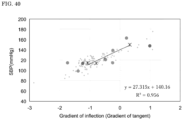
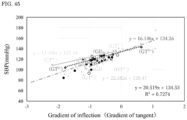
- the evaluating unit collates a value of the gradient between the two points of inflection or the gradient of the tangent at the point of inflection that is the analysis result of the biological signal data of the evaluation-target person, with the correlation data, and infers a blood pressure value.
- the evaluating unit infers whether or not an autonomic nervous system is in disorder, based on whether or not analysis results of a plurality of biological signal data measured from the evaluation-target person at different times present a change conforming to a distribution trend of the correlation data.
- whether or not the autonomic nervous system is in disorder is inferred, using the plurality of biological signal data measured before and after an exercise load.
- the analyzing unit employs a gradient between the two points of inflection as the analysis result, and in a case where the number of the extreme values is two or less, the analyzing unit employs a gradient of a tangent at one of points of inflection as the analysis result.
- the analyzing unit decides which one of tangents at points of inflection is to be employed in consideration of whether the point of inflection in a low-frequency band is higher or lower than a maximum value and whether or not both positive and negative gradients of tangents are present, and in a case where the number of the extreme values is one and a concave-convex function is present sandwiching a point of inflection, the analyzing unit employs a tangent at a point of inflection that is not the extreme value.
- the analyzing unit finds through the analysis that the number of the extreme values in the quartic function is two and there are two gradients of tangents,
- the analyzing unit finds, as the heart rate variability information, two peak-to-peak amplitudes from extreme values included in time phases of an atrial systole and a ventricular systole, finds a reference slope from a Lorenz plot in a reference time range by employing a Lorenz plot method, successively finds, in predetermined time windows with a predetermined overlap ratio, a relative slope which is a difference between a slope of each Lorenz plot created every predetermined time shorter than the reference time range and the reference slope, applies predetermined-frequency filtering to a time waveform of the obtained relative slope, frequency-analyzes a time waveform resulting from the filtering, converts a result of the frequency analysis to the analyzed waveform represented on the log-log axes, extracts a frequency band where a slope of a regression line of the analyzed waveform is close to 1/f, and finds the quartic function for a point group of the analyzed waveform in a range of the extracted frequency band.
- the present invention provides a biological state evaluation method of causing a computer to analyze biological signal data as sound/vibration information that is propagated from a surface of a body of a person through a three-dimensional knitted fabric of a biological signal detection sensor having the three-dimensional knitted fabric and a microphone, to be detected by the microphone while the biological signal detection sensor is in contact with the body, to evaluate a biological state of the person, the method including:
- blood pressure classification including at least distinction between normotension and hypertension is determined.
- a value of the gradient between the two points of inflection or the gradient of the tangent at the point of inflection that is the analysis result of the biological signal data of the evaluation-target person is collated with the correlation data, and a blood pressure value is inferred.
- whether or not an autonomic nervous system is in disorder is inferred based on whether or not analysis results of a plurality of biological signal data measured from the evaluation-target person at different times present a change conforming to a distribution trend of the correlation data.
- whether or not the autonomic nervous system is in disorder is inferred, using the plurality of biological signal data measured before and after an exercise load.
- the present invention provides a computer program causing a computer to analyze biological signal data as sound/vibration information that is propagated from a surface of a body of a person through a three-dimensional knitted fabric of a biological signal detection sensor having the three-dimensional knitted fabric and a microphone, to be detected by the microphone while the biological signal detection sensor is in contact with the body, to evaluate a biological state of the person, the program causing the computer to execute:
- blood pressure classification including at least distinction between normotension and hypertension is determined.
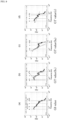
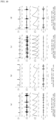
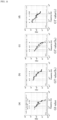
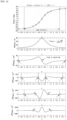
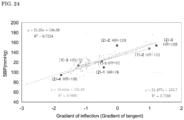
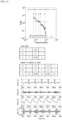
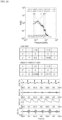
- FIG. 27 to FIG. 32 illustrate the calculation results of the GIGT values and time waveforms of ECGs, PCGs, PPGs, and RCs of both subjects illustrated in FIG. 24 to FIG. 26 .
- a compensation mechanism worked on a high arterial pressure, a stroke volume increased, and the amplitude of PPG became about twice that in the resting state.
- HR and SBP both decreased, but the amplitude of PPG remained twice that in the resting state.
- a reflected wave also increased, which indicates a possibility that the blood pressure decreased due to vasodilation.
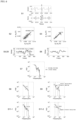
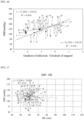
- FIG. 34 is an SBP-HR correlation chart where a difference between distribution states in a resting state and a state after the cancellation of the exercise load are shown.
- the gray point group is data in the resting state, and the point group in darker color than the gray point group and the point group larger in diameter irrespective of the color depth are data after the cancellation of the exercise load.
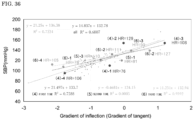
- FIG. 35 is an SBP-GIGT correlation chart where the data in the resting state and the exercise stress test are compared. It can be considered that combining FIGs. 33 to FIG. 36 makes it possible to find an overload resting state in the exercise stress test.
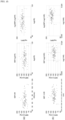
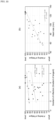
- FIG. 41(a) depicts trajectories of the variations in the three persons with a strong feeling of fatigue
- FIG. 41(b) depicts trajectories of the variations in the three persons with a weak feeling of fatigue.
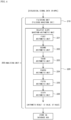
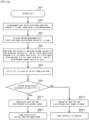
- FIG. 42 is a flowchart illustrating a method of searching for a blood pressure sudden change case by using GT 2
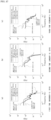
- FIG. 43 and FIG. 44 are charts illustrating graphs corresponding to steps S21 to S27-2 in FIG. 42 .
- GT 2 is first detected (S21).
- S22 a point where heart rate variability is large is identified based on RRI of an electrocardiogram
- S23 blood pressure measurement data
- GT 2 is calculated (S24).
- a point where the blood pressure is at its maximum value is set as GT 2+
- a point where the blood pressure is at its minimum value is set as GT 2-
- an average value of the blood pressures during six-minute measurement time is set as a GI value.
Landscapes
- Health & Medical Sciences (AREA)
- Life Sciences & Earth Sciences (AREA)
- Engineering & Computer Science (AREA)
- Public Health (AREA)
- Medical Informatics (AREA)
- General Health & Medical Sciences (AREA)
- Biomedical Technology (AREA)
- Physics & Mathematics (AREA)
- Animal Behavior & Ethology (AREA)
- Surgery (AREA)
- Cardiology (AREA)
- Molecular Biology (AREA)
- Pathology (AREA)
- Veterinary Medicine (AREA)
- Biophysics (AREA)
- Heart & Thoracic Surgery (AREA)
- Physiology (AREA)
- Neurology (AREA)
- Epidemiology (AREA)
- Primary Health Care (AREA)
- Acoustics & Sound (AREA)
- Vascular Medicine (AREA)
- Neurosurgery (AREA)
- General Business, Economics & Management (AREA)
- Computer Vision & Pattern Recognition (AREA)
- Artificial Intelligence (AREA)
- Psychiatry (AREA)
- Signal Processing (AREA)
- Physical Education & Sports Medicine (AREA)
- Databases & Information Systems (AREA)
- Business, Economics & Management (AREA)
- Data Mining & Analysis (AREA)
- Measuring Pulse, Heart Rate, Blood Pressure Or Blood Flow (AREA)
Applications Claiming Priority (2)
| Application Number | Priority Date | Filing Date | Title |
|---|---|---|---|
| JP2022072790 | 2022-04-26 | ||
| PCT/JP2023/016368 WO2023210668A1 (ja) | 2022-04-26 | 2023-04-25 | 生体状態評価装置、生体状態評価方法、コンピュータプログラム及び記録媒体 |
Publications (2)
| Publication Number | Publication Date |
|---|---|
| EP4516213A1 true EP4516213A1 (de) | 2025-03-05 |
| EP4516213A4 EP4516213A4 (de) | 2025-08-20 |
Family
ID=88519070
Family Applications (1)
| Application Number | Title | Priority Date | Filing Date |
|---|---|---|---|
| EP23796408.5A Pending EP4516213A4 (de) | 2022-04-26 | 2023-04-25 | Vorrichtung zur beurteilung eines biologischen zustands, verfahren zur beurteilung eines biologischen zustands, computerprogramm und aufzeichnungsmedium |
Country Status (4)
| Country | Link |
|---|---|
| US (1) | US20250268481A1 (de) |
| EP (1) | EP4516213A4 (de) |
| JP (1) | JPWO2023210668A1 (de) |
| WO (1) | WO2023210668A1 (de) |
Families Citing this family (1)
| Publication number | Priority date | Publication date | Assignee | Title |
|---|---|---|---|---|
| JP2026024118A (ja) * | 2024-08-01 | 2026-02-13 | 株式会社デルタツーリング | 血圧推定装置、コンピュータプログラム及び記録媒体 |
Family Cites Families (7)
| Publication number | Priority date | Publication date | Assignee | Title |
|---|---|---|---|---|
| CN204515353U (zh) * | 2015-03-31 | 2015-07-29 | 深圳市长桑技术有限公司 | 一种智能手表 |
| JP6885545B2 (ja) | 2018-01-13 | 2021-06-16 | 株式会社デルタツーリング | 血圧推定装置、血圧推定方法、コンピュータプログラム及び記録媒体 |
| KR102830100B1 (ko) * | 2018-12-21 | 2025-07-03 | 삼성전자주식회사 | 혈압 추정 장치 및 방법 |
| US10989523B2 (en) | 2019-03-14 | 2021-04-27 | The Boeing Company | Sub-surface patterning for diffraction-based strain measurement and damage detection in structures |
| JP7464219B2 (ja) | 2019-04-23 | 2024-04-09 | 株式会社サクラクレパス | 積層体及びインジケーター |
| EP3991664B1 (de) * | 2019-06-25 | 2025-08-13 | Delta Kogyo Co., Ltd. | Gesundheitsüberwachungsvorrichtung, computerprogramm, aufzeichnungsmedium und biosignalmessvorrichtung |
| US12165052B2 (en) * | 2019-10-18 | 2024-12-10 | Apple Inc. | Interpretable neural networks for cuffless blood pressure estimation |
-
2023
- 2023-04-25 EP EP23796408.5A patent/EP4516213A4/de active Pending
- 2023-04-25 US US18/859,701 patent/US20250268481A1/en active Pending
- 2023-04-25 JP JP2024517360A patent/JPWO2023210668A1/ja active Pending
- 2023-04-25 WO PCT/JP2023/016368 patent/WO2023210668A1/ja not_active Ceased
Also Published As
| Publication number | Publication date |
|---|---|
| US20250268481A1 (en) | 2025-08-28 |
| EP4516213A4 (de) | 2025-08-20 |
| WO2023210668A1 (ja) | 2023-11-02 |
| JPWO2023210668A1 (de) | 2023-11-02 |
Similar Documents
| Publication | Publication Date | Title |
|---|---|---|
| JP7634617B2 (ja) | 統合されたekg及びppgセンサを用いたインテリジェントパルス平均化を使用して静脈酸素飽和度を測定するシステム及び方法 | |
| US10117634B2 (en) | Acoustic and vibration information accumulation mechanism, acoustic and vibration sensing system, and computer program | |
| JP6097495B2 (ja) | 生体状態分析装置及びコンピュータプログラム | |
| CN109310347B (zh) | 生理和病理生理睡眠条件的非侵入性检测方法和装置 | |
| US7771364B2 (en) | Method and system for cardiovascular system diagnosis | |
| Tadi et al. | Seismocardiography: Toward heart rate variability (HRV) estimation | |
| US11937902B2 (en) | Blood pressure estimation device, blood pressure estimation method, computer program, and storage medium | |
| JP4625886B2 (ja) | 脈波解析法及び自律神経機能評価装置 | |
| EP3925525B1 (de) | Vorrichtung zur bestimmung physikalischer zustände, computerprogramm und aufzeichnungsmedium | |
| JP7607337B2 (ja) | 健康監視装置、コンピュータプログラム及び記録媒体 | |
| EP4516213A1 (de) | Vorrichtung zur beurteilung eines biologischen zustands, verfahren zur beurteilung eines biologischen zustands, computerprogramm und aufzeichnungsmedium | |
| EP3871593B1 (de) | Vorrichtung zur messung biologischer signale, inferenzvorrichtung für biologische zustände und inferenzsystem für biologische zustände | |
| US20230389814A1 (en) | Biological signal analysis device, computer program, and recording medium | |
| Solosenko et al. | Automatic extrasystole detection using photoplethysmographic signals | |
| WO2014132722A1 (ja) | 生体状態推定装置、コンピュータプログラム及び記録媒体 | |
| WO2024162226A1 (ja) | 循環動態変動指標算出装置、生理指標推定装置、コンピュータプログラム及び記録媒体 | |
| Sharan | ECG-derived respiration for sleep-wake stage classification | |
| JP2024004423A (ja) | 血圧推定装置、コンピュータプログラム及び記録媒体 | |
| Anisimov et al. | Comparison of heart rate derived from ECG and pulse wave signals during controlled breathing test for biofeedback systems | |
| Mayapur | Literature survey on heart rate variability and its various processing and analyzing techniques | |
| RU2289301C2 (ru) | Способ определения функционального состояния человека | |
| WO2025249580A1 (ja) | 生体状態推定装置、コンピュータプログラム及び記録媒体 | |
| 노승우 | APPLICATIONS OF NEW BALLISTOCARDIOGRAPH SYSTEMS-CONTINUOUS BLOOD PRESSURE ESTIMATION AND BIOMETRIC RECOGNITION | |
| Mignanelli et al. | Algorithm for automatic detection of the cardiovascular parameter PR-interval from LDV-velocity signals | |
| Pupo et al. | ECG-derived respiration in atrial fibrillation |
Legal Events
| Date | Code | Title | Description |
|---|---|---|---|
| STAA | Information on the status of an ep patent application or granted ep patent |
Free format text: STATUS: THE INTERNATIONAL PUBLICATION HAS BEEN MADE |
|
| PUAI | Public reference made under article 153(3) epc to a published international application that has entered the european phase |
Free format text: ORIGINAL CODE: 0009012 |
|
| STAA | Information on the status of an ep patent application or granted ep patent |
Free format text: STATUS: REQUEST FOR EXAMINATION WAS MADE |
|
| 17P | Request for examination filed |
Effective date: 20241120 |
|
| AK | Designated contracting states |
Kind code of ref document: A1 Designated state(s): AL AT BE BG CH CY CZ DE DK EE ES FI FR GB GR HR HU IE IS IT LI LT LU LV MC ME MK MT NL NO PL PT RO RS SE SI SK SM TR |
|
| DAV | Request for validation of the european patent (deleted) | ||
| DAX | Request for extension of the european patent (deleted) | ||
| A4 | Supplementary search report drawn up and despatched |
Effective date: 20250718 |
|
| RIC1 | Information provided on ipc code assigned before grant |
Ipc: A61B 5/021 20060101AFI20250714BHEP Ipc: A61B 5/024 20060101ALI20250714BHEP Ipc: A61B 5/00 20060101ALI20250714BHEP Ipc: A61B 7/04 20060101ALI20250714BHEP Ipc: G16H 20/30 20180101ALI20250714BHEP Ipc: G16H 40/63 20180101ALI20250714BHEP Ipc: G16H 50/30 20180101ALI20250714BHEP Ipc: A61B 5/16 20060101ALN20250714BHEP |