EP4516433A1 - Compositions d'alliages a base de titane - Google Patents
Compositions d'alliages a base de titane Download PDFInfo
- Publication number
- EP4516433A1 EP4516433A1 EP23194920.7A EP23194920A EP4516433A1 EP 4516433 A1 EP4516433 A1 EP 4516433A1 EP 23194920 A EP23194920 A EP 23194920A EP 4516433 A1 EP4516433 A1 EP 4516433A1
- Authority
- EP
- European Patent Office
- Prior art keywords
- titanium alloy
- alloy composition
- titanium
- total mass
- composition
- Prior art date
- Legal status (The legal status is an assumption and is not a legal conclusion. Google has not performed a legal analysis and makes no representation as to the accuracy of the status listed.)
- Pending
Links
Images




Classifications
-
- B—PERFORMING OPERATIONS; TRANSPORTING
- B23—MACHINE TOOLS; METAL-WORKING NOT OTHERWISE PROVIDED FOR
- B23K—SOLDERING OR UNSOLDERING; WELDING; CLADDING OR PLATING BY SOLDERING OR WELDING; CUTTING BY APPLYING HEAT LOCALLY, e.g. FLAME CUTTING; WORKING BY LASER BEAM
- B23K10/00—Welding or cutting by means of a plasma
- B23K10/02—Plasma welding
- B23K10/027—Welding for purposes other than joining, e.g. build-up welding
-
- C—CHEMISTRY; METALLURGY
- C22—METALLURGY; FERROUS OR NON-FERROUS ALLOYS; TREATMENT OF ALLOYS OR NON-FERROUS METALS
- C22C—ALLOYS
- C22C1/00—Making non-ferrous alloys
- C22C1/04—Making non-ferrous alloys by powder metallurgy
- C22C1/045—Alloys based on refractory metals
- C22C1/0458—Alloys based on titanium, zirconium or hafnium
-
- B—PERFORMING OPERATIONS; TRANSPORTING
- B22—CASTING; POWDER METALLURGY
- B22F—WORKING METALLIC POWDER; MANUFACTURE OF ARTICLES FROM METALLIC POWDER; MAKING METALLIC POWDER; APPARATUS OR DEVICES SPECIALLY ADAPTED FOR METALLIC POWDER
- B22F1/00—Metallic powder; Treatment of metallic powder, e.g. to facilitate working or to improve properties
- B22F1/05—Metallic powder characterised by the size or surface area of the particles
-
- B—PERFORMING OPERATIONS; TRANSPORTING
- B22—CASTING; POWDER METALLURGY
- B22F—WORKING METALLIC POWDER; MANUFACTURE OF ARTICLES FROM METALLIC POWDER; MAKING METALLIC POWDER; APPARATUS OR DEVICES SPECIALLY ADAPTED FOR METALLIC POWDER
- B22F10/00—Additive manufacturing of workpieces or articles from metallic powder
- B22F10/20—Direct sintering or melting
-
- B—PERFORMING OPERATIONS; TRANSPORTING
- B22—CASTING; POWDER METALLURGY
- B22F—WORKING METALLIC POWDER; MANUFACTURE OF ARTICLES FROM METALLIC POWDER; MAKING METALLIC POWDER; APPARATUS OR DEVICES SPECIALLY ADAPTED FOR METALLIC POWDER
- B22F3/00—Manufacture of workpieces or articles from metallic powder characterised by the manner of compacting or sintering; Apparatus specially adapted therefor ; Presses and furnaces
- B22F3/12—Both compacting and sintering
- B22F3/16—Both compacting and sintering in successive or repeated steps
-
- B—PERFORMING OPERATIONS; TRANSPORTING
- B22—CASTING; POWDER METALLURGY
- B22F—WORKING METALLIC POWDER; MANUFACTURE OF ARTICLES FROM METALLIC POWDER; MAKING METALLIC POWDER; APPARATUS OR DEVICES SPECIALLY ADAPTED FOR METALLIC POWDER
- B22F3/00—Manufacture of workpieces or articles from metallic powder characterised by the manner of compacting or sintering; Apparatus specially adapted therefor ; Presses and furnaces
- B22F3/18—Manufacture of workpieces or articles from metallic powder characterised by the manner of compacting or sintering; Apparatus specially adapted therefor ; Presses and furnaces by using pressure rollers
-
- B—PERFORMING OPERATIONS; TRANSPORTING
- B23—MACHINE TOOLS; METAL-WORKING NOT OTHERWISE PROVIDED FOR
- B23K—SOLDERING OR UNSOLDERING; WELDING; CLADDING OR PLATING BY SOLDERING OR WELDING; CUTTING BY APPLYING HEAT LOCALLY, e.g. FLAME CUTTING; WORKING BY LASER BEAM
- B23K35/00—Rods, electrodes, materials, or media, for use in soldering, welding, or cutting
- B23K35/02—Rods, electrodes, materials, or media, for use in soldering, welding, or cutting characterised by mechanical features, e.g. shape
- B23K35/0255—Rods, electrodes, materials, or media, for use in soldering, welding, or cutting characterised by mechanical features, e.g. shape for use in welding
- B23K35/0261—Rods, electrodes or wires
-
- B—PERFORMING OPERATIONS; TRANSPORTING
- B23—MACHINE TOOLS; METAL-WORKING NOT OTHERWISE PROVIDED FOR
- B23K—SOLDERING OR UNSOLDERING; WELDING; CLADDING OR PLATING BY SOLDERING OR WELDING; CUTTING BY APPLYING HEAT LOCALLY, e.g. FLAME CUTTING; WORKING BY LASER BEAM
- B23K35/00—Rods, electrodes, materials, or media, for use in soldering, welding, or cutting
- B23K35/22—Rods, electrodes, materials, or media, for use in soldering, welding, or cutting characterised by the composition or nature of the material
- B23K35/24—Selection of soldering or welding materials proper
- B23K35/32—Selection of soldering or welding materials proper with the principal constituent melting at more than 1550°C
- B23K35/325—Ti as the principal constituent
-
- B—PERFORMING OPERATIONS; TRANSPORTING
- B33—ADDITIVE MANUFACTURING TECHNOLOGY
- B33Y—ADDITIVE MANUFACTURING, i.e. MANUFACTURING OF THREE-DIMENSIONAL [3D] OBJECTS BY ADDITIVE DEPOSITION, ADDITIVE AGGLOMERATION OR ADDITIVE LAYERING, e.g. BY 3D PRINTING, STEREOLITHOGRAPHY OR SELECTIVE LASER SINTERING
- B33Y10/00—Processes of additive manufacturing
-
- B—PERFORMING OPERATIONS; TRANSPORTING
- B33—ADDITIVE MANUFACTURING TECHNOLOGY
- B33Y—ADDITIVE MANUFACTURING, i.e. MANUFACTURING OF THREE-DIMENSIONAL [3D] OBJECTS BY ADDITIVE DEPOSITION, ADDITIVE AGGLOMERATION OR ADDITIVE LAYERING, e.g. BY 3D PRINTING, STEREOLITHOGRAPHY OR SELECTIVE LASER SINTERING
- B33Y70/00—Materials specially adapted for additive manufacturing
-
- C—CHEMISTRY; METALLURGY
- C22—METALLURGY; FERROUS OR NON-FERROUS ALLOYS; TREATMENT OF ALLOYS OR NON-FERROUS METALS
- C22C—ALLOYS
- C22C14/00—Alloys based on titanium
-
- B—PERFORMING OPERATIONS; TRANSPORTING
- B22—CASTING; POWDER METALLURGY
- B22F—WORKING METALLIC POWDER; MANUFACTURE OF ARTICLES FROM METALLIC POWDER; MAKING METALLIC POWDER; APPARATUS OR DEVICES SPECIALLY ADAPTED FOR METALLIC POWDER
- B22F2201/00—Treatment under specific atmosphere
- B22F2201/10—Inert gases
-
- B—PERFORMING OPERATIONS; TRANSPORTING
- B22—CASTING; POWDER METALLURGY
- B22F—WORKING METALLIC POWDER; MANUFACTURE OF ARTICLES FROM METALLIC POWDER; MAKING METALLIC POWDER; APPARATUS OR DEVICES SPECIALLY ADAPTED FOR METALLIC POWDER
- B22F2301/00—Metallic composition of the powder or its coating
- B22F2301/20—Refractory metals
- B22F2301/205—Titanium, zirconium or hafnium
-
- B—PERFORMING OPERATIONS; TRANSPORTING
- B22—CASTING; POWDER METALLURGY
- B22F—WORKING METALLIC POWDER; MANUFACTURE OF ARTICLES FROM METALLIC POWDER; MAKING METALLIC POWDER; APPARATUS OR DEVICES SPECIALLY ADAPTED FOR METALLIC POWDER
- B22F2304/00—Physical aspects of the powder
- B22F2304/10—Micron size particles, i.e. above 1 micrometer up to 500 micrometer
-
- B—PERFORMING OPERATIONS; TRANSPORTING
- B22—CASTING; POWDER METALLURGY
- B22F—WORKING METALLIC POWDER; MANUFACTURE OF ARTICLES FROM METALLIC POWDER; MAKING METALLIC POWDER; APPARATUS OR DEVICES SPECIALLY ADAPTED FOR METALLIC POWDER
- B22F2998/00—Supplementary information concerning processes or compositions relating to powder metallurgy
- B22F2998/10—Processes characterised by the sequence of their steps
-
- B—PERFORMING OPERATIONS; TRANSPORTING
- B22—CASTING; POWDER METALLURGY
- B22F—WORKING METALLIC POWDER; MANUFACTURE OF ARTICLES FROM METALLIC POWDER; MAKING METALLIC POWDER; APPARATUS OR DEVICES SPECIALLY ADAPTED FOR METALLIC POWDER
- B22F2999/00—Aspects linked to processes or compositions used in powder metallurgy
-
- B—PERFORMING OPERATIONS; TRANSPORTING
- B23—MACHINE TOOLS; METAL-WORKING NOT OTHERWISE PROVIDED FOR
- B23K—SOLDERING OR UNSOLDERING; WELDING; CLADDING OR PLATING BY SOLDERING OR WELDING; CUTTING BY APPLYING HEAT LOCALLY, e.g. FLAME CUTTING; WORKING BY LASER BEAM
- B23K2103/00—Materials to be soldered, welded or cut
- B23K2103/08—Non-ferrous metals or alloys
- B23K2103/14—Titanium or alloys thereof
Definitions
- the present invention relates to titanium alloy compositions suited for manufacturing components by additive manufacturing, resulting in components that exhibit relatively small prior ⁇ -grain sizes.
- Structured metal parts made of titanium or titanium alloys conventionally have been made by casting, forging or machining from a billet. These techniques have several disadvantages, such as high material use of the expensive titanium metal and large lead times in the fabrication of the metal component. Casting, which often can be used for production of a potentially near-net-shape component, typically has a reduced material quality due to lack of control of solidification and cooling rates. Tooling costs and the inability to prepare components with complex shapes are additional disadvantages of the conventional methods.
- Fully dense physical components can be made by additive manufacturing, a manufacturing technology also known as rapid prototyping, rapid manufacturing, free form fabrication and layered manufacturing.
- Additive manufacturing prepares near-net-shape products by consecutive layering of materials one layer at a time to yield the three-dimensional component. This is opposed to subtractive manufacturing, in which a billet or block of material is worked by removing material in order to produce the final product.
- thermo-mechanical processing it is desirable in additive manufacturing to match the material properties achieved by conventional thermo-mechanical processing methods such as forging.
- thermo-mechanical processing the material properties are in most cases a result of the refined grain structures achieved by recrystallization induced by the plastic deformation of the mechanical forming steps.
- This mechanism is not available in a typical additive manufacturing process, where molten material is added in layers, solidifies and cools down without any mechanical forming. This typically results in coarse as-solidified grain structures. In many alloys the resulting structures will also be elongated with a high aspect ratio. This is due to the directional heat extraction provided by the relatively colder workpiece as superheated molten metal is added. Solidification initiates from the previously deposited layer(s) and propagates up into the deposited material as it cools down. The solidification structures will in many cases extend across several layers, up to several centimeters in size. These characteristics are typically detrimental to mechanical properties, giving rise to reduced and/or anisotropic strength, elongation and fatigue performance.
- Prior techniques for improving as-deposited grain structure include, for example, utilization of a hybrid process where each deposited layer is plastically deformed to achieve a recrystallized grain structure has been applied to reduce distortion and improve mechanical properties (see U.S. Pat. Ap. Pub. No. US2015/0360289, Liou et al. (2015 )). Such intermediate forming steps, however, give a reduced effective deposition rate (negatively impacting productivity), and can limit the freedom of fabrication in terms of the ability to form complex shapes.
- Other techniques include inter-layer laser peening and ultrasonic impact treatment, such as described in International Pat. Appl. WO 2013140147 A1 (Wescott et al. (2013 )), inter-layer cold rolling, such as described in European Pat. App. Pub.
- EP2962788 A1 Liou et al. (2016 )
- forced cooling of the as-solidified layer during cooling of the solidified metal in preparation for laser or ultrasonic impact treatment to reduce thermal distortion and refine grain structures as a result of recrystallization see U.S. Pat. App. Pub. No. US2015/0041025, Wescott et al. (2015 )
- Physically working the solidified surface of a work product has resulted in varying degrees of success, and the processes can be complex and expensive due to the need for special equipment. Further, for the methods that physically work the deposited layer, contaminations from tooling will be a concern since any contaminations can get enclosed between layers of the final product in an additive manufacturing process. Physically working the product also adds processing time, thereby reducing productivity.
- US 2013/0174944 A1 discloses titanium alloys designed for additive manufacturing designed to achieve an equiaxed grain structure, comprising by weight about 3.0% to about 6.0% aluminum, 0% to about 1.5% tin, about 2.0% to about 4.0% vanadium, about 0.5% to about 4.5% molybdenum, about 1.0% to about 2.5% chromium, about 0.20% to about 0.55% iron, 0% to about 0.35% oxygen, 0% to about 0.007% boron, and 0% to about 0.60% other incidental elements and impurities.
- US 2021/0238712 A1 discloses titanium alloys with 2-20 wt% of Fe, Ni and or Cu added to achieve equiaxed grain structure.
- US 2004/0136859 discloses a titanium alloy containing 0.01-5 wt %, preferably 0.1-3 wt %, of bismuth, based on the weight of bismuth and the titanium alloy being suitable for making a dental casting or a medical implant by casting.
- JPH 05279773 discloses adding 0.1 to 0.8 wt% O and 0.001 to 0.5 wt% of one or more of P, As, Sb, Bi, S, Se, Te, and B to titanium alloys of ⁇ -type, ⁇ + ⁇ -type and ⁇ -type, that the alloys have a uniform fine structure with improved strength at room temperature and high temperature.
- the main objective of the invention is the provision of titanium alloys suited for being applied in direct energy deposition additive manufacturing of components having isotropic high-strength mechanical properties.
- the invention is based on a discovery, believed to be novel, of that aluminum and molybdenum based titanium alloys obtain a significant grain refinement effect of the as-solidified grain structure with an addition of bismuth, making the titanium alloys especially suited for use in additive manufacturing of components with high mechanical strength.
- the term "remaining wt% Ti” as used herein means that the amount of titanium in the alloy composition is determined in accordance with the content of the other constituents in the composition to make the total content of constituents sum up to 100 wt%. I.e., the content of titanium in the composition fills the "available space" in the composition left by the other constituents. For example, if an alloy composition according to the invention contains 6 wt% Al, 3 wt% Mo, 1 wt% Bi, 1 wt% impurities, and 3 wt% of an optional alloying element, the content of Ti including unavoidable impurities is 86 wt% since the total content of other constituents adds up to 14 wt%.
- exemplary embodiments are directed to refinement of solidification structures in additive manufacturing by providing a weldable titanium alloy wire made of an Al and Mo containing Ti alloy that includes small additions of the low surface tension metal Bi.
- the addition of surface active element, such as Bi in such titanium alloy for additive manufacturing is shown empirically to promote grain nucleation, presumably due to reduction of liquid-solid interfacial energy which can lead to a reduced barrier for nuclei formation and growth, along with enhancement of surface tension driven melt pool flow.
- the content of aluminium in either the first, or the second, or the third alloy composition according to the first aspect of the invention may be from 3 to 6.75 wt%, preferably from 4 to 6.5 wt%, more preferably from 5 to 6.25 wt%, and most preferably from 5.9 to 6.1 wt% based on the total mass of the titanium alloy composition.
- the content of molybdenum in the first alloy composition of the first aspect of the invention may be from 1.75 to 5.5 wt%, preferably from 2 to 5 wt%, more preferably from 2.25 to 4 wt%, more preferably from 2.5 to 3.5 wt%, and most preferably from 2.9 to 3.1 wt%, and/or the total content of molybdenum and vanadium in the second alloy composition may be from 2 to 5.5 wt%, preferably from 2.5 to 5 wt%, more preferably from 3 to 4.5 wt%, more preferably from 3.25 to 4.0 wt%, and most preferably from 3.4 to 3.6 wt%, and wherein the weight percentages are based on the total mass of the titanium alloy composition.
- the content of bismuth in either the first, or the second, or the third alloy composition according to the first aspect of the invention may be from 0.3 to 1.4 wt%, preferably from 0.35 to 1.3 wt%, more preferably from 0.4 to 1.2 wt%, more preferably from 0.45 to 1.1 wt%, more preferably from 0.5 to 1 wt%, more preferably from 0.6 to 0.9 wt%, and most preferably from 0.7 to 0.8 wt% based on the total mass of the titanium alloy composition.
- the total content of one or more elements selected from the group of beta eutectoid stabilizers; Fe, Cr, Co, Cu, Ni, Mn, W, B, and Si in either the second or the third alloy composition according to the first aspect of the invention may be in the range from 0.4 to 1.4 wt%, preferably from 0.5 to 1.3 wt%, more preferably from 0.6 to 1.2 wt%, more preferably from 0.7 to 1.1 wt%, and most preferably from 0.8 to 1.0 wt%, based on the total mass of the titanium alloy composition.
- the combination of Bi and one or more of the above range extending elements is shown empirically to result in a substantial refinement of prior ⁇ -grain size.
- the content of oxygen in either the first, or the second, or the third alloy composition according to the first aspect of the invention may contain less than 0.5 wt%, preferably less than 0.4 wt%, more preferably less than 0.3 wt%, more preferably less than 0.2 wt%, and most preferably between 0.06 and 0.18 wt%, based on the total mass of the alloy composition.
- the titanium alloy composition comprises or consists of 6 wt% Al, 3 wt% Mo, 0,6 wt% Bi, and 0.6 wt% Fe, the rest is Ti and unavoidable impurities, wherein the weight percentages are based on the total mass of the titanium alloy composition.
- the first and/or second and/or third alloy composition according to the first aspect of the invention may further comprise a total amount of from 0.1 to 5.0 wt% Sn and/or from 0.1 to 6.0 wt% Zr, based on the total mass of the titanium alloy composition.
- unavoidable impurities refers to any unintended constituent and/or element being present in the alloy compositions, typically originating from the upstream processing and/or the raw materials applied in manufacturing the titanium and/or the alloy constituents of the alloy composition.
- alloy compositions provided herein allow refinement of the solidification structures during metal additive manufacturing to achieve products with improved material quality, particularly having more equiaxed as-solidified grain structure. These refined grain structures can result in increased strength, fatigue resistance, ductility and isotropic properties of additive manufactured components.
- Exemplary embodiments of the alloy composition according to the first aspect of the invention can provide grain refinement in metal articles of titanium produced by additive manufacturing without the need for modification of the manufacturing process.
- the resulting grain structure of the deposited material can have comparable aspect ratio and homogeneity approaching that of mechanically worked titanium alloys.
- Some embodiments can exhibit a significantly reduced average grain size compared to typical cast or additively manufactured materials.
- the reduced barrier for grain formation provided by the Bi-addition, optionally combined with one or more of the solidification range extending elements Fe, Cr, Co, Cu, Ni, Mn, W, B and Si, can result in solidification structure refinement by simply applying the alloy composition in an additive manufacturing process which involves melting and subsequent layered metal deposition of the alloy.
- the alloy composition according to the first aspect of the invention is provided in the form of a welding wire.
- Exemplary alloy compositions in the form of a weldable wire can provide a practical way to achieve significant refinement of metal structure of the titanium alloy components made by metal additive manufacturing, resulting in grains that in most cases can be similar to or somewhat coarser than typical mechanically worked titanium metals, and can be of comparable aspect ratio and homogeneity.
- Embodiments of the alloy composition can achieve solidification refinement without negatively impacting deposition productivity.
- the alloy compositions of the first aspect of the invention can be used with most melting tools.
- said alloy compositions can be used preferably with plasma arc torches and inert gas atmospheres due to evaporation and volatility associated with the low melting point additives in high intensity laser processes and electron beam processes performed in a vacuum.
- the alloy compositions of the first aspect of the invention can be used with any metal additive manufacturing process, including plasma and wire-based processes, and electron beam and laser systems, and combinations thereof.
- Exemplary embodiments in the form of a welding wire can be particularly suitable for high deposition rate processes where solidification grain structures can be very coarse.
- feedstocks for metal additive manufacturing where the feedstocks are a titanium alloy including the low surface tension element Bi, optionally in combination with one or more elements that increase solidification range.
- the feedstock can be in the form of a titanium alloy powder or a titanium alloy wire.
- the invention relates to a welding wire made of a titanium alloy composition according to the first aspect of the invention.
- the welding wire may have a nominal diameter in the range from 0.5 to 10.0 mm, preferably from 0.7 to 5.0 mm, more preferably from 0.8 to 2.5 mm, more preferably from 0.9 to 2.0 mm, more preferably from 1.0 to 1.8 mm, and most preferably from 1.2 to 1.6 mm.
- the welding wire can be prepared using any conventional method.
- One method can include production of a bar stock or billet.
- the bar stock or billet can be rolled to a diameter typically less than about 10 mm to 15 mm.
- the rolled bar stock or billet can be drawn to final size having a targeted diameter for use in the additive manufacturing process.
- Alternative methods of producing a titanium welding wire can involve production through a solid state processing.
- the process can include powder compaction and sintering prior to hot working without intermediate melting of titanium sponge.
- the weldable titanium wire can be produced from titanium sponge by processing solely in the solid state without melting occurring to any of the constituents at any time during processing.
- the invention relates to a powder made of a titanium alloy composition according to the first aspect of the invention.
- the titanium alloy powder can be produced using any know method.
- the titanium alloy powder can be produced via gas atomization, water atomization, plasma atomization, centrifugal atomization, plasma rotation electrode process, or any combination thereof.
- the resulting titanium alloy powders can have an irregular shape or can be spherical, or a combination thereof.
- the titanium alloy powder particles can have a smooth or rough surface.
- the particles of the titanium alloy powder can have a nominal particle size distribution of from 15 ⁇ m to 200 ⁇ m, as determined by laser diffraction analysis according to standard ISO 13320:2020.
- the invention relates to a method for manufacturing a three-dimensional component made of a titanium alloy, characterised in that the method comprises forming the three-dimensional component by an additive manufacturing process applying a titanium alloy according to the first aspect of the invention.
- the additive manufacturing process may advantageously comprise:
- the method according to the invention may advantageously further comprise using two melting tools, a first melting tool to preheat at least a portion of a surface of the base material; and a second melting tool to heat and melt a weldable wire according to the second aspect of the invention, such that molten titanium alloy material is deposited onto the preheated area of the base material forming a liquid molten pool.
- the base material can be moved relative to the position of the first and second heating devices in a predetermined pattern such that the successive deposits of molten titanium alloy material solidifies and forms the three-dimensional component.
- the feedstock may be a welding wire according to the second aspect of the invention
- the second melting tool may be a plasma transferred arc torch (PTA) applied to heat and melt the welding wire above the deposition area of the base material.
- PTA plasma transferred arc torch
- both the first and second melting tools are a plasma transferred arc torch (PTA).
- PTA plasma transferred arc torch
- FIG 6 An example embodiment applying two melting tools are drawn schematically in figure 6 .
- the figure shows a holding substrate 1, e.g. made of a Ti-6Al-4V alloy, onto which a three-dimensional object is to be formed by solid freeform fabrication.
- the figure displays the initial part of the deposition process where a first welding stripe 2 of the titanium alloy is being shaped.
- a wire 3 made of the titanium alloy according to first aspect of the invention is continuously being supplied by a wire feeder 4 which positions the wire 3 such that its distal end is located above the molten pool 5 at the deposition area on the holding substrate 1.
- the wire 3 is given a velocity indicated by the upper arrow on the Figure which corresponds to the heating and melting rate of the distal end such that droplets 6 of molten wire are continuously being supplied to the molten pool 5.
- a first plasma transferred arc 7 is formed by the first melting tool (PTA-torch 8) which is electrically connected to a DC power source 9 such that the electrode 10 of the PTA-torch becomes the cathode and the holding substrate 1 the anode.
- the first plasma transferred arc 7 heats the deposition area and assists in forming the molten pool 5.
- the PTA-torch 8 may be a gas tungsten arc welding (GTAW) torch equipped with a magnetic arc deflector (not shown) to control the size and position of the arc 8.
- GTAW gas tungsten arc welding
- a second plasma transferred arc 11 is formed by the second melting tool (PTA-torch 12) which is electrically connected to a DC power source 13 such that the electrode 14 of the PTA-torch 12 becomes the cathode and the feed wire 3 the anode.
- the plasma transferred arc 11 is continuous and directed to heat and melt the distal end of the wire 3.
- the effect of the DC power source 13 may advantageously be regulated to maintain a heating and melting rate in accordance with the feeding velocity of the wire 3 such that the formation of the droplets 6 are timed to maintain a continuous drip of molten wire into the molten pool 5.
- the surface active element can reduce the liquid-solid interfacial energy and therefore reduce the barrier for grain nucleation and growth during solidification.
- the surface active element can enhance surface tension-driven flow in the melt pool that affects solidification by influencing thermal gradients in the melt and at the solid-liquid interface.
- the surface active element can promote fragmentation in the partially solidified mushy zone.
- the surface active element can contribute to increased constitutional undercooling due to extension of the solidification range to provide an increased growth restriction factor.
- the methods also can contain a step of including in the weldable wire an element that promote additional constitutional undercooling by extending the alloy's freezing range. This can further increase the tendency for grain nucleation and refinement. It is important to limit such additions in order to avoid detrimental segregation and solidification flaws in the final product.
- the combination with Bi allows for significant grain refinement without such detrimental effects.
- the element that promotes constitutional undercooling can be selected from the group categorized as eutectoid beta-stabilizing solutes. The relevant elements of this group are consisting of Fe, Cr, Co, Cu, Ni, Mn, W, B and Si.
- the methods also can contain a step of including in the weldable wire an elements that promote alpha stabilization.
- An exemplary element that promotes alpha stabilization is Al. Elements in this group also contribute to increased strength due to solid-solution hardening. Another element that can be included to provide further solid solution strengthening is Si.
- the methods provided herein can yield a three-dimensional component having an average grain size reduced by a factor of at least 2 and preferably at least 5 compared to a grain size of a three-dimensional component prepared using a titanium alloy feedstock from alloy Ti-6A1-4V or other conventional weldable ⁇ - ⁇ Titanium alloys that does not include a surface active element in an additive manufacturing process.
- the invention may relate to the use of a titanium alloy according to the first aspect of the invention in an additive manufacturing process
- the titanium alloy may in a further embodiment preferably be in the form of a welding wire according to the second aspect of the invention, or a powder according to the fourth aspect of the invention.
- ranges and amounts can be expressed as “about” a particular value or range. “About” also includes the exact amount. Hence “about 5 percent” means “about 5 percent” and also “5 percent.” “About” means within typical experimental error for the application or purpose intended.
- wt% refers to weight percent, sometimes referred to as w/w, and is the percent of the total mass of the composition that is one component. Weight percent also can be expressed as 100 ⁇ the weight fraction of a component in a composition. The sum of the wt% of all of the components in a composition equals 100.
- an optional component in a system means that the component may be present or may not be present in the system.
- any element so conjoined means “either or both” of the elements so conjoined, i.e., elements that are conjunctively present in some cases and disjunctively present in other cases. Multiple elements listed with “and/or” should be construed in the same fashion, i.e., "one or more" of the elements so conjoined. Other elements may optionally be present other than the elements specifically identified by the "and/or” clause, whether related or unrelated to those elements specifically identified.
- a reference to "A and/or B", when used in conjunction with open-ended language such as “comprising” can refer, in one embodiment, to A only (optionally including elements other than B); in another embodiment, to B only (optionally including elements other than A); in yet another embodiment, to both A and B (optionally including other elements); etc.
- a "combination" refers to any association between two items or among more than two items.
- the association can be spatial or refer to the use of the two or more items for a common purpose.
- additive manufacturing is also known as “additive fabrication” and “additive layer manufacturing” and refers to an additive process implementing the manufacturing, layer after layer, of a component.
- the component can be manufactured from a 3D model data.
- a titanium alloy source such as wire or powder, can be used.
- An energy source such as a plasma arc, laser, electron beam, or a combination thereof can be used to melt the titanium alloy source.
- additive manufacturing system refers to the machine used for additive manufacturing.
- a "weldable wire” refers to wire of a titanium alloy material to be melted under the additive manufacturing conditions to form a designed component.
- the weldable wire can be a long, narrow wire-like structure.
- the weldable wire can be provided as a coil wrapped around a spool.
- the weldable wire can be a shorter, typically linear, structure. They can be provided as a welding rod or a welding electrode.
- the weldable wire can be in the form of a narrow elongated wire that can a nominal diameter in the range from 0.025 inches to 0.5 inches. It can have a length of at least 10 feet.
- the welding wires can have a nominal diameter selected from 1/32, 1/16, 1 ⁇ 8, 1 ⁇ 4, 3 ⁇ 8 and 1 ⁇ 2 inches, or a nominal diameter of from about 0.5 mm to 15 mm.
- Such wires can have lengths of at least 10 feet, at least 20 feet, at least 100 feet or at least 1000 feet. They can be spooled. In the case of larger diameter rods, with diameters of for example 5-15mm, the total length can be just a few inches, for example about 3 inches to 1 foot in length.
- a "Plasma Arc Welding torch” or “PAW torch” refers to a welding torch that can be used in plasma arc welding.
- the torch can be designed so that a gas can be heated to a high temperature to form plasma and can become electrically conductive. The plasma then can transfer an electric arc to a workpiece. The intense heat of the arc can melt metal and/or fuse two pieces of metal together.
- a PAW torch can include a nozzle for constricting the arc thereby increasing the power density of the arc.
- the plasma gas can be a noble gas.
- the plasma gas can be argon.
- the PAW torch can have an outer nozzle for providing a shielding gas.
- the shielding gas can be argon, helium or combinations thereof.
- a shielding gas can assist in reducing oxidation of the molten metal.
- PAW torches can include plasma transferred arc torches.
- plasma transferred arc torch or "PTA torch” as used interchangeably herein refers to any device able to heat and excite a stream of inert gas to plasma by an electric arc discharge and then transfer the flow of plasma gas including the electric arc out through an orifice (such as a nozzle) to form a constricted plume that extends out of the orifice and transfers the intense heat of the arc to a target region.
- Plasma gas can be fed along an electrode and ionized and accelerated in the vicinity of a cathode.
- the arc can be directed towards the workpiece and is more stable than a free burning arc (such as in a TIG torch).
- Current typically goes up to 400 A, and voltage typically is in the range of about 25 - 35 V.
- base material refers to the target material for the heat from a melting tool and on which a molten pool can be formed.
- the melting tool can be a PAW torch, a PTA torch, a laser device, an electron beam, or any combination thereof.
- a base material can be the holding substrate when depositing the first layer of titanium alloy material. When one or more layers of titanium alloy material have been deposited onto the holding substrate, the base material can be the upper layer of deposited titanium alloy material that is to have deposited a new layer of titanium alloy material.
- design model or “computer assisted design model” or “CAD-model” as used interchangeably herein refers to any known or conceivable virtual vectorized layered three-dimensional representation of a component that is to be formed by an additive manufacturing process.
- the model may, for instance, be obtained by forming a virtual vectorized layered model of the three-dimensional component by first dividing the component into a set of virtual parallel layers and then dividing each of the parallel layers into a set of virtual quasi one-dimensional pieces that can be used by the controller of the additive manufacturing system to form the component via layers of metal deposited or fused according to the virtual parallel layers.
- a "computer” can include, but is not limited to, hardware and/or software, which can capture and/or store data, and any program that can be programed to communicate with and/or control one or more electronic devices or software controlling mechanical devices.
- the computer can include non-transitory computer-readable medium that can include, but is not limited to, CD-ROM, removable flash memory card, a hard disk drive, or a magnetic tape.
- computer memory refers to a configurable storage element capable of storing digital data or information that may be acquired by a computer.
- inert atmosphere refers to any known or conceivable gas or gaseous mixture containing less than 1% oxygen in order to reduce or prevent oxidation.
- the inert atmosphere can be non-reactive.
- the inert atmosphere can be non-oxidizing.
- the inert atmosphere can protect the component from exposure to oxygen or being subject to oxidation or other unwanted chemical action from constituents of the ambient atmosphere.
- Exemplary inert atmospheres include one or more noble gases.
- the inert atmosphere can include argon, helium, neon, xenon, or a combination thereof.
- muscle zone refers to a region adjacent to a liquid solid interface where a liquid phase and solid phase co-exist during solidification.
- microstructure refers to the internal crystallite structure of an alloy over distances from about 1 micron to about 1 mm, which can include the location, shape, size, and relative amounts of grains and metallurgical phases in the metal. It can include the three-dimensional arrangement of grains or metallurgical phases.
- microstructure refers to the internal crystal grain structure, or multiple crystallographically related microstructural elements of an alloy over distances from about greater than 0.5 mm to about 100 mm, which can include the location, shape, size, and relative amounts of the elements that comprise the materials internal structure on a macroscopic scale.
- prior-beta grains the discrete regions that can be identified by looking at patterns in the microstructure which reflect crystallographically related microstructures in addition to elongated continuous grains that are present at most boundaries between prior-beta grains.
- surface active refers to a chemical element that lowers the surface tension (or interfacial tension) between a gas and a liquid or between a liquid and a solid.
- range includes all values therein and all subranges therein.
- range includes 1 and 10 and all values between 1 and 10, such as, e.g., 1.1, 2.5, 3.333, 6.26, 7.9989, etc., and includes all subranges therebetween, such as for example, 1 to 3.5, 2.75 to 9.33, 1.5 to 9.999, etc.
- Ti alloy compositions that can exhibit refined solidification structures when used to fabricate a component using a melting- and fusion based additive manufacturing process.
- the Ti alloy feedstock composition can be in the form of a powder, wire, rod, ribbon, or a combination thereof.
- the Ti alloy feedstock composition can be a weldable wire.
- the addition of one or a combination of a surface active elements can reduce the interfacial energy barrier for nucleation during solidification of the as-deposited Ti alloy material.
- the Ti alloy composition can include a surface active element Bi in combination with one or multiple elements selected from the group of beta eutectoid stabilizers that will increase solidification range, picked from the list: Fe, Cr, Co, Cu, Ni, Mn, W, B, and Si.
- An exemplary composition includes titanium or a titanium base alloy in combination with about 0.05 wt% to about 1.5 wt% Bi and 0,3 to 1.5 wt% Fe.
- Titanium melt has a high surface tension. This high surface tension can act as a barrier for nucleating grains. This can result in strong preference for epitaxial and columnar solidification, as the interfacial energy barrier is omitted when solidification proceeds from existing grains.
- FIG. 1A The schematic illustrates typical epitaxial growth that is exhibited by many conventional alloys when applied in additive manufacturing. It is a result of the preference for continued solidification to build upon the partially re-melted grains in the previous layer rather than forming new nuclei separate from the propagating solidification front.
- the nucleation resistance is related to the surface energy associated with forming new liquid-solid interfaces in the melt pool.
- Bi acts as a surface active element.
- Bi can enhance surface tension-driven flow in the melt pool that affects solidification by influencing thermal gradients in the melt and at the solid-liquid interface. The Bi can potentially contribute to refinement through fragmentation in the partially solidified mushy zone.
- the Bi can increase the tendency towards constitutional undercooling due to extension of the solidification range but is expected to contribute less through this mechanism compared to elements like Fe, Ni or Cu based on solute partitioning exhibited in established binary phase diagrams.
- the constitutional undercooling of a composition can be induced and increased by specifically including other elements that increase solidification range and provide an increased grain growth restriction in combination with one or more surface active elements. The presence of these other elements that increase solidification range can lead to a greater proportion of the solid clusters to overcome the nucleation barrier. Partitioning of elements can occur during solidification, which can increase or decrease the amount of the particular element in the liquid adjacent to the solid.
- a build-up of solutes at the solid-liquid interface can induce constitutional undercooling and contribute to nucleation at multiple sites rather than continued columnar grain growth.
- the degree of partitioning can be approximately proportional to grain growth restriction. Examples of elements that increase solidification range and provide an increased grain growth restriction are Fe, Ni and Cu. Particular care has to be taken with such addition to avoid too severe segregation, which can lead to material defects. It is therefore preferred to not rely entirely on this mechanism to achieve refinement, as this requires larger additions, typically above 1,5 wt%.
- the combination with surface active addition of Bi to increase potency of such solutes as Fe, Ni and Cu is therefore beneficial.
- a surface active element such as Bi
- a surface active element such as Bi
- elements selected from the group of beta eutectoid stabilizers such as Bi
- Fe, Cr, Co, Cu, Ni, Mn, W, B, and Si can result in refinement of solidification structures that substantially obviates one or more of the problems due to limitations and disadvantages of additive manufacturing using conventional alloys.
- the products yielded can have more equiaxed as-solidified grain structure.
- Manufactured products having these refined grain structures can demonstrate increased strength, fatigue resistance, ductility, or a combination thereof.
- Exemplary metal compositions containing Bi in combination with one or more elements selected from the group of beta eutectoid stabilizers; Fe, Cr, Co, Cu, Ni, Mn, W, B, and Si can result in metal layers deposited during an additive manufacturing process with a grain structure having a comparable aspect ratio and homogeneity to that typically present in mechanically worked metals and a significantly reduced average grain size compared to typical cast or additively manufactured materials.
- Exemplary metal compositions containing Bi in combination with one or more elements selected from the group of beta eutectoid stabilizers; Fe, Cr, Co, Cu, Ni, Mn, W, B, and Si can be provided in the form of a weldable wire.
- exemplary metal compositions can yield deposited metal layers that can include an alpha-beta titanium alloy that exhibits substantially refined solidification structure primarily due to the addition of Bi.
- the total amount of Bi that can be present in the titanium alloy composition can be from 0.3 to 1.4 wt%, preferably from 0.35 to 1.3 wt%, more preferably from 0.4 to 1.2 wt%, more preferably from 0.45 to 1.1 wt%, more preferably from 0.5 to 1 wt%, more preferably from 0.6 to 0.9 wt%, and most preferably from 0.7 to 0.8 wt%.
- embodiments of the titanium alloy compositions can include one or more elements that are known to increase the solidification range, generally belonging to the group eutectoid beta-stabilizing elements, chosen from the list Fe, Cr, Co, Cu, Ni, Mn, W, B and Si.
- the total amount of the one or a combination of two or more beta-stabilizing elements that can be present in a titanium alloy composition can be an amount of from 0.4 to 1.4 wt%, preferably from 0.5 to 1.3 wt%, more preferably from 0.6 to 1.2 wt%, more preferably from 0.7 to 1.1 wt%, and most preferably from 0.8 to 1.0 wt%, based on the total weight of the titanium alloy composition.
- a beta-stabilizing element belonging to the group isomorphous beta-stabilizing elements can stabilize the ⁇ -phase of titanium without significant increase in solidification range and allows the titanium or titanium alloy to maintain some of the beta phase in the final product.
- One or a combination of isomorphous beta-stabilizing elements can be used, picked from the list V, Mo, Nb and Ta.
- the total amount of the one or a combination of two or more beta-stabilizing elements that can be present in a titanium alloy composition can be an amount of from 1.75 to 5.5 wt%, preferably from 2 to 5 wt%, more preferably from 2.25 to 4 wt%, more preferably from 2.5 to 3.5 wt%, and most preferably from 2.9 to 3.1 wt% based on the total weight of the titanium alloy composition.
- the titanium alloy composition can include Al as an alpha-stabilizer.
- the total amount of A1 that can be present in the titanium alloy composition can be from 3 to 6.75 wt%, preferably from 4 to 6.5 wt%, more preferably from 5 to 6.25 wt%, and most preferably from 5.9 to 6.1 wt% based on the total weight of the titanium alloy composition.
- the addition of Bi to Ti or a Ti alloy has been found to effectively inhibit columnar solidification.
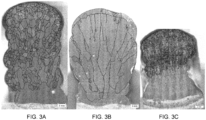
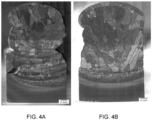
- columnar solidification was inhibited, transitioning from a primarily columnar morphology to a predominately equiaxed morphology. This is illustrated in FIG. 1B , and shown in FIGS. 2B , 3B and 4B .
- Columnar grains are largely eliminated in compositions containing Bi in a range from 0.5-1.0 wt%.
- the effect of Bi can be more pronounced when Fe is added, as illustrated in FIG. 2C and FIG. 3C .
- extending solidification range by addition of Fe can yield further solidification refinement.
- Exemplary titanium alloy compositions can be used in additive manufactured processes to produce products having potential for high strength, improved fatigue properties, isotropic material behavior, or a combination thereof, due to largely eliminating the presence of coarse columnar solidification structures and reducing the average prior beta-grain size by a factor of 10 or more compared to that achieved in titanium alloys that do not include these alloying additions.
- the exemplary titanium alloy compositions can be used to prepare a titanium alloy feed stock.
- the titanium alloy feedstock can be used in any additive manufacturing process that uses a titanium alloy feedstock.
- the titanium alloy feedstock can be in the form of a titanium alloy wire, titanium alloy ribbon, titanium alloy rod, titanium alloy powder or a combination thereof.
- the heat source of an additive manufacturing process can be used to melt the feedstock.
- the heat source can be a plasma arc, a laser beam, an electron beam, or any combination thereof.
- Exemplary titanium alloy compositions when used in an additive manufacturing process can yield components that can exhibit higher strength, improved fatigue properties and isotropic material behavior due to largely eliminating the presence of coarse columnar solidification structures that typically are produced in additive manufacturing processes.
- average prior beta-grain size can be reduced by a factor of 10 or more compared to conventional alloy compositions.
- Additional benefits of exemplary embodiments can include reduced tendency towards defects in additive manufacturing that are associated with high melt pool surface tension. This includes the "balling" phenomenon seen in powder bed selective laser sintering and similar processes.
- a reduction in melt pool surface tension can be beneficial for bead shape, wetting and fusion in any additive manufacturing process.
- the Bi-addition can be combined with elements that can increase solidification range and solute partitioning.
- elements that can increase solidification range and solute partitioning. Examples include Fe, Ni and Cu, alone or in any combination.
- Fe when Fe is included, the solid phase cannot dissolve as much Fe as the liquid from which the Fe originates. The Fe will therefore be displaced into the liquid ahead of the solidification front. This Fe enrichment can lead to a reduction in solidification temperature for the liquid adjacent to the solidification front. Solidification can therefore not proceed until this portion of liquid has cooled down further. Meanwhile, there is liquid further away from the solidification front that is not enriched with Fe. As the temperature drops, these regions can start solidifying, giving rise to multiple solidification zones and consequent refinement of structure.
- the titanium alloy compositions provided herein can include one or more inoculants.
- the inoculants can provide nucleation sites for grains to develop.
- examples of inoculants that can be included are TiB or TiB 2 , typically in an amount of from 0.05 to 0.5 wt%, and/or Y 2 O 3 typically in an amount of from 0.02 to 0.2 wt%, based on the total mass of the alloy composition. It is believed that in most conditions, TiB 2 is likely to be dissolved in the titanium alloy melt pool and not contribute as an inoculant but rather through its effect on solute partitioning and solidification range (similar to Fe, Ni and Cu).
- Exemplary titanium alloy compositions can contain an amount of oxygen in the range of from about 0.01 wt% to about 0.3 wt%, based on the total weight of the titanium alloy composition.
- the titanium alloy composition can contain an amount of oxygen in the range of from about 0.05 wt% to about 0.3 wt%, based on the total weight of the titanium alloy composition.
- Exemplary titanium alloy compositions can be provided as a weldable wire made by any conventional titanium alloy wire production process, including melting and ingot casting followed by a series of forming steps including for example billet forging, rolling and wire drawing.
- Additive manufacturing processes are known in the art. For example, see e.g. U.S. Pat. Nos. 5,745,834 (Bampton et al., 1998 ); 6,143,378 (Harwell et al., 2000 ); 7,326,377 (Adams, 2008 ); 8,994,592 (Scott et al., 2015 ); 9,064,671 (Ljungblad et al., 2015 ); 9,174,300 (Stecker et al., 2015 ); 9,175,568 (Ryan et al., 2015 ); 9,352,421 (Illston, 2016 ); 9,399,264 (Stecker, 2016 ); 9,481,931 (Stempfer, 2016 ); 9,522,426 (Das et al., 2016 ); 9,713,844 (Ackelid, 2017 ); 9,776,282 (Subramanian et al., 2017).
- Exemplary embodiments provide a method of making an additively manufactured metal component, the method can include (a) providing a metal feedstock that includes the above described titanium alloy compositions of the first aspect of the invention; (b) exposing at least a portion of the metal feedstock to an energy source for melting at least a portion of the metal feedstock to form molten metal; (c) depositing the molten metal on a substrate from a first start position to a first stop position to form a melt layer corresponding to the first virtual vectorized layered model of the component; (d) at least partially solidifying the melt layer, thereby generating a first metal layer of the additively manufactured metal component; (e) repositioning the substrate or the energy source or both to a start position of the next layer of virtual vectorized layered model of the component; and repeating steps (b) through (e) a plurality of times to generate a plurality of solid layers by sequentially solidifying a plurality of melt layers in an additive-manufacturing build direction.
- post-production a plurality
- Typical process conditions of additive manufacturing usually result in directional solidification and growth of columnar crystals due to the presence of steep thermal gradients, but this can be dependent on the alloy utilized.
- solidification is directional and epitaxial with spatial and crystallographic orientation of ⁇ -grains dictated by process characteristics that include a steep thermal gradient from heat source/melt pool to workpiece.
- Crystallography and morphology of ⁇ - ⁇ microstructures in Ti-6A1-4V alloy upon allotropic transformation are directly affected by the prior ⁇ -grain structure through orientation relationships, grain boundary nucleation and alignment caused by difference in interfacial energy, diffusion rates and thermal conductivity between different crystallographic directions in the lattice.
- This macro-micro interaction can lead to long ranging limitations of crystallographic and morphological diversity within prior ⁇ -grains, and thus pronounced differences in strain response across ⁇ -grain boundaries.
- the titanium alloy compositions containing the described alloying elements can be used as the metallic material or metal feedstock for building the component.
- the metal composition can result in a workpiece in which columnar grains are reduced.
- the metal composition can result in a workpiece that can contain a grain structure that is approximately equiaxed.
- the metal composition can result in a workpiece exhibiting a refined solidification structure.
- the presence of Bi and especially Bi in combination with Fe or other Beta-eutectoid element can result in increased crystallographic diversity in the workpiece.
- the component can be made by melting a titanium alloy feedstock that contains the described alloy elements into a layer of deposited metallic material onto a base material and fusing together successive deposits of metallic material.
- the methods can include using a heating device to heat and melt a portion of a metal feedstock that contains Bi such that molten metallic material is formed and is deposited onto a targeted area of the base material.
- the titanium alloy feedstock can be provided in the form of a weldable wire or a powder or a combination thereof.
- two heating devices can be used.
- a first heating device can be used to preheat at least a portion of the surface of the base material, e.g., at the position at which the metallic material is to be deposited.
- a second heating device can be used to heat and melt the weldable wire containing Bi such that molten metallic material from the melted weldable wire is deposited onto the preheated area of the base material.
- Each heating device can be separately controlled.
- Each heating device can be modulated to produce a separate temperature effect.
- the heating device(s) can include any device capable of providing sufficient energy to the weldable wire to melt the weldable wire into molten metallic material.
- the heating device(s) can include a torch (PAW, PTA, GMAW or MIG-type), an electron beam device, a laser device or any combination thereof.
- the heating devices can be the same, or they can differ from each other.
- a first torch can be used to pre-heat a target deposition area on the base material to form a preheated area.
- a second torch can be used to heat and melt the weldable wire. This can result in drops of molten metal falling into the preheated area of the target deposition area.
- a laser device can be used to pre-heat a target deposition area on the base material to form a preheated area
- a torch can be used to heat and melt a consumable electrode, resulting in drops of molten metal that fall into the preheated area of the target deposition area.
- a torch can be used to pre-heat a target deposition area on the base material to form a preheated area
- a laser device can be used to heat and melt the weldable wire, resulting in drops of molten metal that fall into the preheated area of the target deposition area.
- the first heating device can be a laser and the second heating device can be an electron beam.
- the first heating device can be an electron beam device, and the second heating device can be a laser. In some methods, the first heating device can be a torch and the second heating device can be an electron beam. In some methods, the first heating device can be an electron beam device, and the second heating device can be a torch.
- the methods provided herein can allow refinement of solidification structures in titanium alloy workpieces made by additive manufacturing processes.
- the methods can eliminate or significantly reduce the coarse columnar structures typically produced by conventional additive manufacturing methods and materials. Elimination of these coarse columnar structures can result in a manufactured product that can exhibit higher strength, ductility, fatigue resistance, or a combination thereof than achieved in conventional additive manufacturing processes.
- Cylindrical bolts with a diameter of 25 mm, a total mass per bolt of 600g and various chemical compositions were made by mixing crushed titanium sponge having a particle size distribution up to 0.5 mm. Crushed sponge was sieved through a 500 micron screen and mixed with 5.5 wt% Al, 0.26 wt% V, 3.18 wt% Mo and 0.58 wt% Bi each with an average particle size from 50 to 250 ⁇ m. The mixture was blended in a mixer until a substantially homogeneous composition was achieved. Approximately two hours is a typical mixing time.
- the bolts were then made by compacting an amount of the powder, approximately 600g per bolt, and subjecting the powder to a gradual increase in pressure. This resulted in a bolt with a density in the range from 92 to 96% of maximum theoretical density.
- the bolts were sintered at 1250 °C for 8 hours in an inert atmosphere.
- the compacted and sintered bolts with a diameter of about 25 mm were subject to several rolling steps to form a 14 mm diameter rod.
- Each rolling step was performed by stress relieving the extruded rod by heating it to a temperature of 600 °C with 15 min time at temperature, and then passing through a rolling step which decreased the diameter a certain percentage. This was repeated until the desired diameter was achieved.
- the rods were turned down to 12 mm diameter to remove surface oxide, then used directly as feedstock in a plasma and wire-based additive manufacturing system. Production of welding wire could be achieved by further reduction and wire drawing steps.
- the rolled rod was used in an additive manufacturing process using a plasma arc welding torch and stepwise feeding of the rod to melt and deposit droplets in a layered fashion. Columnar deposits with a diameter of approximately 15mm and height of up to 30 mm were produced. Between 6 and 10 layers where deposited, with one minute waiting time between each layer in order to mimic the typical process conditions of an additive manufacturing process. The previous layer was partially re-melted by the arc prior to deposition of the next layer. The welding current utilized on the transferred plasma arc was 150 A.
- the solid form test object was sectioned for metallographic inspection.
- a macrograph is shown in FIG. 2A .
- An overview image consisting of stitched micrographs with grains outlined is shown in FIG. 3A .
- the composition containing Bi resulted in a solid form test object in which columnar grains are minimized.
- the presence of Bi inhibited columnar solidification.
- the grain structure in the test object is approximately equiaxed and exhibits a refined structure.
- the mean grain size was measured in FIG.3A to 0.60 mm 2 .
- a comparative alloyed rod without Bi was prepared.
- the rod was made as described above in Example 1 by mixing crushed titanium sponge having a particle size distribution up to 0.5 mm with 5.41 wt% Al, 0.25 wt% V, 3.01 wt% Mo, each with an average particle size fraction from 50 to 250 ⁇ m.
- the solid form test object was sectioned for metallographic inspection.
- a macrograph is shown in FIG. 2B .
- An overview image consisting of stitched micrographs with grains outlined is shown in FIG. 3B .
- the composition that did not include Bi resulted in a solid form test object in which columnar grains are prominent. Columnar grain growth is visible across several deposited layers and the grain structure is coarse. The mean grain size was measured in FIG.3B to 8.76 mm 2 . This is approximately 15 times greater than the equivalent composition with Bi added.
- an alloyed rod was prepared according to the procedures outlined in Example 1, but with the following composition: 89.40 wt% Ti, 6.02 wt% Al, 4.01 wt% V, 0.57 wt% Fe. This constitutes a larger Fe addition than what is present in conventional Ti-6A1-4V which can have up to 0.25 wt% Fe.
- a macrograph is shown in FIG. 4B . As can be seen, addition of Fe alone to a Ti-6A1-4V alloy did not effectively inhibit columnar solidification structures. The mean grain size was measured in FIG. 4B to 2.49 mm 2 .
- FIG. 5 is a bar graph illustrating mean grain size by area from a series of ten comparison tests with building objects in different titanium alloys. All objects were manufactured according to the procedures outlined in Example 1, but with number of layers deposited limited to 5 or 6 across all samples.
- the ten samples of titanium alloys had the elemental composition as given in Table 1.
- Grain size measurement was performed by manually drawing, in a computer application, lines onto the macrograph at prior-beta grain boundaries to form polygons representing each individual grain.
- the software can then calculate mean grain area based on image magnification and the size of polygons drawn onto the image.
Landscapes
- Engineering & Computer Science (AREA)
- Mechanical Engineering (AREA)
- Chemical & Material Sciences (AREA)
- Materials Engineering (AREA)
- Manufacturing & Machinery (AREA)
- Metallurgy (AREA)
- Organic Chemistry (AREA)
- Physics & Mathematics (AREA)
- Plasma & Fusion (AREA)
- Powder Metallurgy (AREA)
Priority Applications (5)
| Application Number | Priority Date | Filing Date | Title |
|---|---|---|---|
| EP23194920.7A EP4516433A1 (fr) | 2023-09-01 | 2023-09-01 | Compositions d'alliages a base de titane |
| US18/501,915 US20250073805A1 (en) | 2023-09-01 | 2023-11-03 | Titanium-base alloy compositions |
| CN202480055902.7A CN121752375A (zh) | 2023-09-01 | 2024-08-28 | 钛基合金组合物 |
| AU2024331354A AU2024331354A1 (en) | 2023-09-01 | 2024-08-28 | Titanium-base alloy compositions |
| PCT/EP2024/074077 WO2025045943A1 (fr) | 2023-09-01 | 2024-08-28 | Compositions d'alliage à base de titane |
Applications Claiming Priority (1)
| Application Number | Priority Date | Filing Date | Title |
|---|---|---|---|
| EP23194920.7A EP4516433A1 (fr) | 2023-09-01 | 2023-09-01 | Compositions d'alliages a base de titane |
Publications (1)
| Publication Number | Publication Date |
|---|---|
| EP4516433A1 true EP4516433A1 (fr) | 2025-03-05 |
Family
ID=87929178
Family Applications (1)
| Application Number | Title | Priority Date | Filing Date |
|---|---|---|---|
| EP23194920.7A Pending EP4516433A1 (fr) | 2023-09-01 | 2023-09-01 | Compositions d'alliages a base de titane |
Country Status (2)
| Country | Link |
|---|---|
| US (1) | US20250073805A1 (fr) |
| EP (1) | EP4516433A1 (fr) |
Families Citing this family (1)
| Publication number | Priority date | Publication date | Assignee | Title |
|---|---|---|---|---|
| CN121535298A (zh) * | 2026-01-20 | 2026-02-17 | 吉林大学 | 一种tc4钛合金电弧增材制造的强韧性调控方法及增材制品 |
Citations (26)
| Publication number | Priority date | Publication date | Assignee | Title |
|---|---|---|---|---|
| US3363668A (en) | 1959-05-29 | 1968-01-16 | Commissariat Energie Atomique | Method of vibrating metal during casting |
| JPH089761B2 (ja) * | 1990-12-21 | 1996-01-31 | ゼネラル・エレクトリック・カンパニイ | クロム、ニオブおよびホウ素を含有するアルミニウム化チタンの製造方法 |
| US5745834A (en) | 1995-09-19 | 1998-04-28 | Rockwell International Corporation | Free form fabrication of metallic components |
| US6143378A (en) | 1998-05-12 | 2000-11-07 | Sandia Corporation | Energetic additive manufacturing process with feed wire |
| US20040136859A1 (en) | 2000-04-12 | 2004-07-15 | Cana Lab Corporation | Titanium alloys having improved castability |
| US20060185473A1 (en) * | 2005-01-31 | 2006-08-24 | Materials & Electrochemical Research Corp. | Low cost process for the manufacture of near net shape titanium bodies |
| US7326377B2 (en) | 2005-11-30 | 2008-02-05 | Honeywell International, Inc. | Solid-free-form fabrication process and apparatus including in-process workpiece cooling |
| US20130174944A1 (en) | 2010-04-30 | 2013-07-11 | Questek Innovations Llc | Titanium alloys |
| WO2013140147A1 (fr) | 2012-03-19 | 2013-09-26 | Bae Systems Plc | Fabrication additive par couches |
| US20140255620A1 (en) | 2013-03-06 | 2014-09-11 | Rolls-Royce Corporation | Sonic grain refinement of laser deposits |
| WO2015028065A1 (fr) | 2013-08-29 | 2015-03-05 | European Space Agency | Fabrication d'élément métallique ou d'élément composite de matrice métallique impliquant une induction sans contact de vibrations haute fréquence |
| US8994592B2 (en) | 2008-10-30 | 2015-03-31 | Mtt Technologies Limited | Additive manufacturing apparatus and method |
| US9064671B2 (en) | 2012-05-09 | 2015-06-23 | Arcam Ab | Method and apparatus for generating electron beams |
| US9175568B2 (en) | 2010-06-22 | 2015-11-03 | Honeywell International Inc. | Methods for manufacturing turbine components |
| US9174300B2 (en) | 2010-03-31 | 2015-11-03 | Sciaky, Inc. | Raster methodology, apparatus and system for electron beam layer manufacturing using closed loop control |
| US20150360289A1 (en) | 2014-06-17 | 2015-12-17 | United Technologies Corporation | Hybrid additive manufacturing method |
| US9352421B2 (en) | 2012-08-06 | 2016-05-31 | Materials Solutions | Additive manufacturing |
| US9399264B2 (en) | 2009-09-17 | 2016-07-26 | Sciaky, Inc. | Electron beam layer manufacturing |
| US9481931B2 (en) | 2011-03-31 | 2016-11-01 | Norsk Titanium As | Method and arrangement for building metallic objects by solid freeform fabrication |
| US9522426B2 (en) | 2012-11-08 | 2016-12-20 | Georgia Tech Research Corporation | Systems and methods for additive manufacturing and repair of metal components |
| US9713844B2 (en) | 2013-04-18 | 2017-07-25 | Arcam Ab | Method and apparatus for additive manufacturing |
| US9776282B2 (en) | 2012-10-08 | 2017-10-03 | Siemens Energy, Inc. | Laser additive manufacture of three-dimensional components containing multiple materials formed as integrated systems |
| US20170326868A1 (en) * | 2016-05-16 | 2017-11-16 | Arconic Inc. | Multi-material wires for additive manufacturing of titanium alloys |
| US20200078860A1 (en) * | 2010-04-30 | 2020-03-12 | Questek Innovations Llc | Titanium Alloys |
| US20210164074A1 (en) * | 2018-08-31 | 2021-06-03 | The Boeing Company | High-strength titanium alloy for additive manufacturing |
| US20210238712A1 (en) | 2017-02-24 | 2021-08-05 | Ohio State Innovation Foundation | Titanium alloys for additive manufacturing |
-
2023
- 2023-09-01 EP EP23194920.7A patent/EP4516433A1/fr active Pending
- 2023-11-03 US US18/501,915 patent/US20250073805A1/en active Pending
Patent Citations (29)
| Publication number | Priority date | Publication date | Assignee | Title |
|---|---|---|---|---|
| US3363668A (en) | 1959-05-29 | 1968-01-16 | Commissariat Energie Atomique | Method of vibrating metal during casting |
| JPH089761B2 (ja) * | 1990-12-21 | 1996-01-31 | ゼネラル・エレクトリック・カンパニイ | クロム、ニオブおよびホウ素を含有するアルミニウム化チタンの製造方法 |
| US5745834A (en) | 1995-09-19 | 1998-04-28 | Rockwell International Corporation | Free form fabrication of metallic components |
| US6143378A (en) | 1998-05-12 | 2000-11-07 | Sandia Corporation | Energetic additive manufacturing process with feed wire |
| US20040136859A1 (en) | 2000-04-12 | 2004-07-15 | Cana Lab Corporation | Titanium alloys having improved castability |
| US20060185473A1 (en) * | 2005-01-31 | 2006-08-24 | Materials & Electrochemical Research Corp. | Low cost process for the manufacture of near net shape titanium bodies |
| US7326377B2 (en) | 2005-11-30 | 2008-02-05 | Honeywell International, Inc. | Solid-free-form fabrication process and apparatus including in-process workpiece cooling |
| US8994592B2 (en) | 2008-10-30 | 2015-03-31 | Mtt Technologies Limited | Additive manufacturing apparatus and method |
| US9399264B2 (en) | 2009-09-17 | 2016-07-26 | Sciaky, Inc. | Electron beam layer manufacturing |
| US9174300B2 (en) | 2010-03-31 | 2015-11-03 | Sciaky, Inc. | Raster methodology, apparatus and system for electron beam layer manufacturing using closed loop control |
| US20130174944A1 (en) | 2010-04-30 | 2013-07-11 | Questek Innovations Llc | Titanium alloys |
| US20200078860A1 (en) * | 2010-04-30 | 2020-03-12 | Questek Innovations Llc | Titanium Alloys |
| US9175568B2 (en) | 2010-06-22 | 2015-11-03 | Honeywell International Inc. | Methods for manufacturing turbine components |
| US9481931B2 (en) | 2011-03-31 | 2016-11-01 | Norsk Titanium As | Method and arrangement for building metallic objects by solid freeform fabrication |
| US20160318130A1 (en) | 2011-03-31 | 2016-11-03 | Norsk Titanium As | Method and arrangement for building metallic objects by solid freeform fabrication |
| US20150041025A1 (en) | 2012-03-19 | 2015-02-12 | Bae Systems Plc | Additive layer manufacturing |
| WO2013140147A1 (fr) | 2012-03-19 | 2013-09-26 | Bae Systems Plc | Fabrication additive par couches |
| US9064671B2 (en) | 2012-05-09 | 2015-06-23 | Arcam Ab | Method and apparatus for generating electron beams |
| US9352421B2 (en) | 2012-08-06 | 2016-05-31 | Materials Solutions | Additive manufacturing |
| US9776282B2 (en) | 2012-10-08 | 2017-10-03 | Siemens Energy, Inc. | Laser additive manufacture of three-dimensional components containing multiple materials formed as integrated systems |
| US9522426B2 (en) | 2012-11-08 | 2016-12-20 | Georgia Tech Research Corporation | Systems and methods for additive manufacturing and repair of metal components |
| US20140255620A1 (en) | 2013-03-06 | 2014-09-11 | Rolls-Royce Corporation | Sonic grain refinement of laser deposits |
| US9713844B2 (en) | 2013-04-18 | 2017-07-25 | Arcam Ab | Method and apparatus for additive manufacturing |
| WO2015028065A1 (fr) | 2013-08-29 | 2015-03-05 | European Space Agency | Fabrication d'élément métallique ou d'élément composite de matrice métallique impliquant une induction sans contact de vibrations haute fréquence |
| EP2962788A1 (fr) | 2014-06-17 | 2016-01-06 | United Technologies Corporation | Procédé de fabrication par méthode additive hybride |
| US20150360289A1 (en) | 2014-06-17 | 2015-12-17 | United Technologies Corporation | Hybrid additive manufacturing method |
| US20170326868A1 (en) * | 2016-05-16 | 2017-11-16 | Arconic Inc. | Multi-material wires for additive manufacturing of titanium alloys |
| US20210238712A1 (en) | 2017-02-24 | 2021-08-05 | Ohio State Innovation Foundation | Titanium alloys for additive manufacturing |
| US20210164074A1 (en) * | 2018-08-31 | 2021-06-03 | The Boeing Company | High-strength titanium alloy for additive manufacturing |
Also Published As
| Publication number | Publication date |
|---|---|
| US20250073805A1 (en) | 2025-03-06 |
Similar Documents
| Publication | Publication Date | Title |
|---|---|---|
| CN109072344B (zh) | 钛、铝、钒和铁的bcc材料及由其制成的产品 | |
| WO2022041252A1 (fr) | Procédé d'élimination de fissures pendant une impression 3d avec un superalliage à base de nickel | |
| EP1287942B1 (fr) | Procédé de fabrication et utilisation d'un métal d'apport pour soudage | |
| JP2025041669A (ja) | アルミニウム合金 | |
| KR20070101304A (ko) | 정밀 정형 티타늄 보디의 저비용 제조 방법 | |
| KR102251066B1 (ko) | 티타늄, 알루미늄, 니오븀, 바나듐 및 몰리브덴의 bcc 재료, 및 그로부터 제조된 제품 | |
| WO2017189456A1 (fr) | Alliages en titane alpha-bêta ayant de l'aluminium et du molybdène, et produits fabriqués à partir de ceux-ci | |
| US20250073805A1 (en) | Titanium-base alloy compositions | |
| CN118541497A (zh) | 钛合金材料、钛合金线材、钛合金粉末和钛合金材料的制造方法 | |
| CN115401361B (zh) | 一种镁锂合金电弧增材制造焊丝及其制备和增材制造方法 | |
| US8778262B2 (en) | Alloy having reduced inclusions | |
| AU2024331354A1 (en) | Titanium-base alloy compositions | |
| JPH06287661A (ja) | 高融点金属溶製材の製造法 | |
| JP2022110396A (ja) | チタン合金材及びその製造方法 | |
| US8414679B2 (en) | Producing an alloy with a powder metallurgical pre-material | |
| JP6075385B2 (ja) | 熱間圧延用チタン鋳片およびその製造方法 | |
| JPH05148565A (ja) | 高エネルギ密度熱源を用いた粒子分散マグネシウム合金の製造方法 | |
| JP2021094589A (ja) | チタン合金鋳塊 | |
| JPH03211245A (ja) | 高エネルギ密度熱源を用いた粒子分散アルミニウム合金の製造方法 | |
| JPH0432528A (ja) | 炭化物分散型チタン基合金の溶解方法 |
Legal Events
| Date | Code | Title | Description |
|---|---|---|---|
| PUAI | Public reference made under article 153(3) epc to a published international application that has entered the european phase |
Free format text: ORIGINAL CODE: 0009012 |
|
| STAA | Information on the status of an ep patent application or granted ep patent |
Free format text: STATUS: THE APPLICATION HAS BEEN PUBLISHED |
|
| AK | Designated contracting states |
Kind code of ref document: A1 Designated state(s): AL AT BE BG CH CY CZ DE DK EE ES FI FR GB GR HR HU IE IS IT LI LT LU LV MC ME MK MT NL NO PL PT RO RS SE SI SK SM TR |
|
| STAA | Information on the status of an ep patent application or granted ep patent |
Free format text: STATUS: REQUEST FOR EXAMINATION WAS MADE |
|
| 17P | Request for examination filed |
Effective date: 20250827 |