EP4516682A2 - Verfahren zum automatisierten andocken einer fluggastbrücke an ein flugzeug - Google Patents
Verfahren zum automatisierten andocken einer fluggastbrücke an ein flugzeug Download PDFInfo
- Publication number
- EP4516682A2 EP4516682A2 EP25152205.8A EP25152205A EP4516682A2 EP 4516682 A2 EP4516682 A2 EP 4516682A2 EP 25152205 A EP25152205 A EP 25152205A EP 4516682 A2 EP4516682 A2 EP 4516682A2
- Authority
- EP
- European Patent Office
- Prior art keywords
- door
- bridgehead
- aircraft
- target position
- passenger boarding
- Prior art date
- Legal status (The legal status is an assumption and is not a legal conclusion. Google has not performed a legal analysis and makes no representation as to the accuracy of the status listed.)
- Pending
Links
Images






Classifications
-
- B—PERFORMING OPERATIONS; TRANSPORTING
- B64—AIRCRAFT; AVIATION; COSMONAUTICS
- B64F—GROUND OR AIRCRAFT-CARRIER-DECK INSTALLATIONS SPECIALLY ADAPTED FOR USE IN CONNECTION WITH AIRCRAFT; DESIGNING, MANUFACTURING, ASSEMBLING, CLEANING, MAINTAINING OR REPAIRING AIRCRAFT, NOT OTHERWISE PROVIDED FOR; HANDLING, TRANSPORTING, TESTING OR INSPECTING AIRCRAFT COMPONENTS, NOT OTHERWISE PROVIDED FOR
- B64F1/00—Ground or aircraft-carrier-deck installations
- B64F1/30—Ground or aircraft-carrier-deck installations for embarking or disembarking passengers
- B64F1/305—Bridges extending between terminal building and aircraft, e.g. telescopic, vertically adjustable
- B64F1/3055—Bridges extending between terminal building and aircraft, e.g. telescopic, vertically adjustable with hinged head interface between aircraft and passenger bridge
-
- B—PERFORMING OPERATIONS; TRANSPORTING
- B64—AIRCRAFT; AVIATION; COSMONAUTICS
- B64F—GROUND OR AIRCRAFT-CARRIER-DECK INSTALLATIONS SPECIALLY ADAPTED FOR USE IN CONNECTION WITH AIRCRAFT; DESIGNING, MANUFACTURING, ASSEMBLING, CLEANING, MAINTAINING OR REPAIRING AIRCRAFT, NOT OTHERWISE PROVIDED FOR; HANDLING, TRANSPORTING, TESTING OR INSPECTING AIRCRAFT COMPONENTS, NOT OTHERWISE PROVIDED FOR
- B64F1/00—Ground or aircraft-carrier-deck installations
- B64F1/002—Taxiing aids
Definitions
- the invention refers to a method for automated docking a passenger boarding bridge to an aircraft.
- a camera based automatic docking is disclosed in WO 2017/198605 A1 .
- To detect a door contour a line of windows is detected.
- a door contour is searched at a position adjacent to the line of windows. Based on the detected door an automatic movement of the PBB is initiated, to get the PBB in alignment with the door of the aircraft.
- the first accuracy is worse than 5 cm, in particular worse than 20 cm. That means in particular, that the assumed position may be determined with a fault of more than +/- 5 cm, in particular more than +/- 20 cm.
- a type of aircraft is determined.
- the flight coordination of the airport can be consulted which provides the data type of the aircraft which is expected to arrive at next at the respective PBB.
- a database can be consulted which has information about the door position within each aircraft type and which has information about the parking position of the aircraft at the respective PBB. Both data lead to a rough position of the door to be docked with an accuracy, which is sufficient for the preposition and to start final docking, but not sufficient for the final phase of docking.
- the database may also comprise an information about which door of a plurality of doors is to be docked and can provide this information to the PBB control.
- the stand comprises at least two passenger boarding bridges.
- the method comprises the step of: automatically selecting one of a plurality of the at least two passenger boarding bridges, allocating the target position to the selected passenger boarding bridge selected out of the at least two passenger boarding bridges for controlling movement of the bridgehead of the selected passenger boarding bridge.
- the target position is determined via an optical scan of the door.
- the optical scan may be performed by laser measurement and/or image recognition.
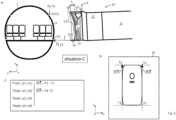
- a longitudinal coordinate and a transverse coordinate of the target position is determined by analyzing a scanned door contour and/or a painted contour marking of the door; a height coordinate of the target position is determined by analyzing the position of a scanned u-shaped marking below the door.
- the scanned u-shaped marking is distinct to the painted contour marking.
- phase a digital model of the door is determined.
- the model is in particular a three-dimensional model.
- the digital three-dimensional model may be created during the docking procedure by scanning the door.
- the three-dimensional model is determined by retrieving a prestored digital three-dimensional model from a database.
- the prestored model can be identified with the help of the identified aircraft type as described above.
- a combination of both mentioned determining methods can be used to improve the quality of the process. So, in a first substep the digital three-dimensional model can be created by scanning; in the second substep the created digital three-dimensional model can be compared with any prestored door model. If the comparison gives a positive feedback (e.g. the created model conforms to a prestored model) the docking procedure may continue - otherwise a failure mode can be initiated.
- a positive feedback e.g. the created model conforms to a prestored model
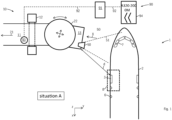
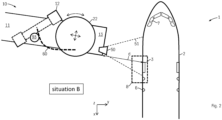
- a third, in particular final, phase the door is merely partially in the field of view of the main scanning device so that the target position is not located in the field view. That may lead to a situation where the camera based docking is not able to follow the target position.
- an auxiliary position which is in relation to the door, will be monitored by the main scanning device.
- a spatial relationship between the target position and the auxiliary position is thereby provided by the digital model.
- the aforementioned feature enables kind of freedom when looking for a suitable position of the camera, since there are other requirements which need to be considered. So, the position of the scanning device should be out of reach of the passengers, in particular that a passenger cannot hit the scanning device with his head, the passenger may not damage the device or the passenger may not fall upon the scanning device. So, on the one hand the scanning device should be located outside of the space, in which the user may be located anytime during boarding. On the other hand the scanning device position should support a best possible field of view, catching the door as far as possible over the entire docking procedure. Further it is preferred that commercially available scanners may be used, such as a stereo camera or a laser scanner.
- the main camera for detecting the target position is located
- an auxiliary scanning device is used to determine the target position.
- the auxiliary scanning device is in particular located in a manner that the target position is within the field of view until docking has finished.
- the combination of both scanning devices enable that the target position is always in the field of view of at least one of the scanning devices. So, the main scanning device may be located for a best possible view on the target position during an early phase; the auxiliary scanning device may be located for a best possible view on the target position during the final phase.
- both the main and the auxiliary scanning device are used, during a phase, in which the target position is within the fields of view of both the main scanning device and of the auxiliary scanning device, the functionality of the cameras is checked by comparing the scanning results of both scanning devices to each other. In particular it is important that both devices provide the same position results for the identical target position; if there is a deviation in the results, at least one of the scanning devices has a malfunction or is not properly calibrated; a failure mode can be issued.
- a possible user interaction may be: Identifying the target position by the user interaction.
- the user indicates the target position on a screen with a suitable HMI input device, e.g. mouse click on the visualization of the target position at a screen.
- the operator does not need to be present at the PBB, moreover the operator can be located at a distant location and may use a remote control to interact with the PBB control unit.
- the method comprises the following steps: Establishing a trajectory defining the movement of the bridgehead to align the bridgehead with the target position, the trajectory comprising in particular a path of movement and in particular a course of orientations. Moving the bridgehead along the established trajectory.
- the path may comprise a group of coordinates.
- the orientations indicate the angular orientation of the bridgehead.
- the method comprises the following steps: during moving, continuing determining the target position and reviewing the trajectory based the continuously detected target position; in particular adapting the trajectory if a deviation from a previously determined target position is determined and/or applying a safety mode if a deviation from a previously determined target position is exceeding a predefined critical value.
- the target position may be continuously monitored by the scanning device. In contrast to just measuring once it has the advantage to improve the accuracy of the docking procedure.
- the trajectory is permanently updated, if deviations from in the measurements occur. When a deviation reaches a critical value, a safety mode can be issued; in the safety mode the movement speed can be decreased or the movement can be stopped.
- the method comprises the following steps: Observing the apron with respect to an obstacle; detecting the position of the obstacle; assessing the relevance of the obstacle by comparing the position of the obstacle with the trajectory.
- the position of the obstacle may also comprise a short term position during movement of the obstacle.
- the comparison may come to the result that a collision between parts of the PBB, in particular the drive, and the obstacle is likely; then the safety mode will be issued. Comparing the position of the obstacle with the trajectory leads to a filtering of the objects, so not all objects detected in the area of the PBB will cause issuance of the safety mode.
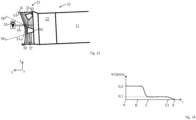
- the movement of the bridgehead is controlled in a manner, in particular that the trajectory is established in a manner, that in a subsequent phase of movement, in particular when the door distance (distance between the door and the approaching edge of the bridgehead) reaches a value of 0.5m,
- the movement of the bridgehead is controlled in a manner, that the movement speed is dependent from a distance between the bridgehead and the door, in particular that the movement speed is decreasing as the distance between the bridgehead and the door is decreasing, and/or
- a calibration step is performed before docking, thereby using a calibration tag located at a fixed location of the bridgehead within the field of view of a camera to be calibrated. Due to the continuous movements and resulting vibrations in a PBB the orientation of the scanning device may change slightly, which may result in inaccurate results. With the help of the calibration step these influences are made obsolete.
- a validating step is performed, in the validating step it is checked, whether the bridgehead is aligned properly to the door.
- the quality may be checked and if a sufficient level of quality is not determined, then an operator may be prompted to confirm or disconfirm, that the passenger boarding bridge is properly docked.
- there may be performed a visual check between a marking on the bridgehead floor and the door contour; if both are aligned in a predetermined manner, docking was successful.
- the aircraft is parked in a MARS stand; the MARS stand having a plurality of separate centerlines associated to one passenger boarding bridge.
- the MARS stand For determining the target position and/or for detecting the assumed position an information is used, on which of the centerlines of the MARS stand the aircraft is parked. This information may be retrieved from a database and/or a VDGS system.
- the bridgehead can be brought into a propoer preposition, which is a good starting position for the camera based docking procedure.
- a MARS stand comprises a plurality of separate centerlines associated to one passenger boarding bridge.
- the centerlines indicate different parking positions for different aircrafts.
- the term "centerlines associated to one passenger boarding bridge” means: Said passenger boarding bridge can be connected to an aircraft parked on a first one of the centerlines as well as to an aircraft parked on a second one of the centerline.
- Separate centerline means: The centerlines are a) not parallel or b) parallel but at a distance.
- the MARS stand may comprise two or more PBBs.
- the inventive arrangement comprising: a Passenger boarding bridge, a control arrangement to control a movement of a bridgehead of the passenger boarding bridge.
- the control arrangement is configured to control a method according to any of the preceding claims.
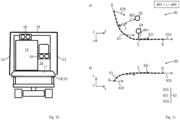
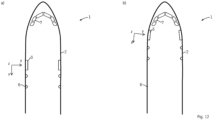
- a coordinate system is defined, which is relevant for the docking procedure ( figure 12 ).
- the direction x indicates the longitudinal direction of the fuselage 2 in the area of the door 3 to be docked.
- the direction y indicates the transverse direction perpendicular to the fuselage in the area of the door.
- the difference between figures 12a and 12b indicates, that the x- and y-direction may slightly differ from the airplane coordinate system in particular where the door 3 is located in the nose of the aircraft ( figure 12b ).
- the direction z indicates the height direction perpendicular to directions x and y.
Landscapes
- Engineering & Computer Science (AREA)
- Mechanical Engineering (AREA)
- Aviation & Aerospace Engineering (AREA)
- Architecture (AREA)
- Civil Engineering (AREA)
- Structural Engineering (AREA)
- Length Measuring Devices By Optical Means (AREA)
- Traffic Control Systems (AREA)
- Image Analysis (AREA)
Applications Claiming Priority (4)
| Application Number | Priority Date | Filing Date | Title |
|---|---|---|---|
| EP18382372 | 2018-05-30 | ||
| DE102018211492 | 2018-07-11 | ||
| PCT/EP2019/063906 WO2019229105A1 (en) | 2018-05-30 | 2019-05-29 | Method for automated docking a passenger boarding bridge to an aircraft |
| EP19732263.9A EP3802325B1 (de) | 2018-05-30 | 2019-05-29 | Verfahren zum automatischen andocken einer fluggastbrücke an ein flugzeug |
Related Parent Applications (2)
| Application Number | Title | Priority Date | Filing Date |
|---|---|---|---|
| EP19732263.9A Division EP3802325B1 (de) | 2018-05-30 | 2019-05-29 | Verfahren zum automatischen andocken einer fluggastbrücke an ein flugzeug |
| EP19732263.9A Division-Into EP3802325B1 (de) | 2018-05-30 | 2019-05-29 | Verfahren zum automatischen andocken einer fluggastbrücke an ein flugzeug |
Publications (2)
| Publication Number | Publication Date |
|---|---|
| EP4516682A2 true EP4516682A2 (de) | 2025-03-05 |
| EP4516682A3 EP4516682A3 (de) | 2025-04-23 |
Family
ID=66999777
Family Applications (2)
| Application Number | Title | Priority Date | Filing Date |
|---|---|---|---|
| EP19732263.9A Active EP3802325B1 (de) | 2018-05-30 | 2019-05-29 | Verfahren zum automatischen andocken einer fluggastbrücke an ein flugzeug |
| EP25152205.8A Pending EP4516682A3 (de) | 2018-05-30 | 2019-05-29 | Verfahren zum automatisierten andocken einer fluggastbrücke an ein flugzeug |
Family Applications Before (1)
| Application Number | Title | Priority Date | Filing Date |
|---|---|---|---|
| EP19732263.9A Active EP3802325B1 (de) | 2018-05-30 | 2019-05-29 | Verfahren zum automatischen andocken einer fluggastbrücke an ein flugzeug |
Country Status (6)
| Country | Link |
|---|---|
| US (1) | US20210214103A1 (de) |
| EP (2) | EP3802325B1 (de) |
| CN (1) | CN112996725B (de) |
| CA (1) | CA3100409C (de) |
| ES (1) | ES3024691T3 (de) |
| WO (1) | WO2019229105A1 (de) |
Families Citing this family (15)
| Publication number | Priority date | Publication date | Assignee | Title |
|---|---|---|---|---|
| WO2021219445A1 (en) | 2020-04-30 | 2021-11-04 | Tk Airport Solutions, S.A. | Method for docking a passenger boarding bridge to an aircraft |
| EP3907141A1 (de) * | 2020-05-06 | 2021-11-10 | thyssenkrupp Airport Solutions, S.A. | Anordnung mit einer fluggastbrücke |
| JP6845976B1 (ja) * | 2020-05-12 | 2021-03-24 | 新明和工業株式会社 | 旅客搭乗橋 |
| CN112046781B (zh) * | 2020-09-11 | 2022-03-01 | 深圳中集天达空港设备有限公司 | 登机桥防撞方法及登机桥防撞系统 |
| EP4316994A4 (de) * | 2021-03-29 | 2025-01-29 | ShinMaywa Industries, Ltd. | Fluggastbrücke |
| CN113204244B (zh) * | 2021-04-23 | 2022-06-03 | 电子科技大学 | 一种基于定位导航的登机桥对接方法 |
| US20240190584A1 (en) * | 2021-07-12 | 2024-06-13 | Shinmaywa Industries, Ltd. | Boarding bridge remote operation system and boarding bridge remote operation program |
| WO2023007770A1 (ja) * | 2021-07-29 | 2023-02-02 | 新明和工業株式会社 | 航空機の乗降部を検出するための検出システム |
| CN115258186B (zh) * | 2022-06-30 | 2026-03-27 | 中国民航技术装备有限责任公司 | 一种安全靴投放装置 |
| CN115320878B (zh) * | 2022-08-25 | 2025-11-04 | 深圳中集天达空港设备有限公司 | 登机桥操作的度量方法、装置、登机桥、设备及介质 |
| CN115258185B (zh) * | 2022-09-23 | 2022-12-13 | 江苏天一航空工业股份有限公司 | 一种用于旅客登机车的智能控制系统及方法 |
| US12420951B2 (en) * | 2022-09-30 | 2025-09-23 | Toyota Motor Engineering & Manufacturing North America, Inc. | Calibration of aircraft mounted cameras |
| CN115783294A (zh) * | 2022-11-15 | 2023-03-14 | 电子科技大学长三角研究院(湖州) | 一种基于桥身属性的登机桥舱门对接方法、系统及终端 |
| DE102022134630A1 (de) | 2022-12-22 | 2024-06-27 | Rheinmetall Air Defence Ag | Fluggastbrücke, Fluggastbrückensystem und Verfahren zum Betrieb eines Fluggastbrückensystems |
| DE102022134637A1 (de) | 2022-12-22 | 2024-06-27 | Rheinmetall Air Defence Ag | Verfahren zur fernsteuerung einer fluggastbrücke |
Citations (7)
| Publication number | Priority date | Publication date | Assignee | Title |
|---|---|---|---|---|
| US20030120358A1 (en) | 2001-12-26 | 2003-06-26 | Neil Hutton | Automated passenger loading bridge method |
| WO2003064255A1 (en) * | 2002-02-01 | 2003-08-07 | Dew Engineering And Development Limited | Passenger loading bridge for servicing plural doorways of an aircraft |
| US20070214585A1 (en) | 2006-03-20 | 2007-09-20 | Dew Engineering And Development Limited | Method for aligning a plurality of passenger boarding bridges |
| US20080098538A1 (en) | 2006-10-31 | 2008-05-01 | Dew Engineering And Development Limited | Vision system for automatically aligning a passenger boarding bridge with a doorway of an aircraft and method therefor |
| EP2660152A2 (de) | 2012-04-30 | 2013-11-06 | Fmt International Trade Ab | Verfahren zur Identifizierung eines Flugzeugs in Verbindung mit dem Parken des Flugzeugs an einem Stand |
| WO2017198605A1 (en) | 2016-05-17 | 2017-11-23 | Thyssenkrupp Elevator Innovation Center S.A. | Method for positioning a passenger boarding bridge at an airplane |
| WO2018034615A1 (en) | 2016-08-15 | 2018-02-22 | Singapore Technologies Dynamics Pte Ltd | Automatic passenger boarding bridge docking system |
Family Cites Families (19)
| Publication number | Priority date | Publication date | Assignee | Title |
|---|---|---|---|---|
| SE503396C2 (sv) * | 1994-09-14 | 1996-06-03 | Fmt Int Trade | Sätt och anordning för anslutning av en passagerarbrygga till en dörr på en farkost |
| US6542086B2 (en) * | 1997-09-22 | 2003-04-01 | Siemens Aktiengesellschaft | Docking system for airport terminals |
| US20030145405A1 (en) * | 2002-02-01 | 2003-08-07 | Neil Hutton | Method and apparatus for automatically pre-positioning a passenger bridge |
| CA2373669A1 (en) * | 2002-02-27 | 2003-08-27 | Indal Technologies Inc. | Imaging system for a passenger bridge of the like for docking automatically with an aircraft |
| US6637063B1 (en) * | 2002-05-07 | 2003-10-28 | Dew Engineering And Development Limited | Beacon docking system for automatically aligning a passenger loading bridge to a doorway of an aircraft |
| US6907635B2 (en) * | 2002-05-07 | 2005-06-21 | Dew Engineering And Development Limited | Beacon docking system with visual guidance display |
| JP4293874B2 (ja) * | 2003-09-29 | 2009-07-08 | 新明和工業株式会社 | ボーディングブリッジ及びボーディングブリッジの目標位置の設定方法 |
| US7120959B2 (en) * | 2004-10-05 | 2006-10-17 | Dew Engineering And Development Limited | Automated elevational adjustment of passenger loading bridge |
| US7458122B2 (en) * | 2005-06-22 | 2008-12-02 | Dew Engineering And Development Limited | Automated passenger boarding bridge alignment system and method with manual identification of aircraft doorway position |
| US7392561B2 (en) * | 2005-06-22 | 2008-07-01 | Dew Engineering And Development Limited | Automated passenger boarding bridge alignment system and method with manual confirmation of aircraft doorway position |
| US20070119003A1 (en) * | 2005-11-25 | 2007-05-31 | Dew Engineering And Development Limited | Method for aligning a passenger boarding bridge to a doorway of an aircraft |
| US20080098537A1 (en) * | 2006-10-31 | 2008-05-01 | Dew Engineering And Development Limited | Method for aligning one end of a passenger boarding bridge with a doorway of an aircraft |
| US20080109970A1 (en) * | 2006-11-09 | 2008-05-15 | Dew Engineering And Development Limited | Radio frequency identification based system and method for aligning one end of a passenger boarding bridge with a doorway of an aircraft |
| ES2357223B1 (es) * | 2008-05-28 | 2012-01-02 | Thyssenkrupp Elevator Innovation Center, S.A. | Sistema anticolision entre pasarelas de acceso a aeronaves. |
| CN103419944B (zh) * | 2012-05-25 | 2015-07-15 | 深圳中集天达空港设备有限公司 | 一种登机桥及其自动靠接方法 |
| EP2972627B1 (de) * | 2013-03-15 | 2019-05-08 | MTD Products Inc | Autonomes mobiles arbeitssystem mit einer basisstation von variabler reflektivität |
| US9708078B2 (en) * | 2014-01-31 | 2017-07-18 | Borealis Technical Limited | Airport terminal traffic and parking management system |
| CN106628232B (zh) * | 2015-10-28 | 2023-06-30 | 深圳中集天达空港设备有限公司 | 登机桥及其接机辅助装置 |
| US10908580B2 (en) * | 2016-09-09 | 2021-02-02 | Accenture Global Solutions Limited | Devices, systems, and methods for automated loading bridge positioning using shapes associated with a vehicle |
-
2019
- 2019-05-29 CA CA3100409A patent/CA3100409C/en active Active
- 2019-05-29 ES ES19732263T patent/ES3024691T3/es active Active
- 2019-05-29 EP EP19732263.9A patent/EP3802325B1/de active Active
- 2019-05-29 US US17/250,112 patent/US20210214103A1/en not_active Abandoned
- 2019-05-29 EP EP25152205.8A patent/EP4516682A3/de active Pending
- 2019-05-29 CN CN201980036068.6A patent/CN112996725B/zh active Active
- 2019-05-29 WO PCT/EP2019/063906 patent/WO2019229105A1/en not_active Ceased
Patent Citations (7)
| Publication number | Priority date | Publication date | Assignee | Title |
|---|---|---|---|---|
| US20030120358A1 (en) | 2001-12-26 | 2003-06-26 | Neil Hutton | Automated passenger loading bridge method |
| WO2003064255A1 (en) * | 2002-02-01 | 2003-08-07 | Dew Engineering And Development Limited | Passenger loading bridge for servicing plural doorways of an aircraft |
| US20070214585A1 (en) | 2006-03-20 | 2007-09-20 | Dew Engineering And Development Limited | Method for aligning a plurality of passenger boarding bridges |
| US20080098538A1 (en) | 2006-10-31 | 2008-05-01 | Dew Engineering And Development Limited | Vision system for automatically aligning a passenger boarding bridge with a doorway of an aircraft and method therefor |
| EP2660152A2 (de) | 2012-04-30 | 2013-11-06 | Fmt International Trade Ab | Verfahren zur Identifizierung eines Flugzeugs in Verbindung mit dem Parken des Flugzeugs an einem Stand |
| WO2017198605A1 (en) | 2016-05-17 | 2017-11-23 | Thyssenkrupp Elevator Innovation Center S.A. | Method for positioning a passenger boarding bridge at an airplane |
| WO2018034615A1 (en) | 2016-08-15 | 2018-02-22 | Singapore Technologies Dynamics Pte Ltd | Automatic passenger boarding bridge docking system |
Also Published As
| Publication number | Publication date |
|---|---|
| CA3100409A1 (en) | 2019-12-05 |
| EP3802325C0 (de) | 2025-02-26 |
| EP4516682A3 (de) | 2025-04-23 |
| WO2019229105A1 (en) | 2019-12-05 |
| US20210214103A1 (en) | 2021-07-15 |
| CN112996725B (zh) | 2024-05-14 |
| EP3802325A1 (de) | 2021-04-14 |
| ES3024691T3 (en) | 2025-06-05 |
| CA3100409C (en) | 2023-05-09 |
| CN112996725A (zh) | 2021-06-18 |
| EP3802325B1 (de) | 2025-02-26 |
Similar Documents
| Publication | Publication Date | Title |
|---|---|---|
| EP3802325B1 (de) | Verfahren zum automatischen andocken einer fluggastbrücke an ein flugzeug | |
| US12307911B2 (en) | Multi-sensor data fusion-based aircraft detection, tracking, and docking | |
| US10392130B2 (en) | Automatic passenger boarding bridge docking system | |
| EP3980336B1 (de) | Verfahren zum andocken einer fahrgastbrücke an ein flugzeug, elektronisches gerät und speichermedium | |
| US6742210B2 (en) | Beacon docking system for automatically aligning a passenger loading bridge to a doorway of an aircraft | |
| JP6209354B2 (ja) | スタンドでの航空機駐機に関連して航空機を特定する方法 | |
| US20030136898A1 (en) | Automatically controlling apparatus and an automatically controlling system of a boarding bridge, which can improve a reliability due to an automatic operation, and a position matching method of a boarding bridge | |
| CN106697322A (zh) | 一种登机桥自动靠接系统及方法 | |
| CN103419944A (zh) | 一种登机桥及其自动靠接方法 | |
| EP3833601B1 (de) | Verfahren zur erfassung des türzustands einer flugzeugtür | |
| CN112265647A (zh) | 登机桥的远程自动控制、装置、介质及电子设备 | |
| EP3814227B1 (de) | Verfahren zum automatischen entdocken einer fluggastbrücke von einem flugzeug | |
| KR102717848B1 (ko) | 탑승교 자율 접이현 장치 및 그의 동작 방법 | |
| CN112340050A (zh) | 登机桥的远程控制方法、装置、介质及电子设备 | |
| US6762694B2 (en) | Centerline identification in a docking guidance system | |
| KR102696730B1 (ko) | 탑승교 캐빈 제어 장치 및 그의 동작 방법 | |
| CN115755944A (zh) | 一种登机桥控制方法及系统 | |
| KR102696255B1 (ko) | 탑승교의 자율 주행 장치 및 방법 | |
| CN117392641A (zh) | 一种飞机牵引车的碰撞预警、导航预警方法及系统 | |
| JP7369375B1 (ja) | 建築物又は土木構造物の管理支援システム | |
| CN120122654A (zh) | 登机桥防碰撞方法、装置、设备、介质和程序产品 | |
| CN119781488A (zh) | 一种铁路隧道无人机的自动路径规划方法、设备及介质 | |
| WO2020127660A1 (en) | Method for detecting an obstacle on an aircraft stand |
Legal Events
| Date | Code | Title | Description |
|---|---|---|---|
| PUAI | Public reference made under article 153(3) epc to a published international application that has entered the european phase |
Free format text: ORIGINAL CODE: 0009012 |
|
| STAA | Information on the status of an ep patent application or granted ep patent |
Free format text: STATUS: THE APPLICATION HAS BEEN PUBLISHED |
|
| AC | Divisional application: reference to earlier application |
Ref document number: 3802325 Country of ref document: EP Kind code of ref document: P |
|
| AK | Designated contracting states |
Kind code of ref document: A2 Designated state(s): AL AT BE BG CH CY CZ DE DK EE ES FI FR GB GR HR HU IE IS IT LI LT LU LV MC MK MT NL NO PL PT RO RS SE SI SK SM TR |
|
| REG | Reference to a national code |
Ref country code: DE Ref legal event code: R079 Free format text: PREVIOUS MAIN CLASS: B64F0001305000 Ipc: B64F0001000000 |
|
| PUAL | Search report despatched |
Free format text: ORIGINAL CODE: 0009013 |
|
| AK | Designated contracting states |
Kind code of ref document: A3 Designated state(s): AL AT BE BG CH CY CZ DE DK EE ES FI FR GB GR HR HU IE IS IT LI LT LU LV MC MK MT NL NO PL PT RO RS SE SI SK SM TR |
|
| RIC1 | Information provided on ipc code assigned before grant |
Ipc: B64F 1/305 20060101ALI20250314BHEP Ipc: B64F 1/00 20240101AFI20250314BHEP |
|
| STAA | Information on the status of an ep patent application or granted ep patent |
Free format text: STATUS: REQUEST FOR EXAMINATION WAS MADE |
|
| 17P | Request for examination filed |
Effective date: 20250526 |
|
| STAA | Information on the status of an ep patent application or granted ep patent |
Free format text: STATUS: EXAMINATION IS IN PROGRESS |
|
| 17Q | First examination report despatched |
Effective date: 20260223 |