EP4516901A1 - Procédé de criblage d'enzymes hydrolytiques - Google Patents
Procédé de criblage d'enzymes hydrolytiques Download PDFInfo
- Publication number
- EP4516901A1 EP4516901A1 EP23194740.9A EP23194740A EP4516901A1 EP 4516901 A1 EP4516901 A1 EP 4516901A1 EP 23194740 A EP23194740 A EP 23194740A EP 4516901 A1 EP4516901 A1 EP 4516901A1
- Authority
- EP
- European Patent Office
- Prior art keywords
- cells
- enzyme
- dna
- screening
- producer
- Prior art date
- Legal status (The legal status is an assumption and is not a legal conclusion. Google has not performed a legal analysis and makes no representation as to the accuracy of the status listed.)
- Withdrawn
Links
Images


Classifications
-
- C—CHEMISTRY; METALLURGY
- C40—COMBINATORIAL TECHNOLOGY
- C40B—COMBINATORIAL CHEMISTRY; LIBRARIES, e.g. CHEMICAL LIBRARIES
- C40B40/00—Libraries per se, e.g. arrays, mixtures
- C40B40/04—Libraries containing only organic compounds
- C40B40/06—Libraries containing nucleotides or polynucleotides, or derivatives thereof
- C40B40/08—Libraries containing RNA or DNA which encodes proteins, e.g. gene libraries
-
- C—CHEMISTRY; METALLURGY
- C12—BIOCHEMISTRY; BEER; SPIRITS; WINE; VINEGAR; MICROBIOLOGY; ENZYMOLOGY; MUTATION OR GENETIC ENGINEERING
- C12N—MICROORGANISMS OR ENZYMES; COMPOSITIONS THEREOF; PROPAGATING, PRESERVING, OR MAINTAINING MICROORGANISMS; MUTATION OR GENETIC ENGINEERING; CULTURE MEDIA
- C12N15/00—Mutation or genetic engineering; DNA or RNA concerning genetic engineering, vectors, e.g. plasmids, or their isolation, preparation or purification; Use of hosts therefor
- C12N15/09—Recombinant DNA-technology
- C12N15/10—Processes for the isolation, preparation or purification of DNA or RNA
- C12N15/1034—Isolating an individual clone by screening libraries
- C12N15/1086—Preparation or screening of expression libraries, e.g. reporter assays
-
- C—CHEMISTRY; METALLURGY
- C12—BIOCHEMISTRY; BEER; SPIRITS; WINE; VINEGAR; MICROBIOLOGY; ENZYMOLOGY; MUTATION OR GENETIC ENGINEERING
- C12N—MICROORGANISMS OR ENZYMES; COMPOSITIONS THEREOF; PROPAGATING, PRESERVING, OR MAINTAINING MICROORGANISMS; MUTATION OR GENETIC ENGINEERING; CULTURE MEDIA
- C12N15/00—Mutation or genetic engineering; DNA or RNA concerning genetic engineering, vectors, e.g. plasmids, or their isolation, preparation or purification; Use of hosts therefor
- C12N15/09—Recombinant DNA-technology
- C12N15/63—Introduction of foreign genetic material using vectors; Vectors; Use of hosts therefor; Regulation of expression
- C12N15/70—Vectors or expression systems specially adapted for E. coli
-
- C—CHEMISTRY; METALLURGY
- C12—BIOCHEMISTRY; BEER; SPIRITS; WINE; VINEGAR; MICROBIOLOGY; ENZYMOLOGY; MUTATION OR GENETIC ENGINEERING
- C12N—MICROORGANISMS OR ENZYMES; COMPOSITIONS THEREOF; PROPAGATING, PRESERVING, OR MAINTAINING MICROORGANISMS; MUTATION OR GENETIC ENGINEERING; CULTURE MEDIA
- C12N9/00—Enzymes; Proenzymes; Compositions thereof; Processes for preparing, activating, inhibiting, separating or purifying enzymes
- C12N9/14—Hydrolases (3)
- C12N9/16—Hydrolases (3) acting on ester bonds (3.1)
- C12N9/18—Carboxylic ester hydrolases (3.1.1)
-
- C—CHEMISTRY; METALLURGY
- C12—BIOCHEMISTRY; BEER; SPIRITS; WINE; VINEGAR; MICROBIOLOGY; ENZYMOLOGY; MUTATION OR GENETIC ENGINEERING
- C12N—MICROORGANISMS OR ENZYMES; COMPOSITIONS THEREOF; PROPAGATING, PRESERVING, OR MAINTAINING MICROORGANISMS; MUTATION OR GENETIC ENGINEERING; CULTURE MEDIA
- C12N9/00—Enzymes; Proenzymes; Compositions thereof; Processes for preparing, activating, inhibiting, separating or purifying enzymes
- C12N9/14—Hydrolases (3)
- C12N9/16—Hydrolases (3) acting on ester bonds (3.1)
- C12N9/18—Carboxylic ester hydrolases (3.1.1)
- C12N9/20—Triglyceride splitting, e.g. by means of lipase
-
- C—CHEMISTRY; METALLURGY
- C12—BIOCHEMISTRY; BEER; SPIRITS; WINE; VINEGAR; MICROBIOLOGY; ENZYMOLOGY; MUTATION OR GENETIC ENGINEERING
- C12N—MICROORGANISMS OR ENZYMES; COMPOSITIONS THEREOF; PROPAGATING, PRESERVING, OR MAINTAINING MICROORGANISMS; MUTATION OR GENETIC ENGINEERING; CULTURE MEDIA
- C12N9/00—Enzymes; Proenzymes; Compositions thereof; Processes for preparing, activating, inhibiting, separating or purifying enzymes
- C12N9/14—Hydrolases (3)
- C12N9/16—Hydrolases (3) acting on ester bonds (3.1)
- C12N9/22—Ribonucleases [RNase]; Deoxyribonucleases [DNase]
-
- C—CHEMISTRY; METALLURGY
- C12—BIOCHEMISTRY; BEER; SPIRITS; WINE; VINEGAR; MICROBIOLOGY; ENZYMOLOGY; MUTATION OR GENETIC ENGINEERING
- C12N—MICROORGANISMS OR ENZYMES; COMPOSITIONS THEREOF; PROPAGATING, PRESERVING, OR MAINTAINING MICROORGANISMS; MUTATION OR GENETIC ENGINEERING; CULTURE MEDIA
- C12N9/00—Enzymes; Proenzymes; Compositions thereof; Processes for preparing, activating, inhibiting, separating or purifying enzymes
- C12N9/14—Hydrolases (3)
- C12N9/78—Hydrolases (3) acting on carbon to nitrogen bonds other than peptide bonds (3.5)
-
- C—CHEMISTRY; METALLURGY
- C12—BIOCHEMISTRY; BEER; SPIRITS; WINE; VINEGAR; MICROBIOLOGY; ENZYMOLOGY; MUTATION OR GENETIC ENGINEERING
- C12N—MICROORGANISMS OR ENZYMES; COMPOSITIONS THEREOF; PROPAGATING, PRESERVING, OR MAINTAINING MICROORGANISMS; MUTATION OR GENETIC ENGINEERING; CULTURE MEDIA
- C12N9/00—Enzymes; Proenzymes; Compositions thereof; Processes for preparing, activating, inhibiting, separating or purifying enzymes
- C12N9/14—Hydrolases (3)
- C12N9/78—Hydrolases (3) acting on carbon to nitrogen bonds other than peptide bonds (3.5)
- C12N9/80—Hydrolases (3) acting on carbon to nitrogen bonds other than peptide bonds (3.5) acting on amide bonds in linear amides (3.5.1)
-
- C—CHEMISTRY; METALLURGY
- C12—BIOCHEMISTRY; BEER; SPIRITS; WINE; VINEGAR; MICROBIOLOGY; ENZYMOLOGY; MUTATION OR GENETIC ENGINEERING
- C12Y—ENZYMES
- C12Y305/00—Hydrolases acting on carbon-nitrogen bonds, other than peptide bonds (3.5)
- C12Y305/04—Hydrolases acting on carbon-nitrogen bonds, other than peptide bonds (3.5) in cyclic amidines (3.5.4)
- C12Y305/04005—Cytidine deaminase (3.5.4.5)
-
- C—CHEMISTRY; METALLURGY
- C40—COMBINATORIAL TECHNOLOGY
- C40B—COMBINATORIAL CHEMISTRY; LIBRARIES, e.g. CHEMICAL LIBRARIES
- C40B40/00—Libraries per se, e.g. arrays, mixtures
- C40B40/02—Libraries contained in or displayed by microorganisms, e.g. bacteria or animal cells; Libraries contained in or displayed by vectors, e.g. plasmids; Libraries containing only microorganisms or vectors
-
- C—CHEMISTRY; METALLURGY
- C12—BIOCHEMISTRY; BEER; SPIRITS; WINE; VINEGAR; MICROBIOLOGY; ENZYMOLOGY; MUTATION OR GENETIC ENGINEERING
- C12Q—MEASURING OR TESTING PROCESSES INVOLVING ENZYMES, NUCLEIC ACIDS OR MICROORGANISMS; COMPOSITIONS OR TEST PAPERS THEREFOR; PROCESSES OF PREPARING SUCH COMPOSITIONS; CONDITION-RESPONSIVE CONTROL IN MICROBIOLOGICAL OR ENZYMOLOGICAL PROCESSES
- C12Q1/00—Measuring or testing processes involving enzymes, nucleic acids or microorganisms; Compositions therefor; Processes of preparing such compositions
- C12Q1/68—Measuring or testing processes involving enzymes, nucleic acids or microorganisms; Compositions therefor; Processes of preparing such compositions involving nucleic acids
- C12Q1/6897—Measuring or testing processes involving enzymes, nucleic acids or microorganisms; Compositions therefor; Processes of preparing such compositions involving nucleic acids involving reporter genes operably linked to promoters
Definitions
- the present invention relates generally to the identification of hydrolytic enzymes and particularly to methods for recovering such enzymes by fluorescent auxotrophic bacterial cells and a fluorescence detection.
- the selection method based on auxotrophy allows for the identification and isolation of cells that have acquired the desired enzyme or metabolic pathway. It provides a way to screen a large library of genetic material and select for the functional expression of the enzyme in a specific cellular context.
- amino acids leucine, histidine, lysine, tryptophan, arginine, sulphur amino acids
- nucleosides/nucleotides uridine, thymidine, ATP, NADH, NAD + , NADP +
- intermediate metabolite acetyl-CoA, phosphorylated sugars
- auxotrophic cell is a type of cell that has lost the ability to synthesize or obtain one or more essential nutrients required for its growth and survival.
- the term “auxotrophy” is derived from the Greek words “auxein” (to increase) and “tropein” (to nourish), indicating the need for external supplementation to support the growth of these cells.
- uridine auxotrophic cells mean that the genes involved in uridine biosynthesis are disrupted by knocking out. With the result that cells can only divide in media containing uridine source. Therefore, cells with uridine auxotrophy can be used uridine or their analogues as a selective marker to screen and identify cells that have successfully incorporated and expressed the desired genes.
- Auxotrophic cells are compatible with a high throughput selection of enzyme activity.
- a high throughput selection method refers to a process or technique that allows for the rapid screening or selection of a large number of samples or candidates in a relatively short period of time.
- the screening or selection in the liquid medium can be performed as micro-wells or microfluidics-based technology. It means, that single cells are cultivated in the microwells plates or encapsulated in micro-droplets.
- microfluidics technology offers a versatile and powerful platform for a wide range of applications, including medical diagnostics, drug discovery, single-cell analysis, and environmental monitoring. Its ability to manipulate small volumes of fluids and integrate various analytical processes onto a single chip has the potential to revolutionize research, analysis, and automation in numerous fields.
- Fluorescence substrates are molecules that can be used to generate fluorescent signals upon interaction with specific enzymes or biological processes. These substrates typically contain a fluorophore that emits light upon excitation, and their fluorescence intensity can be measured to quantify the activity or presence of the enzyme or process of interest.
- Protease substrates typically consist of a peptide sequence that can be recognized and cleaved by the protease, resulting in a change in the fluorescence properties of the attached fluorophore;
- phosphatase often contain a phosphate group attached to a fluorophore, and upon dephosphorylation, the fluorescence intensity changes;
- Kinase substrates are designed to be phosphorylated by specific kinases, resulting in a change in their fluorescence properties;
- Esterase substrates usually contain an ester linkage attached to a fluorophore, and upon esterase activity, the ester bond is cleaved, leading to a change in fluorescence intensity.
- Fluorescent proteins are a class of proteins that can absorb and emit light at specific wavelengths, resulting in fluorescence. They are widely used as molecular tags and probes in biological research due to their ability to visualize and track specific molecules or processes within living cells and organisms. Fluorescent proteins can be genetically encoded, allowing them to be expressed within living cells or organisms by incorporating the gene encoding the fluorescent protein into their genome. This genetic encoding enables researchers to target and visualize specific proteins, organelles, or cellular processes by fusing the fluorescent protein gene with the gene of interest. Green fluorescent protein (GFP) is a widely used tool in biotechnology due to its unique ability to emit green fluorescence when exposed to specific wavelengths of light.
- GFP Green fluorescent protein
- GFP was originally isolated from the jellyfish Aequorea victoria, and its fluorescence property has made it a valuable asset in various applications: GFP can be fused with a target protein of interest to visualize its localization within living cells; as a reporter gene to monitor gene expression levels and promoter activity; in studies of protein-protein interactions and protein complex formation and etc. Beyond GFP, a wide variety of fluorescent proteins with different spectral properties (e.g., blue, cyan, yellow, and red) have been discovered and engineered. This allows for the simultaneous visualization of multiple targets using different coloured fluorescent proteins.
- spectral properties e.g., blue, cyan, yellow, and red
- kinase activity was detected by measuring of GFP fluorescent signal. After phosphorylation of GFP, it became resistant for chymotrypsin digestion. If kinase was inactive, the fluorescent signal was being lost.
- the closest analogue to the invention is described by Jay Short and Martin Keller “High throughput screening for novel enzymes” (US006174673B1 ).
- This patent document relates generally to the identification of new bioactive molecules and particularly to methods for recovering such molecules by co-encapsulation and fluorescence activated cell sorting (FACS).
- FACS fluorescence activated cell sorting
- the described invention adapts traditional eukaryotic flow cytometry cell Sorting Systems to high throughput screening for expression clones in prokaryotes.
- the fluorescent substrates are used for the sorting.
- the method described in the present invention differs from that described in that, that for the detection of enzyme activity could be used any non-fluorescent substrate which is compatible with cell survive.
- the detection of activity is performed by increased florescent signal of reporter protein (for example GFP).
- the method allows the analysis of enzymes present in living microorganisms as well as purified/extracted enzymes. Additionally, the desired enzyme and reporter fluorescent protein can be located in the separate cells as well as in the different microorganism system (for example, E. coli bacteria and yeast, E. coli - Pseudomonas and etc.).
- the system contains one type of cells with reporter protein (reporter cells) and other type of cells with secreted enzyme (producer cells). Both type of cells are cultivated in the one space (tube, droplets and etc).
- this method allows to test enzymes, when substrates are located in the extracellular space and cannot entry into the cells. Also, as the method allows the analysis enzymes toxic for the living cells (for example, proteases and nucleases).
- This invention provides a method of screening of enzymes with uncharacterized activity in the living cells or in the extracellular space.
- the present invention relates to screening or selection process of large libraries of polypeptides during which polypeptides conversion of the substrate to its corresponding product compounds.
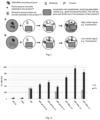
- the invention provides a method, which includes the steps ( Fig.1 ):
- screening is based on auxotrophic cells and fluorescent signal of reporter protein, generated by host cells.
- auxotrophic E. coli cells by using uridine auxotrophic E. coli cells and selecting for the ability to grow in the absence of uridine, this method enables the identification and isolation of cells that have acquired the capacity to convert modified uridine analogue to uridine or synthesize uridine or express an enzyme involved in uridine biosynthesis.
- a process for identifying biocatalyst having a specified activity of interest comprises (i) generating one or more expression libraries derived from nucleic acid; and (ii) screening said libraries utilizing fluorescent auxotrophic bacterial cells and a fluorescence detection to identify said biocatalyst. More particularly, this is a process for identifying biocatalyst having a specified activity of interest by (i) generating one or more expression libraries derived from nucleic acid; (ii) exposing said libraries to a particular substrate or substrates of interest; and (iii) screening said exposed libraries utilizing a fluorescence activated cell sorter to identify clones which react with the substrate or substrates.
- a process for identifying clones having a specified activity of interest by (i) generating one or more expression libraries derived from nucleic acid directly or indirectly isolated from the environment; and (ii) screening said exposed libraries utilizing an assay requiring co-encapsulation, a binding event or the covalent modification of a target, and a fluorescence detection to identify positive clones.
- the present invention may be employed for example, to identify enzymes with desired activity of regio/enantio-selective lipases, esterases, amidohydrolases (for example, amidases, proteases), glycosidases, glycosyl transferases, acylases, lyases, nucleases, phosphatases.
- screening is based on auxotrophic cells allowed to select:
- the methods of the invention allow identification and characterization of enzyme with previously unknown or undefined enzymatic activity.
- the enzyme can by selected from:
- desired substrate can be administered to the cells:
- screening of enzyme activity can be performed:
- Producer enzyme refers to an enzyme which converts substrate ( S ) to product ( P ).
- reporter cells or the term “fluorescent marker” as used therein, unless otherwise specified, refers to auxotrophic cells, which produces fluorescent protein, called reporter protein.
- bioactive fluorescence refers to a fluorescence of the reporter cells.
- Substrate ( S ) as used therein refers to an organic compound which is not metabolised in the auxotrophic cells used for enzyme screening.
- the screened producer enzyme converts substrate ( S ) to product ( P ).
- Product P is essential for growth and survival of reporter cells.
- Product ( P ) as used therein refers to essential nutrients required for growth and survival of auxotrophic cells.
- the product ( P ) is produced from substrate S by using producer enzyme.
- selective medium refers to a mineral medium that lacks the specific nutrient that the auxotrophic cells require for growth.
- the selective medium includes an additional supplement substrate S that can be converts into product P by the functional expression of the desired enzyme.
- Polypeptide library/libraries refers to a pool of enzymes which activity are previously uncharacterised towards the substrate.
- the term "Screening of enzymes” refers to evaluation of every protein for the desired property, while “selection of enzymes” automatically eliminates non-functional variants. Selection or screening of enzymes can be performed from enzyme libraries in vivo or in vitro.
- the term "enzyme library” refers to a set of proteins or genes inserted into expression vectors or cells producing the enzymes.
- the enzyme library can be a metagenomic library, genomic library or a mutant library.
- the metagenomic library can be constructed from various sources of environmental sample, such as soil, water, sludge, and etc.
- Host cell refers to the cells, transformed by a DNA vector harbouring the nucleic acid/DNA gene potentially coded producer enzymes.
- fluorescent analyser refers to ay device, which can be used for detection and measurement of a fluorescence.
- Example 1 Screening of secreted lipases/esterases using GFP fluorescent signal and uridine auxotrophic E . coli cells harbouring hydrolase gene in the selected liquid media
- E. coli DH10B ⁇ pyrFEC competent cells were transformed with compatible (p15 origin) plasmids harbouring superfold green fluorescent protein (sfGFP), for example pSTV28 vector with sfGFP gene.
- the other E . coli DH10B ⁇ pyrFEC competent cells were transformed with plasmids harbouring secreted esterase pUC19-SVG1.
- the PUC19 vector which lacks the esterase gene was used.
- the fluorescence signal of GFP was measured using a plate reader spectrophotometer in black 96 well plates. Parameters of the measuring were as follows: Excitation - 485nm, Emission - 528 nm and gain equal 50. Parameters of the measuring were as follows: Excitation-485nm, Emission-528 nm and gain equal 50.
- Example 2 Screening of secreted lipases/esterases using GFP fluorescent signal and uridine auxotrophic E . coli cells harbouring hydrolase gene in micro-droplets
- Uridine auxotrophic strain E . coli DH10B ⁇ pyrFEC competent cells were transformed with plasmids harbouring super-fold green fluorescent protein (sfGFP), for example pSTV28 vector (p15 origin) with sfGFP gene.
- the other E . coli DH10B ⁇ pyrFEC competent cells were transformed with plasmids harbouring secreted esterase pUC19-SVG1 and co-transformed with compatible plasmids harbouring reporter protein RFP1 in pSTV28 vector.
- the reporter RFP1 permit observed division of producer's cells with hydrolase gene.
- the PUC19 vector, without the esterase gene was used. After transformation cells were cultivated in SOC media 45 min.
- Example 3 Screening of metagenomic amidohydrolases using GFP fluorescent signal and uridine auxotrophic E . coli cells harbouring hydrolase gene in micro-droplets
- Uridine auxotrophic strain E . coli DH10B ⁇ pyrFEC competent cells were transformed with metagenomic library and with compatible plasmids harbouring superfold green fluorescent protein (sfGFP), for example pSTV28 vector (p15 origin) with sfGFP gene.
- sfGFP superfold green fluorescent protein
- pSTV28 vector p15 origin
- sfGFP gene a negative control
- the PUC19 vector without the hydrolase gene was used.
- transformation cells were cultivated in SOC media 45 min. After that cells were collected by centrifugation and transferred into the selective M9 medium containing 20 ⁇ g/ml chloramphenicol, 100 ⁇ g/ml ampicillin, and 20 ⁇ g/ml uridine analogue- N 4 -benzoil-2'-deoxycytidine substrate transported into the cells.
- Example 4 Screening of active mutants of amidohydrolases from mutant library by using GFP fluorescent signal and uridine auxotrophic E . coli cells harbouring hydrolase gene
- Uridine auxotrophic strain E. coli DH10B ⁇ pyrFEC competent cells were transformed with set of 24 mutants of cytidine deaminase CDA_F14 and with compatible plasmids harbouring superfold green fluorescent protein (sfGFP), for example pSTV28 vector (p15 origin) with sfGFP gene. After transformation cells were cultivated in SOC media 45 min. After that cells were collected by centrifugation and transferred into the selective M9 medium containing 20 ⁇ g/ml chloramphenicol, 100 ⁇ g/ml ampicillin, and 20 ⁇ g/ml uridine analogue- N 4 -benzoil-2'-deoxycytidine substrate transported into the cells.
- sfGFP superfold green fluorescent protein
- Seven active enzymes were selected from the 24 mutants set. Bacteria growth in droplets were monitored by florescent microscope after 0h and 18-24h incubation time. The sorting of cells by intensity of fluorescence was performed by using the STYX HTS platform.
- Example 5 Screening of RNA degrading enzymes using GFP fluorescent signal and uridine auxotrophic E . coli in the selected liquid media
- RNA is a substrate, which is not transported into the cells.
- the nucleoside monophosphates are produced after digestion RNA by RNAse A or universal nuclease and phosphodiesterase I from Crotalus adamanteus venom.
- FastAP thermosensitive alkaline phosphatase dephosphorylates nucleoside monophosphates into nucleosides. After that only the produced nucleosides are transported to the cells.
- uridine auxotrophic cells can grow in the selective medium due to the formation of uridine nucleoside from RNA.
- Example 6 Screening of DNA degrading enzymes using GFP fluorescent signal and uridine auxotrophic E . coli in the selected liquid media
- RNA is a substrate, which is not transported into the cells.
- the nucleoside monophosphates are produced after digestion DNA by Exonuclease III or universal nuclease.
- FastAP thermosensitive alkaline phosphatase dephosphorylates deoxynucleoside monophosphates into deoxynucleosides. After that only the produced deoxynucleosides are transported to the cells.
- uridine auxotrophic cells can grow in the selective medium due to the formation of uridine from DNA.
- Example 7 Screening of peptides degrading enzymes using GFP fluorescent signal and uridine auxotrophic E . coli in the selected liquid media
- the corresponding dipeptide ( ⁇ -Ala-Ala - 2.04 mmol, ⁇ -Ala-Val - 2.58 mmol and ⁇ -Ala-Phe - 2.08 mmol) was dissolved in 10 ml of a 1:1 mixture of water and 1,4-dioxane. The mixture was stirred with a magnetic stirrer and 3.9 ml NaOH (1 M) was added slowly. After the dipeptide was dissolved, the reaction mixture was cooled in an ice bath, 1.5 mol eq. of di-tert-butyldicarbonate (Boc 2 O) and stirred at 50°C for 24 hours.
- Boc 2 O di-tert-butyldicarbonate
- reaction mixtures were evaporated with a rotary evaporator and acidified with 10% citric acid solution to pH 4. Extracted four times with 50 ml, 50 ml, 40 ml and 25 ml of ethyl acetate. Fractions containing the product were dried with Na 2 SO 4 , filtered and evaporated on a rotary evaporator. The synthesized dipeptides blocked by the Boc protective group were dissolved in 15 ml of ethyl acetate and mixed with a magnetic stirrer. 1.5 mol equiv was added. (0.445 g) of N-hydroxysuccinimide (NHS) and 1.5 mol. eq.
- NHS N-hydroxysuccinimide
- N4-Acyl-Boc-2'-deoxycytidines were purified by column chromatography using a column filled with 60 ml of silica gel suspended in CHCl 3 . Purification started with CHCl 3 , further purification with mixtures of CHCl 3 and CH 3 OH, gradually increasing the methanol concentration to 10%. Fractions in which the pure product was detected were evaporated using a rotary evaporator. N4-Ala- ⁇ -alaninoyl-Boc-2'-deoxycitidine. (Obtained 300 mg (469,2 g/mol). Yield 32%.
- Proteinase K 1 mg/ml Proteinase K was added into the samples. A mili-Q water was added into the control samples instead of the proteinase K. Then cells were incubated 20 h in the sterile 96-well plate at 37°C, under aeration. The fluorescence signal of GFP was measured using a plate reader spectrophotometer in black 96 well plate. Parameters of the measuring were as follows: Excitation-485nm, Emission-528 nm and gain equal 50.
- Example 8 Screening of RNA degrading enzymes using GFP fluorescent signal and uridine auxotrophic E . coli in micro-droplets
- pSTV28_sfGFP super-fold green fluorescent protein
- RNA is a substrate, which is not transported into the cells.
- the nucleoside monophosphates are produced after digestion RNA by RNAse A.
- uridine auxotrophic cells can grow in the selective medium due to the formation of uridine nucleoside from RNA. No cells division was observed, and the fluorescence signal did not increase in the negative control samples without Rnase A. Bacteria growth in droplets were monitored by florescent microscope after 18 h incubation time.
Landscapes
- Life Sciences & Earth Sciences (AREA)
- Health & Medical Sciences (AREA)
- Chemical & Material Sciences (AREA)
- Organic Chemistry (AREA)
- Genetics & Genomics (AREA)
- Engineering & Computer Science (AREA)
- Zoology (AREA)
- Bioinformatics & Cheminformatics (AREA)
- Wood Science & Technology (AREA)
- Molecular Biology (AREA)
- General Engineering & Computer Science (AREA)
- Biochemistry (AREA)
- General Health & Medical Sciences (AREA)
- Biotechnology (AREA)
- Biomedical Technology (AREA)
- Microbiology (AREA)
- Medicinal Chemistry (AREA)
- Physics & Mathematics (AREA)
- Biophysics (AREA)
- Plant Pathology (AREA)
- Chemical Kinetics & Catalysis (AREA)
- General Chemical & Material Sciences (AREA)
- Bioinformatics & Computational Biology (AREA)
- Crystallography & Structural Chemistry (AREA)
- Measuring Or Testing Involving Enzymes Or Micro-Organisms (AREA)
Priority Applications (1)
| Application Number | Priority Date | Filing Date | Title |
|---|---|---|---|
| EP23194740.9A EP4516901A1 (fr) | 2023-08-31 | 2023-08-31 | Procédé de criblage d'enzymes hydrolytiques |
Applications Claiming Priority (1)
| Application Number | Priority Date | Filing Date | Title |
|---|---|---|---|
| EP23194740.9A EP4516901A1 (fr) | 2023-08-31 | 2023-08-31 | Procédé de criblage d'enzymes hydrolytiques |
Publications (1)
| Publication Number | Publication Date |
|---|---|
| EP4516901A1 true EP4516901A1 (fr) | 2025-03-05 |
Family
ID=88016545
Family Applications (1)
| Application Number | Title | Priority Date | Filing Date |
|---|---|---|---|
| EP23194740.9A Withdrawn EP4516901A1 (fr) | 2023-08-31 | 2023-08-31 | Procédé de criblage d'enzymes hydrolytiques |
Country Status (1)
| Country | Link |
|---|---|
| EP (1) | EP4516901A1 (fr) |
Citations (3)
| Publication number | Priority date | Publication date | Assignee | Title |
|---|---|---|---|---|
| US6174673B1 (en) | 1997-06-16 | 2001-01-16 | Diversa Corporation | High throughput screening for novel enzymes |
| EP0972838B1 (fr) | 1998-07-15 | 2004-09-15 | Roche Diagnostics GmbH | Système de sélection par complémentation d' une auxotrophie en absence d'antibiotique chez E. coli |
| WO2020227637A1 (fr) | 2019-05-08 | 2020-11-12 | Auxolytic Ltd | Procédés de sélection auxotrophe |
-
2023
- 2023-08-31 EP EP23194740.9A patent/EP4516901A1/fr not_active Withdrawn
Patent Citations (3)
| Publication number | Priority date | Publication date | Assignee | Title |
|---|---|---|---|---|
| US6174673B1 (en) | 1997-06-16 | 2001-01-16 | Diversa Corporation | High throughput screening for novel enzymes |
| EP0972838B1 (fr) | 1998-07-15 | 2004-09-15 | Roche Diagnostics GmbH | Système de sélection par complémentation d' une auxotrophie en absence d'antibiotique chez E. coli |
| WO2020227637A1 (fr) | 2019-05-08 | 2020-11-12 | Auxolytic Ltd | Procédés de sélection auxotrophe |
Non-Patent Citations (11)
| Title |
|---|
| "Enzyme Assays : High-throughput Screening, Genetic Selection and Fingerprinting", 4 November 2005, WILEY, ISBN: 978-3-527-60784-6, article AHARONI AMIR ET AL: "High-throughput Screens and Selections of Enzyme-encoding Genes", pages: 163 - 181, XP093131302, DOI: 10.1002/3527607846.ch6 * |
| AUTOUR, ARYCKELYNCK, M: "Ultrahigh-Throughput Improvement and Discovery of Enzymes Using Droplet-Based Microfluidic Screening", MICROMACHINES, vol. 8, 2017, pages 128 |
| BERTELS FELIX ET AL: "Design and Characterization of Auxotrophy-Based Amino Acid Biosensors", PLOS ONE, 19 July 2012 (2012-07-19), pages 1 - 8, XP093131312, Retrieved from the Internet <URL:https://journals.plos.org/plosone/article?id=10.1371/journal.pone.0041349> [retrieved on 20240214] * |
| CHEN, JWANG, YZHENG, PSUN, J: "Engineering synthetic auxotrophs for growth-coupled directed protein evolution", TRENDS BIOTECHNOL. 2022, vol. 40, no. 7, 12 February 2022 (2022-02-12), pages 773 - 776, XP087090792, DOI: 10.1016/j.tibtech.2022.01.010 |
| EVNIN LUKE B ET AL: "Substrate specificity of trypsin investigated by using a genetic selection (catalysis/mutagenesis/enzyme kinetics/proteases)", PROCEEDINGS OF THE NATIONAL ACADEMY OF SCIENCES OF THE UNITED STATES OF AMERICA, vol. 87, no. 17, 1 September 1990 (1990-09-01), pages 6659 - 6663, XP093130969 * |
| FLORA W Y CHIU ET AL: "High-throughput droplet-based microfluidics for directed evolution of enzymes", ELECTROPHORESIS, VERLAG CHEMIE, HOBOKEN, USA, vol. 40, no. 21, 29 August 2019 (2019-08-29), pages 2860 - 2872, XP071505119, ISSN: 0173-0835, DOI: 10.1002/ELPS.201900222 * |
| NEUN, SBREAR, PCAMPBELL, E ET AL.: "Functional metagenomic screening identifies an unexpected β-glucuronidase", NAT CHEM BIOL, vol. 18, 2022, pages 1096 - 1103 |
| SCHEELE, R.ALINDENBURG, L.HPETEK, M ET AL.: "Droplet-based screening of phosphate transfer catalysis reveals how epistasis shapes MAP kinase interactions with substrates", NAT COMMUN, vol. 13, 2022, pages 844 |
| URBELIENE NINA ET AL: "A Rapid Method for the Selection of Amidohydrolases from Metagenomic Libraries by Applying Synthetic Nucleosides and a Uridine Auxotrophic Host", CATALYSTS, vol. 10, no. 4, 21 April 2020 (2020-04-21), pages 445, XP093100231, DOI: 10.3390/catal10040445 * |
| URBELIENE NINA ET AL: "Application of the uridine auxotrophic host and synthetic nucleosides for a rapid selection of hydrolases from metagenomic libraries", MICROBIAL BIOTECHNOLOGY, vol. 12, no. 1, 9 October 2018 (2018-10-09), GB, pages 148 - 160, XP093130987, ISSN: 1751-7915, DOI: 10.1111/1751-7915.13316 * |
| YUAN HTU RTONG XLIN YZHANG YWANG Q: "Ultrahigh-throughput screening of industrial enzyme-producing strains by droplet-based microfluidic system", J IND MICROBIOL BIOTECHNOL, vol. 49, no. 3, 25 May 2022 (2022-05-25), pages kuac007 |
Similar Documents
| Publication | Publication Date | Title |
|---|---|---|
| Bunzel et al. | Speeding up enzyme discovery and engineering with ultrahigh-throughput methods | |
| US5914245A (en) | Solid phase enzyme kinetics screening in microcolonies | |
| CA2656192A1 (fr) | Etiquette d'acide nucleique detectable | |
| US20210147884A1 (en) | Use of type iii polyketide synthases from bacteria as phloroglucinol synthases | |
| US5981207A (en) | Caged enzyme substrates as probes for reporter enzyme activity | |
| US6031094A (en) | Beta-lactam substrates and uses thereof | |
| Schuntermann et al. | Mistranslation of the genetic code by a new family of bacterial transfer RNAs | |
| US20040175765A1 (en) | Cell-screening assay and composition | |
| EP4516901A1 (fr) | Procédé de criblage d'enzymes hydrolytiques | |
| US7427680B2 (en) | Fluorogenic substrates for BETA-lactamase gene expression | |
| CN109679886A (zh) | 一种基于生物传感器的高通量筛选方法 | |
| AU2002251755B2 (en) | Beta-lactamase substrates having phenolic ethers | |
| AU2002251755A1 (en) | Beta-lactamase substrates having phenolic ethers | |
| WO2003006947A2 (fr) | Methode et composition de criblage cellulaire | |
| JPWO2019236761A5 (fr) | ||
| Fulton et al. | High-throughput screening assays for lipolytic enzymes | |
| US20030039990A1 (en) | Non-destructive cell-based assay | |
| CN119931968B (zh) | 一种荧光素酶突变体及其应用 | |
| CA2282042C (fr) | Criblage a l'aide de la cinetique des reactions enzymatiques en phase solide dans des microcolonies | |
| Kalb et al. | Purification of post-transcriptionally modified tRNAs for enhanced cell-free translation systems | |
| CA2358100A1 (fr) | Procede de production d'un systeme marqueur de mecanisme d'action | |
| CN111778270A (zh) | 通过整合发光报告基因反映体外无细胞蛋白表达水平的方法 | |
| CN120118905A (zh) | 一种GlcNAc6P生物传感器及其应用 | |
| US20230374492A1 (en) | Process for selection of aptamers, riboswitches and desoxyriboswitches | |
| US6248541B1 (en) | Screening under nutrient limited conditions |
Legal Events
| Date | Code | Title | Description |
|---|---|---|---|
| STAA | Information on the status of an ep patent application or granted ep patent |
Free format text: STATUS: UNKNOWN |
|
| PUAI | Public reference made under article 153(3) epc to a published international application that has entered the european phase |
Free format text: ORIGINAL CODE: 0009012 |
|
| STAA | Information on the status of an ep patent application or granted ep patent |
Free format text: STATUS: THE APPLICATION HAS BEEN PUBLISHED |
|
| AK | Designated contracting states |
Kind code of ref document: A1 Designated state(s): AL AT BE BG CH CY CZ DE DK EE ES FI FR GB GR HR HU IE IS IT LI LT LU LV MC ME MK MT NL NO PL PT RO RS SE SI SK SM TR |
|
| STAA | Information on the status of an ep patent application or granted ep patent |
Free format text: STATUS: THE APPLICATION IS DEEMED TO BE WITHDRAWN |
|
| 18D | Application deemed to be withdrawn |
Effective date: 20250906 |