EP4517176A1 - Haushaltsofen mit beleuchtungseinrichtung - Google Patents
Haushaltsofen mit beleuchtungseinrichtung Download PDFInfo
- Publication number
- EP4517176A1 EP4517176A1 EP24195099.7A EP24195099A EP4517176A1 EP 4517176 A1 EP4517176 A1 EP 4517176A1 EP 24195099 A EP24195099 A EP 24195099A EP 4517176 A1 EP4517176 A1 EP 4517176A1
- Authority
- EP
- European Patent Office
- Prior art keywords
- cooking oven
- light
- intrados
- cooking
- lighting device
- Prior art date
- Legal status (The legal status is an assumption and is not a legal conclusion. Google has not performed a legal analysis and makes no representation as to the accuracy of the status listed.)
- Pending
Links
Images








Classifications
-
- F—MECHANICAL ENGINEERING; LIGHTING; HEATING; WEAPONS; BLASTING
- F24—HEATING; RANGES; VENTILATING
- F24C—DOMESTIC STOVES OR RANGES ; DETAILS OF DOMESTIC STOVES OR RANGES, OF GENERAL APPLICATION
- F24C7/00—Stoves or ranges heated by electric energy
- F24C7/08—Arrangement or mounting of control or safety devices
- F24C7/082—Arrangement or mounting of control or safety devices on ranges, e.g. control panels, illumination
- F24C7/085—Arrangement or mounting of control or safety devices on ranges, e.g. control panels, illumination on baking ovens
-
- F—MECHANICAL ENGINEERING; LIGHTING; HEATING; WEAPONS; BLASTING
- F24—HEATING; RANGES; VENTILATING
- F24C—DOMESTIC STOVES OR RANGES ; DETAILS OF DOMESTIC STOVES OR RANGES, OF GENERAL APPLICATION
- F24C15/00—Details
- F24C15/008—Illumination for oven cavities
Definitions
- the present invention relates to a household appliance with an outer surface interrupted by a separation gap and a lighting device for impacting the visibility of the separation gap and remotely communicating visual signals.
- the household appliances referred to in the invention comprise:
- the separation gaps Due to the technical function thereof, the separation gaps have non negligible extensions, are difficult to conceal from the user's sight, and form household appliance zones which are esthetically unsatisfactory and currently unused.
- the lighting device allows utilizing the zone of the separation gap for remotely communicating visual signals, e.g., at a greater distance than the legibility with the naked eye of a traditional user interface.
- the lighting device also allows positively impacting the esthetics of the household appliance at the separation gap.
- the separation gap is positioned in a front face of the household appliance (vertically oriented in the position of installation and use of the household appliance) with the longitudinal extension oriented horizontally, where the longitudinal extension can be rectilinear (in the case of a flat front face of the household appliance) or curved (in the case of a convex front face of the household appliance), where the light strip projected onto the first intrados also extends horizontally.
- the horizontal orientation of the projected light strip creates a visual signaling effect easily and naturally perceivable by humans, without generating associations of stress or danger. Furthermore, the horizontal light strip divides, but simultaneously visually connects the bordering regions of the outer surface of the household appliance, neutralizing the visual effect of the geometric shape of the gap.
- At least one of the first intrados, the second intrados and the gap bottom delimits at least one outlet opening of a ventilation channel, wherein the lighting device and the separation gap are configured so that the outlet opening is in a shaded zone, not lit by the light strip projected onto the first intrados.
- the light strip projected onto the first intrados divides the interstice space into:
- a household appliance 1 comprises:
- the separation gap 12 forms an elongated interstice space (or groove or recess) 13, delimited by a first intrados 14 (intended as a lateral elongated delimitation face), a second intrados 15 (intended as a lateral elongated delimitation face) opposite to and facing the first intrados 14, and a gap bottom 16, and an open passage 17 towards the exterior of the household appliance 1.
- the household appliance 1 comprises a lighting device 18 positioned behind the outer surface 4 (thus further inside the household appliance than the outer surface 4) and configured to project a light strip 19 onto the first intrados 14, resulting in a light path 20 which, starting from the lighting device 18, crosses the interstice space 13 transversely to a longitudinal extension thereof and impacts the first intrados 14 reflecting the light so as to continue through the open passage 17 outside the household appliance 1 ( figure 9 ).
- the lighting device 18 allows utilizing the zone of the separation gap 12 for remotely communicating visual signals, e.g., at a greater distance than the legibility with the naked eye of a traditional user interface.
- the lighting device 18 further allows positively impacting the esthetics of the household appliance 1 at the separation gap 12.
- the separation gap 12 is positioned in a front face 20 of the household appliance 1 (vertically oriented in the position of installation and use of the household appliance 1) with the longitudinal extension of the separation gap 12 oriented horizontally or lying in a horizontal plane, where the longitudinal extension of the separation gap 12 can be rectilinear (in the case of a flat front face 20) or curved (in the case of a convex front face 20), where the first intrados 14 and/or the light strip 19 projected onto the first intrados 14 also extends horizontally.
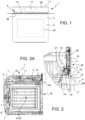
- the first intrados 14 and/or the light strip 19 projected onto the first intrados 14 can be planar or curved, for example, but with a horizontal extension in at least one linear direction, e.g., according to a horizontal plane or a plane inclined downwards in a forward direction of the household appliance 1 (as can be seen in figure 2A , for example).
- the horizontal orientation of the projected light strip 19 creates a visual signaling effect easily and naturally perceivable by humans, without generating associations of stress or danger. Furthermore, the horizontal light strip 19 divides, but simultaneously visually joins the bordering regions of the outer surface 4 of the household appliance 1, neutralizing the visual effect of the geometric shape of the separation gap 12.
- At least one of the first intrados 14, the second intrados 15, and the gap bottom 16 delimits at least one outlet opening 21 of a ventilation channel 22 (air ejection and/or suction channel), where the lighting device 18 and the separation gap 12 are configured so that the outlet opening 21 is in a shaded zone 23 not lit by the lighting device 18, in particular not lit by the light strip 19 projected onto the first intrados 14.
- a ventilation channel 22 air ejection and/or suction channel
- the light strip 19 projected onto the first intrados 14 divides the interstice space 13 into:
- the lighting device 18 is operable or configured to vary features (e.g., the position, the length, the color, the light intensity) of the light strip 19 over time, depending on an operating state and/or operating parameters of the household appliance 1.
- the lighting device is in signal connection with and controlled by the electronic control system 10. This provides light feedback, positioned on the household appliance 1, for communicating to the user, at a distance of up to at least 5 meters, an operating state of the household appliance 1, e.g., on and off state, an operating state, a charging state with the household product.
- the lighting device is configured to vary the color of the light strip 19 between at least two different colors, e.g., between four different colors, e.g., between blue, white, red and yellow.
- each different color of the light strip 19 is a different, specific piece of information on the state of operation of the household appliance 1.
- the colors and/or change in color of the light strip 19 can be set or adjusted or deactivated by the user by means of the user interface 11 on board the household appliance 1 or made in a remote electronic device 24, e.g., a smart phone or tablet computer.
- the household appliance 1 is one of:
- the household products which are treated by means of the household appliance 1 can comprise one or more of:
- the separation gap 12 can be formed, for example, between two outer surface portions 4 movable with respect to each other, e.g., a gap between an edge of a door 25 and a fixed adjacent edge of the household appliance 1.
- the separation gap 12 can be formed, for example, and the light strip 19 can thus be generated, between the door 25 and a control panel 26 of the household appliance 1 and clearly visible when the door 25 is closed ( figures 1, 2A , 9 ), e.g., in an oven 1.1 or a dishwasher 1.5.
- the first intrados 14 can be formed by an upper edge of the door 25 and/or a handle 46 of the door 25, e.g., in the cooking oven 1.1.
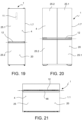
- the separation gap 12 can be formed, for example, between an edge of a first door or drawer 25.1 and an adjacent edge of a second door or drawer 25.2 of a refrigerator 1.7 or freezer 1.8 or combined refrigerator-freezer ( figures 19, 20, 21 ).
- the separation gap 12 can be formed, for example, between an edge of a hatch and a fixed adjacent edge of a washing machine 1.2 or a tumble dryer 1.3.
- the separation gap 12 can be formed, for example, between an edge of a drawer and a fixed adjacent edge, e.g., of a control panel, of a drawer-type dishwasher.
- the separation gap 12 can be formed, for example, between an edge of a first drawer and an adjacent edge of a second drawer of a drawer-type dishwasher.
- the separation gap 12 can be formed, for example, at structural or functional slits of the household appliance 1, e.g., at an air ejection or suction slit in an oven 1.1 or a dishwasher 1.5 or a tumble dryer 1.3 or a refrigerator 1.7.
- All the positions indicated for the separation gap 12 are particularly advantageous for a corresponding arrangement and configuration of the lighting device for generating the light strip 19 in said positions.
- the lighting device 18 is arranged inside the household appliance 1 or at least covered by the outer wall 3 or the outer surface 4 and is not directly visible and/or accessible to users from outside the household appliance 1. This allows optimizing the lighting device 18 without having to consider the esthetic appearance thereof.
- the lighting device 18 is arranged on a rear side of a control panel 26 of the household appliance 1, e.g., of the oven 1.1, in which control panel 26 the user interface 11 and at least part of the electronic control system 10 are integrated.
- the lighting device 18 can be directly connected, mechanically and electrically, to the control panel 26, i.e., mechanically connected to the control panel 26 and electrically connected to the electronic control system 10.
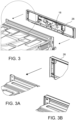
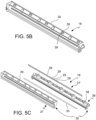
- the lighting device 18 comprises a lighting strip 27 with a PCB circuit board 28 and a plurality of LEDs 29 arranged in a row, e.g., RGBW LEDs, selectively controllable by the PCB circuit board 28, and its own light guide housing 30, for example distinct from the control panel 26, which supports and positions the lighting strip 27 and which forms a light guide channel 31 for guiding the light from the lighting strip 27 to a light outlet slit 32 of the light guide housing 30 ( figures 5 , 5A - 5E ).
- a lighting strip 27 with a PCB circuit board 28 and a plurality of LEDs 29 arranged in a row, e.g., RGBW LEDs, selectively controllable by the PCB circuit board 28, and its own light guide housing 30, for example distinct from the control panel 26, which supports and positions the lighting strip 27 and which forms a light guide channel 31 for guiding the light from the lighting strip 27 to a light outlet slit 32 of the light guide housing 30 ( figures 5 , 5A - 5E ).
- the lighting device 18 can further comprise a refraction plate or layer 33 positioned in the light path, e.g., in the light guide housing 30 to cause a refraction of the light from the lighting strip 27 before said light is reflected by the first intrados 14. This allows evening the light intensity and diffusing the light along the light strip 19, despite the original generation of the light in discrete points by means of the LEDs.
- the refraction plate or layer 33 can be transparent or translucent ( figures 5C , 5D,5E ).
- the light guide housing 30, which is preferably made of plastic, is self-supporting and structurally distinct from the control panel 26 of the household appliance 1. This allows for a modular design and a high degree of prefabrication of the single components of the household appliance 1.
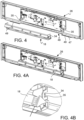
- the light guide housing 30 forms coupling portions 34, for example snap-on teeth ( figures 4, 4B , 6F ) for a snap engagement (without requiring screws or gluing) with corresponding counter-coupling portions 35, for example stop edges ( figures 4, 4B ) of the household appliance 1, in particular of the control panel 26 or a board of the electronic control system 10. This facilitates and accelerates assembly.
- coupling portions 34 for example snap-on teeth ( figures 4, 4B , 6F ) for a snap engagement (without requiring screws or gluing) with corresponding counter-coupling portions 35, for example stop edges ( figures 4, 4B ) of the household appliance 1, in particular of the control panel 26 or a board of the electronic control system 10.
- the light guide housing 30 comprises a first half-shell 36 (half-shell higher up in figure 5C and lower down in figure 5D ) and a second half-shell 37 (half-shell lower down in figure 5C and higher up in figure 5D ) mutually connectable by snap engagement ( figures 6E, 6F, 6G ), e.g., by means of a combined engagement movement of translational insertion and subsequent snap-engagement rotation.
- first half-shell 36 and the second half-shell 37 form:
- the light guide housing 30, in particular the first half-shell 36 and/or the second half-shell 37 form one or more LED seats 42, e.g., a groove or snap-on teeth, for accommodation by (simple) insertion (e.g., snap-on insertion) of the lighting strip 27 ( figures 6C, 6D ).
- LED seats 42 e.g., a groove or snap-on teeth
- the light guide housing 30, in particular the second half-shell 37 and/or the first half-shell 36 form one or more refraction seats 43, e.g., a groove, for accommodation by (simple) insertion of the refraction plate or layer 33 ( figures 6A, 6B ).
- the light guide channel 31 forms, between the lighting strip 31 and the refraction plate or layer 33, a first polished surface 44 and a second polished surface 45 opposed to each other and reflecting the light from the lighting strip 31 so as to guide it through the light outlet slit 32 towards the first intrados 14 ( figures 7, 8 ).
- the first polished surface 44 and the second polished surface 45 are preferably formed, the one in the first half-shell 36 and the other in the second half-shell 37, and/or possibly polished or mirror-polished or coated with a polished layer after formation by injection molding of the first half-shell 36 and the second half-shell 37.
- the polishing itself and control of the degree of shine are facilitated by the structure with two half-shells of the light guide housing 30.
- the light guide channel 31 further forms at least one stepped or notched or roughened surface 45D preferably oblique to the first polished surface 44 and the second polished surface 45, and preferably downstream of the refraction plate/layer 33, to prevent the light from spreading towards the shaded zone 23.
- reflecting surfaces of the light guide channel 31, which are not visible from outside the household appliance 1, are white, while reflecting surfaces of the light guide channel 31, which are visible from outside the household appliance 1, are of a color other than white, e.g., of the same color as the outer surface 4. This combines the need for good light reflection and esthetic continuity of the separation gap 12 with the outer surface 4.
- the lighting device 18 is in heat exchange communication with a ventilation channel 22 of the household appliance to avoid it from being overheated.
- the/a control panel 26 of the household appliance 1 integrates the/a user interface 11 with display and forms a (preferably lower) delimitation wall 47 which forms a (preferably upper) side of the separation gap 12, e.g., the second intrados 15, and which forms:
- the control panel 26 has an injection-molded support structure made of plastic.
- the electronic control system 10 and the lighting device 18 are configured so that:
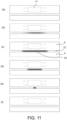
- the light signaling of the "cooking completed" state can comprise an in-length centered pulsation of the light strip 19, e.g., with a white color ( figure 15 ).
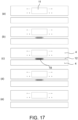
- a light signaling of the "hot cooking cavity 50" can comprise a light intensity pulsation of the light strip 19, e.g., with a yellow or orange color, where the length of the light strip depends on the temperature of the cooking cavity 50 ( figures 16 , 17 ).
- the treatment devices 7 of the household appliance 1 can comprise one or more of:
- the treatment detectors 8 can comprise one or more of:
- the anomaly detectors 9 also are in signal connection with the electronic control system 10 and can comprise one or more of a temperature sensor, a water presence sensor, a smoke presence sensor, a water absence sensor, a position/presence sensor of movable or detachable parts of the household appliance.
- the electronic control system 10 controls the one or more treatment devices 7 and/or also controls the lighting device 18 depending on anomaly signals generated by the anomaly detectors 9.
- the household cooking oven 1.1 ( figures 1, 2, 2A , 26 ) comprises a cooking cavity 50 forming the treatment seat 5 and being closable by a door 25, as well as a ventilation system 52, a heating system 53 for heating the food products, optionally a movement system 56 (e.g., for turning the meat to be grilled), optionally a steam generator 58 for generating steam in the treatment position 6, optionally a gas burner adapted to heat food in the treatment position 6.
- the microwave oven 1.6 ( figure 27 ) comprises a cooking cavity forming the treatment seat 5 and being closable by a door 25, as well as a microwave generator 57 for generating microwaves in the treatment position 6, a movement system 56, optionally a ventilation system 52.
- the washing machine 1.2 ( figure 22 ) comprises a laundry drum forming the treatment seat 5 and closable by a door 25, as well as a hydraulic system 51, a water heating system 53, a dispensing system 55, a movement system 56.
- the tumble dryer 1.3 ( figure 23 ) comprises a basket or laundry drum forming the treatment seat 5 and closable by a door 25, as well as a ventilation system 52, an air heating system 53, a dehumidification system 54, a movement system 56.
- the washer-dryer 1.4 ( figure 24 ) comprises a laundry drum forming the treatment seat 5 and closable by a door 25, as well as a hydraulic system 51, a water heating system 53, a dispensing system 55, a movement system 56, a ventilation system 52, an air heating system 53, a dehumidification system 54.
- the dishwasher 1.4 ( figure 25 ) comprises an accommodation cavity forming the treatment seat 5 and being closable by a door 25, as well as a hydraulic system 51, a water heating system 53, a dispensing system 55, and optionally a dehumidification system 54.
- the refrigerator 1.7 ( figure 28 ) comprises a cooling cavity forming the treatment seat 5 and closable by a door 25, as well as a cooling and/or freezing system 59 adapted to cool and/or freeze the household products in the treatment position 6, and optionally a ventilation and/or air circulating system 52 for aerating the household products in the treatment position 6.
- the freezer 1.8 ( figure 29 ) comprises a freezing cavity forming the treatment seat 5 and closable by a door 25, as well as a freezing system 59 adapted to freeze the household products in the treatment position 6.
- Each of the household appliances 1, 1.1 ... 1.8 described in greater detail can selectively comprise one or more of the treatment detectors 8 and selectively one or more of the anomaly detectors 9, in conjunction with their signal connections with the electronic control system 10, described above and not repeated herein for brevity.
Landscapes
- Engineering & Computer Science (AREA)
- Chemical & Material Sciences (AREA)
- Combustion & Propulsion (AREA)
- Mechanical Engineering (AREA)
- General Engineering & Computer Science (AREA)
- Electric Ovens (AREA)
Applications Claiming Priority (1)
| Application Number | Priority Date | Filing Date | Title |
|---|---|---|---|
| IT102023000017802A IT202300017802A1 (it) | 2023-08-30 | 2023-08-30 | Elettrodomestico con un dispositivo di illuminazione, in particolare forno di cottura |
Publications (1)
| Publication Number | Publication Date |
|---|---|
| EP4517176A1 true EP4517176A1 (de) | 2025-03-05 |
Family
ID=89898110
Family Applications (1)
| Application Number | Title | Priority Date | Filing Date |
|---|---|---|---|
| EP24195099.7A Pending EP4517176A1 (de) | 2023-08-30 | 2024-08-19 | Haushaltsofen mit beleuchtungseinrichtung |
Country Status (2)
| Country | Link |
|---|---|
| EP (1) | EP4517176A1 (de) |
| IT (1) | IT202300017802A1 (de) |
Citations (9)
| Publication number | Priority date | Publication date | Assignee | Title |
|---|---|---|---|---|
| DE102005047915A1 (de) * | 2005-10-06 | 2007-04-12 | BSH Bosch und Siemens Hausgeräte GmbH | Haushaltsgerät, insbesondere Einbau-Haushaltsgerät mit einer steuerbaren Betriebsanzeige |
| US20100147338A1 (en) * | 2005-10-06 | 2010-06-17 | Buesing Johannes | Dishwasher, in Particular Domestic Dishwasher with a Controllable Operation Display Panel |
| DE102011075095A1 (de) * | 2011-05-02 | 2012-11-08 | BSH Bosch und Siemens Hausgeräte GmbH | Geschirrspülmaschine mit mindestens zwei Leuchtstreifen an mindestens einer Seitenkante des Möbelblattes ihrer Tür |
| EP2857754A2 (de) * | 2013-10-03 | 2015-04-08 | BSH Hausgeräte GmbH | Haushaltsgerät |
| US10076227B2 (en) * | 2010-03-26 | 2018-09-18 | BSH Hausgeräte | Dishwasher |
| DE102017209071A1 (de) * | 2017-05-30 | 2018-12-06 | BSH Hausgeräte GmbH | Streifenleuchte |
| US10655863B1 (en) * | 2019-05-13 | 2020-05-19 | Emz-Hanauer Gmbh & Co. Kgaa | Luminaire for domestic electric appliance, such as a domestic oven |
| US10883726B2 (en) * | 2017-06-28 | 2021-01-05 | Lg Electronics Inc. | Light emitting device in door for cooking appliance and cooking appliance including the same |
| EP3762653B1 (de) * | 2018-03-09 | 2022-11-09 | BSH Hausgeräte GmbH | Haushaltsgerät mit einer anzeigeeinrichtung mit intensitätsvariablen lichtbild, sowie verfahren |
-
2023
- 2023-08-30 IT IT102023000017802A patent/IT202300017802A1/it unknown
-
2024
- 2024-08-19 EP EP24195099.7A patent/EP4517176A1/de active Pending
Patent Citations (9)
| Publication number | Priority date | Publication date | Assignee | Title |
|---|---|---|---|---|
| DE102005047915A1 (de) * | 2005-10-06 | 2007-04-12 | BSH Bosch und Siemens Hausgeräte GmbH | Haushaltsgerät, insbesondere Einbau-Haushaltsgerät mit einer steuerbaren Betriebsanzeige |
| US20100147338A1 (en) * | 2005-10-06 | 2010-06-17 | Buesing Johannes | Dishwasher, in Particular Domestic Dishwasher with a Controllable Operation Display Panel |
| US10076227B2 (en) * | 2010-03-26 | 2018-09-18 | BSH Hausgeräte | Dishwasher |
| DE102011075095A1 (de) * | 2011-05-02 | 2012-11-08 | BSH Bosch und Siemens Hausgeräte GmbH | Geschirrspülmaschine mit mindestens zwei Leuchtstreifen an mindestens einer Seitenkante des Möbelblattes ihrer Tür |
| EP2857754A2 (de) * | 2013-10-03 | 2015-04-08 | BSH Hausgeräte GmbH | Haushaltsgerät |
| DE102017209071A1 (de) * | 2017-05-30 | 2018-12-06 | BSH Hausgeräte GmbH | Streifenleuchte |
| US10883726B2 (en) * | 2017-06-28 | 2021-01-05 | Lg Electronics Inc. | Light emitting device in door for cooking appliance and cooking appliance including the same |
| EP3762653B1 (de) * | 2018-03-09 | 2022-11-09 | BSH Hausgeräte GmbH | Haushaltsgerät mit einer anzeigeeinrichtung mit intensitätsvariablen lichtbild, sowie verfahren |
| US10655863B1 (en) * | 2019-05-13 | 2020-05-19 | Emz-Hanauer Gmbh & Co. Kgaa | Luminaire for domestic electric appliance, such as a domestic oven |
Also Published As
| Publication number | Publication date |
|---|---|
| IT202300017802A1 (it) | 2025-03-02 |
Similar Documents
| Publication | Publication Date | Title |
|---|---|---|
| US9565963B2 (en) | Steam generator and cooking apparatus having the same | |
| KR20080024025A (ko) | 조리기기 | |
| KR20230011151A (ko) | 냉장고 및 가전기기 | |
| US12268348B2 (en) | Dishwasher | |
| KR20050010028A (ko) | 수증기 발생 기능을 갖는 고주파 가열 장치 | |
| KR100901890B1 (ko) | 조리기기 | |
| EP4517176A1 (de) | Haushaltsofen mit beleuchtungseinrichtung | |
| EP4517177A1 (de) | Haushaltsofen mit beleuchtungseinrichtung | |
| CN110246434A (zh) | 具有显示装置的家用器具 | |
| KR100213947B1 (ko) | 균일한 가열이 가능한 오븐 기능을 갖는 토스터 | |
| US12215917B2 (en) | Refrigerator and home appliance | |
| KR20230011153A (ko) | 냉장고 및 가전기기 | |
| EP3885483B1 (de) | Kombination aus einem haushaltsgerät mit benutzerschnittstelle und einem externen elektronischen gerät | |
| KR20230173566A (ko) | 냉장고 | |
| KR20230011150A (ko) | 냉장고 및 가전기기 | |
| KR100836352B1 (ko) | 조리기기 | |
| KR20060035904A (ko) | 빌트인 타입 전기오븐의 냉각시스템 | |
| KR20080020875A (ko) | 조리기기 | |
| KR100901914B1 (ko) | 조리기기 | |
| KR100633171B1 (ko) | 빌트인 타입 전기오븐의 냉각시스템 | |
| JP6368652B2 (ja) | 加熱調理器 | |
| KR20230011148A (ko) | 냉장고 및 가전기기 | |
| KR100872238B1 (ko) | 조리기기 | |
| KR100674724B1 (ko) | 빌트인 타입의 전기오븐 | |
| KR20230011147A (ko) | 냉장고 및 가전기기 |
Legal Events
| Date | Code | Title | Description |
|---|---|---|---|
| PUAI | Public reference made under article 153(3) epc to a published international application that has entered the european phase |
Free format text: ORIGINAL CODE: 0009012 |
|
| STAA | Information on the status of an ep patent application or granted ep patent |
Free format text: STATUS: THE APPLICATION HAS BEEN PUBLISHED |
|
| AK | Designated contracting states |
Kind code of ref document: A1 Designated state(s): AL AT BE BG CH CY CZ DE DK EE ES FI FR GB GR HR HU IE IS IT LI LT LU LV MC ME MK MT NL NO PL PT RO RS SE SI SK SM TR |
|
| STAA | Information on the status of an ep patent application or granted ep patent |
Free format text: STATUS: REQUEST FOR EXAMINATION WAS MADE |
|
| 17P | Request for examination filed |
Effective date: 20250701 |
|
| STAA | Information on the status of an ep patent application or granted ep patent |
Free format text: STATUS: EXAMINATION IS IN PROGRESS |
|
| 17Q | First examination report despatched |
Effective date: 20250819 |