EP4517367A1 - Radarmessvorrichtung mit mehreren übertragungspfaden unter verwendung von zeitfrequenzraumverteilung - Google Patents
Radarmessvorrichtung mit mehreren übertragungspfaden unter verwendung von zeitfrequenzraumverteilung Download PDFInfo
- Publication number
- EP4517367A1 EP4517367A1 EP24197111.8A EP24197111A EP4517367A1 EP 4517367 A1 EP4517367 A1 EP 4517367A1 EP 24197111 A EP24197111 A EP 24197111A EP 4517367 A1 EP4517367 A1 EP 4517367A1
- Authority
- EP
- European Patent Office
- Prior art keywords
- periodic
- radar
- signal
- signals
- periodic radar
- Prior art date
- Legal status (The legal status is an assumption and is not a legal conclusion. Google has not performed a legal analysis and makes no representation as to the accuracy of the status listed.)
- Pending
Links
Images


Classifications
-
- G—PHYSICS
- G01—MEASURING; TESTING
- G01S—RADIO DIRECTION-FINDING; RADIO NAVIGATION; DETERMINING DISTANCE OR VELOCITY BY USE OF RADIO WAVES; LOCATING OR PRESENCE-DETECTING BY USE OF THE REFLECTION OR RERADIATION OF RADIO WAVES; ANALOGOUS ARRANGEMENTS USING OTHER WAVES
- G01S13/00—Systems using the reflection or reradiation of radio waves, e.g. radar systems; Analogous systems using reflection or reradiation of waves whose nature or wavelength is irrelevant or unspecified
- G01S13/02—Systems using reflection of radio waves, e.g. primary radar systems; Analogous systems
- G01S13/06—Systems determining position data of a target
- G01S13/42—Simultaneous measurement of distance and other co-ordinates
-
- G—PHYSICS
- G01—MEASURING; TESTING
- G01S—RADIO DIRECTION-FINDING; RADIO NAVIGATION; DETERMINING DISTANCE OR VELOCITY BY USE OF RADIO WAVES; LOCATING OR PRESENCE-DETECTING BY USE OF THE REFLECTION OR RERADIATION OF RADIO WAVES; ANALOGOUS ARRANGEMENTS USING OTHER WAVES
- G01S7/00—Details of systems according to groups G01S13/00, G01S15/00, G01S17/00
- G01S7/02—Details of systems according to groups G01S13/00, G01S15/00, G01S17/00 of systems according to group G01S13/00
- G01S7/35—Details of non-pulse systems
- G01S7/352—Receivers
-
- G—PHYSICS
- G01—MEASURING; TESTING
- G01S—RADIO DIRECTION-FINDING; RADIO NAVIGATION; DETERMINING DISTANCE OR VELOCITY BY USE OF RADIO WAVES; LOCATING OR PRESENCE-DETECTING BY USE OF THE REFLECTION OR RERADIATION OF RADIO WAVES; ANALOGOUS ARRANGEMENTS USING OTHER WAVES
- G01S13/00—Systems using the reflection or reradiation of radio waves, e.g. radar systems; Analogous systems using reflection or reradiation of waves whose nature or wavelength is irrelevant or unspecified
- G01S13/02—Systems using reflection of radio waves, e.g. primary radar systems; Analogous systems
- G01S13/06—Systems determining position data of a target
- G01S13/08—Systems for measuring distance only
- G01S13/32—Systems for measuring distance only using transmission of continuous waves, whether amplitude-, frequency-, or phase-modulated, or unmodulated
- G01S13/34—Systems for measuring distance only using transmission of continuous waves, whether amplitude-, frequency-, or phase-modulated, or unmodulated using transmission of continuous, frequency-modulated waves while heterodyning the received signal, or a signal derived therefrom, with a locally-generated signal related to the contemporaneously transmitted signal
- G01S13/343—Systems for measuring distance only using transmission of continuous waves, whether amplitude-, frequency-, or phase-modulated, or unmodulated using transmission of continuous, frequency-modulated waves while heterodyning the received signal, or a signal derived therefrom, with a locally-generated signal related to the contemporaneously transmitted signal using sawtooth modulation
-
- G—PHYSICS
- G01—MEASURING; TESTING
- G01S—RADIO DIRECTION-FINDING; RADIO NAVIGATION; DETERMINING DISTANCE OR VELOCITY BY USE OF RADIO WAVES; LOCATING OR PRESENCE-DETECTING BY USE OF THE REFLECTION OR RERADIATION OF RADIO WAVES; ANALOGOUS ARRANGEMENTS USING OTHER WAVES
- G01S13/00—Systems using the reflection or reradiation of radio waves, e.g. radar systems; Analogous systems using reflection or reradiation of waves whose nature or wavelength is irrelevant or unspecified
- G01S13/02—Systems using reflection of radio waves, e.g. primary radar systems; Analogous systems
- G01S13/06—Systems determining position data of a target
- G01S13/08—Systems for measuring distance only
- G01S13/32—Systems for measuring distance only using transmission of continuous waves, whether amplitude-, frequency-, or phase-modulated, or unmodulated
- G01S13/34—Systems for measuring distance only using transmission of continuous waves, whether amplitude-, frequency-, or phase-modulated, or unmodulated using transmission of continuous, frequency-modulated waves while heterodyning the received signal, or a signal derived therefrom, with a locally-generated signal related to the contemporaneously transmitted signal
- G01S13/347—Systems for measuring distance only using transmission of continuous waves, whether amplitude-, frequency-, or phase-modulated, or unmodulated using transmission of continuous, frequency-modulated waves while heterodyning the received signal, or a signal derived therefrom, with a locally-generated signal related to the contemporaneously transmitted signal using more than one modulation frequency
-
- G—PHYSICS
- G01—MEASURING; TESTING
- G01S—RADIO DIRECTION-FINDING; RADIO NAVIGATION; DETERMINING DISTANCE OR VELOCITY BY USE OF RADIO WAVES; LOCATING OR PRESENCE-DETECTING BY USE OF THE REFLECTION OR RERADIATION OF RADIO WAVES; ANALOGOUS ARRANGEMENTS USING OTHER WAVES
- G01S13/00—Systems using the reflection or reradiation of radio waves, e.g. radar systems; Analogous systems using reflection or reradiation of waves whose nature or wavelength is irrelevant or unspecified
- G01S13/02—Systems using reflection of radio waves, e.g. primary radar systems; Analogous systems
- G01S13/50—Systems of measurement based on relative movement of target
- G01S13/58—Velocity or trajectory determination systems; Sense-of-movement determination systems
- G01S13/583—Velocity or trajectory determination systems; Sense-of-movement determination systems using transmission of continuous unmodulated waves, amplitude-, frequency-, or phase-modulated waves and based upon the Doppler effect resulting from movement of targets
- G01S13/584—Velocity or trajectory determination systems; Sense-of-movement determination systems using transmission of continuous unmodulated waves, amplitude-, frequency-, or phase-modulated waves and based upon the Doppler effect resulting from movement of targets adapted for simultaneous range and velocity measurements
-
- G—PHYSICS
- G01—MEASURING; TESTING
- G01S—RADIO DIRECTION-FINDING; RADIO NAVIGATION; DETERMINING DISTANCE OR VELOCITY BY USE OF RADIO WAVES; LOCATING OR PRESENCE-DETECTING BY USE OF THE REFLECTION OR RERADIATION OF RADIO WAVES; ANALOGOUS ARRANGEMENTS USING OTHER WAVES
- G01S7/00—Details of systems according to groups G01S13/00, G01S15/00, G01S17/00
- G01S7/02—Details of systems according to groups G01S13/00, G01S15/00, G01S17/00 of systems according to group G01S13/00
- G01S7/35—Details of non-pulse systems
-
- G—PHYSICS
- G01—MEASURING; TESTING
- G01S—RADIO DIRECTION-FINDING; RADIO NAVIGATION; DETERMINING DISTANCE OR VELOCITY BY USE OF RADIO WAVES; LOCATING OR PRESENCE-DETECTING BY USE OF THE REFLECTION OR RERADIATION OF RADIO WAVES; ANALOGOUS ARRANGEMENTS USING OTHER WAVES
- G01S7/00—Details of systems according to groups G01S13/00, G01S15/00, G01S17/00
- G01S7/02—Details of systems according to groups G01S13/00, G01S15/00, G01S17/00 of systems according to group G01S13/00
- G01S7/35—Details of non-pulse systems
- G01S7/352—Receivers
- G01S7/354—Extracting wanted echo-signals
Definitions
- the invention relates to radar applications with multiple transmission and reception channels.
- the invention relates in particular to a radar measuring device forming a radar transceiver system offering distance measurement, angular position measurement, low power consumption and a high signal-to-noise ratio.
- the FMCW radar approach allows to determine the distance between a radar device and one or more reflectors.
- a reflector is an object reflecting the radar wave. This approach also allows to determine the radial component of a relative velocity between the radar device and the reflector, in particular by using the Doppler effect.
- Fig. 1 is a representation of an example of a periodic FMCW radar signal and an echo in a frequency versus time graph.
- the frequency of the periodic FMCW radar signal increases linearly over a frequency band B for a duration T frame .
- the frequency of the periodic FMCW radar signal changes periodically with a period T. After a flight time ⁇ an echo of the periodic FMCW radar signal is received.
- the frequency of the echo of the periodic radar signal FMCW follows the same evolution as the frequency of the periodic radar signal FMCW.
- the difference between the instantaneous frequencies of the periodic radar signal FMCW and its echo, noted IF, can be determined in particular using an FFT (Fast Fourier Transform) and makes it possible to calculate the flight time ⁇ and to deduce the distance between the FMCW radar device and the reflector at the origin of the echo considered.
- the FMCW approach can be used in conjunction with a SIMO ("Single input multiple output”) radar approach or a MIMO ("Multiple Input Multiple Output”) approach to determine, without performing a radar scan, an angle between a direction of a radar device and a direction of a reflector.
- SIMO Single input multiple output
- MIMO Multiple Input Multiple Output
- SIMO and MIMO approaches use the phase difference of the same wave reflected by a reflector between several receiving antennas to determine this angle also called AOA ("Angle Of Arrival").
- AOA Angle Of Arrival
- the angular resolution i.e. the smallest difference that can be distinguished between the AOAs of two reflectors, is directly related to the number of receiving antennas, for example a SIMO radar with four receiving antennas allows an angular resolution of approximately thirty degrees while a SIMO radar with eight receiving antennas allows an angular resolution of approximately fifteen degrees.
- each receiving antenna requires a dedicated processing chain, including in particular an LNA ("Low Noise Amplifier"), a mixer, a filter and an ADC (“Analogue to Digital Converter").
- the MIMO approach proposes to increase the angular resolution by increasing the number of transmitting antennas, for example, a MIMO radar device with two transmitting antennas and four receiving antennas allows an angular resolution of about 15 degrees.
- this approach requires distinguish in the signal received by a receiving antenna the reflected waves, also called echoes, coming from each transmitting antenna.
- FIG. 2 is a schematic representation of an example of a transmitting and receiving antenna arrangement according to the SIMO and MIMO approaches.
- An angle ⁇ is the angle formed between a y direction of a SIMO or MIMO radar measurement device and the direction of a reflector, ⁇ is the AOA.
- the upper part of the figure shows an example of a SIMO architecture composed of a transmitting antenna and 4 receiving antennas, each receiving antenna is separated by a distance d.
- the radar signal received by an antenna has traveled an additional distance dsin( ⁇ ) compared to the adjacent receiving antenna. This additional distance causes a phase shift between the signals received by each of the transmitting antennas. This phase shift can be determined using an FFT called "angle FFT" and then used to determine ⁇ .
- the lower part of the figure shows an example of a MIMO architecture composed of two transmitting antennas and 4 receiving antennas.
- the two transmitting antennas are separated by a distance 4d.
- An echo of the signal emitted by the second transmitting antenna will therefore have traveled an additional distance of 4dsin( ⁇ ) compared to an echo of the signal emitted by the first transmitting antenna.
- TDM Time Division Multiplexing
- the frame transmitted by a TDM-MIMO radar device must be long enough to contain a time slot for each transmitting antenna, which limits the duration during which the device can be put into sleep mode between two transmission-reception cycles. This limitation of the sleep duration consequently increases the consumption of the TDM-MIMO radar device.
- Another way to distinguish between echoes from different transmitting antennas is to modulate the phase of the signal emitted by each transmitting antenna, an example of this applicable to a MIMO radar device with two transmitting antennas is called BPM ("Binary Phase Modulation").
- BPM Binary Phase Modulation
- the phase of the signal emitted by the second transmitting antenna is shifted by 180° relative to the phase of the signal emitted by the first transmitting antenna.
- This way allows a MIMO radar device to transmit simultaneously on each of its antennas, with different phase shifts applied to the signals emitted by each antenna.
- this way has the disadvantage of suffering a lot of interference between the signals emitted by each antenna and phase demodulation errors, the phase modulation of a signal often being incorrectly interpreted when processing the received signals.
- the transmitting antennas of a MIMO radar device using phase modulation are therefore often confused with each other when processing the signals received by the receiving antennas, which causes a degradation of the angular resolution and the distance resolution of such a device.
- the present invention overcomes the aforementioned drawbacks by proposing a frequency-modulated radar measuring device with continuous emission.
- a reflector is understood to mean, for example, an object on which radar signals are reflected and from which the distance and/or radial velocity and/or an angle with the radar measuring device are to be calculated.
- Radial velocity is understood to be the component of the relative velocity of the reflector with respect to the radar device in the direction formed by a straight line passing through the reflector and the radar device.
- the angle of the reflector with the radar device is an angle, also called AOA, formed between said direction and a characteristic axis of the radar device.
- echoes of the first periodic radar signals means the periodic radar signals, at the level of the receiving antennas of the radar measuring device, resulting from the reflection of the first periodic radar signals on the reflector.
- a periodic radar signal whose frequency varies is understood to mean a signal intended to be emitted by at least one transmitting antenna of a radar device and whose frequency varies.
- the variation of this frequency is periodic according to the period T.
- the T frame part of the period T, said period T according to which the frequencies of the first periodic radar signals vary, is divided into several sections. Within each section, the value of the frequency of each first periodic radar signal varies linearly.
- Such arrangements allow the radar measurement device to use the FMCW approach to estimate the distance and/or radial velocity of one or more reflectors while benefiting from the advantages inherent in this approach.
- Such arrangements allow the radar measurement device to make use of the MIMO approach allowing an estimation of the AOA while using the different transmitting antennas simultaneously.
- the first periodic radar signals transmitted by each transmitting antenna will not cause or very little interference with each other because the frequency of each first periodic radar signal is different at each instant from the frequency of the other first signals. periodic radars.
- the echoes from each transmitting antenna will also be very distinct from each other, which allows for an accurate estimation of the AOA.
- the invention may further comprise one or more of the following characteristics, taken in isolation or in all technically possible combinations.
- the phase of the first periodic radar signal considered, at the end of the section T x considered is equal to the phase of the first periodic radar signal considered at the start of one of the other sections T x .
- Such an arrangement allows, after a rearrangement of the sections of the echoes of the first periodic radar signals, a phase continuity of the echoes of the first periodic radar signals on all the parts T frame .
- This phase continuity on the part T frame makes it possible to estimate the distance of the reflector using an FFT ("Fast Fourier Transform") applied to the entire part T frame .
- the distance resolution thus obtained is c/2B, c being the speed of light and B the FMCW frequency band.
- Distance resolution is the smallest distance difference between two reflectors that can be distinguished by the radar measuring device.
- the distance estimation of the reflector will be carried out using FFTs applied to each segment T x .
- the distance resolution thus obtained is cX/2B, X being the number of sections. The distance resolution would therefore be greater (which corresponds to degraded performance).
- the generator comprises N synchronized digital-analog converters, called DACs.
- Each DAC will be able, depending on a digital signal, to generate a periodic analog signal at a frequency distinct from the periodic analog signals generated by the other DACs.
- the DACs being synchronized, they will also be able to generate periodic analog signals in phase agreement.
- Said first periodic radar signals will be able to be generated using the DACs.
- the generator comprises N polar modulators, each polar modulator being configured to generate a signal from which one of said first periodic radar signals is generated.
- Each polar modulator may provide a frequency shift of the signal that it generates, which makes it possible to ensure that the frequency of each first periodic radar signal is different from the frequency of the other first periodic radar signals at each instant of the part T frame .
- the signal generated by each polar modulator may be used as input, for example, of a multiplexer which will generate one of said first periodic radar signals as output.
- the reception circuit comprises N ⁇ M mixers, each mixer being configured to perform heterodyne mixing of one of the M signals with one of N second periodic radar signals, each second periodic radar signal being generated from one of said N first periodic radar signals.
- each second periodic radar signal is one of the first periodic signals and that each first periodic radar signal corresponds to a second periodic radar signal.
- IF the frequency difference between a first periodic radar signal and its echo.
- This IF is directly proportional to the flight time, noted ⁇ , and therefore to the distance between the radar measuring device and the reflector.
- the initial phase of the signal from each mixer will also make it possible to determine the AOA of the reflector.
- the second periodic signal has a time delay called focus delay, denoted R focus , relative to the first periodic radar signal from which the second periodic radar signal is generated.
- the focus delay R focus by being configured to be close to the time of flight ⁇ , makes it possible to overcome the windowing effects that FMCW radar measurement devices can suffer from when the distance from the reflector increases or when the duration T frame is reduced.
- the first N periodic radar signals are generated from a reference periodic radar signal whose frequency varies linearly in the frequency band B according to a period T ref .
- the term periodic reference radar signal means an FMCW radar signal according to the prior art.
- the period T ref may be equal to the period T or the value of the period T ref may be equal to the value of the part T frame .
- Sections of the reference periodic radar signal may be used to generate the sections T x of the first periodic radar signals, using different orders of arrangement of the sections of the reference periodic radar signal for each first periodic radar signal.
- the first N periodic radar signals are generated by applying time shifts to the reference periodic radar signal.
- first periodic radar signals are generated with frequencies varying in the band B and whose frequencies at each instant may be different by using different time offsets for the generation of each first periodic radar signal.
- the period T ref of variation of the frequency of the reference periodic radar signal is equal to the part T frame and the first periodic radar signal of index k, k being an integer between 1 and N, is generated by applying a time shift to the reference periodic radar signal.
- D k k ⁇ 1 ⁇ T trame N .
- each segment T x is defined by the difference of each time offset D k with the previous index time offset D k-1 .
- This time shift of index k ensures that the duration of each section T x is equivalent to that of the other sections T x and that the difference between the frequencies of the first periodic radar signals at each instant is maximum for a frequency band B used.
- a duration of each segment T x and a frequency band covered by each segment T x are configured according to a segment arrangement code.
- segment arrangement code to configure the duration and frequency band of each segment T x makes it possible to generate the first N periodic radar signals while limiting potential interference with other periodic signals present in the environment of the device according to the invention.
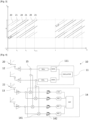
- FIG. 3 is a representation of an example of first periodic radar signals 20 and echoes 21 according to the invention in a graph representing the frequency as a function of time.
- 3 first periodic radar signals 20 are represented.
- the first periodic radar signals 20 are emitted during the part T frame .
- Each first periodic radar signal 20 is emitted by a transmitting antenna of a radar measuring device 10 according to the invention.
- a reflector reflects the first periodic radar signals 20 which induces echoes 21 of the first periodic radar signals.
- the reflector may in particular be characterized by a radar equivalent surface.
- Each first periodic radar signal 20 induces an echo 21 which is received by receiving antennas 13 of the radar measuring device 10 according to the invention, after a flight time ⁇ .
- Each receiving antenna 13 of the radar device 10 according to the invention receives a signal 22, this signal comprises the echoes 21 of each first periodic radar signal 20 caused by at least one reflector.
- the frequency of each first periodic radar signal 20 is different from the frequencies of the other first periodic radar signals 20 at each time of the frame portion T. In this way, the first periodic radar signals 20 transmitted by each transmitting antenna 12 do not cause interference with each other.
- the frequency shift between a first periodic radar signal 20 and its echo 21, also called frequency difference IF, makes it possible to calculate a distance between the radar measuring device and the reflector having caused the echo 21 considered.
- a receiving circuit 14 of the radar device 10 according to the invention will be able, from at least one signal 22 received by a receiving antenna 13, to determine the IF associated with a reflector and then, from this IF, to calculate the distance between the radar measuring device and the reflector considered.
- Several reflectors at different distances will each cause an echo 21 with a distinct IF, which will make it possible to calculate the distance of each reflector.
- the echo 21 of each first periodic radar signal 20 is distinct in frequency from the echoes of the other first periodic radar signals 20. Since the flight time ⁇ is considered to be low compared to the transmission duration T frame , the echo 21 close in frequency to one of the first periodic radar signals 20 is the echo 21 of the first periodic radar signal 20 considered. This makes it possible to distinguish, from one another, the echoes of the first periodic radar signals 20 emitted by each transmission antenna 12 of the radar measuring device 10 according to the invention.
- the reception circuit 14 of the radar measuring device 10 according to the invention can then determine a phase shift between the echoes 21 of the first periodic radar signals 20 emitted by each transmission antenna 12. By phase shift is meant an initial phase difference.
- the receiving circuit will also be able to determine a phase shift between the signals received by each receiving antenna.
- the device 10 according to the invention can implement a MIMO architecture making it possible to calculate the AOA of a reflector while exploiting all the transmission capacity of the radar device according to the invention (each transmitting antenna transmits simultaneously).
- phase of the first periodic radar signal considered at the end of the section T x considered is equal to the phase of the first periodic radar signal 20 at the start of one of the other sections T x .
- Phase is understood to mean the instantaneous phase of a periodic signal. In the context of a sinusoidal expression of the periodic signal, this is the argument of the sine function.
- the phase continuity between the sections of the first periodic radar signals 20 allows phase continuity on the part T frame of the signals 22 received by the receiving antennas.
- These signals 22 may be directly or indirectly (after one or more transformations) processed using a fast Fourier Transform (FFT) over the entire T frame portion in order to determine frequency deviations IFs.
- FFTs fast Fourier Transform
- S 1 being the first periodic radar signal 20 of index 1 (represented in solid line on the fig. 3 ), f c being the central frequency of frequency band B and ⁇ the slope of the frequency variation.
- s 2 sin 2 ⁇ f c ⁇ B / 2 t ⁇ T 1 + ⁇ t ⁇ T 1 2 , ⁇ t ⁇ 0 T 1 sin 2 ⁇ f c ⁇ B / 2 t + T 1 + ⁇ t + T 1 2 , ⁇ t ⁇ T 1 T 2 sin 2 ⁇ f c ⁇ B / 2 t + ⁇ t 2 , ⁇ t ⁇ T 2 T trame
- S 2 being the first periodic radar signal 20 of index 2 (represented in large dotted lines on the fig. 3 ).
- s 3 sin 2 ⁇ f c ⁇ B / 2 t ⁇ T 2 + ⁇ t ⁇ T 2 2 , ⁇ t ⁇ 0 T 1 sin 2 ⁇ f c ⁇ B / 2 t + ⁇ t 2 , ⁇ t ⁇ T 1 T 2 sin 2 ⁇ f c ⁇ B / 2 t + T 2 + ⁇ t + T 2 2 , ⁇ t ⁇ T 2 T trame
- S 3 being the first periodic radar signal 20 of index 3 (represented in small dotted lines on the fig. 3 ).
- Each polar modulator 111 generates a signal from which a first periodic radar signal 20 is created, for example, using a multiplexer “MUL.” then a power amplifier “PA”.
- each signal generated by one of the polar modulators 111 is different at each instant from the frequency of the signals generated by the other polar modulators 111. In this way, the frequency of each first periodic radar signal 20 is different at each instant from the frequency of the other first periodic radar signals 20.
- Each first periodic radar signal 20 is emitted by at least one transmitting antenna (one transmitting antenna per first signal in the example shown).
- the generator 111 comprises N digital-analog converters “DAC” (“Digital Analogue Converter”). Each first signal 20 is generated using a digital-analog converter from a digital signal.
- DAC Digital Analogue Converter
- Each receiving antenna is configured to receive a signal 22 comprising, if a reflector is present in a visibility zone of the radar, the echoes of the first signals 20.
- Each signal 22 may, for example, be amplified by a low noise amplifier “LNA” (“Low Noise Amplifier”) then be mixed according to a heterodyne mixture by a mixer 141 with a second periodic radar signal generated from one of the first signals 20.
- LNA Low Noise amplifier
- each second periodic radar signal is one of the first periodic radar signals 20, from a splitter 15, and each first signal 20 corresponds to a second periodic radar signal.
- the frequencies f 1 and f 2 and the initial phases ⁇ 1 and ⁇ 2 being respectively the frequencies and the initial phases of the signal 22 and of the second periodic radar signal at the input of one of the mixers 141.
- a low-pass filter 142 will make it possible to isolate the component of frequency f 3 and initial phase ⁇ 3 which can then be digitized using an analog-digital converter (ADC).
- the reception circuit 14 of the radar measuring device 10 comprises, for example, a digital signal processor DSP (“Digital Signal Processing”) configured to perform FFTs making it possible to calculate the distance between the reflectors and the radar measuring device and the AOAs of the reflectors.
- DSP Digital Signal Processing
- the reception circuit 14 may not include a mixer 141.
- the signals 22 received may be directly digitized as well as the first signals 20 and the frequency differences IFs determined without heterodyne mixing but by digital processing only.
- such an embodiment has the drawback of requiring ADCs having a much higher sampling frequency in order to be able to digitize the signals 22 directly without losing useful information.
- each second periodic radar signal has a time delay R focus relative to the first signal 20 from which it is generated.
- a radar measuring device as described in the application FR3125887 allows this time delay and uses it, by configuring it to be close to the time of flight ⁇ , to reduce the IFs (which allows to use ADCs with even lower sampling rates) and to avoid windowing effects (producing reflector ghost images) when the distance between the reflector and the device is such that the time of flight ⁇ is greater than the period T.
- Fig. 5 is a schematic representation of an example of steps for generating first periodic radar signals according to the invention.
- a reference periodic radar signal 23 is shown, which is an FMCW signal as present in the prior art.
- the frequency of the reference periodic radar signal varies linearly in the frequency band B.
- the variation in the frequency of the reference periodic radar signal 23 is periodic according to a period T ref .
- Each section T x of the first periodic radar signals 20 may be generated from a section of the reference periodic radar signal 23, for example, digitally, when the first periodic radar signals 20 are generated using DACs.
- time shifts D k may be applied to the reference periodic radar signal 23 to generate the first periodic radar signals 20.
- the period T ref is equal to the period T and each segment T x comes from the reference periodic radar signal 23 shifted by a time shift D k to which is applied a time window, also called a gate, of width T x and starting at the start time of the segment T x considered.
- Each first periodic radar signal may then be constituted, for example using a switch, from the different segments T x generated from the reference periodic radar signal 23.
- T ref Frame . That is to say that the duration of the period T ref of variation of the frequency of the reference periodic radar signal 23 is equal to the duration of the part T frame of the period T of the first periodic radar signals 20.
- a time window of width T frame and starting at the start of the part T frame makes it possible to generate an intermediate signal of duration T frame.
- the intermediate signal is then repeated according to the period T to form the first periodic radar signal 20 of index k.
- This way of generating the first periodic radar signals 20 allows in particular an equal duration for each section T x .
- This way also allows, for a given frequency band B, a maximum difference between the frequency at each instant of a first periodic radar signal 20 with the frequency of the other first periodic radar signals 20. Having a maximum difference between the frequencies at each instant of the first periodic radar signals makes it possible to limit as much as possible the interference between the first periodic signals 20 during their simultaneous emissions.
- a duration of each segment T x and a frequency band covered by each segment T x are configured according to a segment arrangement code.
- a section arrangement code is one or more digital or analog signals containing information representative of the duration and frequency band of each section T x .
- segment arrangement code to configure the duration and frequency band of each segment T x makes it possible to generate the first N periodic radar signals, for example by leaving one or more parts of the frequency band B unused. This makes it possible to limit interference with other periodic signals, occupying this or these parts of the frequency band B, in the environment of the radar device according to the invention.
- the chunk layout code will generate the first N periodic radar signals in such a way as to limit the average destructive interference experienced by the first periodic radar signals.
- the section layout code could, for example, be used to configure the generation of the first N periodic radar signals by the polar modulators or by the DACs.
Landscapes
- Engineering & Computer Science (AREA)
- Radar, Positioning & Navigation (AREA)
- Remote Sensing (AREA)
- Computer Networks & Wireless Communication (AREA)
- Physics & Mathematics (AREA)
- General Physics & Mathematics (AREA)
- Radar Systems Or Details Thereof (AREA)
Applications Claiming Priority (1)
| Application Number | Priority Date | Filing Date | Title |
|---|---|---|---|
| FR2309053A FR3152599B1 (fr) | 2023-08-29 | 2023-08-29 | Dispositif de mesure radar à plusieurs voies de transmission utilisant une distribution dans l’espace temps-fréquence |
Publications (1)
| Publication Number | Publication Date |
|---|---|
| EP4517367A1 true EP4517367A1 (de) | 2025-03-05 |
Family
ID=89661340
Family Applications (1)
| Application Number | Title | Priority Date | Filing Date |
|---|---|---|---|
| EP24197111.8A Pending EP4517367A1 (de) | 2023-08-29 | 2024-08-28 | Radarmessvorrichtung mit mehreren übertragungspfaden unter verwendung von zeitfrequenzraumverteilung |
Country Status (3)
| Country | Link |
|---|---|
| US (1) | US20250076457A1 (de) |
| EP (1) | EP4517367A1 (de) |
| FR (1) | FR3152599B1 (de) |
Citations (3)
| Publication number | Priority date | Publication date | Assignee | Title |
|---|---|---|---|---|
| US20200233076A1 (en) * | 2019-06-27 | 2020-07-23 | Intel Corporation | Methods and apparatus to implement compact time-frequency division multiplexing for mimo radar |
| EP4016126A1 (de) * | 2020-12-17 | 2022-06-22 | NXP USA, Inc. | Chirp-mimo-radar mit frequenz- und zeitversetzter modulation |
| FR3125887A1 (fr) | 2021-07-29 | 2023-02-03 | Commissariat A L'energie Atomique Et Aux Energies Alternatives | Dispositif et procede de mesure radar a double generation de signal radar |
-
2023
- 2023-08-29 FR FR2309053A patent/FR3152599B1/fr active Active
-
2024
- 2024-08-28 EP EP24197111.8A patent/EP4517367A1/de active Pending
- 2024-08-28 US US18/817,503 patent/US20250076457A1/en active Pending
Patent Citations (3)
| Publication number | Priority date | Publication date | Assignee | Title |
|---|---|---|---|---|
| US20200233076A1 (en) * | 2019-06-27 | 2020-07-23 | Intel Corporation | Methods and apparatus to implement compact time-frequency division multiplexing for mimo radar |
| EP4016126A1 (de) * | 2020-12-17 | 2022-06-22 | NXP USA, Inc. | Chirp-mimo-radar mit frequenz- und zeitversetzter modulation |
| FR3125887A1 (fr) | 2021-07-29 | 2023-02-03 | Commissariat A L'energie Atomique Et Aux Energies Alternatives | Dispositif et procede de mesure radar a double generation de signal radar |
Also Published As
| Publication number | Publication date |
|---|---|
| FR3152599A1 (fr) | 2025-03-07 |
| FR3152599B1 (fr) | 2025-10-17 |
| US20250076457A1 (en) | 2025-03-06 |
Similar Documents
| Publication | Publication Date | Title |
|---|---|---|
| TWI821290B (zh) | 使用共同信號波形的組合雷達和通信系統 | |
| US11061126B2 (en) | Cooperative frequency-modulated continuous-waveform radar systems | |
| CN113466799B (zh) | 在频率调制连续波(fmcw)雷达系统中的干扰检测 | |
| US11125854B2 (en) | Time transfer and position determination during simultaneous radar and communications operation | |
| EP2339369B1 (de) | Radarortungsverfahren insbesondere für Bordradargeräte zur Umsetzung einer Hinderniserfassungs- und -vermeidungsfunktion | |
| EP2574957B1 (de) | Verfahren zur Abschätzung der unzweideutigen Dopplerfrequenz eines beweglichen Ziels, insbesondere im Meer, und Radar, das dieses Verfahren anwendet | |
| CN110892288A (zh) | 采用合成多普勒处理的直接检测激光雷达系统和方法 | |
| FR2737307A1 (fr) | Systeme de mesure de distance | |
| EP3321711B1 (de) | Aufnahmevorrichtung für antenne mit elektronischer strahlschwenkung, die im resm- und radarmodus arbeiten kann, und mit dieser vorrichtung ausgestatteter radar | |
| EP2959308B1 (de) | Verfahren und system zur abschätzung der einfallsrichtung eines zielsignals relativ zu einem satelliten | |
| EP4124886A1 (de) | Vorrichtung und verfahren zur radarmessung mit doppelter radarsignalgenerierung | |
| EP3605145B1 (de) | Hochauflösendes fernverarbeitungsverfahren | |
| EP4517367A1 (de) | Radarmessvorrichtung mit mehreren übertragungspfaden unter verwendung von zeitfrequenzraumverteilung | |
| EP4006571A1 (de) | Radarerkennungsgerät | |
| FR2682772A1 (fr) | Procede et dispositif de mesure de courtes distances par analyse du retard de propagation d'une onde. | |
| EP3538916B1 (de) | Verfahren zum testen der elektromagnetischen verträglichkeit eines radardetektors mit mindestens einem impulssignalsender an bord | |
| EP0044235B1 (de) | Nachweisvorrichtung für bewegende Ziele in einem Radarsystem und Radarsystem mit einer solchen Vorrichtung | |
| EP0390657A1 (de) | Messung der Sende-Empfangsstabilität in einem Radargerät | |
| EP4024613B1 (de) | Verfahren zum einstellen einer antenne, ausrichter und antenne | |
| EP4575551A1 (de) | Impulsradar mit hybridem impulsansatz und frequenzmodulation | |
| FR2954517A1 (fr) | Systeme de reponse a un signal emis par un radar et utilisation de ce systeme notamment pour tester les radars, en particulier de type mti. | |
| EP3538919B1 (de) | Verfahren zum testen der elektromagnetischen verträglichkeit eines radardetektors mit mindestens einem impulssignalgeber an bord | |
| EP3538917B1 (de) | Verfahren zum testen der elektromagnetischen verträglichkeit eines radardetektors mit mindestens einem impulssignalgeber an bord | |
| EP3910370A1 (de) | Verfahren zur radarerfassung der entfernung und der relativen geschwindigkeit eines echos in bezug auf den radarträger und radar zur umsetzung eines solchen verfahrens | |
| EP4330722A1 (de) | Radarsystem und zugehöriges verfahren zur optimierung der beseitigung von radarstörungen |
Legal Events
| Date | Code | Title | Description |
|---|---|---|---|
| PUAI | Public reference made under article 153(3) epc to a published international application that has entered the european phase |
Free format text: ORIGINAL CODE: 0009012 |
|
| STAA | Information on the status of an ep patent application or granted ep patent |
Free format text: STATUS: REQUEST FOR EXAMINATION WAS MADE |
|
| 17P | Request for examination filed |
Effective date: 20240828 |
|
| AK | Designated contracting states |
Kind code of ref document: A1 Designated state(s): AL AT BE BG CH CY CZ DE DK EE ES FI FR GB GR HR HU IE IS IT LI LT LU LV MC ME MK MT NL NO PL PT RO RS SE SI SK SM TR |