EP4517615A1 - Procédé mis en oeuvre par ordinateur pour la surveillance, l'optimisation et la prévision d'une tâche de nettoyage, système de traitement de données et programme informatique - Google Patents
Procédé mis en oeuvre par ordinateur pour la surveillance, l'optimisation et la prévision d'une tâche de nettoyage, système de traitement de données et programme informatique Download PDFInfo
- Publication number
- EP4517615A1 EP4517615A1 EP24198028.3A EP24198028A EP4517615A1 EP 4517615 A1 EP4517615 A1 EP 4517615A1 EP 24198028 A EP24198028 A EP 24198028A EP 4517615 A1 EP4517615 A1 EP 4517615A1
- Authority
- EP
- European Patent Office
- Prior art keywords
- cleaning
- data
- virtual
- cleaning device
- environment
- Prior art date
- Legal status (The legal status is an assumption and is not a legal conclusion. Google has not performed a legal analysis and makes no representation as to the accuracy of the status listed.)
- Pending
Links
Images


Classifications
-
- G—PHYSICS
- G06—COMPUTING OR CALCULATING; COUNTING
- G06Q—INFORMATION AND COMMUNICATION TECHNOLOGY [ICT] SPECIALLY ADAPTED FOR ADMINISTRATIVE, COMMERCIAL, FINANCIAL, MANAGERIAL OR SUPERVISORY PURPOSES; SYSTEMS OR METHODS SPECIALLY ADAPTED FOR ADMINISTRATIVE, COMMERCIAL, FINANCIAL, MANAGERIAL OR SUPERVISORY PURPOSES, NOT OTHERWISE PROVIDED FOR
- G06Q10/00—Administration; Management
- G06Q10/04—Forecasting or optimisation specially adapted for administrative or management purposes, e.g. linear programming or "cutting stock problem"
-
- A—HUMAN NECESSITIES
- A47—FURNITURE; DOMESTIC ARTICLES OR APPLIANCES; COFFEE MILLS; SPICE MILLS; SUCTION CLEANERS IN GENERAL
- A47L—DOMESTIC WASHING OR CLEANING; SUCTION CLEANERS IN GENERAL
- A47L11/00—Machines for cleaning floors, carpets, furniture, walls, or wall coverings
- A47L11/40—Parts or details of machines not provided for in groups A47L11/02 - A47L11/38, or not restricted to one of these groups, e.g. handles, arrangements of switches, skirts, buffers, levers
- A47L11/4011—Regulation of the cleaning machine by electric means; Control systems and remote control systems therefor
-
- B—PERFORMING OPERATIONS; TRANSPORTING
- B08—CLEANING
- B08B—CLEANING IN GENERAL; PREVENTION OF FOULING IN GENERAL
- B08B3/00—Cleaning by methods involving the use or presence of liquid or steam
- B08B3/02—Cleaning by the force of jets or sprays
- B08B3/024—Cleaning by means of spray elements moving over the surface to be cleaned
-
- B—PERFORMING OPERATIONS; TRANSPORTING
- B08—CLEANING
- B08B—CLEANING IN GENERAL; PREVENTION OF FOULING IN GENERAL
- B08B3/00—Cleaning by methods involving the use or presence of liquid or steam
- B08B3/02—Cleaning by the force of jets or sprays
- B08B3/026—Cleaning by making use of hand-held spray guns; Fluid preparations therefor
-
- B—PERFORMING OPERATIONS; TRANSPORTING
- B08—CLEANING
- B08B—CLEANING IN GENERAL; PREVENTION OF FOULING IN GENERAL
- B08B9/00—Cleaning hollow articles by methods or apparatus specially adapted thereto
- B08B9/08—Cleaning containers, e.g. tanks
- B08B9/093—Cleaning containers, e.g. tanks by the force of jets or sprays
- B08B9/0936—Cleaning containers, e.g. tanks by the force of jets or sprays using rotating jets
-
- B—PERFORMING OPERATIONS; TRANSPORTING
- B25—HAND TOOLS; PORTABLE POWER-DRIVEN TOOLS; MANIPULATORS
- B25J—MANIPULATORS; CHAMBERS PROVIDED WITH MANIPULATION DEVICES
- B25J9/00—Program-controlled manipulators
- B25J9/16—Program controls
- B25J9/1679—Program controls characterised by the tasks executed
-
- G—PHYSICS
- G06—COMPUTING OR CALCULATING; COUNTING
- G06Q—INFORMATION AND COMMUNICATION TECHNOLOGY [ICT] SPECIALLY ADAPTED FOR ADMINISTRATIVE, COMMERCIAL, FINANCIAL, MANAGERIAL OR SUPERVISORY PURPOSES; SYSTEMS OR METHODS SPECIALLY ADAPTED FOR ADMINISTRATIVE, COMMERCIAL, FINANCIAL, MANAGERIAL OR SUPERVISORY PURPOSES, NOT OTHERWISE PROVIDED FOR
- G06Q10/00—Administration; Management
- G06Q10/06—Resources, workflows, human or project management; Enterprise or organisation planning; Enterprise or organisation modelling
- G06Q10/063—Operations research, analysis or management
- G06Q10/0631—Resource planning, allocation, distributing or scheduling for enterprises or organisations
- G06Q10/06311—Scheduling, planning or task assignment for a person or group
- G06Q10/063114—Status monitoring or status determination for a person or group
-
- A—HUMAN NECESSITIES
- A47—FURNITURE; DOMESTIC ARTICLES OR APPLIANCES; COFFEE MILLS; SPICE MILLS; SUCTION CLEANERS IN GENERAL
- A47L—DOMESTIC WASHING OR CLEANING; SUCTION CLEANERS IN GENERAL
- A47L2201/00—Robotic cleaning machines, i.e. with automatic control of the travelling movement or the cleaning operation
- A47L2201/06—Control of the cleaning action for autonomous devices; Automatic detection of the surface condition before, during or after cleaning
-
- G—PHYSICS
- G05—CONTROLLING; REGULATING
- G05B—CONTROL OR REGULATING SYSTEMS IN GENERAL; FUNCTIONAL ELEMENTS OF SUCH SYSTEMS; MONITORING OR TESTING ARRANGEMENTS FOR SUCH SYSTEMS OR ELEMENTS
- G05B2219/00—Program-control systems
- G05B2219/30—Nc systems
- G05B2219/45—Nc applications
- G05B2219/45082—Sanding robot, to clean surfaces
Definitions
- the invention relates to a computer-implemented method for monitoring and optimizing the fulfillment of a cleaning task, which comprises at least one cleaning step, and for predicting a cleaning result on a cleaning object by means of a virtual twin of a cleaning environment, which comprises the cleaning object and a cleaning device.
- the invention further comprises a system for data processing and a computer program.
- the data processing system includes known systems with one or more processors, volatile and non-volatile data storage devices, as well as a bus system and interfaces for linking these and other components.
- this also includes a data or system structure that is not computer-implemented in the traditional sense, but rather biological, for example, such as a DNA memory.
- the virtual or digital twin then also has a biological basis.
- it is an artificial biological structure that stores the cleaning environment, including parameters and experience values, virtually in a biogenic neural network and carries out optimized cleaning.
- a cleaning task represents a requirement to remove contamination from an object by applying a cleaning process.
- the cleaning task and the cleaning process used are specified by the type of contamination, the means used to remove it and the extent and extent to which the contamination must be removed. This depends primarily on the object to be cleaned, including the processes and materials used there.
- a cleaning object is an object to which contaminants adhere and from which they must be removed when the cleaning task is carried out. In the case of biological contamination, disinfection is also required.
- the cleaning task is defined in particular by the requirements placed on the cleaning object during normal operation. For example, other, higher requirements are placed on cleanliness if the cleaning object is used in the food or pharmaceutical production sector, for example.
- the cleaning object is made up of areas with different requirements, which can also be a complete exception to cleaning.
- Stationary cleaning systems are permanently installed in a room (tank, pipeline, production plant) that needs to be cleaned regularly. They are used, for example, for adaptive tank cleaning or for conveyor belt cleaning using a nozzle assembly, but also as cleaning systems in filling plants with surge cleaners.
- Manual mobile cleaning systems record the pose, i.e. position and orientation of a manual cleaning device, preferably a spray lance, and transmit this information to a server, which processes the data and, in addition to using it to optimize the cleaning process, displays the desired information on a terminal device.
- a server which processes the data and, in addition to using it to optimize the cleaning process, displays the desired information on a terminal device.
- the spray lance or the object to be tracked is absolutely located in space with its position and orientation.
- the data can be transferred from the spray lance to the server for evaluation and for the optimization process.
- the server processes the data and, based on the simulation, generates a temporally and spatially resolved cleaning process. This is visualized in various ways.
- Robotic or automated mobile cleaning systems comprise at least one cleaning robot. This can preferably operate in two versions. Version 1 can move freely in the production environment and concentrates on cleaning external machine surfaces, floors, walls and the ceiling area. Version 2 travels on a transport device, e.g. a conveyor belt, through production facilities, independently or externally driven (e.g. through the conveyor belt), and cleans them from the inside out. Both versions have localization sensors to perceive their respective environment (e.g. radar, LIDAR, ultrasound, TOF, induction sensors) and to determine their own position in relation to the elements and surfaces relevant to cleaning. Additional contamination sensors, which include various sensors for the qualitative and/or quantitative detection of contamination, enable the location- and time-resolved detection (e.g. using fluorescence and white light detection) of the contamination to be removed. In the context of the invention, sensors or sensor arrangements as a whole are referred to as sensors.
- a cleaning environment is the entire technical structure within which the cleaning task is carried out.
- the cleaning environment includes the cleaning object and the cleaning device.
- a data structure or database is understood to be a surface model or generally a data source, a data space or a digital infrastructure.
- the database is used to store historical values that the self-learning algorithms access. If static and dynamic data are mentioned below in particular, these are preferably stored in one of the aforementioned structures.
- Parameters of operating conditions of the cleaning environment define the interaction between the cleaning device and the object to be cleaned and are referred to below as dynamic data.
- dynamic data represent the technical requirements of the object to be cleaned when carrying out the cleaning process, while at the same time reflecting the requirements of the cleaning device and in particular the operating conditions during the cleaning process, with which the cleaning task can then be solved.
- the dynamic data are the subject of optimization.
- Cleaning movements are carried out by the cleaning device, in particular by an associated cleaning device, such as a spray lance or cleaning lance or a movable nozzle.
- an associated cleaning device such as a spray lance or cleaning lance or a movable nozzle.
- virtual contamination is applied to the virtualized cleaning object in a virtual form, so that after applying a virtual cleaning agent, the cleaning success can also be determined on the virtual level.
- Cleaning agents are released by the cleaning device and hit the object to be cleaned under defined conditions in order to interact with the dirt, for example by removing, dissolving or rinsing it away.
- the publication EP 3 189 384 B1 A device which is in particular detachably connected to a cleaning device.
- the device comprises at least one sensor means for detecting the position of at least one cleaning area of the cleaning device used for cleaning, at least one display device and at least one data processing device (5) operatively connected to the display device and the at least one sensor means.
- the data processing device is designed and set up to display at least one representation of at least one surface to be cleaned in at least one first color or colorless (29') and, depending on a detected change in the position of at least the cleaning area of the cleaning device, to display the surface to be cleaned in at least a second color.
- the at least one sensor means detects a contact pressure of the at least one cleaning area of the cleaning device on the surface to be cleaned, wherein at least one threshold value for the contact pressure is defined. Only when the threshold value is reached and/or exceeded in the case of a detected change in the position of at least the cleaning area, the surface to be cleaned is displayed in the second color (29") and/or the at least one sensor means detects the distance of the outlet of a jet nozzle of a Cleaning device from the surface to be cleaned, the angle of the outlet of the jet nozzle or jet to the surface to be cleaned, the width and strength of the jet. At least one threshold value for the strength of the jet on the surface is specified. The surface to be cleaned is only displayed in the second color when the threshold value is reached and/or exceeded when a change in the position of the jet nozzle is detected.
- mapping the digital recording in the form of a "map" of the environment is carried out in the current technology exclusively via the sensors integrated in the AR headset (a wearable device for displaying "augmented reality", in which digital information is integrated into the real world).
- the map created in this way is generally very coarsely resolved and of poor quality.
- the map is not saved or retrieved; instead, the mapping is carried out again before and during each cleaning.
- different 3D maps are produced almost every time an object or room is cleaned that is actually identical. This circumstance is a hindrance to reproducible and comprehensible cleaning documentation.
- This approach is also made more difficult by cleaning spray and steam influences in industrial cleaning environments. This system approach therefore appears difficult to implement in practice.
- EP 3 315 219 A1 a mobile, autonomous cleaning device for surfaces in an application room, in particular for use within closed industrial plants, comprising at least one Release device for applying a cleaning agent and/or for removing adhesions from the surfaces and at least one device for determining the position.
- the publication EP 3 950 159 A1 describes a stationary cleaning system comprising a jet cleaner, which in turn comprises a nozzle for dispensing cleaning agent in the form of a jet, wherein the nozzle is arranged on a rotary head and is connected there to a manipulation device.
- the manipulation device can move the nozzle so that the jet is directed in all directions.
- the object of the invention is therefore to improve quality and traceability and, above all, to enable the prediction of a cleaning process.
- the object is achieved by a computer-implemented method for monitoring and optimizing the fulfillment of a cleaning task, which comprises at least one cleaning step, and for predicting a cleaning result on a cleaning object using a virtual twin of a cleaning environment.
- the cleaning task includes in particular the removal of adhesions.
- the cleaning environment comprises the cleaning object and a cleaning device.
- the cleaning task comprises at least one cleaning step.
- the virtual twin is captured in particular by digitizing the cleaning environment, whereby the static data of the virtual twin is initially made available for further processing, e.g. for simulating the cleaning process.
- this also includes defining the associated critical cleaning areas on the cleaning object, required or maximum exposure times for cleaning agents and restricted zones in which no cleaning may take place.
- the static data provides a constant, comprehensible basis for documentation.
- a multi-sensor system e.g. sensor fusion of several localization sensors
- a multi-sensor approach also makes the measurement basis significantly more robust and accurate, even in difficult industrial environments.
- the concept of the virtual twin also allows for live interfaces and feedback to the ongoing process, especially the cleaning process.
- data on the processed product or process parameters e.g. temperatures
- a dynamic, adaptive reference and recommendation environment can be created for the user.
- This adaptive environment of the virtual twin can be supplemented by coupling it to appropriate AI modules, which then create a continuously self-learning system that benefits significantly from the reproducibly stable model approach of the 3D environment.
- Existing operator knowledge can also be collected via suitable interfaces and incorporated into the generally available reference cleaning used for comparable cleaning objects.
- the function of the system according to the invention is basically local, optionally also networked after an advantageous further development, so that the experiences of similar systems are incorporated into a common virtual twin, which in turn is accessed equally by all systems.
- HMI Human Machine Interface
- a representation can be made via an HMI, for example visually and/or haptically and/or acoustically.
- a haptic representation is made, for example, via a vibration in the handle of a cleaning lance or spray lance.
- the invention also enables dynamic optimization of cleaning processes and training of operating personnel.
- a flexible distribution of sensors e.g. clip-on sensors, drones, cameras, glasses, etc.
- sensors e.g. clip-on sensors, drones, cameras, glasses, etc.
- their combined use as a multi-sensor system are also possible.
- the cleaning device comprising a cleaning agent, a cleaning device, a sensor arrangement, a control device and a display device.
- the control device preferably has a database for storing cleaning processes, the dynamic data.
- the virtual twin of the cleaning device is defined in its basic structure by the static data.
- the static data preferably include elements of the cleaning environment and their permanently valid cleaning parameters, such as associated subjects, objects, cleaning devices and sensors.
- Associated dynamic data or parameters relate, for example, to position, dimensions, angles, structures, surfaces and the movements of movable elements as well as properties relating to the cleaning agent.
- the static data also preferably include a description of a cleaning device as part of the cleaning device, for example, the characteristics of the nozzle used to dispense the cleaning agent and other properties of the work area.
- associated dynamic data or parameters relate, for example, to a distance to the object being cleaned, a pose (i.e. position and angle).
- Dynamic data also describe the parameters of the cleaning agents, for example their composition, consistency, temperature, cleaning performance per time, minimum and maximum exposure time.
- the cleaning agent application and, if applicable, its outflow are stored in the group of dynamic data, with the parameters including, for example, the volume flow of the cleaning agent per unit of time, the spray pattern, the spray angle.
- the associated cyclical updating of changes takes place in accordance with the process sequence according to the invention.
- the static and dynamic data are available in a form that can be processed by a computer.
- Another part of the cleaning device relates to input, modification, deletion and output options or means (such as AR/VR glasses, smartphones, wearables, cameras, projectors, acoustic and haptic options), the properties of which are also described by static data and are collectively referred to as HMI in the context of the invention.
- AR glasses make it possible to integrate digital information into the real world, for example by overlaying it on the real visible environment.
- VR glasses create a computer-generated environment that offers a realistic experience by immersing the user in a virtual world.
- the input and output means are used to support, control, make decisions and document cleaning processes and preferably also to detect contamination.
- the solution according to the invention serves to improve the cleaning process for manual cleaning as well as for mobile or stationary automatic cleaning devices, such as a tank cleaner or cleaning robots.
- the cleaning parameters such as volume flow application, should be optimally determined or determined in a spatially resolved and/or time-dependent and/or condition-dependent manner.
- the cleaning device comprises a virtual twin, both for 2D and 3D environments, with which it is linked and which is linked to a database with stored cleaning parameters, for example spatially resolved linked to a 3D CAD model, as well as manually implemented Expert knowledge (e.g. on the machine side from the plant manufacturer, on the process side from the food producer) is accessed and stored in the database.
- a database in the broadest sense, in particular dynamic data describing the cleaning process and static data describing the cleaning environment, including other sources, should be accessed. This includes not only information that has been created manually, but also data generated automatically, for example by AI.
- the expert knowledge should not only come from the machine manufacturer and/or the food producer in terms of process technology, but also from other sources. This expert knowledge should also be fed to the cleaning device, with the associated memory and data processing device, via interfaces.
- aspects of general logging or cleaning documentation are taken into account in the cleaning device.
- this also includes the interface to the user or the company in order to be able to call up and evaluate the existing data (e.g. for audits, etc.).
- the approach according to the invention is much more robust in terms of accuracy than the state of the art and also offers significant added value for the end user, not least in terms of available information.
- the basis here is the concept of a virtual or digital twin. A precise 3D model of the environment or the objects to be cleaned is created in advance, during the commissioning phase of such a system. Prior knowledge, e.g. that of the manufacturer of the system, is also incorporated into this.
- a virtual 3D twin for cleaning applications can also be used for cleaning robotics, as automated cleaning devices, and other applications.
- the invention involves information exchange and processing in both directions, from the cleaning device to the virtual twin and vice versa, and preferably also as "simulation-in-the-loop" (optimization through simulation loops, for individual cleaning steps as well as for the entire cleaning process).
- contamination and cleaning models which contain specifications and empirical values and include parameters such as materials to be treated (processing material) and process parameters, has proven to be advantageous.
- This describes a standardized system modeling. This can follow the specifications in the context of Industry 4.0 with systematic integration (data modeling, etc.) in an Asset Administration Shell (AAS).
- AAS Asset Administration Shell
- contamination and cleaning models in addition to the mathematical-analytical models based on the parameters, the surfaces (resolved to component level) of the machines are also stored, so that a comprehensive description and evaluation of the virtual twin can be realized in a spatially resolved manner within the scope of the static data.
- a dynamic cleaning specification is dynamically mapped locally on the surface of the entire system complex based on the current level of contamination. This also makes it possible to predict the cleaning requirements.
- the quality of the virtual twin as a whole is not rigid, but is continuously adjusted through feedback, especially the dynamic data. Any visualization for operator training or validation or support purposes can be derived from the virtual twin independently of time (historically, as a forecast or in real time). Measured or recorded cleaning effort (e.g. by operators) can be considered for feedback, for example.
- step b) steps a) and the following steps, in particular steps c, d, d1, e, e1, f, e2, e3 and e4 according to the above description of the process flow for optimizing the current cleaning step.
- steps b) and following are repeated at least once to optimize the entire cleaning task.
- the dynamic data also includes information on the application of simulated virtual contamination to specific, virtualized areas of the object to be cleaned. This makes it possible to determine in the virtual cleaning process whether the cleaning is successful, for example with a certain pose of the spray lance in relation to shadows on the surface to be cleaned by built-in components.
- the dynamic data also include the use of virtual cleaning agents with associated properties and specified application restrictions. This makes it possible to determine in the virtual cleaning process whether the cleaning is successful with the selected cleaning agent and its specific properties.
- Human movement in the cleaning environment places special demands on a system because these movements are unpredictable. Nevertheless, the system must react to this, at least for reasons of occupational safety. Appropriate algorithms must be provided, as with any use of robots. Human movement also affects the cleaning movement of the operator, for example when guiding a spray lance. In this case, human movement must be optimized, which is done through direct feedback via the HMI or in another way, e.g. in the form of an evaluation of the entire cleaning process.
- the nozzle databases and programs preferably map jet geometries and flow conditions of nozzles of the cleaning device from which the cleaning agent is released onto the object to be cleaned.
- output signals for displaying operating states on at least one HMI are defined in the virtual twin.
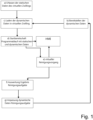
- Fig. 1 shows a schematic process diagram of an embodiment of the method according to the invention for optimizing the cleaning process exclusively in the virtual twin.
- the static data are first recorded, which represent a kind of basic structure of the virtual twin.
- This concerns all values that inevitably remain unchanged during the cleaning process, such as the dimensions of the cleaning object and the cleaning device, and thus the definition of the entire cleaning environment.
- this also includes parts of the cleaning object that are of particular importance, such as protruding parts that can cause a spray shadow when cleaning agent is sprayed on.
- there are also other essentially unchangeable properties of the cleaning device such as the maximum achievable pressure with which the cleaning agent can be applied or the spray pattern of a nozzle permanently installed in the cleaning device.
- the program sequence is ready to start in the virtual twin according to step d).
- This is also optionally shown in an HMI, for example on a screen, for example by virtualizing the cleaning object, whereby the coloring of the surfaces indicates that they have not yet been cleaned.
- step f the result of the entire cleaning task is subjected to an evaluation according to step f). If deficiencies are found, for example inadequate cleaning due to shading in the Spray area, parameters or dynamic data are adjusted in step g). In the above example of shading, this can be done by changing or adding to the pose, i.e. the orientation of a spray nozzle, in order to reach shaded areas and to be able to carry out cleaning there in accordance with requirements.
- step c The appropriately adjusted dynamic data is now fed back into step b), the provision of the dynamic data.
- a new, optimized virtual cleaning process can be started and carried out with updated dynamic data that is loaded into the virtual twin in step c).
- Fig. 2 shows a schematic process diagram of an embodiment of the method according to the invention for optimizing the cleaning process in a real cleaning environment, including the virtual twin.
- the process sequence shown includes the previously described Fig. 1 described, but there is a fundamental difference.
- the cleaning is not only carried out virtually, but also at the same time in a real cleaning device. This includes the possibility of not only evaluating the overall result of the cleaning, but also of recording the results of individual cleaning steps using sensors and immediately optimizing the cleaning step in question, without first having to run through the entire cleaning process and evaluate the end result.
- step e The now complete static and dynamic data are not only transferred to the virtual cleaning process in step e), but also to the real cleaning device according to step d1).
- a parallel cleaning process can be started that is practically interlocked in the program flow, whereby this is carried out both according to step e1) in the Cleaning environment in which the cleaning device acts on the cleaning object during the cleaning process, as well as in step e) in the virtual twin as a virtual cleaning process.
- a display in the HMI If, for example, the cleaning success is shown there by color changes on surfaces that have already been cleaned, insufficiently cleaned areas can now be documented and clarified by evaluating the sensor data of the cleaning device in step e3), while at the same time a remedy is offered by changing the dynamic data.
- a haptic display is also provided, for example, if an operator is involved and can receive information on how to improve the cleaning success through a vibration in the handle of the cleaning device or in another suitable way, such as changing the orientation of the cleaning device.
- the Fig. 2 The process described includes the possibility of evaluating the overall result of the cleaning task, also here in step f).
- the sensor data obtained in step e2) in the cleaning device are also used for this purpose.
- the focus here is on optimizing the individual cleaning steps, which is carried out in a shorter way and leads to faster optimization. Therefore, the evaluation of the entire cleaning task and the resulting adjustment of the dynamic data is shown as optional in a dashed box.
- Fig. 4 shows schematically a process diagram in a different representation of a further embodiment of the method according to the invention for optimizing the cleaning process with a mobile cleaner, wherein the process sequence in contrast to Fig. 3 is shown continuously.
- the process begins with the detection of the environment and the associated movement by a sensor.
- the pose i.e. position and orientation of the cleaning device, is then sent to the server.
- the sensor transmits a trigger signal to the server.
- the server receives both data, pose and trigger signal.
- the server then assigns the pose to an absolute map, i.e. it relates the position and orientation of the cleaning device to, for example, the 3D model of the object being cleaned.
- the server then carries out an evaluation using the stored surface model. After the evaluation, the server sends the results to a display, which then shows the cumulative history.
- FIG. 5 shows schematically a perspective view of an embodiment of a cleaning device, designed as a stationary cleaning system, specifically a tank cleaner 100.
- This category of stationary cleaning systems would also include conveyor belt cleaning by means of a nozzle assembly, but also cleaning systems in filling plants with surge cleaners.
- the tank cleaner 100 has a movable sensor arm 122 suitable for analyzing the entire interior of the tank, on which the contamination sensor 120 is arranged, which has a light source 124 and a contamination sensor 126.
- the cleaning agent is dispensed from the nozzle 160 by the control system, by the server 2.
- the nozzle 160 is arranged at the end of the nozzle arm 180, which is pivotable about a horizontal axis and connected to the rotary head 140 of the tank cleaner 100, which can rotate about a vertical axis.
- the autonomous mobile cleaning device belongs to the group of robotic or automated mobile cleaning systems.
- Robotic or automated mobile cleaning systems comprise at least one cleaning robot. This can operate in two variants.
- Variant 1 can move freely in the production environment and concentrates on cleaning external machine surfaces, floors, walls and ceiling areas, which it approaches autonomously.
- Variant 2 travels on a transport device (e.g. a conveyor belt) through production systems, either independently or externally driven (e.g. by the conveyor belt) and cleans them from the inside out.
- a transport device e.g. a conveyor belt
- production systems either independently or externally driven (e.g. by the conveyor belt) and cleans them from the inside out.
- the contamination and cleaning models are designed in such a way that they create a separate profile for each type of contamination. These can either be predefined (e.g. known products that regularly pass through the system in question and make up the majority of the contamination), but can also be classified and saved in a self-learning manner. The system then continuously learns which cleaning parameters, the dynamic data in the sense of the invention, can be used to remove the respective contamination.
- This self-optimization can either be intelligent, particularly AI-based, or it can be designed as a rule-based control loop based on previously defined optimization criteria and rules.
- the aspects described above will be explained using the two design variants in an example cleaning process.
- Variant 1 At the beginning of the cleaning, a reference and detection run is carried out. The entire relevant cleaning and production environment is traveled through and the existing contamination level is recorded and stored in the virtual twin based on location. Based on this, two approaches can be pursued.
- Approach A the robot travels through the cleaning environment according to a previously programmed pattern and works on the surfaces and in particular the detected residual contamination using a rule-based control circuit (e.g. criterion "clean until spot is clean"). The spot is sprayed iteratively again and again and a sensor inspected until the criterion is reached, only then is the cleaning process continued at another location.
- criterion "clean until spot is clean”
- the spot is sprayed iteratively again and again and a sensor inspected until the criterion is reached, only then is the cleaning process continued at another location.
- One possible variation here is to first work through a standard cleaning scheme, then detect and iteratively clean only the areas that are still dirty.
- Approach B an intelligent cleaning process is determined using AI, which includes the underlying 3D map of the environment as well as cleaning and contamination models of the detected residual contamination.
- AI which includes the underlying 3D map of the environment as well as cleaning and contamination models of the detected residual contamination.
- suitable cleaning parameters and periods can be estimated or simulated in advance and, if necessary, efficient cleaning success can be achieved immediately in most of the steps.
- the system automatically cleans again and continuously learns or adapts the parameters (e.g. cleaning time or intensity) from cleaning to cleaning.
- all results including the initial detection results, the final detection results, cleaning parameters, etc., are stored in the digital cleaning process for further documentation (e.g. for retrieval during audits or similar).
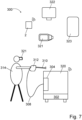
- Fig. 7 shows a schematic view of an embodiment of a cleaning device, designed as a manual mobile cleaning system 300.
- the cleaning system 300 records the pose, position and orientation of the cleaning device designed as a spray lance 310 and sends this information to the server 2, which processes the data and ultimately displays the desired information on a terminal device, for example VR or AR glasses 312, the screen 322 of a computer or on a smartphone 323.
- the spray lance 310 is connected to a central unit 320 and receives at least the necessary energy and the cleaning agent from it via the supply hose 308.
- a model is created for a defined zero point or coordinate origin as a basis for the simulation.
- This model can be created on the basis of 3D scans or CAD or drawing sets, especially of the object to be cleaned.
- the model can be voxel-, surface- or parametric-based.
- a voxel refers to a grid point in a three-dimensional grid, analogous to a pixel in a 2D image, a raster graphic.
- this created model is used as a map for any sensors or the localization part of the sensor. Otherwise, a corresponding "map", a 3D model of the cleaning object, with the same zero point or known reference to the zero point of the model is created and used for the sensor.
- the spray lance 310 or the object to be tracked is located absolutely in space.
- the necessary calculation can be carried out either on a processor of the spray lance 310 itself or on the server 2.
- the data can be transmitted live from the spray lance 310 with a time offset either in chunks or directly or subsequently in its entirety to the server for evaluation.
- a chunk is the largest unit of physical disk storage that is allocated for data storage by the database server.
- Server 2 processes the data and generates a temporally and spatially resolved cleaning process based on the simulation. This is visualized in various ways, as described below.
- pose sensor 312 belongs to the localization sensor technology, as initially defined in the definition of robotic or automated mobile cleaning systems Suitable basic technologies for position determination are listed below. With two positions, an orientation can also be calculated. Some methods allow direct position and orientation determination, others only indirect.
- the invention requires an absolute, time-resolved signal to a reference point. This reference point is used in the simulation.
- the measurement data of the sensors used, both the data of the pose sensor 312 and the sensor arrangement 304 are preprocessed. This can be done directly in the evaluation unit 302, or alternatively subsequently on the server 2 after the data determined by the sensors, the pose sensor 312 and the sensor arrangement 304, have been transmitted to it. In the embodiment shown, the transmission is wireless.
- the data from the spray lance 310 and other available data are visualized.
- This processed information can be prepared for the aforementioned purposes and presented to the user on various end devices or saved as a log. According to an advantageous embodiment, it is also provided to represent the operator as an avatar who guides the spray lance 310 and brings it into the appropriate positions.
- the protocol can show the entire cleaning process including the movement of the spray lance 310 or it can also contain a summary, such as “disinfection effect on the system” instead of “time-resolved disinfection distribution of the system” or only the qualitative result "system sufficiently disinfected”.
Landscapes
- Business, Economics & Management (AREA)
- Engineering & Computer Science (AREA)
- Human Resources & Organizations (AREA)
- Economics (AREA)
- Strategic Management (AREA)
- Entrepreneurship & Innovation (AREA)
- Development Economics (AREA)
- Quality & Reliability (AREA)
- Theoretical Computer Science (AREA)
- Game Theory and Decision Science (AREA)
- Mechanical Engineering (AREA)
- Marketing (AREA)
- Operations Research (AREA)
- General Physics & Mathematics (AREA)
- Tourism & Hospitality (AREA)
- Physics & Mathematics (AREA)
- General Business, Economics & Management (AREA)
- Educational Administration (AREA)
- Robotics (AREA)
- Electric Vacuum Cleaner (AREA)
Applications Claiming Priority (1)
| Application Number | Priority Date | Filing Date | Title |
|---|---|---|---|
| EP23194684 | 2023-08-31 |
Publications (1)
| Publication Number | Publication Date |
|---|---|
| EP4517615A1 true EP4517615A1 (fr) | 2025-03-05 |
Family
ID=87929225
Family Applications (1)
| Application Number | Title | Priority Date | Filing Date |
|---|---|---|---|
| EP24198028.3A Pending EP4517615A1 (fr) | 2023-08-31 | 2024-09-02 | Procédé mis en oeuvre par ordinateur pour la surveillance, l'optimisation et la prévision d'une tâche de nettoyage, système de traitement de données et programme informatique |
Country Status (1)
| Country | Link |
|---|---|
| EP (1) | EP4517615A1 (fr) |
Cited By (1)
| Publication number | Priority date | Publication date | Assignee | Title |
|---|---|---|---|---|
| CN120469197A (zh) * | 2025-06-19 | 2025-08-12 | 中万恩科技有限公司 | 高精度且低延迟的清洗剂定量输送系统 |
Citations (5)
| Publication number | Priority date | Publication date | Assignee | Title |
|---|---|---|---|---|
| EP3315219A1 (fr) | 2016-10-28 | 2018-05-02 | Fraunhofer-Gesellschaft zur Förderung der angewandten Forschung e.V. | Dispositif de nettoyage pour surfaces |
| EP3189384B1 (fr) | 2014-09-05 | 2019-06-19 | Martin Cudzilo | Dispositif de détection de travaux de nettoyage effectués |
| US20190343355A1 (en) * | 2018-05-11 | 2019-11-14 | Samsung Electronics Co., Ltd. | Method and apparatus for executing cleaning operation |
| EP3950159A1 (fr) | 2020-08-07 | 2022-02-09 | Fraunhofer-Gesellschaft zur Förderung der angewandten Forschung e.V. | Système de nettoyage, programme informatique et signal de support de données |
| WO2022134732A1 (fr) * | 2020-12-25 | 2022-06-30 | 达闼机器人股份有限公司 | Procédé, appareil et système de commande d'une pluralité de robots, support de stockage, dispositif électronique et produit-programme |
-
2024
- 2024-09-02 EP EP24198028.3A patent/EP4517615A1/fr active Pending
Patent Citations (5)
| Publication number | Priority date | Publication date | Assignee | Title |
|---|---|---|---|---|
| EP3189384B1 (fr) | 2014-09-05 | 2019-06-19 | Martin Cudzilo | Dispositif de détection de travaux de nettoyage effectués |
| EP3315219A1 (fr) | 2016-10-28 | 2018-05-02 | Fraunhofer-Gesellschaft zur Förderung der angewandten Forschung e.V. | Dispositif de nettoyage pour surfaces |
| US20190343355A1 (en) * | 2018-05-11 | 2019-11-14 | Samsung Electronics Co., Ltd. | Method and apparatus for executing cleaning operation |
| EP3950159A1 (fr) | 2020-08-07 | 2022-02-09 | Fraunhofer-Gesellschaft zur Förderung der angewandten Forschung e.V. | Système de nettoyage, programme informatique et signal de support de données |
| WO2022134732A1 (fr) * | 2020-12-25 | 2022-06-30 | 达闼机器人股份有限公司 | Procédé, appareil et système de commande d'une pluralité de robots, support de stockage, dispositif électronique et produit-programme |
Cited By (1)
| Publication number | Priority date | Publication date | Assignee | Title |
|---|---|---|---|---|
| CN120469197A (zh) * | 2025-06-19 | 2025-08-12 | 中万恩科技有限公司 | 高精度且低延迟的清洗剂定量输送系统 |
Similar Documents
| Publication | Publication Date | Title |
|---|---|---|
| DE112022001224T5 (de) | Systeme und verfahren zur verwaltung einer roboterflotte | |
| EP1447770B1 (fr) | Procédé et système de visualisation d'information assisté par ordinateur | |
| DE112018002565B4 (de) | System und Verfahren zum direkten Anlernen eines Roboters | |
| EP3709853B1 (fr) | Traitement du sol au moyen d'un robot autonome mobile | |
| EP3619585B1 (fr) | Procédé de commande d'appareils de nettoyage | |
| EP4235342A2 (fr) | Exploration d'une zone d'intervention d'un robot par un robot mobile autonome | |
| WO2019043171A1 (fr) | Planification de déplacement pour robot mobile autonome | |
| EP3974934A1 (fr) | Procédé de commande d'un robot mobile autonome | |
| DE102020105045A1 (de) | Verfahren und vorrichtungen zur erleichterung einer autonomen navigation von robotervorrichtungen | |
| DE102019122760A1 (de) | Selbstfahrende mobile roboter, die mensch-roboter-interaktionen verwenden | |
| WO2020016385A1 (fr) | Procédé et système destiné à déterminer une position d'un véhicule | |
| DE102011006062A1 (de) | Verfahren zur autonomen Inspektion einer Umgebung oder Bearbeitung von Bodenflächen | |
| Kohn et al. | Towards a real-time environment reconstruction for VR-based teleoperation through model segmentation | |
| EP4186651B1 (fr) | Système et procédé doté d'un système | |
| EP4137981A1 (fr) | Génération d'un modèle d'informations de bâtiment | |
| EP4517615A1 (fr) | Procédé mis en oeuvre par ordinateur pour la surveillance, l'optimisation et la prévision d'une tâche de nettoyage, système de traitement de données et programme informatique | |
| EP3400862A2 (fr) | Procédé de programmation d'un robot de service et documentation relative aux services fournis | |
| DE112023003580T5 (de) | Lebenslanges roboterlernen für mobile Roboter | |
| EP0411498B1 (fr) | Système de manipulation dans des lieux de travail non accessibles | |
| EP4493362A1 (fr) | Planification d'un trajet d'un robot | |
| EP4627419A1 (fr) | Procédé d'auto-apprentissage pour un processus de fabrication et/ou de montage | |
| DE102020211053A1 (de) | Annotationsvorrichtung | |
| EP1700175A1 (fr) | Dispositif et procede de programmation d'un robot industriel | |
| EP3961585A1 (fr) | Procédé de vérification d'un état d'une unité d'exploitation mobile ou d'une station de maintenance | |
| EP4449217A1 (fr) | Attribution d'une tâche à un expert à distance |
Legal Events
| Date | Code | Title | Description |
|---|---|---|---|
| PUAI | Public reference made under article 153(3) epc to a published international application that has entered the european phase |
Free format text: ORIGINAL CODE: 0009012 |
|
| STAA | Information on the status of an ep patent application or granted ep patent |
Free format text: STATUS: THE APPLICATION HAS BEEN PUBLISHED |
|
| AK | Designated contracting states |
Kind code of ref document: A1 Designated state(s): AL AT BE BG CH CY CZ DE DK EE ES FI FR GB GR HR HU IE IS IT LI LT LU LV MC ME MK MT NL NO PL PT RO RS SE SI SK SM TR |
|
| STAA | Information on the status of an ep patent application or granted ep patent |
Free format text: STATUS: REQUEST FOR EXAMINATION WAS MADE |
|
| 17P | Request for examination filed |
Effective date: 20250905 |