EP4517748A1 - Audio spatial - Google Patents
Audio spatial Download PDFInfo
- Publication number
- EP4517748A1 EP4517748A1 EP24193105.4A EP24193105A EP4517748A1 EP 4517748 A1 EP4517748 A1 EP 4517748A1 EP 24193105 A EP24193105 A EP 24193105A EP 4517748 A1 EP4517748 A1 EP 4517748A1
- Authority
- EP
- European Patent Office
- Prior art keywords
- capture
- metadata
- audio
- capture setting
- bitstream
- Prior art date
- Legal status (The legal status is an assumption and is not a legal conclusion. Google has not performed a legal analysis and makes no representation as to the accuracy of the status listed.)
- Pending
Links
Images








Classifications
-
- H—ELECTRICITY
- H04—ELECTRIC COMMUNICATION TECHNIQUE
- H04S—STEREOPHONIC SYSTEMS
- H04S7/00—Indicating arrangements; Control arrangements, e.g. balance control
- H04S7/30—Control circuits for electronic adaptation of the sound field
- H04S7/302—Electronic adaptation of stereophonic sound system to listener position or orientation
-
- G—PHYSICS
- G10—MUSICAL INSTRUMENTS; ACOUSTICS
- G10L—SPEECH ANALYSIS TECHNIQUES OR SPEECH SYNTHESIS; SPEECH RECOGNITION; SPEECH OR VOICE PROCESSING TECHNIQUES; SPEECH OR AUDIO CODING OR DECODING
- G10L19/00—Speech or audio signals analysis-synthesis techniques for redundancy reduction, e.g. in vocoders; Coding or decoding of speech or audio signals, using source filter models or psychoacoustic analysis
- G10L19/04—Speech or audio signals analysis-synthesis techniques for redundancy reduction, e.g. in vocoders; Coding or decoding of speech or audio signals, using source filter models or psychoacoustic analysis using predictive techniques
- G10L19/16—Vocoder architecture
- G10L19/167—Audio streaming, i.e. formatting and decoding of an encoded audio signal representation into a data stream for transmission or storage purposes
-
- G—PHYSICS
- G06—COMPUTING OR CALCULATING; COUNTING
- G06F—ELECTRIC DIGITAL DATA PROCESSING
- G06F3/00—Input arrangements for transferring data to be processed into a form capable of being handled by the computer; Output arrangements for transferring data from processing unit to output unit, e.g. interface arrangements
- G06F3/16—Sound input; Sound output
- G06F3/165—Management of the audio stream, e.g. setting of volume, audio stream path
-
- G—PHYSICS
- G10—MUSICAL INSTRUMENTS; ACOUSTICS
- G10L—SPEECH ANALYSIS TECHNIQUES OR SPEECH SYNTHESIS; SPEECH RECOGNITION; SPEECH OR VOICE PROCESSING TECHNIQUES; SPEECH OR AUDIO CODING OR DECODING
- G10L19/00—Speech or audio signals analysis-synthesis techniques for redundancy reduction, e.g. in vocoders; Coding or decoding of speech or audio signals, using source filter models or psychoacoustic analysis
- G10L19/008—Multichannel audio signal coding or decoding using interchannel correlation to reduce redundancy, e.g. joint-stereo, intensity-coding or matrixing
-
- G—PHYSICS
- G10—MUSICAL INSTRUMENTS; ACOUSTICS
- G10L—SPEECH ANALYSIS TECHNIQUES OR SPEECH SYNTHESIS; SPEECH RECOGNITION; SPEECH OR VOICE PROCESSING TECHNIQUES; SPEECH OR AUDIO CODING OR DECODING
- G10L19/00—Speech or audio signals analysis-synthesis techniques for redundancy reduction, e.g. in vocoders; Coding or decoding of speech or audio signals, using source filter models or psychoacoustic analysis
- G10L19/04—Speech or audio signals analysis-synthesis techniques for redundancy reduction, e.g. in vocoders; Coding or decoding of speech or audio signals, using source filter models or psychoacoustic analysis using predictive techniques
- G10L19/16—Vocoder architecture
- G10L19/173—Transcoding, i.e. converting between two coded representations avoiding cascaded coding-decoding
-
- G—PHYSICS
- G10—MUSICAL INSTRUMENTS; ACOUSTICS
- G10L—SPEECH ANALYSIS TECHNIQUES OR SPEECH SYNTHESIS; SPEECH RECOGNITION; SPEECH OR VOICE PROCESSING TECHNIQUES; SPEECH OR AUDIO CODING OR DECODING
- G10L19/00—Speech or audio signals analysis-synthesis techniques for redundancy reduction, e.g. in vocoders; Coding or decoding of speech or audio signals, using source filter models or psychoacoustic analysis
- G10L19/04—Speech or audio signals analysis-synthesis techniques for redundancy reduction, e.g. in vocoders; Coding or decoding of speech or audio signals, using source filter models or psychoacoustic analysis using predictive techniques
- G10L19/16—Vocoder architecture
- G10L19/18—Vocoders using multiple modes
- G10L19/22—Mode decision, i.e. based on audio signal content versus external parameters
-
- H—ELECTRICITY
- H04—ELECTRIC COMMUNICATION TECHNIQUE
- H04R—LOUDSPEAKERS, MICROPHONES, GRAMOPHONE PICK-UPS OR LIKE ACOUSTIC ELECTROMECHANICAL TRANSDUCERS; ELECTRIC HEARING AIDS; PUBLIC ADDRESS SYSTEMS
- H04R3/00—Circuits for transducers
- H04R3/005—Circuits for transducers for combining the signals of two or more microphones
-
- H—ELECTRICITY
- H04—ELECTRIC COMMUNICATION TECHNIQUE
- H04S—STEREOPHONIC SYSTEMS
- H04S3/00—Systems employing more than two channels, e.g. quadraphonic
- H04S3/008—Systems employing more than two channels, e.g. quadraphonic in which the audio signals are in digital form, i.e. employing more than two discrete digital channels
-
- H—ELECTRICITY
- H04—ELECTRIC COMMUNICATION TECHNIQUE
- H04S—STEREOPHONIC SYSTEMS
- H04S7/00—Indicating arrangements; Control arrangements, e.g. balance control
- H04S7/30—Control circuits for electronic adaptation of the sound field
-
- H—ELECTRICITY
- H04—ELECTRIC COMMUNICATION TECHNIQUE
- H04S—STEREOPHONIC SYSTEMS
- H04S7/00—Indicating arrangements; Control arrangements, e.g. balance control
- H04S7/30—Control circuits for electronic adaptation of the sound field
- H04S7/302—Electronic adaptation of stereophonic sound system to listener position or orientation
- H04S7/303—Tracking of listener position or orientation
- H04S7/304—For headphones
-
- H—ELECTRICITY
- H04—ELECTRIC COMMUNICATION TECHNIQUE
- H04S—STEREOPHONIC SYSTEMS
- H04S7/00—Indicating arrangements; Control arrangements, e.g. balance control
- H04S7/30—Control circuits for electronic adaptation of the sound field
- H04S7/308—Electronic adaptation dependent on speaker or headphone connection
-
- G—PHYSICS
- G10—MUSICAL INSTRUMENTS; ACOUSTICS
- G10L—SPEECH ANALYSIS TECHNIQUES OR SPEECH SYNTHESIS; SPEECH RECOGNITION; SPEECH OR VOICE PROCESSING TECHNIQUES; SPEECH OR AUDIO CODING OR DECODING
- G10L19/00—Speech or audio signals analysis-synthesis techniques for redundancy reduction, e.g. in vocoders; Coding or decoding of speech or audio signals, using source filter models or psychoacoustic analysis
- G10L19/04—Speech or audio signals analysis-synthesis techniques for redundancy reduction, e.g. in vocoders; Coding or decoding of speech or audio signals, using source filter models or psychoacoustic analysis using predictive techniques
- G10L19/16—Vocoder architecture
- G10L19/18—Vocoders using multiple modes
- G10L19/24—Variable rate codecs, e.g. for generating different qualities using a scalable representation such as hierarchical encoding or layered encoding
-
- H—ELECTRICITY
- H04—ELECTRIC COMMUNICATION TECHNIQUE
- H04S—STEREOPHONIC SYSTEMS
- H04S2400/00—Details of stereophonic systems covered by H04S but not provided for in its groups
- H04S2400/11—Positioning of individual sound objects, e.g. moving airplane, within a sound field
-
- H—ELECTRICITY
- H04—ELECTRIC COMMUNICATION TECHNIQUE
- H04S—STEREOPHONIC SYSTEMS
- H04S2400/00—Details of stereophonic systems covered by H04S but not provided for in its groups
- H04S2400/15—Aspects of sound capture and related signal processing for recording or reproduction
-
- H—ELECTRICITY
- H04—ELECTRIC COMMUNICATION TECHNIQUE
- H04S—STEREOPHONIC SYSTEMS
- H04S2420/00—Techniques used stereophonic systems covered by H04S but not provided for in its groups
- H04S2420/03—Application of parametric coding in stereophonic audio systems
-
- H—ELECTRICITY
- H04—ELECTRIC COMMUNICATION TECHNIQUE
- H04S—STEREOPHONIC SYSTEMS
- H04S2420/00—Techniques used stereophonic systems covered by H04S but not provided for in its groups
- H04S2420/11—Application of ambisonics in stereophonic audio systems
Definitions
- Example embodiments may relate to systems, methods and/or computer programs for providing spatial audio.
- some embodiments relate to the transmission of spatial audio signals and associated metadata.
- Spatial audio signals are being used in greater frequency to produce a more immersive audio experience.
- Spatial audio refers to 3D audio, i.e., it can provide a percept where sound sources are heard from different directions.
- Spatial audio can be reproduced, e.g., using a loudspeaker setup or via headphones, preferably with head-tracking capability.
- a stereo or multi-channel recording can be passed from the recording or capture apparatus to a listening apparatus and replayed using a suitable multi-channel output such as a multi-channel loudspeaker arrangement and using binaural rendering or virtual surround processing on a pair of stereo headphones or headset.
- mobile apparatus such as mobile phone to have more than two microphones. This offers the possibility to record real multichannel audio. With advanced signal processing it is further possible to beamform or directionally amplify or process the audio signal captured by the microphones from a specific or desired direction.
- the captured audio signals may comprise metadata to provide greater adaptability of spatial audio signals.
- the means for determining that the first capture setting changes to the second capture setting is configured to determine that the orientation of the apparatus has changed from a first orientation to a second orientation.
- the means for determining that the first capture setting changes to the second capture setting is configured to determine that an input request has been received to change the first capture setting to the second capture setting.
- the apparatus further comprises means for transmitting the set of descriptive metadata indicative of one or more capture parameters associated with the first capture setting to the one or more remote devices via an out-of-band signal.
- the one or more capture parameters comprises at least one of: a directional element comprising a number of directions described by the spatial metadata; a channel element comprising a number of transport channels supported by the apparatus; a source format describing a configuration of the apparatus; and a variable description describing at least one of a capture type, an angle between two microphones of the plurality of microphones, an apparatus size and a microphone polar pattern including omnidirectional, cardiod, hypercardioid, or supercardioid patterns.
- the bitstream for the current streaming session comprises the one or more capture parameters.
- the means for generating the set of audio encoder input format data is configured to use a metadata-assisted spatial audio, MASA, format.
- the audio encoder is an immersive voice and audio services, IVAS, codec.
- the apparatus comprises a user device.
- an apparatus comprising: means for receiving a bitstream for a current streaming session; means for decoding the bitstream for the current streaming session, to determine a representation of spatial audio signals and associated metadata, the metadata including, in part, a set of descriptive metadata indicative of one or more capture parameters associated with a first capture setting; means for configuring an audio renderer according to the decoded descriptive metadata; means for providing the representation of the spatial audio signals to the audio renderer for rendering to produce a rendered audio output signal; means for outputting the rendered audio output signal by a plurality of speakers; means for receiving an updated bitstream for the current streaming session and means for decoding the updated bitstream for the current streaming session, to determine an updated representation of spatial audio signals and associated metadata, the metadata including, in part, a set of descriptive metadata indicative of one or more capture parameters associated with a second capture setting, wherein the means for configuring the audio renderer according to the decoded descriptive metadata is configured to change at least one of the one or more capture parameters of the set of descriptive metadata to be associated with the
- the apparatus further comprises means for receiving a bitstream for a current streaming session receives the bitstream.
- the apparatus further comprises means for receiving the set of descriptive metadata indicative of one or more capture parameters associated with the first capture setting to the one or more remote devices via an out-of-band signal; and wherein the means for configuring the audio renderer further comprises configuring the audio renderer according to the set of descriptive metadata indicative of one or more capture parameters associated with the first capture setting.
- the apparatus comprises a user device.
- a method comprising: capturing spatial audio signals by a plurality of microphones using a first capture setting; generating a set of audio encoder input format data comprising a representation of the spatial audio signals and associated metadata, the metadata including, in part, a set of descriptive metadata indicative of one or more capture parameters associated with the first capture setting; providing the set of audio encoder input format data to an audio encoder for encoding the representation of the spatial audio signals and the associated metadata to a bitstream for a current streaming session; transmitting the bitstream to one or more remote devices for rendering the representation of the spatial audio signals based, at least in part, on the set of descriptive metadata; and determining, during the current streaming session, that the first capture setting changes to a second capture setting, wherein, in response to the determination that the first capture setting changes to a second capture setting, and while transmitting the bitstream, capturing spatial audio signals comprising capturing spatial audio signals using the second capture setting and generating the audio encoder input format data comprises changing at least one of the one or more
- a method comprising: receiving a bitstream for a current streaming session; decoding the bitstream for the current streaming session, to determine a representation of spatial audio signals and associated metadata, the metadata including, in part, a set of descriptive metadata indicative of one or more capture parameters associated with a first capture setting; configuring an audio renderer according to the decoded descriptive metadata; providing the representation of the spatial audio signals to the audio renderer for rendering to produce a rendered audio output signal; outputting the rendered audio output signal by a plurality of speakers; receiving an updated bitstream for the current streaming session and decoding the updated bitstream for the current streaming session, to determine an updated representation of spatial audio signals and associated metadata, the metadata including, in part, a set of descriptive metadata indicative of one or more capture parameters associated with a second capture setting, wherein configuring the audio renderer according to the decoded descriptive metadata comprises changing at least one of the one or more capture parameters of the set of descriptive metadata to be associated with the second capture setting.
- a computer program product comprising a set of instructions which, when executed on an apparatus, is configured to cause the apparatus to carry out the method of any preceding method definition.
- a non-transitory computer readable medium comprising program instructions stored thereon for performing a method, comprising: capturing spatial audio signals by a plurality of microphones using a first capture setting; generating a set of audio encoder input format data comprising a representation of the spatial audio signals and associated metadata, the metadata including, in part, a set of descriptive metadata indicative of one or more capture parameters associated with the first capture setting; providing the set of audio encoder input format data to an audio encoder for encoding the representation of the spatial audio signals and the associated metadata to a bitstream for a current streaming session; transmitting the bitstream to one or more remote devices for rendering the representation of the spatial audio signals based, at least in part, on the set of descriptive metadata; and determining, during the current streaming session, that the first capture setting changes to a second capture setting, wherein, in response to the determination that the first capture setting changes to a second capture setting, and while transmitting the bitstream, capturing spatial audio signals comprising capturing spatial audio signals using the second capture
- a non-transitory computer readable medium comprising program instructions stored thereon for performing a method, comprising: receiving a bitstream for a current streaming session; decoding the bitstream for the current streaming session, to determine a representation of spatial audio signals and associated metadata, the metadata including, in part, a set of descriptive metadata indicative of one or more capture parameters associated with a first capture setting; configuring an audio renderer according to the decoded descriptive metadata; providing the representation of the spatial audio signals to the audio renderer for rendering to produce a rendered audio output signal; outputting the rendered audio output signal by a plurality of speakers; receiving an updated bitstream for the current streaming session and decoding the updated bitstream for the current streaming session, to determine an updated representation of spatial audio signals and associated metadata, the metadata including, in part, a set of descriptive metadata indicative of one or more capture parameters associated with a second capture setting, wherein configuring the audio renderer according to the decoded descriptive metadata comprises changing at least one of the one or more capture parameters of the set of descriptive metadata to be
- Example embodiments relate to an apparatus, method and computer program for output of stereo or spatial audio.
- Stereo or spatial audio may be represented by data in any suitable form, whether in the form of one or more data files or, in the case of streaming data, data packets or any other suitable format.
- the stereo or spatial audio may relate to voice and other audio communications.
- stereo audio data comprises two channels, left and right, for output by respective first and second loudspeakers.
- More advanced formats include 2.1, which adds lower frequencies for output to a third, subwoofer loudspeaker, as well as 5.1 and 7.1 which may be generally known as "surround sound" formats.
- Spatial audio data also called three dimensional audio or immersive audio, may describe audio data that enables users to perceive sounds from all around them; for a fully-immersive experience, the spatial audio data may include cues so that users can perceive other properties such as directions of sounds emitted by one or more sound sources or objects, trajectories of the sound sources or objects, variations of sound magnitudes based on changing distance from the sound sources or objects, and other sound effects. For example, if a user moves their user device, e.g., their smartphone, this may change how the audio is perceived.
- the apparatus may comprise a user device having three or more microphones.
- the user device may be a portable user device, for example a smartphone, a tablet computer, digital assistant, wearable computer or head mounted device (HMD). This list is not exhaustive.
- the user device may also comprise loudspeakers.
- User devices may be configured to receive and decode different types of audio data, including monaural audio data, stereoscopic (stereo) audio data comprising two channels, other forms of multi-channel audio data, e.g., 2.1, 5.1 and 7.1 and spatial audio data, e.g., Ambisonics or metadata-assisted spatial audio (MASA).
- monaural audio data stereoscopic (stereo) audio data comprising two channels
- other forms of multi-channel audio data e.g., 2.1, 5.1 and 7.1
- spatial audio data e.g., Ambisonics or metadata-assisted spatial audio (MASA).
- User devices may be capable of establishing a communications session with one or more other user devices, servers and/or nodes via a communications network.
- a user device may be configured to transmit and receive data using protocols for 3G, 4G, LTE, 5G or any future generation communication protocol.
- a user device may comprise means for short-range communications using, for example, Bluetooth, Zigbee or WiFi.
- the user device may comprise one or more antennas for communicating with external devices, for example one or more other remote user devices and/or one or more remote servers and/or one or more communications nodes of a network.
- a user device may process and output different types of audio data.
- a user device may output stereo audio data associated with a music track or movie to first and second loudspeakers.
- audio data i.e., audio data not being the stereo audio data currently being output to the first and second loudspeakers
- this is usually output by one or both of the first and second loudspeakers.
- an audible notification may be output to one or both of the first and second loudspeakers.
- the two types of audio data are mixed, at least for some period of time.
- Example embodiments are aimed at improved flexibility and user experience for user devices where there are three or more loudspeakers and/or microphones.
- example embodiments may enable utilization of one or more loudspeakers that are currently not in use.
- example embodiments may enable optimized audio output, e.g., stereo widening effects, enhanced immersivity and/or increased volume. Other advantages will become apparent.
- Spatial audio refers to 3D audio. Spatial audio includes a perception of where sound sources are heard from different directions and replicated the audio to a user. Spatial audio can be reproduced, for example, using a loudspeaker setup or via headphones. Optionally, spatial audio rendering can utilize head-tracking capability.
- FIG. 1A is a plan view of a first apparatus 100 in a first orientation according to which one or more example embodiments may be applied.
- the apparatus 100 of FIG. 1A is a smartphone shown from behind.
- the smartphone apparatus 100 comprises a back 102, front 104, microphones 106A-106F and a camera 108.
- FIG. 1B is a plan view of the FIG. 1A first apparatus in a second orientation.
- the apparatus 100 of Fig 1B is the smartphone of FIG. 1A flipped such that the front 104 is showing.
- the front 104 of the smartphone may comprise a touchscreen.
- Microphones 106A, 106B and 106C are located on the back 102 of the apparatus and microphones 106D, 106E and 106F are located on the front 104 of the apparatus.
- the apparatus shown in FIG. 1A and FIG. 1B is merely an example, the microphones may be alternatively arranged in other configurations such as shown in FIGS. 3 to 5 .
- the camera 108 is located on the back 102 of the apparatus and, optionally, there may also be a camera present on the front 104 of the apparatus (not shown). At least one of the microphones 106C may be located alongside the camera 108.
- the apparatus of FIG. 1a and 1b can use parametric capture means to analyse and process audio input signals received at the microphones 106A-106F and thus derive either a parametric spatial audio format or synthesize some other spatial audio format.
- the smartphone has integrated microphones 106A-106F with a placing that allows for good voice pickup in different orientations and use cases. Microphone separation along each of the three main axis is preferred for good spatial audio capture and processing, however, in thin devices microphone separation along only two of the axis is needed.
- the apparatus may be a user device, or user equipment UE, which typically refers to a portable computing device that includes wireless mobile communication devices operating with or without a subscriber identification module (SIM), including, but not limited to, the following types of devices: a mobile station (mobile phone), smartphone, personal digital assistant, handset, device using a wireless modem (alarm or measurement device, etc.), laptop and/or touch screen computer, tablet, game console, notebook, and multimedia device.
- SIM subscriber identification module
- a user device may also be a nearly exclusive uplink only device, of which an example is a camera or video camera loading images or video clips to a network.
- a user device may also be a device having capability to operate in Internet of Things (IoT) network which is a scenario in which objects are provided with the ability to transfer data over a network without requiring human-to-human or human-to-computer interaction.
- IoT Internet of Things
- Metadata-assisted spatial audio is a parametric spatial audio format, known from the ongoing 3GPP standardization of the Immersive Voice and Audio Services (IVAS) codec and specified in Annex A of 3GPP TS 26.258.
- Ambisonics is a spatial audio format that is non-parametric.
- MASA is a format of spatial audio and meta data may be obtained by analysis of the microphone signals.
- the MASA format consists of audio signals and metadata.
- the audio signals can be mono or stereo (i.e., 1-2 transport channels).
- the metadata comprises descriptive metadata and spatial metadata. Examples of descriptive metadata and spatial metadata are given below in detail: Table A.1: MASA format descriptive common metadata parameters Field Bits Description Format descriptor 64 Defines the MASA format for IVAS.
- Eight 8-bit ASCII characters 01001001, 01010110, 01000001, 01010011, 01001101, 01000001, 01010011, 01000001 Values stored as 8 consecutive 8-bit unsigned integers.
- Channel audio format 16 Combined following fields stored in two bytes. Value stored as a single 16-bit unsigned integer.
- Number of directions (1) Number of directions described by the spatial metadata. Each direction is associated with a set of direction dependent spatial metadata.
- Range of values: [1, 2] Number of channels (1) Number of transport channels in the format.
- Table A.2a MASA format spatial metadata parameters (dependent of number of directions) Field Bits Description Direction index 16 Direction of arrival of the sound at a time-frequency parameter interval. Spherical representation at about 1-degree accuracy. Range of values: “covers all directions at about 1° accuracy” Values stored as 16-bit unsigned integers. Direct-to-total energy ratio 8 Energy ratio for the direction index (i.e., time-frequency subframe). Calculated as energy in direction / total energy. Range of values: [0.0, 1.0] Values stored as 8-bit unsigned integers with uniform spacing of mapped values. Spread coherence 8 Spread of energy for the direction index (i.e., time-frequency subframe).
- Range of values [0.0, 1.0] Values stored as 8-bit unsigned integers with uniform spacing of mapped values.
- Table A.2b MASA format spatial metadata parameters independent of number of directions)
- Field Bits Description Diffuse-to-total energy ratio 8 Energy ratio of non-directional sound over surrounding directions. Calculated as energy of non-directional sound / total energy.
- Range of values [0.0, 1.0] (Parameter is independent of number of directions provided.) Values stored as 8-bit unsigned integers with uniform spacing of mapped values. Remainder-to-total energy ratio 8 Energy ratio of the remainder (such as microphone noise) sound energy to fulfil requirement that sum of energy ratios is 1. Calculated as energy of remainder sound / total energy. Range of values: [0.0, 1.0] (Parameter is independent of number of directions provided.) Values stored as 8-bit unsigned integers with uniform spacing of mapped values.
- Table A.1 presents the MASA descriptive common metadata parameters in order of writing.
- Table A.2a and Table A.2b present the MASA spatial metadata parameters dependent and independent of the number of directions, respectively.
- the MASA spatial metadata describes the spatial audio characteristics corresponding to the one or two transport audio signals.
- the spatial audio scene can be rendered for listening based on the combination of the transport audio signals and the spatial metadata.
- MASA spatial metadata parameters are described in order in the following.
- Spatial directions represent the directional energy flows in the sound scene.
- Each spatial direction together with corresponding direct-to-total energy ratio describes how much of the total energy for each time-frequency tile is coming from that specific direction.
- this parameter can also be thought of as the direction of arrival (DOA).
- Each spatial direction can be represented using a 16-bit direction index. This is an efficient representation of directions as points of a spherical grid with an accuracy of about 1 degree in any arbitrary direction.
- the direction indexing corresponds to the function for transforming the audio direction angular values (azimuth ⁇ and elevation ⁇ ) into an index, and the inverse function for transforming the index into the audio direction angular values.
- Each pair of values containing the elevation and the azimuth is first quantized on a spatial spherical grid of points and the index of the corresponding point is constructed.
- the structure of the spherical grid is defined first, followed by the quantization function and lastly the index formation followed by the corresponding de-indexing function.
- the spherical grid is defined as a succession of horizontal circles of points.
- the circles are distributed on the sphere, and they correspond to several elevation values.
- the indexing functions make the connection between the angles (elevation and azimuth) corresponding to each of these points on the grid and a 16-bit index.
- the quantization in the spherical grid is done as follows:
- the resulting quantized direction index is obtained by enumerating the points on the spherical grid by starting with the points for null elevation first, then the points corresponding to the smallest positive elevation codeword, the points corresponding to the first negative elevation codeword, followed by the points on the following positive elevation codeword and so on.
- Direct-to-total energy ratios work together with spatial directions as described above. Each direct-to-total energy ratio corresponds to a specific spatial direction and describes how much of the energy comes from that specific spatial direction compared to the total energy.
- Spread coherence is a parameter that describes the directional energy flow further. It represents situations where coherent directional sound energy is coming from multiple directions at the same time. This is represented with a single spread coherence parameter that describes how the sound should be synthesized.
- this parameter should be used such that value 0 means that the sound is synthesized to single direction as directed by the spatial direction, value 0.5 means that the sound is synthesized to the spatial direction and two surrounding directions as coherent, and 1 means that the sound is synthesized to two surrounding directions around the spatial direction.
- Surround coherence is a parameter that describes the non-directional energy flow. It represents how much of the non-directional energy should be presented as coherent reproduction instead of decorrelated reproduction.
- the spatial metadata describes how spatial rendering is done, i.e., from which direction certain time-frequency component should be renderer, etc. This defines the sound scene (together with the audio).
- the descriptive metadata provides additional information, e.g., on how the spatial capture or spatial audio generation was done. This information can be used to optimize encoding in certain cases, and it can be used to improve rendering quality in advanced rendering, when the information is made available at the receiver. For this to happen, the information needs to be passed though the transmission channel, e.g., using the codec bitstream, RTP signaling, or any other suitable method.
- Channel audio format in MASA descriptive metadata defines the number of directions in MASA metadata (1-2), the number of channels (1-2 transport channels), and the source format (unknown source format including mixes (default value); microphone grid, e.g., smartphone or other such UE; channel-based source (e.g., 5.1); or Ambisonics).
- variable description all this information in a session can be constant/fixed, however, the information is provided in each frame, i.e., once per 20ms and it can thus vary often.
- the variable description provides, e.g.: transport channel polar pattern information, channel angles for the directive patterns, and channel distance information.
- Spatial audio capture can be done in many different usage scenarios. For example, regular spatial audio call, spatial audio with audio focus, and spatial audio capture in a rich ambience generally require somewhat different means and settings for optimal capture, encoding, and rendering. In capture, this is up to the implementor, and many solutions may exist. On the other hand, anything related to encoding needs to be available for the codec, and for anything related to rendering, the information needs to be made available for the receiving UE.
- IVAS MASA format provides a mechanism to adapt several rendering-related aspects via 50Hz update rate for the descriptive metadata and delivering immersive voice and audio capture optimizations can then be done using IVAS codec in a suitable way.
- the present disclosure relates to spatial audio capture, encoding, transmission, and rendering, where a method is proposed to enable rendering quality improvements in spatial audio communications and real-time streaming by configuring and adding descriptive metadata parameters that correspond to the selected spatial audio capture mode and/or the targeted effect, which achieves providing real-time information describing specific properties of the spatial audio capture setup and/or the targeted spatial audio effect to the spatial audio renderer.
- Utilization of the transmitted descriptive metadata parameters is based on the specific renderer implementation of the receiving device.
- the present disclosure makes it possible to provide audio capture parameters that are synchronized with the corresponding spatial audio representation to a renderer via a codec bitstream or out-of-band signaling.
- the adaptive audio capture parameters can in examples, e.g., indicate a separation of an audio-focused source or sources for improved rendering control in playback.
- the adaptive audio capture parameters can in further examples, e.g., indicate a change in at least one of: capture microphone polar patterns, angle between the beams, and distance between the stereo channels.
- This information can be used in rendering to, for example, modify rendering such that the changes become inaudible for a user to maintain rendering regardless of changes in capture or such that the changes are made more pronounced to make the effect stronger.
- the present disclosure relates to real-time adaptation of descriptive metadata in a parametric spatial audio format for encoding and transmission in spatial audio communications and streaming use cases and services.
- the codec can be the 3GPP IVAS codec
- the parametric audio format can be the MASA format
- the adapted part of the descriptive metadata can contain the Channel audio format including the Source format description comprising Transport definition, Channel angles and Channel distance, while Number of channels can be (at least predominantly) 2 and Number of directions can be 1 or 2.
- FIG. 2 is a view 200 of the first apparatus 300 in use with a user 202 in a first capture setting.
- the first capture setting is shown in FIG. 2 as handset mode, where the apparatus 100 is held against the user's ear during a phone call.
- FIG. 3A is a plan view of the apparatus 100 in a first orientation 300.
- FIG. 3B is a plan view of the first apparatus in a second orientation 310.
- FIG. 3C is a plan view of a first apparatus in a third orientation 320.
- the user 202 is making a media call with the apparatus 100 in handset mode.
- a spatial audio capture and transmission is made according to first capture settings.
- microphones 302A-302D may be used for spatial audio analysis.
- At least two channels 314 that are received by the microphones are selected as transport channels allowing for good voice pickup and left-right separation for transport channels.
- the two channels 314 picked as transport channels may be those closest to the user's mouth when talking into the apparatus 300.
- the two channels that are chosen as transport channels may vary according to the orientation of the apparatus.
- the apparatus 100 can have several different orientations (e.g., the first 300, second 310 and third orientations 320 shown in FIGS. 3A-3C ). Generally, a somewhat upright orientation (portrait) is typical. All of FIG 3A-3C show the apparatus in handset mode and therefore using the first capture setting. Handset mode may in some examples encompass an orientation range angle through 90 degrees.
- the user 202 can first be on a media call with the apparatus 100 (e.g., mobile phone) against their ear, i.e., user is capturing a spatial audio signal with no video in handset mode and the first capture setting is used in this case.
- the microphone 302A-302D placement and resulting selection are understood as one example only. In an example where there are four microphones 302A-302D, one microphone may be placed in the center of each side of the apparatus.
- An example capture first selects and maintains the following parameters in MASA descriptive metadata:
- MASA formats may conceivably be used, however the above represents one example MASA format.
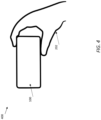
- the user 202 When finished with the media call the user 202 then changes the apparatus 100 orientation to capture further audio (e.g., landscape orientation, see FIG. 4 ) and introduce a video component to their media call. For example, there is a musical performance that user wishes to show to the recipient.
- FIGs. 4 and 5 represent the apparatus being held in an alternative orientation 400, 500.
- the microphone 502A-502D placement and resulting selection are understood as one example only and other possible use case scenarios are conceivable.
- the system now determines a new configuration suitable for the change in the use case, the new configuration is known as the second capture setting.
- MASA descriptive metadata can now be as follows, by way of example:
- the user triggering recording a video as part of the media call results in different selection of a second capture setting, which may in turn drive new selection of microphone polar pattern configuration and finally the corresponding change in descriptive metadata that is sent to receiving user.
- the orientation of the device changes the optimal transport signal selection. Also, this change is made visible to the receiver as part of the parametric format's descriptive metadata.
- the apparatus orientation change results in different transport channel selection of microphones 502A and 502B, which is reflected primarily in the last sub-field value.
- the new transport channel selection of microphones 502A and 502B is conducted based on the most useful microphones to be used.
- This new adaptive behavior of the capture information when delivered to the receiver, can then be used to optimize the rendering in a suitable renderer implementation. For example, a wider sound stage can be renderer for the music video part. A more subdued spatial scene may be of interest during the handset mode call.
- an audio focus algorithm on user's smartphone detects two talkers (or other sound sources of interest) in different parts of the scene and the active signals from these two sound sources are at least partly overlapping in time. For example, it can be useful to be able to concentrate more on one of the audio-focused sources at a given time during the rendering. According to the present disclosure, this can be better achieved by a suitable description of the capture scenario and related capture configuration, which is enabled by adapting the descriptive metadata (i.e., in a second capture setting) and transmitting it to the receiver.
- the system now adapts the descriptive metadata according to a second capture setting of the MASA format as follows during a specific portion of the audio focusing spatial audio capture:
- the system selects the capture configuration and adapts the descriptive metadata of the MASA format.
- MASA formats may conceivably be used, however by way of example an proposed MASA format is shown as follows:
- the first two sub-fields in the "Variable description" that are adapted according to the choice driven by the desired effect of smooth playback of an expansive immersive ambience.
- This generates the second capture setting, which may be different to a first initial capture setting that is used initially by the apparatus.
- This set of information when delivered to the receiver, can then be used to optimize the rendering in a suitable renderer implementation. For example, listener may get better utilization of their multi-channel loudspeaker setup, where there is more content now being played back also from behind the user and from the height channels.
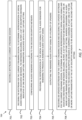
- the method 600 comprises a first operation 601 of capturing spatial audio signals by a plurality of microphones using a first capture setting.
- the method 600 comprises a second operation 602 of generating a set of audio encoder input format data comprising a representation of the spatial audio signals and associated metadata, the metadata including, in part, a set of descriptive metadata indicative of one or more capture parameters associated with the first capture setting.
- Generating the set of audio encoder input format data may optionally comprise generating the set of audio encoder input format data is configured to use the MASA format.
- the method 600 comprises a third operation 603 of providing the set of audio encoder input format data to an audio encoder for encoding the representation of the spatial audio signals and the associated metadata to a bitstream for a current streaming session.
- the audio encoder may be the IVAS codec.
- the method 600 comprises a fourth operation 604 of transmitting the bitstream to one or more remote devices for rendering the representation of the spatial audio signals based, at least in part, on the set of descriptive metadata.
- capturing spatial audio signals comprising capturing spatial audio signals using the second capture setting and generating the audio encoder input format data comprises changing at least one of the one or more capture parameters of the set of descriptive metadata to be associated with the second capture setting.
- determining that the first capture setting changes to a second capture setting may comprise determining that the orientation of the apparatus has changed from a first orientation to a second orientation. For example, the apparatus may have changed from a handset mode as shown in FIG.2 and FIG.3 , to the portrait mode shown in FIG.4 and FIG. 5 .
- determining that the first capture setting changes to the second capture setting may comprise determining that an input request has been received to change the first capture setting to the second capture setting, for example, in the scenarios as discussed in the second and third use case.
- an AI system may determine that the first capture setting changes to the second capture setting.
- the method 600 may further comprise transmitting the set of descriptive metadata indicative of one or more capture parameters associated with the first capture setting to the one or more remote devices.
- the transmission may be conducted via an out-of-band signal.
- the capture parameters may comprises at least one of: a directional element comprising a number of directions described by the spatial metadata, a channel element comprising a number of transport channels supported by the apparatus, a source format describing a configuration of the apparatus; and a variable description describing at least one of a capture type, an angle between two microphones of the plurality of microphones, an apparatus size and a microphone polar pattern including omnidirectional, cardiod, hypercardioid, or supercardioid patterns.
- the bitstream for the current streaming session comprises the one or more capture parameters.
- FIG. 7 shows, by way of example, a flowchart of a method according to example embodiments.
- Each element of the flowchart may comprise one or more operations.
- the operations may be performed in hardware, software, firmware or a combination thereof.
- the operations may be performed, individually or collectively, by a means, wherein the means may comprise at least one processor; and at least one memory storing instructions that, when executed by the at least one processor, cause the performance of the operations.
- the method 700 comprises a first operation 701 of receiving a bitstream for a current streaming session.
- Receiving the bitstream for a current streaming session may include receives the bitstream from the apparatus 100 of FIG 1-5 .
- the method 700 comprises a second operation 702 of decoding the bitstream for the current streaming session, to determine a representation of spatial audio signals and associated metadata, the metadata including, in part, a set of descriptive metadata indicative of one or more capture parameters associated with a first capture setting.
- the method 700 comprises a third operation 703 of configuring an audio renderer according to the decoded descriptive metadata.
- the method 700 comprises a fifth operation 705 of outputting the rendered audio output signal by a plurality of speakers.
- the method 700 comprises a sixth operation 706 of receiving an updated bitstream for the current streaming session and decoding the updated bitstream for the current streaming session, to determine an updated representation of spatial audio signals and associated metadata, the metadata including, in part, a set of descriptive metadata indicative of one or more capture parameters associated with a second capture setting.
- Configuring the audio renderer according to the decoded descriptive metadata comprises changing at least one of the one or more capture parameters of the set of descriptive metadata to be associated with the second capture setting.
- the method may optionally further comprise further for receiving the set of descriptive metadata indicative of one or more capture parameters associated with the first capture setting to the one or more remote devices via an out-of-band signal.
- configuring the audio renderer may further comprise configuring the audio renderer according to the set of descriptive metadata indicative of one or more capture parameters associated with the first capture setting.
- FIG. 8 is a flowchart 800 of a method according to example embodiments.
- Each element of the flowchart may comprise one or more operations.
- the operations may be performed in hardware, software, firmware or a combination thereof.
- the operations may be performed, individually or collectively, by a means, wherein the means may comprise at least one processor; and at least one memory storing instructions that, when executed by the at least one processor, cause the performance of the operations.
- the operations 801-807 may, for example, be performed at an apparatus such as apparatus shown in FIG.1-5 .
- the capture system configures descriptive metadata parameters for the audio encoder format based on the initially selected capture mode and settings. These are inserted as part of the encoder format to complete the input for current time segment. For example, this inserts MASA descriptive metadata parameters as shown in examples above for an IVAS encoder time segment, i.e., a 20-ms frame.
- a next time segment is proceeded to and processed (e.g., a 20-ms frame for IVAS).
- the capture system detects any input to adapt the spatial audio capture. For example, this can be a user input, an application input, etc. For example, user can add a video recording, or select an audio focus, or any other relevant input that can change at least some aspect relating to the spatial audio capture.
- the spatial audio capture is updated according to a new mode setting. If no input is detected, the previously selected mode setting is maintained.
- the system captures the spatial audio and generates an audio encoder input format according to the captured audio.
- the spatial audio capture may now differ according to whether or the spatial audio capture was updated.
- the capture system again configures the descriptive metadata parameters for the audio encoder format based now on the currently selected capture mode and settings.
- the audio encoder format is encoded by the audio encoder, which is ran, and encoded audio data (bitstream) is transmitted at step 807.
- the encoded bitstream is received 808 at a separate apparatus.
- the separated apparatus may be a user device of any kind, as for the apparatus where the encoded bitstream was sent from.
- an output audio is renderer according to at least the received spatial audio and the selected configuration and finally at step 812 the audio is output.
- FIG. 9 is a flowchart 900 of a method according to example embodiments.
- Each element of the flowchart may comprise one or more operations.
- the operations may be performed in hardware, software, firmware or a combination thereof.
- the operations may be performed, individually or collectively, by a means, wherein the means may comprise at least one processor; and at least one memory storing instructions that, when executed by the at least one processor, cause the performance of the operations.
- the capture system disclosed in FIG. 8 and FIG. 9 adapts spatial audio capture according to selected effect or operation mode.
- an encoder input format is generated adaptively based not only on the selected spatial audio capture and audio representation resulting from it but also using descriptive metadata parameters.
- the descriptive metadata can be utilized by the encoder and/or a suitable external control module that can relate, e.g., to RTP payload format implementation (including in examples RTP packetization).
- the descriptive metadata parameter configuration according to the disclosure can correspond to either the physical properties of the spatial audio capture or, at least partly, the desired effect corresponding with the selected operation mode.
- the descriptive metadata parameter selection guides a renderer implementation to process and render the spatial audio in a different way in order to, e.g., make an effect stronger, cleaner, etc.
- the IVAS codec or any other suitable immersive audio codec can provide means for delivering the necessary descriptive metadata to the receiver according to a suitable out-of-band signalling.
- the descriptive metadata parameters or, e.g., their changes can be transmitted using RTP.
- RTP header extension mechanism can be used.
- FIG. 10 provides a block diagram that helps to understand the processing used in RTP.
- FIG. 11 shows an apparatus according to some example embodiments, which may comprise the apparatus 100.
- the apparatus may be configured to perform the operations described herein, for example operations described with reference to any disclosed process.
- the apparatus comprises at least one processor 1100 and at least one memory 1101 directly or closely connected to the processor.
- the memory 1101 includes at least one random access memory (RAM) 1101a and at least one read-only memory (ROM) 1101b.
- Computer program code (software) 1105 is stored in the ROM 1101b.
- the apparatus may be connected to a transmitter (TX) and a receiver (RX).
- the apparatus may, optionally, be connected with a user interface (UI) for instructing the apparatus and/or for outputting data.
- TX transmitter
- RX receiver
- UI user interface
- the at least one processor 1100, with the at least one memory 1101 and the computer program code 1105 are arranged to cause the apparatus to at least perform at least the method according to any preceding process, for example as disclosed in relation to the flow diagrams of FIGs. 6 and/or 7 and related features thereof.
- FIG. 12 shows a non-transitory media 1200 according to some embodiments.
- the non-transitory media 1200 is a computer readable storage medium. It may be e.g. a CD, a DVD, a USB stick, a blue ray disk, etc.
- the non-transitory media 1200 stores computer program code, causing an apparatus to perform the method of any preceding process for example as disclosed in relation to the flow diagrams and related features thereof.
- Names of network elements, protocols, and methods are based on current standards. In other versions or other technologies, the names of these network elements and/or protocols and/or methods may be different, as long as they provide a corresponding functionality. For example, embodiments may be deployed in 2G/3G/4G/5G networks and further generations of 3GPP but also in non-3GPP radio networks such as WiFi.
- a memory may be volatile or non-volatile. It may be e.g. a RAM, a SRAM, a flash memory, a FPGA block ram, a DCD, a CD, a USB stick, and a blue ray disk.
- each of the entities described in the present description may be based on a different hardware, or some or all of the entities may be based on the same hardware. It does not necessarily mean that they are based on different software. That is, each of the entities described in the present description may be based on different software, or some or all of the entities may be based on the same software.
- Each of the entities described in the present description may be embodied in the cloud.
Landscapes
- Engineering & Computer Science (AREA)
- Physics & Mathematics (AREA)
- Acoustics & Sound (AREA)
- Signal Processing (AREA)
- Multimedia (AREA)
- Health & Medical Sciences (AREA)
- Audiology, Speech & Language Pathology (AREA)
- Human Computer Interaction (AREA)
- Computational Linguistics (AREA)
- Mathematical Physics (AREA)
- General Health & Medical Sciences (AREA)
- Theoretical Computer Science (AREA)
- Otolaryngology (AREA)
- General Engineering & Computer Science (AREA)
- General Physics & Mathematics (AREA)
- Stereophonic System (AREA)
- Two-Way Televisions, Distribution Of Moving Picture Or The Like (AREA)
Applications Claiming Priority (1)
| Application Number | Priority Date | Filing Date | Title |
|---|---|---|---|
| GB2313324.2A GB2633084A (en) | 2023-09-01 | 2023-09-01 | Spatial audio |
Publications (1)
| Publication Number | Publication Date |
|---|---|
| EP4517748A1 true EP4517748A1 (fr) | 2025-03-05 |
Family
ID=88296811
Family Applications (1)
| Application Number | Title | Priority Date | Filing Date |
|---|---|---|---|
| EP24193105.4A Pending EP4517748A1 (fr) | 2023-09-01 | 2024-08-06 | Audio spatial |
Country Status (4)
| Country | Link |
|---|---|
| US (1) | US20250080939A1 (fr) |
| EP (1) | EP4517748A1 (fr) |
| CN (1) | CN119559954A (fr) |
| GB (1) | GB2633084A (fr) |
Citations (3)
| Publication number | Priority date | Publication date | Assignee | Title |
|---|---|---|---|---|
| US20160219392A1 (en) * | 2013-04-10 | 2016-07-28 | Nokia Corporation | Audio Recording and Playback Apparatus |
| US20200409995A1 (en) * | 2019-06-28 | 2020-12-31 | Apple Inc. | Spatial audio file format for storing capture metadata |
| WO2023061556A1 (fr) * | 2021-10-12 | 2023-04-20 | Nokia Technologies Oy | Signalisation d'orientation retardée pour communications immersives |
Family Cites Families (3)
| Publication number | Priority date | Publication date | Assignee | Title |
|---|---|---|---|---|
| WO2017143067A1 (fr) * | 2016-02-19 | 2017-08-24 | Dolby Laboratories Licensing Corporation | Capture de son destinée à des dispositifs mobiles |
| EP3422744B1 (fr) * | 2017-06-30 | 2021-09-29 | Nokia Technologies Oy | Appareil et procédés associés |
| US11430451B2 (en) * | 2019-09-26 | 2022-08-30 | Apple Inc. | Layered coding of audio with discrete objects |
-
2023
- 2023-09-01 GB GB2313324.2A patent/GB2633084A/en active Pending
-
2024
- 2024-08-06 EP EP24193105.4A patent/EP4517748A1/fr active Pending
- 2024-08-19 US US18/808,757 patent/US20250080939A1/en active Pending
- 2024-08-30 CN CN202411215049.9A patent/CN119559954A/zh active Pending
Patent Citations (3)
| Publication number | Priority date | Publication date | Assignee | Title |
|---|---|---|---|---|
| US20160219392A1 (en) * | 2013-04-10 | 2016-07-28 | Nokia Corporation | Audio Recording and Playback Apparatus |
| US20200409995A1 (en) * | 2019-06-28 | 2020-12-31 | Apple Inc. | Spatial audio file format for storing capture metadata |
| WO2023061556A1 (fr) * | 2021-10-12 | 2023-04-20 | Nokia Technologies Oy | Signalisation d'orientation retardée pour communications immersives |
Non-Patent Citations (1)
| Title |
|---|
| DOLBY LABORATORIES ET AL: "On IVAS Capture Device Orientation Signaling", vol. SA WG4, no. Wroclaw, Poland; 20200120 - 20200124, 14 January 2020 (2020-01-14), XP052472986, Retrieved from the Internet <URL:https://ftp.3gpp.org/tsg_sa/WG4_CODEC/TSGS4_107_Wroclaw/Docs/S4-200156.zip S4-200156-On IVAS Capture Device Orientation Signaling.docx> [retrieved on 20200114] * |
Also Published As
| Publication number | Publication date |
|---|---|
| CN119559954A (zh) | 2025-03-04 |
| US20250080939A1 (en) | 2025-03-06 |
| GB202313324D0 (en) | 2023-10-18 |
| GB2633084A (en) | 2025-03-05 |
Similar Documents
| Publication | Publication Date | Title |
|---|---|---|
| EP3803858B1 (fr) | Fusion de paramètres audio spatiaux | |
| US10241741B2 (en) | Audio processing based upon camera selection | |
| EP2984854B1 (fr) | Appareil d'enregistrement et de lecture audio | |
| US20250056176A1 (en) | Audio Representation and Associated Rendering | |
| US8340315B2 (en) | Assembly, system and method for acoustic transducers | |
| US20140226842A1 (en) | Spatial audio processing apparatus | |
| US20080219485A1 (en) | Apparatus, System and Method for Acoustic Signals | |
| CN112513982B (zh) | 空间音频参数 | |
| WO2022120782A1 (fr) | Synchronisation de lecture multimédia | |
| US20250080939A1 (en) | Spatial audio | |
| KR102842005B1 (ko) | 청력 장치의 환경 오디오 신호를 향상시키기 위한 방법, 시스템 및 이러한 청력 장치 | |
| US20230188924A1 (en) | Spatial Audio Object Positional Distribution within Spatial Audio Communication Systems | |
| US20250211904A1 (en) | Audio signal capture | |
| US12532144B2 (en) | Apparatus, methods and computer programs for processing audio signals | |
| JP7350698B2 (ja) | 音響装置及び音響装置のボリューム制御方法 | |
| US12250534B2 (en) | Adaptive sound scene rotation | |
| RU2810920C2 (ru) | Обработка звука в звуковых услугах с эффектом присутствия |
Legal Events
| Date | Code | Title | Description |
|---|---|---|---|
| PUAI | Public reference made under article 153(3) epc to a published international application that has entered the european phase |
Free format text: ORIGINAL CODE: 0009012 |
|
| STAA | Information on the status of an ep patent application or granted ep patent |
Free format text: STATUS: THE APPLICATION HAS BEEN PUBLISHED |
|
| AK | Designated contracting states |
Kind code of ref document: A1 Designated state(s): AL AT BE BG CH CY CZ DE DK EE ES FI FR GB GR HR HU IE IS IT LI LT LU LV MC ME MK MT NL NO PL PT RO RS SE SI SK SM TR |
|
| STAA | Information on the status of an ep patent application or granted ep patent |
Free format text: STATUS: REQUEST FOR EXAMINATION WAS MADE |
|
| 17P | Request for examination filed |
Effective date: 20250904 |
|
| STAA | Information on the status of an ep patent application or granted ep patent |
Free format text: STATUS: EXAMINATION IS IN PROGRESS |