EP4517764A1 - Augmentation de données médicales - Google Patents
Augmentation de données médicales Download PDFInfo
- Publication number
- EP4517764A1 EP4517764A1 EP23194816.7A EP23194816A EP4517764A1 EP 4517764 A1 EP4517764 A1 EP 4517764A1 EP 23194816 A EP23194816 A EP 23194816A EP 4517764 A1 EP4517764 A1 EP 4517764A1
- Authority
- EP
- European Patent Office
- Prior art keywords
- medical data
- data
- distance
- generation
- user
- Prior art date
- Legal status (The legal status is an assumption and is not a legal conclusion. Google has not performed a legal analysis and makes no representation as to the accuracy of the status listed.)
- Withdrawn
Links
Images


Classifications
-
- G—PHYSICS
- G16—INFORMATION AND COMMUNICATION TECHNOLOGY [ICT] SPECIALLY ADAPTED FOR SPECIFIC APPLICATION FIELDS
- G16H—HEALTHCARE INFORMATICS, i.e. INFORMATION AND COMMUNICATION TECHNOLOGY [ICT] SPECIALLY ADAPTED FOR THE HANDLING OR PROCESSING OF MEDICAL OR HEALTHCARE DATA
- G16H10/00—ICT specially adapted for the handling or processing of patient-related medical or healthcare data
- G16H10/60—ICT specially adapted for the handling or processing of patient-related medical or healthcare data for patient-specific data, e.g. for electronic patient records
-
- G—PHYSICS
- G16—INFORMATION AND COMMUNICATION TECHNOLOGY [ICT] SPECIALLY ADAPTED FOR SPECIFIC APPLICATION FIELDS
- G16H—HEALTHCARE INFORMATICS, i.e. INFORMATION AND COMMUNICATION TECHNOLOGY [ICT] SPECIALLY ADAPTED FOR THE HANDLING OR PROCESSING OF MEDICAL OR HEALTHCARE DATA
- G16H30/00—ICT specially adapted for the handling or processing of medical images
- G16H30/20—ICT specially adapted for the handling or processing of medical images for handling medical images, e.g. DICOM, HL7 or PACS
-
- G—PHYSICS
- G16—INFORMATION AND COMMUNICATION TECHNOLOGY [ICT] SPECIALLY ADAPTED FOR SPECIFIC APPLICATION FIELDS
- G16H—HEALTHCARE INFORMATICS, i.e. INFORMATION AND COMMUNICATION TECHNOLOGY [ICT] SPECIALLY ADAPTED FOR THE HANDLING OR PROCESSING OF MEDICAL OR HEALTHCARE DATA
- G16H40/00—ICT specially adapted for the management or administration of healthcare resources or facilities; ICT specially adapted for the management or operation of medical equipment or devices
- G16H40/60—ICT specially adapted for the management or administration of healthcare resources or facilities; ICT specially adapted for the management or operation of medical equipment or devices for the operation of medical equipment or devices
- G16H40/63—ICT specially adapted for the management or administration of healthcare resources or facilities; ICT specially adapted for the management or operation of medical equipment or devices for the operation of medical equipment or devices for local operation
Definitions
- the present invention relates to medical data augmentation, and also to providing said medical data.
- EMR systems are typically user profile based, which means that they make it possible to configure specific views presented to users of different roles. Accordingly, these systems may display only the most relevant patient information for the role of the viewer. For example, based on the view's authorization level, the system may determine which information and functionalities are required for their role or specialism.
- a method of generating augmented medical data comprises:
- a particularly useful piece of information for understanding the context of the generation of medical data is data describing a distance between one or more users and the medical data generation device (i.e. software or hardware configured for the generation of medical data). For example, by augmenting (i.e. linking or adding) generation distance data to the medical data, (parts of) the medical data may be appropriately presented to a viewer. Additionally, the distance information may be useful for other purposes, such as tracking progression of an infection in a healthcare setting (e.g. a close proximity to a data generator may lead to a higher chance of infection spread event).
- the distance of a certain user to the medical data generation device may provide valuable information that enables the natural progression of a workflow. That is, if it is known that a user was close to a data generation device during medical data generation, then access to said medical data may be made simpler or faster (e.g., presented automatically, require fewer inputs/clicks/human-machine interactions) to access by the user when they are in the proximity of a data viewer. Conversely, if a user was distant from the data generation device, then access to the medical data may not be simplified (i.e. not or less likely to be presented automatically) for the user when in proximity of the data viewer (e.g., to ensure that the information presented is relevant to the user, or even for privacy considerations). Of course, in certain circumstances the converse may be beneficial, with medical data information shown automatically to a viewing user as a priority if they were not near the data generation device during generation, so that they may quickly be aware of the results.
- the generation distance data may be used to simplify and expedite access to and presentation of the medical data for certain users. Nevertheless, it should be understood that the precise usage of the generation distance data may vary depending on the circumstances, depending on user/healthcare provider preferences and the context of the medical data.
- the generation distance information may aid in the assessment of whether the medical data can be deemed reliable or not. This may be particularly useful in scenarios where there are brief anomalies that could either be explained by equipment malfunction or incorrect generation techniques (noticeable by a user if in close proximity to the medical data generation), or could instead indicate a certain pathology.
- the augmentation of the medical data with generation distance data enables a more thorough understanding of the medical data, whether for interpreting the medical data or for appropriate presentation of the medical data.
- the method may further comprise obtaining user characteristic data describing at least one characteristic of the one or more users, and augmenting the obtained medical data based on the obtained user characteristic data.
- obtaining and storing information regarding the type of user may be particularly useful.
- an improved understanding of the medical data may be achieved, both for future interpretation and determination of appropriate presenting/provision for viewing.
- the medical data may be predicted with high certainty to be associated with cardiology.
- a device configured for outputting the medical data it may be known that said medical data is likely to be relevant to them, such that it is presented and/or highlighted.
- this may enable improved workflows between users of similar roles picking up work where the last user left. Indeed, this reduces the need for manual user input to ensure that the correct information is presented, saving valuable time and cognitive effort.
- the user characteristic data may include at least one of a user identifier, a user role, a user action, a user group, a user experience, and a user expertise.
- obtaining the generation distance data may comprise determining, for each of the one or more users, a value indicative of a distance between the user and the medical data generator.
- proximity of the user to the medical data generation device there may be various ways to determine proximity of the user to the medical data generation device. For example, known absolute positions of the user and data generation device may be leveraged to determine distance. Alternatively, a relative measure (such as a signal strength of a signal transmitted between the data generation device and a user device) may be used to determine the proximity. Of course, the value need not be a precise measure. Instead, the value may indicate a range of distance between the user and data generator (e.g., proximate, same room, outside of room, etc.).
- determining the value indicative of the distance between the user and the medical data generator may comprise obtaining a location of the user during generation of the obtained medical data, obtaining a location of the medical data generator during generation of the obtained medical data, and generating the value based on the obtained location of the user and the obtained location of the medical data generator.
- the location of the one or more users and/or the medical data generator may be obtained from a real time location system.
- the location information obtained from the real time location system may also be added/linked to the medical data. That is, in addition to the distance information, the absolute location information may also be augmented to the user data.
- the method may further comprise comparing the generation distance data to a predetermined requirement. Accordingly, augmenting the obtained medical data based on the obtained distance data may be performed responsive to the generation distance data satisfying the predetermined requirement.
- the predetermined requirement may comprise at least one of a maximum distance, a minimum amount of time within a predetermined distance, and a predefined location requirement.
- the medical data may only be augmented with the generation distance data should such data meet requirements.
- the requirements may be set such that the generation distance information is relevant. For example, if a user is not present for the generation of the medical data, then this may be implied by having no generation distance information linked to the medical data for that user. Thus, this feature may ensure that less relevant information is not used to augment the medical data, saving storage space and reducing complexity of interpretation.
- augmenting the obtained medical data may comprise linking the generation distance data as metadata to the medical data, and/or annotating the medical data with the generation distance data.
- the medical data may be augmented using the generation distance data.
- Two such ways are to supply the generation distance data as metadata, or simply annotating the medical data.
- a method for providing medical data to a viewer comprises:
- a key advantage of the invention of providing appropriate (parts of) medical data to a viewer may be achieved by leveraging the generation distance data used to augment the medical data.
- another relevant aspect to providing appropriate data includes a distance of the viewer to the device that generated the medical data. This can be particularly useful in tandem with the generation distance data with any similarities or differences being useful for the appropriate selection of (parts of) medical data to be output to the viewer.
- information about the viewer may be useful for the appropriate selection of (parts of) medical data to be output to the viewer. This may be particularly true if the characteristics of the user(s) (which may have been added as metadata to the medical data in the medical data generation stage) in the vicinity of the data generation device during generation of the medical data is known.
- a system generating augmented medical data comprising:
- the proposed invention enables the automatic provision of relevant information without the need for configuration or time-consuming manual interaction with medical data (e.g., electronic medical records). It has been realised that, by observing a distance between users that interact with the system that generates data (i.e., the medical data generation device) as well as nearby users, the parts of the medical data that may be needed for a specific user may be determined.
- medical data e.g., electronic medical records
- the medical data augmented based on generation distance data enables the determination of the correct/appropriate medical data to be presented to users (e.g., healthcare workers) who collaborate in a dynamic environment. For example, consider healthcare workers who take over work at a specific machine in order to free-up time of another clinical specialist.
- the recorded proximity of generation of medical data to a first user and/or patient are used to associate that data to a first and second user. Associations may be based on a user identifier, as well as role or team identifier. For example, the association can be established, if a user has been near a medical data generation device for a given minimum period of time. When including the role, any user with identical or similar roles may be associated with the generated medical data. The proximity may be amended with other user characteristics such as role, expertise, team, unit and hospital associated with the user.
- this allows medical data presentation systems to better cope with different users who take over responsibilities (each user having different roles, skills, or experience). That is, this allows appropriate medical data to be presented depending on the user who is viewing the medical data. Also, the medical data may be shared between different parties in a reliable and robust manner. In addition, it facilitates more efficient information sharing among members of the same team by focussing on the correct/appropriate medical data at the right time. For example, given the hand-over work from a first user to a second user, it may be possible to continue the medical dataflow with the second worker without specific configuration.
- the proposed invention may cope with continuation of workflow by different users by showing the correct medical data without explicit configuration of workflow based on the captured user proximity to the data generation process.
- the receiving party/hospital can make use of the distance information to determine a quality of data collection (as a quality measure) and can determine if the data has been collected according to the advised protocols, and by the people with the right speciality and expertise (as a trust measure).
- the proposed invention may improve the way in which electronic medical records (EMRs) are used to access, visualize and update patient medical data.
- EMRs electronic medical records
- the distance information can be used to improve the interaction with EMR systems.
- the medical data associated with distance data satisfying certain distance criteria can have different display, accessibility, editing, and processing configurations.
- the medical data having distance information indicative of a user proximate during generation may be made immediately visible and accessible, enabling the user to quickly visualize, check, correct and approve the data.
- the medical data having distance information indicative of a user far away during generation may be highlighted, enabling the user to become aware of other relevant data.
- access information i.e., viewing information
- access information can be stored, and used to determine how the distance information can be used to modify the interaction with the EMR. For example, first interaction after data collection, can happen as described above ("non-distant” data access made faster and simpler, and “distant” data highlighted), while second interaction with the EMR, can be different, for example, “distant” data made more easily accessible, while “non-distant data” less easily accessible (e.g., requires more clicks, or additional user-computer interactions).
- Such displays provide medical for a plurality of subjects, for example in one hospital unit.
- the medical data provided by the user interface may be adapted. For example, areas and information corresponding to particular patients or to particular data/information can be displayed in different manner (e.g., most relevant (determined based on distance) display on top, or highlighted), selected information displayed more (or less) prominently, hidden information (which is not typically displayed) becoming visible, and so on.
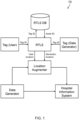
- FIG. 1 there is presented a simplified block diagram of a system that may implement the medical data augmentation according to the core concept of the invention.
- the following steps may be implemented by the system 10 of Fig. 1 according to an embodiment of the invention:
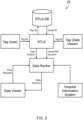
- Fig 2 presents a block diagram of a system for presenting augmented medical data according to another aspect of the illustrative embodiment of the invention. To implement the usage of the system 20 and the augmented medical data, the following steps may be implemented according to an aspect of an embodiment of the invention:
- the system will thus present medical data to the second nurse because both were associated with the medical data based on the generation distance data.
- the data ranker sends the ranked medical image data to the data viewer.
- the data viewer outputs the ranked data to the viewers(s).
- design rules may use the measured user distance in the generation distance data to model workflow. This enables the system to provide one fluid dataflow in a workflow that is being executed by multiple users.
- distance can be used.
- different hospitals may have different definitions of distance (i.e. different definitions of proximate, distant, etc,), as well as different means and methods for calculating distance information. Since the ultimate goal of the invention is to improve access to (appropriate) medical data, and since different institutions have different means or problems with access to medical data, it is expected that their distance information is defined so that the solution contributes most to their particular use case.
- one hospital may decide to apply the rules for providing the medical data according to patient types and patient conditions, while another may take workflow information as basis, and another may decide on distance rules according to the data type of the medical data.
- Fig.3 presents a flow diagram of a method 100 of generating augmented medical data. That is, there is provided a method of augmenting medical data generated by a data generation device.
- step 110 medical data generated by a medical data generation device is obtained.
- the medical data may be obtained directly from the medical data generation device, a medical treatment, or may be obtained indirectly (e.g., from an EMR system, patient information centre, data storage device, data storage system, and/or medical database).
- the medical data may be any data relevant to the health and/or physiological state of a subject, for example vital signs, medical images, bodily measurements, etc.
- the medical data may also include workflow and protocol information which guided/instructed the collection of data relevant to health and/or physiological state of the subject.
- the medical data generation device may include any means for generating said medical data.
- the medical data generation device is considered to mean hardware generating medical data, software for processing medical data to produce further medical data based on simulations/processing using a model and/or mathematical formula.
- the medical data may be generated by clinicians (e.g., a manual heart rate reading) in the form of clinician notes and observations, making the clinician a medical data generation device in certain contexts.
- step 120 generation distance data is obtained.
- the generation distance data describes a distance between one or more users and the medical data generation device during generation of the obtained medical data.
- the one or more users may include any individual operating the medical data generation device, any observers of the generation of the medical data by the medical data generation device, and any other individuals in the vicinity of the medical data generation device.
- the one or more users may include any people present while the medical data is generated. This may primarily include healthcare professionals, but may also include the subject of the medical data, and any other individuals.
- the generation distance data may include any indication of the distance between the user and the device used to generate the medical data.
- the generation distance data may include a measurement of the distance, or may be a discrete value such as near, medium and far.
- the generation distance data may include a distance distribution describing the distance between the user and the device for the whole time the medical data is generated, or may include a smaller number of sample distance values (e.g., an average distance, a maximum and minimum distance, a random sampling of distances during generation, etc.).
- the generation distance data at least provides an indication as to how close the user was to the medical data generation device during generation.
- obtaining the generation distance data may comprise determining, for each of the one or more users, a value indicative of a distance between the user and the medical data generator. This may be achieved by a signal strength that is inversely proportional to the distance between the medical data generator device and the user, or by determining the absolute location(s) of the user and device.
- the device and user may be equipped with wireless sensors that can communicate with each other, then the distance between the device and the user can be determined based on the signal strength calculations (without determination of the location).
- determining the value indicative of the distance between the user and the medical data generator may comprise obtaining a location of the user during generation of the obtained medical data, and obtaining a location of the medical data generator during generation of the obtained medical data. That is, an absolute location of the user and device is gathered. From such information, the value indicative of distance can be generated in a manner readily appreciated by the skilled person.
- the location of the one or more users and/or the medical data generator may be obtained from a real time location system. Thus, the locations can be acquired using a known technology.
- the method 100 may further comprise an additional optional step of comparing the generation distance data to a predetermined requirement.
- the obtained medical data is then only augmented responsive to the generation distance data satisfying the predetermined requirement.
- a step of checking that the generation distance data meets a condition which may include at least one of a maximum distance, and a minimum amount of time within a predetermined distance.
- a condition which may include at least one of a maximum distance, and a minimum amount of time within a predetermined distance.
- user characteristic data describing at least one characteristic of the one or more users is obtained.
- the user characteristic data may include at least one of a user identifier, a user role, a user action, a user group, a user experience, and a user expertise.
- the user characteristic data may be obtained automatically from a user profile database, or may be input by the user(s) during generation of the medical data. Said characteristics of the user may also be added/appended as meta data to the medical data.
- the obtained medical data is augmented based on (i.e. using) the obtained generation distance data.
- Augmenting the obtained medical data may comprise linking the generation distance data as metadata to the medical data.
- augmenting the obtained medical data may comprise annotating the medical data with the generation distance data.
- augmenting the medical data based on the obtained generation distance data means that information describing a distance between one or more users and the medical data generation device is associated with the medical data in way that when the medical data is looked up, the distance information is readily available.
- the obtained medical data may also be augmented based on (i.e. using) the obtained user characteristic data. That is, the user characteristic data may be linked to, and/or used to annotate, the medical data.
- Fig.4 presents a flow diagram of a method 200 for providing medical data to a viewer according to a further aspect of the invention.
- the viewer may be any individual(s) that are either controlling a device configured to output the medical data, an observer, or any other individual in the vicinity of the device configured to output the medical data.
- augmented medical data (generated according to a method within the scope of method 100) is retrieved. That is, the augmented medical data may be generated, or may have been stored and then retrieved in step 100.
- This step may also involve extracting (using known techniques) the generation distance data from the augmented medical data, such that the medical data and associated generation distance data are obtained.
- step 220 at least a part of the medical data to be output to the viewer is determined. This is achieved based on the generation distance data. That is, the parts of the medical data appropriate for output for viewing by a viewer is determined based on comparison of the generation distance data to a ruleset.
- the method may further include step 210.
- viewing distance data and/or viewer characteristic data is obtained. More particularly, viewing distance data describing a distance between the viewer and a device adapted to output medical data may be obtained. This distance may be determined in the same way as the generation distance data described above. Additionally and/or alternatively, characteristic data describing at least one characteristic of the viewer may be obtained. This characteristic data may be similar to the user characteristic data described above.
- the determination of the (part of) medical data to be output to the viewer may be further based on the viewing distance data and/or viewer characteristic data as appropriate.
- the interface 310 is configured to obtain medical data generated by a medical data generation device, and obtain generation distance data describing a distance between one or more users and the medical data generation device during generation of the obtained medical data. Furthermore, the interface may be optionally configured to obtain user characteristic data as described above.
- the generation distance data may be acquired from a RTLS, however embodiments are not restricted to such.
- the generation distance data may be acquired from the medical data generation device itself, or another device.
- the medical data may be acquired from an EMR system, but embodiments also aren't restricted thereto.
- the medical data may be acquired directly from the medical data generation device.
- the processor 320 is configured to augment the obtained medical data based on the obtained generation distance data. This may be achieved by any known means for editing data, whether it is implemented by an image manipulation module, or another editing platform.
- the system 300 may receive the medical data and associated generation distance data, and output augmented medical data.
- the augmented medical data may be stored in an EMR system, hospital information system, or another database for later use (e.g., medical data analysis or output).
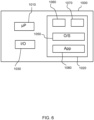
- Fig.6 illustrates an example of a computer 1000 within which one or more parts of an embodiment may be employed.
- Various operations discussed above may utilize the capabilities of the computer 1000.
- one or more parts of a system for acquiring an input from a user to control an interface may be incorporated in any element, module, application, and/or component discussed herein.
- system functional blocks can run on a single computer or may be distributed over several computers and locations (e.g. connected via internet).
- the computer 1000 includes, but is not limited to, smart phones, PCs, workstations, laptops, PDAs, palm devices, servers, storages, and the like.
- the computer 1000 may include one or more processors 1010, memory 1020 and one or more I/O devices 1030 that are communicatively coupled via a local interface (not shown).
- the local interface can be, for example but not limited to, one or more buses or other wired or wireless connections, as is known in the art.
- the local interface may have additional elements, such as controllers, buffers (caches), drivers, repeaters, and receivers, to enable communications. Further, the local interface may include address, control, and/or data connections to enable appropriate communications among the aforementioned components.
- the processor 1010 is a hardware device for executing software that can be stored in the memory 1020.
- the processor 1010 can be virtually any custom made or commercially available processor, a central processing unit (CPU), a digital signal processor (DSP), or an auxiliary processor among several processors associated with the computer 1000, and the processor 1010 may be a semiconductor-based microprocessor (in the form of a microchip) or a microprocessor.
- the memory 1020 can include any one or combination of volatile memory elements (e.g., random access memory (RAM), such as dynamic random access memory (DRAM), static random access memory (SRAM), etc.) and non-volatile memory elements (e.g., ROM, erasable programmable read only memory (EPROM), electronically erasable programmable read only memory (EEPROM), programmable read only memory (PROM), tape, compact disc read only memory (CD-ROM), disk, diskette, cartridge, cassette or the like, etc.).
- RAM random access memory
- DRAM dynamic random access memory
- SRAM static random access memory
- non-volatile memory elements e.g., ROM, erasable programmable read only memory (EPROM), electronically erasable programmable read only memory (EEPROM), programmable read only memory (PROM), tape, compact disc read only memory (CD-ROM), disk, diskette, cartridge, cassette or the like, etc.
- the memory 1020 may incorporate electronic, magnetic, optical, and/or other types
- the software in the memory 1020 may include one or more separate programs, each of which comprises an ordered listing of executable instructions for implementing logical functions.
- the software in the memory 1020 includes a suitable operating system (O/S) 1050, compiler 1060, source code 1070, and one or more applications 1080 in accordance with exemplary embodiments.
- the application 1080 comprises numerous functional components for implementing the features and operations of the exemplary embodiments.
- the application 1080 of the computer 1000 may represent various applications, computational units, logic, functional units, processes, operations, virtual entities, and/or modules in accordance with exemplary embodiments, but the application 1080 is not meant to be a limitation.
- Application 1080 may be a source program, executable program (object code), script, or any other entity comprising a set of instructions to be performed.
- a source program then the program is usually translated via a compiler (such as the compiler 1060), assembler, interpreter, or the like, which may or may not be included within the memory 1020, so as to operate properly in connection with the O/S 1050.
- the application 1080 can be written as an object oriented programming language, which has classes of data and methods, or a procedure programming language, which has routines, subroutines, and/or functions, for example but not limited to, C, C++, C#, Pascal, Python, BASIC, API calls, HTML, XHTML, XML, ASP scripts, JavaScript, FORTRAN, COBOL, Perl, Java, ADA, .NET, functional programming and the like.
- the I/O devices 1030 may include input devices such as, for example but not limited to, a mouse, keyboard, scanner, microphone, camera, etc. Furthermore, the I/O devices 1030 may also include output devices, for example but not limited to a printer, display, etc. Finally, the I/O devices 1030 may further include devices that communicate both inputs and outputs, for instance but not limited to, a NIC or modulator/demodulator (for accessing remote devices, other files, devices, systems, or a network), a radio frequency (RF) or other transceiver, a telephonic interface, a bridge, a router, etc. The I/O devices 1030 also include components for communicating over various networks, such as the Internet or intranet.
- a NIC or modulator/demodulator for accessing remote devices, other files, devices, systems, or a network
- RF radio frequency
- the I/O devices 1030 also include components for communicating over various networks, such as the Internet or intranet.
- the software in the memory 1020 may further include a basic input output system (BIOS) (omitted for simplicity).
- BIOS is a set of essential software routines that initialize and test hardware at start-up, start the O/S 1050, and support the transfer of data among the hardware devices.
- the BIOS is stored in some type of read-only-memory, such as ROM, PROM, EPROM, EEPROM or the like, so that the BIOS can be executed when the computer 800 is activated.
- the processor 1010 When the computer 1000 is in operation, the processor 1010 is configured to execute software stored within the memory 1020, to communicate data to and from the memory 1020, and to generally control operations of the computer 1000 pursuant to the software.
- the application 1080 and the O/S 1050 are read, in whole or in part, by the processor 1010, perhaps buffered within the processor 1010, and then executed.
- a computer readable medium may be an electronic, magnetic, optical, or other physical device or means that can contain or store a computer program for use by or in connection with a computer related system or method.
- the application 1080 can be embodied in any computer-readable medium for use by or in connection with an instruction execution system, apparatus, or device, such as a computer-based system, processor-containing system, or other system that can fetch the instructions from the instruction execution system, apparatus, or device and execute the instructions.
- a "computer-readable medium" can be any means that can store, communicate, propagate, or transport the program for use by or in connection with the instruction execution system, apparatus, or device.
- the computer readable medium can be, for example but not limited to, an electronic, magnetic, optical, electromagnetic, infrared, or semiconductor system, apparatus, device, or propagation medium.
- a computer-readable storage medium stores a computer program comprising computer program code configured to cause one or more physical computing devices to carry out an encoding or decoding method as described above when the program is run on the one or more physical computing devices.
- Storage media may include volatile and non-volatile computer memory such as RAM, PROM, EPROM, and EEPROM, optical discs (like CD, DVD, BD), magnetic storage media (like hard discs and tapes).
- RAM random access memory
- PROM read-only memory
- EPROM erasable programmable read-only memory
- EEPROM electrically erasable programmable read-only memory
- optical discs like CD, DVD, BD
- magnetic storage media like hard discs and tapes.
- Various storage media may be fixed within a computing device or may be transportable, such that the one or more programs stored thereon can be loaded into a processor.
- the blocks shown in the block diagram in Figs. 1 , 2 and 5 may be separate physical components, or logical subdivisions of single physical components, or may be all implemented in an integrated manner in one physical component.
- the functions of one block shown in the drawings may be divided between multiple components in an implementation, or the functions of multiple blocks shown in the drawings may be combined in single components in an implementation.
- Hardware components suitable for use in embodiments of the present invention include, but are not limited to, conventional microprocessors, application specific integrated circuits (ASICs), and field-programmable gate arrays (FPGAs).
- One or more blocks may be implemented as a combination of dedicated hardware to perform some functions and one or more programmed microprocessors and associated circuitry to perform other functions.
- a computer program may be stored/distributed on a suitable medium, such as an optical storage medium or a solid-state medium supplied together with or as part of other hardware, but may also be distributed in other forms, such as via the Internet or other wired or wireless telecommunication systems.
- a suitable medium such as an optical storage medium or a solid-state medium supplied together with or as part of other hardware, but may also be distributed in other forms, such as via the Internet or other wired or wireless telecommunication systems.
- each block in the flowchart or block diagrams may represent a module, segment, or portion of instructions, which comprises one or more executable instructions for implementing the specified logical function(s).
- the functions noted in the block may occur out of the order noted in the figures.
- two blocks shown in succession may, in fact, be executed substantially concurrently, or the blocks may sometimes be executed in the reverse order, depending upon the functionality involved.
Landscapes
- Health & Medical Sciences (AREA)
- Engineering & Computer Science (AREA)
- Medical Informatics (AREA)
- Epidemiology (AREA)
- General Health & Medical Sciences (AREA)
- Primary Health Care (AREA)
- Public Health (AREA)
- Biomedical Technology (AREA)
- Radiology & Medical Imaging (AREA)
- Nuclear Medicine, Radiotherapy & Molecular Imaging (AREA)
- Business, Economics & Management (AREA)
- General Business, Economics & Management (AREA)
- Medical Treatment And Welfare Office Work (AREA)
Priority Applications (1)
| Application Number | Priority Date | Filing Date | Title |
|---|---|---|---|
| EP23194816.7A EP4517764A1 (fr) | 2023-09-01 | 2023-09-01 | Augmentation de données médicales |
Applications Claiming Priority (1)
| Application Number | Priority Date | Filing Date | Title |
|---|---|---|---|
| EP23194816.7A EP4517764A1 (fr) | 2023-09-01 | 2023-09-01 | Augmentation de données médicales |
Publications (1)
| Publication Number | Publication Date |
|---|---|
| EP4517764A1 true EP4517764A1 (fr) | 2025-03-05 |
Family
ID=87929299
Family Applications (1)
| Application Number | Title | Priority Date | Filing Date |
|---|---|---|---|
| EP23194816.7A Withdrawn EP4517764A1 (fr) | 2023-09-01 | 2023-09-01 | Augmentation de données médicales |
Country Status (1)
| Country | Link |
|---|---|
| EP (1) | EP4517764A1 (fr) |
Citations (5)
| Publication number | Priority date | Publication date | Assignee | Title |
|---|---|---|---|---|
| US20140207489A1 (en) * | 2011-06-22 | 2014-07-24 | Koninklijke Philips Electronics N.V. | Mapping of health data |
| US20140278522A1 (en) * | 2013-03-12 | 2014-09-18 | Cerner Innovation, Inc. | Right patient situational awareness system |
| US20190286844A1 (en) * | 2016-07-28 | 2019-09-19 | Koninklijke Philips N.V. | System and method for optimizing a user experience based on patient context, user roles, current workflow, and display proximity |
| US20190320899A1 (en) * | 2018-04-20 | 2019-10-24 | Covidien Lp | Proximity based data acquisition and display |
| US20200411177A1 (en) * | 2019-06-27 | 2020-12-31 | GE Precision Healthcare LLC | Location-Based User Authorization for an Infant Care Device |
-
2023
- 2023-09-01 EP EP23194816.7A patent/EP4517764A1/fr not_active Withdrawn
Patent Citations (5)
| Publication number | Priority date | Publication date | Assignee | Title |
|---|---|---|---|---|
| US20140207489A1 (en) * | 2011-06-22 | 2014-07-24 | Koninklijke Philips Electronics N.V. | Mapping of health data |
| US20140278522A1 (en) * | 2013-03-12 | 2014-09-18 | Cerner Innovation, Inc. | Right patient situational awareness system |
| US20190286844A1 (en) * | 2016-07-28 | 2019-09-19 | Koninklijke Philips N.V. | System and method for optimizing a user experience based on patient context, user roles, current workflow, and display proximity |
| US20190320899A1 (en) * | 2018-04-20 | 2019-10-24 | Covidien Lp | Proximity based data acquisition and display |
| US20200411177A1 (en) * | 2019-06-27 | 2020-12-31 | GE Precision Healthcare LLC | Location-Based User Authorization for an Infant Care Device |
Similar Documents
| Publication | Publication Date | Title |
|---|---|---|
| US11004547B2 (en) | Systems and methods of aggregating healthcare-related data from multiple data centers and corresponding applications | |
| US10515428B2 (en) | Facilitating and tracking clinician-assignment status | |
| RU2536379C2 (ru) | Способ и система для обеспечения удаленного доступа к состоянию прикладной программы | |
| US8380533B2 (en) | System and method of providing dynamic and customizable medical examination forms | |
| JP2021061042A (ja) | 健康データを匿名化し、分析のために地理的領域を横断して健康データを修正及び編集するシステム及び方法 | |
| US10692593B1 (en) | Identifying events in a badge of a graphical user interface | |
| US11334679B2 (en) | System and method for optimizing a user experience based on patient context, user roles, current workflow, and display proximity | |
| JP2012510670A (ja) | ウィジェット型アプリケーションにおける臨床要素の抽出、保持、及び送信のシステム及び方法 | |
| GB2473929A (en) | Method and system for managing patients and healthcare resources | |
| US20260106005A1 (en) | Universal medical charting | |
| McGrath et al. | Optimizing radiologist productivity and efficiency: work smarter, not harder | |
| WO2024196685A1 (fr) | Systèmes et procédés pour des parcours de soins adaptatifs pour des problèmes de santé complexes | |
| Vorakulpipat et al. | A mobile-based patient-centric passive system for guiding patients through the hospital workflow: design and development | |
| Kadayat et al. | Internet-of-Things enabled smart health monitoring system using AutoAI: A graphical tool of IBM Watson Studio | |
| Dewadas et al. | Digitalisation in healthcare: a review of present developments in Malaysia | |
| US20190189288A1 (en) | Providing subject-specific information | |
| US20230377739A1 (en) | Data Distribution Component of Digital Healthcare Platform | |
| US20230360780A1 (en) | Generating information indicative of an interaction | |
| CN113793677B (zh) | 一种电子病历管理方法、装置、存储介质及电子设备 | |
| US20190026434A1 (en) | System and methods of activity tracking within electronic medical records | |
| US10510439B2 (en) | System and method for processing healthcare information | |
| US20210158938A1 (en) | Enhanced Enterprise Image Reading with Search and Direct Streaming | |
| WO2022170215A1 (fr) | Outil de visualisation d'aperçu contextuel clinique et d'assistance à la décision | |
| US11450427B1 (en) | Computing system for displaying locations of clinical events undergone by patients | |
| EP4485473A1 (fr) | Système de communication d'archivage d'images amélioré pour visualiser des données d'images médicales avec des résultats attendus et des points d'attention |
Legal Events
| Date | Code | Title | Description |
|---|---|---|---|
| PUAI | Public reference made under article 153(3) epc to a published international application that has entered the european phase |
Free format text: ORIGINAL CODE: 0009012 |
|
| STAA | Information on the status of an ep patent application or granted ep patent |
Free format text: STATUS: THE APPLICATION HAS BEEN PUBLISHED |
|
| AK | Designated contracting states |
Kind code of ref document: A1 Designated state(s): AL AT BE BG CH CY CZ DE DK EE ES FI FR GB GR HR HU IE IS IT LI LT LU LV MC ME MK MT NL NO PL PT RO RS SE SI SK SM TR |
|
| STAA | Information on the status of an ep patent application or granted ep patent |
Free format text: STATUS: THE APPLICATION IS DEEMED TO BE WITHDRAWN |
|
| 18D | Application deemed to be withdrawn |
Effective date: 20250906 |