EP4517848A1 - Lichtemittierende vorrichtung - Google Patents
Lichtemittierende vorrichtung Download PDFInfo
- Publication number
- EP4517848A1 EP4517848A1 EP23826957.5A EP23826957A EP4517848A1 EP 4517848 A1 EP4517848 A1 EP 4517848A1 EP 23826957 A EP23826957 A EP 23826957A EP 4517848 A1 EP4517848 A1 EP 4517848A1
- Authority
- EP
- European Patent Office
- Prior art keywords
- emitting device
- frame body
- lead
- light
- recess
- Prior art date
- Legal status (The legal status is an assumption and is not a legal conclusion. Google has not performed a legal analysis and makes no representation as to the accuracy of the status listed.)
- Pending
Links
Images






Classifications
-
- H—ELECTRICITY
- H10—SEMICONDUCTOR DEVICES; ELECTRIC SOLID-STATE DEVICES NOT OTHERWISE PROVIDED FOR
- H10H—INORGANIC LIGHT-EMITTING SEMICONDUCTOR DEVICES HAVING POTENTIAL BARRIERS
- H10H20/00—Individual inorganic light-emitting semiconductor devices having potential barriers, e.g. light-emitting diodes [LED]
- H10H20/80—Constructional details
- H10H20/85—Packages
- H10H20/857—Interconnections, e.g. lead-frames, bond wires or solder balls
-
- H—ELECTRICITY
- H10—SEMICONDUCTOR DEVICES; ELECTRIC SOLID-STATE DEVICES NOT OTHERWISE PROVIDED FOR
- H10H—INORGANIC LIGHT-EMITTING SEMICONDUCTOR DEVICES HAVING POTENTIAL BARRIERS
- H10H20/00—Individual inorganic light-emitting semiconductor devices having potential barriers, e.g. light-emitting diodes [LED]
- H10H20/01—Manufacture or treatment
- H10H20/036—Manufacture or treatment of packages
- H10H20/0364—Manufacture or treatment of packages of interconnections
-
- H—ELECTRICITY
- H10—SEMICONDUCTOR DEVICES; ELECTRIC SOLID-STATE DEVICES NOT OTHERWISE PROVIDED FOR
- H10H—INORGANIC LIGHT-EMITTING SEMICONDUCTOR DEVICES HAVING POTENTIAL BARRIERS
- H10H20/00—Individual inorganic light-emitting semiconductor devices having potential barriers, e.g. light-emitting diodes [LED]
- H10H20/80—Constructional details
- H10H20/85—Packages
- H10H20/8506—Containers
-
- H—ELECTRICITY
- H10—SEMICONDUCTOR DEVICES; ELECTRIC SOLID-STATE DEVICES NOT OTHERWISE PROVIDED FOR
- H10H—INORGANIC LIGHT-EMITTING SEMICONDUCTOR DEVICES HAVING POTENTIAL BARRIERS
- H10H20/00—Individual inorganic light-emitting semiconductor devices having potential barriers, e.g. light-emitting diodes [LED]
- H10H20/80—Constructional details
- H10H20/85—Packages
- H10H20/852—Encapsulations
- H10H20/853—Encapsulations characterised by their shape
Definitions
- the present invention relates to a light-emitting device, and more particularly to a light-emitting device having a semiconductor light-emitting element such as a light-emitting diode (LED) mounted on a lead frame.
- a semiconductor light-emitting element such as a light-emitting diode (LED) mounted on a lead frame.
- Patent Literature 1 discloses a method for forming a light-emitting device by forming a resin molded body on a lead frame provided with notches, and cutting the resin molded body and the lead frame along the notches.
- Patent Literature 2 discloses a surface-mounted light-emitting device having a first resin molded body composed of a light-emitting element and a first and a second leads, which are integrally molded, and a second resin molded body containing a phosphor coating the light-emitting element.
- the present invention has been made in view of the problem described above, and an object of the invention is to provide a light-emitting device that prevents peeling between a resin and a lead frame, exhibits high die shear strength, and is less susceptible to defects such as wire breakage.
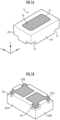
- FIG. 1A and FIG. 1B are conceptual diagrams illustrating an essential section of a light-emitting device 10 according to a first embodiment of the present invention, and are perspective views of the essential section observed from the upper surface side and the lower surface side, respectively.
- the light-emitting device 10 has a plurality of lead electrodes (hereinafter also referred to simply as "the leads") and a resin frame body 22. The following will describe a case where the light-emitting device 10 has two leads 12A and 12B; however, the light-emitting device 10 may have three or more leads.
- the resin frame body 22 has an opening 25 in which a light-emitting element is installed, and the opening 25 is filled with the coating member 35.
- the four corners on the back surface of the light-emitting device 10 have recesses 23 where the corners of the leads 12A and 12B are exposed inside.
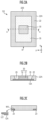
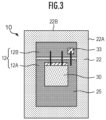
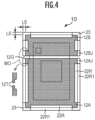
- FIG. 2A is a diagram illustrating the upper surface of the light-emitting device 10, and FIG. 2B is a sectional view taken along line A-A illustrated in FIG. 2A . Further, FIG. 2C is a side view observed from direction B illustrated in FIG. 2A . Further, FIG. 3 is a diagram illustrating the upper surface of the light-emitting device 10 before being filled with the coating member 35, and FIG. 4 is a diagram illustrating the back surface (the surface to be mounted on a circuit board) of the light-emitting device 10.
- the light-emitting device 10 has the lead 12A (first electrode) and the lead 12B (second electrode), which have plate shapes.
- the core material of the lead 12A and the lead 12B is made of copper (Cu), which is a metal that has good etching properties (corrosive properties), and the surface thereof is plated with nickel/gold (Ni/Au), which is a corrosion-resistant metal.
- Aluminum (Al), which is a corrosive metal, or an iron alloy such as iron-nickel-cobalt (Fe-Ni-Co) can be used as the core material of the lead 12A and the lead 12B.
- a corrosion-resistant metal such as platinum (Pt), palladium (Pd), or rhodium (Rh) can be used for the surfaces of the lead 12A and the lead 12B.
- a lead pair 12 consisting of the leads 12A and 12B (hereinafter also referred to as a lead frame 12 of the light-emitting device 10) is formed on substantially the same surface and separated from each other by a gap (slit) 12G between the leads 12A and 12B.
- the lead 12A and the lead 12B will be referred to simply as the leads when there is no particular distinction therebetween.
- the resin frame body 22 is formed by, for example, adding titanium oxide particles to a silicone resin, an epoxy resin, or an acrylic resin (white resin).
- the resin frame body 22 may be formed by adding carbon black to a silicone resin, an epoxy resin, or an acrylic resin (black resin).
- the resin frame body 22 has a rectangular shape (rectangular columnar shape) and has two outer side surfaces 22A parallel to each other and two outer side surfaces 22B perpendicular to the outer side surfaces 22A.
- the four corners of the back surface of the resin frame body 22 have the recesses 23 in which the corners of the leads 12A and 12B are exposed inside.
- thinner portions 12T are provided at outer edge portions WS of the leads 12A and 12B excluding the corners.
- thinner portions 12T are provided at edge portions WO where the leads 12A and 12B face each other. The thinner portions 12T cover the edges of the leads 12A and 12B by the resin of the resin frame body 22, thus preventing the leads from peeling off from the resin frame body 22 during dicing or the like.
- the thinner portions 12T are formed by so-called half etching to a depth of, for example, approximately 50% relative to the thickness of the leads 12A and 12B.
- the light-emitting device 10 is mounted by placing the back surface of the light-emitting device 10 (i.e., the back surface of the resin frame body 22) on a circuit board or the like, and attaching by using solder or the like. As illustrated in FIG. 1B and FIG. 4 , the recesses 23 are provided at the four corners of the back surface (mounting surface) of the resin frame body 22.
- the resin frame body 22 is provided so as to enclose the entire outer peripheries of the leads, burying the gap between the leads. The end portions of the leads are exposed in the recesses 23.
- FIG. 5 is a partial enlarged perspective view of the recess 23 in an enlarged view.
- the resin frame body 22 is recessed from the outer side surfaces 22A and 22B, and the rectangular corner of the lead 12A is exposed in the recess 23.
- the recess 23 in which the corner of the lead 12A is exposed will be described. The same applies to the recess 23 in which the corner of the lead 12B is exposed.
- an end surface 12E of the corner of the lead 12A is located in a position recessed inward from the outer side surfaces 22A and 22B of the resin frame body 22.
- the resin frame body 22 has a rectangular (L-shaped) bottom surface 22H, and the end surface 12E of the lead 12A is located in a position recessed inward from the outer side surfaces 22A and 22B by a distance LS ( FIG. 4 ).
- fillet guards 22G are formed as the partition walls of the resin frame body 22.
- a rectangular space for accommodating a solder fillet is defined in the recess 23 by the fillet guards 22G and the bottom surface 22H of the resin frame body 22.
- the recess 23 functions as a rectangular housing for accommodating the solder fillet.
- the depths (heights) of the bottom surface 22H and the fillet guards 22G are substantially the same as the thickness of the lead 12A.
- an outer peripheral portion 22R1 of a back surface 22R of the resin frame body 22 is formed slightly lower than the back surface 22R by the process and has a step 22S with respect to the back surface 22R, as illustrated in FIG. 4 and FIG. 5 .
- the light-emitting device 10 can be mounted without being detached from the circuit board.
- it is possible to achieve mounting with high die shear strength and without impairing heat dissipation and reliability.
- the back surface 22R of the resin frame body 22 may be a flat surface without the step 22S.
- the recess 23 may be formed by removing only the surface layer (plating layer) of the lead frame 12 by a micro milling cutter or the like such that the step 22S is not formed.
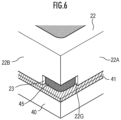
- FIG. 6 is a partial enlarged perspective view illustrating a solder joint in an enlarged view when the light-emitting device 10 is mounted on the wiring (land) 41 of the circuit board 40 by using the solder 45.
- the fillet of the solder 45 is formed in the recess 23, thus making it possible to maintain high die shear strength also in the case of mounting the light-emitting device 10 on the wiring that is approximately the same size therewith.
- FIG. 7 is a partial enlarged perspective view illustrating, in an enlarged view, the recess 23, which is a modified example of the present embodiment.
- the recess 23 having an arc shape (fan-like shape) is formed.
- the bottom surface 22H of the resin frame body 22 has an arc shape (or a quadrant shape), and the end surface (side surface) 12E of the end portion of the lead 12A has a cylindrical side surface shape.
- the fillet guards 22G which are the partition walls extending and protruding from the resin frame body 22, are formed on both sides of the end portion of the lead 12A.
- a quarter-cylindrical space for accommodating the solder fillet is defined in the recess 23 by the fillet guards 22G and the bottom surface 22H of the resin frame body 22.
- the arc-shaped recess 23 functions as a housing for accommodating the solder fillet.
- the above-described protruding fillet guards 22G hold a part of the solder fillet in a necking manner, thus making it possible to increase the die shear strength.
- the fillet of the solder 45 is formed in the recess 23, so that high die shear strength can be maintained even when mounting the light-emitting device 10 on wiring of approximately the same size as the light-emitting device 10.
- the recesses 23 of the resin frame body 22 are rectangular and arc-shaped recesses, but the recesses 23 of other shapes may be formed as long as the recesses have the end surfaces of the leads exposed therein and have spaces for accommodating the solder fillets to be connected to the lead end surfaces.
- the resin frame body 22 has the opening 25 (first opening), which is an inner region of the frame body, and the surfaces of the lead 12A and the lead 12B are partly exposed through the opening 25.
- a semiconductor light-emitting element (hereinafter referred to simply as the light-emitting element) 30 is installed in the opening 25.
- the light-emitting element 30 in the present embodiment is composed of an LED (Light Emitting Diode) 31, which is a light source element, and a phosphor 32, which is an optical member provided on the light source element.
- the light source element may alternatively be a laser diode (LD) or the like.
- the optical member is not limited to a phosphor. Further, the optical member may not be provided.
- the lead 12A is an anode electrode
- the lead 12B is a cathode electrode
- a p-electrode of the LED 31 is connected to and placed on the lead 12A
- an n-electrode of the LED 31 is connected to the lead 12B by bonding wire.
- the plate-shaped phosphor 32 is provided on the LED 31.
- the light-emitting element 30 may have an optical member such as a translucent member provided on the LED 31.
- various types of phosphors such as YAG (yttrium aluminum garnet), LuAG (lutetium aluminum garnet), GYAG (gadolinium aluminum garnet), ⁇ , ⁇ sialon, SCASN, CASN, KFS can be appropriately used.
- a nanoparticle light conversion member of a cadmium selenium (CdSn)-based, indium phosphide (InP)-based, or indium nitride (InN)-based member, or the like can be placed on the upper surface (light exit surface) of the LED 31.
- the nanoparticle light conversion member is preferably placed within a hundred and several tens of nm from the upper surface of the LED 31, because the light conversion efficiency is improved by quantum coupling.
- a protection element 33 which is a Zener diode, is mounted by bonding on the lead 12B exposed through the opening 25.
- the other electrode of the protection element 33 is connected to the lead 12A by bonding wire.
- a varistor or the like can be used as the protection element 33. Further, a passive element such as a capacitor, a resistor, or a light receiving element may be provided.
- the resin frame body 22 has a rectangular shape when viewed from above, and has a rectangular columnar opening 25, which is an inner region of the frame body.
- the opening 25 is not limited to the rectangular columnar shape, and may alternatively have a cylindrical shape, a truncated cone shape, or other shape.
- FIG. 8 is a flowchart illustrating the manufacturing method for the light-emitting device 10.
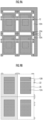
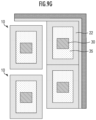
- FIG. 9A to FIG. 9G are top views illustrating steps.
- FIG. 9A, FIG. 9B , and FIG. 9E to FIG. 9G are top views, FIG. 9C and FIG. 9D being back surface views.
- cutting lines CL, along which the devices are divided, are indicated by solid lines, and element mounting portions are indicated by dotted lines.
- a prepared copper (Cu) plate that will become the lead frame 12 is punched by a die to form punched portions 12N ( FIG. 9A ).
- a resist mask may be formed and die-cut by etching.
- a resist mask with openings in the portions that will become the thinner portions 12T is formed before forming the punched portions 12N, and the resist mask is etched to be thinner.
- the upper surface of the lead frame 12 is plated with nickel (Ni) and gold (Au) in this order (Ni/Au plating) by electrolytic plating ( FIG. 9A ).
- the resin frame body 22 of thermosetting resin is formed on the lead frame 12 by insert molding ( FIG. 9B ).
- the resin frame body 22 has the opening 25, which is the inner region of the resin frame body 22, and the surfaces of the lead 12A and the lead 12B are partly exposed through the opening 25.
- FIG. 10A is a schematic top view illustrating an intersectional part X of the cutting lines CL of the lead frame 12 (refer to FIG. 9C and FIG. 9D ) in an enlarged view
- FIG. 10B is a sectional view illustrating the sections of the intersectional part X in step S4 and step S5.
- a plating layer 12P on the surface of the lead frame 12 is removed by dicing (rectangular teeth) along the cutting lines CL at predetermined widths (plating removal portions RB) ( FIG. 10B , top).
- the core material 12C (Cu) is exposed at the plating removal portions RB ( FIG. 9C ).
- the outer peripheral portion 22R1 of the back surface 22R of the resin frame body 22 is also cut to form the step 22S, which is slightly lower than the back surface 22R (refer to FIG. 5 ).
- the plating layer 12P may be removed by milling or the like instead of dicing.
- the core material 12C (Cu) of the lead frame 12 of the plating removal portions is etched using an etching solution ( FIG. 10B , middle).
- the plating layer 12P on the resin frame body 22 is removed by air blasting ( FIG. 10B , bottom).
- Other removal methods include water jet blasting.
- the plating layer 12P on the resin frame body 22 can be left. In such a case, this step is skipped.
- the plating layer 12P that has been left functions as a solder attraction wall when the light-emitting device 10 is soldered to a circuit board.
- the rectangular recess 23 ( FIG. 5 ) is formed at a corner of the resin frame body 22 by etching the lead frame 12 at the intersectional part X ( FIG. 9D ).
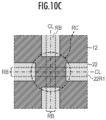
- FIG. 10C illustrates a removal region RC of the lead frame 12 in the case where the recess 23 having the arc shape is formed.
- Gold-tin (Au-Sn) solder paste is printed on the element mounting area. Then, the light-emitting element 30 and the protection element 33 are mounted on the solder.
- Reflow (heating at 300°C) is performed to melt and solidify the gold-tin solder to mount the elements.
- Gold wire is used to perform wire bonding of the light-emitting element 30 and the protection element 33 thereby to mount the elements ( FIG. 9E ).
- Silicone resin which is a translucent adhesive, is applied to the light exit surface of the LED 31.
- the phosphor 32 is mounted on the LED 31.
- temporary curing is performed at 180°C to bond the phosphor 32 ( FIG. 9E ).
- the opening 25 of the resin frame body 22 is filled with a coating resin made of silicone resin containing titanium oxide particles, and the resin is cured by heating at 150°C for three hours to form the coating member 35 ( FIG. 9F ).
- the light-emitting device 10 is manufactured by the steps described above ( FIG. 9G ).
- a resin frame body may peel off due to a cutting stress applied to the lead frame.
- the lead frame 12 of a cut portion is removed in advance, so that there will be no peeling between the lead frame 12 and the resin frame body 22.
- the present invention can provide a light-emitting device that prevents peeling between a frame body and a lead frame, exhibits high solder joint die shear strength, and is less susceptible to wire breakage and the like.
Landscapes
- Led Device Packages (AREA)
Applications Claiming Priority (2)
| Application Number | Priority Date | Filing Date | Title |
|---|---|---|---|
| JP2022100686A JP2024001800A (ja) | 2022-06-22 | 2022-06-22 | 発光装置 |
| PCT/JP2023/020776 WO2023248770A1 (ja) | 2022-06-22 | 2023-06-05 | 発光装置 |
Publications (2)
| Publication Number | Publication Date |
|---|---|
| EP4517848A1 true EP4517848A1 (de) | 2025-03-05 |
| EP4517848A4 EP4517848A4 (de) | 2025-10-01 |
Family
ID=89379631
Family Applications (1)
| Application Number | Title | Priority Date | Filing Date |
|---|---|---|---|
| EP23826957.5A Pending EP4517848A4 (de) | 2022-06-22 | 2023-06-05 | Lichtemittierende vorrichtung |
Country Status (7)
| Country | Link |
|---|---|
| US (1) | US20250324830A1 (de) |
| EP (1) | EP4517848A4 (de) |
| JP (1) | JP2024001800A (de) |
| KR (1) | KR20250026176A (de) |
| CN (1) | CN119404618A (de) |
| TW (1) | TW202404919A (de) |
| WO (1) | WO2023248770A1 (de) |
Cited By (1)
| Publication number | Priority date | Publication date | Assignee | Title |
|---|---|---|---|---|
| US20240379926A1 (en) * | 2021-09-24 | 2024-11-14 | Stanley Electric Co., Ltd. | Light-emitting device, and method for producing light-emitting device |
Family Cites Families (7)
| Publication number | Priority date | Publication date | Assignee | Title |
|---|---|---|---|---|
| JP4608294B2 (ja) | 2004-11-30 | 2011-01-12 | 日亜化学工業株式会社 | 樹脂成形体及び表面実装型発光装置並びにそれらの製造方法 |
| JP5217800B2 (ja) | 2008-09-03 | 2013-06-19 | 日亜化学工業株式会社 | 発光装置、樹脂パッケージ、樹脂成形体並びにこれらの製造方法 |
| JP2013051296A (ja) * | 2011-08-31 | 2013-03-14 | Panasonic Corp | 半導体装置用パッケージとその製造方法、および半導体装置 |
| KR102153619B1 (ko) * | 2014-04-04 | 2020-09-09 | 엘지디스플레이 주식회사 | 발광다이오드 장치와 이를 이용한 액정표시장치 |
| JP6260593B2 (ja) * | 2015-08-07 | 2018-01-17 | 日亜化学工業株式会社 | リードフレーム、パッケージ及び発光装置、並びにこれらの製造方法 |
| TWM558999U (zh) * | 2017-12-11 | 2018-04-21 | 長華科技股份有限公司 | 發光封裝元件 |
| JP6888709B2 (ja) * | 2020-04-09 | 2021-06-16 | 日亜化学工業株式会社 | 発光装置の製造方法及び発光装置 |
-
2022
- 2022-06-22 JP JP2022100686A patent/JP2024001800A/ja active Pending
-
2023
- 2023-06-05 WO PCT/JP2023/020776 patent/WO2023248770A1/ja not_active Ceased
- 2023-06-05 CN CN202380047842.XA patent/CN119404618A/zh active Pending
- 2023-06-05 US US18/869,060 patent/US20250324830A1/en active Pending
- 2023-06-05 KR KR1020247041195A patent/KR20250026176A/ko active Pending
- 2023-06-05 EP EP23826957.5A patent/EP4517848A4/de active Pending
- 2023-06-14 TW TW112122142A patent/TW202404919A/zh unknown
Cited By (1)
| Publication number | Priority date | Publication date | Assignee | Title |
|---|---|---|---|---|
| US20240379926A1 (en) * | 2021-09-24 | 2024-11-14 | Stanley Electric Co., Ltd. | Light-emitting device, and method for producing light-emitting device |
Also Published As
| Publication number | Publication date |
|---|---|
| CN119404618A (zh) | 2025-02-07 |
| JP2024001800A (ja) | 2024-01-10 |
| TW202404919A (zh) | 2024-02-01 |
| US20250324830A1 (en) | 2025-10-16 |
| EP4517848A4 (de) | 2025-10-01 |
| WO2023248770A1 (ja) | 2023-12-28 |
| KR20250026176A (ko) | 2025-02-25 |
Similar Documents
| Publication | Publication Date | Title |
|---|---|---|
| CN102142513B (zh) | Led封装及制作led封装的方法 | |
| EP3591721B1 (de) | Lichtemittierende vorrichtung | |
| JP5869961B2 (ja) | 半導体発光装置 | |
| JP6336105B2 (ja) | オプトエレクトロニクス部品の製造 | |
| JP6337873B2 (ja) | パッケージ、パッケージ中間体、発光装置及びそれらの製造方法 | |
| JP6260593B2 (ja) | リードフレーム、パッケージ及び発光装置、並びにこれらの製造方法 | |
| CN113380928B (zh) | 半导体装置的制造方法 | |
| WO2003044872A1 (fr) | Dispositif electroluminescent semi-conducteur compose et son procede de fabrication | |
| JP2013247243A (ja) | 半導体発光装置 | |
| EP4517848A1 (de) | Lichtemittierende vorrichtung | |
| JP6107229B2 (ja) | 発光装置 | |
| JP2017130589A (ja) | 発光装置の製造方法 | |
| US11223000B2 (en) | Method of manufacturing light emitting element mounting base member, method of manufacturing light emitting device using the light emitting element mounting base member, light emitting element mounting base member, and light emitting device using the light emitting element mounting base member | |
| US20240379926A1 (en) | Light-emitting device, and method for producing light-emitting device | |
| US12261252B2 (en) | Light-emitting device and manufacturing method of the same | |
| EP2682993B1 (de) | Gegossenes Gehäuse für eine lichtemittierende Vorrichtung und lichtemittierende Vorrichtung damit | |
| US20250006880A1 (en) | Semiconductor light-emitting device | |
| JP2024054731A (ja) | 半導体発光装置 | |
| EP4191689A1 (de) | Lichtemittierendes halbleiterbauelement | |
| JP2016119464A (ja) | 発光装置 | |
| EP4418336A1 (de) | Lichtemittierende vorrichtung und leiterrahmen | |
| KR100303393B1 (ko) | 반도체패키지의 회로기판 구조 및 그 제조방법 | |
| JP2018160673A (ja) | パッケージの製造方法、パッケージ中間体の製造方法及び発光装置の製造方法 |
Legal Events
| Date | Code | Title | Description |
|---|---|---|---|
| STAA | Information on the status of an ep patent application or granted ep patent |
Free format text: STATUS: THE INTERNATIONAL PUBLICATION HAS BEEN MADE |
|
| PUAI | Public reference made under article 153(3) epc to a published international application that has entered the european phase |
Free format text: ORIGINAL CODE: 0009012 |
|
| STAA | Information on the status of an ep patent application or granted ep patent |
Free format text: STATUS: REQUEST FOR EXAMINATION WAS MADE |
|
| 17P | Request for examination filed |
Effective date: 20241127 |
|
| AK | Designated contracting states |
Kind code of ref document: A1 Designated state(s): AL AT BE BG CH CY CZ DE DK EE ES FI FR GB GR HR HU IE IS IT LI LT LU LV MC ME MK MT NL NO PL PT RO RS SE SI SK SM TR |
|
| REG | Reference to a national code |
Ref country code: DE Ref legal event code: R079 Free format text: PREVIOUS MAIN CLASS: H01L0033620000 Ipc: H10H0020850000 |
|
| STAA | Information on the status of an ep patent application or granted ep patent |
Free format text: STATUS: EXAMINATION IS IN PROGRESS |
|
| A4 | Supplementary search report drawn up and despatched |
Effective date: 20250829 |
|
| DAV | Request for validation of the european patent (deleted) | ||
| DAX | Request for extension of the european patent (deleted) | ||
| RIC1 | Information provided on ipc code assigned before grant |
Ipc: H10H 20/85 20250101AFI20250825BHEP Ipc: H10H 20/01 20250101ALI20250825BHEP |
|
| 17Q | First examination report despatched |
Effective date: 20250908 |