EP4518190A1 - Procédé pour fournir des services de communication à un équipement utilisateur à l'aide d'un réseau d'accès - Google Patents
Procédé pour fournir des services de communication à un équipement utilisateur à l'aide d'un réseau d'accès Download PDFInfo
- Publication number
- EP4518190A1 EP4518190A1 EP23194846.4A EP23194846A EP4518190A1 EP 4518190 A1 EP4518190 A1 EP 4518190A1 EP 23194846 A EP23194846 A EP 23194846A EP 4518190 A1 EP4518190 A1 EP 4518190A1
- Authority
- EP
- European Patent Office
- Prior art keywords
- user equipment
- mobile communication
- service
- time
- communication network
- Prior art date
- Legal status (The legal status is an assumption and is not a legal conclusion. Google has not performed a legal analysis and makes no representation as to the accuracy of the status listed.)
- Pending
Links
Images

Classifications
-
- H—ELECTRICITY
- H04—ELECTRIC COMMUNICATION TECHNIQUE
- H04B—TRANSMISSION
- H04B7/00—Radio transmission systems, i.e. using radiation field
- H04B7/14—Relay systems
- H04B7/15—Active relay systems
- H04B7/185—Space-based or airborne stations; Stations for satellite systems
- H04B7/1853—Satellite systems for providing telephony service to a mobile station, i.e. mobile satellite service
- H04B7/18532—Arrangements for managing transmission, i.e. for transporting data or a signalling message
- H04B7/18534—Arrangements for managing transmission, i.e. for transporting data or a signalling message for enhancing link reliablility, e.g. satellites diversity
-
- H—ELECTRICITY
- H04—ELECTRIC COMMUNICATION TECHNIQUE
- H04B—TRANSMISSION
- H04B7/00—Radio transmission systems, i.e. using radiation field
- H04B7/14—Relay systems
- H04B7/15—Active relay systems
- H04B7/185—Space-based or airborne stations; Stations for satellite systems
- H04B7/1851—Systems using a satellite or space-based relay
- H04B7/18513—Transmission in a satellite or space-based system
-
- H—ELECTRICITY
- H04—ELECTRIC COMMUNICATION TECHNIQUE
- H04L—TRANSMISSION OF DIGITAL INFORMATION, e.g. TELEGRAPHIC COMMUNICATION
- H04L41/00—Arrangements for maintenance, administration or management of data switching networks, e.g. of packet switching networks
- H04L41/08—Configuration management of networks or network elements
- H04L41/0803—Configuration setting
- H04L41/0806—Configuration setting for initial configuration or provisioning, e.g. plug-and-play
-
- H—ELECTRICITY
- H04—ELECTRIC COMMUNICATION TECHNIQUE
- H04L—TRANSMISSION OF DIGITAL INFORMATION, e.g. TELEGRAPHIC COMMUNICATION
- H04L41/00—Arrangements for maintenance, administration or management of data switching networks, e.g. of packet switching networks
- H04L41/50—Network service management, e.g. ensuring proper service fulfilment according to agreements
- H04L41/5041—Network service management, e.g. ensuring proper service fulfilment according to agreements characterised by the time relationship between creation and deployment of a service
-
- H—ELECTRICITY
- H04—ELECTRIC COMMUNICATION TECHNIQUE
- H04L—TRANSMISSION OF DIGITAL INFORMATION, e.g. TELEGRAPHIC COMMUNICATION
- H04L41/00—Arrangements for maintenance, administration or management of data switching networks, e.g. of packet switching networks
- H04L41/22—Arrangements for maintenance, administration or management of data switching networks, e.g. of packet switching networks comprising specially adapted graphical user interfaces [GUI]
Definitions
- the present invention relates a method for providing communication services to a user equipment using an access network of or associated with a mobile communication network, wherein - in order to provide communication services on a normal or increased quality-of-service level to the user equipment, and while the user equipment is connected to the mobile communication network or while the user equipment is in connected mode - user plane data and/or control plane data are transmitted, in uplink and/or in downlink direction, between the user equipment and the mobile communication network, wherein the user equipment- while being located, during a time interval of a first kind of time intervals, at a location of a first kind of locations - is able to be served, by at least one base station entity of the access network, on the normal or increased quality-of-service level, and wherein the user equipment - while being located, during a time interval of a second kind of time intervals, at a location of either the first or the second kind of locations - is able to be served, by any base station entity of the access network, at maximum on a quality-of-service level
- the present invention relates to a user equipment for being provided with communication services using an access network of or associated with a mobile communication network, wherein the user equipment is served by the access network, wherein - in order to provide communication services on a normal or increased quality-of-service level to the user equipment, and while the user equipment is connected to the mobile communication network or while the user equipment is in connected mode - user plane data and/or control plane data are transmitted, in uplink and/or in downlink direction, between the user equipment and the mobile communication network, wherein the user equipment - while being located, during a time interval of a first kind of time intervals, at a location of a first kind of locations - is able to be served, by at least one base station entity of the access network, on the normal or increased quality-of-service level, and wherein the user equipment - while being located, during a time interval of a second kind of time intervals, at a location of either the first or the second kind of locations - is able to be served, by any base station entity of the access
- the present invention relates to a system or a mobile communication network for providing communication services to a user equipment using an access network of or associated with the mobile communication network, wherein - in order to provide communication services on a normal or increased quality-of-service level to the user equipment, and while the user equipment is connected to the mobile communication network or while the user equipment is in connected mode - user plane data and/or control plane data are transmitted, in uplink and/or in downlink direction, between the user equipment and the mobile communication network, wherein the user equipment - while being located, during a time interval of a first kind of time intervals, at a location of a first kind of locations - is able to be served, by at least one base station entity of the access network, on the normal or increased quality-of-service level, and wherein the user equipment - while being located, during a time interval of a second kind of time intervals, at a location of either the first or the second kind of locations - is able to be served, by any base station entity of the access network, at maximum on
- the present invention relates to a program and to a computer-readable medium for providing communication services to a user equipment using an access network of or associated with a mobile communication network according to the inventive method.
- Mobile communication networks such as public land mobile networks are typically realized as cellular mobile communication networks, i.e. comprising (or using or being associated or assigned to a radio access network comprising) radio cells.
- cellular systems are known conforming to different mobile communication standards or radio access technologies, like 2G/3G/4G/5G radio access technologies (referring to the different generations of radio access technologies) and typically comprise (or consist of) cells (or radio cells) of one or a plurality of the respective radio access technology/radio access technologies.
- Such mobile communication networks that are purely or predominantly based on terrestrial infrastructures of the radio access network (and, hence, are also called terrestrial networks or TN-networks) are typically organized throughout a country (or a part of or a region within a country) in a repeating pattern of typically stationary (radio) cells (and associated base station entities) which typically belong to (or are operated or used by or associated or assigned to) a mobile network operator (MNO).
- MNO mobile network operator
- a better radio coverage is typically experienced by user equipments, whereas in other (geographical) parts or locations worse radio coverage is experienced; i.e. a user equipment - while being located at a location of a first kind of locations - is able to be served, by at least one base station entity of the access network, on the normal or increased quality-of-service level, and the same or another user equipment - while being located at a location of the second kind of locations - is able to be served, by any base station entity of the access network, at maximum on a quality-of-service level inferior compared to the normal or increased quality-of-service level, thus, it might also be the case that such a user equipment is not able to be served at all (which would also correspond to a quality-of-service level inferior compared to the normal or increased quality-of-service level).
- Such a dependence of the quality of the radio coverage (provided by the considered mobile communication network) on, mainly, the location of the considered user equipment mainly stems
- non-terrestrial networks i.e. mobile communication networks that use, at least partly, non-terrestrial infrastructures of the radio access network, especially using satellites and/or high-altitude platforms.
- satellites - especially non-geostationary satellites that are preferred due to comparatively high latency characteristics of geostationary satellites - one such satellite is typically able to provide (due to the movement of such a satellite relative to the earth surface, which relative movement typically occurs with rather large velocities, at least compared to typical (passenger) velocities used on the earth surface, e.g.
- a considered user equipment - while being located, during a time interval of a first kind of time intervals, at a location of a first kind of locations - is able to be served, by at least one base station entity of the access network, on the normal or increased quality-of-service level
- this considered user equipment - while being located, during a time interval of a second kind of time intervals, at a location of either the first or the second kind of locations - is able to be served, by any base station entity of the access network, at maximum on a quality-of-service level inferior compared to the normal or increased quality-of-service level.
- discontinuous radio coverage (or modifications - and, thus degradations - of quality-of-service levels regarding radio coverage) is both possible in terrestrial network (especially in case that the user equipment is moving relative to stationary base station entities) and, typically even more so, in non-terrestrial networks, even in case of stationary user equipments; this being especially true in case that the satellite constellation is still being built or in case of shadowing effects (e.g. due to plants or buildings) blocking a direct line of sight between the user equipment and the serving satellite of high-altitude platform.
- This might prove especially detrimental in case of important or high-urgency communication services being provided to a user equipment, e.g. emergency calls or the like.
- An object of the present invention is to provide a technically simple, effective and cost-effective solution for providing communication services to a user equipment using an access network of or associated with a mobile communication network, wherein in case of such discontinuous radio coverage - i.e. the user equipment is able to be served on the normal or increased quality-of-service level (while being located, during a time interval of a first kind of time intervals, at a location of a first kind of locations) and the user equipment is able to be served at maximum on a quality-of-service level inferior compared to the normal or increased quality-of-service level (while being located, during a time interval of a second kind of time intervals, at a location of either the first or the second kind of locations) - and even though radio coverage deteriorates or has already deteriorated, at least a minimum of communication services is able to be provided to the user equipment.
- a further object of the present invention is to provide a corresponding user equipment, a corresponding system or a corresponding mobile communication network
- the object of the present invention is achieved by a method for providing communication services to a user equipment using an access network of or associated with a mobile communication network,
- non-terrestrial networks are used, inter alia, to provide network coverage in (geographical) areas that are not covered by terrestrial networks (TN).
- TN terrestrial networks
- One use case thereof is to provide emergency call (EC) services in remote areas of a country.
- EC emergency call
- the access to non-terrestrial networks with regular handsets might be already possible and will be possible based on the 3GPP Rel-17 and -18 definition of non-terrestrial network functionality.
- Approaches for "direct-2-device” are also currently being discussed, providing low bitrate services to unmodified LTE handsets (-> "SpaceX D2D"). Nevertheless, at least the following problems might not be entirely solved even using non-terrestrial networks:
- This service resume information is transmitted by using control plane signaling - especially using an access stratum control channel or an access stratum dedicated control channel - from the mobile communication network (especially being or at least comprising a cellular terrestrial network and/or a cellular non-terrestrial network).
- the service resume information is used (especially in case of a non-terrestrial network) to indicate the dynamically changing satellite coverage of such a non-terrestrial network, due to the movement of serving satellites.
- a user equipment uses an access network of or associated with a mobile communication network.
- user plane data and/or control plane data are transmitted, in uplink and/or in downlink direction, between the user equipment and the mobile communication network; this typically assumes that such communication services are provided, to the user equipment, on a normal or increased quality-of-service level, and the user equipment needs to be connected to the mobile communication network (and/or the user equipment is in connected mode).
- quality-of-service are possible:
- the access network is or corresponds to, or at least comprises a part being, a non-terrestrial network.
- the user equipment indicates, via local signaling or via an actuator or display means, a service resume indication
- the first point in time, at which the service resume information is received by the user equipment precedes the second point in time, at which the user equipment indicates the service resume indication, wherein especially the service resume information is received, by the user equipment, in case that a quality-of-service level, monitored by the user equipment and/or by the access network, is determined to be inferior to a specific predefined serving cell quality threshold.
- the service resume indication informs the user of the user equipment
- the service resume information is transmitted using control channel and/or a control channel message and/or a non-access stratum message, especially one or a plurality out of the following:
- the service resume information and/or the service resume indication comprises a global navigation satellite system reference point and/or a map information and/or a polygon information, the global navigation satellite system reference point and/or the map information and/or the polygon information indicating better radio coverage and/or a better quality-of-service level and/or where the communication service is intended to continue, wherein especially the user equipment calculates the vector from its current position to the target position.
- the present invention relates to a user equipment for being provided with communication services using an access network of or associated with a mobile communication network, wherein the user equipment is served by the access network,
- the present invention relates to a system or to a mobile communication network for providing communication services to a user equipment using an access network of or associated with the mobile communication network,
- the present invention relates to a program comprising a computer readable program code which, when executed on a computer and/or on a user equipment and/or on a network node of a mobile communication network, or in part on a user equipment and/or in part on network node of a mobile communication network, causes the computer and/or the user equipment and/or the network node of the mobile communication network to perform the inventive method.
- FIG 1 two instances of a user equipment 20 are schematically shown in a mobile communication network 100 and using an access network 110 of or associated with the mobile communication network 100, wherein communication services are able to be provided, to the user equipment 20, on a normal or increased quality-of-service level (in case that radio coverage is rather good - schematically represented, in Figure 1 , by means of the user equipment 20 (or an instance thereof) being located completely within a radio coverage area 11 of a base station entity 111) and wherein (in case of worse radio transmission conditions - schematically represented, in Figure 1 , by means of the user equipment 20 (or another instance thereof) being located on the border, or partly outside of the radio coverage area 11 of the base station entity 111) communication services are able to be provided at maximum on an inferior quality-of-service level, i.e.
- the inferior quality-of-service might deteriorate such that it approaches a loss of connection.
- the user equipment 20 represented in Figure 1 might also be called a considered user equipment or a specific user equipment; of course, further user equipments are typically present and connected to (and/or served by) the mobile communication network 100, however, again for the sake of simplicity, such further user equipments are not represented in Figure 1 .
- Figure 1 illustrates the situation of the user equipment 20 in a mobile communication network 100, typically being a non-terrestrial network, and comprising the access network 110 and a core network 120.
- the mobile communication network 100 is preferably a cellular telecommunications network comprising typically a plurality of network cells (or radio cells).
- the access network 110 is part of or associated with the mobile communication network 100.
- the user equipment 20 is able to be connected to (or served by) the (first) base station entity 111 and/or a further (or second) base station entity 112, both base station entities 111, 112 being part of the access network 110.
- the access network 110 comprises, besides the (first and second) base station entities 111, 112, still further base station entities which are, however and the sake of simplicity, not shown in Figure 1 .
- each of the base station entities 111, 112 of the mobile communication network 100 serves a radio coverage area or radio cell, the (first) base station entity 111 serving a first radio cell 11, and the second base station entity 112 serving a second radio cell 12.
- radio coverage areas or radio cells 11, 12 provided or generated by the base station entities 111, 112 of the access network 110 are typically geographically moving (i.e.
- base station entity 111, 112 serving the user equipment 20 is used here in association, especially and exemplarily, with satellites or high-altitude platforms being part of the non-terrestrial infrastructure of the mobile communication network 100 or of its (or assigned or associated) access network 110; however, it is to be understood, that such satellites do not necessarily need to comprise (or to be provided such that) all functional elements or functionalities of a base station entity, such as a gNB in, e.g., a 5G mobile communication network 100: In, or as part of, a non-terrestrial network, there are typically (and necessarily) further infrastructure elements such as ground stations providing feeder links, etc., and the distribution of functionalities (or parts) of a base station entity might be distributed also among these further infrastructure elements; nevertheless, a considered user equipment 20 is served by the base station entity functionality and at least the antenna part - or radio unit - needs to
- communication services are provided to the user equipment 20 using the access network 110 of or associated with the mobile communication network 100.
- a typical mobile communication network 100 i.e. in the geographical area covered by the mobile communication network 100
- a user equipment 20 normally experiences a better radio coverage in some geographical areas than in others. This is especially true in predominantly terrestrial mobile communication networks 100 having rather stationary base station entities, i.e. in case that the radio coverage is rather static (geography-wise).
- a user equipment 20 In a typical mobile communication network 100 being predominantly a non-terrestrial network, a user equipment 20 normally also experiences a better radio coverage in some geographical areas than in others, but this dependency is additionally linked with a timing aspect: Due to the dynamic of the satellite movement (or the movement of high-altitude platforms) that are providing at least part of the base station entity-functionality, at a first location and, additionally, at a first point in time, the considered user equipment 20 might experience a better radio coverage than both at the same first location at a later (second) point in time but also at another (second) location at that later (second) point in time.
- the radio coverage, at the first location might again be better (due to, e.g., the next satellite of a specific constellation being located such as to be able to provide radio coverage).
- first kind of location 250, second kind of location” 260 as well as “first kind of time interval” 250', “second kind of time interval” 260' are used in order to indicate that the considered user equipment 20 is able to experience a rather good radio coverage if located, during a time interval of the first kind of time interval 250', at a location of the first kind of locations 250, and that the user equipment 20 will have worse radio coverage if located, during a time interval of the second kind of time intervals 260', at a location of either the first kind of locations 250 or the second kind of locations.
- FIG. 2 shows, in greater detail, just such a situation of a considered user equipment 20: While being located, during the time interval (schematically represented by means of a double arrow) of the first kind of time intervals 250', at a location (a geographical area schematically encircled in Figure 2 , comprising the user equipment 20) of the first kind of locations 250, the user equipment 20 is able to be served, by at least one base station entity (schematically indicated, in Figure 2 , by means of reference sign S1) of the access network 110 on the normal or increased quality-of-service level.
- a base station entity Schematically indicated, in Figure 2 , by means of reference sign S1
- the user equipment 20 In case that the user equipment 20 is located, during a time interval of the second kind of time intervals 260', at a location of either the first or the second kinds of locations 250, 260, it is, at most, able to be served (by any base station entity of the access network 110) on a quality-of-service level inferior compared to the normal or increased quality-of-service level (and perhaps it is not able to be served at all).
- Figure 2 aims at showing the dynamical situation of moving base station entities by means of two different sets of arcs (of circles) and by means of two arrows S 1 , S 2 that both indicate different points in time, namely a first point in time t 1 , a second point in time t 2 ,a third point in time t 3 , and a fourth point in time t 4 , respectively:
- Reference sign S 1 refers to a base station entity, especially a satellite, e.g.
- the edge of the radio coverage area of S 1 is indicated by means of a drawn-through arc
- the edge of the radio coverage area of S 1 is indicated by means of a dashed lined arc, having longer dashes
- the edge of the radio coverage area of S1 is indicated by means of a dashed lined arc, having shorter dashes
- the edge of the radio coverage area of S1 is indicated by means of a dotted arc.
- a further (or second) base station entity e.g. base station entity 111
- base station entity 111 being indicated, in Figure 2 , by means of reference sign S 2 , and a corresponding arrow that also indicates the (same) first to fourth points in time t 1 , t 2 , t 3 , t 4 .
- the user equipment 20 is still located within the coverage area of satellite S 1 , i.e. in a location of the first kind of locations 250, where a normal or increased quality-of-service level is able to be provided.
- the user equipment 20 cannot be served any more by satellite S1 (at least not on a normal or increased quality-of-service level), and - unless another satellite is available - is only able to be served at maximum on an inferior quality-of-service level (compared to the normal or increased quality-of-service level). This is true for the user equipment 20 both in case it is located in (or at) its location 250, and as well if being moved to another location that is indicated by means of reference sign 260 and an encircled area.
- such radio coverage is able to be provided, to the (considered) user equipment 20, in order to be able to provide communication services either on a normal or increased quality-of-service level (while the user equipment 20 being located in certain locations and during certain time intervals), or on an inferior quality-of-service level (while the user equipment 20 being located in other locations and/or during other time intervals).
- the present invention it is advantageously possible to provide information, to the user equipment 20, about such a deterioration of the quality-of-service level, how to best respond to such a deterioration of the quality-of-service level and/or what to possibly do to avoid or at least to mitigate such a deterioration, and, also, when to again expect a better quality-of-service level.
- the access stratum of the user equipment 20 indicates or forwards the service resume information 650 to the non-access stratum of the user equipment 20.
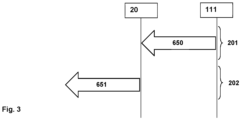
- FIG. 3 This is schematically shown in Figure 3 , which exemplarily illustrates this transmission of the service resume information:
- the transmission by the mobile communication network 100 (especially by the (first) base station entity 111 of the access network 110 of the mobile communication network 100), and the reception, by the user equipment 20, of the service resume information 650.
- This transmission occurs using an access stratum control channel or an access stratum dedicated control channel.
- the access stratum of the user equipment 20 indicates or forwards the service resume information 650 and/or a service resume indication 651 to the non-access stratum of the user equipment (wherein the service resume indication 651 is derived from the service resume information 650).
- This service resume information is transmitted by using control plane signaling from the mobile communication network 100, especially a cellular terrestrial network (TN) or a cellular non-terrestrial network (NTN).
- TN cellular terrestrial network
- NTN non-terrestrial network
- the service resume information is used - especially in case of a non-terrestrial network - to indicate the dynamically changing satellite coverage of such a non-terrestrial network, due to the movement of serving satellites.
- the transmission of the service resume information 650 corresponds to a notification method, using a radio channel of the mobile communication network 100 - especially a control plane channel, preferably a dedicated control channel -, wherein the service resume information 650 and/or the service indication information 651 (derived from the service resume information 650) informs the user equipment 20 (e.g. for or during an emergency call) about the better availability of (e.g. emergency call) services, by pointing out, e.g.:
- the user equipment indicates the service resume indication 651 via local signaling or via an actuator or display means - and due to the access stratum of the user equipment 20 indicating or forwarding the service resume information 650 to the non-access stratum of the user equipment 20.
- Such service resume indication 651 might comprise, or might be intended to comprise an information relating to at least one time interval of the first kind of time intervals 250' and/or at least one location of the first kind of locations 250 (i.e. where the user equipment 20 is able to get a better quality-of-service level).
- the at least one time interval of the first kind of time intervals 250' and/or the at least one location of the first kind of locations 250 is indicated, especially visually, haptically and/or acoustically, to a user of the user equipment 20, especially using a display means of the user equipment 20 and/or using a display means of a device locally connected to the user equipment 20.
- the service resume indication 651 comprises a service level indication regarding the service level to be expected during the at least one time interval of the first kind of time intervals 250' and/or the at least one location of the first kind of locations 250 indicated by the service resume indication 651.
- the transmission of the service resume information 650 to the user equipment 20 precedes the user equipment 20 indicating the service resume indication 651. Furthermore especially according to the present invention, the transmission of the service resume information 650 is triggered - especially by either the user equipment 20 and/or the mobile communication network 100, especially the access network 110 - in case of either a current or an expected deterioration of quality-of-service, i.e. the service resume information is received, by the user equipment, especially in case that a quality-of-service level, monitored by the user equipment and/or by the access network, is determined to be (or is expected to shortly be) inferior to a specific predefined serving cell quality threshold.
- the inferior quality-of-service level (while the user equipment 20 being located, during a time interval of the second kind of time intervals 260', at either the first or the second kind of locations 250, 260) - compared to the normal or increased quality-of-service level - might either correspond to a complete loss of connection, or to just a lower quality-of-service level or deterioration compared to the normal or increased kind. In the former case, the assumption is that no communication is possible to and from the considered user equipment 20.
- this transmission of the service resume information 650 (first point in time 201) necessarily needs to occur during a time interval of the first kind of time intervals 250' and while the user equipment 20 is located at a location of the first kind of locations 250.
- the indication, or forwarding of the service resume information 650 to the non-access stratum of the user equipment 20 - at the second point in time - might then (but not necessarily needs to) occur later, i.e. after a loss of connection occurred.
- the inferior quality-of-service level (while the user equipment 20 being located, during a time interval of the second kind of time intervals 260', at either the first or the second kind of locations 250, 260) could also correspond to just a lower quality-of-service level or deterioration compared to the normal or increased kind (but a, perhaps somewhat slowed-down, data transmission towards the user equipment 20 would still be possible); in this case, the transmission of the service resume information 650 (i.e.
- the first point in time 201) might occur during either a time interval of the first kind of time intervals 250' (and while the user equipment 20 is located at a location of the first kind of locations 250) or during a time interval of the second kind of time intervals 260' (and while the user equipment 20 is located at either the first or the second kind of locations 250, 260).
- a time interval of the first kind of time intervals 250' and while the user equipment 20 is located at a location of the first kind of locations 250
- a time interval of the second kind of time intervals 260' and while the user equipment 20 is located at either the first or the second kind of locations 250, 260.
- service resume indication 651 informs the user of the user equipment 20
- the service resume information 650 is transmitted, according to the present invention, on the control plane, i.e. especially using a control channel and/or a control channel message and/or a non-access stratum message, especially one or a plurality out of the following:
- the service resume information 650 and/or the service resume indication 651 comprises a global navigation satellite system reference point and/or a map information and/or a polygon information, the global navigation satellite system reference point and/or the map information and/or the polygon information indicating better radio coverage and/or a better quality-of-service level and/or where the communication service is intended to continue, wherein especially the user equipment 20 calculates the vector from its current position to the target position.
- a method for providing service resume (notification) information 650 in a mobile communication network 100 especially in a non-terrestrial network, i.e. the access network 110 being or corresponding to, or at least comprising a part being, a non-terrestrial network.
- such a channel configuration is specific to transmit such service resume (notification) information 650 - i.e. such a specific channel is able to be defined by means of using a high redundancy of data, a robust coding, a low data rate that is able to also operate under challenging radio channel conditions, etc.
- existing (control) channels are able to be used for transmitting the service resume information 650, e.g. by enhancing the information carried via such channels.
- the service resume information 650 is sent to the user equipment 20 from the network, in particular an non-terrestrial network, (i.e. the mobile communication network 100) in different situations (such as the following situations) using the control channel or the dedicated control channel:
- the service resume information 650 might be, as such, just a GNSS reference point to better coverage (in which case the user equipment 20 would, e.g., calculate the vector from its current position - which is also know to non-terrestrial network networks at least - to the target position), alternatively, the service resume information 650 might be in form of a "map" or map information providing the information of where the service is intended to continue.
- the service resume information is able to already comprise some further information to speed up the process to find the relevant resources, such as frequency and timing information for service continuation at the target location; obviously the more information needs to be transmitted (in order to transmit the service resume information 650) the more robust the connection must (still) be; hence, typically in case of a connection currently breaking down, only a limited service resume information 650 is able to be provided.
- At least one out of the following reliable channel characteristics are able to be applied according to the present invention, in order to transmit the service resume information 650:
- a serving cell quality threshold is able to be defined that triggers the signaling of the service resume information 650 on the new channel or channel configuration.
- the service resume information 650 might signal the target location where the user equipment 20 shall head to for resumed coverage and/or that the current location of the user equipment 20 is not served for a defined time interval (e.g. next 10 seconds or minutes).
- the service resume information 650 might signal the target coverage area (e.g. defined as a polygone) where the user equipment 20 shall head towards for resumed coverage and/or that the current location of the user equipment 20 is not served for a defined time interval (e.g. next 10 seconds or minutes).
- the target point or target area is calculated - especially based on the user equipment's 20 current location (known at the satellite from the call establishment signaling based on the user equipment's 20 GNSS information which is transmitted to the satellite, the trajectory and the timing of the out-flying (current service Sat) and the in-flying next sat including that satellite trajectory and timing).
- this calculation of the target point or target area might be performed under consideration of the ground topology (incl. radiofrequency shading effects, ground characteristics like valleys, roads, forests, etc. for which this information needs to be available at the satellite based on topology map databases).
Landscapes
- Engineering & Computer Science (AREA)
- Computer Networks & Wireless Communication (AREA)
- Signal Processing (AREA)
- Physics & Mathematics (AREA)
- Astronomy & Astrophysics (AREA)
- Aviation & Aerospace Engineering (AREA)
- General Physics & Mathematics (AREA)
- Mobile Radio Communication Systems (AREA)
Priority Applications (3)
| Application Number | Priority Date | Filing Date | Title |
|---|---|---|---|
| EP23194846.4A EP4518190A1 (fr) | 2023-09-01 | 2023-09-01 | Procédé pour fournir des services de communication à un équipement utilisateur à l'aide d'un réseau d'accès |
| CN202480048186.XA CN121548958A (zh) | 2023-09-01 | 2024-08-28 | 一种用于使用移动通信网络的接入网或与该移动通信网络相关联的接入网来向用户装备提供通信服务的方法、用户装备、系统或移动通信网络、程序和计算机可读介质 |
| PCT/EP2024/074022 WO2025045918A1 (fr) | 2023-09-01 | 2024-08-28 | Procédé pour fournir des services de communication à un équipement utilisateur utilisant un réseau d'accès d'un réseau de communication mobile ou associé à celui-ci, équipement utilisateur, système ou réseau de communication mobile, programme et support lisible par ordinateur |
Applications Claiming Priority (1)
| Application Number | Priority Date | Filing Date | Title |
|---|---|---|---|
| EP23194846.4A EP4518190A1 (fr) | 2023-09-01 | 2023-09-01 | Procédé pour fournir des services de communication à un équipement utilisateur à l'aide d'un réseau d'accès |
Publications (1)
| Publication Number | Publication Date |
|---|---|
| EP4518190A1 true EP4518190A1 (fr) | 2025-03-05 |
Family
ID=87929300
Family Applications (1)
| Application Number | Title | Priority Date | Filing Date |
|---|---|---|---|
| EP23194846.4A Pending EP4518190A1 (fr) | 2023-09-01 | 2023-09-01 | Procédé pour fournir des services de communication à un équipement utilisateur à l'aide d'un réseau d'accès |
Country Status (3)
| Country | Link |
|---|---|
| EP (1) | EP4518190A1 (fr) |
| CN (1) | CN121548958A (fr) |
| WO (1) | WO2025045918A1 (fr) |
Citations (4)
| Publication number | Priority date | Publication date | Assignee | Title |
|---|---|---|---|---|
| WO2015193727A1 (fr) * | 2014-06-19 | 2015-12-23 | Orange | Procédés, appareil et support lisible permettant à une api de notifier une application d'un changement futur de qos |
| US20200260333A1 (en) * | 2017-10-26 | 2020-08-13 | Huawei Technologies Co., Ltd. | Techniques for notifying a quality of service change |
| US20220217059A1 (en) * | 2019-04-30 | 2022-07-07 | Talefonaktiebolaget LM Ericsson (publ) | Technique for Anticipating Service Level Impacts |
| WO2022161773A1 (fr) * | 2021-01-29 | 2022-08-04 | Thales Dis France Sas | Connexion par satellite à économie d'énergie pour dispositif à faible capacité |
-
2023
- 2023-09-01 EP EP23194846.4A patent/EP4518190A1/fr active Pending
-
2024
- 2024-08-28 CN CN202480048186.XA patent/CN121548958A/zh active Pending
- 2024-08-28 WO PCT/EP2024/074022 patent/WO2025045918A1/fr active Pending
Patent Citations (4)
| Publication number | Priority date | Publication date | Assignee | Title |
|---|---|---|---|---|
| WO2015193727A1 (fr) * | 2014-06-19 | 2015-12-23 | Orange | Procédés, appareil et support lisible permettant à une api de notifier une application d'un changement futur de qos |
| US20200260333A1 (en) * | 2017-10-26 | 2020-08-13 | Huawei Technologies Co., Ltd. | Techniques for notifying a quality of service change |
| US20220217059A1 (en) * | 2019-04-30 | 2022-07-07 | Talefonaktiebolaget LM Ericsson (publ) | Technique for Anticipating Service Level Impacts |
| WO2022161773A1 (fr) * | 2021-01-29 | 2022-08-04 | Thales Dis France Sas | Connexion par satellite à économie d'énergie pour dispositif à faible capacité |
Non-Patent Citations (1)
| Title |
|---|
| MARCO SPINI ET AL: "Discontinuous Coverage EN Resolution", vol. 3GPP SA 2, no. Online; 20230417 - 20230421, 7 April 2023 (2023-04-07), XP052291097, Retrieved from the Internet <URL:https://www.3gpp.org/ftp/tsg_sa/WG2_Arch/TSGS2_156E_Electronic_2023-04/Docs/S2-2304432.zip S2-2304432 23.501 5GSAT Discontinuous Coverage EN Resolution.docx> [retrieved on 20230407] * |
Also Published As
| Publication number | Publication date |
|---|---|
| CN121548958A (zh) | 2026-02-17 |
| WO2025045918A1 (fr) | 2025-03-06 |
Similar Documents
| Publication | Publication Date | Title |
|---|---|---|
| US11811432B2 (en) | Satellite acquisition assistance for supporting satellite wireless access by a mobile device | |
| US12531630B2 (en) | Infrastructure equipment, communications devices and methods | |
| US11617138B2 (en) | Terminal device, telecommunications apparatus and methods | |
| CN112567810B (zh) | 用于无线通信网络的通信设备、基础设施设备和方法 | |
| CN109075853B (zh) | 针对卫星通信的切换 | |
| CN101243666B (zh) | 卫星与地面混合式ofdm通信方法和装置 | |
| US12580642B2 (en) | Methods, communictions devices, and non-terrestrial infrastructure equipment | |
| US11902011B2 (en) | Reconfigured uplink resource (PUR) for non-terrestrial networks (NTN) | |
| US20060239238A1 (en) | Techniques for facilitating communication handoffs | |
| EP4460913A1 (fr) | Prise en charge d'espaces de couverture pour un accès par satellite | |
| JPH0969807A (ja) | ユーザのrf被爆モニタ及び制御機能を有する衛星通信システム | |
| WO2021022489A1 (fr) | Procédé de commande de transfert intercellulaire, appareil, dispositif, et support de stockage | |
| KR20230169974A (ko) | 위성 액세스 상으로의 매시브 IoT 를 위한 PLMN 선택 | |
| US12581371B2 (en) | Method and device for use in non-terrestrial network (NTN) | |
| MXPA01009716A (es) | Aparato y metodo para llamadas. | |
| JP2024513102A (ja) | ユーザ機器、ネットワークノード、及びユーザ機器又はネットワークノードにおける方法 | |
| US20240214900A1 (en) | Relay communication management in response to cellular connection radio link failure (rlf) | |
| WO1995034181A1 (fr) | Systeme de communications | |
| US12375202B2 (en) | Data transmission method, terminal device and network device | |
| WO2025045918A1 (fr) | Procédé pour fournir des services de communication à un équipement utilisateur utilisant un réseau d'accès d'un réseau de communication mobile ou associé à celui-ci, équipement utilisateur, système ou réseau de communication mobile, programme et support lisible par ordinateur | |
| CN120092404A (zh) | 非地面网络和地面网络之间的用户设备移动性 | |
| CN116054904A (zh) | 卫星物联网通信系统、方法以及存储介质 | |
| US20250386208A1 (en) | Coverage availability via nas signaling | |
| EP4568356B1 (fr) | Réseau de communication mobile, équipement utilisateur, système ou réseau de communication mobile, programme et support lisible par ordinateur | |
| EP4346120A1 (fr) | Réseau, système ou réseau de communication mobile, entité ou fonctionnalité d'informations de couverture |
Legal Events
| Date | Code | Title | Description |
|---|---|---|---|
| PUAI | Public reference made under article 153(3) epc to a published international application that has entered the european phase |
Free format text: ORIGINAL CODE: 0009012 |
|
| STAA | Information on the status of an ep patent application or granted ep patent |
Free format text: STATUS: EXAMINATION IS IN PROGRESS |
|
| 17P | Request for examination filed |
Effective date: 20240722 |
|
| AK | Designated contracting states |
Kind code of ref document: A1 Designated state(s): AL AT BE BG CH CY CZ DE DK EE ES FI FR GB GR HR HU IE IS IT LI LT LU LV MC ME MK MT NL NO PL PT RO RS SE SI SK SM TR |