EP4518295A2 - Procédé, dispositif et système de gestion de service de réseau - Google Patents
Procédé, dispositif et système de gestion de service de réseau Download PDFInfo
- Publication number
- EP4518295A2 EP4518295A2 EP24203922.0A EP24203922A EP4518295A2 EP 4518295 A2 EP4518295 A2 EP 4518295A2 EP 24203922 A EP24203922 A EP 24203922A EP 4518295 A2 EP4518295 A2 EP 4518295A2
- Authority
- EP
- European Patent Office
- Prior art keywords
- network
- service
- identifier
- management unit
- management
- Prior art date
- Legal status (The legal status is an assumption and is not a legal conclusion. Google has not performed a legal analysis and makes no representation as to the accuracy of the status listed.)
- Pending
Links
Images




Classifications
-
- H—ELECTRICITY
- H04—ELECTRIC COMMUNICATION TECHNIQUE
- H04W—WIRELESS COMMUNICATION NETWORKS
- H04W24/00—Supervisory, monitoring or testing arrangements
- H04W24/02—Arrangements for optimising operational condition
-
- H—ELECTRICITY
- H04—ELECTRIC COMMUNICATION TECHNIQUE
- H04L—TRANSMISSION OF DIGITAL INFORMATION, e.g. TELEGRAPHIC COMMUNICATION
- H04L41/00—Arrangements for maintenance, administration or management of data switching networks, e.g. of packet switching networks
- H04L41/08—Configuration management of networks or network elements
- H04L41/0803—Configuration setting
- H04L41/0813—Configuration setting characterised by the conditions triggering a change of settings
-
- H—ELECTRICITY
- H04—ELECTRIC COMMUNICATION TECHNIQUE
- H04L—TRANSMISSION OF DIGITAL INFORMATION, e.g. TELEGRAPHIC COMMUNICATION
- H04L41/00—Arrangements for maintenance, administration or management of data switching networks, e.g. of packet switching networks
- H04L41/08—Configuration management of networks or network elements
- H04L41/0876—Aspects of the degree of configuration automation
- H04L41/0886—Fully automatic configuration
-
- H—ELECTRICITY
- H04—ELECTRIC COMMUNICATION TECHNIQUE
- H04L—TRANSMISSION OF DIGITAL INFORMATION, e.g. TELEGRAPHIC COMMUNICATION
- H04L41/00—Arrangements for maintenance, administration or management of data switching networks, e.g. of packet switching networks
- H04L41/40—Arrangements for maintenance, administration or management of data switching networks, e.g. of packet switching networks using virtualisation of network functions or resources, e.g. SDN or NFV entities
-
- H—ELECTRICITY
- H04—ELECTRIC COMMUNICATION TECHNIQUE
- H04L—TRANSMISSION OF DIGITAL INFORMATION, e.g. TELEGRAPHIC COMMUNICATION
- H04L41/00—Arrangements for maintenance, administration or management of data switching networks, e.g. of packet switching networks
- H04L41/50—Network service management, e.g. ensuring proper service fulfilment according to agreements
- H04L41/5041—Network service management, e.g. ensuring proper service fulfilment according to agreements characterised by the time relationship between creation and deployment of a service
- H04L41/5051—Service on demand, e.g. definition and deployment of services in real time
-
- H—ELECTRICITY
- H04—ELECTRIC COMMUNICATION TECHNIQUE
- H04L—TRANSMISSION OF DIGITAL INFORMATION, e.g. TELEGRAPHIC COMMUNICATION
- H04L41/00—Arrangements for maintenance, administration or management of data switching networks, e.g. of packet switching networks
- H04L41/50—Network service management, e.g. ensuring proper service fulfilment according to agreements
- H04L41/5041—Network service management, e.g. ensuring proper service fulfilment according to agreements characterised by the time relationship between creation and deployment of a service
- H04L41/5054—Automatic deployment of services triggered by the service manager, e.g. service implementation by automatic configuration of network components
-
- H—ELECTRICITY
- H04—ELECTRIC COMMUNICATION TECHNIQUE
- H04L—TRANSMISSION OF DIGITAL INFORMATION, e.g. TELEGRAPHIC COMMUNICATION
- H04L47/00—Traffic control in data switching networks
- H04L47/70—Admission control; Resource allocation
- H04L47/78—Architectures of resource allocation
- H04L47/781—Centralised allocation of resources
-
- H—ELECTRICITY
- H04—ELECTRIC COMMUNICATION TECHNIQUE
- H04L—TRANSMISSION OF DIGITAL INFORMATION, e.g. TELEGRAPHIC COMMUNICATION
- H04L67/00—Network arrangements or protocols for supporting network services or applications
- H04L67/14—Session management
- H04L67/148—Migration or transfer of sessions
-
- H—ELECTRICITY
- H04—ELECTRIC COMMUNICATION TECHNIQUE
- H04L—TRANSMISSION OF DIGITAL INFORMATION, e.g. TELEGRAPHIC COMMUNICATION
- H04L67/00—Network arrangements or protocols for supporting network services or applications
- H04L67/50—Network services
- H04L67/51—Discovery or management thereof, e.g. service location protocol [SLP] or web services
-
- H—ELECTRICITY
- H04—ELECTRIC COMMUNICATION TECHNIQUE
- H04W—WIRELESS COMMUNICATION NETWORKS
- H04W28/00—Network traffic management; Network resource management
- H04W28/16—Central resource management; Negotiation of resources or communication parameters, e.g. negotiating bandwidth or QoS [Quality of Service]
-
- H—ELECTRICITY
- H04—ELECTRIC COMMUNICATION TECHNIQUE
- H04W—WIRELESS COMMUNICATION NETWORKS
- H04W8/00—Network data management
- H04W8/02—Processing of mobility data, e.g. registration information at HLR [Home Location Register] or VLR [Visitor Location Register]; Transfer of mobility data, e.g. between HLR, VLR or external networks
- H04W8/06—Registration at serving network Location Register, VLR or user mobility server
- H04W8/065—Registration at serving network Location Register, VLR or user mobility server involving selection of the user mobility server
Definitions
- Embodiments of this application relate to the field of communications technologies, and in particular, to a network service management method, device, and system.
- a most advanced mobile communications technology is used in a 5th generation (5th-generation, 5G) mobile communications system (5G system for short).
- the 5G system can provide a super-capacity bandwidth rate and more secure communication for a mobile user, to meet widely varied service requirements in all walks of life.
- a physical network is sliced into a plurality of virtual end-to-end networks by using a network slice technology.
- Each virtual network may be referred to as one network slice (network slice, NS).
- Each network slice is logically independent.
- Each network slice includes an independent network function or an independent network function instance combination.
- a same network slice may carry services of different tenants, to meet service requirements and services of the different tenants. For example, an electricity meter reading service and a water meter reading service may be carried in one network slice that supports a meter reading service.
- a service management unit usually aggregates service requests of different tenants into network slice requirement information, and sends the network slice requirement information to a network management unit, so that the network management unit deploys, based on the network slice requirement information, a network slice that carries services of the different tenants.
- the network management unit is aware of a service obtained through aggregation by the service management unit, but cannot be aware of a plurality of services. Therefore, the network management unit cannot dynamically and adaptively adjust a network resource based on different service requirements.
- Embodiments of this application provide a network service management method, a device, and a system, to resolve an existing problem that a network resource cannot be adaptively and dynamically adjusted based on different service requirements.
- an embodiment of this application provides a network service management method, including: obtaining, by a network management unit, information about a target network service, where the information about the target network service includes an identifier of the target network service and requirement information of the target network service; obtaining, by the network management unit, an identifier of a network based on the requirement information of the target network service, where the network meets the requirement information of the target network service; and configuring, by the network management unit, an association relationship between the identifier of the target network service and the identifier of the network, or configuring, by the network management unit, the identifier of the target network service in management information of the network, or configuring, by the network management unit, the identifier of the network in management information of the target network service.
- the information about the target network service may be information about a target network, the requirement information of the target network service may be requirement information of the target network, and the network may be a network slice, a network slice subnet, or a subnet. This is not limited.
- the configuring, by the network management unit, an association relationship between the identifier of the target network service and the identifier of the network may be: maintaining, by the network management unit, the association relationship between the identifier of the target network service and the identifier of the network.
- the network management unit may associate the target network service with the network. Because the target network service is a service carried in the network, different services carried in the network can be well distinguished in a scenario in which the network carries a plurality of services, thereby implementing dynamic management by the network management unit on the different services carried in the network.
- the obtaining, by a network management unit, information about a target network service includes: receiving, by the network management unit, a network management request, and obtaining the information about the target network service from the network management request, where the network management request carries the information about the target network service, where the network management request includes any one of the following requests: a network creation request, a network allocation request, a network modification request, a network service migration request, and a network activation request.
- the network management request is the network service migration request
- the network service migration request is used to request to migrate the target network service from a source network to a destination network
- the network management request further carries an identifier of the source network and an identifier of the destination network.
- the obtaining, by the network management unit, an identifier of a network based on the requirement information of the target network service includes: when an existing network meets a requirement of the target network service, obtaining, by the network management unit, an identifier of the existing network that meets the requirement of the target network service; or creating, by the network management unit based on the requirement information of the target network service, a network that meets the requirement information of the target network service, and allocating an identifier to the network.
- the network management unit can use the existing available network or create the new network as the network in this solution, and allocate the identifier to the network.
- the method further includes: configuring, by the network management unit, the requirement information of the target network service in the management information of the network.
- the network management unit can configure the requirement information of the target network service in the management information of the network, to specify a specific requirement of the service carried in the network.
- the identifier of the target network service is used to identify a network requirement of a service
- the identifier of the target network service includes but is not limited to any one of the following: a network request identifier, a tenant identifier, a service identifier, a tenant service identifier, a network service requirement information identifier, a network requirement information identifier, network slice selection assistance information, and a network service management information identifier
- the network service requirement information identifier may be alternatively a network requirement information identifier
- the method further includes: determining, by the network management unit, requirement information of at least one network slice subnet service based on the requirement information of the target network service; and allocating, by the network management unit to each of the at least one network slice subnet service, an identifier of the network slice subnet service.
- the requirement information of the target network service can be split into the requirement information of the at least one network slice subnet service, to carry the target network service in a plurality of network slice subnets.
- the method further includes: configuring, by the network management unit, an association relationship between the identifier of the network slice subnet service and the identifier of the target network service.
- the network management unit can associate a network slice service with the network slice subnet service, to specify a specific network slice subnet service included in the network slice service.
- an embodiment of this application provides a network management unit, including:
- the network management unit For a specific implementation of the network management unit, refer to behavior and a function of the network management unit in the network service management method provided in the first aspect or the possible implementations of the first aspect. Details are not described herein again. Therefore, with the network management unit provided in this aspect, a same beneficial effect as that in the first aspect can be achieved.
- an embodiment of this application provides a network management unit.
- the network management unit is capable of implementing a function performed by the network management unit in the first aspect.
- the function may be implemented by hardware, or may be implemented by hardware by executing corresponding software.
- the hardware or the software includes one or more modules corresponding to the function.
- a structure of the network management unit includes a processor and a communications interface.
- the processor is configured to support the network management unit in performing the corresponding function in the foregoing method.
- the communications interface is configured to support communication between the network management unit and another network element.
- the network management unit may further include a memory.
- the memory is configured to be coupled to the processor.
- the memory stores a program instruction and data that are necessary for the network management unit.
- an embodiment of this application provides a computer storage medium, configured to store a computer software instruction used by the foregoing network management unit, where the computer software instruction includes a program used to perform the solution in the foregoing aspect.
- an embodiment of this application provides a network service management method, including: obtaining, by a network management unit, requirement information of a target network service; creating, by the network management unit, management information of the target network service, where the management information of the target network service includes an identifier of the management information of the target network service; and associating, by the network management unit, the management information of the target network service with a network, where the network meets the requirement information of the target network service.
- the requirement information of the target network service is requirement information of a target network slice, and that the network meets the requirement information of the target network service may be alternatively described as that the network meets the requirement information of the target network slice.
- the associating, by the network management unit, the management information of the target network service with a network may be alternatively described as configuring, by the network management unit, a relationship between the identifier of the management information of the target network service and an identifier of the network.
- the network management unit may associate the management information of the target network service with the network. Because the requirement information of the target network service is configured in the management information of the target network service, and the target network service is a service carried in the network, different services carried in the network can be well distinguished in a scenario in which the network carries a plurality of services, thereby implementing dynamic management by the network management unit on the different services carried in the network.
- the obtaining, by a network management unit, requirement information of a target network service includes: receiving, by the network management unit, a network management request, and obtaining the requirement information of the target network service from the network management request, where the network management request carries the requirement information of the target network service, and the network management request includes any one of the following requests: a network creation request, a network allocation request, a network modification request, a network service migration request, and a network activation request.
- the requirement information of the target network service may be replaced with the requirement information of the target network slice.
- the network management request is the network service migration request
- the network service migration request is used to request to migrate the target network service from a source network to a destination network
- the network management request further carries an identifier of the source network and an identifier of the destination network.
- the requirement information of the target network service can be carried in the network management request and sent to the network management unit, thereby improving information sending security.
- the receiving, by the network management unit, a network management request specifically includes: receiving, by the network management unit, the network management request from a service management unit; and correspondingly, the method further includes: returning, by the network management unit, the identifier of the management information of the target network service to the service management unit.
- the method before the associating, by the network management unit, the management information of the target network service with a network, the method further includes: determining, by the network management unit, the network based on the requirement information of the target network service.
- this may be described as follows: Before the configuring, by the network management unit, a relationship between the identifier of the management information of the target network service and an identifier of the network, the method further includes: determining, by the network management unit, the network based on the requirement information of the target network slice.
- the associating, by the network management unit, the management information of the target network service with a network includes:
- the method further includes: an allocation module, configured to allocate the identifier to the management information of the target network service, where the identifier of the management information of the target network service is used to identify the management information of the target network service.
- the identifier of the target network service includes any one of the following identifiers: a network request identifier, a tenant identifier, a service identifier, a tenant service identifier, a network service requirement information identifier, a network requirement information identifier, and a network service management information identifier.
- the network service requirement information identifier may be alternatively described as a network slice requirement information identifier.
- an embodiment of this application provides a network management unit, including:
- the network management unit For a specific implementation of the network management unit, refer to behavior and a function of the network management unit in the network service management method provided in the second aspect or the possible implementations of the second aspect. Details are not described herein again. Therefore, with the network management unit provided in this aspect, a same beneficial effect as that in the second aspect can be achieved.
- an embodiment of this application provides a network management unit.
- the network management unit is capable of implementing a function performed by the network management unit in the second aspect.
- the function may be implemented by hardware, or may be implemented by hardware by executing corresponding software.
- the hardware or the software includes one or more modules corresponding to the function.
- a structure of the network management unit includes a processor and a communications interface.
- the processor is configured to support the network management unit in performing the corresponding function in the method in the second aspect.
- the communications interface is configured to support communication between the network management unit and another network element.
- the network management unit may further include a memory.
- the memory is configured to be coupled to the processor.
- the memory stores a program instruction and data that are necessary for the network management unit.
- an embodiment of this application provides an apparatus.
- the apparatus exists in a product form of a chip.
- a structure of the apparatus includes a processor and a memory.
- the memory is configured to be coupled to the processor, and stores a program instruction and data that are necessary for the apparatus.
- the processor is configured to execute the program instruction stored in the memory, to enable the apparatus to perform a function corresponding to a network management unit in the foregoing method.
- the network slice is a broad concept. It may be considered that a conventional network or a dedicated network is also a network slice, or it may be considered that a network slice subnet is also a network slice.
- a network architecture may include a service management unit, a network slice management unit, component management units, a transport network domain manager (transport network manager, TN-DM), and network function (network function, NF) units. Data or a signaling message may be transmitted between the component management units by using the TN-DM.
- a plurality of NFs may form a network slice or a network slice subnet.
- the service management unit in FIG. 1 may be a service management function (service management function, SMF) unit, and is mainly configured to: receive a service requirement of a tenant, convert the service requirement into a network slice requirement, and perform service management.
- the service management unit may be deployed in an operation support system (operation support system, OSS), or may be deployed outside the OSS.
- the service management unit may be a management or operation system of a third party (such as a tenant).
- the service management unit may be independently deployed, or may be integrated into a management unit (such as a business support system (business support system, BSS), a service management unit, a service orchestration unit, or a service management and orchestration unit).
- a management unit such as a business support system (business support system, BSS), a service management unit, a service orchestration unit, or a service management and orchestration unit.
- the service management unit in FIG. 1 is not limited to being named as the SMF unit, and may be alternatively named as a customer service management function (
- the network slice management unit in FIG. 1 may be a network slice management function (network slice management function, NSMF) unit, and mainly includes one or both of an end-to-end network management function and an end-to-end network orchestration function.
- the network slice management unit may have some or all of the following functions: end-to-end network management (for example, network life cycle management, network template management, network fault management, network performance management, and network configuration management), end-to-end network, subnet, and network function mapping, coordination of network resources or sub-SLAs provided by different domains (for example, an access network domain, a core network domain, and a transmission domain), splitting of network requirement information into subnet requirement information, and centralized orchestration on subnets and network resources provided by all subdomains, so that subnets or network functions provided by different subdomains can meet a requirement (for example, an SLA requirement, a key performance indicator (key performance indicator, KPI) requirement, and a quality of service (quality of service, QoS) requirement) of a target
- the network slice management unit may be deployed in an OSS, or may be deployed outside the OSS.
- the network slice management unit may be independently deployed, or may be integrated into a management unit (such as a network orchestration unit, a network management and orchestration unit, a service management unit, a service orchestration unit, a service management and orchestration unit, or a network functions virtualization orchestrator (network function virtualization orchestrator, NFVO)).
- a management unit such as a network orchestration unit, a network management and orchestration unit, a service management unit, a service orchestration unit, a service management and orchestration unit, or a network functions virtualization orchestrator (network function virtualization orchestrator, NFVO)).
- NFVO network functions virtualization orchestrator
- the component management unit may be independently deployed, or may be integrated into a management unit (such as a network slice management unit, a network orchestration unit, a network management and orchestration unit, a network element management unit, a network function management unit, a service management unit, a service orchestration unit, a service management and orchestration unit, or an NFVO).
- a management unit such as a network slice management unit, a network orchestration unit, a network management and orchestration unit, a network element management unit, a network function management unit, a service management unit, a service orchestration unit, a service management and orchestration unit, or an NFVO.
- a management unit such as a network slice management unit, a network orchestration unit, a network management and orchestration unit, a network element management unit, a network function management unit, a service management unit, a service orchestration unit, a service management and orchestration unit, or an NFVO.
- FIG. 1 is not limited to being named as the DM unit, and may be alternatively
- a subnet managed by the component management unit may include one or more of the following parts: an AN, a CN, and a TN.
- the subnet management unit may be considered as an AN DM.
- the subnet management unit may be considered as a CN DM.
- the subnet management unit may be considered as a mix DM.
- the TN-DM in FIG. 1 includes one or both of a transport network management function and a transport network orchestration function.
- the TN-DM may have some or all of the following functions: transport network management (including transport network life cycle management (creation, update, and deletion), transport network fault management, transport network performance management, transport network configuration management, and the like).
- the TN-DM may be deployed in an OSS, or may be deployed outside the OSS.
- the TN-DM may be independently deployed, or may be integrated into a management unit (such as a network slice management unit, a network orchestration unit, a network management and orchestration unit, a component management unit, a network element management unit, a service management unit, a service orchestration unit, a service management and orchestration unit, or an NFVO).
- a management unit such as a network slice management unit, a network orchestration unit, a network management and orchestration unit, a component management unit, a network element management unit, a service management unit, a service orchestration unit,
- FIG. 1 is only an example architectural diagram.
- the network architecture may further include another function node.
- the network architecture further includes a network function management (NF manager) unit.
- the NF manager unit includes one or all of the following functions: network function life cycle management, network function fault management, network function performance management, network function configuration management, and the like.
- a name of the NF manager is not limited, and may be alternatively a network element manager (element manager (EM)).
- the NF manager may be deployed in the component management unit.
- the component management unit includes a function of the NF manager.
- the NF manager may be deployed independently of the component management unit, and there is a network function management interface between the NF manager and the component management unit.
- FIG. 2 is a schematic composition diagram of a network management unit according to an embodiment of this application.
- the management unit may include at least one processor 21, a memory 22, a communications interface 23, and a communications bus 24.
- the device structure shown in FIG. 2 constitutes no limitation on the management unit.
- the management unit may include more or fewer components than those shown in the figure, or combine some components, or have different component arrangements. This is not limited in this embodiment of this application. The following describes the components of the management unit in detail with reference to FIG. 2 .
- the processor 21 is a control center of the management unit; and may be one processor, or may be a general name of a plurality of processing elements.
- the processor 21 may be a central processing unit (central processing unit, CPU), or may be an application-specific integrated circuit (application specific integrated circuit, ASIC), or may be configured as one or more integrated circuits implementing the embodiments of this application, for example, one or more microprocessors (e.g. digital signal processor, DSP) or one or more field programmable gate arrays (field programmable gate array, FPGA).
- the processor 21 may perform various functions of the management unit by running or executing a software program stored in the memory 22 and by invoking data stored in the memory 22.
- the processor 21 may include one or more CPUs, for example, a CPU 0 and a CPU 1 that are shown in FIG. 2 .
- the management unit may include a plurality of processors, for example, the processor 21 and a processor 25 that are shown in FIG. 2 .
- Each of these processors may be a single-core (single-CPU) processor, or may be a multi-core (multi-CPU) processor.
- the processor herein may be one or more devices, circuits, and/or processing cores configured to process data (such as a computer program instruction).
- the memory 22 is not limited thereto.
- the memory 22 may exist independently, and is connected to the processor 21 by using the communications bus 24. Alternatively, the memory 22 may be integrated into the processor 21.
- the memory 22 is configured to store a software program for performing the solutions provided in the embodiments of this application, and the processor 21 controls execution of the software program.
- the communications interface 23 is configured to communicate with another device or a communications network, such as the Ethernet, a radio access network (radio access network, RAN), or a wireless local area network (wireless local area networks, WLAN).
- the communications interface 23 may include a receiving unit for implementing a receiving function and a sending unit for implementing a sending function.
- the communications bus 24 may be an industry standard architecture (industry standard architecture, ISA) bus, a peripheral component interconnect (peripheral component, PCI) bus, an extended industry standard architecture (extended industry standard architecture, EISA) bus, or the like.
- the bus may be classified as an address bus, a data bus, a control bus, or the like. For ease of representation, only one thick line is used to represent the bus in FIG. 2 , but this does not mean that there is only one bus or only one type of bus.
- FIG. 3 is a flowchart of a network service management method according to an embodiment of this application. As shown in FIG. 3 , the method may include the following steps.
- Step 301 A network management unit obtains information about a target network service.
- the network management unit may be the network slice management unit or the domain management unit in FIG. 1 .
- the requirement information of the target network service may be requirement information of the network, for example, requirement information of a target network slice.
- the requirement information of the target network service may be used to describe a requirement of the target network service or a requirement of the network.
- the requirement information of the target network service may include at least one of the following information: a quantity of users, area distribution of the users, a service transmission status of a user, an activation ratio of the users, a use time of the service, a coverage area of the service or the network, a movement status of the user, a roaming status of the user, a latency of the network, a bandwidth of the network, a throughput of the network, reliability of the network, a coverage level of the network, and a coverage area of the network.
- the user may correspond to a device (such as a terminal device) that can obtain or use a service of the tenant, and the user may be a tenant.
- the terminal device may be a device such as an electricity meter that records an amount of electricity used by the tenant, and the user may correspond to the terminal device.
- the user may use the terminal device.
- a service requested by the tenant may be a service function performed by a user corresponding to the tenant.
- the user is an electricity meter that records an amount of electricity used by the tenant
- the service requested by the tenant may be an electricity meter reading service.
- the service transmission status of the user may be a service use status of the user, for example, a time period for sending/receiving the service by the user, a packet size for sending/receiving the service by the user, power for sending/receiving the service by the user, and a bandwidth size for sending/receiving the service by the user.
- the user is an electricity meter that records an amount of electricity used by the tenant, and the service transmission status of the user is as follows: The electricity meter sends a packet once a day, and a size of the packet sent each time is 20 M.
- the coverage area of the service may be used to indicate a coverage status of the service, and may be a coverage level or a coverage scenario of the service.
- the coverage scenario of the service is indoor coverage, outdoor coverage, suburban coverage, subway coverage, tunnel coverage, or the like.
- the coverage level of the service may be strong coverage, normal coverage, weak coverage, or the like.
- the movement status of the user may include at least one of the following statuses: whether the user moves, a quantity of users in a moving state, and a moving level of the user.
- the moving level of the user may include one or more of the following: fast, medium-speed, slow, immobile, or the like.
- the roaming status of the user may include at least one of the following statuses: whether the user roams, quantities of users who may roam at different moments, and the like.
- the bandwidth of the network may be a bandwidth that can be provided by the network.
- a bandwidth of a network is 10 megahertz (MHz).
- the throughput of the network may be used to describe a data forwarding capability of the network.
- a throughput of a network is 100 megabits per second (Mbit/s), indicating that the network slice supports transmission of 100-Mbit data in one second.
- the coverage level of the network may include a coverage level of a network slice, and is used to indicate coverage strength of the network.
- the coverage strength may be represented by using strong coverage, normal coverage, weak coverage, or the like, or may be represented by using indoor coverage, outdoor coverage, suburban coverage, or the like.
- the coverage area of the network may be used to describe a network coverage area in which the network is used, for example, Shanghai.
- the network management unit is the network slice management unit in FIG. 1
- the target network service is a network slice service
- the information about the target network service is information about the network slice service
- the identifier of the target network service is an identifier of the network slice service
- the requirement information of the target network service is requirement information of the network slice service.
- the network slice management unit receives, from a service management unit, a network management request that carries the information about the network slice service, and obtains the information about the network slice service based on the network management request.
- the information about the network slice service is obtained by the service management unit based on service requirement information, and the service requirement information is requirement information of the service requested by the tenant.
- the service management unit may directly use, as the identifier of the network slice service, an identifier of the service requested by the tenant, and the service management unit may use the service requirement information as the requirement information of the network slice service; or when the service requested by the tenant is carried in at least two network slices, the service management unit splits the service requested by the tenant into at least two network slice services, splits the service requirement information into requirement information of the at least two network slice services, and allocates, to each network slice service, an identifier of the network slice service.
- the network slice service may be alternatively named as a network slice service management object, network slice requirement information, or the like. This is not limited.
- the network management unit is the domain management unit in FIG. 1
- the target network service is a network slice subnet service
- the information about the target network service is information about the network slice subnet service
- the identifier of the target network service is an identifier of the network slice subnet service
- the requirement information of the target network service is requirement information of the network slice subnet service.
- the domain management unit receives, from a network slice management unit, a network management request that carries the information about the network slice subnet service, and obtains the information about the network slice subnet service based on the network management request.
- the information about the network slice subnet service is obtained by the network slice management unit based on information about a network slice service.
- the network creation request is used to request to create a network instance.
- the network modification request is used to request to modify a network instance.
- the foregoing request is the network modification request
- the foregoing request further carries a network modification type and/or an identifier of the network.
- the network modification type includes at least one of the following: adding a network service, removing a network service, and deleting a network service.
- a network that carries the target network service is a network slice, or when the target network service is the network slice subnet service, a network that carries the target network service is a network slice subnet.
- Step 302 The network management unit obtains the identifier of the network based on the requirement information of the target network service, where the network meets the requirement information of the target network service.
- the network management unit selects, from the existing networks, the available network that meets the requirement of the network service, obtains an identifier of the available network, and uses the identifier of the available network as the identifier of the network in step 302.
- Selecting, from the existing networks, the available network that meets the target network service may mean that when a network (a network slice or a network subnet) that meets the requirement information of the target network service exists in the existing networks, or when a network that can be modified (for example, expanded) to meet the requirement information of the target network service exists in the existing networks, or when the network management unit receives a message used to instruct to reuse a network in the existing networks, the network management unit selects the available network from the existing networks.
- a network a network slice or a network subnet
- Step 303 The network management unit configures an association relationship between the identifier of the target network service and the identifier of the network, or the network management unit configures the identifier of the target network service in management information of the network, or the network management unit configures the identifier of the network in management information of the target network service.
- That the network management unit configures an association relationship between the identifier of the target network service and the identifier of the network may mean that the network management unit maintains the association relationship between the identifier of the target network service and the identifier of the network, or the network management unit correspondingly stores the identifier of the target network service and the identifier of the network.
- the target network service is a network slice service
- the network is a network slice
- the network management unit is the network slice management unit in FIG. 1 .
- step 303 may be replaced with the following:
- the network slice management unit configures an association relationship between an identifier of the network slice service and an identifier of the network slice, or the network slice management unit configures the identifier of the network slice service in management information of the network slice, or the network slice management unit configures the identifier of the network slice in management information of the network slice service.
- the target network service is a network slice subnet service
- the network is a network slice subnet
- the network management unit is the domain management unit in FIG. 1 .
- step 303 may be replaced with the following: The domain management unit configures an association relationship between an identifier of the network slice subnet service and an identifier of the network slice subnet, or the domain management unit configures the identifier of the network slice subnet service in management information of the network slice subnet, or the domain management unit configures the identifier of the network slice subnet in management information of the network slice subnet service.
- the network management unit may associate the target network service with the network. Because the target network service is a service carried in the network, different services carried in the network can be well distinguished in a scenario in which the network carries a plurality of services, thereby implementing dynamic management by the network management unit on the different services carried in the network.
- the method further includes: configuring, by the network management unit, the requirement information of the target network service in the management information of the network, so that requirement information of a service carried in the network can be well determined.
- the method further includes: determining, by the network management unit, requirement information of at least one network slice subnet service based on the requirement information of the target network service; and allocating, by the network management unit to each of the at least one network slice subnet service, an identifier of the network slice subnet service.
- the network management unit determines that the target network service can be split into the at least one network slice subnet
- the network management unit determines the requirement information of the target network service as the requirement information of the at least one network slice subnet service.
- the method further includes: configuring, by the network management unit, an association relationship between the identifier of the network slice subnet service and the identifier of the target network service.
- the target network service may correspond to the network slice subnet service, to better determine a plurality of network slice subnet services included in the target network service.
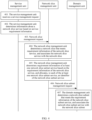
- FIG. 4 shows another network service management method according to an embodiment of this application. The method is performed by the units shown in FIG. 1 through interaction, and the method may include the following steps.
- Step 401 A service management unit receives a service management request.
- the service management request carries service requirement information
- the service requirement information includes at least one of the following information: a quantity of users, area distribution of the users, a service transmission status of a user, an activation ratio of the users, a use time of a service, a coverage area of the service or a network, a movement status of the user, a roaming status of the user, a latency of the network, a bandwidth of the network, a throughput of the network, reliability of the network, a coverage level of the network, and a coverage area of the network.
- the service requirement information refer to the description of the requirement information of the target network service in the solution shown in FIG. 3 . Details are not described herein again.
- the service management unit receives the service management request sent by a tenant.
- Step 402 The service management unit determines information about a network slice service based on the service requirement information.
- the information about the network slice service includes an identifier of the network slice service and requirement information of the network slice service.
- one network slice service is created, an identifier of the network slice service is allocated, and an attribute of the network slice service is set, that is, requirement information of the network slice service is configured on the network slice service.
- the service requirement information is split into requirement information of a plurality of network slice services, identifiers of the network slice services are allocated, and attributes of the network slice services are set, that is, requirement information of the network slice services is configured on the network slice services.
- Step 403 The service management unit sends a network slice management request to a network slice management unit.
- the network slice management request may carry the information about the network slice service, and the network slice management request may be the network management request in the solution shown in FIG. 3 . Details are not described herein again.
- Step 404 The network slice management unit determines a network slice that meets the requirement information of the network slice service, and associates the network slice service with the network slice.
- the network slice management unit may use an existing available network slice or create a new network slice to meet the requirement information of the network slice service.
- That the network slice management unit associates the network slice service with the network slice may include: configuring, by the network slice management unit, an association relationship between the identifier of the network slice service and an identifier of the network slice, or configuring, by the network slice management unit, the identifier of the network slice service in management information of the network slice, or configuring, by the network slice management unit, the identifier of the network slice in management information of the network slice service.
- This process is the same as step 303 in the solution shown in FIG. 3 . Details are not described herein again.
- Step 405 The network slice management unit determines requirement information of at least one network slice subnet service based on the requirement information of the network slice service, and allocates, to each of the at least one network slice subnet service, an identifier of the network slice subnet service.
- one network slice subnet service is created, an identifier of the network slice subnet service is allocated, and an attribute of the network slice subnet service is set, that is, requirement information of the network slice subnet service is configured for the network slice subnet service.
- the requirement information of the network slice service is split into requirement information of a plurality of network slice subnet services, the plurality of network slice subnet services are created, identifiers of the network slice subnet services are allocated, and attributes of the network slice subnet services are set, that is, corresponding requirement information of the network slice subnet services is configured on the network slice subnet services.
- Step 406 The network slice management unit sends a network slice subnet management request to a domain management unit.
- Step 407 The domain management unit determines a network slice subnet that meets the requirement information of the network slice subnet service, and associates the network slice subnet service with the network slice subnet.
- the domain management unit may use an existing available network slice subnet or create a new network slice subnet to meet the requirement information of the network slice subnet service.
- That the domain management unit associates the network slice subnet service with the network slice subnet may include: configuring, by the domain management unit, an association relationship between the identifier of the network slice subnet service and an identifier of the network slice subnet, or configuring, by the domain management unit, the identifier of the network slice subnet service in management information of the network slice subnet, or configuring, by the domain management unit, the identifier of the network slice subnet in management information of the network slice subnet service.
- This process is the same as step 303 in the solution shown in FIG. 3 . Details are not described herein again.
- the network management unit may alternatively obtain only requirement information of a target network service, and create management information of the target network service based on the obtained requirement information of the target network service.
- the network management unit may further allocate an identifier of the management information of the target network service to the target network service, set an attribute of the management information of the target network service, that is, configure the requirement information of the target network service in the management information of the target network service, and after determining a network that carries the target network service, associate the management information of the target network service with the network, where the identifier of the management information of the target network service is used to uniquely identify the management information of the target network service.
- FIG. 5 refers FIG. 5 .
- FIG. 5 is a flowchart of another network service management method according to an embodiment of this application. As shown in FIG. 5 , the method may include the following steps.
- Step 501 A network management unit obtains requirement information of a target network service.
- the network management unit may be the network slice management unit or the domain management unit in FIG. 1 .
- the requirement information of the target network service may be requirement information of a network, for example, may be requirement information of a target network slice.
- the requirement information of the target network service may be used to describe a requirement of the target network service or a requirement of the network.
- the requirement information of the target network service may include at least one of the following information: a quantity of users, area distribution of the users, a service transmission status of a user, an activation ratio of the users, a use time of the service, a coverage area of the service or the network, a movement status of the user, a roaming status of the user, a latency of the network, a bandwidth of the network, a throughput of the network, reliability of the network, a coverage level of the network, and a coverage area of the network.
- a quantity of users e.g., a service transmission status of a user, an activation ratio of the users, a use time of the service, a coverage area of the service or the network, a movement status of the user, a roam
- the network management unit is the network slice management unit in FIG. 1
- the target network service is a network slice service
- the requirement information of the target network service is requirement information of the network slice service.
- the network slice management unit receives, from a service management unit, a network management request that carries the requirement information of the network slice service, and obtains the requirement information of the network slice service based on the network management request.
- the requirement information of the network slice service is obtained by the service management unit based on service requirement information, and the service requirement information is requirement information of a service requested by a tenant.
- the service management unit directly uses the service requirement information as the requirement information of the network slice service; or when the service requested by the tenant is carried in at least two network slices, the service management unit splits the service requested by the tenant into at least two network slice services, and splits the service requirement information into requirement information of the at least two network slice services.
- the network slice service may be alternatively named as a network slice service management object, network slice requirement information, or the like. This is not limited.
- the network management unit is the domain management unit in FIG. 1
- the target network service is a network slice subnet service
- the requirement information of the target network service is requirement information of the network slice subnet service.
- the domain management unit receives, from a network slice management unit, a network management request that carries the requirement information of the network slice subnet service, and obtains the requirement information of the network slice subnet service based on the network management request.
- the requirement information of the network slice subnet service is obtained by the network slice management unit based on requirement information of a network slice service.
- the network slice management unit directly uses the requirement information of the network slice service as the requirement information of the network slice subnet service; or when the network slice service is carried in at least two network slice subnets, the network slice management unit splits the network slice service into at least two network slice subnet services, and splits the requirement information of the network slice service into requirement information of the at least two network slice subnet services.
- the network slice subnet service may be alternatively named as a network slice subnet service management object or the like. This is not limited.
- the network management request may include any one of the following requests: a network creation request, a network allocation request, a network modification request, a network service migration request, and a network activation request.
- a network creation request a network creation request
- a network allocation request a network modification request
- a network service migration request a network activation request.
- Step 502 The network management unit creates management information of the target network service.
- the management information of the target network service includes an identifier of the management information of the target network service, the identifier of the management information of the target network service is used to uniquely identify the management information of the target network service, and the requirement information of the target network service is configured in the management information of the target network service. That the network management unit creates management information of the target network service includes: configuring, by the network management unit, the requirement information of the target network service in the management information of the network service.
- the network meets the requirement information of the target network service.
- the target network service is a network slice service
- the network is a network slice.
- the target network service is a network slice subnet service
- the network is a network slice subnet.
- That the network management unit associates the management information of the target network service with the network includes: configuring, by the network management unit, a relationship between the identifier of the management information of the target network service and an identifier of the network, or configuring, by the network management unit, the identifier of the management information of the target network service in management information of the network, or configuring, by the network management unit, the identifier of the management information of the target network service and the requirement information of the target network service in the management information of the network.
- the target network service may correspond to the network slice subnet service, to better determine a plurality of network slice subnet services included in the target network service.
- the method further includes: determining, by the network management unit, the network that meets the target network service.
- the network management unit may determine, from existing available networks, the network that meets the target network service, or the network management unit deploys a new network to meet the requirement information of the target network service.
- the method further includes: allocating, by the network management unit, the identifier to the management information of the target network service, where the identifier of the management information of the target network service is used to identify the management information of the target network service, and the identifier of the management information of the target network service may include but is not limited to any one of the following identifiers: a network request identifier, a tenant identifier, a service identifier, a tenant service identifier, a network service requirement information identifier, a network requirement information identifier, and a network service management information identifier. This is not limited. Management information of different target network services corresponds to different identifiers.
- the network service requirement information identifier may be alternatively described as a network slice requirement information identifier.
- the network management unit After allocating the identifier of the management information of the target network service, the network management unit further returns the identifier of the management information of the target network service. For example, when the network management unit is the network slice management unit in FIG. 1 , the network management unit returns the identifier of management information of the target network service to the service management unit; or when the network management unit is the domain management unit in FIG. 1 , the network management unit returns the identifier of the management information of the target network service to the network slice management unit.
- FIG. 6A and FIG. 6B are a flowchart of still another network service management method according to an embodiment of this application. The method is performed through interaction by the units shown in FIG. 1 . As shown in FIG. 6A and FIG. 6B , the method may include the following steps.
- Step 601 A service management unit receives a service management request.
- the service management request carries service requirement information
- the service requirement information includes at least one of the following information: a quantity of users, area distribution of the users, a service transmission status of a user, an activation ratio of the users, a use time of a service, a coverage area of the service or a network, a movement status of the user, a roaming status of the user, a latency of the network, a bandwidth of the network, a throughput of the network, reliability of the network, a coverage level of the network, and a coverage area of the network.
- the service requirement information refer to the description of the requirement information of the target network service in the solution shown in FIG. 3 . Details are not described herein again.
- the service management unit receives the service management request sent by a tenant.
- Step 602 The service management unit determines requirement information of a network slice service based on the service requirement information.
- the service management unit determines the service requirement information as the requirement information of the network slice service.
- the service management unit splits the service requirement information into requirement information of at least two network slice services.
- Step 603 The service management unit sends a network slice management request to a network slice management unit.
- the network slice management request may carry the requirement information of the network slice service, and the network slice management request may be the network management request in the solution shown in FIG. 3 . Details are not described herein again.
- Step 604 The network slice management unit creates management information of the network slice service, allocates an identifier to the management information of the network slice service, and configures the requirement information of the network slice service in the management information of the network slice service.
- That the network slice management unit associates the network slice with the management information of the network slice service may include: configuring, by the network slice management unit, an association relationship between the identifier of the management information of the network slice service and the identifier of the network slice, or configuring, by the network slice management unit, the identifier of the management information of the network slice service in management information of the network, or configuring, by the network slice management unit, the identifier of the management information of the network slice service and the requirement information of the target network service in the management information of the network.
- Step 606 The network slice management unit splits the requirement information of the network slice service into requirement information of a network slice subnet service.
- Step 610 The network slice management unit manages the network slice subnet service and the network slice service.
- That the network slice management unit manages the network slice subnet service and the network slice service may mean that the network slice management unit correspondingly stores the network slice subnet service and the network slice service.
- the obtaining module 70 is configured to support the network management unit in performing step 301, step 302, step 403, step 501, and step 603.
- the association module 71 is configured to support the network management unit in performing step 303, step 503, and step 605.
- the determining module 72 is configured to support the network management unit in performing step 405 and step 502.
- the allocation module 73 is configured to support the network management unit in performing step 405, step 502, and step 604.
- the network management unit provided in this embodiment of this application is configured to perform the foregoing network service management method, and therefore can achieve a same effect as the foregoing network service management method.
- FIG. 8 shows an apparatus.
- the apparatus exists in a product form of a chip and is configured to perform a function of the network management unit in the foregoing embodiments.
- the apparatus may include a processing module 80 and a communications module 81.
- the processing module 80 is configured to control and manage an action of the apparatus.
- the processing module 80 is configured to support the apparatus in performing step 303, step 503, step 605, step 405, step 502, step 405, step 502, and step 604, and/or is configured to perform another process of the technology described in this specification.
- the communications module 81 is configured to support communication between the apparatus and another network entity, for example, communication with the service management unit or a network entity shown in FIG. 1 .
- the apparatus may further include a storage module 82, configured to store program code and data of the apparatus.
- the processing module 80 may be a processor or a controller.
- the processing module 80 may implement or execute various example logical blocks, modules, and circuits described with reference to content disclosed in this application.
- the processor may be a combination implementing a computing function, for example, a combination including one or more microprocessors, or a combination of a DSP and a microprocessor.
- the communications module 81 may be a communications interface, a transceiver circuit, or the like.
- the storage module 82 may be a memory.
- the apparatus in this embodiment of this application may be the apparatus shown in FIG. 2 .
- the disclosed apparatus and method may be implemented in other manners.
- the described apparatus embodiments are merely examples.
- the module or unit division is merely logical function division.
- a plurality of units or components may be combined or integrated into another apparatus, or some features may be ignored or not performed.
- the displayed or discussed mutual couplings or direct couplings or communication connections may be implemented by using some interfaces.
- the indirect couplings or communication connections between the apparatuses or units may be implemented in electrical, mechanical, or other forms.
- the units described as separate parts may or may not be physically separate, and parts displayed as units may be one or more physical units, that is, may be located in one place, or may be distributed in a plurality of different places. Some or all of the units may be selected based on actual requirements to achieve the objectives of the solutions in the embodiments.
- function units in the embodiments of this application may be integrated into one processing unit, or each of the units may exist alone physically, or two or more units may be integrated into one unit.
- the integrated unit may be implemented in a form of hardware, or may be implemented in a form of a software function unit.
- the integrated unit When the integrated unit is implemented in the form of a software function unit and sold or used as an independent product, the integrated unit may be stored in a readable storage medium.
- the software product is stored in a storage medium and includes several instructions for instructing a device (which may be a single-chip microcomputer, a chip, or the like) or a processor (processor) to perform all or some of the steps of the methods described in the embodiments of this application.
- the foregoing storage medium includes any medium that can store program code, such as a USB flash drive, a removable hard disk, a ROM, a RAM, a magnetic disk, or an optical disc.
- Embodiment 1 A network service management method, wherein the method comprises:
- Embodiment 2 The method according to embodiment 1, wherein the obtaining, by a network management unit, requirement information of a target network slice comprises:
- Embodiment 3 The method according to embodiment 2, wherein the receiving, by the network management unit, a network management request specifically comprises: receiving, by the network management unit, the network management request from a service management unit; and
- Embodiment 4 The method according to embodiment 2, wherein when the network management request is the network service migration request, and the network service migration request is used to request to migrate the target network service from a source network to a destination network, the network management request further carries an identifier of the source network and an identifier of the destination network.
- Embodiment 5 The method according to any one of embodiments 1 to 4, wherein before the configuring, by the network management unit, a relationship between the identifier of the management information of the target network service and an identifier of a network, the method further comprises: determining, by the network management unit, the network based on the requirement information of the target network slice.
- Embodiment 6 The method according to any one of embodiments 1 to 5, wherein the method further comprises: allocating, by the network management unit, the identifier to the management information of the target network service.
- Embodiment 7 The method according to any one of embodiments 1 to 6, wherein the identifier of the management information of the target network service comprises any one of the following identifiers: a network request identifier, a tenant identifier, a service identifier, a tenant service identifier, a network slice requirement information identifier, and a network requirement information identifier
- Embodiment 8 A network service management method, wherein the method comprises:
- Embodiment 9 The method according to embodiment 8, wherein the obtaining, by a network management unit, information about a target network service comprises:
- Embodiment 10 The method according to embodiment 9, wherein when the network management request is the network service migration request, and the network service migration request is used to request to migrate the target network service from a source network to a destination network, the network management request further carries an identifier of the source network and an identifier of the destination network.
- Embodiment 11 The method according to any one of embodiments 8 to 10, wherein the obtaining, by the network management unit, an identifier of a network based on the requirement information of the target network service comprises:
- Embodiment 12 The method according to any one of embodiments 8 to 11, wherein the method further comprises: configuring, by the network management unit, the requirement information of the target network service in the management information of the network.
- Embodiment 13 The method according to any one of embodiments 8 to 12, wherein the identifier of the target network service comprises any one of the following: a network request identifier, a tenant identifier, a service identifier, a tenant service identifier, a network service requirement information identifier, network slice selection assistance information, a network service management information identifier, and a network requirement information identifier.
- Embodiment 14 The method according to any one of embodiments 8 to 13, wherein the method further comprises:
- Embodiment 15 The method according to embodiment 14, wherein the method further comprises: configuring, by the network management unit, an association relationship between the identifier of the network slice subnet service and the identifier of the target network service.
- Embodiment 16 A network management unit, wherein the network management unit comprises:
- Embodiment 17 The network management unit according to embodiment 16, wherein the obtaining module is specifically configured to:
- Embodiment 18 The network management unit according to embodiment 17, wherein when the network management request is the network service migration request, and the network service migration request is used to request to migrate the target network service from a source network to a destination network, the network management request further carries an identifier of the source network and an identifier of the destination network.
- Embodiment 19 The network management unit according to any one of embodiments 16 to 18, wherein the determining module is further configured to determine the network based on the requirement information of the target network slice before the association module configures the relationship between the identifier of the management information of the target network service and the identifier of the network.
- Embodiment 20 The network management unit according to any one of embodiments 16 to 19, wherein the network management unit further comprises: an allocation module, configured to allocate the identifier to the management information of the target network service, wherein the identifier of the management information of the target network service is used to identify the management information of the target network service.
- an allocation module configured to allocate the identifier to the management information of the target network service, wherein the identifier of the management information of the target network service is used to identify the management information of the target network service.
- Embodiment 21 The network management unit according to any one of embodiments 16 to 20, wherein the identifier of the management information of the target network service comprises any one of the following identifiers: a network request identifier, a tenant identifier, a service identifier, a tenant service identifier, a network slice requirement information identifier, and a network requirement information identifier
- Embodiment 22 A network management unit, wherein the network management unit comprises:
- Embodiment 24 The network management unit according to embodiment 23, wherein when the network management request is the network service migration request, and the network service migration request is used to request to migrate the target network service from a source network to a destination network, the network management request further carries an identifier of the source network and an identifier of the destination network.
- Embodiment 25 The network management unit according to any one of embodiments 22 to 24, wherein the obtaining module is specifically configured to:
- Embodiment 26 The network management unit according to any one of embodiments 22 to 25, wherein the association module is further configured to configure the requirement information of the target network service in the management information of the network.
- Embodiment 27 The network management unit according to any one of embodiments 22 to 26, wherein the identifier of the target network service comprises any one of the following identifiers: a network request identifier, a tenant identifier, a service identifier, a tenant service identifier, a network service requirement information identifier, network slice selection assistance information, a network service management information identifier, and a network requirement information identifier.
- Embodiment 28 The network management unit according to any one of embodiments 22 to 27, wherein the network management unit further comprises:
- Embodiment 30 An apparatus, comprising at least one processor and a memory, wherein the memory is configured to store a computer program, and when the computer program is executed by the at least one processor, the network service management method according to any one of embodiments 1 to 7 is implemented.
- Embodiment 31 A computer storage medium, wherein the computer storage medium stores a computer program, and when the program is executed by a processor, the network service management method according to any one of embodiments 1 to 7 is implemented.
- Embodiment 32 An apparatus, comprising at least one processor and a memory, wherein the memory is configured to store a computer program, and when the computer program is executed by the at least one processor, the network service management method according to any one of embodiments 8 to 15 is implemented.
- Embodiment 33 A computer storage medium, wherein the computer storage medium stores a computer program, and when the program is executed by a processor, the network service management method according to any one of embodiments 8 to 15 is implemented.
- Embodiment 34 A computer program product, wherein the computer program product stores a computer program, and when the program is executed by a processor, the network service management method according to any one of embodiments 1 to 7 is implemented, or the network service management method according to any one of embodiments 8 to 15 is implemented.
Landscapes
- Engineering & Computer Science (AREA)
- Computer Networks & Wireless Communication (AREA)
- Signal Processing (AREA)
- Quality & Reliability (AREA)
- Automation & Control Theory (AREA)
- Data Exchanges In Wide-Area Networks (AREA)
Applications Claiming Priority (3)
| Application Number | Priority Date | Filing Date | Title |
|---|---|---|---|
| CN201711140055.2A CN109803281B (zh) | 2017-11-16 | 2017-11-16 | 网络业务的管理方法、设备及系统 |
| EP18879566.0A EP3713282B1 (fr) | 2017-11-16 | 2018-11-12 | Procédé, dispositif et système de gestion pour service de réseau |
| PCT/CN2018/115091 WO2019096101A1 (fr) | 2017-11-16 | 2018-11-12 | Procédé, dispositif et système de gestion pour service de réseau |
Related Parent Applications (2)
| Application Number | Title | Priority Date | Filing Date |
|---|---|---|---|
| EP18879566.0A Division EP3713282B1 (fr) | 2017-11-16 | 2018-11-12 | Procédé, dispositif et système de gestion pour service de réseau |
| EP18879566.0A Division-Into EP3713282B1 (fr) | 2017-11-16 | 2018-11-12 | Procédé, dispositif et système de gestion pour service de réseau |
Publications (2)
| Publication Number | Publication Date |
|---|---|
| EP4518295A2 true EP4518295A2 (fr) | 2025-03-05 |
| EP4518295A3 EP4518295A3 (fr) | 2025-05-07 |
Family
ID=66539369
Family Applications (2)
| Application Number | Title | Priority Date | Filing Date |
|---|---|---|---|
| EP18879566.0A Active EP3713282B1 (fr) | 2017-11-16 | 2018-11-12 | Procédé, dispositif et système de gestion pour service de réseau |
| EP24203922.0A Pending EP4518295A3 (fr) | 2017-11-16 | 2018-11-12 | Procédé, dispositif et système de gestion de service de réseau |
Family Applications Before (1)
| Application Number | Title | Priority Date | Filing Date |
|---|---|---|---|
| EP18879566.0A Active EP3713282B1 (fr) | 2017-11-16 | 2018-11-12 | Procédé, dispositif et système de gestion pour service de réseau |
Country Status (5)
| Country | Link |
|---|---|
| US (2) | US11831509B2 (fr) |
| EP (2) | EP3713282B1 (fr) |
| CN (2) | CN109803281B (fr) |
| ES (1) | ES2998836T3 (fr) |
| WO (1) | WO2019096101A1 (fr) |
Families Citing this family (14)
| Publication number | Priority date | Publication date | Assignee | Title |
|---|---|---|---|---|
| ES2903002T3 (es) | 2016-10-31 | 2022-03-30 | Huawei Tech Co Ltd | Procedimiento de gestión de segmento de red, conjunto de gestión y sistema |
| WO2018094667A1 (fr) * | 2016-11-24 | 2018-05-31 | 华为技术有限公司 | Procédé de gestion, unité de gestion, et système |
| CN109803281B (zh) * | 2017-11-16 | 2021-11-19 | 华为技术有限公司 | 网络业务的管理方法、设备及系统 |
| WO2020222107A1 (fr) * | 2019-05-02 | 2020-11-05 | Telefonaktiebolaget Lm Ericsson (Publ) | Détermination de capacité disponible par partition cellulaire |
| CN114051279B (zh) * | 2020-07-23 | 2025-01-17 | 华为技术有限公司 | 一种业务处理方法及网络设备 |
| CN114143217B (zh) * | 2020-08-14 | 2025-01-21 | 中兴通讯股份有限公司 | 一种允许nssai确定方法、网络设备及存储介质 |
| CN112153675B (zh) * | 2020-09-01 | 2023-06-23 | 中国联合网络通信集团有限公司 | 一种业务开通方法及装置 |
| CN114390549B (zh) * | 2020-10-19 | 2024-03-26 | 上海华为技术有限公司 | 一种用户服务方法、接入网设备以及系统 |
| CN112333750B (zh) * | 2020-11-06 | 2023-10-20 | 中国联合网络通信集团有限公司 | 网络切片的选择方法及装置、切片映射系统、网络设备 |
| CN112631769B (zh) * | 2020-12-17 | 2024-01-05 | 深圳市滚水科技有限公司 | 用于app的本地缓存管理方法、装置、设备及介质 |
| CN112969191A (zh) * | 2021-02-05 | 2021-06-15 | 湖南科技学院 | 基于产品服务模板的5g网络切片产品快速设计方法 |
| CN117135058A (zh) * | 2022-05-20 | 2023-11-28 | 中国移动通信有限公司研究院 | 资源管理方法及装置 |
| CN116016154B (zh) * | 2022-12-02 | 2025-09-26 | 中国电信股份有限公司 | IPv6地址资源的管理方法、装置、设备、介质及产品 |
| CN118843148A (zh) * | 2023-04-23 | 2024-10-25 | 中兴通讯股份有限公司 | 基于数字孪生的QoS管控方法、相关装置和介质 |
Family Cites Families (17)
| Publication number | Priority date | Publication date | Assignee | Title |
|---|---|---|---|---|
| WO2006036089A1 (fr) * | 2004-09-28 | 2006-04-06 | Telefonaktiebolaget Lm Ericsson (Publ) | Base de donnees de reseau d'acces radio pour la connaissance du canal radio et reseau d'environnement de service |
| CN104518935B (zh) * | 2013-09-27 | 2018-05-25 | 华为技术有限公司 | 实现虚拟网络通信的方法、装置和系统 |
| BR112017023037A2 (pt) * | 2015-06-01 | 2018-07-03 | Huawei Tech Co Ltd | aparelho e método para funções virtualizadas em planos de controle e de dados. |
| US20160353367A1 (en) * | 2015-06-01 | 2016-12-01 | Huawei Technologies Co., Ltd. | System and Method for Virtualized Functions in Control and Data Planes |
| CN106550410B (zh) * | 2015-09-17 | 2020-07-07 | 华为技术有限公司 | 一种通信控制方法和控制器、用户设备、相关装置 |
| US10506489B2 (en) * | 2015-09-18 | 2019-12-10 | Huawei Technologies Co., Ltd. | System and methods for network slice reselection |
| CN106572517B (zh) * | 2015-10-09 | 2018-12-18 | 中国移动通信集团公司 | 网络切片的处理方法、接入网络的选择方法及装置 |
| CN106657194B (zh) * | 2015-11-02 | 2020-05-08 | 中兴通讯股份有限公司 | 一种网络切片能力开放的方法、装置及系统 |
| US10129108B2 (en) * | 2015-11-13 | 2018-11-13 | Huawei Technologies Co., Ltd. | System and methods for network management and orchestration for network slicing |
| JP6725703B2 (ja) * | 2016-02-16 | 2020-07-22 | アイディーエーシー ホールディングス インコーポレイテッド | ネットワークスライシング操作 |
| EP4236253A3 (fr) * | 2016-03-09 | 2023-10-18 | Ntt Docomo, Inc. | Procédé d'attribution de tranche |
| CN107295609B (zh) * | 2016-03-30 | 2021-06-15 | 中兴通讯股份有限公司 | 网络切片处理方法及装置、终端、基站 |
| CN107343306B (zh) * | 2016-04-28 | 2019-03-22 | 中兴通讯股份有限公司 | 网络切片的选择方法及装置 |
| CN106572516B (zh) | 2016-09-28 | 2021-02-12 | 华为技术有限公司 | 一种网络切片选择方法、终端设备及网络设备 |
| CN106851589B (zh) * | 2016-12-30 | 2019-02-19 | 北京小米移动软件有限公司 | 无线网络接入方法、装置及系统 |
| CN106982458B (zh) * | 2017-03-09 | 2019-12-17 | 华为技术有限公司 | 一种网络切片的选择方法及装置 |
| CN109803281B (zh) | 2017-11-16 | 2021-11-19 | 华为技术有限公司 | 网络业务的管理方法、设备及系统 |
-
2017
- 2017-11-16 CN CN201711140055.2A patent/CN109803281B/zh active Active
- 2017-11-16 CN CN202111332081.1A patent/CN114205844B/zh active Active
-
2018
- 2018-11-12 EP EP18879566.0A patent/EP3713282B1/fr active Active
- 2018-11-12 EP EP24203922.0A patent/EP4518295A3/fr active Pending
- 2018-11-12 ES ES18879566T patent/ES2998836T3/es active Active
- 2018-11-12 WO PCT/CN2018/115091 patent/WO2019096101A1/fr not_active Ceased
-
2020
- 2020-05-15 US US16/875,496 patent/US11831509B2/en active Active
-
2023
- 2023-10-31 US US18/498,458 patent/US12284081B2/en active Active
Also Published As
| Publication number | Publication date |
|---|---|
| EP3713282A1 (fr) | 2020-09-23 |
| ES2998836T3 (en) | 2025-02-21 |
| EP3713282B1 (fr) | 2024-11-06 |
| CN109803281B (zh) | 2021-11-19 |
| EP3713282A4 (fr) | 2021-01-13 |
| US20240064062A1 (en) | 2024-02-22 |
| CN114205844B (zh) | 2024-05-14 |
| EP4518295A3 (fr) | 2025-05-07 |
| WO2019096101A1 (fr) | 2019-05-23 |
| US12284081B2 (en) | 2025-04-22 |
| US11831509B2 (en) | 2023-11-28 |
| US20200280493A1 (en) | 2020-09-03 |
| CN114205844A (zh) | 2022-03-18 |
| CN109803281A (zh) | 2019-05-24 |
Similar Documents
| Publication | Publication Date | Title |
|---|---|---|
| US12284081B2 (en) | Network service management method, device, and system | |
| US10999740B2 (en) | Network slice management method, management unit, and system | |
| US11146462B2 (en) | Network slice management method, device, and system | |
| US12063594B2 (en) | Method, device, and system for deploying network slice | |
| CN113300877B (zh) | 一种网络切片管理方法及设备 | |
| WO2019029267A1 (fr) | Procédé de gestion de tranche de réseau et appareil | |
| US11088924B2 (en) | Network management method, device, and system | |
| CN104601680B (zh) | 一种资源管理方法及装置 |
Legal Events
| Date | Code | Title | Description |
|---|---|---|---|
| PUAI | Public reference made under article 153(3) epc to a published international application that has entered the european phase |
Free format text: ORIGINAL CODE: 0009012 |
|
| STAA | Information on the status of an ep patent application or granted ep patent |
Free format text: STATUS: REQUEST FOR EXAMINATION WAS MADE |
|
| 17P | Request for examination filed |
Effective date: 20241002 |
|
| AC | Divisional application: reference to earlier application |
Ref document number: 3713282 Country of ref document: EP Kind code of ref document: P |
|
| AK | Designated contracting states |
Kind code of ref document: A2 Designated state(s): AL AT BE BG CH CY CZ DE DK EE ES FI FR GB GR HR HU IE IS IT LI LT LU LV MC MK MT NL NO PL PT RO RS SE SI SK SM TR |
|
| REG | Reference to a national code |
Ref country code: DE Ref legal event code: R079 Free format text: PREVIOUS MAIN CLASS: H04L0067510000 Ipc: H04W0024020000 |
|
| PUAL | Search report despatched |
Free format text: ORIGINAL CODE: 0009013 |
|
| AK | Designated contracting states |
Kind code of ref document: A3 Designated state(s): AL AT BE BG CH CY CZ DE DK EE ES FI FR GB GR HR HU IE IS IT LI LT LU LV MC MK MT NL NO PL PT RO RS SE SI SK SM TR |
|
| RIC1 | Information provided on ipc code assigned before grant |
Ipc: H04W 8/06 20090101ALN20250401BHEP Ipc: H04L 67/51 20220101ALI20250401BHEP Ipc: H04L 41/5051 20220101ALI20250401BHEP Ipc: H04L 41/40 20220101ALI20250401BHEP Ipc: H04W 28/16 20090101ALI20250401BHEP Ipc: H04W 24/02 20090101AFI20250401BHEP |
|
| GRAP | Despatch of communication of intention to grant a patent |
Free format text: ORIGINAL CODE: EPIDOSNIGR1 |
|
| STAA | Information on the status of an ep patent application or granted ep patent |
Free format text: STATUS: GRANT OF PATENT IS INTENDED |
|
| RIC1 | Information provided on ipc code assigned before grant |
Ipc: H04W 24/02 20090101AFI20251219BHEP Ipc: H04W 28/16 20090101ALI20251219BHEP Ipc: H04L 41/40 20220101ALI20251219BHEP Ipc: H04L 41/5051 20220101ALI20251219BHEP Ipc: H04L 67/51 20220101ALI20251219BHEP Ipc: H04W 8/06 20090101ALN20251219BHEP |
|
| INTG | Intention to grant announced |
Effective date: 20260116 |